Axillary Reverse Mapping Improves Quality of Life by Significantly Reducing Clinically Relevant Lymphedema After Axillary Lymph Node Dissection in Older Women with Breast Cancer



Simple Summary
Abstract
1. Introduction
2. Materials and Methods
2.1. Study Design and Patient Allocation
2.2. Inclusion and Exclusion Criteria
2.3. Surgical Technique
2.4. Lymphedema Assessment
- Grade 0: No lymphedema (normal arm, no measurable volume increase compared to the contralateral side, and no BIS changes).
- Grade 1: Subclinical/latent lymphedema (no visible swelling; mild increase in lymphatic load or BIS alterations; corresponding to ISL Stage 0).
- Grade 2: Mild lymphedema (clinically visible swelling with <20% volume difference compared to the contralateral arm; corresponding to ISL Stage I).
- Grade 3: Moderate lymphedema (≥20% volume difference and associated functional impairment; corresponding to ISL Stage II).
2.5. Data Collection
2.6. Statistical Analysis
3. Results
3.1. Study Population
3.2. Baseline Characteristics
3.3. Lymphedema Incidence and Severity
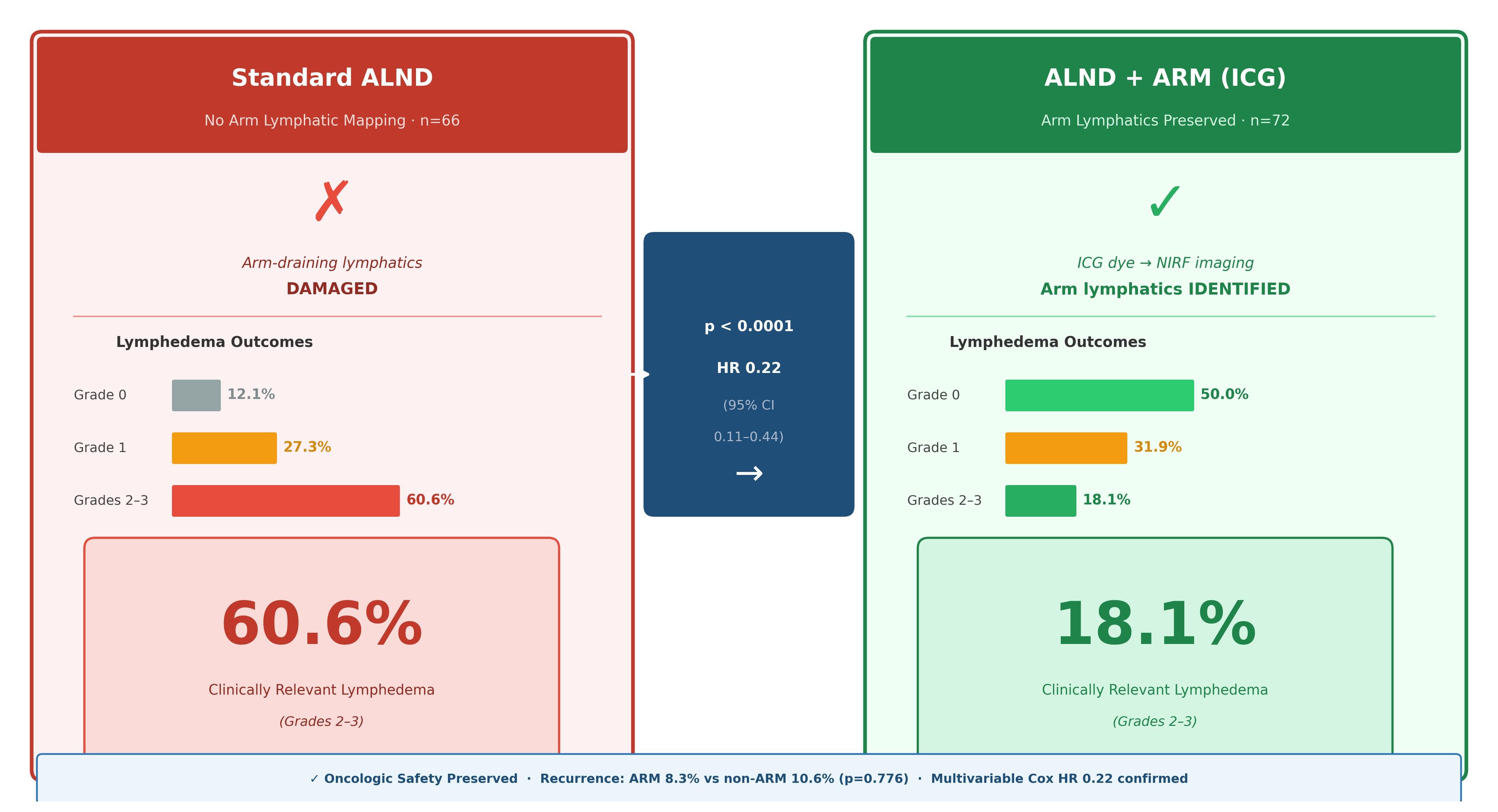
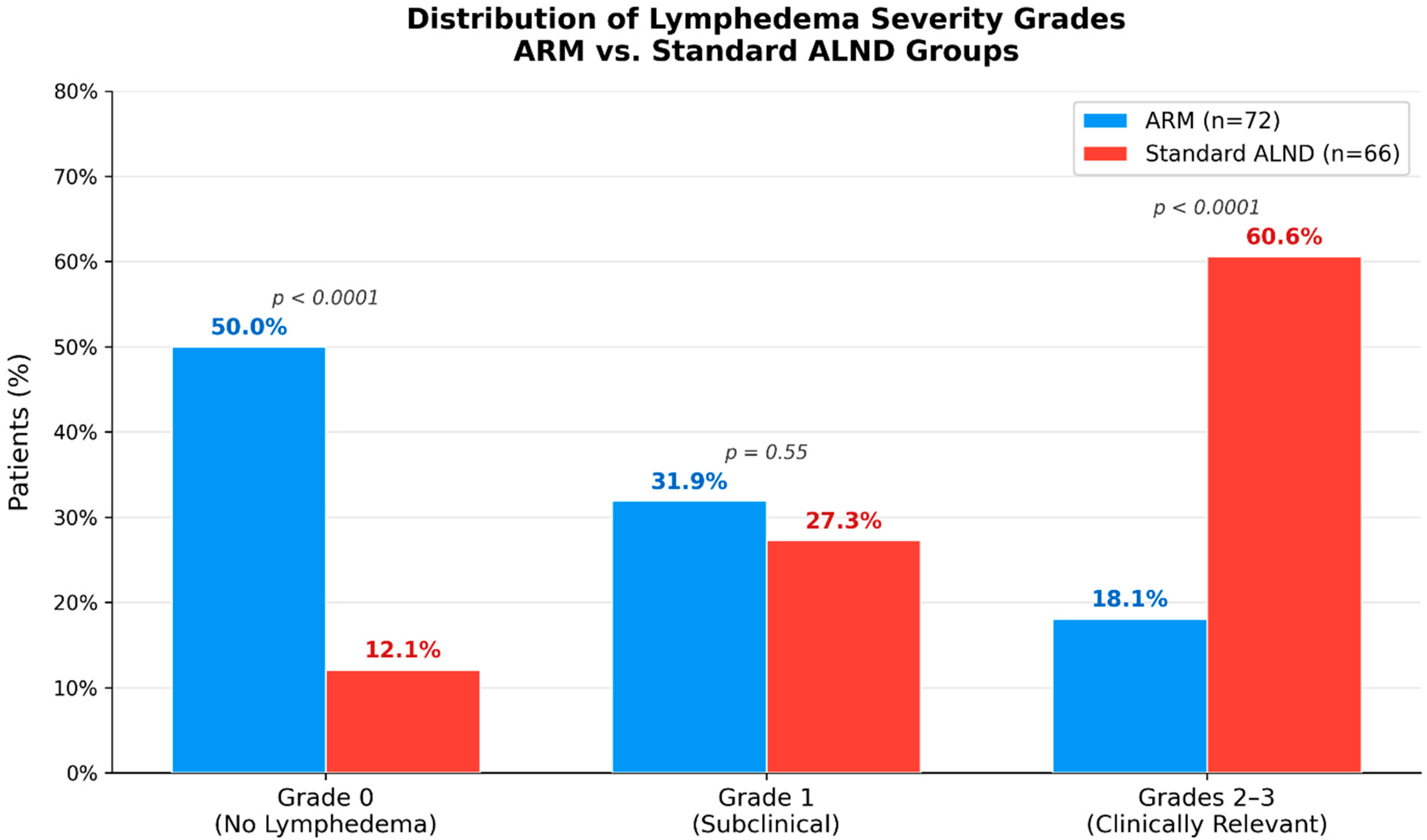
- Grade 0: 50.0% vs. 12.1% (p < 0.0001);
- Grade 1: 31.9% vs. 27.3% (p = 0.55);
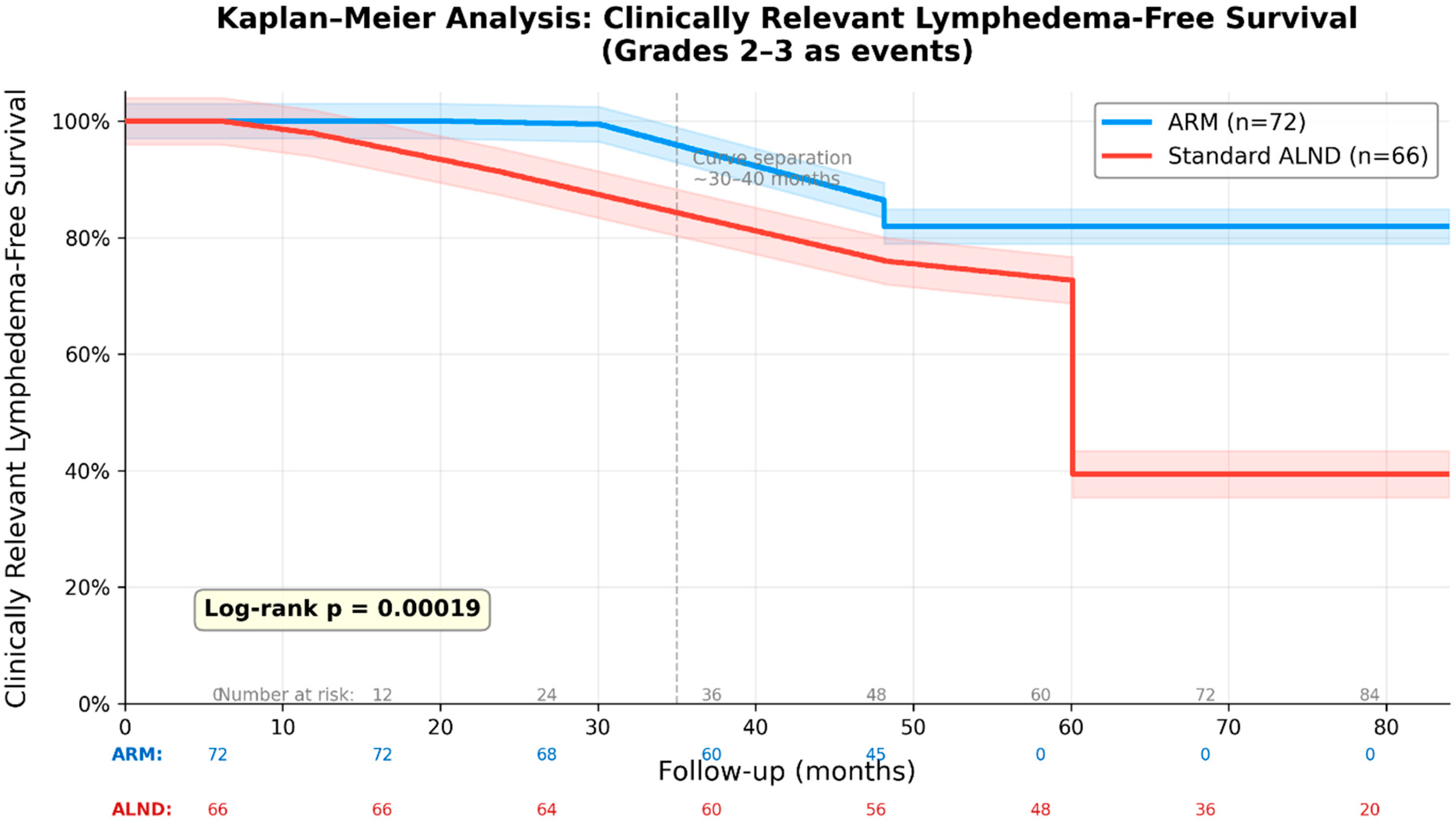
- Grades 2–3: 18.1% vs. 60.6% (p < 0.0001).


| Grade | ARM (n = 72), n (%) | Non-ARM (n = 66), n (%) | p-Value |
|---|---|---|---|
| 0 (None) | 36 (50.0) | 8 (12.1) | <0.0001 |
| 1 (Subclinical) | 23 (31.9) | 18 (27.3) | 0.55 |
| 2–3 (Clinically relevant) | 13 (18.1) | 40 (60.6) | <0.0001 |
3.4. Oncologic Outcomes
3.5. Multivariable Analysis
4. Discussion
5. Conclusions
Supplementary Materials
Author Contributions
Funding
Institutional Review Board Statement
Informed Consent Statement
Data Availability Statement
Conflicts of Interest
References
- Rafn, B.S.; Christensen, J.; Larsen, A.; Bloomquist, K. Prospective Surveillance for Breast Cancer-Related Arm Lymphedema: A Systematic Review and Meta-Analysis. J. Clin. Oncol. 2022, 40, 1009–1026. [Google Scholar] [CrossRef] [Scilit] [PubMed]
- McDuff, S.G.; Mina, A.I.; Brunelle, C.L.; Salama, L.; Warren, L.E.; Abouegylah, M.; Swaroop, M.; Skolny, M.N.; Asdourian, M.; Gillespie, T.; et al. Timing of Lymphedema After Treatment for Breast Cancer: When Are Patients Most At Risk? Int. J. Radiat. Oncol. Biol. Phys. 2019, 103, 62–70. [Google Scholar] [CrossRef] [Scilit] [PubMed]
- DiSipio, T.; Rye, S.; Newman, B.; Hayes, S. Incidence of unilateral arm lymphoedema after breast cancer: A systematic review and meta-analysis. Lancet Oncol. 2013, 14, 500–515. [Google Scholar] [CrossRef] [Scilit]
- Gillespie, T.C.; Sayegh, H.E.; Brunelle, C.L.; Daniell, K.M.; Taghian, A.G. Breast cancer-related lymphedema: Risk factors, precautionary measures, and treatments. Gland. Surg. 2018, 7, 379–403. [Google Scholar] [CrossRef] [Scilit]
- Wijaya, W.A.; Peng, J.; He, Y.; Chen, J.; Cen, Y. Clinical application of axillary reverse mapping in patients with breast cancer: A systematic review and meta-analysis. Breast 2020, 53, 189–200. [Google Scholar] [CrossRef] [Scilit]
- Guo, X.; Jiao, D.; Zhu, J.; Xiao, H.; Zhao, X.; Yang, Y.; Zhao, Y.; Liu, Z. The effectiveness of axillary reverse mapping in preventing breast cancer-related lymphedema: A meta-analysis based on randomized controlled trials. Gland. Surg. 2021, 10, 1447–1459. [Google Scholar] [CrossRef] [Scilit]
- Fan, Y.-C.; Li, L.; Meng, X.-C. Quality of life and oncologic safety of axillary reverse mapping in patients with breast cancer: A systematic review and meta-analysis. Ann. Med. Surg. 2025, 87, 3707–3714. [Google Scholar] [CrossRef] [Scilit] [PubMed]
- Fourgeaud, C.; Vignes, S. New insights in breast cancer-related lymphedema. J. Med. Vasc. 2024, 49, 135–140. [Google Scholar] [CrossRef] [Scilit]
- Boughey, J.C.; Suman, V.J.; Mittendorf, E.A.; Ahrendt, G.M.; Wilke, L.G.; Taback, B.; Leitch, A.M.; Kuerer, H.M.; Bowling, M.; Flippo-Morton, T.S.; et al. Sentinel lymph node surgery after neoadjuvant chemotherapy in patients with node-positive breast cancer: The ACOSOG Z1071 (Alliance) clinical trial. JAMA 2013, 310, 1455–1461. [Google Scholar] [CrossRef] [Scilit]
- Caudle, A.S.; Yang, W.T.; Krishnamurthy, S.; Mittendorf, E.A.; Black, D.M.; Gilcrease, M.Z.; Bedrosian, I.; Hobbs, B.P.; DeSnyder, S.M.; Hwang, R.F.; et al. Improved Axillary Evaluation Following Neoadjuvant Therapy for Patients with Node-Positive Breast Cancer Using Selective Evaluation of Clipped Nodes: Implementation of Targeted Axillary Dissection. J. Clin. Oncol. 2016, 34, 1072–1078. [Google Scholar] [CrossRef] [Scilit]
- Kuemmel, S.; Heil, J.; Bruzas, S.; Breit, E.; Schindowski, D.; Harrach, H.; Chiari, O.; Hellerhoff, K.; Bensmann, E.; Hanf, V.; et al. Safety of Targeted Axillary Dissection After Neoadjuvant Therapy in Patients with Node-Positive Breast Cancer. JAMA Surg. 2023, 158, 807–815. [Google Scholar] [CrossRef] [Scilit] [PubMed]
- Zheng, S.-Y.; Chen, C.-Y.; Qi, W.-X.; Cai, G.; Xu, C.; Cai, R.; Qian, X.-F.; Shen, K.-W.; Cao, L.; Chen, J.-Y. The influence of axillary surgery and radiotherapeutic strategy on the risk of lymphedema and upper extremity dysfunction in early breast cancer patients. Breast 2023, 68, 142–148. [Google Scholar] [CrossRef] [Scilit] [PubMed]
- Boczar, D.; Forte, A.J.; Huayllani, M.T.; Kassis, S.; Manrique, O.J.; McLaughlin, S.A. Use of Axillary Reverse Mapping to Prevent Lymphedema During Breast Cancer Treatment: A Systematic Review. Lymphat. Res. Biol. 2026, 24, 7–12. [Google Scholar] [CrossRef] [Scilit] [PubMed]
- Co, M.; Lam, L.; Suen, D.; Kwong, A. Axillary Reverse Mapping in the Prevention of Lymphoedema: A Systematic Review and Pooled Analysis. Clin. Breast Cancer 2023, 23, e14–e19. [Google Scholar] [CrossRef] [Scilit]
- Vanni, G.; Pellicciaro, M.; Materazzo, M.; Buonomo, O.C. Axillary Reverse Mapping in Breast Cancer: Would We Need it in the Era of Surgical De-Escalation? Clin. Breast Cancer 2023, 23, e377–e379. [Google Scholar] [CrossRef] [Scilit]
- Aguilera-Eguía, R.A.; Serón, P.; Gutiérrez-Arias, R.; Herrera-Serna, B.; Pérez-Galdavini, V.; Inostroza-Reyes, G.; Yáñez-Baeza, C.; Fuentes-Barría, H.; Arriagada, H.B.; Inostroza-Quiroz, J.; et al. Which Physical Therapy Intervention Is Most Effective in Reducing Secondary Lymphedema Associated with Breast Cancer? A Systematic Review and Network Meta-Analysis. J. Clin. Med. 2025, 14, 6762. [Google Scholar] [CrossRef] [Scilit]
- Ochoa, D.; Korourian, S.; Boneti, C.; Adkins, L.; Badgwell, B.; Klimberg, V.S. Axillary reverse mapping: Five-year experience. Surgery 2014, 156, 1261–1268. [Google Scholar] [CrossRef] [Scilit]
- Gradishar, W.J.; Moran, M.S.; Abraham, J.; Abramson, V.; Aft, R.; Agnese, D.; Allison, K.H.; Anderson, B.; Bailey, J.; Burstein, H.J.; et al. NCCN Guidelines® Insights: Breast Cancer, Version 5.2025. J. Natl. Compr. Cancer Netw. 2025, 23, 426–436. [Google Scholar] [CrossRef] [Scilit]
- Gennaro, M.; Maccauro, M.; Sigari, C.; Casalini, P.; Bedodi, L.; Conti, A.; Caraceni, A.; Bombardieri, E. Selective axillary dissection after axillary reverse mapping to prevent breast-cancer-related lymphoedema. Eur. J. Surg. Oncol. 2013, 39, 1341–1345. [Google Scholar] [CrossRef] [Scilit]
- Bhimani, F.; Feldman, S.; Cavalli, A.; Chen, Y.; Obaid, L.; Rachofsky, C.; Gupta, A.; Pastoriza, J.; Johnson, K.; McEvoy, M. Axillary Reverse Mapping Aids in Reducing the Rates of Breast Cancer-Related Lymphedema in Underserved Ethnically Diverse Population. Ann. Surg. Oncol. 2024, 31, 5937–5946. [Google Scholar] [CrossRef] [Scilit]
- International Society of Lymphology. The diagnosis and treatment of peripheral lymphedema: 2013 Consensus Document of the International Society of Lymphology. Lymphology 2013, 46, 1–11. [Google Scholar]
- Hamamoto, Y.; Makita, K.; Nagasaki, K.; Kanzaki, H.; Kochi, M.; Yamashita, M.; Takahashi, M.; Takabatake, D.; Aogi, K. Internal mammary node failure in invasive breast cancer patients who received post-operative radiotherapy without prophylactic internal mammary node irradiation. Breast Cancer 2025, 32, 1262–1268. [Google Scholar] [CrossRef] [Scilit] [PubMed]
- Noguchi, M.; Inokuchi, M.; Yokoi-Noguchi, M.; Morioka, E.; Haba, Y.; Takahashi, T.; Shioya, A.; Yamada, S. Axillary Reverse Mapping in Clinically Node-Positive Breast Cancer Patients. Cancers 2023, 15, 5302. [Google Scholar] [CrossRef] [Scilit] [PubMed]
- Kajiwara, K.; Kako, J.; Kobayashi, M.; Kanaoka, M.; Yamanaka, M. Mediating role of caregiver burden in the relationship between patient activities of daily living and positive aspects of caregiving among family caregivers of breast cancer-related lymphedema patients. Support. Care Cancer 2026, 34, 133. [Google Scholar] [CrossRef] [Scilit] [PubMed]
- Tang, Y.; Wei, Q.; Yu, M.; Zhu, L. Current status and influence of positive aspects of caregiving among family caregivers of patients with breast cancer-related lymphedema: A cross-sectional study. Support. Care Cancer 2025, 33, 1086. [Google Scholar] [CrossRef] [Scilit]
- de Wild, S.R.; Koppert, L.B.; A van Nijnatten, T.J.; Kooreman, L.F.S.; Peeters, M.-J.T.F.D.V.; Smidt, M.L.; Simons, J.M. Systematic review of targeted axillary dissection in node-positive breast cancer treated with neoadjuvant systemic therapy: Variation in type of marker and timing of placement. Br. J. Surg. 2024, 111, znae071. [Google Scholar] [CrossRef] [Scilit]
- Letellier, M.-E.; Ibrahim, M.; Towers, A.; Chaput, G. Incidence of lymphedema related to various cancers. Med. Oncol. 2024, 41, 245. [Google Scholar] [CrossRef] [Scilit]
- Klernäs, P.; Johnsson, A.; Horstmann, V.; Kristjanson, L.J.; Johansson, K. Lymphedema Quality of Life Inventory (LyQLI)-Development and investigation of validity and reliability. Qual. Life Res. 2015, 24, 427–439. [Google Scholar] [CrossRef] [Scilit]
- Raymakers, A.M.; King, T.A.; Mittendorf, E.A.; Dey, T.; Jain, M.; Paskett, E.D.; McAlearney, A.S.; Greenup, R.A.; Broyles, J.M.; Myers, S.P. Impact of Breast Cancer-Related Lymphedema on Cancer Care Costs: Longitudinal and Age-Based Analyses. Ann. Surg. Oncol. 2026, 33, 3311–3318. [Google Scholar] [CrossRef] [Scilit]
- Shih, Y.-C.T.; Xu, Y.; Cormier, J.N.; Giordano, S.; Ridner, S.H.; Buchholz, T.A.; Perkins, G.H.; Elting, L.S. Incidence, treatment costs, and complications of lymphedema after breast cancer among women of working age: A 2-year follow-up study. J. Clin. Oncol. 2009, 27, 2007–2014. [Google Scholar] [CrossRef] [Scilit]

| Variable | ARM Group (n = 72) | Non-ARM Group (n = 66) | Total (n = 138) | p-Value |
|---|---|---|---|---|
| Age, years (mean ± SD) | 72.0 ± 4.3 | 73.0 ± 4.8 | 72.5 ± 4.5 | 0.712 |
| Follow-up duration, months (mean ± SD) | 46.0 ± 8.5 | 47.0 ± 9.1 | 46.5 ± 8.8 | 0.681 |
| Molecular Subtype, n (%) | 0.906 | |||
| Luminal A | 26 (37.1) | 28 (41.2) | 54 (39.1) | |
| Luminal B | 22 (31.4) | 19 (27.9) | 41 (29.7) | |
| HER2-positive | 11 (15.7) | 12 (17.6) | 23 (16.7) | |
| Triple-negative (TNBC) | 11 (15.7) | 9 (13.2) | 20 (14.5) | |
| Clinical Stage, n (%) | 0.512 | |||
| Stage I | 2 (2.8) | 2 (3.0) | 4 (2.9) | |
| Stage II | 20 (27.8) | 22 (33.3) | 42 (30.4) | |
| Stage III | 50 (69.4) | 42 (63.7) | 92 (66.7) | |
| Neoadjuvant Therapy, n (%) Yes/No | 51/21 (70.8/29.2) | 48/18 (72.7/27.3) | 99/39 (71.7/28.3) | 0.80 |
| Type of Surgery, n (%) | 0.09 † | |||
| Mastectomy | 36 (50.0) | 43 (65.2) | 79 (57.2) | |
| Breast-conserving surgery | 21 (29.2) | 15 (22.7) | 36 (26.1) | |
| Other (combined/complex procedures) | 15 (20.8) | 8 (12.1) | 23 (16.7) | |
| Recurrence, n (%) | 6 (8.3) | 7 (10.6) | 13 (10.1) | 0.776 |
| Any lymphedema (Score > 0), n (%) | 36 (50.0) | 58 (87.9) | 94 (68.1) | <0.0001 |
Disclaimer/Publisher’s Note: The statements, opinions and data contained in all publications are solely those of the individual author(s) and contributor(s) and not of MDPI and/or the editor(s). MDPI and/or the editor(s) disclaim responsibility for any injury to people or property resulting from any ideas, methods, instructions or products referred to in the content. |
© 2026 by the authors. Licensee MDPI, Basel, Switzerland. This article is an open access article distributed under the terms and conditions of the Creative Commons Attribution (CC BY) license.
Share and Cite
Tokocin, M.; Pehlivan, T.; Celik, A. Axillary Reverse Mapping Improves Quality of Life by Significantly Reducing Clinically Relevant Lymphedema After Axillary Lymph Node Dissection in Older Women with Breast Cancer. Curr. Oncol. 2026, 33, 212. https://doi.org/10.3390/curroncol33040212
Tokocin M, Pehlivan T, Celik A. Axillary Reverse Mapping Improves Quality of Life by Significantly Reducing Clinically Relevant Lymphedema After Axillary Lymph Node Dissection in Older Women with Breast Cancer. Current Oncology. 2026; 33(4):212. https://doi.org/10.3390/curroncol33040212
Chicago/Turabian StyleTokocin, Merve, Turan Pehlivan, and Atilla Celik. 2026. "Axillary Reverse Mapping Improves Quality of Life by Significantly Reducing Clinically Relevant Lymphedema After Axillary Lymph Node Dissection in Older Women with Breast Cancer" Current Oncology 33, no. 4: 212. https://doi.org/10.3390/curroncol33040212
APA StyleTokocin, M., Pehlivan, T., & Celik, A. (2026). Axillary Reverse Mapping Improves Quality of Life by Significantly Reducing Clinically Relevant Lymphedema After Axillary Lymph Node Dissection in Older Women with Breast Cancer. Current Oncology, 33(4), 212. https://doi.org/10.3390/curroncol33040212