Integrating Exercise and Education into Lung Cancer Care: Results from the OVER-CRF Pilot Study on Cancer-Related Fatigue and Quality of Life

 , ,
, ,  , , , and
Simple Summary
Abstract
1. Introduction
2. Materials and Methods
2.1. Study Design
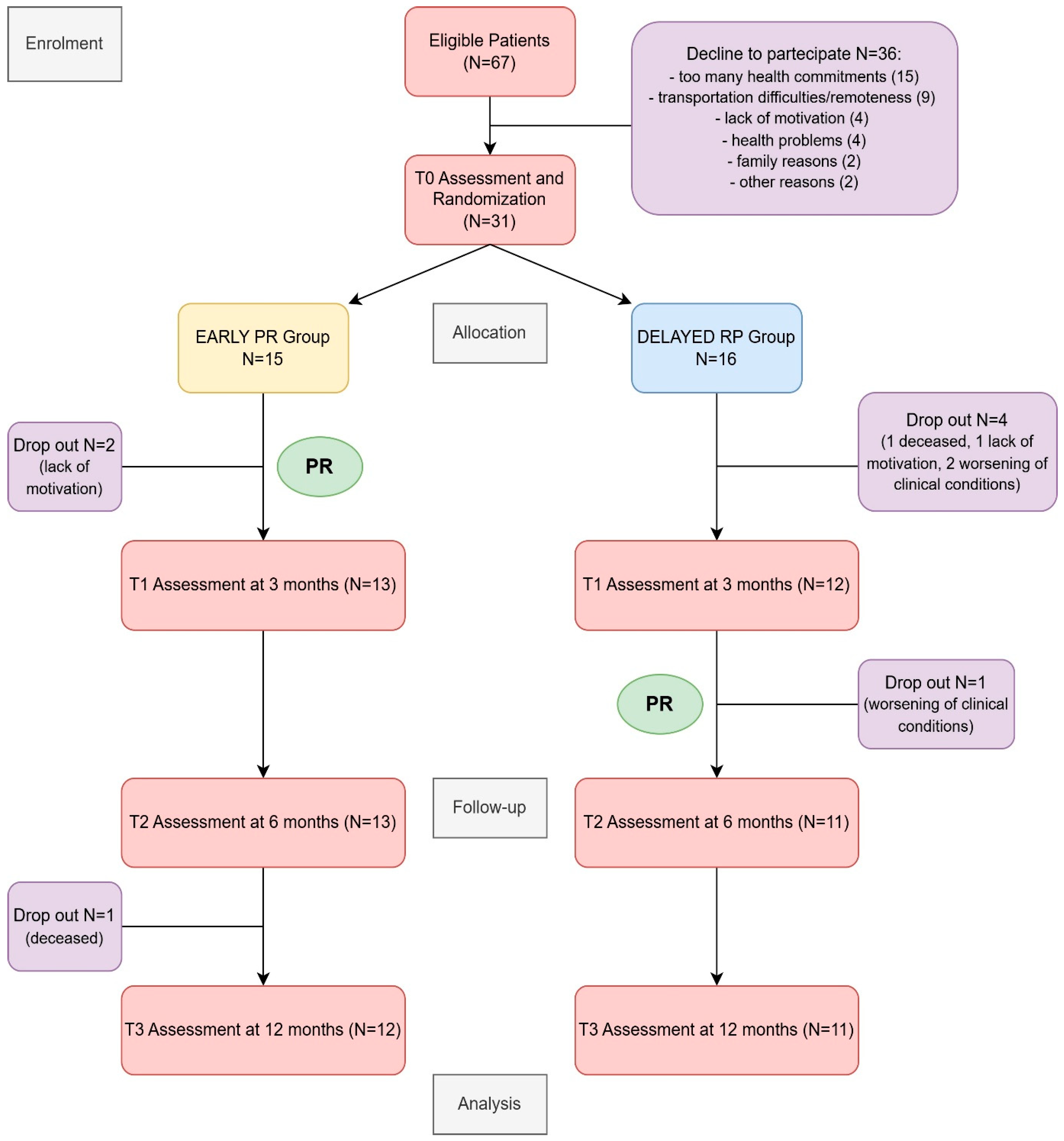
- recruitment rates, treatment failure rates (overall and by cause), 12-month survival, and intervention safety;
- clinical outcomes, including CRF, QoL, physical performance, and physical activity levels during the 12 months following enrollment.
2.2. Study Setting and Recruitment
2.2.1. Study Setting
2.2.2. Participants and Recruitment Process
2.2.3. Measurements and Data Collection Timepoints
2.3. Intervention
2.4. Outcomes
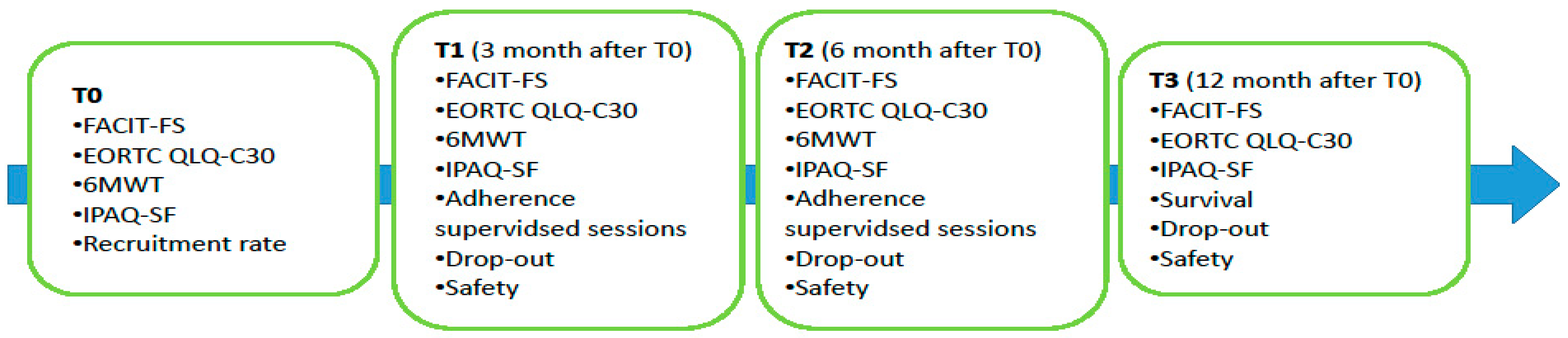
- Recruitment rates, treatment failures and reasons for drop-out, 12-month survival rates;
- Safety: adverse events related to the PR program during the 3-month intervention were recorded (falls, fractures, muscle pain, exertional dyspnea, acute musculoskeletal inflammation, hematomas, etc.); falls or fractures occurring between T2 and T3 were also monitored;
- Clinical assessments: CRF was evaluated using the Functional Assessment of Chronic Illness-Fatigue Scale (FACIT-FS), QoL with the European Organization for Research and Treatment of Cancer Quality of Life Questionnaire-C30 (EORTC-QLQ-C30), and physical performance with the 6-Minute Walk Test (6MWT);
- Physical activity levels were assessed using the International Physical Activity Questionnaire–Short Form (IPAQ-SF).
2.5. Sample Size
2.6. Allocation and Blinding
2.7. Data Analysis
2.8. Patient and Public Involvement
3. Results
3.1. Recruitment and Participant Flow
3.2. Baseline Characteristics of the Sample
3.3. Anticancer Treatments
3.4. Adherence and Safety of the Rehabilitation Intervention
3.5. Clinical Outcomes
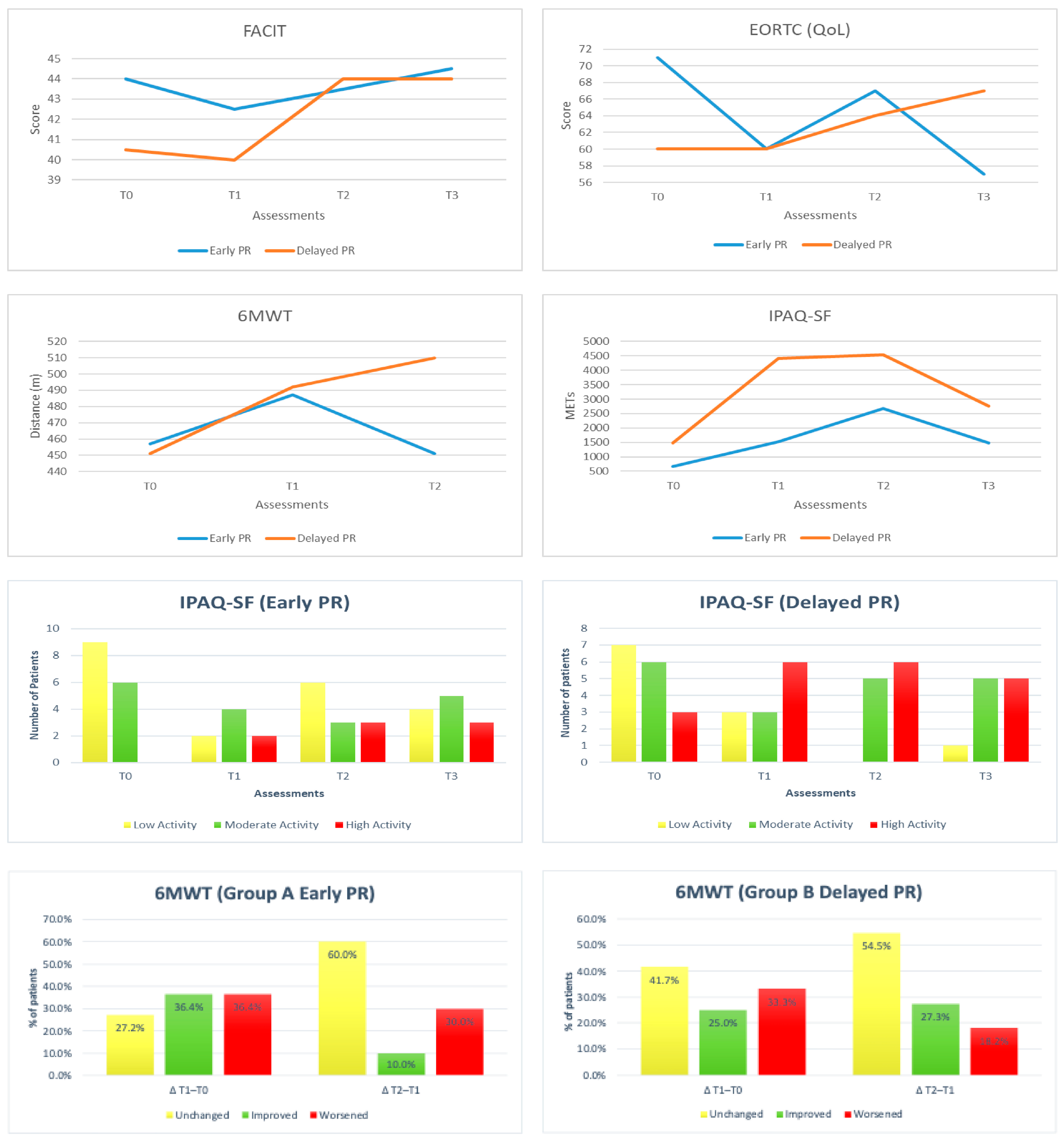
- Cancer-Related Fatigue (FACIT-FS): Perceived fatigue improved in both the Early and Delayed groups following the PR intervention (+2.9 vs. +3.9, respectively).
- Quality of Life (EORTC QLQ-C30): The groups showed diverging trends. The Early group’s QoL worsened initially (T0–T1), improved at six months, and declined again at 12 months. Conversely, the Delayed group remained stable initially and subsequently showed progressive and sustained QoL improvements from T1 through T3.
- Physical Performance (6MWT): Mean walking distance improved in both groups (Early: +30.2 m; Delayed: +17.6 m). Although mean changes did not reach the 42 m MCID threshold described by Granger et al. for lung cancer patients [30], a subset of the sample achieved this level of improvement (36% in the Early group and 25% in the Delayed group).
- Physical Activity (IPAQ-SF): Baseline activity levels were low, with 100% of the Early group and 81% of the Delayed group categorized as inactive. Post-intervention assessments showed a decrease in inactive patients in both groups, suggesting the PR program effectively increased routine physical activity levels. This active lifestyle was largely maintained between T2 and T3.
4. Discussion
Limitations and Strengths
5. Conclusions
Author Contributions
Funding
Institutional Review Board Statement
Informed Consent Statement
Data Availability Statement
Acknowledgments
Conflicts of Interest
References
- Bray, F.; Laversanne, M.; Sung, H.; Ferlay, J.; Siegel, R.L.; Soerjomataram, I.; Jemal, A. Global cancer statistics 2022: GLOBOCAN estimates of incidence and mortality worldwide for 36 cancers in 185 countries. CA Cancer J. Clin. 2024, 74, 229–263. [Google Scholar] [CrossRef] [Scilit] [PubMed]
- European Cancer Information System. Data Explorer: 2024 Estimates. Available online: https://ecis.jrc.ec.europa.eu/data-explorer#/estimates/estimated-incidence-mortality-by-country-summary?ageFrom=0&ageTo=85%2B&sex=0&indicator=IN&yearFrom=2024&yearTo=2024&cancerEntity=22&country=EU27 (accessed on 23 March 2026).
- Bade, B.C.; Zhao, J.; Li, F.; Tanoue, L.; Lazowski, H.; Alfano, C.M.; Silvestri, G.A.; Irwin, M.L. Trends and predictors of Quality of Life in lung cancer survivors. Lung Cancer 2024, 191, 107793. [Google Scholar] [CrossRef] [Scilit]
- Luo, Y.; Luo, J.; Su, Q.; Yang, Z.; Miao, J.; Zhang, L. Exploring Central and Bridge Symptoms in Patients with Lung Cancer: A Network Analysis. Semin. Oncol. Nurs. 2024, 40, 151651. [Google Scholar] [CrossRef] [Scilit]
- Bade, B.C.; Saadia, A.F.; Ha, D.M.; Tan, M.; Barton-Burke, M.; Cheville, A.L.; Escalante, C.P.; Gozal, D.; Granger, C.L.; Presley, C.J.; et al. Cancer-related Fatigue in Lung Cancer: A Research Agenda: An Official American Thoracic Society Research Statement. Am. J. Respir. Crit. Care Med. 2023, 207, e6–e28. [Google Scholar] [CrossRef] [Scilit]
- Van Hulle, F.; Arents, E.; Quadflieg, K.; Haesevoets, S.; Hermans, F.; Criel, M.; Ruttens, D.; Derom, E.; Daenen, M.; Spruit, M.A.; et al. The trajectory of cancer-related fatigue throughout lung cancer treatment and its association with physical activity. Support Care Cancer 2025, 33, 926. [Google Scholar] [CrossRef] [Scilit]
- Fabi, A.; Bhargava, R.; Fatigoni, S.; Guglielmo, M.; Horneber, M.; Roila, F.; Weis, J.; Jordan, K.; Ripamonti, C. Cancer-related fatigue: ESMO Clinical Practice Guidelines for diagnosis and treatment. Ann. Oncol. 2020, 31, 713–723. [Google Scholar] [CrossRef] [Scilit] [PubMed]
- Rochester, C.L.; Alison, J.A.; Carlin, B.; Jenkins, A.R.; Cox, N.S.; Bauldoff, G.; Bhatt, S.P.; Bourbeau, J.; Burtin, C.; Camp, P.G.; et al. Pulmonary Rehabilitation for Adults with Chronic Respiratory Disease: An Official American Thoracic Society Clinical Practice Guideline. Am. J. Respir. Crit. Care Med. 2023, 208, e7–e26. [Google Scholar] [CrossRef] [Scilit]
- De Ruysscher, D.; Faivre-Finn, C.; Nackaerts, K.; Jordan, K.; Arends, J.; Douillard, J.; Ricardi, U.; Peters, S. Recommendation for supportive care in patients receiving concurrent chemotherapy and radiotherapy for lung cancer. Ann. Oncol. 2020, 31, 41–49. [Google Scholar] [CrossRef] [Scilit]
- Ao, C.; Zhan, L. Pulmonary rehabilitation improves lung function and exercise tolerance in elderly non-surgical NSCLC patients. Am. J. Cancer Res. 2025, 15, 4029–4042. [Google Scholar] [CrossRef] [Scilit]
- Rutkowska, A.; Jastrzebski, D.; Rutkowski, S.; Żebrowska, A.; Stanula, A.; Szczegielniak, J.; Ziora, D.; Casaburi, R. Exercise training in patients with non-small cell lung cancer during in-hospital chemotherapy treatment: A randomized controlled trial. J. Cardiopulm. Rehabil. 2019, 39, 127–133. [Google Scholar] [CrossRef] [Scilit] [PubMed]
- Edbrooke, L.; Aranda, S.; Granger, C.L.; McDonald, C.F.; Krishnasamy, M.; Mileshkin, L.; Clark, R.A.; Gordon, I.; Irving, L.; Denehy, L. Multidisciplinary home-based rehabilitation in inoperable lung cancer: A randomised controlled trial. Thorax 2019, 74, 787–796. [Google Scholar] [CrossRef] [Scilit]
- Hoffman, A.J.; Brintnall, R.A.; von Eye, A.; Jones, L.W.; Alderink, G.; Patzelt, L.H.; Brown, J.K. Home-based exercise: Promising rehabilitation for symptom relief, improved functional status and quality of life for post-surgical lung cancer patients. J. Thorac. Dis. 2014, 6, 632–640. [Google Scholar] [CrossRef] [Scilit]
- Singh, B.; Spence, R.; Steele, M.L.; Hayes, S.; Toohey, K. Exercise for Individuals with Lung Cancer: A Systematic Review and Meta-Analysis of Adverse Events, Feasibility, and Effectiveness. Semin. Oncol. Nurs. 2020, 36, 151076. [Google Scholar] [CrossRef] [Scilit] [PubMed]
- Xu, J.; Lu, H.; Fang, T.; Wang, H.; Chen, Y.; Hua, J.; Hu, Y.; Cai, D.; Cai, P.; Zhou, Y.; et al. Health fitness, physical activity, and quality of life in patients undergoing first chemotherapy for lung cancer: A cross-sectional study. Sci. Rep. 2025, 15, 21797. [Google Scholar] [CrossRef] [Scilit] [PubMed]
- Cormie, P.; Zopf, E.M.; Zhang, X.; Schmitz, K.H. The Impact of Exercise on Cancer Mortality, Recurrence, and Treatment-Related Adverse Effects. Epidemiol. Rev. 2017, 39, 71–92. [Google Scholar] [CrossRef] [Scilit]
- Ezzatvar, Y.; Ramírez-Vélez, R.; de Asteasu, M.L.S.; Martínez-Velilla, N.; Zambom-Ferraresi, F.; Izquierdo, M.; García-Hermoso, A. Physical Function and All-Cause Mortality in Older Adults Diagnosed with Cancer: A Systematic Review and Meta-Analysis. J. Gerontol. Ser. A 2020, 76, 1447–1453. [Google Scholar] [CrossRef] [Scilit]
- Bettariga, F.; Galvao, D.A.; Taaffe, D.R.; Bishop, C.; Lopez, P.; Maestroni, L.; Quinto, G.; Crainich, U.; Verdini, E.; Bandini, E.; et al. Association of muscle strength and cardiorespiratory fitness with all-cause and cancer-specific mortality in patients diagnosed with cancer: A systematic review with meta-analysis. Br. J. Sports Med. 2025, 59, 722–732. [Google Scholar] [CrossRef] [Scilit]
- Driessen, E.J.; Peeters, M.E.; Bongers, B.C.; Maas, H.A.; Bootsma, G.P.; van Meeteren, N.L.; Janssen-Heijnen, M.L. Effects of prehabilitation and rehabilitation including a home-based component on physical fitness, adherence, treatment tolerance, and recovery in patients with non-small cell lung cancer: A systematic review. Crit. Rev. Oncol. Hematol. 2017, 114, 63–76. [Google Scholar] [CrossRef] [Scilit] [PubMed]
- Tenconi, S.; Mainini, C.; Rapicetta, C.; Braglia, L.; Galeone, C.; Cavuto, S.; Merlo, D.F.; Costi, S.; Paci, M.; Piro, R.; et al. Rehabilitation for lung cancer patients undergoing surgery: Results of the PUREAIR randomized trial. Eur. J. Phys. Rehabil. Med. 2021, 57, 1002–1011. [Google Scholar] [CrossRef] [Scilit] [PubMed]
- Hu, Y.; Gu, S.; Bu, Z.; Liu, Z.; Dong, J.; Shi, J.; Xu, Y. Effect of exercise for patients with advanced lung cancer and cancer-related fatigue: A systematic review and meta-analysis. J. Sport Health Sci. 2025, 14, 101017. [Google Scholar] [CrossRef] [Scilit]
- Bloch, Z.; Jensen, S.; Sørensen, V.; Langer, S.W.; Quist, M. The Effect of Exercise on Quality of Life in Patients with Advanced Lung Cancer: A Secondary Analysis of a Randomized Controlled Trial. Clin. Lung Cancer 2025, 26, e582–e590. [Google Scholar] [CrossRef] [Scilit]
- Granger, C.L.; Connolly, B.; Denehy, L.; Hart, N.; Antippa, P.; Lin, K.-Y.; Parry, S.M. Understanding factors influencing physical activity and exercise in lung cancer: A systematic review. Support. Care Cancer 2016, 25, 983–999. [Google Scholar] [CrossRef] [Scilit]
- Fram, J.; Boss, K.; Villaflor, V.; Jayabalan, P. Barriers to and enablers of physical activity participation in lung cancer survivors. PM R 2024, 16, 1307–1316. [Google Scholar] [CrossRef] [Scilit]
- Eldridge, S.M.; Chan, C.L.; Campbell, M.J.; Bond, C.M.; Hopewell, S.; Thabane, L.; Lancaster, G.A. CONSORT 2010 statement: Extension to randomised pilot and feasibility trials. BMJ 2016, 355, i5239. [Google Scholar] [CrossRef] [Scilit]
- Fugazzaro, S.; Mainini, C.; Pecorari, A.; Denti, M.; Galavotti, M.B.; Messori, M.; Costi, S.; Ciammella, P.; Falco, F.; Zanelli, F.; et al. Feasibility of an early versus delayed rehabilitation intervention in patients with lung cancer on cancer-related fatigue: A pilot RCT. Future Oncol. 2026, 22, 147–156. [Google Scholar] [CrossRef] [Scilit] [PubMed]
- Patel, A.V.; Friedenreich, C.M.; Moore, S.C.; Hayes, S.C.; Silver, J.K.; Campbell, K.L.; Winters-Stone, K.; Gerber, L.H.; George, S.M.; Fulton, J.E.; et al. American College of Sports Medicine Roundtable Report on Physical Activity, Sedentary Behavior, and Cancer Prevention and Control. Med. Sci. Sports Exerc. 2019, 51, 2391–2402. [Google Scholar] [CrossRef] [Scilit]
- Cella, D.; Eton, D.T.; Lai, J.-S.; Peterman, A.H.; Merkel, D.E. Combining Anchor and Distribution-Based Methods to Derive Minimal Clinically Important Differences on the Functional Assessment of Cancer Therapy (FACT) Anemia and Fatigue Scales. J. Pain Symptom Manag. 2002, 24, 547–561. [Google Scholar] [CrossRef] [Scilit] [PubMed]
- Maringwa, J.T.; Quinten, C.; King, M.; Ringash, J.; Osoba, D.; Coens, C.; Martinelli, F.; Vercauteren, J.; Cleeland, C.S.; Flechtner, H.; et al. Minimal important differences for interpreting health-related quality of life scores from the EORTC QLQ-C30 in lung cancer patients participating in randomized controlled trials. Support. Care Cancer 2010, 19, 1753–1760. [Google Scholar] [CrossRef] [Scilit] [PubMed]
- Granger, C.L.; E Holland, A.; Gordon, I.R.; Denehy, L. Minimal important difference of the 6-minute walk distance in lung cancer. Chronic Respir. Dis. 2015, 12, 146–154. [Google Scholar] [CrossRef] [Scilit]
- Quist, M.; Adamsen, L.; Rørth, M.; Laursen, J.H.; Christensen, K.B.; Langer, S.W. The Impact of a Multidimensional Exercise Intervention on Physical and Functional Capacity, Anxiety, and Depression in Patients with Advanced-Stage Lung Cancer Undergoing Chemotherapy. Integr. Cancer Ther. 2015, 14, 341–349. [Google Scholar] [CrossRef] [Scilit] [PubMed]
- Cavalheri, V.; Jenkins, S.; Cecins, N.; Gain, K.; Phillips, M.J.; Sanders, L.H.; Hill, K. Exercise training for people following curative intent treatment for non-small cell lung cancer: A randomized controlled trial. Braz. J. Phys. Ther. 2017, 21, 58–68. [Google Scholar] [CrossRef] [Scilit]
- Erlik, M.; Timm, H.; Larsen, A.T.S.; Quist, M. Reasons for non-participation in cancer rehabilitation: A scoping literature review. Support. Care Cancer 2024, 32, 346. [Google Scholar] [CrossRef] [Scilit]
- Nadler, M.; Bainbridge, D.; Tomasone, J.; Cheifetz, O.; Juergens, R.A.; Sussman, J. Oncology care provider perspectives on exercise promotion in people with cancer: An examination of knowledge, practices, barriers, and facilitators. Support. Care Cancer 2017, 25, 2297–2304. [Google Scholar] [CrossRef] [Scilit]
- Avancini, A.; Pala, V.; Trestini, I.; Tregnago, D.; Mariani, L.; Sieri, S.; Krogh, V.; Boresta, M.; Milella, M.; Pilotto, S.; et al. Exercise Levels and Preferences in Cancer Patients: A Cross-Sectional Study. Int. J. Environ. Res. Public Health 2020, 17, 5351. [Google Scholar] [CrossRef] [Scilit]
- Li, Q.; Guo, C.; Cao, B.; Zhou, F.; Wang, J.; Ren, H.; Li, Y.; Wang, M.; Liu, Y.; Zhang, H.; et al. Safety and efficacy evaluation of personalized exercise prescription during chemotherapy for lung cancer patients. Thorac. Cancer 2024, 15, 906–918. [Google Scholar] [CrossRef] [Scilit]
- Campbell, K.L.; Winters-Stone, K.M.; Wiskemann, J.; May, A.M.; Schwartz, A.L.; Courneya, K.S.; Zucker, D.S.; Matthews, C.E.; Ligibel, J.A.; Gerber, L.H.; et al. Exercise Guidelines for Cancer Survivors: Consensus Statement from International Multidisciplinary Roundtable. Med. Sci. Sports Exerc. 2019, 51, 2375–2390. [Google Scholar] [CrossRef] [Scilit]
- Ulrich, C.M.; Himbert, C.; Barnes, C.A.; Boucher, K.M.; Daniels, B.; Bandera, V.M.; Ligibel, J.A.; Wetter, D.W.; Hess, R.; Kim, J.; et al. Precision Exercise Effect on Fatigue and Function in Lung Cancer Surgery: A Randomized Clinical Trial. JAMA Surg. 2025, 160, 495–519. [Google Scholar]
- Mustian, K.M.; Alfano, C.M.; Heckler, C.; Kleckner, A.S.; Kleckner, I.R.; Leach, C.R.; Mohr, D.; Palesh, O.G.; Peppone, L.J.; Piper, B.F.; et al. Comparison of Pharmaceutical, Psychological, and Exercise Treatments for Cancer-Related Fatigue. JAMA Oncol. 2017, 3, 961–968. [Google Scholar] [CrossRef] [Scilit]
- Herranz-Gomez, A.; Cuenca-Martinez, F.; Suso-Marti, L.; Varangot-Reille, C.; Prades-Monfort, M.; Calatayud, J.; Casana, J. Effectiveness of Therapeutic Exercise Models on Cancer-Related Fatigue in Patients with Cancer Undergoing Chemotherapy: A Systematic Review and Network Meta-analysis. Arch. Phys. Med. Rehabil. 2023, 104, 1331–1342. [Google Scholar] [CrossRef] [Scilit]
- Voon, N.S.; Khadar, N.Z.A. Impact of patient education and care on quality of life and mental well-being in cancer patients undergoing radiotherapy: A systematic review. Support. Care Cancer 2026, 34, 310. [Google Scholar] [CrossRef] [Scilit]
- Ficarra, S.; Kang, D.-W.; Wilson, R.L.; Gonzalo-Encabo, P.; Christopher, C.N.; Normann, A.J.; Lopez, P.; Lakićević, N.; Dieli-Conwright, C.M. Exercise medicine for individuals diagnosed with Lung Cancer: A systematic review and meta-analysis of health outcomes. Lung Cancer 2025, 201, 108413. [Google Scholar] [CrossRef] [Scilit]
- Missel, M.; Langballe, R.; Quist, M.; Donsel, P.O.; Bidstrup, P.E.; Huang, L.; Borregaard, B.; Stenger, M.; Andersen, P.B.; Christensen, T.D.; et al. SCAPAS-LungCancer—Improving supportive care for patients surgically treated for non-small cell lung cancer: Protocol for a prospective, longitudinal, observational and exploratory multicentre study. BMJ Open 2025, 15, e094823. [Google Scholar] [CrossRef] [Scilit]



| Individual PR program offered to patients during physiotherapist-supervised sessions | Main themes addressed in therapeutic educational group sessions |
|---|---|
| Type of exercise (FITT-VP, tools and monitoring) | First group session: Empowering people with evidence-based strategies to enhance physical well-being and overall QoL. |
| Aerobic exercise 20–30 min, 2–3 times per week Bicycle Intensity: 60–80% of maximum heart rate Increase by 5 min every 4 weeks. Tools and monitoring: Oximeter, heart rate, Borg Scale, resistance applied | Goal Setting: helping participants set realistic short- and long-term goals. Problem Solving: identifying potential barriers and solutions and evaluating results. Physical Activity: brainstorming sessions on the benefits of physical exercise. Assistive Devices and Orthoses: Guidance on the use of walking aids and supportive devices to enhance mobility and reduce disability. Breathing Techniques and Relaxation: diaphragmatic breathing and body-scan relaxation exercises to manage stress and fatigue and promote well-being. |
| Muscle strengthening 20–30 min, 2 times per week Isometric and isotonic exercises for the lower limbs, upper limbs, and trunk Repetitions: 8–15; Sets: 2–4 Gym machines, ankle weights, exercise bands, balls/cushions Tools and monitoring: Weight, number of repetitions/sets, speed, breathing, posture, and Borg Scale | Second session: Empowering people to self-manage cancer-related fatigue. |
| Goal Setting: training people to set realistic short- and long-term goals. Problem Solving: identifying potential barriers and solutions and evaluating results. Helping patients plan strategies to incorporate physical activity into everyday life. Understanding Fatigue: exploring the causes and symptoms of CRF through brainstorming sessions to share participants’ experiences and discuss strategies to manage fatigue. Effective Communication: empowering patients to ask for help and express their needs to caregivers and healthcare professionals, using role-playing techniques to improve communication skills. Relaxation Techniques: diaphragmatic breathing and body-scan relaxation exercises to manage stress and fatigue and promote well-being. Self-management of breathing exercises: empowering people through the use of specific breathing exercises, including PEP therapy and incentive spirometer, to improve respiratory function and alleviate fatigue-related symptoms. |
| Variables | Overall (N = 31) | Early PR (N = 15) | Delayed PR (N = 16) | |
|---|---|---|---|---|
| Sex | Female (N, %) | 12 (39) | 6 (50) | 6 (50) |
| Male (N, %) | 19 (61) | 9 (47) | 10 (53) | |
| Age, years (mean, SD) | 67.4 (9.36) | 66.6 (11.5) | 68.1 (7.14) | |
| Age ≥ 70 years (N, %) | 15 (48) | 6 (40) | 9 (56) | |
| Education, years (mean, SD) | 10.2 (3) | 10.5 (3.31) | 9.94 (2.74) | |
| Family status | Living with family (N, %) | 25 (81) | 12 (80) | 13 (81.25) |
| Living alone (N, %) | 5 (16) | 3 (20) | 2 (12.5) | |
| Living with friends (N, %) | 1 (3) | 0 (0) | 1 (6.25) | |
| Occupation | Retired (N, %) | 21 (68) | 11 (73.4) | 10 (62.5) |
| Employed (N, %) | 8 (25) | 2 (13.3) | 6 (37.5) | |
| Unemployed (N, %) | 2 (7) | 2 (13.3) | 0 (0) | |
| Lung cancer stage | II | 6 (19) | 3 (20) | 3 (18.75) |
| III | 25 (81) | 12 (80) | 13 (81.25) | |
| Smoking habit | Current smoker | 12 (39) | 9 (60) | 3 (18.75) |
| Former smoker (quit ≥ 6 months) | 16 (51) | 5 (33) | 11 (68.75) | |
| Never smoker | 3 (10) | 1 (7) | 2 (12.5) | |
| Performance status | ECOG 0 (N, %) | 22 (71) | 11 (50) | 11 (50) |
| ECOG 1 (N, %) | 9 (29) | 4 (44) | 5 (56) | |
| Anticancer treatment during PR | IV Chemotherapy (Carbo/Cisplatin + gemcitabine; Cisplatin + etoposide; Carbo/Cisplatin + Paclitaxel; Carboplatin + Taxol NEOADJ; Cisplatin + Vinorelbin) | 10 concurrent RT 8 sequential RT 7 no RT | 6 concurrent RT 4 sequential RT 2 no RT | 4 concurrent RT 2 sequential RT 5 no RT |
| IV Chemotherapy + Immunotherapy (Carboplatin + Pemetrexed + Pembrolizumab; NEOADJ Carboplatin + Pemetrexed + Nivolumab) | 2 sequential RT 3 no RT | - 2 no RT | 2 sequential RT 1 no RT | |
| No IV chemotherapy/immunotherapy | 1 only RT | 1 only RT | - | |
| Oral TKI (Osimertinib) | 1 sequential RT 1 no RT | - - | 1 sequential RT 1 no RT | |
| Rehabilitation Intervention | Overall (N = 31) | Early PR (N = 15) | Delayed PR (N = 16) |
|---|---|---|---|
| Started the PR program according to allocation (N, %) | 27 (87) | 15 (100) | 12 (75) |
| Attended >70% of sessions according to allocation (N, %) | 24 (77) | 13 (86.7) | 11 (91.7) |
| Drop-out (N, %) | 8 (26) | 3 (20) | 5 (31) |
| Exercise-related adverse events (N, %) | 0 (0) | 0 (0) | 0 (0) |
| Clinical Outcomes | Group | T0 | T1 | T2 | T3 |
|---|---|---|---|---|---|
| FACIT (mean ± SD) | Early PR (N = 15) | 37.9 ± 11.5 | 40.8 ± 5.2 | 39.2 ± 9.5 | 44.4 ± 3.8 |
| Delayed PR (N = 16) | 40.3 ± 6.2 | 40.1 ± 5.8 | 44.0 ± 4.8 | 41.9 ± 8.6 | |
| EORTC–function (mean ± SD) | Early PR (N = 15) | 80.6 ± 14.1 | 80.6 ± 10.7 | 73.2 ± 25.5 | 85.1 ± 12.6 |
| Delayed PR (N = 16) | 79.2 ± 12.2 | 87.4 ± 7.4 | 85.5 ± 8.1 | 81.6 ± 17.5 | |
| EORTC–QoL (mean ± SD) | Early PR (N = 15) | 70.6 ± 18.3 | 59.8 ± 18.2 | 66.7 ± 18.5 | 56.9 ± 26.3 |
| Delayed PR (N = 16) | 59.9 ± 17.5 | 59.7 ± 15.0 | 63.6 ± 12.5 | 66.7 ± 9.6 | |
| EORTC–symptoms (mean ± SD) | Early PR (N = 15) | 19.5 ± 15.8 | 17.9 ± 12.9 | 15.6 ± 16.5 | 11.3 ± 10.2 |
| Delayed PR (N = 16) | 17.1 ± 9.1 | 10.7 ± 7.2 | 11.2 ± 7.3 | 15.8 ± 13.9 | |
| 6MWT (mean ± SD) | Early PR (N = 15) | 456.5 ± 100.2 | 486.7 ± 60.5 | 450.6 ± 91.1 | Not assessed |
| Delayed PR (N = 16) | 451.4 ± 101.5 | 492.3 ± 86.3 | 509.9 ± 93.1 | Not assessed | |
| IPAQ (mean ± SD) | Early PR (N = 15) | 665.4 ± 814.7 | 1527.8 ± 1357.4 | 2678.2 ± 4173.4 | 1490.9 ± 1697.8 |
| Delayed PR (N = 16) | 1481.2 ± 1832.7 | 4408.0 ± 4535.9 | 4533.7 ± 4145.9 | 2760.1 ± 2400.3 |
Disclaimer/Publisher’s Note: The statements, opinions and data contained in all publications are solely those of the individual author(s) and contributor(s) and not of MDPI and/or the editor(s). MDPI and/or the editor(s) disclaim responsibility for any injury to people or property resulting from any ideas, methods, instructions or products referred to in the content. |
© 2026 by the authors. Licensee MDPI, Basel, Switzerland. This article is an open access article distributed under the terms and conditions of the Creative Commons Attribution (CC BY) license.
Share and Cite
Galavotti, M.B.; Pecorari, A.; Mainini, C.; Denti, M.; Messori, M.; Costi, S.; Bressi, B.; Pellegrini, M.; Ciammella, P.; Falco, F.; et al. Integrating Exercise and Education into Lung Cancer Care: Results from the OVER-CRF Pilot Study on Cancer-Related Fatigue and Quality of Life. Curr. Oncol. 2026, 33, 313. https://doi.org/10.3390/curroncol33060313
Galavotti MB, Pecorari A, Mainini C, Denti M, Messori M, Costi S, Bressi B, Pellegrini M, Ciammella P, Falco F, et al. Integrating Exercise and Education into Lung Cancer Care: Results from the OVER-CRF Pilot Study on Cancer-Related Fatigue and Quality of Life. Current Oncology. 2026; 33(6):313. https://doi.org/10.3390/curroncol33060313
Chicago/Turabian StyleGalavotti, Maria Beatrice, Alessia Pecorari, Carlotta Mainini, Monica Denti, Monica Messori, Stefania Costi, Barbara Bressi, Martina Pellegrini, Patrizia Ciammella, Francesco Falco, and et al. 2026. "Integrating Exercise and Education into Lung Cancer Care: Results from the OVER-CRF Pilot Study on Cancer-Related Fatigue and Quality of Life" Current Oncology 33, no. 6: 313. https://doi.org/10.3390/curroncol33060313
APA StyleGalavotti, M. B., Pecorari, A., Mainini, C., Denti, M., Messori, M., Costi, S., Bressi, B., Pellegrini, M., Ciammella, P., Falco, F., Zanelli, F., Braglia, L., & Fugazzaro, S. (2026). Integrating Exercise and Education into Lung Cancer Care: Results from the OVER-CRF Pilot Study on Cancer-Related Fatigue and Quality of Life. Current Oncology, 33(6), 313. https://doi.org/10.3390/curroncol33060313