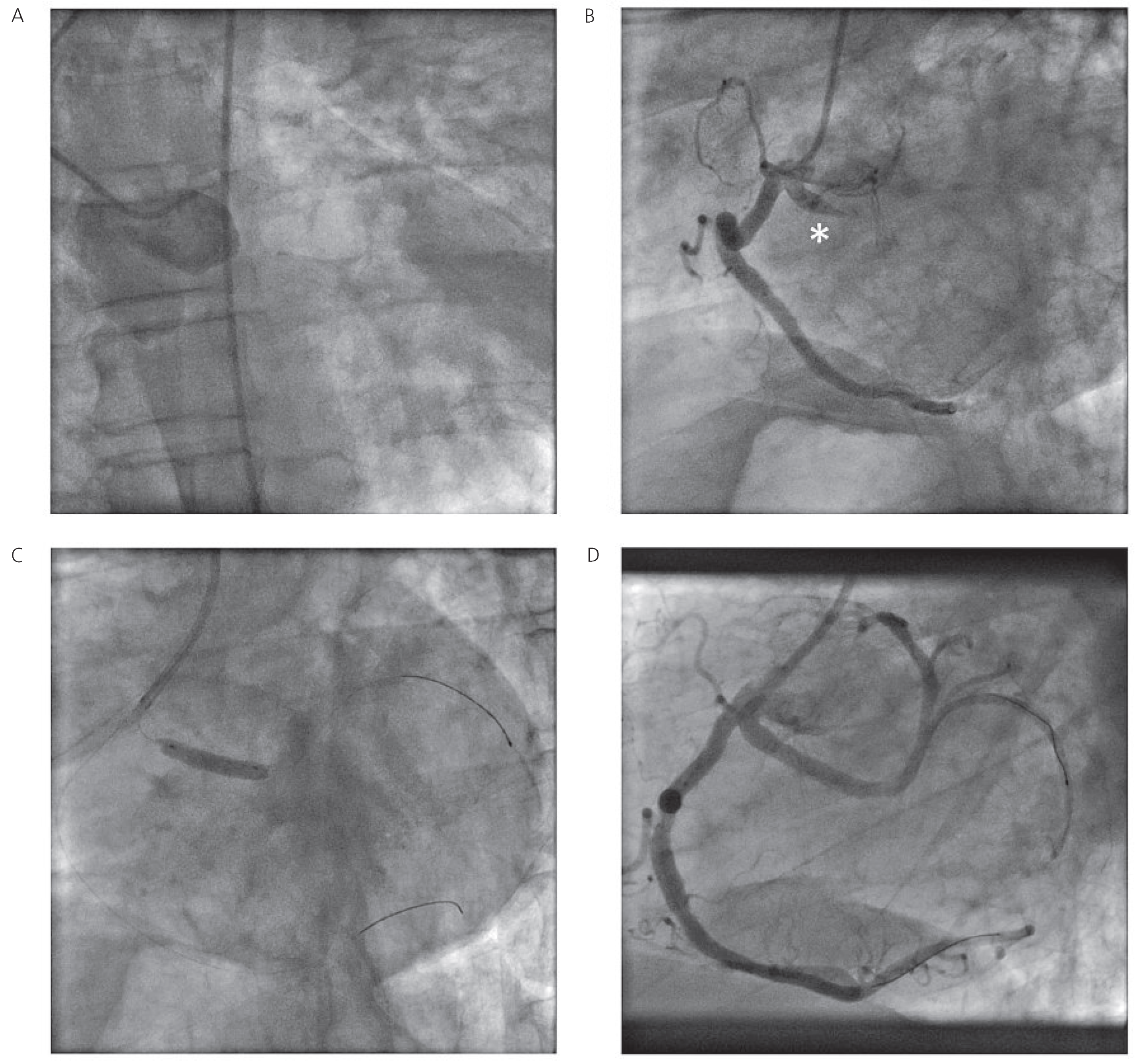
Myocardial Infarction in a Patient with a Single Coronary Artery


Funding/potential competing interests
References
- Angelini, P.; Velasco, J.A.; Flamm, S. Coronary anomalies: incidence, pathophysiology, and clinical relevance. Circulation 2002, 105, 2449–2454. [Google Scholar] [CrossRef] [PubMed]
- Yamanaka, O.; Hobbs, R.E. Coronary artery anomalies in 126 595 patients undergoing coronary arteriography. Catheterization and cardiovascular diagnosis 1990, 21, 28–40. [Google Scholar] [CrossRef] [PubMed]
© 2011 by the author. Attribution - Non-Commercial - NoDerivatives 4.0.
Share and Cite
Mutschelknauss, M.; Buser, P.T.; Kaiser, C.; Crevoisier, J.-L.; Zellweger, M.J. Myocardial Infarction in a Patient with a Single Coronary Artery. Cardiovasc. Med. 2011, 14, 195. https://doi.org/10.4414/cvm.2011.01596
Mutschelknauss M, Buser PT, Kaiser C, Crevoisier J-L, Zellweger MJ. Myocardial Infarction in a Patient with a Single Coronary Artery. Cardiovascular Medicine. 2011; 14(6):195. https://doi.org/10.4414/cvm.2011.01596
Chicago/Turabian StyleMutschelknauss, Marcus, Peter T. Buser, Christoph Kaiser, Jean-Luc Crevoisier, and Michael J. Zellweger. 2011. "Myocardial Infarction in a Patient with a Single Coronary Artery" Cardiovascular Medicine 14, no. 6: 195. https://doi.org/10.4414/cvm.2011.01596
APA StyleMutschelknauss, M., Buser, P. T., Kaiser, C., Crevoisier, J.-L., & Zellweger, M. J. (2011). Myocardial Infarction in a Patient with a Single Coronary Artery. Cardiovascular Medicine, 14(6), 195. https://doi.org/10.4414/cvm.2011.01596