1. Introduction
Tyrosol is a simple phenylethanoid naturally occurring in plants across multiple botanical families, including Oleaceae, Scrophulariaceae, Crassulaceae, and Malvaceae, with extra-virgin olive oil representing its most concentrated dietary source [
1]. Experimental and translational studies indicate that Tyrosol and its metabolites exert antioxidant and anti-inflammatory effects, including attenuation of reactive oxygen species generation, preservation of glutathione-dependent defenses, and inhibition of NF-κB signaling and endothelial adhesion molecule expression [
2,
3,
4,
5]. In vivo, these properties translate into protection in models of acute and chronic inflammation, as well as neuroprotection in preclinical systems [
6]. Importantly, a randomized controlled trial in humans demonstrated that dietary Tyrosol, partly via its endogenous bioconversion to hydroxyTyrosol, improved vascular function and a cluster of cardiovascular risk markers, including endothelial function, HDL cholesterol, homocysteine, and inflammatory gene expression, providing direct evidence for cardiometabolic benefits at physiologically relevant doses [
7]. Collectively, these findings position tyrosol as a bioactive dietary phenolic with emerging relevance for cardiovascular, neuroprotective, and anti-inflammatory applications in human health and justify further clinical investigation into its efficacy as a targeted nutraceutical [
6,
8].
These protective effects are attributed to Tyrosol’s capacity to reduce lipid peroxidation and enhance cellular resilience against oxidative challenge [
6,
9]. Furthermore, Tyrosol undergoes endogenous conversion to hydroxytyrosol in humans [
7], a potent metabolite that has been shown to promote mitochondrial biogenesis and improve aerobic capacity [
10]. This metabolic relationship suggests that Tyrosol supplementation may confer downstream benefits related to energy production, sustained physical effort, and recovery from exercise-induced stress.
Research further suggests that tyrosol’s potential health and performance benefits may be partly mediated through its endogenous conversion to hydroxytyrosol, which has been shown to enhance mitochondrial efficiency and oxidative defense [
11,
12,
13]. HydroxyTyrosol, a structurally related compound, has been observed to enhance time-trial performance in recreational athletes without increasing perceived exertion, suggesting that it may reduce perceived exertion and delay the onset of fatigue [
10]. Through its endogenous conversion to hydroxytyrosol, which supports mitochondrial function, tyrosol could potentially prolong exercise duration and enhance fatigue resistance, which may support aerobic performance [
7,
10].
Recent findings in rodents demonstrate that supplementation with Rhodiola rosea extract, a botanical source in which tyrosol is a principal bioactive constituent, significantly improved time to exhaustion and attenuated exercise-evoked oxidative stress [
14]. These observations are consistent with the antioxidant and mitochondrial-supportive properties attributed to tyrosol and suggest that tyrosol-containing preparations may enhance endurance capacity. By contrast, creatine primarily enhances strength without similar endurance benefits. This distinction suggests that Tyrosol may fulfill specific physiological needs that creatine alone does not address, particularly in terms of sustained energy and aerobic capacity. Creatine’s primary role in rapid ATP regeneration supports high-intensity, short-duration activities, whereas Tyrosol’s antioxidant and mitochondrial-supportive properties may complement this by providing sustained energy for longer, endurance-based efforts [
7,
10,
15]. In many clinical studies of creatine, the creatine loading protocol has been used. Especially in studies involving the elderly, it has been shown that the loading phase is important for maximizing the efficacy of creatine. However, excessive intake of creatine supplements may cause gastrointestinal discomfort symptoms. Therefore, the purpose of this study was to investigate the effects of short-term and low-dose creatine supplementation, without a loading phase, combined with Tyrosol, or the ingredients individually, on endurance, strength, and fatigue resistance in humans to determine whether or not a synergistic relationship between creatine and Tyrosol exists.
2. Materials and Methods
2.1. Study Design and Protocol Overview
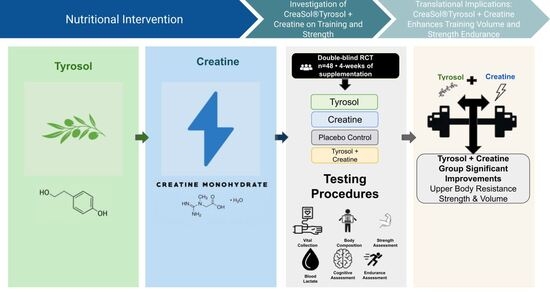
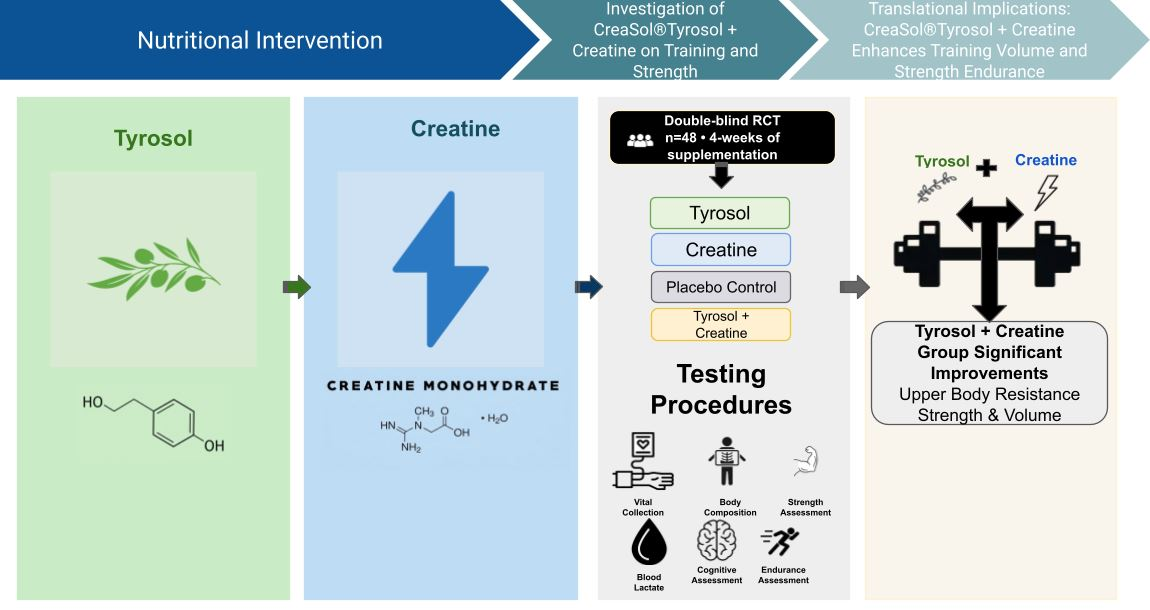
This study was carried out at a single study site (Applied Science and Performance Institute; Tampa, FL, USA) as a randomized, double-blind, placebo-controlled, parallel-group design (
Supplementary Material CONSORT checklist) to evaluate the potential ergogenic and cognitive benefits of combined CreaSol
®Tyrosol and creatine supplementation relative to either ingredient alone or a placebo. The protocol was approved by an external Institutional Review Board (IRB) (Advarra; Columbia, MD, USA; Protocol #Pro00084231) and was registered with clinicaltrials.gov (ID: NCT06883292). Before engaging in any study procedures, participants signed an IRB-approved informed consent form for study participation. All of the participants visited the laboratory for medical history screening to confirm eligibility based on the criteria described in the following section. There was no public involvement in the design, conduct, and reporting of the trial or in developing plans for recruitment, design, or implementation of the study. No subjects were asked to advise on the interpretation or writing up of results.
Recruitment and testing of subjects occurred from March 2025 to August 2025. Participants were randomly assigned using a block design via randomizer.org to one of the four possible study conditions while maintaining double-blind allocation. One group was supplemented with capsules containing 500 mg of Tyrosol (CreaSol®Tyrosol (Stabilized Tyrosol, SSAT); granted patent (US12390425B1) (Moltek Nutrition Co., Ltd., Nanjing, China), plus a placebo powder. A second group was supplemented with 3 g of creatine powder plus placebo capsules. The third group received a combination of Tyrosol capsules and creatine powder, and lastly, the fourth group received placebo capsules and placebo powder. Each Tyrosol capsule contained 500 mg of active CreaSol®Tyrosol, encapsulated in an opaque capsule shell. Creatine powder contained 3 g of active creatine monohydrate, while the placebo powder consisted of 3 g of resistant dextrin. Placebo capsules matched the Tyrosol capsules in appearance, while containing 500 mg of resistant dextrin.
Following informed consent and the condition allocation, the participants underwent baseline testing (aka, Pre) after an overnight fast of at least eight h. The visit consisted of the following assessments in successive order, after check-in: (1) vitals were taken, which included: heart rate and blood oxidation (SpO
2) (Einstein Associates pulse oximeter model 500BL, Stafford, TX, USA), blood pressure (Bioland model 2005-1, Paramount, CA, USA), and body temperature (Chunni model CN520, Stafford, TX, USA); (2) whole-body composition was measured using dual-energy X-ray absorptiometry (DXA; Horizon A DXA System, Hologic Inc., Marlborough, MA, USA); (3) participants then consumed a standardized food-bar snack; (4) cognitive performance was assessed using the Psychomotor Vigilance Test (PVT) (Inquisit Web version 6.6, Millisecond Software, LLC, Seattle, WA, USA); (5) grip strength was then conducted on both hands in triplicate using a digital hand dynamometer; (6) maximal isometric lower-body strength was evaluated via a computerized mid-thigh pull (Exsurgo GStrength dynamometer, Ashburn, VA, USA); (7) participants then performed two sets of two plyometric push-ups on a dual ground-reaction force plate (Leonardo Mechanograph, Pforzheim, Germany); (8) immediately following the push-ups, resting blood lactate was measured using Nova Biomedical meter (Lactate Plus, Waltham, MA, USA) in duplicate to establish pre-bench metabolic status; (9) upper-body strength was assessed with a 5-repetition maximum (5 RM) bench press, from which estimated 1 RM values were calculated; (10) using this estimated 1 RM, participants performed one set of bench press repetitions to failure at 70% 1 RM, followed by three sets to failure at 50% 1 RM with two-minute rest intervals; (11) immediately following the bench press, blood lactate was again measured in duplicate; (12) the plyometric push-up protocol was repeated to assess the acute effects of fatigue; (13) participants then completed a 1-mile treadmill time trial at maximal sustainable pace, with rate of perceived exertion (RPE) recorded every 400 m using the Borg scale [
16], and estimated VO
2 max was calculated from run time, age, gender, and BMI following the equation described by Kayihan et al. (2014) [
17]; (14) finally, the PVT was repeated to evaluate post-exercise cognitive performance.
After completion of baseline testing, participants entered the four-week supplementation period, in which they consumed one serving of their treatments daily for four weeks. At the end of the 4th week period, all baseline assessments were repeated, again under fasted conditions, to evaluate the effects of supplementation (aka, Post). Short-term recovery was assessed at 24 h post and 48 h post. At 24 h post, all physical testing procedures were repeated minus the following assessments: DXA, blood lactate, 5 RM bench press, bench press sets to failure, and the second plyometric push-up protocol. Additionally, at post-treatment, perceptual measures for muscle soreness and perceived recovery were completed immediately after the initial PVT test, and at 24 h post. Lastly, the 48 h post assessment consisted solely of the perceptual measures to monitor recovery. During all post-supplementation visits, the participants received their assigned dose of investigational product with water, which was administered immediately following DXA and prior to cognitive and perceptual assessments. Compliance with the trial was based on subject self-report, visit 1 testing of inclusion/exclusion criteria, and return of unused capsules and packets, which were counted and recorded by research staff. Overall compliance, as well as compliance per group, of supplement consumption by subjects was >91% for all conditions. Study design is shown in
Figure 1, and study timepoint testing is summarized in
Table 1. Adverse events were monitored through weekly communication via email and/or phone with subjects starting the day after visit 1 and continuing through the end of the subject’s enrollment period.
2.2. Study Participants
Male and female participants, aged 18 to 50 years old, were recruited by word of mouth, email contact, and direct contact from the greater Tampa Bay Area. Participants were excluded from the study if they presented any medical condition that could interfere with exercise performance or the study protocol. Specifically, individuals with a known diagnosis of cardiovascular, metabolic, endocrine, renal, hepatic, or hematological disease were not eligible. Those with a history of malignancy, gastrointestinal surgery within the past 12 months, or recent musculoskeletal injury or orthopedic surgery were also excluded. Participants with psychiatric conditions, including depression or peptic ulcers, were not eligible. Lifestyle factors that led to exclusion included regular smoking or excessive alcohol consumption (defined as more than 14 drinks per week). Women who were pregnant, breastfeeding, or planning to become pregnant were excluded, as were individuals currently using hormone replacement therapy or hormone-boosting supplements. Participants were also required to be active as defined by engaging in moderate to vigorous exercise at least 2 days per week. Additionally, as part of screening, subjects were required to have an estimated VO
2 max that is >60% of the population norm (based on their age and gender matched normative values), per American College of Sports Medicine guidelines [
18]. The VO
2 max estimations at screening were obtained by following a non-exercise regression model validated and described by Bradshaw et al. (2005) [
19]. Furthermore, subjects were required to fill out a medication/supplement form to verify they were not taking any substance that may affect the action of Tyrosol and/or creatine. Specifically, subjects were excluded if using dietary supplements that may enhance mitochondrial function, muscle hypertrophy, or muscle strength (e.g., protein formulas, creatine, amino acids, Tyrosol, etc.), use of dietary supplements that may enhance mitochondrial function, muscle hypertrophy, or muscle strength (e.g., protein formulas, creatine, amino acids, Tyrosol, etc.). Finally, participants who had taken creatine or tyrosine supplementation within the past 4 weeks were also excluded.
The sample size was determined using an a priori power analysis (G*Power, version 3.0), based on pre-clinical data, which yielded an effect size of 1.42. The power calculation was performed using an independent t-test, for this effect size, combined with a power of α = 0.05, 1 − β = 0.80, 80%, indicated a need for approximately 10 subjects per group to detect significant differences between groups.
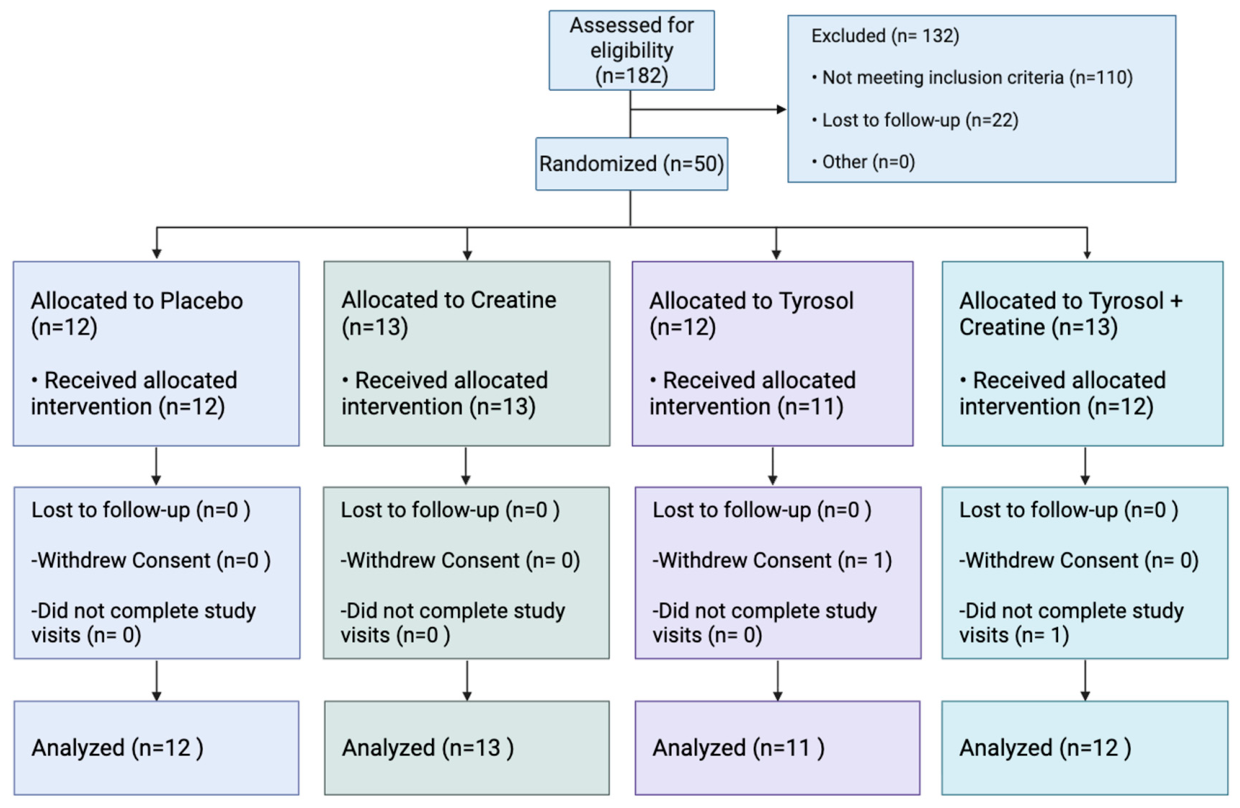
A total of 50 participants were randomly assigned to the four possible study conditions. Following dropouts, a total of 48 participants completed the trial and were used for study analysis (
Figure 2). The descriptive characteristics of the participants are noted in
Table 2. No serious or clinically significant adverse events were observed. Three gastrointestinal events occurred in the Creatine + Tyrosol group: one case of mild nausea, one case of mild bloating, and one case of moderate nausea/bloating that led to withdrawal. No other adverse events were reported, and all remaining participants completed the study. These findings are consistent with prior creatine research, which has reported occasional mild to moderate gastrointestinal symptoms without clinically meaningful safety concerns [
20].
2.3. Body Composition
Body mass to the nearest 0.1 kg was measured with a digital scale (Seca, Chino, CA, USA). A whole-body scan on a dual-energy X-ray absorptiometry device (Horizon A DXA System, Hologic Inc., Marlborough, MA, USA) was then performed with the subject lying in a supine position with knees and elbows extended. Subjects were instructed to avoid eating within a 10 h window of their DXA assessment to ensure minimal influence on scan outcomes. The DXA was calibrated against a manufacturer-provided phantom device prior to each day of testing.
2.4. Strength and Endurance Testing
Grip strength was measured using a digital hand dynamometer (Vernier Lab, Beaverton, OR, USA). Subjects were instructed to perform a 5 s maximal voluntary contraction, consisting of 3 repetitions with the right hand and then 3 repetitions on the left hand. Subjects were given 20 s of rest between all repetitions. To perform each repetition, participants held the dynamometer in their palm and were instructed to secure a comfortable grip. Their backs were supported with 90 degrees of elbow flexion and 0 degrees of shoulder flexion. Subjects were given a countdown followed by an instruction to squeeze as hard as possible while still maintaining form. After 5 s, the subjects were told to relax. These instructions were repeated for all repetitions. Maximum force was recorded using the Vernier LabQuest® 2 (Vernier Science Education, Beaverton, OR, USA) and analyzed using Logger Pro (Version 3.16.2) software. Peak force values were utilized for the study analysis.
To measure upper body strength and endurance, subjects were asked to perform a 5-repetition maximum (RM) bench press, which was also used to calculate their estimated 1 RM for the determination of the weight used during the protocol. The subject’s 1 RM was then calculated from this 5 RM weight using the Brzycki formula [
21]. Subjects started with a warm-up consisting of the following: 1 set of 8–10 reps of a light weight of their choosing, followed by 1–2 sets of 3–5 reps of progressively heavier weights (~50–70% of self-estimated 1 RM). Following a 2 min rest, subjects selected a weight they felt confident they could bench for 5–7 reps but not more than 7 reps (based on warm-up weights). Weight was increased until the subject was able to complete 5 reps with good form and felt they had 0 to 1 rep left after racking. The final weight was their 5 RM. For safety, a spotter was always present for lifts, and a set of safety bars was used as well.
Each bench press attempt began with the subject’s arms fully extended, and every successful repetition required the barbell to fully touch the participant’s xiphoid process before returning to the start position. Subjects were instructed to maintain two feet on the ground with their buttocks, upper back, and head on the bench at all times. All bench press 5 RM attempts were supervised by certified professionals.
Blood lactate was measured using the Nova Biomedical Lacate-Plus meter (Nova Biomedical, Waltham, MA, USA). The procedure is as follows: Researchers donned protective gloves prior to blood collection; using a finger of the subject’s choice, the finger was thoroughly cleaned with an alcohol pad and lanced. With a collection strip inserted into the meter, blood from the lancing was collected and read by the meter. Finally, the subject’s finger was cleaned with a sterile gauze, and all biohazard material was disposed of. Blood lactate was taken in duplicate before and after the bench press exercise, with the average of the results used for analysis.
Each participant was tested for maximal lower-body isometric strength using an Isometric Mid-Thigh Pull (IMTP) device (GStrength dynamometer, Exsurgo Technologies, Ashburn, VA, USA). Participants completed two maximal IMTPs lasting 6 s, separated by 1 min rest. The IMTP position was confirmed by measuring the midpoint distance between the greater trochanter of the femur and the superior border of the patella. Foot position was also controlled using an X-Y coordinate system to ensure that participants maintained foot position and stance width during and between testing sessions. Strength was determined by measuring the peak force attained during the IMTP pull. Force production was recorded using a linear position transducer previously validated by Garnacho-Castano et al. (2015) [
22], and the resulting data were used for analysis. The peak results of the two maximal repetitions for each subject were used and analyzed for differences within and between groups.
To assess upper body power, participants performed plyometric push-ups [
23] on a dual ground reaction force plate. The platform consisted of two symmetrical plates (left and right), each with four strain gauge force sensors (eight total). Subjects assumed a standard or modified (positioned on hands and knees) push-up position with one hand centered on each half of the force plate. After an initiation command, each subject completed two maximal effort plyometric push-ups, where the subject drops approximately halfway to the ground, then explodes upward pressing as high as possible into the air on each repetition. After thirty seconds of rest, the protocol was repeated for a total of two sets. Force curves were analyzed for peak force and rate of force development using the accompanying software, consistent with prior applications of plyometric push-ups on dual force plates [
22,
24]. The peak results of the two maximal repetitions for each subject were used and analyzed (across both arms) for differences within and between groups, looking at max force, rate of force development, and max power. Signals from the sensors were sampled at 800 Hz and analyzed using Mechanography GRFP Research Edition
® software (version 4.2-b05.53-RES).
A 1-mile run time trial on a treadmill was performed to assess aerobic endurance through VO
2 max. The treadmill allowed participants to adjust the speed as needed to maintain their maximal sustainable pace throughout the test. Treadmill incline was set at 1 degree to simulate outdoor running. During the trial, participants were informed each time they reached a quarter mile closer to completion, and were asked about their perceived exertion at that time using the Borg scale (described below). The total time taken to complete the 1 mile was recorded as the primary performance measure. VO
2 max was calculated using the previously validated exercise-based equation [
25]. Subject’s heart rate (using a pulse oximeter) was recorded at the end of the mile.
2.5. Visual Assessment Scales (VAS)
The perceived recovery scale (PRS) was used to measure recovery from exercise as previously described [
26]. Upper body soreness was assessed using a previously validated 7-point Likert scale [
27]. Subjects performed 5 bodyweight pushups before answering the soreness questionnaire, in order to gauge their soreness after muscle activation. Lastly, the Borg scale of perceived exertion was used to measure the subject’s perceived exertion status throughout the 1-mile timed trial [
16].
2.6. Computerized Cognition and Reflex Assessment
The Psychomotor Vigilance Test (PVT) was used as previously described [
28]. PVT assessment has become a widely used measure of behavioral alertness, owing in large part to the combination of its high sensitivity and its psychometric advantages over other cognitive tests. This assessment was performed using Inquisit Web version 6.6 by Millisecond Software, LLC (
https://www.millisecond.com/). Specifically, the keyboard version was used, allowing participants to respond to stimuli by typing corresponding symbols on their keyboards. Briefly, participants were asked to press the spacebar as soon as they saw a red circle appearing on the screen. Afterwards, their reaction is displayed for 0.5 s. The test is timed and stops after ~10 min. From this sequence of tests, data is accumulated to indicate valid responses (i.e., responses made after the red circle appears); false starts (an error of commission, in which reaction time < 100 ms); mean reaction time; and Lapses (Defined as the number of total times reaction time exceeded 500 ms). Lastly, the performance score is calculated, which is a composite measure of overall task performance (expressed as a percentage), defined as 1 minus the number of PVT lapses and false starts divided by the number of valid stimuli (including false starts). A lower performance score reflects reduced task accuracy or efficiency, potentially due to cognitive fatigue, lack of skill, distractions, or task complexity.
2.7. Statistical Analysis
Statistical analyses were conducted using JASP version 0.19.3 and GraphPad Prism Version 10. Data are reported as mean ± standard deviation in tables, and standard error of the mean in figures. Effect sizes were calculated using Cohen’s d and described as trivial (0–0.19), small (0.2–0.49), moderate (0.5–0.79), and large (0.8+). Outliers were identified via the 1.5 interquartile range rule, and applicable data were winsorized. Normality and variance assumptions were tested using the Shapiro–Wilk.
To explore changes between time points and differences between treatment conditions, a repeated measures ANCOVA was used, with time point as a repeated measure (baseline, 4 weeks, and 24 and 48 h after 4-week testing, where applicable), and treatment condition (the 4 groups—placebo, creatine, Tyrosol, and Tyrosol + Creatine) as a between-subjects factor. Post hoc tests in the scope of the ANCOVA procedure were conducted with Holm-Bonferroni corrections for multiple comparisons. Repeated measures ANCOVA was conducted on all outcome variables as dependents (one at a time), with treatment condition and time as independent factors, and weight as covariates, or with no covariates. The procedures were repeated two times, with only weight as a covariate, or no covariates. For simplicity, the tables show the ANCOVA when controlling for bodyweight. With the exception that no covariates were controlled for when looking at changes in bodyweight, blood lactate, and cognitive and subjective tests (PVT, soreness, and recovery). The trial was prospectively powered to detect overall between-group differences in performance outcomes, and not for sex-specific or sex-by-treatment interaction analyses, which are considered exploratory given the small subsamples per sex within each group. Thus, differences between the sexes were not controlled for. A p-value < 0.05 was considered statistically significant.
Lastly, delta changes among groups were also assessed via a one-way ANOVA to detect differences in mean changes between Baseline and Week 4, and day 28 to day 29. Fisher’s least significant difference (LSD) post hoc analysis was used to assess pairwise differences. A p-value < 0.05 was considered statistically significant.
4. Discussion
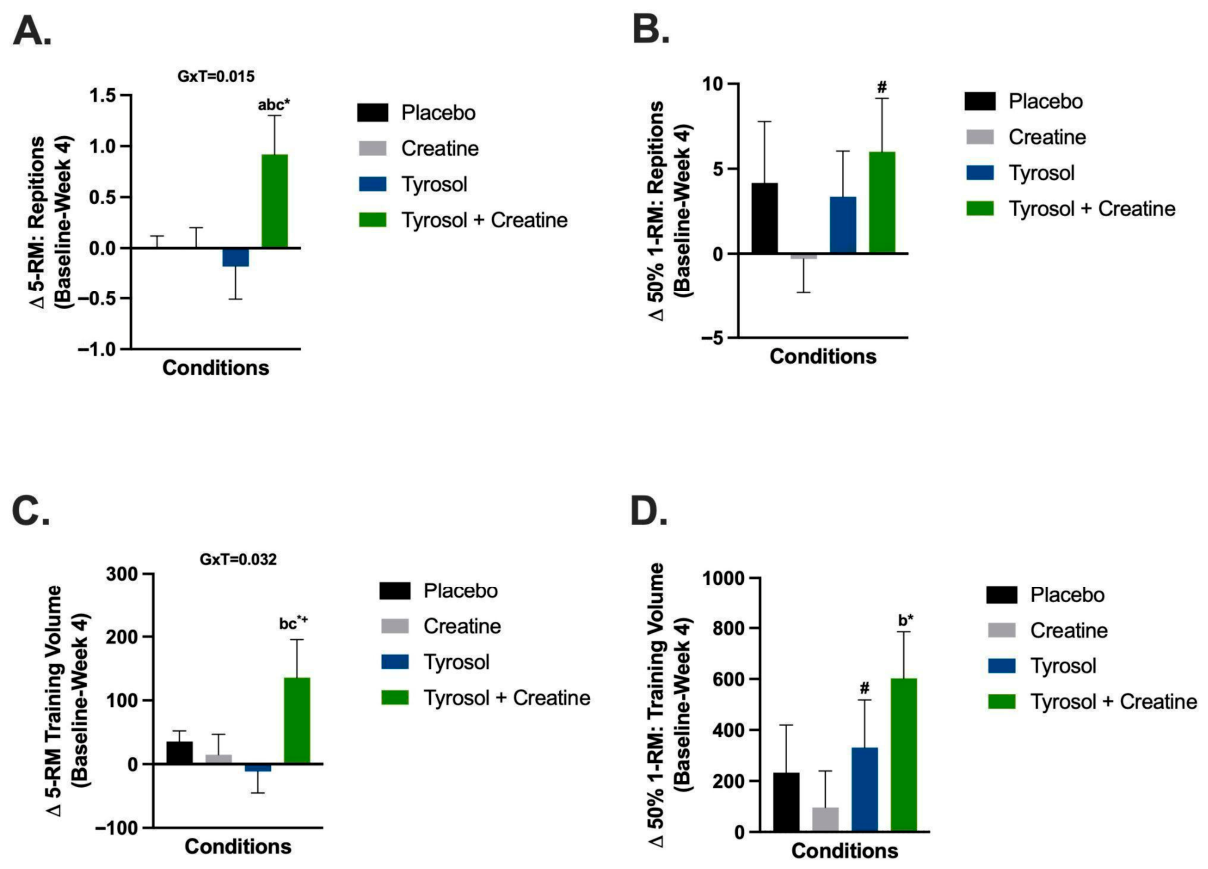
The primary and most robust finding of this trial is that the combination of Tyrosol and creatine meaningfully improved upper body resistance training performance after 4 weeks of short-term supplementation without a loading phase; whereas Tyrosol or creatine alone produced modest and less consistent effects on the same tasks. Across the 5 RM bench press test, Tyrosol + Creatine elicited a significant increase in repetitions, with a significant group × time interaction and clear advantages over Tyrosol, creatine, and placebo when delta changes and between group effect sizes were examined, indicating that the ergogenic response cannot be attributed to training alone or to either supplement in isolation but instead points to a synergistic interaction that enhances high intensity, low repetition performance. Notably, these improvements were driven by greater repetitions and total training volume rather than increases in absolute load, suggesting an enhancement in fatigue resistance and work capacity at a given relative intensity rather than a shift in maximal strength per se, a pattern that is practically important given evidence that higher resistance training volume is a key driver of long-term strength and hypertrophic adaptations [
29,
30,
31,
32]. The submaximal data help delineate the boundary of this effect: at 50% 1 RM, Tyrosol + Creatine increased weight lifted and total training volume and tended to increase repetitions, and showed higher training volume than creatine alone when delta changes were compared, yet no global between group main effects emerged; at 70% 1 RM, only small within group increases in load were seen for placebo and Tyrosol + Creatine, with no significant interactions or between group differences. This pattern suggests that the combined supplement may preferentially enhance performance under conditions that concurrently tax strength and local fatigue (e.g., 5 RM work and higher volume sets at 50% 1 RM) rather than clearly shifting performance at intermediate intensities. Mechanistically, creatine’s established role in augmenting phosphocreatine resynthesis and buffering high-energy phosphate availability supports repeated high-tension contractions [
29,
30], while Tyrosol’s proposed vascular, antioxidant, and mitochondrial actions, supported by its endogenous conversion to hydroxytyrosol [
7], may improve muscle oxygenation and redox balance, helping sustain force output under metabolically challenging conditions [
33,
34]. In contrast, tasks such as 70% 1 RM sets, grip strength, plyometric push-ups and mid-thigh pull where volume did not systematically diverge across groups, may simply lack the sensitivity or differential loading needed to reveal this advantage, aligning these findings with the broader literature showing creatine’s strongest effects in high intensity, repeated effort contexts while extending that concept by suggesting that co administration with Tyrosol can further amplify such responses.
A degree of inter-individual variability in training adaptations was expected, and in some outcomes, the placebo group showed larger change-score dispersion than the supplement groups. This pattern is consistent with the well-documented heterogeneity of resistance-training and creatine responses, as well as the substantial variability often observed in placebo arms of randomized trials. Importantly, our main inferences are based on group × time interactions and between-group comparisons that incorporate this variance, and the ergogenic advantage of Tyrosol + Creatine on upper-body strength-endurance remained evident despite the differences in variability across groups.
Additionally, it is noteworthy that in this trial, creatine was supplemented at a dose of 3 g/day without a loading phase. Many clinical studies on creatine emphasize the importance of a loading phase for its efficacy. However, supplementation without a loading phase and at lower doses typically requires a longer duration to demonstrate creatine’s beneficial effects, whereas higher doses of creatine may cause adverse effects such as gastrointestinal discomfort. In this clinical study, the combined supplementation of low-dose creatine with Tyrosol not only avoided high-dose creatine loading but also achieved improvements in strength endurance following short-term supplementation.
Endurance measures (1-mile run time and estimated VO2 max) were similarly unchanged, apart from a small improvement in 1-mile performance between days 28 and 29 in the creatine group, which may reflect random variation or day-to-day fluctuations rather than a true performance change. The lack of creatine-enhanced changes may be due to the fact that these tests, although max effort, were not in a load or volume range to demonstrate creatine’s effect. Furthermore, the low daily dosage and short 4-week time frame were probably not enough to demonstrate effects on these assessments.
Body composition remained stable, which is unsurprising given the short 4-week duration and the fact that performance improvements can precede measurable changes in lean mass. Blood lactate responses to bench press were robust and large in all groups both at baseline and week 4, but were indistinguishable between treatments, indicating that the metabolic stress of the bench protocol was primarily driven by the exercise load itself and not markedly altered by the supplements. Plyometric push-up performance (max force, rate of force development, power) showed consistent decrements pre to post bench, again independent of treatment, reinforcing that the acute fatigue induced by the resistance session was substantial but not appreciably modulated by Tyrosol, creatine, or their combination.
The soreness and perceived recovery data add an important layer, particularly regarding Tyrosol’s potential role in subjective recovery. All groups experienced marked increases in upper body soreness 24 and 48 h after the bench session, but the Tyrosol only group demonstrated the smallest relative elevations (≈90% at 24 h and 39% at 48 h), whereas Tyrosol + Creatine showed the largest increases (≈575% and 600%, respectively). Statistical analysis revealed a significant group × time interaction for soreness, with pairwise comparisons indicating that Tyrosol + Creatine reported substantially higher soreness than Tyrosol, creatine, and placebo at 48 h, whereas Tyrosol alone did not show significant elevations from baseline. Since muscle soreness is driven by intensity and training volume (which this group demonstrated during the bench press), and also considering that lower baseline soreness was observed in the Tyrosol + Creatine group, this combination likely contributed to the magnitude of the observed percentage changes.
The overall pattern suggests that Tyrosol may blunt perceived soreness when taken alone, perhaps via antioxidant, anti-inflammatory, or nociceptive pathways [
2,
3], while the combination with creatine, possibly through higher training volumes and greater mechanical/muscle damage, results in disproportionately higher delayed onset muscle soreness [
35,
36]. Perceived recovery scores did not differ meaningfully between groups, implying that athletes can feel similarly “ready” despite distinct soreness profiles. Importantly, the elevated soreness in Tyrosol + Creatine did not impair performance and may simply reflect a greater training stimulus; however, chronically higher soreness could become problematic for some athletes if it interferes with training adherence, movement quality, or downstream performance [
35,
36]. Importantly, we did not control for training volume or intensity in this study, which can confound the soreness outcome measure.
The null findings in cognitive performance (PVT) further narrow the scope of the ergogenic effects observed. At baseline, before any treatment administration, the placebo group showed impaired PVT performance pre to post workout (more lapses, slower reaction time, and worse composite scores), but these differences dissipated at the week 4 mark and were not associated with any supplement condition, indicating they likely arose from random variation, learning effects, or uncontrolled factors rather than a systematic cognitive consequence of exercise. By week 4, only a small slowing in mean reaction time persisted in the placebo group post exercise, with no consistent between-group differences. Thus, within the parameters of this protocol, Tyrosol, creatine, and Tyrosol + Creatine did not appear to confer meaningful protection against acute exercise-induced cognitive fatigue, nor did they systematically enhance psychomotor vigilance. This is notable given the interest in polyphenols and creatine as potential cognitive aids, and suggests that any such benefits may require different dosing strategies, longer durations, more cognitively demanding paradigms, or populations with greater baseline cognitive susceptibility [
37,
38].
Several limitations should temper the interpretation of these results. First, the sample size and variability in training status, technique, and adherence could have limited statistical power, especially for secondary outcomes with smaller expected effect sizes, contributing to the mixed pattern of significant within-group changes and marginal or absent between-group effects. Second, it is clear that the bench press outcomes showed definitive advantages for Tyrosol + Creatine; however, supporting data across other intensities and tasks raises the possibility that some findings seem to reflect task-specific sensitivity. Third, soreness and perceived recovery metrics, while informative, are inherently subjective and influenced by baseline differences, the total training stimuli (which were not controlled for), expectations, and prior experience; the lower baseline soreness in Tyrosol + Creatine may partially exaggerate their relative delta changes despite statistical adjustment. Finally, the plyometric and cognitive endpoints may have been constrained by ceiling effects, limited familiarization, or the choice and timing of tests, reducing their ability to capture subtle treatment effects.
An additional study limitation is regarding possible sex differences. In this study, both men and women were included and analyzed together, with sex balanced across treatments, with no systematic baseline differences in age, body mass, or BMI. Importantly, the study was appropriately powered to detect overall treatment effects rather than sex-by-treatment interactions; thus, we were unable to perform a robust statistical analysis between the sexes in this study due to the small sample size. We did, however, help control for this variable by controlling for the covariate of body weight in our statistical analysis, which would help account for a portion of the differences between the sexes. Therefore, larger, dedicated trials are needed to rigorously test sex-specific effects for Tyrosol + Creatine. Additionally, sleep and diet, which may contribute to exercise performance, were not controlled for in this study. Subjects were instructed to maintain their normal activities of daily living without significant disruptions, so while sleep and diet may have had a small effect on physical performance, they should not have significantly altered the intervention.
Future research would help to refine these observations in several key ways since this investigation appears to be the first of its kind. Longer interventions (8–12 weeks or more) under tightly standardized and progressive resistance training programs are needed to determine whether the acute and short-term performance advantages of Tyrosol + Creatine translate into superior long-term adaptations in maximal strength, hypertrophy, and power. Incorporating more frequent and detailed session-by-session tracking of performance (volume, RPE, velocity-based metrics) would help clarify whether the combination supplement consistently elevates training quality over time or primarily benefits certain loading schemes (e.g., near 5 RM work and higher volume sets at 50% 1 RM). Furthermore, given the divergent soreness profiles, dedicated recovery trials employing controlled muscle-damaging protocols, more granular soreness mapping, such as objective measures of muscle damage (e.g., creatine kinase), and functional recovery tests (e.g., repeated jump performance over 24–72 h) should be particularly valuable. Finally, due to the potential cardiovascular benefits of Tyrosol [
7], it would be beneficial to examine the long-term benefits of Tyrosol supplementation for cardiovascular health by examining key markers such as blood pressure, lactate, and lipid panels in conjunction with physical activity and dietary controls.