


Influence of Matrix Type on Marginal Gap Formation of Deep Class II Bulk-Fill Composite Restorations


Abstract
1. Introduction
2. Materials and Methods
3. Results
SEM Analysis
4. Discussion
5. Conclusions
Author Contributions
Funding
Institutional Review Board Statement
Informed Consent Statement
Data Availability Statement
Conflicts of Interest
References
- Schierz, O.; Baba, K.; Fueki, K. Functional oral health-related quality of life impact: A systematic review in populations with tooth loss. J. Oral Rehabil. 2021, 48, 256–270. [Google Scholar] [CrossRef] [Scilit] [PubMed]
- Carvalho, J.C.; Mestrinho, H.D.; Stevens, S.; van Wijk, A.J. Do oral health conditions adversely impact young adults? Caries Res. 2015, 49, 266–274. [Google Scholar] [CrossRef] [Scilit] [PubMed]
- Van Ende, A.; De Munck, J.; Lise, D.P.; Van Meerbeek, B. Bulk-Fill Composites: A Review of the Current Literature. J. Adhes. Dent. 2017, 19, 95–109. [Google Scholar] [CrossRef] [Scilit] [PubMed]
- Cidreira Boaro, L.C.; Pereira Lopes, D.; de Souza, A.S.C.; Lie Nakano, E.; Ayala Perez, M.D.; Pfeifer, C.S.; Goncalves, F. Clinical performance and chemical-physical properties of bulk fill composites resin—A systematic review and meta-analysis. Dent. Mater. 2019, 35, e249–e264. [Google Scholar] [CrossRef] [Scilit] [PubMed]
- Heck, K.; Manhart, J.; Hickel, R.; Diegritz, C. Clinical evaluation of the bulk fill composite QuiXfil in molar class I and II cavities: 10-year results of a RCT. Dent. Mater. 2018, 34, e138–e147. [Google Scholar] [CrossRef] [Scilit]
- AlQahtani, M.Q.; Michaud, P.L.; Sullivan, B.; Labrie, D.; AlShaafi, M.M.; Price, R.B. Effect of High Irradiance on Depth of Cure of a Conventional and a Bulk Fill Resin-based Composite. Oper. Dent. 2015, 40, 662–672. [Google Scholar] [CrossRef] [Scilit]
- AlShaafi, M.M.; AlQussier, A.; AlQahtani, M.Q.; Price, R.B. Effect of Mold Type and Diameter on the Depth of Cure of Three Resin-Based Composites. Oper. Dent. 2018, 43, 520–529. [Google Scholar] [CrossRef] [Scilit]
- El-Damanhoury, H.; Platt, J. Polymerization shrinkage stress kinetics and related properties of bulk-fill resin composites. Oper. Dent. 2014, 39, 374–382. [Google Scholar] [CrossRef] [Scilit]
- Catel, Y.; Angermann, J.; Fassler, P.; Fischer, U.; Schnur, T.; Moszner, N. High refractive index monofunctional monomers as promising diluents for dental composites. Dent. Mater. 2021, 37, 351–358. [Google Scholar] [CrossRef] [Scilit]
- Kowalska, A.; Sokolowski, J.; Bociong, K. The Photoinitiators Used in Resin Based Dental Composite-A Review and Future Perspectives. Polymers 2021, 13, 470. [Google Scholar] [CrossRef] [Scilit]
- Moszner, N.; Fischer, U.K.; Ganster, B.; Liska, R.; Rheinberger, V. Benzoyl germanium derivatives as novel visible light photoinitiators for dental materials. Dent. Mater. 2008, 24, 901–907. [Google Scholar] [CrossRef] [Scilit] [PubMed]
- Van Ende, A.; De Munck, J.; Van Landuyt, K.L.; Poitevin, A.; Peumans, M.; Van Meerbeek, B. Bulk-filling of high C-factor posterior cavities: Effect on adhesion to cavity-bottom dentin. Dent. Mater. Off. Publ. Acad. Dent. Mater. 2013, 29, 269–277. [Google Scholar] [CrossRef] [Scilit] [PubMed]
- Benetti, A.R.; Havndrup-Pedersen, C.; Honore, D.; Pedersen, M.K.; Pallesen, U. Bulk-fill resin composites: Polymerization contraction, depth of cure, and gap formation. Oper. Dent. 2015, 40, 190–200. [Google Scholar] [CrossRef] [Scilit] [PubMed]
- Loguercio, A.D.; Rezende, M.; Gutierrez, M.F.; Costa, T.F.; Armas-Vega, A.; Reis, A. Randomized 36-month follow-up of posterior bulk-filled resin composite restorations. J. Dent. 2019, 85, 93–102. [Google Scholar] [CrossRef] [Scilit]
- Bucuta, S.; Ilie, N. Light transmittance and micro-mechanical properties of bulk fill vs. conventional resin based composites. Clin. Oral Investig. 2014, 18, 1991–2000. [Google Scholar] [CrossRef] [Scilit]
- Scholtanus, J.D.; Ozcan, M. Clinical longevity of extensive direct composite restorations in amalgam replacement: Up to 3.5 years follow-up. J. Dent. 2014, 42, 1404–1410. [Google Scholar] [CrossRef] [Scilit]
- Loomans, B.A.; Opdam, N.J.; Roeters, F.J.; Bronkhorst, E.M.; Burgersdijk, R.C.; Dorfer, C.E. A randomized clinical trial on proximal contacts of posterior composites. J. Dent. 2006, 34, 292–297. [Google Scholar] [CrossRef] [Scilit]
- Kampouropoulos, D.; Paximada, C.; Loukidis, M.; Kakaboura, A. The influence of matrix type on the proximal contact in Class II resin composite restorations. Oper. Dent. 2010, 35, 454–462. [Google Scholar] [CrossRef] [Scilit]
- Durr, E.S.; Ahmad, M.Z.; Gaikwad, R.N.; Arjumand, B. Comparison of two different matrix band systems in restoring two surface cavities in posterior teeth done by senior undergraduate students at Qassim University, Saudi Arabia: A randomized controlled clinical trial. Indian J. Dent. Res. 2018, 29, 459–464. [Google Scholar] [CrossRef] [Scilit]
- Loomans, B.A.; Opdam, N.J.; Roeters, F.J.; Bronkhorst, E.M.; Huysmans, M.C. Restoration techniques and marginal overhang in Class II composite resin restorations. J. Dent. 2009, 37, 712–717. [Google Scholar] [CrossRef] [Scilit]
- Loomans, B.A.; Opdam, N.J.; Roeters, F.J.; Huysmans, M.C. Proximal marginal overhang of composite restorations in relation to placement technique of separation rings. Oper. Dent. 2012, 37, 21–27. [Google Scholar] [CrossRef] [Scilit]
- Shaalan, O.O. Evaluation of Matrix Band Systems for Posterior Proximal Restorations among Egyptian Dentists: A Cross-Sectional Survey. Acta Stomatol. Croat. 2020, 54, 392–400. [Google Scholar] [CrossRef] [Scilit]
- Lindberg, A.; van Dijken, J.W.; Lindberg, M. Nine-year evaluation of a polyacid-modified resin composite/resin composite open sandwich technique in Class II cavities. J. Dent. 2007, 35, 124–129. [Google Scholar] [CrossRef] [Scilit]
- Coelho-De-Souza, F.H.; Camargo, J.C.; Beskow, T.; Balestrin, M.D.; Klein-Junior, C.A.; Demarco, F.F. A randomized double-blind clinical trial of posterior composite restorations with or without bevel: 1-year follow-up. J. Appl. Oral. Sci. 2012, 20, 174–179. [Google Scholar] [CrossRef] [Scilit] [PubMed]
- Coelho-de-Souza, F.H.; Klein-Junior, C.A.; Camargo, J.C.; Beskow, T.; Balestrin, M.D.; Demarco, F.F. Double-blind randomized clinical trial of posterior composite restorations with or without bevel: 6-month follow-up. J. Contemp. Dent. Pract. 2010, 11, 1–8. [Google Scholar] [CrossRef] [Scilit]
- Kays, B.T.; Sneed, W.D.; Nuckles, D.B. Microhardness of Class II composite resin restorations with different matrices and light positions. J. Prosthet. Dent. 1991, 65, 487–490. [Google Scholar] [CrossRef] [Scilit]
- Demarco, F.F.; Pereira-Cenci, T.; de Almeida Andre, D.; de Sousa Barbosa, R.P.; Piva, E.; Cenci, M.S. Effects of metallic or translucent matrices for Class II composite restorations: 4-year clinical follow-up findings. Clin. Oral Investig. 2011, 15, 39–47. [Google Scholar] [CrossRef] [Scilit] [PubMed]
- Mullejans, R.; Badawi, M.O.; Raab, W.H.; Lang, H. An in vitro comparison of metal and transparent matrices used for bonded class II resin composite restorations. Oper. Dent. 2003, 28, 122–126. [Google Scholar] [PubMed]
- Chan, D.C. Modified matrix adaptation for sub-gingival Class II amalgam restorations. Oper. Dent. 2003, 28, 469–472. [Google Scholar]
- Dietrich, T.; Losche, A.C.; Losche, G.M.; Roulet, J.F. Marginal adaptation of direct composite and sandwich restorations in Class II cavities with cervical margins in dentine. J. Dent. 1999, 27, 119–128. [Google Scholar] [CrossRef] [Scilit]
- Price, R.B.; Rueggeberg, F.A.; Harlow, J.; Sullivan, B. Effect of mold type, diameter, and uncured composite removal method on depth of cure. Clin. Oral Investig. 2016, 20, 1699–1707. [Google Scholar] [CrossRef] [Scilit] [PubMed]
- Goodchild, J.H. Class II composite placement is difficult! Solutions to help overcome the clinical challenges. Dent. Today 2013, 32, 116–117. [Google Scholar]
- Lutz, F.; Krejci, I.; Luescher, B.; Oldenburg, T.R. Improved proximal margin adaptation of Class II composite resin restorations by use of light-reflecting wedges. Quintessence Int. 1986, 17, 659–664. [Google Scholar] [PubMed]
- Nguyen, D.P.; Motyka, N.C.; Meyers, E.J.; Vandewalle, K.S. Depth of cure of proximal composite resin restorations using a new perforated metal matrix. Gen. Dent. 2018, 66, 68–74. [Google Scholar] [PubMed]
- Lösche, G.M. Marginal adaptation of Class II composite fillings: Guided polymerization vs reduced light intensity. J. Adhes. Dent. 1999, 1, 31–39. [Google Scholar] [PubMed]
- Lima, R.B.W.; Troconis, C.C.M.; Moreno, M.B.P.; Murillo-Gomez, F.; De Goes, M.F. Depth of cure of bulk fill resin composites: A systematic review. J. Esthet. Restor. Dent. 2018, 30, 492–501. [Google Scholar] [CrossRef] [Scilit] [PubMed]
- Cerdan, F.; Ceballos, L.; Fuentes, M.V. Quality of approximal surfaces of posterior restorations in primary molars. J. Oral Sci. 2021, 63, 347–351. [Google Scholar] [CrossRef] [Scilit]
- Loomans, B.A.; Opdam, N.J.; Roeters, J.F.; Bronkhorst, E.M.; Plasschaert, A.J. Influence of composite resin consistency and placement technique on proximal contact tightness of Class II restorations. J. Adhes. Dent. 2006, 8, 305–310. [Google Scholar]
- Saber, M.H.; El-Badrawy, W.; Loomans, B.A.; Ahmed, D.R.; Dorfer, C.E.; El Zohairy, A. Creating tight proximal contacts for MOD resin composite restorations. Oper. Dent. 2011, 36, 304–310. [Google Scholar] [CrossRef] [Scilit]
- Souza-Junior, E.J.; de Souza-Regis, M.R.; Alonso, R.C.; de Freitas, A.P.; Sinhoreti, M.A.; Cunha, L.G. Effect of the curing method and composite volume on marginal and internal adaptation of composite restoratives. Oper. Dent. 2011, 36, 231–238. [Google Scholar] [CrossRef] [Scilit]
- Szep, S.; Frank, H.; Kenzel, B.; Gerhardt, T.; Heidemann, D. Comparative study of composite resin placement: Centripetal buildup versus incremental technique. Pract. Proced. Aesthet. Dent. 2001, 13, 243–250; discussion 252. [Google Scholar] [PubMed]
- Hofmann, N.; Hunecke, A. Influence of curing methods and matrix type on the marginal seal of class II resin-based composite restorations in vitro. Oper. Dent. 2006, 31, 97–105. [Google Scholar] [CrossRef] [Scilit] [PubMed]
- Cenci, M.S.; Demarco, F.F.; Pereira, C.L.; Lund, R.G.; de Carvalho, R.M. One-year comparison of metallic and translucent matrices in Class II composite resin restorations. Am. J. Dent. 2007, 20, 41–45. [Google Scholar] [PubMed]
- Demarco, F.F.; Cenci, M.S.; Lima, F.G.; Donassollo, T.A.; Andre Dde, A.; Leida, F.L. Class II composite restorations with metallic and translucent matrices: 2-year follow-up findings. J. Dent. 2007, 35, 231–237. [Google Scholar] [CrossRef] [Scilit]
- Mehl, A.; Hickel, R.; Kunzelmann, K.H. Physical properties and gap formation of light-cured composites with and without ‘softstart-polymerization’. J. Dent. 1997, 25, 321–330. [Google Scholar] [CrossRef] [Scilit]
- Lee, C.H.; Ferracane, J.; Lee, I.B. Effect of pulse width modulation-controlled LED light on the polymerization of dental composites. Dent. Mater. 2018, 34, 1836–1845. [Google Scholar] [CrossRef] [Scilit]
- Piccioni, M.A.; Baratto-Filho, F.; Kuga, M.C.; Morais, E.C.; Campos, E.A. Cuspal movement related to different polymerization protocols. J. Contemp. Dent. Pract. 2014, 15, 26–28. [Google Scholar] [CrossRef] [Scilit]
- Uno, S.; Asmussen, E. Marginal adaptation of a restorative resin polymerized at reduced rate. Scand. J. Dent. Res. 1991, 99, 440–444. [Google Scholar] [CrossRef] [Scilit]
- Yoshikawa, T.; Burrow, M.F.; Tagami, J. A light curing method for improving marginal sealing and cavity wall adaptation of resin composite restorations. Dent. Mater. 2001, 17, 359–366. [Google Scholar] [CrossRef] [Scilit]
- Yoshikawa, T.; Nakaoki, Y.; Takada, T.; Burrow, M.F.; Tagami, J. Effect of light-curing method and irradiation time on marginal sealing and cavity wall adaptation of resin composite restorations. Am. J. Dent. 2003, 16, 63A–67A. [Google Scholar]
- Feilzer, A.J.; Dooren, L.H.; de Gee, A.J.; Davidson, C.L. Influence of light intensity on polymerization shrinkage and integrity of restoration-cavity interface. Eur. J. Oral Sci. 1995, 103, 322–326. [Google Scholar] [CrossRef] [Scilit] [PubMed]
- Unterbrink, G.L.; Muessner, R. Influence of light intensity on two restorative systems. J. Dent. 1995, 23, 183–189. [Google Scholar] [CrossRef] [Scilit]
- Ganster, B.; Fischer, U.K.; Moszner, N.; Liska, R. New Photocleavable Structures. Diacylgermane-Based Photoinitiators for Visible Light Curing. Macromolecules 2008, 41, 2394–2400. [Google Scholar] [CrossRef] [Scilit]
- Ilie, N.; Bucuta, S.; Draenert, M. Bulk-fill resin-based composites: An in vitro assessment of their mechanical performance. Oper. Dent. 2013, 38, 618–625. [Google Scholar] [CrossRef] [Scilit]
- Sartori, N.; Knezevic, A.; Peruchi, L.D.; Phark, J.H.; Duarte, S., Jr. Effects of Light Attenuation through Dental Tissues on Cure Depth of Composite Resins. Acta Stomatol. Croat. 2019, 53, 95–105. [Google Scholar] [CrossRef] [Scilit]
- Frankenberger, R.; Tay, F.R. Self-etch vs etch-and-rinse adhesives: Effect of thermo-mechanical fatigue loading on marginal quality of bonded resin composite restorations. Dent. Mater. 2005, 21, 397–412. [Google Scholar] [CrossRef] [Scilit] [PubMed]
- Peutzfeldt, A.; Muhlebach, S.; Lussi, A.; Flury, S. Marginal Gap Formation in Approximal “Bulk Fill” Resin Composite Restorations after Artificial Ageing. Oper. Dent. 2018, 43, 180–189. [Google Scholar] [CrossRef] [Scilit] [PubMed]
- Alves dos Santos, M.P.; Luiz, R.R.; Maia, L.C. Randomised trial of resin-based restorations in Class I and Class II beveled preparations in primary molars: 48-month results. J. Dent. 2010, 38, 451–459. [Google Scholar] [CrossRef] [Scilit]
- Loomans, B.A.; Roeters, F.J.; Opdam, N.J.; Kuijs, R.H. The effect of proximal contour on marginal ridge fracture of Class II composite resin restorations. J. Dent. 2008, 36, 828–832. [Google Scholar] [CrossRef] [Scilit]
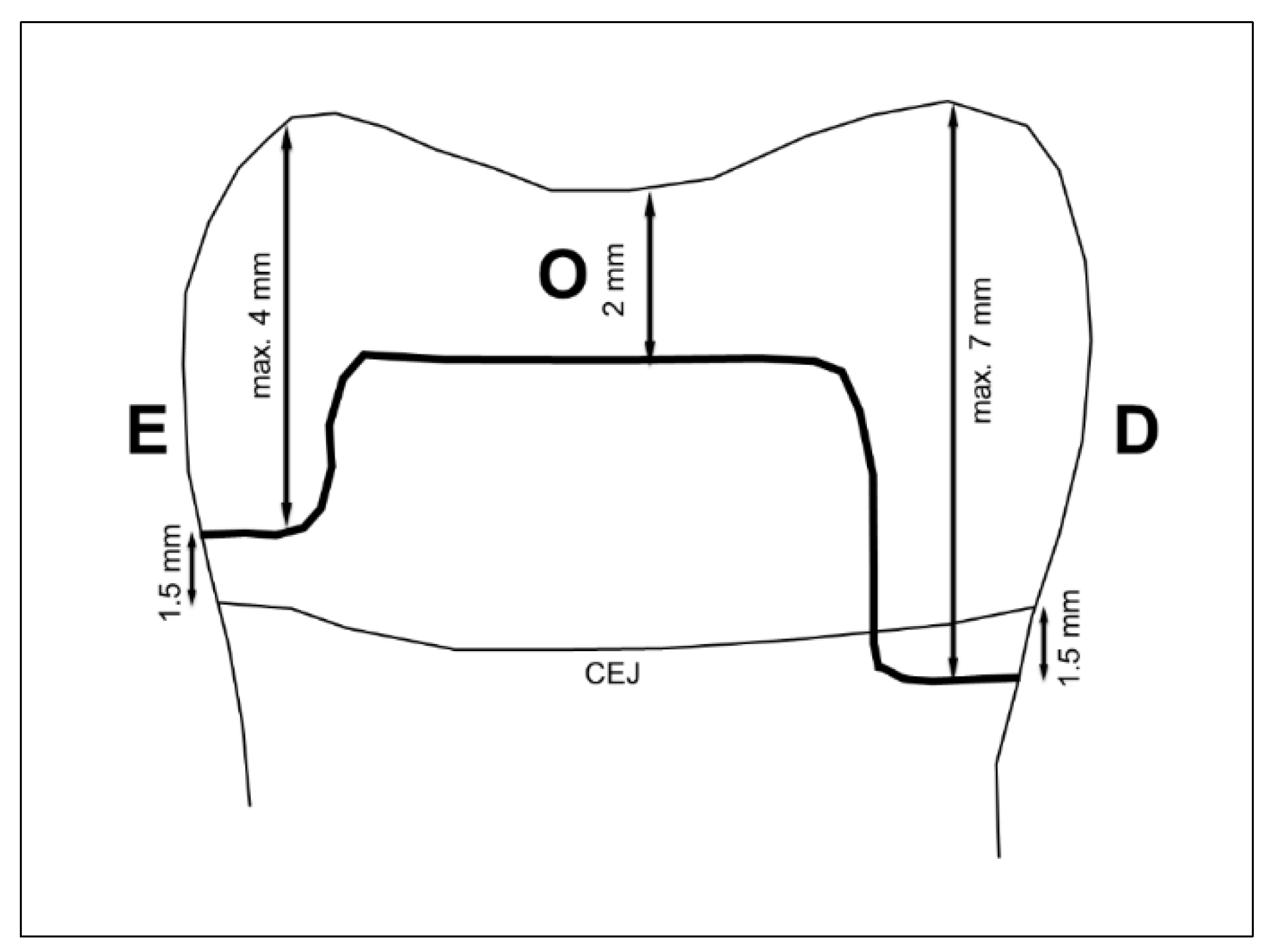
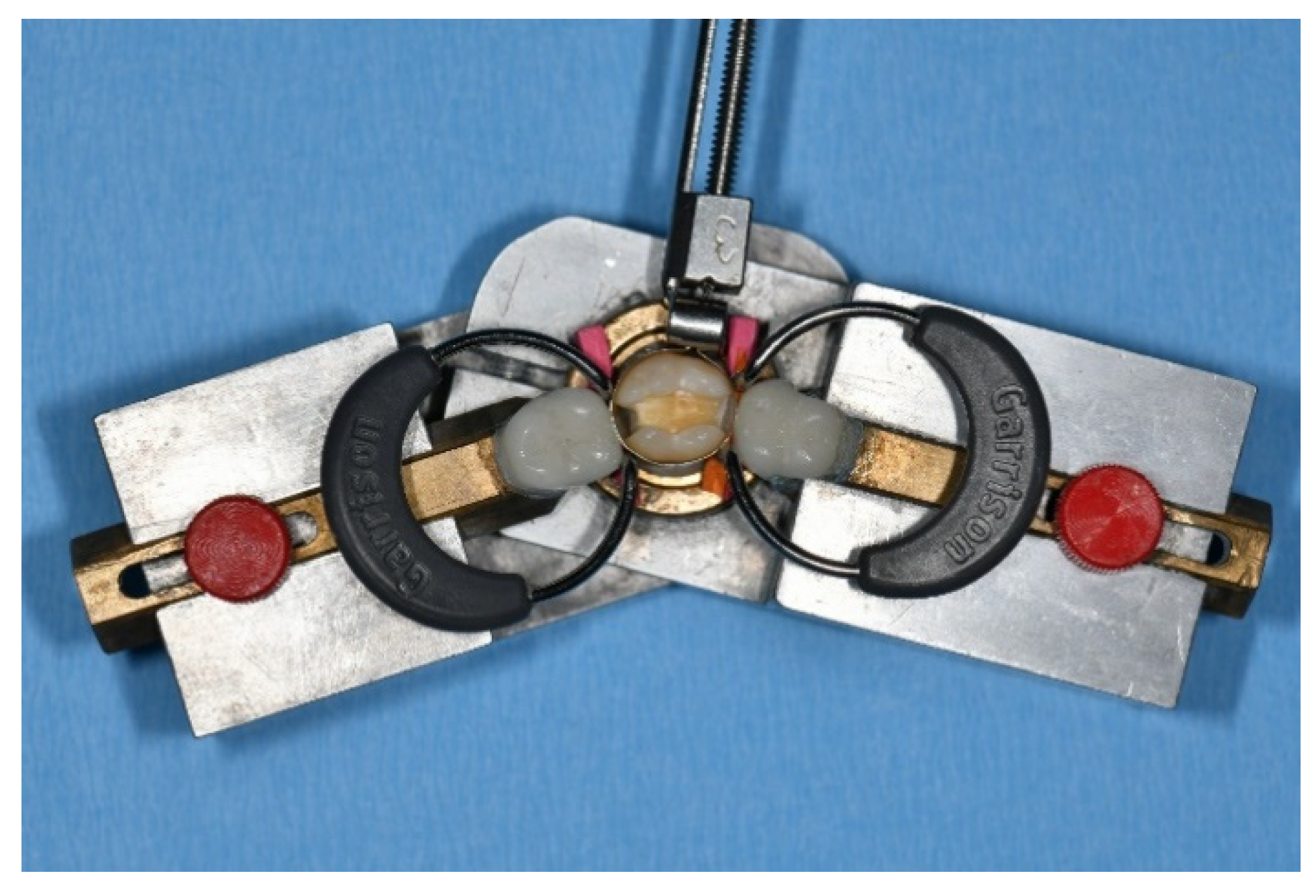
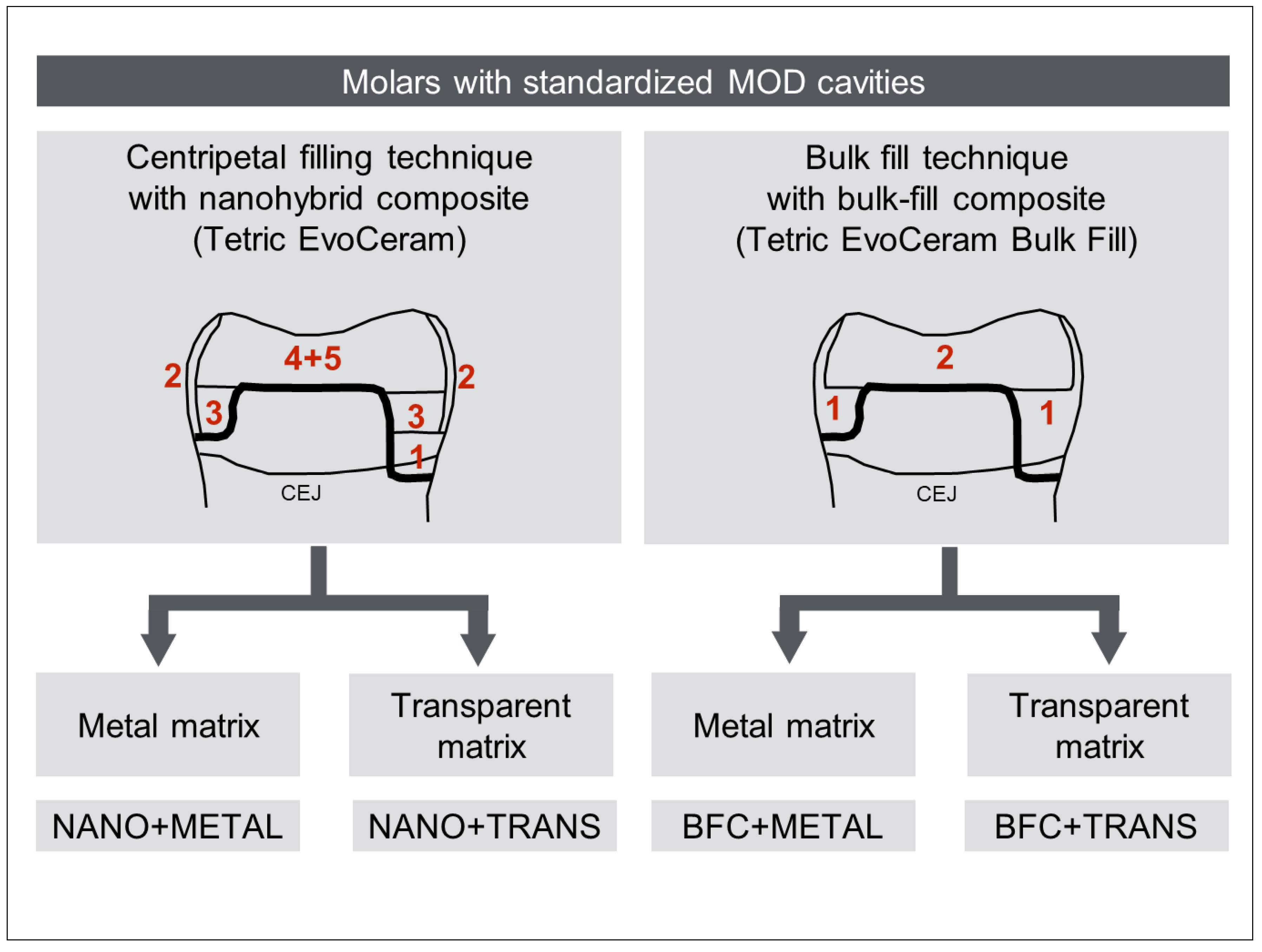
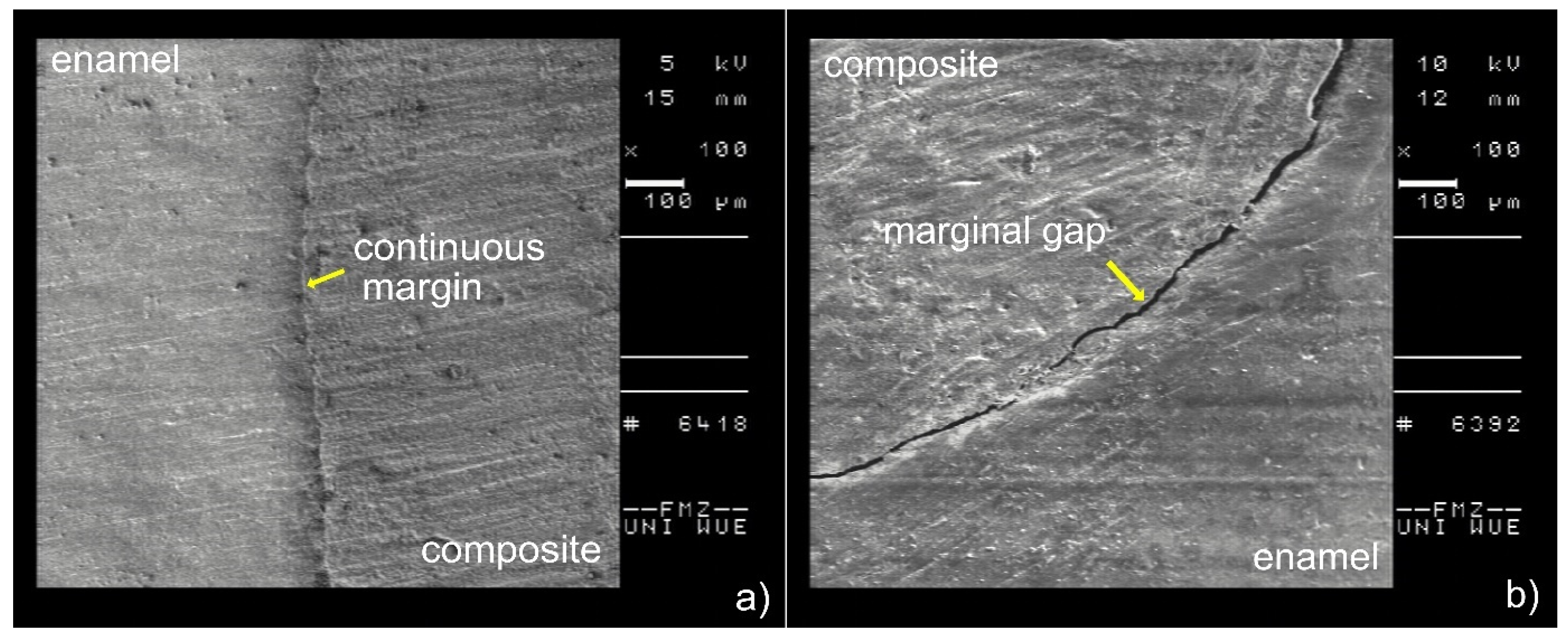

| Tetric EvoCeram a | Tetric EvoCeram Bulk Fill b | |||
|---|---|---|---|---|
| Organical matrix [wt%] | Bis-GMA Bis-EMA UDMA | 16.8 | Bis-GMA Bis-EMA UDMA | 19.7 |
| Fillers [wt%] | Aluminoborosilicate glass, Ytterbiumtriflourid, Mixed oxides | 48.5 | Aluminoborosilicate glass, Ytterbiumtriflourid, Mixed oxides | 62.5 |
| Prepolymers | 34.0 | Prepolymers | 17.0 | |
| Additives | <0.8 | Additives | <1.0 | |
| Phototinitiators | Lucirin®-TPO Camphorquinone | Ivocerin® Lucirin®-TPO Camphorquinone | ||
| Flexural strength [MPa] | 120 | 120 | ||
| Flexural modulus [MPa] | 10,000 | 10,000 | ||
| Water absorption [μg/mm3], 7d | 21.2 | 24.8 | ||
| Water solubility [μg/mm3], 7d | <1.0 | <1.0 | ||
| Radio opacity [% Al] | 400 (except for Bleach) | 260 | ||
| 200 (Bleach I) | ||||
| 300 (Bleach L, M, XL) | ||||
| Depth of cure [mm] | >1.5 | 4 | ||
| Translucency [%] | 6.5–20.0 | 14.0–16.0 | ||
| Vickers hardness HV 0.5/30 [MPa] | 580 | 620 | ||
| Continuous Margins [%] | ||||||||
|---|---|---|---|---|---|---|---|---|
| Margin Location | Mean | SD | Median | 68%-CI | Pw | dCohen | ES s-m-l | |
| Lower | Upper | |||||||
| CI | CI | |||||||
| Enamel | 46.125 | 25.962 | 45.194 | 20.589 | 70.414 | 0.00005 *** | 0.78 | m |
| Dentin | 22.577 | 24.349 | 15.674 | 0 | 42.839 | |||
| Total | 36.642 | 20.412 | 33.366 | 20.685 | 58.413 | - | - | - |
| Continuous Margins [%] | |||||||||
| Margin Location | Matrix | Mean | SD | Median | 68%-CI | Pu | dCohen | ES s-m-l | |
| Lower | Upper | ||||||||
| CI | CI | ||||||||
| Enamel | METAL | 55.491 | 22.477 | 54.067 | 27.141 | 75.203 | 0.013 * | 0.77 | m |
| TRANS | 36.759 | 26.337 | 37.836 | 12.359 | 50.353 | ||||
| Dentin | METAL | 32.349 | 25.155 | 25.902 | 8.135 | 50.120 | 0.0038 ** | 0.87 | l |
| TRANS | 12.804 | 19.573 | 5.981 | 0.000 | 32.134 | ||||
| Total (enamel + dentin) | METAL | 46.211 | 14.912 | 47.799 | 33.028 | 63.291 | 0.0011 ** | 1.052 | l |
| TRANS | 27.073 | 20.978 | 27.553 | 9.899 | 33.477 | ||||
| Margin Location | Composite (Filling Technique) | Mean | SD | Median | 68%-CI | Pu | dCohen | ES s-m-l | |
| Lower | Upper | ||||||||
| CI | CI | ||||||||
| Enamel | NANO (CT) | 46.231 | 29.005 | 47.021 | 16.359 | 71.126 | 0.87 | - | - |
| BFC (BFT) | 46.019 | 23.286 | 43.859 | 26.790 | 66.368 | ||||
| Dentin | NANO (CT) | 15.716 | 20.832 | 6.636 | 0.000 | 32.192 | 0.031 * | 0.58 | m |
| BFC (BFT) | 29.437 | 26.151 | 23.865 | 7.198 | 44.914 | ||||
| Total (enamel + dentin) | NANO (CT) | 34.482 | 21.894 | 31.806 | 10.026 | 59.518 | 0.56 | - | - |
| BFC (BFT) | 38.802 | 19.132 | 33.366 | 24.686 | 53.162 | ||||
| Groups | Continuous Margins [%] | ||||||||
|---|---|---|---|---|---|---|---|---|---|
| Margin Location | Composite–Matrix | Mean | SD | Median | 68%-CI | Pu | dCohen | ES s-m-l | |
| Lower | Upper | ||||||||
| CI | CI | ||||||||
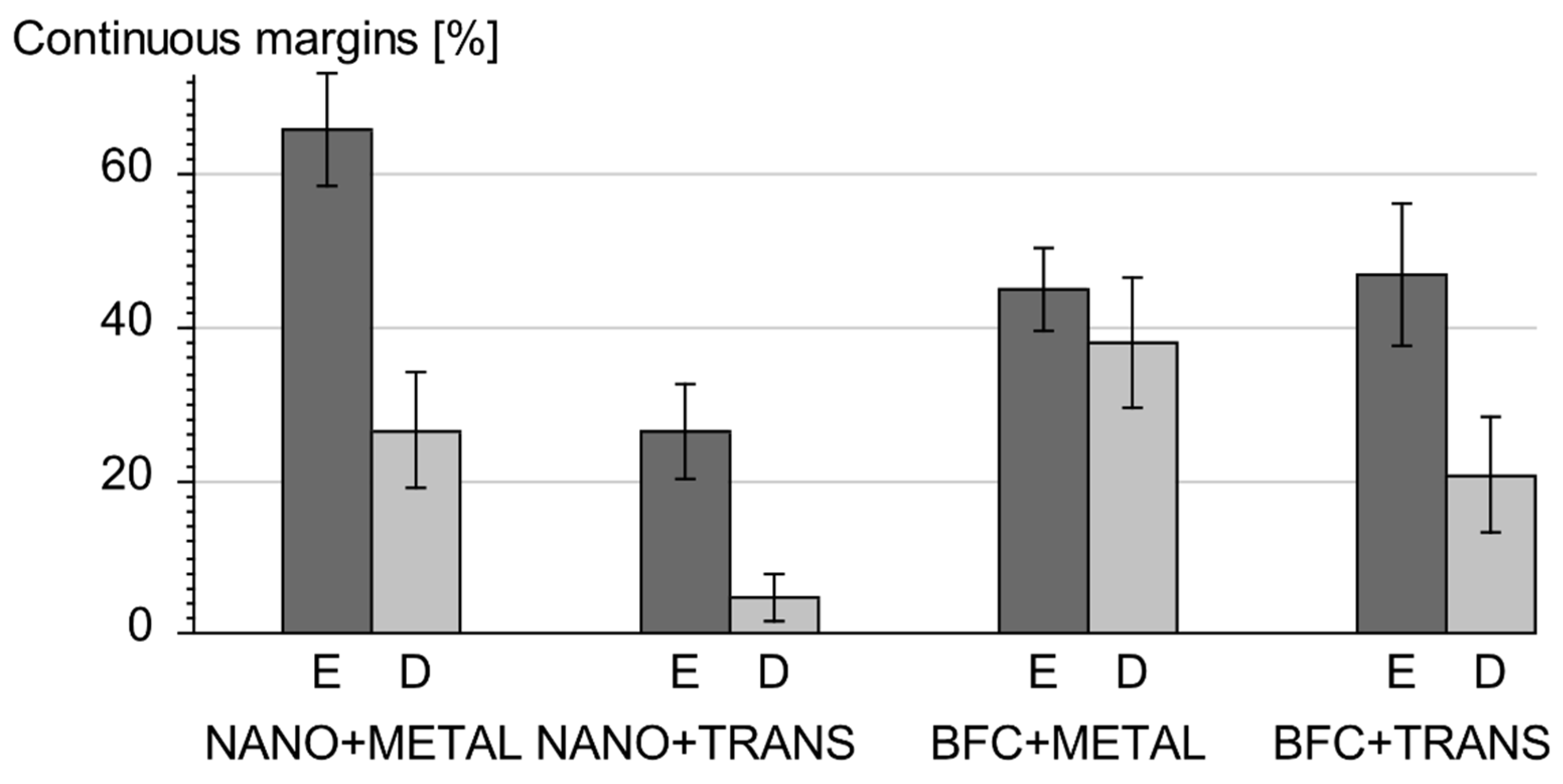
| Enamel | NANO–METAL | 65.935 | 22.724 | 66.863 | 48.644 | 86.094 | 0.0017 ** | 1.844 | l |
| NANO–TRANS | 26.526 | 19.921 | 29.178 | 2.768 | 46.963 | ||||
| Dentin | NANO–METAL | 26.644 | 23.438 | 22.863 | 3.438 | 47.188 | 0.021 * | 1.212 | l |
| NANO–TRANS | 4.789 | 10.072 | 0.000 | 0.000 | 6.971 | ||||
| Total (E + D) | NANO–METAL | 50.857 | 15.947 | 51.389 | 36.907 | 66.868 | 0.0010 ** | 2.270 | l |
| NANO–TRANS | 18.107 | 12.720 | 22.809 | 2.451 | 29.456 | ||||
| Enamel | BFC–METAL | 45.047 | 17.545 | 46.335 | 26.909 | 61.575 | 0.91 | - | - |
| BFC–TRANS | 46.991 | 28.894 | 43.812 | 23.423 | 74.805 | ||||
| Dentin | BFC–METAL | 38.054 | 26.723 | 36.196 | 15.584 | 52.186 | 0.064 | - | - |
| BFC–TRANS | 20.819 | 23.760 | 10.797 | 4.073 | 34.958 | ||||
| Total (E + D) | BFC–METAL | 41.564 | 12.929 | 41.039 | 29.364 | 51.575 | 0.27 | - | - |
| BFC–TRANS | 36.040 | 24.261 | 28.686 | 16.419 | 56.898 | ||||
Publisher’s Note: MDPI stays neutral with regard to jurisdictional claims in published maps and institutional affiliations. |
© 2022 by the authors. Licensee MDPI, Basel, Switzerland. This article is an open access article distributed under the terms and conditions of the Creative Commons Attribution (CC BY) license (https://creativecommons.org/licenses/by/4.0/).
Share and Cite
Hahn, B.; Haubitz, I.; Krug, R.; Krastl, G.; Soliman, S. Influence of Matrix Type on Marginal Gap Formation of Deep Class II Bulk-Fill Composite Restorations. Int. J. Environ. Res. Public Health 2022, 19, 4961. https://doi.org/10.3390/ijerph19094961
Hahn B, Haubitz I, Krug R, Krastl G, Soliman S. Influence of Matrix Type on Marginal Gap Formation of Deep Class II Bulk-Fill Composite Restorations. International Journal of Environmental Research and Public Health. 2022; 19(9):4961. https://doi.org/10.3390/ijerph19094961
Chicago/Turabian StyleHahn, Britta, Imme Haubitz, Ralf Krug, Gabriel Krastl, and Sebastian Soliman. 2022. "Influence of Matrix Type on Marginal Gap Formation of Deep Class II Bulk-Fill Composite Restorations" International Journal of Environmental Research and Public Health 19, no. 9: 4961. https://doi.org/10.3390/ijerph19094961
APA StyleHahn, B., Haubitz, I., Krug, R., Krastl, G., & Soliman, S. (2022). Influence of Matrix Type on Marginal Gap Formation of Deep Class II Bulk-Fill Composite Restorations. International Journal of Environmental Research and Public Health, 19(9), 4961. https://doi.org/10.3390/ijerph19094961

