Article

Psychosocial Working Conditions and Social Participation. A 10-Year Follow-Up of Senior Workers
1
Division of Occupational and Environmental Medicine, Department of Laboratory Medicine, Lund University, 22363 Lund, Sweden
2
Occupational Therapy and Occupational Science Research Group, Department of Health Sciences, Lund University, 22100 Lund, Sweden
3
Division of Social Medicine and Global Health, Department of Clinical Sciences in Malmö, Lund University, 22213 Malmö, Sweden
4
Unit of Occupational Medicine, Institute for Environmental Medicine, Karolinska Institute, 17177 Stockholm, Sweden
5
Active and Healthy Ageing Research Group, Department of Health Sciences, Lund University, 22100 Lund, Sweden
*
Author to whom correspondence should be addressed.
Int. J. Environ. Res. Public Health 2021, 18(17), 9154; https://doi.org/10.3390/ijerph18179154

Submission received: 14 July 2021 / Revised: 18 August 2021 / Accepted: 27 August 2021 / Published: 30 August 2021

Abstract

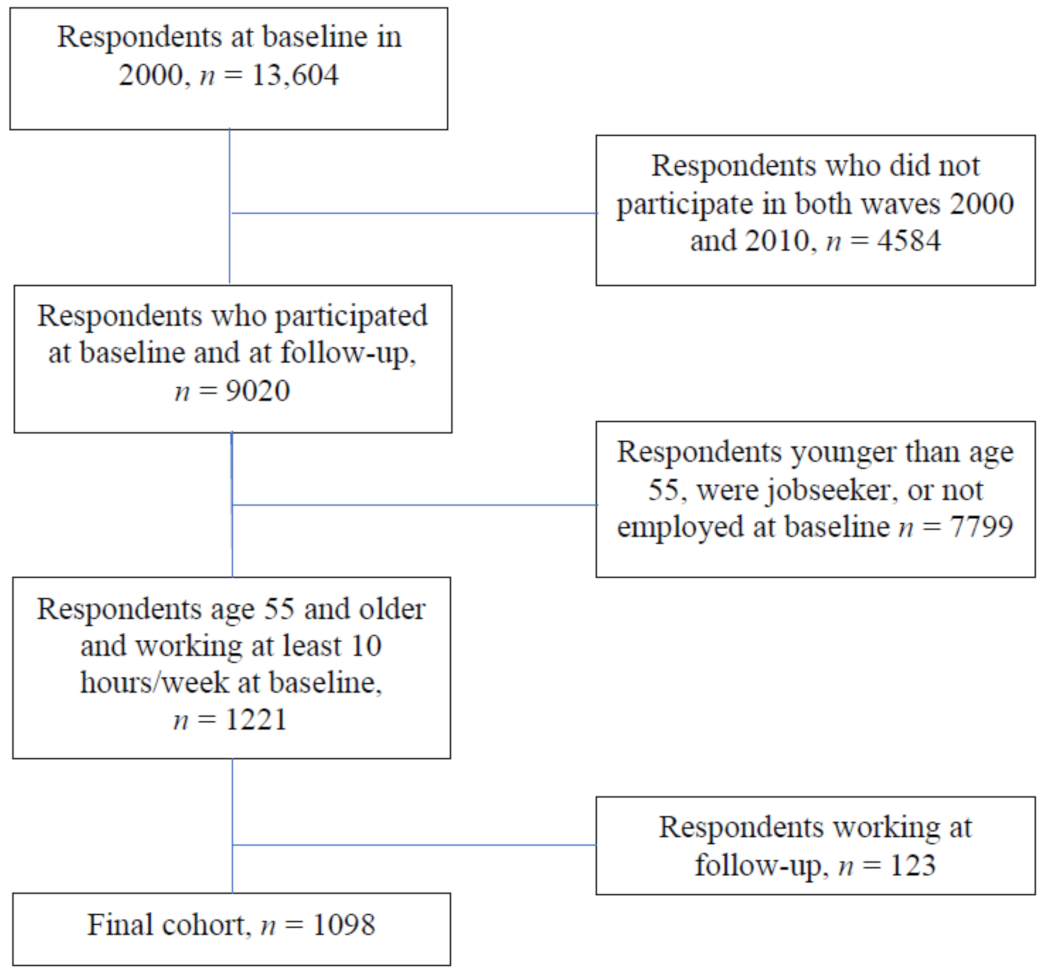
Social participation is important for health, and it is well known that high strain jobs impact negatively on mental and physical health. However, knowledge about the impact of psychosocial working conditions on social participation from a long-term perspective is lacking. The purpose of this study was to investigate the associations between different job types and social participation from a long-term perspective. A comprehensive public health questionnaire “The Scania Public Health Survey”, was used, and psychosocial working conditions were measured with a Swedish translation of the Job Content Questionnaire. Based on data from 1098 working respondents aged 55 at baseline and a 10-year follow-up when the respondents were not working, the analyses revealed that social participation varied by job type. Jobs with high decision latitude, as in active and relaxed jobs, seem to predict high social participation, even after cessation of employment. Besides that, the result suggests that high social participation during working life is a predictor of high social participation from a long-term perspective which promotes healthy aging. Incentives for working longer are strongly related to good working conditions. A supportive work environment with possibilities for employees to participate in decision making, i.e., high control, is vital for a sustainable working life. This may contribute to an extended working life and may also support social participation prior to retirement as well as after retirement and thus to healthy aging.
Keywords: aging; extended working life; decision latitude; health promotion; life-course perspective; work-life balance; retirement; self-rated health; social activities; sustainable working life; work environment aging; extended working life; decision latitude; health promotion; life-course perspective; work-life balance; retirement; self-rated health; social activities; sustainable working life; work environment