Article

A New Pedestrian Crossing Level of Service (PCLOS) Method for Promoting Safe Pedestrian Crossing in Urban Areas


1
UHasselt, Transportation Research Institute (IMOB), Agoralaan, 3590 Diepenbeek, Belgium
2
Centre for Public Health, Queen’s University Belfast, Belfast BT7 1NN, UK
3
Department of Civil Engineering, College of Engineering, Qassim University, Buraydah 51452, Saudi Arabia
4
Department of Civil and Environmental Engineering, College of Design and Built Environment, King Fahd University of Petroleum and Minerals, Dhahran 31261, Saudi Arabia
*
Author to whom correspondence should be addressed.
Int. J. Environ. Res. Public Health 2021, 18(16), 8813; https://doi.org/10.3390/ijerph18168813

Submission received: 7 July 2021 / Revised: 14 August 2021 / Accepted: 16 August 2021 / Published: 20 August 2021

Abstract

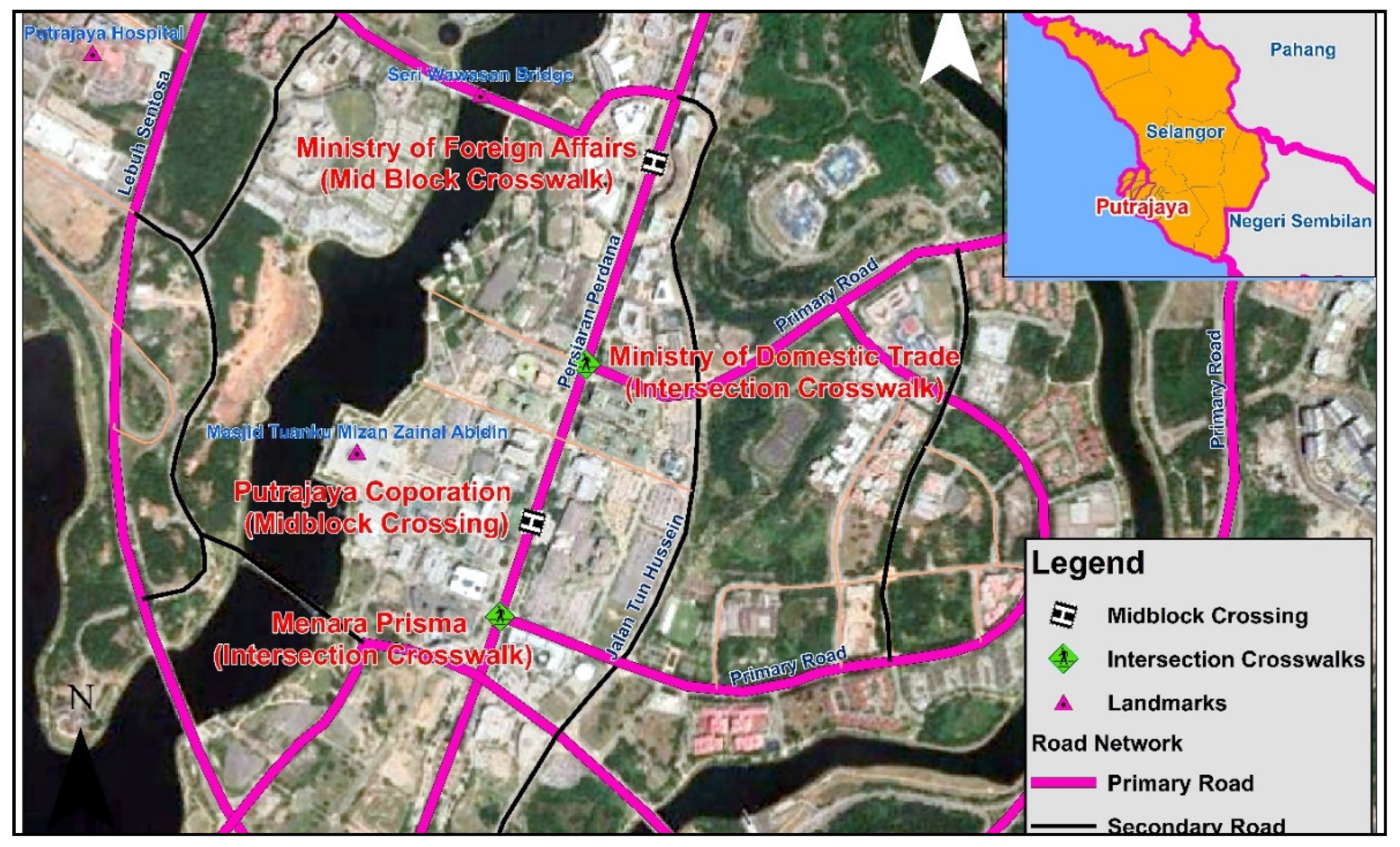
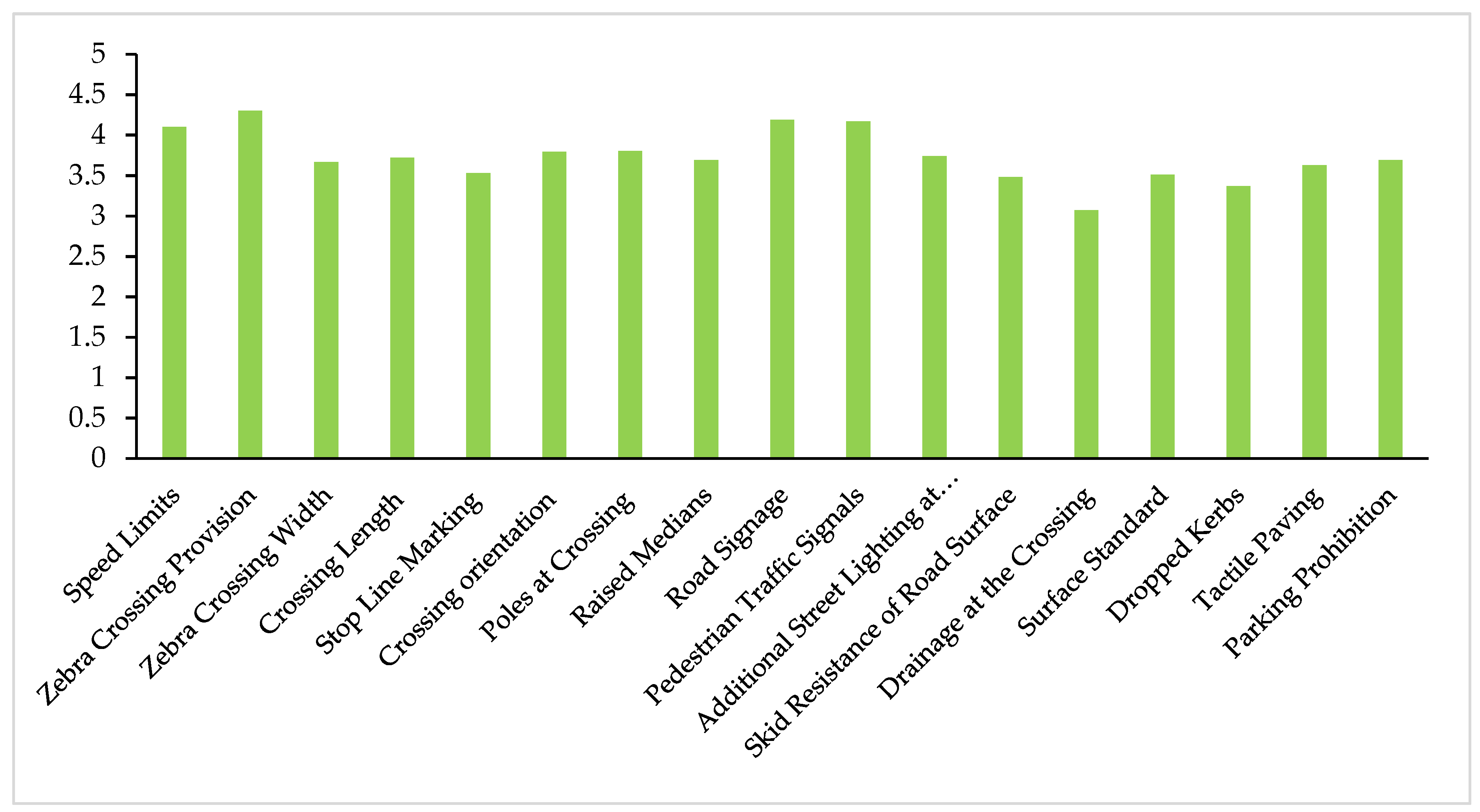
Crosswalks are critical locations in the urban transport network that need to be designed carefully as pedestrians are directly exposed to vehicular traffic. Although various methods are available to evaluate the level of service (LOS) at pedestrian crossings, pedestrian crossing facilities are frequently ignored in assessing crosswalk conditions. This study attempts to provide a comprehensive framework for evaluating crosswalks based on several essential indicators adopted from different guidelines. A new pedestrian crossing level of service (PCLOS) method is introduced in this research, with an aimto promote safe and sustainable operations at such locations. The new PCLOS employs an analytical point system to compare existing street crossing conditions to the guidelines’ standards, taking into account the scores and coefficients of the indicators. The quantitative scores and coefficients of indicators are assigned based on field observations and respondent opinions. The method was tested to evaluate four pedestrian crosswalks in the city of Putrajaya, Malaysia. A total of 17 indicators were selected for the study after a comprehensive literature review. Survey results show that the provision of a zebra crossing was the most critical indicator at the pedestrian crossings, while drainage near crosswalks was regarded as the least important. Four indicators had a coefficient value above 4, indicating that these are very critical pedestrian crossing facilities and significantly impact the calculation of LOS for pedestrian crossings. Four crosswalks were evaluated using the proposed method in Putrajaya, Malaysia. The crosswalk at the Ministry of Domestic Trade Putrajaya got the “PCLOS A”. In contrast, the midblock crossing in front of the Putrajaya Corporation was graded “PCLOS C”. While the remaining two crosswalks were graded as “PCLOS B” crosswalks. Based on the assigned PCLOS grade, the proposed method could also assist in identifying current design and operation issues in existing pedestrian crossings and providing sound policy recommendations for improvements to ensure pedestrian safety.
Keywords: active mobility; walking; urban crosswalk evaluation; crossing indicators; pedestrian safety; public health; level of service analysis active mobility; walking; urban crosswalk evaluation; crossing indicators; pedestrian safety; public health; level of service analysis