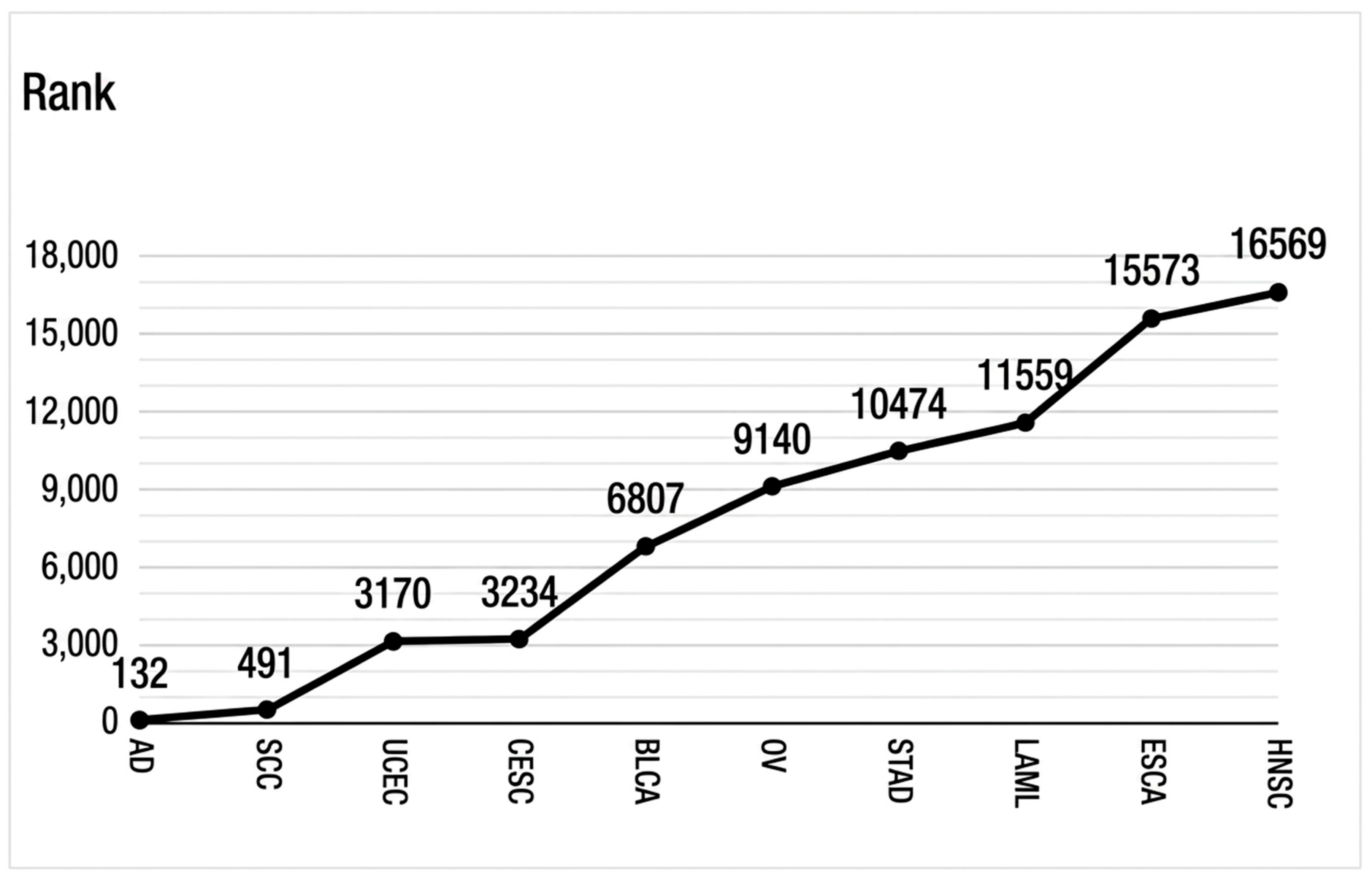
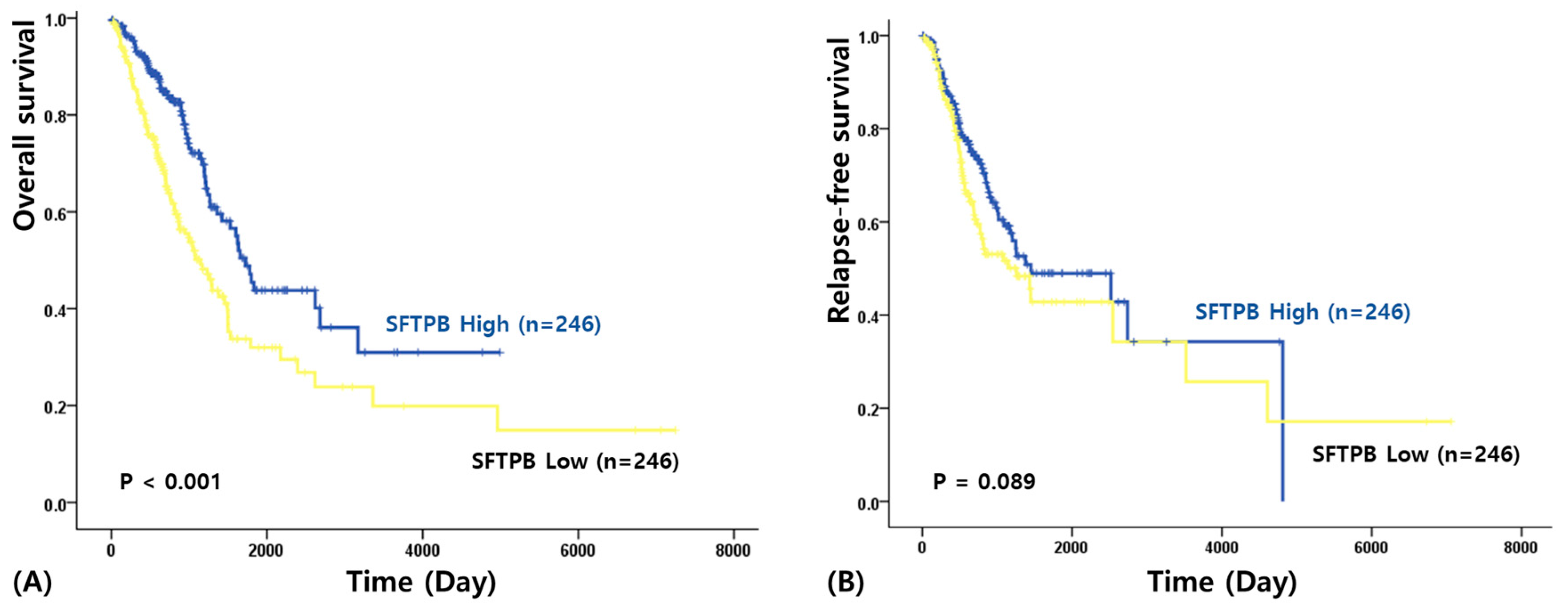
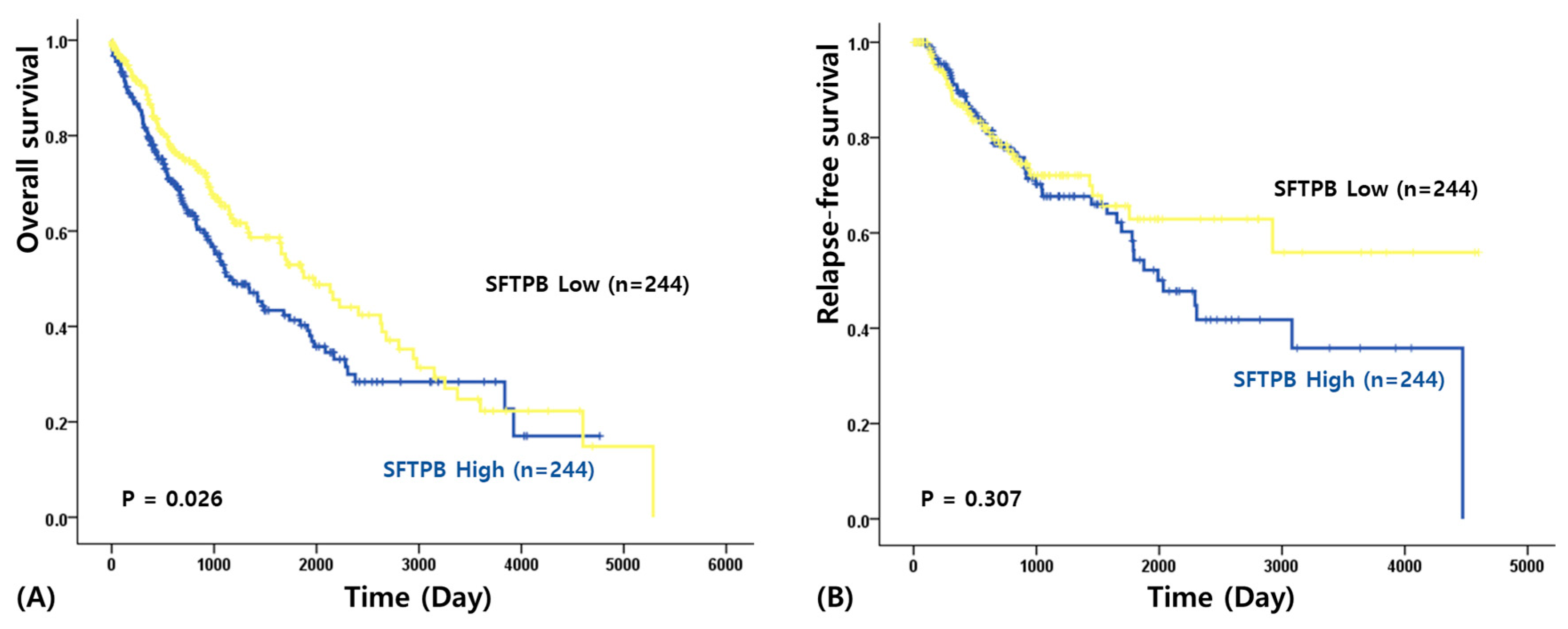
SFTPB Expression Predicts Favorable Survival in Lung Adenocarcinoma but Poor Prognosis in Lung Squamous Cell Carcinoma

Abstract
1. Introduction
2. Materials and Methods
2.1. TCGA Data Analysis
2.2. Statistical Analysis
3. Results

4. Discussion
5. Conclusions
Author Contributions
Funding
Institutional Review Board Statement
Informed Consent Statement
Data Availability Statement
Conflicts of Interest
References
- Sung, H.; Ferlay, J.; Siegel, R.L.; Laversanne, M.; Soerjomataram, I.; Jemal, A.; Bray, F. Global Cancer Statistics 2020: GLOBOCAN Estimates of Incidence and Mortality Worldwide for 36 Cancers in 185 Countries. CA Cancer J. Clin. 2021, 71, 209–249. [Google Scholar] [CrossRef] [PubMed]
- Odintsov, I.; Sholl, L.M. Prognostic and Predictive Biomarkers in Non-Small Cell Lung Carcinoma. Pathology 2024, 56, 192–204. [Google Scholar] [CrossRef]
- WHO Classification of Tumours Editorial Board. Thoracic Tumours, 5th ed.; International Agency for Research on Cancer: Lyon, France, 2021; Volume 5. [Google Scholar]
- Herbst, R.S.; Heymach, J.V.; Lippman, S.M. Lung Cancer. N. Engl. J. Med. 2008, 359, 1367–1380. [Google Scholar] [CrossRef]
- Chen, Z.; Fillmore, C.M.; Hammerman, P.S.; Kim, C.F.; Wong, K.K. Non-Small-Cell Lung Cancers: A Heterogeneous Set of Diseases. Nat. Rev. Cancer 2014, 14, 535–546. [Google Scholar] [CrossRef]
- Relli, V.; Trerotola, M.; Guerra, E.; Alberti, S. Abandoning the Notion of Non-Small Cell Lung Cancer. Trends Mol. Med. 2019, 25, 585–594. [Google Scholar] [CrossRef]
- Xiao, J.; Lu, X.; Chen, X.; Zou, Y.; Liu, A.; Li, W.; He, B.; He, S.; Chen, Q. Eight Potential Biomarkers for Distinguishing between Lung Adenocarcinoma and Squamous Cell Carcinoma. Oncotarget 2017, 8, 71759–71771. [Google Scholar] [CrossRef]
- Lu, C.; Chen, H.; Shan, Z.; Yang, L. Identification of Differentially Expressed Genes between Lung Adenocarcinoma and Lung Squamous Cell Carcinoma by Gene Expression Profiling. Mol. Med. Rep. 2016, 14, 1483–1490. [Google Scholar] [CrossRef] [PubMed]
- Zhan, C.; Yan, L.; Wang, L.; Sun, Y.; Wang, X.; Lin, Z.; Zhang, Y.; Shi, Y.; Jiang, W.; Wang, Q. Identification of Immunohistochemical Markers for Distinguishing Lung Adenocarcinoma from Squamous Cell Carcinoma. J. Thorac. Dis. 2015, 7, 1398–1405. [Google Scholar] [CrossRef] [PubMed]
- Cancer Genome Atlas Research Network. Comprehensive Molecular Profiling of Lung Adenocarcinoma. Nature 2014, 511, 543–550. [Google Scholar] [CrossRef] [PubMed]
- Pao, W.; Girard, N. New Driver Mutations in Non-Small-Cell Lung Cancer. Lancet Oncol. 2011, 12, 175–180. [Google Scholar] [CrossRef]
- Skoulidis, F.; Byers, L.A.; Diao, L.; Papadimitrakopoulou, V.A.; Tong, P.; Izzo, J.; Behrens, C.; Kadara, H.; Parra, E.R.; Canales, J.R.; et al. Co-Occurring Genomic Alterations Define Major Subsets of KRAS-Mutant Lung Adenocarcinoma with Distinct Biology, Immune Profiles, and Therapeutic Vulnerabilities. Cancer Discov. 2015, 5, 860–877. [Google Scholar] [CrossRef]
- Cancer Genome Atlas Research Network. Comprehensive Genomic Characterization of Squamous Cell Lung Cancers. Nature 2012, 489, 519–525. [Google Scholar] [CrossRef]
- Wang, N.J.; Sanborn, Z.; Arnett, K.L.; Bayston, L.J.; Liao, W.; Proby, C.M.; Leigh, I.M.; Collisson, E.A.; Gordon, P.B.; Jakkula, L.; et al. Loss-of-Function Mutations in Notch Receptors in Cutaneous and Lung Squamous Cell Carcinoma. Proc. Natl. Acad. Sci. USA 2011, 108, 17761–17766. [Google Scholar] [CrossRef]
- Whitsett, J.A.; Weaver, T.E. Hydrophobic Surfactant Proteins in Lung Function and Disease. N. Engl. J. Med. 2002, 347, 2141–2148. [Google Scholar] [CrossRef] [PubMed]
- Nogee, L.M. Genetic Causes of Surfactant Protein Abnormalities. Curr. Opin. Pediatr. 2019, 31, 330–339. [Google Scholar] [CrossRef]
- Travis, W.D.; Brambilla, E.; Noguchi, M.; Nicholson, A.G.; Geisinger, K.; Yatabe, Y.; Powell, C.A.; Beer, D.; Riely, G.; Garg, K.; et al. International Association for the Study of Lung Cancer/American Thoracic Society/European Respiratory Society: International Multidisciplinary Classification of Lung Adenocarcinoma: Executive Summary. Proc. Am. Thorac. Soc. 2011, 8, 381–385. [Google Scholar] [CrossRef] [PubMed]
- Zhang, L.; Whitsett, J.A.; Stripp, B.R. Regulation of Clara cell secretory protein gene transcription by thyroid transcription factor-1. Biochim. Biophys. Acta 1997, 1350, 359–367. [Google Scholar] [CrossRef]
- Shijubo, N.; Honda, Y.; Itoh, Y.; Nakanishi, F.; Hirasawa, M.; Abe, S. Surfactant Protein B as a Differentiation Marker in Lung Adenocarcinoma. Am. J. Respir. Crit. Care Med. 1995, 152, 1261–1266. [Google Scholar] [CrossRef]
- Weaver, T.E.; Conkright, J.J. Function of Surfactant Proteins B and C. Annu. Rev. Physiol. 2001, 63, 555–578. [Google Scholar] [CrossRef]
- Whitsett, J.A.; Wert, S.E.; Weaver, T.E. Alveolar Surfactant Homeostasis and the Pathogenesis of Pulmonary Disease. Annu. Rev. Med. 2010, 61, 105–119. [Google Scholar] [CrossRef]
- Polyak, K.; Weinberg, R.A. Transitions between Epithelial and Mesenchymal States: Acquisition of Malignant and Stem Cell Traits. Nat. Rev. Cancer 2009, 9, 265–273. [Google Scholar] [CrossRef] [PubMed]
- Peinado, H.; Olmeda, D.; Cano, A. Snail, Zeb and bHLH Factors in Tumour Progression: An Alliance against the Epithelial Phenotype? Nat. Rev. Cancer 2007, 7, 415–428. [Google Scholar] [CrossRef] [PubMed]



| AD | SCC | |||||
|---|---|---|---|---|---|---|
| High | Low | p-Value | High | Low | p-Value | |
| Age | ||||||
| ≤65 | 110 | 126 | 0.148 | 86 | 103 | 0.122 |
| >65 | 135 | 119 | 157 | 141 | ||
| Gender | ||||||
| Female | 133 | 133 | 1 | 70 | 56 | 0.140 |
| Male | 112 | 112 | 173 | 188 | ||
| Smoking status | ||||||
| Yes | 165 | 168 | 0.772 | 212 | 200 | 0.134 |
| No | 81 | 78 | 32 | 44 | ||
| Pathologic stage | ||||||
| Stage I | 149 | 113 | 0.011 | 134 | 103 | 0.009 |
| Stage II | 49 | 68 | 61 | 95 | ||
| Stage III | 34 | 45 | 42 | 41 | ||
| Stage IV | 9 | 15 | 4 | 3 | ||
| M stage | ||||||
| M0 | 166 | 113 | 0.184 | 202 | 198 | 0.727 |
| M1 | 9 | 15 | 4 | 3 | ||
| N stage | ||||||
| N0 | 175 | 141 | 0.006 | 163 | 147 | 0.007 |
| N1 | 36 | 57 | 49 | 77 | ||
| N2 | 28 | 40 | 21 | 19 | ||
| N3 | 0 | 2 | 5 | 0 | ||
| T stage | ||||||
| T1 | 90 | 74 | 0.501 | 60 | 48 | 0.343 |
| T2 | 124 | 136 | 143 | 143 | ||
| T3 | 22 | 23 | 31 | 39 | ||
| T4 | 8 | 10 | 9 | 14 | ||
| SFTPB | EGFR | KRAS | TP53 | ALK | BRAF | Age | ||
|---|---|---|---|---|---|---|---|---|
| SFTPB | R | 1 | −0.140 | −0.076 | 0.128 | 0.044 | −0.177 | 0.028 |
| P | 0.002 | 0.090 | 0.004 | 0.332 | <0.001 | 0.533 | ||
| EGFR | R | −0.140 | 1 | 0.011 | −0.123 | −0.024 | 0.061 | −0.001 |
| P | 0.002 | 0.810 | 0.007 | 0.595 | 0.177 | 0.983 | ||
| KRAS | R | −0.076 | 0.011 | 1 | −0.057 | −0.004 | 0.080 | −0.022 |
| P | 0.090 | 0.810 | 0.209 | 0.934 | 0.078 | 0.624 | ||
| TP53 | R | 0.128 | −0.123 | −0.057 | 1 | 0.067 | −0.003 | 0.072 |
| P | 0.004 | 0.007 | 0.209 | 0.139 | 0.940 | 0.112 | ||
| ALK | R | 0.044 | −0.024 | −0.004 | 0.067 | 1 | −0.040 | −0.048 |
| P | 0.332 | 0.595 | 0.934 | 0.139 | 0.372 | 0.291 | ||
| BRAF | R | −0.177 | 0.061 | 0.080 | −0.003 | −0.040 | 1 | −0.050 |
| P | <0.001 | 0.177 | 0.078 | 0.940 | 0.372 | 0.265 | ||
| Age | R | 0.028 | −0.001 | −0.022 | 0.072 | −0.048 | −0.050 | 1 |
| P | 0.533 | 0.983 | 0.624 | 0.112 | 0.291 | 0.265 | ||
| SFTPB | TP53 | CDKN2A | SOX2 | PIK3CA | NOTCH1 | Age | ||
|---|---|---|---|---|---|---|---|---|
| SFTPB | R | 1 | −0.101 | −0.085 | −0.176 | −0.143 | −0.050 | 0.036 |
| P | 0.026 | 0.062 | <0.001 | 0.002 | 0.273 | 0.431 | ||
| TP53 | R | −0.101 | 1 | −0.011 | 0.058 | 0.050 | 0.196 | −0.045 |
| P | 0.026 | 0.810 | 0.200 | 0.273 | <0.001 | 0.326 | ||
| CDKN2A | R | −0.085 | −0.011 | 1 | −0.004 | −0.014 | −0.074 | −0.012 |
| P | 0.062 | 0.810 | 0.929 | 0.761 | 0.104 | 0.788 | ||
| SOX2 | R | −0.176 | 0.058 | −0.004 | 1 | 0.528 | 0.004 | −0.116 |
| P | <0.001 | 0.200 | 0.929 | <0.001 | 0.933 | 0.011 | ||
| PIK3CA | R | −0.143 | 0.050 | −0.014 | 0.528 | 1 | −0.032 | −0.025 |
| P | 0.002 | 0.273 | 0.761 | <0.001 | 0.482 | 0.584 | ||
| NOTCH1 | R | −0.050 | 0.196 | −0.074 | 0.004 | −0.032 | 1 | −0.012 |
| P | 0.273 | <0.001 | 0.104 | 0.933 | 0.482 | 0.785 | ||
| Age | R | 0.036 | −0.045 | −0.012 | −0.116 | −0.025 | −0.012 | 1 |
| P | 0.431 | 0.326 | 0.788 | 0.011 | 0.584 | 0.785 | ||
| Variable | AD HR (95% CI) | p-Value | SCC HR (95% CI) | p-Value |
|---|---|---|---|---|
| Age | 1.011 (0.996–1.027) | 0.148 | 1.017 (1.001–1.035) | 0.042 |
| Male vs. Female | 1.104 (0.822–1.481) | 0.511 | 1.239 (0.902–1.702) | 0.186 |
| Stage III–IV vs. I–II | 2.247 (1.641–3.077) | <0.001 | 1.574 (1.143–2.168) | 0.005 |
| SFTPB High vs. Low | 0.551 (0.405–0.748) | <0.001 | 1.347 (1.028–1.767) | 0.031 |
Disclaimer/Publisher’s Note: The statements, opinions and data contained in all publications are solely those of the individual author(s) and contributor(s) and not of MDPI and/or the editor(s). MDPI and/or the editor(s) disclaim responsibility for any injury to people or property resulting from any ideas, methods, instructions or products referred to in the content. |
© 2026 by the authors. Published by MDPI on behalf of the Lithuanian University of Health Sciences. Licensee MDPI, Basel, Switzerland. This article is an open access article distributed under the terms and conditions of the Creative Commons Attribution (CC BY) license.
Share and Cite
Kim, S.; Hong, H.; Lee, J.-H. SFTPB Expression Predicts Favorable Survival in Lung Adenocarcinoma but Poor Prognosis in Lung Squamous Cell Carcinoma. Medicina 2026, 62, 1140. https://doi.org/10.3390/medicina62061140
Kim S, Hong H, Lee J-H. SFTPB Expression Predicts Favorable Survival in Lung Adenocarcinoma but Poor Prognosis in Lung Squamous Cell Carcinoma. Medicina. 2026; 62(6):1140. https://doi.org/10.3390/medicina62061140
Chicago/Turabian StyleKim, Soonsoo, Hyowon Hong, and Jae-Ho Lee. 2026. "SFTPB Expression Predicts Favorable Survival in Lung Adenocarcinoma but Poor Prognosis in Lung Squamous Cell Carcinoma" Medicina 62, no. 6: 1140. https://doi.org/10.3390/medicina62061140
APA StyleKim, S., Hong, H., & Lee, J.-H. (2026). SFTPB Expression Predicts Favorable Survival in Lung Adenocarcinoma but Poor Prognosis in Lung Squamous Cell Carcinoma. Medicina, 62(6), 1140. https://doi.org/10.3390/medicina62061140