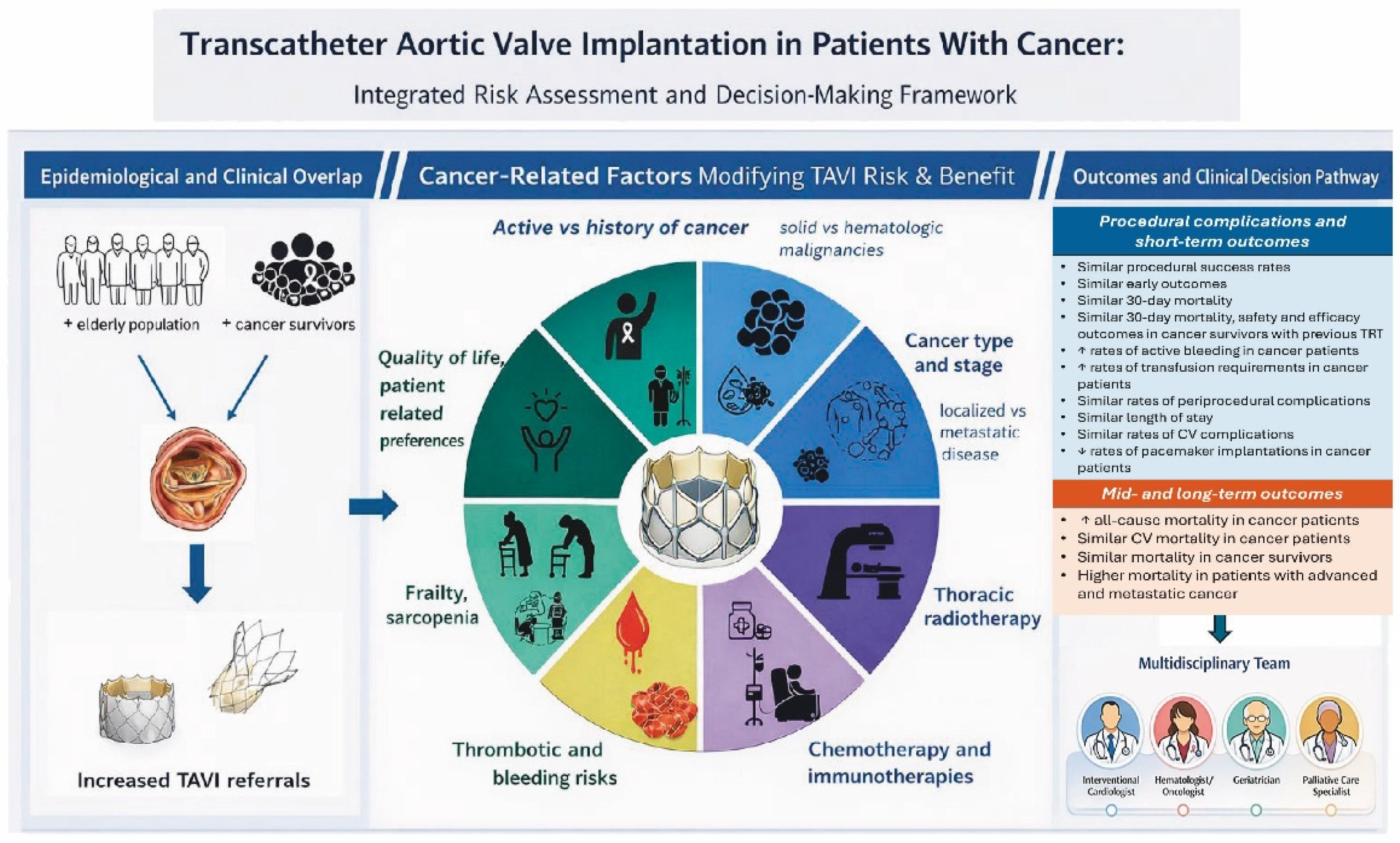
Transcatheter Aortic Valve Implantation in Cancer Patients: A Contemporary Review of the Specific Challenges, the Outcomes, Risk Stratification, and Decision-Making
 ,
,  ,
,  and
and
Abstract
1. Introduction
2. Methodology
3. Epidemiological Overlap Between Cancer and Aortic Stenosis
4. Cancer-Specific Challenges in TAVI
4.1. Heterogeneity of Cancer Types, Stages, and Prognoses
4.2. Hematologic Malignancies
4.3. Active Cancer vs. Cancer Survivorship
4.4. Thoracic Radiotherapy
4.5. Competing Thrombotic and Bleeding Risks: Implications for Post-TAVI Antithrombotic Therapy
4.6. Immunosuppression and Risk of Infection
4.7. Frailty, Nutritional Status, Cachexia, and Sarcopenia
5. Clinical Outcomes of TAVI in Cancer Patients
5.1. Procedural Success and Short-Term Outcomes
5.2. Procedural Complications
5.3. Mid- and Long-Term Survival
5.4. Active vs. History of Cancer: Differential Outcomes
5.5. Symptom Relief and Functional Status After TAVI
5.6. Comparison with Surgical Aortic Valve Replacement
6. Risk Stratification and Decision-Making in Cancer Patients
7. Gaps in Evidence and Future Directions
- Under-representation of cancer patients in clinical trials.
- Lack of standardized definitions for cancer status and outcomes.
- Limited integration of oncology-specific prognostic tools.
- Multidimensional geriatric assessment in patient selection.
- Insufficient data on optimal antithrombotic strategies.
- Long-term outcomes and valve durability.
- Patient-reported outcomes and quality-of-life measures.
- Integration of cardio-oncology and structural heart programs.
8. Limitations
9. Conclusions
Author Contributions
Funding
Institutional Review Board Statement
Informed Consent Statement
Data Availability Statement
Conflicts of Interest
References
- Cribier, A.; Eltchaninoff, H.; Bash, A.; Borenstein, N.; Tron, C.; Bauer, F.; Derumeaux, G.; Anselme, F.; Laborde, F.; Leon, M.B. Percutaneous transcatheter implantation of an aortic valve prosthesis for calcific aortic stenosis: First human case description. Circulation 2002, 106, 3006–3008. [Google Scholar] [CrossRef]
- Sundt, T.M.; Jneid, H. Guideline Update on Indications for Transcatheter Aortic Valve Implantation Based on the 2020 American College of Cardiology/American Heart Association Guidelines for Management of Valvular Heart Disease. JAMA Cardiol. 2021, 6, 1088–1089. [Google Scholar] [CrossRef]
- Praz, F.; Borger, M.A.; Lanz, J.; Marin-Cuartas, M.; Abreu, A.; Adamo, M.; Marsan, N.A.; Barili, F.; Bonaros, N.; Cosyns, B.; et al. 2025 ESC/EACTS Guidelines for the management of valvular heart disease: Developed by the task force for the management of valvular heart disease of the European Society of Cardiology (ESC) and the European Association for Cardio-Thoracic Surgery (EACTS). Eur. Heart J. 2025, 46, 4635–4736. [Google Scholar] [CrossRef]
- Santangelo, G.; Moscardelli, S.; Barbieri, L.; Faggiano, A.; Carugo, S.; Faggiano, P. Aortic Valve Stenosis and Cancer: Problems of Management. J. Clin. Med. 2023, 12, 5804. [Google Scholar] [CrossRef]
- Giza, D.E.; Iliescu, G.; Hassan, S.; Marmagkiolis, K.; Iliescu, C. Cancer as a Risk Factor for Cardiovascular Disease. Curr. Oncol. Rep. 2017, 19, 39. [Google Scholar] [CrossRef] [PubMed]
- Abruzzo, A.R.; McGurk, S.; Tolis, G., Jr.; Aranki, S.; Sabe, A.; Cunningham, M.J.; Nohria, A.; Itoh, A. Outcomes of surgical valve replacements for radiation-induced valvulopathy. JTCVS Open 2025, 23, 134–146. [Google Scholar] [CrossRef] [PubMed]
- Smith, C.R.; Leon, M.B.; Mack, M.J.; Miller, D.C.; Moses, J.W.; Svensson, L.G.; Tuzcu, E.M.; Webb, J.G.; Fontana, G.P.; Makkar, R.R.; et al. Transcatheter versus surgical aortic-valve replacement in high-risk patients. N. Engl. J. Med. 2011, 364, 2187–2198. [Google Scholar] [CrossRef]
- Leon, M.B.; Smith, C.R.; Mack, M.J.; Makkar, R.R.; Svensson, L.G.; Kodali, S.K.; Thourani, V.H.; Tuzcu, E.M.; Miller, D.C.; Herrmann, H.C.; et al. Transcatheter or Surgical Aortic-Valve Replacement in Intermediate-Risk Patients. N. Engl. J. Med. 2016, 374, 1609–1620. [Google Scholar] [CrossRef]
- Mack, M.J.; Leon, M.B.; Thourani, V.H.; Makkar, R.; Kodali, S.K.; Russo, M.; Kapadia, S.R.; Malaisrie, S.C.; Cohen, D.J.; Pibarot, P.; et al. Transcatheter Aortic-Valve Replacement with a Balloon-Expandable Valve in Low-Risk Patients. N. Engl. J. Med. 2019, 380, 1695–1705. [Google Scholar] [CrossRef]
- Kapadia, S.R.; Leon, M.B.; Makkar, R.R.; Tuzcu, E.M.; Svensson, L.G.; Kodali, S.; Webb, J.G.; Mack, M.J.; Douglas, P.S.; Thourani, V.H.; et al. 5-year outcomes of transcatheter aortic valve replacement compared with standard treatment for patients with inoperable aortic stenosis (PARTNER 1): A randomised controlled trial. Lancet 2015, 385, 2485–2491. [Google Scholar] [CrossRef] [PubMed]
- Reardon, M.J.; Adams, D.H.; Kleiman, N.S.; Yakubov, S.J.; Coselli, J.S.; Deeb, G.M.; Gleason, T.G.; Lee, J.S.; Hermiller, J.B.; Chetcuti, S.; et al. 2-Year Outcomes in Patients Undergoing Surgical or Self-Expanding Transcatheter Aortic Valve Replacement. J. Am. Coll. Cardiol. 2015, 66, 113–121. [Google Scholar]
- Mangner, N.; Woitek, F.J.; Haussig, S.; Holzhey, D.; Stachel, G.; Schlotter, F.; Höllriegel, R.; Mohr, F.W.; Schuler, G.; Linke, A. Impact of active cancer disease on the outcome of patients undergoing transcatheter aortic valve replacement. J. Interv. Cardiol. 2018, 31, 188–196. [Google Scholar] [CrossRef]
- Felix, N.; Nogueira, A.; Carvalho, P.E.P.; Costa, T.A.; Tramujas, L.; Generoso, G.; Feldman, S.; Garot, P.; de Farias, M.D.C.A.D. Outcomes of patients with active cancer after transcatheter aortic valve replacement: An updated meta-analysis. Cardio-Oncology 2024, 10, 55. [Google Scholar] [CrossRef]
- Bendary, A.; Ramzy, A.; Bendary, M.; Salem, M. Transcatheter aortic valve replacement in patients with severe aortic stenosis and active cancer: A systematic review and meta-analysis. Open Heart 2020, 7, e001131. [Google Scholar] [CrossRef] [PubMed]
- Saberian, P.; Contreras, R.; Gurram, A.; Nasrollahizadeh, A.; Keetha, N.R.; Nguyen, A.L.; Nayak, S.S.; Keivanlou, M.; Hashemi, M.; Amini-Salehi, E.; et al. Clinical Outcomes and Prognostic Implications of TAVR in Patients With Active Cancer: A Meta-Analysis. Clin. Cardiol. 2025, 48, e70121. [Google Scholar] [CrossRef]
- Noguchi, M.; Tabata, M.; Ito, J.; Kato, N.; Obunai, K.; Watanabe, H.; Yashima, F.; Watanabe, Y.; Naganuma, T.; Yamawaki, M.; et al. Midterm outcomes of transcatheter aortic valve replacement in patients with active cancer. Open Heart 2024, 11, e002573. [Google Scholar] [CrossRef]
- Landes, U.; Iakobishvili, Z.; Vronsky, D.; Zusman, O.; Barsheshet, A.; Jaffe, R.; Jubran, A.; Yoon, S.-H.; Makkar, R.R.; Taramasso, M.; et al. Transcatheter Aortic Valve Replacement in Oncology Patients With Severe Aortic Stenosis. JACC Cardiovasc. Interv. 2019, 12, 78–86. [Google Scholar] [CrossRef] [PubMed]
- Ahsan, U.; Naz, S.; Anum, A.; Unum, A.; Hamza, R.M.; Qasim, R.M.; Taaruf, A.; Khan, N. Outcomes and Adverse Effects of Transcatheter Aortic Valve Replacement (TAVR) in Cancer Patients: A Meta-Analysis. Cureus 2024, 16, e73442. [Google Scholar] [CrossRef]
- Siegel, R.L.; Kratzer, T.B.; Giaquinto, A.N.; Sung, H.; Jemal, A. Cancer statistics, 2025. CA Cancer J. Clin. 2025, 75, 10–45. [Google Scholar] [CrossRef] [PubMed]
- Osnabrugge, R.L.; Mylotte, D.; Head, S.J.; Van Mieghem, N.M.; Nkomo, V.T.; LeReun, C.M.; Bogers, A.J.J.C.; Piazza, N.; Kappetein, A.P. Aortic stenosis in the elderly: Disease prevalence and number of candidates for transcatheter aortic valve replacement: A meta-analysis and modeling study. J. Am. Coll. Cardiol. 2013, 62, 1002–1012. [Google Scholar]
- Otto, C.M.; Prendergast, B. Aortic-valve stenosis--from patients at risk to severe valve obstruction. N. Engl. J. Med. 2014, 371, 744–756. [Google Scholar] [CrossRef]
- Giovannucci, E.; Harlan, D.M.; Archer, M.C.; Bergenstal, R.M.; Gapstur, S.M.; Habel, L.A.; Pollak, M.; Regensteiner, J.G.; Yee, D. Diabetes and cancer: A consensus report. Diabetes Care 2010, 33, 1674–1685. [Google Scholar] [CrossRef]
- Hanahan, D.; Weinberg, R.A. Hallmarks of cancer: The next generation. Cell 2011, 144, 646–674. [Google Scholar] [CrossRef]
- Yuan, F.; Wen, W.; Jia, G.; Long, J.; Shu, X.O.; Zheng, W. Serum Lipid Profiles and Cholesterol-Lowering Medication Use in Relation to Subsequent Risk of Colorectal Cancer in the UK Biobank Cohort. Cancer Epidemiol. Biomark. Prev. 2023, 32, 524–530. [Google Scholar] [CrossRef]
- Wong, G.; Hayen, A.; Chapman, J.R.; Webster, A.C.; Wang, J.J.; Mitchell, P.; Craig, J.C. Association of CKD and cancer risk in older people. J. Am. Soc. Nephrol. 2009, 20, 1341–1350. [Google Scholar] [CrossRef] [PubMed]
- Thanassoulis, G.; Campbell, C.Y.; Owens, D.S.; Smith, J.G.; Smith, A.V.; Peloso, G.M.; Kerr, K.F.; Pechlivanis, S.; Budoff, M.J.; Harris, T.B.; et al. Genetic associations with valvular calcification and aortic stenosis. N. Engl. J. Med. 2013, 368, 503–512. [Google Scholar] [CrossRef] [PubMed]
- Rattazzi, M.; Bertacco, E.; Del Vecchio, A.; Puato, M.; Faggin, E.; Pauletto, P. Aortic valve calcification in chronic kidney disease. Nephrol. Dial. Transplant. 2013, 28, 2968–2976. [Google Scholar] [CrossRef] [PubMed]
- Stewart, B.F.; Siscovick, D.; Lind, B.K.; Gardin, J.M.; Gottdiener, J.S.; Smith, V.E.; Kitzman, D.W.; Otto, C.M. Clinical factors associated with calcific aortic valve disease. Cardiovascular Health Study. J. Am. Coll. Cardiol. 1997, 29, 630–634. [Google Scholar] [CrossRef]
- Cutter, D.J.; Schaapveld, M.; Darby, S.C.; Hauptmann, M.; van Nimwegen, F.A.; Krol, A.D.; Janus, C.P.; van Leeuwen, F.E.; Aleman, B.M. Risk of valvular heart disease after treatment for Hodgkin lymphoma. J. Natl. Cancer Inst. 2015, 107, djv008. [Google Scholar] [CrossRef]
- Lee, C.; Hahn, R.T. Valvular Heart Disease Associated With Radiation Therapy: A Contemporary Review. Struct. Heart J. Heart Team 2023, 7, 100104. [Google Scholar] [CrossRef]
- Belzile-Dugas, E.; Eisenberg, M.J. Radiation-Induced Cardiovascular Disease: Review of an Underrecognized Pathology. J. Am. Heart Assoc. 2021, 10, e021686. [Google Scholar] [CrossRef] [PubMed]
- Hull, M.C.; Morris, C.G.; Pepine, C.J.; Mendenhall, N.P. Valvular dysfunction and carotid, subclavian, and coronary artery disease in survivors of hodgkin lymphoma treated with radiation therapy. JAMA 2003, 290, 2831–2837. [Google Scholar] [CrossRef]
- Leedy, D.; Elison, D.M.; Farias, F.; Cheng, R.; McCabe, J.M. Transcatheter aortic valve intervention in patients with cancer. Heart (Br. Card. Soc.) 2023, 109, 1508–1515. [Google Scholar] [CrossRef] [PubMed]
- Sung, H.; Ferlay, J.; Siegel, R.L.; Laversanne, M.; Soerjomataram, I.; Jemal, A.; Bray, F. Global Cancer Statistics 2020: GLOBOCAN Estimates of Incidence and Mortality Worldwide for 36 Cancers in 185 Countries. CA Cancer J. Clin. 2021, 71, 209–249. [Google Scholar] [CrossRef]
- Siegel, R.L.; Miller, K.D.; Wagle, N.S.; Jemal, A. Cancer statistics, 2023. CA Cancer J. Clin. 2023, 73, 17–48. [Google Scholar] [CrossRef]
- Khorana, A.A.; Francis, C.W.; Culakova, E.; Fisher, R.I.; Kuderer, N.M.; Lyman, G.H. Thromboembolism in hospitalized neutropenic cancer patients. J. Clin. Oncol. 2006, 24, 484–490. [Google Scholar] [CrossRef]
- Vahanian, A.; Beyersdorf, F.; Praz, F.; Milojevic, M.; Baldus, S.; Bauersachs, J.; Capodanno, D.; Conradi, L.; De Bonis, M.; De Paulis, R.; et al. 2021 ESC/EACTS Guidelines for the management of valvular heart disease. Eur. Heart J. 2022, 43, 561–632. [Google Scholar] [CrossRef]
- Otto, C.M.; Nishimura, R.A.; Bonow, R.O.; Carabello, B.A.; Erwin, J.P., III; Gentile, F.; Jneid, H.; Krieger, E.V.; Mack, M.; McLeod, C.; et al. 2020 ACC/AHA Guideline for the Management of Patients With Valvular Heart Disease: Executive Summary: A Report of the American College of Cardiology/American Heart Association Joint Committee on Clinical Practice Guidelines. Circulation 2021, 143, e35–e71. [Google Scholar] [CrossRef] [PubMed]
- Shahid, K.; Khalife, M.; Dabney, R.; Phan, A.T. Immunotherapy and targeted therapy-the new roadmap in cancer treatment. Ann. Transl. Med. 2019, 7, 595. [Google Scholar]
- Vanneman, M.; Dranoff, G. Combining immunotherapy and targeted therapies in cancer treatment. Nat. Rev. Cancer 2012, 12, 237–251. [Google Scholar] [CrossRef]
- Liu, Z.; Aguayo, E.; Porter, G.; Ali, K.; Zinoviev, R.; Benharash, P. Association of hematological malignancies with clinical and financial outcomes following transcatheter aortic valve replacement. Clinics 2025, 80, 100741. [Google Scholar] [CrossRef]
- Biancari, F.; Dahlbacka, S.; Juvonen, T.; Virtanen, M.P.O.; Maaranen, P.; Jaakkola, J.; Laakso, T.; Niemelä, M.; Tauriainen, T.; Vento, A.; et al. Favorable outcome of cancer patients undergoing transcatheter aortic valve replacement. Int. J. Cardiol. 2020, 315, 86–89. [Google Scholar] [CrossRef]
- Balanescu, S.M.; Balanescu, D.V.; Donisan, T.; Yang, E.H.; Palaskas, N.; Lopez-Mattei, J.; Hassan, S.; Kim, P.; Cilingiroglu, M.; Marmagkiolis, K.; et al. The Onco-cardiologist Dilemma: To Implant, to Defer, or to Avoid Transcatheter Aortic Valve Replacement in Cancer Patients with Aortic Stenosis? Curr. Cardiol. Rep. 2019, 21, 83. [Google Scholar] [CrossRef]
- Sarı, C.; Ayhan, H.; Baştuğ, S.; Kasapkara, H.A.; Karaduman, B.D.; Aslan, A.N.; Özen, M.B.; Bilen, E.; Bayram, N.A.; Keleş, T.; et al. Transcatheter aortic valve implantation in the presence of hematologic malignancies. Turk. Kardiyol. Dern. Ars. 2015, 43, 529–535. [Google Scholar] [CrossRef][Green Version]
- Garot, P.; Morice, M.C.; Angiolillo, D.J.; Cabau, J.R.; Park, D.W.; Van Mieghem, N.M.; Collet, J.-P.; Leon, M.B.; Sengottuvelu, G.; Neylon, A.; et al. Defining high bleeding risk in patients undergoing transcatheter aortic valve implantation: A VARC-HBR consensus document. EuroIntervention 2024, 20, 536–550. [Google Scholar] [CrossRef]
- Iliescu, C.A.; Grines, C.L.; Herrmann, J.; Yang, E.H.; Cilingiroglu, M.; Charitakis, K.; Hakeem, A.; Toutouzas, K.P.; Leesar, M.A.; Marmagkiolis, K. SCAI Expert consensus statement: Evaluation, management, and special considerations of cardio-oncology patients in the cardiac catheterization laboratory (endorsed by the cardiological society of india, and sociedad Latino Americana de Cardiologıa intervencionista). Catheter. Cardiovasc. Interv. 2016, 87, E202–E223. [Google Scholar]
- Nobre Menezes, M.; Tavares da Silva, M.; Magalhães, A.; Melica, B.; Toste, J.C.; Calé, R.; Almeida, M.; Fiuza, M.; de Oliveira, E.I. Interventional cardiology in cancer patients: A position paper from the Portuguese Cardiovascular Intervention Association and the Portuguese Cardio-Oncology Study Group of the Portuguese Society of Cardiology. Rev. Port. Cardiol. 2024, 43, 35–48. [Google Scholar] [CrossRef] [PubMed]
- Cequier, Á.; Pérez de Prado, A.; Moreno, R.; Cosín-Sales, J.; López de Sá, E.; Evangelista, A.; Bueno, H.; Anguita, M. Percutaneous cardiological intervention and cardiac surgery: Patient-centered care. Position statement of the Spanish Society of Cardiology. Rev. Esp. Cardiol. 2019, 72, 658–663. [Google Scholar] [CrossRef]
- Bergom, C.; Bradley, J.A.; Ng, A.K.; Samson, P.; Robinson, C.; Lopez-Mattei, J.; Mitchell, J.D. Past, Present, and Future of Radiation-Induced Cardiotoxicity: Refinements in Targeting, Surveillance, and Risk Stratification. JACC Cardio Oncol. 2021, 3, 343–359. [Google Scholar] [CrossRef] [PubMed]
- Cella, L.; Oh, J.H.; Deasy, J.O.; Palma, G.; Liuzzi, R.; D’avino, V.; Conson, M.; Picardi, M.; Salvatore, M.; Pacelli, R. Predicting radiation-induced valvular heart damage. Acta Oncol. 2015, 54, 1796–1804. [Google Scholar] [CrossRef] [PubMed] [PubMed Central]
- Agrawal, N.; Kattel, S.; Waheed, S.; Kapoor, A.; Singh, V.; Sharma, A.; Page, B.J.; Attwood, K.M.; Iyer, V.; Pokharel, S.; et al. Clinical Outcomes after Transcatheter Aortic Valve Replacement in Cancer Survivors Treated with Ionizing Radiation. Cardio-Oncology 2019, 5, 8. [Google Scholar] [CrossRef]
- Patil, S.; Pingle, S.R.; Shalaby, K.; Kim, A.S. Mediastinal irradiation and valvular heart disease. Cardio-Oncology 2022, 8, 7. [Google Scholar] [CrossRef]
- Mitchell, J.D.; Cehic, D.A.; Morgia, M.; Bergom, C.; Toohey, J.; Guerrero, P.A.; Ferencik, M.; Kikuchi, R.; Carver, J.R.; Zaha, V.G.; et al. Cardiovascular Manifestations from Therapeutic Radiation: A Multidisciplinary Expert Consensus Statement From the International Cardio-Oncology Society. JACC Cardio Oncol. 2021, 3, 360–380. [Google Scholar] [CrossRef]
- Allen, C.J.; Patterson, T.; Prendergast, B.; Roberts-Thompson, R.L.; Rajani, R.; Redwood, S.R. Simultaneous Transcatheter Double Valve Treatment of Mediastinal Radiation-Induced Severe Calcific Aortic and Mitral Stenosis. JACC Case Rep. 2020, 2, 1443–1447. [Google Scholar] [CrossRef]
- Buller, H.R.; van Doormaal, F.F.; van Sluis, G.L.; Kamphuisen, P.W. Cancer and thrombosis: From molecular mechanisms to clinical presentations. J. Thromb. Haemost. 2007, 5, 246–254. [Google Scholar] [CrossRef]
- Sud, R.; Khorana, A.A. Cancer-associated thrombosis: Risk factors, candidate biomarkers and a risk model. Thromb. Res. 2009, 123, S18–S21. [Google Scholar] [CrossRef]
- Franchini, M.; Tufano, A.; Casoria, A.; Coppola, A. Arterial Thrombosis in Cancer Patients: An Update. Semin. Thromb. Hemost. 2021, 47, 942–949. [Google Scholar] [CrossRef]
- Frere, C.; Font, C.; Esposito, F.; Crichi, B.; Girard, P.; Janus, N. Incidence, risk factors, and management of bleeding in patients receiving anticoagulants for the treatment of cancer-associated thrombosis. Support. Care Cancer 2022, 30, 2919–2931. [Google Scholar] [CrossRef]
- Ten Berg, J.; Sibbing, D.; Rocca, B.; Van Belle, E.; Chevalier, B.; Collet, J.P.; Dudek, D.; Gilard, M.; Gorog, D.A.; Grapsa, J.; et al. Management of antithrombotic therapy in patients undergoing transcatheter aortic valve implantation: A consensus document of the ESC Working Group on Thrombosis and the European Association of Percutaneous Cardiovascular Interventions (EAPCI), in collaboration with the ESC Council on Valvular Heart Disease. Eur. Heart J. 2021, 42, 2265–2269. [Google Scholar] [CrossRef]
- Nijenhuis, V.J.; Brouwer, J.; Søndergaard, L.; Collet, J.P.; Grove, E.L.; Ten Berg, J.M. Antithrombotic therapy in patients undergoing transcatheter aortic valve implantation. Heart 2019, 105, 742–748. [Google Scholar] [CrossRef]
- Cereda, A.; Lucreziotti, S.; Franchina, A.G.; Laricchia, A.; De Regibus, V.; Conconi, B.; Carlà, M.; Spangaro, A.; Rocchetti, M.; Ponti, L.; et al. Systematic Review and Meta-Analysis of Oral Anticoagulant Therapy in Atrial Fibrillation Cancer Patients. Cancers 2023, 15, 2574. [Google Scholar] [CrossRef]
- Naidu, M.U.; Ramana, G.V.; Rani, P.U.; Mohan, I.K.; Suman, A.; Roy, P. Chemotherapy-induced and/or radiation therapy-induced oral mucositis--complicating the treatment of cancer. Neoplasia 2004, 6, 423–431. [Google Scholar] [CrossRef]
- Falanga, A.; Leader, A.; Ambaglio, C.; Bagoly, Z.; Castaman, G.; Elalamy, I.; Lecumberri, R.; Niessner, A.; Pabinger, I.; Szmit, S.; et al. EHA Guidelines on Management of Antithrombotic Treatments in Thrombocytopenic Patients With Cancer. Hemasphere 2022, 6, e750. [Google Scholar] [CrossRef]
- Rapoport, B.L. Management of the cancer patient with infection and neutropenia. Semin. Oncol. 2011, 38, 424–430. [Google Scholar] [CrossRef]
- Seo, S.K.; Liu, C.; Dadwal, S.S. Infectious Disease Complications in Patients with Cancer. Crit. Care Clin. 2021, 37, 69–84. [Google Scholar] [CrossRef]
- Strange, J.E.; Østergaard, L.; Køber, L.; Bundgaard, H.; Iversen, K.; Voldstedlund, M.; Gislason, G.H.; Olesen, J.B.; Fosbøl, E.L. Patient Characteristics, Microbiology, and Mortality of Infective Endocarditis After Transcatheter Aortic Valve Implantation. Clin. Infect. Dis. 2023, 77, 1617–1625. [Google Scholar] [CrossRef]
- Afilalo, J.; Lauck, S.; Kim, D.H.; Lefèvre, T.; Piazza, N.; Lachapelle, K.; Martucci, G.; Lamy, A.; Labinaz, M.; Peterson, M.D.; et al. Frailty in Older Adults Undergoing Aortic Valve Replacement: The FRAILTY-AVR Study. J. Am. Coll. Cardiol. 2017, 70, 689–700. [Google Scholar] [CrossRef]
- Green, P.; Arnold, S.V.; Cohen, D.J.; Kirtane, A.J.; Kodali, S.K.; Brown, D.L.; Rihal, C.S.; Xu, K.; Lei, Y.; Hawkey, M.C.; et al. Relation of frailty to outcomes after transcatheter aortic valve replacement (from the PARTNER trial). Am. J. Cardiol. 2015, 116, 264–269. [Google Scholar] [CrossRef]
- Mohile, S.G.; Velarde, C.; Hurria, A.; Magnuson, A.; Lowenstein, L.; Pandya, C.; O’Donovan, A.; Gorawara-Bhat, R.; Dale, W. Geriatric Assessment-Guided Care Processes for Older Adults: A Delphi Consensus of Geriatric Oncology Experts. J. Natl. Compr. Cancer Netw. 2015, 13, 1120–1130. [Google Scholar] [CrossRef]
- Wildiers, R.A.; Mohile, S.; Repetto, L.; Van Leeuwen, B.; Milisen, K.; Hurria, A. International Society of Geriatric Oncology consensus on geriatric assessment in older patients with cancer. J. Clin. Oncol. 2014, 32, 2595–2603. [Google Scholar] [CrossRef] [PubMed] [PubMed Central]
- Stortecky, S.; Schoenenberger, A.W.; Moser, A.; Kalesan, B.; Jüni, P.; Carrel, T.; Bischoff, S.; Schoenenberger, C.M.; Stuck, A.E.; Windecker, S.; et al. Evaluation of multidimensional geriatric assessment as a predictor of mortality and cardiovascular events after transcatheter aortic valve implantation. JACC Cardiovasc. Interv. 2012, 5, 489–496. [Google Scholar] [CrossRef] [PubMed]
- Kosaraju, N.; Wu, P.; Leng, M.; Bolano, M.; Rafique, A.M.; Shen, J.; Satou, N.; Huchting, J.; Goldwater, D.; Aksoy, O.; et al. Impact of frailty on mortality and quality of life in patients with a history of cancer undergoing transcatheter aortic valve replacement. Clin. Cardiol. 2022, 45, 977–985. [Google Scholar] [CrossRef]
- Damluji, A.A.; Alfaraidhy, M.; AlHajri, N.; Rohant, N.N.; Kumar, M.; Al Malouf, C.; Bahrainy, S.; Kwak, M.J.; Batchelor, W.B.; Forman, D.E.; et al. Sarcopenia and Cardiovascular Diseases. Circulation 2023, 147, 1534–1553. [Google Scholar] [CrossRef]
- Zhang, Y.; Zhang, J.; Zhan, Y.; Pan, Z.; Liu, Q.; Yuan, W. Sarcopenia Is a Prognostic Factor of Adverse Effects and Mortality in Patients With Tumour: A Systematic Review and Meta-Analysis. J. Cachexia Sarcopenia Muscle 2024, 15, 2295–2310. [Google Scholar] [CrossRef]
- Ansaripour, A.; Arjomandi Rad, A.; Koulouroudias, M.; Angouras, D.; Athanasiou, T.; Kourliouros, A. Sarcopenia Adversely Affects Outcomes following Cardiac Surgery: A Systematic Review and Meta-Analysis. J. Clin. Med. 2023, 12, 5573. [Google Scholar] [CrossRef]
- Muresan, B.T.; Núñez-Abad, M.; Artero, A.; Rios, J.; Cunquero-Tomás, A.; Iranzo, V.; Garrido, J.; Jiménez-Portilla, A.; Herrero, C.C.; Juan, C.J.S. Relation of Malnutrition and Nosocomical Infections in Cancer Patients in Hospital: An Observational Study. J. Nutr. Metab. 2022, 2022, 5232480. [Google Scholar] [CrossRef]
- Bertschi, D.; Kiss, C.M.; Schoenenberger, A.W.; Stuck, A.E.; Kressig, R.W. Sarcopenia in Patients Undergoing Transcatheter Aortic Valve Implantation (TAVI): A Systematic Review of the Literature. J. Nutr. Health Aging 2021, 25, 64–70. [Google Scholar] [CrossRef]
- Yang, Y.W.; Pan, P.; Xia, X.; Zhou, Y.W.; Ge, M.L. Prognostic value of sarcopenia in older adults with transcatheter aortic valve implantation: A systematic review and meta-analysis. Arch. Gerontol. Geriatr. 2023, 115, 105125. [Google Scholar] [CrossRef]
- He, J. Prognostic value of sarcopenia in aortic valve replacement: A systematic review and meta-analysis. Front. Nutr. 2025, 12, 1529270. [Google Scholar] [CrossRef]
- Watanabe, Y.; Kozuma, K.; Hioki, H.; Kawashima, H.; Nara, Y.; Kataoka, A.; Shirai, S.; Tada, N.; Araki, M.; Takagi, K.; et al. Comparison of Results of Transcatheter Aortic Valve Implantation in Patients With Versus Without Active Cancer. Am. J. Cardiol. 2016, 118, 572–577. [Google Scholar] [CrossRef]
- Song, Y.; Wang, Y.; Wang, Z.; Xu, C.; Dou, J.; Jiang, T. Comparing Clinical Outcomes on Oncology Patients With Severe Aortic Stenosis Undergoing Transcatheter Aortic Valve Implantation: A Systematic Review and Meta-Analysis. Front. Cardiovasc. Med. 2022, 9, 890082. [Google Scholar] [CrossRef]
- Aikawa, T.; Kuno, T.; Malik, A.H.; Briasoulis, A.; Kolte, D.; Kampaktsis, P.N.; Latib, A. Transcatheter Aortic Valve Replacement in Patients With or Without Active Cancer. J. Am. Heart Assoc. 2023, 12, e030072. [Google Scholar] [CrossRef]
- Osawa, T.; Tajiri, K.; Hoshi, T.; Ieda, M.; Ishizu, T. Impact of cancer in patients with aortic stenosis undergoing transcatheter aortic valve replacement: A systematic review and meta-analysis. Int. J. Cardiol. Heart Vasc. 2024, 52, 101410. [Google Scholar] [CrossRef]
- Guha, A.; Dey, A.K.; Arora, S.; Cavender, M.A.; Vavalle, J.P.; Sabik, J.F., III; Jimenez, E.; Jneid, H.; Addison, D. Contemporary Trends and Outcomes of Percutaneous and Surgical Aortic Valve Replacement in Patients With Cancer. J. Am. Heart Assoc. 2020, 9, e014248. [Google Scholar] [CrossRef] [PubMed]
- Kojima, Y.; Higuchi, R.; Hagiya, K.; Saji, M.; Takamisawa, I.; Iguchi, N.; Takanashi, S.; Doi, S.; Okazaki, S.; Sato, K.; et al. Prognosis of patients with active cancer undergoing transcatheter aortic valve implantation: An insight from Japanese multicenter registry. Int. J. Cardiol. Heart Vasc. 2022, 40, 101045. [Google Scholar] [CrossRef]
- Diaz-Arocutipa, C.; Torres-Valencia, J.; Zavaleta-Camacho, G.; Vicent, L. Association Between Previous or Active Cancer and Clinical Outcomes in TAVR Patients: A Systematic Review and Meta-Analysis of 255,840 Patients. Front. Cardiovasc. Med. 2021, 8, 763557. [Google Scholar] [CrossRef]
- Lind, A.; Totzeck, M.; Mahabadi, A.A.; Jánosi, R.A.; El Gabry, M.; Ruhparwar, A.; Mrotzek, S.M.; Hinrichs, L.; Akdeniz, M.; Rassaf, T.; et al. Impact of Cancer in Patients Undergoing Transcatheter Aortic Valve Replacement: A Single-Center Study. JACC Cardio Oncol. 2020, 2, 735–743. [Google Scholar] [CrossRef]
- Wang, T.F.; Carrier, M.; Carney, B.J.; Kimpton, M.; Delluc, A. Anticoagulation management and related outcomes in patients with cancer-associated thrombosis and thrombocytopenia: A systematic review and meta-analysis. Thromb. Res. 2023, 227, 8–16. [Google Scholar] [CrossRef]
- Amat-Santos, I.J.; Messika-Zeitoun, D.; Eltchaninoff, H.; Kapadia, S.; Lerakis, S.; Cheema, A.N.; Gutiérrez-Ibanes, E.; Munoz, A.; Pan, M.; Webb, J.G.; et al. Infective endocarditis after transcatheter aortic valve implantation: Results from a large multicenter registry. Circulation 2015, 131, 1566–1574. [Google Scholar] [CrossRef]
- Hassanin, A.; Afify, H.; Zook, S.; Frishman, W.H.; Aronow, W.S. Infective Endocarditis After Transcatheter Aortic Valve Implantation: A Systematic Review. Cardiol. Rev. 2023, 31, 93–98. [Google Scholar] [CrossRef]
- Khan, A.; Aslam, A.; Satti, K.N.; Ashiq, S. Infective endocarditis post-transcatheter aortic valve implantation (TAVI), microbiological profile and clinical outcomes: A systematic review. PLoS ONE 2020, 15, e0225077. [Google Scholar] [CrossRef]
- Ghannam, A.; Gharacholou, S.M.; Ball, C.T.; Pollak, P.M.; Parikh, P.P.; Landolfo, C.; Ali, M.T.; Landolfo, K. Characteristics and Outcomes After Transcatheter Aortic Valve Implantation in Immunocompromised Patients. Am. J. Cardiol. 2022, 173, 100–105. [Google Scholar] [CrossRef] [PubMed]
- Murphy, A.C.; Koshy, A.N.; Cameron, W.; Horrigan, M.; Kearney, L.; Yeo, B.; Farouque, O.; Yudi, M.B. Transcatheter aortic valve replacement in patients with a history of cancer: Periprocedural and long-term outcomes. Catheter. Cardiovasc. Interv. 2021, 97, 157–164. [Google Scholar] [CrossRef]
- Zafar, M.R.; Mustafa, S.F.; Miller, T.W.; Alkhawlani, T.; Sharma, U.C. Outcomes after transcatheter aortic valve replacement in cancer survivors with prior chest radiation therapy: A systematic review and meta-analysis. Cardiooncology 2020, 6, 8. [Google Scholar] [CrossRef]
- Kadri, A.N.; Bernardo, M.; Assar, S.Z.; Werns, S.; Abbas, A.E. Surgical Versus Transcatheter Aortic Valve Replacement in Patients With Malignancy. Cardiovasc. Revasc. Med. 2021, 23, 59–65. [Google Scholar] [CrossRef]
- Nashef, S.A.; Roques, F.; Sharples, L.D.; Nilsson, J.; Smith, C.; Goldstone, A.R.; Lockowandt, U. EuroSCORE II. Eur. J. Cardiothorac. Surg. 2012, 41, 734–744; discussion 44–45. [Google Scholar] [CrossRef]
- Durand, E.; Borz, B.; Godin, M.; Tron, C.; Litzler, P.Y.; Bessou, J.P.; Dacher, J.-N.; Bauer, F.; Cribier, A.; Eltchaninoff, H. Performance analysis of EuroSCORE II compared to the original logistic EuroSCORE and STS scores for predicting 30-day mortality after transcatheter aortic valve replacement. Am. J. Cardiol. 2013, 111, 891–897. [Google Scholar] [CrossRef]
- Leong, D.P.; Cirne, F.; Aghel, N.; Baro Vila, R.C.; Cavalli, G.D.; Ellis, P.M.; Healey, J.S.; Whitlock, R.; Khalaf, D.; Mian, H.; et al. Cardiac Interventions in Patients With Active, Advanced Solid and Hematologic Malignancies: JACC: CardioOncology State-of-the-Art Review. JACC Cardio Oncol. 2023, 5, 415–430. [Google Scholar] [CrossRef]
- Krane, M.; Deutsch, M.A.; Bleiziffer, S.; Schneider, L.; Ruge, H.; Mazzitelli, D.; Schreiber, C.; Brockmann, G.; Voss, B.; Bauernschmitt, R.; et al. Quality of life among patients undergoing transcatheter aortic valve implantation. Am. Heart J. 2010, 160, 451–457. [Google Scholar] [CrossRef]
- Lauck, S.; Garland, E.; Achtem, L.; Forman, J.; Baumbusch, J.; Boone, R.; Cheung, A.; Ye, J.; Wood, D.A.; Webb, J.G. Integrating a palliative approach in a transcatheter heart valve program: Bridging innovations in the management of severe aortic stenosis and best end-of-life practice. Eur. J. Cardiovasc. Nurs. 2014, 13, 177–184. [Google Scholar] [CrossRef]
- Turgeon, R.D.; Ellis, U.M.; Barry, A.R. Antithrombotic therapy in patients after transcatheter aortic valve implantation: A network meta-analysis. Eur. Heart J. Cardiovasc. Pharmacother. 2024, 10, 454–464. [Google Scholar] [CrossRef]
- Arjomandi Rad, A.; Streukens, S.; Vainer, J.; Athanasiou, T.; Maessen, J.; Sardari Nia, P. The current state of the multidisciplinary heart team approach: A systematic review. Eur. J. Cardiothorac. Surg. 2024, 67, ezae461. [Google Scholar] [CrossRef] [PubMed]


| First Author | Study Design | N | Study Population | Primary Endpoint | Key Findings | Limitations | Potential Bias |
|---|---|---|---|---|---|---|---|
| Mangner 2018 [12] | Prospective cohort | 1821 | Active vs. history vs. no cancer | 1-year mortality | ↑ 1-year mortality in active cancer | Retrospective single-center design with a relatively small number of patients with active cancer (99 of 1821). | Selection bias due to the retrospective, single-center observational design, in which only patients considered suitable for TAVR were included. |
| Felix 2024 [13] | Systematic review & meta-analysis | Pooled cohort | Active cancer vs. no cancer | Mortality and VARC outcomes | ↑ mortality and bleeding; ≈ procedural complications | Study-level meta-analysis, no subgroup or meta-regression analyses based on cancer type and device used due to incomplete reporting and limited number of included studies. | Detection bias: Patients with cancer are often on anticoagulants or have lower baseline platelets, making bleeding events more likely to be reported. |
| Bendary 2020 [14] | Systematic review & meta-analysis | 5162 | Active cancer vs. no cancer | 30-day and 1-year mortality | ≈ 30-day outcomes; ↑ 1-year mortality | Relies on older studies in which TAVI technology and peri-procedural care were less advanced than current standards. | Publication bias: Small studies showing “no difference” are often not published, which can tilt meta-analysis results toward the “positive” (risk). |
| Saberian 2025 [15] | Systematic review & meta-analysis | Pooled cohort | Active cancer vs. no cancer | Mortality and complications | ≈ short-term outcomes; ↑ 1- and 2-year mortality | Heterogeneity in cancer type, stage, and treatment across the studies included, which may affect the outcomes. | Selection bias due to the inclusion of predominantly observational, non-randomized studies in the meta-analysis, which may influence the pooled outcome estimates. |
| Landes 2019 [17] | Multinational registry | 2744 | Active cancer vs. no cancer | Mortality and complications | ≈ 30-day mortality; ↑ long-term mortality | As a multi-national registry, there is significant variation in how “active cancer” is defined across different countries and healthcare systems. | Selection bias: Only patients deemed “operable” by high-volume, specialized centers were included, potentially overestimating survival. |
| Liu 2025 [41] | National cohort study | Large administrative dataset | Hematologic malignancies | Clinical and financial outcomes | ↑ complications and resource utilization | Use of an administrative database lacking detailed clinical and oncologic information (e.g., cancer stage, treatment status, and disease activity), which may lead to residual confounding and limit the interpretation of the results. | Selection bias due to the retrospective observational design using an administrative database, in which patient inclusion depends on coding and clinical decision-making rather than randomization. |
| Biancari 2020 [42] | Retrospective cohort | 2130 | Active cancer vs. no cancer | Mortality and complications | ≈ short-term outcomes; ↑ long-term mortality | High heterogeneity between participating centers regarding patient selection criteria and TAVI techniques. | Reporting/Recall bias: Since this was retrospective, researchers relied on medical records that may have missed minor complications (like small bleeds or delirium), leading to an underestimation of procedural risk. |
| Kosaraju 2022 [72] | Observational cohort | 555 | History of cancer | Mortality and quality of life | Frailty predicts mortality and QoL | The subjectivity of frailty assessment tools can vary significantly between different clinicians in a non-standardized setting. | Information/Observer bias: Frailty is often assessed by different clinicians with different “eyes.” |
| Watanabe 2016 [80] | Multicenter observational cohort | 749 | Active cancer vs. no cancer | 30-day and 1-year mortality | ≈ short-term outcomes; ≈ procedural complications | Lacks data on cancer stage, histology, and specific types of active systemic therapy (chemo/radiation). | Selection bias: TAVI may have been preferentially offered to cancer patients perceived as sufficiently fit, potentially biasing outcomes toward more favorable results. |
| Song 2022 [81] | Systematic review & meta-analysis | pooled cohort | Active cancer vs. no cancer | Mortality and complications | ↑ long-term mortality | No published randomized controlled trials were included. Due to short follow-up, the study only analyzed the outcome indexes in the early and medium-term and failed to explore the longer-term prognosis of TAVI. | Heterogeneity bias: High I2 values (statistical inconsistency) often occur because of different follow-up durations across pooled studies. |
| Aikawa 2023 [82] | Nationwide registry | 122,573 | Active cancer vs. no cancer | Mortality and readmissions | ≈ in-hospital mortality; ↑ readmissions | Nationwide registries often lack “granular” data, such as left ventricular ejection fraction (LVEF), surgical risk scores or specific anatomical challenges (e.g., porcelain aorta). | Confounding by indication: Patients with cancer might be readmitted more often not due to TAVI failure, but due to cancer-related complications (infection, anemia). |
| Osawa 2024 [83] | Systematic review & meta-analysis | Pooled cohort | Active or previous cancer | Mortality and complications | ↑ long-term mortality | Pools “active” and “previous” cancer together; this significantly obscures the actual risk of patients currently undergoing therapy. | Dilution bias: Including patients with a history of cancer (cured) “dilutes” the mortality signal compared to those with truly active, advanced disease. |
| Guha 2020 [84] | National database study | 63,352 | Active cancer vs. no cancer | Procedural outcomes | ≈ short-term mortality; ↑ readmissions | Relies on ICD-10 codes, which often lack details on cancer severity, current chemotherapy status, or biological frailty markers. | Misclassification bias: Coding errors in large databases can lead to patients with a “history of cancer” being labeled as “active cancer,” or vice versa. |
| Kojima 2022 [85] | Multicenter cohort | 1114 | Active cancer vs. no cancer | Survival outcomes | ↑ mortality in metastatic cancer | The number of patients with active malignancy and the follow-up period were limited. | Survival bias: Patients with metastatic cancer who live long enough to be referred for, worked up for, and receive a TAVI are already “biological survivors.” |
| Diaz-Arocutipa 2021 [86] | Systematic review & meta-analysis | 255,840 | Active or previous cancer | Mortality and complications | ↑ long-term mortality; ≈ procedural complications | The massive N (255,840) is driven by administrative databases, which dilutes the precision of “active” vs. “history of” cancer definitions. | Aggregation bias: By pooling very large registry data with small high-quality cohorts, the registry “noise” may drown out specific clinical insights. |
| Lind 2020 [87] | Single-center cohort | 892 | Active cancer vs. no cancer | Mortality and complications | ↑ mortality in cancer patients | Single-center study with a relatively small sample size, limiting the generalizability of the findings to broader populations. Long period of recruitment, during which guidelines for TAVI have changed. | Detection bias: Because cancer patients are monitored more closely by oncologists (scans, blood tests), complications are more likely to be “detected” in this group compared to the general population. |
| Key Priorities for Future Research Regarding TAVI in Cancer Patients and Survivors: |
|---|
|
Disclaimer/Publisher’s Note: The statements, opinions and data contained in all publications are solely those of the individual author(s) and contributor(s) and not of MDPI and/or the editor(s). MDPI and/or the editor(s) disclaim responsibility for any injury to people or property resulting from any ideas, methods, instructions or products referred to in the content. |
© 2026 by the authors. Published by MDPI on behalf of the Lithuanian University of Health Sciences. Licensee MDPI, Basel, Switzerland. This article is an open access article distributed under the terms and conditions of the Creative Commons Attribution (CC BY) license.
Share and Cite
Keramida, K.; Mavraganis, G.; Masoura, C.; Aznaouridis, K.; Androutsopoulou, V.; Tsioufis, K. Transcatheter Aortic Valve Implantation in Cancer Patients: A Contemporary Review of the Specific Challenges, the Outcomes, Risk Stratification, and Decision-Making. Medicina 2026, 62, 1139. https://doi.org/10.3390/medicina62061139
Keramida K, Mavraganis G, Masoura C, Aznaouridis K, Androutsopoulou V, Tsioufis K. Transcatheter Aortic Valve Implantation in Cancer Patients: A Contemporary Review of the Specific Challenges, the Outcomes, Risk Stratification, and Decision-Making. Medicina. 2026; 62(6):1139. https://doi.org/10.3390/medicina62061139
Chicago/Turabian StyleKeramida, Kalliopi, Georgios Mavraganis, Constantina Masoura, Konstantinos Aznaouridis, Vasiliki Androutsopoulou, and Konstantinos Tsioufis. 2026. "Transcatheter Aortic Valve Implantation in Cancer Patients: A Contemporary Review of the Specific Challenges, the Outcomes, Risk Stratification, and Decision-Making" Medicina 62, no. 6: 1139. https://doi.org/10.3390/medicina62061139
APA StyleKeramida, K., Mavraganis, G., Masoura, C., Aznaouridis, K., Androutsopoulou, V., & Tsioufis, K. (2026). Transcatheter Aortic Valve Implantation in Cancer Patients: A Contemporary Review of the Specific Challenges, the Outcomes, Risk Stratification, and Decision-Making. Medicina, 62(6), 1139. https://doi.org/10.3390/medicina62061139