A Comparative Study of Different Biological Drugs in First-Line Therapy in Crohn’s Disease: A Multicenter Descriptive Analysis


 ,
,  , , , , ,
Abstract
1. Introduction
2. Material and Methods
Statistical Analysis
3. Results
3.1. Description of Patients Included in the Study
3.2. Retrospective Comparative Study of the Efficacy and Safety of Different First-Line Biological Treatments in Patients with CD Included in the Study
3.3. Predictive Factors for Clinical Remission at 12 Weeks According to Different Biological Agents Studied
4. Discussions
5. Conclusions
Author Contributions
Funding
Institutional Review Board Statement
Informed Consent Statement
Data Availability Statement
Acknowledgments
Conflicts of Interest
References
- Torres, J.; Mehandru, S.; Colombel, J.-F.; Peyrin-Biroulet, L. Crohn’s disease. Lancet 2017, 389, 1741–1755. [Google Scholar] [CrossRef] [Scilit]
- Satsangi, J.; Silverberg, M.S.; Vermeire, S.; Colombel, J.F. The Montreal classification of inflammatory bowel disease: Controversies, consensus, and implications. Gut 2006, 55, 749–753. [Google Scholar] [CrossRef] [Scilit]
- Best, W.R.; Becktel, J.M.; Singleton, J.W.; Kern, F., Jr. Development of a Crohn’s disease activity index. National Cooperative Crohn’s Disease Study. Gastroenterology 1976, 70, 439–444. [Google Scholar] [CrossRef] [Scilit]
- Manuc, T.E.; Manuc, M.M.; Diculescu, M.M. Recent insights into the molecular pathogenesis of Crohn’s disease: A review of emerging therapeutic targets. Clin. Exp. Gastroenterol. 2016, 9, 59–70. [Google Scholar] [CrossRef] [Scilit] [PubMed]
- Gordon, H.; Minozzi, S.; Kopylov, U.; Verstockt, B.; Chaparro, M.; Buskens, C.; Warusavitarne, J.; Agrawal, M.; Allocca, M.; Atreya, R.; et al. ECCO Guidelines on Therapeutics in Crohn’s Disease: Medical Treatment. J. Crohns. Colitis 2024, 18, 1531–1555. [Google Scholar] [CrossRef] [Scilit] [PubMed]
- Hanauer, S.B.; Feagan, B.G.; Lichtenstein, G.R.; Mayer, L.F.; Schreiber, S.; Colombel, J.F.; Rachmilewitz, D.; Wolf, D.C.; Olson, A.; Bao, W.; et al. Maintenance infliximab for Crohn’s disease: The ACCENT I randomised trial. Lancet 2002, 359, 1541–1549. [Google Scholar] [CrossRef] [Scilit]
- Rutgeerts, P.; D’HAens, G.; Targan, S.; Vasiliauskas, E.; Hanauer, S.B.; Present, D.H.; Mayer, L.; Van Hogezand, R.A.; Braakman, T.; DeWoody, K.L.; et al. Efficacy and safety of retreatment with anti-tumor necrosis factor antibody (infliximab) to maintain remission in Crohn’s disease. Gastroenterology 1999, 117, 761–769. [Google Scholar] [CrossRef] [Scilit]
- A Singh, J.; A Wells, G.; Christensen, R.; Ghogomu, E.T.; Maxwell, L.J.; MacDonald, J.K.; Filippini, G.; Skoetz, N.; Francis, D.K.; Lopes, L.C.; et al. Adverse effects of biologics: A network meta-analysis and Cochrane overview. Cochrane Database Syst. Rev. 2011, 2011, CD008794. [Google Scholar] [CrossRef] [Scilit] [PubMed]
- Chen, B.; Gao, X.; Zhong, J.; Ren, J.; Zhu, X.; Liu, Z.; Wu, K.; Kalabic, J.; Yu, Z.; Huang, B.; et al. Efficacy and safety of adalimumab in Chinese patients with moderately to severely active Crohn’s disease: Results from a randomized trial. Therap. Adv. Gastroenterol. 2020, 13, 1756284820938960. [Google Scholar] [CrossRef] [Scilit]
- Hanauer, S.B.; Sandborn, W.J.; Rutgeerts, P.; Fedorak, R.N.; Lukas, M.; MacIntosh, D.; Panaccione, R.; Wolf, D.; Pollack, P. Human anti-tumor necrosis factor monoclonal antibody (adalimumab) in Crohn’s disease: The CLASSIC-I trial. Gastroenterology 2006, 130, 323–591. [Google Scholar] [CrossRef] [Scilit]
- Sandborn, W.J.; Rutgeerts, P.; Enns, R.; Hanauer, S.B.; Colombel, J.-F.; Panaccione, R.; D’HAens, G.; Li, J.; Rosenfeld, M.R.; Kent, J.D.; et al. Adalimumab induction therapy for Crohn disease previously treated with infliximab: A randomized trial. Ann. Intern. Med. 2007, 146, 829–838. [Google Scholar] [CrossRef] [Scilit]
- MacDonald, J.K.; Nguyen, T.M.; Khanna, R.; Timmer, A. Anti-IL-12/23p40 antibodies for induction of remission in Crohn’s disease. Cochrane Database Syst. Rev. 2016, 11, CD007572. [Google Scholar] [CrossRef] [Scilit]
- Sandborn, W.J.; Gasink, C.; Gao, L.-L.; Blank, M.A.; Johanns, J.; Guzzo, C.; Sands, B.E.; Hanauer, S.B.; Targan, S.; Rutgeerts, P.; et al. Ustekinumab induction and maintenance therapy in refractory Crohn’s disease. N. Engl. J. Med. 2012, 367, 1519–1528. [Google Scholar] [CrossRef] [Scilit]
- Feagan, B.G.; Sandborn, W.J.; Gasink, C.; Jacobstein, D.; Lang, Y.; Friedman, J.R.; Blank, M.A.; Johanns, J.; Gao, L.-L.; Miao, Y.; et al. Ustekinumab as Induction and Maintenance Therapy for Crohn’s Disease. N. Engl. J. Med. 2016, 375, 1946–1960. [Google Scholar] [CrossRef] [Scilit]
- Rutgeerts, P.; Gasink, C.; Chan, D.; Lang, Y.; Pollack, P.; Colombel, J.-F.; Wolf, D.C.; Jacobstein, D.; Johanns, J.; Szapary, P.; et al. Efficacy of Ustekinumab for Inducing Endoscopic Healing in Patients with Crohn’s Disease. Gastroenterology 2018, 155, 1045–1058. [Google Scholar] [CrossRef] [Scilit]
- Sandborn, W.J.; Feagan, B.G.; Fedorak, R.N.; Scherl, E.; Fleisher, M.R.; Katz, S.; Johanns, J.; Blank, M.; Rutgeerts, P. A randomized trial of Ustekinumab, a human interleukin-12/23 monoclonal antibody, in patients with moderate-to-severe Crohn’s disease. Gastroenterology 2008, 135, 1130–1141. [Google Scholar] [CrossRef] [Scilit] [PubMed]
- Sandborn, W.J.; Feagan, B.G.; Rutgeerts, P.; Hanauer, S.; Colombel, J.-F.; Sands, B.E.; Lukas, M.; Fedorak, R.N.; Lee, S.; Bressler, B.; et al. Vedolizumab as induction and maintenance therapy for Crohn’s disease. N. Engl. J. Med. 2013, 369, 711–721. [Google Scholar] [CrossRef] [Scilit] [PubMed]
- Feagan, B.G.; Greenberg, G.R.; Wild, G.; Fedorak, R.N.; Paré, P.; McDonald, J.W.; Cohen, A.; Bitton, A.; Baker, J.; Dubé, R.; et al. Treatment of active Crohn’s disease with MLN0002, a humanized antibody to the alpha4beta7 integrin. Clin. Gastroenterol. Hepatol. 2008, 6, 1370–1377. [Google Scholar] [CrossRef] [Scilit]
- Sands, B.E.; Feagan, B.G.; Rutgeerts, P.; Colombel, J.-F.; Sandborn, W.J.; Sy, R.; D’Haens, G.; Ben-Horin, S.; Xu, J.; Rosario, M.; et al. Effects of vedolizumab induction therapy for patients with Crohn’s disease in whom tumor necrosis factor antagonist treatment failed. Gastroenterology 2014, 147, 618–627.e3. [Google Scholar] [CrossRef] [Scilit]
- Watanabe, K.; Motoya, S.; Ogata, H.; Kanai, T.; Matsui, T.; Suzuki, Y.; Shikamura, M.; Sugiura, K.; Oda, K.; Hori, T.; et al. Effects of vedolizumab in Japanese patients with Crohn’s disease: A prospective, multicenter, randomized, placebo-controlled Phase 3 trial with exploratory analyses. J. Gastroenterol. 2020, 55, 291–306. [Google Scholar] [CrossRef] [Scilit] [PubMed]
- Tursi, A.; Mocci, G.; Cuomo, A.; Ferronato, A.; Elisei, W.; Picchio, M.; Maconi, G.; Scaldaferri, F.; Papa, A.; Italian group for switch of biologics; et al. Replacement of Adalimumab Originator to Adalimumab Biosimilar for a Non-Medical Reason in Patients with Inflammatory Bowel Disease: A Real-life Comparison of Adalimumab Biosimilars Currently Available in Italy. J. Gastrointestin. Liver Dis. 2022, 31, 411–416. [Google Scholar] [CrossRef] [Scilit] [PubMed]
- Preda, C.M.; Fulger, L.E.; Negreanu, L.; Manuc, M.; Sandra, I.; Diculescu, M.M. Adalimumab versus infliximab in treating post-operative recurrence of Crohn’s disease: A national cohort study. Rev. Esp. Enferm. Dig. 2016, 108, 642–647. [Google Scholar] [CrossRef] [Scilit] [PubMed]
- Preda, C.; Fulger, L.E.; Gheorghe, L.; Gheorghe, C.; Goldis, A.; Trifan, A.; Tantau, M.; Tantau, A.; Negreanu, L.; Manuc, M.; et al. Infliximab and Adalimumab in Crohn’s disease: Real- life data from a national cohort study. Curr. Health Sci. J. 2016, 42, 115–124. [Google Scholar]
- Mateescu, R.B.; Gheorghe, C.; Trifan, A.V.; Saftoiu, A.; Seicean, A.; Diculescu, M.M.; Banciu, C.; Gheorghe, L.S.; Busuioc, B.; Goldis, A.; et al. Safety, Efficacy and Persistence of Advanced Therapies in Inflammatory Bowel Disease: Results from ORIGINS. A Retrospective Observational Study. J. Gastrointestin. Liver Dis. 2023, 32, 444–451. [Google Scholar] [CrossRef] [Scilit]
- Piecuch, D.; Hańczyk, E.; Kopciał, S.; Pawelec, N.; Mazur, W.; Kornatowska, K. Ustekinumab in the Treatment of Crohn’s Disease-A Narrative Review on Clinical Efficacy and Safety Profile. Pharmacy 2025, 13, 73. [Google Scholar] [CrossRef] [Scilit]
- Tursi, A.; Mocci, G.; Lorenzetti, R.; Allegretta, L.; Brandimarte, G.; Cassieri, C.; Colucci, R.; De Medici, A.; Faggiani, R.; Ferronato, A.; et al. Long-term real-life efficacy and safety of infliximab and adalimumab in the treatment of inflammatory bowel diseases outpatients. Eur. J. Gastroenterol. Hepatol. 2021, 33, 670–679. [Google Scholar] [CrossRef] [Scilit]
- Kamal, M.E.; Werida, R.H.; Radwan, M.A.; Askar, S.R.; Omran, G.A.; El-Mohamdy, M.A.; Hagag, R.S. Efficacy and safety of infliximab and adalimumab in inflammatory bowel disease patients. Inflammopharmacology 2024, 32, 3259–3269. [Google Scholar] [CrossRef] [Scilit] [PubMed]
- Doecke, J.D.; Hartnell, F.; Bampton, P.; Bell, S.; Mahy, G.; Grover, Z.; Lewindon, P.; Jones, L.V.; Sewell, K.; Krishnaprasad, K.; et al. Infliximab vs. adalimumab in Crohn’s disease: Results from 327 patients in an Australian and New Zealand observational cohort study. Aliment. Pharmacol. Ther. 2017, 45, 542–552. [Google Scholar] [CrossRef] [Scilit]
- Singh, S.; Andersen, N.N.; Andersson, M.; Loftus, E.V.; Jess, T. Comparison of infliximab with adalimumab in 827 biologic-naïve patients with Crohn’s disease: A population-based Danish cohort study. Aliment. Pharmacol. Ther. 2018, 47, 596–604. [Google Scholar] [CrossRef] [Scilit]
- Inokuchi, T.; Takahashi, S.; Hiraoka, S.; Toyokawa, T.; Takagi, S.; Takemoto, K.; Miyaike, J.; Fujimoto, T.; Higashi, R.; Morito, Y.; et al. Long-term outcomes of patients with Crohn’s disease who received infliximab or adalimumab as the first-line biologics. J. Gastroenterol. Hepatol. 2019, 34, 1329–1336. [Google Scholar] [CrossRef] [Scilit]
- Na, J.E.; Park, Y.E.; Park, J.; Kim, T.-O.; Lee, J.H.; Park, S.B.; Kim, S.; Lee, S.B.; Busan Ulsan Gyeongnam Intestinal Study Group Society (BIGS). Comparative real-world outcomes between ustekinumab, infliximab, and adalimumab in bio-naïve and bio-experienced Crohn’s disease patients: A retrospective multicenter study. BMC Gastroenterol. 2024, 24, 306. [Google Scholar] [CrossRef] [Scilit]
- Supovec, E.; Hanžel, J.; Novak, G.; Manevski, D.; Štabuc, B.; Drobne, D. First-line anti-TNF agents, ustekinumab and vedolizumab perform similarly in Crohn’ disease, but not in ulcerative colitis. Eur. J. Gastroenterol Hepatol. 2025, 37, 557–564. [Google Scholar] [CrossRef] [Scilit]
- Gil-Candel, M.; Gascón-Cánovas, J.J.; Urbieta-Sanz, E.; Rentero-Redondo, L.; Onteniente-Candela, M.; Iniesta-Navalón, C. Comparison of drug survival between infliximab and adalimumab in inflammatory bowel disease. Int. J. Clin. Pharm. 2020, 42, 500–507. [Google Scholar] [CrossRef] [Scilit] [PubMed]
- Koo, H.M.; Jun, Y.K.; Choi, Y.; Shin, C.M.; Park, Y.S.; Kim, N.; Lee, D.H.; Shin, Y.K.; Yoon, H. 10 years of biologic use patterns in patients with inflammatory bowel disease: Treatment persistence, switching and dose intensification—A nationwide population-based study. Therap. Adv. Gastroenterol. 2023, 16, 17562848231201728. [Google Scholar] [CrossRef] [Scilit]
- Arnott, I.D.; McNeill, G.; Satsangi, J. An analysis of factors influencing short-term and sustained response to infliximab treatment for Crohn’s disease. Aliment. Pharmacol. Ther. 2003, 17, 1451–1457. [Google Scholar] [CrossRef] [Scilit]
- Vermeire, S.; Louis, E.; Carbonez, A.; Assche, G.; Noman, M.; Belaiche, J.; Vos, M.; Gossum, A.; Pescatore, P.; Fiasse, R.; et al. Demographic and clinical parameters influencing the short-term outcome of anti-tumor necrosis factor (infliximab) treatment in Crohn’s disease. Am. J. Gastroenterol. 2002, 97, 2357–2363. [Google Scholar] [CrossRef] [PubMed]
- Chanchlani, N.; Lin, S.; Bewshea, C.; Hamilton, B.; Thomas, A.; Smith, R.; Roberts, C.; Bishara, M.; Nice, R.; Lees, C.W.; et al. Mechanisms and management of loss of response to anti-TNF therapy for patients with Crohn’s disease: 3-year data from the prospective, multicentre PANTS cohort study. Lancet Gastroenterol. Hepatol. 2024, 9, 521–538. [Google Scholar] [CrossRef] [Scilit] [PubMed]
- Chaparro, M.; Panés, J.; García, V.; Merino, O.; Nos, P.; Domènech, E.; Peñalva, M.; García-Planella, E.; Esteve, M.; Hinojosa, J.; et al. Long-term durability of response to adalimumab in Crohn’s disease. Inflamm. Bowel. Dis. 2012, 18, 685–690. [Google Scholar] [CrossRef] [Scilit]
- Grad, S.; Farcas, R.A.; Dumitrascu, D.L.; Surdea-Blaga, T.; Ismaiel, A.; Popa, S. Predictors of Immunogenicity and Loss of Response to ANTI-TNFα Therapy in Crohn Disease-A Systematic Review. Am. J. Ther. 2025, 32, e262–e268. [Google Scholar] [CrossRef] [Scilit]
- Peters, C.P.; Eshuis, E.J.; Toxopeüs, F.M.; Hellemons, M.E.; Jansen, J.M.; D’HAens, G.R.; Fockens, P.; Stokkers, P.C.; Tuynman, H.A.; van Bodegraven, A.A.; et al. Adalimumab for Crohn’s disease: Long-term sustained benefit in a population-based cohort of 438 patients. J. Crohns Colitis 2014, 8, 866–875. [Google Scholar] [CrossRef] [Scilit]
- González, L.L.; Delgado, T.V.; Morón, J.M.V.; Laria, L.C.; Carnerero, E.L.; Pérez, M.B.M.; Capilla, D.S.; Manrique, H.P.; Díaz, A.S.; Arias, F.A. Ustekinumab in Crohn’s disease: Real-world outcomes and predictors of response. Rev. Esp. Enferm. Dig. 2022, 114, 272–279. [Google Scholar] [CrossRef] [Scilit] [PubMed]
- Barré, A.; Colombel, J.F.; Ungaro, R. Review article: Predictors of response to vedolizumab and ustekinumab in inflammatory bowel disease. Aliment. Pharmacol. Ther. 2018, 47, 896–905. [Google Scholar] [CrossRef] [Scilit] [PubMed]
- Fanizza, J.; D’amico, F.; Lusetti, F.; Fasulo, E.; Allocca, M.; Furfaro, F.; Zilli, A.; Parigi, T.L.; Radice, S.; Peyrin-Biroulet, L.; et al. The Role of IL-23 Inhibitors in Crohn’s Disease. J. Clin. Med. 2023, 13, 224. [Google Scholar] [CrossRef] [Scilit]
- Lyu, S.; Zhong, G.; Song, Y.; Sun, Y.; Li, J.; Fan, X.; Qing, Q.; Li, M. A novel nomogram for predicting endoscopic remission in refractory Crohn’s disease with ustekinumab administration. Rev. Esp. Enferm. Dig. 2024, 116, 644–645. [Google Scholar] [CrossRef] [Scilit] [PubMed]



| GROUP | All Patients | Vedolizumab | Ustekinumab | Infliximab | Adalimumab | p-Value | |
|---|---|---|---|---|---|---|---|
| No. (%) | No. (%) | No. (%) | No. (%) | No. (%) | |||
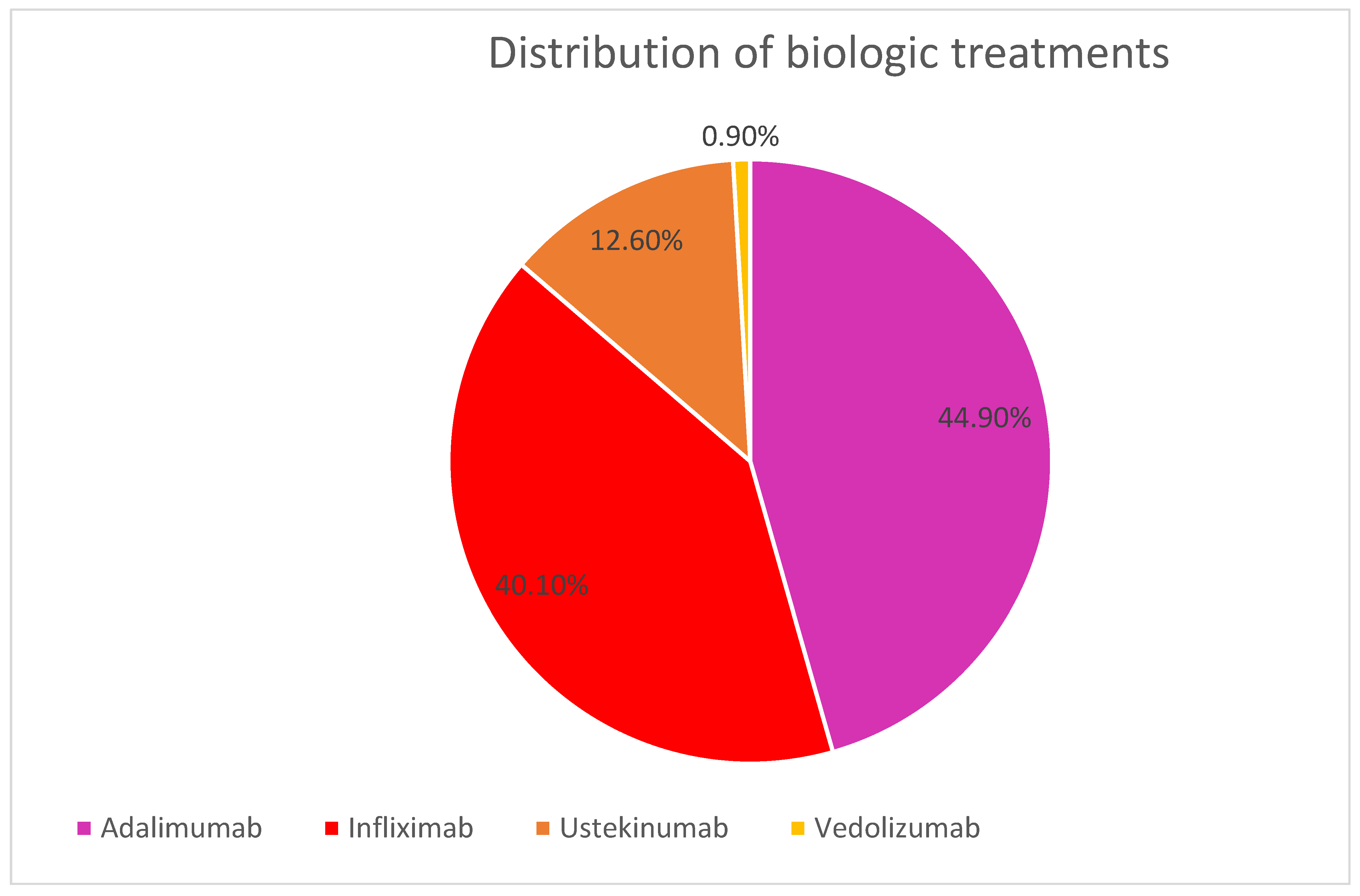
| No | 535 (100%) | 5 (0.9%) | 68 (12.6%) | 216 (40.1%) | 242 (44.9%) | ||
| Age mean | 33 | 36 | 43 | 32 | 33 | <0.001 | |
| Sex | M | 315 (58.9%) | 3 (60%) | 32 (47.1%) | 134 (62%) | 142 (58.7%) | 0.107 |
| F | 220 (41.1%) | 2 (40%) | 36 (52.9%) | 82 (38%) | 100 (41.3%) | ||
| Smokers | 215 (40.2%) | 1 (20%) | 18 (26.5%) | 96 (44.4%) | 96 (39.7%) | 0.008 | |
| Former smokers | 106 (19.7%) | 0 (0%) | 8 (11.8%) | 44 (20.4%) | 54 (22.3%) | 0.221 | |
| BMI mean (kg/m2) | 23.38 | 21.45 | 23.91 | 23.45 | 23.05 | 0.104 | |
| Age at diagnosis (A) | A1 | 14 (3%) | 0 (0%) | 0 (0%) | 10 (5.1%) | 4 (1.9%) | 0.002 |
| A2 | 305 (65.9%) | 5 (100%) | 26 (50%) | 136 (68.7%) | 138 (66.3%) | ||
| A3 | 144 (31.1%) | 0 (0%) | 26 (50%) | 52 (26.3%) | 66 (31.7%) | ||
| Disease location (L) | L1 | 154 (28.6%) | 0 (0%) | 30 (44.1%) | 34 (15.7%) | 88 (36.4%) | 0.001 |
| L2 | 154 (28.6%) | 0 (0%) | 14 (20.6%) | 86 (39.8%) | 54 (22.3%) | ||
| L3 | 227 (42.1%) | 5 (100%) | 24 (35.3%) | 96 (44.4%) | 100 (41.3%) | ||
| Disease behavior (B) | B1 | 283 (52.9%) | 3 (60%) | 54 (79.4%) | 102 (47.2%) | 122 (50.4%) | <0.001 |
| B2 | 164 (30.4%) | 0 (0%) | 12 (17.6%) | 54 (25%) | 96 (39.7%) | <0.001 | |
| B3 | 88 (16.4%) | 2 (40%) | 0 (0%) | 64 (29.6%) | 22 (9.1%) | <0.001 | |
| Perianal disease | 114 (21.3%) | 2 (40%) | 0 (0%) | 80 (37%) | 32 (13.2%) | <0.001 | |
| Time from diagnosis to biologic initiation (mean) (months) | 6 | 1 | 5.5 | 6 | 6 | 0.001 | |
| Surgery before treatment initiation | 170 (31.9%) | 0 | 10 (15.2%) | 72 (33.3%) | 88 (36.4%) | 0.004 | |
| Colonic/intestinal resections before treatment initiation | 162 (30.3%) | 0 | 10 (15.2%) | 68 (31.5%) | 84 (34.7%) | 0.005 | |
| Permanent/temporary stoma | 11 (2.1%) | 0 | 1 (1.5%) | 4 (1.9%) | 6 (2.5%) | 0.01 | |
| The average no of surgical interventions in operated patients | 1.1 | 0 | 1.2 | 1.1 | 1.1 | 0.42 | |
| Concomitant immunomodulator (azathioprine) at initiation of 1st-line biologic | 231 (43.2%) | 0 (0%) | 0 (0%) | 156 (72.2%) | 75 (31.0%) | <0.001 | |
| GROUP | All Patients | Vedolizumab | Ustekinumab | Infliximab | Adalimumab | p-Value |
|---|---|---|---|---|---|---|
| INITIAL CDAI Mean | 245 | 36 | 278.5 | 230 | 245 | 0.021 |
| INITIAL CRP Mean (mg/dL) | 11.2 | 25 | 8 | 21 | 9.3 | <0.001 |
| INITIAL Calprotectin Mean (mcg/g) | 650 | 234 | 506 | 467 | 667 | 0.654 |
| Clinical Remission = YES (152) | Clinical Remission = NO (44) | p-Value | ||
|---|---|---|---|---|
| AGE Mean | 32 | 25.5 | 0.014 | |
| SEX No (%) | M | 106 (69.7%) | 28 (63.6%) | 0.863 |
| Smokers No (%) | 74 (43%) | 22 (50%) | 0.497 | |
| Former Smokers No (%) | 40 (23.3%) | 4 (9.1%) | 0.038 | |
| BMI Mean (kg/m2) | 23.45 | 22.4 | 0.007 | |
| L Subgroups No (%) | L1 | 32 (18.6%) | 2 (4.5%) | 0.029 |
| L2 | 64 (37.2%) | 22 (50%) | ||
| L3 | 76 (44.2%) | 20 (45.5%) | ||
| Disease Behavior No (%) | B1 | 84 (48.8%) | 18 (40.9%) | 0.399 |
| B2 | 36 (20.9%) | 18 (40.9%) | 0.01 | |
| B3 | 54 (31.4%) | 10 (22.7%) | 0.355 | |
| Perianal Disease No (%) | 54 (31.4%) | 26 (59.1%) | 0.001 | |
| Time Diagnosis to Biologic Mean (Months) | 7 | 36 | <0.001 | |
| INITIAL CDAI Mean | 231 | 343.5 | <0.001 | |
| INITIAL CRP Mean (mg/dL) | 21 | 12 | 0.273 | |
| INITIAL Calprotectin Mean (mcg/g) | 598 | 1000 | 0.054 | |
| INITIAL Hemoglobin Mean (g/dL) | 12.6 | 11.5 | 0.07 | |
| Extraintestinal Manifestations No (%) | 24 (14.1%) | 7 (15.9%) | 0.811 | |
| Clinical Remission = YES (194) | Clinical Remission = NO (48) | p-Value | ||
|---|---|---|---|---|
| AGE Mean | 35 | 34 | 0.733 | |
| SEX No (%) | M | 118 (60.8%) | 24 (50%) | 0.192 |
| Smokers No (%) | 70 (36.1%) | 26 (54.2%) | 0.031 | |
| Former Smokers No (%) | 44 (22.7%) | 10 (20.8%) | 0.784 | |
| BMI Mean (kg/m2) | 23.43 | 22.86 | 0.181 | |
| L Subgroups No (%) | L1 | 76 (39.2%) | 12 (25%) | 0.169 |
| L2 | 42 (21.6%) | 12 (25%) | ||
| L3 | 76 (39.2%) | 24 (50%) | ||
| Disease Behavior No (%) | B1 | 106 (54.6%) | 16 (33.3%) | 0.01 |
| B2 | 66 (34%) | 30 (62.5%) | <0.001 | |
| B3 | 20 (10.3%) | 2 (4.2%) | 0.264 | |
| Time Diagnosis to Biologic Mean (Months) | 11 | 18.5 | 0.558 | |
| INITIAL CDAI Mean | 250 | 220 | 0.453 | |
| INITIAL CRP Mean (mg/dL) | 7 | 19.9 | 0.01 | |
| INITIAL Calprotectin Mean (mcg/g) | 547 | 784 | 0.432 | |
| INITIAL Hemoglobin Mean (g/dL) | 12.8 | 12.35 | 0.723 | |
| Extraintestinal Manifestations No (%) | 33 (17.1%) | 8 (17%) | 1 | |
| Clinical Remission = Y (58) | Clinical Remission = N (10) | p-Value | ||
|---|---|---|---|---|
| AGE Mean | 39.5 | 39.5 | 1 | |
| SEX No (%) | M | 32 (55.2%) | 0 (0%) | <0.001 |
| Smokers No (%) | 18 (31%) | 0 (0%) | 0.06 | |
| Former Smokers No (%) | 8 (13.8%) | 0 (0%) | 0.215 | |
| BMI Mean (kg/m2) | 23.8 | 25.71 | 0.299 | |
| L Subgroups No (%) | L1 | 26 (44.8%) | 4 (40%) | 0.737 |
| L2 | 12 (20.7%) | 2 (20%) | ||
| L3 | 20 (34.5%) | 4 (40%) | ||
| Disease Behavior No (%) | B1 | 44 (75.9%) | 10 (100%) | 0.108 |
| B2 | 12 (20.7%) | 0 (0%) | 0.189 | |
| B3 | 2 (3.4%) | 0 (0%) | 0.554 | |
| Time Diagnosis to Biologic Mean (months) | 5 | 5 | 0.754 | |
| INITIAL CDAI Mean | 260 | 189 | 0.066 | |
| INITIAL CRP Mean (mg/dL) | 7 | 5.9 | 0.467 | |
| INITIAL Calprotectin Mean (mcg/g) | 500 | 655 | 0.16 | |
| INITIAL Hemoglobin Mean (g/dL) | 13 | 12.2 | 0.723 | |
| Extraintestinal Manifestations No (%) | 14 (24.1%) | 2 (20%) | 1.000 | |
Disclaimer/Publisher’s Note: The statements, opinions and data contained in all publications are solely those of the individual author(s) and contributor(s) and not of MDPI and/or the editor(s). MDPI and/or the editor(s) disclaim responsibility for any injury to people or property resulting from any ideas, methods, instructions or products referred to in the content. |
© 2026 by the authors. Published by MDPI on behalf of the Lithuanian University of Health Sciences. Licensee MDPI, Basel, Switzerland. This article is an open access article distributed under the terms and conditions of the Creative Commons Attribution (CC BY) license.
Share and Cite
Gila, A.; Preda, C.M.; Diculescu, M.; Bratu, R.M.; Istratescu, D.; Stroie, T.; Trifan, A.; Tantau, A.; Bucurica, S.; Tieranu, C.G.; et al. A Comparative Study of Different Biological Drugs in First-Line Therapy in Crohn’s Disease: A Multicenter Descriptive Analysis. Medicina 2026, 62, 901. https://doi.org/10.3390/medicina62050901
Gila A, Preda CM, Diculescu M, Bratu RM, Istratescu D, Stroie T, Trifan A, Tantau A, Bucurica S, Tieranu CG, et al. A Comparative Study of Different Biological Drugs in First-Line Therapy in Crohn’s Disease: A Multicenter Descriptive Analysis. Medicina. 2026; 62(5):901. https://doi.org/10.3390/medicina62050901
Chicago/Turabian StyleGila, Andrei, Carmen Monica Preda, Mircea Diculescu, Razvan Matei Bratu, Doina Istratescu, Tudor Stroie, Anca Trifan, Alina Tantau, Sandica Bucurica, Cristian George Tieranu, and et al. 2026. "A Comparative Study of Different Biological Drugs in First-Line Therapy in Crohn’s Disease: A Multicenter Descriptive Analysis" Medicina 62, no. 5: 901. https://doi.org/10.3390/medicina62050901
APA StyleGila, A., Preda, C. M., Diculescu, M., Bratu, R. M., Istratescu, D., Stroie, T., Trifan, A., Tantau, A., Bucurica, S., Tieranu, C. G., Minea, H., Buzuleac, A. M., Negreanu, L., Popescu, R., & Ciora, C. A. (2026). A Comparative Study of Different Biological Drugs in First-Line Therapy in Crohn’s Disease: A Multicenter Descriptive Analysis. Medicina, 62(5), 901. https://doi.org/10.3390/medicina62050901