Enhanced Recovery After Surgery Incorporating Erector Spinae Plane Block Versus Standard Care in Adolescent Idiopathic Scoliosis: A Comparative Cohort Analysis of Early Postoperative Recovery

 ,
,  , , ,
, , ,
Abstract
1. Introduction
2. Methods
2.1. Study Design and Setting
2.2. Study Period and Patient Selection
2.2.1. Inclusion Criteria
- Diagnosis of adolescent idiopathic scoliosis (AIS);
- Age < 18 years at the time of surgery;
- Elective primary posterior instrumented spinal fusion performed at the study center;
- Availability of postoperative data for the prespecified early outcomes (pain, nausea, and length of stay).
2.2.2. Exclusion Criteria
- Age ≥ 18 years;
- Non-idiopathic scoliosis (congenital, neuromuscular, syndromic, or other secondary deformities);
- Revision spinal surgery or previous major spinal procedure;
- Non-comparable perioperative pathway;
- Missing or incomplete data for primary postoperative endpoints.
2.3. Cohort Allocation
2.4. Perioperative Pathways
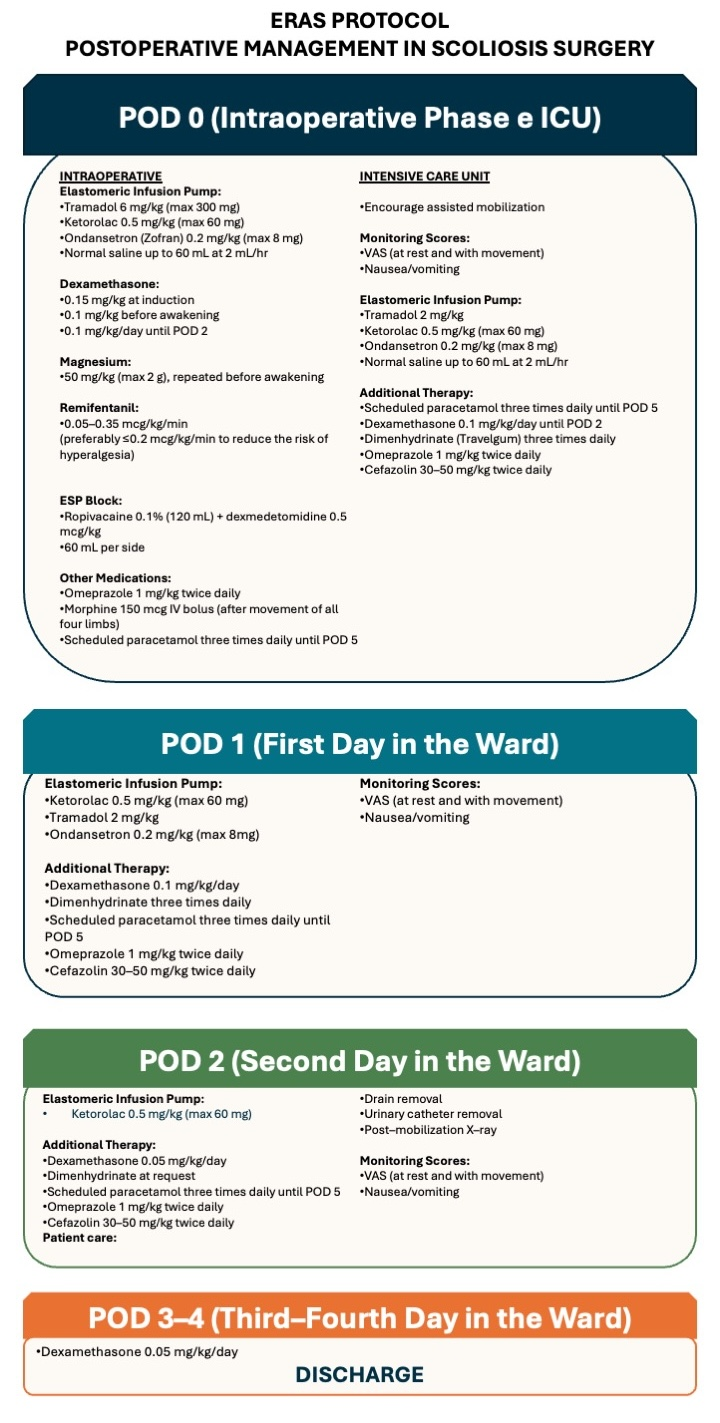
2.4.1. Historical Standard-Care Pathway
2.4.2. ERAS+ESPB Pathway
2.5. ESPB Technique
- Ropivacaine (AstraZeneca, Cambridge, UK) 0.1% (Naropin): total volume 120 mL (total dose 120 mg);
- Dexmedetomidine: total dose 60 mcg.
- The solution was equally divided between the sides: 60 mL per side (i.e., 60 mg ropivacaine + 30 mcg dexmedetomidine per side).
- Preparation was performed using six 20 mL syringes; each contained 20 mg ropivacaine and 10 mcg dexmedetomidine.
2.6. Mobilization Policy
2.7. Outcomes
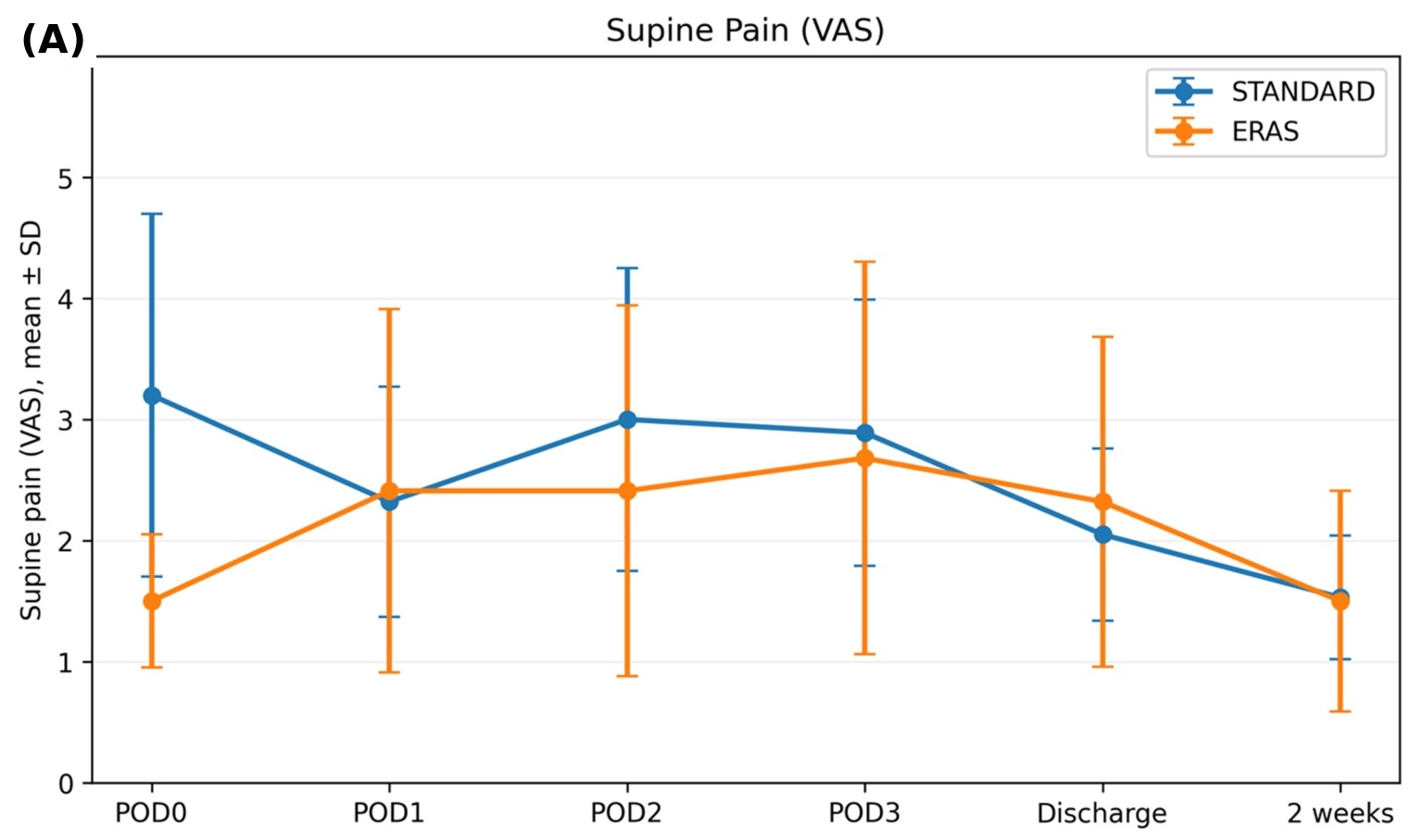
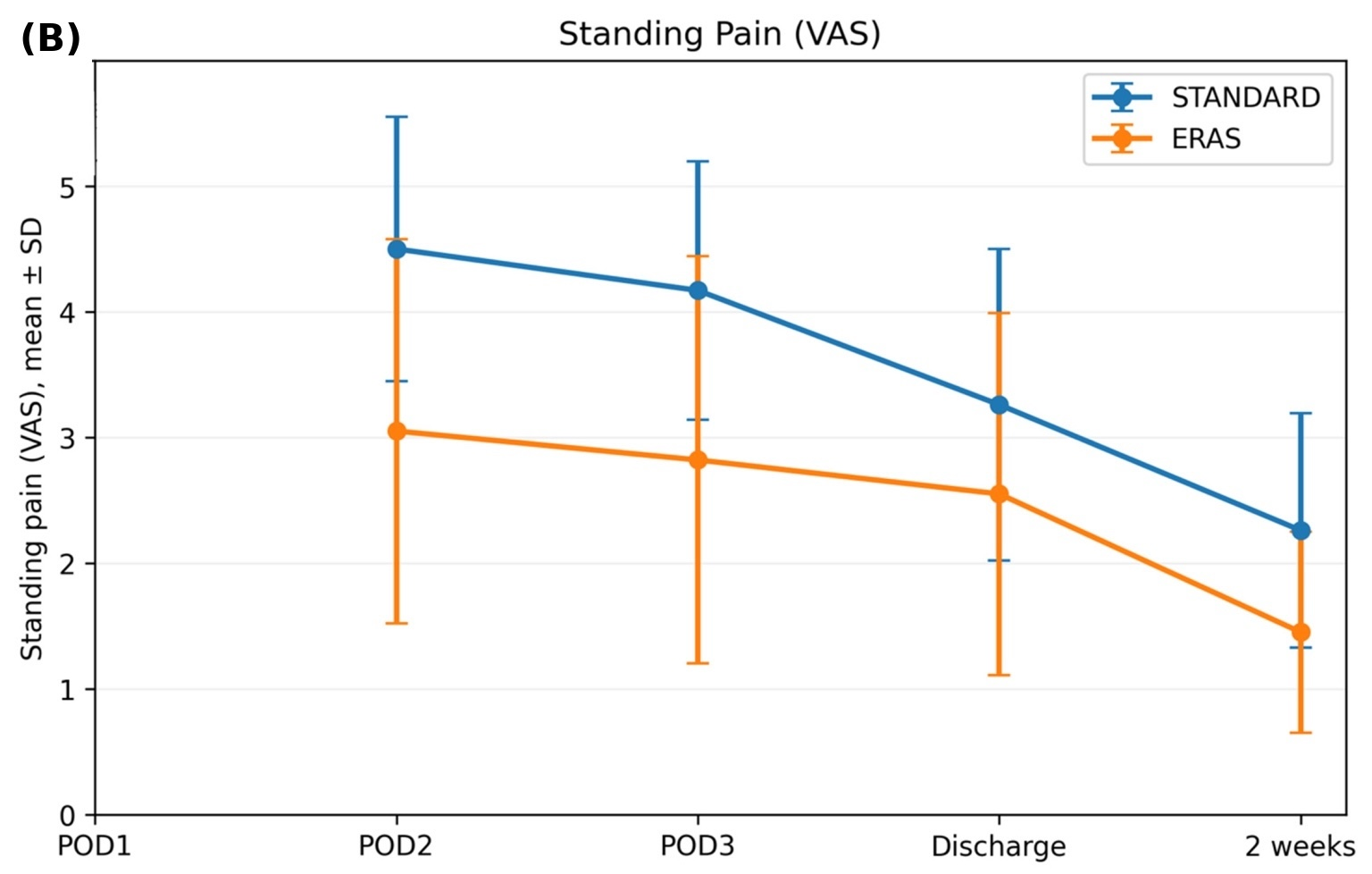
- Postoperative pain (visual analog scale), assessed at POD0, POD1, POD2, POD3, discharge, and 2-week follow-up, under two conditions:
- Supine pain;
- Standing pain.
- 2.
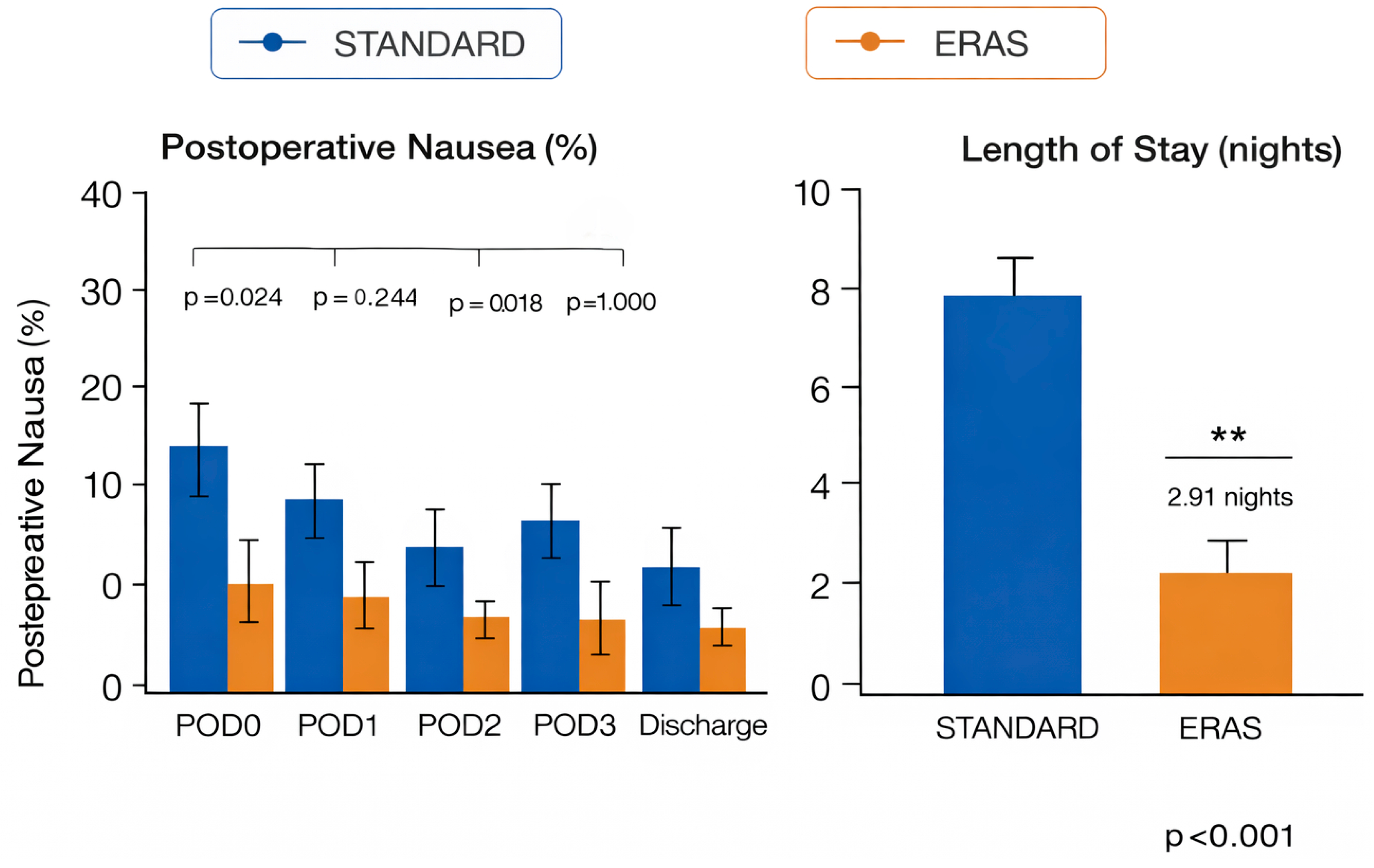
- Postoperative nausea, recorded daily (yes/no) on POD0–POD3.
- 3.
- Length of stay (LOS), defined as the number of nights from surgery to hospital discharge.
2.8. Patient Characteristics, Intraoperative Variables, and Data Collection
2.9. Statistical Analysis and Ethics
3. Results
3.1. Study Population
3.2. Postoperative Pain
3.2.1. Supine Pain
3.2.2. Standing Pain
3.3. Postoperative Nausea (POD0–POD3)
3.4. Length of Stay
4. Discussion
4.1. Main Findings
4.2. Pain Trajectory: Why Standing Pain Improved More Than Supine Pain
4.3. Nausea, Antiemetic Strategy, and Early Gastrointestinal Recovery
4.4. Length of Stay as a System-Level Endpoint
4.5. Clinical Perspective and Next Research Step
4.6. Limitations
5. Conclusions
Author Contributions
Funding
Institutional Review Board Statement
Informed Consent Statement
Data Availability Statement
Conflicts of Interest
References
- Weinstein, S.L.; Dolan, L.A.; Cheng, J.C.Y.; Danielsson, A.; Morcuende, J.A. Adolescent idiopathic scoliosis. Lancet 2008, 371, 1527–1537. [Google Scholar] [CrossRef] [Scilit] [PubMed]
- Cheng, J.C.; Castelein, R.M.; Chu, W.C.; Danielsson, A.J.; Dobbs, M.B.; Grivas, T.B.; Gurnett, C.A.; Luk, K.D.; Moreau, A.; Newton, P.O.; et al. Adolescent idiopathic scoliosis. Nat. Rev. Dis. Primers 2015, 1, 15030. [Google Scholar] [CrossRef] [Scilit] [PubMed]
- Rullander, A.-C.; Jonsson, H.; Lundström, M.; Lindh, V. Young people’s experiences with scoliosis surgery: A survey of pain, nausea, and global satisfaction. Orthop. Nurs. 2013, 32, 327–333; quiz 334–335. [Google Scholar] [CrossRef] [Scilit]
- Ljungqvist, O.; Scott, M.; Fearon, K.C. Enhanced Recovery After Surgery: A Review. JAMA Surg. 2017, 152, 292–298. [Google Scholar] [CrossRef] [Scilit] [PubMed]
- Debono, B.; Wainwright, T.W.; Wang, M.Y.; Sigmundsson, F.G.; Yang, M.M.H.; Smid-Nanninga, H.; Bonnal, A.; Le Huec, J.-C.; Fawcett, W.J.; Ljungqvist, O.; et al. Consensus statement for perioperative care in lumbar spinal fusion: Enhanced Recovery After Surgery (ERAS®) Society recommendations. Spine J. 2021, 21, 729–752. [Google Scholar] [CrossRef] [Scilit] [PubMed]
- Gornitzky, A.L.; Flynn, J.M.; Muhly, W.T.; Sankar, W.N. A Rapid Recovery Pathway for Adolescent Idiopathic Scoliosis That Improves Pain Control and Reduces Time to Inpatient Recovery After Posterior Spinal Fusion. Spine Deform. 2016, 4, 288–295. [Google Scholar] [CrossRef] [Scilit] [PubMed]
- Gadiya, A.D.; Koch, J.E.J.; Patel, M.S.; Shafafy, M.; Grevitt, M.P.; Quraishi, N.A. Enhanced recovery after surgery (ERAS) in adolescent idiopathic scoliosis (AIS): A meta-analysis and systematic review. Spine Deform. 2021, 9, 893–904. [Google Scholar] [CrossRef] [Scilit] [PubMed]
- Brigato, P.; De Salvatore, S.; Oggiano, L.; Palombi, D.; Sangiovanni, G.M.; Di Cosimo, G.; Perrotta, D.; Ruzzini, L.; Costici, P.F. Enhanced recovery after surgery for adolescent idiopathic scoliosis: A revised systematic review and meta-analysis. Spine Deform. 2025, 13, 647–665. [Google Scholar] [CrossRef] [Scilit] [PubMed]
- Al-Naseem, A.O.; Alshahomi, Y.; Almehandi, A.; Alabdallah, A.; Almotlaqem, N.A.; Alotaibi, L.; Lari, A.; Alahmad, R.; Aoude, A.; AlDuwaisan, A.; et al. Safety and efficacy of erector spinae plane block for perioperative analgesia in posterior spinal fusion surgery for pediatric idiopathic scoliosis: A meta-analysis. Spine Deform. 2025, 13, 1659–1671. [Google Scholar] [CrossRef] [Scilit] [PubMed]
- Fletcher, N.D.; Andras, L.M.; Lazarus, D.E.; Owen, R.J.; Geddes, B.J.; Cao, J.; Skaggs, D.L.; Oswald, T.S.; Bruce, R.W. Use of a Novel Pathway for Early Discharge Was Associated with a 48% Shorter Length of Stay After Posterior Spinal Fusion for Adolescent Idiopathic Scoliosis. J. Pediatr. Orthop. 2017, 37, 92–97. [Google Scholar] [CrossRef] [Scilit] [PubMed]
- Koucheki, R.; Koyle, M.; Ibrahim, G.M.; Nallet, J.; Lebel, D.E. Comparison of interventions and outcomes of enhanced recovery after surgery: A systematic review and meta-analysis of 2456 adolescent idiopathic scoliosis cases. Eur. Spine J. 2021, 30, 3457–3472. [Google Scholar] [CrossRef] [Scilit] [PubMed]
- Fletcher, N.D.; Murphy, J.S.; Austin, T.M.; Bruce, R.W.; Harris, H.; Bush, P.; Yu, A.; Kusumoto, H.; Schmitz, M.L.; Devito, D.P.; et al. Short term outcomes of an enhanced recovery after surgery (ERAS) pathway versus a traditional discharge pathway after posterior spinal fusion for adolescent idiopathic scoliosis. Spine Deform. 2021, 9, 1013–1019. [Google Scholar] [CrossRef] [Scilit] [PubMed]
- Muhly, W.T.; Sankar, W.N.; Ryan, K.; Norton, A.; Maxwell, L.G.; DiMaggio, T.; Farrell, S.; Hughes, R.; Gornitzky, A.; Keren, R.; et al. Rapid Recovery Pathway After Spinal Fusion for Idiopathic Scoliosis. Pediatrics 2016, 137, e20151568. [Google Scholar] [CrossRef] [Scilit] [PubMed]
- Subramanian, T.; Mazzucco, M.; Subramanian, A.; Mcgowen, S.; Halayqeh, S.; Zhao, E.; Kaidi, A.C.; Dekhne, M.; Lovecchio, F.C.; Zhukovsky, M.; et al. Efficacy of Erector Spinae Plane Block in Pediatric Scoliosis Surgery: A Systematic Review and Meta-Analysis. Clin. Spine Surg. 2025. [Google Scholar] [CrossRef] [Scilit] [PubMed]
- Ren, Y.; Gao, J.; Nie, X.; Hua, L.; Zheng, T.; Guo, D.; Zhang, J. Bilateral ultrasound-guided erector spinae plane block for postoperative analgesia in paediatric idiopathic scoliosis patients undergoing posterior spine fusion surgery: A randomized controlled trial. Eur. Spine J. 2024, 33, 3823–3832. [Google Scholar] [CrossRef] [Scilit] [PubMed]
- Young, E.Y.; Gurd, D.; Kuivila, T.; Seif, J.; Bess, L.; Goodwin, R. Erector Spinae Plane Block with Liposomal Bupivacaine for Adolescent Idiopathic Scoliosis Surgery: No Patient-controlled Analgesia Needed. Spine (Phila Pa 1976) 2025, 50, 266–270. [Google Scholar] [CrossRef] [Scilit] [PubMed]
- Syed, A.N.; Baghdadi, S.; Muhly, W.T.; Baldwin, K.D. Nausea and Vomiting After Posterior Spinal Fusion in Adolescent Idiopathic Scoliosis: A Systematic and Critical Analysis Review. JBJS Rev. 2024, 12, e23.00176. [Google Scholar] [CrossRef] [Scilit] [PubMed]
- Kranke, P.; Morin, A.M.; Roewer, N.; Eberhart, L.H.J. Dimenhydrinate for prophylaxis of postoperative nausea and vomiting: A meta-analysis of randomized controlled trials. Acta Anaesthesiol. Scand. 2002, 46, 238–244. [Google Scholar] [CrossRef] [Scilit] [PubMed]
- Fung, A.C.-H.; Tsang, J.T.-W.; Chung, P.H.-Y.; Kak-Yuen Wong, K. Does Chewing Gum Lead to Earlier Postoperative Gastrointestinal Recovery in Children? A Systematic Review and Meta-analysis. J. Pediatr. Surg. 2024, 59, 268–274. [Google Scholar] [CrossRef] [Scilit] [PubMed]



| ERAS (n = 35) | Controls (n = 34) | p Value | |
|---|---|---|---|
| Age (years) | 15.2 ± 3.4 | 15.2 ± 3.4 | 0.748 |
| Cobb angle (°) | 63.3 ± 20 | 53.8 ± 13.6 | 0.198 |
| Blood loss (mL) | 447.0 ± 254.4 | 432.5 ± 205.3 | 0.955 |
| Operative time (min) | 227.4 ± 52.9 | 240.2 ± 58.4 | 0.345 |
| Sex | 0.465 | ||
| Female | 22 (62.9%) | 23 (67.6%) | |
| Male | 13 (37.1%) | 11 (35.3%) | |
| Lenke type | 0.353 | ||
| 1 | 15 | 14 | |
| 2 | 3 | 2 | |
| 3 | 9 | 6 | |
| 4 | 1 | 2 | |
| 5 | 3 | 4 | |
| 6 | 4 | 6 |
| Timepoint | Standard (n = 34) | ERAS (n = 35) | p-Value |
|---|---|---|---|
| POD0 | 3.20 ± 1.50 | 1.50 ± 0.55 | <0.001 |
| POD1 | 2.32 ± 0.95 | 2.41 ± 1.50 | 0.811 |
| POD2 | 3.00 ± 1.25 | 2.41 ± 1.53 | 0.181 |
| POD3 | 2.89 ± 1.10 | 2.68 ± 1.62 | 0.621 |
| Discharge | 2.05 ± 0.71 | 2.32 ± 1.36 | 0.429 |
| 2-week follow-up | 1.53 ± 0.51 | 1.50 ± 0.91 | 0.909 |
| Timepoint | Standard (n = 34) | ERAS (n = 35) | p-Value |
|---|---|---|---|
| POD1 | Not assessable | Assessable in 22/35 patients | N/A |
| POD2 | 4.50 ± 1.05 (n = 6) | 3.05 ± 1.53 (n = 22) | 0.020 |
| POD3 | 4.17 ± 1.03 (n = 12) | 2.82 ± 1.62 (n = 22) | 0.006 |
| Discharge | 3.26 ± 1.24 | 2.55 ± 1.44 | 0.094 |
| 2-week follow-up | 2.26 ± 0.93 | 1.45 ± 0.80 | 0.006 |
| Timepoint | Standard (n = 34) | ERAS (n = 35) | p-Value |
|---|---|---|---|
| POD0 | 12/34 (35.3%) | 4/35 (11.4%) | 0.024 |
| POD1 | 9/34 (26.5%) | 5/35 (14.3%) | 0.244 |
| POD2 | 11/34 (32.4%) | 3/35 (8.6%) | 0.018 |
| POD3 | 5/34 (14.7%) | 5/35 (14.3%) | 1.000 |
| Outcome | Standard (n = 34) | ERAS (n = 35) | p-Value |
|---|---|---|---|
| Length of stay (nights), mean ± SD | 8.32 ± 2.06 | 5.41 ± 1.10 | <0.001 |
| Mean difference (Standard − ERAS) | - | 2.91 nights | - |
Disclaimer/Publisher’s Note: The statements, opinions and data contained in all publications are solely those of the individual author(s) and contributor(s) and not of MDPI and/or the editor(s). MDPI and/or the editor(s) disclaim responsibility for any injury to people or property resulting from any ideas, methods, instructions or products referred to in the content. |
© 2026 by the authors. Published by MDPI on behalf of the Lithuanian University of Health Sciences. Licensee MDPI, Basel, Switzerland. This article is an open access article distributed under the terms and conditions of the Creative Commons Attribution (CC BY) license.
Share and Cite
De Salvatore, S.; Di Cosimo, G.; Brigato, P.; Inverso, M.; Oggiano, L.; Sessa, S.; Palombi, D.; Palmieri, F.; Guida, S.; Contursi, A.; et al. Enhanced Recovery After Surgery Incorporating Erector Spinae Plane Block Versus Standard Care in Adolescent Idiopathic Scoliosis: A Comparative Cohort Analysis of Early Postoperative Recovery. Medicina 2026, 62, 775. https://doi.org/10.3390/medicina62040775
De Salvatore S, Di Cosimo G, Brigato P, Inverso M, Oggiano L, Sessa S, Palombi D, Palmieri F, Guida S, Contursi A, et al. Enhanced Recovery After Surgery Incorporating Erector Spinae Plane Block Versus Standard Care in Adolescent Idiopathic Scoliosis: A Comparative Cohort Analysis of Early Postoperative Recovery. Medicina. 2026; 62(4):775. https://doi.org/10.3390/medicina62040775
Chicago/Turabian StyleDe Salvatore, Sergio, Gianmichele Di Cosimo, Paolo Brigato, Michele Inverso, Leonardo Oggiano, Sergio Sessa, Davide Palombi, Francesca Palmieri, Stefano Guida, Antonio Contursi, and et al. 2026. "Enhanced Recovery After Surgery Incorporating Erector Spinae Plane Block Versus Standard Care in Adolescent Idiopathic Scoliosis: A Comparative Cohort Analysis of Early Postoperative Recovery" Medicina 62, no. 4: 775. https://doi.org/10.3390/medicina62040775
APA StyleDe Salvatore, S., Di Cosimo, G., Brigato, P., Inverso, M., Oggiano, L., Sessa, S., Palombi, D., Palmieri, F., Guida, S., Contursi, A., Fumo, C., Curri, C., Miccio, S., D’Alessandro, M., & Costici, P. F. (2026). Enhanced Recovery After Surgery Incorporating Erector Spinae Plane Block Versus Standard Care in Adolescent Idiopathic Scoliosis: A Comparative Cohort Analysis of Early Postoperative Recovery. Medicina, 62(4), 775. https://doi.org/10.3390/medicina62040775