Does Regional Anesthesia Improve Recovery After vNOTES Hysterectomy? A Comparative Observational Study

 , , , ,
Abstract
1. Introduction
2. Materials and Methods
3. Results
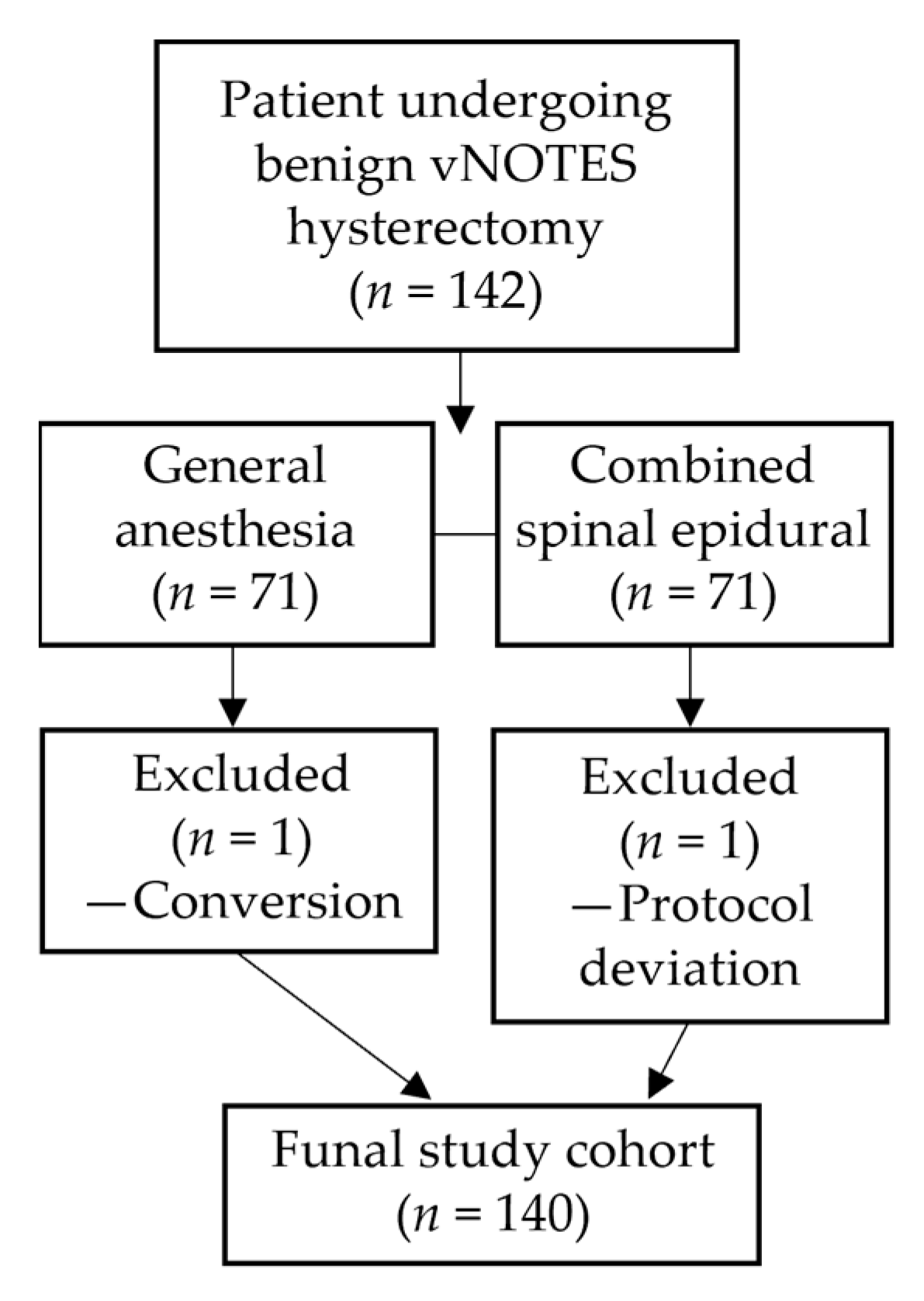
3.1. Participant Flow and Baseline Characteristics
3.2. Intraoperative Physiologic and Anesthetic Parameters
3.3. Primary Outcome and Recovery Measures
3.4. Recovery and Safety Outcomes
4. Discussion
5. Conclusions
Supplementary Materials
Author Contributions
Funding
Institutional Review Board Statement
Informed Consent Statement
Data Availability Statement
Acknowledgments
Conflicts of Interest
Abbreviations
| ASA | American Society of Anesthesiologists |
| BMI | Body mass index |
| CSEA | Combined spinal-epidural anesthesia |
| ERAS | Enhanced Recovery After Surgery |
| GA | General anesthesia |
| IQR | Interquartile range |
| MAC | Minimum alveolar concentration |
| PONV | Postoperative nausea and vomiting |
| SD | Standard deviation |
| vNOTES | Vaginal natural orifice transluminal endoscopic surgery |
References
- Baekelandt, J. Total vaginal NOTES hysterectomy: A new approach to hysterectomy. Facts Views Vis. Obgyn. 2017, 9, 33–40. [Google Scholar] [CrossRef]
- Baekelandt, J.; De Mulder, P.A.; Le Roy, I.; Mathieu, C.; Laenen, A.; Enzlin, P.; Weyers, S.; Mol, B.W.; Bosteels, J.J. Postoperative outcomes and quality of life following hysterectomy by natural orifice transluminal endoscopic surgery (NOTES) compared to laparoscopy in women with a non-prolapsed uterus and benign gynaecological disease: A systematic review and meta-analysis. Eur. J. Obstet. Gynecol. Reprod. Biol. 2017, 208, 6–15. [Google Scholar] [CrossRef] [PubMed]
- Farah, S.; Albaini, O.; Al Jardali, M.; Daccache, A.; Jallad, K. The Feasibility and Safety of vNOTES Hysterectomy and Uterosacral Ligament Suspension: A Case Series. J. Minim. Invasive Gynecol. 2023, 30, 414–417. [Google Scholar] [CrossRef] [PubMed]
- Şimşek, E.; Yıldız, Ö.A.; Gündüz, S.; Karakaş, S.; Yaşar, L. vNOTES scarless and painless endometrial cancer staging surgery. J. Obs. Gynaecol. Res. 2024, 50, 1965–1970. [Google Scholar] [CrossRef]
- Jonsdottir, G.M.; Jorgensen, S.; Cohen, S.L.; Wright, K.N.; Shah, N.T.; Chavan, N.; Einarsson, J.I. Increasing minimally invasive hysterectomy: Effect on cost and complications. Obs. Gynecol. 2011, 117, 1142–1149. [Google Scholar] [CrossRef] [PubMed]
- Uğur, B.K.; Pirbudak, L.; Öztürk, E.; Balat, Ö.; Uğur, M.G. Spinal versus general anesthesia in gynecologic laparoscopy: A prospective, randomized study. Turk. J. Obs. Gynecol. 2020, 17, 186–195. [Google Scholar] [CrossRef] [PubMed]
- Rodgers, A.; Walker, N.; Schug, S.; McKee, A.; Kehlet, H.; Van Zundert, A.; Sage, D.; Futter, M.; Saville, G.; Clark, T.; et al. Reduction of postoperative mortality and morbidity with epidural or spinal anaesthesia: Overview of randomized trials. BMJ 2000, 321, 1493. [Google Scholar] [CrossRef]
- Alshebly, A.A.; Alhwaiti, A.S.; Bahamdan, O. Comparing Regional Anesthesia and General Anesthesia for Postoperative Pain Control in Abdominal Surgeries: A Systematic Review and Meta-Analysis. Cureus 2025, 17, e90483. [Google Scholar] [CrossRef] [PubMed] [PubMed Central]
- Della Corte, L.; Mercorio, A.; Palumbo, M.; Viciglione, F.; Cafasso, V.; Candice, A.; Bifulco, G.; Giampaolino, P. Minimally invasive anesthesia for laparoscopic hysterectomy: A case series. Arch. Gynecol. Obstet. 2022, 306, 2001–2007. [Google Scholar] [CrossRef] [PubMed] [PubMed Central]
- Nelson, G.; Fotopoulou, C.; Taylor, J.; Glaser, G.; Bakkum-Gamez, J.; Meyer, L.A.; Stone, R.; Mena, G.; Elias, K.M.; Altman, A.D.; et al. ERAS Society guidelines for gynecologic oncology: Implementation challenges-2023 update. Gynecol. Oncol. 2023, 173, 58–67. [Google Scholar] [CrossRef]
- Ljungqvist, O.; Scott, M.; Fearon, K. Enhanced recovery after surgery: A review. World J. Surg. 2017, 41, 1661–1668. [Google Scholar] [CrossRef] [PubMed]
- Odeberg, S.; Ljungqvist, O.; Svenberg, T.; Gannedahl, P.; Bäckdahl, M.; von Rosen, A.; Sollevi, A. Pneumoperitoneum and cerebral haemodynamics during laparoscopy. Acta Anaesthesiol. Scand. 1994, 38, 276–281. [Google Scholar] [CrossRef]
- Nguyen, N.T.; Wolfe, B.M. Physiologic effects of pneumoperitoneum in the morbidly obese. Arch. Surg. 2001, 136, 1238–1243. [Google Scholar] [CrossRef]
- Hirvonen, E.A.; Nuutinen, L.S.; Kauko, M. Ventilatory effects, blood gases, and oxygenation during laparoscopic hysterectomy. Acta Anaesthesiol. Scand. 1995, 39, 949–955. [Google Scholar] [CrossRef]
- Brandão, J.C.; Lessa, M.A.; Motta-Ribeiro, G.; Hashimoto, S.; Paula, L.F.; Torsani, V.; Le, L.; Bao, X.; Eikermann, M.; Dahl, D.M.; et al. Global and Regional Respiratory Mechanics During Robotic-Assisted Laparoscopic Surgery: A Randomized Study. Anesth. Analg. 2019, 129, 1564–1573, Erratum in Anesth. Analg. 2020, 130, e118. [Google Scholar] [CrossRef] [PubMed]
- Tontu, F.; Akca, H.; Berktas, C.K.; Asar, S.; Ozcan, F.G. The impact of pneumoperitoneum and steep Trendelenburg positioning on novel oxygenation and saturation indices in robot-assisted laparoscopic prostatectomies: A prospective observational study. Saudi J. Anaesth. 2025, 19, 271–276. [Google Scholar] [CrossRef] [PubMed] [PubMed Central]
- Aranake, A.; Mashour, G.A.; Avidan, M.S. Minimum alveolar concentration: Ongoing relevance and clinical utility. Anaesthesia 2013, 68, 512–522. [Google Scholar] [CrossRef] [PubMed]
- Wu, C.L.; Raja, S.N. Treatment of acute postoperative pain. Lancet. 2011, 377, 2215–2225. [Google Scholar] [CrossRef]
- American Society of Anesthesiologists (ASA). Standards for Basic Anesthetic Monitoring; ASA: Washington, DC, USA, 2020. [Google Scholar]
- European Society of Anaesthesiology and Intensive Care (ESAIC). Perioperative Monitoring Guidelines; ESAIC: Brussels, Belgium, 2021. [Google Scholar]
- Apfelbaum, J.L.; Hagberg, C.A.; Connis, R.T.; Abdelmalak, B.B.; Agarkar, M.; Dutton, R.P.; Fiadjoe, J.E.; Greif, R.; Klock, P.A.; Mercier, D.; et al. 2022 ASA Practice Guidelines for Management of the Difficult Airway. Anesthesiology 2022, 136, 31–81. [Google Scholar] [CrossRef]
- Apfel, C.C.; Läärä, E.; Koivuranta, M.; Greim, C.A.; Roewer, N. A simplified risk score for predicting PONV. Anesthesiology 1999, 91, 693–700. [Google Scholar] [CrossRef] [PubMed]
- Gan, T.J.; Belani, K.G.; Bergese, S.; Chung, F.; Diemunsch, P.; Habib, A.S.; Jin, Z.; Kovac, A.L.; Meyer, T.A.; Urman, R.D.; et al. Fourth Consensus Guidelines for the Management of PONV. Anesth. Analg. 2020, 131, 411–448. [Google Scholar] [CrossRef]
- Weibel, S.; Rücker, G.; Eberhart, L.H.; Pace, N.L.; Hartl, H.M.; Jordan, O.L.; Mayer, D.; Riemer, M.; Schaefer, M.S.; Raj, D.; et al. Drugs for preventing postoperative nausea and vomiting in adults after general anaesthesia: A network meta-analysis. Cochrane Database Syst. Rev. 2020, 10, CD012859. [Google Scholar] [CrossRef] [PubMed] [PubMed Central]
- Misiołek, H.; Zajączkowska, R.; Daszkiewicz, A.; Woroń, J.; Dobrogowski, J.; Wordliczek, J.; Owczuk, R. Postoperative pain management-2018 consensus statement. Anaesthesiol. Intensive Ther. 2018, 50, 173–199. [Google Scholar] [CrossRef]
- ASA. Practice Guidelines for Moderate Procedural Sedation and Analgesia; ASA: Washington, DC, USA, 2018. [Google Scholar]
- Aldrete, J.A. The post-anesthesia recovery score revisited. J. Clin. Anesth. 1995, 7, 89–91. [Google Scholar] [CrossRef] [PubMed]
- Huskisson, E.C. Measurement of pain (VAS). Lancet 1974, 304, 1127–1131. [Google Scholar] [CrossRef] [PubMed]
- Jebb, A.T.; Ng, V.; Tay, L. Advances in Likert scale development (1995–2019). Front. Psychol. 2021, 12, 637547. [Google Scholar] [CrossRef]
- Dindo, D.; Demartines, N.; Clavien, P.-A. Classification of surgical complications. Ann. Surg. 2004, 240, 205–213. [Google Scholar] [CrossRef]
- Brown, A.S.; Campbell, D. Patient-centred outcomes. BJA Educ. 2025, 25, 335–342. [Google Scholar] [CrossRef]
- Rubin, D.B. Multiple Imputation for Nonresponse in Surveys; Wiley: New York, NY, USA, 1987. [Google Scholar]
- Rawal, N.; Holmström, B. The combined spinal–epidural technique. Best Pract. Res. Clin. Anaesthesiol. 2003, 17, 347–364. [Google Scholar] [CrossRef]
- Harten, J.M.; Boyne, I.; Hannah, P.; Varveris, D.; Brown, A. Height/weight adjusted dosing of spinal local anesthetic for Cesarean section. Anaesthesia 2005, 60, 348–353. [Google Scholar] [CrossRef]
- Van de Velde, M. Low-dose spinal anesthesia to prevent spinal-induced hypotension. Curr. Opin. Anaesthesiol. 2019, 32, 268–270. [Google Scholar] [CrossRef] [PubMed]


| Variable | GA (n = 70) | CSEA (n = 70) | p-Value |
|---|---|---|---|
| Age (years), mean ± SD | 52.3 ± 9.8 | 51.7 ± 10.1 | 0.72 |
| BMI (kg/m2), mean ± SD | 28.4 ± 3.5 | 28.6 ± 3.2 | 0.72 |
| ASA class III, n (%) | 10 (14.3%) | 11 (15.7%) | 1.00 |
| Apfel score, median [IQR] | 2 [2,3] | 2 [2,3] | 1.00 |
| Hypertension, n (%) | 19 (27.1%) | 20 (28.6%) | 1.00 |
| Diabetes mellitus, n (%) | 8 (11.4%) | 7 (10.0%) | 1.00 |
| Operative time (min), mean ± SD | 98.2 ± 16.5 | 97.5 ± 15.9 | 0.80 |
| Outcome | General Anesthesia (n = 70) | Combined Spinal Epidural Anesthesia (n = 70) | Adjusted Effect | 95 Percent Confidence Interval | p Value |
|---|---|---|---|---|---|
| Hypotension episodes, median and interquartile range | 1 (0 to 2) | 3 (2 to 4) | Adjusted rate ratio 2.9 | 1.9 to 4.3 | <0.001 |
| Duration of hypotension (minutes), mean ± SD | 6.1 ± 5.4 | 14.3 ± 9.2 | Adjusted mean difference 8.2 | 6.0 to 10.5 | <0.001 |
| Bradycardia, n (%) | 3 (4.3) | 11 (15.7) | Adjusted odds ratio 4.1 | 1.1 to 15.3 | 0.03 |
| Phenylephrine use (micrograms), mean ± SD | 90 ± 55 | 180 ± 75 | Adjusted mean difference 90 | 65 to 115 | <0.001 |
| End tidal carbon dioxide (mmHg), mean ± SD | 37.5 ± 3.8 | 38.2 ± 4.2 | Adjusted mean difference 0.7 | −0.6 to 2.0 | 0.28 |
| Peak airway pressure (cm H2O), mean ± SD | 22.4 ± 3.6 | 17.1 ± 2.8 | Adjusted mean difference −5.3 | −6.2 to −4.4 | <0.001 |
| Lowest oxygen saturation (%), mean ± SD | 93.1 ± 2.8 | 95.2 ± 1.9 | Adjusted mean difference 2.1 | 1.2 to 2.9 | 0.004 |
| Intravenous fluids (mL), mean ± SD | 1100 ± 250 | 1080 ± 260 | Adjusted mean difference −20 | −95 to 55 | 0.61 |
| Estimated blood loss (mL), mean ± SD | 120 ± 40 | 115 ± 38 | Adjusted mean difference −5 | −20 to 10 | 0.48 |
| Urine output (mL), mean ± SD | 180 ± 60 | 175 ± 55 | Adjusted mean difference −5 | −25 to 15 | 0.65 |
| Lowest core temperature (°C), mean ± SD | 36.0 ± 0.4 | 36.1 ± 0.5 | Adjusted mean difference 0.1 | −0.1 to 0.2 | 0.27 |
| Outcome | General Anesthesia (n = 70) | Combined Spinal Epidural Anesthesia (n = 70) | Adjusted Effect | 95 Percent Confidence Interval | p Value |
|---|---|---|---|---|---|
| Postoperative nausea and vomiting, n (%) | 32 (45.7) | 15 (21.4) | Adjusted odds ratio 0.32 | 0.15 to 0.68 | 0.012 |
| Time to discharge from recovery unit (minutes), mean ± SD | 92 ± 15 | 76 ± 14 | Adjusted mean difference −16 | −20 to −12 | 0.004 |
| Pain score at hour 1, mean ± SD | 4.8 ± 1.2 | 3.2 ± 1.1 | Adjusted mean difference −1.6 | −2.0 to −1.2 | 0.001 |
| Pain score at hour 6, mean ± SD | 3.9 ± 1.0 | 2.5 ± 0.9 | Adjusted mean difference −1.4 | −1.7 to −1.0 | <0.001 |
| Pain score at hour 24, mean ± SD | 2.8 ± 0.8 | 1.7 ± 0.7 | Adjusted mean difference −1.1 | −1.4 to −0.8 | 0.002 |
| Pain burden, area under the curve (0 to 24 h), mean ± SD | 67 ± 12 | 43 ± 10 | Adjusted mean difference −24 | −28 to −20 | <0.001 |
| Outcome | General Anesthesia (n = 70) | Combined Spinal Epidural Anesthesia (n = 70) | Effect Estimate | 95 Percent Confidence Interval | p Value |
|---|---|---|---|---|---|
| Time to ambulation (hours), mean ± SD | 11.2 ± 3.0 | 7.6 ± 2.4 | Adjusted mean difference −3.6 | −4.4 to −2.8 | <0.001 |
| Time to oral intake (hours), mean ± SD | 15.8 ± 4.2 | 11.9 ± 3.5 | Adjusted mean difference −3.9 | −5.1 to −2.7 | 0.001 |
| Length of hospital stay (days), mean ± SD | 2.9 ± 0.8 | 2.5 ± 0.7 | Adjusted mean difference −0.4 | −0.6 to −0.2 | 0.021 |
| Patient satisfaction, median and interquartile range | 4 (3 to 4) | 5 (4 to 5) | Adjusted odds ratio 2.6 | 1.4 to 4.8 | 0.017 |
| Complications within thirty days, n (%) | 3 (4.3) | 2 (2.9) | Odds ratio 0.67 | 0.11 to 3.95 | 0.64 |
Disclaimer/Publisher’s Note: The statements, opinions and data contained in all publications are solely those of the individual author(s) and contributor(s) and not of MDPI and/or the editor(s). MDPI and/or the editor(s) disclaim responsibility for any injury to people or property resulting from any ideas, methods, instructions or products referred to in the content. |
© 2026 by the authors. Published by MDPI on behalf of the Lithuanian University of Health Sciences. Licensee MDPI, Basel, Switzerland. This article is an open access article distributed under the terms and conditions of the Creative Commons Attribution (CC BY) license.
Share and Cite
Arkan, K.; Yilmaz, K.C.; Erkmen, A.D.; Akgol, S.; Colak, G.C.; Haliscelik, M.A.; Acil, F.; Can, B. Does Regional Anesthesia Improve Recovery After vNOTES Hysterectomy? A Comparative Observational Study. Medicina 2026, 62, 154. https://doi.org/10.3390/medicina62010154
Arkan K, Yilmaz KC, Erkmen AD, Akgol S, Colak GC, Haliscelik MA, Acil F, Can B. Does Regional Anesthesia Improve Recovery After vNOTES Hysterectomy? A Comparative Observational Study. Medicina. 2026; 62(1):154. https://doi.org/10.3390/medicina62010154
Chicago/Turabian StyleArkan, Kevser, Kubra Cakar Yilmaz, Ali Deniz Erkmen, Sedat Akgol, Gul Cavusoglu Colak, Mesut Ali Haliscelik, Fatma Acil, and Behzat Can. 2026. "Does Regional Anesthesia Improve Recovery After vNOTES Hysterectomy? A Comparative Observational Study" Medicina 62, no. 1: 154. https://doi.org/10.3390/medicina62010154
APA StyleArkan, K., Yilmaz, K. C., Erkmen, A. D., Akgol, S., Colak, G. C., Haliscelik, M. A., Acil, F., & Can, B. (2026). Does Regional Anesthesia Improve Recovery After vNOTES Hysterectomy? A Comparative Observational Study. Medicina, 62(1), 154. https://doi.org/10.3390/medicina62010154