Sepsis Biomarkers in Evolution: Comparative Insights and the Promising Roles of MDW and Presepsin

 ,
,  , , , ,
  ,
,  ,
, 
Abstract
1. Introduction
2. Methods
- Focus on sepsis or septic shock according to recognized diagnostic criteria;
- Evaluation of one or more biomarkers for diagnosis, severity assessment, or prognosis;
- Original research articles, meta-analyses, or high-quality narrative reviews;
- Published in peer-reviewed journals and written in English.
- Studies not directly relevant to the diagnostic or clinical utility of sepsis biomarkers;
- Articles lacking original data or meaningful clinical insight.
3. Current State of Biomarkers
3.1. Most Studied Biomarkers: C-Reactive Protein (CRP) and Procalcitonin (PCT)
3.2. MiRNA
3.3. Soluble Triggering Receptor Expressed on Myeloid Cells-1 (sTREM-1)
3.4. Neutrophil Gelatinase-Associated Lipocalin (NGAL)
3.5. Proenkephalin (PENK)
3.6. Llipopolysaccharide-Binding Protein (LBP)
3.7. Monocyte Distribution Width (MDW)
3.8. Presepsin (P-SEP)
3.9. MR-Proadrenomedullin (MR-proADM)
4. Comparison
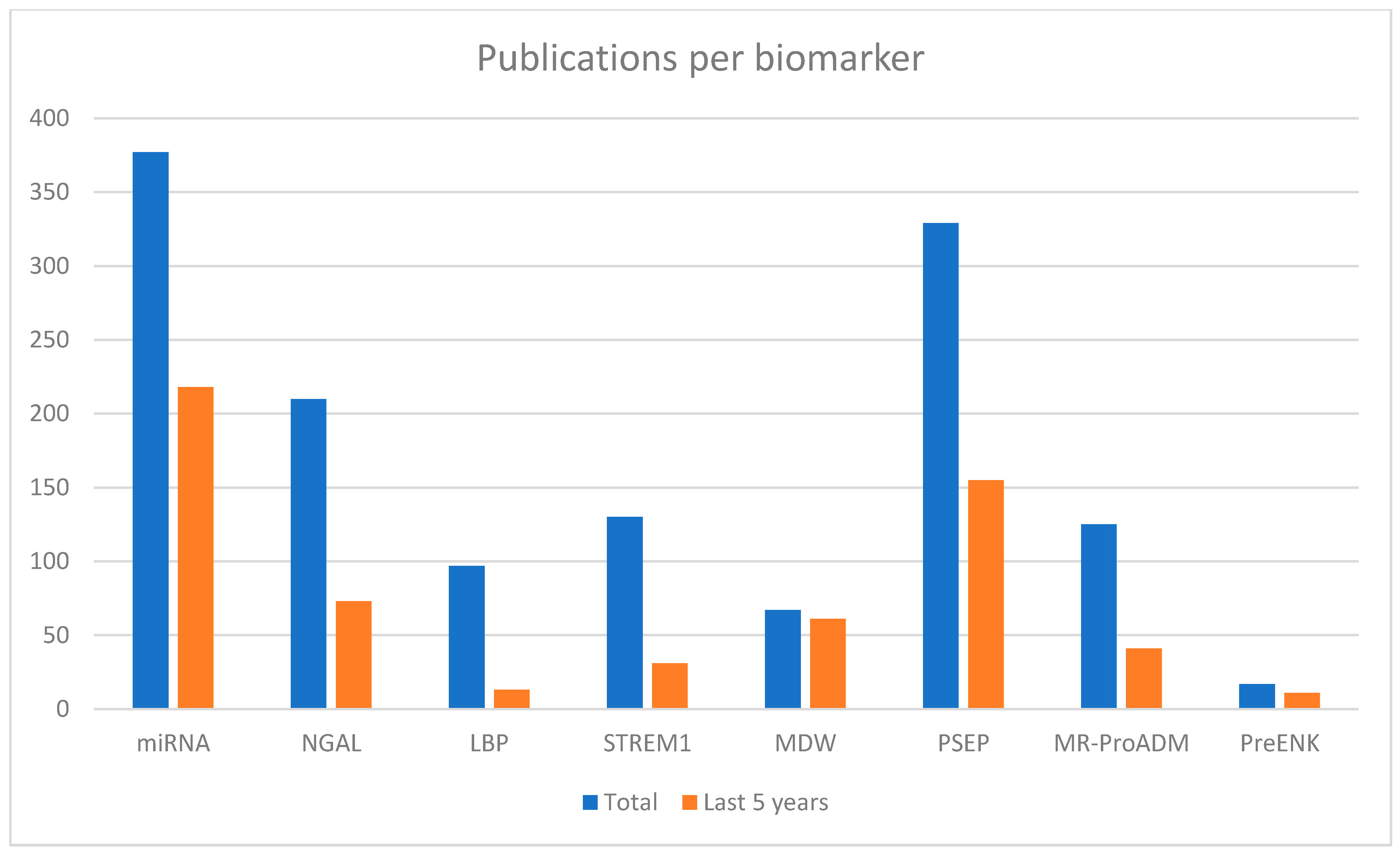
4.1. Publication Trends
4.2. Comparative Table
4.3. Different Expression Profiles of Biomarkers Based on the Infectious Trigger
5. MDW and P-SEP: Overview
5.1. Focus on MDW and P-SEP
5.2. Ongoing Project
6. Conclusions
Author Contributions
Funding
Institutional Review Board Statement
Informed Consent Statement
Data Availability Statement
Conflicts of Interest
References
- Singer, M.; Deutschman, C.S.; Seymour, C.W.; Shankar-Hari, M.; Annane, D.; Bauer, M.; Bellomo, R.; Bernard, G.R.; Chiche, J.D.; Coopersmith, C.M.; et al. The Third International Consensus Definitions for Sepsis and Septic Shock (Sepsis-3). JAMA 2016, 315, 801–810. [Google Scholar] [CrossRef] [Scilit]
- Vincent, J.L.; Marshall, J.C.; Namendys-Silva, S.A.; François, B.; Martin-Loeches, I.; Lipman, J.; Reinhart, K.; Antonelli, M.; Pickkers, P.; Njimi, H.; et al. Assessment of the worldwide burden of critical illness: The Intensive Care Over Nations (ICON) audit. Lancet Respir. Med. 2014, 2, 380–386. [Google Scholar] [CrossRef] [Scilit]
- Clyne, B.; Olshaker, J.S. The C-reactive protein 1. J. Emerg. Med. 1999, 17, 1019–1025. [Google Scholar] [CrossRef] [Scilit]
- Kolb-Bachofen, V. A Review on the Biological Properties of C-Reactive Protein. Immunobiology 1991, 183, 133–145. [Google Scholar] [CrossRef] [Scilit]
- Juroš, G.F.; Tomičić, M.; Šarić, S.D.; Perić, M.; Rogić, D. Contribution of presepsin, procalcitonin and C-reactive protein to the SOFA score in early sepsis diagnosis in emergency abdominal surgical patients. Signa Vitae 2019, 15, 38–45. [Google Scholar] [CrossRef] [Scilit]
- Chuang, C.L.; Yeh, H.T.; Niu, K.Y.; Chen, C.B.; Seak, C.J.; Yen, C.C. Diagnostic performances of procalcitonin and C-reactive protein for sepsis: A systematic review and meta-analysis. Eur. J. Emerg. Med. 2025, 32, 248–258. [Google Scholar] [CrossRef] [Scilit] [PubMed]
- Tan, M.; Lu, Y.; Jiang, H.; Zhang, L. The diagnostic accuracy of procalcitonin and C-reactive protein for sepsis: A systematic review and meta-analysis. J. Cell. Biochem. 2019, 120, 5852–5859. [Google Scholar] [CrossRef] [Scilit]
- Becker, K.L.; Nylén, E.S.; White, J.C.; Müller, B.; Snider, R.H. Procalcitonin and the Calcitonin Gene Family of Peptides in Inflammation, Infection, and Sepsis: A Journey from Calcitonin Back to Its Precursors. J. Clin. Endocrinol. Metab. 2004, 89, 1512–1525. [Google Scholar] [CrossRef] [Scilit] [PubMed]
- Kiya, G.T.; Asefa, E.T.; Abebe, G.; Mekonnen, Z. Procalcitonin Guided Antibiotic Stewardship. Biomark. Insights 2024, 19, 11772719241298197. [Google Scholar] [CrossRef] [Scilit] [PubMed]
- Cleland, D.A.; Eranki, A.P. Procalcitonin. In StatPearls; StatPearls Publishing: Treasure Island, FL, USA, 2023. Available online: https://www.ncbi.nlm.nih.gov/books/NBK539794/ (accessed on 16 August 2025).
- Schuetz, P.; Albrich, W.; Mueller, B. Procalcitonin for diagnosis of infection and guide to antibiotic decisions: Past, present and future. BMC Med. 2011, 9, 107. [Google Scholar] [CrossRef] [Scilit]
- Wacker, C.; Prkno, A.; Brunkhorst, F.M.; Schlattmann, P. Procalcitonin as a diagnostic marker for sepsis: A systematic review and meta-analysis. Lancet Infect. Dis. 2013, 13, 426–435. [Google Scholar] [CrossRef] [Scilit] [PubMed]
- Bacli, C.; Sungurtekin, H.; Gürses, E.; Sungurtekin, U.; Kaptanoǧlu, B. Usefulness of procalcitonin for diagnosis of sepsis in the intensive care unit. Crit. Care 2003, 7, 85. [Google Scholar] [CrossRef] [Scilit]
- Bartel, D.P. MicroRNAs: Genomics, Biogenesis, Mechanism, and Function. Cell 2004, 116, 281–297. [Google Scholar] [CrossRef] [Scilit] [PubMed]
- Nour, Z.; El-Hamamsy, K.; Ehsan, I.; Fawaz, L.; Shaker, O.; Mossallam, D.; ElGindy, H. MicroRNAs as Potential Diagnostic New Biomarkers in Diagnosis of Sepsis in Pediatric Patients. Rep. Biochem. Mol. Biol. 2022, 11, 327–335. [Google Scholar] [CrossRef] [Scilit] [PubMed]
- Möhnle, P.; Hirschberger, S.; Hinske, L.C.; Briegel, J.; Hübner, M.; Weis, S. MicroRNAs 143 and 150 in whole blood enable detection of T-cell immunoparalysis in sepsis. Mol. Med. 2018, 24, 54. [Google Scholar] [CrossRef] [Scilit]
- Fehlmann, T.; Reinheimer, S.; Sonehara, N.; Xie, H.; Leichtle, A.B.; Rohli, K.E.; Ferdinande, L.; Wouters, H.; Fankhauser, C.; Megger, D.A.; et al. Evaluating the Use of Circulating MicroRNA Profiles for Lung Cancer Detection in Symptomatic Patients. JAMA Oncol. 2020, 6, 714–723. [Google Scholar] [CrossRef] [Scilit]
- Wu, Y.; Wang, F.; Fan, X.; Bao, R.; Bo, L.; Li, J.; Deng, X. Accuracy of plasma sTREM-1 for sepsis diagnosis in systemic inflammatory patients: A systematic review and meta-analysis. Crit. Care 2012, 16, R229. [Google Scholar] [CrossRef] [Scilit]
- Aksaray, S. Diagnostic value of sTREM-1 and procalcitonin levels in the early diagnosis of sepsis. North. Clin. Istanb. 2016, 3, 175–182. [Google Scholar] [CrossRef] [Scilit]
- Petric, V.; Brkic, S.; Lendak, D.; Mihajlovic, D.; Mikic, A.N.; Brkic, S.; Komazec, S.L. The significance of strem-1 as a diagnostic biomarker of sepsis in the context of sepsis-3 definition. Signa Vitae 2018, 14, 65–70. [Google Scholar] [CrossRef] [Scilit]
- Uchino, S.; Kellum, J.A.; Bellomo, R.; Doig, G.S.; Morimatsu, H.; Morgera, S.; Schetz, M.; Tan, I.; Bouman, C.; Macedo, E.; et al. Acute Renal Failure in Critically Ill Patients: A Multinational, Multicenter Study. JAMA 2005, 294, 813–818. [Google Scholar] [CrossRef] [Scilit]
- Hoste, E.A.J.; Bagshaw, S.M.; Bellomo, R.; Cely, C.M.; Colman, R.; Cruz, D.N.; Edipidis, K.; Forni, L.G.; Gomersall, C.D.; Govil, D. Epidemiology of acute kidney injury in critically ill patients: The multinational AKI-EPI study. Intensive Care Med. 2015, 41, 1411–1423. [Google Scholar] [CrossRef] [Scilit]
- Ferreira, G.S.; Frota, M.L.; Gonzaga, M.J.D.; Vattimo, M.d.F.F.; Lima, C. The Role of Biomarkers in Diagnosis of Sepsis and Acute Kidney Injury. Biomedicines 2024, 12, 931. [Google Scholar] [CrossRef] [Scilit] [PubMed]
- Lindberg, S.; Jensen, J.S.; Mogelvang, R.; Pedersen, S.H.; Galatius, S.; Flyvbjerg, A.; Magnusson, N.E. Plasma neutrophil gelatinase-associated lipocalinin in the general population: Association with inflammation and prognosis. Arterioscler. Thromb. Vasc. Biol. 2014, 34, 2135–2142. [Google Scholar] [CrossRef] [Scilit] [PubMed]
- Paul, A.; Newbigging, N.S.; Lenin, A.; Gowri, M.; Varghese, J.S.; Nell, A.J.; Abhilash, K.P.P.; John Binu, A.; Chandiraseharan, V.K.; Iyyadurai, R.; et al. Role of Neutrophil Gelatinase-associated Lipocalin (NGAL) and Other Clinical Parameters as Predictors of Bacterial Sepsis in Patients Presenting to the Emergency Department with Fever. Indian J. Crit. Care Med. 2023, 27, 176–182. [Google Scholar] [CrossRef] [Scilit]
- Yan, Q.W.; Yang, Q.; Mody, N.; Graham, T.E.; Hsu, C.H.; Xu, Z.; Houstis, N.E.; Kahn, B.B.; Rosen, E.D. The adipokine lipocalin 2 is regulated by obesity and promotes insulin resistance. Diabetes 2007, 56, 2533–2540. [Google Scholar] [CrossRef] [Scilit]
- Wallenius, V.; Elias, E.; Bergstrom, G.M.L.; Zetterberg, H.; Behre, C.J. The lipocalins retinol-binding protein-4, lipocalin-2 and lipocalin-type prostaglandin d2-synthase correlate with markers of inflammatory activity, alcohol intake and blood lipids, but not with insulin sensitivity in metabolically healthy 58-year-old Swedish men. Exp. Clin. Endocrinol. Diabetes 2011, 119, 75–80. [Google Scholar] [CrossRef] [Scilit]
- Emmens, J.E.; ter Maaten, J.M.; Damman, K.; van Veldhuisen, D.J.; de Boer, R.A.; Struck, J.; Bergmann, A.; Sama, I.E.; Streng, K.W.; Anker, S.D.; et al. Proenkephalin, an Opioid System Surrogate, as a Novel Comprehensive Renal Marker in Heart Failure. Circ. Heart Fail. 2019, 12, e005544. [Google Scholar] [CrossRef] [Scilit] [PubMed]
- Beunders, R.; Van Groenendael, R.; Leijte, G.P.; Kox, M.; Pickkers, P. Proenkephalin Compared to Conventional Methods to Assess Kidney Function in Critically Ill Sepsis Patients. Shock 2020, 54, 308–314. [Google Scholar] [CrossRef] [Scilit]
- Kim, H.; Hur, M.; Lee, S.; Marino, R.; Magrini, L.; Cardelli, P.; Struck, J.; Bergmann, A.; Hartmann, O.; Di Somma, S.; et al. Proenkephalin, Neutrophil Gelatinase-Associated Lipocalin, and Estimated Glomerular Filtration Rates in Patients with Sepsis. Ann. Lab. Med. 2017, 37, 388–397. [Google Scholar] [CrossRef] [Scilit]
- Heumann, D.; Lauener, R.; Ryffel, B. The dual role of LBP and CD14 in response to Gram-negative bacteria or Gram-negative compounds. J. Endotoxin Res. 2003, 9, 381–384. [Google Scholar] [CrossRef] [Scilit]
- Schumann, R.R.; Leong, S.R.; Flaggs, G.W.; Gray, P.W.; Wright, S.D.; Mathison, J.C.; Tobias, P.S.; Ulevitch, R.J. Structure and Function of Lipopolysaccharide Binding Protein. Science 1990, 249, 1429–1431. [Google Scholar] [CrossRef] [Scilit]
- Opal, S.M.; Scannon, P.J.; Vincent, J.L.; White, M.; Carroll, S.F.; Palardy, J.E.; Parejo, N.A.; Pribble, J.P.; Lemke, J.H. Relationship between plasma levels of lipopolysaccharide (LPS) and LPS- binding protein in patients with severe sepsis and septic shock. J. Infect. Dis. 1999, 180, 1584–1589. [Google Scholar] [CrossRef] [Scilit]
- Mueller, M.; Stamme, C.; Draing, C.; Hartung, T.; Seydel, U.; Schromm, A.B. Cell activation of human macrophages by lipoteichoic acid is strongly attenuated by lipopolysaccharide-binding protein. J. Biol. Chem. 2006, 281, 31448–31456. [Google Scholar] [CrossRef] [Scilit]
- Prucha, M.; Herold, I.; Zazula, R.; Dubska, L.; Dostal, M.; Hildebrand, T.; Hyanek, J. Significance of lipopolysaccharide-binding protein (an acute phase protein) in monitoring critically ill patients. Crit. Care 2003, 7, R154. [Google Scholar] [CrossRef] [Scilit]
- García de Guadiana Romualdo, L.; Albaladejo Oton, M.D.; Rebollo Acebes, S.; Esteban Torrella, P.; Hernando Holgado, A.; Jimenez Santos, E.; Jimenez Sanchez, R.; Orton Freire, A. Diagnostic accuracy of lipopolysaccharide-binding protein for sepsis in patients with suspected infection in the emergency department. Ann. Clin. Biochem. 2018, 55, 143–148. [Google Scholar] [CrossRef] [Scilit] [PubMed]
- Gaïni, S.; Koldkjær, O.G.; Pedersen, C.; Pedersen, S.S. Procalcitonin, lipopolysaccharide-binding protein, interleukin-6 and C-reactive protein in community-acquired infections and sepsis: A prospective study. Crit. Care 2006, 10, R53. [Google Scholar] [CrossRef] [Scilit] [PubMed]
- Eisinger, G.J.; Osman, W.; Prather, E.R.; Julian, M.W.; Gavrilin, M.A.; Crouser, E.D.; Wewers, M.D. Inflammasome Activation in an In Vitro Sepsis Model Recapitulates Increased Monocyte Distribution Width Seen in Patients with Sepsis. Crit. Care Explor. 2022, 4, e0631. [Google Scholar] [CrossRef] [Scilit]
- Polilli, E.; Di Iorio, G.; Silveri, C.; Angelini, G.; Anelli, M.C.; Esposito, J.E.; D’Amato, M.; Parruti, G.; Carinci, F. Monocyte Distribution Width as a predictor of community acquired sepsis in patients prospectively enrolled at the Emergency Department. BMC Infect. Dis. 2022, 22, 849. [Google Scholar] [CrossRef] [Scilit]
- Piccioni, A.; Spagnuolo, F.; Baroni, S.; Savioli, G.; Valletta, F.; Bungaro, M.C.; Tullo, G.; Candelli, M.; Gasbarrini, A.; Franceschi, F. The Need for Standardized Guidelines for the Use of Monocyte Distribution Width (MDW) in the Early Diagnosis of Sepsis. J. Pers. Med. 2024, 15, 5. [Google Scholar] [CrossRef] [Scilit]
- Jo, S.J.; Kim, S.W.; Choi, J.H.; Choi, S.P.; Lee, J.; Lim, J. Monocyte distribution width (MDW) as a useful indicator for early screening of sepsis and discriminating false positive blood cultures. PLoS ONE 2022, 17, e0279374. [Google Scholar] [CrossRef] [Scilit] [PubMed]
- la Woo, A.; Oh, D.K.; Park, C.J.; Hong, S.B. Monocyte distribution width compared with C-reactive protein and procalcitonin for early sepsis detection in the emergency department. PLoS ONE 2021, 16, e0250101. [Google Scholar] [CrossRef] [Scilit]
- Eisinger, G.J.; Hosler, Q.; Crouser, E.D.; Herman, D.D. Diagnostic Performance of Monocyte Distribution Width for the Detection of Sepsis: A Systematic Review and Meta-Analysis. JACEP Open 2025, 6, 100073. [Google Scholar] [CrossRef] [Scilit]
- Memar, M.Y.; Baghi, H.B. Presepsin: A promising biomarker for the detection of bacterial infections. Biomed. Pharmacother. 2019, 111, 649–656. [Google Scholar] [CrossRef] [Scilit]
- Lonez, C.; Irvine, K.L.; Pizzuto, M.; Schmidt, B.I.; Gay, N.J.; Ruysschaert, J.M.; Gangloff, M.; Bryant, C.E. Critical residues involved in Toll-like receptor 4 activation by cationic lipid nanocarriers are not located at the lipopolysaccharide-binding interface. Cell. Mol. Life Sci. 2015, 72, 3971–3982. [Google Scholar] [CrossRef] [Scilit]
- van der Mark, V.A.; Ghiboub, M.; Marsman, C.; Zhao, J.; van Dijk, R.; Hiralall, J.K.; Ho-Mok, K.S.; Castricum, Z.; de Jonge, W.J.; Oude Elferink, R.P.; et al. Phospholipid flippases attenuate LPS-induced TLR4 signaling by mediating endocytic retrieval of Toll-like receptor 4. Cell. Mol. Life Sci. 2017, 74, 715–730. [Google Scholar] [CrossRef] [Scilit]
- Kim, C.J. Current Status of Antibiotic Stewardship and the Role of Biomarkers in Antibiotic Stewardship Programs. Infect. Chemother. 2022, 54, 674–698. [Google Scholar] [CrossRef] [Scilit] [PubMed]
- Shirakawa, K.; Naitou, K.; Hirose, J.; Takahashi, T.; Furusako, S. Presepsin (sCD14-ST): Development and evaluation of one-step ELISA with a new standard that is similar to the form of presepsin in septic patients. Clin. Chem. Lab. Med. 2011, 49, 937–939. [Google Scholar] [CrossRef] [Scilit]
- Okamura, Y.; Yokoi, H. Development of a point-of-care assay system for measurement of presepsin (sCD14-ST). Clin. Chim. Acta 2011, 412, 2157–2161. [Google Scholar] [CrossRef] [Scilit] [PubMed]
- Novelli, G.; Morabito, V.; Ferretti, G.C.; Pugliese, F.; Ruberto, F.; Venuta, F.; Poli, L.; Rossi, M.; Berloco, P.B. Pathfast presepsin assay for early diagnosis of bacterial infections in surgical patients: Preliminary study. Transplant. Proc. 2013, 45, 2750–2753. [Google Scholar] [CrossRef] [Scilit]
- Zhang, X.; Liu, D.; Liu, Y.N.; Wang, R.; Xie, L.X. The accuracy of presepsin (sCD14-ST) for the diagnosis of sepsis in adults: A meta-analysis. Crit. Care 2015, 19, 323. [Google Scholar] [CrossRef] [Scilit] [PubMed]
- Pugni, L.; Pietrasanta, C.; Milani, S.; Vener, C.; Ronchi, A.; Falbo, M.; Arghittu, M.; Mosca, F. Presepsin (soluble CD14 subtype): Reference ranges of a new sepsis marker in term and preterm neonates. PLoS ONE 2015, 10, e0146020. [Google Scholar] [CrossRef] [Scilit]
- Endo, S.; Suzuki, Y.; Takahashi, G.; Shozushima, T.; Ishikura, H.; Murai, A.; Nishida, T.; Irie, Y.; Miura, M.; Iguchi, H.; et al. Usefulness of presepsin in the diagnosis of sepsis in a multicenter prospective study. J. Infect. Chemother. 2012, 18, 891–897. [Google Scholar] [CrossRef] [Scilit]
- Liu, B.; Chen, Y.X.; Yin, Q.; Zhao, Y.Z.; Li, C.S. Diagnostic value and prognostic evaluation of Presepsin for sepsis in an emergency department. Crit. Care 2013, 17, R244. [Google Scholar] [CrossRef] [Scilit]
- Shozushima, T.; Takahashi, G.; Matsumoto, N.; Kojika, M.; Okamura, Y.; Endo, S. Usefulness of presepsin (sCD14-ST) measurements as a marker for the diagnosis and severity of sepsis that satisfied diagnostic criteria of systemic inflammatory response syndrome. J. Infect. Chemother. 2011, 17, 764–769. [Google Scholar] [CrossRef] [Scilit]
- Piccioni, A.; Baroni, S.; Rozzi, G.; Belvederi, F.; Leggeri, S.; Spagnuolo, F.; Novelli, M.; Pignataro, G.; Candelli, M.; Covino, M.; et al. Evaluation of Presepsin for Early Diagnosis of Sepsis in the Emergency Department. J. Clin. Med. 2025, 14, 2480. [Google Scholar] [CrossRef] [Scilit] [PubMed]
- Piccioni, A.; Santoro, M.C.; de Cunzo, T.; Tullo, G.; Cicchinelli, S.; Saviano, A.; Valletta, F.; Pascale, M.M.; Candelli, M.; Covino, M.; et al. Presepsin as early marker of sepsis in emergency department: A narrative review. Medicina 2021, 57, 770. [Google Scholar] [CrossRef] [Scilit] [PubMed]
- Kim, H.; Song, J.; Lee, S.; Park, D.W.; Ahn, S.; Kim, J.; Park, J.; Cho, H.-J.; Moon, S.; Choi, S.-H. Presepsin levels for discriminating sepsis and predicting mortality among organ failure patients stratified by hypercreatinemia. Signa Vitae 2023, 19, 109–118. [Google Scholar] [CrossRef] [Scilit]
- MR-proADM Mechanism of Action—IT. Available online: https://www.thermofisher.com/uk/en/home/clinical/diagnostic-testing/brahms/mr-proadm/mechanism.html (accessed on 15 August 2025).
- Brain, S.D.; Grant, A.D. Vascular actions of calcitonin gene-related peptide and adrenomedullin. Physiol. Rev. 2004, 84, 903–934. [Google Scholar] [CrossRef] [Scilit]
- Önal, U.; Valenzuela-Sánchez, F.; Vandana, K.E.; Rello, J. Mid-Regional Pro-Adrenomedullin (MR-proADM) as a Biomarker for Sepsis and Septic Shock: Narrative Review. Healthcare 2018, 6, 110. [Google Scholar] [CrossRef] [Scilit]
- Piccioni, A.; Saviano, A.; Cicchinelli, S.; Valletta, F.; Santoro, M.C.; de Cunzo, T.; Zanza, C.; Longhitano, Y.; Tullo, G.; Tilli, P.; et al. Proadrenomedullin in Sepsis and Septic Shock: A Role in the Emergency Department. Medicina 2021, 57, 920. [Google Scholar] [CrossRef] [Scilit]
- Spoto, S.; Cella, E.; de Cesaris, M.; Locorriere, L.; Mazzaroppi, S.; Nobile, E.; Lanotte, A.M.; Pedicino, L.; Fogolari, M.; Costantino, S.; et al. Procalcitonin and MR-Proadrenomedullin Combination with SOFA and qSOFA Scores for Sepsis Diagnosis and Prognosis: A Diagnostic Algorithm. Shock 2018, 50, 44–52. [Google Scholar] [CrossRef] [Scilit] [PubMed]
- Liang, J.; Cai, Y.; Shao, Y. Comparison of presepsin and Mid-regional pro-adrenomedullin in the diagnosis of sepsis or septic shock: A systematic review and meta-analysis. BMC Infect. Dis. 2023, 23, 288. [Google Scholar] [CrossRef] [Scilit]
- Pradhan, S.; Ghimire, A.; Bhattarai, B.; Khanal, B.; Pokharel, K.; Lamsal, M.; Koirala, S. The role of C-reactive protein as a diagnostic predictor of sepsis in a multidisciplinary Intensive Care Unit of a tertiary care center in Nepal. Indian J. Crit. Care Med. 2016, 20, 417. [Google Scholar] [CrossRef] [Scilit]
- Smith, K.J.; Wateska, A.; Nowalk, M.P.; Raymund, M.; Lee, B.Y.; Zimmerman, R.K.; Fine, M.J. Cost-Effectiveness of Procalcitonin-Guided Antibiotic Use in Community Acquired Pneumonia. J. Gen. Intern. Med. 2013, 28, 1157. [Google Scholar] [CrossRef] [Scilit]
- Yang, G.B.; Lee, K.R.; Hong, D.Y.; Park, S.O.; Kim, J.W.; Kim, S.Y.; Lee, Y.H. Presepsin as a predictor of septic shock and mortality in patients with urinary tract infection according to the Sepsis-3 definitions. Signa Vitae 2024, 20, 70–77. [Google Scholar] [CrossRef] [Scilit]
- Sur, D.; Advani, S.; Braithwaite, D. MicroRNA panels as diagnostic biomarkers for colorectal cancer: A systematic review and meta-analysis. Front. Med. 2022, 9, 915226. [Google Scholar] [CrossRef] [Scilit]
- Agnello, L.; Ciaccio, A.M.; Del Ben, F.; Gambino, C.M.; Scazzone, C.; Giglia, A.; Biundo, G.; Cortegiani, A.; Lo Sasso, B.; Ciaccio, M.; et al. Clinical usefulness of presepsin and monocyte distribution width (MDW) kinetic for predicting mortality in critically ill patients in intensive care unit. Front. Med. 2024, 11, 1393843. [Google Scholar] [CrossRef] [Scilit]
- Sakr, Y.; Burgett, U.; Nacul, F.E.; Reinhart, K.; Brunkhorst, F. Lipopolysaccharide binding protein in a surgical intensive care unit: A marker of sepsis? Crit. Care Med. 2008, 36, 2014–2022. [Google Scholar] [CrossRef] [Scilit] [PubMed]
- Abcam. Human LBP ELISA Kit (LPS Binding Protein) (ab279407). Available online: https://www.abcam.com/en-us/products/elisa-kits/human-lbp-elisa-kit-lps-binding-protein-ab279407?srsltid=AfmBOopfApmySfFxrim6nkzGqgaGl2ft7I4_0z0lhsEP5EfJWUKNayWZ&utm_source=chatgpt.com (accessed on 17 August 2025).
- BioVendor R&D. Human Lipopolysaccharide Binding Protein (LBP) ELISA. Available online: https://www.biovendor.com/human-lipopolysaccharide-binding-protein-lbp-elisa?utm_source=chatgpt.com (accessed on 17 August 2025).
- Rivera-Chavez, F.A.; Minei, J.P. Soluble Triggering Receptor Expressed on Myeloid Cells-1 Is an Early Marker of Infection in the Surgical Intensive Care Unit. Surg. Infect. 2009, 10, 435. [Google Scholar] [CrossRef] [Scilit]
- Christ-Crain, M.; Morgenthaler, N.G.; Struck, J.; Harbarth, S.; Bergmann, A.; Müller, B. Mid-regional pro-adrenomedullin as a prognostic marker in sepsis: An observational study. Crit. Care 2005, 9, R816. [Google Scholar] [CrossRef] [Scilit] [PubMed]
- National Institute for Health and Care Excellence (NICE). The Technology: MR-proADM Test for Use with Clinical Deterioration Scores in Cases of Suspected Infection. Medtech Innovation Briefing MIB195. 2019. Available online: https://www.nice.org.uk/advice/mib195/chapter/The-technology (accessed on 7 January 2026).
- Benning, L.; Reineke, M.; Rodrigues, C.E.; Kälble, F.; Speer, C.; Sommerer, C.; Mahler, C.F.; Schmitt, F.C.F.; Mieth, M.; Zeier, M.; et al. Proenkephalin A 119–159 in Kidney Transplantation: A Novel Biomarker for Superior Tracking of Graft Function Trajectories. Transpl. Int. 2025, 38, 14366. [Google Scholar] [CrossRef] [Scilit]
- Cortegiani, A.; Russotto, V.; Montalto, F.; Foresta, G.; Accurso, G.; Palmeri, C.; Raineri, S.M.; Giarratano, A. Procalcitonin as a marker of Candida species detection by blood culture and polymerase chain reaction in septic patients. BMC Anesthesiol. 2014, 14, 9. [Google Scholar] [CrossRef] [Scilit] [PubMed]
- Pepys, M.B.; Hirschfield, G.M. C-reactive protein: A critical update. J. Clin. Investig. 2003, 111, 1805–1812. [Google Scholar] [CrossRef] [Scilit]
- Blairon, L.; Wittebole, X.; Laterre, P.F. Lipopolysaccharide-Binding Protein Serum Levels in Patients with Severe Sepsis Due to Gram-Positive and Fungal Infections. J. Infect. Dis. 2003, 187, 287–291. [Google Scholar] [CrossRef] [Scilit] [PubMed]
- Cui, N.; Wang, H.; Su, L.X.; Zhang, J.H.; Liu, D.W. The expression of triggering receptor expressed on myeloid cells receptor-1 in Aspergillus infected mice. Zhonghua Nei Ke Za Zhi 2017, 56, 601–605. [Google Scholar] [CrossRef] [Scilit]
- Crouser, E.D.; Parrillo, J.E.; Seymour, C.W.; Angus, D.C.; Bicking, K.; Esguerra, V.G.; Peck-Palmer, O.M.; Magari, R.T.; Julian, M.W.; Kleven, J.M.; et al. Monocyte Distribution Width: A Novel Indicator of Sepsis-2 and Sepsis-3 in High-Risk Emergency Department Patients. Crit. Care Med. 2019, 47, 1018–1025. [Google Scholar] [CrossRef] [Scilit]
- Mester, P.; Keller, D.; Kunst, C.; Schmid, S.; Krautbauer, S.; Müller, M.; Buechler, C.; Pavel, V. Elevated Serum Presepsin Identifies Herpes Simplex Virus-1 Reactivation in COVID-19 Patients. Viruses 2025, 17, 357. [Google Scholar] [CrossRef] [Scilit] [PubMed]
- Zou, Q.; Wen, W.; Zhang, X. Presepsin as a novel sepsis biomarker. World J. Emerg. Med. 2014, 5, 16–19. [Google Scholar] [CrossRef] [Scilit]
- Bauer, A.N.; Majumdar, N.; Williams, F.; Rajput, S.; Pokhrel, L.R.; Cook, P.P.; Akula, S.M. MicroRNAs: Small but Key Players in Viral Infections and Immune Responses to Viral Pathogens. Biology 2023, 12, 1334. [Google Scholar] [CrossRef] [Scilit]
- Dix, A.; Czakai, K.; Leonhardt, I.; Schäferhoff, K.; Bonin, M.; Guthke, R.; Einsele, H.; Kurzai, O.; Löffler, J.; Linde, J. Specific and novel microRNAs are regulated as response to fungal infection in human dendritic cells. Front. Microbiol. 2017, 8, 244849. [Google Scholar] [CrossRef] [Scilit]


| Biomarker | Turnaround Time | Estimated Cost | Sensitivity | Specificity | Time of Increase | Main References |
|---|---|---|---|---|---|---|
| CRP | 30–60 min | Very low (EUR 1–5) | 72–92% | 40–70% | Increases after 12–24 h | [4,6,65,66] |
| PCT | 20–60 min (automated) | Medium (EUR 15–50) | 70–85% | 70–91% | Starts to rise at 6 h, peaks at 12–24 h | [12,13,66,67] |
| miRNA (e.g., miR-146a, miR-150) | 6–24 h (RT-PCR) | High (EUR 100–200) | Variable (60–90%) | Variable | Very early, transcriptional response | [14,15,16,68] |
| MDW | ~15–30 min (part of CBC) | Low (included in CBC) | 75–85% | 65–80% | Very early, during monocyte activation | [38,39,40,69] |
| P-SEP | 15–30 min (POC or ELISA) | Medium (EUR 20–60/test) | 80–86% | 67–81% | Early, within 2–3 h from infectious trigger | [49,53,56,57] |
| NGAL | 30 min–2 h (plasma) | Medium (EUR 20–60) | 87% (cut-off 570 ng/mL) | 46% | Early (2–4 h), but influenced by AKI | [24,25] |
| LBP | 1–3 h (ELISA) | Medium (EUR 30–60) | ~78% | ~64% | Within 24 h (not specific) | [33,35,36,70,71,72] |
| sTREM-1 | 1–3 h (ELISA) | Medium (EUR 30–70) | 71% | 73% | Early, amplifies inflammatory signaling | [19,73] |
| MR-proADM | 30–60 min | Medium (EUR 30–70) | 81–84% | 68–86% | Early, within 4–6 h | [74,75] |
| Pre-ENK | 30–60 min | Medium (EUR 30–70) | N/A * | N/A * | Within 6–12 h from renal insult or systemic stress | [76] |
| Biomarker | Bacterial Gram− | Bacterial Gram+ | Viral | Fungal |
|---|---|---|---|---|
| PCT | ✓ | ✓ (lower) | ✗/rare | ✗ |
| CRP | ✓ | ✓ | ✓ | ✓ |
| LBP | ✓ | ✓ (less) | ✗ | ✓ (some cases) |
| STREM-1 | ✓ | ✓ | ✗ | ✓ (some animal studies) |
| NGAL | ✓ | ✗ | ✗ | ✗ |
| MDW | ✓ | ✓ | ✓ | ✓ |
| PSEP | ✓ | ✓ | ✓ | ✓ (mainly Candida) |
| miRNA | ✓ | ✓ | ✓ | ✓ |
Disclaimer/Publisher’s Note: The statements, opinions and data contained in all publications are solely those of the individual author(s) and contributor(s) and not of MDPI and/or the editor(s). MDPI and/or the editor(s) disclaim responsibility for any injury to people or property resulting from any ideas, methods, instructions or products referred to in the content. |
© 2026 by the authors. Published by MDPI on behalf of the Lithuanian University of Health Sciences. Licensee MDPI, Basel, Switzerland. This article is an open access article distributed under the terms and conditions of the Creative Commons Attribution (CC BY) license.
Share and Cite
Piccioni, A.; Fiorentino, L.; Baroni, S.; Leggeri, S.; Pignataro, G.; Napoli, G.; Savioli, G.; Covino, M.; Gasbarrini, A.; Franceschi, F.; et al. Sepsis Biomarkers in Evolution: Comparative Insights and the Promising Roles of MDW and Presepsin. Medicina 2026, 62, 148. https://doi.org/10.3390/medicina62010148
Piccioni A, Fiorentino L, Baroni S, Leggeri S, Pignataro G, Napoli G, Savioli G, Covino M, Gasbarrini A, Franceschi F, et al. Sepsis Biomarkers in Evolution: Comparative Insights and the Promising Roles of MDW and Presepsin. Medicina. 2026; 62(1):148. https://doi.org/10.3390/medicina62010148
Chicago/Turabian StylePiccioni, Andrea, Lucrezia Fiorentino, Silvia Baroni, Simone Leggeri, Giulia Pignataro, Giulia Napoli, Gabriele Savioli, Marcello Covino, Antonio Gasbarrini, Francesco Franceschi, and et al. 2026. "Sepsis Biomarkers in Evolution: Comparative Insights and the Promising Roles of MDW and Presepsin" Medicina 62, no. 1: 148. https://doi.org/10.3390/medicina62010148
APA StylePiccioni, A., Fiorentino, L., Baroni, S., Leggeri, S., Pignataro, G., Napoli, G., Savioli, G., Covino, M., Gasbarrini, A., Franceschi, F., & Candelli, M. (2026). Sepsis Biomarkers in Evolution: Comparative Insights and the Promising Roles of MDW and Presepsin. Medicina, 62(1), 148. https://doi.org/10.3390/medicina62010148