Article

Active Vitamin D Level Is Independently Associated with the Presence and Severity of Coronary Artery Disease in Patients with Chronic Kidney Disease


1
Department of Internal Medicine, Pusan National University School of Medicine, Yangsan 50612, Republic of Korea
2
Research Institute for Convergence of Biomedical Science and Technology, Pusan National University Yangsan Hospital, Yangsan 50612, Republic of Korea
Medicina 2026, 62(1), 124; https://doi.org/10.3390/medicina62010124

Submission received: 8 December 2025 / Revised: 30 December 2025 / Accepted: 5 January 2026 / Published: 7 January 2026

Abstract

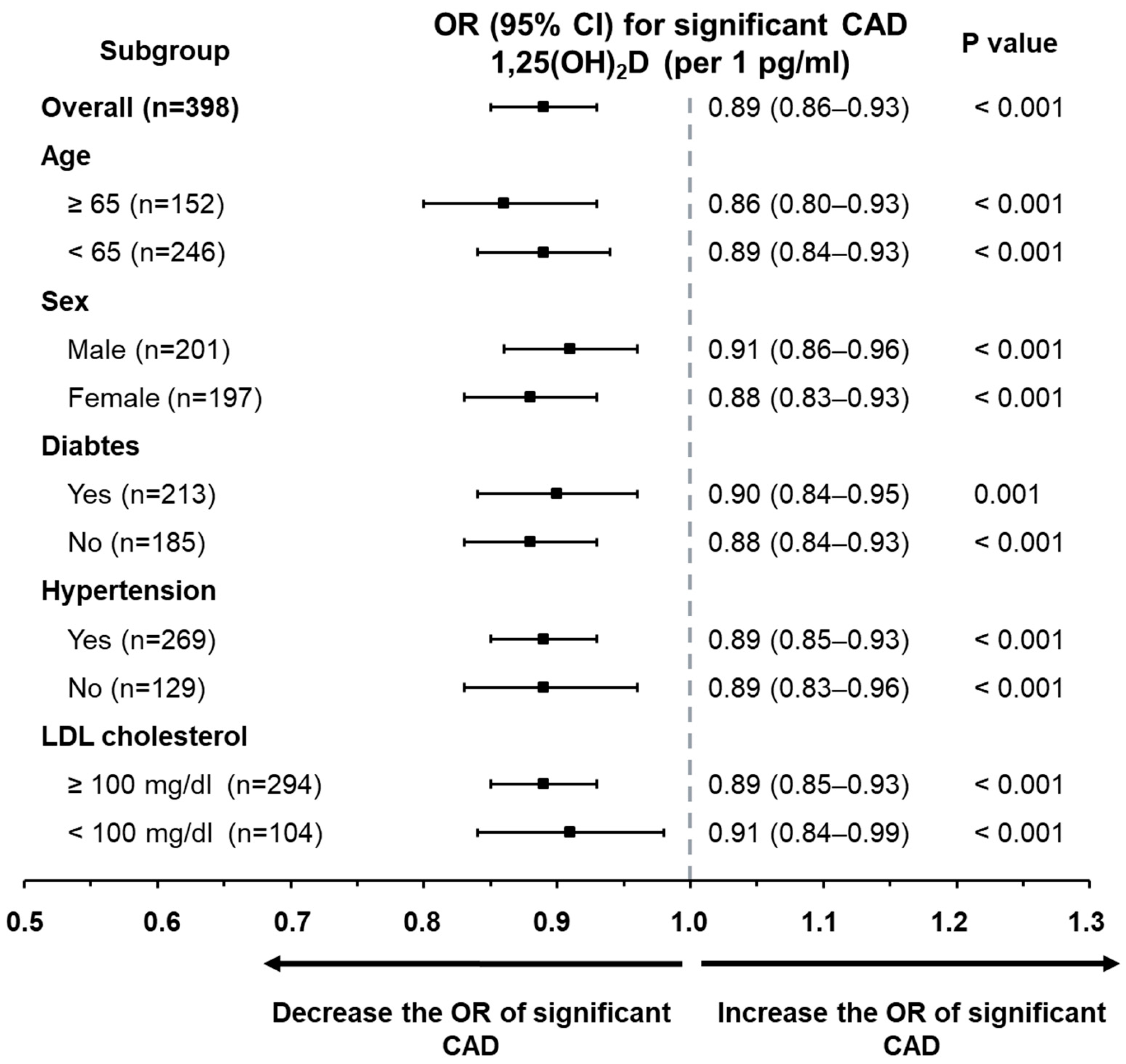
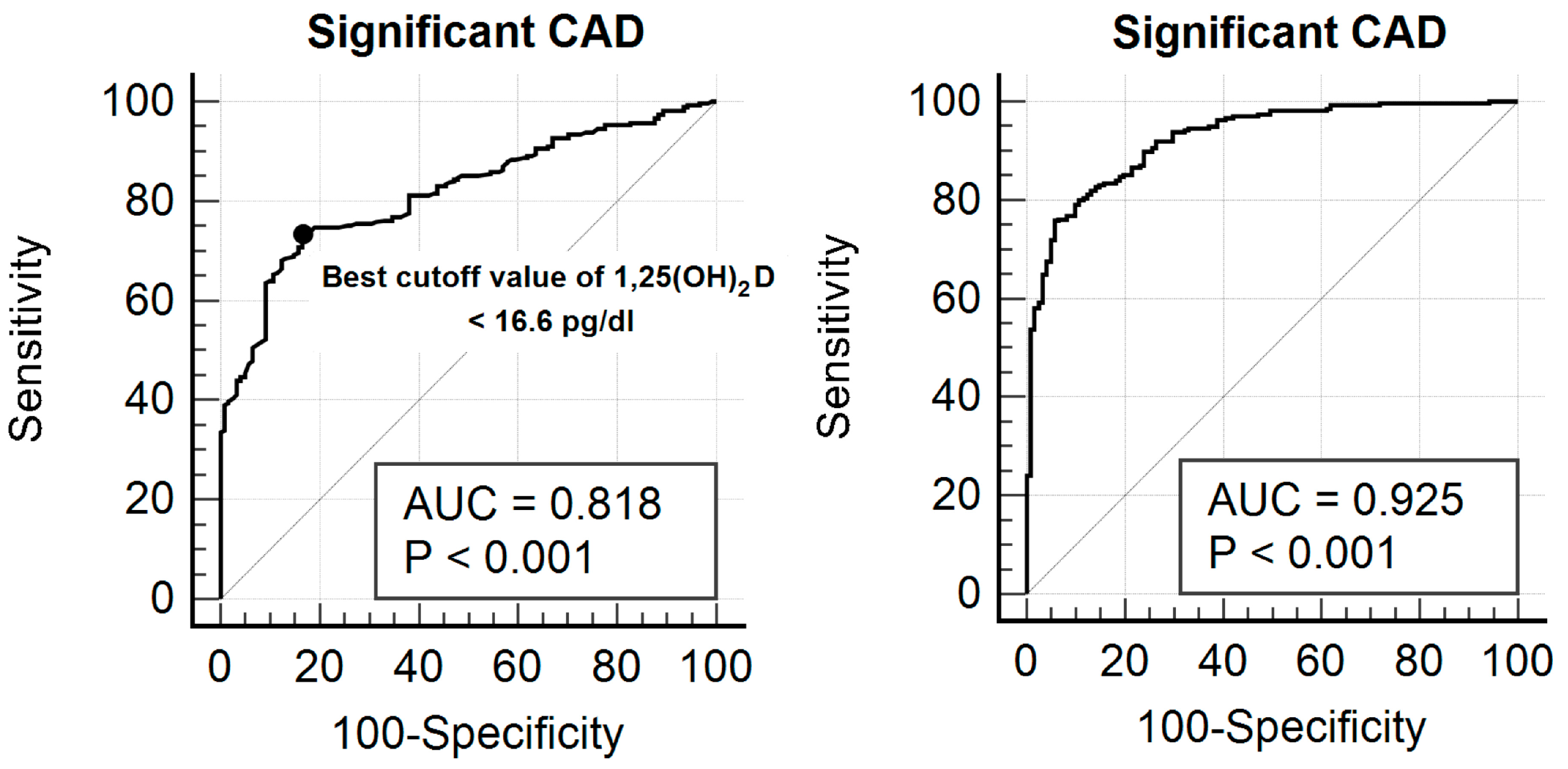
Background and Objectives: Chronic kidney disease (CKD) increases the risk of coronary artery disease (CAD), and vitamin D deficiency—particularly reduced levels of 1,25-dihydroxyvitamin D [1,25(OH)2D], the biologically active form of vitamin D that declines early in CKD due to impaired renal conversion—may be a contributing factor. This study aimed to assess the relationship between 1,25(OH)2D levels and the presence and severity of CAD in CKD patients. Materials and Methods: We retrospectively analyzed 398 non-dialysis CKD patients (eGFR < 60 mL/min/1.73 m2) who underwent elective coronary angiography. Serum 1,25(OH)2D and 25(OH)D levels were measured, and CAD severity was assessed using the Gensini score. Results: Lower 1,25(OH)2D levels were independently associated with both the presence and se-verity of CAD. Logistic regression revealed that each 1 pg/mL increase in 1,25(OH)2D was linked to an 11% reduction in odds of significant CAD (OR: 0.89; 95% CI: 0.86–0.93; p < 0.001). In contrast, 25(OH)D was not significantly related to CAD. Linear regression showed an inverse correlation between 1,25(OH)2D and Gensini scores (β = −0.329, p < 0.001), indicating reduced disease severity with higher vitamin D levels. Subgroup analyses confirmed consistent associations across age, sex, diabetes, hypertension, and LDL-cholesterol categories. ROC analysis demonstrated that 1,25(OH)2D alone had good predictive ability for CAD (AUC = 0.818), which improved to 0.925 when combined with traditional risk factors. The optimal cutoff for 1,25(OH)2D was ≤16.6 pg/mL, yielding 73.3% sensitivity and 83.5% specificity. Conclusions: Serum 1,25(OH)2D is an independent predictor of both the presence and extent of CAD in CKD patients and may serve as a valuable non-traditional biomarker for cardiovascular risk assessment.
Keywords: coronary artery disease; chronic kidney disease; vitamin D coronary artery disease; chronic kidney disease; vitamin D