Hereditary Angioedema Prophylaxis Therapy: Berotralstat and Lanadelumab Safety Profile


Abstract
1. Introduction
2. Materials and Methods
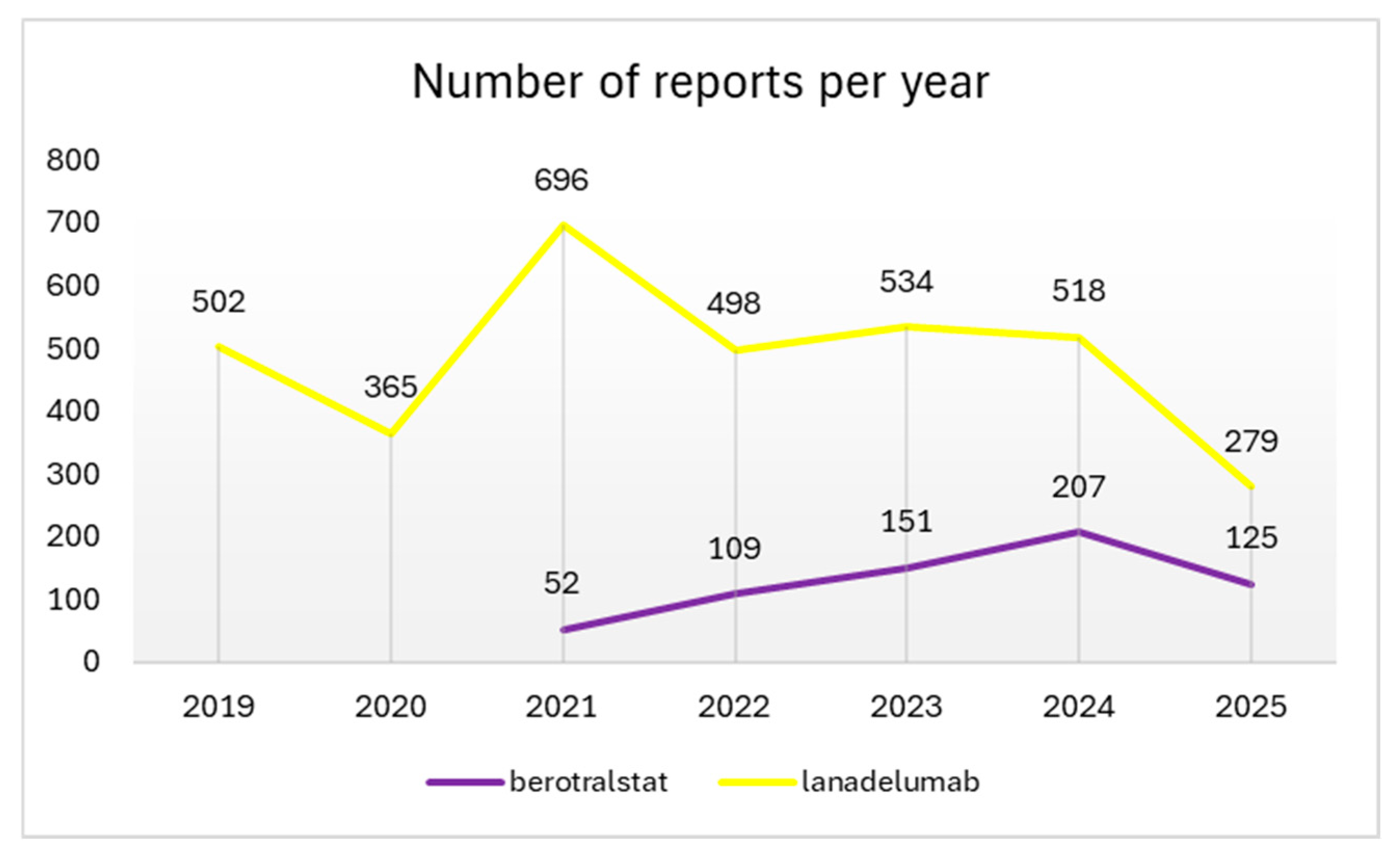
3. Results
4. Discussion
Limits
5. Conclusions
Author Contributions
Funding
Institutional Review Board Statement
Informed Consent Statement
Data Availability Statement
Conflicts of Interest
Abbreviations
| HAE-C1INH | Hereditary angioedema due to C1 inhibitor deficiency |
| LTP | Long-term prophylaxis |
| ADRs | Adverse drug reactions |
| pdC1-INH | Plasma-derived C1-INH concentrate |
| AEs | Adverse events |
References
- Banerji, A.; Riedl, M.A.; Bernstein, J.A.; Cicardi, M.; Longhurst, H.J.; Zuraw, B.L.; Busse, P.J.; Anderson, J.; Magerl, M.; Martinez-Saguer, I.; et al. Effect of Lanadelumab Compared with Placebo on Prevention of Hereditary Angioedema Attacks: A Randomized Clinical Trial. JAMA 2018, 320, 2108–2121, Erratum in JAMA 2019, 321, 1636. https://doi.org/10.1001/jama.2019.4254. [Google Scholar] [CrossRef] [PubMed] [PubMed Central]
- Maurer, M.; Magerl, M.; Betschel, S.; Aberer, W.; Ansotegui, I.J.; Aygören-Pürsün, E.; Banerji, A.; Bara, N.A.; Boccon-Gibod, I.; Bork, K.; et al. The international WAO/EAACI guideline for the management of hereditary angioedema-The 2021 revision and update. Allergy 2022, 77, 1961–1990. [Google Scholar] [CrossRef] [PubMed]
- Farkas, H.; Stobiecki, M.; Peter, J.; Kinaciyan, T.; Maurer, M.; Aygören-Pürsün, E.; Kiani-Alikhan, S.; Wu, A.; Reshef, A.; Bygum, A.; et al. Long-term safety and effectiveness of berotralstat for hereditary angioedema: The open-label APeX-S study. Clin. Transl. Allergy 2021, 11, e12035. [Google Scholar] [CrossRef] [PubMed] [PubMed Central]
- Zanichelli, A.; Senter, R.; Merlo, A.; Gidaro, A.; Popescu Janu, V.; Cogliati, C.B.; Cancian, M. Comorbidities in Angioedema Due to C1-Inhibitor Deficiency: An Italian Survey. J. Allergy Clin. Immunol. Pract. 2024, 12, 1029–1036. [Google Scholar] [CrossRef] [PubMed]
- Bernstein, J.A.; Schwartz, L.; Yang, W.; Baker, J.; Anderson, J.; Farkas, H.; Aygören-Pürsün, E.; Bygum, A.; Jacobs, I.; Feuersenger, H.; et al. Long-term safety and efficacy of subcutaneous C1-inhibitor in older patients with hereditary angioedema. Ann. Allergy Asthma Immunol. 2020, 125, 334–340.e1. [Google Scholar] [CrossRef] [PubMed]
- Princic, N.; Evans, K.A.; Shah, C.H.; Sing, K.; Juethner, S.; Schultz, B.G. Comparison of real-world healthcare resource utilization and costs among patients with hereditary angioedema on lanadelumab or berotralstat long-term prophylaxis. J. Comp. Eff. Res. 2025, 14, e240205. [Google Scholar] [CrossRef] [PubMed] [PubMed Central]
- Zuraw, B.L.; Lopez-Gonzalez, L.; Manjelievskaia, J.; Winer, I.; Dean, A.; Wall, S.; Nelson, J.; Nestler-Parr, S.; Gillard, P.; Christiansen, S.C. Adherence and persistence among patients with hereditary angioedema receiving long-term prophylaxis in the United States. Allergy Asthma Proc. 2025, 46, 209–217. [Google Scholar] [CrossRef] [PubMed]
- Horváth, H.R.; Visy, B.; Kőhalmi, K.V.; Balla, Z.; Andrási, N.; Czaller, I.; Zotter, Z.; Farkas, H. A national survey of four decades of hereditary angioedema prophylaxis: Efficacy and safety of old and new drugs. Clin. Immunol. 2025, 279, 110542. [Google Scholar] [CrossRef] [PubMed]
- Magerl, M.; Bouillet, L.; Martinez-Saguer, I.; Gavini, F.; Bent-Ennakhil, N.; Sayegh, L.; Andresen, I. Real-World Effectiveness of Lanadelumab in Hereditary Angioedema: Multicountry INTEGRATED Observational Study. J. Allergy Clin. Immunol. 2025, 13, 378–387.e2, Erratum in J. Allergy Clin. Immunol. 2025, 13, 954. https://doi.org/10.1016/j.jaip.2025.02.003. [Google Scholar] [CrossRef] [PubMed]
- Riedl, M.A.; Soteres, D.; Sublett, J.W.; Desai, B.; Tomita, D.; Collis, P.; Bernstein, J.A.; APeX-S Study Investigators. Hereditary angioedema outcomes in US patients switched from injectable long-term prophylactic medication to oral berotralstat. Ann. Allergy Asthma Immunol. 2024, 132, 505–511.e1. [Google Scholar] [CrossRef] [PubMed]
- Busse, P.J.; Christiansen, S.C.; Riedl, M.A.; Banerji, A.; Bernstein, J.A.; Castaldo, A.J.; Craig, T.; Davis-Lorton, M.; Frank, M.M.; Li, H.H.; et al. US HAEA Medical Advisory Board 2020 Guidelines for the Management of Hereditary Angioedema. J. Allergy Clin. Immunol. 2021, 9, 132–150.e3. [Google Scholar] [CrossRef] [PubMed]
- Anderson, J.; Maina, N. Reviewing clinical considerations and guideline recommendations of C1 inhibitor prophylaxis for hereditary angioedema. Clin. Transl. Allergy 2022, 12, e12092. [Google Scholar] [CrossRef] [PubMed] [PubMed Central]
- Bork, K.; Meng, G.; Staubach, P.; Hardt, J. Hereditary angioedema: New findings concerning symptoms, affected organs, and course. Am. J. Med. 2006, 119, 267–274. [Google Scholar] [CrossRef] [PubMed]
- Bouillet, L.; Gompel, A. Hereditary angioedema in women: Specific challenges. Immunol. Allergy Clin. N. Am. 2013, 33, 505–511. [Google Scholar] [CrossRef] [PubMed]
- Kulkarni, M.; Travers, J.B.; Rohan, C. High Estrogen States in Hereditary Angioedema: A Spectrum. Clin. Rev. Allergy Immunol. 2021, 60, 396–403. [Google Scholar] [CrossRef] [PubMed]
- Cancian, M.; Triggianese, P.; Modica, S.; Arcoleo, F.; Bignardi, D.; Brussino, L.; Colangelo, C.; Di Agosta, E.; Firinu, D.; Guarino, M.D.; et al. The impact of puberty on the onset, frequency, location, and severity of attacks in hereditary angioedema due to C1-inhibitor deficiency: A survey from the Italian Network for Hereditary and Acquired Angioedema (ITACA). Front. Pediatr. 2023, 11, 1141073. [Google Scholar] [CrossRef] [PubMed] [PubMed Central]
- Johnston, D.; Lumry, W.; Banerji, A.; Aygören-Pürsün, E.; Bernstein, J.; Maurer, M.; Cicardi, M.; Christiansen, S.; Zuraw, B.; Dobo, S.; et al. Gastrointestinal (GI) Adverse Events (AEs) Observed with Berotralstat (BCX7353) Treatment for Hereditary Angioedema (HAE) are Primarily Mild, Self-limited, and Diminish with Time on Treatment. J. Allergy Clin. Immunol. 2020, 145, AB102. [Google Scholar] [CrossRef]
- Srinivasan, C.; Ritchie, B.; Adatia, A. Berotralstat in hereditary angioedema due to C1 inhibitor deficiency: First real-world evidence from a Canadian center. Front. Immunol. 2024, 15, 1339421. [Google Scholar] [CrossRef] [PubMed] [PubMed Central]
- Cao, Y.; Kan, H.; Wang, X.; Zhi, Y. Gut microbiome alterations in hereditary angioedema. Ann. Allergy Asthma Immunol. 2022, 128, 451–458.e6. [Google Scholar] [CrossRef] [PubMed]
- Beard, N.; Frese, M.; Smertina, E.; Mere, P.; Katelaris, C.; Mills, K. Interventions for the long-term prevention of hereditary angioedema attacks. Cochrane Database Syst. Rev. 2022, 11, CD013403. [Google Scholar] [CrossRef] [PubMed] [PubMed Central]
- Riedl, M.A.; Bernstein, J.A.; Craig, T.; Banerji, A.; Magerl, M.; Cicardi, M.; Longhurst, H.J.; Shennak, M.M.; Yang, W.H.; Schranz, J.; et al. An open-label study to evaluate the long-term safety and efficacy of lanadelumab for prevention of attacks in hereditary angioedema: Design of the HELP study extension. Clin. Transl. Allergy 2017, 7, 36. [Google Scholar] [CrossRef] [PubMed] [PubMed Central]
- FDA Labels for Lanadelumab (TAKHZYRO®). 2018. Available online: https://www.accessdata.fda.gov/drugsatfda_docs/label/2018/761090s001lbl.pdf (accessed on 5 February 2024).
- Isabwe, G.A.C.; Garcia Neuer, M.; de Las Vecillas Sanchez, L.; Lynch, D.M.; Marquis, K.; Castells, M. Hypersensitivity reactions to therapeutic monoclonal antibodies: Phenotypes and endotypes. J. Allergy Clin. Immunol. 2018, 142, 159–170.e2. [Google Scholar] [CrossRef] [PubMed]
- Senter, R.; Zanichelli, A.; Stefano, A.; Arcoleo, F.; Bignardi, D.; Borrelli, P.; Cogliati, C.; Colangelo, C.; De Pasquale, T.; Giacco, S.D.; et al. The Impact of COVID-19 on Patients with Bradykinin-Mediated Angioedema in the ITACA Cohort. Clin. Exp. Allergy 2025, 55, 955–959. [Google Scholar] [CrossRef] [PubMed]
- Sharif, A. Guilty by association? The complex relationship between immunosuppressants and cancer. BMJ Oncol. 2023, 2, e000127. [Google Scholar] [CrossRef] [PubMed]
- Li, H.; Wang, C.; Guo, C. A Pharmacovigilance Analysis of Post-Marketing Safety of Tezepelumab. J. Allergy Clin. Immunol. Pract. 2025, 13, 551–558.e6. [Google Scholar] [CrossRef] [PubMed]


| Drug Name (Trademark) | Indications | Dosage | Mechanism of Action |
|---|---|---|---|
| Plasma-derived C1 inhibitor (Cynrize) | Acute attack, STP, LTP All age groups | 1000 IU iv every 3–4 days | Inhibits factor XIIa and activated plasma kallicrein |
| Plasma-derived C1 inhibitor (Haegarda, Berinert sc, CSL Behring) | LTP | 60 IU/kg sc every 3–4 days | Inhibits factor XIIa and activated plasma kallicrein |
| Lanadelumab (Takhzyro, Takeda) | LTP | 300 mg sc every 2 or 4 weeks | Inhibits activated plasma kallicrein |
| Berotralstat (Orladeyo, BioCryst) | LTP | 150 mg daily orally | Inhibits activated plasma kallicrein |
| Berotralstat (%) | Lanadelumab (%) | |
|---|---|---|
| Patient sex distribution | ||
| Female | 238 (37%) | 2433 (71%) |
| Male | 128 (20%) | 790 (23%) |
| Unknown | 278 (43%) | 209 (6%) |
| Age group distribution | ||
| 2–11 years | 0 (0%) | 21 (0.6%) |
| 12–17 years | 24 (4%) | 91 (3%) |
| 18–44 years | 97 (15%) | 817 (24%) |
| 45–64 years | 78 (12%) | 821 (24%) |
| 65–74 years | 36 (6%) | 199 (6%) |
| ≥75 years | 9 (1%) | 98 (3%) |
| Unknown | 400 (62%) | 1385 (40%) |
| Adverse Events | Berotralstat (%) | Lanadelumab (%) | p-Value |
|---|---|---|---|
| Cardiac disorders | 22 (3.4) | 136 (3.9) | 0.57 |
| Gastrointestinal disorders | 308 (47.9) | 475 (13.3) | 0.0001 |
| Diarrhea | 94 | 71 | 0.0001 |
| Abdominal pain | 66 | 44 | 0.0001 |
| Nausea | 52 | 94 | 0.0001 |
| Dyspepsia | 39 | 9 | 0.0001 |
| General disorders and administration site conditions | 200 (31) | 1575 (45.9) | 0.0001 |
| Injection site pain | 3 | 333 | 0.0001 |
| Injection site erythema | 3 | 114 | 0.0001 |
| Fatigue | 38 | 107 | 0.0001 |
| Immune system disorders | 9 (1.4) | 183 (5.3) | 0.0001 |
| Drug hypersensitivity | 4 | 99 | 0.0002 |
| Anaphylactoid reaction | 2 | 23 | 0.411 |
| Infections | 52 (8) | 801 (23.3) | 0.0001 |
| COVID-19 | 16 | 237 | 0.0001 |
| Influenza | 5 | 73 | 0.018 |
| Viral gastroenteritis | 4 | 22 | 1 |
| Pneumonia | 0 | 105 | 0.0001 |
| Injury | 65 (10) | 1384 (40.3) | 0.0001 |
| Product dose omission issue | 14 | 600 | 0.0001 |
| Inappropriate schedule of product administration | 8 | 371 | 0.0001 |
| Exposure during pregnancy | 6 | 44 | 0.1633 |
| Investigations | 50 (7.7) | 683 (19.9) | 0.0001 |
| Weight decreased | 8 | 358 | 0.0001 |
| Weight increased | 15 | 362 | 0.0001 |
| Blood pressure increased | 3 | 39 | 0.139 |
| Metabolism | 10 (1.5) | 135 (3.9) | 0.0016 |
| Decreased appetite | 5 | 20 | 0.579 |
| Dehydration | 1 | 30 | 0.0105 |
| Weight fluctuation | 0 | 23 | 0.0626 |
| Musculoskeletal and connective tissue disorders | 30 (4.6) | 345 (10) | 0.0001 |
| Myalgia | 4 | 54 | 0.0684 |
| Arthralgia | 5 | 57 | 0.112 |
| Back pain | 11 | 44 | 0.3561 |
| Neoplasms | 13 (2) | 133 (3.8) | 0.0202 |
| Nervous system disorders | 111 (17) | 600 (17,4) | 0.91 |
| Product issues | 9 (1.4) | 268 (7.8) | 0.0001 |
| Product available issue | 2 | 102 | 0.0003 |
| Product distribution issue | 1 | 71 | 0.0076 |
| Respiratory, thoracic, and mediastinal disorders | 36 (5.6) | 319 (9.2) | 0.0017 |
| Skin and subcutaneous tissue disorders | 52 (8) | 380 (11) | 0.0253 |
| Social circumstances | 3 (0.4) | 221 (6.4) | 0.0001 |
| Insurance issue | 2 | 168 | 0.0001 |
| Inability to afford medication | unk. | 19 | 0.0589 |
| Surgical and medical procedures | 11 (1.7) | 230 (6.7) | 0.0001 |
| Hospitalization | 1 | 56 | 0.0014 |
| Therapy interrupted | 3 | 36 | 0.191 |
| Surgery | 17 | 162 | 0.1595 |
| Vascular disorders | 17 (2.6) | 162 (4.7) | 0.0158 |
| Thrombosis | 2 | 37 | 0.0759 |
| Hemorrhage | 0 | 23 | 0.0391 |
Disclaimer/Publisher’s Note: The statements, opinions and data contained in all publications are solely those of the individual author(s) and contributor(s) and not of MDPI and/or the editor(s). MDPI and/or the editor(s) disclaim responsibility for any injury to people or property resulting from any ideas, methods, instructions or products referred to in the content. |
© 2025 by the authors. Published by MDPI on behalf of the Lithuanian University of Health Sciences. Licensee MDPI, Basel, Switzerland. This article is an open access article distributed under the terms and conditions of the Creative Commons Attribution (CC BY) license (https://creativecommons.org/licenses/by/4.0/).
Share and Cite
Donadoni, M.; La Cava, L.; Bizzi, E.; Popescu Janu, V.; Meschia, A.; Cirigliano, F.; Cogliati, C.; Gidaro, A. Hereditary Angioedema Prophylaxis Therapy: Berotralstat and Lanadelumab Safety Profile. Medicina 2025, 61, 1897. https://doi.org/10.3390/medicina61111897
Donadoni M, La Cava L, Bizzi E, Popescu Janu V, Meschia A, Cirigliano F, Cogliati C, Gidaro A. Hereditary Angioedema Prophylaxis Therapy: Berotralstat and Lanadelumab Safety Profile. Medicina. 2025; 61(11):1897. https://doi.org/10.3390/medicina61111897
Chicago/Turabian StyleDonadoni, Mattia, Leyla La Cava, Emanuele Bizzi, Valentina Popescu Janu, Alessia Meschia, Federica Cirigliano, Chiara Cogliati, and Antonio Gidaro. 2025. "Hereditary Angioedema Prophylaxis Therapy: Berotralstat and Lanadelumab Safety Profile" Medicina 61, no. 11: 1897. https://doi.org/10.3390/medicina61111897
APA StyleDonadoni, M., La Cava, L., Bizzi, E., Popescu Janu, V., Meschia, A., Cirigliano, F., Cogliati, C., & Gidaro, A. (2025). Hereditary Angioedema Prophylaxis Therapy: Berotralstat and Lanadelumab Safety Profile. Medicina, 61(11), 1897. https://doi.org/10.3390/medicina61111897