Article

Quality of Life and Socioeconomic Situation of Patients with Hereditary Angioedema in Slovakia

by
Martina Ondrušová
1,2,
Martin Suchanský
1,
Soňa Vándor Svidová
1,
Katarína Hrubišková
3,
Jana Zelníková
4,
Karolína Vorčáková
5,* and
Miloš Jeseňák
6,7,*
1
PharmIn Ltd., Karadžičova 16, 82108 Bratislava, Slovakia
2
Faculty of Public Health, Slovak Medical University, 83303 Bratislava, Slovakia
3
Centre for Hereditary Angioedema, Allergy-Immunology Outpatient Clinic, 5th Internal Clinic, Faculty of Medicine, Comenius University and Slovak Medical University, 83303 Bratislava, Slovakia
4
Immunoallergology JZ, Ltd., Faculty Hospital, 01207 Žilina, Slovakia
5
Department of Dermatovenereology, Jessenius Faculty of Medicine in Martin, Comenius University in Slovakia, University Teaching Hospital, 03659 Martin, Slovakia
6
National Centre for Hereditary Angioedema, Department of Paediatrics and Adolescent Medicine, Department of Pulmonology and Phthisiology, Jessenius Faculty of Medicine in Martin, Comenius University in Slovakia, University Teaching Hospital, 03659 Martin, Slovakia
7
Institute of Clinical Immunology and Medical Genetics, Jessenius Faculty of Medicine in Martin, Comenius University in Slovakia, University Teaching Hospital, 03659 Martin, Slovakia
*
Authors to whom correspondence should be addressed.
Medicina 2026, 62(4), 705; https://doi.org/10.3390/medicina62040705
Submission received: 30 December 2025 / Revised: 8 March 2026 / Accepted: 25 March 2026 / Published: 7 April 2026
(This article belongs to the Special Issue Updates on Allergies and Immunodeficiencies)

Abstract

Background and Objectives: Hereditary angioedema (HAE) represents a specific form of life-threatening inborn errors of immunity. Current guidelines recommend regular assessment of the disease burden, disease control and quality of life. This study describes the profile of HAE patients in Slovakia, disease control, quality of life, states of anxiety and depression, and socioeconomic situation. Materials and Methods: We used a set of standardized questionnaires—AE-QoL, AECT, HADS and Socioeconomic Status Questionnaire, and a non-standardized questionnaire—to describe the characteristics of the population. Results: We collected data on 56.44% (57 out of 101) of HAE adult patients registered in Slovakia. Moderate to severe HAE was present in 61.40% of patients; 73.68% were on long-term prophylactic treatment; and 19.30% received rescue treatment due to an acute HAE attack during the last 4 weeks. Most patients achieved lower AE-QoL scores, indicating a good quality of life. The AECT score indicated well-controlled disease in 91.23% of patients. Anxiety and/or depression scores were higher than normal in 17.54% of patients. Patients with HAE earned less than the average population, but most of them were economically active with relatively low rates of presenteeism and absenteeism. Only a minority of patients used social system benefits. Patients were exclusively cared for by relatives. Conclusions: The QoL scores achieved in all three standardized questionnaires indicate a good quality of life of HAE patients in Slovakia, which is associated with a high and specialized standard of care. Anxiety and/or depression were present in 17.54% of patients. Direct patients costs and social care costs are low, but there is an indirect socioeconomic burden on patients and their families.

1. Introduction

Hereditary angioedema (HAE) is a rare hereditary disease characterized by sudden, severe, life-threatening attacks of skin and submucous tissue swelling caused by increased vascular permeability due to overproduction of bradykinin [1]. It is a heterogeneous disease with a complex pathophysiology and many of the affected are unaware of their diagnosis. Attacks can be triggered by emotional stress, dental treatment, infection, surgery, injury, medication, menstruation or alcohol, but the trigger is often unknown [2,3].
Episodes of swelling last 1–5 days on average. Edema can affect different parts of the body, including the face, upper respiratory tract, limbs, or gastrointestinal tract [4]. Laryngeal angioedema, i.e., swelling of the upper respiratory tract, is the most severe and potentially fatal clinical manifestation, as it can lead to airway obstruction and asphyxia.
Recently, an analysis of the National Registry of HAE Patients in Slovakia was published, identifying a total of 126 patients (101 adult patients; 80.16%) with an estimated prevalence and incidence of 1:41,280 and 1:1,360,000, respectively. Among them, 12 novel, previously undescribed mutations were found [5]. The frequency of attacks varies widely [6]. In Slovakia, the frequency of more than 10 attacks per year was recorded in 7.14% of patients, 6–10 attacks in 8.16%, five and less attacks in 84.69% of patients, and 38.78% of patients experienced laryngeal swelling during their lifetime [7].
The management of HAE is based on prophylaxis (long-term or short-term) and treatment of acute attacks (rescue treatment). Long-term prophylaxis focuses on preventing or reducing the frequency and severity of attacks, whereas short-term prophylaxis is indicated to prevent attacks in anticipated high-risk situations, such as surgery, intubation, dental surgery, etc. [6]. Prophylactic treatment usually includes androgens (e.g., danazol, stanozolol), antifibrinolytics (e.g., tranexamic acid, epsilon-aminocaproic acid), human C1-INH concentrate (intravenous or subcutaneous), berotralstat or lanadelumab. However, current guidelines recommend only pdC1-INH, lanadelumab or berotralstat for the long-term prophylaxis in the first line of the treatment [2,8,9,10].
The aim of the rescue treatment is to reduce the severity and duration of angioedema. The treatment is significantly more effective if it is given at the onset of an attack within the first few hours [11]. An effective rescue treatment is the intravenous administration of a concentrate of human C1-INH in the form of a plasma derivative as well as a recombinant human C1-INH protein. Another option is subcutaneous icatibant (bradykinin B2 receptor antagonist) [10,12].
Recurrent angioedema attacks are associated with a significant reduction in quality of life for both patients and their relatives in all areas of life [13]: limitation of daily activities, fear of having an attack due to its unpredictability, increased absence from work or school, as well as need for nursing care [2,14].
Despite these facts, there is relatively little data on quality of life in HAE patients in the literature, and local data from Slovakia are not available at all. Indirect costs associated with HAE are difficult or even impossible to assess from hard data due to the lack of a clear classification of HAE.
The aim of this study was to describe the current profile of patients with HAE in Slovakia (demographics, categorization of HAE, therapy), to assess disease control, to determine their quality of life, to detect states of anxiety and depression and to describe their socioeconomic situation (presenteeism, absenteeism, social benefits, need for informal care, individual costs and limitations due to HAE).

2. Materials and Methods

2.1. Study Design

We present a quantitative cohort study that retrospectively evaluated the medical and socioeconomic situation of patients over a specified period. The study was descriptive only and did not evaluate specific treatment outcomes. The primary objective was a descriptive characterization of Slovak HAE patients, including demographic data, quality of life and socioeconomic status, as the set of collected information offers a unique opportunity to analyze a general cohort of patients from a single European country, without the need to extrapolate the results to larger cohorts. Moreover, the aim was to cover as large a proportion of the HAE patient population as possible. The secondary objective was an exploratory analysis of differences in quality of life between different patient groups.

2.2. Study Population

The monitored Slovak HAE patients were treated in two centres: 1. National Reference Centre for Hereditary Angioedema, University Hospital in Martin; 2. Centre for Hereditary Angioedema, 5th Department of Internal Medicine, Faculty of Medicine, Comenius University Bratislava and University Hospital in Bratislava. The inclusion criteria were slightly different for individual questionnaires; therefore, the study population was divided into two groups: A and B. Inclusion criteria, identical for both cohorts (A and B), were as follows: definitively diagnosed HAE at any time in the past; signed consent for the processing of personal data for the purpose of participation in the presented study; citizenship of the Slovak Republic. Extended inclusion criteria for the Socioeconomic Status Questionnaire (cohort B): the patient fulfils the local conditions for any form of work performance (according to the Labour Code—Act No. 311/2001 Coll., § 11, section 2 [15]), regardless of whether they have actually worked—specifically, the patient has reached the age of 15 and at the same time has completed compulsory schooling. All patients met the criteria for completing questionnaires A and B. Exclusion criteria for all questionnaires were the diagnosis of another serious disease in the terminal stage, severe comorbid conditions due to HAE and death of the patient.

2.3. Primary and Secondary Outcomes

The primary outcomes of the study were to collect data on quality of life, disease control and psychological condition of HAE patients in Slovakia. The secondary outcomes were to assess the socioeconomic status of the patients, their social benefits and the need for informal care.

2.4. Questionnaires Specification

The data collection consisted of five questionnaires (3 standardized and the rest non-standardized), each focusing on specific target areas.

2.5. Basic Patient Profile Questionnaire

The non-standardized questionnaire focused on the description of the patient profile and HAE treatment and contained 17 questions [16]. The assessment period was specifically defined for each question: from the date of diagnosis, retrospectively for the last 4 weeks, or up to the date of completion of the questionnaire. The HAE severity parameter for the last year was approved by the study validators before the start of the study according to Prior et al. [17].

2.6. Angioedema Quality of Life Questionnaire (AE-QoL)

AE-QoL is an angioedema-specific quality of life (QoL) questionnaire suitable for the adult population (>18 years). The questionnaire consists of 17 items divided into four domains, Functioning, Fatigue/Mood, Fears/Shame and Nutrition, and has a recall period of 4 weeks. Domain scores and total scores range from 0 to 100, with higher scores indicating greater QoL impairment. The AE-QoL version used was the Angioedema Quality of Life Questionnaire—Slovakian Version 2017 (provided with the official Slovakian translation).

2.7. Angioedema Control Test (AECT)

The standardized AECT questionnaire is suitable for the adult population (>18 years) with all forms of recurrent angioedema [18,19]. The questionnaire monitors disease control retrospectively, with a recall period of 4 weeks. It contains 4 questions with the score ranging from 0 to 16. A cut-off score of <10 points corresponds to poorly controlled disease [18,19]. The AECT 4-week [20] recall version was used in this study. The questionnaire was translated into Slovak by the study implementers for the purpose of this research. The translation was not subjected to a formal forward–backward translation process, cognitive debriefing, or independent psychometric validation in the Slovak population. Therefore, although the original instrument has been formally validated and the cut-off value of ≥10 points corresponds to well-controlled disease in validated language versions, the Slovak version used in this study should be considered exploratory.

2.8. Hospital Anxiety and Depression Scale (HADS)

The standardized HADS questionnaire consists of 14 questions and is suitable for any population without restrictions. The HADS is a simple total score divided into two separately scored scales: anxiety (A-scale) and depression (D-scale) [21]. For both separately, the score ranges from 0 to 21. The HADS score is divided into interpretation categories: normal (0–7), mild (8–10), moderate (11–14) and severe (15–21). The recall period was 7 days. We used the HADS—Slovakia/Slovak—Version of 13 March 2017 (updated 23 June 2021)—Mapi (with an official Slovak translation) [22,23,24].

2.9. Socioeconomic Status Questionnaire (SESQ)

A non-standardized questionnaire called the Evaluation of the Socioeconomic Situation of Patients with HAE consisted of 37 questions. It was developed by Pharm-In, Ltd. and study validators. It is suitable for patients with any disease who have reached 15 years of age and have completed compulsory education in accordance with the Labour Code—Act No. 311/2001 Coll., § 11 section 2. The SESQ is not a scoring questionnaire; it is based on a system of sorting categories and identification of the occurrence of individual facts in the monitored population. The evaluation period was 12 months retrospectively. The version used was SESQ v2022.06 (prepared in the Slovak language).

2.10. Data Collection

The data collection period was 1 July–30 September 2022. The final analysis of the data was performed during the period May–June 2025. During this period, the necessary data were extracted from the patients’ medical records, and the patients completed the pre-designed online forms with the assistance of the physician during their medical examinations [25]. Demographic data included age (current and at diagnosis), sex, type and form of HAE, current prophylaxis status, use of rescue treatment in the last 4 weeks and number of acute HAE attacks in three time periods (last 7 days/4 weeks/12 months). An acute HAE attack was defined as the sudden onset of angioedema symptoms in the subcutaneous and/or submucosal compartment at one or more body sites. The questionnaires did not contain any personal data that could be used to identify patients. The study was approved by the Ethics Committee of University Hospital Martin (Martin, Slovakia)—No. EK UNM24/2022, 12 April 2022.

2.11. Data Analysis Considerations

All patients (100%) answered all questions on all questionnaires.
All analyses were descriptive and exploratory in nature. Categorical variables were summarized using absolute and relative frequencies. Continuous variables were described using number of observations, mean, standard deviation (SD), median, interquartile range (IQR), and range. As most variables were not normally distributed, group comparisons were performed using non-parametric tests (Mann–Whitney U test or Kruskal–Wallis test when appropriate). When the Kruskal–Wallis test indicated a global difference between groups, no post hoc pairwise comparisons were performed due to the small sample size and very small subgroup counts (e.g., severe HAE, n = 2). Therefore, the results of the Kruskal–Wallis test should be interpreted as exploratory global comparisons only.
Given the exploratory character of the study and the limited sample size inherent to a rare disease cohort (n = 57), no formal adjustment for multiple testing (e.g., Holm or false discovery rate correction) was applied. All reported p-values should therefore be interpreted as exploratory. Statistical findings were evaluated in the context of clinical relevance, effect direction, and consistency across related outcome measures rather than on isolated statistical significance.
Data were processed and analyzed using Microsoft Excel [Microsoft 365 Business Standard] and STATISTICA 14 [26].

3. Results

3.1. Characteristics of Patient’s Population

According to the Registry of HAE Patients in Slovakia, the number of all living HAE patients as of 31 December 2021 was 126. The calculated prevalence was 1:43,000. The adult population was represented by 101 patients (80.16%) [27]. In this study, data was collected from n = 57 adult patients, representing 56.44% of adult patients registered in the HAE Patient Registry. Descriptive characteristics of the enrolled population are summarized in Table 1. Females predominated in the study: 56.14% (n = 32) vs. 43.86% males (n = 25). The median age at diagnosis was 23.52 years (IQR 16.42–32.48) and 44.53 years (IQR 33.33–55.47) at the time questionnaire completion. More than a half of the patients (61.40%; n = 35) had a moderate to severe form of HAE. More than half of the patients were receiving prophylactic treatment (73.68%; n = 42) (Table 1). Rescue treatment in the last 4 weeks was given to 19.30% (n = 11) of all patients in the study (Table 1).

3.2. QoL Questionnaires

Due to the asymmetry in the distribution of patients on individual QoL scores (and sorting subgroups), interpretation of QoL scores via median with IQR is recommended.

3.2.1. AE-QoL Standardized Questionnaire

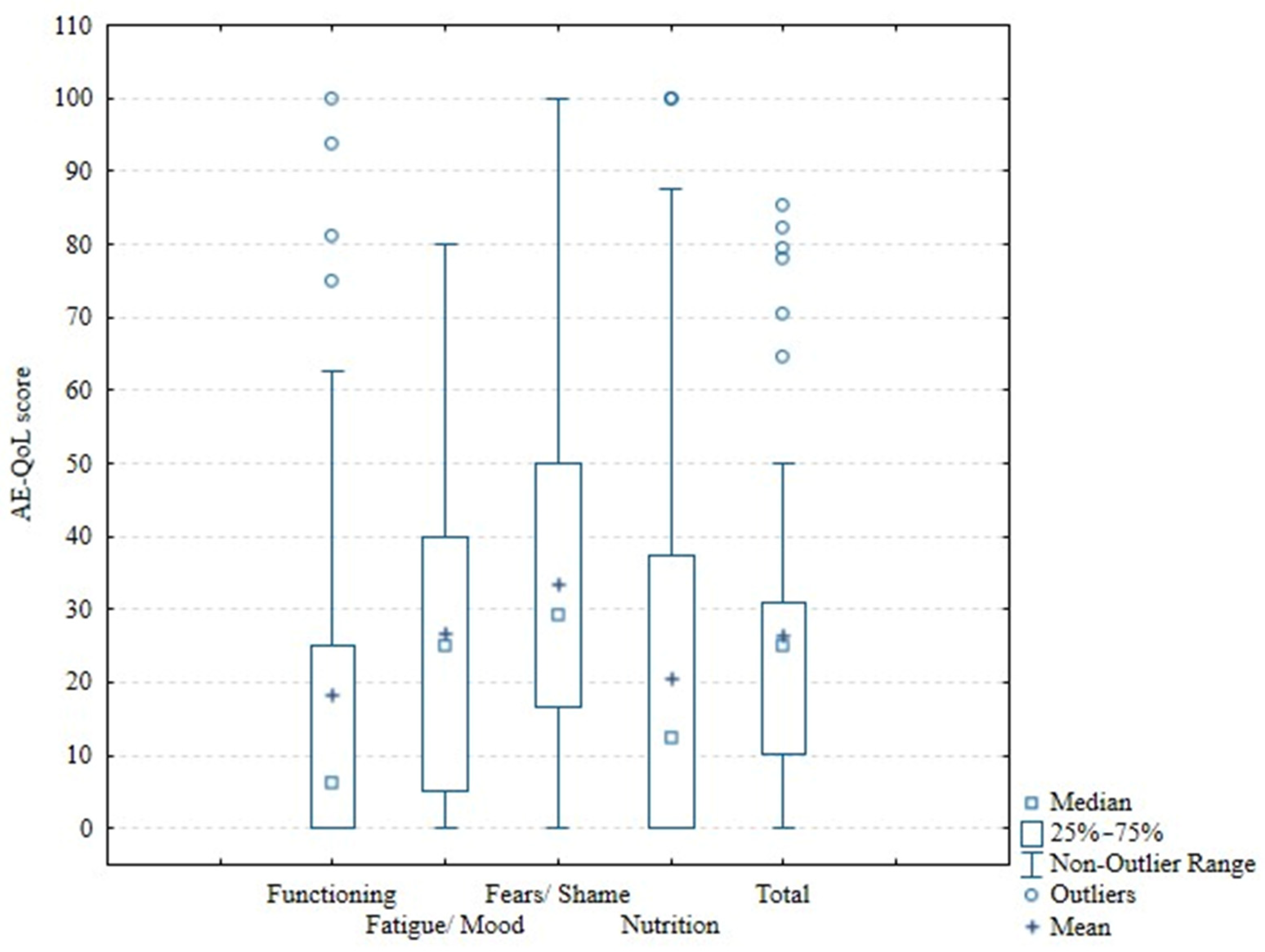
Most patients achieved lower AE-QoL scores, which is desirable and indicates better quality of life. The median total AE-QoL score for the whole population was 25 (IQR 10.29–30.88) (Table 2, Figure 1). There were statistically significant differences in total scores between patients with different uses of prophylaxis and use of rescue treatment (Table 2).

3.2.2. AECT Standardized Questionnaire

The total AECT score reached a median of 14.00 (IQR 12–15) in the population (Table 3). Most patients in the total population (91.23%) achieved an AECT score of 10 or more, indicating a well-controlled disease, regardless of sex, form of HAE and use of prophylaxis. The only statistically significant differences were between patients who had had an acute attack in the last 4 weeks and those who had not, and between patients who had received rescue treatment in the last 4 weeks and those who had not. Patients who used rescue treatment in the last 4 weeks achieved a median score of 11 (IQR 8–12), which is 1 point above the cut-off value for sufficiently controlled disease (Table 3).

3.2.3. HADS Standardized Questionnaire

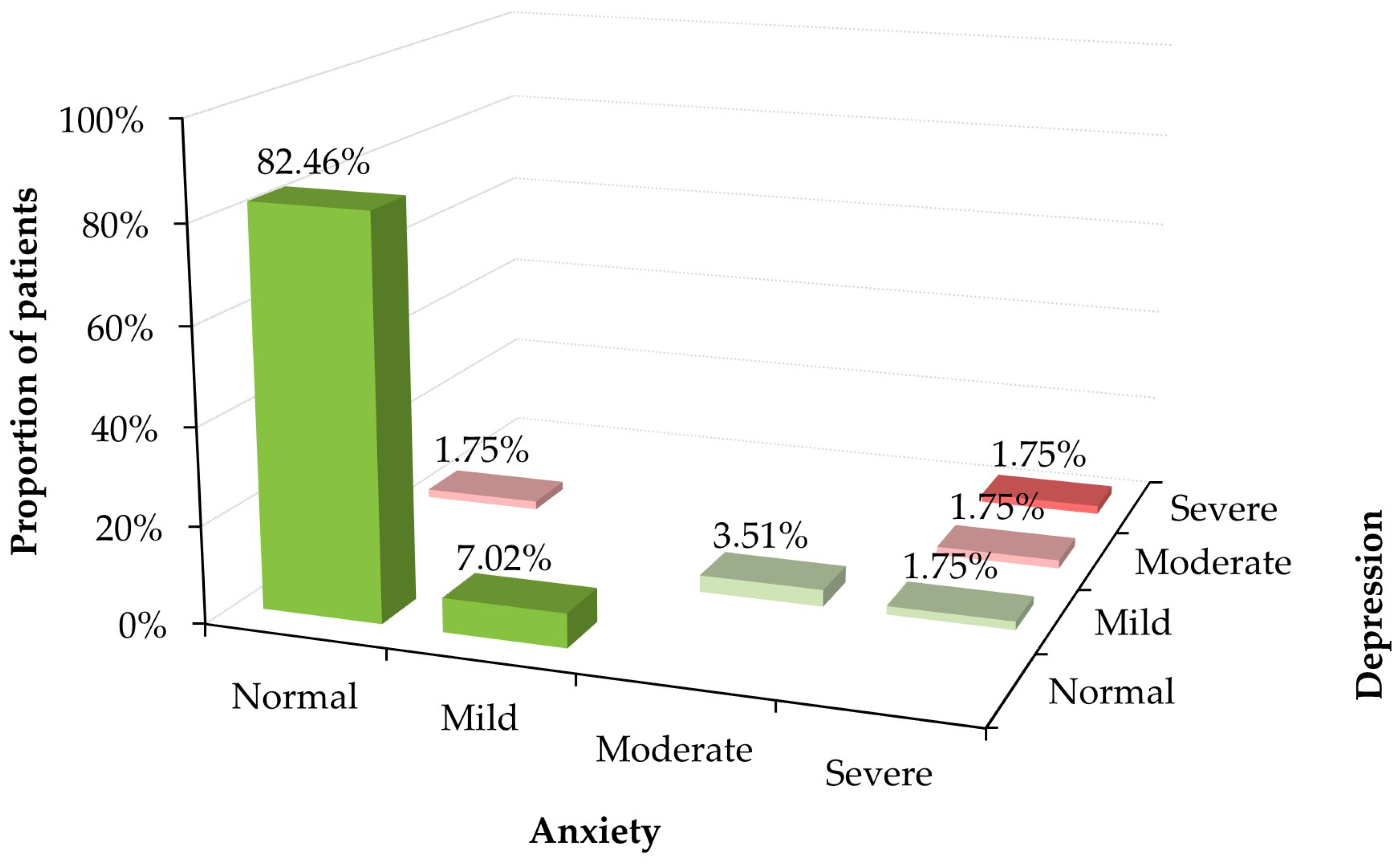
Lower HADS scores indicate good psychological condition in most patients (Table 4). The majority (82.46%) achieved normal scores (Figure 2). Statistically significant differences were only between anxiety and depression scores of patients with and without at least one acute attack during the last 7 days, but only two patients had these acute attacks, and their anxiety or depression were mild or severe. However, the scores can be considered normal for all another groups. Most cases of moderate to severe anxiety and depression were observed in patients on prophylaxis.

3.3. Number of Acute Attacks

In the last 12 months 14.04% of our patients had >10 acute attacks, 10.53% had 6–10 acute attacks and 73.68% had 0–5 acute attacks. In 1.75% of patients the number of acute attacks was unknown . There were significant differences between patients with and without rescue treatment and between patients with different forms of HAE (Table 5).

3.4. Socioeconomic Situation of HAE Patients in the Last 12 Months (Questionnaire B)

All patients who met the additional inclusion criterion (n = 57) participated in the online questionnaire B.
Most patients in the study do not receive most social benefits and are relatively economically active. The study covers a wide range of employment statuses: students, parents on maternity/parental leave, recipients of various pensions, full-time and part-time employees and self-employed.
Among the economically active population, the calculated average gross monthly income of €1140.44 was lower than the country’s average nominal monthly income in 2022 (€1304.00) [28].

3.5. Economic Activity, Declined Work Performance, Presenteeism, Absenteeism and Activity Limitation Due to HAE in the Last 12 Months

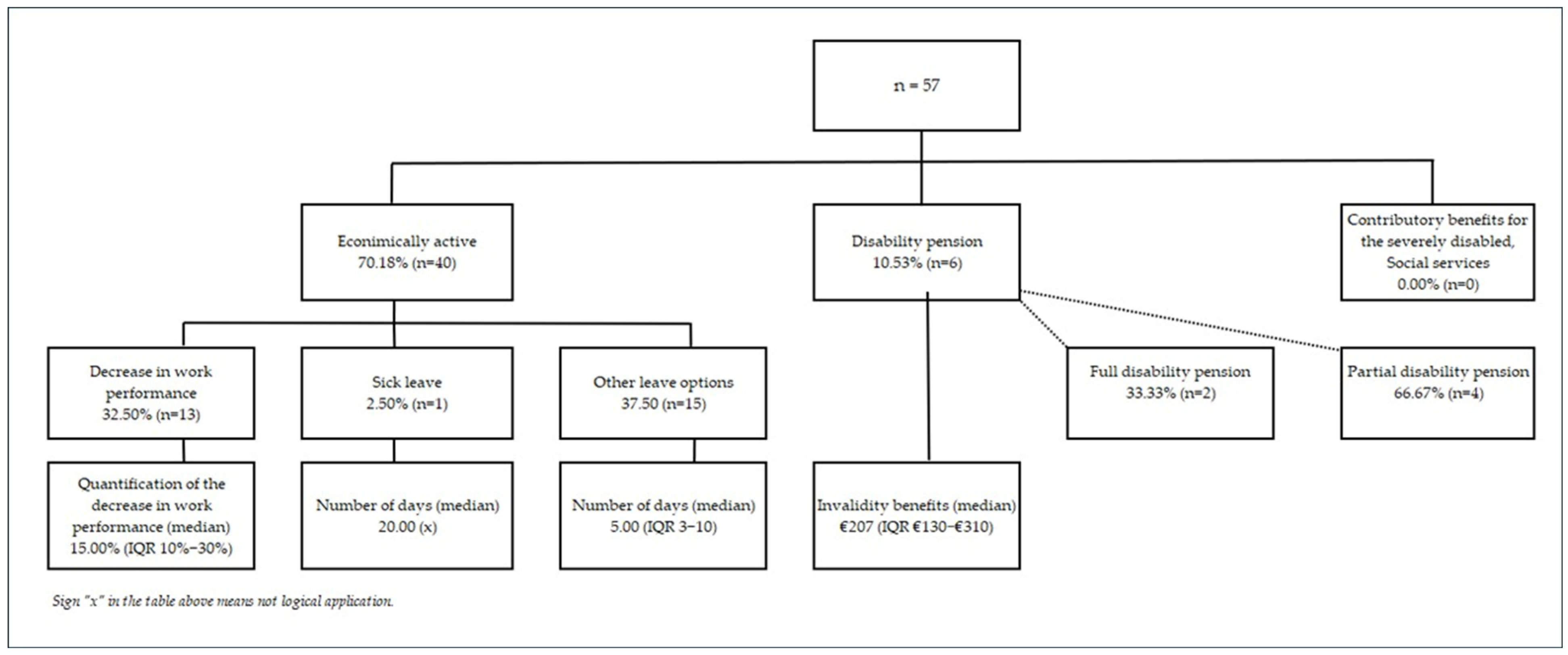
In the last 12 months 70.18% of patients were at least partially economically active (Figure 3). There were proportionally more economically active patients in the group without prophylaxis (80.00% of all patients without prophylaxis) than in the group with prophylaxis (66.12% of all patients with prophylaxis).
A decrease in work performance due to HAE in the last 12 months was reported by 32.50% of economically active patients (Figure 3), of whom 92.31% were on prophylaxis. The median reduction in work performance was 15.00% (IQR 10.00–30.00%).
Only one patient took sickness benefits cumulative for 20 days in the last 12 months (Figure 3). Other forms of leave due to HAE (holidays, sick days, unpaid leave, etc.) were used by 37.50% of patients (median = 5 days; IQR 3–10 days). Among patients with prophylaxis (n = 28), 42.86% took a median of 4.5 days off work (IQR 3–7). In patients without prophylaxis (n = 12), 25.00% took a median of 15 days off work (IQR 4–30).
More than half (56,14%, n = 32) of the patients had to limit their activities in the last 12 months due to HAE, of whom 75.00% reported limitations in their leisure activities: 40.63% in work; 37.50% in travel; 3,13% in sports; 3,13% in routine housework and childcare.

3.6. Disability Pension and Contributory Benefits for the Severely Disabled Due to HAE in the Last 12 Months

Of the patients in our study, 10.53% were receiving some kind of invalidity benefits, of which 33.33% were receiving full invalidity benefits and 66.67% partial invalidity benefits (Figure 3). One patient received partial invalidity benefits due to HAE (16.67%). The median of invalidity benefits was €207/month (IQR €130–€310). None of the patients received contributory benefits for the severely disabled due to HAE in the past 12 months.

3.7. Need for Formal and Informal Care Due to HAE in the Last 12 Months

No patient in the study used social services or 24 h residential care in a social service facility in the last 12 months. Of all patients, only 15.79% (n = 9) required informal care, and they were cared for by a median of two persons (IQR 1–2 persons) in the last 12 months. A total of 80.00% of patients identified the caregiver as their partner, 50.00% as at least one of their parents and 10.00% as at least one of their children. Caregivers spent a median of 10 h per week (IQR 2–20 h) actively caring for a patient. None of the caregivers had received any financial contributions for the care of a severely disabled person due to patient’s HAE disease, and none of the relatives received any caregiver’s allowance due to patient’s HAE disease in the last 12 months. Most patients (77.78%) needed help with household tasks; 66.67% with shopping care; 55.56% with transport to the doctor; and 33.33% with personal hygiene.

3.8. Out-of-Pocket Cost Due to HAE in the Last 12 Months

A total of 87.72% of patients reported zero average co-payments for healthcare due to HAE in the last 12 months (Table 6). All patients in the study had zero co-payments for social care due to HAE. More than a half of them (64.91%) reported zero increase in total costs due to HAE in the last 12 months (median €0, IQR €0–€10). The mean value of €18.28 (SD = 71.16) was driven by one extreme value (Table 6).

3.9. Net Monthly Income During the Last 12 Months

The median of the mean net monthly income in the last 12 months was €750.00 (range €174–€10,000). Due to significant asymmetry in the data, outliers, and extreme values for this item, interpretations based on mean values are not recommended. In median, patients with prophylaxis had a lower income (median €700.00; range €174.00–€10,000; n = 41) than patients without prophylaxis (median €900.00; range €390.00–€2000.00; n = 15).

4. Discussion

This study describes the quality of life of HAE patients in Slovakia, including disease control, psychological condition, and socioeconomic situation. It adds data on QoL in Slovak HAE patients to the recently published epidemiological and molecular genetic data in this cohort [5].
It involves n = 57 adult patients, which represents more than a half (56.44%) of the general cohort of diagnosed patients with HAE in the Slovak Republic (population of n = 5,434,712 in 2022). Beyond confirmed C1-INH-HAE (type I/II), underestimation may still occur, particularly due to diagnostic delays in patients without a positive family history, frequent misdiagnosis as allergic disorders, limited awareness among non-specialists, and the diagnostic complexity of HAE with normal C1-INH. Despite these challenges, in Slovakia the unique centralization of patients into coordinated national expert centers and the existence of a national HAE registry have enabled the capture of a relatively high number of confirmed C1-INH-HAE cases (e.g., n = 132; prevalence ~1:41,280), which is comparable to or higher than figures reported in neighbouring countries such as Austria (n = 137; prevalence ~1:64,396) and the Czech Republic (national cohort reports ~207 patients [5]. Given the rarity of the disease, available publications of similar nature analyze similar patient cohorts. Aygören-Pürsün et al. [14] analyzed the burden of illness on n = 186 HAE patients from Spain (n = 58), Germany (n = 62) and Denmark (n = 44). A Hungarian study [29] analyzed n = 125 HAE patients, while the population of Hungary is approximately 1.78 times the population of Slovakia. And Fouche et al. [30] determined the prevalence of depression and anxiety in n = 26 US HAE patients.
Descriptive observation shows the following relationship between the three questionnaires: lower AE-QoL scores ≥ higher AECT scores ≥ lower HADS scores. Rather desirable quality of life scores were achieved in all three standardized questionnaires.
This study showed that the AE-QoL scores in Slovak patients were lower than those reported in most foreign studies [10,31,32,33,34,35]. This indicates a good quality of life of Slovak HAE patients due to highly specialized standard care. We did not observe statistically significant differences in AE-QoL scores between men and women, which contradicts the findings of some foreign studies, which observed significantly higher AE-QoL total or domain scores in women [29,34,36], or conversely, in men [33]. Patients with prophylaxis had significantly higher AE-QoL scores than patients without prophylaxis. This finding again contradicts the results of other studies, in which use of prophylaxis led to an improved quality of life [32,37]. Our result can be explained by the fact that in our study, prophylactic treatment was received mostly by patients with moderate to severe forms of HAE (n = 35). Patients who required rescue treatment in the last 4 weeks had significantly higher AE-QoL scores than those who did not. We assume that these patients suffered an acute HAE attack during this period. Several studies have shown a positive correlation between the number of attacks during a given period and the AE-QoL scores [10,29,38,39]. Moreover, studies with innovative prophylactic treatment, e.g., lanadelumab, showed a significant and clinically meaningful improvement in AE-QoL very shortly after the initiation of the treatment [40].
Compared with multinational burden-of-illness surveys reporting lower disease control and higher rates of anxiety and depression, our cohort demonstrated more favourable outcomes. These differences may reflect variation in healthcare organization, centralized specialist care, and particularly the relatively high uptake of long-term prophylaxis in our population. In our cohort, 73.68% of patients were receiving long-term prophylaxis, which is higher than in many published European datasets. Greater access to and use of modern prophylactic therapies may contribute to improved disease control and HRQoL, and lower psychological burden. Therefore, cross-country comparisons should be interpreted in light of differences in treatment availability and healthcare system organization. Recent systematic analysis of 65 articles highlighted the importance of early diagnosis and access to the effective treatment to reduce the burden of HAE on patients and society [41].
Significant differences in the AECT score were, as expected, between patients with at least one acute attack in the last 4 weeks and those without, and between patients with rescue treatment in the last 4 weeks and those without. The relationship between decreasing AECT scores and increasing number of attacks has been shown previously [10]. Surprisingly, there was no difference between patients with and without prophylactic treatment, which is not consistent with findings of other authors [32]. Recent studies have demonstrated that AECT is sensitive to clinical change and that a minimal clinically important difference (MCID) has been established (three points of improvement). However, given the cross-sectional design of our study, assessment of responsiveness or MCID-based interpretation was not applicable [42].
The majority of Slovak patients did not suffer from anxiety or depression in the last 7 days. Anxiety and/or depression were present in only 17.54% of patients. The median anxiety score of 3 (IQR 2–6) and median depression score of 2 (IQR 1–4) suggest a good psychological condition of patients in comparison with foreign studies [10,32]. Only five patients had moderate to severe anxiety levels, and one patient had severe depression scores. This patient, on disability pension for anxiety-depressive disorder, had high anxiety (HADS score 18) and high depression (HADS score 19) scores.
Patients receiving long-term prophylaxis had higher AE-QoL scores compared with patients without prophylaxis. This finding should not be interpreted as a negative effect of prophylactic treatment. In our cohort, prophylaxis was predominantly administered to patients with moderate to severe disease, reflecting clinical indication rather than random allocation. Therefore, the observed differences most likely represent confounding by indication, with patients on prophylaxis having a higher baseline disease burden.
Given the cross-sectional design and limited sample size, multivariable adjustment was not performed, as modelling with multiple covariates would be statistically unstable and prone to overfitting. Consequently, comparisons between prophylaxis and non-prophylaxis groups are descriptive and exploratory. No causal inference regarding treatment effect can be made.
Evidence from larger international cohorts suggests that, after appropriate adjustment for disease severity and other confounders, long-term prophylaxis is associated with improved disease control and better patient-reported outcomes. Our findings should therefore be interpreted within the context of baseline disease severity rather than as an effect of treatment itself.
Phase 3 and extension studies of modern prophylactic agents have consistently demonstrated clinically meaningful improvements in HRQoL and disease control, supporting the plausibility of the favourable outcomes observed in a cohort with high prophylaxis uptake.
Our observations on the socioeconomic situation of HAE patients showed that most patients in the study do not receive most social benefits. They are relatively economically active, with relatively low presenteeism and absenteeism compared with other studies [10,14]. Patients with prophylaxis took more days off work than those without prophylaxis, which can be explained by the severity of the underlying disease, but their absence from work was much shorter.
Concerning the total costs of HAE, 35.09% of patients reported more than zero total cost of the disease and additional payments for healthcare, even though all treatments for HAE are fully covered by health insurance. Social care costs were absent, probably due to the relatively young median age of patients and informal care provided by relatives. These findings suggest that even if direct out-of-pocket costs to patients and social care costs to society are low, there is an indirect socioeconomic burden on patients and their families in the form of negative impact on career or education, lost productivity, lost time from unpaid work or foregone leisure time.
The presented study has some limitations. As the aim of this study was to describe the current profile of patients with HAE in Slovakia, we used a cross-sectional design, which captures data at a single time-point but cannot track changes over time. An additional limitation concerns the use of the Angioedema Control Test (AECT). Although AECT is a validated patient-reported outcome instrument with established psychometric properties, including sensitivity to change and a defined cut-off for well-controlled disease, the Slovak version used in our study did not undergo formal cross-cultural validation. The translation was prepared by the study implementers and was not subjected to forward–backward translation procedures or independent validation in the Slovak population. Therefore, AECT-based findings should be interpreted with caution and considered supportive rather than definitive. To mitigate this limitation, conclusions regarding disease control were triangulated with independently collected clinical indicators (attack frequency and rescue treatment use) and with AE-QoL results obtained using a formally validated Slovak version.
An important limitation relates to multiple exploratory comparisons performed across questionnaire domains and patient subgroups. As no formal correction for multiple testing was applied, the risk of type I error cannot be excluded. Reported p-values should therefore be interpreted cautiously and considered hypothesis-generating rather than confirmatory. Given the limited sample size, formal multiplicity adjustments would likely have increased type II error and reduced interpretability in this rare disease cohort. Finally, comparisons between patients receiving and not receiving long-term prophylaxis must be interpreted in light of confounding by indication. Patients on prophylaxis predominantly represented individuals with moderate to severe disease. Due to the cross-sectional design and limited sample size, multivariable adjustment was not performed, as this would risk statistical instability and overfitting. Consequently, associations between prophylaxis and patient-reported outcomes should not be interpreted as causal treatment effects but rather as descriptive differences within the national cohort.
An important contextual limitation is the relatively high proportion of patients receiving long-term prophylaxis in our cohort (73.68%), which exceeds proportions reported in several multinational and European datasets. Higher uptake of prophylactic therapy may contribute to the improved disease control, better HRQoL, and lower psychological burden observed in our population. Consequently, generalizability of these findings to settings with lower access to or uptake of long-term prophylaxis may be limited. To estimate the long-term impact of HAE on quality of life and socioeconomic status of the patients, further research will be needed.


5. Conclusions

Hereditary angioedema represents a lifetime and life-threatening severe disease with significant impact on all aspects of daily life for patients and their families. Monitoring disease burden and quality of life could help to modify and personalize the treatment strategy. Various psychological disorders and problems, identified in a significant proportion of patients, should be considered in the complex management of the disease.

Author Contributions

Conceptualization, M.J. and M.O.; methodology, M.O. and M.J.; software, M.S.; validation, M.J. and M.O.; formal analysis, M.S.; investigation, M.J. and K.V.; resources, M.O. and M.J.; data curation, M.J. and M.S.; writing—original draft preparation, S.V.S.; writing—review and editing, M.O., M.S., K.H., J.Z., K.V. and M.J.; visualization, M.S. and S.V.S.; supervision, M.O. and M.J.; project administration, M.O. and M.J. All authors have read and agreed to the published version of the manuscript.

Funding

This research received no external funding.

Institutional Review Board Statement

The study was conducted in accordance with the Declaration of Helsinki, and approved by the Ethics Committee of University Hospital Martin (Martin, Slovakia) (protocol code No. EK UNM24/2022 and 12 April 2022).

Informed Consent Statement

Informed consent was obtained from all subjects involved in the study.

Data Availability Statement

The data presented in this study are publicly unavailable due to privacy and ethical restrictions. The data are available on request from the corresponding author M.J.

Conflicts of Interest

Authors Martina Ondrušová, Martin Suchanský and Soňa Vándor Svidová was employed by the company PharmIn Ltd., Jana Zelníková was employed by the company Immunoallergology JZ, Ltd. The remaining authors declare that the research was conducted in the absence of any commercial or financial relationships that could be construed as a potential conflict of interest.

Abbreviations

The following abbreviations are used in this manuscript:
AECTAngioedema Control Test
AE-QoLAngioedema Quality of Life Questionnaire
C1-INHC1-inhibitor
HADSHospital Anxiety and Depression Scale
HAEHereditary Angioedema
QoLQuality of Life
SDStandard Deviation

References

  1. Donaldson, V.H.; Evans, R.R. A biochemical abnormality in hereditary angioneurotic edema: Absence of serum inhibitor of C′1-esterase. Am. J. Med. 1963, 35, 37–44. [Google Scholar] [CrossRef]
  2. Zeerleder, S.; Levi, M. Hereditary and acquired C1-inhibitor-dependent angioedema: From pathophysiology to treatment. Ann. Med. 2016, 48, 256–267. [Google Scholar] [CrossRef] [PubMed]
  3. Zanichelli, A.; Vacchini, R.; Badini, M.; Penna, V.; Cicardi, M. Standard care impact on angioedema because of hereditary C1 inhibitor deficiency: A 21-month prospective study in a cohort of 103 patients. Allergy 2011, 66, 192–196. [Google Scholar] [CrossRef] [PubMed]
  4. Bygum, A. Hereditary angio-oedema in Denmark: A nationwide survey. Br. J. Dermatol. 2009, 161, 1153–1158. [Google Scholar] [CrossRef] [PubMed]
  5. Markocsy, A.; Hrubiskova, K.; Hrubisko, M.; Freiberger, T.; Grombirikova, H.; Dolesova, L.; Slivka Vavrova, L.; Lohajova Behulova, R.; Ondrusova, M.; Banovcin, P.; et al. Complex analysis of the national Hereditary angioedema cohort in Slovakia—Identification of 12 novel variants in SERPING1 gene. World Allergy Organ. J. 2024, 17, 100885. [Google Scholar] [CrossRef]
  6. Longhurst, H.; Cicardi, M. Hereditary angio-oedema. Lancet 2012, 379, 474–481. [Google Scholar] [CrossRef]
  7. Jeseňák, M.; Hrubišková, K.; Suchanský, M.; Ondrušová, M. Quality of life, disease control and mental health in patients with he-reditary angioedema in Slovakia—National online survey. In Proceedings of the 13th C1-Inhibitor Deficiency and Angioedema Workshop, Budapest, Hungary, 4–7 May 2023. [Google Scholar]
  8. Stoppa-Lyonnet, D.; Tosi, M.; Laurent, J.; Sobel, A.; Lagrue, G.; Meo, T. Altered C1 inhibitor genes in type I hereditary angioedema. N. Engl. J. Med. 1987, 317, 1–6. [Google Scholar] [CrossRef]
  9. Caballero, T. Treatment of Hereditary Angioedema. J. Investig. Allergol. Clin. Immunol. 2021, 31, 1–16. [Google Scholar] [CrossRef]
  10. Mendivil, J.; Murphy, R.; de la Cruz, M.; Janssen, E.; Boysen, H.B.; Jain, G.; Aygören-Pürsün, E.; Hirji, I.; Devercelli, G. Clinical characteristics and burden of illness in patients with hereditary angioedema: Findings from a multinational patient survey. Orphanet J. Rare Dis. 2021, 16, 94. [Google Scholar] [CrossRef]
  11. Bork, K.; Meng, G.; Staubach, P.; Hardt, J. Treatment with C1 inhibitor concentrate in abdominal pain attacks of patients with hereditary angioedema. Transfusion 2005, 45, 1774–1784. [Google Scholar] [CrossRef]
  12. Patel, G.; Pongracic, J.A. Hereditary and acquired angioedema. Allergy Asthma Proc. 2019, 40, 441–445. [Google Scholar] [CrossRef]
  13. Kuman Tuncel, O.; Gokmen, N.M.; Demir, E.; Gülbahar, O.; Pirildar, S. The impact of hereditary angioedema on quality of life and family planning decisions. Int. J. Psychiatry Med. 2019, 54, 377–394. [Google Scholar] [CrossRef] [PubMed]
  14. Aygören-Pürsün, E.; Bygum, A.; Beusterien, K.; Hautamaki, E.; Sisic, Z.; Wait, S.; Boysen, H.B.; Caballero, T. Socioeconomic burden of hereditary angioedema: Results from the hereditary angioedema burden of illness study in Europe. Orphanet J. Rare Dis. 2014, 9, 99. [Google Scholar] [CrossRef] [PubMed]
  15. Labour Code; Ministry of Labour, Social Affairs and Family of the Slovak Republic: Bratislava, Slovakia, 2001.
  16. Weller, K.; Groffik, A.; Magerl, M.; Tohme, N.; Martus, P.; Krause, K.; Metz, M.; Staubach, P.; Maurer, M. Development and construct validation of the angioedema quality of life questionnaire. Allergy 2012, 67, 1289–1298. [Google Scholar] [CrossRef] [PubMed]
  17. Prior, N.; Remor, E.; Gómez-Traseira, C.; López-Serrano, C.; Cabañas, R.; Contreras, J.; Campos, A.; Cardona, V.; Cimbollek, S.; González-Quevedo, T.; et al. Development of a Disease-Specific Qual-ity of Life Questionnaire for Adult Patients with Hereditary Angioedema Due to C1 Inhibitor Deficiency (HAE-QoL): Spanish Multi-Centre Research Project. Health Qual. Life Outcomes 2012, 10, 82. [Google Scholar] [CrossRef]
  18. Weller, K.; Donoso, T.; Magerl, M.; Aygören-Pürsün, E.; Staubach, P.; Martinez-Saguer, I.; Hawro, T.; Altrichter, S.; Krause, K.; Siebenhaar, F.; et al. Development of the Angioedema Control Test—A patient-reported outcome measure that assesses disease control in patients with recurrent angioedema. Allergy 2020, 75, 1165–1177. [Google Scholar] [CrossRef]
  19. Weller, K.; Donoso, T.; Magerl, M.; Aygören-Pürsün, E.; Staubach, P.; Martinez-Saguer, I.; Hawro, T.; Altrichter, S.; Krause, K.; Siebenhaar, F.; et al. Validation of the Angioedema Control Test (AECT)—A Patient-Reported Outcome Instrument for Assessing Angioedema Control. J. Allergy Clin. Immunol. Pract. 2020, 8, 2050–2057.e4. [Google Scholar] [CrossRef]
  20. Moxie. Angioedema Control Test 4 Weeks Recall Period (AECT4). Available online: https://moxie-gmbh.de/products/angioedema-control-test-4-week-aect4 (accessed on 10 June 2022).
  21. Zigmond, A.S.; Snaith, R.P. The Hospital Anxiety and Depression Scale; Manual; GL Assessment: Brentford, UK, 1994. [Google Scholar]
  22. Zigmond, A.S.; Snaith, R.P. The Hospital Anxiety and Depression Scale. Acta Psychiatr. Scand. 1983, 67, 361–370. [Google Scholar] [CrossRef]
  23. Snaith, R.P. The concepts of mild depression. Br. J. Psychiatry 1987, 150, 387–393. [Google Scholar] [CrossRef]
  24. Klein, D.F. Endogenomorphic depression. Arch. Gen. Psychiatry 1974, 31, 447–454. [Google Scholar] [CrossRef]
  25. Microsoft Forms. Available online: https://forms.office.com/ (accessed on 15 June 2022).
  26. Data Science Workbench, Version 14. TIBCO Software Inc.: Palo Alto, CA, USA, 2020; Available online: http://tibco.com (accessed on 15 June 2022).
  27. Ondrušová, M.; Maronová, M.; Kyselicová, A.; Jeseňák, M. Analysis of Target Population Size and Selected Descriptive Characteristics of Patients with Hereditary Angioedema in Slovakia. 2. Rev. Pharm-In 2022; Electronic Publication Nr. 05042022460. Available online: http://http://www.pharmin.sk (accessed on 4 June 2024).
  28. Statistical Office of the Slovak Republic. Average Monthly Wage of An Employee in the Economy of the Slovak Re-Public in 2022. Available online: https://slovak.statistics.sk/wps/wcm/connect/73a324d0-f02e-4240-9444-0b750a84088c/Priemerna_mesacna_mzda_zamestnanca_hospodarstva_SR_v_roku_2022.pdf?MOD=AJPERES&CVID=oqyfpNo&CVID=oqyfpNo&CVID=oqyfpNo&CVID=oqyfpNo&CVID=oqyfpNo&CVID=oqyfpNo&CVID=oqyfpNo&CVID=oqyfpNo (accessed on 12 May 2022).
  29. Balla, Z.; Ignácz, B.; Varga, L.; Kőhalmi, K.V.; Farkas, H. How Angioedema Quality of Life Questionnaire Can Help Physicians in Treating C1-Inhibitor Deficiency Patients? Clin. Rev. Allergy Immunol. 2021, 61, 50–59. [Google Scholar] [CrossRef] [PubMed]
  30. Fouche, A.S.; Saunders, E.F.H.; Craig, T. Depression and anxiety in patients with hereditary angioedema. Ann. Allergy Asthma Immunol. 2014, 112, 371–375. [Google Scholar] [CrossRef] [PubMed]
  31. Fain, O.; Du-Thanh, A.; Gobert, D.; Launay, D.; Inhaber, N.; Boudjemia, K.; Aubineau, M.; Sobel, A.; Boccon-Gibod, I.; Weiss, L.; et al. Long-term prophylaxis with lanadelumab for HAE: Authorization for temporary use in France. Allergy Asthma Clin. Immunol. 2022, 18, 30. [Google Scholar] [CrossRef] [PubMed]
  32. Zarnowski, J.; Rabe, M.; Kage, P.; Simon, J.C.; Treudler, R. Prophylactic Treatment in Hereditary Angioedema Is Associated with Reduced Anxiety in Patients in Leipzig, Germany. Int. Arch. Allergy Immunol. 2021, 182, 819–826. [Google Scholar] [CrossRef]
  33. Sharma, R.; Basu, S.; Tyagi, R.; Siniah, S.; Barman, P.; Sil, A.; Machhua, S.; Chawla, S.; Pandiarajan, V.; Pilania, R.K.; et al. Quality of life in patients with hereditary angioedema correlates with angioedema control: Our experience at Chandigarh, India. Asia Pac. Allergy 2025, 15, 1–6. [Google Scholar] [CrossRef]
  34. Lapina, L.; Kanepa, A.; Zolovs, M.; Buttgereit, T.; Kurjane, N. Adaptation and linguistic validation of angioedema PROMs in Latvian for assessing recurrent aangioedema. J. Clin. Med. 2025, 14, 1375. [Google Scholar] [CrossRef]
  35. Hide, M.; Kishimoto, M.; Kotera, I.; Akinori, O.; Inoue, Y.; Yamamoto, B.A.; Noto, S. Analysis of disease burden in patients with hereditary angioedema from Japan by patient-reported outcomes. J. Dermatol. 2025, 52, 256–269. [Google Scholar] [CrossRef]
  36. Hews-Girard, J.; Goodyear, M.D. Psychosocial burden of type 1 and 2 hereditary angioedema: A single-center Canadian cohort study. Allergy Asthma Clin. Immunol. 2021, 17, 61. [Google Scholar] [CrossRef]
  37. Castaldo, A.J.; Jervelund, C.; Corcoran, D.; Boysen, M.B.; Christiansen, S.C.; Zuraw, B.L. Assessing the cost and quality-of-life impact of on-demand–only medications for adults with hereditary angioedema. Allergy Asthma Proc. 2021, 42, 108–117. [Google Scholar] [CrossRef]
  38. Weller, K.; Magerl, M.; Peveling-Oberhag, A.; Martus, P.; Staubach, P.; Maurer, M. The Angioedema Quality of Life Questionnaire (AE-QoL)—Assessment of sensitivity to change and minimal clinically important difference. Allergy 2016, 71, 1203–1209. [Google Scholar] [CrossRef]
  39. Itzler, R.; Lumry, W.R.; Sears, J.; Braveman, J.; Li, Y.; Brennan, C.J.; Koch, G.G. An international survey assessing the effects of the duration of attack-free period on health-related quality of life for patients with hereditary angioedema. Orphanet J. Rare Dis. 2024, 19, 241. [Google Scholar] [CrossRef]
  40. Lumry, W.R.; Weller, K.; Magerl, M.; Banerji, A.; Longhurst, H.J.; Riedl, M.A.; Lewis, H.B.; Lu, P.; Devercelli, G.; Jain, G.; et al. Impact of lanadelumab on health-related quality of life in patients with hereditary angioedema in the HELP study. Allergy 2021, 76, 1188–1198. [Google Scholar] [CrossRef]
  41. Guan, X.; Sheng, Y.; Liu, S.; He, M.; Chen, T.; Zhi, Y. Epidemiology, economic, and humanistic burden of hereditary angioedema: A systematic review. Orphanet J. Rare Dis. 2024, 19, 256. [Google Scholar] [CrossRef]
  42. Fijen, L.M.; Vera, C.; Buttgereit, T.; Bonnekoh, H.; Maurer, M.; Magerl, M.; Weller, K. Sensitivity to change and minimal clinically important difference of the angioedema control test. Clin. Transl. Allergy 2023, 13, e12295. [Google Scholar] [CrossRef]
Figure 1. AE-QoL score.
Medicina 62 00705 g001
Figure 2. Distribution of patients according to Hospital Anxiety and Depression Scale (HADS).
Medicina 62 00705 g002
Figure 3. Economic activity and declined work performance due to HAE.
Medicina 62 00705 g003
Table 1. Characteristics of the patient population.
Characteristicsof Patient Population
Number of all living HAE patients in Slovakia (as of 31.12.2021) 126 (100%)
Only adult patients101 (80.16%)
Number of living HAE patients in the study (01.07.2022 to 30.09.2022) 157 (56.44%)
 Questionnaire A57
 Questionnaire B57
Distribution by sex (number of patients)57 (100.00%)
 Females32 (56.14%)
 Males25 (43.86%)
Age of the patients in years: median (range) 
 Age at diagnosis23.52 (16.42–32.48)
 Age at completing the questionnaire44.53 (33.33–55.47)
Type of HAE (number of patients)57 (100.00%)
 I. type51 (89.47%)
 II. type6 (10.53%)
Severity of HAE (number of patients)57 (100.00%)
 Asymptomatic form3 (5.26%)
 Mild form19 (33.33%)
 Moderate form33 (57.89%)
 Sever form2 (3.51%)
Current prophylactic status (number of patients)57 (100.00%)
 Patients on prophylactic treatment42 (73.68%)
 Patients without prophylactic treatment15 (26.32%)
Patients with Rescue treatment during the last 4 weeks (number of patients)57 (100.00%)
 Yes11 (19.30%)
 No46 (80.70%)
At least 1 acute attack during the last 7 days (number of patients) 
 Yes2 (3.51%)
 No52 (91.23%)
 Unknown 23 (5.26%)
At least 1 acute attack during the last 4 weeks (number of patients) 
 Yes11 (19.30%)
 No44 (77.19)
 Unknown 22 (3.51%)
At least 1 acute attack during the last 12 months (number of patients) 
 Yes39 (68.42%)
 No17 (29.82%)
 Unknown 21 (1.75%)
1 The data are for different time periods, so the proportion given is only a rough estimate and does not reflect the real situation. For example, some patients may have died in the meantime and others may have been newly diagnosed. 2 “Unknown” is not included in further analysis, where this parameter is considered to be.
Table 2. AE-QoL score.
AE-QoL ScoreAE-QoL DomainsTotal AE-QoL
FunctioningFatigue/MoodFears/ShameNutrition
Females
 Patients with record, n3232323232
 Median (IQR)0 (0–25)30 (10–42.5)29.17 (22:92–50)12.5 (0–31.25)26.47 (9.56–35.29)
Males
 Patients with record, n2525252525
 Median (IQR)12.5 (0–25)20 (5–35)25 (12.5–37.5)12.5 (0–37.5)20.59 (10.29–29.41)
p-value (Mann–Whitney U Test)0.57680.27030.31680.92520.5090
At least 1 acute attack during the last 4 weeks *
 Patients with record, n1111111111
 Median (IQR)18.75 (0–37.5)30 (5–40)37.5 (12.5–54.17)25 (0–37.5)29.41 (11.76–45.59)
No acute attack during the last 4 weeks *
 Patients with record, n4444444444
 Median (IQR)0 (0–25)20 (2.5–40)25 (16.67–39.58)0 (0–25)24.26 (8.82–29.41)
p-value (Mann–Whitney U Test) *0.18530.58110.47250.23800.3484
Prophylactic treatment during the last 4 weeks
 Patients with record, n4242424242
 Median (IQR)12.5 (0–31.25)27.5 (15–40)29.17 (20.83–50)12.5 (0–37.5)27.21 (11.76–39.71)
Without prophylactic treatment during the last 4 weeks
 Patients with record, n1515151515
 Median (IQR)0 (0–25)15 (0–35)16.67 (12.5–33.33)0 (0–25)16.18 (4.41–27.94)
p-value (Mann–Whitney U Test)0.16650.19780.03250.5320.0489
With rescue treatment during the last 4 weeks
 Patients with record, n1111111111
 Median (IQR)25 (12.5–37.5)35 (25–40)37.5 (29.17–54.17)25 (12.5–37.5)29.41 (20.59–45.59)
Without rescue treatment during the last 4 weeks
 Patients with record, n4646464646
 Median (IQR)0 (0–25)20 (0–40)25 (16.67–41.67)0 (0–25)21.32 (7.35–29.41)
p-value (Mann–Whitney U Test)0.02270.11890.06040.04840.0233
Asymptomatic form HAE
 Patients with record, n33333
 Median (IQR)0 (0–25)35 (15–40)29.17 (16.67–50)12.5 (0–37.5)26.47 (17.65–27.94)
Mild form HAE
 Patients with record, n1919191919
 Median (IQR)6.25 (0–25)25 (0–55)29.17 (12.5–54.17)12.5 (0–50)26.47 (7.35–41.18)
Moderate form HAE
 Patients with record, n3333333333
 Median (IQR)6.25 (0–25)25 (10–40)25 (20.83–41.67)12.5 (0–37.5)25 (8.82–30.88)
Severe form HAE
 Patients with record, n22222
 Median (IQR)6.25 (0–12.5)20 (5–35)20.83 (12.5–29.17)12.5 (0–25)16.18 (11.76–20.59)
p-value (Kruskal–Wallis Test)0.85050.92380.86760.96070.9428
Statistically significant p-value (α < 0.05) is highlighted in bold. * Patients with unknown number of acute attacks are not included.
Table 3. AECT score.
AECT Score
All patients
 Patients with record, n57
 Median (IQR)14 (12–15)
Females
 Patients with record, n32
 Median (IQR)14 (12–15.5)
Males
 Patients with record, n25
 Median (IQR)14 (12–15)
p-value (Mann–Whitney U Test)0.8515
 At least 1 acute attack during the last 4 weeks * 
 Patients with record, n11
 Median (IQR)12 (6–15)
No acute attack during the last 4 weeks *
 Patients with record, n44
 Median (IQR)14 (13–15.5)
p-value (Mann–Whitney U Test) *0.0159
Prophylactic treatment during the last 4 weeks
 Patients with record, n42
 Median (IQR)14 (12–15)
Without prophylactic treatment during the last 4 weeks
 Patients with record, n15
 Median (IQR)14 (13–15)
p-value (Mann–Whitney U Test)0.8472
With rescue treatment during the last 4 weeks
 Patients with record, n11
 Median (IQR)11 (8–12)
Without rescue treatment during the last 4 weeks
 Patients with record, n46
 Median (IQR)14.5 (13–16)
p-value (Mann–Whitney U Test)0.0002
Asymptomatic form HAE
 Patients with record, n3
 Median (IQR)14 (13–15)
Mild form HAE
 Patients with record, n19
 Median (IQR)13 (10–15)
Moderate form HAE
 Patients with record, n33
 Median (IQR)14 (12–16)
Severe form HAE
 Patients with record, n2
 Median (IQR)14 (13–15)
p-value (Kruskal–Wallis Test)0.7051
Statistically significant p-value (α < 0.05) is highlighted in bold. * Patients with unknown number of acute attacks are not included.
Table 4. HADS score. The effect of rescue treatment was not investigated as rescue treatment during the last 7 days was not recorded.
HADS ScoreAnxietyDepression
All patients
 Patients with record, n5757
 Median (IQR)3 (2–6)2 (1–4)
Females
 Patients with record, n3232
 Median (IQR)3 (2–5.5)1 (1–3)
Males
 Patients with record, n2525
 Median (IQR)4 (1–7)2 (1–5)
p-value (Mann–Whitney U Test)0.69780.1283
At least 1 acute attack during the last 7 days *
 Patients with record, n22
 Median (IQR)16.5 (15–18)13.5 (8–19)
No acute attack during the last 7 days *
 Patients with record, n5252
 Median (IQR)3.5 (2–6)2 (1–4)
p-value (Mann–Whitney U Test) *0.01880.0271
Prophylactic treatment during the last 7 days
 Patients with record, n4242
 Median (IQR)4 (2–6)2 (1–4)
Without prophylactic treatment during the last 7 days
 Patients with record, n1515
 Median (IQR)3 (1–6)1 (0–5)
p-value (Mann–Whitney U Test)0.33850.3864
Asymptomatic form HAE
 Patients with record, n33
 Median (IQR)4 (4–6)5 (1–11)
Mild form HAE
 Patients with record, n1919
 Median (IQR)3 (1–8)2 (1–5)
Moderate form HAE
 Patients with record, n3333
 Median (IQR)4 (2–6)2 (1–3)
Severe form HAE
 Patients with record, n22
 Median (IQR)1 (0–2)1.5 (1–2)
p-value (Kruskal–Wallis Test)0.39230.5576
Statistically significant p-value (α < 0.05) is highlighted in bold. * Patients with unknown number of acute attacks are not included.
Table 5. Number of acute attacks during a specified time period.
Number of Acute Attacks During the Specific Period of TimeLast 7 DaysLast 4 WeeksLast 12 Months
All patients
 Patients with record, n545556
 Mean (SD)0.04 (0.19)0.24 (0.51)4.7 (7.17)
 Median (IQR)0 (0–0)0 (0–0)2.5 (0–5)
Females
 Patients with record, n313132
 Median (IQR)0 (0–0)0 (0–0)3 (1–6.5)
Males
 Patients with record, n232424
 Median (IQR)0 (0–0)0 (0–0)1 (0–3.5)
p-value (Mann–Whitney U Test)0.85151.00000.0824
prophylactic treatment during the last 7 days
 Patients with record, n41NANA
 Median (IQR)0 (0–0)NANA
Without prophylactic treatment during the last 7 days
 Patients with record, n13NANA
 Median (IQR)0 (0–0)NANA
p-value (Mann–Whitney U Test) *0.4395NANA
Prophylactic treatment during the last 4 weeks
 Patients with record, n4141NA
 Median (IQR)0 (0–0)0 (0–0)NA
Without Prophylactic treatment during the last 4 weeks
 Patients with record, n4445NA
 Median (IQR)0 (0–0)0 (0–0)NA
p-value (Mann–Whitney U Test)0.43950.1648NA
With rescue treatment during the last 4 weeks
 Patients with record, n1010NA
 Median (IQR)0 (0–0)1 (1–1)NA
Without rescue treatment during the last 4 weeks
 Patients with record, n4445NA
 Median (IQR)0 (0–0)0 (0–0)NA
p-value (Mann–Whitney U Test)0.2614<0.0001NA
Asymptomatic form HAE
 Patients with record, n333
 Median (IQR)0 (0–0)0 (0–0)0 (0–0)
Mild form HAE
 Patients with record, n171818
 Median (IQR)0 (0–0)0 (0–0)1 (0–3)
Moderate form HAE
 Patients with record, n323233
 Median (IQR)0 (0–0)0 (0–0)3 (2–7)
Severe form HAE
 Patients with record, n222
 Median (IQR)0 (0–0)1 (1–1)12.5 (11–14)
p-value (Kruskal–Wallis Test)0.21800.04690.0052
Statistically significant p-value (α < 0.05) is highlighted in bold. * Patients with unknown number of acute attacks are not included. NA = not applicable.
Table 6. Out-of-pocket cost due to HAE in the last 12 months.
Out-of-Pocket Cost
Co-Payments for HealthcareCo-Payments for Social CareIncrease in Total Costs
Mean (SD) €0.51 (1.64)0 (0)18.28 (71.16)
Median (IQR) €0 (0–10)0 (0–0)0 (0–10)
Disclaimer/Publisher’s Note: The statements, opinions and data contained in all publications are solely those of the individual author(s) and contributor(s) and not of MDPI and/or the editor(s). MDPI and/or the editor(s) disclaim responsibility for any injury to people or property resulting from any ideas, methods, instructions or products referred to in the content.