Case Report

Management of Postpartum Extensive Venous Thrombosis after Second Pregnancy

by
Andreea Taisia Tiron
1,2,†,
Anca Filofteia Briceag
2,†,
Liviu Moraru
3,*,
Lavinia Alice Bălăceanu
1,4,
Ion Dina
1,5 and
Laura Caravia
6
1
Faculty of Medicine, “Carol Davila” University of Medicine and Pharmacy, 050474 Bucharest, Romania
2
Department of Cardiology, ”St. John” Emergency Hospital, 13 Vitan Barzesti Street, 042122 Bucharest, Romania
3
Department of Anatomy, ”George Emil Palade” University of Medicine, Pharmacy, Sciences and Technology, 540142 Targu Mures, Romania
4
Department of Internal Medicine, ”St. John” Emergency Hospital, 13 Vitan Barzesti Street, 042122 Bucharest, Romania
5
Department of Gastroenterology, ”St. John” Emergency Hospital, 13 Vitan Barzesti Street, 042122 Bucharest, Romania
6
Division of Cellular and Molecular Biology and Histology, Department of Morphological Sciences ”Carol Davila” University of Medicine and Pharmacy, 050474 Bucharest, Romania
*
Author to whom correspondence should be addressed.
These authors contributed equally to this work.
Medicina 2023, 59(5), 871; https://doi.org/10.3390/medicina59050871

Submission received: 10 March 2023 / Revised: 18 April 2023 / Accepted: 26 April 2023 / Published: 30 April 2023
(This article belongs to the Special Issue Diagnosis, Evaluation, and Management of Diseases during Pregnancy)

Abstract

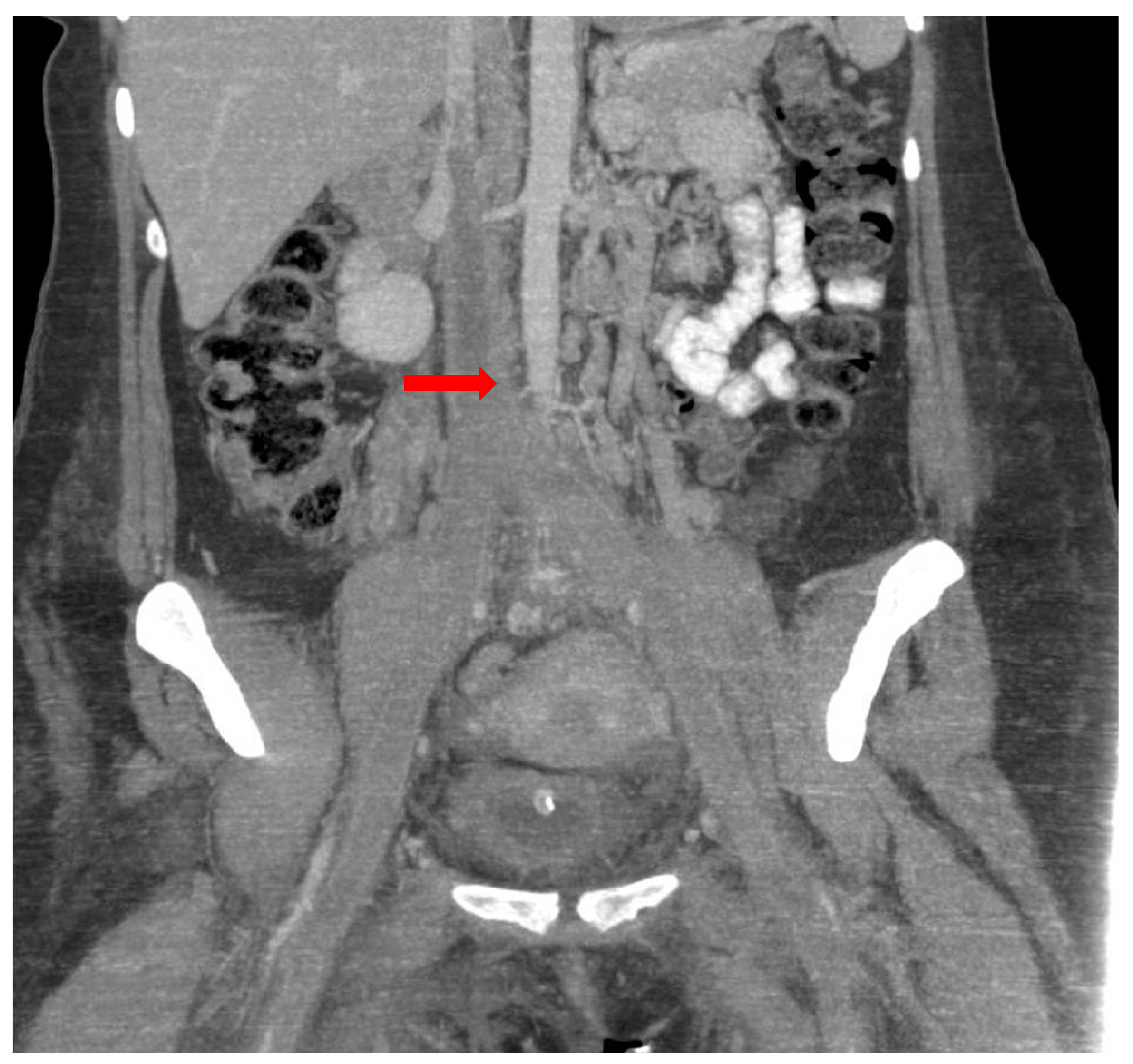
Background: Pregnancy induces a physiological prothrombotic state. The highest risk period for venous thromboembolism and pulmonary embolism in pregnant women is during the postpartum period. Materials and Methods: We present the case of a young woman who gave birth 2 weeks before admission and was transferred to our clinic for edema. She had an increased temperature in her right limb, and a venous Doppler of the limb confirmed thrombosis of the right femoral vein. From the paraclinical examination, we obtained a CBC with leukocytosis, neutrophilia, and thrombocytosis, and a positive D-dimer test. Thrombophilic tests were negative for AT III, lupus anticoagulant negative, and protein S and C, but were positive for heterozygous PAI-1, heterozygous MTHFR A1298C, and EPCR with A1/A2 alleles. After 2 days of UFH with therapeutic APTT, the patient had pain in her left thigh. We performed a venous Doppler, which revealed bilateral femoral and iliac venous thrombosis. During the computed tomography examination, we assessed the venous thrombosis extension on the inferior cava, common iliac, and bilateral common femoral veins. Thrombolysis was initiated with 100 mg of Alteplase given at a rate of 2 mg/h; however, this did not lead to a considerable reduction in the thrombus. Additionally, the treatment with UFH was continued under therapeutic APTT. After 7 days of UFH and triple antibiotic therapy for genital sepsis, the patient had a favorable evolution with remission of venous thrombosis. Results: Alteplase is a thrombolytic agent that is created with recombinant DNA technology, and it was successfully used to treat thrombosis that occurred in the postpartum period. Conclusions: Thrombophilias are associated with a high VTE risk but also with adverse pregnancy outcomes, including recurrent miscarriages and gestational vascular complications. In addition, the postpartum period is associated with a higher VTE risk. A thrombophilic status with heterozygous PAI-1, heterozygous MTHFR A1298C, and EPCR with A1/A2 positive alleles is associated with a high risk of thrombosis and cardiovascular events. Thrombolysis can be successfully used postpartum to treat VTEs. Thrombolysis can be used successfully in VTE developed in the postpartum period.
Keywords: postpartum; venous thrombosis; pregnancy; management postpartum; venous thrombosis; pregnancy; management