Decreased Monocyte HLA-DR Expression in Patients with Sepsis and Acute Kidney Injury

 , , ,
, , ,  , , and
Abstract
1. Introduction
2. Materials and Methods
2.1. Participants
2.2. Definitions
2.3. Preparation of Plasma and Peripheral Blood Mononuclear Cell (PBMC)
2.4. Plasma Cytokine Level Measurement
2.5. Detection of Monocyte HLA-DR Expression
2.6. Statistical Analysis
3. Results
3.1. HLA-DR Expression in Monocytes and Plasma AGE, sRAGE, HMGB1 and S100A12 Levels in Controls and Septic Patients
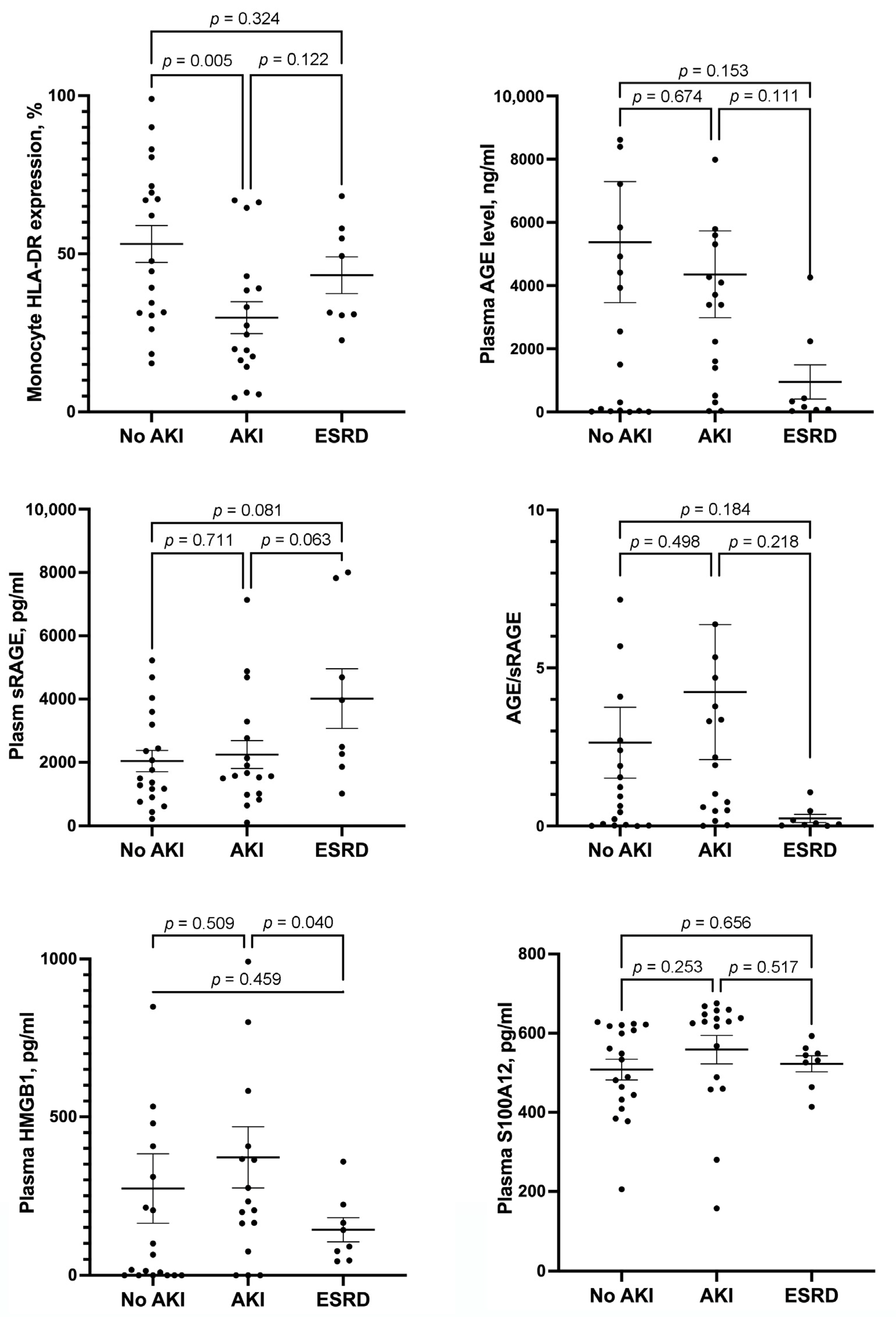
3.2. HLA-DR Expression in Monocytes and Plasma AGE, sRAGE, HMGB1 and S100A12 Levels in Patients with No AKI, AKI, and ESRD
3.3. Effect of AKI on HLA-DR Expression in Monocytes
4. Discussion
5. Conclusions
Author Contributions
Funding
Institutional Review Board Statement
Informed Consent Statement
Data Availability Statement
Acknowledgments
Conflicts of Interest
References
- Chertow, G.M.; Burdick, E.; Honour, M.; Bonventre, J.V.; Bates, D.W. Acute kidney injury, mortality, length of stay, and costs in hospitalized patients. J. Am. Soc. Nephrol. 2005, 16, 3365–3370. [Google Scholar] [CrossRef] [Scilit]
- Nakano, D. Septic acute kidney injury: A review of basic research. Clin. Exp. Nephrol. 2020, 24, 1091–1102. [Google Scholar] [CrossRef] [Scilit]
- Rossaint, J.; Zarbock, A. Acute kidney injury: Definition, diagnosis and epidemiology. Minerva Urol. Nephrol. 2016, 68, 49–57. [Google Scholar]
- Singer, M.; Deutschman, C.S.; Seymour, C.W.; Shankar-Hari, M.; Annane, D.; Bauer, M.; Bellomo, R.; Bernard, G.R.; Chiche, J.D.; Coopersmith, C.M.; et al. The Third International Consensus Definitions for Sepsis and Septic Shock (Sepsis-3). JAMA 2016, 315, 801–810. [Google Scholar] [CrossRef] [Scilit]
- Lukaszewicz, A.C.; Grienay, M.; Resche-Rigon, M.; Pirracchio, R.; Faivre, V.; Boval, B.; Payen, D. Monocytic HLA-DR expression in intensive care patients: Interest for prognosis and secondary infection prediction. Crit. Care Med. 2009, 37, 2746–2752. [Google Scholar]
- Wu, H.P.; Shih, C.C.; Lin, C.Y.; Hua, C.C.; Chuang, D.Y. Serial increase of IL-12 response and human leukocyte antigen-DR expression in severe sepsis survivors. Crit. Care 2011, 15, R224. [Google Scholar] [CrossRef] [Scilit]
- Leijte, G.P.; Rimmele, T.; Kox, M.; Bruse, N.; Monard, C.; Gossez, M.; Monneret, G.; Pickkers, P.; Venet, F. Monocytic HLA-DR expression kinetics in septic shock patients with different pathogens, sites of infection and adverse outcomes. Crit. Care 2020, 24, 110. [Google Scholar] [CrossRef] [Scilit]
- Ahlstrom, A.; Hynninen, M.; Tallgren, M.; Kuusela, P.; Valtonen, M.; Orko, R.; Siitonen, S.; Takkunen, O.; Pettila, V. Predictive value of interleukins 6, 8 and 10, and low HLA-DR expression in acute renal failure. Clin. Nephrol. 2004, 61, 103–110. [Google Scholar] [CrossRef] [Scilit]
- Fukami, K.; Taguchi, K.; Yamagishi, S.; Okuda, S. Receptor for advanced glycation endproducts and progressive kidney disease. Curr. Opin. Nephrol. Hypertens. 2015, 24, 54–60. [Google Scholar] [CrossRef] [Scilit]
- Leclerc, E.; Fritz, G.; Vetter, S.W.; Heizmann, C.W. Binding of S100 proteins to RAGE: An update. Biochim. Biophys. Acta 2009, 1793, 993–1007. [Google Scholar] [CrossRef] [Scilit]
- Rhodes, A.; Evans, L.E.; Alhazzani, W.; Levy, M.M.; Antonelli, M.; Ferrer, R.; Kumar, A.; Sevransky, J.E.; Sprung, C.L.; Nunnally, M.E.; et al. Surviving Sepsis Campaign: International Guidelines for Management of Sepsis and Septic Shock: 2016. Intensive Care Med. 2017, 43, 304–377. [Google Scholar] [CrossRef] [Scilit] [PubMed]
- Khwaja, A. KDIGO clinical practice guidelines for acute kidney injury. Nephron Clin. Pract. 2012, 120, c179–c184. [Google Scholar] [CrossRef] [Scilit] [PubMed]
- Knaus, W.A.; Draper, E.A.; Wagner, D.P.; Zimmerman, J.E. APACHE II: A severity of disease classification system. Crit. Care Med. 1985, 13, 818–829. [Google Scholar] [CrossRef] [Scilit] [PubMed]
- Wu, H.P.; Lin, Y.K. Effect of Eucommia ulmoides Oliv., Gynostemma pentaphyllum (Thunb.) Makino, and Curcuma longa L. on Th1- and Th2-cytokine responses and human leukocyte antigen-DR expression in peripheral blood mononuclear cells of septic patients. J. Ethnopharmacol. 2018, 217, 195–204. [Google Scholar] [CrossRef] [Scilit] [PubMed]
- Zhuang, Y.; Peng, H.; Chen, Y.; Zhou, S.; Chen, Y. Dynamic monitoring of monocyte HLA-DR expression for the diagnosis, prognosis, and prediction of sepsis. Front. Biosci. Landmark 2017, 22, 1344–1354. [Google Scholar] [CrossRef] [Scilit]
- Wu, J.F.; Ma, J.; Chen, J.; Ou-Yang, B.; Chen, M.Y.; Li, L.F.; Liu, Y.J.; Lin, A.H.; Guan, X.D. Changes of monocyte human leukocyte antigen-DR expression as a reliable predictor of mortality in severe sepsis. Crit. Care 2011, 15, R220. [Google Scholar] [CrossRef] [Scilit]
- Heyman, S.N.; Rosen, S.; Rosenberger, C. A role for oxidative stress. Contrib. Nephrol. 2011, 174, 138–148. [Google Scholar] [CrossRef] [Scilit]
- Silva, S.; de Cal, M.; Cruz, D.; Lentini, P.; Corradi, V.; Gallo, G.; Salvatori, G.; Verbine, A.; Pogoshyan, L.; Nalesso, F.; et al. Oxidative stress and ‘monocyte reprogramming’ in septic patients with acute kidney injury requiring CRRT. Blood Purif. 2008, 26, 188–192. [Google Scholar] [CrossRef] [Scilit]
- Brodska, H.; Malickova, K.; Valenta, J.; Fabio, A.; Drabek, T. Soluble receptor for advanced glycation end products predicts 28-day mortality in critically ill patients with sepsis. Scand. J. Clin. Lab. Investig. 2013, 73, 650–660. [Google Scholar] [CrossRef] [Scilit]
- Miyagawa, T.; Iwata, Y.; Oshima, M.; Ogura, H.; Sato, K.; Nakagawa, S.; Yamamura, Y.; Kamikawa, Y.; Miyake, T.; Kitajima, S.; et al. Soluble receptor for advanced glycation end products protects from ischemia- and reperfusion-induced acute kidney injury. Biol. Open 2021, 11, bio058852. [Google Scholar] [CrossRef] [Scilit]
- Prasad, K. Is there any evidence that AGE/sRAGE is a universal biomarker/risk marker for diseases? Mol. Cell Biochem. 2019, 451, 139–144. [Google Scholar] [CrossRef] [Scilit] [PubMed]
- Zakiyanov, O.; Kriha, V.; Vachek, J.; Zima, T.; Tesar, V.; Kalousova, M. Placental growth factor, pregnancy-associated plasma protein-A, soluble receptor for advanced glycation end products, extracellular newly identified receptor for receptor for advanced glycation end products binding protein and high mobility group box 1 levels in patients with acute kidney injury: A cross sectional study. BMC Nephrol. 2013, 14, 245. [Google Scholar] [CrossRef] [Scilit]
- Nikolakopoulou, Z.; Hector, L.R.; Creagh-Brown, B.C.; Evans, T.W.; Quinlan, G.J.; Burke-Gaffney, A. Plasma S100A8/A9 heterodimer is an early prognostic marker of acute kidney injury associated with cardiac surgery. Biomark. Med. 2019, 13, 205–218. [Google Scholar] [CrossRef] [Scilit] [PubMed]
- Ludes, P.O.; de Roquetaillade, C.; Chousterman, B.G.; Pottecher, J.; Mebazaa, A. Role of Damage-Associated Molecular Patterns in Septic Acute Kidney Injury, from Injury to Recovery. Front. Immunol. 2021, 12, 606622. [Google Scholar] [CrossRef] [Scilit] [PubMed]
- Wei, S.; Gao, Y.; Dai, X.; Fu, W.; Cai, S.; Fang, H.; Zeng, Z.; Chen, Z. SIRT1-mediated HMGB1 deacetylation suppresses sepsis-associated acute kidney injury. Am. J. Physiol. Renal Physiol. 2019, 316, F20–F31. [Google Scholar] [CrossRef] [Scilit] [PubMed]
- Hu, Y.M.; Pai, M.H.; Yeh, C.L.; Hou, Y.C.; Yeh, S.L. Glutamine administration ameliorates sepsis-induced kidney injury by downregulating the high-mobility group box protein-1-mediated pathway in mice. Am. J. Physiol. Renal Physiol. 2012, 302, F150–F158. [Google Scholar] [CrossRef] [Scilit] [PubMed]



| No AKI (n = 19) | AKI (n = 17) | ESRD (n = 8) | All Patients (n = 44) | Controls (n = 27) | |
|---|---|---|---|---|---|
| Age (years) | 76.3 ± 2.6 | 73.9 ± 2.5 | 77.0 ± 3.6 | 75.5 ± 1.6 | 60.3 ± 1.3 * |
| Male (%) | 14 (73.7) | 10 (58.8) | 2 (25.0) | 26 (59.1) | 17 (63.0) |
| APACHE II score | 18.0 ± 0.9 | 26.9 ± 1.0 † | 27.8 ± 3.3 † | 23.2 ± 1.1 | |
| SOFA score | 8.5 ± 0.7 | 11.9 ± 0.9 † | 12.3 ± 0.8 † | 10.5 ± 0.6 | |
| History (%) | |||||
| COPD | 1 (5.3) | 1 (5.9) | 0 (0.0) | 2 (4.5) | |
| Heart failure | 3 (15.8) | 2 (11.8) | 0 (0.0) | 5 (11.4) | |
| Hypertension | 14 (73.7) | 9 (52.9) | 7 (87.5) | 30 (68.2) | |
| Diabetes mellitus | 7 (36.8) | 6 (35.3) | 6 (75.0) | 19 (43.2) | |
| Old CVA | 5 (26.3) | 4 (23.5) | 1 (12.5) | 10 (22.7) | |
| Liver cirrhosis | 2 (10.5) | 3 (17.6) | 0 (0.0) | 5 (11.4) | |
| Active malignancy | 1 (5.3) | 1 (5.9) | 0 (0.0) | 2 (4.5) | |
| Infection source | |||||
| Pneumonia | 13 (68.4) | 13 (76.5) | 3 (37.5) | 29 (65.9) | |
| UTI | 3 (15.8) | 0 (0.0) | 2 (25.0) | 5 (11.4) | |
| Others | 3 (15.8) | 4 (23.5) | 3 (37.5) | 10 (22.7) | |
| Adverse event | |||||
| New arrhythmia | 3 (15.8) | 1 (5.9) | 0 (0.0) | 4 (9.1) | |
| GI bleeding | 1 (5.3) | 3 (17.6) | 0 (0.0) | 4 (9.1) | |
| Shock | 8 (42.1) | 11 (64.7) | 6 (75.0) | 25 (56.8) | |
| Thrombocytopenia | 5 (26.3) | 7 (41.2) | 3 (37.5) | 15 (34.1) | |
| Jaundice | 3 (15.8) | 5 (29.4) | 0 (0.0) | 8 (18.2) | |
| Bacteremia | 3 (15.8) | 2 (11.8) | 2 (25.0) | 7 (15.9) | |
| Body weight, kg | 62.5 ± 3.6 | 60.6 ± 3.7 | 52.0 ± 4.3 | 59.9 ± 2.3 | 65.5 ± 1.9 |
| Serum creatinine, mg/dL | 1.25 ± 0.18 | 3.32 ± 0.36 † | 6.25 ± 1.31† | 2.96 ± 0.39 | 0.88 ± 0.05 * |
| Urine output, mL/kg/h | 0.97 ± 0.14 | 0.72 ± 0.17 | 0.05 ± 0.03 †,‡ | 0.70 ± 0.10 | |
| 28-day mortality | 1 (5.3) | 9 (52.9) † | 4 (50.0) † | 14 (31.8) |
| Variables | Univariable B (95% CI) | p Value | Multivariable B (95% CI) | p Value |
|---|---|---|---|---|
| 28-day mortality | −17.018 (−32.141 to −1.894) | 0.028 | −5.689 (−22.953 to 11.575) | 0.509 |
| AKI | −23.289 (−38.329 to −8.248) | 0.003 | −18.425 (−35.278 to −1.573) | 0.033 |
| ESRD | −9.862 (−28.850 to 9.126) | 0.300 | −8.231 (−28.692 to 12.229) | 0.421 |
| GI bleeding | −25.795 (−50.484 to −1.106) | 0.041 | −17.369 (−42.396 to 7.658) | 0.168 |
Publisher’s Note: MDPI stays neutral with regard to jurisdictional claims in published maps and institutional affiliations. |
© 2022 by the authors. Licensee MDPI, Basel, Switzerland. This article is an open access article distributed under the terms and conditions of the Creative Commons Attribution (CC BY) license (https://creativecommons.org/licenses/by/4.0/).
Share and Cite
Wu, H.-P.; Chuang, L.-P.; Liu, P.-H.; Chu, C.-M.; Yu, C.-C.; Lin, S.-W.; Kao, K.-C.; Li, L.-F.; Chuang, D.-Y. Decreased Monocyte HLA-DR Expression in Patients with Sepsis and Acute Kidney Injury. Medicina 2022, 58, 1198. https://doi.org/10.3390/medicina58091198
Wu H-P, Chuang L-P, Liu P-H, Chu C-M, Yu C-C, Lin S-W, Kao K-C, Li L-F, Chuang D-Y. Decreased Monocyte HLA-DR Expression in Patients with Sepsis and Acute Kidney Injury. Medicina. 2022; 58(9):1198. https://doi.org/10.3390/medicina58091198
Chicago/Turabian StyleWu, Huang-Pin, Li-Pang Chuang, Pi-Hua Liu, Chien-Ming Chu, Chung-Chieh Yu, Shih-Wei Lin, Kuo-Chin Kao, Li-Fu Li, and Duen-Yau Chuang. 2022. "Decreased Monocyte HLA-DR Expression in Patients with Sepsis and Acute Kidney Injury" Medicina 58, no. 9: 1198. https://doi.org/10.3390/medicina58091198
APA StyleWu, H.-P., Chuang, L.-P., Liu, P.-H., Chu, C.-M., Yu, C.-C., Lin, S.-W., Kao, K.-C., Li, L.-F., & Chuang, D.-Y. (2022). Decreased Monocyte HLA-DR Expression in Patients with Sepsis and Acute Kidney Injury. Medicina, 58(9), 1198. https://doi.org/10.3390/medicina58091198