

FGF-23 and Phosphate in Children with Chronic Kidney Disease: A Cross-Sectional Study in Kazakhstan

 ,
, 
Abstract
1. Introduction
2. Materials and Methods
2.1. Study Design and Participants
2.2. Ethics Approval
2.3. Procedures and Laboratory Measurements
2.4. Statistical Analyses
3. Results
3.1. Patient Characteristics
3.2. FGF-23 in Children with CKD
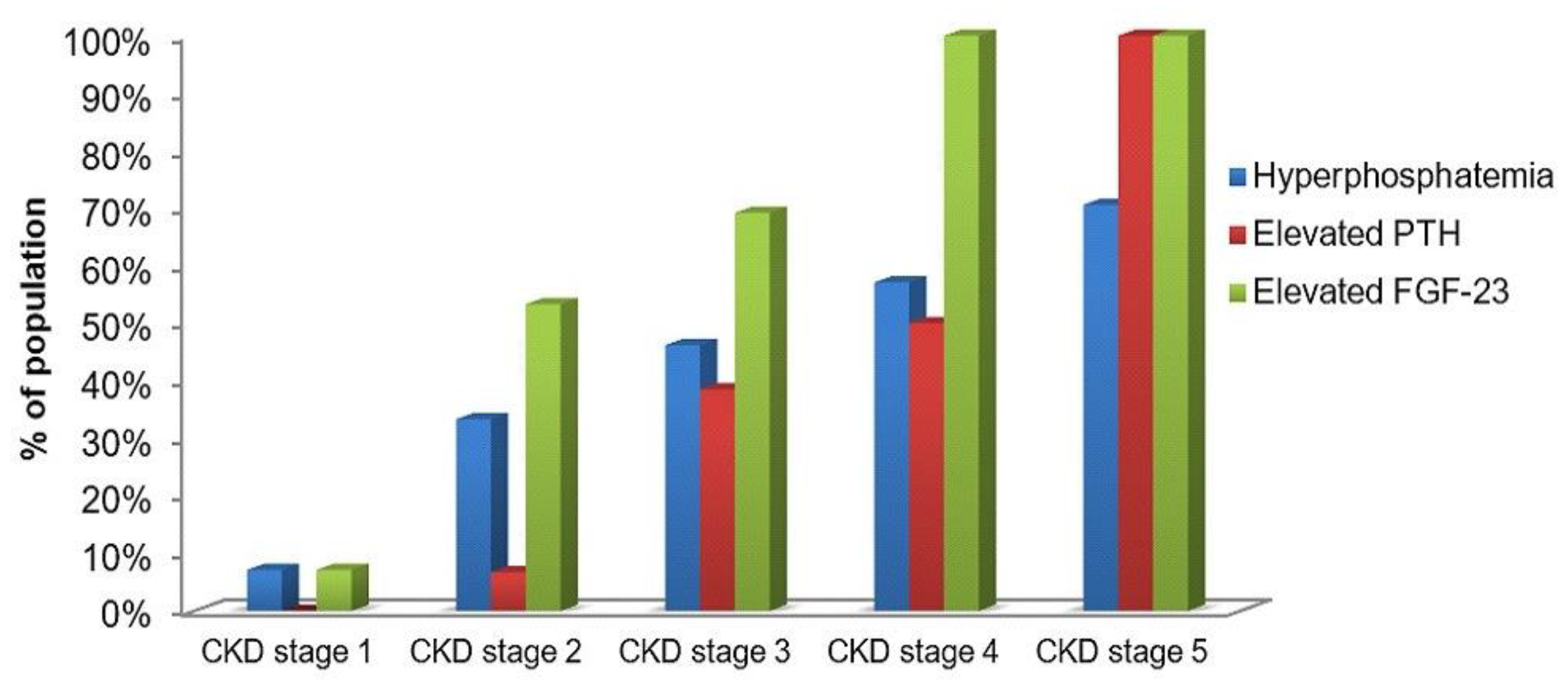
3.3. Phosphate, PTH and 25-OH Vitamin D in Children with CKD
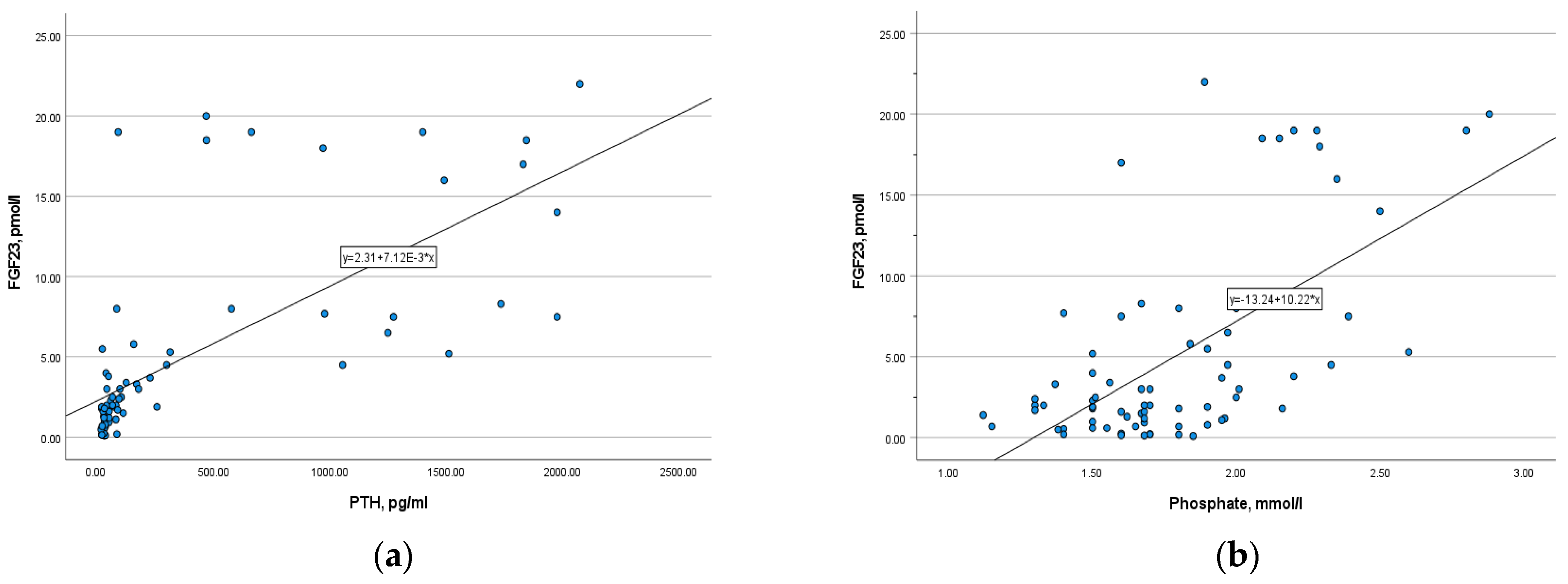
3.4. Correlations of FGF-23 with Other Bone Markers
4. Discussion
5. Conclusions
Author Contributions
Funding
Institutional Review Board Statement
Informed Consent Statement
Data Availability Statement
Research and Publication Ethics
Conflicts of Interest
References
- Brück, K.; Stel, V.S.; Fraser, S.; De Goeij, M.C.M.; Caskey, F.; Abu-Hanna, A.; Jager, K.J. Translational research in nephrology: Chronic kidney disease prevention and public health. Clin. Kidney J. 2015, 8, 647–655. [Google Scholar] [CrossRef] [PubMed]
- Bikbov, B.; Purcell, C.A.; Levey, A.S.; Smith, M.; Abdoli, A.; Abebe, M.; Adebayo, O.M.; Afarideh, M.; Agarwal, S.K.; Agudelo-Botero, M.; et al. Global, regional, and national burden of chronic kidney disease, 1990–2017: A systematic analysis for the global burden of disease study 2017. Lancet 2020, 395, 709–733. [Google Scholar] [CrossRef]
- Stanifer, J.W.; Muiru, A.; Jafar, T.H.; Patel, U.D. Chronic kidney disease in low- and middle-income countries. Nephrol. Dial. Transpl. 2016, 31, 868–874. [Google Scholar] [CrossRef] [PubMed]
- Becherucci, F.; Roperto, R.M.; Materassi, M.; Romagnani, P. Chronic kidney disease in children. Clin. Kidney J. 2016, 9, 583–591. [Google Scholar] [CrossRef] [PubMed]
- Kanatbayeva, A.B.; Kabulbayev, K.A.; Naushabayeva, A.E.; Nurbekova, A.A. Results of the screening for chronic kidney disease in population of Almaty-city. Nephrol. Dial. 2012, 14, 109–113. [Google Scholar]
- Gansevoort, R.T.; Correa-Rotter, R.; Hemmelgarn, B.R.; Jafar, T.H.; Heerspink, H.J.L.; Mann, J.F.; Matsushita, K.; Wen, C.P. Chronic kidney disease and cardiovascular risk: Epidemiology, mechanisms, and prevention. Lancet 2013, 382, 339–352. [Google Scholar] [CrossRef]
- Foster, B. Growth and Development of the Child with Renal Disease. In Pediatric Nephrology, 7th ed.; Avner, E., Harmon, W., Niaudet, P., Eds.; Springer: Berlin/Heidelberg, Germany, 2016; pp. 637–665. [Google Scholar]
- Siomou, E.; Stefanidis, C.J. FGF-23 in children with CKD: A new player in the development of CKD—Mineral and bone disorder. Nephrol. Dial. Transplant. 2012, 23–26. [Google Scholar] [CrossRef]
- Seiler, S.; Heine, G.H.; Fliser, D. Clinical relevance of FGF-23 in chronic kidney disease. Kidney Int. 2009, 76, S34–S42. [Google Scholar] [CrossRef]
- Lu, X.; Hu, M.C. Klotho/FGF23 axis in chronic kidney disease and cardiovascular disease. Kidney Dis. 2017, 3, 15–23. [Google Scholar] [CrossRef]
- Gattineni, J.; Bates, C.; Twombley, K.; Dwarakanath, V.; Robinson, M.L.; Goetz, R.; Mohammadi, M.; Baum, M. FGF23 Decreases renal NaPi-2a and NaPi-2c expression and induces hypophosphatemia in vivo predominantly via FGF receptor 1. Am. J. Physiol. Ren. Physiol. 2009, 297, 282–291. [Google Scholar] [CrossRef]
- Hu, M.C.; Kuro-o, M.; Moe, O.W. Klotho and chronic kidney disease. Contrib. Nephrol. 2013, 180, 47–63. [Google Scholar] [CrossRef] [PubMed]
- Wolf, M. Update on fibroblast growth factor 23 in chronic kidney disease. Kidney Int. 2012, 82, 737–747. [Google Scholar] [CrossRef] [PubMed]
- Jean, G.; Terrat, J.C.; Vanel, T.; Hurot, J.M.; Lorriaux, C.; Mayor, B.; Chazot, C. High levels of serum fibroblast growth factor (FGF)-23 are associated with increased mortality in long haemodialysis patients. Nephrol. Dial. Transpl. 2009, 24, 2792–2796. [Google Scholar] [CrossRef] [PubMed]
- Gutiérrez, O.M. Fibroblast growth factor 23 and the last mile. Clin. J. Am. Soc. Nephrol. 2020, 15, 1355–1357. [Google Scholar] [CrossRef] [PubMed]
- Bouma-de Krijger, A.; Vervloet, M.G. Fibroblast growth factor 23: Are we ready to use it in clinical practice? J. Nephrol. 2020, 33, 509–527. [Google Scholar] [CrossRef] [PubMed]
- Sinha, M.D.; Turner, C.; Dalton, R.N.; Rasmussen, P.; Waller, S.; Booth, C.J.; Goldsmith, D.J. Investigating FGF-23 concentrations and its relationship with declining renal function in paediatric patients with pre-dialysis CKD stages 3-5. Nephrol. Dial. Transpl. 2012, 27, 4361–4368. [Google Scholar] [CrossRef] [PubMed]
- Liu, D.; Alvarez-elías, A.C.; Wile, B.; Belostotsky, V.; Filler, G. Deviations from the expected relationship between serum FGF23 and other markers in children with CKD: A cross-sectional study. BMC Nephrol. 2017, 1–10. [Google Scholar] [CrossRef]
- Van Husen, M.; Fischer, A.K.; Lehnhardt, A.; Klaassen, I.; Möller, K.; Müller-Wiefel, D.E.; Kemper, M.J. Fibroblast growth factor 23 and bone metabolism in children with chronic kidney disease. Kidney Int. 2010, 78, 200–206. [Google Scholar] [CrossRef][Green Version]
- Magnusson, P.; Hansson, S.; Swolin-Eide, D. A prospective study of fibroblast growth factor-23 in children with chronic kidney disease. Scand. J. Clin. Lab. Investig. 2010, 70, 15–20. [Google Scholar] [CrossRef]
- Levin, A.; Stevens, P.E.; Bilous, R.W.; Coresh, J.; de Francisco, A.L.M.; de Jong, P.E.; Griffith, K.E.; Hemmelgarn, B.R.; Iseki, K.; Lamb, E.J.; et al. Kidney Disease: Improving Global Outcomes (KDIGO) KDIGO 2012 clinical practice guideline for the evaluation and management of chronic kidney disease. Kidney Int. Suppl. 2013, 3, 1–150. [Google Scholar]
- Portale, A.A.; Wolf, M.; Jüppner, H.; Messinger, S.; Kumar, J.; Wesseling-Perry, K.; Schwartz, G.J.; Furth, S.L.; Warady, B.A.; Salusky, I.B. Disordered FGF23 and Mineral Metabolism in Children with CKD. Clin. J. Am. Soc. Nephrol. 2014, 9, 344–353. [Google Scholar] [CrossRef] [PubMed]
- Wan, M.; Smith, C.; Shah, V.; Gullet, A.; Wells, D.; Rees, L.; Shroff, R. Fibroblast growth factor 23 and soluble klotho in children with chronic kidney disease. Nephrol. Dial. Transpl. 2013, 28, 153–161. [Google Scholar] [CrossRef] [PubMed]
- Viaene, L.; Bammens, B.; Meijers, B.K.I.; Vanrenterghem, Y.; Vanderschueren, D.; Evenepoel, P. Residual renal function is an independent determinant of serum FGF-23 levels in dialysis patients. Nephrol. Dial. Transpl. 2012, 27, 2017–2022. [Google Scholar] [CrossRef] [PubMed][Green Version]

| All Patients (n = 73) | |
|---|---|
| Age (year) | 7.5 (4.0–11.0) |
| Female/male | 35 (47.9)/38 (52.1) |
| CKD cause | |
| CAKUT | 51 (69.9) |
| Glomerular diseases | 13 (17.8) |
| Nephrolithiasis and nephrocalcinosis | 4 (5.5) |
| HUS | 3 (4.1) |
| Cystic kidney diseases | 2 (2.7) |
| CKD stage | |
| Stage 1 | 14 (19.2) |
| Stage 2 | 15 (20.5) |
| Stage 3 | 13 (17.8) |
| Stage 4 | 14 (19.2) |
| Stage 5 | 17 (23.3) |
| HD | 8 (11) |
| PD | 9 (12.3) |
| Growth and development | |
| Normal | 52 (71.2) |
| Delay | 21(28.8) |
| CKD-MBD | 27 (37) |
| Renal anemia | 25 (34.2) |
| Variable | Healthy Individuals | CKD Stage 1 eGFR >90 mL/min/1.73 m2 (n = 14) | CKD Stage 2 eGFR 60–89 mL/min/1.73 m2 (n = 15) | CKD Stage 3 eGFR 30–59 mL/min/1.73 m2 (n = 13) | CKD Stage 4 eGFR 15–29 mL/min/1.73 m2 (n = 14) | CKD Stage 5 eGFR <15 mL/min/1.73 m2 (n = 17) |
|---|---|---|---|---|---|---|
| Creatinine, mg/dL | N/A | 0.4 ± 0.08 | 0.73 ± 0.19 | 1.11 (0.81–1.62) | 2.32 ± 0.82 | 7.95 ± 2.43 |
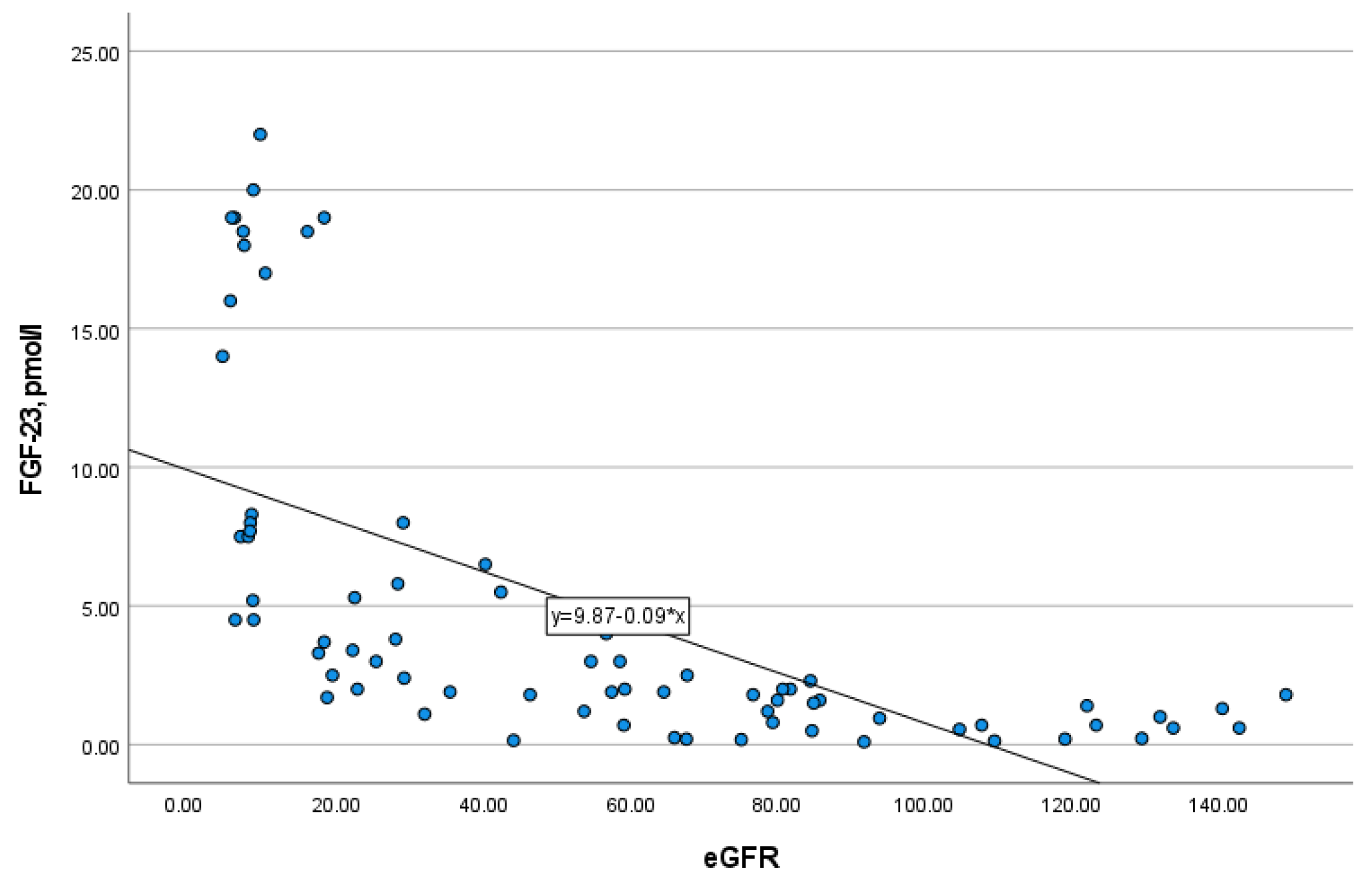
| eGFR, mL/min/1.73 m² | N/A | 121.46 ± 17.94 | 77.17 ± 7.39 | 49.17 ± 9.61 | 22.5 ± 4.69 | 7.5 ± 1.55 |
| Urea, mmol/L | N/A | 3.68 ± 0.92 | 5.29 ± 1.44 | 6.5 (4.64–10.0) | 14.48 ± 6.0 | 22.06 ± 4.6 |
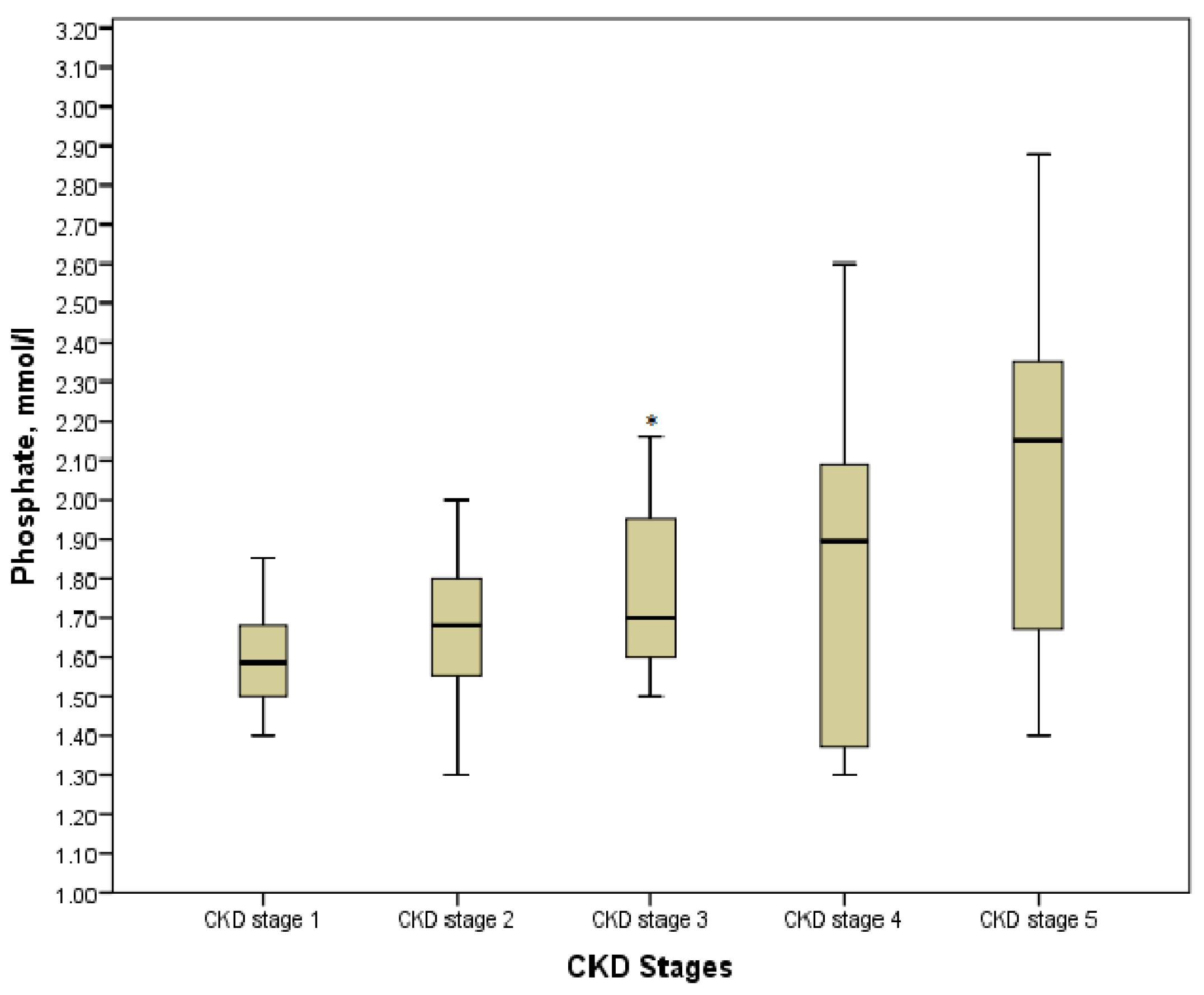
| Phosphate, mmol/L | 1.52 ± 0.05 | 1.54 ± 0.21 | 1.66 ± 0.2 | 1.76 ± 0.21 a,f | 1.8 ± 0.41 a | 2.08 ± 0.45 a,c |
| Calcium, mmol/L | N/A | 2.23 (2.0–2.39) | 2.1 (2.0–2.2) | 2.16 (2.05–2.25) | 2.15 (2.06–2.32) | 1.8 (1.45–2.04) a,d |
| Ionized calcium, mmol/L | N/A | 1.2 (1.0–1.5) | 1.2 (1.01–1.4) | 1.25 (1.0–1.3) | 1.26 (1.21–1.3) | 1.1 (0.87–1.15) a,e |
| Alkaline phosphatase, U/L | N/A | 244.86 ± 74.7 | 300.76 ± 69.06 a | 250.56 ± 85.52 | 328.39 ± 119.95 | 495.6 ± 303.2 c |
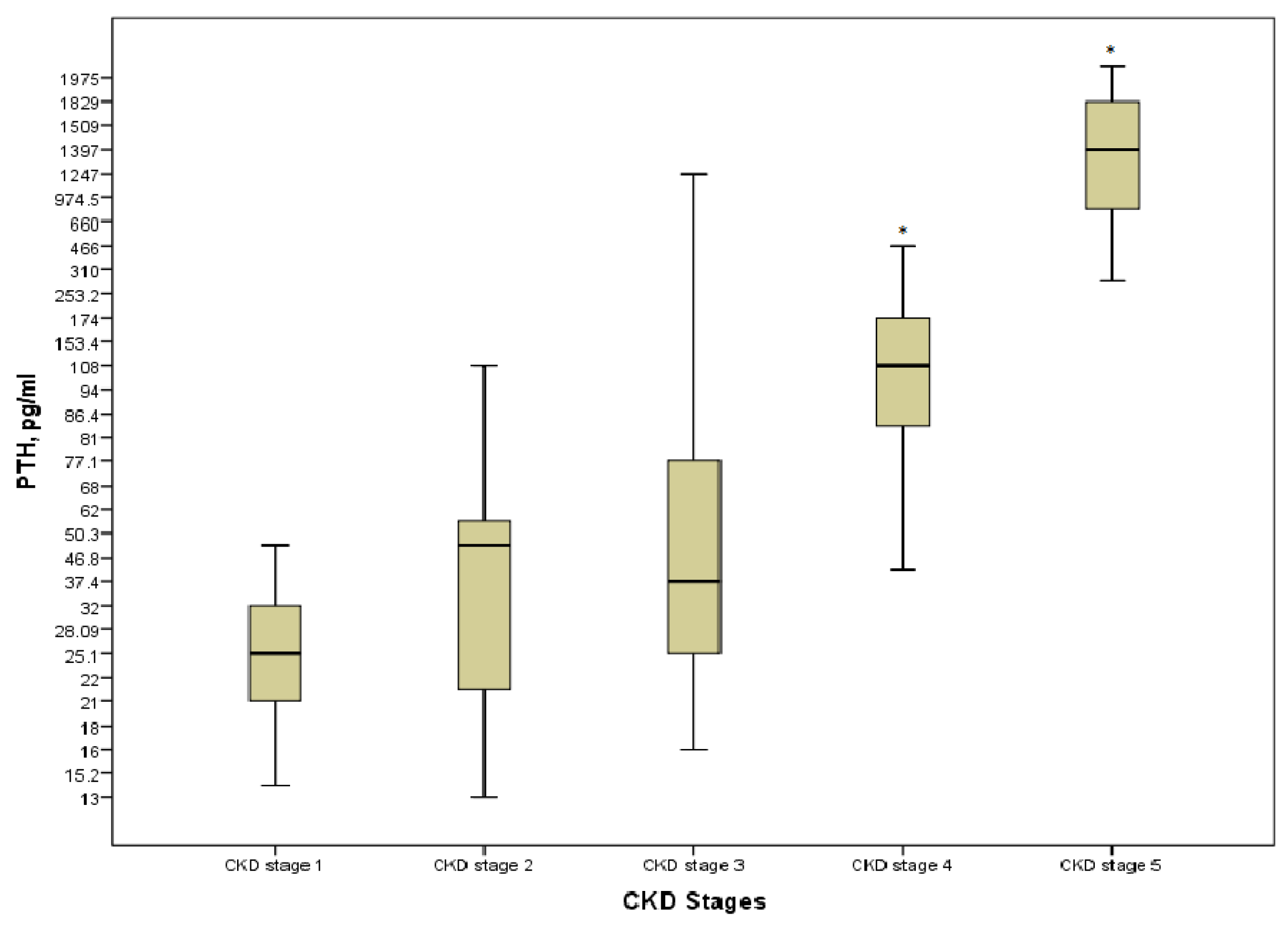
| PTH, pg/mL | 25.5 (21.25–44.75) | 25.5 (21.0–32.0) | 46.8 (21.7–54.0) | 37.4 (21.7–85.55) | 110.34 (83.28–186.5) b,f | 1397 (814–1836) e,f |
| 25-OH vitamin D, ng/mL | N/A | 29.4 ± 14.49 | 24.51 ± 10.64 | 21.16 ± 10.17 | 20.2 ± 14.37 | 20.08 ± 16.27 |
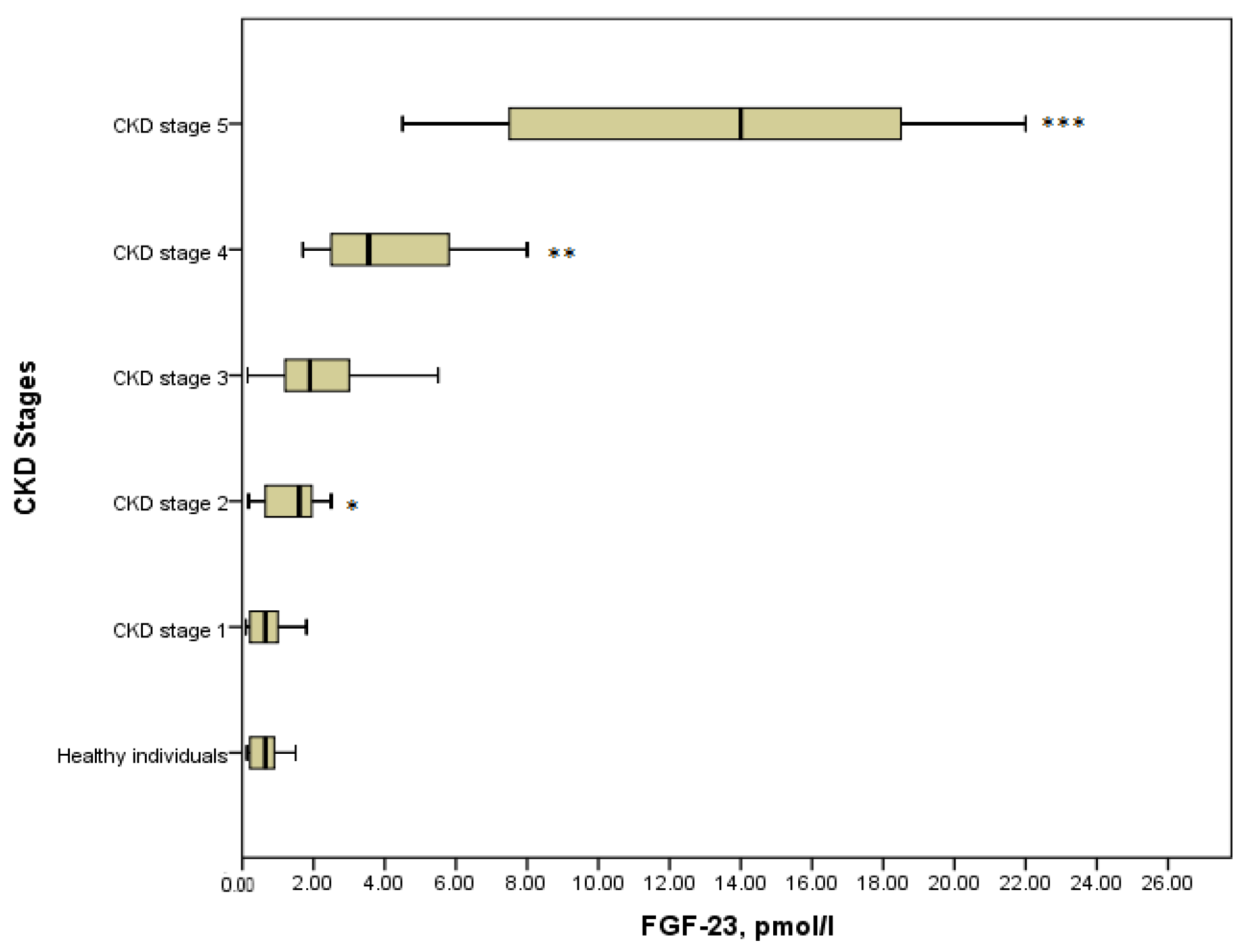
| FGF-23, pmol/L | 0.65 (0.22–0.98) | 0.65 (0.22–1.08) | 1.6 (1.5–1.8) a,f | 1.9 (1.15–3.5) | 3.55 (2.48–6.35) c | 14.0 (7.5–18.75) d |
Publisher’s Note: MDPI stays neutral with regard to jurisdictional claims in published maps and institutional affiliations. |
© 2020 by the authors. Licensee MDPI, Basel, Switzerland. This article is an open access article distributed under the terms and conditions of the Creative Commons Attribution (CC BY) license (http://creativecommons.org/licenses/by/4.0/).
Share and Cite
Balmukhanova, A.; Kabulbayev, K.; Alpay, H.; Kanatbayeva, A.; Balmukhanova, A. FGF-23 and Phosphate in Children with Chronic Kidney Disease: A Cross-Sectional Study in Kazakhstan. Medicina 2021, 57, 15. https://doi.org/10.3390/medicina57010015
Balmukhanova A, Kabulbayev K, Alpay H, Kanatbayeva A, Balmukhanova A. FGF-23 and Phosphate in Children with Chronic Kidney Disease: A Cross-Sectional Study in Kazakhstan. Medicina. 2021; 57(1):15. https://doi.org/10.3390/medicina57010015
Chicago/Turabian StyleBalmukhanova, Altynay, Kairat Kabulbayev, Harika Alpay, Assiya Kanatbayeva, and Aigul Balmukhanova. 2021. "FGF-23 and Phosphate in Children with Chronic Kidney Disease: A Cross-Sectional Study in Kazakhstan" Medicina 57, no. 1: 15. https://doi.org/10.3390/medicina57010015
APA StyleBalmukhanova, A., Kabulbayev, K., Alpay, H., Kanatbayeva, A., & Balmukhanova, A. (2021). FGF-23 and Phosphate in Children with Chronic Kidney Disease: A Cross-Sectional Study in Kazakhstan. Medicina, 57(1), 15. https://doi.org/10.3390/medicina57010015

