Article

Emergency Medical Service Directors’ Protocols for Exertional Heat Stroke


by
Michael R. Szymanski
1,*,
Samantha E. Scarneo-Miller
1,2,
M. Seth Smith
3,
Michelle L. Bruner
3 and
Douglas J. Casa
1
1
Korey Stringer Institute, Department of Kinesiology, University of Connecticut, Storrs, CT 06269, USA
2
Division of Athletic Training, School of Medicine, West Virginia University, Morgantown, WV 26506, USA
3
Department of Orthopedics and Rehabilitation, University of Florida, Gainesville, FL 32607, USA
*
Author to whom correspondence should be addressed.
Medicina 2020, 56(10), 494; https://doi.org/10.3390/medicina56100494

Submission received: 21 August 2020 / Revised: 11 September 2020 / Accepted: 22 September 2020 / Published: 24 September 2020
(This article belongs to the Special Issue Prevention, Recognition, and Treatment of Exertional Heat Illnesses)

Abstract

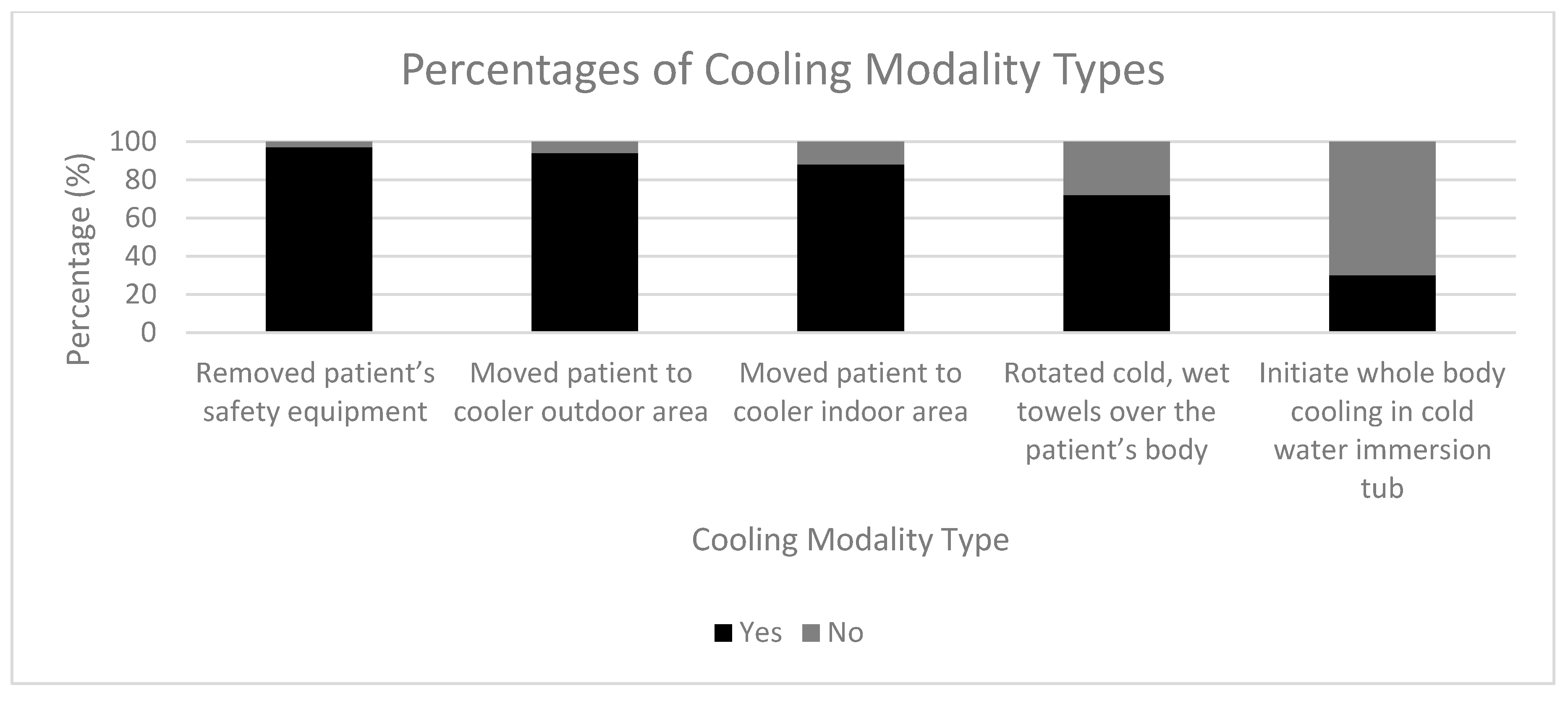
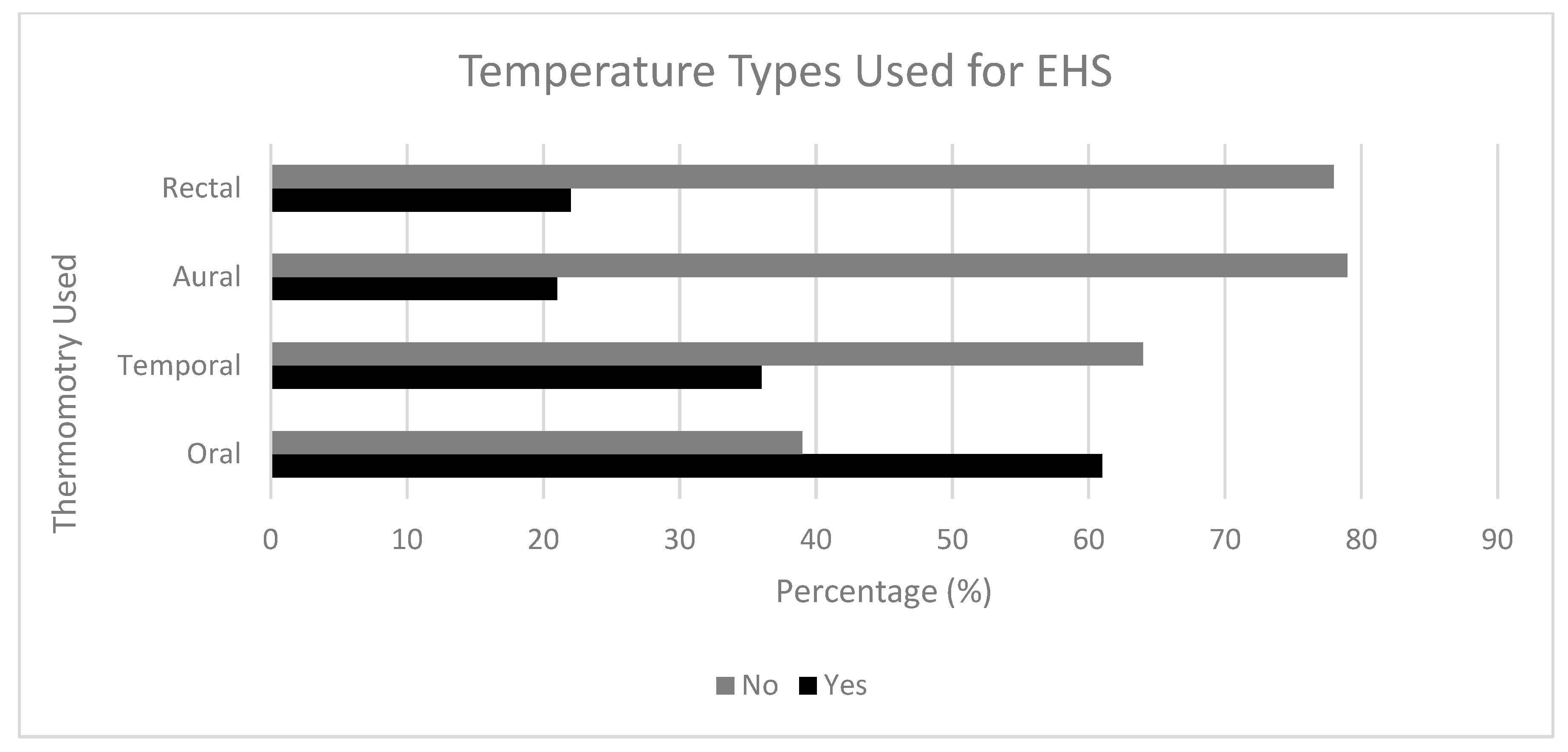
Background and Objectives: Emergency Medical Service (EMS) protocols vary widely and may not implement best practices for exertional heat stroke (EHS). EHS is 100% survivable if best practices are implemented within 30 min. The purpose of this study is to compare EMS protocols to best practices for recognizing and treating EHS. Materials and Methods: Individuals (n = 1350) serving as EMS Medical or Physician Director were invited to complete a survey. The questions related to the EHS protocols for their EMS service. 145 individuals completed the survey (response rate = 10.74%). Chi-Squared Tests of Associations (χ2) with 95% confidence intervals (CI) were calculated. Prevalence ratios (PR) with 95% CI were calculated to determine the prevalence of implementing best practices based on location, working with an athletic trainer, number of EHS cases, and years of directing. All PRs whose 95% CIs excluded 1.00 were considered statistically significant; Chi-Squared values with p values < 0.05 were considered statistically significant. Results: A majority of the respondents reported not using rectal thermometry for the diagnosis of EHS (n = 102, 77.93%) and not using cold water immersion for the treatment of EHS (n = 102, 70.34%). If working with an athletic trainer, EMS is more likely to implement best-practice treatment (i.e., cold-water immersion and cool-first transport-second) (69.6% vs. 36.9%, χ2 = 8.480, p < 0.004, PR = 3.15, 95% CI = 1.38, 7.18). Conclusions: These findings demonstrate a lack of implementation of best-practice standards for EHS by EMS. Working with an athletic trainer appears to increase the likelihood of following best practices. Efforts should be made to improve EMS providers’ implementation of best-practice standards for the diagnosis and management of EHS to optimize patient outcomes.
Keywords: cool-first transport-second; EHS; heat illness; cold-water immersion cool-first transport-second; EHS; heat illness; cold-water immersion