Multidimensional Predictors of Tirzepatide Efficacy: Clinical, Genetic, and Molecular Biomarkers for Glycemic, Weight, and Organ Protection

 , , , ,
  and
and
Abstract
1. Introduction
2. Methods
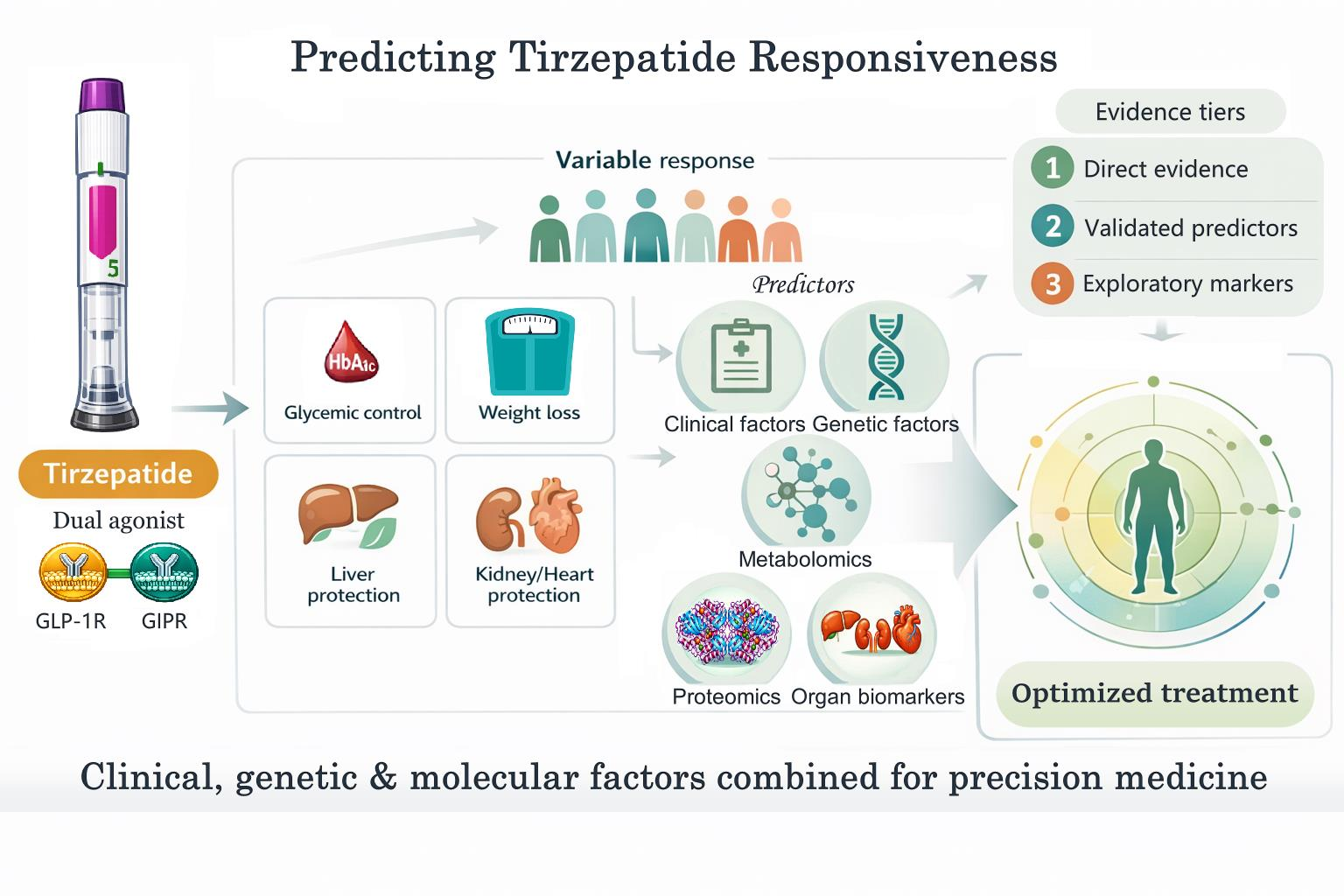
- Tier 1: Direct tirzepatide clinical evidence.
- Tier 2: Strong disease-domain evidence requiring tirzepatide-specific validation.
- Tier 3: Mechanistic or preclinical rationale with limited clinical support.
3. Interindividual Variability in Tirzepatide Response: Responders and Non-Responders
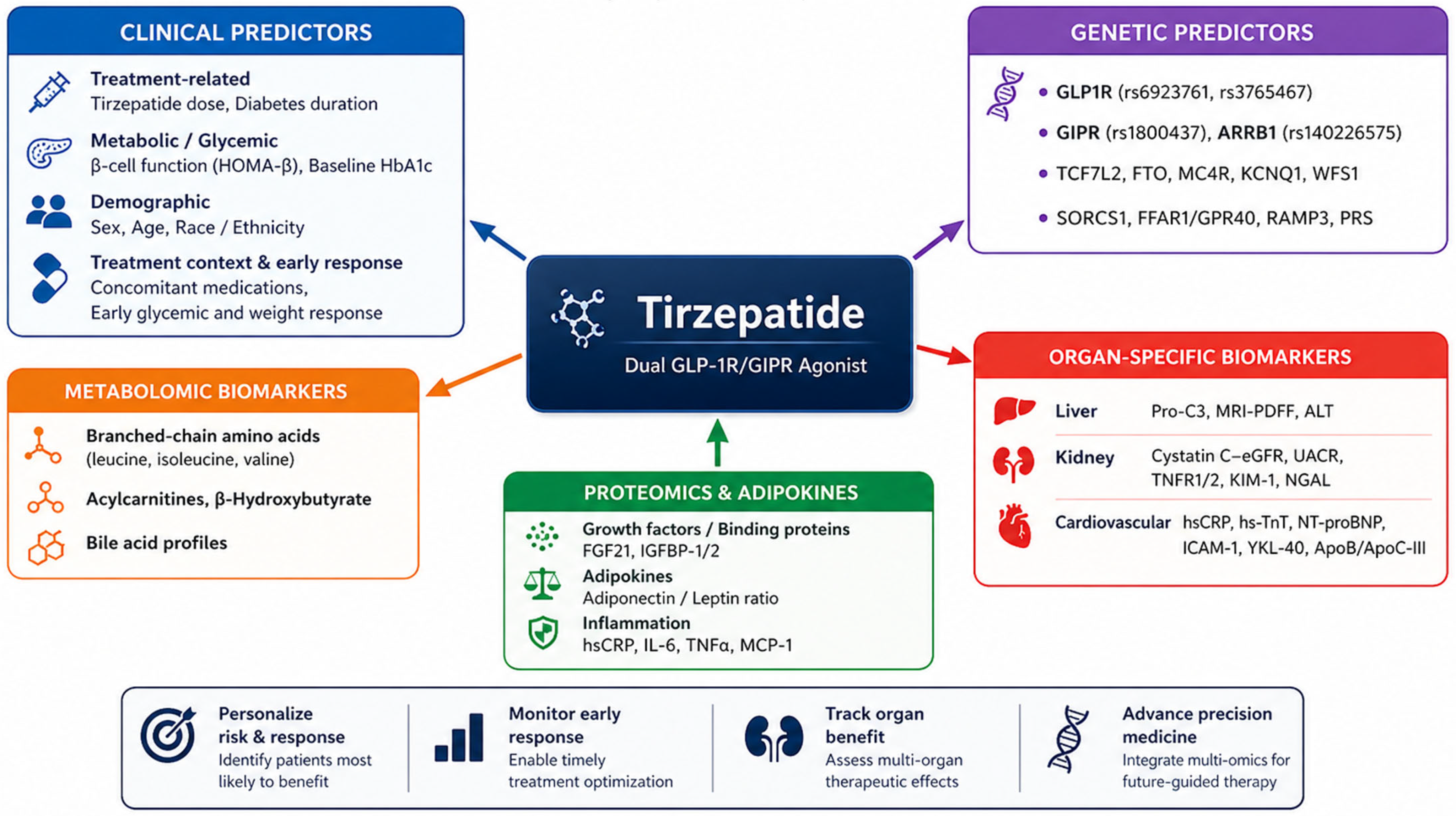
4. Clinical Predictors of Tirzepatide Response
5. Genetic Predictors

| Gene | Variant (RefSNP cluster ID) | Functional Impact | Reported Association | Evidence Source | References |
|---|---|---|---|---|---|
| GLP1R | rs6923761 (Gly168Ser) | Affects insulin secretory response to GLP-1 during oral glucose challenge | Greater HbA1c and weight reduction with GLP-1RA | GLP-1RA clinical | [36,37] |
| GLP1R | rs3765467 | Modifies ligand binding affinity; associated with early-onset T2DM risk | Greater HbA1c reduction with exenatide and liraglutide | GLP-1RA clinical | [38,39] |
| GIPR | rs1800437 (Glu354Gln) | Reduces GIP receptor signaling efficiency | Lower fasting and post-OGTT C-peptide; reduced incretin effect; no significant impact on weight-loss, but increased nausea/vomiting in tirzepatide-treated individuals | Physiological; tirzepatide in vitro; GLP-1RA GWAS | [40,41,42,43,74] |
| ARRB1 | rs140226575 | Regulates GLP-1R desensitization, internalization, and β-arrestin–dependent signaling | Additional HbA1c reduction (~0.6–0.8%) with GLP-1RA | GLP-1RA GWAS | [44,45] |
| TCF7L2 | rs7903146 | Impaired incretin-mediated insulin secretion via Wnt signaling | Reduced GLP-1–stimulated insulin secretion (TT genotype) | Physiological; GLP-1RA (inconclusive) | [46,47,48,49] |
| FTO | rs9939609 | Alters CNS satiety signaling; associated with increased appetite and BMI | Potentially attenuated weight loss response to tirzepatide | Preclinical/physiological | [50,51,52] |
| MC4R | Loss-of-function variants | Causes hyperphagia and early-onset obesity | Comparable weight reduction with GLP-1RA and tirzepatide versus controls | Tirzepatide clinical | [53,54,55,56] |
| KCNQ1 | rs2237892, rs2237895 | Impairs insulin secretion via voltage-gated K+ channel | Strong association with T2DM (especially in East Asians); inconsistent effects on GLP-1 level | Physiological | [57,58,59] |
| WFS1 | rs10010131, rs734312 | Impairs β-cell function; insulin processing, and ER stress responses | Associated with T2DM susceptibility; GLP-1RA improved glycemic control in Wolfram syndrome | GLP-1RA case report | [60,61,62,63,64] |
| SORCS1 | rs1416406 | Disrupts islet architecture and insulin granule trafficking (via PDGF-related pathways) | Genotype-dependent differences in HbA1c, glucose, and β-cell function with exenatide | GLP-1RA clinical | [65,66,67,68] |
| FFAR1 (GPR40) | — | Mediates FFA-stimulated incretin (GLP-1/GIP) secretion | Reduced GLP-1 and GIP secretion in GPR40-deficient mice | Preclinical | [69,70] |
| RAMP3 | — | Modulates GLP-1R surface expression and signaling bias | Enhanced GLP-1–mediated insulin secretion with RAMP3 overexpression | Preclinical | [71] |
6. Metabolomic Predictors
7. Proteomics and Adipokine Predictors
8. Organ-Specific Markers
9. Conclusions
Author Contributions
Funding
Institutional Review Board Statement
Informed Consent Statement
Data Availability Statement
Conflicts of Interest
Abbreviations
| AKI | Acute kidney injury |
| AKT | Protein kinase B |
| ALT | Alanine aminotransferase |
| ApoB | Apolipoprotein B |
| ApoC-III | Apolipoprotein C-III |
| APRI | AST to platelet ratio index |
| ARRB1 | Beta-arrestin 1 |
| AUROC | Area under the receiver operating characteristic curve |
| BCAAs | Branched-chain amino acids |
| BHB | Beta-hydroxybutyrate |
| BMI | Body mass index |
| BOLD | Blood oxygen level dependent |
| cAMP | Cyclic adenosine monophosphate |
| CKD | Chronic kidney disease |
| CREB | cAMP response element-binding protein |
| DKD | Diabetic kidney disease |
| ECM | Extracellular matrix |
| eGFR | Estimated glomerular filtration rate |
| ELF | Enhanced Liver Fibrosis |
| ERK | Extracellular signal-regulated kinase |
| ESKD | End-stage kidney disease |
| FFAR1 | Free fatty acid receptor 1 |
| FGF21 | Fibroblast growth factor 21 |
| FIB-4 | Fibrosis-4 Index |
| FTO | Fat mass and obesity-associated protein |
| GDF-15 | Growth differentiation factor-15 |
| GIP | Glucose-dependent insulinotropic polypeptide |
| GLP-1 | Glucagon-like peptide-1 |
| GLP-1RAs | Glucagon-like peptide-1 receptor agonists |
| GPCR | G protein-coupled receptor |
| GPR40 | G protein-coupled receptor 40 |
| GWAS | Genome-wide association studies |
| HbA1c | Hemoglobin A1c |
| HDL | High-density lipoprotein |
| HFpEF | Heart failure with preserved ejection fraction |
| HOMA-β | Homeostatic model assessment of β-cell function |
| HOMA2-β | Homeostatic model assessment 2 of β-cell function |
| HOMA2-IR | Homeostatic model assessment 2 of insulin resistance |
| hsCRP | High-sensitivity C-reactive protein |
| hs-TnT | High-sensitivity troponin T |
| ICAM-1 | Intercellular adhesion molecule-1 |
| IGFBP-1/2 | Insulin-like growth factor binding protein-1/2 |
| IL-6 | Interleukin-6 |
| KCNQ1 | Potassium voltage-gated channel subfamily Q member 1 |
| KIM-1 | Kidney injury molecule-1 |
| LDL | Low-density lipoprotein |
| MASH | Metabolic dysfunction-associated steatohepatitis |
| MC4R | Melanocortin 4 receptor |
| MCP-1 | Monocyte chemoattractant protein-1 |
| MRI | Magnetic resonance imaging |
| MRI-PDFF | Magnetic resonance imaging–proton density fat fraction |
| mTOR | Mechanistic target of rapamycin |
| NAFLD | Non-alcoholic fatty liver disease |
| NF-κB | Nuclear factor kappa-B |
| NGAL | Neutrophil gelatinase-associated lipocalin |
| NT-proBNP | N-terminal pro-B-type natriuretic peptide |
| PRS | Polygenic risk scores |
| RAMP3 | Receptor activity-modifying protein 3 |
| SORCS1 | Sortilin-related VPS10 domain-containing receptor 1 |
| T1DM | Type 1 diabetes mellitus |
| T2DM | Type 2 diabetes mellitus |
| TCA | Tricarboxylic acid |
| TCF7L2 | Transcription factor 7-like 2 |
| TGR5 | Takeda G protein-coupled receptor 5 |
| TNF-α | Tumor necrosis factor-alpha |
| TNFR1/2 | Tumor necrosis factor receptor 1/2 |
| UACR | Urine albumin-to-creatinine ratio |
| WFS1 | Wolframin ER transmembrane glycoprotein |
| YKL-40 | Chitinase-3-like protein-1 |
References
- Lu, X.; Xie, Q.; Pan, X.; Zhang, R.; Zhang, X.; Peng, G.; Zhang, Y.; Shen, S.; Tong, N. Type 2 diabetes mellitus in adults: Pathogenesis, prevention and therapy. Signal Transduct. Target. Ther. 2024, 9, 262. [Google Scholar] [CrossRef]
- Davies, M.J.; Aroda, V.R.; Collins, B.S.; Gabbay, R.A.; Green, J.; Maruthur, N.M.; Rosas, S.E.; Del Prato, S.; Mathieu, C.; Mingrone, G.; et al. Management of Hyperglycemia in Type 2 Diabetes, 2022. A Consensus Report by the American Diabetes Association (ADA) and the European Association for the Study of Diabetes (EASD). Diabetes Care 2022, 45, 2753–2786. [Google Scholar] [CrossRef]
- Drucker, D.J. Mechanisms of Action and Therapeutic Application of Glucagon-like Peptide-1. Cell Metab. 2018, 27, 740–756. [Google Scholar] [CrossRef]
- Sattar, N.; Lee, M.M.Y.; Kristensen, S.L.; Branch, K.R.H.; Del Prato, S.; Khurmi, N.S.; Lam, C.S.P.; Lopes, R.D.; McMurray, J.J.V.; Pratley, R.E.; et al. Cardiovascular, mortality, and kidney outcomes with GLP-1 receptor agonists in patients with type 2 diabetes: A systematic review and meta-analysis of randomised trials. Lancet Diabetes Endocrinol. 2021, 9, 653–662. [Google Scholar] [CrossRef] [PubMed]
- Willard, F.S.; Douros, J.D.; Gabe, M.B.; Showalter, A.D.; Wainscott, D.B.; Suter, T.M.; Capozzi, M.E.; van der Velden, W.J.; Stutsman, C.; Cardona, G.R.; et al. Tirzepatide is an imbalanced and biased dual GIP and GLP-1 receptor agonist. JCI Insight 2020, 5, e140532. [Google Scholar] [CrossRef] [PubMed]
- Thomas, M.K.; Nikooienejad, A.; Bray, R.; Cui, X.; Wilson, J.; Duffin, K.; Milicevic, Z.; Haupt, A.; Robins, D.A. Dual GIP and GLP-1 Receptor Agonist Tirzepatide Improves Beta-cell Function and Insulin Sensitivity in Type 2 Diabetes. J. Clin. Endocrinol. Metab. 2021, 106, 388–396. [Google Scholar] [CrossRef] [PubMed]
- Małecki, M.T.; Batterham, R.L.; Sattar, N.; Levine, J.A.; Rodríguez, Á.; Bergman, B.K.; Wang, H.; Ghimpeteanu, G.; Lee, C.J. Predictors of ≥15% Weight Reduction and Associated Changes in Cardiometabolic Risk Factors with Tirzepatide in Adults with Type 2 Diabetes in SURPASS 1-4. Diabetes Care 2023, 46, 2292–2299. [Google Scholar] [CrossRef]
- De Block, C.; Peleshok, J.; Wilding, J.P.H.; Kwan, A.Y.M.; Rasouli, N.; Maldonado, J.M.; Wysham, C.; Liu, M.; Aleppo, G.; Benneyworth, B.D. Post Hoc Analysis of SURPASS-1 to -5: Efficacy and Safety of Tirzepatide in Adults with Type 2 Diabetes are Independent of Baseline Characteristics. Diabetes Ther. 2025, 16, 43–71. [Google Scholar] [CrossRef]
- Jastreboff, A.M.; Aronne, L.J.; Ahmad, N.N.; Wharton, S.; Connery, L.; Alves, B.; Kiyosue, A.; Zhang, S.; Liu, B.; Bunck, M.C.; et al. Tirzepatide Once Weekly for the Treatment of Obesity. N. Engl. J. Med. 2022, 387, 205–216. [Google Scholar] [CrossRef]
- Garvey, W.T.; Frias, J.P.; Jastreboff, A.M.; le Roux, C.W.; Sattar, N.; Aizenberg, D.; Mao, H.; Zhang, S.; Ahmad, N.N.; Bunck, M.C.; et al. Tirzepatide once weekly for the treatment of obesity in people with type 2 diabetes (SURMOUNT-2): A double-blind, randomised, multicentre, placebo-controlled, phase 3 trial. Lancet 2023, 402, 613–626. [Google Scholar] [CrossRef]
- Packer, M.; Zile, M.R.; Kramer, C.M.; Baum, S.J.; Litwin, S.E.; Menon, V.; Ge, J.; Weerakkody, G.J.; Ou, Y.; Bunck, M.C.; et al. Tirzepatide for Heart Failure with Preserved Ejection Fraction and Obesity. N. Engl. J. Med. 2025, 392, 427–437. [Google Scholar] [CrossRef] [PubMed]
- Borlaug, B.A.; Zile, M.R.; Kramer, C.M.; Baum, S.J.; Hurt, K.; Litwin, S.E.; Murakami, M.; Ou, Y.; Upadhyay, N.; Packer, M. Effects of tirzepatide on circulatory overload and end-organ damage in heart failure with preserved ejection fraction and obesity: A secondary analysis of the SUMMIT trial. Nat. Med. 2025, 31, 544–551. [Google Scholar] [CrossRef]
- Apperloo, E.M.; Tuttle, K.R.; Pavo, I.; Haupt, A.; Taylor, R.; Wiese, R.J.; Hemmingway, A.; Cherney, D.Z.I.; Sattar, N.; Heerspink, H.J.L. Tirzepatide Associated with Reduced Albuminuria in Participants with Type 2 Diabetes: Pooled Post Hoc Analysis From the Randomized Active- and Placebo-Controlled SURPASS-1-5 Clinical Trials. Diabetes Care 2025, 48, 430–436. [Google Scholar] [CrossRef]
- Heerspink, H.J.L.; Sattar, N.; Pavo, I.; Haupt, A.; Duffin, K.L.; Yang, Z.; Wiese, R.J.; Tuttle, K.R.; Cherney, D.Z.I. Effects of tirzepatide versus insulin glargine on kidney outcomes in type 2 diabetes in the SURPASS-4 trial: Post-hoc analysis of an open-label, randomised, phase 3 trial. Lancet Diabetes Endocrinol. 2022, 10, 774–785. [Google Scholar] [CrossRef] [PubMed]
- Loomba, R.; Hartman, M.L.; Lawitz, E.J.; Vuppalanchi, R.; Boursier, J.; Bugianesi, E.; Yoneda, M.; Behling, C.; Cummings, O.W.; Tang, Y.; et al. Tirzepatide for Metabolic Dysfunction-Associated Steatohepatitis with Liver Fibrosis. N. Engl. J. Med. 2024, 391, 299–310. [Google Scholar] [CrossRef]
- Pearson, E.R.; Del Prato, S.; Pavo, I.; Franco, D.R.; Zheng, J.; Nicolay, C.; Hemmingway, A.; Wiese, R.J.; Kahn, S.E. Predictors of Initial and Sustained Glycemic and Weight Response to Tirzepatide: A Post Hoc Analysis of SURPASS-4. Diabetes 2025, 74, 1850–1862. [Google Scholar] [CrossRef]
- Mishra, R.; Raj, R.; Elshimy, G.; Zapata, I.; Kannan, L.; Majety, P.; Edem, D.; Correa, R. Adverse Events Related to Tirzepatide. J. Endocr. Soc. 2023, 7, bvad016. [Google Scholar] [CrossRef]
- Patel, H.; Khunti, K.; Rodbard, H.W.; Bajaj, H.S.; Bray, R.; Kindracki, Z.; Rodríguez, Á. Gastrointestinal adverse events and weight reduction in people with type 2 diabetes treated with tirzepatide in the SURPASS clinical trials. Diabetes Obes. Metab. 2024, 26, 473–481. [Google Scholar] [CrossRef]
- Fonseca, V.A. Defining and characterizing the progression of type 2 diabetes. Diabetes Care 2009, 32, S151–S156. [Google Scholar] [CrossRef]
- Frias, J.P.; De Block, C.; Brown, K.; Wang, H.; Thomas, M.K.; Zeytinoglu, M.; Maldonado, J.M. Tirzepatide Improved Markers of Islet Cell Function and Insulin Sensitivity in People with T2D (SURPASS-2). J. Clin. Endocrinol. Metab. 2024, 109, 1745–1753. [Google Scholar] [CrossRef] [PubMed]
- Jones, A.G.; McDonald, T.J.; Shields, B.M.; Hill, A.V.; Hyde, C.J.; Knight, B.A.; Hattersley, A.T. Markers of β-Cell Failure Predict Poor Glycemic Response to GLP-1 Receptor Agonist Therapy in Type 2 Diabetes. Diabetes Care 2016, 39, 250–257. [Google Scholar] [CrossRef]
- Lean, M.E.; Leslie, W.S.; Barnes, A.C.; Brosnahan, N.; Thom, G.; McCombie, L.; Peters, C.; Zhyzhneuskaya, S.; Al-Mrabeh, A.; Hollingsworth, K.G.; et al. Primary care-led weight management for remission of type 2 diabetes (DiRECT): An open-label, cluster-randomised trial. Lancet 2018, 391, 541–551. [Google Scholar] [CrossRef]
- Thong, K.Y.; McDonald, T.J.; Hattersley, A.T.; Blann, A.D.; Ramtoola, S.; Duncan, C.; Carr, S.; Adamson, K.; Nayak, A.U.; Khurana, R.; et al. The association between postprandial urinary C-peptide creatinine ratio and the treatment response to liraglutide: A multi-centre observational study. Diabet. Med. 2014, 31, 403–411. [Google Scholar] [CrossRef]
- Heise, T.; Wang, H.; Mast, C.J.; Benabbad, I.; Lee, C.; Liao, B. 227-OR: Tirzepatide Reduces HbA1c and Body Weight Significantly More than Placebo Regardless of Insulin Sensitivity and Beta-Cell Function—Post Hoc Analysis from SURMOUNT-2. Diabetes 2024, 73, 227-OR. [Google Scholar] [CrossRef]
- Rosenstock, J.; Vázquez, L.; Del Prato, S.; Franco, D.R.; Weerakkody, G.; Dai, B.; Landó, L.F.; Bergman, B.K.; Rodríguez, A. Achieving Normoglycemia with Tirzepatide: Analysis of SURPASS 1-4 Trials. Diabetes Care 2023, 46, 1986–1992. [Google Scholar] [CrossRef] [PubMed]
- Jones, A.G.; Lonergan, M.; Henley, W.E.; Pearson, E.R.; Hattersley, A.T.; Shields, B.M. Should Studies of Diabetes Treatment Stratification Correct for Baseline HbA1c? PLoS ONE 2016, 11, e0152428. [Google Scholar] [CrossRef] [PubMed]
- Shin, J.; Chang, J.S.; Kim, H.S.; Ko, S.H.; Cha, B.Y.; Son, H.Y.; Yoon, K.H.; Cho, J.H. Effects of a 6-Month Exenatide Therapy on HbA1c and Weight in Korean Patients with Type 2 Diabetes: A Retrospective Cohort Study. Diabetes Metab. J. 2012, 36, 364–370. [Google Scholar] [CrossRef] [PubMed]
- Yang, Y.; He, L.; Han, S.; Yang, N.; Liu, Y.; Wang, X.; Li, Z.; Ping, F.; Xu, L.; Li, W.; et al. Sex Differences in the Efficacy of Glucagon-Like Peptide-1 Receptor Agonists for Weight Reduction: A Systematic Review and Meta-Analysis. J. Diabetes 2025, 17, e70063. [Google Scholar] [CrossRef]
- Rentzeperi, E.; Pegiou, S.; Koufakis, T.; Grammatiki, M.; Kotsa, K. Sex Differences in Response to Treatment with Glucagon-like Peptide 1 Receptor Agonists: Opportunities for a Tailored Approach to Diabetes and Obesity Care. J. Pers. Med. 2022, 12, 454. [Google Scholar] [CrossRef]
- Börchers, S.; Skibicka, K.P. GLP-1 and Its Analogs: Does Sex Matter? Endocrinology 2025, 166, bqae165. [Google Scholar] [CrossRef]
- Richard, J.E.; Anderberg, R.H.; López-Ferreras, L.; Olandersson, K.; Skibicka, K.P. Sex and estrogens alter the action of glucagon-like peptide-1 on reward. Biol. Sex. Differ. 2016, 7, 6. [Google Scholar] [CrossRef]
- Giorgino, F.; Lingvay, I.; Van Gaal, L.F.; Sharma, P.; Rodríguez, Á.; Kiljański, J.; Torcello-Gómez, A.; Levine, J.A. Early Fasting Serum Glucose or Weight Reduction with Tirzepatide and Metabolic Outcomes in People with Type 2 Diabetes: A Post Hoc Analysis of the SURPASS Trials. Diabetes Care 2025, 48, 790–798. [Google Scholar] [CrossRef]
- Kahn, S.E.; Haffner, S.M.; Heise, M.A.; Herman, W.H.; Holman, R.R.; Jones, N.P.; Kravitz, B.G.; Lachin, J.M.; O’Neill, M.C.; Zinman, B.; et al. Glycemic durability of rosiglitazone, metformin, or glyburide monotherapy. N. Engl. J. Med. 2006, 355, 2427–2443. [Google Scholar] [CrossRef]
- Rosengren, A.; Jing, X.; Eliasson, L.; Renström, E. Why treatment fails in type 2 diabetes. PLoS Med. 2008, 5, e215. [Google Scholar] [CrossRef]
- Song, Z.; Tang, Y.; Peng, M.; Han, R.; He, P. Pharmacogenomics of Tirzepatide: Genomic Insights into Dual GIP/GLP-1 Agonist Response in Type 2 Diabetes and Atherosclerosis. Pharmaceuticals 2025, 18, 1261. [Google Scholar] [CrossRef]
- de Luis, D.A.; Diaz Soto, G.; Izaola, O.; Romero, E. Evaluation of weight loss and metabolic changes in diabetic patients treated with liraglutide, effect of RS 6923761 gene variant of glucagon-like peptide 1 receptor. J. Diabetes Complicat. 2015, 29, 595–598. [Google Scholar] [CrossRef] [PubMed]
- Sathananthan, A.; Man, C.D.; Micheletto, F.; Zinsmeister, A.R.; Camilleri, M.; Giesler, P.D.; Laugen, J.M.; Toffolo, G.; Rizza, R.A.; Cobelli, C.; et al. Common genetic variation in GLP1R and insulin secretion in response to exogenous GLP-1 in nondiabetic subjects: A pilot study. Diabetes Care 2010, 33, 2074–2076. [Google Scholar] [CrossRef] [PubMed]
- Fang, Y.; Zhang, J.; Ji, L.; Zhu, C.; Xiao, Y.; Gao, Q.; Song, W.; Wei, L. GLP1R rs3765467 Polymorphism Is Associated with the Risk of Early Onset Type 2 Diabetes. Int. J. Endocrinol. 2023, 2023, 8729242. [Google Scholar] [CrossRef] [PubMed]
- Guan, Z.; Du, Y.; Li, R.; Zhang, S.; Xu, Y.; Zhang, X.; Zhang, F.; Yin, Y.; Wu, K.; Li, X.; et al. Association between glucagon-like peptide-1 receptor gene polymorphism and treatment response to GLP1R agonists in Chinese patients with type 2 diabetes: A prospective cohort study. Eur. J. Clin. Pharmacol. 2022, 78, 793–799. [Google Scholar] [CrossRef]
- Saxena, R.; Hivert, M.-F.; Langenberg, C.; Tanaka, T.; Pankow, J.S.; Vollenweider, P.; Lyssenko, V.; Bouatia-Naji, N.; Dupuis, J.; Jackson, A.U.; et al. Genetic variation in GIPR influences the glucose and insulin responses to an oral glucose challenge. Nat. Genet. 2010, 42, 142–148. [Google Scholar] [CrossRef]
- Almind, K.; Ambye, L.; Urhammer, S.A.; Hansen, T.; Echwald, S.M.; Holst, J.J.; Gromada, J.; Thorens, B.; Pedersen, O. Discovery of amino acid variants in the human glucose-dependent insulinotropic polypeptide (GIP) receptor: The impact on the pancreatic beta cell responses and functional expression studies in Chinese hamster fibroblast cells. Diabetologia 1998, 41, 1194–1198. [Google Scholar] [CrossRef]
- Kizilkaya, H.S.; Sørensen, K.V.; Kibsgaard, C.J.; Gasbjerg, L.S.; Hauser, A.S.; Sparre-Ulrich, A.H.; Grarup, N.; Rosenkilde, M.M. Loss of Function Glucose-Dependent Insulinotropic Polypeptide Receptor Variants Are Associated with Alterations in BMI, Bone Strength and Cardiovascular Outcomes. Front. Cell Dev. Biol. 2021, 9, 749607. [Google Scholar] [CrossRef]
- Rees, T.A.; Buttle, B.J.; Tasma, Z.; Yang, S.H.; Harris, P.W.R.; Walker, C.S. Tirzepatide, GIP(1-42) and GIP(1-30) display unique signaling profiles at two common GIP receptor variants, E354 and Q354. Front. Pharmacol. 2024, 15, 1463313. [Google Scholar] [CrossRef] [PubMed]
- Sonoda, N.; Imamura, T.; Yoshizaki, T.; Babendure, J.L.; Lu, J.C.; Olefsky, J.M. Beta-Arrestin-1 mediates glucagon-like peptide-1 signaling to insulin secretion in cultured pancreatic beta cells. Proc. Natl. Acad. Sci. USA 2008, 105, 6614–6619. [Google Scholar] [CrossRef]
- Dawed, A.Y.; Mari, A.; Brown, A.; McDonald, T.J.; Li, L.; Wang, S.; Hong, M.G.; Sharma, S.; Robertson, N.R.; Mahajan, A.; et al. Pharmacogenomics of GLP-1 receptor agonists: A genome-wide analysis of observational data and large randomised controlled trials. Lancet Diabetes Endocrinol. 2023, 11, 33–41. [Google Scholar] [CrossRef]
- Del Bosque-Plata, L.; Martínez-Martínez, E.; Espinoza-Camacho, M.; Gragnoli, C. The Role of TCF7L2 in Type 2 Diabetes. Diabetes 2021, 70, 1220–1228. [Google Scholar] [CrossRef] [PubMed]
- Lyssenko, V.; Lupi, R.; Marchetti, P.; Del Guerra, S.; Orho-Melander, M.; Almgren, P.; Sjögren, M.; Ling, C.; Eriksson, K.F.; Lethagen, A.L.; et al. Mechanisms by which common variants in the TCF7L2 gene increase risk of type 2 diabetes. J. Clin. Investig. 2007, 117, 2155–2163. [Google Scholar] [CrossRef]
- Schäfer, S.A.; Tschritter, O.; Machicao, F.; Thamer, C.; Stefan, N.; Gallwitz, B.; Holst, J.J.; Dekker, J.M.; t Hart, L.M.; Nijpels, G.; et al. Impaired glucagon-like peptide-1-induced insulin secretion in carriers of transcription factor 7-like 2 (TCF7L2) gene polymorphisms. Diabetologia 2007, 50, 2443–2450. [Google Scholar] [CrossRef] [PubMed]
- Kyriakidou, A.; Kyriazou, A.V.; Koufakis, T.; Vasilopoulos, Y.; Avramidis, I.; Baltagiannis, S.; Goulis, D.G.; Kotsa, K. Association between variants in TCF7L2, CTRB1/2, and GLP-1R genes and response to therapy with glucagon-like peptide-1 receptor agonists. Postgrad. Med. 2024, 136, 218–225. [Google Scholar] [CrossRef]
- Frayling, T.M.; Timpson, N.J.; Weedon, M.N.; Zeggini, E.; Freathy, R.M.; Lindgren, C.M.; Perry, J.R.; Elliott, K.S.; Lango, H.; Rayner, N.W.; et al. A common variant in the FTO gene is associated with body mass index and predisposes to childhood and adult obesity. Science 2007, 316, 889–894. [Google Scholar] [CrossRef]
- Li, S.; Wang, X.; Zhang, J.; Li, J.; Liu, X.; Ma, Y.; Han, C.; Zhang, L.; Zheng, L. Exenatide ameliorates hepatic steatosis and attenuates fat mass and FTO gene expression through PI3K signaling pathway in nonalcoholic fatty liver disease. Braz. J. Med. Biol. Res. 2018, 51, e7299. [Google Scholar] [CrossRef]
- Melhorn, S.J.; Askren, M.K.; Chung, W.K.; Kratz, M.; Bosch, T.A.; Tyagi, V.; Webb, M.F.; De Leon, M.R.B.; Grabowski, T.J.; Leibel, R.L.; et al. FTO genotype impacts food intake and corticolimbic activation. Am. J. Clin. Nutr. 2018, 107, 145–154. [Google Scholar] [CrossRef]
- Fatima, M.T.; Ahmed, I.; Fakhro, K.A.; Akil, A.S.A. Melanocortin-4 receptor complexity in energy homeostasis, obesity and drug development strategies. Diabetes Obes. Metab. 2022, 24, 583–598. [Google Scholar] [CrossRef] [PubMed]
- Farooqi, I.S.; Keogh, J.M.; Yeo, G.S.H.; Lank, E.J.; Cheetham, T.; O’Rahilly, S. Clinical Spectrum of Obesity and Mutations in the Melanocortin 4 Receptor Gene. N. Engl. J. Med. 2003, 348, 1085–1095. [Google Scholar] [CrossRef]
- Iepsen, E.W.; Zhang, J.; Thomsen, H.S.; Hansen, E.L.; Hollensted, M.; Madsbad, S.; Hansen, T.; Holst, J.J.; Holm, J.C.; Torekov, S.S. Patients with Obesity Caused by Melanocortin-4 Receptor Mutations Can Be Treated with a Glucagon-like Peptide-1 Receptor Agonist. Cell Metab. 2018, 28, 23–32.e23. [Google Scholar] [CrossRef] [PubMed]
- Bhatnagar, P.; Ahmad, N.N.; Li, X.; Coghlan, M.; Kaplan, L.M.; Farooqi, I.S. Tirzepatide leads to weight reduction in people with obesity due to MC4R deficiency. Nat. Med. 2025, 31, 3294–3296. [Google Scholar] [CrossRef] [PubMed]
- Yasuda, K.; Miyake, K.; Horikawa, Y.; Hara, K.; Osawa, H.; Furuta, H.; Hirota, Y.; Mori, H.; Jonsson, A.; Sato, Y.; et al. Variants in KCNQ1 are associated with susceptibility to type 2 diabetes mellitus. Nat. Genet. 2008, 40, 1092–1097. [Google Scholar] [CrossRef]
- Müssig, K.; Staiger, H.; Machicao, F.; Kirchhoff, K.; Guthoff, M.; Schäfer, S.A.; Kantartzis, K.; Silbernagel, G.; Stefan, N.; Holst, J.J.; et al. Association of type 2 diabetes candidate polymorphisms in KCNQ1 with incretin and insulin secretion. Diabetes 2009, 58, 1715–1720. [Google Scholar] [CrossRef]
- Smushkin, G.; Sathananthan, M.; Sathananthan, A.; Dalla Man, C.; Micheletto, F.; Zinsmeister, A.R.; Cobelli, C.; Vella, A. Diabetes-associated common genetic variation and its association with GLP-1 concentrations and response to exogenous GLP-1. Diabetes 2012, 61, 1082–1089. [Google Scholar] [CrossRef]
- Wu, L.; Zhang, J.; Li, D.; Zhang, Z.; Ni, Q.; Han, R.; Ye, L.; Zhang, Y.; Hong, J.; Wang, W.; et al. Novel WFS1 variants are associated with different diabetes phenotypes. Front. Genet. 2024, 15, 1433060. [Google Scholar] [CrossRef]
- Sandhu, M.S.; Weedon, M.N.; Fawcett, K.A.; Wasson, J.; Debenham, S.L.; Daly, A.; Lango, H.; Frayling, T.M.; Neumann, R.J.; Sherva, R.; et al. Common variants in WFS1 confer risk of type 2 diabetes. Nat. Genet. 2007, 39, 951–953. [Google Scholar] [CrossRef] [PubMed]
- Sparsø, T.; Andersen, G.; Albrechtsen, A.; Jørgensen, T.; Borch-Johnsen, K.; Sandbaek, A.; Lauritzen, T.; Wasson, J.; Permutt, M.A.; Glaser, B.; et al. Impact of polymorphisms in WFS1 on prediabetic phenotypes in a population-based sample of middle-aged people with normal and abnormal glucose regulation. Diabetologia 2008, 51, 1646–1652. [Google Scholar] [CrossRef]
- Scully, K.; Wolfsdorf, J. Efficacy of GLP-1 Agonist Therapy in Autosomal Dominant WFS1-Related Disorder: A Case Report. Horm. Res. Paediatr. 2021, 93, 409–414. [Google Scholar] [CrossRef] [PubMed]
- Panfili, E.; Frontino, G.; Pallotta, M.T. GLP-1 receptor agonists as promising disease-modifying agents in WFS1 spectrum disorder. Front. Clin. Diabetes Healthc. 2023, 4, 1171091. [Google Scholar] [CrossRef] [PubMed]
- Goodarzi, M.O.; Lehman, D.M.; Taylor, K.D.; Guo, X.; Cui, J.; Quiñones, M.J.; Clee, S.M.; Yandell, B.S.; Blangero, J.; Hsueh, W.A.; et al. SORCS1: A Novel Human Type 2 Diabetes Susceptibility Gene Suggested by the Mouse. Diabetes 2007, 56, 1922–1929. [Google Scholar] [CrossRef]
- Clee, S.M.; Yandell, B.S.; Schueler, K.M.; Rabaglia, M.E.; Richards, O.C.; Raines, S.M.; Kabara, E.A.; Klass, D.M.; Mui, E.T.K.; Stapleton, D.S.; et al. Positional cloning of Sorcs1, a type 2 diabetes quantitative trait locus. Nat. Genet. 2006, 38, 688–693. [Google Scholar] [CrossRef]
- Zhou, L.M.; Xu, W.; Yan, X.M.; Li, M.X.Y.; Liang, H.; Weng, J.P. Association between SORCS1 rs1416406 and therapeutic effect of exenatide. Chin. Med. J. 2017, 97, 1415–1419. [Google Scholar] [CrossRef]
- Rathmann, W.; Bongaerts, B. Pharmacogenetics of novel glucose-lowering drugs. Diabetologia 2021, 64, 1201–1212. [Google Scholar] [CrossRef]
- Edfalk, S.; Steneberg, P.; Edlund, H. Gpr40 is expressed in enteroendocrine cells and mediates free fatty acid stimulation of incretin secretion. Diabetes 2008, 57, 2280–2287. [Google Scholar] [CrossRef]
- Guan, H.-P.; Xiong, Y. Learn from failures and stay hopeful to GPR40, a GPCR target with robust efficacy, for therapy of metabolic disorders. Front. Pharmacol. 2022, 13, 1043828. [Google Scholar] [CrossRef]
- Pearce, A.; Kumari, P.; Sisk, C.M.; Harris, M.; Yeung, H.Y.; Winfield, S.; Caron, K.M.; Ladds, G. Receptor activity-modifying protein 3 enhances GLP-1-mediated insulin secretion. J. Biol. Chem. 2025, 301, 110604. [Google Scholar] [CrossRef]
- Truong, B.; Carr, S.; Weckstein, A.; Natarajan, P. Abstract 4363148: Polygenic Modification of Weight Loss Response to GLP-1 Receptor Agonists. Circulation 2025, 152, A4363148. [Google Scholar] [CrossRef]
- Zheng, Y.; Guo, Z.; Jeong, E.; Xu, S.; Samuels, J.M.; Dawwas, G.K.; Tao, R.; Srivastava, G.; Chen, Y.; Yu, D. Weight loss from glucagon-like peptide-1 receptor agonists by genetic factors in adults with type 2 diabetes. Diabetes Res. Clin. Pract. 2026, 231, 113041. [Google Scholar] [CrossRef]
- Su, Q.J.; Ashenhurst, J.R.; Xu, W.; Tran, V.; Wu, R.R.; Weldon, C.H.; Shi, J.; Hicks, B.; 23andMe Research Team; Abul-Husn, N.S.; et al. Genetic predictors of GLP1 receptor agonist weight loss and side effects. Nature 2026. [Google Scholar] [CrossRef]
- Wang, T.J.; Larson, M.G.; Vasan, R.S.; Cheng, S.; Rhee, E.P.; McCabe, E.; Lewis, G.D.; Fox, C.S.; Jacques, P.F.; Fernandez, C.; et al. Metabolite profiles and the risk of developing diabetes. Nat. Med. 2011, 17, 448–453. [Google Scholar] [CrossRef]
- Newgard, C.B.; An, J.; Bain, J.R.; Muehlbauer, M.J.; Stevens, R.D.; Lien, L.F.; Haqq, A.M.; Shah, S.H.; Arlotto, M.; Slentz, C.A.; et al. A branched-chain amino acid-related metabolic signature that differentiates obese and lean humans and contributes to insulin resistance. Cell Metab. 2009, 9, 311–326. [Google Scholar] [CrossRef] [PubMed]
- Chen, M.; Zhao, N.; Shi, W.; Xing, Y.; Liu, S.; Meng, X.; Li, L.; Zhang, H.; Meng, Y.; Xie, S.; et al. Glucose-dependent insulinotropic polypeptide/glucagon-like peptide 1 receptor agonist tirzepatide promotes branched chain amino acid catabolism to prevent myocardial infarction in non-diabetic mice. Cardiovasc. Res. 2025, 121, 454–467. [Google Scholar] [CrossRef] [PubMed]
- Engelbrechtsen, L.; Iepsen, E.P.W.; Andersson, E.A.; Mahendran, Y.; Lundgren, J.; Jonsson, A.E.; Madsbad, S.; Holst, J.J.; Vestergaard, H.; Hansen, T.; et al. Weight loss and weight maintenance obtained with or without GLP-1 analogue treatment decrease branched chain amino acid levels. Metabolomics 2016, 12, 181. [Google Scholar] [CrossRef]
- Pirro, V.; Roth, K.D.; Lin, Y.; Willency, J.A.; Milligan, P.L.; Wilson, J.M.; Ruotolo, G.; Haupt, A.; Newgard, C.B.; Duffin, K.L. Effects of Tirzepatide, a Dual GIP and GLP-1 RA, on Lipid and Metabolite Profiles in Subjects with Type 2 Diabetes. J. Clin. Endocrinol. Metab. 2022, 107, 363–378. [Google Scholar] [CrossRef]
- Schooneman, M.G.; Vaz, F.M.; Houten, S.M.; Soeters, M.R. Acylcarnitines: Reflecting or inflicting insulin resistance? Diabetes 2013, 62, 1–8. [Google Scholar] [CrossRef] [PubMed]
- Batchuluun, B.; Al Rijjal, D.; Prentice, K.J.; Eversley, J.A.; Burdett, E.; Mohan, H.; Bhattacharjee, A.; Gunderson, E.P.; Liu, Y.; Wheeler, M.B. Elevated Medium-Chain Acylcarnitines Are Associated with Gestational Diabetes Mellitus and Early Progression to Type 2 Diabetes and Induce Pancreatic β-Cell Dysfunction. Diabetes 2018, 67, 885–897. [Google Scholar] [CrossRef]
- Adams, S.H.; Hoppel, C.L.; Lok, K.H.; Zhao, L.; Wong, S.W.; Minkler, P.E.; Hwang, D.H.; Newman, J.W.; Garvey, W.T. Plasma acylcarnitine profiles suggest incomplete long-chain fatty acid beta-oxidation and altered tricarboxylic acid cycle activity in type 2 diabetic African-American women. J. Nutr. 2009, 139, 1073–1081. [Google Scholar] [CrossRef]
- Pali, D.V.; Kim, S.; Mantik, K.E.K.; Lee, J.B.; So, C.Y.; Moon, S.; Park, D.H.; Kwak, H.B.; Kang, J.H. Unraveling the Translational Relevance of β-Hydroxybutyrate as an Intermediate Metabolite and Signaling Molecule. Int. J. Mol. Sci. 2025, 26, 7362. [Google Scholar] [CrossRef]
- Fulghum, K.; Salathe, S.F.; Davis, X.; Thyfault, J.P.; Puchalska, P.; Crawford, P.A. Ketone body metabolism and cardiometabolic implications for cognitive health. npj Metab. Health Dis. 2024, 2, 29. [Google Scholar] [CrossRef]
- Garcia, E.; Shalaurova, I.; Matyus, S.P.; Oskardmay, D.N.; Otvos, J.D.; Dullaart, R.P.F.; Connelly, M.A. Ketone Bodies Are Mildly Elevated in Subjects with Type 2 Diabetes Mellitus and Are Inversely Associated with Insulin Resistance as Measured by the Lipoprotein Insulin Resistance Index. J. Clin. Med. 2020, 9, 321. [Google Scholar] [CrossRef]
- McKenzie, A.L.; Athinarayanan, S.J.; Adams, R.N.; Volk, B.M.; Phinney, S.D.; Ratner, R.E. 307-OR: Mean Blood Beta-Hydroxybutyrate Predicts Clinically Significant Weight Loss following 90 Days Carbohydrate-Restricted Nutrition Therapy. Diabetes 2021, 70, 307-OR. [Google Scholar] [CrossRef]
- Qi, L.; Chen, Y. Circulating Bile Acids as Biomarkers for Disease Diagnosis and Prevention. J. Clin. Endocrinol. Metab. 2023, 108, 251–270. [Google Scholar] [CrossRef]
- Chiang, J.Y.L.; Ferrell, J.M. Bile acid receptors FXR and TGR5 signaling in fatty liver diseases and therapy. Am. J. Physiol. Gastrointest. Liver Physiol. 2020, 318, G554–G573. [Google Scholar] [CrossRef]
- Hu, W.; Gong, W.; Yang, F.; Cheng, R.; Zhang, G.; Gan, L.; Zhu, Y.; Qin, W.; Gao, Y.; Li, X.; et al. Dual GIP and GLP-1 receptor agonist tirzepatide alleviates hepatic steatosis and modulates gut microbiota and bile acid metabolism in diabetic mice. Int. Immunopharmacol. 2025, 147, 113937. [Google Scholar] [CrossRef]
- Flippo, K.H.; Potthoff, M.J. Metabolic Messengers: FGF21. Nat. Metab. 2021, 3, 309–317. [Google Scholar] [CrossRef]
- Fisher, F.M.; Chui, P.C.; Antonellis, P.J.; Bina, H.A.; Kharitonenkov, A.; Flier, J.S.; Maratos-Flier, E. Obesity is a fibroblast growth factor 21 (FGF21)-resistant state. Diabetes 2010, 59, 2781–2789. [Google Scholar] [CrossRef]
- Post, A.; Dam, W.A.; Sokooti, S.; Groothof, D.; Gloerich, J.; van Gool, A.J.; Kremer, D.; Gansevoort, R.T.; van den Born, J.; Kema, I.P.; et al. Circulating FGF21 Concentration, Fasting Plasma Glucose, and the Risk of Type 2 Diabetes: Results From the PREVEND Study. J. Clin. Endocrinol. Metab. 2023, 108, 1387–1393. [Google Scholar] [CrossRef]
- Guo, H.; Jing, Y.; Zhang, Y.; Song, L.; Wu, W.; Wang, J.; Wang, M.; Niu, X.; Wang, M.; Pan, X.; et al. Prepregnancy GLP-1RA use improves maternal lipid metabolism via liver-secreted FGF21 during pregnancy in HFD-fed dams. Obesity 2025, 33, 1504–1517. [Google Scholar] [CrossRef]
- Le, T.D.V.; Fathi, P.; Watters, A.B.; Ellis, B.J.; Besing, G.K.; Bozadjieva-Kramer, N.; Perez, M.B.; Sullivan, A.I.; Rose, J.P.; Baggio, L.L.; et al. Fibroblast growth factor-21 is required for weight loss induced by the glucagon-like peptide-1 receptor agonist liraglutide in male mice fed high carbohydrate diets. Mol. Metab. 2023, 72, 101718. [Google Scholar] [CrossRef]
- Hoeflich, A.; David, R.; Hjortebjerg, R. Current IGFBP-Related Biomarker Research in Cardiovascular Disease—We Need More Structural and Functional Information in Clinical Studies. Front. Endocrinol. 2018, 9, 388. [Google Scholar] [CrossRef]
- Boughanem, H.; Yubero-Serrano, E.M.; López-Miranda, J.; Tinahones, F.J.; Macias-Gonzalez, M. Potential Role of Insulin Growth-Factor-Binding Protein 2 as Therapeutic Target for Obesity-Related Insulin Resistance. Int. J. Mol. Sci. 2021, 22, 1133. [Google Scholar] [CrossRef]
- Wheatcroft, S.B.; Kearney, M.T.; Shah, A.M.; Ezzat, V.A.; Miell, J.R.; Modo, M.; Williams, S.C.; Cawthorn, W.P.; Medina-Gomez, G.; Vidal-Puig, A.; et al. IGF-binding protein-2 protects against the development of obesity and insulin resistance. Diabetes 2007, 56, 285–294. [Google Scholar] [CrossRef]
- Hedbacker, K.; Birsoy, K.; Wysocki, R.W.; Asilmaz, E.; Ahima, R.S.; Farooqi, I.S.; Friedman, J.M. Antidiabetic effects of IGFBP2, a leptin-regulated gene. Cell Metab. 2010, 11, 11–22. [Google Scholar] [CrossRef]
- Rosen, E.D.; Spiegelman, B.M. What we talk about when we talk about fat. Cell 2014, 156, 20–44. [Google Scholar] [CrossRef]
- Friedman, J.M. Leptin and the endocrine control of energy balance. Nat. Metab. 2019, 1, 754–764. [Google Scholar] [CrossRef]
- Achari, A.E.; Jain, S.K. Adiponectin, a Therapeutic Target for Obesity, Diabetes, and Endothelial Dysfunction. Int. J. Mol. Sci. 2017, 18, 1321. [Google Scholar] [CrossRef]
- Frühbeck, G.; Catalán, V.; Rodríguez, A.; Gómez-Ambrosi, J. Adiponectin-leptin ratio: A promising index to estimate adipose tissue dysfunction. Relation with obesity-associated cardiometabolic risk. Adipocyte 2018, 7, 57–62. [Google Scholar] [CrossRef]
- Simental-Mendía, L.E.; Simental-Mendía, M.; Barragán-Zúñiga, L.J.; Navarro-Tinoco, L. Effect of tirzepatide on leptin and adiponectin levels. Eur. J. Intern. Med. 2024, 130, 168–170. [Google Scholar] [CrossRef]
- Simental-Mendía, L.E.; Sánchez-García, A.; Linden-Torres, E.; Simental-Mendía, M. Impact of glucagon-like peptide-1 receptor agonists on adiponectin concentrations: A meta-analysis of randomized controlled trials. Br. J. Clin. Pharmacol. 2021, 87, 4140–4149. [Google Scholar] [CrossRef]
- Kanda, H.; Tateya, S.; Tamori, Y.; Kotani, K.; Hiasa, K.; Kitazawa, R.; Kitazawa, S.; Miyachi, H.; Maeda, S.; Egashira, K.; et al. MCP-1 contributes to macrophage infiltration into adipose tissue, insulin resistance, and hepatic steatosis in obesity. J. Clin. Investig. 2006, 116, 1494–1505. [Google Scholar] [CrossRef]
- Weisberg, S.P.; McCann, D.; Desai, M.; Rosenbaum, M.; Leibel, R.L.; Ferrante, A.W., Jr. Obesity is associated with macrophage accumulation in adipose tissue. J. Clin. Investig. 2003, 112, 1796–1808. [Google Scholar] [CrossRef]
- Xu, H.; Barnes, G.T.; Yang, Q.; Tan, G.; Yang, D.; Chou, C.J.; Sole, J.; Nichols, A.; Ross, J.S.; Tartaglia, L.A.; et al. Chronic inflammation in fat plays a crucial role in the development of obesity-related insulin resistance. J. Clin. Investig. 2003, 112, 1821–1830. [Google Scholar] [CrossRef]
- Masson, W.; Lobo, M.; Nogueira, J.P.; Barbagelata, L.; Touzas, P.; Frías, J.P. Anti-inflammatory effects of tirzepatide: A systematic review and meta-analysis. Rev. Endocr. Metab. Disord. 2025, 7, 5–15. [Google Scholar] [CrossRef]
- Xia, Y.; Jin, J.; Sun, Y.; Kong, X.; Shen, Z.; Yan, R.; Huang, R.; Liu, X.; Xia, W.; Ma, J.; et al. Tirzepatide’s role in targeting adipose tissue macrophages to reduce obesity-related inflammation and improve insulin resistance. Int. Immunopharmacol. 2024, 143, 113499. [Google Scholar] [CrossRef]
- Viana, D.P.d.C.; Invitti, A.L.; Schor, E. Tirzepatide as a Potential Disease-Modifying Therapy in Lipedema: A Narrative Review on Bridging Metabolism, Inflammation, and Fibrosis. Int. J. Mol. Sci. 2025, 26, 10741. [Google Scholar] [CrossRef]
- Bendotti, G.; Montefusco, L.; Lunati, M.E.; Usuelli, V.; Pastore, I.; Lazzaroni, E.; Assi, E.; Seelam, A.J.; El Essawy, B.; Jang, J.; et al. The anti-inflammatory and immunological properties of GLP-1 Receptor Agonists. Pharmacol. Res. 2022, 182, 106320. [Google Scholar] [CrossRef] [PubMed]
- Gastaldelli, A.; Cusi, K.; Fernández Landó, L.; Bray, R.; Brouwers, B.; Rodríguez, Á. Effect of tirzepatide versus insulin degludec on liver fat content and abdominal adipose tissue in people with type 2 diabetes (SURPASS-3 MRI): A substudy of the randomised, open-label, parallel-group, phase 3 SURPASS-3 trial. Lancet Diabetes Endocrinol. 2022, 10, 393–406. [Google Scholar] [CrossRef] [PubMed]
- Lonardo, A.; Weiskirchen, R. Tirzepatide in metabolic dysfunction-associated steatotic liver disease and steatohepatitis: A novel star on the horizon? Explor. Drug Sci. 2025, 3, 1008128. [Google Scholar] [CrossRef]
- Nielsen, M.J.; Dolman, G.E.; Harris, R.; Frederiksen, P.; Chalmers, J.; Grove, J.I.; Irving, W.L.; Karsdal, M.A.; Patel, K.; Leeming, D.J.; et al. PRO-C3 is a predictor of clinical outcomes in distinct cohorts of patients with advanced liver disease. JHEP Rep. 2023, 5, 100743. [Google Scholar] [CrossRef]
- Nielsen, M.J.; Nedergaard, A.F.; Sun, S.; Veidal, S.S.; Larsen, L.; Zheng, Q.; Suetta, C.; Henriksen, K.; Christiansen, C.; Karsdal, M.A.; et al. The neo-epitope specific PRO-C3 ELISA measures true formation of type III collagen associated with liver and muscle parameters. Am. J. Transl. Res. 2013, 5, 303–315. [Google Scholar] [PubMed]
- Daniels, S.J.; Leeming, D.J.; Eslam, M.; Hashem, A.M.; Nielsen, M.J.; Krag, A.; Karsdal, M.A.; Grove, J.I.; Neil Guha, I.; Kawaguchi, T.; et al. ADAPT: An Algorithm Incorporating PRO-C3 Accurately Identifies Patients with NAFLD and Advanced Fibrosis. Hepatology 2019, 69, 1075–1086. [Google Scholar] [CrossRef]
- Mak, A.L.; Lee, J.; van Dijk, A.M.; Vali, Y.; Aithal, G.P.; Schattenberg, J.M.; Anstee, Q.M.; Brosnan, M.J.; Zafarmand, M.H.; Ramsoekh, D.; et al. Systematic Review with Meta-Analysis: Diagnostic Accuracy of Pro-C3 for Hepatic Fibrosis in Patients with Non-Alcoholic Fatty Liver Disease. Biomedicines 2021, 9, 1920. [Google Scholar] [CrossRef]
- Hartman, M.L.; Sanyal, A.J.; Loomba, R.; Wilson, J.M.; Nikooienejad, A.; Bray, R.; Karanikas, C.A.; Duffin, K.L.; Robins, D.A.; Haupt, A. Effects of Novel Dual GIP and GLP-1 Receptor Agonist Tirzepatide on Biomarkers of Nonalcoholic Steatohepatitis in Patients with Type 2 Diabetes. Diabetes Care 2020, 43, 1352–1355. [Google Scholar] [CrossRef]
- Loomba, R.; Neuschwander-Tetri, B.A.; Sanyal, A.; Chalasani, N.; Diehl, A.M.; Terrault, N.; Kowdley, K.; Dasarathy, S.; Kleiner, D.; Behling, C.; et al. Multicenter Validation of Association Between Decline in MRI-PDFF and Histologic Response in NASH. Hepatology 2020, 72, 1219–1229. [Google Scholar] [CrossRef]
- Stine, J.G.; Munaganuru, N.; Barnard, A.; Wang, J.L.; Kaulback, K.; Argo, C.K.; Singh, S.; Fowler, K.J.; Sirlin, C.B.; Loomba, R. Change in MRI-PDFF and Histologic Response in Patients with Nonalcoholic Steatohepatitis: A Systematic Review and Meta-Analysis. Clin. Gastroenterol. Hepatol. 2021, 19, 2274–2283.e2275. [Google Scholar] [CrossRef]
- Rinella, M.E.; Neuschwander-Tetri, B.A.; Siddiqui, M.S.; Abdelmalek, M.F.; Caldwell, S.; Barb, D.; Kleiner, D.E.; Loomba, R. AASLD Practice Guidance on the clinical assessment and management of nonalcoholic fatty liver disease. Hepatology 2023, 77, 1797–1835. [Google Scholar] [CrossRef]
- Guha, I.N.; Parkes, J.; Roderick, P.; Chattopadhyay, D.; Cross, R.; Harris, S.; Kaye, P.; Burt, A.D.; Ryder, S.D.; Aithal, G.P.; et al. Noninvasive markers of fibrosis in nonalcoholic fatty liver disease: Validating the European Liver Fibrosis Panel and exploring simple markers. Hepatology 2008, 47, 455–460. [Google Scholar] [CrossRef]
- Heerspink, H.J.L.; Friedman, A.N.; Bjornstad, P.; van Raalte, D.H.; Cherney, D.; Cao, D.; Garcia-Pérez, L.E.; Stefanski, A.; Turfanda, I.; Bunck, M.C.; et al. Kidney Parameters with Tirzepatide in Obesity with or without Type 2 Diabetes. J. Am. Soc. Nephrol. 2025, 36, 2190–2200. [Google Scholar] [CrossRef]
- Kamrul-Hasan, A.; Patra, S.; Dutta, D.; Nagendra, L.; Muntahi-Reza, A.; Borozan, S.; Pappachan, J.M. Renal effects and safety of tirzepatide in subjects with and without diabetes: A systematic review and meta-analysis. World J. Diabetes 2025, 16, 101282. [Google Scholar] [CrossRef] [PubMed]
- TREASURE-CKD Research Site. Available online: https://clinicaltrials.gov/study/NCT05536804 (accessed on 23 March 2026).
- Chew, J.S.; Saleem, M.; Florkowski, C.M.; George, P.M. Cystatin C--a paradigm of evidence based laboratory medicine. Clin. Biochem. Rev. 2008, 29, 47–62. [Google Scholar] [PubMed]
- Benoit, S.W.; Ciccia, E.A.; Devarajan, P. Cystatin C as a biomarker of chronic kidney disease: Latest developments. Expert Rev. Mol. Diagn. 2020, 20, 1019–1026. [Google Scholar] [CrossRef]
- Heerspink, H.J.L.; Sattar, N.; Pavo, I.; Haupt, A.; Duffin, K.L.; Yang, Z.; Wiese, R.J.; Wilson, J.M.; Hemmingway, A.; Cherney, D.Z.I.; et al. Effects of Tirzepatide Versus Insulin Glargine on Cystatin C-Based Kidney Function: A SURPASS-4 Post Hoc Analysis. Diabetes Care 2023, 46, 1501–1506. [Google Scholar] [CrossRef]
- Packer, M.; Zile, M.R.; Kramer, C.M.; Murakami, M.; Ou, Y.; Borlaug, B.A. Interplay of Chronic Kidney Disease and the Effects of Tirzepatide in Patients with Heart Failure, Preserved Ejection Fraction, and Obesity: The SUMMIT Trial. J. Am. Coll. Cardiol. 2025, 85, 1721–1735. [Google Scholar] [CrossRef]
- Coresh, J.; Heerspink, H.J.L.; Sang, Y.; Matsushita, K.; Arnlov, J.; Astor, B.C.; Black, C.; Brunskill, N.J.; Carrero, J.-J.; Feldman, H.I.; et al. Change in albuminuria and subsequent risk of end-stage kidney disease: An individual participant-level consortium meta-analysis of observational studies. Lancet Diabetes Endocrinol. 2019, 7, 115–127. [Google Scholar] [CrossRef] [PubMed]
- Heerspink, H.J.L.; Greene, T.; Tighiouart, H.; Gansevoort, R.T.; Coresh, J.; Simon, A.L.; Chan, T.M.; Hou, F.F.; Lewis, J.B.; Locatelli, F.; et al. Change in albuminuria as a surrogate endpoint for progression of kidney disease: A meta-analysis of treatment effects in randomised clinical trials. Lancet Diabetes Endocrinol. 2019, 7, 128–139. [Google Scholar] [CrossRef]
- Gohda, T.; Niewczas, M.A.; Ficociello, L.H.; Walker, W.H.; Skupien, J.; Rosetti, F.; Cullere, X.; Johnson, A.C.; Crabtree, G.; Smiles, A.M.; et al. Circulating TNF receptors 1 and 2 predict stage 3 CKD in type 1 diabetes. J. Am. Soc. Nephrol. 2012, 23, 516–524. [Google Scholar] [CrossRef]
- Niewczas, M.A.; Gohda, T.; Skupien, J.; Smiles, A.M.; Walker, W.H.; Rosetti, F.; Cullere, X.; Eckfeldt, J.H.; Doria, A.; Mayadas, T.N.; et al. Circulating TNF receptors 1 and 2 predict ESRD in type 2 diabetes. J. Am. Soc. Nephrol. 2012, 23, 507–515. [Google Scholar] [CrossRef] [PubMed]
- Ye, X.; Luo, T.; Wang, K.; Wang, Y.; Yang, S.; Li, Q.; Hu, J. Circulating TNF receptors 1 and 2 predict progression of diabetic kidney disease: A meta-analysis. Diabetes Metab. Res. Rev. 2019, 35, e3195. [Google Scholar] [CrossRef]
- Chen, T.K.; Estrella, M.M.; Katz, R.; Sarnak, M.J.; Grams, M.E.; Cushman, M.; Levitan, E.B.; Parikh, C.R.; Kimmel, P.L.; Bonventre, J.V.; et al. Plasma Biomarkers of Kidney Health and Mortality in Diabetes and Chronic Kidney Disease in the REGARDS Study. Clin. J. Am. Soc. Nephrol. 2024, 19, 1585–1593. [Google Scholar] [CrossRef] [PubMed]
- Pavkov, M.E.; Weil, E.J.; Fufaa, G.D.; Nelson, R.G.; Lemley, K.V.; Knowler, W.C.; Niewczas, M.A.; Krolewski, A.S. Tumor necrosis factor receptors 1 and 2 are associated with early glomerular lesions in type 2 diabetes. Kidney Int. 2016, 89, 226–234. [Google Scholar] [CrossRef]
- Kawanami, D.; Takashi, Y. GLP-1 Receptor Agonists in Diabetic Kidney Disease: From Clinical Outcomes to Mechanisms. Front. Pharmacol. 2020, 11, 967. [Google Scholar] [CrossRef] [PubMed]
- Han, W.K.; Bailly, V.; Abichandani, R.; Thadhani, R.; Bonventre, J.V. Kidney Injury Molecule-1 (KIM-1): A novel biomarker for human renal proximal tubule injury. Kidney Int. 2002, 62, 237–244. [Google Scholar] [CrossRef]
- Humphreys, B.D.; Xu, F.; Sabbisetti, V.; Grgic, I.; Naini, S.M.; Wang, N.; Chen, G.; Xiao, S.; Patel, D.; Henderson, J.M.; et al. Chronic epithelial kidney injury molecule-1 expression causes murine kidney fibrosis. J. Clin. Investig. 2013, 123, 4023–4035. [Google Scholar] [CrossRef]
- Sabbisetti, V.S.; Waikar, S.S.; Antoine, D.J.; Smiles, A.; Wang, C.; Ravisankar, A.; Ito, K.; Sharma, S.; Ramadesikan, S.; Lee, M.; et al. Blood kidney injury molecule-1 is a biomarker of acute and chronic kidney injury and predicts progression to ESRD in type I diabetes. J. Am. Soc. Nephrol. 2014, 25, 2177–2186. [Google Scholar] [CrossRef]
- Panduru, N.M.; Sandholm, N.; Forsblom, C.; Saraheimo, M.; Dahlström, E.H.; Thorn, L.M.; Gordin, D.; Tolonen, N.; Wadén, J.; Harjutsalo, V.; et al. Kidney Injury Molecule-1 and the Loss of Kidney Function in Diabetic Nephropathy: A Likely Causal Link in Patients with Type 1 Diabetes. Diabetes Care 2015, 38, 1130–1137. [Google Scholar] [CrossRef]
- Nowak, N.; Skupien, J.; Niewczas, M.A.; Yamanouchi, M.; Major, M.; Croall, S.; Smiles, A.; Warram, J.H.; Bonventre, J.V.; Krolewski, A.S. Increased plasma kidney injury molecule-1 suggests early progressive renal decline in non-proteinuric patients with type 1 diabetes. Kidney Int. 2016, 89, 459–467. [Google Scholar] [CrossRef]
- Kin Tekce, B.; Tekce, H.; Aktas, G.; Sit, M. Evaluation of the urinary kidney injury molecule-1 levels in patients with diabetic nephropathy. Clin. Investig. Med. 2014, 37, E377–E383. [Google Scholar] [CrossRef]
- Abdul-Husseein, H.K.; Adnan Alzubaidi, F. Assessing the potential protective effects of tirzepatide against renal ischaemia-reperfusion injury in male rats: Inhibition of Foxo1 expression and pyroptosis. Pharmakeftiki 2025, 37, 39–43. [Google Scholar] [CrossRef]
- Devarajan, P. Neutrophil gelatinase-associated lipocalin (NGAL): A new marker of kidney disease. Scand. J. Clin. Lab. Investig. 2008, 241, 89–94. [Google Scholar] [CrossRef] [PubMed]
- Romejko, K.; Markowska, M.; Niemczyk, S. The Review of Current Knowledge on Neutrophil Gelatinase-Associated Lipocalin (NGAL). Int. J. Mol. Sci. 2023, 24, 10470. [Google Scholar] [CrossRef] [PubMed]
- He, P.; Bai, M.; Hu, J.P.; Dong, C.; Sun, S.; Huang, C. Significance of Neutrophil Gelatinase-Associated Lipocalin as a Biomarker for the Diagnosis of Diabetic Kidney Disease: A Systematic Review and Meta-Analysis. Kidney Blood Press. Res. 2020, 45, 497–509. [Google Scholar] [CrossRef]
- Cox, E.F.; Buchanan, C.E.; Bradley, C.R.; Prestwich, B.; Mahmoud, H.; Taal, M.; Selby, N.M.; Francis, S.T. Multiparametric Renal Magnetic Resonance Imaging: Validation, Interventions, and Alterations in Chronic Kidney Disease. Front. Physiol. 2017, 8, 696. [Google Scholar] [CrossRef] [PubMed]
- Nicholls, S.J.; Pavo, I.; Bhatt, D.L.; Buse, J.B.; Prato, S.D.; Kahn, S.E.; Lincoff, A.M.; McGuire, D.K.; Miller, D.; Nauck, M.A.; et al. Cardiovascular Outcomes with Tirzepatide versus Dulaglutide in Type 2 Diabetes. N. Engl. J. Med. 2025, 393, 2409–2420. [Google Scholar] [CrossRef]
- McDonagh, T.A.; Metra, M.; Adamo, M.; Gardner, R.S.; Baumbach, A.; Böhm, M.; Burri, H.; Butler, J.; Čelutkienė, J.; Chioncel, O.; et al. 2021 ESC Guidelines for the diagnosis and treatment of acute and chronic heart failure. Eur. Heart J. 2021, 42, 3599–3726. [Google Scholar] [CrossRef]
- Tsutsui, H.; Albert, N.M.; Coats, A.J.S.; Anker, S.D.; Bayes-Genis, A.; Butler, J.; Chioncel, O.; Defilippi, C.R.; Drazner, M.H.; Felker, G.M.; et al. Natriuretic Peptides: Role in the Diagnosis and Management of Heart Failure: A Scientific Statement from the Heart Failure Association of the European Society of Cardiology, Heart Failure Society of America and Japanese Heart Failure Society. Eur. J. Heart Fail. 2023, 25, 616–631. [Google Scholar] [CrossRef]
- Kistorp, C.; Bliddal, H.; Goetze, J.P.; Christensen, R.; Faber, J. Cardiac natriuretic peptides in plasma increase after dietary induced weight loss in obesity. BMC Obes. 2014, 1, 24. [Google Scholar] [CrossRef]
- Sattar, N.; Weerakkody, G.J.; McGuire, D.K.; Kosiborod, M.N.; Lee, M.M.Y.; Welsh, P.; Pearson, E.R.; Wiese, R.J.; Duffin, K.; Wilson, J.; et al. The Association Between Tirzepatide Versus Insulin Glargine and NT-proBNP Levels in People with Type 2 Diabetes with or at Elevated Risk for Cardiovascular Disease: Post hoc Analyses of SURPASS 4. Circulation 2025, 151, 1430–1432. [Google Scholar] [CrossRef] [PubMed]
- Aimo, A.; Januzzi, J.L., Jr.; Vergaro, G.; Ripoli, A.; Latini, R.; Masson, S.; Magnoli, M.; Anand, I.S.; Cohn, J.N.; Tavazzi, L.; et al. Prognostic Value of High-Sensitivity Troponin T in Chronic Heart Failure: An Individual Patient Data Meta-Analysis. Circulation 2018, 137, 286–297. [Google Scholar] [CrossRef] [PubMed]
- Ridker, P.M.; Rifai, N.; Rose, L.; Buring, J.E.; Cook, N.R. Comparison of C-Reactive Protein and Low-Density Lipoprotein Cholesterol Levels in the Prediction of First Cardiovascular Events. N. Engl. J. Med. 2002, 347, 1557–1565. [Google Scholar] [CrossRef]
- Ridker, P.M.; Everett, B.M.; Thuren, T.; MacFadyen, J.G.; Chang, W.H.; Ballantyne, C.; Fonseca, F.; Nicolau, J.; Koenig, W.; Anker, S.D.; et al. Antiinflammatory Therapy with Canakinumab for Atherosclerotic Disease. N. Engl. J. Med. 2017, 377, 1119–1131. [Google Scholar] [CrossRef]
- Ridker, P.M.; Danielson, E.; Fonseca, F.A.H.; Genest, J.; Gotto, A.M.; Kastelein, J.J.P.; Koenig, W.; Libby, P.; Lorenzatti, A.J.; MacFadyen, J.G.; et al. Rosuvastatin to Prevent Vascular Events in Men and Women with Elevated C-Reactive Protein. N. Engl. J. Med. 2008, 359, 2195–2207. [Google Scholar] [CrossRef]
- Bhatt, D.L.; Wilson, J.M.; Wiese, R.J.; Yang, Z.; Duffin, K.L.; Pavo, I. Abstract 16779: Tirzepatide Reduces High-Sensitivity C-reactive Protein in Patients with Type 2 Diabetes and High Cardiovascular Risk: A Post Hoc Analysis of the SURPASS-4 Trial. Circulation 2023, 148, A16779. [Google Scholar] [CrossRef]
- Wilson, J.M.; Lin, Y.; Luo, M.J.; Considine, G.; Cox, A.L.; Bowsman, L.M.; Robins, D.A.; Haupt, A.; Duffin, K.L.; Ruotolo, G. The dual glucose-dependent insulinotropic polypeptide and glucagon-like peptide-1 receptor agonist tirzepatide improves cardiovascular risk biomarkers in patients with type 2 diabetes: A post hoc analysis. Diabetes Obes. Metab. 2022, 24, 148–153. [Google Scholar] [CrossRef]
- Wilson, J.M.; Nikooienejad, A.; Robins, D.A.; Roell, W.C.; Riesmeyer, J.S.; Haupt, A.; Duffin, K.L.; Taskinen, M.R.; Ruotolo, G. The dual glucose-dependent insulinotropic peptide and glucagon-like peptide-1 receptor agonist, tirzepatide, improves lipoprotein biomarkers associated with insulin resistance and cardiovascular risk in patients with type 2 diabetes. Diabetes Obes. Metab. 2020, 22, 2451–2459. [Google Scholar] [CrossRef] [PubMed]

| Predictor | Target Outcome | Effect Size (OR/aOR, 95% CI) | Source Study | References |
|---|---|---|---|---|
| Higher tirzepatide dose | HbA1c and weight reduction | Dose-dependent effect (5/10/15 mg) | SURPASS 1–4; SURMOUNT 1–3 | [8,9,10] |
| Shorter diabetes duration | HbA1c ≤ 6.5% at week 52 | Independent predictor | SURPASS-4 post hoc | [16] |
| Higher baseline HOMA-β | HbA1c ≤ 6.5% at week 52; glycemic durability (years 2) | OR 1.34 (1.06–1.69) for years 2 maintenance | SURPASS-4 post hoc | [16] |
| Lower baseline HbA1c | HbA1c target attainment; ≥15% weight reduction | aOR 1.28 per 1% decrease (1.15–1.43) for ≥15% weight reduction | Pooled SURPASS 1–4; SURPASS-4 post hoc | [7,16] |
| Female sex | ≥15% and ≥10% weight reduction | aOR 2.63 (2.19–3.17) for ≥15% weight reduction | Pooled SURPASS 1–4; SURPASS-4 post hoc | [7,16] |
| Younger age | ≥15% weight reduction | aOR 0.94 per 5-year increase (0.90–0.99) | Pooled SURPASS 1–4 | [7] |
| White or Asian race | ≥15% weight reduction | Higher probability vs. other racial groups | Pooled SURPASS 1–4 | [7] |
| Baseline metformin monotherapy | HbA1c target attainment; ≥15% weight reduction | aOR 1.77 (1.27–2.46) for ≥15% weight reduction | SURPASS-4 post hoc; pooled SURPASS 1–4 | [7,16] |
| Sulfonylurea use at week 52 | Glycemic durability (years 2) | OR 0.56 (0.37–0.85) | SURPASS-4 post hoc | [16] |
| Absence of baseline albuminuria | HbA1c ≤ 6.5% at week 52 | Independent predictor | SURPASS-4 post hoc | [16] |
| Lower baseline FPG and non-HDL cholesterol | ≥15% weight reduction | Significant in multivariate model | Pooled SURPASS 1–4 | [7] |
| Early FPG response (≥20% reduction at week 4) | Greater HbA1c and FPG reduction at weeks 40–42 | Early responders > non-early responders | SURPASS post hoc | [32] |
| Early weight response (≥5% reduction at week 8) | Greater weight loss and cardiometabolic improvement at weeks 40–42 | Early responders > non-early responders | SURPASS post hoc | [32] |
| Evidence Tier | Definition | Clinical Role | Biomarkers/Predictors | Key Supporting Evidence | Clinical Implication |
|---|---|---|---|---|---|
| Tier 1 | Direct tirzepatide clinical evidence | Baseline predictor | Clinical predictors (dose, diabetes duration, HOMA-β, HbA1c, sex, age, race, medications) | SURPASS 1–4 and SURMOUNT 1–3 post hoc analyses [7,16,32] | Immediately applicable for initial treatment stratification |
| Early on-treatment response indicator | Early reductions in fasting plasma glucose and body weight | SURPASS 1–4 and SURMOUNT 1–3 post hoc analyses [7,16,32] | Supports early response assessment and dose titration | ||
| Early on-treatment response indicator | BCAAs (leucine, isoleucine, valine) | Pirro et al. 2022: early reduction (week 4) correlated with HbA1c and HOMA2-IR [79] | Potential early pharmacodynamic biomarker (weeks 4–12) | ||
| Early response indicator and treatment-monitoring biomarker | Cystatin C–based eGFR | SURPASS-4, SURMOUNT-1, SUMMIT post hoc analyses [123,128,129] | Complementary renal biomarker; less affected by muscle mass artifact | ||
| Early on-treatment response indicator and treatment-monitoring biomarker | UACR | SURPASS 1–5, SURMOUNT 1–2: dose-dependent reduction of 19–26% [13,123,128] | Primary renal biomarker for monitoring and risk stratification | ||
| Treatment-monitoring biomarker | Pro-C3 | T2DM biomarker studies and SYNERGY-NASH: consistent reduction [15,118] | Monitoring of hepatic fibrogenesis | ||
| Treatment-monitoring biomarker | MRI-PDFF | SYNERGY-NASH: −46% to −57% reduction; ≥30% threshold validated [15,119,120] | Gold-standard noninvasive quantification of liver fat | ||
| Early on-treatment response indicator and treatment-monitoring biomarker | IGFBP-1/2 | Thomas et al. 2021: increased levels with tirzepatide vs. dulaglutide [6] | Marker of improved insulin sensitivity | ||
| Early on-treatment response indicator and treatment-monitoring biomarker | Adiponectin-to-leptin ratio | Multiple studies: adiponectin ↑ and leptin ↓ with tirzepatide [6,103] | Indicator of adipose tissue remodeling and metabolic health | ||
| Treatment-monitoring biomarker | hsCRP | SUMMIT: −38.8% vs. −5.9% placebo (p < 0.001); SURPASS-4: −38% to −48% reduction [12,158] | CV risk and systemic inflammation monitoring | ||
| Treatment-monitoring biomarker | hs-TnT | SUMMIT: ETD −10.4% (p = 0.003); significant from week 12 through week 52 [12] | Monitoring myocardial injury (e.g., HFpEF) | ||
| Treatment-monitoring biomarker | NT-proBNP | SUMMIT: trend toward reduction (p = 0.07); SURPASS-4: greater reduction with higher baseline (interaction p = 0.0312) [12,153] | Complementary biomarker for heart failure stratification | ||
| Tier 2 | Strong disease-domain evidence requiring tirzepatide-specific validation | Baseline predictor | TNFR1/2 | Joslin Kidney Study (2012); meta-analysis RR 2.51–3.23 for DKD progression [132,133,134] | High-priority candidates for validation (e.g., TREASURE-CKD) |
| Treatment-monitoring biomarker | KIM-1 | Sabbisetti et al., 2014: correlated with eGFR decline (r = 0.52); preclinical reduction observed [140,144] | Early detection of tubular injury | ||
| Treatment-monitoring biomarker | NGAL | Meta-analysis: sensitivity 0.79–0.90, specificity 0.87–0.97 for DKD [147] | Monitoring tubular injury and renal protection | ||
| Baseline predictor | FGF21 | Le et al. 2023: attenuated GLP-1RA weight loss in liver-specific FGF21 knockout mice [94] | Potential determinant of weight loss variability | ||
| Baseline predictor | Genetic variants (GLP1R, GIPR, ARRB1, etc.) | GWAS and pharmacogenomic studies; PRS approaches [35,45,72] | Future precision medicine strategies | ||
| Early on-treatment response indicator + Treatment-monitoring biomarker | ICAM-1/YKL-40/GDF-15 | Phase 2 studies: significant reduction at week 26; early changes (week 4) for ICAM-1, YKL-40 [159] | Endothelial and inflammatory CV risk monitoring; requires phase 3 validation | ||
| Treatment-monitoring biomarker | ApoB, ApoC-III, LPIR score | Phase 2: dose-dependent reduction; ApoC-III explained 22.9% of TG variability independently of weight loss [160] | Monitoring atherogenic lipoprotein profile; requires validation | ||
| Tier 3 | Mechanistic or preclinical rationale with limited clinical support | Treatment-monitoring biomarker | Acylcarnitines | Elevated in T2DM and IR; no consistent change with tirzepatide [79,80,81,82] | Requires tirzepatide-specific clinical validation |
| Treatment-monitoring biomarker | β-Hydroxybutyrate | Inversely associated with IR; >0.5 mM linked to weight reduction [85,86] | Exploratory marker of metabolic flexibility | ||
| Treatment-monitoring biomarker | Bile acid profiles | Preclinical studies: favorable shifts with tirzepatide [89] | Requires human clinical validation | ||
| Treatment-monitoring biomarker | Inflammatory cytokines (IL-6, TNF-α, MCP-1) | Meta-analysis: reductions in hsCRP and IL-6; preclinical NF-κB pathway inhibition [108,109,110,111] | Monitoring anti-inflammatory effects |
| Predictor/Biomarker | Most Relevant Phenotype/Population | Primary Clinical Role | Generalizability |
|---|---|---|---|
| Diabetes duration, baseline HbA1c, HOMA-β, concomitant therapy | T2DM | Baseline predictors of glycemic target attainment | Not established for predicting hepatic, renal, or HF-related outcomes |
| Female sex, younger age, early weight change | Obesity and/or T2DM | Predictors and early indicators of weight-loss response | Limited applicability to organ-specific outcomes |
| BCAAs | T2DM; metabolic response studies | Early on-treatment metabolic indicator | Promising for glycemic/metabolic response; not validated for hepatic, renal, or HF outcomes |
| Pro-C3, MRI-PDFF | MASH/hepatic steatosis | Hepatic response-monitoring biomarkers | Phenotype-specific; not baseline predictors of overall tirzepatide efficacy |
| UACR, cystatin C-based eGFR | CKD/DKD or albuminuric populations | Renal response-monitoring biomarkers | Renal-specific; should not be extrapolated to glycemic or hepatic response prediction |
| TNFR1/2, KIM-1, NGAL | CKD/DKD-related populations | Exploratory renal biomarkers | Strong disease-domain relevance, but limited direct tirzepatide-treated populations |
| hs-TnT, NT-proBNP, hsCRP | HFpEF or high cardiovascular risk populations | Cardiovascular/HF response-monitoring biomarkers | Most applicable in cardiovascular phenotypes; broader extrapolation remains uncertain |
| GLP1R, GIPR, ARRB1 and other genetic variants | Incretin-based therapy or pharmacogenomic study populations | Exploratory candidate predictors | Population- and endpoint-specific effects remain uncertain; limited tirzepatide-specific clinical validation |
Disclaimer/Publisher’s Note: The statements, opinions and data contained in all publications are solely those of the individual author(s) and contributor(s) and not of MDPI and/or the editor(s). MDPI and/or the editor(s) disclaim responsibility for any injury to people or property resulting from any ideas, methods, instructions or products referred to in the content. |
© 2026 by the authors. Licensee MDPI, Basel, Switzerland. This article is an open access article distributed under the terms and conditions of the Creative Commons Attribution (CC BY) license.
Share and Cite
Shin, M.H.; Jeong, J.W.; Ha, S.E.; Singh, R.; Lee, M.Y.; Ro, S.; Yu, T.Y. Multidimensional Predictors of Tirzepatide Efficacy: Clinical, Genetic, and Molecular Biomarkers for Glycemic, Weight, and Organ Protection. Pharmaceuticals 2026, 19, 791. https://doi.org/10.3390/ph19050791
Shin MH, Jeong JW, Ha SE, Singh R, Lee MY, Ro S, Yu TY. Multidimensional Predictors of Tirzepatide Efficacy: Clinical, Genetic, and Molecular Biomarkers for Glycemic, Weight, and Organ Protection. Pharmaceuticals. 2026; 19(5):791. https://doi.org/10.3390/ph19050791
Chicago/Turabian StyleShin, Min Hyeok, Jin Woo Jeong, Se Eun Ha, Rajan Singh, Moon Young Lee, Seungil Ro, and Tae Yang Yu. 2026. "Multidimensional Predictors of Tirzepatide Efficacy: Clinical, Genetic, and Molecular Biomarkers for Glycemic, Weight, and Organ Protection" Pharmaceuticals 19, no. 5: 791. https://doi.org/10.3390/ph19050791
APA StyleShin, M. H., Jeong, J. W., Ha, S. E., Singh, R., Lee, M. Y., Ro, S., & Yu, T. Y. (2026). Multidimensional Predictors of Tirzepatide Efficacy: Clinical, Genetic, and Molecular Biomarkers for Glycemic, Weight, and Organ Protection. Pharmaceuticals, 19(5), 791. https://doi.org/10.3390/ph19050791