NIS-Centered Reporter Gene Imaging and Radionuclide-Integrated Nanoplatforms for Quantitative Tracking of Immune Cell Therapy in Oncology and Inflammatory Disease Models


Abstract
1. Introduction
2. Clinical Rationale and Translational Need for Immune Cell Tracking
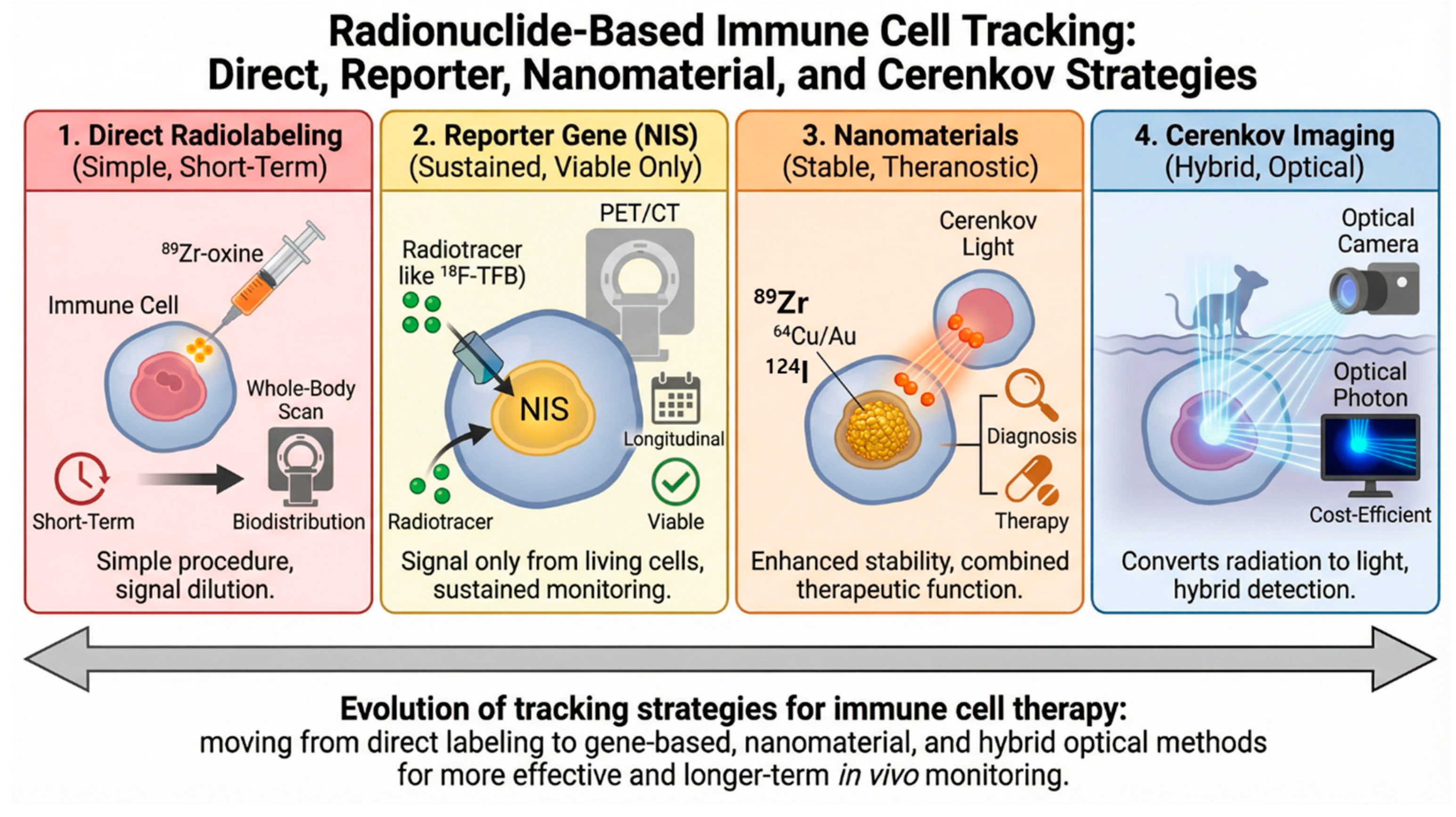
3. Radionuclide-Based Immune Cell Tracking: From Direct Labeling to Reporter Gene and Hybrid Optical Conversion Strategies
4. Comparative Functional Roles of Radionuclide-Based Immune Cell Imaging Platforms
4.1. Direct Radiolabeling and Early Biodistribution Assessment
4.2. Reporter Gene Imaging and Viability-Dependent Signal Generation
4.3. Radionuclide-Integrated Nanomaterials and Intracellular Signal Retention
4.4. Cerenkov Luminescence Imaging and Optical Signal Conversion
4.5. Modality Selection in Immune Cell Imaging
5. Current Diagnostic and Technical Barriers
6. Future Perspectives
7. Limitations of This Review
8. Conclusions
Funding
Institutional Review Board Statement
Informed Consent Statement
Data Availability Statement
Conflicts of Interest
Abbreviations
| AJR | American Journal of Roentgenology |
| AuNPs | Gold Nanoparticles |
| BRAF | B-Raf Proto-Oncogene |
| CAR | Chimeric Antigen Receptor |
| CLI | Cerenkov Luminescence Imaging |
| CT | Computed Tomography |
| DC | Dendritic Cell |
| EJNMMI | European Journal of Nuclear Medicine and Molecular Imaging |
| GMP | Good Manufacturing Practice |
| hNIS | Human Sodium Iodide Symporter |
| I-124 | Iodine-124 |
| I-131 | Iodine-131 |
| KHIDI | Korea Health Industry Development Institute |
| NK | Natural Killer |
| NIS | Sodium Iodide Symporter |
| NRF | National Research Foundation |
| PET | Positron Emission Tomography |
| PET/CT | Positron Emission Tomography/Computed Tomography |
| RIe-AuNPs | Radionuclide-Embedded Gold Nanoparticles |
| SPECT | Single-Photon Emission Computed Tomography |
| TFB | Tetrafluoroborate |
| RPT | Radiopharmaceutical therapy |
| [18F]F | Fluorine-18 radionuclide prefix used for fluorine-18-labeled radiopharmaceuticals |
| [64Cu]Cu | Copper-64 |
| [89Zr]Zr | Zirconium-89 |
| [89Zr]Zr-oxine | Zirconium-89 Oxinate Complex |
| [99ᵐTc]Tc | Technetium-99m |
| [198Au]Au | Gold-198 |
References
- Dai, G.; Levy, O.; Carrasco, N. Cloning and characterization of the thyroid iodide transporter. Nature 1996, 379, 458–460. [Google Scholar] [CrossRef] [PubMed]
- Smanik, P.A.; Liu, Q.; Furminger, T.L.; Ryu, K.; Xing, S.; Mazzaferri, E.L.; Jhiang, S.M. Cloning of the human sodium iodide symporter. Biochem. Biophys. Res. Commun. 1996, 226, 339–345. [Google Scholar] [CrossRef] [PubMed]
- Riesco-Eizaguirre, G.; Santisteban, P.; De la Vieja, A. The complex regulation of NIS expression and activity in thyroid and extrathyroidal tissues. Endocr. Relat. Cancer 2021, 28, T141–T165. [Google Scholar] [CrossRef] [PubMed]
- Spitzweg, C.; Nelson, P.J.; Wagner, E.; Bartenstein, P.; A Weber, W.; Schwaiger, M.; Morris, J.C. The sodium iodide symporter (NIS): Novel applications for radionuclide imaging and treatment. Endocr. Relat. Cancer 2021, 28, T193–T213. [Google Scholar] [CrossRef]
- Arczewska, K.D.; Godlewska, M.; Krasuska, W.; Lyczkowska, A.; Kiedrowski, M.; Czarnocka, B. Expression of pendrin and NIS iodide transporters in human breast tumor and peri-tumoral tissue. Arch. Med. Sci. 2022, 18, 1041–1050. [Google Scholar] [CrossRef]
- Fu, M.; Gao, Y.; Guo, W.; Meng, Q.; Jin, Q.; Yang, R.; Yang, Y.; Zhang, Y.; Zhang, W. Mechanisms of Sodium/Iodide Symporter-Mediated Mammary Gland Iodine Compensation during Lactation. Nutrients 2022, 14, 3592. [Google Scholar] [CrossRef]
- Gadisi, R.P.; Naicker, M.; Naidoo, S. The extra-thyroidal distribution of sodium iodide symporter. Front. Endocrinol. 2025, 16, 1567405. [Google Scholar] [CrossRef]
- Lee, J.H.; Jung, K.H.; Mina, K.; Lee, K.-H. Extracellular vesicles deliver sodium iodide symporter protein and promote cancer cell radioiodine therapy. Sci. Rep. 2022, 12, 11190. [Google Scholar] [CrossRef]
- Riesco-Eizaguirre, G.; Santisteban, P. A perspective view of sodium iodide symporter research and its clinical implications. Eur. J. Endocrinol. 2006, 155, 495–512. [Google Scholar] [CrossRef]
- Demyashkin, G.; Guzik, A.; Parshenkov, M.; Belokopytov, D.; Shchekin, V.; Batov, M.; Shegai, P.; Kaprin, A. Elevated NIS Expression Correlates with Chemoresistance in Triple-Negative Breast Cancer: Potential Link to FOXA1 Activity. Med. Sci. 2025, 13, 250. [Google Scholar] [CrossRef]
- Demyashkin, G.; Kogan, E.; Demura, T.; Guzik, A.; Belokopytov, D.; Batov, M.; Shchekin, V.; Bicherova, I.; Shegai, P.; Kaprin, A. Parity and NIS Expression in Atypical Cells of Triple-Negative Breast Cancer, and Prognosis. Int. J. Mol. Sci. 2025, 26, 9947. [Google Scholar] [CrossRef]
- Kitzberger, C.; Spellerberg, R.; Han, Y.; Schmohl, K.A.; Stauss, C.; Zach, C.; Kälin, R.E.; Multhoff, G.; Eiber, M.; Schilling, F.; et al. Mesenchymal Stem Cell-mediated Image-guided Sodium Iodide Symporter (NIS) Gene Therapy Improves Survival of Glioblastoma-bearing Mice. Clin. Cancer Res. 2023, 29, 930–942. [Google Scholar] [CrossRef]
- Spellerberg, R.; Benli-Hoppe, T.; Kitzberger, C.; Hageneier, M.; Schwenk, N.; Öztürk, Ö.; Steiger, K.; Multhoff, G.; Eiber, M.; Schilling, F.; et al. Dual EGFR- and TfR-targeted gene transfer for sodium iodide symporter gene therapy of glioblastoma. Mol. Ther. Oncolytics 2022, 27, 272–287. [Google Scholar] [CrossRef]
- Darabi, N.; Keshavarz, M.; Nabipour, I.; Assadi, M. The sodium iodide symporter (NIS) as theranostic gene in preclinical therapy of extra-thyroidal malignancies. Clin. Transl. Imaging 2023, 11, 113–125. [Google Scholar] [CrossRef]
- Acton, P.D.; Zhou, R. Imaging reporter genes for cell tracking with PET and SPECT. Q. J. Nucl. Med. Mol. Imaging 2005, 49, 349–360. [Google Scholar] [PubMed]
- Kemler, I.; Karamched, B.; Neuhauser, C.; Dingli, D. Quantitative imaging and dynamics of tumor therapy with viruses. FEBS J. 2021, 288, 6273–6285. [Google Scholar] [CrossRef] [PubMed]
- Backhaus, P.; Pentlow, K.S.; Ho, A.L.; Mauguen, A.; A Fagin, J.; Pillarsetty, N.V.K.; Lyashchenko, S.K.; Burnazi, E.; Ghossein, R.A.; Chhabra, S.; et al. [18F]TFB PET/CT misses intense [124I]iodine-avid metastases after redifferentiation therapy in metastatic thyroid cancer. EJNMMI Res. 2024, 14, 91. [Google Scholar] [CrossRef] [PubMed]
- Khoshnevisan, A.; Jauregui-Osoro, M.; Shaw, K.; Baguña Torres, J.; Young, J.D.; Ramakrishnan, N.K.; Jackson, A.; Smith, G.E.; Gee, A.D.; Blower, P.J. [18F]tetrafluoroborate as a PET tracer for the sodium/iodide symporter: The importance of specific activity. EJNMMI Res. 2016, 6, 34. [Google Scholar] [CrossRef]
- Kiraga, L.; Kucharzewska, P.; Paisey, S.J.; Cheda, L.; Domanska, A.; Rogulski, Z.; Rygiel, T.P.; Boffi, A.; Krol, M. Nuclear imaging for immune cell tracking in vivo: Comparison of various cell labeling methods and their application. Coord. Chem. Rev. 2021, 445, 214008. [Google Scholar] [CrossRef]
- Galli, F.; Varani, M.; Lauri, C.; Silveri, G.G.; Onofrio, L.; Signore, A. Immune cell labelling and tracking: Implications for adoptive cell transfer therapies. EJNMMI Radiopharm. Chem. 2021, 6, 7. [Google Scholar] [CrossRef]
- Lechermann, L.M.; Lau, D.; Attili, B.; Aloj, L.; Gallagher, F.A. In vivo cell tracking using PET: Opportunities and challenges for clinical translation in oncology. Cancers 2021, 13, 4042. [Google Scholar] [CrossRef]
- Ashmore-Harris, C.; Iafrate, M.; Saleem, A.; Fruhwirth, G.O. Non-invasive reporter gene imaging of cell therapies, including T cells and stem cells. Mol. Ther. 2020, 28, 1392–1416. [Google Scholar] [CrossRef] [PubMed]
- Roca, M.; de Vries, E.F.J.; Jamar, F.; Israel, O.; Signore, A. Guidelines for the labelling of leucocytes with 111In-oxine. Eur. J. Nucl. Med. Mol. Imaging 2010, 37, 835–841. [Google Scholar] [CrossRef]
- de Vries, E.F.J.; Roca, M.; Jamar, F.; Israel, O.; Signore, A. Guidelines for the labelling of leucocytes with 99mTc-HMPAO. Eur. J. Nucl. Med. Mol. Imaging 2010, 37, 842–848. [Google Scholar] [CrossRef] [PubMed]
- Diocou, S.; Volpe, A.; Jauregui-Osoro, M.; Boudjemeline, M.; Chuamsaamarkkee, K.; Man, F.; Blower, P.J.; Ng, T.; Mullen, G.E.D.; Fruhwirth, G.O. [18F]tetrafluoroborate-PET/CT enables sensitive tumor and metastasis in vivo imaging in a sodium iodide symporter-expressing tumor model. Sci. Rep. 2017, 7, 946. [Google Scholar] [CrossRef] [PubMed]
- Chaurasiya, S.; Yang, A.; Zhang, Z.; Lu, J.; Valencia, H.; Kim, S.-I.; Woo, Y.; Warner, S.G.; Olafsen, T.; Zhao, Y.; et al. Comprehensive preclinical study supporting clinical trial of oncolytic chimeric poxvirus CF33-hNIS-anti-PDL1 to treat breast cancer. Mol. Ther. Methods Clin. Dev. 2022, 24, 102–116. [Google Scholar] [CrossRef]
- Han, Y.; Koehler, V.F.; Nagarajah, J.; Schmohl, K.A.; Stauss, C.; Schwenk, N.; Spellerberg, R.; Kitzberger, C.; Kumbrink, J.; Zach, C.; et al. TGF-β1-based restoration of sodium iodide symporter expression in radioiodine-refractory differentiated thyroid cancer via engineered MSCs. Mol. Ther. 2025, 33, 6130–6145. [Google Scholar] [CrossRef]
- Riesco-Eizaguirre, G.; Rodríguez, I.; De la Vieja, A.; Costamagna, E.; Carrasco, N.; Nistal, M.; Santisteban, P. The BRAFV600E oncogene induces sodium iodide symporter repression. Cancer Res. 2009, 69, 8317–8325. [Google Scholar] [CrossRef]
- Shah, S.; Lucke-Wold, B. Image-guided mesenchymal stem cell NIS radionuclide therapy for glioblastoma. Cancers 2024, 16, 2892. [Google Scholar] [CrossRef]
- Zhang, Z.; Yang, A.; Chaurasiya, S.; Park, A.K.; Lu, J.; Kim, S.-I.; Warner, S.G.; Yuan, Y.-C.; Liu, Z.; Han, H.; et al. CF33-hNIS-antiPDL1 virus primes pancreatic ductal adenocarcinoma for enhanced therapy. Cancer Gene Ther. 2022, 29, 722–733. [Google Scholar] [CrossRef]
- Chaurasiya, S.; Kim, S.I.; O’Leary, M.; Park, A.K.; Lu, J.; Kang, S.; Zhang, Z.; Yang, A.; Woo, Y.; Fong, Y.; et al. Toward comprehensive imaging of oncolytic viroimmunotherapy. Mol. Ther. Oncolytics 2021, 23, 303–310. [Google Scholar] [CrossRef]
- Rand, J.; Yamauchi, D.; Chaurasiya, S.; Zhang, J.; Deshpande, S.; Chong, L.; Seiz, A.; Meisen, H.; Fong, Y.; Yuan, Y. hNIS-based imaging to monitor treatment with the novel oncolytic virus CF33-hNIS-antiPDL1 in humans with advanced triple negative breast cancer. Front. Oncol. 2025, 25, 1565244. [Google Scholar] [CrossRef]
- Dingli, D.; Diaz, R.M.; Bergert, E.R.; O’Connor, M.K.; Morris, J.C.; Russell, S.J. Genetically targeted radiotherapy for multiple myeloma. Blood 2003, 102, 489–496. [Google Scholar] [CrossRef]
- Msaouel, P.; Iankov, I.D.; Allen, C.; Aderca, I.; Federspiel, M.J.; Tindall, D.J.; Morris, J.C.; Koutsilieris, M.; Russell, S.J.; Galanis, E. Noninvasive imaging and radiovirotherapy of prostate cancer using an oncolytic measles virus expressing the sodium iodide symporter. Mol. Ther. 2009, 17, 2041–2048. [Google Scholar] [CrossRef]
- Goel, M.; Mackeyev, Y.; Krishnan, S. Radiolabeled nanomaterials for cancer diagnostics and therapy: Recent advances. Cancer Nanotechnol. 2023, 27, 15. [Google Scholar] [CrossRef] [PubMed]
- Zhen, Z.; Feng, L.; Liu, H.; Chen, M.; Chen, J.; Wang, J. Radionuclide-labeled nanomaterials for tumor therapy: Recent progress and perspectives. Mater. Today Bio 2025, 34, 102156. [Google Scholar] [CrossRef]
- Sun, N.; Wang, T.; Zhang, S. Radionuclide-labelled nanoparticles for cancer combination therapy and imaging. J. Nanobiotechnol. 2024, 22, 728. [Google Scholar] [CrossRef] [PubMed]
- Wang, R.; Liu, H.; Antal, B.; Wolterbeek, H.T.; Denkova, A.G. Ultrasmall gold nanoparticles radiolabeled with iodine-125 for targeted cancer therapy. ACS Appl. Bio Mater. 2024, 7, 1240–1249. [Google Scholar] [CrossRef] [PubMed]
- Lee, S.B.; Lee, S.W.; Jeong, S.Y.; Yoon, G.; Cho, S.J.; Kim, S.K.; Lee, I.K.; Ahn, B.C.; Lee, J.; Jeon, Y.H. Engineering of radioiodine-labeled gold core-shell nanoparticles for dendritic cell trafficking imaging. ACS Appl. Mater. Interfaces 2017, 9, 8480–8489. [Google Scholar] [CrossRef]
- Lee, S.B.; Lee, Y.J.; Cho, S.J.; Kim, S.K.; Lee, S.W.; Lee, J.; Lim, D.K.; Jeon, Y.H. Antigen-free radionuclide-embedded gold nanoparticles for dendritic cell maturation and tracking. Adv. Healthc. Mater. 2018, 7, e1701369. [Google Scholar] [CrossRef]
- Lee, S.B.; Lee, J.-E.; Cho, S.J.; Chin, J.; Kim, S.K.; Lee, I.K.; Lee, S.W.; Lee, J.; Jeon, Y.H. Crushed gold shell nanoparticles labeled with radioactive iodine as a theranostic nanoplatform. Nano Micro Lett. 2019, 11, 36. [Google Scholar] [CrossRef]
- Shen, W.; Zhou, H.; Liu, T.; Pei, P.; Huang, J.; Yi, X.; Yang, K. The potential clinical applications of radionuclide labeled/doped gold-based nanomaterials. Radiat. Med. Prot. 2020, 1, 186–195. [Google Scholar] [CrossRef]
- Young, D.J.; Edwards, A.J.; Quiroz Caceda, K.G.; Liberzon, E.; Barrientos, J.; Hong, S.G.; Turner, J.; Choyke, P.L.; Arlauckas, S.P.; Lazorchak, A.S.; et al. In vivo tracking of ex-vivo-generated 89Zr-oxine-labeled plasma cells by PET in a non-human primate model. Mol. Ther. 2025, 33, 580–594. [Google Scholar] [CrossRef]
- Khan, A.; Man, F.; Muhammad Faruqu, F.; Kim, J.; Al-Salemee, F.; Minino, A.; Volpe, A.; Liam-Or, R.; Simpson, P.; Fruhwirth, G.; et al. PET Imaging of Small Extracellular Vesicles via [89Zr]Zr(oxinate)4 Direct Radiolabeling. Bioconjug. Chem. 2022, 33, 473–485. [Google Scholar] [CrossRef]
- Bystrom, J.; Da Costa, M.P.; Carrascal-Miniño, A.; Qureshi, A.; Keeling, G.P.; Pham, T.T.; Sunassee, K.; Carroll, E.C.; Garrod-Ketchley, C.; Schroth, J. Impact of age on the homing potential of 89Zr-radiolabelled CD8+ T cells (pilot preclinical PET tracking study). Sci. Rep. 2025, 15, 10237. [Google Scholar] [CrossRef] [PubMed]
- Teng, M.; Liang, X.; Liu, H.; Li, Z.; Gao, X.; Zhang, C.; Cheng, H.; Chen, H.; Liu, G. Cerenkov radiation shining a light for cancer theranostics. Nano Today 2024, 55, 102174. [Google Scholar] [CrossRef]
- Xu, P.; Lin, S.; Wang, Y.; Abdukayum, A.; Wang, Y. Radionuclide-based Cerenkov luminescence in biomedicine: Current research progress and future perspectives. TrAC. Trends Anal. Chem. 2024, 170, 117452. [Google Scholar] [CrossRef]
- Liu, N.; Su, X.; Sun, X. Cerenkov radiation-activated probes for deep cancer theranostics: A review. Theranostics 2022, 12, 7404–7419. [Google Scholar] [CrossRef] [PubMed]
- Pham, T.T.; Chenoweth, A.; Patel, N.; Banu, A.; Osborn, G.; Blower, P.J.; Karagiannis, S.N.; Ma, M.T. In vivo PET imaging of 89Zr-labeled NK and CAR-NK cells. J. Nucl. Med. 2024, 65, 1035–1043. [Google Scholar] [CrossRef] [PubMed]
- Massicano, A.V.F.; Bartels, J.L.; Jeffers, C.D.; Crenshaw, B.K.; Houson, H.; Mueller, C.; Younger, J.W.; Knapp, P.; McConathy, J.E.; Lapi, S.E. Production of [89Zr]oxinate4 and cell radiolabeling for human use. J. Label. Comp. Radiopharm. 2021, 64, 209–216. [Google Scholar] [CrossRef]
- Pratt, E.C.; Skubal, M.; Mc Larney, B.; Causa-Andrieu, P.; Das, S.; Sawan, P.; Araji, A.; Riedl, C.; Vyas, K.; Tuch, D.; et al. Prospective testing of clinical Cerenkov luminescence imaging against standard-of-care nuclear imaging for tumour location. Nat. Biomed. Eng. 2022, 6, 559–568. [Google Scholar] [CrossRef]
- Ruggiero, A.; Holland, J.P.; Lewis, J.S.; Grimm, J. Cerenkov luminescence imaging of medical isotopes. J. Nucl. Med. 2010, 51, 1123–1130. [Google Scholar] [CrossRef]
- Thorek, D.L.J.; Ogirala, A.; Beattie, B.J.; Grimm, J. Quantitative imaging of disease signatures through radioactive decay signal conversion. Nat. Med. 2013, 19, 1345–1350. [Google Scholar] [CrossRef]
- Alborghetti, L.; Vurro, F.; Belloli, S.; Rainone, P.; Valtorta, S.; Capialbi, M.M.; Lacavalla, M.A.; Pizzardi, S.; Moresco, R.M.; Boschi, F.; et al. Cerenkov luminescence microscopy: A novel approach for high-resolution radiotracer imaging. iScience 2025, 28, 113840. [Google Scholar] [CrossRef]
- Yang, Z.; Pang, T.T.; Wu, Z.J.; Yan, T.Y.; Yu, J.M.; Wang, X.Y.; Liu, D.; Lu, X.J.; Kang, X.Y.; Li, G.Y.; et al. Construction of a high-sensitivity Cherenkov luminescence imaging system in tumor models. EJNMMI Res. 2025, 15, 123. [Google Scholar] [CrossRef]
- Spyratou, E.; Kokkinogoulis, K.; Tsigaridas, G.; Kareliotis, G.; Platoni, K.; Makropoulou, M.; Efstathopoulos, E.P. Novel Biophotonic Techniques for Phototherapy Enhancement: Cerenkov Radiation as a Bridge between Ionizing and Non-Ionizing Radiation Treatment. J. Nanother. 2023, 4, 86–105. [Google Scholar] [CrossRef]
- Thorek, D.L.J.; Das, S.; Grimm, J. Molecular imaging using nanoparticle quenchers of Cerenkov luminescence. Small 2014, 10, 3729–3734. [Google Scholar] [CrossRef][Green Version]
- van Dam, R.M.; Chatziioannou, A.F. Cerenkov luminescence imaging in radiochemistry development. Front. Phys. 2021, 9, 632056. [Google Scholar] [CrossRef]
- Man, F.; Khan, A.A.; Carrascal-Miniño, A.; Blower, P.J.; de Rosales, R.T.M. A kit formulation for the preparation of [89Zr]Zr(oxinate)4 for PET cell tracking: White blood cell labelling and comparison with [111In]In(oxinate)3. Nucl. Med. Biol. 2020, 90, 31–40. [Google Scholar] [CrossRef]
- Weist, M.R.; Starr, R.; Aguilar, B.; Chea, J.; Miles, J.K.; Poku, E.; Gerdts, E.; Yang, X.; Priceman, S.J.; Forman, S.J.; et al. PET of adoptively transferred chimeric antigen receptor T cells with 89Zr-oxine. J. Nucl. Med. 2018, 59, 1531–1537. [Google Scholar] [CrossRef]
- Man, F.; Lim, L.; Volpe, A.; Gabizon, A.; Shmeeda, H.; Draper, B.; Parente-Pereira, A.C.; Maher, J.; Blower, P.J.; Fruhwirth, G.O.; et al. In vivo PET tracking of 89Zr-labeled Vγ9Vδ2 T cells to mouse xenograft breast tumors activated with liposomal alendronate. Mol. Ther. 2019, 27, 219–229. [Google Scholar] [CrossRef]
- Sta Maria, N.S.; Barnes, S.R.; Weist, M.R.; Khawli, L.A.; Pachipulusu, V.; Lin, S.W.; Zheng, L.; Cohrs, D.; Liu, X.; Hu, P.; et al. Spatio-temporal biodistribution of 89Zr-oxine-labeled CAR T cells in mice. Sci. Rep. 2021, 11, 16304. [Google Scholar] [CrossRef]
- Kurebayashi, Y.; Choyke, P.L.; Sato, N. Imaging of cell-based therapy using 89Zr-oxine ex vivo cell labeling for positron emission tomography. Nanotheranostics 2021, 5, 27–36. [Google Scholar] [CrossRef]
- Koyasu, S.; Minor, H.A.; Asiedu, K.O.; Choyke, P.L.; Sato, N. Zirconium-89-oxine cell tracking by PET reveals in vivo trafficking of monocyte-macrophage lineage cells. Pharmaceuticals 2025, 18, 897. [Google Scholar] [CrossRef]
- Lee, S.B.; Ahn, S.B.; Lee, S.W.; Jeong, S.Y.; Ghilsuk, Y.; Ahn, B.-C.; Kim, E.-M.; Jeong, H.-J.; Lee, J.; Lim, D.-K.; et al. Radionuclide-embedded gold nanoparticles for enhanced dendritic cell-based cancer immunotherapy, sensitive and quantitative tracking of dendritic cells with PET and Cerenkov luminescence. NPG Asia Mater. 2016, 8, e281. [Google Scholar] [CrossRef]
- Daems, N.; Michiels, C.; Lucas, S.; Baatout, S.; Aerts, A. Gold nanoparticles meet medical radionuclides. Nucl. Med. Biol. 2021, 100, 61–90. [Google Scholar] [CrossRef]
- Dittmann, M.; Gonzalez Carvalho, J.M.; Rahbar, K.; Schäfers, M.; Claesener, M.; Riemann, B.; Seifert, R. Incremental diagnostic value of [18F]tetrafluoroborate PET-CT compared to [131I]iodine scintigraphy in recurrent differentiated thyroid cancer. Eur. J. Nucl. Med. Mol. Imaging 2020, 47, 2639–2646. [Google Scholar] [CrossRef]
- Groot-Wassink, T.; Aboagye, E.O.; Wang, Y.; Lemoine, N.R.; Reader, A.J.; Vassaux, G. Quantitative imaging of Na/I symporter transgene expression using positron emission tomography in the living animal. Mol. Ther. 2004, 9, 436–442. [Google Scholar] [CrossRef]
- Niu, M.; Qin, J.; Wang, L.; Hu, H.; Shi, J.; Yang, X.; Zhang, Y.; Zhang, J. Evaluation of [18F]tetrafluoroborate as a Potential PET Imaging Agent in a Sodium Iodide Symporter-Transfected Cell Line A549 and Endogenous NIS-Expressing Cell Lines MKN45 and K1. Mol. Imaging 2022, 2022, 2679260. [Google Scholar] [CrossRef]
- O’Doherty, J.W.; Jauregui-Osoro, M.; Brothwood, T.; Szyszko, T.A.; Marsden, P.; O’Doherty, M.J.; Cook, G.J.R.; Blower, P.J.; Lewington, V.J. [18F]tetrafluoroborate ([18F]TFB), a PET probe for imaging sodium/iodide symporter expression: Whole-body biodistribution, safety and radiation dosimetry in thyroid cancer patients. J. Nucl. Med. 2017, 58, 1666–1671. [Google Scholar] [CrossRef]
- Piccardo, A.; Fiz, F.; Righi, S.; Raffa, S.; Riondato, M.; Bottoni, G.; Bauckneht, M.; Massollo, M.; Rizzo, A.; Naseri, M.S.Z.; et al. [18F]Tetrafluoroborate, a new NIS PET/CT radiopharmaceutical: An overview focused on differentiated thyroid cancer. Eur. Thyroid. J. 2025, 14, e240320. [Google Scholar] [CrossRef]
- Ventura, D.; Dittmann, M.; Büther, F.; Schäfers, M.; Rahbar, K.; Hescheler, D.; Claesener, M.; Schindler, P.; Riemann, B.; Seifert, R.; et al. Diagnostic performance of [18F]TFB PET/CT compared with therapeutic activity [131I]iodine SPECT/CT and [18F]FDG PET/CT in recurrent differentiated thyroid carcinoma. J. Nucl. Med. 2024, 65, 192–198. [Google Scholar] [CrossRef]
- Coenen, H.H.; Gee, A.D.; Adam, M.; Antoni, G.; Cutler, C.S.; Fujibayashi, Y.; Jeong, J.M.; Mach, R.H.; Mindt, T.L.; Pike, V.W.; et al. Consensus nomenclature rules for radiopharmaceutical chemistry: Setting the record straight. Nucl. Med. Biol. 2017, 55, v–xi. [Google Scholar] [CrossRef]
- Penheiter, A.R.; Russell, S.J.; Carlson, S.K. The sodium iodide symporter (NIS) as an imaging reporter for gene, viral, and cell-based therapies. Curr. Gene Ther. 2012, 12, 33–47. [Google Scholar] [CrossRef]
- Ahn, B.C. Sodium iodide symporter for nuclear molecular imaging and gene therapy: From bedside to bench and back. Theranostics 2012, 2, 392–402. [Google Scholar] [CrossRef]
- Brader, P.; Serganova, I.; Blasberg, R.G. Noninvasive molecular imaging using reporter genes. J. Nucl. Med. 2013, 54, 167–172. [Google Scholar] [CrossRef]
- Jauregui-Osoro, M.; Sunassee, K.; Weeks, A.J.; Berry, D.J.; Paul, R.L.; Cleij, M.; Banga, J.P.; O’doherty, M.J.; Marsden, P.K.; Clarke, S.E.M.; et al. Synthesis and biological evaluation of [18F]tetrafluoroborate: A PET imaging agent for thyroid disease and reporter gene imaging of the sodium/iodide symporter. Eur. J. Nucl. Med. Mol. Imaging 2010, 37, 2108–2116. [Google Scholar] [CrossRef]
- Jiang, H.; Schmit, N.R.; Koenen, A.R.; Bansal, A.; Pandey, M.K.; Glynn, R.B.; Kemp, B.J.; Delaney, K.L.; Dispenzieri, A.; Bakkum-Gamez, J.N.; et al. Safety, pharmacokinetics, metabolism and radiation dosimetry of [18F]tetrafluoroborate ([18F]TFB) in healthy human subjects. EJNMMI Res. 2017, 7, 90. [Google Scholar] [CrossRef]
- Shalaby, N.; Xia, Y.; Kelly, J.J.; Sanchez-Pupo, R.; Martinez, F.; Fox, M.S.; Thiessen, J.D.; Hicks, J.W.; Scholl, T.J.; Ronald, J.A. Imaging CAR-NK cells targeted to HER2 ovarian cancer with human sodium-iodide symporter-based positron emission tomography. Eur. J. Nucl. Med. Mol. Imaging 2024, 51, 3176–3190. [Google Scholar] [CrossRef]
- Jacob, J.; Nadkarni, S.; Volpe, A.; Peng, Q.; Tung, S.L.; Hannen, R.F.; Mohseni, Y.R.; Scotta, C.; Marelli-Berg, F.M.; Lechler, R.I.; et al. Spatiotemporal in vivo tracking of polyclonal human regulatory T cells reveals a role for innate immune cells in Treg transplant recruitment. Mol. Ther. Methods Clin. Dev. 2021, 20, 324–336. [Google Scholar] [CrossRef]
- Vandergaast, R.; Khongwichit, S.; Jiang, H.; DeGrado, T.R.; Peng, K.-W.; Smith, D.R.; Russell, S.J.; Suksanpaisan, L. Enhanced noninvasive imaging of oncology models using the NIS reporter gene and bioluminescence imaging. Cancer Gene Ther. 2020, 27, 179–188. [Google Scholar] [CrossRef]
- Concilio, S.C.; Russell, S.J.; Peng, K.W. A brief review of reporter gene imaging in oncolytic virotherapy and gene therapy. Mol. Ther. Oncolytics 2021, 21, 98–109. [Google Scholar] [CrossRef]
- Volpe, A.; Pillarsetty, N.V.K.; Lewis, J.S.; Ponomarev, V. Applications of nuclear-based imaging in gene and cell therapy: Probe considerations. Mol. Ther. Oncolytics 2021, 20, 447–458. [Google Scholar] [CrossRef]
- Dohan, O.; De la Vieja, A.; Paroder, V.; Riedel, C.; Artani, M.; Reed, M.; Ginter, C.S.; Carrasco, N. The sodium/iodide symporter (NIS): Characterization, regulation, and medical significance. Endocr. Rev. 2003, 24, 48–77. [Google Scholar] [CrossRef]
- Micali, S.; Bulotta, S.; Puppin, C.; Territo, A.; Navarra, M.; Bianchi, G.; Damante, G.; Filetti, S.; Russo, D. Sodium iodide symporter (NIS) in extrathyroidal malignancies: Focus on breast and urological cancer. BMC Cancer 2014, 14, 303. [Google Scholar] [CrossRef]
- Kogai, T.; Taki, K.; Brent, G.A. Enhancement of sodium/iodide symporter expression in thyroid and lactating breast. Endocr. Relat. Cancer 2006, 13, 797–826. [Google Scholar] [CrossRef]
- Ryan, J.; Curran, C.E.; Hennessy, E.; Newell, J.; Morris, J.C.; Kerin, M.J.; Dwyer, R.M. The sodium iodide symporter (NIS) and potential regulators in normal, benign, and malignant human breast tissue. PLoS ONE 2011, 6, e16023. [Google Scholar] [CrossRef]
- US Food and Drug Administration. Long Term Follow-Up After Administration of Human Gene Therapy Products: Guidance for Industry; FDA: Silver Spring, MD, USA, 2020.
- US Food and Drug Administration. Considerations for the Development of Chimeric Antigen Receptor (CAR) T Cell Products: Guidance for Industry; FDA: Silver Spring, MD, USA, 2024.
- Eisenman, D.; Swindle, S. Food and Drug Administration guidance on design of clinical trials for gene therapy products with potential for genome integration or genome editing and associated long-term follow-up of research subjects. Appl. Biosaf. 2022, 27, 201–209. [Google Scholar] [CrossRef]
- Doctor, A.; Seifert, V.; Ullrich, M.; Hauser, S.; Pietzsch, J. Three-dimensional cell culture systems in radiopharmaceutical cancer research. Cancers 2020, 12, 2765. [Google Scholar] [CrossRef]
- Abdollahi, H.; Saboury, B.; Soltani, M.; Shi, K.; Uribe, C.; Rahmim, A. Radiopharmaceutical therapy on-a-chip: A perspective on microfluidic-driven digital twins towards personalized cancer therapies. Sci. Bull. 2023, 68, 2058–2061. [Google Scholar] [CrossRef]
- Nayak, P.; Bentivoglio, V.; Varani, M.; Signore, A. Three-dimensional in vitro tumor spheroid models for evaluation of anticancer therapy: Recent updates. Cancers 2023, 15, 4846. [Google Scholar] [CrossRef]
- Petreus, T.; Cadogan, E.; Hughes, G.; Smith, A.; Reddy, V.P.; Lau, A.; O’cOnnor, M.J.; Critchlow, S.; Ashford, M.; O’cOnnor, L.O. Tumour-on-chip microfluidic platform for assessment of drug pharmacokinetics and treatment response. Commun. Biol. 2021, 4, 1001. [Google Scholar] [CrossRef] [PubMed]
- Fang, L.; Liu, Y.; Qiu, J.; Wan, W. Bioprinting and its use in tumor-on-a-chip technology for anticancer drug screening. Int. J. Bioprint. 2022, 8, 603. [Google Scholar] [CrossRef] [PubMed]
- Liu, X.; Fang, J.; Huang, S.; Wu, X.; Xie, X.; Wang, J.; Liu, F.; Zhang, M.; Peng, Z.; Hu, N. Tumor-on-a-chip: From bioinspired design to biomedical application. Microsyst. Nanoeng. 2021, 7, 50. [Google Scholar] [CrossRef] [PubMed]
- Regmi, S.; Fu, A.; Luo, K.Q. Applications of microfluidics and organ-on-a-chip in cancer research. Biosensors 2022, 12, 459. [Google Scholar] [CrossRef]

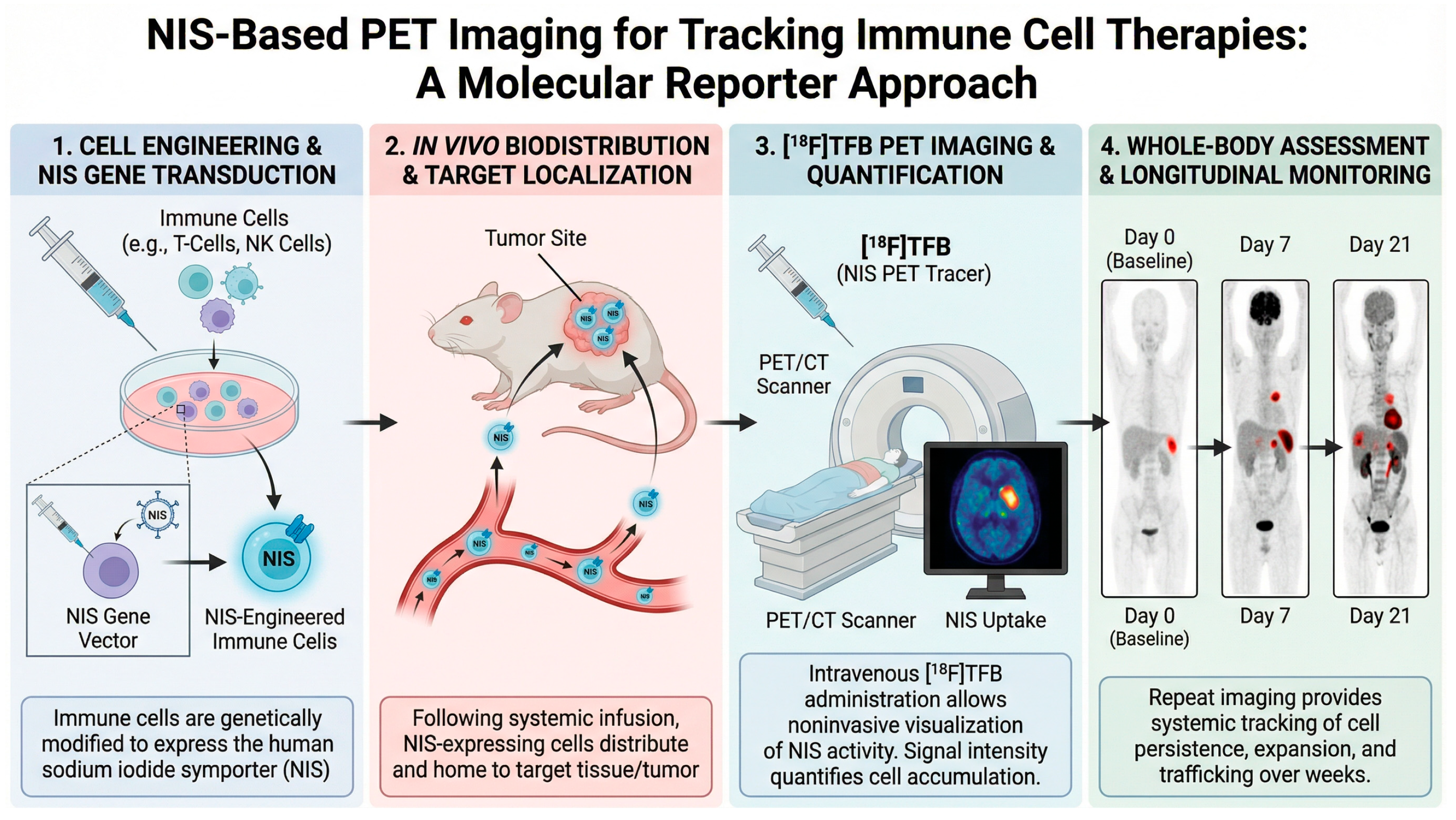

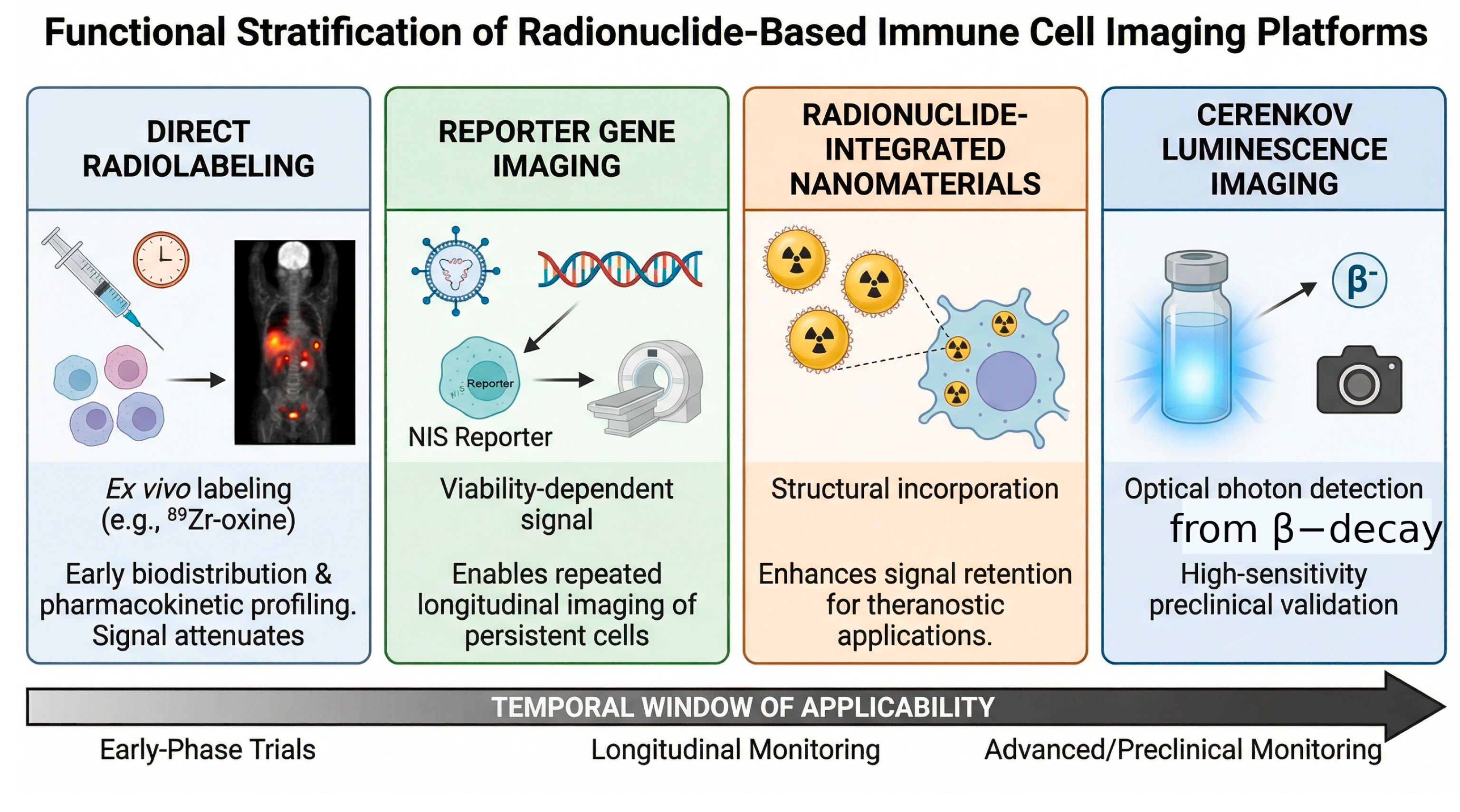

| Category | Key References | Core Contribution | Relevance to Immune Cell Tracking |
|---|---|---|---|
| NIS discovery | [1,2,3] | Cloning, transport mechanism, stoichiometry | Molecular basis of tracer uptake |
| Physiological & clinical characterization | [4,5,6,7,8,9] | Regulation, Endocrine application | Safety and regulatory familiarity |
| NIS substrate spectrum | [25,69,70,71,72,73] | PET/SPECT-compatible tracers including [18F]TFB, [124I]NaI, [123I]NaI, and [99ᵐTc]TcO4− | Supports modality selection for longitudinal tracking |
| Extrathyroidal expression | [10,11] | Expression in non-thyroid tissues | Adaptability to engineered cells |
| Reporter gene concept | [12,13,14] | Radioisotope concentrator gene therapy | Feasibility of ectopic expression |
| PET reporter validation | [15,16,17,18,67,68] | Quantitative PET imaging of hNIS | Longitudinal in vivo monitoring |
| [18F]TFB development | [69] | Introduction of PET-compatible NIS tracer | Improved imaging resolution |
| Human dosimetry & safety | [70,71] | Biodistribution and radiation assessment | Clinical translation |
| Clinical diagnostic validation | [25,72] | Tumor detection and comparison to iodine imaging | Proof of clinical utility |
| Strategy | PET Platform(s) | SPECT Platform(s) | Time Window/ Longitudinal Capability | Main Translational Use | Key Refs. |
|---|---|---|---|---|---|
| Direct radiolabeling | [89Zr]Zr-oxine; [64Cu]Cu-based labels | [111In]In-oxine; [99ᵐTc]Tc-HMPAO | Short-term; limited by decay, efflux, cell division | Early biodistribution and safety assessment | [19,20,21,22,23,24,43,44,45,46,47,48,49,50,59,60,61,62,63,64] |
| NIS reporter gene | hNIS + [124I]NaI; hNIS + [18F]TFB | hNIS + [123I]NaI; hNIS + [99ᵐTc]TcO4−; hNIS + [131I]NaI | Repeated imaging; viability-dependent signal | Longitudinal tracking of viable engineered cells | [1,2,3,4,5,6,7,8,9,10,11,12,13,14,15,16,17,18,25,26,27,28,67,68,69,70,71,72,73,74,75,76,77,78,79,80,81,82,83] |
| Oncolytic/viral NIS platforms | NIS vectors + [124I]NaI/[18F]TFB | NIS vectors + [123I]NaI/[131I]NaI/[99ᵐTc]TcO4− | Repeated imaging depending on expression stability | Gene-delivery and radiovirotherapy monitoring | [29,30,31,32,33,34,81,82,83] |
| Radionuclide-integrated nanomaterials | [64Cu]Cu-, [89Zr]Zr-, radioiodine-AuNPs | [99ᵐTc]Tc-, [198Au]Au-, radioiodine-AuNPs | Moderate; depends on retention and cell fate | Signal retention and theranostic design | [35,36,37,38,39,40,41,42,65,66] |
| Cerenkov luminescence imaging | β+ PET radionuclide-based CLI | Not primary; comparator γ-tracers when applicable | Isotope-dependent; mainly preclinical | Tracer validation and PET/SPECT-optical cross-validation | [51,52,53,54,55,56,57,58] |
| Platform | Signal Origin and Biological Readout | Strengths | Limitations | Optimal Translational Use | Refs. |
|---|---|---|---|---|---|
| Direct radiolabeling | Preloaded intracellular radionuclide; early biodistribution independent of viability | Simple workflow; quantitative early trafficking; clinically feasible GMP labeling | Physical decay, efflux, proliferation dilution, no viability specificity | Immediate post-infusion pharmacokinetics and safety mapping | [19,20,21,22,23,24,43,44,45,46,47,48,49,50,59,60,61,62,63,64] |
| NIS reporter gene imaging | Transporter-mediated tracer uptake; viable-cell persistence | Repeated imaging; signal linked to living engineered cells; PET and SPECT tracer options | Requires gene transfer; physiologic uptake in thyroid, salivary glands, stomach; regulatory complexity | Long-term persistence monitoring in gene and cell therapy | [1,2,3,4,5,6,7,8,9,10,11,12,13,14,15,16,17,18,25,26,27,28,67,68,69,70,71,72,73,74,75,76,77,78,79,80,81,82,83] |
| Radionuclide-integrated nanomaterials | Structurally retained isotope; intracellular signal retention | No genetic modification; improved radionuclide retention; theranostic design | Long-term biocompatibility, degradation, and clearance require further evaluation | Preclinical and early translational immune-cell tracking | [35,36,37,38,39,40,41,42,65,66] |
| Cerenkov luminescence imaging | Optical photons generated by radioactive decay | Sensitive small-animal imaging; supports PET-optical validation | Limited tissue penetration; not suitable as stand-alone deep human imaging | Preclinical validation and radiochemistry development | [51,52,53,54,55,56,57,58] |
Disclaimer/Publisher’s Note: The statements, opinions and data contained in all publications are solely those of the individual author(s) and contributor(s) and not of MDPI and/or the editor(s). MDPI and/or the editor(s) disclaim responsibility for any injury to people or property resulting from any ideas, methods, instructions or products referred to in the content. |
© 2026 by the author. Licensee MDPI, Basel, Switzerland. This article is an open access article distributed under the terms and conditions of the Creative Commons Attribution (CC BY) license.
Share and Cite
Lee, S.B. NIS-Centered Reporter Gene Imaging and Radionuclide-Integrated Nanoplatforms for Quantitative Tracking of Immune Cell Therapy in Oncology and Inflammatory Disease Models. Pharmaceuticals 2026, 19, 790. https://doi.org/10.3390/ph19050790
Lee SB. NIS-Centered Reporter Gene Imaging and Radionuclide-Integrated Nanoplatforms for Quantitative Tracking of Immune Cell Therapy in Oncology and Inflammatory Disease Models. Pharmaceuticals. 2026; 19(5):790. https://doi.org/10.3390/ph19050790
Chicago/Turabian StyleLee, Sang Bong. 2026. "NIS-Centered Reporter Gene Imaging and Radionuclide-Integrated Nanoplatforms for Quantitative Tracking of Immune Cell Therapy in Oncology and Inflammatory Disease Models" Pharmaceuticals 19, no. 5: 790. https://doi.org/10.3390/ph19050790
APA StyleLee, S. B. (2026). NIS-Centered Reporter Gene Imaging and Radionuclide-Integrated Nanoplatforms for Quantitative Tracking of Immune Cell Therapy in Oncology and Inflammatory Disease Models. Pharmaceuticals, 19(5), 790. https://doi.org/10.3390/ph19050790