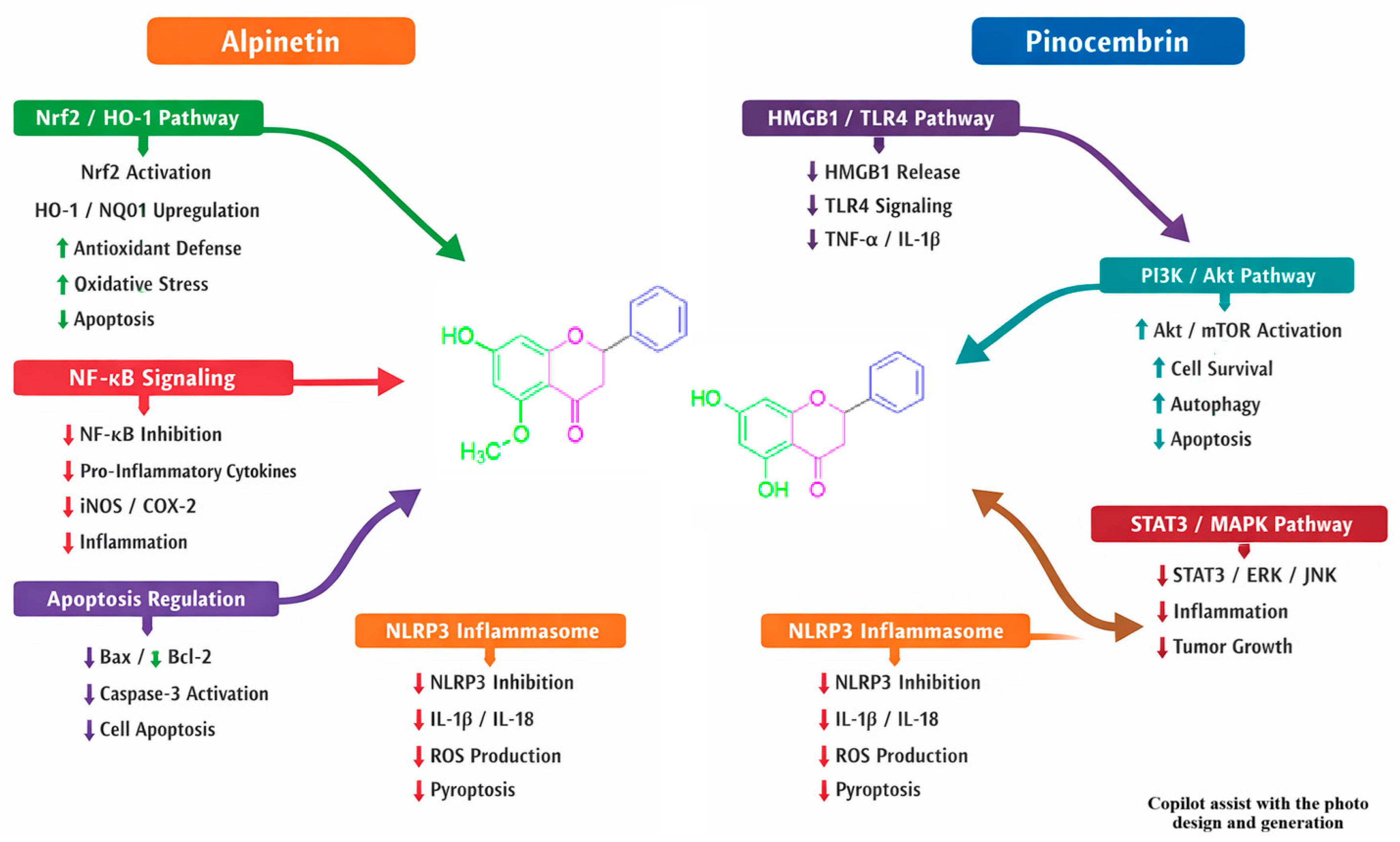
Preclinical Pharmacological Actions of Alpinetin and Pinocembrin—A Comparative Review

 , , and
Abstract
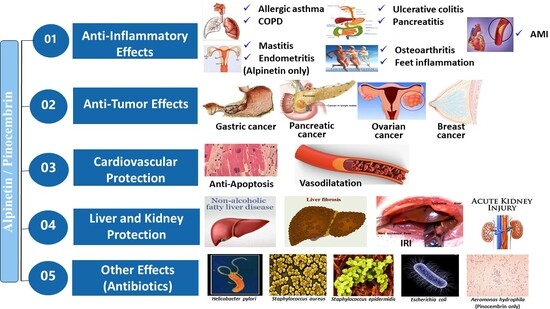
1. Introduction
2. Search Strategy
3. Pharmacokinetics of Alpinetin and Pinocembrin
4. Absorption and Distribution
5. Metabolism
6. Excretion
7. Pharmacodynamics of Alpinetin and Pinocembrin
8. Anti-Inflammatory Activity
8.1. Anti-Inflammatory Effects Against Respiratory Diseases
8.1.1. Allergic Asthma
8.1.2. Chronic Obstructive Pulmonary Disease (COPD)
8.2. Anti-Inflammatory Effects Against Digestive Diseases
8.2.1. Ulcerative Colitis
8.2.2. Pancreatitis-Induced Lung Injury
8.3. Anti-Inflammatory Effects Against Reproductive Diseases
8.3.1. Mastitis
8.3.2. Endometritis
8.4. Anti-Inflammatory Effects Against Locomotor Diseases
8.4.1. Osteoarthritis
8.4.2. Foot Inflammation
8.5. Anti-Inflammatory Effects Against Cardiovascular Diseases
9. Anti-Tumor Effects
9.1. Gastrointestinal Cancer
9.1.1. Gastric Cancer
9.1.2. Pancreatic Cancer
9.2. Gynecological Tumors
9.2.1. Ovarian Cancer
9.2.2. Breast Cancer
10. Cardiovascular Protection
10.1. Anti-Apoptotic Effects in Cardiomyocytes
10.2. Vasodilatation
10.3. Other Cardiovascular-Protective Effects
11. Liver and Kidney Protection
11.1. Non-Alcoholic Fatty Liver Disease
11.2. Liver and Kidney Injury
11.3. Hepatic Ischemia–Reperfusion Injury
11.4. Other Effects
12. Discussion
13. Conclusions
14. Future Aspects
Author Contributions
Funding
Informed Consent Statement
Data Availability Statement
Conflicts of Interest
Abbreviations
| ADME | Absorption, Distribution, Metabolism, Excretion |
| AhR | Aryl Hydrocarbon Receptor |
| ALT | Alanine Aminotransferase |
| AMI | Acute Myocardial Infarction |
| APD | Action Potential Duration |
| AST | Aspartate Aminotransferase |
| AUC (0–t) | Area Under the Plasma Concentration–Time Curve from Time Zero to Time t |
| BALF | Bronchoalveolar Lavage Fluid |
| BCRP | Breast Cancer Resistance Protein |
| CHRM3 | Muscarinic Acetylcholine Receptor M3 |
| Clint | Intrinsic Clearance |
| CLz/F | Apparent Oral Clearance During the Terminal Phase |
| CNKI | China National Knowledge Infrastructure |
| CYP450 | Cytochrome P450 |
| CYP1A2 | Cytochrome P450 1A2 |
| CYP2A6 | Cytochrome P450 2A6 |
| CYP2C8 | Cytochrome P450 2C8 |
| CYP2C9 | Cytochrome P450 2C9 |
| CYP2D6 | Cytochrome P450 2D6 |
| CYP2E1 | Cytochrome P450 2E1 |
| CYP3A4 | Cytochrome P450 3A4 |
| Cmax | Maximum Plasma Concentration |
| COPD | Chronic Obstructive Pulmonary Disease |
| CREB | cAMP Response Element-Binding Protein |
| CX40/CX43 | Connexin 40/Connexin 43 |
| DSS | Dextran Sodium Sulfate |
| ER Stress | Endoplasmic Reticulum Stress |
| ESI | Electrospray Ionization |
| FDA | Food and Drug Administration |
| GSRS | Global Substance Registration System |
| HIF-1α | Hypoxia-Inducible Factor 1 Alpha |
| HPLC | High-Performance Liquid Chromatography |
| HPLC-DAD | High-Performance Liquid Chromatography–Diode Array Detection |
| HMGB1 | High-Mobility Group Box 1 |
| HAS | Human Serum Albumin |
| HO-1 | Heme Oxygenase-1 |
| ICAM-1 | Intercellular Adhesion Molecule 1 |
| IC50 | Half Maximal Inhibitory Concentration |
| IL-1 | Interleukin-1 |
| IPF | Idiopathic Pulmonary Fibrosis |
| IR | Ischemia–Reperfusion |
| JAK2 | Janus Kinase 2 |
| MAPK | Mitogen-Activated Protein Kinase |
| MBC | Minimum Bactericidal Concentration |
| MD2 | Myeloid Differentiation Protein 2 |
| MIC | Minimum Inhibitory Concentration |
| MPO | Myeloperoxidase |
| mTORC1 | Mechanistic Target of Rapamycin Complex 1 |
| NAFLD | Non-Alcoholic Fatty Liver Disease |
| NASH | Non-Alcoholic Steatohepatitis |
| NF-κB | Nuclear Factor Kappa-Light-Chain-Enhancer of Activated B Cells |
| NGF | Nerve Growth Factor |
| NLRP3 | NOD-, LRR-, and Pyrin Domain-Containing Protein 3 Inflammasome |
| Nrf2 | Nuclear Factor Erythroid 2-Related Factor 2 |
| OVA | Ovalbumin |
| PCBG | Pinocembrin-7-O-β-D-glucoside |
| PI3K/Akt | Phosphoinositide 3-Kinase/Protein Kinase B |
| PPAR-γ | Peroxisome Proliferator-Activated Receptor Gamma |
| PRISMA | Preferred Reporting Items for Systematic Reviews and Meta-Analyses |
| pHIMs | Pooled Human Intestine Microsomes |
| pHLMs | Pooled Human Liver Microsomes |
| ROS | Reactive Oxygen Species |
| SIRT1 | Sirtuin 1 |
| STAT3 | Signal Transducer and Activator of Transcription 3 |
| TCM | Traditional Chinese medicine |
| T1/2 | Elimination Half-Life |
| TLR4 | Toll-Like Receptor 4 |
| TOF-MS | Time-of-Flight Mass Spectrometry |
| UGT | UDP-glucuronosyltransferase |
| UPLC-ESI-MS/MS | Ultra-Performance Liquid Chromatography–Electrospray Ionization–Tandem Mass Spectrometry |
| UHPLC-ESI-MS/MS | Ultra-High-Performance Liquid Chromatography–Electrospray Ionization–Tandem Mass Spectrometry |
| UHPLC-TOF-MS | Ultra-High-Performance Liquid Chromatography–Time-of-Flight Mass Spectrometry |
| Vz/F | Apparent Volume of Distribution During the Terminal Phase after Oral Administration |
References
- Cathébras, P. Qu’est-ce qu’une maladie? What is a disease? Rev. Med. Interne 1997, 18, 809–813. [Google Scholar] [CrossRef]
- Zhou, M.; Wu, B. Chinese Medicine in Regulating Immune Balance for the Treatment of Autoimmune Diseases. Am. J. Chin. Med. 2025, 53, 1615–1640. [Google Scholar] [CrossRef]
- Lee, K.H. Research and future trends in the pharmaceutical development of medicinal herbs from Chinese medicine. Public Health Nutr. 2000, 3, 515–522. [Google Scholar] [CrossRef]
- Rizvi, S.A.A.; Einstein, G.P.; Tulp, O.L.; Sainvil, F.; Branly, R. Introduction to Traditional Medicine and Their Role in Prevention and Treatment of Emerging and Re-Emerging Diseases. Biomolecules 2022, 12, 1442. [Google Scholar] [CrossRef]
- Roy, A.; Khan, A.; Ahmad, I.; Alghamdi, S.; Rajab, B.S.; Babalghith, A.O.; Alshahrani, M.Y.; Islam, S.; Islam, M.R. Flavonoids a Bioactive Compound from Medicinal Plants and Its Therapeutic Applications. BioMed Res. Int. 2022, 2022, 5445291. [Google Scholar] [CrossRef]
- Panche, A.N.; Diwan, A.D.; Chandra, S.R. Flavonoids: An overview. J. Nutr. Sci. 2016, 5, e47. [Google Scholar] [CrossRef]
- Havsteen, B. Flavonoids, a class of natural products of high pharmacological potency. Biochem. Pharmacol. 1983, 32, 1141–1148. [Google Scholar] [CrossRef] [PubMed]
- Leonte, D.; Ungureanu, D.; Zaharia, V. Flavones and Related Compounds: Synthesis and Biological Activity. Molecules 2023, 28, 6528. [Google Scholar] [CrossRef] [PubMed]
- Spiegel, M.; Andruniów, T.; Sroka, Z. Flavones’ and Flavonols’ Antiradical Structure-Activity Relationship-A Quantum Chemical Study. Antioxidants 2020, 9, 461. [Google Scholar] [CrossRef] [PubMed]
- Islam, M.T.; Tahara, S. Dihydroflavonols from Lannea coromandelica. Phytochemistry 2000, 54, 901–907. [Google Scholar] [CrossRef]
- Ko, K.P. Isoflavones: Chemistry, analysis, functions and effects on health and cancer. Asian Pac. J. Cancer Prev. 2014, 15, 7001–7010. [Google Scholar] [CrossRef] [PubMed]
- Tanjung, M.; Hakim, E.H.; Elfahmi; Latip, J.; Syah, Y.M. Dihydroflavonol and flavonol derivatives from Macaranga recurvata. Nat. Prod. Commun. 2012, 7, 1309–1310. [Google Scholar] [CrossRef]
- Zhuang, C.; Zhang, W.; Sheng, C.; Zhang, W.; Xing, C.; Miao, Z. Chalcone: A Privileged Structure in Medicinal Chemistry. Chem. Rev. 2017, 117, 7762–7810. [Google Scholar] [CrossRef]
- Mattioli, R.; Francioso, A.; Mosca, L.; Silva, P. Anthocyanins: A Comprehensive Review of Their Chemical Properties and Health Effects on Cardiovascular and Neurodegenerative Diseases. Molecules 2020, 25, 3809. [Google Scholar] [CrossRef]
- Kumar, N.; Singh, B.; Bhandari, P.; Gupta, A.P.; Uniyal, S.K.; Kaul, V.K. Biflavonoids from Lonicera japonica. Phytochemistry 2005, 66, 2740–2744. [Google Scholar] [CrossRef]
- Kim, J.D.; Liu, L.; Guo, W.; Meydani, M. Chemical structure of flavonols in relation to modulation of angiogenesis and immune-endothelial cell adhesion. J. Nutr. Biochem. 2006, 17, 165–176. [Google Scholar] [CrossRef] [PubMed]
- Al-Khayri, J.M.; Sahana, G.R.; Nagella, P.; Joseph, B.V.; Alessa, F.M.; Al-Mssallem, M.Q. Flavonoids as Potential Anti-Inflammatory Molecules: A Review. Molecules 2022, 27, 2901. [Google Scholar] [CrossRef] [PubMed]
- Kopustinskiene, D.M.; Jakstas, V.; Savickas, A.; Bernatoniene, J. Flavonoids as Anticancer Agents. Nutrients 2020, 12, 457. [Google Scholar] [CrossRef]
- Du, Z.; Cui, D.; Wang, L. Inhibition effect and mechanisms of baicalein on the growth of HepG2 hepatocellular carcinoma cells xenograft model in nude mice and its mechanism. Chin. J. Cancer Prev. Treat. 2020, 27, 848–854. [Google Scholar]
- Ciumarnean, L.; Milaciu, M.V.; Runcan, O.; Vesa, S.C.; Rachisan, A.L.; Negrean, V.; Perne, M.G.; Donca, V.I.; Alexescu, T.G.; Para, I.; et al. The Effects of Flavonoids in Cardiovascular Diseases. Molecules 2020, 25, 4320. [Google Scholar] [CrossRef]
- Zhang, W.; Lian, Y.; Li, Q.; Sun, L.; Chen, R.; Lai, X.; Lai, Z.; Yuan, E.; Sun, S. Preventative and Therapeutic Potential of Flavonoids in Peptic Ulcers. Molecules 2020, 25, 4626. [Google Scholar] [CrossRef]
- Rufino, A.T.; Costa, V.M.; Carvalho, F.; Fernandes, E. Flavonoids as antiobesity agents: A review. Med. Res. Rev. 2021, 41, 556–585. [Google Scholar] [CrossRef] [PubMed]
- Russo, M.; Moccia, S.; Spagnuolo, C.; Tedesco, I.; Russo, G.L. Roles of flavonoids against coronavirus infection. Chem. Biol. Interact. 2020, 328, 109211. [Google Scholar] [CrossRef]
- Ullah, A.; Munir, S.; Badshah, S.L.; Khan, N.; Ghani, L.; Poulson, B.G.; Emwas, A.H.; Jaremko, M. Important Flavonoids and Their Role as a Therapeutic Agent. Molecules 2020, 25, 5243. [Google Scholar] [CrossRef]
- Tan, B.C.; Tan, S.K.; Wong, S.M.; Ata, N.; Rahman, N.A.; Khalid, N. Distribution of Flavonoids and Cyclohexenyl Chalcone Derivatives in Conventional Propagated and In Vitro-Derived Field-Grown Boesenbergia rotunda (L.) Mansf. Evid. Based Complement. Altern. Med. 2015, 2015, 451870. [Google Scholar]
- Qiao, C.; Xu, L.; Wang, Z.; Yang, Z. Progress in studies of alpinetin and cardamonin. Chin. Wild Plant Resour. 2001, 20, 11–13. [Google Scholar]
- Qiao, C.; Han, Q.; Song, J.; Wang, Z.; Xu, L.; Xu, H. Analysis of eight bioactive compounds in alpinia species by HPLC. Nat. Prod. Res. 2008, 20, 422–426. [Google Scholar]
- Lan, X.; Wang, W.; Li, Q.; Wang, J. The Natural Flavonoid Pinocembrin: Molecular Targets and Potential Therapeutic Applications. Mol. Neurobiol. 2016, 53, 1794–1801. [Google Scholar] [CrossRef]
- Yang, G.; Guo, C. Pharmacogenomics and Individualized Therapeutic Medication Policy Decision; People’s Health Publishing House: Beijing, China, 2016; pp. 94–97. [Google Scholar]
- Cao, J. Relationship between UGT1A1*28 gene polymorphism and irinotecan-induced toxicity and response to chemotherapy. J. Mod. Oncol. 2019, 27, 1087–1089. [Google Scholar]
- Grogan, S.; Preuss, C.V. Pharmacokinetics. In StatPearls [Internet]; StatPearls Publishing: Treasure Island, FL, USA, 2025. [Google Scholar]
- Murakami, T. Absorption sites of orally administered drugs in the small intestine. Expert Opin. Drug Discov. 2017, 12, 1219–1232. [Google Scholar] [CrossRef]
- Oie, S. Drug distribution and binding. J. Clin. Pharmacol. 1986, 26, 583–586. [Google Scholar] [CrossRef]
- Zhou, L.; Montalvo, A.D.; Collins, J.M.; Wang, D. Quantitative analysis of the UDP-glucuronosyltransferase transcriptome in human tissues. Pharmacol. Res. Perspect. 2023, 11, e01154. [Google Scholar] [CrossRef]
- Carrillo Norte, J.A. Excreción de fármacos. El proceso farmacocinético: Llega el fármaco al sitio de acción? [Pharmacokinetic process: Does the site of drug action? Excretion of drugs]. Rev. Enferm. 2011, 34, 24–31. [Google Scholar] [PubMed]
- Chen, W.; Xiong, W.; Xu, Y.; Fang, J. Determination of Alpinetin and eardamonin in rat plasma by UHPLC-ESI-MS/MS. TCPM 2015, 10, 2220–2224. [Google Scholar]
- Guo, W.W.; Qiu, F.; Chen, X.Q.; Ba, Y.Y.; Wang, X.; Wu, X. In-vivo absorption of pinocembrin-7-O-β-D-glucoside in rats and its in-vitro biotransformation. Sci. Rep. 2016, 6, 29340. [Google Scholar] [CrossRef] [PubMed]
- Qiu, J.; Wu, H.; Feng, F.; He, X.; Wang, C.; Chu, S.; Xiang, Z. Metabolic Profiling of Alpinetin in Rat Plasma, Urine, Bile and Feces after Intragastric Administration. Molecules 2019, 24, 3458. [Google Scholar] [CrossRef]
- Jin, X.; Fang, Z.; Qu, Y.; Tang, B.; Yang, L.; Wang, L. Study on the glucuronidation of Alpinetin in human liver microsomes. Chin. J. Clin. Pharmacol. 2011, 11, 847–849. [Google Scholar]
- Yang, F.; Wei, X. The effect of excision repair cross complementing 1 and thymidylate synthetase mRNA expression and uridine-diphosphoglucuronosyl transferase 1A1 gene polymorphism on chemotherapeutic effect and prognosis of gastric cancer. Chin. J. Exp. Surg. 2019, 3, 420–423. [Google Scholar]
- Song, Z.; Gao, X.; Wu, M.; Lu, F.; Qin, H. Structure, function, and application of cytochrome P450 enzymes. Microbiol. China 2020, 7, 2245–2254. [Google Scholar]
- Otake, Y.; Hsieh, F.; Walle, T. Glucuronidation versus oxidation of the flavonoid galangin by human liver microsomes and hepatocytes. Drug Metab. Dispos. 2002, 30, 576–581. [Google Scholar] [CrossRef]
- Dou, W.; Ding, L.; Zhang, J.; Wang, Z. Alpinetin activates PXR and up-regulates CYP3A4 mRNA. Chin. Pharmacol. Bull. 2012, 06, 761–763. [Google Scholar]
- Lu, Y.; Deng, H.; Pan, H.; Lv, J.; Xu, Y.; Peng, J.; He, Y. Selective inhibition of Alpinetin on CYP1A2 in human liver microsomes. J. Zunyi Med. Univ. 2015, 5, 454–459. [Google Scholar]
- Šarić Mustapić, D.; Debeljak, Ž.; Maleš, Ž.; Bojić, M. The Inhibitory Effect of Flavonoid Aglycones on the Metabolic Activity of CYP3A4 Enzyme. Molecules 2018, 23, 2553. [Google Scholar] [CrossRef]
- Navrátilová, L.; Ramos Mandíková, J.; Pávek, P.; Mladěnka, P.; Trejtnar, F. Honey flavonoids inhibit hOATP2B1 and hOATP1A2 transporters and hOATP-mediated rosuvastatin cell uptake in vitro. Xenobiotica 2018, 48, 745–755. [Google Scholar] [CrossRef] [PubMed]
- Shen, X.; Liu, Y.; Luo, X.; Yang, Z. Advances in Biosynthesis, Pharmacology, and Pharmacokinetics of Pinocembrin, a Promising Natural Small-Molecule Drug. Molecules 2019, 24, 2323. [Google Scholar] [CrossRef] [PubMed]
- Qi, C.; Fu, J.; Zhao, H.; Xing, H.; Dong, D.; Wu, B. Identification of UGTs and BCRP as potential pharmacokinetic determinants of the natural flavonoid alpinetin. Xenobiotica 2019, 49, 276–283. [Google Scholar] [CrossRef]
- Zhao, G.; Tong, Y.; Luan, F.; Zhu, W.; Zhan, C.; Qin, T.; An, W.; Zeng, N. Alpinetin: A Review of Its Pharmacology and Pharmacokinetics. Front. Pharmacol. 2022, 13, 814370. [Google Scholar] [CrossRef]
- Ye, W.; Lin, X.; Zhang, Y.; Xu, Y.; Sun, R.; Wen, C.; Wang, X.; Bao, S.; Chen, R. Quantification and pharmacokinetics of alpinetin in rat plasma by UHPLC-MS/MS using protein precipitation coupled with dilution approach to eliminate matrix effects. J. Pharm. Biomed. Anal. 2018, 152, 242–247. [Google Scholar] [CrossRef]
- Wang, Z.H.; Hong, M.; Sun, X.Y.; He, G.Y. Determination of alpinetin glucuronidation activities in liver microsomes from different species using UFLC-ESI-MS. Lat. Am. J. Pharm. 2012, 31, 725–730. [Google Scholar]
- Hou, M.; Tian, H.; Wu, J.; Deng, Z. Metabolite identification and excretion of pinocembrin-7-O-β-D-glucoside in rats by UHPLC/MS. J. Pharm. Biomed. Anal. 2024, 248, 116291. [Google Scholar] [CrossRef]
- Sayre, C.L.; Alrushaid, S.; Martinez, S.E.; Anderson, H.D.; Davies, N.M. Pre-Clinical Pharmacokinetic and Pharmacodynamic Characterization of Selected Chiral Flavonoids: Pinocembrin and Pinostrobin. J. Pharm. Pharm. Sci. 2015, 18, 368–395. [Google Scholar] [CrossRef]
- Rasul, A.; Millimouno, F.M.; Ali Eltayb, W.; Ali, M.; Li, J.; Li, X. Pinocembrin: A novel natural compound with versatile pharmacological and biological activities. BioMed Res. Int. 2013, 2013, 379850. [Google Scholar] [CrossRef]
- Marino, M.; Jamal, Z.; Zito, P.M. Pharmacodynamics. In StatPearls [Internet]; StatPearls Publishing: Treasure Island, FL, USA, 2025. [Google Scholar]
- Suo, C.; Sun, L.; Yang, S. Alpinetin activates the δ receptor instead of the κ and μ receptor pathways to protect against rat myocardial cell apoptosis. Exp. Ther. Med. 2014, 7, 109–116. [Google Scholar] [CrossRef]
- Yu, Z.; Yue, B.; Ding, L.; Luo, X.; Ren, Y.; Zhang, J.; Mani, S.; Wang, Z.; Dou, W. Activation of PXR by Alpinetin Contributes to Abrogate Chemically Induced Inflammatory Bowel Disease. Front. Pharmacol. 2020, A11, 474. [Google Scholar] [CrossRef] [PubMed]
- Zheng, Y.; Wan, G.; Yang, B.; Gu, X.; Lin, J. Cardioprotective Natural Compound Pinocembrin Attenuates Acute Ischemic Myocardial Injury via Enhancing Glycolysis. Oxid. Med. Cell. Longev. 2020, 2020, 4850328. [Google Scholar] [CrossRef]
- Cao, P.; Chen, Q.; Shi, C.; Pei, M.; Wang, L.; Gong, Z. Pinocembrin ameliorates acute liver failure via activating the Sirt1/PPARα pathway in vitro and in vivo. Eur. J. Pharmacol. 2022, 915, 174610. [Google Scholar] [CrossRef]
- Lin, X.; Ren, X.; Xiao, X.; Yang, Z.; Yao, S.; Wong, G.W.; Liu, Z.; Wang, C.; Su, Z.; Li, J. Important Role of Immunological Responses to Environmental Exposure in the Development of Allergic Asthma. Allergy Asthma Immunol. Res. 2020, 12, 934–948. [Google Scholar] [CrossRef]
- Zhao, Z.; Tao, L.; Liu, A.; Ma, M.; Li, H.; Zhao, H.; Yang, J.; Wang, S.; Jin, Y.; Shao, X.; et al. NF-kappaB is a key modulator in the signaling pathway of Borrelia burgdorferi BmpA-induced inflammatory chemokines in murine microglia BV2 cells. Mol. Med. Rep. 2018, 17, 4953–4958. [Google Scholar] [PubMed]
- Kuribayashi, K.; Iida, S.; Nakajima, Y.; Funaguchi, N.; Tabata, C.; Fukuoka, K.; Fujimori, Y.; Ihaku, D.; Nakano, T. Suppression of heme oxygenase-1 activity reduces airway hyperresponsiveness and inflammation in a mouse model of asthma. J. Asthma 2015, 52, 662–668. [Google Scholar] [CrossRef] [PubMed]
- Wu, D.; Li, S.; Liu, X.; Xu, J.; Jiang, A.; Zhang, Y.; Liu, Z.; Wang, J.; Zhou, E.; Wei, Z.; et al. Alpinetin prevents inflammatory responses in OVA-induced allergic asthma through modulating PI3K/AKT/NF-kappaB and HO-1 signaling pathways in mice. Int. Immunopharmacol. 2020, 89, 107073. [Google Scholar] [CrossRef]
- Gu, X.; Zhang, Q.; Du, Q.; Shen, H.; Zhu, Z. Pinocembrin attenuates allergic airway inflammation via inhibition of NF-κB pathway in mice. Int. Immunopharmacol. 2017, 53, 90–95. [Google Scholar] [CrossRef]
- Wang, C.; Zhou, J.; Wang, J.; Li, S.; Fukunaga, A.; Yodoi, J.; Tian, H. Progress in the mechanism and targeted drug therapy for COPD. Signal Transduct. Target. Ther. 2020, 5, 248. [Google Scholar] [CrossRef] [PubMed]
- Su, Y.; Tao, X.; Xu, J. Protective effect of Alpinetin on rats with chronic obstructive pulmonary disease. Food Sci. Nutr. 2020, 8, 6603–6611. [Google Scholar] [CrossRef] [PubMed]
- Gan, W.; Li, X.; Cui, Y.; Xiao, T.; Liu, R.; Wang, M.; Wei, Y.; Cui, M.; Ren, S.; Helian, K.; et al. Pinocembrin relieves lipopolysaccharide and bleomycin induced lung inflammation via inhibiting TLR4-NF-κB-NLRP3 inflammasome signaling pathway. Int. Immunopharmacol. 2021, 90, 107230. [Google Scholar] [CrossRef] [PubMed]
- Ma, Y.Y.; Li, R.; Shang, Z.X.; Liu, W.; Jiao, X.Y.; Liang, L.Y.; Liu, R.; Li, Z. An in silico and in vitro integrated analysis method to reveal the curative mechanisms and pharmacodynamic substances of Bufei granule on chronic obstructive pulmonary disease. Mol. Divers. 2023, 27, 103–123. [Google Scholar] [CrossRef]
- Qian, J.; Xue, M. Pinocembrin Relieves Mycoplasma pneumoniae Infection-Induced Pneumonia in Mice Through the Inhibition of Oxidative Stress and Inflammatory Response. Appl. Biochem. Biotechnol. 2022, 194, 6335–6348. [Google Scholar] [CrossRef]
- Chen, H.; Liu, C.; Zhan, Y.; Wang, Y.; Hu, Q.; Zeng, Z. Alpinetin ameliorates bleomycin-induced pulmonary fibrosis by repressing fibroblast differentiation and proliferation. Biomed. Pharmacother. 2024, 171, 116101. [Google Scholar] [CrossRef]
- Zhang, J.; Ma, B. Alpinetin alleviates LPS-induced lung epithelial cell injury by inhibiting p38 and ERK1/2 signaling via aquaporin-1. Tissue Cell 2024, 87, 102305. [Google Scholar] [CrossRef]
- Derseh, H.B.; Goodger, J.Q.D.; Scheerlinck, J.Y.; Samuel, C.S.; Woodrow, I.E.; Palombo, E.A.; Cumming, A.; Snibson, K. The efficacy and safety of pinocembrin in a sheep model of bleomycin-induced pulmonary fibrosis. PLoS ONE 2021, 16, e0260719. [Google Scholar] [CrossRef]
- Fiorino, G.; Danese, S.; Giacobazzi, G.; Spinelli, A. Medical therapy versus surgery in moderate-to-severe ulcerative colitis. Dig. Liver Dis. 2021, 53, 403–408. [Google Scholar] [CrossRef]
- Tan, Y.; Guan, Y.; Zheng, C. Protection of Alpinetin on dextran sulfate sodium-induced ulcerative colitis in mice and its mechanism. Drugs Clin. 2018, 6, 1303–1311. [Google Scholar]
- Hu, K.; Qian, H.; Liu, L.; Li, Y.; Jin, L.; Chen, L.; Tan, B.; Yin, H. MeCP2 promotes the inhibition of inflammatory factor expression in murine macrophages by alpinetin and its molecular mechanism. Curr. Immunol. 2019, 4, 271–276. [Google Scholar]
- Hu, K.; Huang, M.; Duan, Y.; Qian, H.; Cao, X.; Liu, L. The molecular mechanism for expression regulation of IL-6 via H3K9 deacetylation in murine macrophage induced by alpinetin. Immunol. J. 2017, 6, 461–468. [Google Scholar]
- Hu, K.; Huang, M.; Yan, Q.; Li, Y.; Chen, Y.; Chen, L.; Zhang, Y.; Tan, B.; Yin, H. Alpinetin inhibits IL-6 expression via promoting the methylation of cytosine in CpG island of promotor region. Immunol. J. 2020, 4, 305–311. [Google Scholar]
- He, X.; Wei, Z.; Wang, J.; Kou, J.; Liu, W.; Fu, Y.; Yang, Z. Alpinetin attenuates inflammatory responses by suppressing TLR4 and NLRP3 signaling pathways in DSS-induced acute colitis. Sci. Rep. 2016, 6, 28370. [Google Scholar] [CrossRef]
- Lee, S.H. Intestinal permeability regulation by tight junction: Implication on inflammatory bowel diseases. Intest. Res. 2015, 13, 11–18. [Google Scholar] [CrossRef]
- Tan, Y.; Zheng, C. Effects of Alpinetin on Intestinal Barrier Function, Inflammation and Oxidative Stress in Dextran Sulfate Sodium-Induced Ulcerative Colitis Mice. Am. J. Med. Sci. 2018, 355, 377–386. [Google Scholar] [CrossRef]
- Miao, Y.; Lv, Q.; Qiao, S.; Yang, L.; Tao, Y.; Yan, W.; Wang, P.; Cao, N.; Dai, Y.; Wei, Z. Alpinetin improves intestinal barrier homeostasis via regulating AhR/suv39h1/TSC2/mTORC1/autophagy pathway. Toxicol. Appl. Pharmacol. 2019, 384, 114772. [Google Scholar] [CrossRef]
- Lv, Q.; Shi, C.; Qiao, S.; Cao, N.; Guan, C.; Dai, Y.; Wei, Z. Alpinetin exerts anti-colitis efficacy by activating AhR, regulating miR-302/DNMT-1/CREB signals, and therefore promoting Treg differentiation. Cell Death Dis. 2018, 9, 890. [Google Scholar] [CrossRef]
- Yue, B.; Ren, J.; Yu, Z.; Luo, X.; Ren, Y.; Zhang, J.; Mani, S.; Wang, Z.; Dou, W. Pinocembrin alleviates ulcerative colitis in mice via regulating gut microbiota, suppressing TLR4/MD2/NF-κB pathway and promoting intestinal barrier. Biosci. Rep. 2020, 40, BSR20200986. [Google Scholar] [CrossRef] [PubMed]
- Wang, Z.; Li, Y.; Tang, B. Protection Mechanism of Alpinetin on Pulmonary Microvascular Endothelial Cells Injury. Chin. J. Integr. Med. 2017, 4, 476–479. [Google Scholar]
- Ali, B.M.; Al-Mokaddem, A.K.; Selim, H.M.R.M.; Alherz, F.A.; Saleh, A.; Hamdan, A.M.E.; Ousman, M.S.; El-Emam, S.Z. Pinocembrin’s protective effect against acute pancreatitis in a rat model: The correlation between TLR4/NF-κB/NLRP3 and miR-34a-5p/SIRT1/Nrf2/HO-1 pathways. Biomed. Pharmacother. 2024, 176, 116854. [Google Scholar] [CrossRef] [PubMed]
- Cobirka, M.; Tancin, V.; Slama, P. Epidemiology and Classification of Mastitis. Animals 2020, 10, 2212. [Google Scholar] [CrossRef] [PubMed]
- Aratani, Y. Myeloperoxidase: Its role for host defense, inflammation, and neutrophil function. Arch. Biochem. Biophys. 2018, 640, 47–52. [Google Scholar] [CrossRef]
- Chen, H.; Mo, X.; Yu, J.; Huang, Z. Alpinetin attenuates inflammatory responses by interfering toll-like receptor 4/nuclear factor kappa B signaling pathway in lipopolysaccharide-induced mastitis in mice. Int. Immunopharmacol. 2013, 17, 26–32. [Google Scholar] [CrossRef]
- Espinos, J.J.; Fabregues, F.; Fontes, J.; Garcia-Velasco, J.A.; Llacer, J.; Requena, A.; Checa, M.A.; Bellver, J. Impact of chronic endometritis in infertility: A SWOT analysis. Reprod. Biomed. Online 2021, 42, 939–951. [Google Scholar] [CrossRef]
- Liang, Y.; Shen, T.; Ming, Q.; Han, G.; Zhang, Y.; Liang, J.; Zhu, D. Alpinetin ameliorates inflammatory response in LPS-induced endometritis in mice. Int. Immunopharmacol. 2018, 62, 309–312. [Google Scholar] [CrossRef]
- Ruan, G.; Xu, J.; Wang, K.; Wu, J.; Zhu, Q.; Ren, J.; Bian, F.; Chang, B.; Bai, X.; Han, W.; et al. Associations between knee structural measures, circulating inflammatory factors and MMP13 in patients with knee osteoarthritis. Osteoarthr. Cartil. 2018, 26, 1063–1069. [Google Scholar] [CrossRef]
- Dai, T.; Shi, K.; Chen, G.; Shen, Y.; Pan, T. Malvidin attenuates pain and inflammation in rats with osteoarthritis by suppressing NF-kappaB signaling pathway. Inflamm. Res. 2017, 66, 1075–1084. [Google Scholar] [CrossRef]
- Xu, M.; Jiang, T.; Qin, Y. The research progress of osteoarthritis pathogenesis. Int. J. Orthop. 2020, 4, 229–233. [Google Scholar]
- Gao, Y.; Wang, S.; He, L.; Wang, C.; Yang, L. Alpinetin Protects Chondrocytes and Exhibits Anti-Inflammatory Effects via the NF-kappaB/ERK Pathway for Alleviating Osteoarthritis. Inflammation 2020, 43, 1742–1750. [Google Scholar] [CrossRef] [PubMed]
- Dai, W.; Huang, Z.; Zhang, B.; Du, Y.; Li, X. The protective effect of Alpinetin on chondrocyte damage induced by lipopolysaccharide. Tianjin Med. J. 2020, 12, 1137–1141. [Google Scholar]
- Wang, C.; Yang, L.; Xu, K. Use of Alpinetin in the Treatment of Osteoarthritis: China. CN 111374969A, 17 July 2020.
- Zhang, D.; Huang, B.; Xiong, C.; Yue, Z. Pinocembrin inhibits matrix metalloproteinase expression in chondrocytes. IUBMB Life 2015, 67, 36–41. [Google Scholar] [CrossRef] [PubMed]
- Song, M.T.; Ruan, J.; Zhang, R.Y.; Deng, J.; Ma, Z.Q.; Ma, S.P. Astragaloside IV ameliorates neuroinflammation-induced depressive-like behaviors in mice via the PPARgamma/NF-kappaB/NLRP3 inflammasome axis. Acta Pharmacol. Sin. 2018, 39, 1559–1570. [Google Scholar] [CrossRef]
- Cui, L.; Yao, J.; Xin, Q.; Liu, Z.; Liu, P. Study on the anti-inflammatory effect and mechanism of Alpinetin on acute inflammation induced by carrageenan in mice. Chin. J. Clin. Pharmacol. 2019, 35, 2276–2279. [Google Scholar]
- Ahmed, E.A.; Ibrahim, H.M.; Khalil, H.E. Pinocembrin Reduces Arthritic Symptoms in Mouse Model via Targeting Sox4 Signaling Molecules. J. Med. Food 2021, 24, 282–291. [Google Scholar] [CrossRef]
- Feng, M.; Chen, X.; Huang, F.; Chen, L.; Liu, C.; Li, W.; Li, Y.; Chen, S.; Deng, Z.; Wei, Z.; et al. Alpinetin Alleviates Cardiac Inflammation and Remodeling via TLR4/MyD88/NF-κB Signaling Pathway in Rats with Acute Myocardial Infarction. Int. J. Mol. Sci. 2025, 26, 10073. [Google Scholar] [CrossRef]
- Chen, X.; Wan, W.; Guo, Y.; Ye, T.; Fo, Y.; Sun, Y.; Qu, C.; Yang, B.; Zhang, C. Pinocembrin ameliorates post-infarct heart failure through activation of Nrf2/HO-1 signaling pathway. Mol. Med. 2021, 27, 100. [Google Scholar] [CrossRef]
- Mattiuzzi, C.; Lippi, G. Cancer statistics: A comparison between World Health Organization (WHO) and Global Burden of Disease (GBD). Eur. J. Public Health 2020, 30, 1026–1027. [Google Scholar] [CrossRef]
- Cohen, A.D.; Garfall, A.L.; Stadtmauer, E.A.; Melenhorst, J.J.; Lacey, S.F.; Lancaster, E.; Vogl, D.T.; Weiss, B.M.; Dengel, K.; Nelson, A.; et al. B cell maturation antigen-specific Car T cells are clinically active in multiple myeloma. J. Clin. Investig. 2019, 6, 2210–2221. [Google Scholar] [CrossRef]
- Cao, M.; Li, H.; Sun, D.; He, S.; Lei, L.; Peng, J.; Chen, W. Epidemiological trend analysis of gastric cancer in China from 2000 to 2019. Chin. J. Dig. Surg. 2021, 1, 102–109. [Google Scholar]
- Wang, Z.; Lu, W.; Li, Y.; Tang, B. Alpinetin promotes Bax translocation, induces apoptosis through the mitochondrial pathway and arrests human gastric cancer cells at the G2/M phase. Mol. Med. Rep. 2013, 7, 915–920. [Google Scholar] [CrossRef]
- Zhang, H.; Jiang, Q.; Gong, G.; Li, M.; Alotaibi, S.H. Alpinetin: Anti-human gastric cancer potential and urease inhibition activity in vitro. Arch. Med. Sci. 2023, 19, 1479–1486. [Google Scholar] [CrossRef]
- Li, X.; Fu, X.; Fan, L.; Wang, J.; Zhang, D.; Zhao, Y.; Zhang, L.; Zhao, Y. Pinocembrin inhibits the proliferation, migration and invasion of gastric cancer cell line AGS. Jichu Yixue Yu Linchuang [Basic Med. Clin.] 2022, 42, 1744–1752. [Google Scholar]
- Khalaf, N.; El-Serag, H.B.; Abrams, H.R.; Thrift, A.P. Burden of Pancreatic Cancer: From Epidemiology to Practice. Clin. Gastroenterol. Hepatol. 2021, 19, 876–884. [Google Scholar] [CrossRef] [PubMed]
- Du, J.; Tang, B.; Wang, J.; Sui, H.; Jin, X.; Wang, L.; Wang, Z. Antiproliferative effect of alpinetin in BxPC-3 pancreatic cancer cells. Int. J. Mol. Med. 2012, 29, 607–612. [Google Scholar] [CrossRef]
- Tao, L.; Chen, X.; Zheng, Y.; Wu, Y.; Jiang, X.; You, M.; Li, S.; Hu, F. Chinese Propolis Suppressed Pancreatic Cancer Panc-1 Cells Proliferation and Migration via Hippo-YAP Pathway. Molecules 2021, 26, 2803. [Google Scholar] [CrossRef]
- Jia, Z.H.; Jia, Y.; Guo, F.J.; Chen, J.; Zhang, X.W.; Cui, M.H. Phosphorylation of STAT3 at Tyr705 regulates MMP-9 production in epithelial ovarian cancer. PLoS ONE 2017, 12, e0183622. [Google Scholar] [CrossRef]
- Zeng, J.; Wang, J.; Yin, J.; Song, Q. Study of the inhibition effect of alpinetin on human ovarian cancer cell line OVCAR-8 and its mechanism. China Med. Her. 2018, 10, 13–17. [Google Scholar]
- Zhao, X.; Guo, X.; Shen, J.; Hua, D. Alpinetin inhibits proliferation and migration of ovarian cancer cells via suppression of STAT3 signaling. Mol. Med. Rep. 2018, 18, 4030–4036. [Google Scholar] [CrossRef] [PubMed]
- Gao, J.; Lin, S.; Gao, Y.; Zou, X.; Zhu, J.; Chen, M.; Wan, H.; Zhu, H. Pinocembrin inhibits the proliferation and migration and promotes the apoptosis of ovarian cancer cells through down-regulating the mRNA levels of N-cadherin and GABAB receptor. Biomed. Pharmacother. 2019, 120, 109505. [Google Scholar] [CrossRef]
- Zhang, T.; Guo, S.; Zhu, X.; Qiu, J.; Deng, G.; Qiu, C. Alpinetin inhibits breast cancer growth by ROS/NF-kappaB/HIF-1alpha axis. J. Cell Mol. Med. 2020, 24, 8430–8440. [Google Scholar] [CrossRef] [PubMed]
- Zhu, X.; Li, R.; Wang, C.; Zhou, S.; Fan, Y.; Ma, S.; Gao, D.; Gai, N.; Yang, J. Pinocembrin Inhibits the Proliferation and Metastasis of Breast Cancer via Suppression of the PI3K/AKT Signaling Pathway. Front. Oncol. 2021, 11, 661184. [Google Scholar] [CrossRef] [PubMed]
- Li, Y.; Liu, X. Novel insights into the role of mitochondrial fusion and fission in cardiomyocyte apoptosis induced by ischemia/reperfusion. J. Cell. Physiol. 2018, 233, 5589–5597. [Google Scholar] [CrossRef]
- Tong, G.; Wu, X. Alpinetin on neonatal rat cardiomyocyte apoptosis and its mechanism. J. Liaoning Med. Univ. 2011, 32, 114–124. [Google Scholar]
- Xu, S.; Ilyas, I.; Little, P.J.; Li, H.; Kamato, D.; Zheng, X.; Luo, S.; Li, Z.; Liu, P.; Han, J.; et al. Endothelial Dysfunction in Atherosclerotic Cardiovascular Diseases and Beyond: From Mechanism to Pharmacotherapies. Pharmacol. Rev. 2021, 73, 924–967. [Google Scholar] [CrossRef] [PubMed]
- Zou, C.; Hu, F.; Wang, X.; Liu, L.; Zou, H.; Liu, J.; Lai, S.; Huang, H. Alpinetin protects against myocardial ischemia-reperfusion injury by inhibiting ferroptosis and apoptosis via mitochondrial ferritin. Eur. J. Pharmacol. 2025, 1005, 178123. [Google Scholar] [CrossRef]
- Daios, S.; Kaiafa, G.; Pilalas, D.; Nakou, I.; Kanellos, I.; Kirdas, K.; Despoudi, K.; Papanas, N.; Savopoulos, C. Endothelial Dysfunction and Platelet Hyperaggregation in Type 2 Diabetes Mellitus: The Era of Novel Anti-diabetic Agents. Curr. Med. Chem. 2021, 28, 3935–3963. [Google Scholar] [CrossRef]
- Infante, T.; Costa, D.; Napoli, C. Novel Insights Regarding Nitric Oxide and Cardiovascular Diseases. Angiology 2021, 72, 411–425. [Google Scholar] [CrossRef]
- Wang, Z.T.; Lau, C.W.; Chan, F.L.; Yao, X.; Chen, Z.Y.; He, Z.D.; Huang, Y. Vasorelaxant effects of cardamonin and alpinetin from Alpinia henryi K. Schum. J. Cardiovasc. Pharmacol. 2001, 37, 596–606. [Google Scholar] [CrossRef]
- Guo, Y.; Zhang, C.; Ye, T.; Chen, X.; Liu, X.; Chen, X.; Sun, Y.; Qu, C.; Liang, J.; Shi, S.; et al. Pinocembrin ameliorates arrhythmias in rats with chronic ischaemic heart failure. Ann. Med. 2021, 53, 830–840. [Google Scholar] [CrossRef]
- Moriya, J. Critical roles of inflammation in atherosclerosis. J. Cardiol. 2019, 73, 22–27. [Google Scholar] [CrossRef] [PubMed]
- Ong, S.B.; Hernandez-Resendiz, S.; Crespo-Avilan, G.E.; Mukhametshina, R.T.; Kwek, X.Y.; Cabrera-Fuentes, H.A.; Hausenloy, D.J. Inflammation following acute myocardial infarction: Multiple players, dynamic roles, and novel therapeutic opportunities. Pharmacol. Ther. 2018, 186, 73–87. [Google Scholar] [CrossRef]
- Villar-Fincheira, P.; Sanhueza-Olivares, F.; Norambuena-Soto, I.; Cancino-Arenas, N.; Hernandez-Vargas, F.; Troncoso, R.; Gabrielli, L.; Chiong, M. Role of Interleukin-6 in Vascular Health and Disease. Front. Mol. Biosci. 2021, 8, 641734. [Google Scholar] [CrossRef]
- Libby, P. Targeting Inflammatory Pathways in Cardiovascular Disease: The Inflammasome, Interleukin-1, Interleukin-6 and Beyond. Cells 2021, 10, 951. [Google Scholar] [CrossRef] [PubMed]
- Jing, R.; Long, T.Y.; Pan, W.; Li, F.; Xie, Q.Y. IL-6 knockout ameliorates myocardial remodeling after myocardial infarction by regulating activation of M2 macrophages and fibroblast cells. Eur. Rev. Med. Pharmacol. Sci. 2019, 23, 6283–6291. [Google Scholar] [PubMed]
- Hasan, R.; Siregar, G.A.; Lindarto, D. Syzygium Polyanthum Reduced TNF-alpha and ADAM17 Protein Expression in Myocardial Infarction Rat Model. Med. Arch. 2020, 74, 416–420. [Google Scholar] [CrossRef]
- Lungkaphin, A.; Pongchaidecha, A.; Palee, S.; Arjinajarn, P.; Pompimon, W.; Chattipakorn, N. Pinocembrin reduces cardiac arrhythmia and infarct size in rats subjected to acute myocardial ischemia/reperfusion. Appl. Physiol. Nutr. Metab. 2015, 40, 1031–1037. [Google Scholar] [CrossRef]
- Jantan, I.; Pisar, M.; Sirat, H.M.; Basar, N.; Jamil, S.; Ali, R.M.; Jalil, J. Inhibitory effects of compounds from Zingiberaceae species on platelet activating factor receptor binding. Phytother. Res. 2024, 18, 1005–1007. [Google Scholar] [CrossRef]
- Zhou, Y. Study on extraction, purification and DPPH free radicals scavenging activities of flavonoids from Alpinia Katsumadai Hayata and Angelica Keiskei Koidzmi. Qingdao Agric. Univ. 2012, 88. Available online: https://www.dissertationtopic.net/down/1813784 (accessed on 3 February 2026).
- Huang, D.Q.; El-Serag, H.B.; Loomba, R. Global epidemiology of NAFLD-related HCC: Trends, predictions, risk factors and prevention. Nat. Rev. Gastroenterol. Hepatol. 2021, 18, 223–238. [Google Scholar] [CrossRef]
- Kasper, P.; Martin, A.; Lang, S.; Kutting, F.; Goeser, T.; Demir, M.; Steffen, H.M. NAFLD and cardiovascular diseases: A clinical review. Clin. Res. Cardiol. 2021, 110, 921–937. [Google Scholar] [CrossRef]
- Attia, S.L.; Softic, S.; Mouzaki, M. Evolving Role for Pharmacotherapy in NAFLD/NASH. Clin. Transl. Sci. 2021, 14, 11–19. [Google Scholar] [CrossRef]
- Zhou, Y.; Ding, Y.L.; Zhang, J.L.; Zhang, P.; Wang, J.Q.; Li, Z.H. Alpinetin improved high fat diet-induced non-alcoholic fatty liver disease (NAFLD) through improving oxidative stress, inflammatory response and lipid metabolism. Biomed. Pharmacother. 2018, 97, 1397–1408. [Google Scholar] [CrossRef]
- Chen, W.; Xue, D.; Feng, X.; Zhong, Y.; Li, Q.; Zhang, W.; Jiang, G. Pinocembrin ameliorates non-alcoholic fatty liver disease by activating Nrf2/HO-1 and inhibiting the NF-κB signaling pathway. Histol. Histopathol. 2025, 40, 1817–1828. [Google Scholar] [PubMed]
- Darwish, S.F.; Abdel Mageed, S.S.; Mahmoud, A.M.A.; El-Demerdash, A.A.; Doghish, A.S.; Azzam, R.K.; Mohamed, R.E.; Farouk, E.A.; Noshy, M.; Shakweer, M.M.; et al. Pinocembrin protects against cisplatin-induced liver injury via modulation of oxidative stress, TAK-1 inflammation, and apoptosis. Toxicol. Appl. Pharmacol. 2025, 502, 117433. [Google Scholar] [CrossRef] [PubMed]
- Zhang, Y.; Yu, C.; Feng, Y. Pinocembrin ameliorates lipopolysaccharide-induced HK-2 cell apoptosis and inflammation by regulating endoplasmic reticulum stress. Exp. Ther. Med. 2022, 24, 513. [Google Scholar] [CrossRef]
- Liu, H.; Man, K. New Insights in Mechanisms and Therapeutics for Short- and Long-Term Impacts of Hepatic Ischemia Reperfusion Injury Post Liver Transplantation. Int. J. Mol. Sci. 2021, 22, 8210. [Google Scholar] [CrossRef] [PubMed]
- Pan, J.; Chen, S.; Guo, W.; Cao, S.; Shi, X.; Zhang, J.; Zhang, H.; Zhang, S. Alpinetin protects against hepatic ischemia/reperfusion injury in mice by inhibiting the NF-kappaB/MAPK signaling pathways. Int. Immunopharmacol. 2021, 95, 107527. [Google Scholar] [CrossRef]
- Ma, T.; Zhang, H.; Li, T.; Bai, J.; Wu, Z.; Cai, T.; Chen, Y.; Xia, X.; Du, Y.; Fu, W. Protective effect of pinocembrin from Penthorum chinense Pursh on hepatic ischemia reperfusion injury via regulating HMGB1/TLR4 signal pathway. Phytother. Res. 2023, 37, 181–194. [Google Scholar] [CrossRef]
- Huang, W.; Dai, X.; Liu, Y. Studies on antibacterial activity of flavonoids and diarylheptanoids from Alpinia katsumadai. J. Plant Resour. Environ. 2006, 1, 37–40. [Google Scholar]
- Xiao, S.; Zhang, Y.; Liu, Z.; Li, A.; Tong, W.; Xiong, X.; Nie, J.; Zhong, N.; Zhu, G.; Liu, J.; et al. Alpinetin inhibits neuroinflammation and neuronal apoptosis via targeting the JAK2/STAT3 signaling pathway in spinal cord injury. CNS Neurosci. Ther. 2023, 29, 1094–1108. [Google Scholar] [CrossRef] [PubMed]
- Chen, Y.; Yang, C.; Zou, M.; Wang, D.; Sheng, R.; Zhan, M.; Chen, Q.; Yang, W.; Liu, X.; Xu, S. Inhibiting mitochondrial inflammation through Drp1/HK1/NLRP3 pathway: A mechanism of alpinetin attenuated aging-associated cognitive impairment. Phytother. Res. 2023, 37, 2454–2471. [Google Scholar] [CrossRef]
- Wu, Y.; Chen, J.; Wei, W.; Miao, Y.; Liang, C.; Wu, J.; Huang, X.; Yin, L.; Geng, Y.; Chen, D.; et al. A study of the antibacterial mechanism of pinocembrin against multidrug-resistant Aeromonas hydrophila. Int. Microbiol. 2022, 25, 605–613. [Google Scholar] [CrossRef]
- He, W.; Li, Y.; Xue, C.; Hu, Z.; Chen, X.; Sheng, F. Effect of Chinese medicine alpinetin on the structure of human serum albumin. Bioorg. Med. Chem. 2005, 13, 1837–1845. [Google Scholar] [CrossRef]
- CSPC ZhongQi Pharmaceutical Technology Co., Ltd. Phase II Study of Pinocembrin Injection to Treat Ischemic Stroke. ClinicalTrials.gov ID NCT02059785. Available online: https://clinicaltrials.gov/study/NCT02059785 (accessed on 3 February 2026).
- Benet, L.Z.; Hosey, C.M.; Ursu, O.; Oprea, T.I. BDDCS, the Rule of 5 and drugability. Adv. Drug Deliv. Rev. 2016, 101, 89–98. [Google Scholar] [CrossRef]
- BenchChem. Lipophilicity and Membrane Permeability of Pinocembrin and Pinocembrin-7-Acetate: A Technical Guide [Internet]. Available online: https://pdf.benchchem.com/15592/Lipophilicity_and_Membrane_Permeability_of_Pinocembrin_and_Pinocembrin_7_Acetate_A_Technical_Guide.pdf (accessed on 15 April 2026).
- Wei, M.; Huo, Y.; Yuan, J.; Fan, X.; Wang, X.; Tan, S.; Gao, X.; Ouyang, R.; Li, H. Alpinetin Nanoparticles Alleviate Optic Nerve Injury Induced by Acute Glaucoma via LRP1-PPARγ Mediated Regulation of Microglial Lipid Metabolism. Adv. Sci. 2026, 13, e13270. [Google Scholar] [CrossRef]
- Shen, X.; Rong, W.; Adu-Frimpong, M.; He, Q.; Li, X.; Shi, F.; Ji, H.; Toreniyazov, E.; Xia, X.; Zhang, J.; et al. Preparation, in vitro and in vivo evaluation of pinocembrin-loaded TPGS modified liposomes with enhanced bioavailability and antihyperglycemic activity. Drug Dev. Ind. Pharm. 2022, 48, 623–634. [Google Scholar] [CrossRef] [PubMed]
- PrecisionFDA. Alpinetin and Pinocembrin. Available online: https://precision.fda.gov/ginas/app/ui/substances/45219b0b-8547-482e-aba3-47554cce7846 (accessed on 3 February 2026).
- PrecisionFDA. Alpinetin and Pinocembrin. Available online: https://precision.fda.gov/ginas/app/ui/substances/4e7a0baa-f47c-40ae-b71b-0d48e3c6977a (accessed on 3 February 2026).
- Patridge, E.; Gareiss, P.; Kinch, M.S.; Hoyer, D. An analysis of FDA-approved drugs: Natural products and their derivatives. Drug Discov. Today 2016, 21, 204–207. [Google Scholar] [CrossRef]
- Bailey, R.L. Current regulatory guidelines and resources to support research of dietary supplements in the United States. Crit. Rev. Food Sci. Nutr. 2020, 60, 298–309. [Google Scholar] [CrossRef] [PubMed]
- BenchChem. Alpinetin: A Technical Guide to Its Bioavailability and Pharmacokinetics. Available online: https://pdf.benchchem.com/1664/Amiprilose_A_Technical_Guide_to_its_Pharmacokinetics_and_Bioavailability.pdf (accessed on 26 April 2026).
- Li, H.; Zhang, Y.; Wu, B.; Xu, C. Comparative pharmacological evaluation of pinocembrin and alpinetin in cardiovascular and cancer models. Sci. Rep. 2024, 14, 1–12. [Google Scholar]
- Liu, Y.; Chen, X.; Huang, D.; Wang, X. Enantioseparation and content determination of (±)-alpinetin and (±)-pinocembrin in Alpiniae Katsumadai semen by HPLC. Chin. J. Mod. Appl. Pharm. 2025, 42, 424–429. [Google Scholar]
- Sharma, A.; Sathiyanarayanan, L.; Arulmozhi, S. Investigating the therapeutic potential of pinocembrin in Alzheimer’s disease: Insights from network pharmacology and molecular docking. In Silico Pharmacol. 2025, 14, 7. [Google Scholar] [CrossRef]
- Lu, S.; Jiang, S.; Feng, J.; Chen, W.; Huang, D.; Sun, L. Two new flavonoid glucosides from Penthorum chinense Pursh. Nat. Prod. Res. 2025, 39, 6294–6300. [Google Scholar] [CrossRef]



| Absorption and Distribution | |||
|---|---|---|---|
| Pharmacokinetics Parameters | Alpinetin | Pinocembrin | Comment |
| Assessment analytical method | UHPLC-ESI-MS/MS, micellar electrophoresis | UPLC-ESI-MS/MS | These methods are highly sensitive compared to HPLC |
| Dosage for rats | 5 mg/kg (oral, cardamom extract) | 40 mg/kg of PCBG | Administration at different dosages |
| Cmax (maximum plasma concentration) | 385.633 ± 91.192 ng/mL | 109.0 ng/mL | Alpinetin has a higher Cmax, greater systemic exposure, distributes widely, and has rapid clearance, but pinocembrin has a longer T1/2 (half-life). |
| T1/2 (half-life) | 1.5784 ± 0.239 h | 2.5 ± 0.0 h | |
| AUC (o-t) (area under the dosage curve) | 911.723 ± 59.208 ng/mL·h | 137.6 ng/mL·h | |
| Vz/F (apparent volume of distribution) | 24.295 ± 6.858 L/kg | 12.3 L/kg | |
| CLz/F (apparent clearance) | 10.6834 ± 0.684 L/h/kg | 3.4 L/h/kg | |
| Metabolism | |||
| Assessment analytical method | UHPLC-TOF-MS | HPLC-DAD | UHPLC-TOF-MS is more sensitive than HPLC-DAD |
| Main metabolites | Prototypes, glucuronic acid conjugates, phenolic acid metabolites | Sulfonated and glucuronidated conjugate metabolites | Glucuronic acid conjugates as major metabolites |
| CYP450 interaction | Limit CYP-mediated biotransformation; selective inhibition of CYP1A2 and CYP3A4 | Inhibit CYP3A4 and CYP2D6 | Influence different cytochrome enzymes |
| Drug–drug interaction | Inhibit CYP3A4/CYP1A2-metabolized drugs | Inhibit CYP3A4, CYP2D6, and drug transporters, hOATP1A2 and hOATP2B1 | The drug–drug interaction of both may decrease the blood concentration through CYP enzymes |
| Clinical implications | Dosage adjustment needed when co-administered with CYP1A2 or CYP3A4 | Drug–drug interactions because of CYP and transporter inhibition | Manage the dosage and avoid drug–drug interaction |
| Excretion | |||
| Phase II metabolism | Extensive glucuronidation | Glucuronidation | Rely on conjugation for clearance |
| Major metabolite(s) | Single major glucuronide metabolite | Glucuronide conjugates | Different metabolite profiles |
| UGT enzymes involved | UGT1A3, UGT1A1, UGT1A9, UGT2B15, UGT1A10 | Involve the same enzymes | |
| Excretion pathway | Transporter-mediated excretion (bile/urine) | Mainly fecal excretion | Clear alpinetin via bile or urine; pinocembrin is predominantly excreted via feces |
| Conclusion | |||
| Based on the above information, alpinetin demonstrated faster absorption, higher systemic exposure, and bile/urine clearance, whereas pinocembrin showed slower clearance, longer half-life, and predominant fecal excretion. | |||
| Pharmacological Actions | Flavonoids | Experimental Model | Rodent Strain (In Vivo/In Vitro)/ Administration Route/ Dose/Time | Mechanisms | References | |
|---|---|---|---|---|---|---|
| Anti- inflammatory | Respiratory System | Alpinetin/Pinocembrin | allergic asthma/ allergic airway | BALB/c mice (in vivo) Intraperitoneal injection 10, 20, 40 mg/kg Once daily during OVA challenge phase EC50/IC50: not reported | PI3K/AKT/NF-κB, HO-1 | [63,64] |
| Alpinetin | COPD | Sprague–Dawley rats (in vivo) Oral gavage 25, 50, 100 mg/kg Once daily for 8 weeks following COPD induction EC50/IC50: not reported | PI3K/Akt/NF-κB STAT3/PI3K/Akt | [66] | ||
| Pinocembrin | Lung injury or inflammation | C57BL/6 mice (in vivo) Oral gavage 20, 40 mg/kg Once daily during the induction/challenge period EC50/IC50: not reported | TLR4-NF-κB-NLRP3 | [67] | ||
| Digestive System | Alpinetin | Ulcerative colitis | C57BL/6 mice (in vivo) Oral gavage 20, 50, 100 mg/kg Once daily during DSS exposure EC50/IC50: not reported | ① STAT3/IL-6 ② TLR4 and NLRP3 ③ AhR/Suv39h1/TSC2/mTORC1 ④ miR-302/DNMT-1/CREB | [74,78,81,82] | |
| Pinocembrin | Ulcerative colitis | C57BL/6 mice (in vivo) Oral gavage 20, 40, 80 mg/kg 7 days concurrent with DSS exposure EC50/IC50: not reported | TLR4/MD2/NF-κB | [83] | ||
| Alpinetin | Pancreatitis | Sprague–Dawley rats (in vivo) Intraperitoneal injection 25, 50, 100 mg/kg Administered after induction of pancreatitis EC50/IC50: not reported | Aquaporin-1 regulation p38/ERK1/2 signaling modulation | [84] | ||
| Pinocembrin | Pancreatitis | Sprague–Dawley rats (in vivo) Intraperitoneal injection 25, 50, 100 mg/kg Administered after induction of pancreatitis EC50/IC50: not reported | TLR4/NF-κB/NLRP3 miR-34a-5p/SIRT1/Nrf2/HO-1 | [85] | ||
| Reproductive System | Alpinetin | Mastitis | BALB/c mice (in vivo) Intraperitoneal injection 25, 50, 100 mg/kg Administered after LPS challenge EC50/IC50: not reported | TLR4/NF-κB | [88] | |
| Alpinetin | Endometritis | BALB/c mice (in vivo) Intraperitoneal injection 25, 50, 100 mg/kg Administered after LPS challenge EC50/IC50: not reported | TLR4/NF-κB PPAR-γ/NF-κB | [90] | ||
| Locomotor System | Alpinetin | Osteoarthritis | C57BL/6 mice (in vivo) Intraperitoneal injection 25, 50, 100 mg/kg Administered daily after OA induction EC50/IC50: not reported | NF-κB/ERK | [94] | |
| Pinocembrin | Osteoarthritis | C57BL/6 mice (in vivo) Intraperitoneal injection 20, 40, 80 mg/kg Daily administration after OA induction EC50/IC50: not reported | NF-κB pathway inhibition | [97] | ||
| Alpinetin | Foot inflammation | BALB/c mice (in vivo) Intraperitoneal injection 20, 40, 80 mg/kg Administered after carrageenan challenge EC50/IC50: not reported | PPARγ/NF-κB | [99] | ||
| Pinocembrin | Rheumatoid arthritis | BALB/c mice (in vivo) Oral gavage 25, 50, 100 mg/kg Daily administration after arthritis induction EC50/IC50: not reported | Sox4/Stat3 | [100] | ||
| Cardiovascular System | Alpinetin | Acute myocardial infarction | Sprague–Dawley rats (in vivo) Intraperitoneal injection 25, 50, 100 mg/kg Administered after AMI induction EC50/IC50: not reported | TLR4/MyD88/NF-κB | [101] | |
| Pinocembrin | Post-infarct heart failure | C57BL/6 mice (in vivo) Oral gavage 20, 40, 80 mg/kg Daily administration after infarction EC50/IC50: not reported | Nrf2/HO-1 | [102] | ||
| Anti- tumor | Gastrointestinal Cancer | Alpinetin | Gastric cancer | AGS and N87 (in vitro) 10 to 100 μM Cells treated for 24 to 48 h EC50: not reported IC50: 40 to 60 μM | Mitochondria-dependent endogenous apoptosis pathway | [103] |
| Pinocembrin | Gastric cancer | AGS (in vitro) 10 to 100 μM Cells treated for 24 to 48 h EC50: not reported IC50: 40 to 60 μM | NF-κB signaling suppression miR-34a-5p modulation | [104] | ||
| Alpinetin | Pancreatic cancer | BxPC-3 (in vitro) 10 to 100 μM Cells treated for 24 to 48 h EC50: not reported IC50: 40 to 60 μM | Bcl-2, XIAP, caspases | [110] | ||
| Pinocembrin | Pancreatic cancer | Panc-1 (in vitro) 10 to 100 μM Cells treated for 24 to 48 h EC50: not reported IC50: 40 to 60 μM | NF-κB/ERK | [111] | ||
| Gynecological Tumors | Alpinetin | Ovarian cancer | SKOV3 (in vitro) 10 to 100 μM Cells treated for 24 to 48 h EC50: not reported IC50: 40 to 60 μM | STAT3 | [112] | |
| Pinocembrin | Ovarian cancer | SKOV3 and A2780 (in vitro) 10 to 100 μM Cells treated for 24 to 48 h EC50: not reported IC50: 40 to 60 μM | Epithelial–mesenchymal transition regulation, GABAB receptor pathway | [113] | ||
| Alpinetin | Breast cancer | MDA-MB-231, 4T1, MCF-7 (in vitro) 10 to 100 μM Cells treated for 24 to 48 h EC50: not reported IC50: 40 to 60 μM | ROS/NF-κB/HIF-1α | [114] | ||
| Pinocembrin | Breast cancer | MCF-7 (in vitro) 10 to 100 μM Cells treated for 24 to 48 h EC50: not reported IC50: 40 to 60 μM | PI3K/AKT | [115] | ||
| Cardiovascular Protection | Anti-Apoptosis | Alpinetin | Cardiomyocyte apoptosis model | Sprague–Dawley rats (in vivo) Intraperitoneal injection 25, 50, 100 mg/kg Administered prior to hypoxia/reoxygenation challenge EC50/IC50: not reported | PKC/ERK pathway Caspase-3, Bcl-2 | [116,117] |
| Pinocembrin | Pulmonary arterial hypertension model | Rats (in vivo) Review article | Rho A/ROCK | [118] | ||
| Vasodilatation | Alpinetin | Mesenteric artery | Sprague–Dawley rats (in vivo) 1 to 100 μM (applied to isolated aortic rings) Acute exposure during organ bath experiments | ① NO-mediated endothelium-dependent relaxation ② Endothelium-independent relaxation ③ PKC-dependent contraction | [124] | |
| Pinocembrin | Chronic ischemic heart failure | Sprague–Dawley rats (in vivo) Oral gavage 20, 40, 80 mg/kg Daily treatment after establishment of chronic heart failure EC50/IC50: not reported | Ion channel regulation | [125] | ||
| Liver and Kidney Protection | Alpinetin | Non-alcoholic fatty liver disease | Sprague–Dawley rats (in vivo) Oral gavage 25, 50, 100 mg/kg Daily treatment during high-fat diet feeding (several weeks) EC50/IC50: not reported | SOD1/Nrf-2/HO-1, TLR4/NF-κB | [138] | |
| Pinocembrin | High-fat diet-mediated non-alcoholic fatty liver | Sprague–Dawley rats (in vivo) Oral gavage 20, 40, 80 mg/kg Daily treatment during high-fat diet feeding (several weeks) EC50/IC50: not reported | Nrf2/HO-1/NF-κB | [139] | ||
| Alpinetin | Liver and kidney injury | Male BALB/c mice (in vivo) Intraperitoneal injection 25, 50, 100 mg/kg Alpinetin administered prior to LPS challenge EC50/IC50: not reported | TLR4/NF-κB | [140,141] | ||
| Alpinetin | Liver fibrosis | Sprague–Dawley rats (in vivo) Oral gavage 25, 50, 100 mg/kg Daily treatment during CCl4 exposure EC50/IC50: not reported | Nrf2/HO-1 NLRP3 | [142] | ||
| Pinocembrin | Liver injury | Male BALB/c mice (in vivo) Oral gavage 20, 40, 80 mg/kg Daily treatment following cisplatin exposure EC50/IC50: not reported | NF-κB/MAPK | [143] | ||
| Pinocembrin | Kidney injury | HK-2 cells (in vitro) 10 to 100 μM Cells treated for 24 to 48 h EC50: not reported IC50: 40 to 60 μM | NF-κB Nrf2/HO-1 | [144] | ||
| Alpinetin | Hepatic ischemia–reperfusion injury | Male C57BL/6 mice (in vivo) Intraperitoneal injection 25, 50, 100 mg/kg Alpinetin administered prior to ischemia/reperfusion challenge EC50/IC50: not reported | NF-κB/MAPK | [143] | ||
| Pinocembrin | Hepatic ischemia–reperfusion injury | Male C57BL/6 mice (in vivo) Oral gavage 20, 40, 80 mg/kg Administered prior to ischemia/reperfusion challenge EC50/IC50: not reported | HMGB1/TLR4 | [144] | ||
| Other Effects | Alpinetin | Antibacterial activity | Helicobacter pylori, Staphylococcus aureus, Staphylococcus epidermidis, Escherichia coli (in vitro) 10 to 100 μM EC50/IC50: not reported | Drp1/HK1/NLRP3 | [145] | |
| Pinocembrin | Antibacterial activity | Aeromonas hydrophila (in vitro) 10 to 100 μM EC50/IC50: not reported | Protein and DNA metabolism | [49] | ||
| Alpinetin | Pinocembrin | Differences | |
|---|---|---|---|
| Relative efficacy | Higher systemic exposure with Cmax 385.6 ng/mL 2–3-fold reduction in pro-inflammatory cytokines Strong anti-inflammatory, hepatoprotective, and anti-tumor efficacy | Lower systemic exposure with Cmax 109 ng/mL 1.8-fold increase in antioxidant enzyme activity 2–4-fold lower minimum inhibitory concentrations (MICs) against Gram-positive bacteria | Alpinetin possesses systemic anti-inflammatory and multi-organ protection Pinocembrin is stronger in antibacterial potency |
| Pharmacological advantages | Faster absorption and higher plasma exposure Selective CYP1A2 inhibition and limited CYP-mediated metabolism Demonstrates therapeutic activity in the respiratory, digestive, cardiovascular, hepatic, and renal systems | Longer half-life with 2.5 h Inhibits CYP3A4, CYP2D6, and transporters Excellent blood–brain barrier penetration and mitochondrial protection | Alpinetin displays systemic versatility Pinocembrin offers longer persistence despite lower systemic exposure |
| Translational relevance | Broad therapeutic potential across multiple organ systems Requires formulation optimization to overcome bioavailability | Promise in neurological disorders, particularly ischemic stroke and Alzheimer’s disease | Alpinetin possesses multi-organ pharmacological activity but is still in preliminary translational stages Pinocembrin is more suitable for neurological applications |
| Item (s) | Alpinetin | Pinocembrin | Risk Assessment |
|---|---|---|---|
| Randomization | Rarely reported in animal studies; allocation methods are unclear | Rarely reported; allocation procedures are not described | High |
| Blinding | No evidence of blinding in pharmacokinetic or pharmacodynamic experiments | No blinding reported in antioxidant or signaling pathway studies | High |
| Sample size | Small-cohort studies with a limited number of rats | Similar to alpinetin | Moderate |
| Target | Cytokine reduction, NF-κB/MAPK modulation; clearly reported but heterogeneous | Antioxidant enzyme activity, Nrf2/HO-1 signaling; clearly reported but diverse | Moderate |
| Reproducibility | Pharmacokinetic parameters (Cmax, AUC, clearance) are reported; some methods are insufficient | Pharmacokinetic data are reported (PCBG studies), but methodological detail is limited | Moderate |
| Finding | Preclinical reports only | Preclinical reports only | High |
Disclaimer/Publisher’s Note: The statements, opinions and data contained in all publications are solely those of the individual author(s) and contributor(s) and not of MDPI and/or the editor(s). MDPI and/or the editor(s) disclaim responsibility for any injury to people or property resulting from any ideas, methods, instructions or products referred to in the content. |
© 2026 by the authors. Licensee MDPI, Basel, Switzerland. This article is an open access article distributed under the terms and conditions of the Creative Commons Attribution (CC BY) license.
Share and Cite
Chen, X.; Law, S.K.; Li, H.; Zhang, M.; Yu, W.; Li, Y.; Zhou, Y.; Leung, A.W.N.; Wu, B.; Xu, C.; et al. Preclinical Pharmacological Actions of Alpinetin and Pinocembrin—A Comparative Review. Pharmaceuticals 2026, 19, 734. https://doi.org/10.3390/ph19050734
Chen X, Law SK, Li H, Zhang M, Yu W, Li Y, Zhou Y, Leung AWN, Wu B, Xu C, et al. Preclinical Pharmacological Actions of Alpinetin and Pinocembrin—A Comparative Review. Pharmaceuticals. 2026; 19(5):734. https://doi.org/10.3390/ph19050734
Chicago/Turabian StyleChen, Xinxiang, Siu Kan Law, Huajian Li, Mei Zhang, Wenying Yu, Yixiao Li, Ying Zhou, Albert Wing Nang Leung, Bo Wu, Chuanshan Xu, and et al. 2026. "Preclinical Pharmacological Actions of Alpinetin and Pinocembrin—A Comparative Review" Pharmaceuticals 19, no. 5: 734. https://doi.org/10.3390/ph19050734
APA StyleChen, X., Law, S. K., Li, H., Zhang, M., Yu, W., Li, Y., Zhou, Y., Leung, A. W. N., Wu, B., Xu, C., & Feng, M. (2026). Preclinical Pharmacological Actions of Alpinetin and Pinocembrin—A Comparative Review. Pharmaceuticals, 19(5), 734. https://doi.org/10.3390/ph19050734