Bioactive Natural Compounds in Triple-Negative Breast Cancer: Molecular Targets and Therapeutic Perspectives
 , , and
Abstract
1. Introduction
2. Methods
3. Cancer Hallmarks in TNBC: A Molecular Snapshot
3.1. Overview of Hallmarks
3.2. Emphasis on Key Altered Pathways in TNBC
3.2.1. Sustained Proliferation
3.2.2. Evasion of Apoptosis
3.2.3. Angiogenesis
3.2.4. Immune Evasion and Inflammation
3.2.5. Invasion and Metastasis
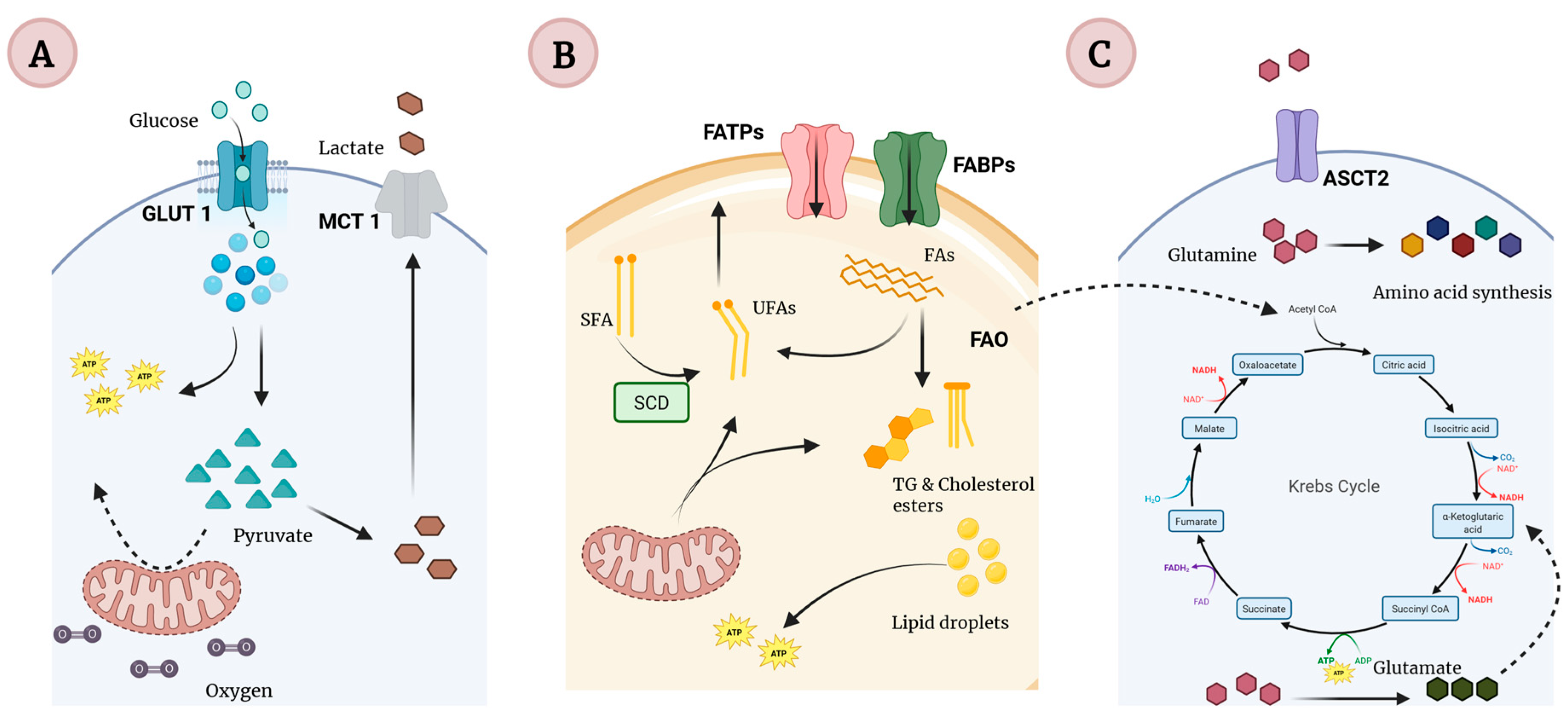
3.2.6. Metabolic Rewiring

3.3. Clinical Translation: Early Molecular Diagnosis and Therapeutic Targeting
3.4. Current Therapeutic Landscape and Limitations in TNBC
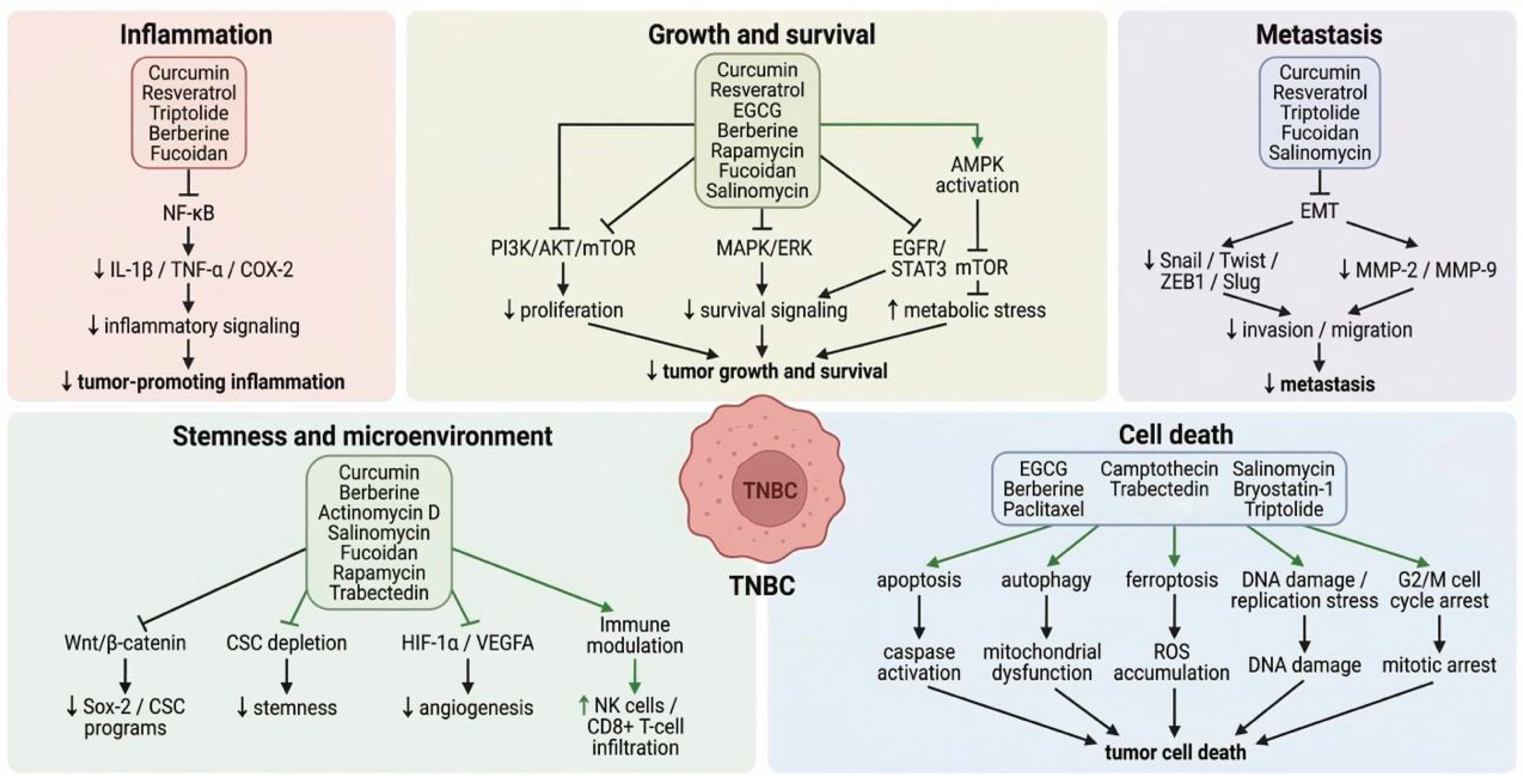
4. Plant-Derived Natural Compounds Targeting TNBC Hallmarks
4.1. Polyphenols
4.2. Terpenoids
4.3. Alkaloids
5. Non-Plant Natural Products with Anticancer Activity in TNBC
5.1. Promising Marine Compounds
5.2. Microbial Products: Rapamycin, Actinomycin D, and Salinomycin
5.3. Animal-Derived Anticancer Agents
6. Overcoming Drug Resistance with Natural Compounds
6.1. Mechanisms of Resistance in TNBC
6.2. Natural Product Strategies
6.2.1. Inhibiting ABCG2/MDR1 Pumps
6.2.2. Targeting CSC Markers
6.2.3. Modulation of Redox Balance
6.2.4. Re-Sensitizing Cells to Taxanes and Anthracyclines
6.2.5. Integrative Synthesis and Prioritization of Therapeutic Strategies
7. Immunomodulatory Potential of Natural Compounds
7.1. Modulation of PD-1/PD-L1 Axis
7.2. Enhancement of Dendritic Cell and T-Cell Function
7.3. Opportunities for Combination with Immune Checkpoint Inhibitors
8. Challenges and Perspectives for Clinical Translation
8.1. Bioavailability, Pharmacokinetics, and Toxicity
8.2. Nanocarrier-Based Delivery Systems
8.3. Standardization of Extracts: Regulatory Hurdles
8.4. Clinical Trial Landscape and Future Prospects
9. Conclusions
Author Contributions
Funding
Institutional Review Board Statement
Informed Consent Statement
Data Availability Statement
Conflicts of Interest
Abbreviations
| ABC | ATP-Binding Cassette |
| ABCG2 | ATP-Binding Cassette Subfamily G Member 2 |
| ACC | Acetyl-CoA Carboxylase |
| ACAT-1 | Acyl-CoA:Cholesterol Acyltransferase 1 |
| AKT | Protein Kinase B |
| AKT3 | RAC-gamma Serine/Threonine-Protein Kinase |
| ALDH | Aldehyde Dehydrogenase |
| ALDH1A1 | Aldehyde dehydrogenase 1 family member A1 |
| AP-1 | Activator Protein 1 |
| AR | Androgen receptor |
| ASCT2 | Alanine-Serine-Cysteine Transporter 2 |
| ATM | Ataxia-Telangiectasia Mutated |
| ATP | Adenosine Triphosphate |
| AXL | AXL Receptor Tyrosine Kinase |
| BAD | BCL-2-Associated Death Promoter |
| BAK | BCL-2 Antagonist/Killer |
| BAX | BCL-2-Associated X Protein |
| BC | Breast Cancer |
| BBB | Blood–brain barrier |
| BBR | Berberine |
| BCL-2 | B-cell Lymphoma 2 |
| BCL-XL | B-cell Lymphoma Extra Large |
| BDNF | Brain-Derived Neurotrophic Factor |
| BH | BCL-2 Homology |
| BH3 | BCL-2 Homology 3 Domain |
| BHG | Brain Histology Group |
| BHM | BCL-2 Homology Motif |
| BID | BH3 Interacting Domain Death Agonist |
| BIM | BCL-2 Interacting Mediator of Cell Death |
| BMI | Body Mass Index |
| BRCA | Breast Cancer Susceptibility Gene |
| CCL5 | C-C Motif Chemokine Ligand 5 |
| Caspase-9 | Cysteine Aspartate Protease 9 |
| CD3 | Cluster of differentiation 3 |
| CD4 | Cluster of differentiation 4 |
| CD8 | Cluster of differentiation 8 |
| CD8+ T cells | Cluster of Differentiation 8 Positive T Cells |
| cDC1 | Conventional Dendritic Cell Type 1 |
| CK14 | Cytokeratin 14 |
| CK5/6 | Cytokeratin 5/6 |
| CO2 | Carbon Dioxide |
| COX-2 | Cyclooxygenase 2 |
| CPT | Camptothecin |
| CSC | Cancer Stem Cell |
| CSCs | Cancer Stem Cells |
| ctDNA | Circulating tumor DNA |
| CTCs | Circulating tumor cells |
| CXCL10 | C-X-C Motif Chemokine Ligand 10 |
| DCs | Dendritic Cells |
| DCIS | Ductal carcinoma in situ |
| ddPCR | Droplet digital polymerase chain reaction |
| DOX | Doxorubicin |
| ECM | Extracellular Matrix |
| EGCG | Epigallocatechin-3-Gallate |
| EGFR | Epidermal Growth Factor Receptor |
| EMT | Epithelial–Mesenchymal Transition |
| ER | Estrogen Receptor |
| ERα | Estrogen Receptor Alpha |
| ERK1/2 | Extracellular Signal-Regulated Kinases ½ |
| EVs | Extracellular vesicles |
| FA | Fatty Acid |
| FA-CoA | Fatty Acyl-Coenzyme A |
| FABPs | Fatty Acid Binding Proteins |
| FAD | Flavin Adenine Dinucleotide |
| FADH2 | Reduced Flavin Adenine Dinucleotide |
| FAO | Fatty Acid Oxidation |
| FASN | Fatty Acid Synthase |
| FATPs | Fatty Acid Transport Proteins |
| FGFs | Fibroblast Growth Factors |
| FOXA1 | Forkhead Box A1 |
| GPX4 | Glutathione Peroxidase 4 |
| GLOBOCAN | Global Cancer Observatory |
| GLUT1 | Glucose Transporter 1 |
| GSK3β | Glycogen Synthase Kinase 3 Beta |
| H2O | Water |
| HDACi | Histone Deacetylase Inhibitor |
| HDI | Histone Deacetylase Inhibitor |
| HGF | Hepatocyte Growth Factor |
| HER2 | Human Epidermal Growth Factor Receptor 2 |
| HIF | Hypoxia-Inducible Factor |
| HIF-1α | Hypoxia-Inducible Factor 1 Alpha |
| HIF-2α | Hypoxia-Inducible Factor 2 Alpha |
| ICAM-1 | Intercellular Adhesion Molecule 1 |
| IFNγ | Interferon Gamma |
| IGF2 | Insulin-Like Growth Factor 2 |
| IKK | IκB Kinase |
| IL | Interleukin |
| IL-1β | Interleukin 1 Beta |
| IL-6 | Interleukin 6 |
| IL-12 | Interleukin 12 |
| IRF1 | Interferon Regulatory Factor 1 |
| IκBα | Inhibitor of Kappa B Alpha |
| JAK | Janus Kinase |
| JNK | c-Jun N-terminal Kinase |
| Ki-67 | Marker of proliferation Ki-67 |
| LAT1 | L-Type Amino Acid Transporter 1 |
| lncRNA | Long non-coding RNA |
| MAPK | Mitogen-Activated Protein Kinase |
| MCL-1 | Myeloid Cell Leukemia 1 |
| MCT1 | Monocarboxylate Transporter 1 |
| MDR | Multidrug Resistance |
| MDR1 | Multidrug Resistance Protein 1 |
| MET | Mesenchymal–Epithelial Transition Factor |
| miR-16 | MicroRNA 16 |
| miR-145 | MicroRNA 145 |
| miR-146a | MicroRNA 146a |
| miR-20a | MicroRNA 20a |
| miR-92a | MicroRNA 92a |
| miRNA | MicroRNA |
| MMP-9 | Matrix Metalloproteinase 9 |
| MMPs | Matrix Metalloproteinases |
| MRD | Molecular residual disease |
| MRI | Magnetic resonance imaging |
| mRNA | Messenger RNA |
| MRP1 | Multidrug Resistance-Associated Protein 1 |
| MT1-MMP | Membrane-Type 1 Matrix Metalloproteinase |
| mTOR | Mechanistic Target of Rapamycin |
| mTORC1 | Mechanistic Target of Rapamycin Complex 1 |
| mTORC2 | Mechanistic Target of Rapamycin Complex 2 |
| MYC | Myelocytomatosis Oncogene |
| NAD | Nicotinamide Adenine Dinucleotide |
| NADH | Reduced Nicotinamide Adenine Dinucleotide |
| N-cadherin | Neural Cadherin |
| NDDS | Nanoparticle Drug Delivery System |
| NF-κB | Nuclear Factor Kappa B |
| NGS | Next-generation sequencing |
| NK | Natural Killer |
| NLRP12 | NLR Family Pyrin Domain Containing 12 |
| NO | Nitric Oxide |
| NPs | Nanoparticles |
| NRF2 | Nuclear Factor Erythroid 2–Related Factor 2 |
| Notch1 | Neurogenic Locus Notch Homolog Protein 1 |
| OXPHOS | Oxidative Phosphorylation |
| PALB2 | Partner and localizer of BRCA2 |
| PARP | Poly (ADP-Ribose) Polymerase |
| PARP1 | Poly (ADP-Ribose) Polymerase 1 |
| PCR | Polymerase chain reaction |
| PD-1 | Programmed Cell Death Protein 1 |
| PD-L1 | Programmed Death-Ligand 1 |
| PGK1 | Phosphoglycerate Kinase 1 |
| PI3K | Phosphoinositide 3-Kinase |
| PIK3CA | Phosphatidylinositol-4,5-Bisphosphate 3-Kinase Catalytic Subunit Alpha |
| PIK3R1 | Phosphoinositide-3-Kinase Regulatory Subunit 1 |
| PIP3 | Phosphatidylinositol (3,4,5)-Triphosphate |
| PKC | Protein Kinase C |
| PR | Progesterone Receptor |
| p-AKT | Phosphorylated AKT |
| p-ERK1/2 | Phosphorylated ERK1/2 |
| p-FAK | Phosphorylated Focal Adhesion Kinase |
| PTEN | Phosphatase and Tensin Homolog |
| PTPN12 | Protein Tyrosine Phosphatase Non-Receptor Type 12 |
| PTGS2 | Prostaglandin-Endoperoxide Synthase 2 |
| PTX | Paclitaxel |
| PUMA | p53 Upregulated Modulator of Apoptosis |
| RAD51 | RAD51 recombinase |
| RAS | Rat Sarcoma |
| RIPK2 | Receptor-Interacting Serine/Threonine-Protein Kinase 2 |
| ROS | Reactive Oxygen Species |
| SCD | Stearoyl-CoA Desaturase |
| SFA | Saturated fatty acid |
| Slug | Snail family transcriptional repressor 2 |
| SNAI1 | Snail Family Transcriptional Repressor 1 |
| SOD | Superoxide Dismutase |
| Sox-2 | SRY (Sex Determining Region Y)-Box 2 |
| STAT3 | Signal Transducer and Activator of Transcription 3 |
| TAZ | Transcriptional Coactivator with PDZ-Binding Motif |
| TG | Triglyceride |
| TGF-β | Transforming Growth Factor Beta |
| TGFβ-1 | Transforming Growth Factor Beta 1 |
| TILs | Tumor-infiltrating lymphocytes |
| TME | Tumor Microenvironment |
| TNBC | Triple-Negative Breast Cancer |
| TNF-α | Tumor Necrosis Factor Alpha |
| TP53 | Tumor Protein P53 |
| UFAs | Unsaturated fatty acids |
| uPA | Urokinase-Type Plasminogen Activator |
| USP8 | Ubiquitin-Specific Protease 8 |
| VE-cadherin | Vascular Endothelial Cadherin |
| VCAM1 | Vascular Cell Adhesion Molecule 1 |
| VEGF | Vascular Endothelial Growth Factor |
| VEGF-A | Vascular Endothelial Growth Factor A |
| VEGFA | Vascular Endothelial Growth Factor A |
| VEGFR | Vascular Endothelial Growth Factor Receptor |
| VEGFR2 | Vascular Endothelial Growth Factor Receptor 2 |
| Wnt | Wingless-Type MMTV Integration Site Family |
| XCL1 | X-C Motif Chemokine Ligand 1 |
| XRCC1 | X-Ray Repair Cross-Complementing Protein 1 |
| YAP | Yes-Associated Protein |
| ZEB1 | Zinc Finger E-Box Binding Homeobox 1 |
| ZEB2 | Zinc Finger E-Box Binding Homeobox 2 |
| β-catenin | Beta-Catenin |
| β-TrCP | Beta-Transducin Repeat-Containing Protein |
| γH2AX | Gamma H2A Histone Family Member X |
References
- Kim, J.; Harper, A.; McCormack, V.; Sung, H.; Houssami, N.; Morgan, E.; Mutebi, M.; Garvey, G.; Soerjomataram, I.; Fidler-Benaoudia, M.M. Global patterns and trends in breast cancer incidence and mortality across 185 countries. Nat. Med. 2025, 31, 1154–1162. [Google Scholar] [CrossRef] [PubMed]
- Sung, H.; Ferlay, J.; Siegel, R.L.; Laversanne, M.; Soerjomataram, I.; Jemal, A.; Bray, F. Global Cancer Statistics 2020: GLOBOCAN Estimates of Incidence and Mortality Worldwide for 36 Cancers in 185 Countries. CA Cancer J. Clin. 2021, 71, 209–249. [Google Scholar] [CrossRef] [PubMed]
- Xu, H.; Xu, B. Breast cancer: Epidemiology, risk factors and screening. Chin. J. Cancer Res. 2023, 35, 565–583. [Google Scholar] [CrossRef]
- Huang, J.; Chan, P.S.; Lok, V.; Chen, X.; Ding, H.; Jin, Y.; Yuan, J.; Lao, X.; Zheng, Z.J.; Wong, M.C. Global incidence and mortality of breast cancer: A trend analysis. Aging 2021, 13, 5748–5803. [Google Scholar] [CrossRef]
- Hirko, K.A.; Rocque, G.; Reasor, E.; Taye, A.; Daly, A.; Cutress, R.I.; Copson, E.R.; Lee, D.W.; Lee, K.H.; Im, S.A.; et al. The impact of race and ethnicity in breast cancer—Disparities and implications for precision oncology. BMC Med. 2022, 20, 72. [Google Scholar] [CrossRef]
- Lei, S.; Zheng, R.; Zhang, S.; Wang, S.; Chen, R.; Sun, K.; Zeng, H.; Zhou, J.; Wei, W. Global patterns of breast cancer incidence and mortality: A population-based cancer registry data analysis from 2000 to 2020. Cancer Commun. 2021, 41, 1183–1194. [Google Scholar] [CrossRef]
- Kumar, N.; Ehsan, S.; Banerjee, S.; Fernandez Perez, C.; Lhuilier, I.; Neuner, J.; Friebel-Klingner, T.; Fayanju, O.M.; Nair, B.; Anjum Niinuma, S.; et al. The unique risk factor profile of triple-negative breast cancer: A comprehensive meta-analysis. JNCI J. Natl. Cancer Inst. 2024, 116, 1210–1219. [Google Scholar] [CrossRef]
- Anastasiadi, Z.; Lianos, G.D.; Ignatiadou, E.; Harissis, H.V.; Mitsis, M. Breast cancer in young women: An overview. Updates Surg. 2017, 69, 313–317. [Google Scholar] [CrossRef]
- Pan, J.-W.; Zabidi, M.M.A.; Ng, P.-S.; Meng, M.-Y.; Hasan, S.N.; Sandey, B.; Sammut, S.-J.; Yip, C.-H.; Rajadurai, P.; Rueda, O.M.; et al. The molecular landscape of Asian breast cancers reveals clinically relevant population-specific differences. Nat. Commun. 2020, 11, 6433. [Google Scholar] [CrossRef] [PubMed]
- Siegel, R.L.; Miller, K.D.; Wagle, N.S.; Jemal, A. Cancer statistics, 2023. CA Cancer J. Clin. 2023, 73, 17–48. [Google Scholar] [CrossRef]
- Liu, N.; Johnson, K.J.; Ma, C.X. Male Breast Cancer: An Updated Surveillance, Epidemiology, and End Results Data Analysis. Clin. Breast Cancer 2018, 18, e997–e1002. [Google Scholar] [CrossRef] [PubMed]
- Fentiman, I.S. Risk factors for male breast cancer. Am. J. Transl. Res. 2023, 15, 6918–6925. [Google Scholar]
- Akbari, M.; Nasiri, H.; Ziaee, M. Male Breast Cancer Biology, Screening, Treatment, and Follow-Up: A Narrative Review. Iran. J. Public Health 2024, 53, 2694–2704. [Google Scholar] [CrossRef]
- Almansour, N.M. Triple-Negative Breast Cancer: A Brief Review About Epidemiology, Risk Factors, Signaling Pathways, Treatment and Role of Artificial Intelligence. Front. Mol. Biosci. 2022, 9, 836417. [Google Scholar] [CrossRef] [PubMed]
- Nag, S.; Dikshit, R.; Desai, S.; Mane, A.; Mhatre, S.; Neve, R.; Gurav, M.; Bhosale, N.; Perumal, P.; Kembhavi, Y.; et al. Risk factors for the development of triple-negative breast cancer versus non-triple-negative breast cancer: A case–control study. Sci. Rep. 2023, 13, 13551. [Google Scholar] [CrossRef] [PubMed]
- Giaquinto, A.N.; Sung, H.; Miller, K.D.; Kramer, J.L.; Newman, L.A.; Minihan, A.; Jemal, A.; Siegel, R.L. Breast Cancer Statistics, 2022. CA Cancer J. Clin. 2022, 72, 524–541. [Google Scholar] [CrossRef]
- Sporikova, Z.; Koudelakova, V.; Trojanec, R.; Hajduch, M. Genetic Markers in Triple-Negative Breast Cancer. Clin. Breast Cancer 2018, 18, e841–e850. [Google Scholar] [CrossRef]
- Yang, R.; Li, Y.; Wang, H.; Qin, T.; Yin, X.; Ma, X. Therapeutic progress and challenges for triple negative breast cancer: Targeted therapy and immunotherapy. Mol. Biomed. 2022, 3, 8. [Google Scholar] [CrossRef]
- Schopp, J.G.; Polat, D.S.; Arjmandi, F.; Hayes, J.C.; Ahn, R.W.; Sullivan, K.; Sahoo, S.; Porembka, J.H. Imaging Challenges in Diagnosing Triple-Negative Breast Cancer. RadioGraphics 2023, 43, e230027. [Google Scholar] [CrossRef]
- Wang, L.; Zhai, Q.; Lu, Q.; Lee, K.; Zheng, Q.; Hong, R.; Wang, S. Clinical genomic profiling to identify actionable alterations for very early relapsed triple-negative breast cancer patients in the Chinese population. Ann. Med. 2021, 53, 1358–1369. [Google Scholar] [CrossRef]
- Dent, R.; André, F.; Gonçalves, A.; Martin, M.; Schmid, P.; Schütz, F.; Kümmel, S.; Swain, S.M.; Bilici, A.; Loirat, D.; et al. IMpassion132 double-blind randomised phase III trial of chemotherapy with or without atezolizumab for early relapsing unresectable locally advanced or metastatic triple-negative breast cancer. Ann. Oncol. 2024, 35, 630–642. [Google Scholar] [CrossRef]
- Licata, L.; Mariani, M.; Viale, G.; Dent, R.; Tolaney, S.M.; Schmid, P.; Hamilton, E.; Sotiriou, C.; Pusztai, L.; Bianchini, G. Timing of Recurrence after Neoadjuvant Chemo-Immunotherapy in Patients with Early-Stage Triple-Negative Breast Cancer. Clin. Cancer Res. 2025, 31, 3916–3921. [Google Scholar] [CrossRef]
- Kan, L.L.-Y.; Chan, B.C.-L.; Leung, P.-C.; Wong, C.-K. Natural-Product-Derived Adjunctive Treatments to Conventional Therapy and Their Immunoregulatory Activities in Triple-Negative Breast Cancer. Molecules 2023, 28, 5804. [Google Scholar] [CrossRef]
- Bhutta, Z.A.; Choi, K. Phytochemicals as Novel Therapeutics for Triple-Negative Breast Cancer: A Comprehensive Review of Current Knowledge. Phytother. Res. 2025, 39, 364–396. [Google Scholar] [CrossRef] [PubMed]
- Li, Q.; Ye, Z.; Wang, G.; Chen, Y.; Deng, J.; Wang, D.; Wang, Y. Natural Products as Novel Therapeutic Agents for Triple-Negative Breast Cancer: Current Evidence, Mechanisms, Challenges, and Opportunities. Molecules 2025, 30, 1201. [Google Scholar] [CrossRef] [PubMed]
- Reytor-González, C.; Jiménez-Flores, E.; González, N.; Simancas-Racines, D. Redefining Chemoresistance: Natural Bioactives as Molecular Modulators at the Cancer–Tumor Microenvironment Interface. Int. J. Mol. Sci. 2025, 26, 8037. [Google Scholar] [CrossRef]
- Kobakova, Y.; Moneva-Sakelarieva, M.; Konstantinov, S.; Momekov, G.; Ivanova, S.A.; Atanasova, V.; Chaneva, M.; Tododrov, R.; Bashev, N.; Atanasov, P. Natural products as part of triple negative breast cancer. Pharmacia 2025, 72, 1–11. [Google Scholar] [CrossRef]
- Berman, T.A.; Ben-Arye, E.; Kienle, G.S.; Master, V.; Huston, A.; Paller, C.J. Integrating Botanicals into Oncology Care: Consideration of FDA Regulation of Botanical Products and Botanical Clinical Trials. Clin. Cancer Res. 2025, 31, 1566–1572. [Google Scholar] [CrossRef] [PubMed]
- Telang, N. Stem Cell Targeting Natural Products for Therapy-Resistant Triple Negative Breast Cancer. Med. Res. Arch. 2025, 13, 1–6. [Google Scholar] [CrossRef]
- Telang, N.T.; Nair, H.B.; Wong, G.Y.C. Growth Inhibitory Efficacy of Chinese Herbs in a Cellular Model for Triple-Negative Breast Cancer. Pharmaceuticals 2021, 14, 1318. [Google Scholar] [CrossRef]
- Lugano, R.; Ramachandran, M.; Dimberg, A. Tumor angiogenesis: Causes, consequences, challenges and opportunities. Cell. Mol. Life Sci. 2020, 77, 1745–1770. [Google Scholar] [CrossRef]
- Yang, M.; Mu, Y.; Yu, X.; Gao, D.; Zhang, W.; Li, Y.; Liu, J.; Sun, C.; Zhuang, J. Survival strategies: How tumor hypoxia microenvironment orchestrates angiogenesis. Biomed. Pharmacother. 2024, 176, 116783. [Google Scholar] [CrossRef] [PubMed]
- Ren, B.; Yee, K.O.; Lawler, J.; Khosravi-Far, R. Regulation of tumor angiogenesis by thrombospondin-1. Biochim. Et Biophys. Acta (BBA)-Rev. Cancer 2006, 1765, 178–188. [Google Scholar] [CrossRef] [PubMed]
- Nagy, J.A.; Chang, S.-H.; Dvorak, A.M.; Dvorak, H.F. Why are tumour blood vessels abnormal and why is it important to know? Br. J. Cancer 2009, 100, 865–869. [Google Scholar] [CrossRef] [PubMed]
- Liu, Z.-L.; Chen, H.-H.; Zheng, L.-L.; Sun, L.-P.; Shi, L. Angiogenic signaling pathways and anti-angiogenic therapy for cancer. Signal Transduct. Target. Ther. 2023, 8, 198. [Google Scholar] [CrossRef]
- Hanahan, D.; Weinberg, R.A. Hallmarks of Cancer: The Next Generation. Cell 2011, 144, 646–674. [Google Scholar] [CrossRef]
- Rubtsova, S.N.; Zhitnyak, I.Y.; Gloushankova, N.A. Dual role of E-cadherin in cancer cells. Tissue Barriers 2022, 10, 2005420. [Google Scholar] [CrossRef]
- Błaszczak, E.; Miziak, P.; Odrzywolski, A.; Baran, M.; Gumbarewicz, E.; Stepulak, A. Triple-Negative Breast Cancer Progression and Drug Resistance in the Context of Epithelial–Mesenchymal Transition. Cancers 2025, 17, 228. [Google Scholar] [CrossRef]
- Sznurkowska, M.K.; Aceto, N. The gate to metastasis: Key players in cancer cell intravasation. FEBS J. 2022, 289, 4336–4354. [Google Scholar] [CrossRef]
- Srinivasan, D.; Balakrishnan, R.; Chauhan, A.; Kumar, J.; Girija, D.M.; Shrestha, R.; Shrestha, R.; Subbarayan, R. Epithelial–Mesenchymal Transition in Cancer: Insights Into Therapeutic Targets and Clinical Implications. MedComm 2025, 6, e70333. [Google Scholar] [CrossRef]
- Plygawko, A.T.; Kan, S.; Campbell, K. Epithelial–mesenchymal plasticity: Emerging parallels between tissue morphogenesis and cancer metastasis. Philos. Trans. R. Soc. B Biol. Sci. 2020, 375, 20200087. [Google Scholar] [CrossRef]
- Zheng, P.; Li, W. Crosstalk Between Mesenchymal Stromal Cells and Tumor-Associated Macrophages in Gastric Cancer. Front. Oncol. 2020, 10, 571516. [Google Scholar] [CrossRef]
- Pereira, P.; Panier, J.; Nater, M.; Herbst, M.; Calvanese, A.L.; Köksal, H.; Castañón, H.; Cecconi, V.; de Lara, P.T.; Pascolo, S.; et al. Inflammatory cytokines mediate the induction of and awakening from metastatic dormancy. Cell Rep. 2025, 44, 115388. [Google Scholar] [CrossRef]
- Gu, X.; Wei, S.; Lv, X. Circulating tumor cells: From new biological insights to clinical practice. Signal Transduct. Target. Ther. 2024, 9, 226. [Google Scholar] [CrossRef]
- Lee, H.; Kim, B.; Park, J.; Park, S.; Yoo, G.; Yum, S.; Kang, W.; Lee, J.-M.; Youn, H.; Youn, B. Cancer stem cells: Landscape, challenges and emerging therapeutic innovations. Signal Transduct. Target. Ther. 2025, 10, 248. [Google Scholar] [CrossRef]
- Tellez-Gabriel, M.; Heymann, M.-F.; Heymann, D. Circulating Tumor Cells as a Tool for Assessing Tumor Heterogeneity. Theranostics 2019, 9, 4580–4594. [Google Scholar] [CrossRef]
- De Leon-Oliva, D.; González-Prieto, P.; De Castro-Martinez, P.; Boaru, D.L.; Laguna-Hernández, P.; Fraile-Martinez, O.; García-Montero, C.; Guijarro, L.G.; López-González, L.; Díaz-Pedrero, R.; et al. Revisiting the biological role of the Warburg effect: Evolving perspectives on cancer metabolism. Pathol. Res. Pract. 2025, 273, 156151. [Google Scholar] [CrossRef] [PubMed]
- Zarrella, S.; Miranda, M.R.; Covelli, V.; Restivo, I.; Novi, S.; Pepe, G.; Tesoriere, L.; Rodriquez, M.; Bertamino, A.; Campiglia, P.; et al. Endoplasmic Reticulum Stress and Its Role in Metabolic Reprogramming of Cancer. Metabolites 2025, 15, 221. [Google Scholar] [CrossRef] [PubMed]
- Yang, Y.; Wang, W. Recent progress in immune evasion mechanisms of triple-negative breast cancer. J. Transl. Med. 2025, 23, 1314. [Google Scholar] [CrossRef]
- Garcia-Diaz, A.; Shin, D.S.; Moreno, B.H.; Saco, J.; Escuin-Ordinas, H.; Rodriguez, G.A.; Zaretsky, J.M.; Sun, L.; Hugo, W.; Wang, X.; et al. Interferon Receptor Signaling Pathways Regulating PD-L1 and PD-L2 Expression. Cell Rep. 2017, 19, 1189–1201. [Google Scholar] [CrossRef] [PubMed]
- Mrouj, K.; Andrés-Sánchez, N.; Dubra, G.; Singh, P.; Sobecki, M.; Chahar, D.; Ghoul, E.A.; Aznar, A.B.; Prieto, S.; Pirot, N.; et al. Ki-67 regulates global gene expression and promotes sequential stages of carcinogenesis. Proc. Natl. Acad. Sci. USA 2021, 118, e2026507118. [Google Scholar] [CrossRef] [PubMed]
- Wang, Z.; Liu, L.; Li, Y.; Song, Z.; Jing, Y.; Fan, Z.; Zhang, S. Analysis of CK5/6 and EGFR and Its Effect on Prognosis of Triple Negative Breast Cancer. Front. Oncol. 2021, 10, 575317. [Google Scholar] [CrossRef] [PubMed]
- Torres-Esquius, S.; Llop-Guevara, A.; Gutiérrez-Enríquez, S.; Romey, M.; Teulé, À.; Llort, G.; Herrero, A.; Sánchez-Henarejos, P.; Vallmajó, A.; González-Santiago, S.; et al. Prevalence of Homologous Recombination Deficiency Among Patients With Germline RAD51C/D Breast or Ovarian Cancer. JAMA Netw. Open 2024, 7, e247811. [Google Scholar] [CrossRef] [PubMed]
- Rabab, K.E.; Buchanan, P.J.; Colley, G.; White, A.; Murphy, A.; McCormack, C.; Eustace, A.J. TP53 Mutation-Specific Dysregulation of Store-Operated Calcium Entry and Apoptotic Sensitivity in Triple-Negative Breast Cancer. Cancers 2025, 17, 1614. [Google Scholar] [CrossRef]
- Zhang, H.; Jiang, R.; Zhu, J.; Sun, K.; Huang, Y.; Zhou, H.; Zheng, Y.; Wang, X. PI3K/AKT/mTOR signaling pathway: An important driver and therapeutic target in triple-negative breast cancer. Breast Cancer 2024, 31, 539–551. [Google Scholar] [CrossRef]
- Haque, M.; Shyanti, R.K.; Mishra, M.K. Targeted therapy approaches for epithelial-mesenchymal transition in triple negative breast cancer. Front. Oncol. 2024, 14, 1431418. [Google Scholar] [CrossRef]
- de Heer, E.C.; Jalving, M.; Harris, A.L. HIFs, angiogenesis, and metabolism: Elusive enemies in breast cancer. J. Clin. Investig. 2020, 130, 5074–5087. [Google Scholar] [CrossRef]
- Escudero Mendez, L.; Srinivasan, M.; Hamouda, R.K.; Ambedkar, B.; Arzoun, H.; Sahib, I.; Fondeur, J.; Mohammed, L. Evaluation of CD44+/CD24- and Aldehyde Dehydrogenase Enzyme Markers in Cancer Stem Cells as Prognostic Indicators for Triple-Negative Breast Cancer. Cureus 2022, 14, e28056. [Google Scholar] [CrossRef]
- Ma, L.; Xu, H.; Wang, C.; Hu, Y.; Ren, Q.; Yu, S. Advances of androgen receptor in triple-negative breast cancer: From molecular mechanisms to clinical applications. Discov. Oncol. 2025, 16, 1677. [Google Scholar] [CrossRef]
- Costa, R.L.B.; Han, H.S.; Gradishar, W.J. Targeting the PI3K/AKT/mTOR pathway in triple-negative breast cancer: A review. Breast Cancer Res. Treat. 2018, 169, 397–406. [Google Scholar] [CrossRef]
- Song, X.; Liu, Z.; Yu, Z. EGFR Promotes the Development of Triple Negative Breast Cancer Through JAK/STAT3 Signaling. Cancer Manag. Res. 2020, 12, 703–717. [Google Scholar] [CrossRef]
- El Guerrab, A.; Bamdad, M.; Bignon, Y.; Penault-Llorca, F.; Aubel, C. Anti-EGFR monoclonal antibodies enhance sensitivity to DNA-damaging agents in BRCA1 -mutated and PTEN -wild-type triple-negative breast cancer cells. Mol. Carcinog. 2017, 56, 1383–1394. [Google Scholar] [CrossRef] [PubMed]
- Pascual, J.; Turner, N.C. Targeting the PI3-kinase pathway in triple-negative breast cancer. Ann. Oncol. 2019, 30, 1051–1060. [Google Scholar] [CrossRef] [PubMed]
- Miricescu, D.; Totan, A.; Stanescu-Spinu, I.-I.; Badoiu, S.C.; Stefani, C.; Greabu, M. PI3K/AKT/mTOR Signaling Pathway in Breast Cancer: From Molecular Landscape to Clinical Aspects. Int. J. Mol. Sci. 2020, 22, 173. [Google Scholar] [CrossRef] [PubMed]
- Revathidevi, S.; Munirajan, A.K. Akt in cancer: Mediator and more. Semin. Cancer Biol. 2019, 59, 80–91. [Google Scholar] [CrossRef]
- Presti, D.; Quaquarini, E. The PI3K/AKT/mTOR and CDK4/6 Pathways in Endocrine Resistant HR+/HER2− Metastatic Breast Cancer: Biological Mechanisms and New Treatments. Cancers 2019, 11, 1242. [Google Scholar] [CrossRef]
- Bhola, N.E.; Jansen, V.M.; Koch, J.P.; Li, H.; Formisano, L.; Williams, J.A.; Grandis, J.R.; Arteaga, C.L. Correction: Treatment of Triple-Negative Breast Cancer with TORC1/2 Inhibitors Sustains a Drug-Resistant and Notch-Dependent Cancer Stem Cell Population. Cancer Res. 2019, 79, 875. [Google Scholar] [CrossRef]
- El Guerrab, A.; Bamdad, M.; Bignon, Y.-J.; Penault-Llorca, F.; Aubel, C. Co-targeting EGFR and mTOR with gefitinib and everolimus in triple-negative breast cancer cells. Sci. Rep. 2020, 10, 6367. [Google Scholar] [CrossRef]
- Dadsena, S.; Jenner, A.; García-Sáez, A.J. Mitochondrial outer membrane permeabilization at the single molecule level. Cell. Mol. Life Sci. 2021, 78, 3777–3790. [Google Scholar] [CrossRef]
- Park, H.-A.; Broman, K.; Jonas, E. Oxidative stress battles neuronal Bcl-xL in a fight to the death. Neural Regen. Res. 2021, 16, 12. [Google Scholar] [CrossRef]
- Qian, S.; Wei, Z.; Yang, W.; Huang, J.; Yang, Y.; Wang, J. The role of BCL-2 family proteins in regulating apoptosis and cancer therapy. Front. Oncol. 2022, 12, 985363. [Google Scholar] [CrossRef]
- Buja, L.M. The cell theory and cellular pathology: Discovery, refinements and applications fundamental to advances in biology and medicine. Exp. Mol. Pathol. 2021, 121, 104660. [Google Scholar] [CrossRef]
- Sun, B.; Zhao, H. The bioinformatics analysis of RIOX2 gene in lung adenocarcinoma and squamous cell carcinoma. PLoS ONE 2021, 16, e0259447. [Google Scholar] [CrossRef]
- Kaloni, D.; Diepstraten, S.T.; Strasser, A.; Kelly, G.L. BCL-2 protein family: Attractive targets for cancer therapy. Apoptosis 2023, 28, 20–38. [Google Scholar] [CrossRef]
- Ameh-Mensah, C.; Duduyemi, B.M.; Bedu-Addo, K.; Atta Manu, E.; Opoku, F.; Titiloye, N. The Analysis of bcl-2 in Association with p53 and Ki-67 in Triple Negative Breast Cancer and Other Molecular Subtypes in Ghana. J. Oncol. 2021, 2021, 1–10. [Google Scholar] [CrossRef]
- Marvalim, C.; Datta, A.; Lee, S.C. Role of p53 in breast cancer progression: An insight into p53 targeted therapy. Theranostics 2023, 13, 1421–1442. [Google Scholar] [CrossRef]
- Kanakaveti, V.; Ramasamy, S.; Kanumuri, R.; Balasubramanian, V.; Saravanan, R.; Ezhil, I.; Pitani, R.; Venkatraman, G.; Rayala, S.K.; Gromiha, M.M. Novel BH4-BCL-2 Domain Antagonists Induce BCL-2-Mediated Apoptosis in Triple-Negative Breast Cancer. Cancers 2022, 14, 5241. [Google Scholar] [CrossRef] [PubMed]
- Briggs, K.J.; Koivunen, P.; Cao, S.; Backus, K.M.; Olenchock, B.A.; Patel, H.; Zhang, Q.; Signoretti, S.; Gerfen, G.J.; Richardson, A.L.; et al. Paracrine Induction of HIF by Glutamate in Breast Cancer: EglN1 Senses Cysteine. Cell 2016, 166, 126–139. [Google Scholar] [CrossRef] [PubMed]
- Li, A.G.; Murphy, E.C.; Culhane, A.C.; Powell, E.; Wang, H.; Bronson, R.T.; Von, T.; Giobbie-Hurder, A.; Gelman, R.S.; Briggs, K.J.; et al. BRCA1-IRIS promotes human tumor progression through PTEN blockade and HIF-1α activation. Proc. Natl. Acad. Sci. USA 2018, 115, E9600–E9609. [Google Scholar] [CrossRef] [PubMed]
- Fu, X.; Pereira, R.; De Angelis, C.; Veeraraghavan, J.; Nanda, S.; Qin, L.; Cataldo, M.L.; Sethunath, V.; Mehravaran, S.; Gutierrez, C.; et al. FOXA1 upregulation promotes enhancer and transcriptional reprogramming in endocrine-resistant breast cancer. Proc. Natl. Acad. Sci. USA 2019, 116, 26823–26834. [Google Scholar] [CrossRef]
- Niu, Y.; Bao, L.; Chen, Y.; Wang, C.; Luo, M.; Zhang, B.; Zhou, M.; Wang, J.E.; Fang, Y.V.; Kumar, A.; et al. HIF2-Induced Long Noncoding RNA RAB11B-AS1 Promotes Hypoxia-Mediated Angiogenesis and Breast Cancer Metastasis. Cancer Res. 2020, 80, 964–975. [Google Scholar] [CrossRef]
- Sulaiman, A.; McGarry, S.; Chambers, J.; Al-Kadi, E.; Phan, A.; Li, L.; Mediratta, K.; Dimitroulakos, J.; Addison, C.; Li, X.; et al. Targeting Hypoxia Sensitizes TNBC to Cisplatin and Promotes Inhibition of Both Bulk and Cancer Stem Cells. Int. J. Mol. Sci. 2020, 21, 5788. [Google Scholar] [CrossRef] [PubMed]
- Liu, Q.; Guan, C.; Liu, C.; Li, H.; Wu, J.; Sun, C. Targeting hypoxia-inducible factor-1alpha: A new strategy for triple-negative breast cancer therapy. Biomed. Pharmacother. 2022, 156, 113861. [Google Scholar] [CrossRef] [PubMed]
- Yee, L.D.; Mortimer, J.E.; Natarajan, R.; Dietze, E.C.; Seewaldt, V.L. Metabolic Health, Insulin, and Breast Cancer: Why Oncologists Should Care About Insulin. Front. Endocrinol. 2020, 11, 58. [Google Scholar] [CrossRef] [PubMed]
- Wang, Z.; Jiang, Q.; Dong, C. Metabolic reprogramming in triple-negative breast cancer. Cancer Biol. Med. 2020, 17, 44–59. [Google Scholar] [CrossRef]
- Hait, N.C.; Maiti, A.; Xu, P.; Qi, Q.; Kawaguchi, T.; Okano, M.; Takabe, K.; Yan, L.; Luo, C. Regulation of hypoxia-inducible factor functions in the nucleus by sphingosine-1-phosphate. FASEB J. 2020, 34, 4293–4310. [Google Scholar] [CrossRef]
- Tiron, A.; Ristescu, I.; Postu, P.A.; Tiron, C.E.; Zugun-Eloae, F.; Grigoras, I. Long-Term Deleterious Effects of Short-term Hyperoxia on Cancer Progression—Is Brain-Derived Neurotrophic Factor an Important Mediator? An Experimental Study. Cancers 2020, 12, 688. [Google Scholar] [CrossRef]
- Ribatti, D.; Nico, B.; Ruggieri, S.; Tamma, R.; Simone, G.; Mangia, A. Angiogenesis and Antiangiogenesis in Triple-Negative Breast cancer. Transl. Oncol. 2016, 9, 453–457. [Google Scholar] [CrossRef]
- Zigterman, B.G.R.; Dubois, L. Inflammation and infection: Cellular and biochemical processes. Ned. Tijdschr. Tandheelkd. 2022, 129, 125–129. [Google Scholar] [CrossRef]
- Jin, Y.; Huynh, D.T.N.; Myung, C.-S.; Heo, K.-S. Ginsenoside Rh1 Prevents Migration and Invasion through Mitochondrial ROS-Mediated Inhibition of STAT3/NF-κB Signaling in MDA-MB-231 Cells. Int. J. Mol. Sci. 2021, 22, 10458. [Google Scholar] [CrossRef]
- Guldenpfennig, C.; Teixeiro, E.; Daniels, M. NF-kB’s contribution to B cell fate decisions. Front. Immunol. 2023, 14, 1214095. [Google Scholar] [CrossRef] [PubMed]
- Haselager, M.; Thijssen, R.; West, C.; Young, L.; Van Kampen, R.; Willmore, E.; Mackay, S.; Kater, A.; Eldering, E. Regulation of Bcl-XL by non-canonical NF-κB in the context of CD40-induced drug resistance in CLL. Cell Death Differ. 2021, 28, 1658–1668. [Google Scholar] [CrossRef]
- Kuang, W.; Gu, Q.; Zhou, Y.; Xiao, X.; He, D.; Deng, Q. Inhibited Expression of NLRP12 Promotes the Development of Triple-Negative Breast Cancer by Activating the NF-κB Pathway. Cell Biochem. Biophys. 2023, 81, 727–735. [Google Scholar] [CrossRef]
- Pavitra, E.; Kancharla, J.; Gupta, V.K.; Prasad, K.; Sung, J.Y.; Kim, J.; Tej, M.B.; Choi, R.; Lee, J.H.; Han, Y.K.; et al. The role of NF-κB in breast cancer initiation, growth, metastasis, and resistance to chemotherapy. Biomed. Pharmacother. 2023, 163, 114822. [Google Scholar] [CrossRef]
- Yamaguchi, H.; Hsu, J.-M.; Yang, W.-H.; Hung, M.-C. Mechanisms regulating PD-L1 expression in cancers and associated opportunities for novel small-molecule therapeutics. Nat. Rev. Clin. Oncol. 2022, 19, 287–305. [Google Scholar] [CrossRef]
- Beckers, R.K.; Selinger, C.I.; Vilain, R.; Madore, J.; Wilmott, J.S.; Harvey, K.; Holliday, A.; Copper, C.L.; Robbins, E.; Gillett, D.; et al. Programmed death ligand 1 expression in triple-negative breast cancer is associated with tumour-infiltrating lymphocytes and improved outcome. Histopathology 2016, 69, 25–34. [Google Scholar] [CrossRef]
- Guo, L.; Li, W.; Zhu, X.; Ling, Y.; Qiu, T.; Dong, L.; Fang, Y.; Yang, H.; Ying, J. PD-L1 expression and CD274 gene alteration in triple-negative breast cancer: Implication for prognostic biomarker. Springerplus 2016, 5, 805. [Google Scholar] [CrossRef]
- Black, M.; Barsoum, I.B.; Truesdell, P.; Cotechini, T.; Macdonald-Goodfellow, S.K.; Petroff, M.; Siemens, D.R.; Koti, M.; Craig, A.W.; Graham, C.H. Activation of the PD-1/PD-L1 immune checkpoint confers tumor cell chemoresistance associated with increased metastasis. Oncotarget 2016, 7, 10557–10567. [Google Scholar] [CrossRef]
- Kwon, M.J. Matrix metalloproteinases as therapeutic targets in breast cancer. Front. Oncol. 2023, 12, 1108695. [Google Scholar] [CrossRef] [PubMed]
- de Almeida, L.G.N.; Thode, H.; Eslambolchi, Y.; Chopra, S.; Young, D.; Gill, S.; Devel, L.; Dufour, A. Matrix Metalloproteinases: From Molecular Mechanisms to Physiology, Pathophysiology, and Pharmacology. Pharmacol. Rev. 2022, 74, 714–770. [Google Scholar] [CrossRef] [PubMed]
- Muniz-Bongers, L.R.; McClain, C.B.; Saxena, M.; Bongers, G.; Merad, M.; Bhardwaj, N. MMP2 and TLRs modulate immune responses in the tumor microenvironment. JCI Insight 2021, 6, e144913. [Google Scholar] [CrossRef]
- Al-Temaimi, R.; Ahmad, R.; Al-Mulla, F. MMP14 and DDR2 are potential molecular markers for metastatic triple-negative breast cancer. Sci. Rep. 2025, 15, 21630. [Google Scholar] [CrossRef]
- Vishnubalaji, R.; Alajez, N.M. Epigenetic regulation of triple negative breast cancer (TNBC) by TGF-β signaling. Sci. Rep. 2021, 11, 15410. [Google Scholar] [CrossRef]
- Debnath, P.; Huirem, R.S.; Dutta, P.; Palchaudhuri, S. Epithelial–mesenchymal transition and its transcription factors. Biosci. Rep. 2022, 42, BSR20211754. [Google Scholar] [CrossRef]
- Zhang, H.; Wang, J.; Yin, Y.; Meng, Q.; Lyu, Y. The role of EMT-related lncRNA in the process of triple-negative breast cancer metastasis. Biosci. Rep. 2021, 41, BSR20203121. [Google Scholar] [CrossRef]
- Xiao, S.; Tian, L.; Gan, X.; Xu, X.; Liao, M.; Song, D.; Yu, Y.; Qin, W.; Zhang, R.; Lyu, H.; et al. Role of Ubiquitin-regulated EMT in Cancer Metastasis and Chemoresistance. Int. J. Biol. Sci. 2025, 21, 6081–6112. [Google Scholar] [CrossRef] [PubMed]
- Kuksis, M.; Gao, Y.; Tran, W.; Hoey, C.; Kiss, A.; Komorowski, A.S.; Dhaliwal, A.J.; Sahgal, A.; Das, S.; Chan, K.K.; et al. The incidence of brain metastases among patients with metastatic breast cancer: A systematic review and meta-analysis. Neuro Oncol. 2021, 23, 894–904. [Google Scholar] [CrossRef] [PubMed]
- Bryan, S.; Witzel, I.; Borgmann, K.; Oliveira-Ferrer, L. Molecular Mechanisms Associated with Brain Metastases in HER2-Positive and Triple Negative Breast Cancers. Cancers 2021, 13, 4137. [Google Scholar] [CrossRef]
- Linville, R.M.; Maressa, J.; Guo, Z.; Chung, T.D.; Farrell, A.; Jha, R.; Searson, P.C. A tissue-engineered model of the blood-tumor barrier during metastatic breast cancer. Fluids Barriers CNS 2023, 20, 80. [Google Scholar] [CrossRef]
- Feng, J.; Tao, Y.; Li, F.; Liu, S. Breast Cancer Brain Metastasis: Bridging Biological Mechanisms to Therapeutic Innovations. MedComm-Oncol. 2025, 4, e70043. [Google Scholar] [CrossRef]
- Ahuja, S.; Zaheer, S. Molecular Mediators of Metabolic Reprogramming in Cancer: Mechanisms, Regulatory Networks, and Therapeutic Strategies. Immunology 2026, 177, 1–43. [Google Scholar] [CrossRef]
- Enwere, M.; Irobi, E.; Chime, V.; Ezeogu, A.; Onu, A.; El Hussein, M.T.; Ogungbade, G.; Davies, E.; Omoniwa, O.; Omale, C.; et al. Metabolic Reprogramming as a Therapeutic Target in Cancer: A Qualitative Systematic Review (QualSR) of Natural Compounds Modulating Glucose and Glutamine Pathways. Onco 2025, 5, 43. [Google Scholar] [CrossRef]
- Sun, X.; Wang, M.; Wang, M.; Yu, X.; Guo, J.; Sun, T.; Li, X.; Yao, L.; Dong, H.; Xu, Y. Metabolic Reprogramming in Triple-Negative Breast Cancer. Front. Oncol. 2020, 10, 428. [Google Scholar] [CrossRef] [PubMed]
- Ogrodzinski, M.P.; Bernard, J.J.; Lunt, S.Y. Deciphering metabolic rewiring in breast cancer subtypes. Transl. Res. 2017, 189, 105–122. [Google Scholar] [CrossRef]
- El Ansari, R.; Craze, M.L.; Miligy, I.; Diez-Rodriguez, M.; Nolan, C.C.; Ellis, I.O.; Rakha, E.A.; Green, A.R. The amino acid transporter SLC7A5 confers a poor prognosis in the highly proliferative breast cancer subtypes and is a key therapeutic target in luminal B tumours. Breast Cancer Res. 2018, 20, 21. [Google Scholar] [CrossRef] [PubMed]
- van Geldermalsen, M.; Wang, Q.; Nagarajah, R.; Marshall, A.D.; Thoeng, A.; Gao, D.; Ritchie, W.; Feng, Y.; Bailey, C.G.; Deng, N.; et al. ASCT2/SLC1A5 controls glutamine uptake and tumour growth in triple-negative basal-like breast cancer. Oncogene 2016, 35, 3201–3208. [Google Scholar] [CrossRef]
- Quek, L.-E.; van Geldermalsen, M.; Guan, Y.F.; Wahi, K.; Mayoh, C.; Balaban, S.; Pang, A.; Wang, Q.; Cowley, M.J.; Brown, K.K.; et al. Glutamine addiction promotes glucose oxidation in triple-negative breast cancer. Oncogene 2022, 41, 4066–4078. [Google Scholar] [CrossRef]
- Zipinotti dos Santos, D.; de Souza, J.C.; Pimenta, T.M.; da Silva Martins, B.; Junior, R.S.R.; Butzene, S.M.S.; Tessarolo, N.G.; Lyra Cilas, P.M., Jr.; Silva, I.V.; Rangel, L.B. The impact of lipid metabolism on breast cancer: A review about its role in tumorigenesis and immune escape. Cell Commun. Signal. 2023, 21, 161. [Google Scholar] [CrossRef]
- Wan, M.; Pan, S.; Shan, B.; Diao, H.; Jin, H.; Wang, Z.; Wang, W.; Han, S.; Liu, W.; He, J.; et al. Lipid metabolic reprograming: The unsung hero in breast cancer progression and tumor microenvironment. Mol. Cancer 2025, 24, 61. [Google Scholar] [CrossRef]
- Szulc, A.; Woźniak, M. Targeting Pivotal Hallmarks of Cancer for Enhanced Therapeutic Strategies in Triple-Negative Breast Cancer Treatment—In Vitro, In Vivo and Clinical Trials Literature Review. Cancers 2024, 16, 1483. [Google Scholar] [CrossRef]
- Shaaban, A.M.; Shaw, E.C. Bench to bedside: Research influencing clinical practice in breast cancer. Diagn. Histopathol. 2022, 28, 473–479. [Google Scholar] [CrossRef]
- Ashraf, A.; Amir, S.Z.; Jahangir, L.; Daniel, E.; Mustafa, M. Revolutionizing early detection of TNBC: The rise of non-invasive biomarkers and next-gen diagnostic strategies. Crit. Rev. Oncol. Hematol. 2026, 218, 105107. [Google Scholar] [CrossRef]
- De Placido, P.; Parsons, H.A. Circulating tumor DNA in early-stage triple-negative breast cancer: Clinical landscape and key open challenges. Curr. Opin. Oncol. 2025, 37, 534–545. [Google Scholar] [CrossRef]
- Brogna, M.R.; Ferrara, G.; Varone, V.; Montone, A.; Fava, A.; Schiano, M.R.; Del Sesto, M.; Pizza, N.; Prota, A.; Barra, C.; et al. Liquid biopsy in triple-negative breast cancer: A promising tool for diagnosis, prognosis, and treatment monitoring. Front. Oncol. 2026, 15, 1642521. [Google Scholar] [CrossRef]
- Lege, B.M.; Patel, K.J.; Panici, B.; Gong, P.; Lewis, M.T.; Ellis, M.J.; Cheng, C. Surface Marker Identification to Capture Live Circulating Tumor Cells in Metastatic Triple-Negative Breast Cancer. Cancer Res. Commun. 2026, 6, 115–129. [Google Scholar] [CrossRef]
- Navarrete-Fernández, O.; Mora, E.; Rivadeneira, J.; Herrera, V.; Riffo-Campos, Á.L. Liquid Biopsy-Based Biomolecular Alterations for the Diagnosis of Triple-Negative Breast Cancer in Adults: A Scoping Review. Diagnostics 2026, 16, 360. [Google Scholar] [CrossRef]
- Chen, I.E.; Lee-Felker, S. Triple-Negative Breast Cancer: Multimodality Appearance. Curr. Radiol. Rep. 2022, 11, 53–59. [Google Scholar] [CrossRef]
- Liu, X.; Dai, Y.; Wu, Y.; Li, F.; Liang, M.; Wu, Q. Diagnostic accuracy of automated breast volume scanning, hand-held ultrasound and molybdenum-target mammography for breast lesions: A systematic review and meta-analysis. Gland Surg. 2025, 14, 294–304. [Google Scholar] [CrossRef]
- Mengmeng, L.; Yixuan, L.; Keris, P.; Marcel, J.W.G.; de Bock, G.H.; Monique, D.D. Diagnostic sensitivity of mammography and MRI for ductal carcinoma in situ in high-risk breast cancer screening: A systematic-review and meta-analysis. Chin. J. Cancer Res. 2025, 37, 973–983. [Google Scholar] [CrossRef] [PubMed]
- Prasath, V.; Jhawar, S.R.; To, B.; Mestres-Villanueva, M.A.; Schneider, B.P.; Reátegui, E.; Stover, D.G. Detection and Monitoring of Breast Cancer Local Recurrence Via Circulating Tumor DNA Minimal Residual Disease Assay. JCO Precis. Oncol. 2025, 9, e2500170. [Google Scholar] [CrossRef] [PubMed]
- Roseshter, T.; Klemantovich, A.; Lafleur, J.; Lan, C.; Cavallone, L.; Bozek, K.; Guay, J.; Elebute, O.; Jenna, S.; Ouellette, R.; et al. Clinical Validation of Digital PCR–Based ctDNA Detection for Risk Stratification in Residual Triple-Negative Breast Cancer: TRICIA Trial Results. Clin. Cancer Res. 2026, OF1–OF16. [Google Scholar] [CrossRef]
- Jie, H.; Ma, W.; Huang, C. Diagnosis, Prognosis, and Treatment of Triple-Negative Breast Cancer: A Review. Breast Cancer Targets Ther. 2025, 17, 265–274. [Google Scholar] [CrossRef] [PubMed]
- Gupta, S.; Nair, N.; Hawaldar, R.W.; Joshi, S.; Gulia, S.; Shet, T.; Sarin, R.; Parmar, V.; Desai, S.; Ghosh, J.; et al. Addition of Carboplatin to Sequential Taxane-Anthracycline Neoadjuvant Chemotherapy in Triple-Negative Breast Cancer: A Phase III Randomized Controlled Trial. J. Clin. Oncol. 2026, 44, 9–19. [Google Scholar] [CrossRef] [PubMed]
- Du, Y.; Huang, L. Efficacy and safety of platinum-based, anthracycline-free neoadjuvant chemotherapy for triple-negative breast cancer: A systematic review and meta-analysis. Discov. Oncol. 2025, 16, 1567. [Google Scholar] [CrossRef]
- Hawkins-Westergard, D.; Dimitrijevic, A.; Yam, C.; Layman, R.M.; Ueno, N.T.; Arun, B.; Lee, J. Abstract P4-08-22: Overcoming Olaparib Resistance in BRCA-Mutated Triple-Negative Breast Cancer: Synergistic Potential of DNA Repair Pathway Inhibitors. Clin. Cancer Res. 2025, 31, P4-08-22. [Google Scholar] [CrossRef]
- Tiberi, E.; Parisi, A.; Pistelli, M.; Savini, A.; Galassi, F.; Reschini, C.; Quintavalle, D.; Napoleoni, R.; Ferrari, C.; Berardi, R. Immunotherapy in Triple-Negative Breast Cancer. Oncol. Ther. 2025, 13, 547–575. [Google Scholar] [CrossRef]
- Tolaney, S.M.; de Azambuja, E.; Kalinsky, K.; Loi, S.; Kim, S.-B.; Yam, C.; Rapoport, B.L.; Im, S.-A.; Pistilli, B.; McHayleh, W.; et al. Sacituzumab govitecan (SG) + pembrolizumab (pembro) vs. chemotherapy (chemo) + pembro in previously untreated PD-L1–positive advanced triple-negative breast cancer (TNBC): Primary results from the randomized phase 3 ASCENT-04/KEYNOTE-D19 study. J. Clin. Oncol. 2025, 43, LBA109. [Google Scholar] [CrossRef]
- Thilagavathi, R.; Priyankha, S.; Kannan, M.; Prakash, M.; Selvam, C. Compounds from diverse natural origin against triple-negative breast cancer: A comprehensive review. Chem. Biol. Drug Des. 2023, 101, 218–243. [Google Scholar] [CrossRef]
- Behroozaghdam, M.; Dehghani, M.; Zabolian, A.; Kamali, D.; Javanshir, S.; Hasani Sadi, F.; Hashemi, M.; Tabari, T.; Rashidi, M.; Mirzaei, S.; et al. Resveratrol in breast cancer treatment: From cellular effects to molecular mechanisms of action. Cell. Mol. Life Sci. 2022, 79, 539. [Google Scholar] [CrossRef]
- Zhang, Z.; Sun, C.; Zhang, L.; Chi, X.; Ji, J.; Gao, X.; Wang, Y.; Zhao, Z.; Liu, L.; Cao, X.; et al. Triptolide interferes with XRCC1/PARP1-mediated DNA repair and confers sensitization of triple-negative breast cancer cells to cisplatin. Biomed. Pharmacother. 2019, 109, 1541–1546. [Google Scholar] [CrossRef]
- Condori-Macuri, R.; Alzamora Gonzales, L.; Cruz-Riquelme, R.; Erasmo Colona-Vallejos, E.C.-V.; Chauca-Torres, N. Antitumor and immunomodulatory activity of fucoidan from the brown alga Lessonia trabeculata (Lessoniaceae) on breast cancer spheroids. Rev. Biol. Trop. 2023, 71, e54918. [Google Scholar] [CrossRef]
- Farghadani, R.; Naidu, R. Curcumin: Modulator of Key Molecular Signaling Pathways in Hormone-Independent Breast Cancer. Cancers 2021, 13, 3427. [Google Scholar] [CrossRef]
- An, H.; Kim, J.Y.; Oh, E.; Lee, N.; Cho, Y.; Seo, J.H. Salinomycin Promotes Anoikis and Decreases the CD44+/CD24− Stem-Like Population via Inhibition of STAT3 Activation in MDA-MB-231 Cells. PLoS ONE 2015, 10, e0141919. [Google Scholar] [CrossRef]
- Steed, K.L.; Jordan, H.R.; Tollefsbol, T.O. SAHA and EGCG Promote Apoptosis in Triple-negative Breast Cancer Cells, Possibly Through the Modulation of cIAP2. Anticancer Res. 2020, 40, 9–26. [Google Scholar] [CrossRef]
- Mohammadinejad, R.; Ahmadi, Z.; Tavakol, S.; Ashrafizadeh, M. Berberine as a potential autophagy modulator. J. Cell. Physiol. 2019, 234, 14914–14926. [Google Scholar] [CrossRef]
- Ren, Z.; Wu, Y.; Guo, X.; Tian, H.; Ou, H.; Xiong, Z.; Xiao, Y.; Xiao, L.; Li, J.; Wu, H.; et al. Ilex latifolia Improves the Anti-Tumor Effectiveness of Rapamycin Against Breast Cancer In Vitro and In Vivo. Foods 2025, 14, 1477. [Google Scholar] [CrossRef] [PubMed]
- Mahdi, Z.A.-A.; Almjalawi, B.S.A.; Naimuzzaman, M.; Hasan, M.; Al-Alaq, F.T.; Al-Dahmoshi, H.O.M.; Kumer, A.; Al-Khafaji, N.S.; Al-Yasiri, S.A.M.; Saki, M. Exploring Camptothecin Derivatives from the Chinese Tree of Camptotheca acuminata as Breast Cancer Protease Inhibitors: Insights from Multi-Scale Computational Analysis. Open Bioinform. J. 2025, 18, e18750362369549. [Google Scholar] [CrossRef]
- Schwarz, E.; Savardekar, H.; Zelinskas, S.; Mouse, A.; Lapurga, G.; Lyberger, J.; Rivaldi, A.; Ringwalt, E.M.; Miller, K.E.; Yu, L.; et al. Trabectedin Enhances the Antitumor Effects of IL-12 in Triple-Negative Breast Cancer. Cancer Immunol. Res. 2025, 13, 560–576. [Google Scholar] [CrossRef]
- Kowalczyk, T.; Staszewski, M.; Markowicz-Piasecka, M.; Sikora, J.; Amaro, C.; Picot, L.; Sitarek, P. Anticancer Activity of the Marine-Derived Compound Bryostatin 1: Preclinical and Clinical Evaluation. Int. J. Mol. Sci. 2025, 26, 7765. [Google Scholar] [CrossRef]
- Quispe-Soto, E.T.; Calaf, G.M. Effect of curcumin and paclitaxel on breast carcinogenesis. Int. J. Oncol. 2016, 49, 2569–2577. [Google Scholar] [CrossRef]
- Das, T.; Nair, R.R.; Green, R.; Padhee, S.; Howell, M.; Banerjee, J.; Mohapatra, S.S.; Mohapatra, S. Actinomycin D Down-regulates SOX2 Expression and Induces Death in Breast Cancer Stem Cells. Anticancer Res. 2017, 37, 1655–1663. [Google Scholar] [CrossRef]
- Bayet-Robert, M.; Kwiatowski, F.; Leheurteur, M.; Gachon, F.; Planchat, E.; Abrial, C.; Mouret-Reynier, M.-A.; Durando, X.; Barthomeuf, C.; Chollet, P. Phase I dose escalation trial of docetaxel plus curcumin in patients with advanced and metastatic breast cancer. Cancer Biol. Ther. 2010, 9, 8–14. [Google Scholar] [CrossRef]
- Calaf, G.; Ponce-Cusi, R.; Carrión, F. Curcumin and paclitaxel induce cell death in breast cancer cell lines. Oncol. Rep. 2018, 40, 2381–2388. [Google Scholar] [CrossRef] [PubMed]
- Sarkar, E.; Kotiya, A.; Khan, A.; Bhuyan, R.; Raza, S.T.; Misra, A.; Mahdi, A.A. The combination of Curcumin and Doxorubicin on targeting PI3K/AKT/mTOR signaling pathway: An in vitro and molecular docking study for inhibiting the survival of MDA-MB-231. Silico Pharmacol. 2024, 12, 58. [Google Scholar] [CrossRef]
- Sarkar, E.; Khan, A.; Ahmad, R.; Misra, A.; Raza, S.T.; Mahdi, A.A. Synergistic Anticancer Efficacy of Curcumin and Doxorubicin Combination Treatment Inducing S-phase Cell Cycle Arrest in Triple-Negative Breast Cancer Cells: An In Vitro Study. Cureus 2024, 16, 1–20. [Google Scholar] [CrossRef]
- Wang, G.; Duan, P.; Wei, Z.; Liu, F. Curcumin sensitizes carboplatin treatment in triple negative breast cancer through reactive oxygen species induced DNA repair pathway. Mol. Biol. Rep. 2022, 49, 3259–3270. [Google Scholar] [CrossRef] [PubMed]
- Vinod, B.S.; Antony, J.; Nair, H.H.; Puliyappadamba, V.T.; Saikia, M.; Shyam Narayanan, S.; Bevin, A.; Anto, R.J. Mechanistic evaluation of the signaling events regulating curcumin-mediated chemosensitization of breast cancer cells to 5-fluorouracil. Cell Death Dis. 2013, 4, e505. [Google Scholar] [CrossRef] [PubMed]
- Vargas, J.E.; Puga, R.; Lenz, G.; Trindade, C.; Filippi-Chiela, E. Cellular Mechanisms Triggered by the Cotreatment of Resveratrol and Doxorubicin in Breast Cancer: A Translational In Vitro–In Silico Model. Oxid. Med. Cell. Longev. 2020, 2020, 1–23. [Google Scholar] [CrossRef]
- Kim, T.H.; Shin, Y.J.; Won, A.J.; Lee, B.M.; Choi, W.S.; Jung, J.H.; Chung, H.Y.; Kim, H.S. Resveratrol enhances chemosensitivity of doxorubicin in multidrug-resistant human breast cancer cells via increased cellular influx of doxorubicin. Biochim. Et Biophys. Acta (BBA)-Gen. Subj. 2014, 1840, 615–625. [Google Scholar] [CrossRef]
- Rai, G.; Mishra, S.; Suman, S.; Shukla, Y. Resveratrol improves the anticancer effects of doxorubicin in vitro and in vivo models: A mechanistic insight. Phytomedicine 2016, 23, 233–242. [Google Scholar] [CrossRef]
- Passos, C.L.A.; Ferreira, C.; de Carvalho, A.G.A.; Silva, J.L.; Garrett, R.; Fialho, E. Oxyresveratrol in Breast Cancer Cells: Synergistic Effect with Chemotherapeutics Doxorubicin or Melphalan on Proliferation, Cell Cycle Arrest, and Cell Death. Pharmaceutics 2024, 16, 873. [Google Scholar] [CrossRef]
- Rai, G.; Suman, S.; Mishra, S.; Shukla, Y. Evaluation of growth inhibitory response of Resveratrol and Salinomycin combinations against triple negative breast cancer cells. Biomed. Pharmacother. 2017, 89, 1142–1151. [Google Scholar] [CrossRef] [PubMed]
- Yang, M.-D.; Sun, Y.; Zhou, W.-J.; Xie, X.-Z.; Zhou, Q.-M.; Lu, Y.-Y.; Su, S.-B. Resveratrol Enhances Inhibition Effects of Cisplatin on Cell Migration and Invasion and Tumor Growth in Breast Cancer MDA-MB-231 Cell Models In Vivo and In Vitro. Molecules 2021, 26, 2204. [Google Scholar] [CrossRef]
- Sprouse, A.A.; Herbert, B.-S. Resveratrol augments paclitaxel treatment in MDA-MB-231 and paclitaxel-resistant MDA-MB-231 breast cancer cells. Anticancer Res. 2014, 34, 5363–5374. [Google Scholar] [PubMed]
- Alayev, A.; Berger, S.M.; Kramer, M.Y.; Schwartz, N.S.; Holz, M.K. The Combination of Rapamycin and Resveratrol Blocks Autophagy and Induces Apoptosis in Breast Cancer Cells. J. Cell. Biochem. 2015, 116, 450–457. [Google Scholar] [CrossRef]
- Zhang, T.; Li, N.; Wang, R.; Sun, Y.; He, X.; Lu, X.; Chu, L.; Sun, K. Enhanced therapeutic efficacy of doxorubicin against multidrug-resistant breast cancer with reduced cardiotoxicity. Drug Deliv. 2023, 30, 2189118. [Google Scholar] [CrossRef]
- Wang, S.; Chen, R.; Zhong, Z.; Shi, Z.; Chen, M.; Wang, Y. Epigallocatechin-3-Gallate Potentiates the Effect of Curcumin in Inducing Growth Inhibition and Apoptosis of Resistant Breast Cancer Cells. Am. J. Chin. Med. 2014, 42, 1279–1300. [Google Scholar] [CrossRef]
- Ndacyayisenga, J.; Maina, E.; Ngeny, L.; Wamunyokoli, F.; Tolo, F. Purple tea catechins exhibit high antiproliferative activity and synergism with cisplatin against the triple-negative breast cancer cell line 4T1. Arch. Biol. Sci. 2023, 75, 475–488. [Google Scholar] [CrossRef]
- Deng, Y.; Li, F.; He, P.; Yang, Y.; Yang, J.; Zhang, Y.; Liu, J.; Tong, Y.; Li, Q.; Mei, X.; et al. Triptolide sensitizes breast cancer cells to Doxorubicin through the DNA damage response inhibition. Mol. Carcinog. 2018, 57, 807–814. [Google Scholar] [CrossRef] [PubMed]
- Shi, Y.; Cao, L.; Zhao, W.; Lai, S.; Chen, Z.; Ye, Z.; Guo, M.; He, J.; Zhou, Y.; Li, G.; et al. Enhancing chemo-immunotherapy in triple-negative breast cancer: Co-delivery of doxorubicin and berberine using nanoparticles to downregulate PD-L1 and eliminate cancer stem cells. Int. J. Pharm. 2025, 670, 125134. [Google Scholar] [CrossRef]
- Zhao, Y.; Jing, Z.; Li, Y.A.; Mao, W. Berberine in combination with cisplatin suppresses breast cancer cell growth through induction of DNA breaks and caspase-3-dependent apoptosis. Oncol. Rep. 2016, 36, 567–572. [Google Scholar] [CrossRef]
- Pusuluri, A.; Krishnan, V.; Wu, D.; Shields, C.W.; Wang, L.W.; Mitragotri, S. Role of synergy and immunostimulation in design of chemotherapy combinations: An analysis of doxorubicin and camptothecin. Bioeng. Transl. Med. 2019, 4, e10129. [Google Scholar] [CrossRef]
- Halama, A.; Suhre, K. Advancing Cancer Treatment by Targeting Glutamine Metabolism—A Roadmap. Cancers 2022, 14, 553. [Google Scholar] [CrossRef]
- Zhao, M.; Wei, F.; Sun, G.; Wen, Y.; Xiang, J.; Su, F.; Zhan, L.; Nian, Q.; Chen, Y.; Zeng, J. Natural compounds targeting glycolysis as promising therapeutics for gastric cancer: A review. Front. Pharmacol. 2022, 13, 1004383. [Google Scholar] [CrossRef] [PubMed]
- Dandoti, S. Mechanisms adopted by cancer cells to escape apoptosis—A review. Biocell 2021, 45, 863–884. [Google Scholar] [CrossRef]
- Dytrych, P.; Kejík, Z.; Hajduch, J.; Kaplánek, R.; Veselá, K.; Kučnirová, K.; Skaličková, M.; Venhauerová, A.; Hoskovec, D.; Martásek, P.; et al. Therapeutic potential and limitations of curcumin as antimetastatic agent. Biomed. Pharmacother. 2023, 163, 114758. [Google Scholar] [CrossRef]
- Song, X.; Zhang, M.; Dai, E.; Luo, Y. Molecular targets of curcumin in breast cancer (Review). Mol. Med. Rep. 2018, 19, 23–29. [Google Scholar] [CrossRef] [PubMed]
- Kciuk, M.; Alam, M.; Ali, N.; Rashid, S.; Głowacka, P.; Sundaraj, R.; Celik, I.; Yahya, E.B.; Dubey, A.; Zerroug, E.; et al. Epigallocatechin-3-Gallate Therapeutic Potential in Cancer: Mechanism of Action and Clinical Implications. Molecules 2023, 28, 5246. [Google Scholar] [CrossRef]
- Akter, K.; Gul, K.; Mumtaz, S. Revisiting Curcumin in Cancer Therapy: Recent Insights into Molecular Mechanisms, Nanoformulations, and Synergistic Combinations. Curr Issues Mol Biol. 2025, 47, 716. [Google Scholar] [CrossRef]
- Shehzad, A.; Qureshi, M.; Anwar, M.N.; Lee, Y.S. Multifunctional Curcumin Mediate Multitherapeutic Effects. J. Food Sci. 2017, 82, 2006–2015. [Google Scholar] [CrossRef]
- Stanić, Z. Curcumin, a Compound from Natural Sources, a True Scientific Challenge—A Review. Plant Foods Hum. Nutr. 2017, 72, 1–12. [Google Scholar] [CrossRef]
- Chen, Z.; Lu, P.; Li, M.; Zhang, Q.; He, T.; Gan, L. Curcumin suppresses metastasis of triple-negative breast cancer cells by modulating EMT signaling pathways: An integrated study of bioinformatics analysis. Medicine 2024, 103, e37264. [Google Scholar] [CrossRef]
- Thongpon, P.; Intuyod, K.; Chomwong, S.; Pongking, T.; Klungsaeng, S.; Muisuk, K.; Charoenram, N.; Sitthirach, C.; Thanan, R.; Pinlaor, P.; et al. Curcumin synergistically enhances the efficacy of gemcitabine against gemcitabine-resistant cholangiocarcinoma via the targeting LAT2/glutamine pathway. Sci. Rep. 2024, 14, 16059. [Google Scholar] [CrossRef] [PubMed]
- Hawk, M.A.; Schafer, Z.T. Mechanisms of redox metabolism and cancer cell survival during extracellular matrix detachment. J. Biol. Chem. 2018, 293, 7531–7537. [Google Scholar] [CrossRef] [PubMed]
- Zhang, E.; Wang, Y.; Zhang, H.; Li, X.; Su, Y.; Cui, J.; Xu, R.; Mao, X.; Sang, M.; Lin, Z.; et al. Resveratrol induces ferroptosis in triple-negative breast cancer through NEDD4L-mediated GPX4 ubiquitination and degradation. Free Radic. Biol. Med. 2025, 235, 231–247. [Google Scholar] [CrossRef]
- Li, C.-W.; Xia, W.; Lim, S.-O.; Hsu, J.L.; Huo, L.; Wu, Y.; Li, L.-Y.; Lai, C.-C.; Chang, S.-S.; Hsu, Y.-H.; et al. AKT1 Inhibits Epithelial-to-Mesenchymal Transition in Breast Cancer through Phosphorylation-Dependent Twist1 Degradation. Cancer Res. 2016, 76, 1451–1462. [Google Scholar] [CrossRef] [PubMed]
- Hedayati, N.; Safari, M.H.; Milasi, Y.E.; Kahkesh, S.; Farahani, N.; Khoshnazar, S.M.; Dorostgou, Z.; Alaei, E.; Alimohammadi, M.; Rahimzadeh, P.; et al. Modulation of the PI3K/Akt signaling pathway by resveratrol in cancer: Molecular mechanisms and therapeutic opportunity. Discov. Oncol. 2025, 16, 669. [Google Scholar] [CrossRef]
- Liu, R.; Chen, Y.; Liu, G.; Li, C.; Song, Y.; Cao, Z.; Li, W.; Hu, J.; Lu, C.; Liu, Y. PI3K/AKT pathway as a key link modulates the multidrug resistance of cancers. Cell Death Dis. 2020, 11, 797. [Google Scholar] [CrossRef]
- Wang, L.; Bo, X.; Yi, X.; Xiao, X.; Zheng, Q.; Ma, L.; Li, B. Exosome-transferred LINC01559 promotes the progression of gastric cancer via PI3K/AKT signaling pathway. Cell Death Dis. 2020, 11, 723. [Google Scholar] [CrossRef]
- Xu, D.; Aka, J.A.; Wang, R.; Lin, S.-X. 17beta-hydroxysteroid dehydrogenase type 5 is negatively correlated to apoptosis inhibitor GRP78 and tumor-secreted protein PGK1, and modulates breast cancer cell viability and proliferation. J. Steroid Biochem. Mol. Biol. 2017, 171, 270–280. [Google Scholar] [CrossRef]
- Ma, J.-H.; Qi, J.; Lin, S.-Q.; Zhang, C.-Y.; Liu, F.; Xie, W.-D.; Li, X. STAT3 Targets ERR-α to Promote Epithelial–Mesenchymal Transition, Migration, and Invasion in Triple-Negative Breast Cancer Cells. Mol. Cancer Res. 2019, 17, 2184–2195. [Google Scholar] [CrossRef] [PubMed]
- Ni, J.; Guo, X.; Wang, H.; Zhou, T.; Wang, X. Differences in the Effects of EGCG on Chromosomal Stability and Cell Growth between Normal and Colon Cancer Cells. Molecules 2018, 23, 788. [Google Scholar] [CrossRef] [PubMed]
- Khan, H.; Reale, M.; Ullah, H.; Sureda, A.; Tejada, S.; Wang, Y.; Zhang, Z.-J.; Xiao, J. Anti-cancer effects of polyphenols via targeting p53 signaling pathway: Updates and future directions. Biotechnol. Adv. 2020, 38, 107385. [Google Scholar] [CrossRef] [PubMed]
- Minnelli, C.; Cianfruglia, L.; Laudadio, E.; Mobbili, G.; Galeazzi, R.; Armeni, T. Effect of Epigallocatechin-3-Gallate on EGFR Signaling and Migration in Non-Small Cell Lung Cancer. Int. J. Mol. Sci. 2021, 22, 11833. [Google Scholar] [CrossRef]
- Qiao, J.; Guo, D.; Tian, H.; Wang, Z.; Fan, Q.; Tian, Y.; Sun, J.; Zhang, X.; Zou, J.; Cheng, J.; et al. Research progress of paclitaxel nanodrug delivery system in the treatment of triple-negative breast cancer. Mater. Today Bio 2024, 29, 101358. [Google Scholar] [CrossRef]
- Español, A.J.; Salem, A.; Di Bari, M.; Cristofaro, I.; Sanchez, Y.; Tata, A.M.; Sales, M.E. The metronomic combination of paclitaxel with cholinergic agonists inhibits triple negative breast tumor progression. Participation of M2 receptor subtype. PLoS ONE 2020, 15, e0226450. [Google Scholar] [CrossRef] [PubMed]
- Gao, B.; Chen, J.; Han, B.; Zhang, X.; Hao, J.; Giuliano, A.E.; Cui, Y.; Cui, X. Identification of triptonide as a therapeutic agent for triple negative breast cancer treatment. Sci. Rep. 2021, 11, 2408. [Google Scholar] [CrossRef]
- Ren, X.; Zhong, Y.; Hu, L.; Zhou, G.; Han, B.; Huang, W.; Zhao, Q. Unleashing the Therapeutic Power of Natural Alkaloids in Triple-Negative Breast Cancer: State-of-the-Art Advances and Future Directions. Phytother. Res. 2025, 39, 4491–4519. [Google Scholar] [CrossRef]
- Zhao, Y.; Jing, Z.; Lv, J.; Zhang, Z.; Lin, J.; Cao, X.; Zhao, Z.; Liu, P.; Mao, W. Berberine activates caspase-9/cytochrome c-mediated apoptosis to suppress triple-negative breast cancer cells in vitro and in vivo. Biomed. Pharmacother. 2017, 95, 18–24. [Google Scholar] [CrossRef]
- El Khalki, L.; Maire, V.; Dubois, T.; Zyad, A. Berberine Impairs the Survival of Triple Negative Breast Cancer Cells: Cellular and Molecular Analyses. Molecules 2020, 25, 506. [Google Scholar] [CrossRef]
- Singh, N.; Masood, T. Berberine in Breast Cancer Management: Molecular Mechanisms, Therapeutic Applications, and Future Directions. Curr. Pharm. Res. 2025, 1, 188–198. [Google Scholar] [CrossRef]
- Lin, Y.; Chiu, Y.; Tsai, Y.; Tsai, Y.; Wang, J.; Tseng, L.; Chiu, J.-H. Different mechanisms involved in the berberine-induced antiproliferation effects in triple-negative breast cancer cell lines. J. Cell. Biochem. 2019, 120, 13531–13544. [Google Scholar] [CrossRef]
- Qin, T.; Liu, K.; Yang, Y.; Huang, J.; Chen, T.; Jiang, Y.; Xu, S. Pharmacological mechanisms of berberine against triple negative breast cancer: Integration of network pharmacology and experimental validation. Phytomed. Plus 2025, 5, 100694. [Google Scholar] [CrossRef]
- Kim, S.; Lee, J.; You, D.; Jeong, Y.; Jeon, M.; Yu, J.; Kim, S.W.; Nam, S.J.; Lee, J.E. Berberine Suppresses Cell Motility Through Downregulation of TGF-β1 in Triple Negative Breast Cancer Cells. Cell. Physiol. Biochem. 2018, 45, 795–807. [Google Scholar] [CrossRef]
- El-Ashmawy, N.E.; Khedr, E.G.; El-Adawy, S.A.; Khedr, N.F. Berberine-Induced Cytotoxicity in Breast Cancer Is Mediated by Reversal of EMT and Repression of Sirtuin 1/AKT Signaling Pathways. J. Biochem. Mol. Toxicol. 2025, 39. [Google Scholar] [CrossRef]
- Gurung, B.; Zeng, Y.; Tang, J.; Peng, X.-R.; Xu, Y.-L.; Yang, F.-M.; Cai, X.-H.; Ge, J.; Chen, G. Conserving threatened plant species with widespread distribution: A case study of lethal utilization of anticancer Nothapodytes trees in Asia. Plant Divers. 2026, 48, 1–15. [Google Scholar] [CrossRef]
- Yakkala, P.A.; Penumallu, N.R.; Shafi, S.; Kamal, A. Prospects of Topoisomerase Inhibitors as Promising Anti-Cancer Agents. Pharmaceuticals 2023, 16, 1456. [Google Scholar] [CrossRef]
- Vizetto-Duarte, C.; Castelo-Branco, P.; Custódio, L. Marine Natural Products as a Promising Source of Therapeutic Compounds to Target Cancer Stem Cells. Curr. Med. Chem. 2021, 28, 4343–4355. [Google Scholar] [CrossRef]
- Wu, S.-Y.; Yan, M.-D.; Wu, A.T.H.; Yuan, K.S.-P.; Liu, S.H. Brown Seaweed Fucoidan Inhibits Cancer Progression by Dual Regulation of mir-29c/ADAM12 and miR-17-5p/PTEN Axes in Human Breast Cancer Cells. J. Cancer 2016, 7, 2408–2419. [Google Scholar] [CrossRef] [PubMed]
- Li, W.; Xue, D.; Xue, M.; Zhao, J.; Liang, H.; Liu, Y.; Sun, T. Fucoidan inhibits epithelial-to-mesenchymal transition via regulation of the HIF-1α pathway in mammary cancer cells under hypoxia. Oncol. Lett. 2019, 18, 330–338. [Google Scholar] [CrossRef] [PubMed]
- Amador, M.L.; Jimeno, J.; Paz-Ares, L.; Cortes-Funes, H.; Hidalgo, M. Progress in the development and acquisition of anticancer agents from marine sources. Ann. Oncol. 2003, 14, 1607–1615. [Google Scholar] [CrossRef]
- Zheng, Y.; Fang, S.; Liu, N.; Zhang, T.; Huang, Y.; Li, L.; Tian, Y.; Hu, X.; Ji, Y.; Guo, Y.; et al. Fucoidan in cancer therapy: From biomedical application to medicinal chemistry approach. J. Mater. Sci. Mater. Med. 2025, 36, 116. [Google Scholar] [CrossRef]
- Zhang, Z.; Zhang, R.; Li, D. Molecular Biology Mechanisms and Emerging Therapeutics of Triple-Negative Breast Cancer. Biologics 2023, 17, 113–128. [Google Scholar] [CrossRef]
- Zanjurne, N.R.; Devade, O.A.; Purane, L.M.; Redasani, V.K. An Overview on Anticancer Drug extracted from Marine Sources. Res. J. Pharmacol. Pharmacodynamics. 2024, 16, 306–314. [Google Scholar] [CrossRef]
- Tedesco, K.L.; Blum, J.L.; Goncalves, A.; Lubinski, J.; Osborne, C.R.C.; Lardelli, P.; Tercero, J.C.; Florez, A.; Holmes, F.A.; Delaloge, S. Final results of a phase II trial of trabectedin (T) in triple-negative, HER2-positive, and BRCA1/2 germ-line-mutated metastatic breast cancer (MBC) patients (pts). J. Clin. Oncol. 2011, 29, 1125. [Google Scholar] [CrossRef]
- Gadducci, A.; Cosio, S. Trabectedin and lurbinectedin: Mechanisms of action, clinical impact, and future perspectives in uterine and soft tissue sarcoma, ovarian carcinoma, and endometrial carcinoma. Front. Oncol. 2022, 12, 914342. [Google Scholar] [CrossRef]
- Powers, T. The origin story of rapamycin: Systemic bias in biomedical research and cold war politics. Mol. Biol. Cell 2022, 33, pe7. [Google Scholar] [CrossRef] [PubMed]
- Tafti, A.; Shojaei, S.; Zali, H.; Karima, S.; Mohammadi-Yeganeh, S.; Mondanizadeh, M. A systems biology approach and in vitro experiment indicated Rapamycin targets key cancer and cell cycle-related genes and miRNAs in triple-negative breast cancer cells. Mol. Carcinog. 2023, 62, 1960–1973. [Google Scholar] [CrossRef] [PubMed]
- Liu, T.; Yacoub, R.; Graham, T.; Yang, L.; Tighiouart, M.; O’Regan, R.M. Effect of mTOR inhibition on sensitivity of triple-negative breast cancer cells to epidermal growth factor inhibition. J. Clin. Oncol. 2009, 27, 1055. [Google Scholar] [CrossRef]
- Zeng, Q.; Yang, Z.; Gao, Y.-J.; Yuan, H.; Cui, K.; Shi, Y.; Wang, H.; Huang, X.; Wong, S.T.; Wang, Y.; et al. Treating triple-negative breast cancer by a combination of rapamycin and cyclophosphamide: An in vivo bioluminescence imaging study. Eur. J. Cancer 2010, 46, 1132–1143. [Google Scholar] [CrossRef]
- Li, C.-L.; Fang, Z.-X.; Wu, Z.; Hou, Y.-Y.; Wu, H.-T.; Liu, J. Repurposed itraconazole for use in the treatment of malignancies as a promising therapeutic strategy. Biomed. Pharmacother. 2022, 154, 113616. [Google Scholar] [CrossRef]
- Rante, H.; Alam, G.; Bayu Murti, Y.; Ali, A. Characterization of Antibiotic Actinomycin D Isolated from Streptomyces parvulus Collected from Marine Sponge of Barrang Lompo Island, Makassar, Indonesia. Infect. Disord. Drug Targets 2025, 25, E18715265306848. [Google Scholar] [CrossRef]
- Yang, H.; Li, S.; Li, W.; Yang, Y.; Zhang, Y.; Zhang, S.; Hao, Y.; Cao, W.; Xu, F.; Wang, H.; et al. Actinomycin D synergizes with Doxorubicin in triple-negative breast cancer by inducing P53-dependent cell apoptosis. Carcinogenesis 2024, 45, 262–273. [Google Scholar] [CrossRef]
- Gupta, V.; Hammond, C.L.; Roztocil, E.; Gonzalez, M.O.; Feldon, S.E.; Woeller, C.F. Thinking inside the box: Current insights into targeting orbital tissue remodeling and inflammation in thyroid eye disease. Surv. Ophthalmol. 2022, 67, 858–874. [Google Scholar] [CrossRef] [PubMed]
- Sarkar, S.; Ghosh, S.S. Synergistic Effect of Salinomycin With Budesonide on TNBC Regression via EMT Reversal and Autophagy Induction. J. Biochem. Mol. Toxicol. 2024, 38, e70045. [Google Scholar] [CrossRef]
- Malekmarzban, F. Study of Modified Salinomycin Analogs on Inhibition of Triple Negative Breast Cancer Metastasis and Invasion Negative Breast Cancer Metastasis and Invasion. Master’s Thesis, Rowan University, Glassboro, NJ, USA, 2023. Available online: https://rdw.rowan.edu/etd/3264 (accessed on 16 February 2026).
- Hero, T.; Buehler, H.; Kouam, P.N.; Priesch-Grzeszowiak, B.; Lateit, T.; Adamietz, I.A. The Triple-negative Breast Cancer Cell Line MDA-MB 231 Is Specifically Inhibited by the Ionophore Salinomycin. Anticancer. Res. 2019, 39, 2821–2827. [Google Scholar] [CrossRef] [PubMed]
- Duffy, C.; Sorolla, A.; Wang, E.; Golden, E.; Woodward, E.; Davern, K.; Ho, D.; Johnstone, E.; Pfleger, K.; Redfern, A.; et al. Honeybee venom and melittin suppress growth factor receptor activation in HER2-enriched and triple-negative breast cancer. NPJ Precis. Oncol. 2020, 4, 24. [Google Scholar] [CrossRef] [PubMed]
- Rahman, R.; Fonseka, A.D.; Sua, S.; Ahmad, M.; Rajendran, R.; Ambu, S.; Davamani, F.; Khoo, A.S.-B.; Chitra, E. Inhibition of breast cancer xenografts in a mouse model and the induction of apoptosis in multiple breast cancer cell lines by lactoferricin B peptide. J. Cell. Mol. Med. 2021, 25, 7181–7189. [Google Scholar] [CrossRef]
- Mammari, N.; Salles, E.; Beaussart, A.; El-Kirat-Chatel, S.; Varbanov, M. Squalamine and Its Aminosterol Derivatives: Overview of Biological Effects and Mechanisms of Action of Compounds with Multiple Therapeutic Applications. Microorganisms 2022, 10, 1205. [Google Scholar] [CrossRef]
- Sterling, C.; Márquez-Garbán, D.; Vadgama, J.; Pietras, R. Squalamines in Blockade of Tumor-Associated Angiogenesis and Cancer Progression. Cancers 2022, 14, 5154. [Google Scholar] [CrossRef]
- Rádis-Baptista, G. Cell-Penetrating Peptides Derived from Animal Venoms and Toxins. Toxins 2021, 13, 147. [Google Scholar] [CrossRef] [PubMed]
- Nedeljković, M.; Damjanović, A. Mechanisms of Chemotherapy Resistance in Triple-Negative Breast Cancer—How We Can Rise to the Challenge. Cells 2019, 8, 957. [Google Scholar] [CrossRef]
- Arumugam, A.; Subramani, R.; Bose Nandy, S.; Terreros, D.; Dwivedi, A.K.; Saltzstein, E.; Lakshmanaswam, R. Silencing growth hormone receptor inhibits estrogen receptor negative breast cancer through ATP-binding cassette sub-family G member 2. Exp. Mol. Med. 2019, 51, 1–13. [Google Scholar] [CrossRef] [PubMed]
- Hamed, A.R.; Abdel-Azim, N.S.; Shams, K.A.; Hammouda, F.M. Targeting multidrug resistance in cancer by natural chemosensitizers. Bull. Natl. Res. Cent. 2019, 43, 8. [Google Scholar] [CrossRef]
- Xu, X.; Zhang, L.; He, X.; Zhang, P.; Sun, C.; Xu, X.; Lu, Y.; Li, F. TGF-β plays a vital role in triple-negative breast cancer (TNBC) drug-resistance through regulating stemness, EMT and apoptosis. Biochem. Biophys. Res. Commun. 2018, 502, 160–165. [Google Scholar] [CrossRef]
- Chang, Y.-T.; Wu, I.-T.; Lee, C.-H.; Hung, C.-C. Phyto-Sesquiterpene Lactones Prevent the Development of Multidrug Resistance in TNBC via ABC Transporters Inhibition and STAT3/MYC Signaling. Cancers 2025, 17, 1321. [Google Scholar] [CrossRef]
- İsaoğlu, M.; Güllüce, M.; Karadayı, M. Plant-Derived Natural Products as Multidrug Resistance Modulators in Cancer Therapy. Anatol. J. Biol. 2020, 1, 1–51. [Google Scholar]
- Zou, J.-Y.; Chen, Q.-L.; Luo, X.-C.; Damdinjav, D.; Abdelmohsen, U.R.; Li, H.-Y.; Battulga, T.; Chen, H.-B.; Wang, Y.-Q.; Zhang, J.-Y. Natural products reverse cancer multidrug resistance. Front. Pharmacol. 2024, 15, 1348076. [Google Scholar] [CrossRef]
- Opara, J.K.; Sanchez, S.; Thomas, S.M.; Anant, S. Natural products targeting cancer stem cells: A promising therapeutic approach. Explor. Drug Sci. 2025, 3, 1008106. [Google Scholar] [CrossRef]
- Debnath, I.; Kundu, M. Therapeutic potential of natural compounds in targeting cancer stem cells: A promising approach for cancer treatment. Discov. Oncol. 2025, 16, 1433. [Google Scholar] [CrossRef]
- de Oliveira, F.P.; Nogueira, M.L.; Galvão, A.F.C.; Dias, R.B.; Bezerra, D.P. Translational drugs targeting cancer stem cells in triple-negative breast cancer. Mol. Ther. Oncol. 2025, 33, 201008. [Google Scholar] [CrossRef]
- Hayes, J.D.; McMahon, M. The Double-Edged Sword of Nrf2: Subversion of Redox Homeostasis during the Evolution of Cancer. Mol. Cell 2006, 21, 732–734. [Google Scholar] [CrossRef]
- Jakubczyk, K.; Dec, K.; Kałduńska, J.; Kawczuga, D.; Kochman, J.; Janda, K. Reactive oxygen species—Sources, functions, oxidative damage. Pol. Merkur. Lek. 2020, 48, 124–127. [Google Scholar]
- Lennicke, C.; Cochemé, H.M. Redox metabolism: ROS as specific molecular regulators of cell signaling and function. Mol. Cell 2021, 81, 3691–3707. [Google Scholar] [CrossRef] [PubMed]
- Muchtaridi, M.; Az-Zahra, F.; Wongso, H.; Setyawati, L.U.; Novitasari, D.; Ikram, E.H.K. Molecular Mechanism of Natural Food Antioxidants to Regulate ROS in Treating Cancer: A Review. Antioxidants 2024, 13, 207. [Google Scholar] [CrossRef]
- Hasan, M.; Wasin, S.M.; Rahman, M.; Azme, E.; Mostaq, M.S.; Nahid, M.M.H.; Mohammad, N.; Tanjum, F.A.; Haque, M.A.; Mahmud, M.A.; et al. Clinically proven natural products against breast cancer, with mechanistic insights. Oncol. Res. 2025, 33, 1611–1632. [Google Scholar] [CrossRef]
- Kong, D.; Yan, Y.; He, X.-Y.; Yang, H.; Liang, B.; Wang, J.; He, Y.; Ding, Y.; Yu, H. Effects of Resveratrol on the Mechanisms of Antioxidants and Estrogen in Alzheimer’s Disease. Biomed. Res. Int. 2019, 2019, 1–8. [Google Scholar] [CrossRef]
- Guestini, F.; McNamara, K.M.; Sasano, H. The Use of Chemosensitizers to Enhance the Response to Conventional Therapy in Triple-Negative Breast Cancer Patients. Breast Cancer Manag. 2017, 6, 127–131. [Google Scholar] [CrossRef]
- Nakhjavani, M.; Shigdar, S. Future of PD-1/PD-L1 axis modulation for the treatment of triple-negative breast cancer. Pharmacol. Res. 2022, 175, 106019. [Google Scholar] [CrossRef]
- Bao, F.; Bai, H.-Y.; Wu, Z.-R.; Yang, Z.-G. Phenolic compounds from cultivated Glycyrrhiza uralensis and their PD-1/PD-L1 inhibitory activities. Nat. Prod. Res. 2021, 35, 562–569. [Google Scholar] [CrossRef]
- Choi, J.-G.; Kim, Y.S.; Kim, J.H.; Kim, T.I.; Li, W.; Oh, T.W.; Jeon, C.H.; Kim, S.J.; Chung, H.-S. Anticancer Effect of Salvia plebeia and Its Active Compound by Improving T-Cell Activity via Blockade of PD-1/PD-L1 Interaction in Humanized PD-1 Mouse Model. Front. Immunol. 2020, 11, 598556. [Google Scholar] [CrossRef]
- Xiong, H.; Han, X.; Cai, L.; Zheng, H. Natural polysaccharides exert anti-tumor effects as dendritic cell immune enhancers. Front. Oncol. 2023, 13, 1274048. [Google Scholar] [CrossRef]
- Huang, P.; Zhou, X.; Zheng, M.; Yu, Y.; Jin, G.; Zhang, S. Regulatory T cells are associated with the tumor immune microenvironment and immunotherapy response in triple-negative breast cancer. Front. Immunol. 2023, 14, 1263537. [Google Scholar] [CrossRef] [PubMed]
- Catanzaro, M.; Corsini, E.; Rosini, M.; Racchi, M.; Lanni, C. Immunomodulators Inspired by Nature: A Review on Curcumin and Echinacea. Molecules 2018, 23, 2778. [Google Scholar] [CrossRef] [PubMed]
- Tuyaerts, S.; Rombauts, K.; Everaert, T.; Van Nuffel, A.M.T.; Amant, F. A Phase 2 Study to Assess the Immunomodulatory Capacity of a Lecithin-based Delivery System of Curcumin in Endometrial Cancer. Front. Nutr. 2019, 5, 138. [Google Scholar] [CrossRef]
- Huang, R.; Yu, H.; Tang, Z. Tussilagone suppresses triple-negative breast cancer progression by inhibiting the TLR4/NF-κB pathway and enhancing anti-tumor immunity. Immunopharmacol. Immunotoxicol. 2025, 47, 740–750. [Google Scholar] [CrossRef]
- Quintana, A.; Saini, K.S.; Vidal, L.; Peg, V.; Slebe, F.; Loibl, S.; Curigliano, G.; Schmid, P.; Cortes, J. Window of opportunity trials with immune checkpoint inhibitors in triple-negative breast cancer. ESMO Open 2024, 9, 103713. [Google Scholar] [CrossRef] [PubMed]
- Gaudio, G.; Martino, E.; Pellizzari, G.; Cavallone, M.; Castellano, G.; Omar, A.; Katselashvili, L.; Trapani, D.; Curigliano, G. Developing combination therapies with biologics in triple-negative breast cancer. Expert Opin. Biol. Ther. 2024, 24, 1075–1094. [Google Scholar] [CrossRef]
- Papageorgiou, G.I.; Skouteris, N.; Eleftheriou, K.; Kosmas, C. Combining immunotherapy with PARP inhibitors. Is it possible to find the way through? Immunotherapy 2024, 16, 999–1003. [Google Scholar] [CrossRef]
- Asano, T. Investigating the Pharmacokinetics of Natural Products: Chal-lenges and Advances in Bioavailability. J. Pharmacogn. Nat. Prod. 2024, 10, 5. [Google Scholar] [CrossRef]
- Yang, Y.; Tong, J.; Xie, X.; Cao, H.; Fu, Y.; Luo, Y.; Liu, S.; Chen, W.; Yang, N. Design, synthesis, and biological evaluation of novel chrysin derivatives as poly(ADP-ribose) polymerase 1 (PARP1) inhibitors for the treatment of breast cancer. Chin. J. Nat. Med. 2024, 22, 455–465. [Google Scholar] [CrossRef] [PubMed]
- Bimonte, S.; Cascella, M.; Barbieri, A.; Arra, C.; Cuomo, A. Current shreds of evidence on the anticancer role of EGCG in triple negative breast cancer: An update of the current state of knowledge. Infect. Agent. Cancer 2020, 15, 2. [Google Scholar] [CrossRef]
- Xu, W.; Zeng, Z.; Tang, Y.; Tian, J.; Hao, X.; Sun, P.; Peng, Y.; Tian, T.; Xiang, D.; Wang, R.; et al. Spatiotemporal-controllable ROS-responsive camptothecin nano-bomb for chemo/photo/immunotherapy in triple-negative breast cancer. J. Nanobiotechnol. 2024, 22, 798. [Google Scholar] [CrossRef] [PubMed]
- Dasari, N.; Guntuku, G.S.; Pindiprolu, S.K.S.S. Targeting triple negative breast cancer stem cells using nanocarriers. Discov. Nano 2024, 19, 41. [Google Scholar] [CrossRef]
- Xiong, K.; Zhang, Y.; Wen, Q.; Luo, J.; Lu, Y.; Wu, Z.; Wang, B.; Chen, Y.; Zhao, L.; Fu, S. Co-delivery of paclitaxel and curcumin by biodegradable polymeric nanoparticles for breast cancer chemotherapy. Int. J. Pharm. 2020, 589, 119875. [Google Scholar] [CrossRef]
- Dasari, N.; Guntuku, G.S.; Pindiprolu, S.K.S.S. Lipid-chondroitin sulfate conjugate modified PLGA nanocarriers of salinomycin for enhanced TRAIL-mediated apoptosis in triple negative breast cancer. Naunyn. Schmiedebergs Arch. Pharmacol. 2025, 399, 349–367. [Google Scholar] [CrossRef]
- Ahmad, J.; Ahamad, J.; Algahtani, M.S.; Garg, A.; Shahzad, N.; Ahmad, M.Z.; Imam, S.S. Nanotechnology-mediated delivery of resveratrol as promising strategy to improve therapeutic efficacy in triple negative breast cancer (TNBC): Progress and promises. Expert Opin. Drug Deliv. 2024, 21, 229–244. [Google Scholar] [CrossRef] [PubMed]
- Giri, P.; Camarillo, I.; Sundararajan, R. Synergistic Enhancement of TNBC Treatment in African American Women: Integrating Resveratrol with Electrical Pulse Therapy. In Proceedings of the 2024 46th Annual International Conference of the IEEE Engineering in Medicine and Biology Society (EMBC), Orlando, FL, USA, 15–19 July 2024; IEEE: New York, NY, USA, 2024; pp. 1–4. [Google Scholar] [CrossRef]
- Prabhu, P.P.; Mohanty, B.; Lobo, C.L.; Balusamy, S.R.; Shetty, A.; Perumalsamy, H.; Mahadev, M.; Mijakovic, I.; Dubey, A.; Singh, P. Harnessing the nutriceutics in early-stage breast cancer: Mechanisms, combinational therapy, and drug delivery. J. Nanobiotechnol. 2024, 22, 574. [Google Scholar] [CrossRef]
- Alemie, A.A.; Siraj, E.A.; Yayehrad, A.T.; Tafere, C.; Tessema, T.A.; Belete, A. Continuous pharmaceutical manufacturing and its contemporary regulatory insights. Discov. Appl. Sci. 2025, 7, 1057. [Google Scholar] [CrossRef]
- Alaouna, M.; Penny, C.; Hull, R.; Molefi, T.; Chauke-Malinga, N.; Khanyile, R.; Makgoka, M.; Bida, M.; Dlamini, Z. Overcoming the Challenges of Phytochemicals in Triple Negative Breast Cancer Therapy: The Path Forward. Plants 2023, 12, 2350. [Google Scholar] [CrossRef]
- Ke, D.Y.J.; El-Sahli, S.; Wang, L. The Potential of Natural Products in the Treatment of Triple-negative Breast Cancer. Curr. Cancer Drug Targets 2022, 22, 388–403. [Google Scholar] [CrossRef] [PubMed]
- Kim, H.K.; Kim, S.J.; Gil, W.J.; Yang, C.-S. Exploring the therapeutic potential of phytochemicals: Challenges and strategies for clinical translation. Phytomedicine 2025, 145, 157090. [Google Scholar] [CrossRef] [PubMed]
- Wang, Y.; Wang, F.; Liu, W.; Geng, Y.; Shi, Y.; Tian, Y.; Zhang, B.; Luo, Y.; Sun, X. New drug discovery and development from natural products: Advances and strategies. Pharmacol. Ther. 2024, 264, 108752. [Google Scholar] [CrossRef] [PubMed]


| TNBC Hallmark | Key Biomarkers | Clinical Outcome |
|---|---|---|
| High proliferation | Ki-67 (MKI67) [51] | High tumor growth rate |
| Basal-like phenotype | CK5/6, CK14, EGFR [52] | Basal epithelial lineage typical of TNBC |
| DNA repair deficiency | BRCA1, BRCA2, RAD51, PALB2 [53] | Sensitivity to PARP inhibitors and platinum therapy |
| Genomic instability | TP53 mutations [54] | Very common driver mutation in TNBC |
| Immune activation | PD-L1 (CD274), CD8, TILs markers (CD3, CD4) [50] | Predicts response to immunotherapy |
| PI3K/AKT pathway activation | PIK3CA, PTEN loss, AKT1 mutations [55] | Oncogenic signaling pathway |
| Epithelial–mesenchymal transition | Vimentin, N-cadherin, Snail, Twist [56] | Tumor invasion and metastasis |
| Angiogenesis | VEGF-A, HIF-1α [57] | Tumor vascularization |
| Cancer stemness | CD44+/CD24− phenotype, ALDH1A1 [58] | Tumor-initiating capacity |
| Androgen receptor signaling | AR [59] | Luminal androgen receptor subtype |
| Diagnostic Approach | Sensitivity | Specificity | Clinical Application |
|---|---|---|---|
| Mammography [127] | Suboptimal for TNBC | Not specified | TNBC may lack suspicious calcifications; often appears as irregular, ill-defined, spiculated, or round mass; less effective in premenopausal patients with dense breasts; rapid progression may bypass in situ stage |
| Ultrasound [127] | 92–100% | Not specified | High sensitivity; can demonstrate benign-appearing features (round/oval shape, parallel orientation) that may delay diagnosis; features include hypoechogenicity, irregular shape, non-circumscribed margins |
| Automated Breast Volume Scanning [128] | Superior to ultrasound and mammography | Superior to ultrasound and mammography | Less operator-dependent than hand-held ultrasound; higher reproducibility; provides high-resolution coronal plane imaging; shorter acquisition time |
| Contrast-Enhanced MRI [127] | ~100% for TNBC detection; 85% for DCIS in high-risk women | Not specified for TNBC | Most accurate and sensitive modality for TNBC; features include intratumoral T2 hyperintensity, smooth mass margins, rim enhancement (most accurate predictor of ER status), persistent enhancement pattern; optimal for assessing neoadjuvant chemotherapy response |
| MRI + Mammography Combined [129] | 99% for DCIS in high-risk women | Not specified | Highest sensitivity when combined; no significant gain over MRI alone in women < 40 years or BRCA1 mutation carriers |
| ctDNA MRD [130] | High sensitivity for recurrence detection | Exceptional specificity | Detects molecular residual disease months before imaging; 95% accuracy for predicting recurrence; enables real-time monitoring of chemotherapy efficacy; identifies very-low-risk groups who may avoid additional chemotherapy |
| Digital PCR-based ctDNA [131] | High sensitivity | High specificity | Validated in TRICIA trial for risk stratification in residual TNBC; correlates with patient outcomes during capecitabine treatment |
| Targeted Panel Sequencing (ctDNA) [130] | Lower than MRD assays | High | Less sensitive than tumor-informed MRD assays; may miss detectable ctDNA even when MRD assays are positive |
| Ki-67 Proliferation Index [132] | Not applicable (predictive) | Not applicable (prognostic) | High expression in TNBC; associated with aggressive disease; helps guide chemotherapy decisions |
| PD-L1 Expression [132] | Not applicable (predictive) | Not applicable (predictive) | Predicts response to immune checkpoint inhibitors (pembrolizumab, atezolizumab); guides immunotherapy combinations |
| Natural Compound | Chemotherapeutic Agent | Main Synergistic Mechanisms | Type of Study |
|---|---|---|---|
| Curcumin | Docetaxel | Reduction in VEGF levels and prevention of docetaxel-associated hematological toxicity | Clinical evidence [152] |
| Paclitaxel | Inhibition of NF-κB signaling; induction of programmed cell death; ↓ p53 expression; ↓ VEGF, MMP-9, and ICAM-1 | In vitro [150,153] | |
| Doxorubicin | Enhanced apoptosis; blockade of doxorubicin-induced EMT via PI3K/AKT and TGF-β modulation; S-phase cell cycle arrest | In vitro + In silico [154] In vitro [155] | |
| Carboplatin | ↓ proliferation, invasion, and migration (↓ MMP2/MMP9); impaired DNA repair (↓ RAD51, ↑ γH2AX); ↑ ROS-mediated apoptosis suppression | In vitro [156] | |
| 5-Fluorouracil | Increased susceptibility to apoptosis via NF-κB | In vitro [157] | |
| Resveratrol | Doxorubicin | Enhanced apoptosis and senescence; ↑ intracellular DOX accumulation via downregulation of ABC transporters (MDR1, MRP1); dose-reduction potential | In vitro + In silico [158] In vivo + In vitro [159,160] |
| Doxorubicin (oxyresveratrol) | Mitochondrial dysfunction (↓ membrane potential); ↑ ROS generation; DNA damage with cell cycle arrest; activation of caspases-3, -7, -8, and -9 | In vitro + In silico [161] | |
| Salinomycin | Suppression of EMT markers (fibronectin, vimentin, N-cadherin, Slug); inhibition of inflammatory, autophagic, and apoptotic regulators | In vivo + In vitro [162] | |
| Cisplatin | ↓ viability, migration, and invasion via inhibition of TGF-β1–driven EMT; attenuation of PI3K/AKT, Smad, MAPK, and NF-κB signaling; reduced toxicity | In vivo + In vitro [163] | |
| Paclitaxel | Restoration of paclitaxel sensitivity; induction of senescence and apoptosis, enabling dose reduction | In vitro [164] | |
| Rapamycin | Induction of apoptosis via mTOR inhibition and prevention of AKT activation | In vitro [165] | |
| Epigallocatechin-3-gallate | Doxorubicin | Prevention of doxorubicin-induced cardiotoxicity | In vivo + In vitro [166] |
| Doxorubicin (with curcumin) | Enhanced DOX efficacy via caspase activation, P-glycoprotein inhibition, and increased intracellular DOX | In vitro [167] | |
| Cisplatin | Reversal of cancer stem cell drug resistance; enhanced chemosensitivity; induction of cell cycle arrest and apoptosis; anti-angiogenic and pro-oxidant effects | In vitro [168] | |
| Triptolide | Doxorubicin | Sensitization to doxorubicin via ATM suppression and inhibition of DNA damage response | In vitro [169] |
| Cisplatin | Enhanced cisplatin sensitivity through disruption of XRCC1/PARP1-mediated base excision repair | In vitro [140] | |
| Berberine | Doxorubicin | Enhanced DOX sensitivity; induction of immunogenic cell death; inhibition of cancer stem cells and oncogenic regulators (Nanog, miRNA-21) | In vivo + In vitro [170] |
| Cisplatin | Induction of DNA damage and caspase-3-mediated apoptosis | In vitro [171] | |
| Camptothecin | Doxorubicin | Reciprocal sensitization and synergistic tumor growth suppression | In vivo + In vitro [172] |
Disclaimer/Publisher’s Note: The statements, opinions and data contained in all publications are solely those of the individual author(s) and contributor(s) and not of MDPI and/or the editor(s). MDPI and/or the editor(s) disclaim responsibility for any injury to people or property resulting from any ideas, methods, instructions or products referred to in the content. |
© 2026 by the authors. Licensee MDPI, Basel, Switzerland. This article is an open access article distributed under the terms and conditions of the Creative Commons Attribution (CC BY) license.
Share and Cite
Jiménez-Flores, E.; Reytor-González, C.; Jima Gavilanes, D.; Carrillo, C.; Horowitz, R.; Carrera, J.C.C.; Bigoni-Ordóñez, G.D.; Simancas-Racines, D. Bioactive Natural Compounds in Triple-Negative Breast Cancer: Molecular Targets and Therapeutic Perspectives. Pharmaceuticals 2026, 19, 550. https://doi.org/10.3390/ph19040550
Jiménez-Flores E, Reytor-González C, Jima Gavilanes D, Carrillo C, Horowitz R, Carrera JCC, Bigoni-Ordóñez GD, Simancas-Racines D. Bioactive Natural Compounds in Triple-Negative Breast Cancer: Molecular Targets and Therapeutic Perspectives. Pharmaceuticals. 2026; 19(4):550. https://doi.org/10.3390/ph19040550
Chicago/Turabian StyleJiménez-Flores, Emilia, Claudia Reytor-González, Dolores Jima Gavilanes, Cesar Carrillo, Raquel Horowitz, Jenny Carola Cárdenas Carrera, Gabriele Davide Bigoni-Ordóñez, and Daniel Simancas-Racines. 2026. "Bioactive Natural Compounds in Triple-Negative Breast Cancer: Molecular Targets and Therapeutic Perspectives" Pharmaceuticals 19, no. 4: 550. https://doi.org/10.3390/ph19040550
APA StyleJiménez-Flores, E., Reytor-González, C., Jima Gavilanes, D., Carrillo, C., Horowitz, R., Carrera, J. C. C., Bigoni-Ordóñez, G. D., & Simancas-Racines, D. (2026). Bioactive Natural Compounds in Triple-Negative Breast Cancer: Molecular Targets and Therapeutic Perspectives. Pharmaceuticals, 19(4), 550. https://doi.org/10.3390/ph19040550