Article

Unveiling the Phytochemical Diversity of Pereskia aculeata Mill. and Pereskia grandifolia Haw.: An Antioxidant Investigation with a Comprehensive Phytochemical Analysis by Liquid Chromatography with High-Resolution Mass Spectrometry

by
Eduarda C. Amaral
1,2,
Alan de A. Veiga
1,
Juliana C. Atherino
3,
Wesley M. de Souza
3,
Diogo H. Kita
1,2,
Francislaine A. Lívero
4,5,
Gustavo da Silva Ratti
5,
Simony R. B. Rosa
6,
Ezilda Jacomassi
6 and
Lauro M. de Souza
1,2,*
1
Instituto de Pesquisa Pelé Pequeno Príncipe, Av. Munhoz da Rocha 490, Curitiba 80035-000, Brazil
2
Faculdades Pequeno Príncipe, Curitiba 80230-020, Brazil
3
Laboratory of Bacteriology, Mycology and Molecular Biology, Departamento de Análises Clínicas, Federal University of Paraná, Curitiba 80210-170, Brazil
4
Laboratory of Cardiometabolic Pharmacology, Departamento de Farmacologia, Federal University of Paraná, Curitiba 81530-000, Brazil
5
Laboratory of Preclinical Research of Natural Products, Paranaense University, Umuarama 87501-390, Brazil
6
Departamento de Plantas Medicinais e Fitoterápicos na Saúde Primária, Universidade Paranaense—Unipar, Umuarama 87501-390, Brazil
*
Author to whom correspondence should be addressed.
Pharmaceuticals 2026, 19(1), 38; https://doi.org/10.3390/ph19010038
Submission received: 28 August 2025 / Revised: 11 December 2025 / Accepted: 16 December 2025 / Published: 23 December 2025

Abstract

Background/Objectives:Pereskia aculeata and Pereskia grandifolia belong to the Cactaceae family, despite their foliar and woody stem characteristics. Both species are commonly known as Ora-pro-nóbis (derived from Latin, meaning “pray for us”), a name rooted in their historical use in colonial Brazil due to their nutritional value, particularly P. aculeata, which is frequently described as a high-protein food source. The goal of the present study was to compare these species based on phytochemical composition and antioxidant capacity. Methods: Both species were investigated for their chemical antioxidant properties (DPPH and phosphomolybdenum complex) and cellular anti-ROS activity using the CACO-2 cell line. A comprehensive phytochemical analysis was performed using LC-MS and GC-MS. Results: P. aculeata exhibited a more abundant content of phenolics and flavonoids, with greater structural variability in phenolic compounds and glycosylated flavonoids than P. grandifolia. Still, P. aculeata showed a more potent chemical antioxidant effect. By contrast, in P. grandifolia, a series of novel saponins was now discovered and characterized. In addition, the compounds from this species exhibited a greater cellular antioxidant activity than those of P. aculeata. Tryptophan-derived alkaloids, such as abrine (N-methyltryptophan), were present in both species, but hypaphorine only in P. aculeata. Conclusions: Both species of Pereskia exhibit potential health benefits, including distinct antioxidant activity, among other unexplored effects, given their significant variability in phytochemicals. These differences could be investigated in greater depth using combined LC-MS and GC-MS, thereby enabling more confident structural investigations of these natural compounds.

1. Introduction

The genus Pereskia, although belonging to the Cactaceae, exhibits remarkable morphological variation. Unlike other species in the Cactaceae, Pereskia spp. have woody stems and well-developed leaves that function as photosynthetic organs. They are predominantly distributed in tropical regions, especially in Central and South America, where they hold significant ethnobotanical relevance. Several species are traditionally used in folk medicine to treat various diseases; however, because of their high nutritional value, they are primarily consumed as food [1]. Investigations into the therapeutic and nutritional potential of unconventional food plants have intensified in recent decades, and some species from the genus Pereskia have garnered interest due to their rich chemical composition and promising pharmacological properties.
Among the species is the Pereskia aculeata Mill., which is the most investigated from this genus. Popularly known as “ora-pro-nóbis”, P. acuelata is valued for its nutritional content, with a high protein content (14–29% dry weight) and amino acids, which are the primary reason its leaves are consumed as a food source [1,2]. Other vitamins, minerals, and bioactive compounds are frequently associated with the benefits of consuming P. aculeata. Various phytochemical investigations have identified compounds in its leaves, including essential oils, phenolic compounds, derivatives of caffeic and coumaric acids; flavonoids and glycoside derivatives of quercetin, kaempferol, and isorhamnetin; carotenoids; mucilage composed mainly of arabinogalactan; and alkaloids [3,4,5,6,7].
In addition to its nutritional properties, the biological properties of P. aculeata were investigated, including potent antioxidant, anti-inflammatory, antinociceptive, wound-healing, antimicrobial, and selective cytotoxic effects against cancer cells, as well as beneficial effects on lipid metabolism and intestinal health [3,5,6,8,9,10,11,12]. Regarding antioxidant activity, extracts from the leaves of P. aculeata demonstrated a high capacity to eliminate free radicals and reduce oxidative damage in experimental models that evaluated their ability to reduce ferric iron and act as free-radical scavengers, thereby demonstrating their effectiveness in mitigating oxidative stress [13]. This property is of significant interest in preventing chronic diseases, such as diabetes, cardiovascular disease, and neurodegenerative disease, in which the imbalance between reactive oxygen species and endogenous antioxidant mechanisms plays a crucial role.
Although less investigated, Pereskia grandifolia Haw., also known as “ora-pro-nóbis-rosa”, is another important species from this genus. P. grandifolia is used in folk medicine to treat cancer, diabetes, hypertension, rheumatism, liver injuries, and as a diuretic; some potential properties were also investigated [1,14,15,16]. The phytochemical composition of P. grandifolia differed from that of P. aculeata, indicating the presence of terpenoids in the essential oil, as well as steroids such as β-sitosterol and stigmasterol, alkaloids [5,15,16,17], and phenolic compounds, including flavonoids such as quercetin and kaempferol, and glycosides [18].
Biological activities of P. grandifolia were also investigated, showing important properties including potent cytotoxicity/antiproliferative activity against cancer cell lines, remarkable hepatoprotective activity in a model of Metabolite-Associated Fatty Liver Disease, reversing steatosis, capacity of normalizing transaminases and lipid profile, and combating oxidative stress, in vitro anti-inflammatory activity and diuretic/hypotensive activity, possibly mediated by vasopressin reduction [15,17,19,20].
The Cactaceae family is a promising, albeit underexplored, source of bioactive compounds. Despite these species having been explored in pharmacological and phytochemical studies, few investigations provide structural details of plant phytochemicals that can support subsequent investigations. Moreover, the studied phytochemical profiles typically focus on the main compounds in extracts, which may not be directly related to their biological properties. Given the rich ethnobotany, potential biological activities, and distinct phytochemical compositions of P. aculeata and P. grandifolia, a detailed comparative analysis of these two species can help elucidate their therapeutic effects and potential pharmacological applications.
Therefore, the goal of this investigation was to provide, alongside antioxidant capacities, a comprehensive analysis of the phytochemical profiles of both species by performing detailed mass spectrometric fingerprinting. This technique generates a unique chemical profile, derived from the molecular mass converted to its respective ion (m/z = mass-to-charge ratio) for each compound, which can be fragmented in a controlled manner to produce individual spectra, also known as “fingerprints,” even from a complex sample like a plant extract. By combining this technique with chromatography, it is possible to measure all compounds simultaneously rather than isolating each component individually, enabling rapid provision of information on the plant’s chemical composition and highlighting their importance in phytochemical analysis.

2. Results

2.1. Chemical Antioxidant Activity

The plant extracts were partitioned into organic fractions (PA-But and PG-But) and aqueous fractions (PA-Aq and PG-Aq), which were submitted to antioxidant assays, and, considering the relevance of phenolic compounds, total flavonoids and polyphenols were quantified. The chloroform fractions from both species were not investigated because of their low solubility and high pigment content, which hindered assay performance.
The ability to reduce the DPPH reagent indicates the antioxidant potential of a plant extract. In this regard, the potential antioxidant is directly related to the extract composition. In our experiments, the PA-But fraction (butanolic fraction of P. aculeata) exhibited the most potent antioxidant activity, with an IC50 of 22 µg · mL−1, indicating a very strong antioxidant capacity. In contrast, the similar fraction from P. grandifolia had an IC50 of 53 µg·mL−1, which, although less effective than PA-But, is considered to have strong antioxidant capacity. Both fractions confirmed the antioxidant potential of these plant constituents, and the differences observed must be related to the phytochemical composition, since P. aculeata (PA-But) exhibited greater amounts of polyphenols (102 mg·g−1) and flavonoids (69 mg·g−1), compared to P. grandifila (PG-But), that had 28.8 and 40.8 mg·g−1, of total polyphenols and flavonoids, respectively.
The capacity to reduce the molybdenum ions also reflects the antioxidant potential, and, again, the fraction PA-But (P. aculeata) was better than PG-But (P. grandifolia), and both organic fractions were more potent than the aqueous fractions (Table 1). Notably, the aqueous fractions had considerably lesser antioxidant effects than the organic fractions, and this could be well explained in terms of total polyphenols and flavonoids retained in the aqueous fractions, which were lower than those in the organic counterparts. This also explains why the PA-But fraction exhibits the highest chemical antioxidant activity, as it contains the highest amount of phenolic compounds (Table 1). At first glance, this suggests that P. aculeata has higher levels of chemical antioxidant compounds than P. grandifolia.

2.2. Effects of PA-But and PG-But on Intracellular ROS Production

For the cell antioxidant evaluation, CACO-2 cells were stimulated to generate reactive oxygen species (ROS) by incubation with the chemotherapeutic agent 5-fluorouracil (5-FU) and monitored using the ROS-sensitive probe 2,7-dichlorofluorescein diacetate (DCFH-DA). The samples were chosen based on the antioxidant activity observed in the chemical assays; therefore, the PA-But and PG-But were used in this assay.
On the one hand, the PA-But fraction had the highest chemical antioxidant activity; on the other hand, this was not observed in the cellular assay, where the PG-But fraction exhibited the highest capacity to prevent the ROS production, whereas the PA-But fraction had no activity in most concentrations tested, but the higher ones with a modest reduction in cell ROS, over the incubation time (60 min) (Figure 1A). By contrast, the PG-But fraction exhibited a strong capacity to reduce cellular ROS even at the lower concentration tested (50 μg·mL−1), which was superior to that observed with the quercetin control at 5 μg·mL−1 and achieved near-zero levels at the higher concentrations, along the incubation period (Figure 1B).
The overall ROS production was quantified as the area under the curve (AUC), converted to total cellular antioxidant activity, and normalized to percent ROS inhibition. No statistically significant differences were observed between the control (5-FU) and the PA-But fractions at concentrations of 50, 100, and 300 μg·mL−1; however, a modest decrease in cell ROS content was observed at 600 and 1000 μg·mL−1, corresponding to 32% and 45%, respectively (Figure 1C). A completely different behavior was observed with the PG-But fraction, which, at lower concentration (50 μg·mL−1), exhibited superior antioxidant capacity than the quercetin control (5 μg·mL−1), inhibiting cell-ROS by 66.7%, compared with 58.3% for quercetin. PG-But fraction at a concentration of 100 μg·mL−1 reduced overall ROS production by 86% compared with the control (5-FU), whereas at higher concentrations, cell ROS were decreased by more than 90%, with no statistically significant differences among them (Figure 1D).

2.3. Phytochemical Composition of Fractions PA-But and PG-But

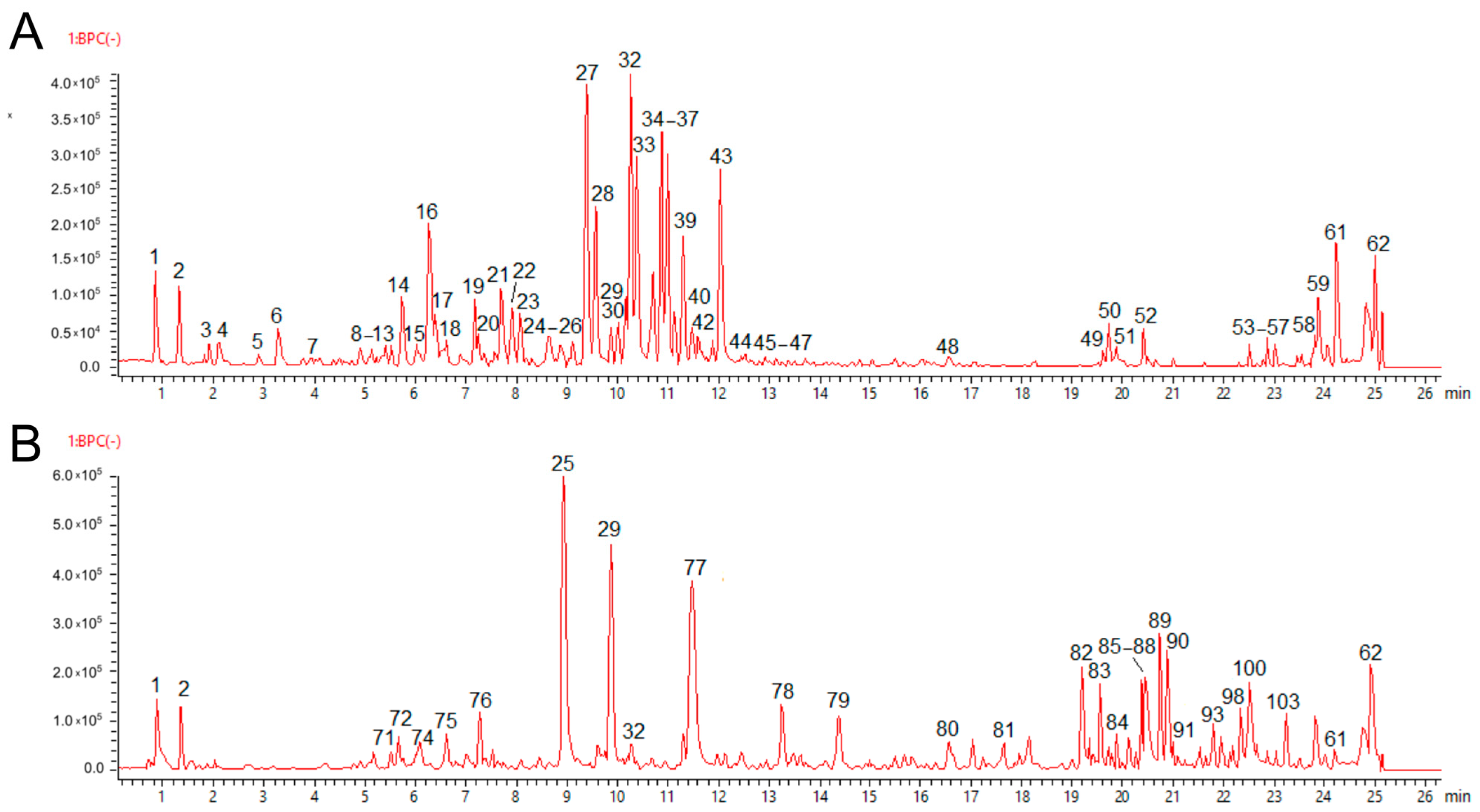
The fractions PA-But and PG-But were investigated for their phytochemical composition. Both were analyzed by LC-MS/MS, in positive and negative ionization modes. The extracts from both plants exhibited distinct chromatographic profiles (Figure 2A,B), confirming that their phytochemical compositions differed markedly. The compounds were observed as protonated [M+H]+ or deprotonated [M-H] ions, as well as conjugated with adducts, such as K+, Na+, NH4+, Cl, or HCOO. The fragmentation spectra were compared with literature and spectral databases, allowing the identification of most of these fraction components, including potential novel compounds for these species.
Pereskia aculeata—this species has been better investigated than the P. grandifolia and, therefore, several compounds were previously described [3,4,5,21]. Despite this, our analysis identified some unreported compounds in the organic fraction of the leaf extract. Besides common compounds, such as disaccharides (e.g., sucrose) appearing at m/z 381.075 [M+K]+, the positive ionization mass spectrometry (MS) revealed a series of nitrogen-containing compounds, typical of alkaloids. Although some of these compounds were not identified, others were tentatively characterized based on their CID-MS spectra.
Common plant compounds, as (1) disaccharide (e.g., sucrose), (2) citric acid, (6) protocatechuic acid, (7, 12) caffeoyl glucoside, (13) p-coumaroyl-glucoside, (16) caffeic acid, and (24) p-coumaric acid, were detected in this fraction (Table 2).
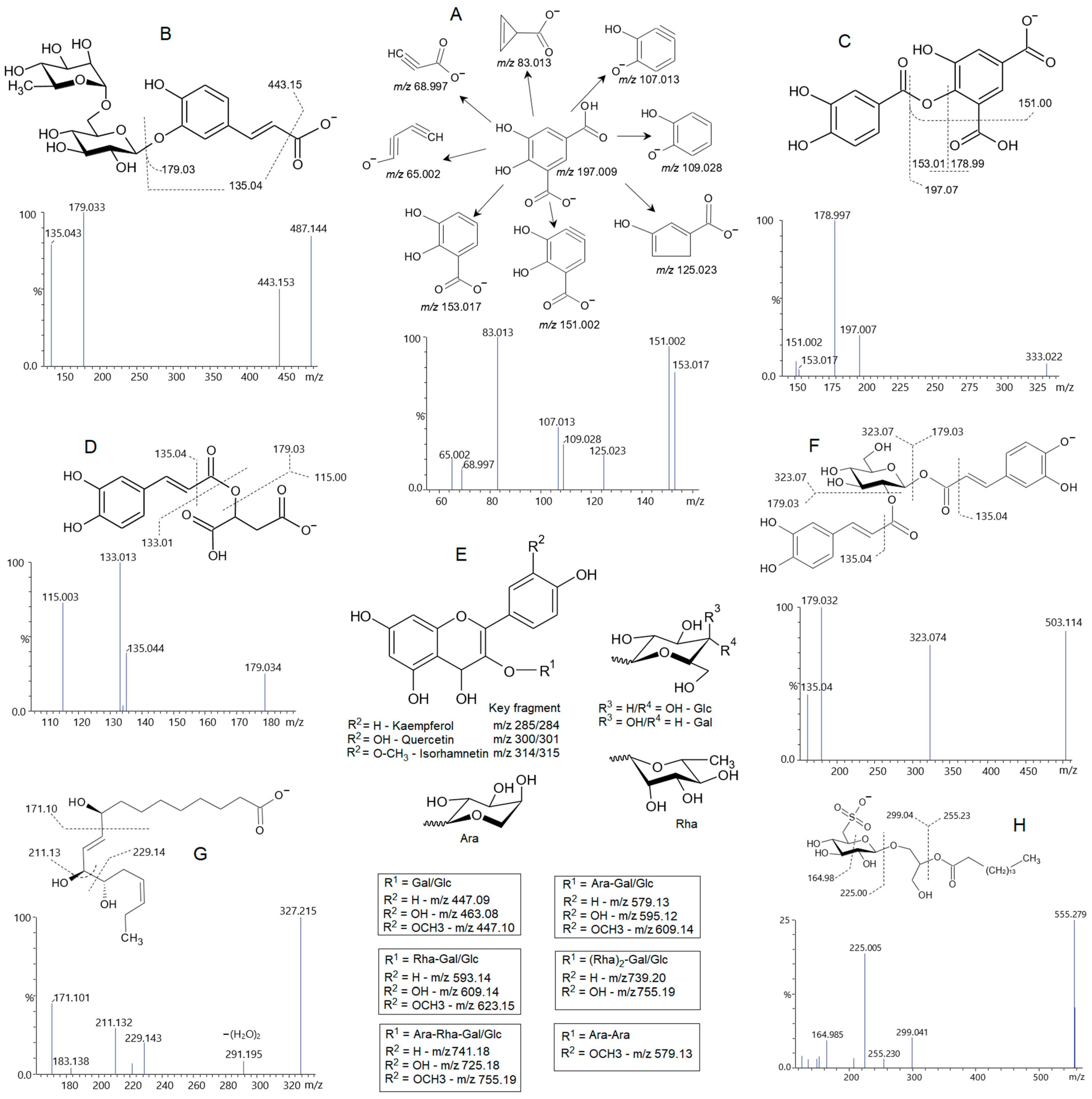
Compound 4, at m/z 197.008 [M-H], with a fragment at m/z 153.018, suggests it is a protocatechuic acid derivative. The neutral loss (NL) of 43.99 Da indicates the presence of another carboxylic acid in this structure, which was lost as CO2, suggesting a structure like a dihydroxybenzene-dicarboxylic acid (Figure 3A). Compounds 5 and 15, at m/z 315.107 [M-H], were identified as hydroxytyrosol-glucoside isomers, as observed through the fragment at m/z 153.054, consistent with the hydroxytyrosol moiety (NL of 162.053 Da), typical of a hexose residue [22]. The compound 8, at m/z 175.060 [M-H], was consistent with isopropylmalic acid, with similar fragments (Table 2), as described in PubChem.
Compound 11, m/z 487.144 [M-H], had similar fragments of caffeoyl-glucosides (i.e., m/z 179.034 and 135.045 from caffeoyl moiety). The simple caffeoyl-glucosides (as in 13) appeared at m/z 341.085, but the compound 11 had 146.058 Da higher than this typical compound, and this difference is consistent with a rhamnosyl residue, suggesting a disaccharide, like rutinose, linked to caffeic acid. The compound swertiamacroside has previously been reported from other plants, such as Fagopyrum esculentum [23], which contains a rutinose moiety attached to caffeic acid via an ester linkage. Despite this similarity, the compound 11 yielded a fragment at m/z 443.153, corresponding to the loss of CO2 (NL 43.98 Da). Therefore, unlike Swertiamacroside, the compound 11 has a rutinose (or isomer) linked to the hydroxyl group of caffeic acid, instead via ester linkage (Figure 2B).
The compound 17 appeared at m/z 333.022 [M-H] and displayed fragments consistent with compound 4 (dihydroxybenzene-dicarboxylic acid), specifically that one at m/z 197.008, indicating the same core compound. The neutral loss (NL) of 136.014 Da is consistent with a protocatechuic residue attached to dihydroxybenzene-dicarboxylic acid. Fragments at m/z 178.997 (dehydrated residue of m/z 197.008), 153.017, and 151.002 support this statement (Figure 3C). Although the MS fragments are robust with the proposed structure, details of where these groups are attached could not be inferred.
Compound 20, m/z 567.261 [M+HCOO], and fragments at m/z 521.257 (loss of adduct), 389.217 (loss of pentosyl residue), 293.085, and 161.045 (from hexosyl residue). This structure is formed by a disaccharide linked to a terpenoid, as the structure of Alangionoside B or its isomer, previously described in Alangium premnifolium [24].
Compound 21, at m/z 295.044 [M-H], gave the fragments from caffeic acid (i.e., m/z 179.033, 135.044); and those consistent with malic acid (i.e., m/z 133.013 and 115.003), indicating a caffeoyl malic acid (Figure 3D), as previously reported in other plants [25]. Compound 22, m/z 359.096 [M+HCOO], with a fragment at m/z 151.038, was consistent with a methoxybenzoyl-hexoside, and compound 23, m/z 371.096 [M-H], seemed to be formed from a benzoic acid derivative, since the fragment at m/z 121.028 was consistent with benzoic acid.
Flavonoids and their glycosides were well reported in P. aculeata [21]. In the fraction PA-But, we also found a series of these compounds, mainly formed by quercetin, kaempferol, and methylquercetin, which had been previously identified as isorhamnetin [3,21], as aglycones. Monosaccharides identified by GC-MS in this fraction were: rhamnose (14%), arabinose (1.5%), galactose (35.2%), and glucose (49.3%). Characteristically, the fragments from flavonol glycosides yield the aglycone ions via a regular heterolytic cleavage, but a homolytic cleavage, yielding a radical ion, is frequently found, mainly in flavonol 3-O-glycosides [26,27]. Herein, the main fragment-ions from aglycones appeared as radical ions, at m/z 300.025 from quercetin, m/z 284.031 from kaempferol, and m/z 314.041 from isorhamnetin, indicating the possible glycosylation site (Figure 3E).
Isomers of these flavonol glycosides are relatively common, usually resulting from a Glc or Gal unit linked to the aglycone [28]. Similarly, we identified isomers for almost all the flavonol glycosides reported herein. Compounds 25 and 26 yielded negative ions at m/z 755.199 [M-H], with a main fragment at m/z 300.025, which were identified as quercetin-di-rhamnosyl-hexosides. Those 27 and 28 appeared at m/z 741.184 [M-H], the aglycone fragment gave m/z 300.025, indicating the presence of quercetin, and the fragment at m/z 609.140, from both, confirmed the loss of a pentose residue. Considering the presence of a single pentose (arabinose) from GC-MS analysis, the compounds 27 and 28 were assumed to be quercetin-arabinosyl-rhamnosyl-hexosides (Table 2), as previously found in plants [21].
Compound 29, at m/z 739.204 [M-H], gave an aglycone-fragment at m/z 284.031, which is relatively common for kaempferol-di-rhamnosyl-hexosides [26,28], despite not being found previously for P. acuelata. Compounds 30 and 31, at m/z 595.127 [M-H], were consistent with quercetin-arabinosyl-hexosides; and 32, m/z 609.142 [M-H], consistent with rutin, as previously described [3]. Isomers 33 and 34, m/z 725.188 [M-H], were identified as kaempferol-arabinosyl-rhamnosyl-hexosides. Although they share similar glycan moieties, as in 27 and 28, these compounds have not been reported in P. aculeata. The last quercetin hexosides (35 and 37) were found at m/z 463.084 [M-H], and free quercetin (48) at m/z 301.033 [M-H].
Compound 36, at m/z 755.199 [M-H], although an isomer of 25/26, gave the aglycone fragment at m/z 315.048/314.041; therefore, consistent with isorhamnetin-arabinosyl-rhamnosyl-hexoside, as previously reported [3]. Kaempferol diglycosides were found at m/z 579.131 [M-H] (38) and m/z 593.147 [M-H] (39), being composed of arabinosyl-hexoside and rhamnosyl-hexoside, respectively; and kaempferol-hexoside (42) was found at m/z 447.090 [M-H]. Similarly, isorhamentin diglycosides were detected at m/z 609.141 [M-H] (41) and m/z 623.157 [M-H] (43), featuring the same glycan moieties as compounds 38 and 39. Two isorhamnetin monoglycosides (44 and 45) were also found at m/z 477.100 [M-H]. Another glycoside (46) was found at m/z 579.132 [M-H], with main fragments at m/z 315.048/314.041, indicating the presence of two arabinose units attached to isorhamnetin. This compound was previously reported in P. aculeata [21].
The compound 47, m/z 503.116 [M-H], gave fragments at m/z 179.033 and 135.044 consistent with caffeic acid, and a fragment at m/z 323.074 produced by the loss of a caffeic acid residue. The MS data for this compound are consistent with a dicaffeoyl hexose (Figure 3F). Although this is the first report of this compound in P. aculeata, a similar compound has been reported in Balanophora japonica [29].
Three intriguing isomers (49, 50, 51) were found at m/z 327.215 [M-H]. These compounds were initially considered contaminants, but a thorough investigation identified them as trihydroxy-octadecadienoic acid (Figure 3G). Although the positions of hydroxyl groups and double bonds could not be resolved, this finding is relevant to this plant, as this class of fatty acids exhibits pharmacological properties, including antiatherosclerotic effects and antiatherogenic activity [30].
To our knowledge, saponins have not been reported in P. aculeata. Therefore, two novel saponins (52, 53) were found in this fraction, at m/z 955.483 and 793.431 [M-H], respectively. These compounds were identified as NH4 adducts in positive-ion mode, with low-abundance intact ions. However, the main ion appeared at m/z 439.351, consistent with an in-source fragmentation that produced a dehydrated residue of oleanolic or ursolic acid. Therefore, compound 52 was identified as a saponin triglycoside, whereas 53 was a diglycoside composed of uronic acid (glucuronic or galacturonic acid) and hexoses (galactose or glucose) attached to the triterpenic acid.
Regardless of the chloroform partition, polar lipids were also detected in PA-But, primarily as lyso-lipids (monoacyl). They appeared as digalactosyl-monoacylglycerol (54, 56) at m/z 721.350 [M+HCOO], the loss of adduct yielded m/z 675.355 and diagnostic fragments of m/z 277.216, characteristic of linolenic acid (C18:3), m/z 415.142 and 397.132 resulting from the digalactosyl-glycerol [31]. The isomers can be explained by the acyl linkage site (i.e., sn-1 or sn-2). Another digalacotsyl-monoacylglycerol (59) was found at m/z 699.375 [M+HCOO]- with similar polar head fragments as in 54/56, but that one at m/z 255.231, consistent with palmitic acid (C16:0).
Lipids 55 and 57 were identified as a lyso-phosphatidylinositol C18:3 (l-PI), appearing at m/z 593.268 [M-H], with diagnostic fragments at m/z 277.216, from C18:3; m/z 241.010, from inositol phosphate residue, and m/z 152.994 from glycerol phosphate residue. The isomers, again, derive from the ester linkage site. Another l-PI (58) was found at m/z 595.284 [M-H], with similar fragments (Table 2), except for the presence of the one at m/z 279.231, indicating the presence of a linoleic acid (C18:2) in this structure. The lipid 61, at m/z 571.284 [M-H], also gave similar fragments, but that at m/z 255.231 was consistent with palmitic acid (C16:0), indicating a l-PI C16:0.
The last lipid (62) in negative ionization was found in PA-But at m/z 555.280 [M-H], being identified as a sufoquinovosylmonoacylglycerol-C16:0 (SQMG) based on diagnostic fragments at m/z 299.041, from the sulfoquinovosylglycerol residue, and m/z 225.005, from the sulfoquinovosyl residue [31]. The fragment at m/z 255.230 confirmed the presence of palmitic acid (Figure 3H).
The fatty acids found in these lipids, herein described, were confirmed by GC-MS analysis. The fatty acids were analyzed as FAME derivatives and quantified by peak area, as relative abundance. Therefore, for PA-But, the fatty acid composition was: palmitic acid (C16:0) 45%, stearic acid (C18:0) 7.5%, linoleic acid (C18:2) 11.2%, and linolenic acid (C18:3) 36.3%.
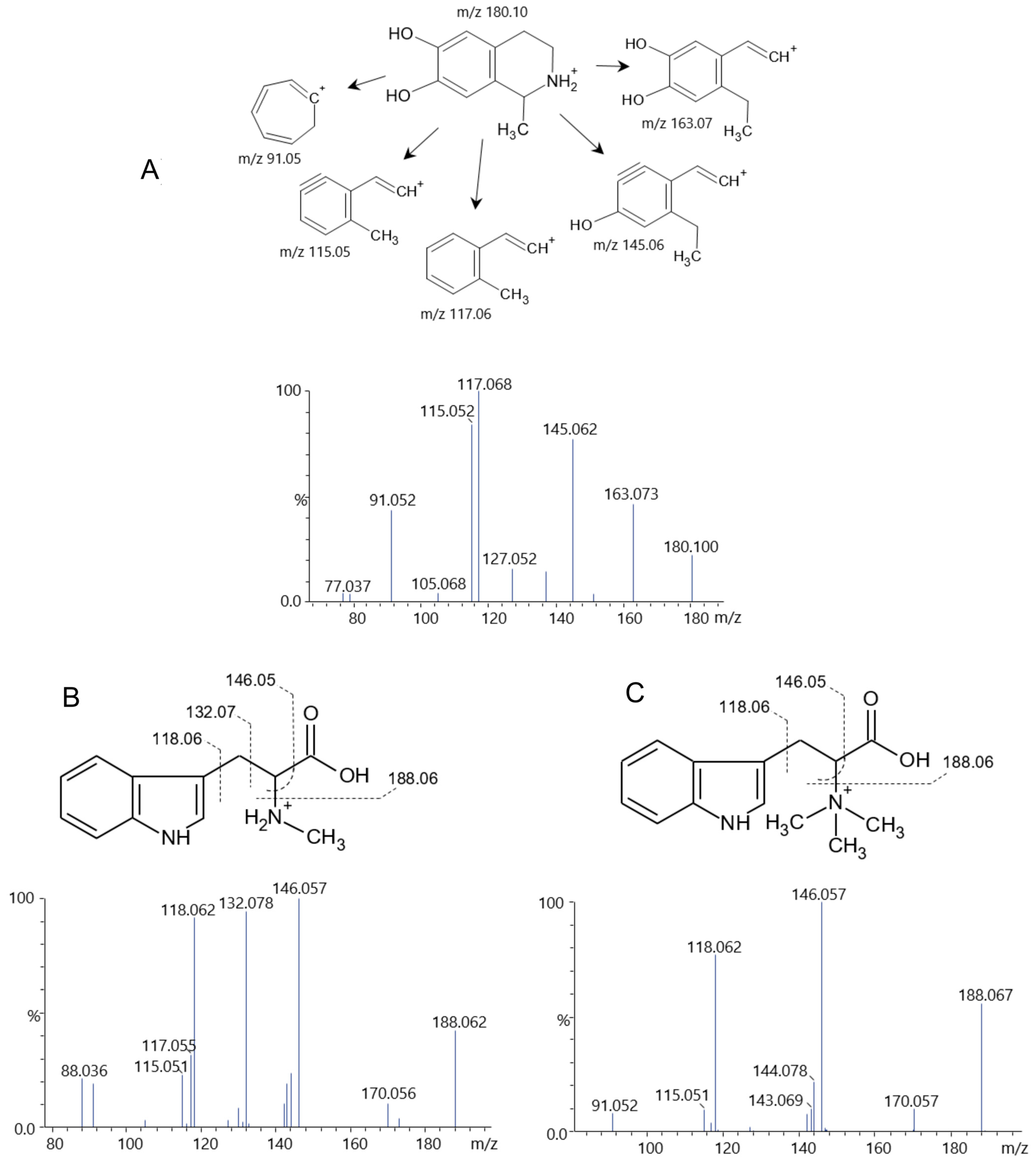
Some compounds were best detected, albeit not exclusively, in the positive-ionization mode due to the presence of basic nitrogen. Two compounds (63, 64) yielded m/z 180.100 [M+H]+, with predicted molecular formula C10H13NO2, with fragments at m/z 163.073 (-NH3), 145.062 (-NH3, -H2O), 117.068, 115.052, and 91.052 (tropylium ion). Some compounds, such as N-acetyltyramine, phenacetin, and salsolinol, share the same molecular formula; the literature indicates that salsolinol exhibits the same fragmentation profile as observed here (Figure 4A). Nevertheless, these compounds appeared in PA-But as isomers, and another compound that matches these characteristics is homophenylalanine, which has not been reported from plants but has been found in the cyanobacterium Nostoc punctiforme [32]. Additional analyses are necessary to confirm this structure.
Phenylalanine (65) at m/z 166.084 [M+H]+ and tryptophan (66) at m/z 205.095 [M+H]+ were also found and confirmed by their fragments (Table 2). Two other compounds exhibited a fragmentation profile similar to that of tryptophan. The compound 67, at m/z 219.110 [M+H]+, 15 Da higher than tryptophan is consistent with abrine (N-methyl-tryptophan), previously found in P. aculeata [6], since the fragment at m/z 188.068, also found in tryptophan, indicate a loss of mathylamine (CH3NH2), confirmed the N-methyl group, and the fragment at m/z 118.063, from indole ring, are consistent with abrine (Figure 4B) [33]. The compound 68, at m/z 247.141, was 42 Da higher than tryptophan, which could indicate the presence of a propyl radical bonded to the alpha-nitrogen or a betaine (trimethylamine) group. The fragmentation profile was similar to tryptophan and abrine, appearing at m/z 188.068, 146.057, 118.063, consistent with hypaphorine (Figure 4C) [34], which was not previously reported in the Pereskia genus.
Aminated lipids were also found in positive ionization (Table 2), as compound 69, at m/z 318.296 [M+H]+, and fragments at m/z 300.285, 282.274, 264.264, yielded after a sequential molecular dehydration, which was consistent with phytosphingosine [35]. The compound 70, m/z 476.333, was consistent with lyso-phosphatidylcholine (C16:0), with the diagnostic fragment appearing at m/z 184.069 [36].
Pereskia grandifolia—This species has been less investigated than P. aculeata, but it has attracted attention due to its potential, which has been explored more recently. The phytochemicals were poorly studied. However, some phenolics and alkaloids were previously reported [5,15,16,17,18].
In our LC-MS analysis of the fraction PG-But, we tentatively identified different compound classes, some of which were similar to those found in P. aculeata. Still, the phytochemical composition of the two species is quite distinct (Figure 2B). Some similar compounds were identified, including salsolinol (or its isomer) (63, 64), abrine (67), and p-coumaroyl glucose (16). Flavonol glycosides were less abundant, with only four structures being found: quercetin-di-rhamonosyl-hexoside (25, 26), rutin isomer 1 (32), kaempferol-di-rhamonosyl-hexoside (29), and rutin isomer 2 (32). Similar lipids were also found, such as digalactosyl-monoacylglycerol (56), lyso-phosphatidylinositol (61), and SQMG (62) (Table 2). Fatty acids were confirmed by GC-MS analysis, giving similar results as in PA-But: C16:0 47.5%, C18:0 10.8%, C18:2 4.2%, and C18:3 37.5%.
Terpenes glycosides were found in PG-But; these compounds were tentatively identified based on MS spectra and literature data. Compounds 71 and 73 appeared at m/z 527.229 [M+HCOO], whereas compound 72 appeared at m/z 395.188 [M+HCOO]. Compound 72 yielded fragments at m/z 349.185 due to the loss of adduct, and m/z 179.055, consistent with a hexose, suggesting a structure similar to distyloside A [37]. Moreover, compounds 71 and 73 were 132.041 Da higher than 72, strongly suggesting the presence of a pentose, as supported by fragments at m/z 149.042. Fragments at m/z 349.186 and 179.055 confirmed their similarity to compound 72. Therefore, compounds 71 and 73 were classified as isomers, sharing the distyloside A core (72) but differing in the attachment of an additional pentose. A similar disaccharide was previously described for distyloside B; however, in this case, the aglycone differs [37]. The aglycone moieties should be further investigated to confirm their identity.
Compound 75, m/z 447.146 [M+HCOO], yielding fragments at m/z 401.142 (loss of adduct), m/z 269.100, 193.048, 161.043. The latter could be from a dehydrated hexose residue, indicating a glycoside. Although these fragments were poorly understood, a benzyl β-primeveroside [38], or isomer, could be considered. The compound 76, at m/z 431.188 [M+HCOO], with deprotonated ion at m/z 385.183 (loss of adduct), was interpreted as a terpenoid glycoside, since it produces fragments at m/z 223.133, 205.122, consistent with the aglycone and m/z 161.044 from a hexose residue. Several possible isomers were identified during the search for the molecular formula (C19H30O8) in the lotus. naturalproducts database, such as roseoside. Therefore, further purification and analysis are necessary to obtain more detailed information.
An unknown alkaloid (77) was found at m/z 262.070 [M-H], with a fragment at m/z 218.080, corresponding to an NL of 43.99 Da, consistent with the loss of CO2, typical of carboxylic acids. The fragment at m/z 200.070 (NL 18.01 Da) indicates the loss of a water molecule from the fragment m/z 218.080; and the fragment at m/z 146.059 could originate from a hydroxydihydroquinoline group, as in isoquinoline alkaloids.
Compounds 78 and 82 (m/z 691.255 and 675.261, respectively) appeared to share the same carbon backbone, but 78 contains a hydroxyl group that 82 lacks. Both loose acetyl groups with similar fragments, but the correct structure could not be assigned. Compound 79, m/z 521.125 [M-H], was partially identified as a benzoic and protocatechuic acid derivative, since it produces fragments at m/z 152.010, indicating a negative radical ion from protocatechuic acid and m/z 121.027, consistent with benzoic acid.
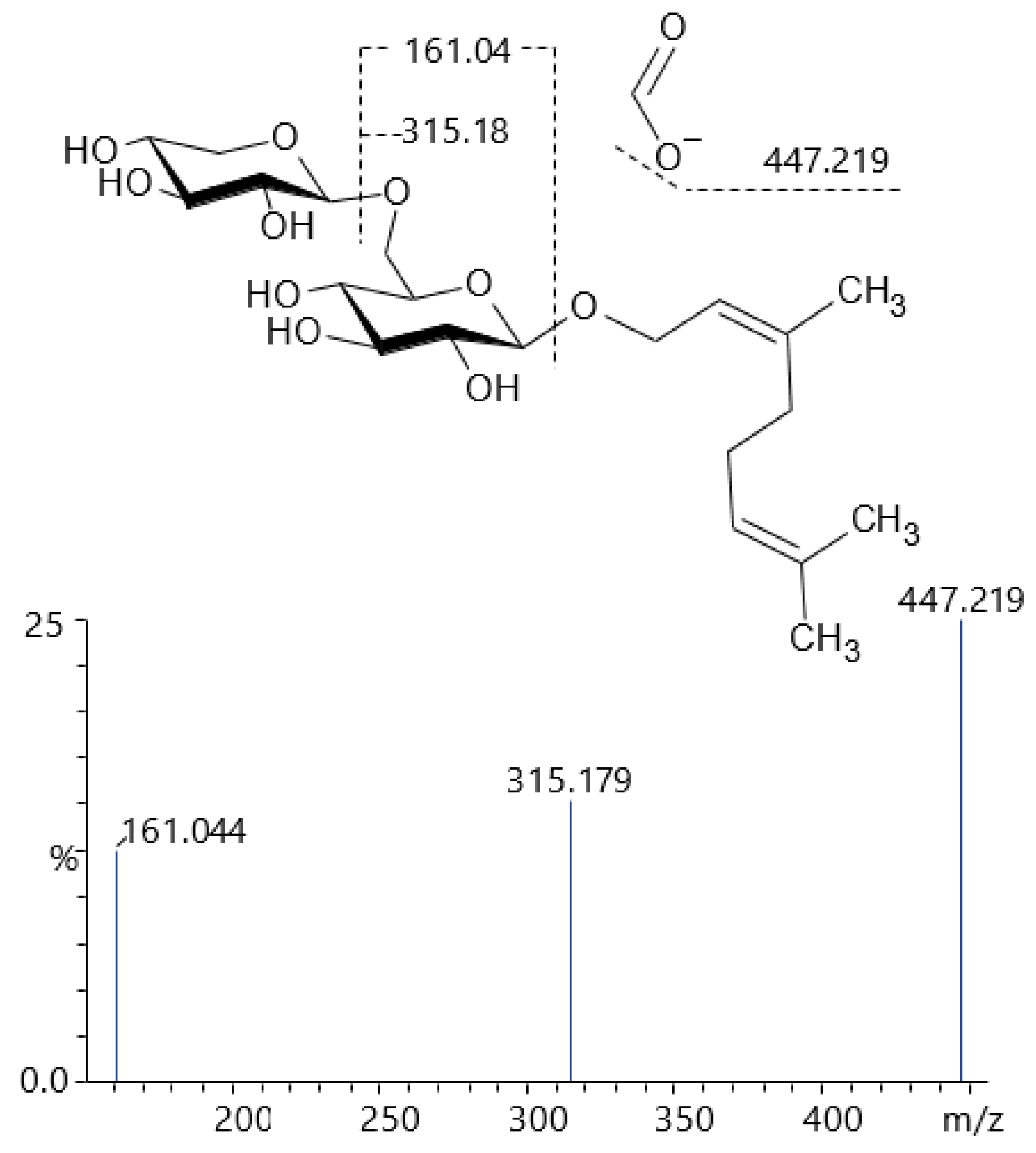
The compound 80, m/z 493.224 [M+HCOO], was identified as a diglycoside, since it produced a fragment at m/z 447.219 (loss of adduct), followed by m/z 315.179, loss of 132.042 Da, consistent with a pentosyl residue, and a fragment from the hexose residue was found at m/z 161.044. This compound is consistent with a geranyl-pentosyl-hexoside (Figure 5), such as geranyl β-primeveroside [39].
Different from P. aculeata, in this fraction from P. grandifolia, a greater variability of triterpenoid saponins was found. In most of them, the aglycone is consistent with ursolic or oleanolic acids. LC-MS analysis of aglycones confirmed the presence of ursolic or oleanolic acid, but the chromatographic system could not resolve them to determine whether both were present. These positive ions were produced as ammonium adducts [M+NH4]+, which exhibited a strong tendency to undergo in-source fragmentation, yielding the ion at m/z 439.351 for most saponins, consistent with a dehydrated ursolic/oleanolic acid [40]. Additional potential aglycones were detected and will be discussed further.
Saponins have been poorly reported for Pereskia spp., but in 1974 [41], an oleanolic saponin was identified that contained a trisaccharide composed of glucuronic acid and glucose, structurally similar to those found herein. The monosaccharide composition, as determined by GC-MS, confirmed a high concentration of glucose (81.5%). However, galactose appeared at a concentration of 16.7%. Although this amount of galactose could arise from other glycosides, such as flavonols, we cannot exclude the possibility that it is present in the saponins, which could explain the presence of several isomers. Other monosaccharides appeared at low concentrations; rhamnose was only 1.8%, and arabinose was seen in less than 1%.
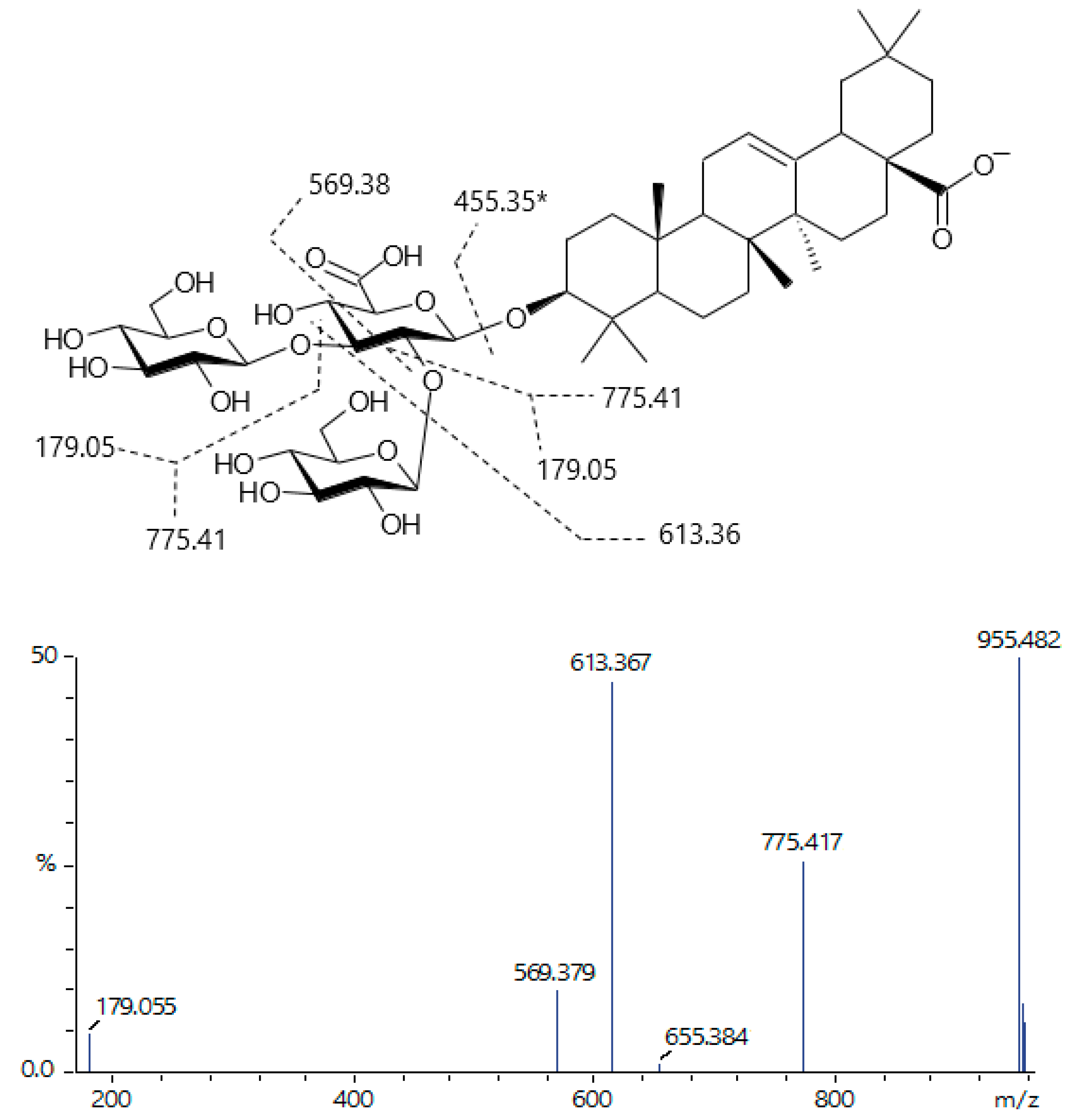
Compound 85, at m/z 1117.533 [M-H], was consistent with soponin tetraglycoside, composed of three hexose units, as observed by sequential losses of 162/180 Da yielding fragments at m/z 955.490, 775.416, 613.368. A fragment at m/z 179.055 is consistent with hexose. A fragment at m/z 569.380 was not consistent with known aglycones, but the fragment at m/z 613.368 was consistent with ursolic/oleanolic acid linked to a dehydrated residue of uronic acid (e.g., glucuronic or galacturonic acid). The fragment at m/z 775.416 was 180 Da less than the ion at m/z 955.490, because it underwent a dehydration-like cleavage, supporting the statement that m/z 613.368 derives from the aglycone linked to a uronic acid residue. Therefore, the compound 85 was partially characterized as a ursolic/oleanolic acid trihexosyl glucuronide (Table 2). Most other saponins exhibited similar structures, differing only in glycosidic chains that included tri-, di-, and monosaccharides, as well as in isomeric forms.
Three isomers (87, 93, 94) were found at m/z 955.482 [M-H], identified as from a triglycosyl saponin (Figure 6). As in compound 85, losses of 162/180 Da indicated the loss of hexoses, and the common fragment at m/z 613.368 confirmed the presence of the uronic acid residue linked to the aglycone. Isomers can be derived from aglycone isomers (e.g., ursolic/oleanolic acid), monosaccharide epimers (e.g., galactose and glucose, or galacturonic and glucuronic acid), or different linkage sites. Only a single structure of these isomers was previously described [41].
Compounds 88, 90, 96, 98, and 99 were all found at m/z 793.430 [M-H] with similar fragments, at m/z 631.383 and 613.368 (loss of a hexose), confirming the uronic acid linked to aglycone, and these isomers were characterized as diglycosyl saponins (Table 2). The compound 100, at m/z 835.441, with fragments at m/z 655.380 and 611.388, could arise from an acetylation version of compounds 88, 90, 96, 98, and 99. The presence of two saponin monoglycosides (102, 103), which were found at m/z 631.379, yielding fragments at m/z 613.370, confirming the dehydration tendency, and m/z 455.350, from the intact aglycone, consistent with the stated ursolic/oleanolic acids, confirmed their linkage with uronic acid.
Other potential saponins composed of different monosaccharides or aglycones were also found. Compound 84, at m/z 985.492 [M-H], was 30 Da (CH2O), higher than saponins 87, 93, 94 (m/z 955.481). The fragments at m/z 805.430 (−180) indicated the loss of a hexose unit, followed by m/z 643.379 (−162) from loss of another hexose dehydrated residue. This fragment retained the additional 30 Da higher than the usual fragment observed for other saponins (m/z 613.368), suggesting the presence of a different aglycone (C31H50O4), such as hederagenin methyl ester.
Compound 86, at m/z 1087.523 [M-H], was 30 Da lower than compound 80, and compound 95, at m/z 925.471 [M-H], was 30 Da lower than compounds 87, 93, and 94 (m/z 955.481). These compounds could result from replacing a hexose unit with a pentose one; nevertheless, they did not yield sufficient fragments to confirm their structures.
The compound 83, m/z 711.374 [M+HCOO], gave fragments at m/z 665.370 from the loss of adduct, along with m/z 503.317 and 179.053, confirming the presence of a hexose. The probable aglycone was found forming the deprotonated ion at m/z 503.318 (89). Although the mass error was higher than expected, the aglycone of this saponin could be madecassic acid (expected m/z 503.337).
Compound 92, m/z 809.435, and fragments at m/z 629.363 (loss of a hexose) and m/z 585.384 could indicate the presence of an additional hydroxyl group in aglycone, such as hydroxyursolic acid (hederagenin), which perfectly matches the fragments observed.
The compound 97 appeared at m/z 791.415 [M-H] with a main fragment at m/z 611.353. These ions were 2 Da smaller than compounds 88, 90, 96, 98, and 99 (m/z 793.430), consistent with an additional unsaturation in the aglycone, namely dehydro-ursolic acid, which was previously characterized in saponins from other plants [42].

3. Discussion

This work represents the first comprehensive characterization of phytochemicals in Pereskia aculeata and P. grandifolia using two complementary chromatographic methodologies, GC-MS and LC-MS. This combination provides a robust approach that overcomes common limitations of LC-MS, particularly for complex phytochemical samples, which often contain numerous isomers that are not resolved by mass spectrometric analysis. While LC-MS provides primary information on overall composition, GC-MS was critical for identifying monosaccharides from the glycosides and fatty acids in lipids. Such MS investigations with this level of detail are becoming scarce, as most studies are merely descriptive and do not thoroughly examine the MS profile to identify molecular fingerprints.
Although P. aculeata has been previously investigated and reported as rich in phenolic compounds, notably flavonol glycosides and phenolic acids [3,4], phytochemical data on P. grandifolia remained scarce. By applying these advanced analytical techniques, our study not only confirms and expands previous findings on P. aculeata but also uncovers, for the first time, the presence of a diverse range of saponins in P. grandifolia. This comparative analysis offers novel insights into the chemical basis underlying the distinct biological activities exhibited by these species. The marked differences in chemical composition between the two species likely reflect intrinsic biosynthetic strategies. P. aculeata accumulates phenolic compounds, particularly a greater variety of glycosylated flavonoids, typically associated with photoprotection and defense against oxidative stress. In contrast, P. grandifolia showed two abundant flavonoids; this species seems to invest more energy into the synthesis of triterpenoid saponins, structurally diverse metabolites widely recognized for their ecological roles in pathogen defense and herbivory control.
The stronger chemical antioxidant capacity observed in P. aculeata correlates with its higher content of flavonoids and phenolic acids, falling within the same range as those reported for other flavonoid-rich extracts, reinforcing the central role of these compounds as radical scavengers, metal chelators, and redox modulators, beyond several different properties, as anti-inflammatory, vasoprotective, and immunomodulatory effects [43,44,45,46,47,48,49]. By contrast, P. grandifolia, with a markedly lower phenolic content, displayed weaker chemical antioxidant responses, which is consistent with previous findings on extracts poor in polyphenols.
Interestingly, despite its lower phenolic abundance, the detection of multiple saponins in P. grandifolia suggests complementary antioxidant mechanisms, likely indirect, through modulation of endogenous enzymatic defenses such as superoxide dismutase, catalase, and glutathione peroxidase. This may be the key reason for the higher cellular antioxidant activity observed in the butanolic fraction of this species, which achieved ROS inhibition above 90%. In contrast, PA-But achieved only 45% inhibition, as the best result. Indeed, saponins from other plant sources were investigated for their effects on cellular oxidative stress, indicating that the primary mechanisms involve upregulating antioxidant enzymes, such as CAT, NRF2, and GCL, as well as restoring glutathione homeostasis [50]. Therefore, it could be the primary pathway underlying the anti-ROS effect observed after incubation with PG-But, which may also explain the lower effects of PA-But.
The pharmacological potential of saponins identified in P. grandifolia deserves particular attention. Beyond their indirect antioxidant effects, saponins are widely reported to have diverse biological activities, including anti-inflammatory effects through downregulation of mediators such as TNF-α, IL-6, and COX-2, cytotoxicity against tumor cells via apoptosis induction, and antimicrobial activity against bacteria, fungi, and protozoa [50,51,52]. Such findings position P. grandifolia as a promising source of bioactive metabolites distinct from those found in P. aculeata. Given the growing interest in plant-based superfoods and functional ingredients, both species represent valuable candidates not only as nutrient-rich vegetables but also as potential raw materials for nutraceutical and pharmaceutical applications.
Regardless of the significant advances in chemical composition and mass spectrometry profiles presented in this work, along with the distinct antioxidant effects observed in both plant components, more advanced assays are needed to fully understand the potential of these species. These assays could include investigating the cellular antioxidant pathway to better understand the observed differences between species, beyond differences in chemical composition. However, challenges in analyzing complex mixtures hinder compound identification, owing to the limited availability of reference standards and the inefficiency of nuclear magnetic resonance (NMR) analysis for such mixtures. This also impacts biological investigations, as different compounds may act synergistically or exhibit opposing effects, leading to an over- or underestimation of the pharmacological contribution of specific metabolites. This could be a reasonable explanation for the low cellular antioxidant activity observed in the PA-But fraction. One way to overcome these difficulties is to implement additional fractionation and purification protocols, which are laborious and beyond the scope of this work, but underscore the importance of future studies that involve pure compounds, large-scale metabolite validation, and in vivo assays to confirm the pharmacological effects suggested by our data.
Despite limitations, our results provide new and complementary insights into the phytochemical and biological diversity of Pereskia species. The dual antioxidant profile observed in this study, in which P. aculeata, rich in phenolic compounds and showing greater chemical antioxidant activity, was compared with P. grandifolia, which was rich in saponins and exhibited stronger cellular antioxidant activity, highlights the complexity and versatility of this genus as a source of bioactive compounds. Furthermore, this study establishes the first comprehensive characterization of Pereskia species by GC-MS and LC-MS, laying the groundwork for future investigations into their nutraceutical value and potential therapeutic applications.

4. Materials and Methods

4.1. Botanical Material

Leaves from P. aculeata and P. grandifolia were provided and identified by Dr. Ezilda Jacomassi, from the Botanical Garden of the Universidade Paranaense (Umuarama, Paraná State, Brazil) at 430 meters above sea level (S23°46′11.3″–W53°16′412″), where these species are cultivated. Leaf samples of these species were collected in August/September 2023. The voucher specimens were deposited at the Botanical Garden Herbarium of the Universidade Paranaense under exsiccate HHMUP-88 (Pereskia aculeata Mill.) and HHMUP-142 (Pereskia grandifolia Haw.). Both species were registered in the National System for the Management of Genetic Heritage and Associated Traditional Knowledge under registration numbers A578420, A464E1A, and A5E5EFC from UNIPAR and AAA483B from IPPPP.

4.2. Chemicals

All chemicals and reagents were purchased from Sigma-Aldrich (St. Louis, MO, USA), unless otherwise specified. Formic acid (98%) and acetonitrile were LC-MS-grade, and ethanol, methanol, butanol, ethyl acetate, propanol, chloroform, n-hexane, and acetic acid were HPLC-grade. Other solvents and reagents were P.A. grade. Water was type 1 ultrapure (Milli-Q, Merck Millipore, Molsheim, France).

4.3. Leaf Extraction and Liquid/Liquid Partition

The leaves of P. aculeata and P. grandifolia were ground in a blender, and 100 g of each was extracted with 70% ethanol at 60 °C for 2 h, with the extraction repeated three times. The extracts were combined and evaporated under reduced pressure. A 1 g portion of each extract was dissolved in water (200 mL) and then fractionated with chloroform (200 mL). The organic layer was recovered, and this process was repeated three times. The chloroform layers were combined and evaporated under reduced pressure, yielding the fractions PA-Chl (from P. aculeata) and PG-Chl (from P. grandifolia). The aqueous layer was subjected to a second fractionation with a mixture of n-butanol and ethyl acetate (8:2, v/v). After three partition cycles, the organic layers were combined and evaporated under reduced pressure, yielding PA-But from P. aculeata and PG-But from P. grandifolia, respectively. The residual aqueous layers were freeze-dried at −50 °C (Liobras, São Carlos, Brazil), giving the fractions PA-Aq (P. aculeata) and PG-Aq (P. grandifolia). These fractions were stored at −20 °C until analysis and assays were performed.

4.4. DPPH Free Radical Scavenging Assay

The experiment followed the procedure described by [53] with adaptations. Fractions PA-But, PA-Aq, PG-But, and PG-Aq were diluted in ethanol to obtain concentrations ranging from 1000 to 1.9 μg·mL−1. The obtained solutions (143 μL) were subsequently mixed with 57 μL of an ethanolic DPPH solution (0.3 mM). The mixture was incubated for 30 min and protected from light. Absorbance was determined using a spectrophotometer (UV-VIS 1601, Shimadzu, Kyoto, Japan) at 540 nm. The negative control was performed using a DPPH solution and ethanol. The blank was formed by mixing ethanol (57 μL) with each of the obtained solutions, ensuring a specific blank for each concentration. The samples were diluted to their respective IC%, resulting in different concentrations. The results were compared with a standard of ascorbic acid. The assay for each concentration per sample was conducted in triplicate under the same analysis conditions, and the averages were used to calculate the DPPH inhibition percentage relative to the negative control using the following formula:
%Inhibition DPPH = 100 − [(Abssample − Absblank)/Abscontrol] × 100
A graph of the DPPH inhibition percentage against concentration was obtained. The IC50 of the analyzed sample was determined from the linear regression equation. The antioxidant activity of the extracts was classified according to the following criteria: IC50 < 50 μg·mL−1 = very strong, 50–100 μg·mL−1 = strong, 101–250 μg·mL−1 = moderate, 251–500 μg·mL−1 = weak, and >500 μg·mL−1 = inactive [54].

4.5. Evaluation of Activity Through the Formation of the Phosphomolybdenum Complex

The assay was conducted following the method described by [55]. Fractions PA-But, PA-Aq, PG-But, and PG-Aq were dissolved in ethanol (0.3 mL; 200 μg·mL−1) and added to a tube containing 1 mL of the phosphomolybdenum complex solution and 1.5 mL of distilled water, and then incubated at 90 °C for 90 min. After the reaction time, the absorbance was measured at 690 nm using a Multiskan FC microplate reader (Thermo Scientific, Waltham, MA, USA). The absorbances of the samples were compared with the absorbance of the ascorbic acid standard at the same concentrations. The results were expressed as relative antioxidant activity (RAA%, compared to ascorbic acid), according to the following equation:
RAA% (ascorbic acid) = [(Abssample − Absblank)/(Absascorbic acid − Absblank)] × 100

4.6. Determination of Total Flavonoids

Total flavonoids were determined by the method described by [56] in triplicate, using a standard curve of quercetin dissolved in ethanol at concentrations ranging from 10 to 500 μg·mL−1. First, 100 µL of each fraction (500 μg·mL) or 100 µL of the quercetin standard was added to a 96-well plate. Then, 100 µL of AlCl3 in methanol (2% w/v) was added to each well, incubated for 60 min, and protected from light. Analysis was performed on a Multiskan FC microplate reader (ThermoScientific, Waltham, MA, USA) at 414 nm against a blank. Quantification was carried out using the external calibration curve method, with quercetin as the reference standard. The linear regression equation obtained (y = 0.009x − 0.0136; R2 = 0.9976) was applied to interpolate the absorbance values of the samples and calculate their respective concentrations, which were then expressed as mg of quercetin equivalents per gram of extract (mg EQ/g).

4.7. Determination of Total Polyphenol Content

The total polyphenol was determined in triplicate by the Folin-Ciocalteu method [57]. Folin-Ciocalteu reagent (100 µL) diluted in water (10%, v/v), 20 µL fractions at 500 μg·mL−1 or gallic acid ranging from 10 to 500 μg·mL−1, and 80 µL of sodium carbonate solution (7.5%, w/v) were added in a 96-well plate, incubated for 60 min, protected from light. The analysis was performed in a Multiskan FC microplate reader (Thermo Scientific, Waltham, MA, USA) at 690 nm. Quantification was performed using the external calibration curve method, with gallic acid as the reference standard, prepared in ethanol. The linear regression equation obtained (y = 0.0024x + 0.0468; R2 = 0.9927) was applied to interpolate the absorbance values of the samples and calculate their respective concentrations, which were then expressed as milligrams of gallic acid equivalents per gram of extract (mg GAE/g).

4.8. Cellular Antioxidant Activity Assay

The cellular antioxidant activity (CAA) was assessed by measuring the ability of the plant fractions to inhibit reactive oxygen species (ROS) production in response to an external stimulus. CACO-2 cells were cultured in DMEM-F12 medium, supplemented with 10% bovine fetal serum and 1% penicillin and streptomycin, and seeded into 96-well microplates at a density of 5 × 10⁵ cells/well and held for 24 h at 37 °C and 5% CO2, to ensure cellular adherence and establish a confluent monolayer. To access the intracellular antioxidant activity, cells were co-incubated with the fluorescent probe 2′,7′-dichlorofluorescein diacetate (DCFH-DA) at a final concentration of 20 μM, and with the PA-But and PG-But fractions, at concentrations of 50, 100, 300, 600, and 1000 μg·mL−1, for 60 min at 37 °C, following a modified version of the protocol previously described [58]. This incubation period enabled intracellular deacetylation of DCFH-DA to 2′,7′-dichlorofluorescein (DCFH). After this incubation period, the wells were washed with phosphate-buffered saline (PBS) to remove any non-internalized DCFH-DA and samples, the cells were then incubated with the ROS stimulator, 5-fluorouracil (5-FU), at 25 mg·mL−1. Fluorescence intensity was immediately monitored for 60 min, with readings taken every 5 min, with excitation/emission of 500 nm/529 nm, using a Varioskan LUX Microplate Reader (Thermo-Scientific—Waltham, MA, USA). Data acquisition was performed in SkanIt RE v. 7.1 (Thermo-Scientific—Waltham, MA USA) and analysis in GraphPad Prism 10 (San Diego, CA, USA), which provided the area under the curve (AUC), used to calculate the total CAA, as follows:
CAA Units = 100 − (AUCAntioxidant/AUCControl) × 100

4.9. Monosaccharide and Aglycone Analysis

To remove residual free mono- or oligosaccharides, 5 mg of the fractions PA-But and PG-But were dissolved in 2 mL ultrapure water and partitioned with 2 mL butanol/ethyl acetate (2:1 v/v) three times; the aqueous phase was discarded and the organic layers were analyzed by thin layer chromatography (TLC) to monitor the presence of free sugars, using silica gel 60G (Sigma-Aldrich St. Louis, MO, USA), developed with EtOAc:H2O:HOAc:HCO2H (9:2.3:1:1, v/v) and stained with orcinol–H2SO4 at 100 °C [59]. After confirming their absence, the samples were hydrolyzed in 1 M TFA, for 4 h at 100 °C. The hydrolysate was partitioned with ethyl acetate/water (1:1, v/v), and the organic layer was evaporated under a nitrogen stream and reserved for further analysis of the aglycone. The aqueous phase was evaporated under a N2 stream, and the monosaccharides were reduced with NaBH4 and acetylated with pyridine/acetic anhydride (1:1, v/v) as previously [26,59]. The resulting alditol acetates were analyzed by gas chromatography coupled with mass spectrometry (GC-MS).

4.10. Fatty Acid Analysis

Fatty acids from the fractions PA-But and PG-But (1 mg each) were converted to their methyl ester derivatives by dissolving them in 500 μL of 1 M methanol-HCl and heating at 80 °C for 1 h. The resulting fatty acid methyl ester (FAME) was extracted by adding n-hexane (1 mL) and 500 μL of water. The upper layer was recovered, and the FAMEs were analyzed by GC-MS [60].

4.11. Gas Chromatography Coupled to Mass Spectrometry Analysis

Alditol acetates and FAME derivatives were analyzed by GC-MS QP2020 (Shimadzu, Kyoto, Japan), coupled to a single quadrupole mass spectrometer equipped with an AOC-6000 autosampler. The column was a 30-m SH-RTX-5MS (Shimadzu, Kyoto, Japan) fused-silica capillary column with an inner diameter of 0.25 mm and a film thickness of 0.25 μm. The carrier gas was helium (analytical grade, 5.0), with the pressure controlled at 90.7 kPa (flow rate of 1.54 mL·min−1).
The chromatography was developed with an initial column temperature of 50 °C, then heated to 150 °C at a rate of 20 °C·min−1, then to 200 °C at 5 °C·min−1 held for 5 min, and to 250 °C at 25 °C·min−1 held for 5 min, with a total running time of 28 min. Other GC-MS components were held at 250 °C (injector, ionization source, and MS interface). Samples were dissolved in acetone with 1 μL of injection, in split mode of 1:10. Data were collected in Scan Mode/Total Ion Current (TIC), ranging from m/z 50–500, with MS operating at electron ionization (EI) mode, with 70 eV. In comparison with authentic standards, the monosaccharides (as alditol acetates) and fatty acids (as FAMEs) were identified by their relative retention times and EI-MS profiles. Data acquisition and analysis were performed with GCMSsolutions v. 4.53SP1 (Shimadzu, Kyoto, Japan).

4.12. Liquid Chromatography—Mass Spectrometry Analysis

The phytochemical composition of PA-But and PG-But was analyzed using an LC-MS-9050 system (Shimadzu, Kyoto, Japan), equipped with a binary high-pressure pump (10,000 psi), autosampler, and column oven. Detection was performed using high-resolution mass spectrometry with a Quadrupole-Time-of-Flight (Q-ToF) mass analyzer and an atmospheric-pressure ionization (API) electrospray ionization (ESI) source. Chromatographic separation was achieved on a reversed-phase C18 column (Titan—Supelco, Bellefonte, PA, USA), 100 × 2.1 mm, 1.9 µm particle size, maintained at 40 °C. The mobile phase consisted of ultra-pure water and acetonitrile containing 0.1% formic acid. A gradient elution was applied at a flow rate of 350 µL·min−1, starting with 5% acetonitrile (held for 1 min), increasing to 80% over 20 min, then to 100% at 22 min, held until 26 min, followed by return to initial conditions at 30 min, and held for a re-equilibration time of 5 min. Samples were prepared at a concentration of 1 mg·mL−1 in a methanol/water solution (1:1, v/v), filtered through a 0.22 µm × 13 mm PTFE syringe filter (Merck, Darmstadt, Germany), and 2 µL were injected for analysis.
Mass spectrometry detection was performed in both positive and negative ion modes, with a scan time of 0.1–30 min and an MS range of m/z 100–2000 at an event time of 0.3 s. The ion source temperatures were as follows: interface at 300 °C, heat block at 400 °C, desolvation line at 250 °C, and desolvation temperature at 526 °C. The gas flow rates were set to 3.0 L·min−1 (nebulizing gas), 10 L·min−1 (heating gas), and 10 L·min−1 (drying gas), with a capillary voltage of 2.5 kV.
For MS2 analysis, the mass spectrometer operated in data-dependent acquisition (DDA) mode, with 5 events and a scan mass range of m/z 100–1500. Precursor ion isolation was performed with a unit Q1 resolution and a threshold intensity of 2000, at charge states of 1 and 2, and an event time of 0.1 s. The fragments were obtained by collision-induced dissociation (CID) at 30 eV (±17 eV spread), using argon at 270 kPa as the collision gas. Data were processed using LabSolutions v. 5.120 and LabSolutions Insight Explorer CSD v. 1.00 software (Shimadzu, Kyoto, Japan), and spectral comparisons were performed using the Pubchem (https://pubchem.ncbi.nlm.nih.gov), MoNa (https://mona.fiehnlab.ucdavis.edu), and Lotus (https://lotus.naturalproducts.net) databases, accessed between April and May 2025, and literature reports. In addition, authentic standards of rutin, quercetin, kaempferol, urosolic acid, and oleanolic acid were used to support compound identification.

4.13. Statistical Analysis

The chemical antioxidant assays were performed in triplicate, and the results are expressed as the mean ± standard error. The cellular antioxidant assays were performed in quadruplicate, repeated on three independent days. One-way analysis of variance (ANOVA) followed by Tukey’s multiple comparisons test was used to determine significance, using GraphPad Prism 10 (GraphPad Software, San Diego, CA, USA). Statistical significance was considered at p < 0.05.

5. Conclusions

This work provides a solid chemical and biological basis for understanding the bioactive potential of Pereskia species, supporting their valorization as underexplored plant resources with relevant nutritional and pharmacological properties, by offering the first comprehensive comparison of P. aculeata and P. grandifolia leaves, integrating phytochemical analysis by mass spectrometry and antioxidant evaluation. The results demonstrate that P. aculeata has higher levels of total phenolics and flavonoids, which are directly reflected in its superior chemical antioxidant capacity. In contrast, P. grandifolia exhibited a distinct phytochemical profile, notably characterized by higher saponin content. This species showed greater cellular antioxidant activity, reducing ROS levels more effectively than P. aculeata, despite its lower phenolic/flavonoid content. The fact that P. aculeata compounds were less effective in reducing ROS levels is unclear, but may result from the presence of stimulatory compounds that act in an antagonistic manner to the phenolics/flavonoids present in the PA-But fraction. These findings highlight the chemical diversity within the genus Pereskia and reinforce the nutritional and pharmacological relevance of these species, which can be considered promising sources of bioactive compounds for the development of functional foods, dietary supplements, and nutraceuticals. Future studies should focus on isolating the structurally elucidated metabolites, evaluating their individual biological activities, and exploring synergistic and antagonistic effects among these plant components.

Author Contributions

Conceptualization, F.A.L., W.M.d.S., E.J. and L.M.d.S.; methodology, E.C.A., A.d.A.V., J.C.A., D.H.K., G.d.S.R. and S.R.B.R.; formal analysis, W.M.d.S., F.A.L., E.J. and L.M.d.S.; investigation, E.C.A., G.d.S.R. and S.R.B.R.; data curation, A.d.A.V. and L.M.d.S.; writing original draft, E.C.A.; J.C.A., A.d.A.V. and D.H.K.; writing—review and editing, F.A.L., W.M.d.S., E.J. and L.M.d.S.; visualization, A.d.A.V. and D.H.K.; supervision, W.M.d.S. and L.M.d.S.; project administration, L.M.d.S.; funding acquisition, L.M.d.S. and W.M.d.S. All authors have read and agreed to the published version of the manuscript.

Funding

This study was financed in part by the Coordenação de Aperfeiçoamento de Pessoal de Nível Superior—Brasil (CAPES)—Finance Code 001 E.C.A. and J.C.A) and by the Conselho Nacional de Desenvolvimento Científico e Tecnológico (CNPq). Finance Code 309926/2021-1 (L.M.S).

Informed Consent Statement

Not applicable.

Data Availability Statement

The original contributions presented in the study are included in the article, further inquiries can be directed to the corresponding author.

Acknowledgments

The authors gratefully acknowledge the support of the Instituto de Pesquisa Pelé Pequeno Príncipe (IPPPP) and Faculdades Pequeno Príncipe.

Conflicts of Interest

The authors declare no conflicts of interest.

References

  1. De Castro Campos Pinto, N.; Scio, E. The Biological Activities and Chemical Composition of Pereskia Species (Cactaceae)—A Review. Plant Foods Hum. Nutr. 2014, 69, 189–195. [Google Scholar] [CrossRef] [PubMed]
  2. Nogueira Silva, N.; Silva, S.; Baron, D.; Oliveira Neves, I.; Casanova, F. Pereskia aculeata Miller as a Novel Food Source: A Review. Foods 2023, 12, 2092. [Google Scholar] [CrossRef] [PubMed]
  3. Garcia, J.A.A.; Corrêa, R.C.G.; Barros, L.; Pereira, C.; Abreu, R.M.V.; Alves, M.J.; Calhelha, R.C.; Bracht, A.; Peralta, R.M.; Ferreira, I.C.F.R. Phytochemical Profile and Biological Activities of “Ora-pro-Nobis” Leaves (Pereskia aculeata Miller), an Underexploited Superfood from the Brazilian Atlantic Forest. Food Chem. 2019, 294, 302–308. [Google Scholar] [CrossRef]
  4. De Souza, A.H.; Mendonça, H.D.O.P.; De Paula, A.C.C.F.F.; Augusti, R.; Fante, C.A.; Melo, J.O.F.; Carlos, L.D.A. Influence of Harvest Time on the Chemical Profile of Pereskia aculeata Mill. Using Paper Spray Mass Spectrometry. Molecules 2022, 27, 4276. [Google Scholar] [CrossRef]
  5. Souza, L.F.; De Barros, I.B.I.; Mancini, E.; Martino, L.D.; Scandolera, E.; Feo, V.D. Chemical Composition and Biological Activities of the Essential Oils from Two Pereskia Species Grown in Brazil. Nat. Prod. Commun. 2014, 9, 1934578X1400901237. [Google Scholar] [CrossRef]
  6. Pinto, N.D.C.C.; Duque, A.P.D.N.; Pacheco, N.R.; Mendes, R.D.F.; Motta, E.V.D.S.; Bellozi, P.M.Q.; Ribeiro, A.; Salvador, M.J.; Scio, E. Pereskia aculeata: A Plant Food with Antinociceptive Activity. Pharm. Biol. 2015, 53, 1780–1785. [Google Scholar] [CrossRef]
  7. Merce, A.L.R.; Landaluze, J.S.; Mangrich, A.S.; Szpoganicz, B.; Sierakowski, M.R. Complexes of Arabinogalactan of Pereskia aculeata and Co2+, Cu2+, Mn2+, and Ni2+. Bioresour. Technol. 2001, 76, 29–37. [Google Scholar] [CrossRef]
  8. Pinto, N.D.C.C.; Machado, D.C.; Da Silva, J.M.; Conegundes, J.L.M.; Gualberto, A.C.M.; Gameiro, J.; Moreira Chedier, L.; Castañon, M.C.M.N.; Scio, E. Pereskia aculeata Miller Leaves Present In Vivo Topical Anti-Inflammatory Activity in Models of Acute and Chronic Dermatitis. J. Ethnopharmacol. 2015, 173, 330–337. [Google Scholar] [CrossRef]
  9. Cruz, T.M.; Lima, A.S.; Zhou, F.; Zhang, L.; Azevedo, L.; Marques, M.B.; Granato, D. Bioaccessibility of Bioactive Compounds from Pereskia aculeata and Their Cellular Antioxidant Effect. Food Chem. 2024, 460, 140484. [Google Scholar] [CrossRef]
  10. Chen, Y.; Liu, K.; Qin, Y.; Chen, S.; Guan, G.; Huang, Y.; Chen, Y.; Mo, Z. Effects of Pereskia aculeata Miller Petroleum Ether Extract on Complete Freund’s Adjuvant-Induced Rheumatoid Arthritis in Rats and Its Potential Molecular Mechanisms. Front. Pharmacol. 2022, 13, 869810. [Google Scholar] [CrossRef]
  11. Santos, A.M.D.; Musachio, E.; Andrade, S.S.; Janner, D.E.; Meichtry, L.B.; Lima, K.F.; Fernandes, E.J.; Prigol, M.; Kaminski, T.A. Ora-pro-Nobis (Pereskia aculeata) Supplementation Promotes Increased Longevity Associated with Improved Antioxidant Status in Drosophila Melanogaster. An. Acad. Bras. Ciênc. 2024, 96, e20240125. [Google Scholar] [CrossRef]
  12. Souza, L.; Caputo, L.; Inchausti De Barros, I.; Fratianni, F.; Nazzaro, F.; De Feo, V. Pereskia aculeata Muller (Cactaceae) Leaves: Chemical Composition and Biological Activities. Int. J. Mol. Sci. 2016, 17, 1478. [Google Scholar] [CrossRef]
  13. Maciel, V.B.V.; Bezerra, R.Q.; Chagas, E.G.L.D.; Yoshida, C.M.P.; Carvalho, R.A.D. Ora-pro-Nobis (Pereskia aculeata Miller): A Potential Alternative for Iron Supplementation and Phytochemical Compounds. Braz. J. Food Technol. 2021, 24, e2020180. [Google Scholar] [CrossRef]
  14. Teixeira, V.M.C.; Oliveira, A.D.; Backes, E.; Souza, C.G.M.D.; Castoldi, R.; Sá-Nakanishi, A.B.D.; Bracht, L.; Comar, J.F.; Corrêa, R.C.G.; Leimann, F.V.; et al. A Critical Appraisal of the Most Recent Investigations on Ora-Pro-Nobis (Pereskia Sp.): Economical, Botanical, Phytochemical, Nutritional, and Ethnopharmacological Aspects. Plants 2023, 12, 3874. [Google Scholar] [CrossRef] [PubMed]
  15. Nurestri, A.M.S.; Sim, K.; Norhanom, A. Phytochemical and Cytotoxic Investigations Os Pereskia grandifolia Haw. (Cactaceae) Leaves. J. Biol. Sci. 2009, 9, 488–493. [Google Scholar] [CrossRef]
  16. Doetsch, P.W.; Cassady, J.M.; McLaughlin, J.L. Identification of mescaline and other b-phenethyl-amines in Pereskia and Islaya by use of fluorescamine conjugates. J. Chromatogr. 1980, 189, 79–85. [Google Scholar] [CrossRef]
  17. Sri Nurestri, A.; Norhanom, A.; Sim, K. Phenolic Content and Antioxidant Activity of Pereskia grandifolia Haw. (Cactaceae) Extracts. Phcog. Mag. 2010, 6, 248. [Google Scholar] [CrossRef] [PubMed]
  18. Torres, T.M.S.; Mazzutti, S.; Castiani, M.A.; Siddique, I.; Vitali, L.; Ferreira, S.R.S. Phenolic Compounds Recovered from Ora-pro-Nobis Leaves by Microwave Assisted Extraction. Biocatal. Agric. Biotechnol. 2022, 39, 102238. [Google Scholar] [CrossRef]
  19. Rodrigues Albuquerque, E.; Ratti Da Silva, G.; De Abreu Braga, F.; Pelegrini Silva, E.; Sposito Negrini, K.; Rodrigues Fracasso, J.A.; Pires Guarnier, L.; Jacomassi, E.; Ribeiro-Paes, J.T.; Da Silva Gomes, R.; et al. Bridging the Gap: Exploring the Preclinical Potential of Pereskia grandifolia in Metabolic-Associated Fatty Liver Disease. Evid. Based Complement. Altern. Med. 2023, 2023, 8840427. [Google Scholar] [CrossRef]
  20. Kazama, C.C.; Uchida, D.T.; Canzi, K.N.; De Souza, P.; Crestani, S.; Gasparotto Junior, A.; Laverde Junior, A. Involvement of Arginine-Vasopressin in the Diuretic and Hypotensive Effects of Pereskia grandifolia Haw. (Cactaceae). J. Ethnopharmacol. 2012, 144, 86–93. [Google Scholar] [CrossRef]
  21. Cruz, T.M.; Santos, J.S.; Do Carmo, M.A.V.; Hellström, J.; Pihlava, J.-M.; Azevedo, L.; Granato, D.; Marques, M.B. Extraction Optimization of Bioactive Compounds from Ora-pro-Nobis (Pereskia aculeata Miller) Leaves and Their in Vitro Antioxidant and Antihemolytic Activities. Food Chem. 2021, 361, 130078. [Google Scholar] [CrossRef]
  22. Grigoletto, I.; García Salas, P.; Valli, E.; Bendini, A.; Ferioli, F.; Pasini, F.; Sánchez Villasclaras, S.; García-Ruiz, R.; Gallina Toschi, T. HPLC-MS/MS Phenolic Characterization of Olive Pomace Extracts Obtained Using an Innovative Mechanical Approach. Foods 2024, 13, 285. [Google Scholar] [CrossRef]
  23. Martín-García, B.; Pasini, F.; Verardo, V.; Gómez-Caravaca, A.M.; Marconi, E.; Caboni, M.F. Distribution of Free and Bound Phenolic Compounds in Buckwheat Milling Fractions. Foods 2019, 8, 670. [Google Scholar] [CrossRef]
  24. Otsuka, H.; Kamada, K.; Ogimi, C.; Hirata, E.; Takushi, A.; Takeda, Y. Alangionosides A and B, Ionol Glycosides from Leaves of Alangium premnifolium. Phytochemistry 1994, 35, 1331–1334. [Google Scholar] [CrossRef]
  25. Lee, K.H.; Cho, J.-Y.; Lee, H.J.; Ma, Y.-K.; Kwon, J.; Park, S.H.; Lee, S.-H.; Cho, J.A.; Kim, W.-S.; Park, K.-H.; et al. Hydroxycinnamoylmalic Acids and Their Methyl Esters from Pear (Pyrus pyrifolia Nakai) Fruit Peel. J. Agric. Food Chem. 2011, 59, 10124–10128. [Google Scholar] [CrossRef]
  26. De Souza, L.M.; Cipriani, T.R.; Serrato, R.V.; Da Costa, D.E.; Iacomini, M.; Gorin, P.A.J.; Sassaki, G.L. Analysis of Flavonol Glycoside Isomers from Leaves of Maytenus ilicifolia by Offline and Online High Performance Liquid Chromatography–Electrospray Mass Spectrometry. J. Chromatogr. A 2008, 1207, 101–109. [Google Scholar] [CrossRef] [PubMed]
  27. de Souza, L.M.; Cipriani, T.R.; Sant’Ana, C.F.; Iacomini, M.; Gorin, P.A.J.; Sassaki, G.L. Heart-Cutting Two-Dimensional (Size Exclusion × Reversed Phase) Liquid Chromatography–Mass Spectrometry Analysis of FLavonol Glycosides from Leaves of Maytenus ilicifolia. J. Chromatogr. A 2009, 1216, 99–105. [Google Scholar] [CrossRef] [PubMed]
  28. De Souza, L.M.; Dartora, N.; Scoparo, C.T.; Gorin, P.A.J.; Iacomini, M.; Sassaki, G.L. Differentiation of Flavonol Glucoside and Galactoside Isomers Combining Chemical Isopropylidenation with Liquid Chromatography–Mass Spectrometry Analysis. J. Chromatogr. A 2016, 1447, 64–71. [Google Scholar] [CrossRef]
  29. Jiang, Z.-H.; Hirose, Y.; Iwata, H.; Sakamoto, S.; Tanaka, T.; Kouno, I. Caffeoyl, Coumaroyl, Galloyl, and Hexahydroxydiphenoyl Glucoses from Balanophora japonica. Chem. Pharm. Bull. 2001, 49, 887–892. [Google Scholar] [CrossRef]
  30. Orekhov, A.N.; Panossian, A.G. Trihydroxyoctadecadienoic Acids Exhibit Antiatherosclerotic and Antiatherogenic Activity. Phytomedicine 1994, 1, 123–126. [Google Scholar] [CrossRef] [PubMed]
  31. De Souza, L.M.; Sassaki, G.L.; Romanos, M.T.V.; Barreto-Bergter, E. Structural Characterization and Anti-HSV-1 and HSV-2 Activity of Glycolipids from the Marine Algae Osmundaria obtusiloba Isolated from Southeastern Brazilian Coast. Mar. Drugs 2012, 10, 918–931. [Google Scholar] [CrossRef] [PubMed]
  32. Koketsu, K.; Mitsuhashi, S.; Tabata, K. Identification of Homophenylalanine Biosynthetic Genes from the Cyanobacterium Nostoc punctiforme PCC73102 and Application to Its Microbial Production by Escherichia coli. Appl. Environ. Microbiol. 2013, 79, 2201–2208. [Google Scholar] [CrossRef]
  33. Owens, J.; Koester, C. Quantitation of Abrine, an Indole Alkaloid Marker of the Toxic Glycoproteins Abrin, by Liquid Chromatography/Tandem Mass Spectrometry When Spiked into Various Beverages. J. Agric. Food Chem. 2008, 56, 11139–11143. [Google Scholar] [CrossRef] [PubMed]
  34. Keller, B.O.; Wu, B.T.F.; Li, S.S.J.; Monga, V.; Innis, S.M. Hypaphorine Is Present in Human Milk in Association with Consumption of Legumes. J. Agric. Food Chem. 2013, 61, 7654–7660. [Google Scholar] [CrossRef]
  35. Lieser, B.; Liebisch, G.; Drobnik, W.; Schmitz, G. Quantification of Sphingosine and Sphinganine from Crude Lipid Extracts by HPLC Electrospray Ionization Tandem Mass Spectrometry. J. Lipid Res. 2003, 44, 2209–2216. [Google Scholar] [CrossRef]
  36. Hu, B.; Song, C.; Li, L.; Wang, M.; Jia, S.; Li, S.; Du, Z.; Ding, X.; Jiang, H. Qualitative Distribution of Endogenous Phosphatidylcholine and Sphingomyelin in Serum Using LC-MS/MS Based Profiling. J. Chromatogr. B 2020, 1155, 122289. [Google Scholar] [CrossRef]
  37. Kim, J.A.; Yang, S.Y.; Wamiru, A.; McMahon, J.B.; Le Grice, S.F.J.; Beutler, J.A.; Kim, Y.H. New Monoterpene Glycosides and Phenolic Compounds from Distylium racemosum and Their Inhibitory Activity against Ribonuclease H. Bioorganic Med. Chem. Lett. 2011, 21, 2840–2844. [Google Scholar] [CrossRef]
  38. Choi, S.K.; Thi, N.N.; Kwon, J.E.; Lee, Y.G.; Kang, S.C.; Baek, N.I. Anti-Inflammatory Activity of Benzyl Glycosides from the Flowers of Lilium Asiatic Hybrids. Pharm. Chem. J. 2021, 55, 170–175. [Google Scholar] [CrossRef]
  39. Zhou, H.; Wang, S.; Xie, H.-F.; Liu, G.; Shamala, L.F.; Pang, J.; Zhang, Z.; Ling, T.-J.; Wei, S. Cytosolic Nudix Hydrolase 1 Is Involved in Geranyl β-Primeveroside Production in Tea. Front. Plant Sci. 2022, 13, 833682. [Google Scholar] [CrossRef] [PubMed]
  40. Maisto, M.; Piccolo, V.; Novellino, E.; Schiano, E.; Iannuzzo, F.; Ciampaglia, R.; Summa, V.; Tenore, G.C. Optimization of Ursolic Acid Extraction in Oil from Annurca Apple to Obtain Oleolytes with Potential Cosmeceutical Application. Antioxidants 2023, 12, 224. [Google Scholar] [CrossRef] [PubMed]
  41. Sahu, N.P.; Banerji, N.; Chakravarti, R.N. A New Saponin of Oleanolic Acid from Pereskia grandifolia. Phytochemistry 1974, 13, 529–530. [Google Scholar] [CrossRef]
  42. Wang, L.; Cai, Y.; Zhang, X.-Q.; Fan, C.-L.; Zhang, Q.-W.; Lai, X.-P.; Ye, W.-C. New Triterpenoid Glycosides from the Roots of Ilex asprella. Carbohydr. Res. 2012, 349, 39–43. [Google Scholar] [CrossRef]
  43. Hassanpour, S.H.; Doroudi, A. Review of the Antioxidant Potential of Flavonoids as a Subgroup of Polyphenols and Partial Substitute for Synthetic Antioxidants. Avicenna J. Phytomedicine 2023, 13, 354–376. [Google Scholar]
  44. Zahra, M.; Abrahamse, H.; George, B.P. Flavonoids: Antioxidant Powerhouses and Their Role in Nanomedicine. Antioxidants 2024, 13, 922. [Google Scholar] [CrossRef] [PubMed]
  45. Liu, Y.; Luo, J.; Peng, L.; Zhang, Q.; Rong, X.; Luo, Y.; Li, J. Flavonoids: Potential Therapeutic Agents for Cardiovascular Disease. Heliyon 2024, 10, e32563. [Google Scholar] [CrossRef]
  46. Jomova, K.; Alomar, S.Y.; Valko, R.; Liska, J.; Nepovimova, E.; Kuca, K.; Valko, M. Flavonoids and Their Role in Oxidative Stress, Inflammation, and Human Diseases. Chem. Biol. Interact. 2025, 413, 111489. [Google Scholar] [CrossRef] [PubMed]
  47. Li, H.; Zhang, Q. Research Progress of Flavonoids Regulating Endothelial Function. Pharmaceuticals 2023, 16, 1201. [Google Scholar] [CrossRef]
  48. Hosseinzade, A.; Esmailzadeh, A. Immunomodulatory Effects of Flavonoids: Possible Induction of T CD4+ Regulatory Cells Through Suppression of mTOR Pathway Signaling Activity. Front. Immunol. 2019, 10, 51. [Google Scholar] [CrossRef] [PubMed]
  49. Rudrapal, M.; Khairnar, S.J.; Khan, J.; Dukhyil, A.B.; Ansari, M.A.; Alomary, M.N.; Alshabrmi, F.M.; Palai, S.; Deb, P.K.; Devi, R. Dietary Polyphenols and Their Role in Oxidative Stress-Induced Human Diseases: Insights Into Protective Effects, Antioxidant Potentials and Mechanism(s) of Action. Front. Pharmacol. 2022, 13, 806470. [Google Scholar] [CrossRef]
  50. Khan, M.; Karima, G.; Khan, M.; Shin, J.; Kim, J. Therapeutic Effects of Saponins for the Prevention and Treatment of Cancer by Ameliorating Inflammation and Angiogenesis and Inducing Antioxidant and Apoptotic Effects in Human Cells. Int. J. Mol. Sci. 2022, 23, 10665. [Google Scholar] [CrossRef] [PubMed]
  51. Chen, S.; Zhou, Y.; Li, H.; You, L.; Pedisić, S.; Shao, P. Saponins Based on Medicinal and Edible Homologous Plants: Biological Activity, Delivery Systems and Its Application in Healthy Foods. Food Bioeng. 2024, 3, 464–481. [Google Scholar] [CrossRef]
  52. Kregiel, D.; Berlowska, J.; Witonska, I.; Antolak, H.; Proestos, C.; Babic, M.; Babic, L.; Zhang, B. Saponin-Based, Biological-Active Surfactants from Plants. In Application and Characterization of Surfactants; Najjar, R., Ed.; InTech: London, UK, 2017; ISBN 978-953-51-3325-4. [Google Scholar]
  53. Mensor, L.L.; Menezes, F.S.; Leitão, G.G.; Reis, A.S.; Santos, T.C.D.; Coube, C.S.; Leitão, S.G. Screening of Brazilian Plant Extracts for Antioxidant Activity by the Use of DPPH Free Radical Method. Phytother. Res. 2001, 15, 127–130. [Google Scholar] [CrossRef]
  54. Itam, A.; Wati, M.S.; Agustin, V.; Sabri, N.; Jumanah, R.A.; Efdi, M. Comparative Study of Phytochemical, Antioxidant, and Cytotoxic Activities and Phenolic Content of Syzygium aqueum (Burm. f. Alston f.) Extracts Growing in West Sumatera Indonesia. Sci. World J. 2021, 2021, 5537597. [Google Scholar] [CrossRef] [PubMed]
  55. Prieto, P.; Pineda, M.; Aguilar, M. Spectrophotometric Quantitation of Antioxidant Capacity through the Formation of a Phosphomolybdenum Complex: Specific Application to the Determination of Vitamin E. Anal. Biochem. 1999, 269, 337–341. [Google Scholar] [CrossRef]
  56. Guerrero-Castillo, P.; Reyes, S.; Robles, J.; Simirgiotis, M.J.; Sepulveda, B.; Fernandez-Burgos, R.; Areche, C. Biological Activity and Chemical Characterization of Pouteria lucuma Seeds: A Possible Use of an Agricultural Waste. Waste Manag. 2019, 88, 319–327. [Google Scholar] [CrossRef] [PubMed]
  57. Bridi, R.; Atala, E.; Pizarro, P.N.; Montenegro, G. Honeybee Pollen Load: Phenolic Composition and Antimicrobial Activity and Antioxidant Capacity. J. Nat. Prod. 2019, 82, 559–565. [Google Scholar] [CrossRef]
  58. Ng, N.; Ooi, L. A Simple Microplate Assay for Reactive Oxygen Species Generation and Rapid Cellular Protein Normalization. Bio-Protoc. 2021, 11, e3877. [Google Scholar] [CrossRef]
  59. De Souza, L.M.; Dartora, N.; Scoparo, C.T.; Cipriani, T.R.; Gorin, P.A.J.; Iacomini, M.; Sassaki, G.L. Comprehensive Analysis of Maté (Ilex paraguariensis) Compounds: Development of Chemical Strategies for Matesaponin Analysis by Mass Spectrometry. J. Chromatogr. A 2011, 1218, 7307–7315. [Google Scholar] [CrossRef]
  60. De Souza, L.M.; Iacomini, M.; Gorin, P.A.J.; Sari, R.S.; Haddad, M.A.; Sassaki, G.L. Glyco- and Sphingophosphonolipids from the Medusa Phyllorhiza punctata: NMR and ESI-MS/MS Fingerprints. Chem. Phys. Lipids 2007, 145, 85–96. [Google Scholar] [CrossRef]
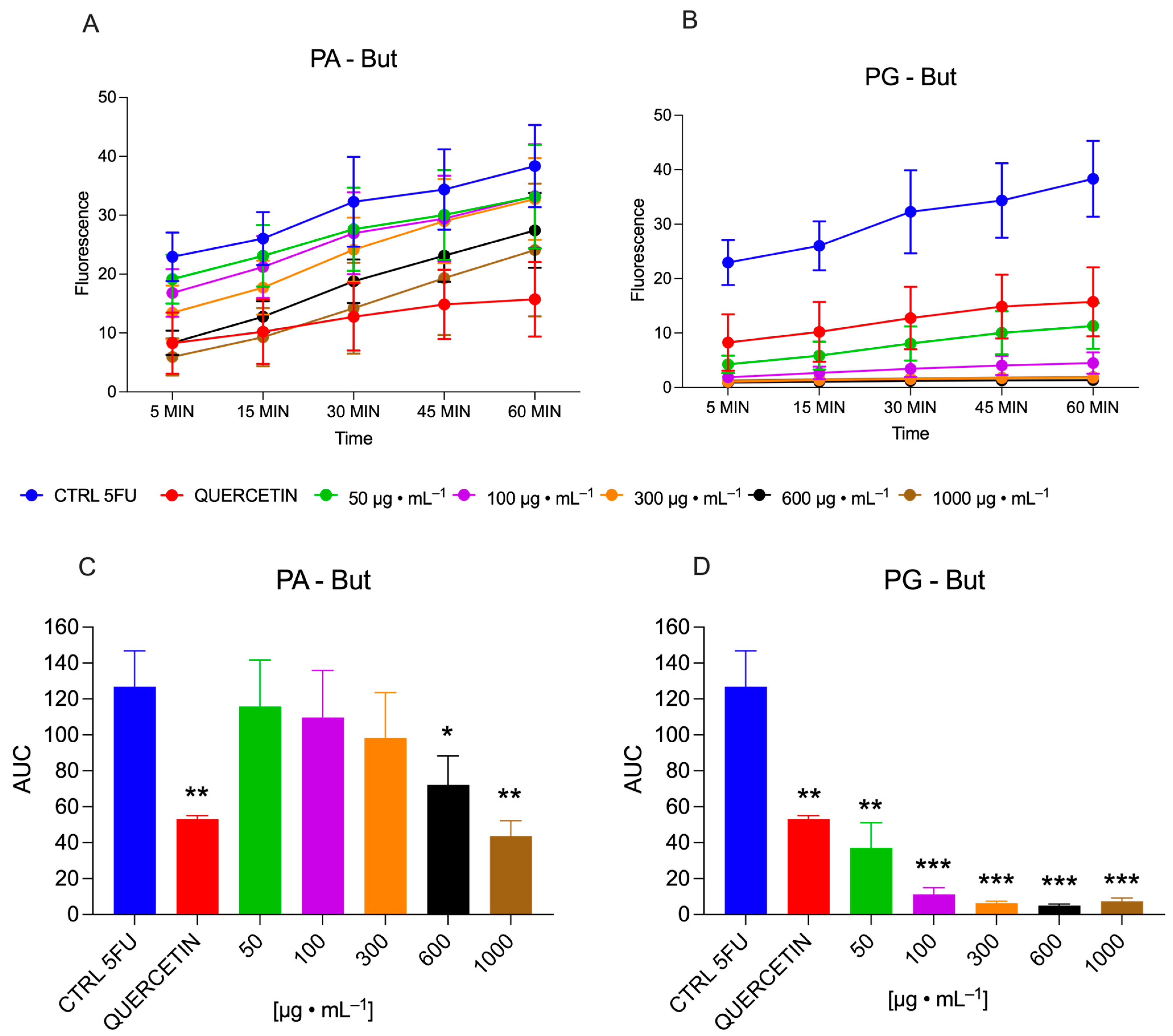
Figure 1. Cellular antioxidant activity was assessed as the ability of the P. aculeata and P. grandifolia fractions to inhibit the intracellular ROS, stimulated with 5-fluorouracil. The fractions PA-But (A) and PG-But (B) were monitored for 60 min, with PG-But showing greater anti-ROS activity. This was confirmed by the AUC calculated from individual concentrations, demonstrating that the PA-But fraction (C) was effective only at higher concentrations (600 and 1000 μg·mL−1). In contrast, the PG-But fraction exhibited a strong antioxidant effect at the lowest tested concentration, and achieved decreases greater than 90% at the higher concentrations (D). The asterisks indicate the confidence level, as follows: * p < 0.05, ** p < 0.01, *** p < 0.001.
Pharmaceuticals 19 00038 g001
Figure 2. Phytochemical analysis of the fractions from Pereskia aculeata (A) and Pereskia grandifolia (B). Distinct chemical constituents are observed in the chromatograms of the PA-But and PG-But fractions. The peak numbers correspond to the compounds further described in the text and Table 2.
Pharmaceuticals 19 00038 g002
Figure 3. Proposed structure and mass spectra (MS2) data obtained in negative ionization. (A) Compound 11, formed by a caffeic acid attached to a rutinose. (B,C) Structures for compounds 4 and 17, based on mass spectra, are consistent with these depicted compounds. (D) Chemical structure of the compound 21, tentatively identified as caffeoyl malic acid. (E) Structure and diversity of flavonol glycosides, composed of kaempferol, quercetin, and isorhamnetin, attached by mono- or oligosaccharides formed by Ara (arabinose), Rha (rhamnose), Gal (galactose), and Glc (Glucose). (F) Structure of compound 47, consistent with a 1,3-dicaffeoylglucose. (G) A representative structure of trihydroxy-octadecadienoic acid, as found for compounds 4951, and the MS data, consistent with the structure. (H) The structure of a sulfoquinovosylmonoacylglycerol, compound 62, the mass spectrum contains key fragments (i.e., m/z 225.005) that support this structure.
Pharmaceuticals 19 00038 g003
Figure 4. (A) Isomeric compounds 63/64 with similar mass spectra consistent with the structure of the isoquinolic alkaloid salsolinol. Structures and mass spectra of abrine (B) and hypaphorine (C), consistent with compounds 67 and 69, were tentatively identified in P. aculeata.
Pharmaceuticals 19 00038 g004
Figure 5. Proposed structure for compound 80 and its mass spectrum, showing strong correlation with geranyl β-primeveroside.
Pharmaceuticals 19 00038 g005
Figure 6. A saponin found in P. grandifolia, depicted based on the structure reported by Sahu et al. [41], and its mass spectrum assignment. Other saponins that share a similar structural core, composed of oleanolic acid attached by a glucuronic acid. The glycan chains are elongated with glucose units up to three units. Due to several isomers found, other glycosidic linkages, and another aglycone, such as ursolic acid, must be regarded as necessary to explain this variability. * The aglycone fragment was not produced from all compounds.
Pharmaceuticals 19 00038 g006
Table 1. Assessment of antioxidant potential, total phenolics, and flavonoids.
SampleDPPH (IC50—μg·mL−1) 1Phosphomolybdenum Complex (%RAA) 2Total Polyphenols 3Total Flavonoids 4
PA-But22.1 ± 5.9 a43.1 ± 1.5 a102 ± 3 a69.1 ± 0.5 a
PA-Aq60 ± 3.1 b27.8 ± 1.5 b62.2 ± 0.2 b31.5 ± 0.5 b
PG-But53.3 ± 0.6 b22.1 ± 1.8 c28.8 ± 0.4 c40.8 ± 2.1 c
PG-Aq86.8 ± 5.8 c10.8 ± 1.6 d17.2 ± 0.2 d25 ± 2.3 d
Ascorbic acid6.1 ± 0.5 d100 *--
Values in each column that have a distinct letter were statistically different (p < 0.05), while the same letter indicated the lack of differences (p > 0.05), as measured by one-way analysis of variance (ANOVA) followed by Tukey’s multiple comparison test. 1 IC50: concentration of samples required to inhibit the formation of DPPH radicals by 50%. 2 The results were expressed as percentages, with ascorbic acid * serving as the 100% standard. 3 Quantification of total polyphenols as mg of gallic acid equivalent per g of extract, and 4 quantification of total flavonoids as mg of quercetin equivalent per g of extract.
Table 2. Phytochemical profile from the fractions PA-But (P. aculeata) and PG-But (P. grandifolia), tentatively identified based on mass spectra data.
PeaktRPrecursor IonFragmentsMolecular FormulaTentatively Identification
PA-But
10.835377.08402341.107, 215.033, 179.054C12H22O11 [M+Cl]Sucrose
21.333191.01834129.018, 111.007, 87.007, 85.028C6H8O7 [M-H]Citric acid
31.919176.07080161.047, 160.039, 149.061, 134.023 n.i.
42.095197.00800153.018, 151.002, 125.023, 109.028, 107.013, 83.130, 65.002C8H8O6 [M-H]Dihydroxybenzene-dicarboxylic acid
52.870315.10704153.054, 123.044C14H20O8 [M-H]Hydroxytyrosol glucoside
63.273153.01835123.044, 109.028, 108.020, 91.018, 81.033C7H6O4 [M-H]Protocatechuic acid
73.922341.08578179.033, 135.044C15H18O9 [M-H]Caffeoyl glucoside
84.892175.06023115.039, 113.059, 85.065C7H12O5 [M-H]Isopropylmalic acid
95.069291.09686142.065, 119.049 n.i.
105.121526.18929218.080 n.i.
115.209487.14361179.034, 135.045C21H28O13 [M-H]Caffeoyl rutinoside
125.395341.08622179.033, 135,044C15H18O9 [M-H]Caffeoyl glucoside
135.513325.09098163.038, 119.049C15H18O8 [M-H]p-Coumaroyl glucoside
145.734218.08103188.070, 162.055, 135.044, 82.029C12H13NO3 [M-H]n.i.
156.011315.10672153.054C14H20O8 [M-H]Hydroxytyrosol glucoside isomer
166.262179.03401135.044C9H8O4 [M-H]Caffeic acid
176.386333.02271197.008, 178.997, 153.017, 151.002C15H10O9 [M-H]Protocatechuic-dihydroxybenzene-dicarboxylic acid.
186.613447.14793401.145, 269.098, 161.043C25H22O5 [M+HCOO]n.i.
197.162435.22101n.d.C27H32O5 [M-H]n.i.
207.232567.26187521.257, 389.217, 293,085, 161.045C24H42O12 [M+HCOO]Alangionoside B isomer
217.701295.04444179.033, 135.044, 133.013, 115.002C13H12O8 [M-H]Caffeoyl malic acid
227.897359.09657151.038C14H18O8 [M+HCOO]Methoxybenzoyl hexoside
238.070371.09643249.060, 231.050, 121.028C16H20O10 [M-H]Benzoyl glycoside
248.625163.03886119.049, 93.033C9H8O3 [M-H]p-Coumaric acid
258.927755.19918609.143, 300.024C33H40O20 [M-H]Quercetin (Rha)2-hexoside
269.040755.19850609.142, 301.030C33H40O20 [M-H]Quercetin (Rha)2-hexoside
279.365741.18404609.140, 300.025C32H38O20 [M-H]Quercetin Ara-Rha-hexoside
289.559741.18352609.140, 300.025C32H38O20 [M-H]Quercetin Ara-Rha-hexoside
299.859739.20474284.031C33H40O19 [M-H]Kaempferol (Rha)2-hexoside
309.995595.12665300.025C26H28O16 [M-H]Quercetin Ara-hexoside
3110.157595.12705463.086, 300.025C26H28O16 [M-H]Quercetin Ara-hexoside
3210.255609.14257301.033, 300.025C27H30O16 [M-H]Rutin (isomer)
3310.375725.18896593.142, 285.038, 284.030C32H38O19 [M-H]Kaempferol Ara-Rha-hexoside
3410.633725.18895593.143, 285.038, 284.030C32H38O19 [M-H]Kaempferol Ara-Rha-hexoside
3510.695463.08488301.033, 300.025C21H20O12 [M-H]Quercetin hexoside
3610.862755.19913623.157, 315.049, 314.041, 299.016C33H40O20 [M-H]Isorhamnetin Ara-Rha-hexoside
3710.981463.08520301.033, 300.025C21H20O12 [M-H]Quercetin hexoside
3811.123579.13170447.092, 285.038, 284.035C26H28O15 [M-H]Kaempferol Ara-hexoside
3911.287593.14714285.037, 284.035C27H30O15 [M-H]Kaempferol Rha-hexoside
4011.469262.07029218.080, 200.069, 146.060, 115.002C13H13NO5 [M-H]Isoquinoline alkaloid
4111.586609.14161315.049, 314.042C27H30O16 [M-H]Isorhamnetin Ara-hexoside
4211.877447.09039285.038, 284.035C21H20O11 [M-H]Kaempferol hexoside
4312.025623.15751315.049, 314.041C28H32O16 [M-H]Isorhamnetin Rha-hexoside
4412.514477.10041315.048, 314.042C22H22O12 [M-H]Isorhamnetin hexoside
4512.802477.10011314.041C22H22O12 [M-H]Isorhamnetin hexoside
4613.133579.13207315/315C26H28O15 [M-H]Isorhamnetin Ara-arabinoside
4713.134503.11619323.074, 179.033, 135.044C24H24O12 [M-H]Dicaffeoyl-hexose
4816.560301.03295178.997, 151.002, 121.028, 107.013C15H10O7 [M-H]Quercetin
4919.611327.21548229.143, 211.133, 171.101C18H32O5 [M-H]Trihydroxy-octadecadienoic acid
5019.716327.21516291.195, 229.143, 211.132, 171.100C18H32O5 [M-H]Trihydroxy-octadecadienoic acid
5119.868327.21532229.144, 211.132, 171.100C18H32O5 [M-H]Trihydroxy-octadecadienoic acid
5220.421955.48309775.422, 613.370, 569.381, 179.054C48H76O19 [M-H]Triglycosyl-saponin
5322.506793.43180613.369, 569.378C42H66O14 [M-H]Diglycosyl-saponin
5422.660721.35951675.352, 415.142, 397.132, 277.216C33H56O14 [M+HCOO]Digalactosylmonoacylglycerol-C18:3
5522.779593.26897277.216, 241.009, 152.994C27H47O12P [M-H]lyso-Phosphatidylinositol-C18:3
5622.871721.35988675.355, 415.142, 397.132, 277.215, 235.081C33H56O14 [M+HCOO]Digalactosyl-monoacylglycerol-C18:3
5723.027593.26906413.209, 315.046, 277.215, 241.009, 152.994C27H47O12P [M-H]lyso-Phosphatidylinositol-C18:3
5823.770595.28406315.044, 279.231, 241.011, 152.994C27H49O12P [M-H]lyso-Phosphatidylinositol-C18:2
5923.813699.37540653.370, 415.142, 397.131, 305.084, 287.076, 255.231, 179.053C31H58O14 [M+HCOO]Digalactosylmonoacylglycerol-C16:0
6023.886265.1458296.959, 79.956C12H26O4S [M-H]SDS
6124.231571.28434315.045, 255.231, 241.009, 152.994C25H49O12P [M-H]lyso-phosphatidylinositol-C16:0
6224.988555.28003299.041, 255.230, 225.005, 164.985, 125.025C25H48O11S [M-H]Sufoquinovosylmonoacylglycerol-C16:0
630.900180.10012163.073, 145.062, 117.068, 115.052, 91.052C10H13NO2 [M+H]+Solsolinol isomer 1
641.336180.10017163.073, 145.062, 117.068, 115.052, 91.052C10H13NO2 [M+H]+Solsolinol isomer 2
652.305166.08455120.079, 103.052, 91.052, 77.037C9H11NO2 [M+H]+Phenylalanine
663.922205.09504188.068, 146.057, 118.063, 115.052, 91.052C11H12N2O2 [M+H]+Tryptophan
674.113219.11031188.068, 146.058, 132.078, 118.063, 91.052C12H14N2O2 [M+H]+Abrine
685.086247.14134188.067, 170.057, 146.057, 118.062, 91.051, 60.078C14H19N2O2 [M]+Hipaphorine
6922.352318.29637300.285, 282.274, 270.264, 264.264, 252.262C18H39NO3 [M+H]+Phytosphingosine
7023.997496.33387478.320, 184.069, 124.996, 104.103C24H51NO7P [M]+lyso-Phosphatidylcholine-C16
PG-But
715.502527.22978481.223, 349.186, 149.042C21H38O12 [M+HCOO]Distyloside A pentoside
725.657395.18859349.185, 179.055C16H30O8 [M+HCOO]Distyloside A
735.968527.22951481.224C21H38O12 [M+HCOO]Distyloside A pentoside
746.052278.06458216.062, 162.054, 132.028, 119.049C13H13NO6 [M-H]Isoquinoline alkaloid
756.607447.14683401.142, 269.100, 193.048, 161.043C18H26O10 [M+HCOO]Benzyl primeveroside
767.271431.18869385.183, 223.132, 205.121, 161.044, 153.090C19H30O8 [M+HCOO]Roseoside isomer
238.079371.09519249.059, 121.027C16H20O10 [M-H]Benzoyl glycoside
258.927755.19844609.141, 301.032, 300.024C33H40O20 [M-H]Quercetin (Rha)2-hexoside
299.864739.20305593.148, 284.029/285.037C33H40O19 [M-H]Kaempferol (Rha)2-hexoside
3210.267609.14050301.033, 300.024C27H30O16 [M-H]Rutin (isomer)
7711.478262.07073218.080, 200.070, 146.059, 115.002C13H13NO5 [M-H]Isoquinoline alkaloid
7813.25691.25579631.231, 355.129, 335.121, 317.110, 273.122C34H44O15 [M-H]n.i.
7914.381521.12538399.089, 152.010, 121.027C31H22O8 [M-H]Benzoic acid derivative
8016.55493.22444447.219, 315.179, 161.044C21H36O10 [M+HCOO]Geranyl-primeveroside (isomer)
8117.661551.33865505.334, 487.320C30H48O9 [M-H]n.i.
8219.195675.26108615.240, 335.121, 317.110, 273.121C34H44O14 [M-H]n.i.
8319.558711.37422665.370, 503.317, 179.052C36H58O11 [M+HCOO]Modecassic acid hexoside
8419.886985.49223805.430, 643.379C49H78O20 [M-H]Methyl-hederagenin (Glc)2-glucuronide
8520.1271117.53369955.490, 775.416, 613.367, 179.055C54H86O24 [M-H]Ursolic/Oleanolic acid (Glc)3-glucuronide
8620.2691087.52311n.d.C53H84O23 [M-H]Ursolic/Oleanolic acid Ara-(Glc)2-glucuronide
8720.451955.48262775.420, 613.369, 569.380, 179.053C48H76O19 [M-H]Ursolic/Oleanolic acid (Glc)2-glucuronide
8820.604793.43032631.383C42H66O14 [M-H]Ursolic/Oleanolic acid glucosyl-glucuronide
8920.745503.31805n.d.C30H48O [M-H]Madecassic acid (isomer)
9020.893793.43112631.380, 613.368, 569.380C42H66O14 [M-H]Ursolic/Oleanolic acid glucosyl-glucuronide
9120.986589.31742545.327, 465.841C36H46O7 [M-H]n.i.
9221.51809.42556629.363, 585.384C42H66O15 [M-H]Hydroxy-Ursolic/Oleanolic acid glucosyl-glucuronide
9321.788955.48179775.423, 613.368C48H76O19 [M-H]Ursolic/Oleanolic acid (Glc)2-glucuronide
9421.949955.48196613.368C48H76O19 [M-H]Ursolic/Oleanolic acid (Glc)2-glucuronide
9522.002925.47164n.d.C47H74O18 [M-H]Ursolic/Oleanolic acid Ara-Glc-glucuronide
9622.132793.43058613.367C42H66O14 [M-H]Ursolic/Oleanolic acid glucosyl-glucuronide
9722.176791.41490611.353, 523.374C42H64O14 [M-H]Moronic acid glucosyl-glucuronide
9822.337793.43078613.369, 569.380, 179.053C42H66O14 [M-H]Ursolic/Oleanolic acid glucosyl-glucuronide
9922.512793.43059613.369, 569.378, 179.052C42H66O14 [M-H]Ursolic/Oleanolic acid glucosyl-glucuronide
10022.643835.44134655.380, 611.388, 595.359, 483.342, 157.013C44H68O15 [M-H](Acetyl) Ursolic/Oleanolic acid glucosyl-glucuronide
5622.865721.35895675.356, 415.143, 397.132, 277.214C33H56O14 [M+HCOO]Digalactosyl-monoacylglycerol-C18:3
10223.033631.37948613.374C36H56O9 [M-H]Ursolic/Oleanolic acid-glucuronide
10323.232631.37960613.373, 455.350C36H56O9 [M-H]Ursolic/Oleanolic acid-glucuronide
6124.211571.28370391.223, 315.044, 255.230, 241.010, 152.994C25H49O12P [M-H]lyso-Phosphatidylinositol C16:0
6224.921555.27955299.041, 255.232, 225.005, 164.984, 152.98337, 125.023, 94.979, 80.963C25H48O11S [M-H]Sufoquinovosylmonoacylglycerol-C16:0
Peak numbers refer to the number of each chromatographic peak depicted in Figure 1; tR—relative retention time; n.d.—not detected; n.i.—not identified.
Disclaimer/Publisher’s Note: The statements, opinions and data contained in all publications are solely those of the individual author(s) and contributor(s) and not of MDPI and/or the editor(s). MDPI and/or the editor(s) disclaim responsibility for any injury to people or property resulting from any ideas, methods, instructions or products referred to in the content.