KA-IHO: A Kinematic-Aware Improved Hippo Optimization Algorithm for Collision-Free Mobile Robot Path Planning in Complex Grid Environments
 , , ,
, , , 
Abstract
1. Introduction
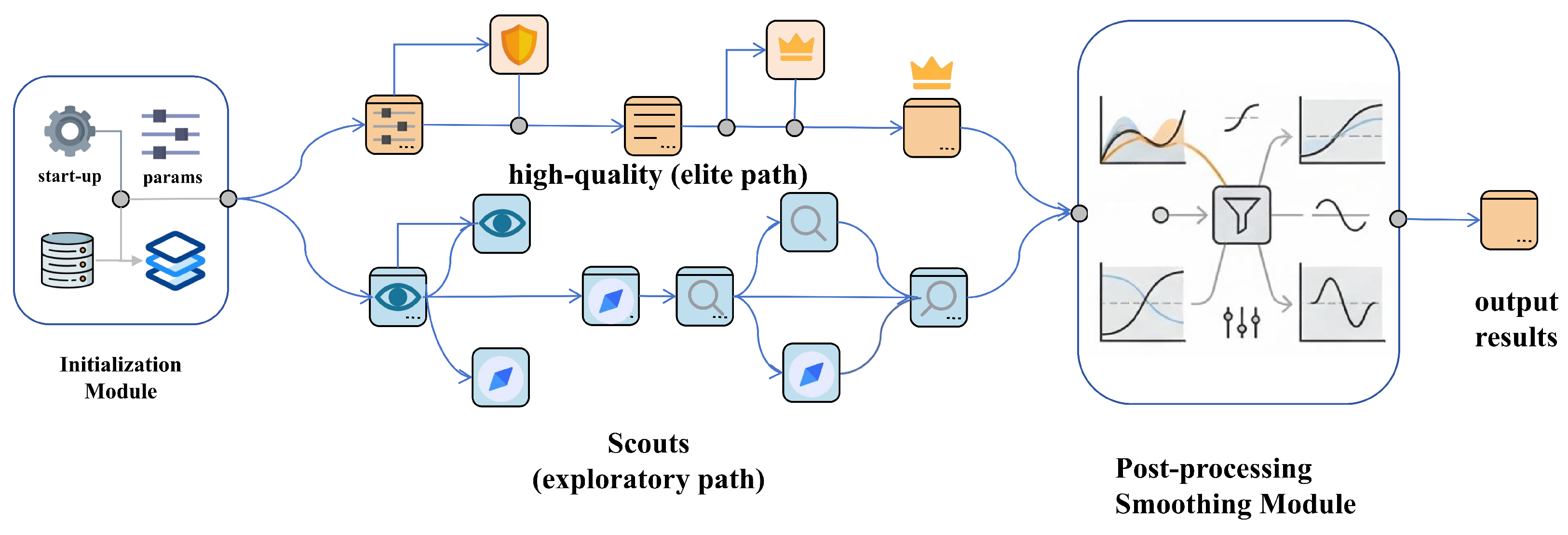
- Elite Safety Pool Initialization Strategy. While elite-based initialization has been explored in general metaheuristic design, its systematic application to collision-constrained path planning remains largely unaddressed. The proposed strategy generates a candidate solution pool 100 times larger than the formal population and mandates the selection of zero-collision elite individuals, mathematically eliminating the “initialization deadlock” problem in high-obstacle-density environments and achieving near-100% probability of constructing a safe initial population. The key innovation lies in the path-scene-specific perturbation scheme (Equation (7)) that combines straight-line baseline seeding with adaptive noise scaling, which is specifically designed for grid-map collision landscapes rather than general function optimization.
- Hierarchical Elite-Scout Iterative Framework. Although layered population structures and Lévy flight [19,20] and differential mutation [21] are individually well established, their integration into a unified hierarchical framework with a dynamically time-decaying exploration probability tailored to map scale is a novel contribution of this work. The population is ranked by fitness and partitioned into an elite layer (centripetal contraction exploitation) and a scout layer (Lévy flight + differential mutation exploration). Through differentiated update rules, this framework achieves dynamic coordination of global exploration and local refinement, simultaneously ensuring optimization accuracy and convergence robustness under extreme small-population and low-iteration constraints.
- Late-Stage Laplacian Line-of-Sight Ironing Operator. Path smoothing post-processors exist in the literature [22,23], but they are typically applied as a separate offline step after optimization terminates. The innovation of the proposed operator is its embedding within the iterative optimization loop with a zero-collision hard constraint, so that geometric straightening and feasibility enforcement are performed jointly and incrementally during the late iteration stage rather than as a decoupled post-process. This greedy geometric refinement mechanism based on midpoint straightening eliminates geometric redundancy and sharp turns, compressing the output path length to its theoretical minimum while ensuring that trajectories satisfy the nonholonomic kinematic constraints of mobile robots and are directly deployable on real platforms [1,2].
- Anti-Stagnation Mechanisms. Restart strategies and local search operators are known techniques in the metaheuristic literature; the specific contribution here is their co-design for the grid path planning context: the Population Stagnation Restart (PSR) strategy incorporates an adaptive elite-reduction schedule triggered only within a mid-stage iteration window to avoid disrupting late-stage convergence, while the 10-Direction Radial Micro-Search is purpose-built to resolve pixel-level collision residuals in narrow corridors that standard gradient-free updates cannot address. Collectively, these mechanisms guarantee high success rates across all map complexities.
2. Related Work
2.1. Classical Swarm Intelligence Optimization Algorithms
2.2. Recent Advances in Metaheuristic Algorithms (2020–2024)
2.3. Key Techniques in Path Planning: Initialization, Lévy Flight, and Path Smoothing
3. Methods
3.1. Problem Formulation
3.2. Overall Framework of KA-IHO
| Algorithm 1 Kinematic-Aware Improved Hippo Optimization (KA-IHO). |
| Require: map grid , start S, goal E, , T, Ensure: best_path, best_fitness, convergence_curve
|
3.3. Oversized Elite Safety Pool Initialization
3.4. Hierarchical Elite-Scout Iterative Framework
3.4.1. Elite Layer Update (Centripetal Contraction)
3.4.2. Scout Layer Update (Lévy Flight and Differential Mutation)
3.5. Dynamic Fitness Function
3.6. Anti-Stagnation Mechanisms: Population Stagnation Restart and Radial Micro-Search
3.6.1. Population Stagnation Restart (PSR) with Adaptive Elite Reduction
3.6.2. 10-Direction Radial Micro-Search
3.7. Late-Stage Laplacian Line-of-Sight Ironing Operator
4. Experimental Results
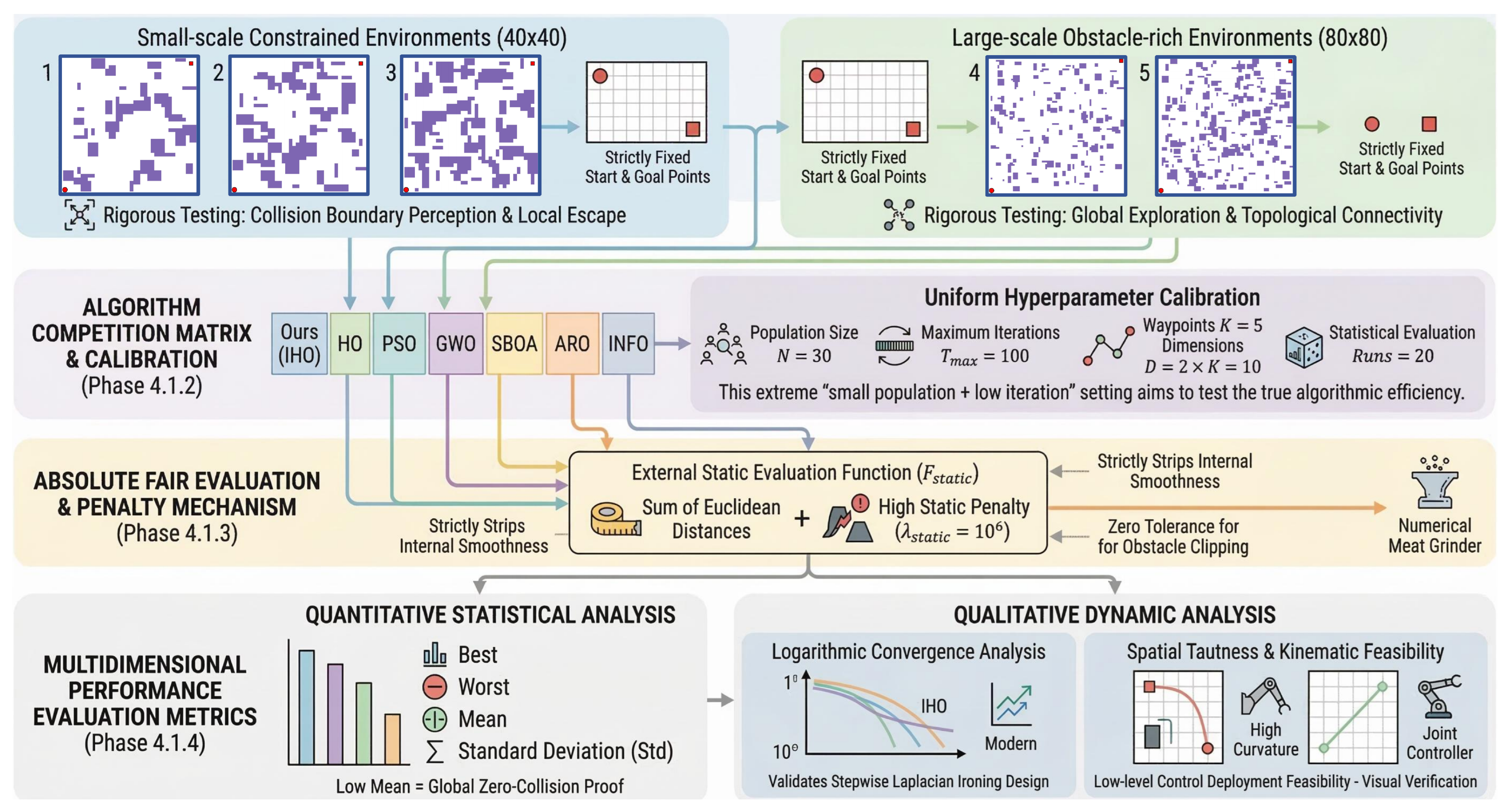
4.1. Experimental Setup
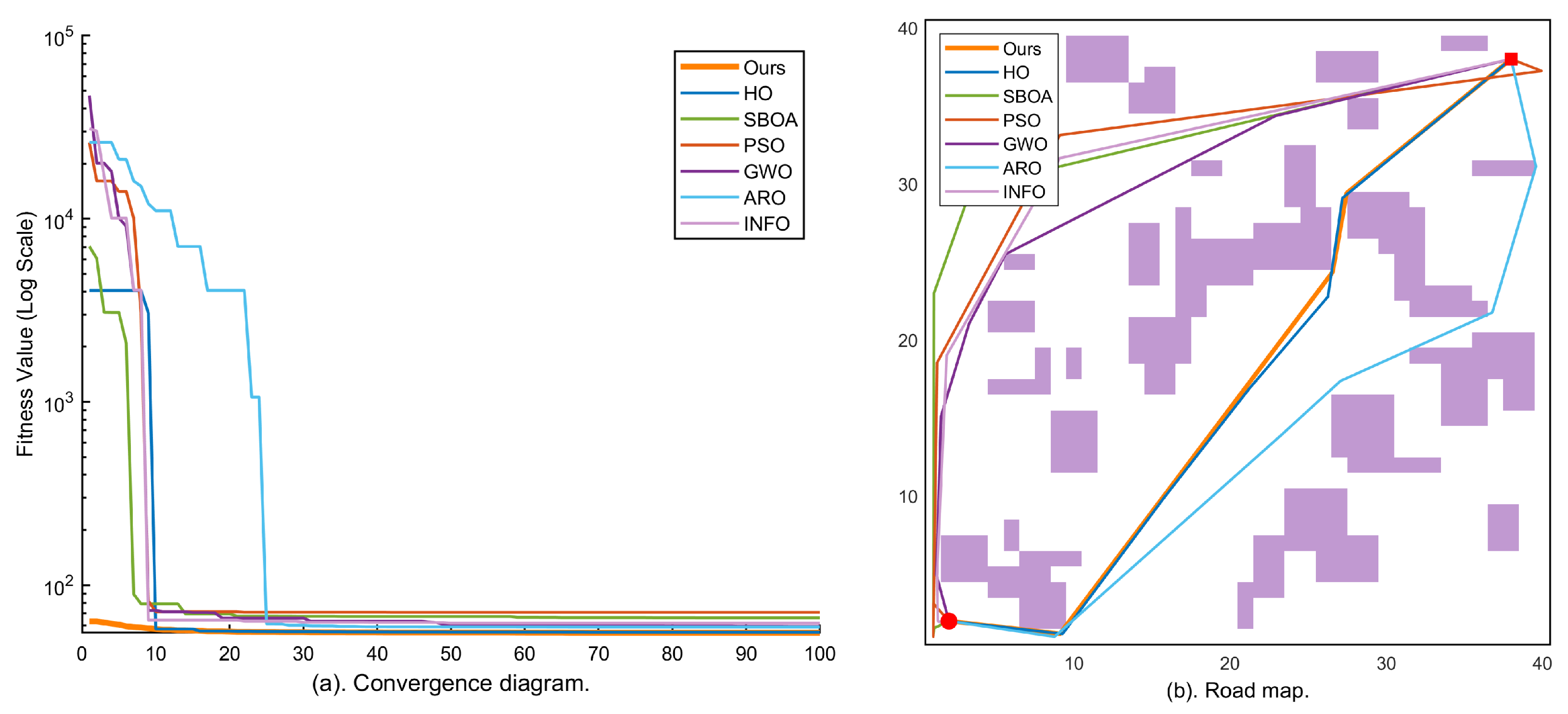
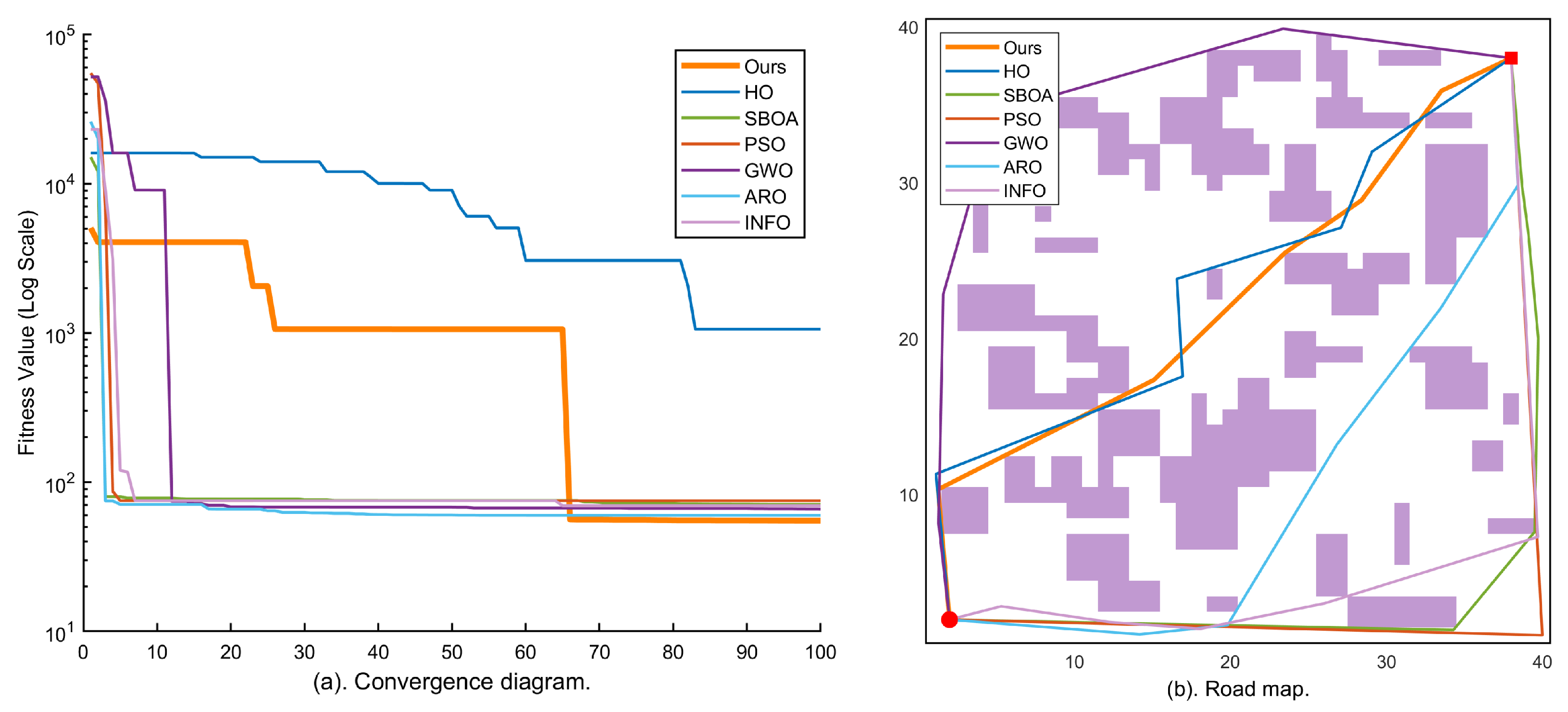
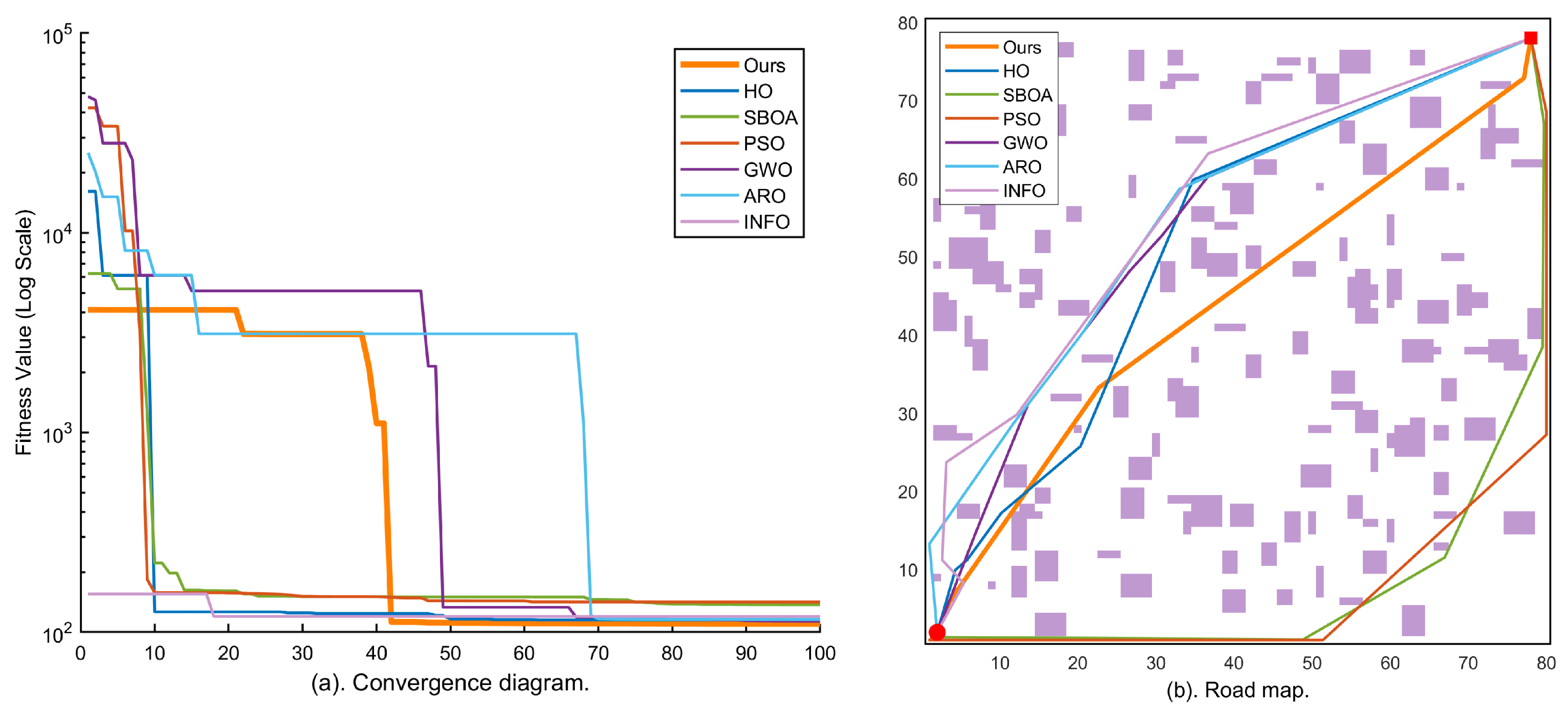
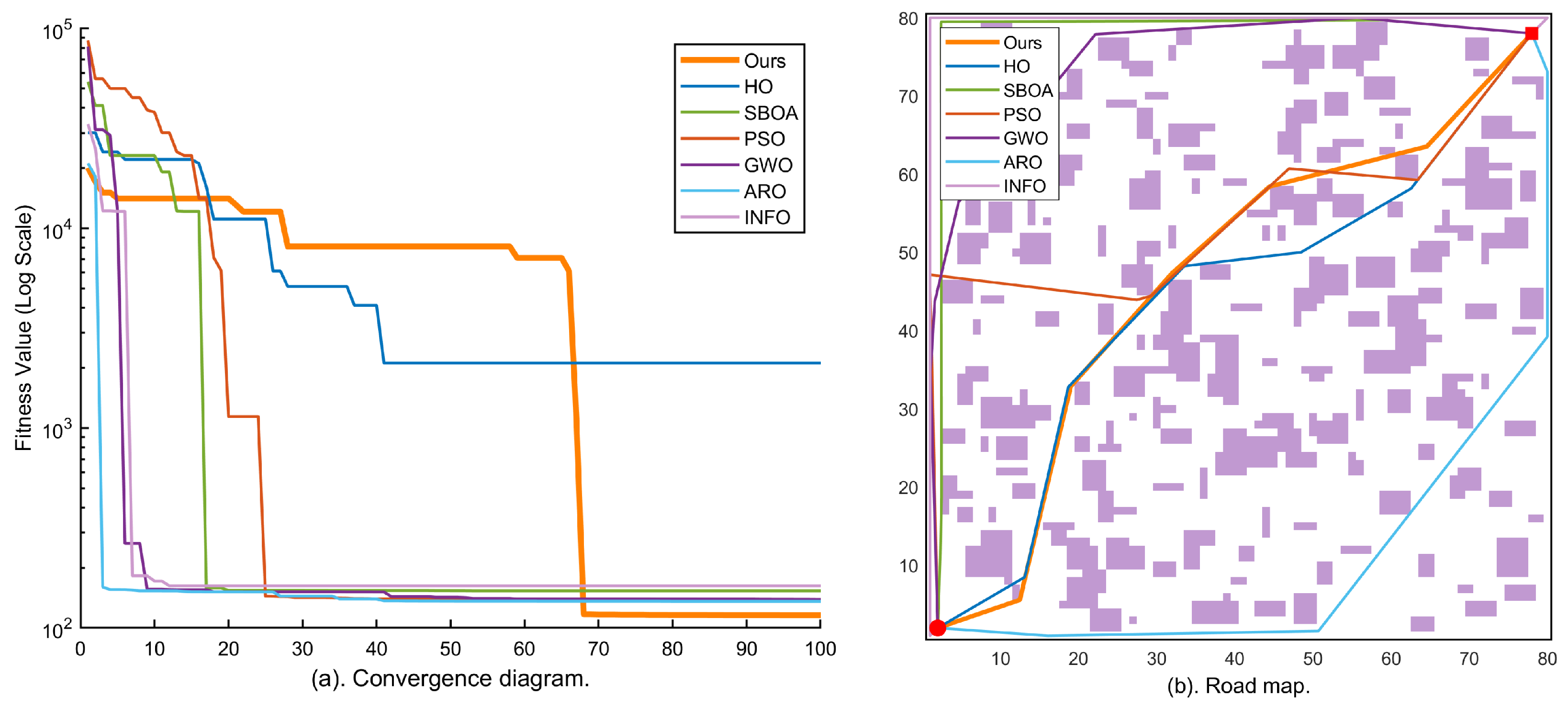
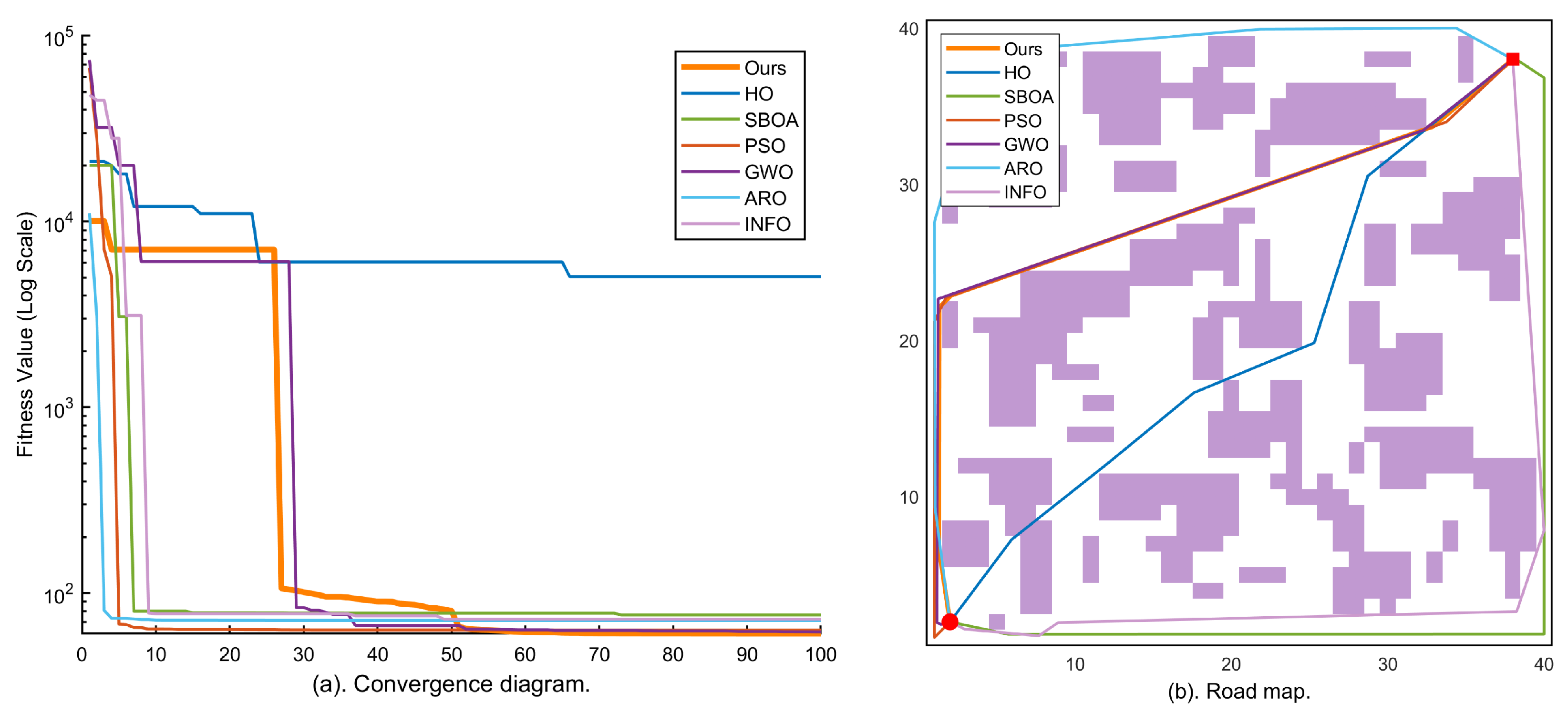
4.2. Simulation Results in Small-Scale Environments (Maps 1–3, 40 × 40)
4.3. Simulation Results in Large-Scale Environments (Maps 4–5, 80 × 80)
4.4. Ablation Study
- Var-A (Baseline): Elite safety pool initialization only; no kinematic smoothness penalty, no Laplacian ironing, no anti-stagnation mechanisms. This variant isolates the contribution of the initialization strategy.
- Var-B (+Kine): Var-A augmented with the kinematic smoothness penalty term in the dynamic fitness function (Section 3.5). This variant isolates the contribution of the kinematic enforcement during iteration.
- Var-C (+Kine+Lap): Var-B augmented with the late-stage Laplacian Line-of-Sight Ironing Operator (Section 3.7). This variant isolates the joint contribution of kinematic penalty and geometric post-refinement.
- Var-D (+Kine+Adp): Var-B augmented with the anti-stagnation mechanisms (PSR and 10-Direction Radial Micro-Search, Section 3.6) but without the Laplacian operator. This variant isolates the contribution of anti-stagnation.
- Full KA-IHO: The complete proposed algorithm with all four components active.
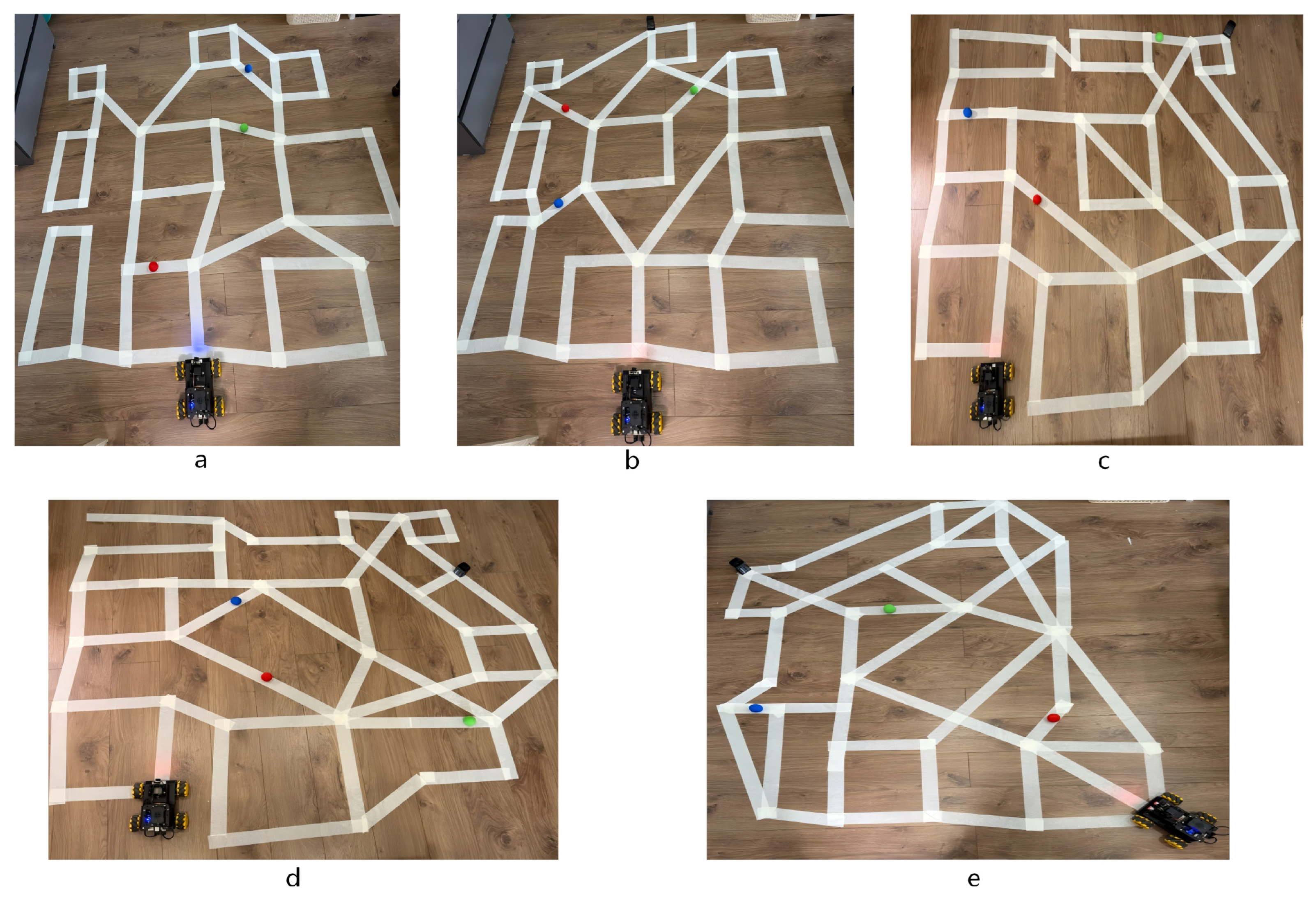
4.5. Hardware Platform Validation
5. Discussion
5.1. Convergence Dynamics Analysis
5.2. Trajectory Quality and Kinematic Feasibility Analysis
5.3. Limitations and Future Work
6. Conclusions
Author Contributions
Funding
Institutional Review Board Statement
Informed Consent Statement
Data Availability Statement
Acknowledgments
Conflicts of Interest
References
- Zheng, L.; Wang, X.; Li, F.; Mao, Z.; Tian, Z.; Peng, Y.; Yuan, C. A mean-field-game-integrated MPC-QP framework for collision-free multi-vehicle control. Drones 2025, 9, 375. [Google Scholar] [CrossRef]
- Xu, L.; Yuan, C.; Jiang, Z. Multi-strategy enhanced secret bird optimization algorithm for solving obstacle avoidance path planning for mobile robots. Mathematics 2025, 13, 717. [Google Scholar] [CrossRef]
- Rashedi, E.; Nezamabadi-pour, H.; Saryazdi, S. GSA: A gravitational search algorithm. Inf. Sci. 2009, 179, 2232–2248. [Google Scholar] [CrossRef]
- Cheng, R.; Jin, Y. A competitive swarm optimizer for large scale optimization. IEEE Trans. Cybern. 2015, 45, 191–204. [Google Scholar] [CrossRef]
- Kennedy, J.; Eberhart, R. Particle swarm optimization. In Proceedings of the ICNN’95—International Conference on Neural Networks, Perth, WA, Australia, 27 November–1 December 1995; Volume 4, pp. 1942–1948. [Google Scholar] [CrossRef]
- Dorigo, M.; Birattari, M.; Stutzle, T. Ant colony optimization. IEEE Comput. Intell. Mag. 2006, 1, 28–39. [Google Scholar] [CrossRef]
- Whitley, D. A genetic algorithm tutorial. Stat. Comput. 1994, 4, 65–85. [Google Scholar] [CrossRef]
- Mirjalili, S.; Mirjalili, S.M.; Lewis, A. Grey wolf optimizer. Adv. Eng. Softw. 2014, 69, 46–61. [Google Scholar] [CrossRef]
- Mirjalili, S.; Lewis, A. The whale optimization algorithm. Adv. Eng. Softw. 2016, 95, 51–67. [Google Scholar] [CrossRef]
- Heidari, A.A.; Mirjalili, S.; Faris, H.; Aljarah, I.; Mafarja, M.; Chen, H. Harris hawks optimization: Algorithm and applications. Future Gener. Comput. Syst. 2019, 97, 849–872. [Google Scholar] [CrossRef]
- Saremi, S.; Mirjalili, S.; Lewis, A. Grasshopper optimisation algorithm: Theory and application. Adv. Eng. Softw. 2017, 105, 30–47. [Google Scholar] [CrossRef]
- Faramarzi, A.; Heidarinejad, M.; Mirjalili, S.; Gandomi, A.H. Marine predators algorithm: A nature-inspired metaheuristic. Expert Syst. Appl. 2020, 152, 113377. [Google Scholar] [CrossRef]
- Wolpert, D.H.; Macready, W.G. No free lunch theorems for optimization. IEEE Trans. Evol. Comput. 1997, 1, 67–82. [Google Scholar] [CrossRef]
- Fritsch, C.J.; Hanekom, C.; Downs, C.T. Hippopotamus population trends in Ndumo Game Reserve, South Africa, from 1951 to 2021. Glob. Ecol. Conserv. 2021, 32, e01910. [Google Scholar] [CrossRef]
- Stears, K.; Nuñez, T.; Muse, E.; Mutayoba, B.; Mccauley, D. Spatial ecology of male hippopotamus in a changing watershed. Sci. Rep. 2019, 9, 15392. [Google Scholar] [CrossRef]
- Lewison, R.L.; Carter, J. Exploring behavior of an unusual megaherbivore: A spatially explicit foraging model of the hippopotamus. Ecol. Model. 2004, 171, 127–138. [Google Scholar] [CrossRef]
- Olivier, R.; Laurie, A. Habitat utilization by hippopotamus in the Mara River. East Afr. J. Ecol. 1974, 12, 249–271. [Google Scholar] [CrossRef]
- Timbuka, C.D. The Ecology and Behaviour of the Common Hippopotamus, Hippopotamus amphibious L., in Katavi National Park, Tanzania: Responses to Varying Water Resources. Ph.D. Thesis, University of Dar es Salaam, Dar es Salaam, Tanzania, 2012. [Google Scholar]
- Houssein, E.H.; Saad, M.R.; Hashim, F.A.; Shaban, H.; Hassaballah, M. Lévy flight distribution: A new metaheuristic algorithm for solving engineering optimization problems. Eng. Appl. Artif. Intell. 2020, 94, 103731. [Google Scholar] [CrossRef]
- Wu, L.; Wu, J.; Wang, T. Enhancing grasshopper optimization algorithm (GOA) with Lévy flight for engineering applications. Sci. Rep. 2023, 13, 124. [Google Scholar] [CrossRef]
- Storn, R.; Price, K. Differential evolution—A simple and efficient heuristic for global optimization over continuous spaces. J. Glob. Optim. 1997, 11, 341–359. [Google Scholar] [CrossRef]
- Emam, M.M.; Samee, N.A.; Jamjoom, M.M.; Houssein, E.H. Optimized deep learning architecture for brain tumor classification using improved hunger games search algorithm. Comput. Biol. Med. 2023, 160, 106966. [Google Scholar] [CrossRef]
- Abdollahzadeh, B.; Khodadadi, N.; Barshandeh, N.; Trojovský, P.; Gharehchopogh, F.S.; El-kenawy, E.-S.M.; Abualigah, L.; Mirjalili, S. Puma optimizer (PO): A novel metaheuristic optimization algorithm and its application in machine learning. Clust. Comput. 2024, 27, 5235–5283. [Google Scholar] [CrossRef]
- Garg, H. A hybrid PSO-GA algorithm for constrained optimization problems. Appl. Math. Comput. 2016, 274, 292–305. [Google Scholar] [CrossRef]
- Mirjalili, S. Moth-flame optimization algorithm: A novel nature-inspired heuristic paradigm. Knowl.-Based Syst. 2015, 89, 228–249. [Google Scholar] [CrossRef]
- Mirjalili, S. The ant lion optimizer. Adv. Eng. Softw. 2015, 83, 80–98. [Google Scholar] [CrossRef]
- Mirjalili, S. SCA: A sine cosine algorithm for solving optimization problems. Knowl.-Based Syst. 2016, 96, 120–133. [Google Scholar] [CrossRef]
- Mirjalili, S.; Gandomi, A.H.; Mirjalili, S.Z.; Saremi, S.; Faris, H.; Mirjalili, S.M. Salp swarm algorithm: A bio-inspired optimizer for engineering design problems. Adv. Eng. Softw. 2017, 114, 163–191. [Google Scholar] [CrossRef]
- Mirjalili, S.; Mirjalili, S.M.; Hatamlou, A. Multi-Verse Optimizer: A nature-inspired algorithm for global optimization. Neural Comput. Appl. 2016, 27, 495–513. [Google Scholar] [CrossRef]
- Li, S.; Chen, H.; Wang, M.; Heidari, A.A.; Mirjalili, S. Slime mould algorithm: A new method for stochastic optimization. Future Gener. Comput. Syst. 2020, 111, 300–323. [Google Scholar] [CrossRef]
- Faramarzi, A.; Heidarinejad, M.; Stephens, B.; Mirjalili, S. Equilibrium optimizer: A novel optimization algorithm. Knowl.-Based Syst. 2020, 191, 105190. [Google Scholar] [CrossRef]
- Abualigah, L.; Yousri, D.; Abd Elaziz, M.; Ewees, A.A.; Al-qaness, M.A.; Gandomi, A.H. Aquila optimizer: A novel meta-heuristic optimization algorithm. Comput. Ind. Eng. 2021, 157, 107250. [Google Scholar] [CrossRef]
- Abdollahzadeh, B.; Gharehchopogh, F.S.; Mirjalili, S. African vultures optimization algorithm: A new nature-inspired metaheuristic algorithm for global optimization problems. Comput. Ind. Eng. 2021, 158, 107408. [Google Scholar] [CrossRef]
- Abdollahzadeh, B.; Soleimanian Gharehchopogh, F.; Mirjalili, S. Artificial gorilla troops optimizer: A new nature-inspired metaheuristic algorithm for global optimization problems. Int. J. Intell. Syst. 2021, 36, 5887–5958. [Google Scholar] [CrossRef]
- Abualigah, L.; Abd Elaziz, M.; Sumari, P.; Geem, Z.W.; Gandomi, A.H. Reptile search algorithm (RSA): A nature-inspired meta-heuristic optimizer. Expert Syst. Appl. 2022, 191, 116158. [Google Scholar] [CrossRef]
- Zhong, C.; Li, G.; Meng, Z. Beluga whale optimization: A novel nature-inspired metaheuristic algorithm. Knowl.-Based Syst. 2022, 251, 109215. [Google Scholar] [CrossRef]
- Zhao, W.; Wang, L.; Mirjalili, S. Artificial hummingbird algorithm: A new bio-inspired optimizer with its engineering applications. Comput. Methods Appl. Mech. Eng. 2022, 388, 114194. [Google Scholar] [CrossRef]
- Abdollahzadeh, B.; Gharehchopogh, F.S.; Khodadadi, N.; Mirjalili, S. Mountain gazelle optimizer: A new nature-inspired metaheuristic algorithm for global optimization problems. Adv. Eng. Softw. 2022, 174, 103282. [Google Scholar] [CrossRef]
- Hashim, F.A.; Houssein, E.H.; Hussain, K.; Mabrouk, M.S.; Al-Atabany, W. Honey badger algorithm: New metaheuristic algorithm for solving optimization problems. Math. Comput. Simul. 2022, 192, 84–110. [Google Scholar] [CrossRef]
- Hashim, F.A.; Hussien, A.G. Snake optimizer: A novel meta-heuristic optimization algorithm. Knowl.-Based Syst. 2022, 242, 108320. [Google Scholar] [CrossRef]
- Abdel-Basset, M.; Mohamed, R.; Jameel, M.; Abouhawwash, M. Mantis search algorithm: A novel bio-inspired algorithm for global optimization and engineering design problems. Comput. Methods Appl. Mech. Eng. 2023, 415, 116200. [Google Scholar] [CrossRef]
- Abdel-Basset, M.; Mohamed, R.; Jameel, M.; Abouhawwash, M. Nutcracker optimizer: A novel nature-inspired metaheuristic algorithm for global optimization and engineering design problems. Knowl.-Based Syst. 2023, 262, 110248. [Google Scholar] [CrossRef]
- Trojovský, P.; Dehghani, M. A new bio-inspired metaheuristic algorithm for solving optimization problems based on walruses behavior. Sci. Rep. 2023, 13, 8775. [Google Scholar] [CrossRef]
- Akbari, M.A.; Zare, M.; Azizipanah-abarghooee, R.; Mirjalili, S.; Deriche, M. The cheetah optimizer: A nature-inspired metaheuristic algorithm for large-scale optimization problems. Sci. Rep. 2022, 12, 10953. [Google Scholar] [CrossRef]
- Zhao, W.; Wang, L.; Mirjalili, S.; Fan, H.; Zhang, J.; Mirjalili, S.; Khodadadi, N.; Cao, Q. Electric eel foraging optimization: A new bio-inspired optimizer for engineering applications. Expert Syst. Appl. 2024, 238, 122200. [Google Scholar] [CrossRef]
- Wang, L.; Cao, Q.; Zhang, Z.; Mirjalili, S.; Zhao, W. Artificial rabbits optimization: A new bio-inspired meta-heuristic algorithm for solving engineering optimization problems. Eng. Appl. Artif. Intell. 2022, 114, 105082. [Google Scholar] [CrossRef]
- Fu, Y.; Liu, D.; Chen, J.; He, L. Secretary bird optimization algorithm: A new metaheuristic for solving global optimization problems. Artif. Intell. Rev. 2024, 57, 123. [Google Scholar] [CrossRef]
- Ahmadianfar, I.; Heidari, A.A.; Gandomi, A.H.; Chu, X.; Chen, H. RUN beyond the metaphor: An efficient optimization algorithm based on Runge Kutta method. Expert Syst. Appl. 2021, 181, 115079. [Google Scholar] [CrossRef]
- Liang, J.J.; Qu, B.Y.; Suganthan, P.N. Problem Definitions and Evaluation Criteria for the CEC 2014 Special Session and Competition on Single Objective Real-Parameter Numerical Optimization; Technical Report 201311; Nanyang Technological University: Singapore, 2013. [Google Scholar]
- Kudela, J.; Matousek, R. New benchmark functions for single-objective optimization based on a zigzag pattern. IEEE Access 2022, 10, 8262–8278. [Google Scholar] [CrossRef]
- Price, K.V.; Awad, N.H.; Ali, M.Z.; Suganthan, P.N. The 100-Digit Challenge: Problem Definitions and Evaluation Criteria for the 100-Digit Challenge Special Session and Competition on Single Objective Numerical Optimization; Technical Report; Nanyang Technological University: Singapore, 2018. [Google Scholar]
- Zhao, W.; Zhang, Z.; Wang, L. Manta ray foraging optimization: An effective bio-inspired optimizer for engineering applications. Eng. Appl. Artif. Intell. 2020, 87, 103300. [Google Scholar] [CrossRef]
- Stavrinidis, S.; Zacharia, P. An ANFIS-based strategy for autonomous robot collision-free navigation in dynamic environments. Robotics 2024, 13, 124. [Google Scholar] [CrossRef]





| Map | Grid Size | Start Point | Goal Point | Obstacle Blocks | Block Size | Complexity Level |
|---|---|---|---|---|---|---|
| Map 1 | 55 | – | Low | |||
| Map 2 | 80 | – | Medium | |||
| Map 3 | 105 | – | High | |||
| Map 4 | 150 | – | Large-scale/Medium | |||
| Map 5 | 250 | – | Large-scale/High |
| Map | Algorithm | SR (%) | Valid Best | Valid Mean | Valid Worst | Valid Std | Time (s) |
|---|---|---|---|---|---|---|---|
| Map 1 | KA-IHO | 100 | 54.77 | 60.63 | 68.42 | 4.42 | 0.300 |
| HO | 10 | 55.16 | 55.21 | 55.26 | 0.07 | 0.201 | |
| SBOA | 55 | 60.12 | 66.10 | 70.20 | 2.50 | 0.212 | |
| PSO | 40 | 67.56 | 75.55 | 80.85 | 4.79 | 0.129 | |
| GWO | 85 | 59.33 | 64.16 | 77.10 | 5.89 | 0.128 | |
| ARO | 40 | 59.29 | 66.66 | 69.38 | 3.68 | 0.204 | |
| INFO | 100 | 60.60 | 67.83 | 83.29 | 6.14 | 0.322 | |
| Map 2 | KA-IHO | 100 | 57.15 | 68.63 | 73.86 | 4.33 | 0.726 |
| HO | 0 | — | — | — | — | 0.378 | |
| SBOA | 85 | 66.50 | 75.76 | 78.13 | 2.98 | 0.526 | |
| PSO | 55 | 68.02 | 94.10 | 185.27 | 36.48 | 0.315 | |
| GWO | 95 | 65.99 | 69.81 | 100.04 | 7.71 | 0.358 | |
| ARO | 50 | 66.24 | 75.25 | 113.95 | 13.85 | 0.302 | |
| INFO | 100 | 70.71 | 75.02 | 77.47 | 2.40 | 0.292 | |
| Map 3 | KA-IHO | 80 | 59.26 | 67.98 | 71.86 | 5.20 | 0.349 |
| HO | 0 | — | — | — | — | 0.194 | |
| SBOA | 10 | 72.24 | 73.71 | 75.18 | 2.08 | 0.215 | |
| PSO | 20 | 75.15 | 77.60 | 79.92 | 1.96 | 0.115 | |
| GWO | 85 | 62.56 | 71.14 | 73.65 | 2.31 | 0.132 | |
| ARO | 50 | 61.04 | 71.29 | 74.15 | 3.74 | 0.226 | |
| INFO | 85 | 71.79 | 77.14 | 90.31 | 5.50 | 0.235 | |
| Map 4 | KA-IHO | 100 | 109.38 | 130.01 | 153.55 | 18.40 | 0.501 |
| HO | 55 | 111.90 | 117.43 | 124.59 | 3.97 | 0.354 | |
| SBOA | 45 | 122.55 | 144.34 | 154.30 | 13.12 | 0.370 | |
| PSO | 55 | 149.87 | 162.00 | 201.49 | 13.57 | 0.223 | |
| GWO | 95 | 113.61 | 136.12 | 223.36 | 23.60 | 0.211 | |
| ARO | 55 | 113.83 | 133.07 | 157.58 | 15.72 | 0.359 | |
| INFO | 100 | 139.64 | 155.90 | 162.33 | 4.49 | 0.409 | |
| Map 5 | KA-IHO | 100 | 123.01 | 143.24 | 150.63 | 8.56 | 0.524 |
| HO | 10 | 115.85 | 118.58 | 121.32 | 3.87 | 0.336 | |
| SBOA | 40 | 152.96 | 155.10 | 156.60 | 1.58 | 0.452 | |
| PSO | 55 | 139.20 | 154.84 | 162.24 | 7.08 | 0.223 | |
| GWO | 80 | 135.74 | 143.61 | 154.48 | 6.81 | 0.355 | |
| ARO | 55 | 135.79 | 144.92 | 152.65 | 6.25 | 0.831 | |
| INFO | 65 | 157.51 | 170.39 | 281.71 | 33.63 | 0.874 |
| Map | Variant | SR (%) | Valid Mean | Valid Worst | Valid Std |
|---|---|---|---|---|---|
| Map 1 | Var-A (Baseline) | 90.0 | 62.07 | 73.42 | 4.97 |
| Var-B (+Kine) | 83.3 | 64.22 | 75.50 | 5.72 | |
| Var-C (+Kine+Lap) | 90.0 | 61.93 | 75.79 | 5.98 | |
| Var-D (+Kine+Adp) | 83.3 | 61.55 | 78.97 | 5.89 | |
| Full KA-IHO | 93.3 | 62.93 | 76.83 | 6.51 | |
| Map 2 | Var-A (Baseline) | 100.0 | 67.21 | 73.79 | 5.28 |
| Var-B (+Kine) | 100.0 | 71.27 | 98.67 | 6.21 | |
| Var-C (+Kine+Lap) | 100.0 | 70.01 | 93.46 | 5.93 | |
| Var-D (+Kine+Adp) | 100.0 | 69.52 | 74.39 | 4.56 | |
| Full KA-IHO | 100.0 | 69.36 | 86.50 | 6.82 | |
| Map 3 | Var-A (Baseline) | 50.0 | 67.39 | 75.61 | 6.34 |
| Var-B (+Kine) | 33.3 | 70.77 | 78.12 | 6.00 | |
| Var-C (+Kine+Lap) | 40.0 | 69.79 | 72.79 | 3.99 | |
| Var-D (+Kine+Adp) | 40.0 | 69.23 | 80.28 | 6.49 | |
| Full KA-IHO | 43.3 | 66.74 | 74.55 | 6.45 | |
| Map 4 | Var-A (Baseline) | 80.0 | 121.84 | 152.20 | 12.49 |
| Var-B (+Kine) | 86.7 | 123.22 | 154.40 | 13.07 | |
| Var-C (+Kine+Lap) | 100.0 | 121.28 | 150.58 | 13.96 | |
| Var-D (+Kine+Adp) | 73.3 | 123.15 | 180.13 | 18.31 | |
| Full KA-IHO | 100.0 | 119.90 | 152.86 | 12.85 | |
| Map 5 | Var-A (Baseline) | 83.3 | 143.72 | 152.93 | 8.39 |
| Var-B (+Kine) | 86.7 | 146.71 | 154.42 | 9.19 | |
| Var-C (+Kine+Lap) | 96.7 | 146.53 | 154.15 | 6.14 | |
| Var-D (+Kine+Adp) | 83.3 | 143.28 | 154.02 | 9.68 | |
| Full KA-IHO | 100.0 | 143.26 | 154.07 | 11.80 |
| Scene | Map | Size (m) | Corridor Structure | Complexity | Navigation Direction (Start → Goal) |
|---|---|---|---|---|---|
| a | Map 1 | Structured rectangular rooms | Low | Bottom-center → Upper-right | |
| b | Map 2 | Irregular crossing corridors | Medium | Bottom-center → Upper-center | |
| c | Map 3 | Dense interlocking channels | High | Bottom-right → Upper-right | |
| d | Map 4 | Open mesh with wide passages | Large-scale/Medium | Bottom-left → Center-right | |
| e | Map 5 | Dense irregular web corridors | Large-scale/High | Bottom-right → Upper-left |
Disclaimer/Publisher’s Note: The statements, opinions and data contained in all publications are solely those of the individual author(s) and contributor(s) and not of MDPI and/or the editor(s). MDPI and/or the editor(s) disclaim responsibility for any injury to people or property resulting from any ideas, methods, instructions or products referred to in the content. |
© 2026 by the authors. Licensee MDPI, Basel, Switzerland. This article is an open access article distributed under the terms and conditions of the Creative Commons Attribution (CC BY) license.
Share and Cite
Yuan, C.; Cai, Y.; Que, H.; Pei, Y.; Zhang, X.; Xie, J.; Zhang, Q.; Mu, L.; Qiao, F. KA-IHO: A Kinematic-Aware Improved Hippo Optimization Algorithm for Collision-Free Mobile Robot Path Planning in Complex Grid Environments. Sensors 2026, 26, 2416. https://doi.org/10.3390/s26082416
Yuan C, Cai Y, Que H, Pei Y, Zhang X, Xie J, Zhang Q, Mu L, Qiao F. KA-IHO: A Kinematic-Aware Improved Hippo Optimization Algorithm for Collision-Free Mobile Robot Path Planning in Complex Grid Environments. Sensors. 2026; 26(8):2416. https://doi.org/10.3390/s26082416
Chicago/Turabian StyleYuan, Chunhong, Yule Cai, Haohua Que, Yuting Pei, Xiang Zhang, Jiayue Xie, Qian Zhang, Lei Mu, and Fei Qiao. 2026. "KA-IHO: A Kinematic-Aware Improved Hippo Optimization Algorithm for Collision-Free Mobile Robot Path Planning in Complex Grid Environments" Sensors 26, no. 8: 2416. https://doi.org/10.3390/s26082416
APA StyleYuan, C., Cai, Y., Que, H., Pei, Y., Zhang, X., Xie, J., Zhang, Q., Mu, L., & Qiao, F. (2026). KA-IHO: A Kinematic-Aware Improved Hippo Optimization Algorithm for Collision-Free Mobile Robot Path Planning in Complex Grid Environments. Sensors, 26(8), 2416. https://doi.org/10.3390/s26082416