Comparing Simultaneous Scalp EEG Recordings from the OpenBCI Cyton and Brain Products BrainAmp


Abstract
1. Introduction
2. Materials and Methods
2.1. Participants
2.2. Stimuli and Tasks
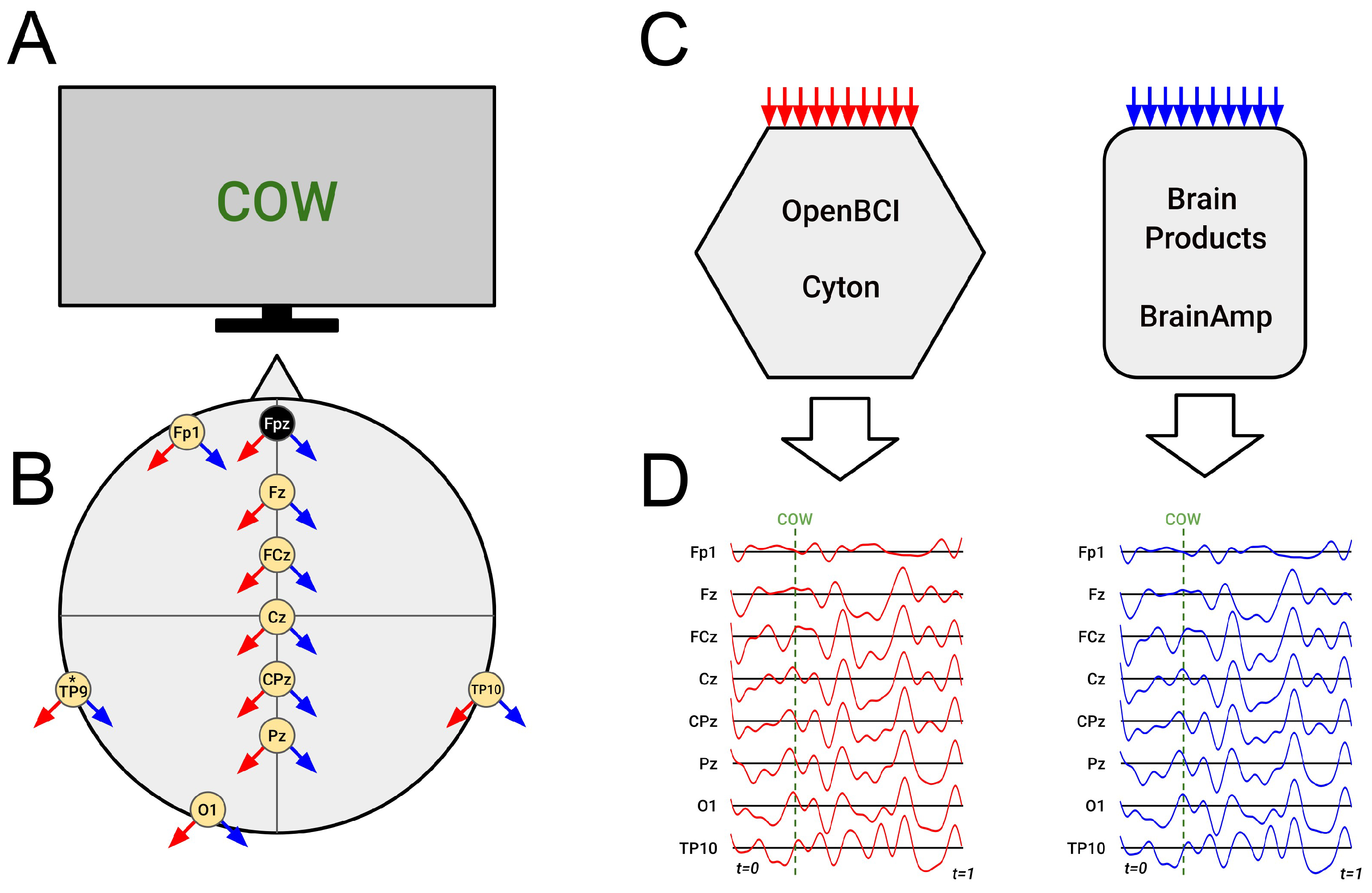
2.3. EEG Recording
2.4. Signal Processing
2.4.1. Filtering
2.4.2. Signal Alignment
2.4.3. Re-Referencing and Artifact Rejection
2.5. Analysis
2.5.1. ERP Component Quantification
2.5.2. Signal Similarity Analysis
2.5.3. ERP Noise Quantification
3. Results
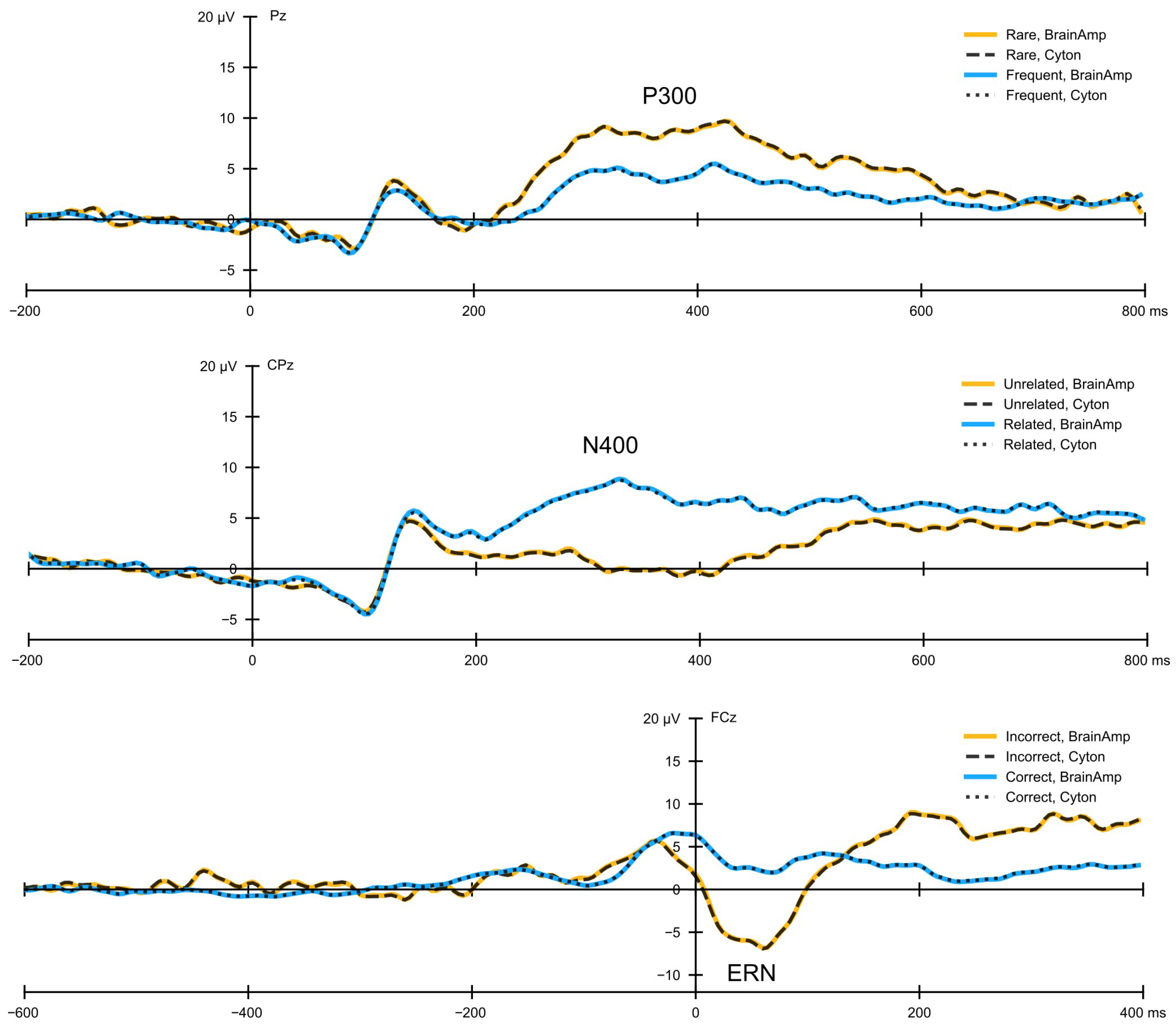
3.1. ERP Components
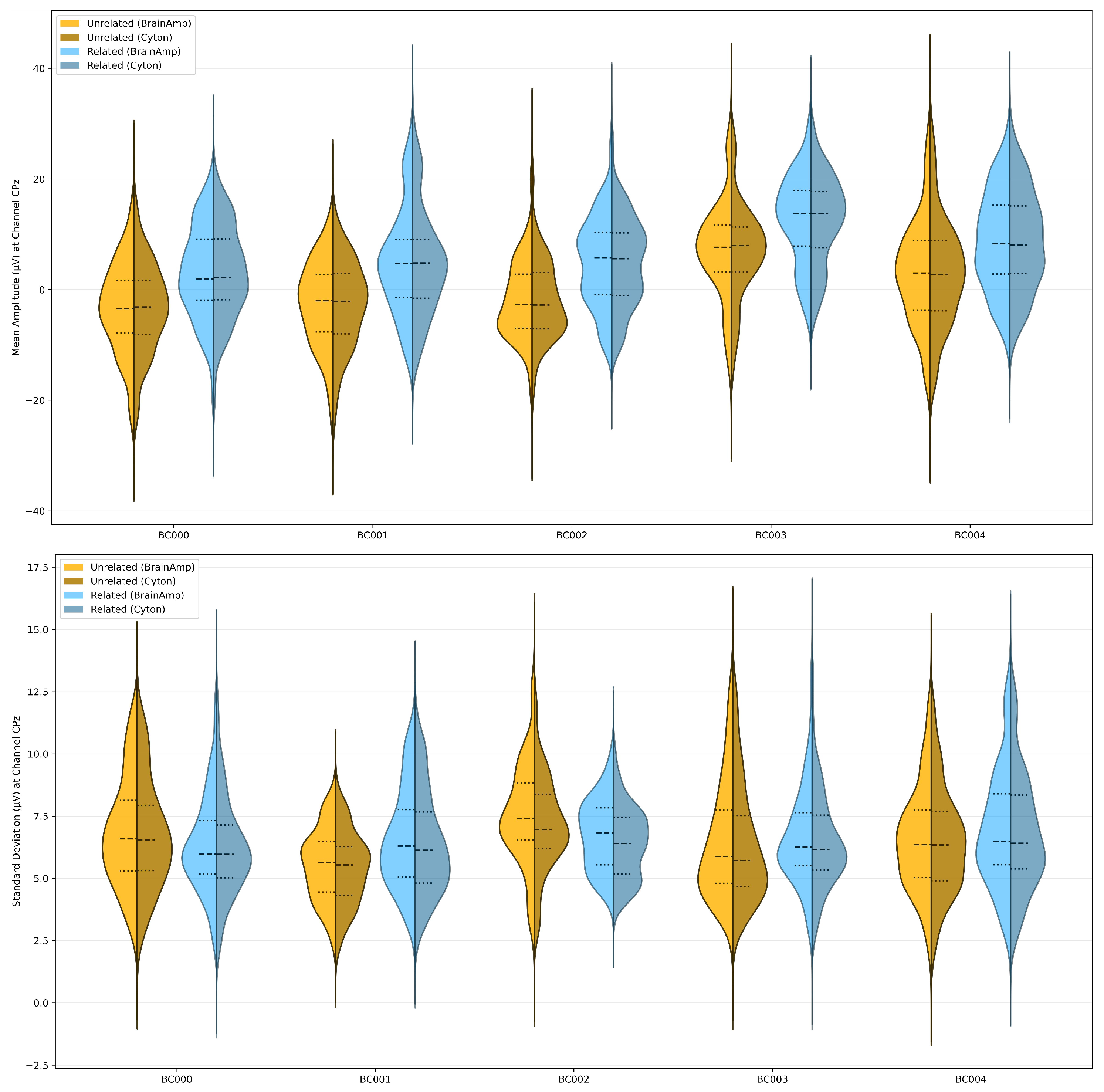
3.1.1. ERP Window Means
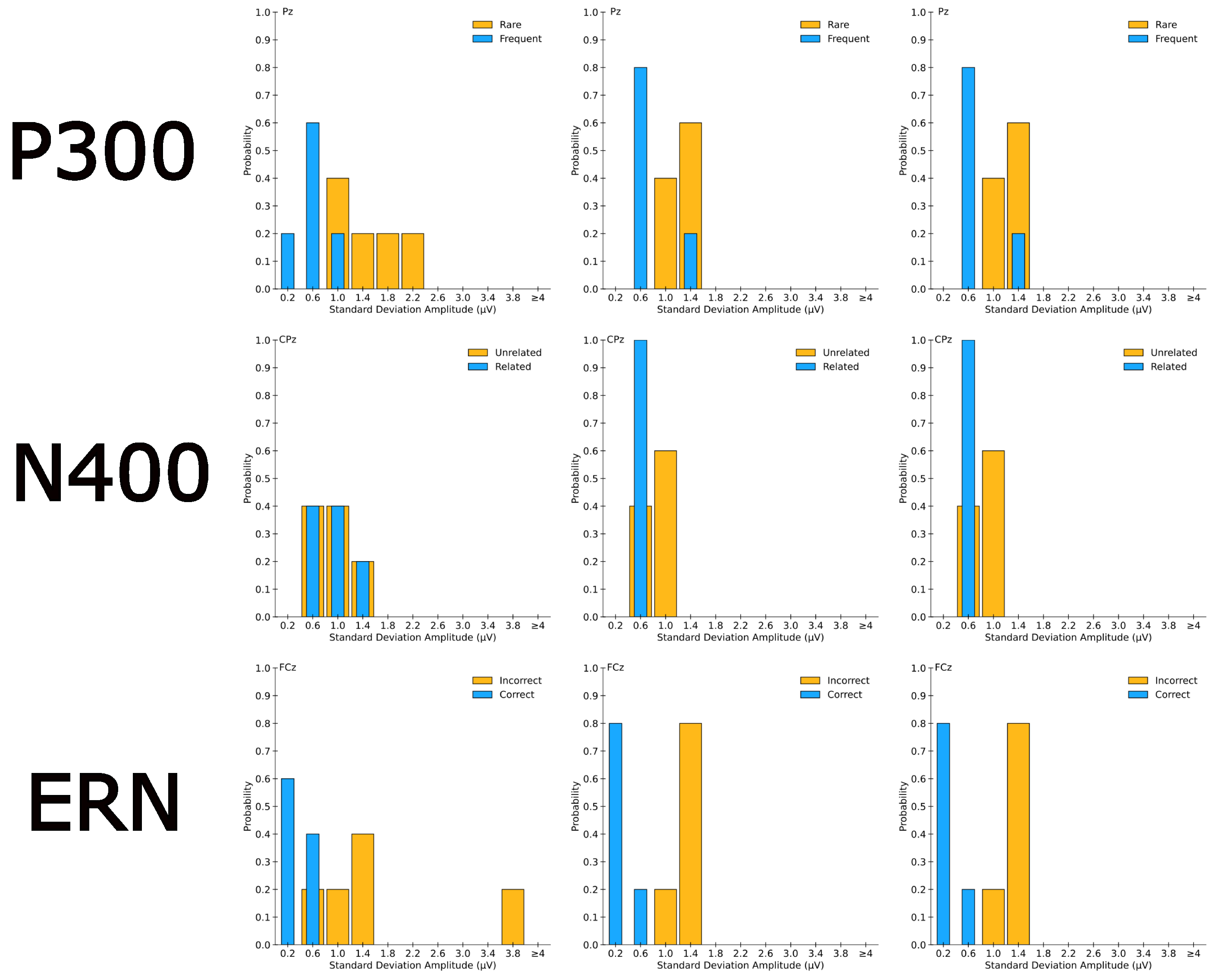
3.1.2. ERP Window Standard Deviations
3.2. Signal Similarity
3.3. ERP Noise Quantification
3.4. Artifact Rejection, Linear Trend, and Signal Synchronization
4. Discussion
4.1. Limitations
4.2. Notable Issues with the OpenBCI Cyton
4.3. Conclusions
Supplementary Materials
Author Contributions
Funding
Institutional Review Board Statement
Informed Consent Statement
Data Availability Statement
Acknowledgments
Conflicts of Interest
References
- Department of Defense. High-Quality, Low-Cost, Multi-Channel EEG System for Non-Traditional Users. D131-002-0040, This Is the Grant That Served as the Seed Funding for What Later Became the OpenBCI Cyton. 2013. Available online: https://www.biomurph.com/our-practice (accessed on 21 December 2025).
- Brain Products. Date Is When Last Accessed, Not When the Equipemnt Was Released; Brain Products GmbH: Gilching, Germany, 2023. [Google Scholar]
- Sabio, J.; Williams, N.S.; McArthur, G.M.; Badcock, N.A. A scoping review on the use of consumer-grade EEG devices for research. PLoS ONE 2024, 19, e0291186. [Google Scholar] [CrossRef]
- Rashid, U.; Niazi, I.K.; Signal, N.; Taylor, D. An EEG experimental study evaluating the performance of Texas Instruments ADS1299. Sensors 2018, 18, 3721. [Google Scholar] [CrossRef]
- Frey, J. Comparison of an open-hardware electroencephalography amplifier with medical grade device in brain-computer interface applications. In Proceedings of the PhyCS-International Conference on Physiological Computing Systems, Lisbon, Portugal, 27–28 July 2016. [Google Scholar]
- Knierim, M.T.; Bleichner, M.G.; Reali, P. A systematic comparison of high-end and low-cost EEG amplifiers for concealed, around-the-ear EEG recordings. Sensors 2023, 23, 4559. [Google Scholar] [CrossRef] [PubMed]
- Polich, J. Updating P300: An integrative theory of P3a and P3b. Clin. Neurophysiol. 2007, 118, 2128–2148. [Google Scholar] [CrossRef] [PubMed]
- Kutas, M.; McCarthy, G.; Donchin, E. Augmenting mental chronometry: The P300 as a measure of stimulus evaluation time. Science 1977, 197, 792–795. [Google Scholar] [CrossRef] [PubMed]
- Kutas, M.; Federmeier, K.D. Thirty years and counting: Finding meaning in the N400 component of the event related brain potential (ERP). Annu. Rev. Psychol. 2011, 62, 621. [Google Scholar] [CrossRef]
- Holcomb, P.J.; Neville, H.J. Auditory and visual semantic priming in lexical decision: A comparison using event-related brain potentials. Lang. Cogn. Processes 1990, 5, 281–312. [Google Scholar] [CrossRef]
- Olvet, D.M.; Hajcak, G. The error-related negativity (ERN) and psychopathology: Toward an endophenotype. Clin. Psychol. Rev. 2008, 28, 1343–1354. [Google Scholar] [CrossRef]
- Eriksen, B.A.; Eriksen, C.W. Effects of noise letters upon the identification of a target letter in a nonsearch task. Percept. Psychophys. 1974, 16, 143–149. [Google Scholar] [CrossRef]
- Kopp, B.; Mattler, U.; Rist, F. Selective attention and response competition in schizophrenic patients. Psychiatry Res. 1994, 53, 129–139. [Google Scholar] [CrossRef]
- Donoghue, T.; Voytek, B. Automated meta-analysis of the event-related potential (ERP) literature. Sci. Rep. 2022, 12, 1867. [Google Scholar] [CrossRef] [PubMed]
- Kappenman, E.S.; Farrens, J.L.; Zhang, W.; Stewart, A.X.; Luck, S.J. ERP CORE: An open resource for human event-related potential research. NeuroImage 2021, 225, 117465. [Google Scholar] [CrossRef] [PubMed]
- Linietsky, J.; Manzur, A.; Godot Engine Contributors. Godot Engine, 4.1; Date Is When Godot 4.1.3 was Released; Godot Foundation: Uitgeest, The Netherlands, 2023.
- Kothe, C.; Shirazi, S.Y.; Stenner, T.; Medine, D.; Boulay, C.; Grivich, M.I.; Artoni, F.; Mullen, T.; Delorme, A.; Makeig, S. The lab streaming layer for synchronized multimodal recording. Imaging Neurosci. 2025, 3, IMAG.a.136. [Google Scholar] [CrossRef] [PubMed]
- Harris, C.R.; Millman, K.J.; van der Walt, S.J.; Gommers, R.; Virtanen, P.; Cournapeau, D.; Wieser, E.; Taylor, J.; Berg, S.; Smith, N.J.; et al. Array programming with NumPy. Nature 2020, 585, 357–362. [Google Scholar] [CrossRef]
- Virtanen, P.; Gommers, R.; Oliphant, T.E.; Haberland, M.; Reddy, T.; Cournapeau, D.; Burovski, E.; Peterson, P.; Weckesser, W.; Bright, J.; et al. SciPy 1.0: Fundamental Algorithms for Scientific Computing in Python. Nat. Methods 2020, 17, 261–272. [Google Scholar] [CrossRef]
- Delorme, A. EEG is better left alone. Sci. Rep. 2023, 13, 2372. [Google Scholar] [CrossRef]
- Kessler, R.; Enge, A.; Skeide, M.A. How EEG preprocessing shapes decoding performance. Commun. Biol. 2025, 8, 1039. [Google Scholar] [CrossRef]
- Kim, S.; Kim, H. A new metric of absolute percentage error for intermittent demand forecasts. Int. J. Forecast. 2016, 32, 669–679. [Google Scholar] [CrossRef]
- OpenBCI. Cyton Specs. 2025. Available online: https://docs.openbci.com/Cyton/CytonSpecs/ (accessed on 15 July 2025).
- Delorme, A.; Sejnowski, T.; Makeig, S. Enhanced detection of artifacts in EEG data using higher-order statistics and independent component analysis. Neuroimage 2007, 34, 1443–1449. [Google Scholar] [CrossRef]
- Blankertz, B.; Tomioka, R.; Lemm, S.; Kawanabe, M.; Muller, K.R. Optimizing spatial filters for robust EEG single-trial analysis. IEEE Signal Process. Mag. 2007, 25, 41–56. [Google Scholar] [CrossRef]
- Kiesel, A.; Miller, J.; Jolicœur, P.; Brisson, B. Measurement of ERP latency differences: A comparison of single-participant and jackknife-based scoring methods. Psychophysiology 2008, 45, 250–274. [Google Scholar] [CrossRef]
- Duncan-Johnson, C.C.; Donchin, E. On quantifying surprise: The variation of event-related potentials with subjective probability. Psychophysiology 1977, 14, 456–467. [Google Scholar] [CrossRef]



| Subject | Frequent | Rare | Related | Unrelated | Correct | Incorrect |
|---|---|---|---|---|---|---|
| BC000 | 0 (0%) | 0 (0%) | 0 (0%) | 0 (0%) | 1 (<1%) | 0 (0%) |
| BC001 | 43 (29%) | 11 (18%) | 0 (0%) | 0 (0%) | 1 (<1%) | 0 (0%) |
| BC002 | 83 (56%) | 20 (32%) | 8 (12%) | 9 (14%) | 63 (17%) | 3 (7%) |
| BC003 | 10 (7%) | 1 (2%) | 2 (3%) | 3 (5%) | 0 (0%) | 0 (0%) |
| BC004 | 20 (14%) | 2 (3%) | 2 (3%) | 2 (3%) | 10 (3%) | 0 (0%) |
| Subject | MAE (µV) ↓ | MAAPE ↓ | ↑ | MAE (µV) ↓ | MAAPE ↓ | ↑ |
|---|---|---|---|---|---|---|
| Visual Oddball—Rare (Pz) | Visual Oddball—Frequent (Pz) | |||||
| BC000 | 0.76 | 0.2 | 0.99 | 0.75 | 0.2 | 0.99 |
| BC001 | 0.68 | 0.19 | 0.99 | 0.69 | 0.2 | 0.99 |
| BC002 | — | — | — | — | — | — |
| BC003 | 0.54 | 0.17 | 0.99 | 0.54 | 0.17 | 0.99 |
| BC004 | 0.84 | 0.21 | 0.98 | 0.8 | 0.22 | 0.98 |
| Word Association—Unrelated (CPz) | Word Association—Related (CPz) | |||||
| BC000 | 0.81 | 0.21 | 0.99 | 0.84 | 0.22 | 0.99 |
| BC001 | 0.66 | 0.19 | 0.99 | 0.76 | 0.21 | 0.99 |
| BC002 | 0.71 | 0.2 | 0.99 | 0.77 | 0.21 | 0.99 |
| BC003 | 0.66 | 0.18 | 0.99 | 0.67 | 0.17 | 0.99 |
| BC004 | 0.57 | 0.16 | 0.99 | 0.62 | 0.17 | 0.99 |
| Flankers—Incorrect (FCz) | Flankers—Correct (FCz) | |||||
| BC000 | 0.96 | 0.18 | 0.99 | 1.01 | 0.2 | 0.99 |
| BC001 | 0.78 | 0.19 | 0.99 | 0.81 | 0.2 | 0.99 |
| BC002 | 1.39 | 0.27 | 0.97 | 1.43 | 0.27 | 0.98 |
| BC003 | 0.6 | 0.15 | 1.0 | 0.64 | 0.19 | 0.99 |
| BC004 | 0.89 | 0.19 | 0.99 | 0.85 | 0.19 | 0.99 |
| Visual Oddball (Pz) | Word Association (CPz) | Flankers (FCz) | ||||
|---|---|---|---|---|---|---|
| Rare | Frequent | Unrelated | Related | Incorrect | Correct | |
| Subject | ||||||
| BC000 | −1.38 *** | −1.64 *** | −1.11 *** | −1.04 *** | −0.69 *** | −1.06 *** |
| BC001 | −1.59 *** | −1.58 *** | −1.27 *** | −1.21 *** | −0.69 *** | −1.16 *** |
| BC002 | — | — | −1.83 *** | −1.96 *** | −1.04 *** | −1.57 *** |
| BC003 | −1.44 *** | −1.29 *** | −0.66 *** | −0.95 *** | ns | −0.88 *** |
| BC004 | −1.16 *** | −1.00 *** | −1.11 *** | −1.33 *** | −0.50 * | −0.73 *** |
Disclaimer/Publisher’s Note: The statements, opinions and data contained in all publications are solely those of the individual author(s) and contributor(s) and not of MDPI and/or the editor(s). MDPI and/or the editor(s) disclaim responsibility for any injury to people or property resulting from any ideas, methods, instructions or products referred to in the content. |
© 2026 by the authors. Licensee MDPI, Basel, Switzerland. This article is an open access article distributed under the terms and conditions of the Creative Commons Attribution (CC BY) license.
Share and Cite
D’Amico, A.; de Sa, V.R. Comparing Simultaneous Scalp EEG Recordings from the OpenBCI Cyton and Brain Products BrainAmp. Sensors 2026, 26, 1153. https://doi.org/10.3390/s26041153
D’Amico A, de Sa VR. Comparing Simultaneous Scalp EEG Recordings from the OpenBCI Cyton and Brain Products BrainAmp. Sensors. 2026; 26(4):1153. https://doi.org/10.3390/s26041153
Chicago/Turabian StyleD’Amico, Alessandro, and Virginia R. de Sa. 2026. "Comparing Simultaneous Scalp EEG Recordings from the OpenBCI Cyton and Brain Products BrainAmp" Sensors 26, no. 4: 1153. https://doi.org/10.3390/s26041153
APA StyleD’Amico, A., & de Sa, V. R. (2026). Comparing Simultaneous Scalp EEG Recordings from the OpenBCI Cyton and Brain Products BrainAmp. Sensors, 26(4), 1153. https://doi.org/10.3390/s26041153