Mobile Network Softwarization: Technological Foundations and Impact on Improving Network Energy Efficiency



Abstract
1. Introduction
1.1. The Importance of Mobile Network Softwarization
1.2. Future Perspectives of Mobile Network Softwarization


2. Background on Mobile Network Softwarization
2.1. The Main Characteristic of SDN and NFV Networks


| NFV Characteristics | Description |
|---|---|
| Cost savings | NFV enables network operators to reduce costs by consolidating network functions onto a smaller number of physical devices, thereby lowering hardware and maintenance expenses. |
| Flexibility and scalability | NFV allows network operators to easily scale network functions as needed, enabling rapid adaptation to changing user demands and market conditions. |
| Service agility | NFV enables network operators to quickly introduce and innovate new network services, reducing the time required to enter the market and improving competitiveness. |
| Multi-tenancy support | NFV supports multi-tenancy, allowing multiple users or applications to share the same virtualized infrastructure while maintaining their own isolated and secure network functions. |
| Reduced complexity | NFV simplifies network operations by enabling network operators to implement, manage, and orchestrate network functions using software, which reduces the need for specialized hardware. |
| SDN Characteristics | Description |
|---|---|
| Energy management | Energy optimization can be applied to various components of the SDN architecture, or SDN can be used as a means for achieving energy savings, either algorithmically or through hardware improvements. |
| Direct programmability | The network is directly programmable as control functions are separated from forwarding functions, allowing network configuration through proprietary or open-source automation tools. |
| Centralized management | Network intelligence is logically centralized within the SDN controller, which maintains a global view of the network, presenting it to applications and policies as a single logical switch. |
| Reduction of CAPEX | Reduces the need to purchase dedicated hardware based on application-specific integrated circuits (ASICs), as new applications can be easily installed on the controller in the application layer. |
| Reduction of OPEX | Enables algorithmic management of network elements such as hardware or software switches/routers that are programmable, which facilitates improved network implementation, management, and scaling. |
| Agility and flexibility | Allows organizations to quickly deploy new applications, services, and infrastructure to rapidly adapt to changing business goals. |
| Enabling innovation | New types of services, applications, and business models can be created directly in the application layer, without disrupting other parts of the network. |
| Network management and resource utilization | By separating the control and data planes, the system gains flexibility, and resources can be utilized as needed by programming the SDN control or data plane (layer). |
| Bandwidth | SDN can efficiently utilize available bandwidth by dynamically allocating it according to user needs. |
| Characteristics | SDN | NFV |
|---|---|---|
| Control | Standardization of control interfaces. Protection of commercial business operational schemes. Measures to avoid performance degradation. Maintaining control of network information for big data development. | Seamless control and service delivery. Real-time and dynamic service provisioning. Creation of granular network policies. Maintaining virtualization information for big data development. |
| Reliability | Seamless connectivity and fast link recovery. Security requirements in EPC and RAN. Security and reliability of transport and data networks. Balance between performance, security, and flexibility. | High complexity of 5G (technologies, devices, IoT). Seamless and high-quality connectivity. Virtualization of terminal endpoints. Security issues (same physical medium). |
| Scalability | Support for heterogeneity of technology and devices. Controller messages with performance and survivability (low packet loss levels). Optimization of flow rules and network slicing. | Scalability at the operator level and robustness. Deployment acceleration. Openness and interoperability, global reach, and mutual administration. |
| Cost- effectiveness | Ability to support a commercial pay-per-service model. Replacement of hardware with software applications. Implementation and procurement of standard network switches (replacing outdated hardware). Shorter time to market and lower implementation risks. | Reduction in energy consumption. Improvement of operational efficiency. Higher capital expenditures. Higher operational costs (short lifecycle of configuration tools). |
2.2. Research on the Development of SDN
2.3. Research on the Development of NFV
2.4. Research on the Implementation of AI in Softwarized Networks
3. Technological Foundations of Network Softwarization
3.1. Software-Defined Networks

3.1.1. Data Layer

OpenFlow Switch


Versions OpenFlow Specification
| OpenFlow Version | Newly Introduced Improvement |
|---|---|
| 1.0 | Network segmentation |
| 1.1 | Introduction of tables, groups, and virtual ports |
| 1.2 | Extensible matching tables, IPv6 support, and multiple controllers support |
| 1.3 | Support for per-flow meters, more flexible table-miss, extended IPv6 header, and event filtering by connection |
| 1.4 | Support for extensible wire protocol, optical port properties, flow monitor, synchronized tables |
| 1.5 | Egress tables, extensible flow entry statistics, TCP flag matching |
3.1.2. Control Layer/Plane

Implementations of the SDN Controller
| Version | Improvement |
|---|---|
| Monolithic SDN Controller | A single monolithic process. |
| Clustered SDN Controller | A set of identical processes that share the load or provide mutual fault protection. |
| Modular SDN Controller | A series of different functional components that collaborate. |
| Microservices SDN Controller | A system that utilizes external services for specific functions, such as path computation. |

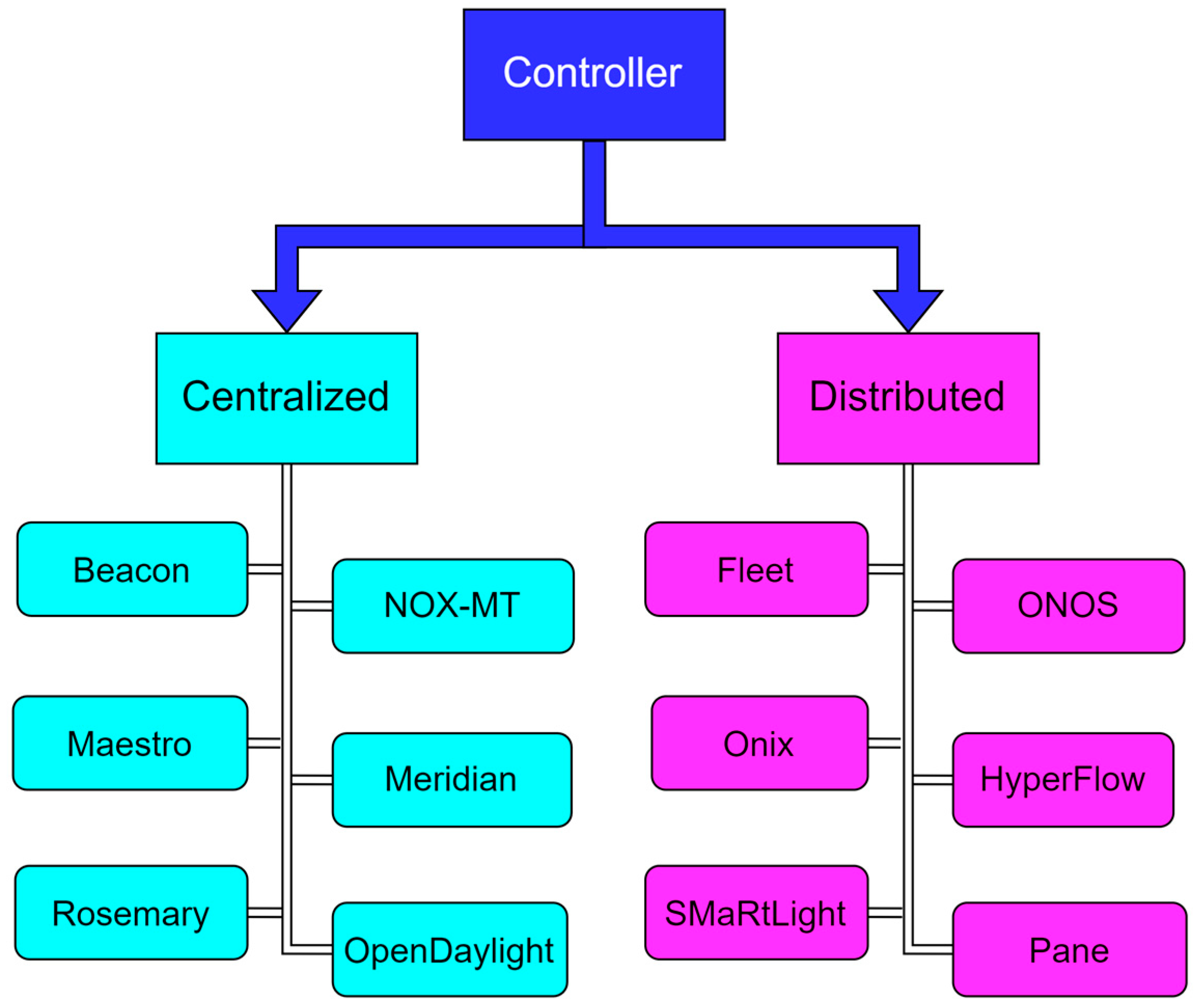
| Controller | Main Features | Type of SDN Controller |
|---|---|---|
| Beacon | High-throughput, Java-based | Monolithic SDN Controller |
| NOX-MT | Improved version of NOX, multi-threading support | Monolithic SDN Controller |
| Maestro | Performance optimization through parallelism | Monolithic SDN Controller |
| ONOS | Large-scale implementations in MNOs, low-latency | Clustered SDN Controller |
| OpenDaylight | Modular architecture, based on MDSE | Modular SDN Controller |
| Meridian | Cloud network support, based on Floodlight controller type | Modular SDN Controller |
| HyperFlow | First distributed SDN controller, uses NOX architecture | Clustered SDN Controller |
| SMaRtLight | Increased fault tolerance, based on Floodlight | Clustered SDN Controller |
| Fleet | Protection against malicious administrators | Microservices SDN Controller |
| ONIX | High scalability, flexible control platform | Clustered SDN Controller |
| PANE | API for SDN control, conflict resolution among requests | Modular SDN Controller |
| Rosemary | Micro-NOS architecture, enhanced application security | Microservices SDN Controller |
| Characteristic | NOX/POX | RYU | Floodlight | OpenDaylight | ONOS |
|---|---|---|---|---|---|
| Supported languages | C/C++ and Python | Python | Java | Java | Java |
| Northbound API | Ad hoc | REST | REST, JavaRPC, Quantum | REST, RESTCONF, XMPP, NETCONF | REST, Neutron |
| Southbound API—OpenFlow Version | 1.0 | 1.0, 1.2, 1.3, 1.4, 1.5, Nicira extensions | 1.0, 1.2, 1.3, 1.4 | 1.0, 1.2, 1.3, 1.4, 1.5 | 1.0, 1.2, 1.3, 1.4, 1.5 |
| NFV support | Yes | Yes | Yes | Yes | Yes |
| REST API support | Yes | Yes | Yes | Yes | Yes |
| Traffic Engineering support | No | Yes | Yes | No | Yes |
| Load Balancing support | Yes | No | Yes | Yes | Yes |
| Network Monitoring support | No | No | Yes | Yes | Yes |
| Web GUI support | No | No | Yes | Yes | Yes |
| Documentation and learning | Low | Medium | High | High, well-documented | High, well-documented |
| Topology discovery | Yes | Yes | No | No | Yes |
| modularity | Low | Non-negligible | Non-negligible | High | High |
| Multithreading—Parallel Processing | Yes/No | Yes | Yes | Yes | Yes |
| Consistency support | No | Yes | Yes | Yes | Yes |
| Network Level | Enterprise | Enterprise | Enterprise | Enterprise | Service Providers (Telcos) |
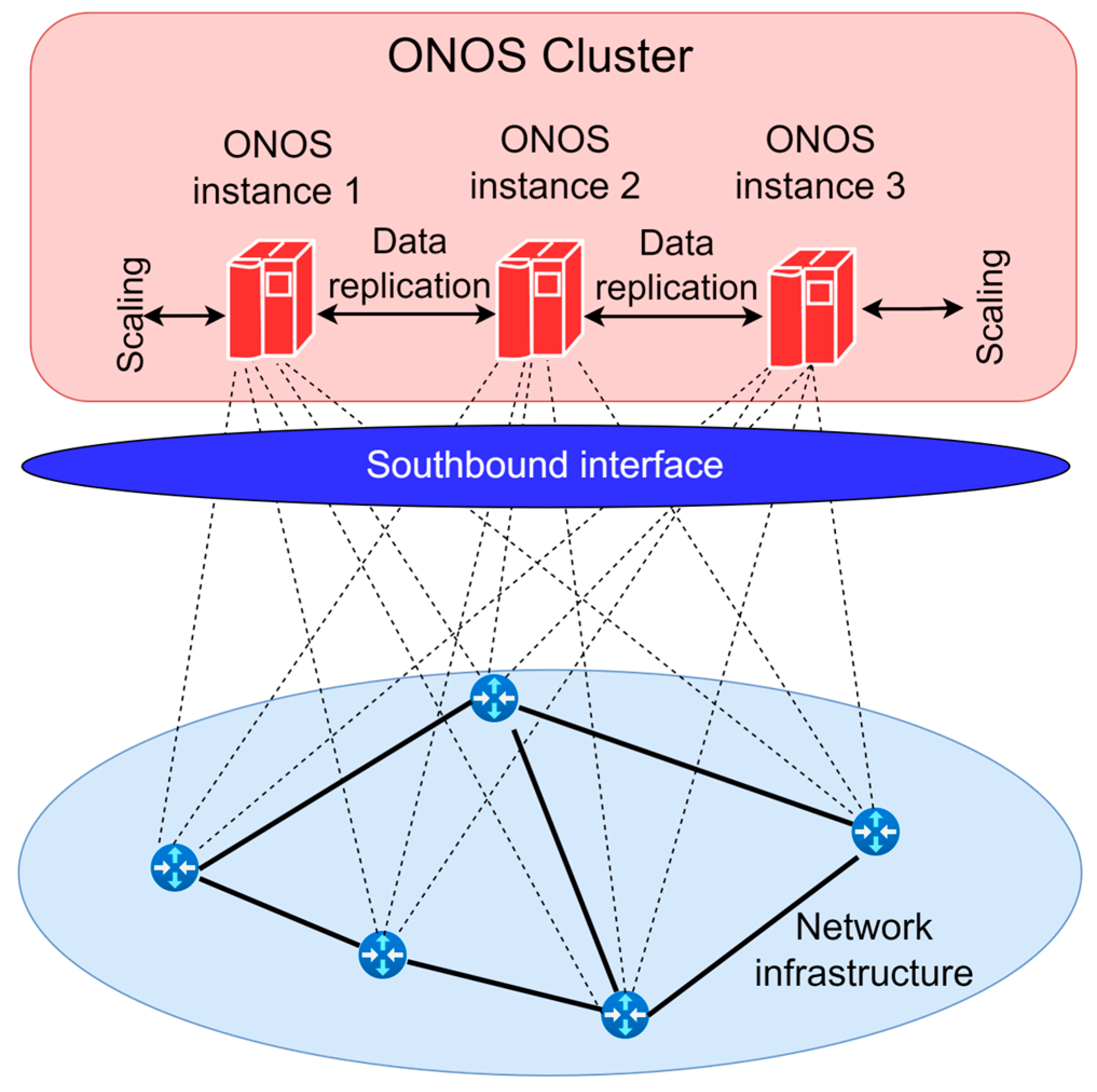
Open Network Operating System SDN Controller Implementation

3.1.3. Application Layer/Plane
3.2. Network Function Virtualization

| Key Aspect | Description |
|---|---|
| Service chaining | NFV technology enables the chaining of multiple VNFs to create complex network services tailored to specific applications and user needs. |
| Orchestration | NFV relies on an orchestration layer that automates the deployment, scaling, and management of VNFs, allowing network operators to efficiently manage network services without manual intervention. |
| Standardization | NFV is built on standardized interfaces and protocols that ensure interoperability between different VNFs and NFV implementations, facilitating network service management from multiple vendors. |
| Flexibility and Scalability | NFV allows MNOs to easily scale network functions as needed, allowing network operators to easily add or remove VNFs based on changes in network traffic, enabling rapid adaptation to changing user demands and market conditions. |
| Resilience | NFV provides high resilience through built-in redundancy mechanisms and automatic failover to alternative resources in case of failure, ensuring continuous availability of network services. |
| Multi-tenancy | NFV supports multi-tenancy, enabling multiple users or applications to share the same virtualized infrastructure while maintaining the isolation and security of their network functions. |
| Reduced Complexity and Automation | NFV relies on automation to simplify the deployment, configuration, and management of VNFs, reducing human error, the need for specialized hardware and skilled personnel and increasing operational efficiency. |
| Elasticity | NFV enables elastic resource allocation, dynamic scaling VNFs up or down as needed, optimizing resource utilization and reducing operating costs. |
| Agility | NFV allows MNOs to quickly introduce new network services and innovations, reducing time-to-market and enhancing competitiveness. |
| Cost Savings | NFV enables network operators to reduce costs by consolidating network functions onto a smaller number of physical devices, thereby lowering hardware and maintenance expenses. |
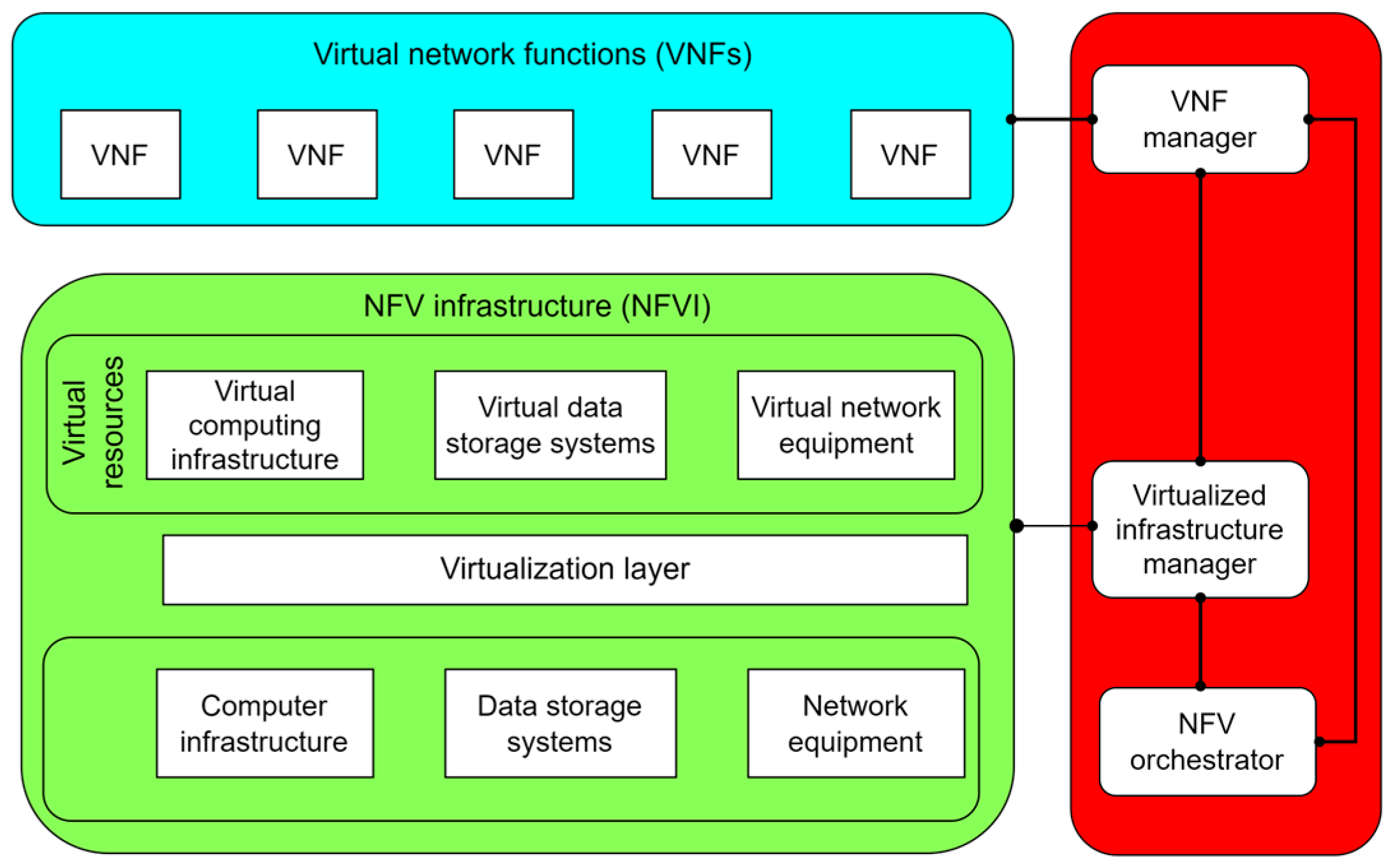
3.2.1. NFV Infrastructure Layer
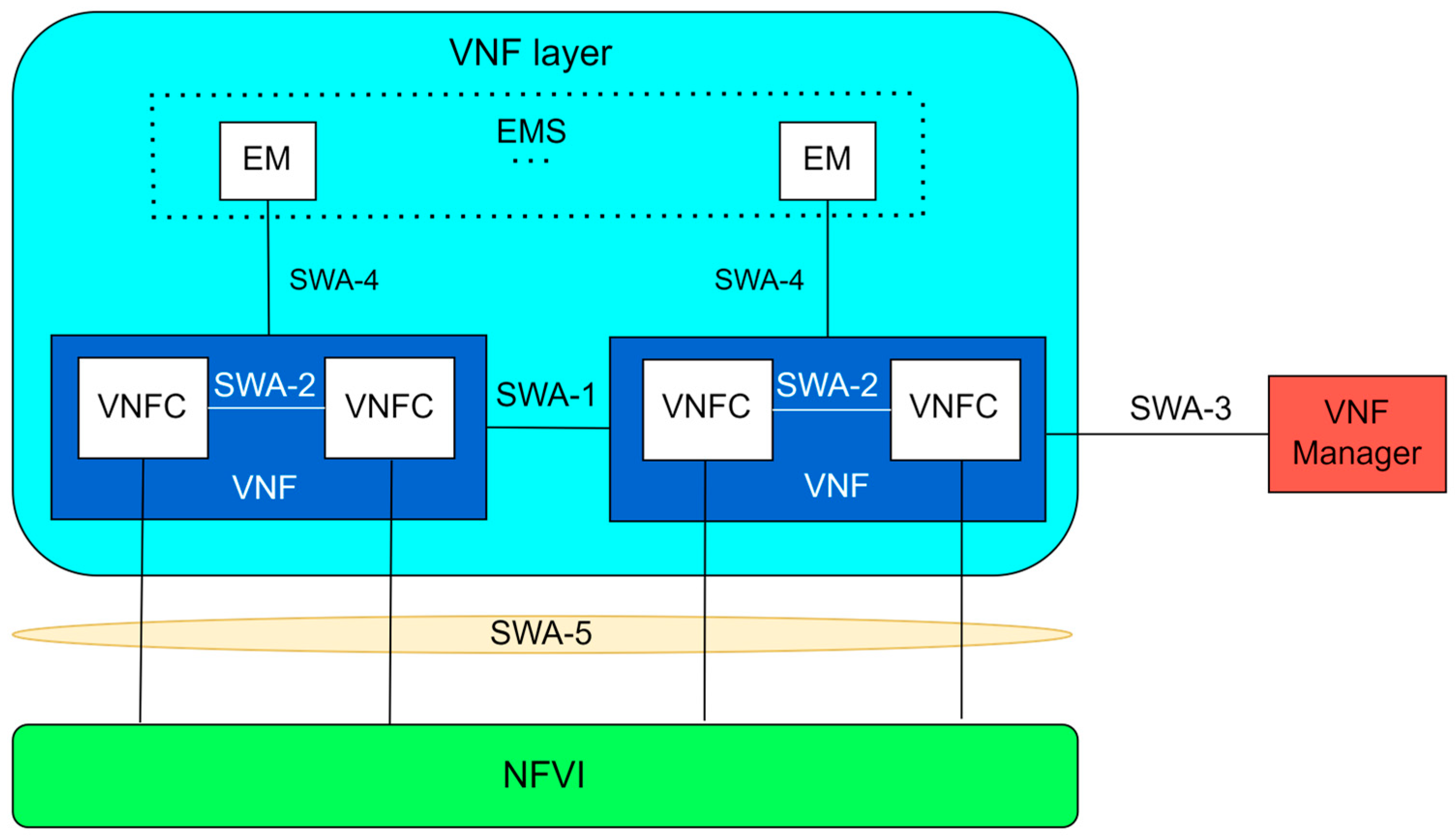
3.2.2. Virtual Network Functions Layer

| Interface | Description |
|---|---|
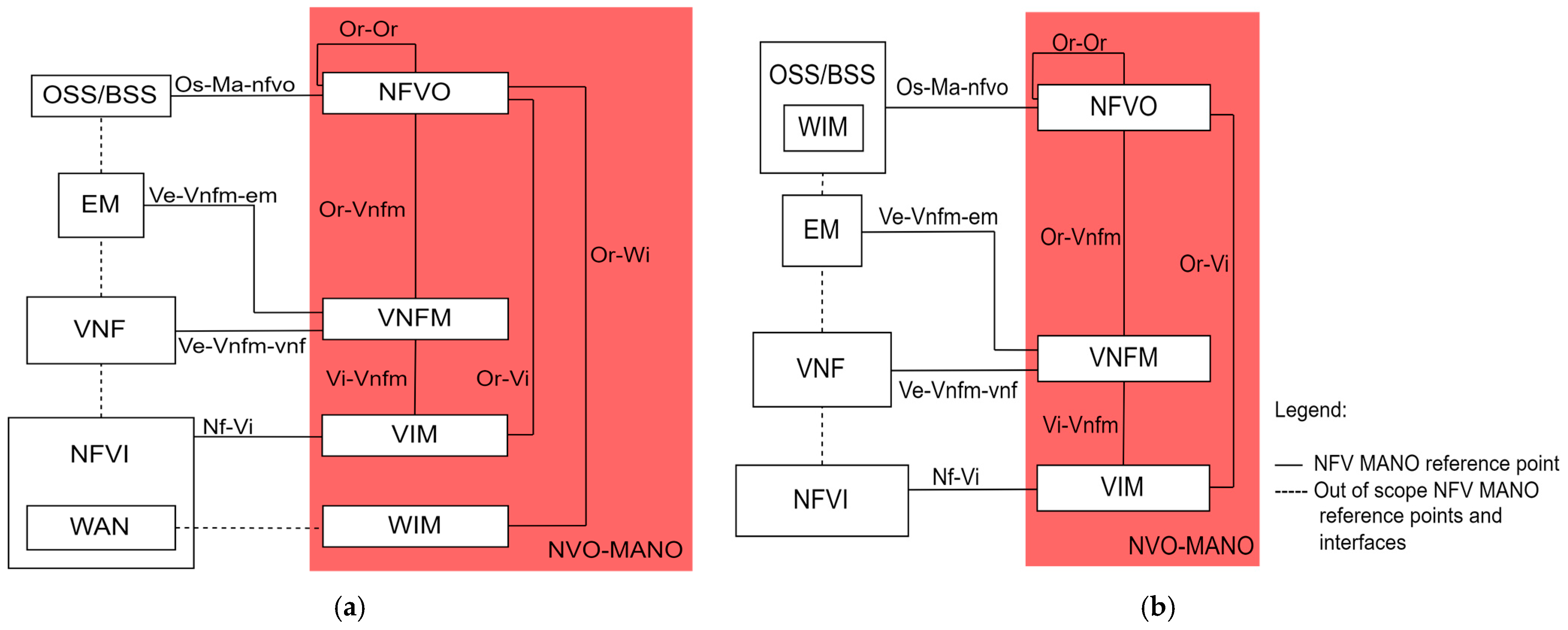
| Os-Ma-nfvo | Ensures communication between OSS/BSS systems and NFVO, enabling network function orchestration and the provision of resource and performance data. It is crucial for service automation and management. |
| Or-Vnfm | Enables the exchange of information between NFVO and VNFM. NFVO uses this interface for managing the lifecycle of VNFs, including instantiation, updating, and removing VNF instances. |
| Ve-Vnfm-em | Connects VNFM with the Element Management (EM) System for monitoring and configuring VNF instances. |
| Ve-Vnfm-vnf | Facilitates communication between VNFM and VNF to enable configuration, performance management, and fault handling of VNF. |
| Or-Vi | Enables data exchange between NFVO and VIM. NFVO uses this interface for orchestrating virtualized resources and allocating capacity within NFVI. |
| Vi-Vnfm | Defines communication between VNFM and VIM. VNFM uses this interface for instantiating and managing virtual resources required for VNF instances. |
| Nf-Vi | Links the NFVI layer with VIM, enabling management of virtualized and physical resources within NFVI. |
| Or-Wi | Ensures communication between NFVO and WIM to enable efficient management of network connectivity between different NFVI locations. |
| Or-Or | Used for exchanging information between NFVO instances in different administrative domains. It enables coordination between multiple orchestrators in distributed NFV environments. |
3.2.3. Management and Orchestration Layer

4. The Impact of Softwarization on the Energy Efficiency of Mobile Networks
4.1. Strategies Based on SDN for Improving Network EE

4.2. Implementation of NFV for Improving Network Services Energy Efficiency

4.3. Implementation of NFV and SDN in Improving RAN Energy Efficiency

4.4. Improving EE of 5G Mobile Networks Using SDN and NFV
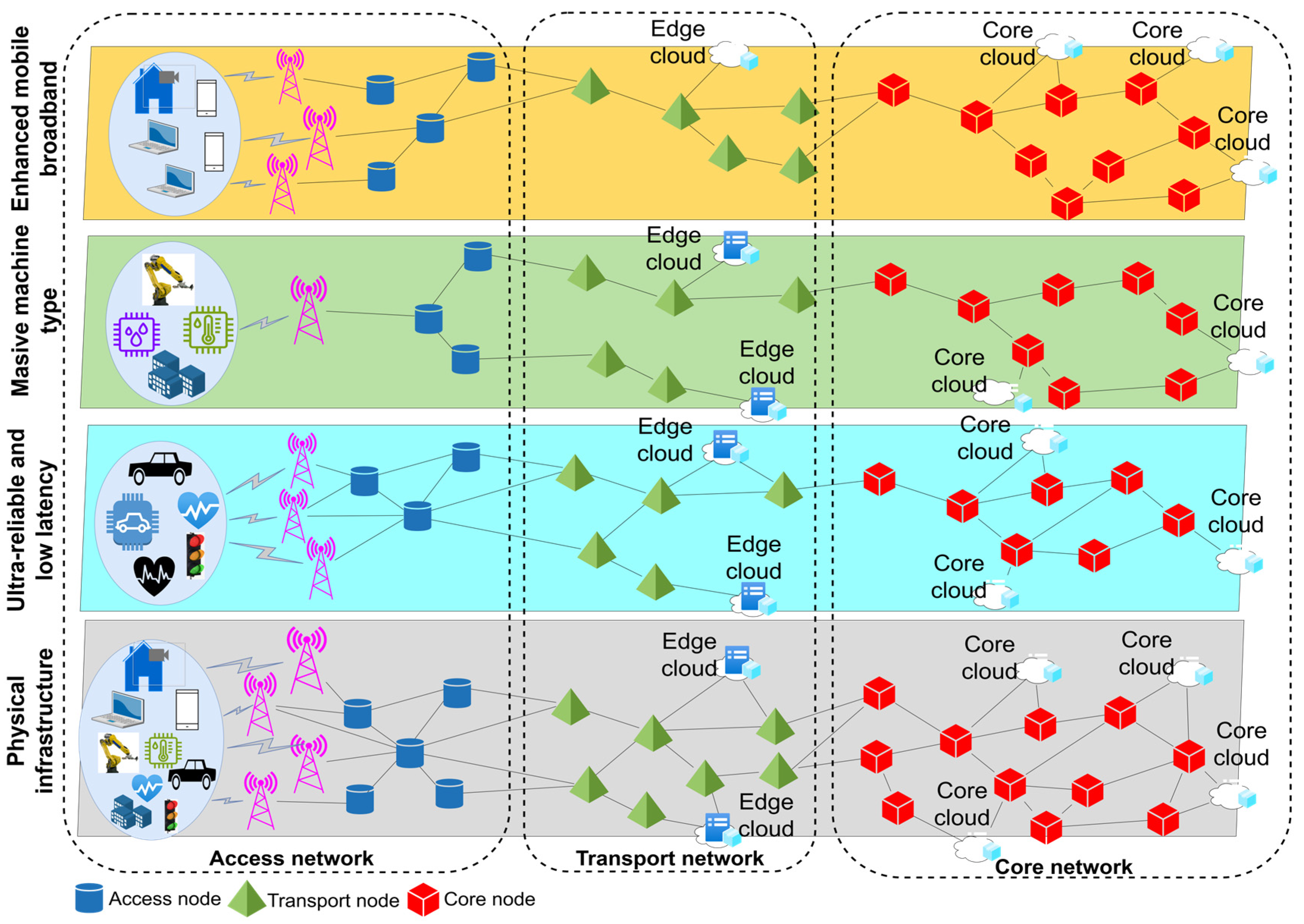
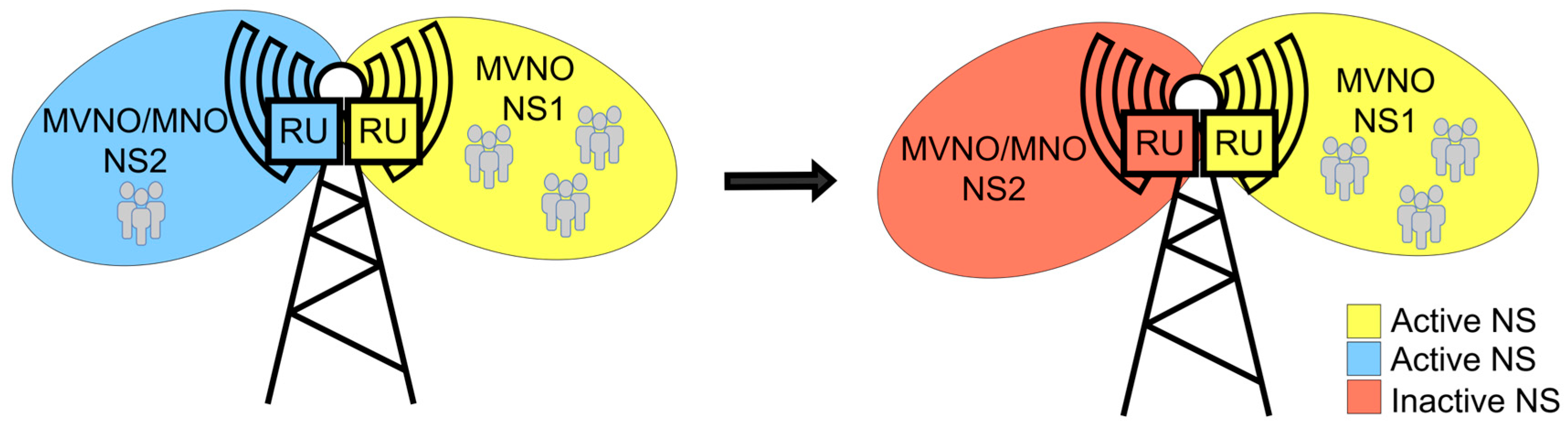
4.4.1. Realization of Network Slicing with SDN and NFCV Technology


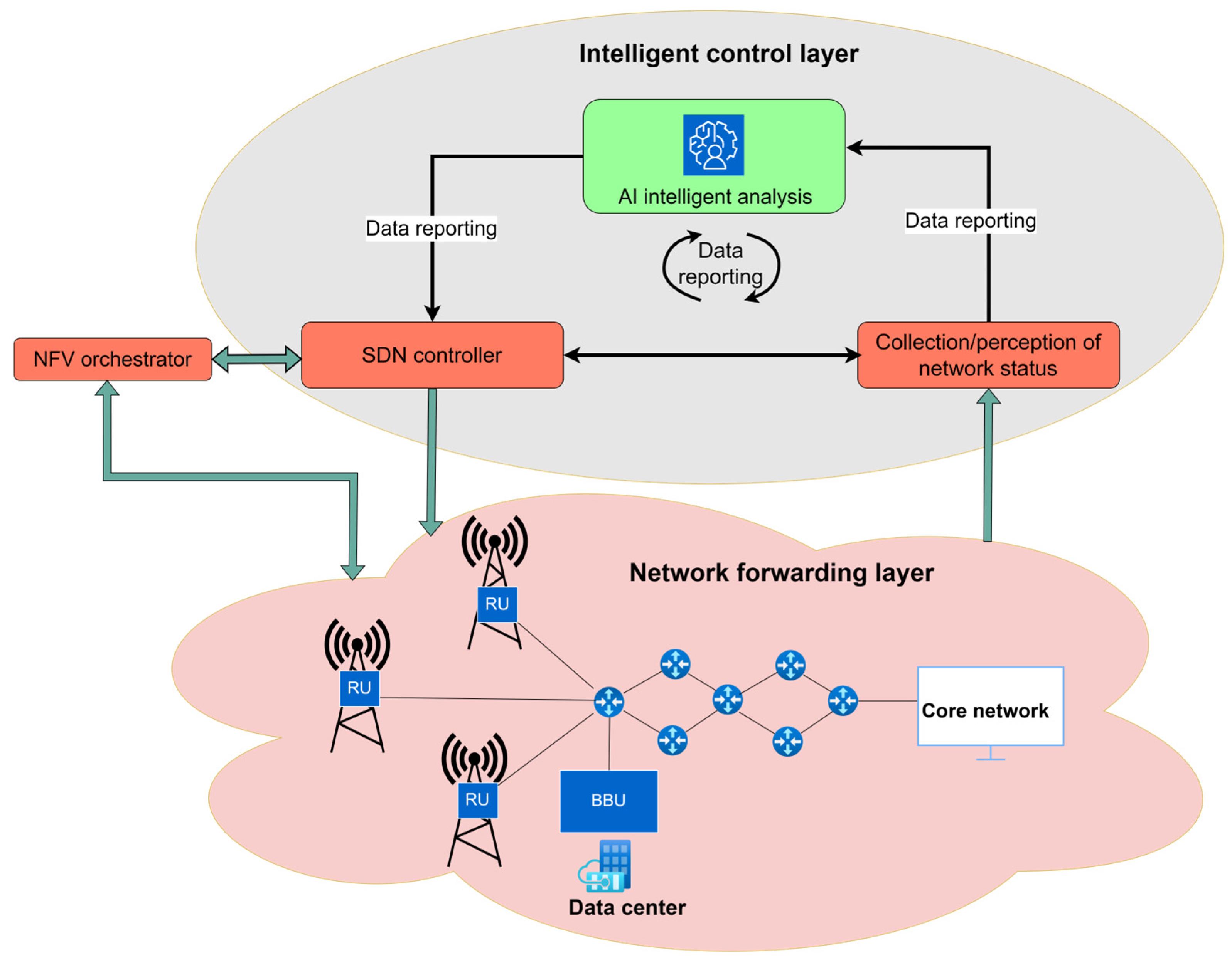
4.4.2. Implementation of AI with SDN and NFCV Technology

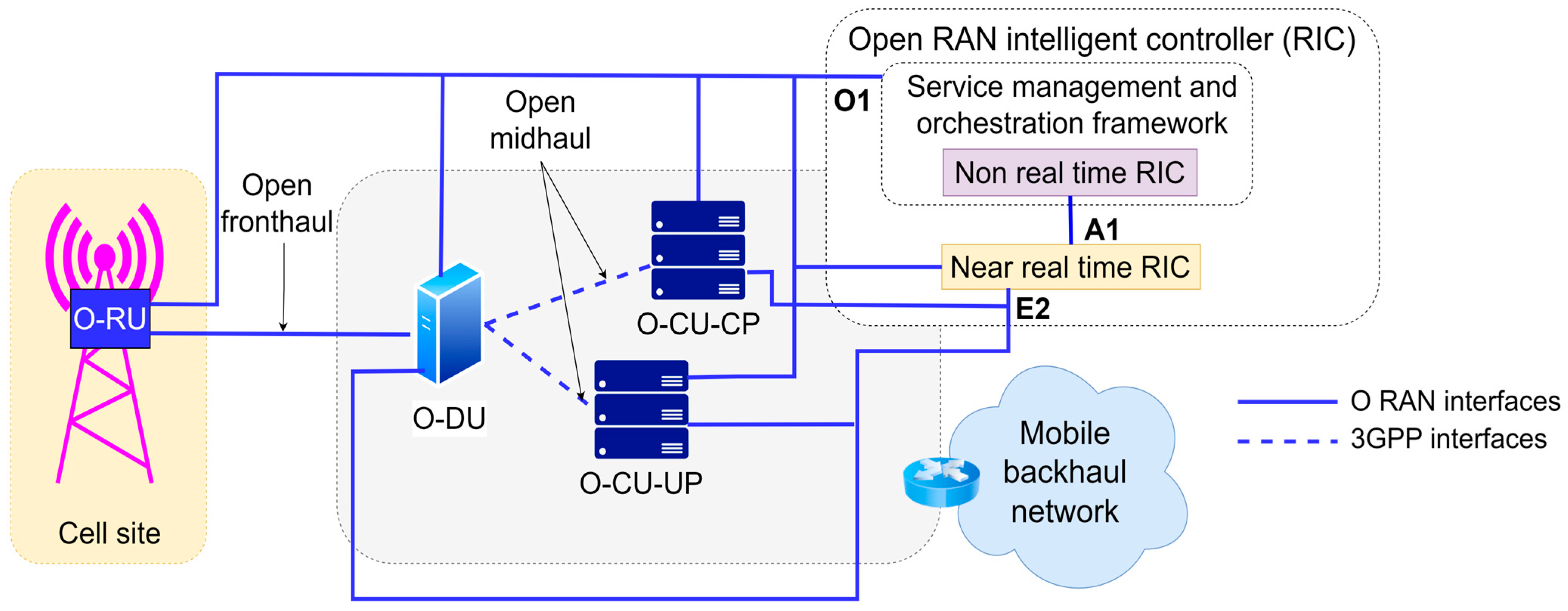
Implementations of AI in O-RAN

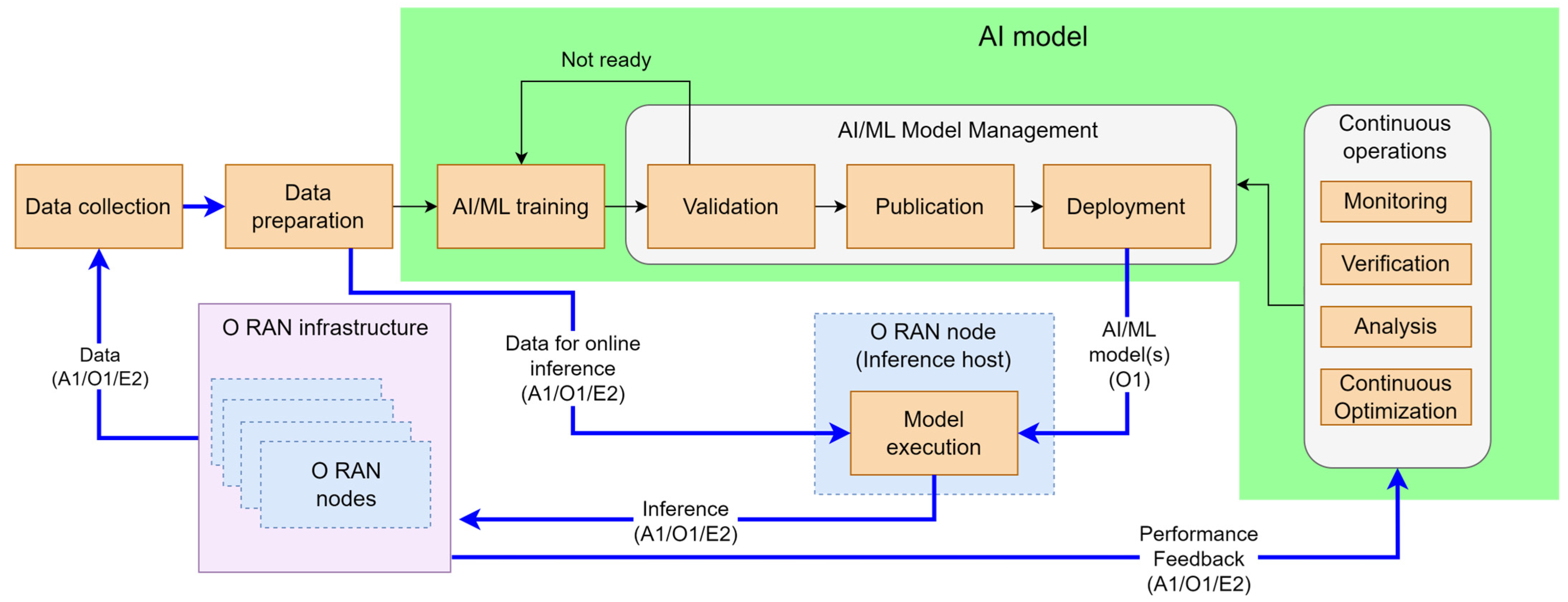
AI Workflow Process in O-RAN

5. Conclusions
Author Contributions
Funding
Conflicts of Interest
Abbreviations
| SDN | Software-Defined Networks |
| NFV | Network Function Virtualization |
| ETSI | European Telecommunications Standards Institute |
| ONF | Open Networking Foundation |
| ITU | International Telecommunication Union |
| IoT | Internet of Things |
| 4G | Fourth Generation |
| 5G | Fifth Generation |
| SA | Standalone |
| NSA | Non-Standalone |
| MNO | Mobile network operator |
| VoIP | Voice over Internet Protocol |
| SBA | Service-based architecture |
| AI | Artificial Intelligence |
| OTT | Over-the-top |
| CAPEX | Capital Expenditures |
| OPEX | Operational Expenditures |
| DDoS | Distributed Denial-of-Service |
| NS | Network slicing |
| VNF | Virtual Network Functions |
| BGWO | Binary Grey Wolf Optimization |
| DDRL | Double Deep Reinforcement Learning |
| BIP | Behavior–interaction–priorities |
| MILP | Mixed integer linear programming |
| SFC | Service Function Chain |
| 6G | Sixth Generation |
| API | Application Programming Interfaces |
| SLA | Service Level Agreements |
| RDB | Resource Database |
| LLDP | Link Layer Discovery Protocol |
| STP | Spanning Tree Protocol |
| BFD | Bidirectional Forwarding Detection |
| ICMP | Internet Control Message Protocol |
| TLS | Transport Layer Security |
| TCP | Transmission Control Protocol |
| NOS | Network Operating System |
| DPCF | Data Plane Control Function |
| ON.Lab | Open Networking Lab |
| RTT | Round-trip time |
| NFVI | NFV Infrastructure |
| COTS | Commercially available off-the-shelf |
| DAS | Direct Attached Storage |
| NAS | Network Attached Storage |
| SAN | Storage Area Network |
| NIC | Network interface card |
| SDS | Software Defined Storage |
| DPDK | Data Plane Development Kit |
| SR-IOV | Single Root I/O Virtualization |
| EM | Element Manager |
| EMS | Element Management System |
| VNFM | VNF Manager |
| VM | Virtual Machine |
| MANO | Management and Orchestration |
| VIM | Virtual Infrastructure Manager |
| NFVO | NFV Orchestrator |
| WIM | Wide Area Network Infrastructure Manager |
| OSS/BSS | Operations Support System/Business Support System |
| NSD | network services descriptor |
| VNFD | VNF descriptor |
| PoP | Point of Presence |
| SNMP | Simple Network Management Protocol |
| NETCONF | Network Configuration Protocol |
| 3GPP | 3rd Generation Partnership Project |
| IETF | Internet Engineering Task Force |
| 2G | Second Generation |
| 3G | Third Generation |
| EE | Energy Efficiency |
| UD | User Data |
| EC | Energy Consumed |
| RAN | Radio Access Network |
| BBU | Baseband Processing Unit |
| DVFS | Dynamic Voltage and Frequency Scaling |
| MVNO | Mobile Virtual Network Operator |
| C-RAN | Cloud-RAN |
| SON | Self-organizing network |
| TWAMP | Two-Way Active Measurement Protocol |
| O-RAN | Open Radio Access Network |
| ML | Machine Learning |
| REST/HTTPS | Representational State Transfer/Hyper-text Transfer Protocol Secure |
| RSSI | Received Signal Strength Indicator |
| WAN | Wide Area Network |
| ONOS | Open Network Operating System |
| LSTM | Long Short-Term Memory |
| IBM | International Business Machines Corp |
| RIC | RAN Intelligent Controller |
| O-DU | Open Distributed Unit |
| O-RU | Open radio interface |
| O-CU | Open Central Unit |
| O-CU-CP | Open Central Unit Control Plane |
| O-CU-UP | Open Central Unit User Plane |
| CUPS | Control and User Plane Separation |
| E2AP | E2 Application Protocol |
| E2SM | E2 Service Model |
| SCTP | Stream Control Transmission Protocol |
| SMO | Service Management and Orchestration |
| RT | Real Time |
| KPI | Key Performance Indicator |
| BS | Base Station |
| QoS | Quality of Service |
References
- Göransson, P.; Black, C.; Culver, T. Software Defined Networks: A Comprehensive Approach, Morgan Kaufmann; Morgan Kaufmann: Cambridge, MA, USA, 2017. [Google Scholar]
- IEEE. IEEE Communications Society. Available online: https://www.comsoc.org/publications/journals/ieee-jsac/cfp/series-network (accessed on 20 January 2025).
- ETSI NFV ISG. ETSI Portal. Available online: https://portal.etsi.org/NFV/NFV_White_Paper.pdf (accessed on 20 January 2025).
- Checko, A.; Christiansen, H.L.; Yan, Y.; Scolari, L.; Kardaras, G.; Berger, M.S.; Dittmann, L. Cloud RAN for Mobile Networks—A Technology Overview. IEEE Commun. Surv. Tutor. 2015, 17, 405. [Google Scholar] [CrossRef]
- Blanco, B.; Fajardo, J.O.; Giannoulakis, I.; Kafetzakis, E.; Peng, S.; Pérez-Romero, J.; Trajkovska, I.; Khodashenas, P.S.; Goratti, L.; Paolino, M.; et al. Technology pillars in the architecture of future 5G mobile networks: NFV, MEC and SDN. Comput. Stand. Interfaces 2017, 54, 216. [Google Scholar] [CrossRef]
- Bhat, S. Optimizing Network Costs for NFV Solutions inUrban and Rural Indian Cellular Networks. Eur. J. Electr. Eng. Comput. Sci. 2024, 8, 32–37. [Google Scholar] [CrossRef]
- Afrasiabi, S.N.; Ebrahimzadeh, A.; Promwongsa, N.; Mouradian, C.; Li, W.; Recse, Á. Cost-Efficient Cluster Migration of VNFs for Service Function Chain Embedding. IEEE Trans. Netw. Serv. Manag. 2024, 21, 979–993. [Google Scholar] [CrossRef]
- Manzalini, A. Softwarization of telecommunications. it-Inf. Technol. 2015, 57, 321–329. [Google Scholar] [CrossRef]
- Kim, J.; Kim, Y.; Yegneswaran, V.; Porras, P.; Shin, S.; Park, T. Extended data plane architecture for in-network security services in software-defined networks. Comput. Secur. 2023, 124, 102976. [Google Scholar] [CrossRef]
- Compastié, M.; Martínez, A.L.; Fernández, C.; Pérez, M.G.; Tsarsitalidis, S.; Xylouris, G.; Mlakar, I.; Kourtis, M.A.; Šafran, V. PALANTIR: An NFV-Based Security-as-a-Service Approach for Automating Threat Mitigation. Sensors 2023, 23, 1658. [Google Scholar] [CrossRef]
- Krishnan, P.; Duttagupta, S.; Achuthan, K. SDN/NFV security framework for fog-to-things computing infrastructure. Softw. Pract. Exp. 2019, 50, 757. [Google Scholar] [CrossRef]
- Eluwole, O.T.; Ojo, M.O. The Key Impacts of Softwarization in the Modern Era of 5G and the Internet of Things. Int. J. Interdiscip. Telecommun. Netw. (IJITN) 2020, 12, 16–27. [Google Scholar] [CrossRef]
- Lin, B.-S.P.; Lin, Y.-B.; Tung, L.-P.; Lin, F.J. Exploring Network Softwarization and Virtualization by Applying SDN/NFV to 5G and IoT. Trans. Netw. Commun. 2018, 6, 1. [Google Scholar] [CrossRef]
- Rodrigues, A.P.; Oliveira, V.T.; Vieira, D.; Pereira, M.B.; Castro, M.F.D. Edge Computing and Network Softwarization for the Internet of Healthcare Things. In Internet of Everything for Smart City and Smart Healthcare Applications; Springer: Berlin/Heidelberg, Germany, 2023; pp. 193–215. [Google Scholar] [CrossRef]
- Temesgene, A.; Nuñez-Martinez, J.; Dini, P. Softwarization and Optimization for Sustainable Future Mobile Networks: A Survey. IEEE Access 2017, 5, 25421–25436. [Google Scholar] [CrossRef]
- Condoluci, M.; Mahmoodi, T. Softwarization and virtualization in 5G mobile networks: Benefits, trends and challenges. Comput. Netw. 2018, 146, 65–84. [Google Scholar] [CrossRef]
- Ericsson Ericsson Mobility Report. November 2024. Available online: https://www.ericsson.com/4adb7e/assets/local/reports-papers/mobility-report/documents/2024/ericsson-mobility-report-november-2024.pdf (accessed on 27 January 2025).
- Ookla.com The Path to “Full” 5G: Challenges and Opportunities in Standalone 5G Deployment. Ookla.com, 6 November 2024. Available online: https://www.ookla.com/articles/the-path-to-standalone-5g-deployments (accessed on 27 January 2025).
- Group Mobile Core Market Stagnant Due to Lack of 5G Standalone Deployments. Dell’Oro Group, 23 January 2024. Available online: https://www.delloro.com/news/mobile-core-market-stagnant-due-to-lack-of-5g-standalone-deployments (accessed on 27 January 2025).
- Group, D. Mobile Core Network Market Bounces Back Up 12 Percent in 3Q 2024. Dell’Oro Group, 21 November 2024. Available online: https://www.delloro.com/news/mobile-core-network-market-bounces-back-up-12-percent-in-3q24 (accessed on 27 January 2025).
- Insights, B.R. SDN AND NFV MARKET REPORT OVERVIEW. Business Research Insights, 6 January 2025. Available online: https://www.businessresearchinsights.com/market-reports/sdn-and-nfv-market-100645 (accessed on 27 January 2025).
- Lorincz, J.; Klarin, Z. How Trend of Increasing Data Volume Affects the Energy Efficiency of 5G Networks. Sensors 2022, 22, 255. [Google Scholar] [CrossRef]
- Lorincz, J.; Klarin, Z.; Begusic, D. Modeling and Analysis of Data and Coverage Energy Efficiency for Different Demographic Areas in 5G Networks. IEEE Syst. J. 2022, 16, 1056–1067. [Google Scholar] [CrossRef]
- Lorincz, J.; Klarin, Z. A Comprehensive Analysis of the Impact of an Increase in User Devices on the Long-Term Energy Efficiency of 5G Networks. Smart Cities 2024, 7, 3616–3657. [Google Scholar] [CrossRef]
- Song, P.; Peng, H.; Zhang, X. A Micro-Service Approach to Cloud Native RAN for 5G and Beyond. IEEE Access 2023, 11, 130257–130271. [Google Scholar] [CrossRef]
- Xia, W.; Wen, Y.; Foh, C.H.; Niyato, D.; Xie, H. A Survey on Software-Defined Networking. IEEE Commun. Surv. Tutor. 2014, 17, 27–51. [Google Scholar] [CrossRef]
- Zeydan, E.; Mangues-Bafalluy, J.; Baranda, J.; Requena, M. Service Based Virtual RAN Architecture for Next Generation Cellular Systems. IEEE Access 2022, 10, 9455–9470. [Google Scholar] [CrossRef]
- Qi, J.; Wu, F.; Li, L.; Shu, H. Artificial intelligence applications in the telecommunications industry. Expert Syst. 2007, 24, 271. [Google Scholar] [CrossRef]
- Chen, H.; Li, L.; Chen, Y. Explore success factors that impact artificial intelligence adoption on telecom industry in China. J. Manag. Anal. 2021, 8, 36. [Google Scholar] [CrossRef]
- Mir, S.Z.; Ghani, A.; Yasin, S.; Aftab, A.; Khuda, I.E. Software Development and Modelling for Churn Prediction Using Logistic Regression in Telecommunication Industry. Int. J. Adv. Trends Comput. Sci. Eng. 2021, 10, 2588. [Google Scholar] [CrossRef]
- Lorincz, J.; Kukuruzović, A.; Blažević, Z. A Comprehensive Overview of Network Slicing for Improving the Energy Efficiency of Fifth-Generation Networks. Sensors 2024, 24, 3242. [Google Scholar] [CrossRef]
- Lottu, O.A.; Ezeigweneme, C.A.; Olorunsogo, T.; Ayodeji, A. Telecom data analytics: Informed decision-making: A review across Africa and the USA. World J. Adv. Res. Rev. 2024, 21, 1272–1287. [Google Scholar] [CrossRef]
- Jabeen, M.; Ishaq, K. Internet of things in telecommunications: A technological perspective. J. Inf. Technol. Teach. Cases 2022, 13, 39–49. [Google Scholar] [CrossRef]
- Ahmed, A.A.G.-E. Benefits and Challenges of Internet of Things for Telecommunication Networks. In Telecommunication Networks—Trends and Developments; Intechopen: London, UK, 2018; pp. 105–124. [Google Scholar] [CrossRef]
- Wang, X.; Wu, H.; Lu, L. A Novel Service Provision Mode for Sustainable Development of the Telecom Industry. Sustainability 2021, 13, 5164. [Google Scholar] [CrossRef]
- Farooq, M.; Raju, V. Impact of Over-the-Top (OTT) Services on the Telecom Companies in the Era of Transformative Marketing. Glob. J. Flex. Syst. Manag. 2019, 20, 177–188. [Google Scholar] [CrossRef]
- Hervieu, A.; Baudry, B.; Gotlieb, A. Managing Execution Environment Variability during Software Testing: An Industrial Experience. In IFIP International Conference on Testing Software and Systems; Lecture Notes in Computer Science; Springer: Berlin/Heidelberg, Germany, 2012. [Google Scholar] [CrossRef]
- ETSI Network Functions Virtualisation (NFV); Ecosystem; Report on SDN Usage in NFV Architectural Framework. February 2015. Available online: https://www.etsi.org/deliver/etsi_gs/NFV-EVE/001_099/005/01.01.01_60/gs_NFV-EVE005v010101p.pdf (accessed on 30 January 2025).
- Aditya, T.; Donald, A.D.; Thippanna, G.; Kousar, M.M.; Murali, T. NFV and SDN: A New Era of Network Agility and Flexibility. Int. J. Adv. Res. Sci. Commun. Technol. (IJARSCT) 2023, 3, 482–493. [Google Scholar] [CrossRef]
- ETSI Network Functions Virtualization. 2018. Available online: https://www.etsi.org/images/files/ETSITechnologyLeaflets/NetworkFunctionsVirtualization.pdf (accessed on 31 January 2025).
- MoCaITGoI. Telecommunication Engineering Centre. Departments of Telecommunications. Study Paper on Software Defined Networking (SDN) as a Tool for Energy Efficiency Approaches in Information and Communication Technology (ICT) Networks. Available online: https://www.tec.gov.in/pdf/Studypaper/Final%20SDN%20and%20energy%20efficiency%20approaches%20in%20SDN%20-%20Copy%20-%20Copy%20-%20Copy.pdf (accessed on 3 February 2025).
- Bouras, C.; Kollia, A.; Papazois, A. SDN & NFV in 5G: Advancements and challenges. In Proceedings of the 2017 20th Conference on Innovations in Clouds, Internet and Networks (ICIN), Paris, France, 7–9 March 2017. [Google Scholar] [CrossRef]
- Chetouane, A.; Karoui, K. Risk based intrusion detection system in software defined networking. Concurr. Comput. Pract. Exp. 2023, 36, e7988. [Google Scholar] [CrossRef]
- Domínguez-Dorado, M.; Calle-Cancho, J.; Galeano-Brajones, J.; Rodríguez-Pérez, F.-J.; Cortés-Polo, D. Detection and Mitigation of Security Threats Using Virtualized Network Functions in Software-Defined Networks. Appl. Sci. 2023, 14, 374. [Google Scholar] [CrossRef]
- Wei, D.; Cao, Y.; Teng, Q.; Yang, L. Software Defined Network-Based Multi Service Routing Algorithm for Spatial Information Network. In Proceedings of the 6th International Conference on Advanced Algorithms and Control Engineering, Changsha, China, 24–26 February 2023. [Google Scholar] [CrossRef]
- Kannan, C.; Muthusamy, R.; Srinivasan, V.; Chidambaram, V.; Karunakaran, K. Machine learning based detection of DDoS attacks in software defined network. Indones. J. Electr. Eng. Comput. Sci. 2023, 32, 1503. [Google Scholar] [CrossRef]
- Raikar, M.M.; Meena, S.M. Network Slicing in Software-Defined Networks for Resource Optimization. In Intelligent Sustainable Systems; Springer Nature Pte Ltd.: Singapore, 2021; pp. 555–564. [Google Scholar] [CrossRef]
- Barakabitze, A.A.; Ahmad, A.; Mijumbi, R.; Hines, A. 5G network slicing using SDN and NFV: A survey of taxonomy, architectures and future challenges. Comput. Netw. 2020, 167, 106984. [Google Scholar] [CrossRef]
- Zehra, S.; Faseeha, U.; Syed, H.J.; Samad, F.; Ibrahim, A.O.; Abulfaraj, A.W.; Nagmeldin, W. Machine Learning-Based Anomaly Detection in NFV: A Comprehensive Survey. Sensors 2023, 23, 5340. [Google Scholar] [CrossRef]
- Pandey, A.K.; Singh, S. Service Chain Placement by Using an African Vulture Optimization Algorithm Based VNF in Cloud-Edge Computing. Adv. Distrib. Comput. Artif. Intell. J. 2023, 12, e31509. [Google Scholar] [CrossRef]
- Thang, N.C.; Park, M. An efficient defense method for compromised switch and middlebox-bypass attacks in service function chaining. J. Commun. Netw. 2020, 22, 493–504. [Google Scholar] [CrossRef]
- Hu, Y.; Guo, Y. Blockchain-Enabled Service Function Chain in 6G Networks: A Survey. In Proceedings of the IEEE International Conference on Communications Workshops, Rome, Italy, 28 May–1 June 2023. [Google Scholar] [CrossRef]
- Rahman, A.; Khan, M.S.I.; Montieri, A.; Islam, M.J.; Karim, M.R.; Hasan, M.; Kundu, D.; Nasir, M.K.; Pescapè, A. BlockSD-5GNet: Enhancing security of 5G network through blockchain-SDN with ML-based bandwidth prediction. Trans. Emerg. Telecommun. Technol. 2024, 35, e4965. [Google Scholar] [CrossRef]
- Bega, D.; Gramaglia, M.; Fiore, M.; Banchs, A.; Costa-Perez, X. AZTEC: Anticipatory Capacity Allocation for Zero-Touch Network Slicing. In Proceedings of the IEEE INFOCOM 2020—IEEE Conference on Computer Communications, Toronto, ON, Canada, 6–9 July 2020. [Google Scholar] [CrossRef]
- Ali, J.; Roh, B.-H. Management of Software-Defined Networking Powered by Artificial Intelligence. In Computer-Mediated Communication; IntechOpen: London, UK, 2022. [Google Scholar] [CrossRef]
- Jimenez-Lazaro, M.; Herrera, J.; Berrocal, J.; Galán-Jiménez, J. Improving the Energy Efficiency of Software-Defined Networks through the Prediction of Network Configurations. Electronics 2022, 11, 2739. [Google Scholar] [CrossRef]
- Aswini, C.; Valarmathi, M.L. Artificial Intelligence Based Smart Routing in Software Defined Networks. Comput. Syst. Sci. Eng. 2023, 44, 1279. [Google Scholar] [CrossRef]
- Masoudi, R.; Ghaffari, A. Software defined networks: A survey. J. Netw. Comput. Appl. 2016, 67, 1–25. [Google Scholar] [CrossRef]
- Kreutz, D.; Ramos, F.M.V.; Veríssimo, P.E.; Rothenberg, C.E.; Azodolmolky, S.; Uhlig, S. Software-Defined Networking: A Comprehensive Survey. Proc. IEEE 2015, 103, 14. [Google Scholar] [CrossRef]
- Foundation, O.N. Opennetworking.org. 13 April 2012. Available online: https://opennetworking.org/wp-content/uploads/2011/09/wp-sdn-newnorm.pdf (accessed on 10 December 2024).
- Foundation, O.N. Opennetworking.org. June 2014. Available online: https://opennetworking.org/wp-content/uploads/2013/02/TR_SDN_ARCH_1.0_06062014.pdf (accessed on 12 December 2024).
- Nisar, K.; Jimson, E.R.; Hijazi, M.H.A.; Welch, I.; Hassan, R.; Aman, A.H.M.; Sodhro, A.H.; Pirbhulal, S.K.S. A survey on the architecture, application, and security of software defined networking: Challenges and open issues. Internet Things 2020, 12, 100289. [Google Scholar] [CrossRef]
- Asadollahi, S.; Goswami, B.; Gonsai, A.M. Software Defined Network, Controller Comparison. Int. J. Innov. Res. Comput. Commun. Eng. 2017, 5, 211–217. [Google Scholar]
- Yan, B.; Liu, Q.; Shen, J.; Liang, D.; Zhao, B.; Ouyang, L. A survey of low-latency transmission strategies in software defined networking. Comput. Sci. Rev. 2021, 40, 100386. [Google Scholar] [CrossRef]
- Batista, E.; Alencar, B.; Silva, E.; Canário, J.; Rios, R.A.; Dustdar, S.; Figueiredo, G.; Prazeres, C. A new intelligent scheduler to improve reactive OpenFlow communication in SDN-based IoT data streams. Discov. Internet Things 2024, 4, 15. [Google Scholar] [CrossRef]
- Liatifis, A.; Sarigiannidis, P.; Argyriou, V.; Lagkas, T. Advancing SDN from OpenFlow to P4: A Survey. ACM Comput. Surv. 2023, 55, 1–37. [Google Scholar] [CrossRef]
- Zhu, L.; Karim, M.M.; Sharif, K.; Xu, F.L.C.; Du, X.; Guizani, M. SDN Controllers: A Comprehensive Analysis and Performance Evaluation Study. ACM Comput. Surv. 2020, 53, 1. [Google Scholar] [CrossRef]
- Paliwal, M.; Shrimankar, D.; Tembhurne, O. Controllers in SDN: A Review Report. IEEE Access 2018, 6, 36256–36270. [Google Scholar] [CrossRef]
- Rahim, J.A.; Nordin, R.; Amodu, O.A. Open-Source Software Defined Networking Controllers: State-of-the-Art, Challenges and Solutions for Future Network Providers. Comput. Mater. Contin. 2024, 80, 747. [Google Scholar] [CrossRef]
- Gupta, N.; Maashi, M.S.; Tanwar, S.; Badotra, S.; Aljebreen, M.; Bharany, S. A Comparative Study of Software Defined Networking Controllers Using Mininet. Electronics 2022, 11, 2715. [Google Scholar] [CrossRef]
- Sheikh, M.N.A.; Hwang, I.-S.; Raza, M.S.; Ab-Rahman, M.S. A Qualitative and Comparative Performance Assessment of Logically Centralized SDN Controllers via Mininet Emulator. Computers 2024, 13, 85. [Google Scholar] [CrossRef]
- ETSI ETSI GS NFV 002 V1.2.1; Network Functions Virtualisation (NFV); Architectural Framework. February 2014. Available online: https://www.etsi.org/deliver/etsi_gs/nfv/001_099/002/01.02.01_60/gs_nfv002v010201p.pdf (accessed on 11 February 2025).
- Yi, B.; Wang, X.; Li, K.; Das, S.K.; Huang, M. A comprehensive survey of Network Function Virtualization. Comput. Netw. 2018, 133, 212–262. [Google Scholar] [CrossRef]
- Cisco Understand NFVIS Virtual Networks: OVS, DPDK and SR-IOV. Cisco, 13 February 2024. Available online: https://www.cisco.com/c/en/us/support/docs/routers/enterprise-nfv-infrastructure-software/221679-understand-nfvis-virtual-networks-ovs.html#toc-hId-869648648 (accessed on 11 February 2025).
- ETSI ETSI GS NFV 003 V1.2.1; Network Functions Virtualisation (NFV); Terminology for Main Concepts in NFV. February 2014. Available online: https://www.etsi.org/deliver/etsi_gs/nfv/001_099/003/01.02.01_60/gs_nfv003v010201p.pdf (accessed on 11 February 2025).
- ETSI ETSI GS NFV-SWA 001 V1.1.1; Network Functions Virtualisation (NFV); Virtual Network Functions Architecture. February 2014. Available online: https://www.etsi.org/deliver/etsi_gs/NFV-SWA/001_099/001/01.01.01_60/gs_NFV-SWA001v010101p.pdf (accessed on 10 April 2025).
- ETSI ETSI GS NFV 006 V5.2.1; Network Functions Virtualisation (NFV) Release 5; Management and Orchestration; Architectural Framework Specification. 2024. Available online: https://www.etsi.org/deliver/etsi_gs/NFV/001_099/006/05.02.01_60/gs_NFV006v050201p.pdf (accessed on 13 February 2025).
- Mijumbi, R.; Serrat, J.; Gorricho, J.-L.; Latre, S.; Charalambides, M.; Lopez, D. Management and orchestration challenges in network functions virtualization. IEEE Commun. Mag. 2016, 54, 98–105. [Google Scholar] [CrossRef]
- GSMA Energy Efficiency: An Overview. 8 May 2019. Available online: https://www.gsma.com/solutions-and-impact/technologies/networks/gsma_resources/energy-efficiency-an-overview (accessed on 24 February 2025).
- Tan, R.; Shi, Y.; Fan, Y.; Zhu, W.; Wu, T. Energy Saving Technologies and Best Practices for 5G Radio Access Network. IEEE Access 2022, 10, 51747–51756. [Google Scholar] [CrossRef]
- Huawei. 5G Power Whitepaper; Huawei Technologies Co., Ltd.: Shenzhen, China, 2019. [Google Scholar]
- Matthiesen, B.; Aydin, O.; Jorswieck, E.A. Throughput and Energy-Efficient Network Slicing. In Proceedings of the WSA 2018, 22nd International ITG Workshop on Smart Antennas, Bochum, Germany, 14–16 March 2018. [Google Scholar]
- ETSI ETSI ES 203 228 V1.3.1; Environmental Engineering (EE); Assessment of Mobile Network Energy Efficiency. October 2020. Available online: https://www.etsi.org/deliver/etsi_es/203200_203299/203228/01.03.01_60/es_203228v010301p.pdf (accessed on 21 February 2025).
- Rout, S.; Sahoo, K.S.; Patra, S.S.; Sahoo, B.; Puthal, D. Energy Effciency in Software Defned Networking: A Survey. SN Comput. Sci. 2021, 2, 1–15. [Google Scholar] [CrossRef]
- Assefa, B.G.; Özkasap, Ö. A survey of energy efficiency in SDN: Software-based methods and optimization models. J. Netw. Comput. Appl. 2019, 137, 127–143. [Google Scholar] [CrossRef]
- Mughees, A.; Tahir, M.; Sheikh, M.A.; Ahad, A. Towards Energy Efficient 5G Networks Using Machine Learning: Taxonomy, Research Challenges, and Future Research Directions. IEEE Access 2020, 8, 187498–187522. [Google Scholar] [CrossRef]
- Singh, R.; Larsen, L.M.P.; Zaballa, E.O.; Berger, M.S.; Kloch, C.; Dittmann, L. Enabling Green Cellular Networks: A Review and Proposal Leveraging Software-Defined Networking, Network Function Virtualization, and Cloud-Radio Access Network. Future Internet 2025, 17, 161. [Google Scholar] [CrossRef]
- Zorello, L.M.; Vieira, M.G.; Tejos, R.A.; Rojas, M.A.; Meirosu, C.; Carvalho, T.C. Improving Energy Efficiency in NFV Clouds with Machine Learning. In Proceedings of the 2018 IEEE 11th International Conference on Cloud Computing (CLOUD), San Francisco, CA, USA, 2–7 July 2018. [Google Scholar] [CrossRef]
- ETSI ETSI GR NFV-EVE 021 V5.1.1; Network Functions Virtualisation (NFV) Release 5; Evolution and Ecosystem; Report on Energy Efficiency Aspects for NFV. September 2023. Available online: https://www.etsi.org/deliver/etsi_gr/NFV-EVE/001_099/021/05.01.01_60/gr_nfv-eve021v050101p.pdf (accessed on 24 February 2025).
- Lorincz, J.; Klarin, Z. Improving the Energy Efficiency of Mobile Networks: Strategies for 5G and 6G Technologies; CRC Press/Taylor & Francis Group: Boca Raton, Florida, USA, 2025; pp. 1–144. [Google Scholar]
- Guan, W.; Wen, X.; Wang, L.; Lu, Z.; Shen, Y. A Service-Oriented Deployment Policy of End-to-End Network Slicing Based on Complex Network Theory. IEEE Access 2018, 6, 19691–19701. [Google Scholar] [CrossRef]
- Phyu, P.; Naboulsi, D.; Stanica, R.; Poitau, G. Towards Energy Efficiency in RAN Network Slicing. In Proceedings of the 2023 IEEE 48th Conference on Local Computer Networks (LCN), Daytona Beach, FL, USA, 2–5 October 2023. [Google Scholar] [CrossRef]
- Shurdi, O.; Ruci, L.; Biberaj, A.; Mesi, G. 5G Energy Efficiency Overview. Eur. Sci. J. 2021, 17, 315. [Google Scholar] [CrossRef]
- Guo, A.; Yuan, C. Network Intelligent Control and Traffic Optimization Based on SDN and Artificial Intelligence. Electronics 2021, 10, 700. [Google Scholar] [CrossRef]
- Sector, I.T.S. Smart Energy Saving of 5G Base Stations: Based on AI and Other Emerging Technologies to Forecast and Optimize the Management of 5G Wireless Network Energy Consumption. March 2021. Available online: https://www.itu.int/en/ITU-T/focusgroups/ai4ee/Documents/T-FG-AI4EE-2021-D.WG3.02-PDF-E.pdf (accessed on 14 April 2025).
- Ezzeddine, Z.; Khalil, A.; Zeddini, B.; Ouslimani, H.H. A Survey on Green Enablers: A Study on the Energy Efficiency of AI-Based 5G Networks. Sensors 2024, 24, 4609. [Google Scholar] [CrossRef] [PubMed]
- Polese, M.; Bonati, L.; D’Oro, S.; Basagni, S.; Melodia, T. Understanding O-RAN: Architecture, Interfaces, Algorithms, Security, and Research Challenges. IEEE Commun. Surv. Tutor. 2023, 25, 1376–1411. [Google Scholar] [CrossRef]
Disclaimer/Publisher’s Note: The statements, opinions and data contained in all publications are solely those of the individual author(s) and contributor(s) and not of MDPI and/or the editor(s). MDPI and/or the editor(s) disclaim responsibility for any injury to people or property resulting from any ideas, methods, instructions or products referred to in the content. |
© 2026 by the authors. Licensee MDPI, Basel, Switzerland. This article is an open access article distributed under the terms and conditions of the Creative Commons Attribution (CC BY) license.
Share and Cite
Lorincz, J.; Kukuruzović, A.; Begušić, D. Mobile Network Softwarization: Technological Foundations and Impact on Improving Network Energy Efficiency. Sensors 2026, 26, 503. https://doi.org/10.3390/s26020503
Lorincz J, Kukuruzović A, Begušić D. Mobile Network Softwarization: Technological Foundations and Impact on Improving Network Energy Efficiency. Sensors. 2026; 26(2):503. https://doi.org/10.3390/s26020503
Chicago/Turabian StyleLorincz, Josip, Amar Kukuruzović, and Dinko Begušić. 2026. "Mobile Network Softwarization: Technological Foundations and Impact on Improving Network Energy Efficiency" Sensors 26, no. 2: 503. https://doi.org/10.3390/s26020503
APA StyleLorincz, J., Kukuruzović, A., & Begušić, D. (2026). Mobile Network Softwarization: Technological Foundations and Impact on Improving Network Energy Efficiency. Sensors, 26(2), 503. https://doi.org/10.3390/s26020503