A Systematic Review on Haptic Feedback in Medical Robotics: Technologies, Applications, Clinical Translation, and an Information-Oriented Perspective

Abstract
1. Introduction
1.1. The Cognitive Dimension of Touch
1.2. Rationale and Scope
- 1.
- To systematically review the physiological basis of haptic perception and its engineering implementation in medical robotic systems
- 2.
- To analyze current applications across surgical robotics, rehabilitation, prosthetics, and training, highlighting both successes and limitations
- 3.
- To identify key technical and translational challenges and propose research priorities for advancing clinical adoption
Contribution
1.3. Research Questions
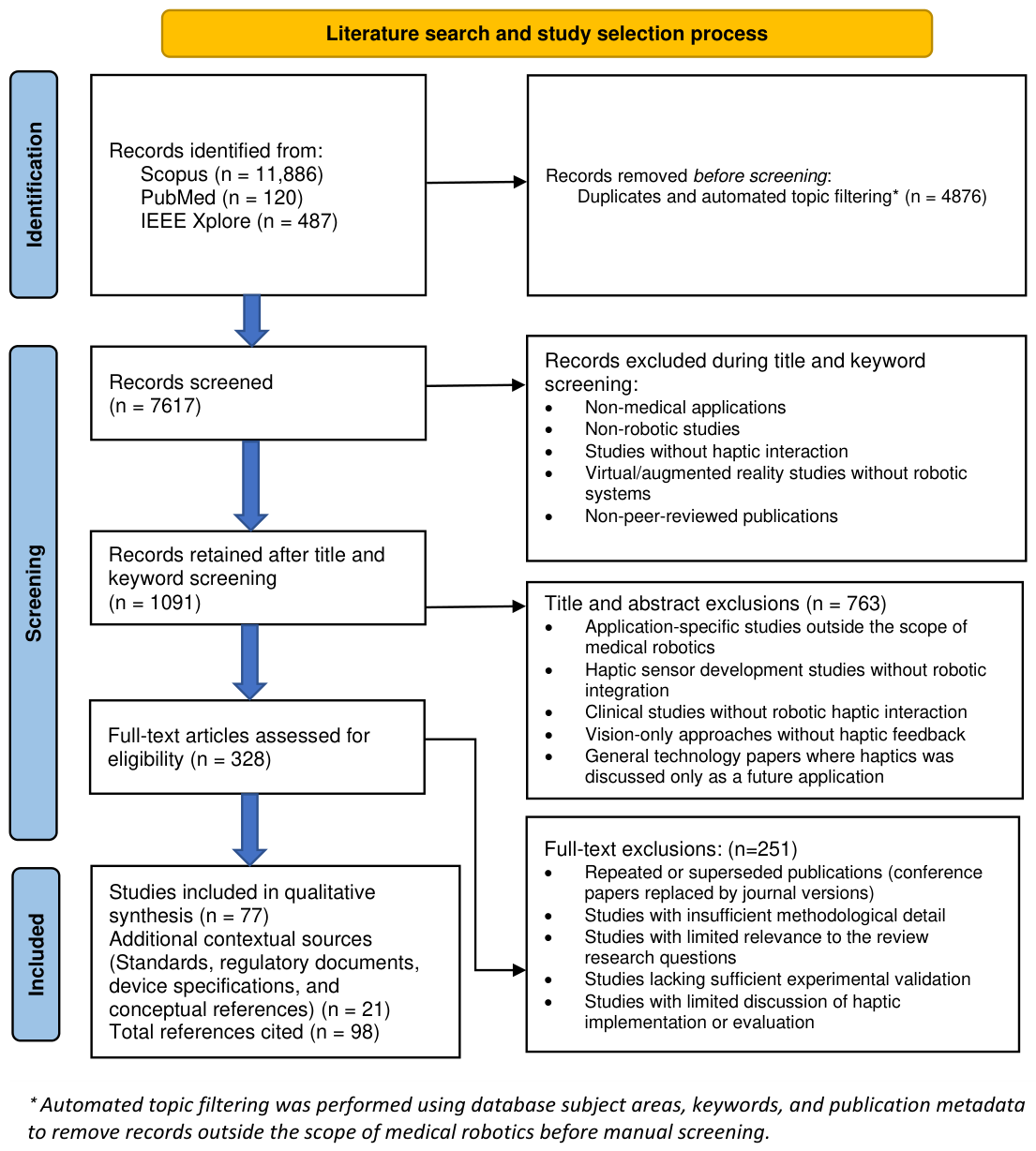
1.4. Literature Search Methodology
1.5. Review Structure
2. Haptic Perception and Device Technologies
2.1. The Physiology of Touch
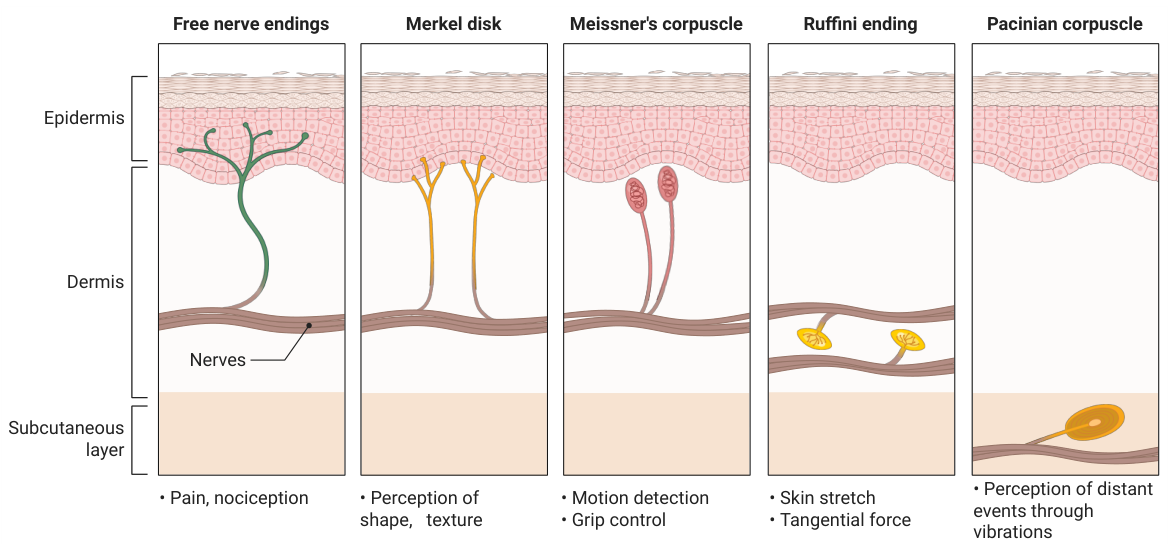
2.1.1. Cutaneous Sensation
2.1.2. Kinesthetic Sensation
2.2. Sensorimotor Integration
2.3. From Perception to Device Design
2.3.1. Mapping Modalities to Devices
- Cutaneous → tactile devices: simulate skin deformation, vibration, or temperature through miniature actuators.
- Kinesthetic → force-feedback devices: generate resistive forces or torques proportional to motion and environment dynamics.
- Hybrid systems: combine both channels to deliver simultaneous cues (e.g., a glove providing fingertip vibration while an arm exoskeleton produces global resistance).
2.3.2. Design Parameters
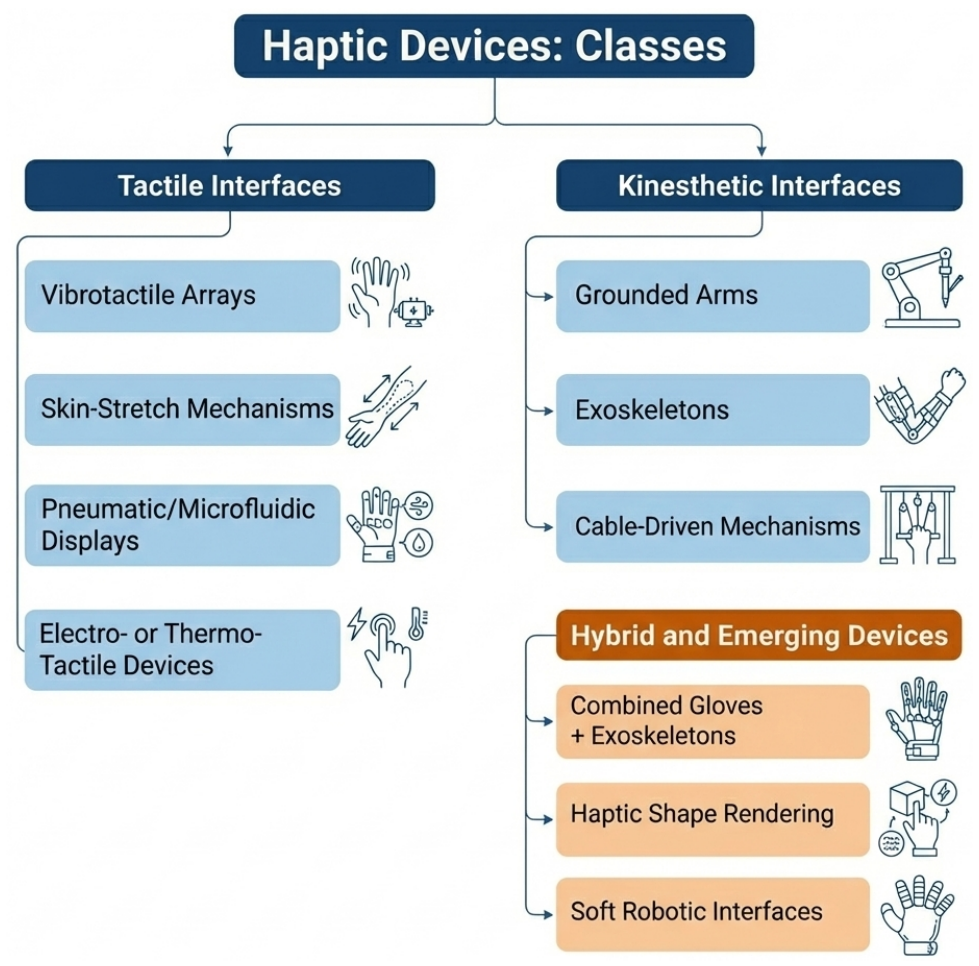
2.4. Device Classes for Haptic Interaction
2.4.1. Cutaneous (Tactile) Interfaces
2.4.2. Kinesthetic Interfaces
2.4.3. Hybrid and Emerging Interfaces
2.5. Evaluation and Performance Metrics
3. Principles of Haptic Rendering
3.1. The Haptic Interaction Loop
- 1.
- Human motion: the user moves the handle or stylus.
- 2.
- Sensing: encoders or force sensors measure position , velocity , and applied force .
- 3.
- Computation: a controller or simulation computes the environment’s response (virtual stiffness, damping, collision).
- 4.
- Actuation: motors or actuators render the calculated reaction force back to the user.
3.2. Transparency: Fidelity of Interaction
3.3. Stability: Safety of Interaction
3.4. Balancing Transparency and Stability
3.5. Control Architectures
3.6. Perceptual and System Constraints
- 1.
- Maximum stable renderable stiffness, (N/m): This is the highest virtual contact stiffness that can be rendered without oscillation or instability. In practice, is limited by the haptic servo rate (Hz), total loop delay, actuator force authority, and the device’s intrinsic damping, inertia, friction, and quantization/noise.
- 2.
- Minimum renderable impedance, : Even with “zero” commanded force, the user still feels the device’s intrinsic impedance due to inertia, viscous/Coulomb friction, transmission backlash, and sensor/actuator imperfections. If this baseline impedance is too high, users perceive a “sticky” or “heavy” free-space motion.
3.7. Design Best Practices
- 1.
- Prioritize safety and passivity: stability always overrides realism.
- 2.
- Optimize mechanical design: lightweight, low-friction mechanisms yield better transparency.
- 3.
- Use high-rate control loops: for both rendering and sensor readout.
- 4.
- Employ adaptive damping/gain scheduling: based on user motion or estimated delay.
- 5.
- Synchronize multimodal cues: align haptic, visual, and auditory feedback (desynchronization degrades performance).
- 6.
- Validate perceptually: user studies remain the final benchmark of fidelity and comfort.
4. Haptic Feedback in Medical Robotics
4.1. Role and Benefits of Haptic Feedback
4.2. Feedback Modalities and Cue Encoding
4.2.1. Cutaneous Cueing: Event and Surface Information
4.2.2. Kinesthetic Feedback: Force and Guidance Information
4.2.3. Multimodal Cue Allocation
4.3. Distributed and Wearable Feedback Systems
4.4. Control Strategies for Medical Haptics
4.4.1. Direct Force Reflection (Bilateral Teleoperation)
4.4.2. Shared Control, Virtual Fixtures, and Guidance Fields
4.4.3. Model-Based and Data-Driven Rendering (Sensorless Haptics)
4.4.4. Latency Compensation and Practical Robustness
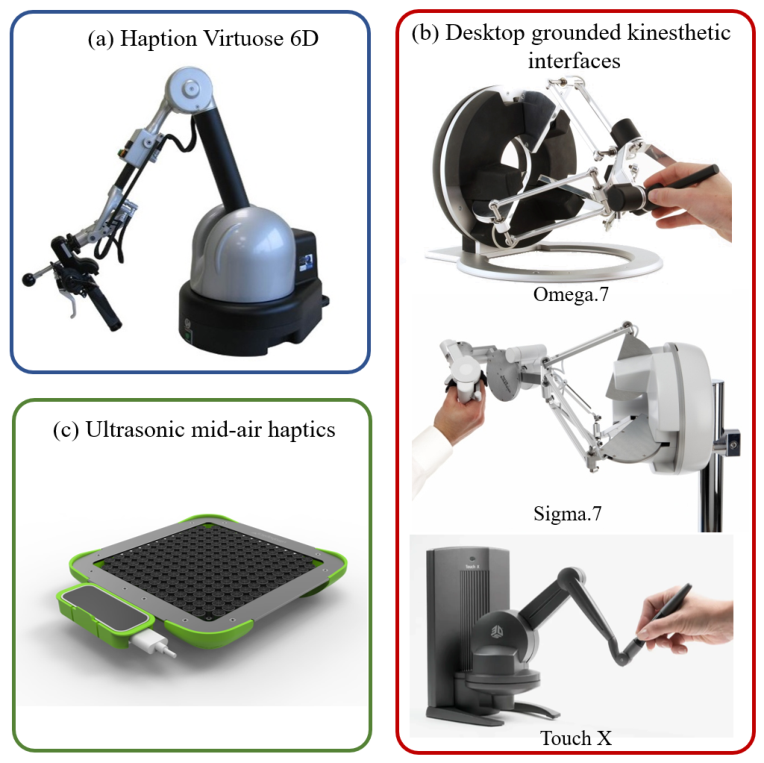
4.5. Representative Systems and Case Studies
- 1.
- Haption Virtuose 6D: The Haption Virtuose 6D RV is a grounded 6-DOF kinesthetic interface designed to render both forces and torques with a comparatively large workspace. According to the manufacturer datasheet, the device provides (at workspace center) 35 N peak/10 N continuous force, and 3.1 N·m peak/1 N·m continuous torque, with a 1 kHz update rate. The same datasheet reports a maximum translational stiffness of 2000 N/m (2 N/mm) in the standard configuration, and higher stiffness for high-force configurations [46].
- 2.
- Desktop Grounded Kinesthetic Interfaces (Omega.7, Sigma.7, Touch/Touch X): Desktop grounded kinesthetic interfaces constitute one of the most widely used classes of haptic hardware in medical robotics, serving as master devices for teleoperation and interaction interfaces for surgical simulation. Most systems employ serial or parallel linkages equipped with high-resolution position encoders and electric actuators that render translational forces and, in some cases, torques or grasp feedback directly to the surgeon’s hand. Their mechanical design prioritizes low inertia, backdrivability, and high control bandwidth (typically 1–4 kHz) to maximize transparency while maintaining stable interaction. Consequently, these devices can render relatively stiff and stable contact interactions, making them well suited for experimental teleoperation platforms and surgical simulators. Commercial systems such as the Omega.7, Sigma.7, Touch X, and Virtuose 6D exemplify different implementations of these design principles, providing a practical compromise between realism, safety, and deployability [4,15,18].
- 3.
- Ultrasonic mid-air arrays (UltraHaptics/Ultraleap): Ultrasonic phased arrays (popularized by UltraHaptics, now within Ultraleap) can generate mid-air tactile sensations, enabling contactless haptic cues. This modality is attractive when physical contact should be minimized (e.g., touchless interfaces in hygiene-sensitive settings), but it should be presented as tactile cueing rather than high-force kinesthetic rendering. A foundational demonstration of multi-point mid-air ultrasound haptics is reported in the UltraHaptics work [20].
4.6. Integration Challenges
4.6.1. Sterilization and the Sterile Barrier
4.6.2. Miniaturization and Instrument Integration
4.6.3. Safety Certification and Quality Management
4.6.4. User Variability: Perception, Gloves, and Calibration
5. Applications in Medicine and Healthcare
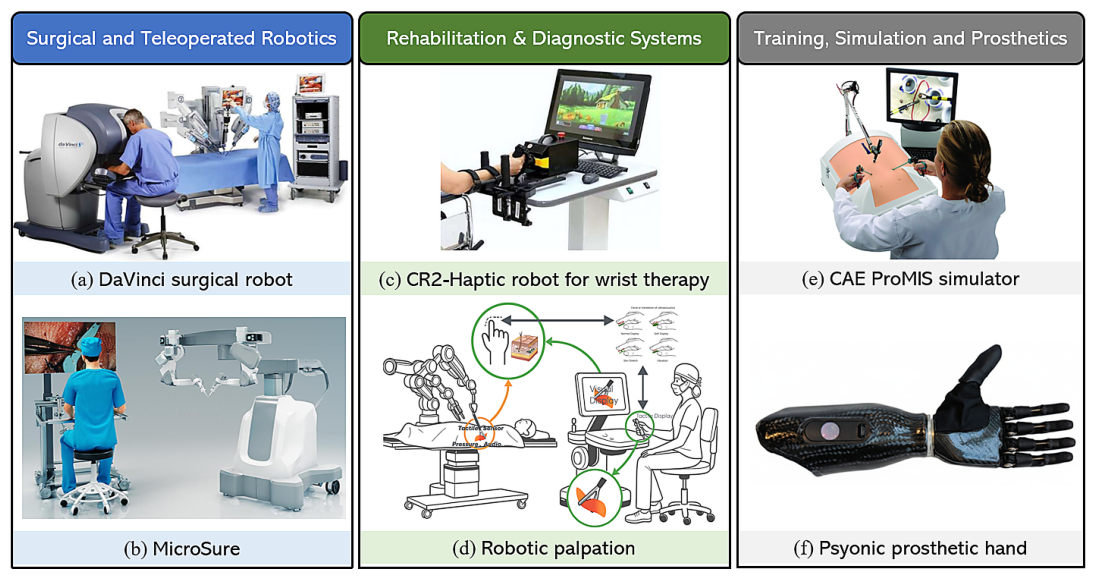
5.1. Surgical and Teleoperated Robotics
5.1.1. Restoring Force Perception in Surgery
5.1.2. Example: da Vinci Research Kit (dVRK)
5.1.3. Shared Control and Virtual Fixtures
5.1.4. Teleoperation and Remote Surgery
5.1.5. Haptics in Interventional Robotics
5.2. Rehabilitation and Diagnostic Systems
5.2.1. Haptics in Motor Rehabilitation
5.2.2. Haptic Biofeedback and Objective Assessment
- Continuous guidance/resistance fields (e.g., compliant “virtual fixtures” for rehabilitation tasks),
- Event-based cues (e.g., vibrotactile alerts for excessive effort or poor posture),
- Task-embedded haptic rendering in game-like therapy exercises (virtual objects, boundaries, or targets).
5.2.3. Diagnostic and Palpation Robotics
5.3. Training, Simulation, and Prosthetics
5.3.1. Surgical Training and Simulation
5.3.2. Haptic Feedback in Prosthetics
- 1.
- Vibrotactile feedback: small vibration motors convey contact events or grip strength to residual skin.
- 2.
- Electrotactile feedback: electrical stimulation of skin nerves simulates touch; intensity scales with grip force.
- 3.
- Mechanotactile feedback: motor-driven pads apply pressure proportional to object stiffness.
5.3.3. Assistive and Wearable Haptics
6. Challenges and Research Frontiers
6.1. Technical Challenges
6.1.1. Rendering Fidelity, Bandwidth, and Device “Z-Width”
6.1.2. Sensing, Miniaturization, and Clinical Integration
6.1.3. Latency and Stability in Networked Teleoperation
6.2. Human-Factor Challenges
6.2.1. Perceptual Utility and Calibration
6.2.2. Cognitive Load and Fatigue
6.2.3. Evaluation and Standardization Gaps
6.3. Safety, Reliability, and Regulatory Translation
7. Future Directions in Medical Haptics
7.1. Data-Driven Haptics and Sensorless Force Estimation
7.2. Emerging Interface Technologies
7.2.1. Multimodal and XR-Enabled Guidance
7.2.2. Soft, Wearable, and Home-Compatible Interfaces
7.2.3. Neurohaptics and Bidirectional Human–Robot Interfaces
7.2.4. Networked Haptics and the “Internet of Skills”
7.3. Outlook and Research Priorities
8. Conclusions
8.1. Synthesis of Evidence and Key Takeaways
8.2. Clinical and Design Implications
8.3. Recommendations for Research and Translation
8.4. Concluding Perspective
Supplementary Materials
Funding
Data Availability Statement
Acknowledgments
Conflicts of Interest
References
- Bergholz, M.; Ferle, M.; Weber, B. The benefits of haptic feedback in robot assisted surgery and their moderators: A meta-analysis. Sci. Rep. 2023, 13, 19215. [Google Scholar] [CrossRef] [PubMed]
- Saluja, S.; Croy, I.; Stevenson, R. The Functions of Human Touch: An Integrative Review. J. Nonverbal Behav. 2024, 48, 387–417. [Google Scholar] [CrossRef]
- Kuhail, M.; Berengueres, J.; Taher, F.; Al Kuwaiti, M. (Eds.) Exploring the Role of Haptic Technology in Healthcare. In Advances, Applications and the Future of Haptic Technology; Springer Nature: Cham, Switzerland, 2024; pp. 15–28. [Google Scholar] [CrossRef]
- Selim, M.; Dresscher, D.; Abayazid, M. A comprehensive review of haptic feedback in minimally invasive robotic liver surgery: Advancements and challenges. Int. J. Med. Robot. Comput. Assist. Surg. 2024, 20, e2605. [Google Scholar] [CrossRef] [PubMed]
- Jones, L.; Lederman, S. Human Hand Function; Oxford University Press: Oxford, UK, 2006. [Google Scholar] [CrossRef]
- Lederman, S.; Klatzky, R. Haptic perception: A tutorial. Atten. Percept. Psychophys. 2009, 71, 1439–1459. [Google Scholar] [CrossRef] [PubMed]
- Bhatnagar, T.; Higgins, A.; Marquardt, N.; Miodownik, M.; Holloway, C. Analysis of Product Architectures of Pin Array Technologies for Tactile Displays. Proc. ACM Hum.-Comput. Interact. 2023, 7, 135–155. [Google Scholar] [CrossRef]
- Otaduy, M.A.; Lin, M.C. (Eds.) Fundamentals of Haptic Rendering. In High Fidelity Haptic Rendering; Springer International Publishing: Berlin/Heidelberg, Germany, 2006; pp. 1–21. [Google Scholar] [CrossRef]
- Culbertson, H.; Schorr, S.B.; Okamura, A.M. Haptics: The Present and Future of Artificial Touch Sensation. Annu. Rev. Control. Robot. Auton. Syst. 2018, 1, 385–409. [Google Scholar] [CrossRef]
- Gleeson, B.; Horschel, S.; Provancher, W. Design of a fingertip-mounted tactile display with tangential skin displacement feedback. IEEE Trans. Haptics 2010, 3, 297–301. [Google Scholar] [CrossRef] [PubMed]
- Nyasulu, T.; Du, S.; Steyn, N.; Dong, E. A study of cutaneous perception parameters for designing haptic symbols towards information transfer. Electronics 2021, 10, 2147. [Google Scholar] [CrossRef]
- Jones, L.; Ho, H. Warm or cool, large or small? The challenge of thermal displays. IEEE Trans. Haptics 2008, 1, 53–70. [Google Scholar] [CrossRef] [PubMed]
- Pacchierotti, C.; Prattichizzo, D.; Kuchenbecker, K. Cutaneous feedback of fingertip deformation and vibration for palpation in robotic surgery. IEEE Trans. Biomed. Eng. 2016, 63, 278–287. [Google Scholar] [CrossRef] [PubMed]
- Okamoto, S.; Konyo, M.; Saga, S.; Tadokoro, S. Detectability and perceptual consequences of delayed feedback in a vibrotactile texture display. IEEE Trans. Haptics 2009, 2, 73–84. [Google Scholar] [CrossRef] [PubMed]
- Avila, A.; Selim, M.; Abayazid, M. Respiratory Motion Compensation and Haptic Feedback for X-Ray-Guided Teleoperated Robotic Needle Insertion. In Proceedings of the 2024 10th IEEE RAS/EMBS International Conference for Biomedical Robotics and Biomechatronics (BioRob), Heidelberg, Germany, 1–4 September 2024; pp. 1352–1357. [Google Scholar] [CrossRef]
- Marchal-Crespo, L.; Reinkensmeyer, D. Review of control strategies for robotic movement training after neurologic injury. J. Neuroeng. Rehabil. 2009, 6, 20. [Google Scholar] [CrossRef] [PubMed]
- Gonçalves, R.; Alves, T.; Carbone, G.; Ceccarelli, M. Cable-Driven Robots in Physical Rehabilitation. In Research Anthology on Emerging Technologies and Ethical Implications in Human Enhancement; IGI Global: Hershey, PA, USA, 2021; pp. 255–290. [Google Scholar] [CrossRef]
- Niemeyer, G.; Slotine, J.J. Telemanipulation with Time Delays. Int. J. Robot. Res. 2004, 23, 873–890. [Google Scholar] [CrossRef]
- Polygerinos, P.; Correll, N.; Morin, S.A.; Mosadegh, B.; Onal, C.D.; Petersen, K.; Cianchetti, M.; Tollet, M.T.; Shepherd, R.F. Soft Robotics: Review of Fluid-Driven Intrinsically Soft Devices; Manufacturing, Sensing, Control, and Applications in Human-Robot Interaction. Adv. Eng. Mater. 2017, 19, 1700016. [Google Scholar] [CrossRef]
- Carter, T.; Seah, S.; Long, B.; Drinkwater, B.; Subramanian, S. UltraHaptics: Multi-point mid-air haptic feedback for touch surfaces. In Proceedings of the UIST 2013-Proceedings of the 26th Annual ACM Symposium on User Interface Software and Technology, St. Andrews, UK, 8–11 October 2013; pp. 505–514. [Google Scholar] [CrossRef]
- Okamura, A. Haptic feedback in robot-assisted minimally invasive surgery. Curr. Opin. Urol. 2009, 19, 102–107. [Google Scholar] [CrossRef] [PubMed]
- Colgate, J.; Brown, J. Factors Affecting the Z-Width of a Haptic Display. In Proceedings of the IEEE International Conference on Robotics and Automation, San Diego, CA, USA, 8–13 May 1994; pp. 3205–3210. [Google Scholar]
- Allin, S.; Matsuoka, Y.; Klatzky, R. Measuring Just Noticeable Differences For Haptic Force Feedback: Implications for Rehabilitation. In Proceedings of the 10th Symposium on Haptic Interfaces for Virtual Environment and Teleoperator Systems, Orlando, FL, USA, 24–25 March 2002; pp. 299–302. [Google Scholar]
- Karadogan, E.; Williams, R.; Howell, J.; Conatser, R. A stiffness discrimination experiment including analysis of palpation forces and velocities. Simul. Healthc. 2010, 5, 279–288. [Google Scholar] [CrossRef] [PubMed]
- De Gersem, G.; Van Brussel, H.; Tendick, F. Reliable and Enhanced Stiffness Perception in Soft-tissue Telemanipulation. Int. J. Robot. Res. 2005, 24, 805–822. [Google Scholar] [CrossRef]
- Colgate, J.; Schenkel, G. Passivity of a class of sampled-data systems: Application to haptic interfaces. J. Robot. Syst. 1997, 14, 37–47. [Google Scholar] [CrossRef]
- Hannaford, B.; Ryu, J.H. Time-Domain Passivity Control of Haptic Interfaces. IEEE Trans. Robot. Autom. 2002, 18, 1–10. [Google Scholar] [CrossRef]
- Franken, M.; Stramigioli, S.; Misra, S.; Secchi, C.; MacChelli, A. Bilateral telemanipulation with time delays: A two-layer approach combining passivity and transparency. IEEE Trans. Robot. 2011, 27, 741–756. [Google Scholar] [CrossRef]
- Laga Boul-Atarass, I.; Rubio Manzanares Dorado, M.; Padillo-Eguía, A.; Racero-Moreno, J.; Eguía-Salinas, I.; Pereira-Arenas, S.; Jiménez-Rodríguez, R.M.; Padillo-Ruiz, J. Role of haptic feedback technologies and novel engineering developments for surgical training and robot-assisted surgery. Front. Robot. AI 2025, 12, 1567955. [Google Scholar] [CrossRef]
- Horibe, T.; Treadway, E.; Gillespie, R. Comparing Series Elasticity and Admittance Control for Haptic Rendering. In Proceedings of the Haptics: Perception, Devices, Control, and Applications; Bello, F., Kajimoto, H., Visell, Y., Eds.; Springer International Publishing: Berlin/Heidelberg, Germany, 2016; pp. 240–250. [Google Scholar]
- Golahmadi, A.; Khan, D.; Mylonas, G.; Marcus, H. Tool-tissue forces in surgery: A systematic review. Ann. Med. Surg. 2021, 68, 102268. [Google Scholar] [CrossRef] [PubMed]
- Jourdes, F.; Valentin, B.; Allard, J.; Duriez, C.; Seeliger, B. Visual Haptic Feedback for Training of Robotic Suturing. Front. Robot. AI 2022, 9, 800232. [Google Scholar] [CrossRef] [PubMed]
- Vitense, H.; Jacko, J.; Emery, V. Multimodal feedback: An assessment of performance and mental workload. Ergonomics 2003, 46, 68–87. [Google Scholar] [CrossRef] [PubMed]
- Haddadi, A.; Hashtrudi-Zaad, K. Delay-Robust Transparent Bilateral Teleoperation Control Design. In Proceedings of the 2008 IEEE/RSJ International Conference on Intelligent Robots and Systems, Nice, France, 22–26 September 2008; pp. 438–444. [Google Scholar] [CrossRef]
- Abbott, J.; Marayong, P.; Okamura, A. Haptic Virtual Fixtures for Robot-Assisted Manipulation. In Robotics Research; Thrun, S., Brooks, R., Durrant-Whyte, H., Eds.; Springer: Berlin/Heidelberg, Germany, 2007; pp. 49–64. [Google Scholar]
- Rosen, J.; Lum, M.; Sinanan, M.; Hannaford, B. Raven: Developing a Surgical Robot from a Concept to a Transatlantic Teleoperation Experiment. In Surgical Robotics: Systems Applications and Visions; Rosen, J., Hannaford, B., Satava, R., Eds.; Springer: New York, NY, USA, 2011; pp. 159–197. [Google Scholar] [CrossRef]
- Ratschat, A.; van Rooij, B.; Luijten, J.; Marchal-Crespo, L. Evaluating tactile feedback in addition to kinesthetic feedback for haptic shape rendering: A pilot study. Front. Robot. AI 2024, 11, 1298537. [Google Scholar] [CrossRef] [PubMed]
- Boutin, J.; Kamoonpuri, J.; Faieghi, R.; Chung, J.; de Ribaupierre, S.; Eagleson, R. Smart haptic gloves for virtual reality surgery simulation: A pilot study on external ventricular drain training. Front. Robot. AI 2024, 10, 1273631. [Google Scholar] [CrossRef] [PubMed]
- SenseGlove. Nova 2: Force-Feedback Haptic Glove (Product Specifications). SenseGlove Website. 2025. Available online: https://www.senseglove.com/solutions/senseglove-for-research/ (accessed on 1 May 2026).
- Li, F.; Chen, J.; Ye, G.; Dong, S.; Gao, Z.; Zhou, Y. Soft Robotic Glove with Sensing and Force Feedback for Rehabilitation in Virtual Reality. Biomimetics 2023, 8, 83. [Google Scholar] [CrossRef] [PubMed]
- Pang, Z.; Wang, T.; Wang, Z.; Yu, J.; Sun, Z.; Liu, S. Design and Analysis of a Wearable Upper Limb Rehabilitation Robot with Characteristics of Tension Mechanism. Appl. Sci. 2020, 10, 2101. [Google Scholar] [CrossRef]
- Ryu, J.H.; Hannaford, B.; Preusche, C.; Hirzinger, G. Time domain passivity control with reference energy behavior. In Proceedings of the 2003 IEEE/RSJ International Conference on Intelligent Robots and Systems (IROS 2003) (Cat. No.03CH37453), Las Vegas, NV, USA, 27–31 October 2003; Volume 3, pp. 2932–2937. [Google Scholar] [CrossRef]
- Okamura, A. Methods for haptic feedback in teleoperated robot-assisted surgery. Ind. Robot. Int. J. Robot. Res. Appl. 2004, 31, 499–508. [Google Scholar] [CrossRef] [PubMed]
- Yan, Y.L.; Ren, T.; Ding, L.; Sun, T.; Huang, S. Robust prediction of tool-tissue interaction force using ISSA-optimized BP neural networks in robotic surgery. BMC Surg. 2025, 25, 368. [Google Scholar] [CrossRef] [PubMed]
- Yılmaz, N.; Burkhart, B.; Deguet, A.; Kazanzides, P.; Tümerdem, U. Enhancing robotic telesurgery with sensorless haptic feedback. Int. J. Comput. Assist. Radiol. Surg. 2024, 19, 1147–1155. [Google Scholar] [CrossRef] [PubMed]
- Haption. Virtuose 6D RV HF Hardware Datasheet. Haption, Soulgé-sur-Ouette, France, 2025. Available online: https://downloads.haption.com/marketing/datasheet/Datasheet-Hardware-Virtuose6DRVHF-2025.pdf (accessed on 21 July 2026).
- Hao, Y.; Zhang, H.; Zhang, Z.; Hu, C.; Shi, C. Development of Force Sensing Techniques for Robot-Assisted Laparoscopic Surgery: A Review. IEEE Trans. Med. Robot. Bionics 2024, 6, 868–887. [Google Scholar] [CrossRef]
- ISO 13485:2016; Medical Devices—Quality Management Systems—Requirements for Regulatory Purposes. International Organization for Standardization: Geneva, Switzerland, 2016.
- IEC 60601-1:2005+A1:2012+A2:2020; Medical Electrical Equipment—Part 1: General Requirements for Basic Safety and Essential Performance. International Electrotechnical Commission: Geneva, Switzerland, 2020.
- Man, T.; Jiang, J.; Schulz, M.; Kükrek, H.; Betzl, J.; Machens, H.G.; Erne, H.C.; Moog, P. Surgical experience and different glove wearing conditions affect tactile sensibility. Heliyon 2022, 8, e12550. [Google Scholar] [CrossRef] [PubMed]
- Chatterjee, A.; Spratt, D.L.; Enz, A.; Bah-Rösman, J.; Brindle, C.T. Hands Deserve Better: A Systematic Review on Surgical Glove Fit and Provider Performance. J. Clin. Med. 2025, 14, 7695. [Google Scholar] [CrossRef] [PubMed]
- Friebe, M. Palpation sensing for robotic-assisted surgery. Die Orthop. 2026, 55, 3–10. [Google Scholar] [CrossRef] [PubMed]
- Dehabadi, M.; Fernando, B.; Berlingieri, P. The use of simulation in the acquisition of laparoscopic suturing skills. Int. J. Surg. 2014, 12, 258–268. [Google Scholar] [CrossRef] [PubMed]
- Khor, K.; Chin, P.; Hisyam, A.; Yeong, C.; Narayanan, A.; Su, E. Development of CR2-Haptic: A compact and portable rehabilitation robot for wrist and forearm training. In Proceedings of the 2014 IEEE Conference on Biomedical Engineering and Sciences (IECBES), Miri, Malaysia, 8–10 December 2014; pp. 424–429. [Google Scholar] [CrossRef]
- Akhtar, A.; Cornman, J.; Austin, J.; Bala, D. Touch Feedback and Contact Reflexes Using the Psyonic Ability Hand. J. Neuroeng. Rehabil. 2024, 21, 45. [Google Scholar]
- Intuitive Foundation. The da Vinci Research Kit. 2025. Available online: https://www.intuitive-foundation.org/dvrk/ (accessed on 29 December 2025).
- Saracino, A.; Deguet, A.; Staderini, F.; Boushaki, M.N.; Cianchi, F.; Menciassi, A.; Sinibaldi, E. Haptic feedback in the da Vinci Research Kit (dVRK): A user study based on grasping, palpation, and incision tasks. Int. J. Med. Robot. Comput. Assist. Surg. 2019, 15, e1999. [Google Scholar] [CrossRef] [PubMed]
- Abayazid, M.; Pacchierotti, C.; Moreira, P.; Alterovitz, R.; Prattichizzo, D.; Misra, S. Experimental evaluation of co-manipulated ultrasound-guided flexible needle steering. Int. J. Med. Robot. Comput. Assist. Surg. 2016, 12, 219–230. [Google Scholar]
- Pacchierotti, C.; Abayazid, M.; Misra, S.; Prattichizzo, D. Teleoperation of steerable flexible needles by combining kinesthetic and vibratory feedback. IEEE Trans. Haptics 2014, 7, 551–556. [Google Scholar] [CrossRef] [PubMed]
- Mak, Y.; Lanciano, A.; Stramigioli, S.; Abayazid, M. Development of Haptic Approaches for a Head-Controlled Soft Robotic Endoscope. In Proceedings of the 2020 8th IEEE RAS/EMBS International Conference for Biomedical Robotics and Biomechatronics (BioRob), New York, NY, USA, 29 November–1 December 2020; pp. 1216–1222. [Google Scholar] [CrossRef]
- Nankaku, A.; Tokunaga, M.; Yonezawa, H.; Kanno, T.; Kawashima, K.; Hakamada, K.; Hirano, S.; Oki, E.; Mori, M.; Kinugasam, Y. Maximum acceptable communication delay for the realization of telesurgery. PLoS ONE 2022, 17, e0274328. [Google Scholar] [CrossRef] [PubMed]
- Hagn, U.; Konietschke, R.; Tobergte, A.; Nickl, M.; Jörg, S.; Kübler, B.; Passig, G.; Gröger, M.; Fröhlich, F.; Seibold, U.; et al. DLR MiroSurge: A versatile system for research in endoscopic telesurgery. Int. J. Comput. Assist. Radiol. Surg. 2010, 5, 183–193. [Google Scholar] [CrossRef] [PubMed]
- Asensus Surgical. Senhance Surgical System. 2025. Available online: https://www.asensus.com/ (accessed on 29 December 2025).
- Killaars, R.E.M.; Visschers, R.G.J.; Dirix, M.; Theeuws, O.P.F.; Eurlings, R.; Dinjens, D.J.H.; Cakir, H.; van Gemert, W.G. Robotic-Assisted Surgery in Children Using the Senhance® Surgical System: An Observational Study. Children 2024, 11, 935. [Google Scholar] [CrossRef] [PubMed]
- Ueda, Y.; Miyahara, S.; Tokuishi, K.; Nakajima, H.; Waseda, R.; Shiraishi, T.; Sato, T. First clinical application of a surgical robot with haptic force feedback function for thoracic surgery: A case report. Shanghai Chest 2024, 8, 16. [Google Scholar] [CrossRef]
- Oshima, N.; Yoshiki, N.; Kohri, Y.; Takao, M.; Miyasaka, N. Initial Experience with the Saroa Surgical System in Robot-Assisted Hysterectomy: First Clinical Case Series and Haptic Feedback Assessment. Medicina 2025, 61, 1716. [Google Scholar] [CrossRef] [PubMed]
- CMR Surgical. Versius Surgical System User Manual, Document No. U-00009v15.0, Version 15.0. Available online: https://cmrsurgical.com/wp-content/uploads/2022/11/U-00009v15-VersiusSurgicalSystem-UserManual-English-UK.pdf (accessed on 21 July 2026).
- Shi, P.; Guo, S.; Zhang, L.; Jin, X.; Hirata, H.; Tamiya, T.; Kawanishi, M. Design and Evaluation of a Haptic Robot-Assisted Catheter Operating System With Collision Protection Function. IEEE Sens. J. 2021, 21, 20807–20816. [Google Scholar] [CrossRef]
- Song, Y.; Tian, Y.; Li, L.; Gao, Q.; Li, Z. Passive haptic interface for robot-assisted endovascular catheterization. Med. Biol. Eng. Comput. 2025, 63, 3067–3082. [Google Scholar] [CrossRef] [PubMed]
- Qin, W.; Yi, H.; Fan, Z.; Zhao, J. Haptic Shared Control Framework with Interaction Force Constraint Based on Control Barrier Function for Teleoperation. Sensors 2025, 25, 405. [Google Scholar] [CrossRef] [PubMed]
- Dagnino, G.; Kundrat, D.; Kwok, T.M.Y.; Abdelaziz, M.E.M.K.; Chi, W.; Nguyen, A.; Riga, C.; Yang, G.Z. In-Vivo Validation of a Novel Robotic Platform for Endovascular Intervention. IEEE Trans. Biomed. Eng. 2023, 70, 1786–1794. [Google Scholar] [CrossRef] [PubMed]
- Zhang, L.; Zuo, J.; Wang, K.; Jiang, T.; Gu, S.; Xu, L.; Zhang, Y. An advanced robotic system incorporating haptic feedback for precision cardiac ablation procedures. Sci. Rep. 2025, 15, 6839. [Google Scholar] [CrossRef] [PubMed]
- Gomez-Risquet, M.; Cáceres-Matos, R.; Magni, E.; Luque-Moreno, C. Effects of Haptic Feedback Interventions in Post-Stroke Gait and Balance Disorders: A Systematic Review and Meta-Analysis. J. Pers. Med. 2024, 14, 974. [Google Scholar] [CrossRef] [PubMed]
- Hocoma. Armeo Rehabilitation. 2025. Available online: https://www.hocoma.com/library/ (accessed on 29 December 2025).
- Dawson-Elli, A.; Adamczyk, P. Design and Validation of a Lower-Limb Haptic Rehabilitation Robot. IEEE Trans. Neural Syst. Rehabil. Eng. 2020, 28, 1584–1594. [Google Scholar] [CrossRef] [PubMed]
- Bakr, M.M.; Idris, G.; Al Ankily, M. The potential integration of Simodont® Dental Trainer in different stages of the dental curriculum. Saudi Dent. J. 2024, 36, 1449–1455. [Google Scholar] [CrossRef] [PubMed]
- Slaczka, D.M.; Shah, R.; Liu, C.; Zou, F.; Karunanayake, G.A. Endodontic access cavity training using artificial teeth and Simodont® dental trainer: A comparison of student performance and acceptance. Int. Endod. J. 2026, 59, 1048–1056. [Google Scholar] [CrossRef] [PubMed]
- Bakr, M.M.; Cameron, A.; Idris, G.; Shamel, M.; Al Ankily, M. A comparative analysis of perceptions and evaluations of Simodont® Dental Trainer: A decade of virtual simulation. Front. Oral Health 2025, 6, 1646299. [Google Scholar] [CrossRef] [PubMed]
- Tan, D.; Schiefer, M.; Keith, M.; Anderson, J.; Tyler, J.; Tyler, D. A neural interface provides long-term stable natural touch perception. Sci. Transl. Med. 2014, 6, 257ra138. [Google Scholar] [CrossRef] [PubMed]
- Malešević, N.; Antfolk, C. Sensory feedback in upper limb prosthetics: Advances and challenges. Nat. Rev. Neurol. 2024, 20, 449–450. [Google Scholar] [CrossRef] [PubMed]
- Samur, E. Introduction. In Performance Metrics for Haptic Interfaces; Springer: London, UK, 2012; pp. 3–7. [Google Scholar] [CrossRef]
- Weir, D.W.; Colgate, J.E.; Peshkin, M.A. Measuring and Increasing Z-Width with Active Electrical Damping. In Proceedings of the 2008 Symposium on Haptic Interfaces for Virtual Environment and Teleoperator Systems, Reno, NV, USA, 13–14 March 2008; pp. 169–175. [Google Scholar] [CrossRef]
- Diolaiti, N.; Niemeyer, G.; Barbagli, F.; Salisbury, J. Stability of Haptic Rendering: Discretization, Quantization, Time Delay, and Coulomb Effects. IEEE Trans. Robot. 2006, 22, 256–268. [Google Scholar] [CrossRef]
- Abeywardena, S.; Yuan, Q.; Tzemanaki, A.; Psomopoulou, E.; Droukas, L.; Melhuish, C.; Dogramadzi, S. Estimation of Tool-Tissue Forces in Robot-Assisted Minimally Invasive Surgery Using Neural Networks. Front. Robot. AI 2019, 6, 56. [Google Scholar] [CrossRef] [PubMed]
- Neidhardt, M.; Mieling, R.; Bengs, M.; Schlaefer, A. Optical force estimation for interactions between tool and soft tissues. Sci. Rep. 2023, 13, 416. [Google Scholar] [CrossRef] [PubMed]
- Wickens, C.D. Multiple Resources and Mental Workload. Hum. Factors 2008, 50, 449–455. [Google Scholar] [CrossRef] [PubMed]
- Hart, S.G. Nasa-Task Load Index (NASA-TLX); 20 Years Later. Proc. Hum. Factors Ergon. Soc. Annu. Meet. 2006, 50, 904–908. [Google Scholar] [CrossRef]
- ISO 9241-210:2019; Ergonomics of Human-System Interaction—Part 210: Human-Centred Design for Interactive Systems. International Organization for Standardization: Geneva, Switzerland, 2019.
- IEC 62366-1:2015; Medical Devices-Part 1: Application of Usability Engineering to Medical Devices. International Electrotechnical Commission: Geneva, Switzerland, 2015.
- U.S. Food and Drug Administration. Applying Human Factors and Usability Engineering to Medical Devices: Guidance for Industry and Food and Drug Administration Staff; Food and Drug Administration: Rockville, MD, USA, 2016.
- ASTM International. ASTM Committee F48 on Exoskeletons and Exosuits. 2025. Available online: https://www.asensus.com/ (accessed on 29 December 2025).
- ISO 14971:2019; Medical Devices—Application of Risk Management to Medical Devices. International Organization for Standardization: Geneva, Switzerland, 2019.
- IEC 62304:2006+A1:2015; Medical device Software—Software Life Cycle Processes. International Electrotechnical Commission: Geneva, Switzerland, 2015.
- Kazemipour, N.; Hooshiar, A.; Kersten-Oertel, M. A usability analysis of augmented reality and haptics for surgical planning. Int. J. Comput. Assist. Radiol. Surg. 2024, 19, 2069–2078. [Google Scholar] [CrossRef] [PubMed]
- Oddo, C.M.; Raspopovic, S.; Artoni, F.; Mazzoni, A.; Spigler, G.; Petrini, F.; Giambattistelli, F.; Vecchio, F.; Miraglia, F.; Zolle, L.; et al. Intraneural stimulation elicits discrimination of textural features by artificial fingertip in intact and amputee humans. eLife 2016, 5, e09148. [Google Scholar] [CrossRef] [PubMed]
- Cady, S.R.; Lambrecht, J.M.; Dsouza, K.T.; Dunning, J.L.; Anderson, J.R.; Malone, K.J.; Chepla, K.J.; Graczyk, E.L.; Tyler, D.J. First-in-human implementation of a bidirectional somatosensory neuroprosthetic system with wireless communication. J. Neuroeng. Rehabil. 2025, 22, 90. [Google Scholar] [CrossRef] [PubMed]
- Aijaz, A.; Dohler, M.; Aghvami, A.; Friderikos, V.; Frodigh, M. Realizing the Tactile Internet: Haptic Communications over Next Generation 5G Cellular Networks. IEEE Wirel. Commun. 2017, 24, 82–89. [Google Scholar] [CrossRef]
- Sivak, M.; Unluhisarcikli, O.; Weinberg, B.; Mirelman-Harari, A.; Bonato, P.; Mavroidis, C. Haptic system for hand rehabilitation integrating an interactive game with an advanced robotic device. In Proceedings of the IEEE Haptics Symposium, Waltham, MA, USA, 25–26 March 2010; pp. 475–481. [Google Scholar] [CrossRef]
- Page, M.J.; McKenzie, J.E.; Bossuyt, P.M.; Boutron, I.; Hoffmann, T.C.; Mulrow, C.D.; Shamseer, L.; Tetzlaff, J.M.; Akl, E.A.; Brennan, S.E.; et al. The PRISMA 2020 statement: An updated guideline for reporting systematic reviews. BMJ 2021, 372, n71. [Google Scholar] [CrossRef] [PubMed]




| Search Domain | Representative Search Query |
|---|---|
| Medical haptics | “haptic feedback” AND “medical robotics” |
| Surgical force feedback | “force feedback” AND “robotic surgery” |
| Tactile perception | “tactile perception” AND “medical robotics” |
| Rehabilitation robotics | rehabilitation AND haptic AND “medical robot” |
| Teleoperation | teleoperation AND haptic AND “medical robotics” |
| Prosthetics | prosthetic AND haptic AND “medical robotics” |
| Surgical simulation | “surgical simulation” AND haptic AND “medical robotics” |
| Receptor Type | Stimulus Sensitivity | Frequency Range | Function |
|---|---|---|---|
| Merkel cells (SA I) | Static pressure, edges | 0–10 Hz | Detect texture and shape |
| Meissner corpuscles (RA I) | Low-frequency vibration | 5–50 Hz | Perceive slip and motion onset |
| Ruffini endings (SA II) | Skin stretch | 0–100 Hz | Encode hand conformation |
| Pacinian corpuscles (RA II) | High-frequency vibration | 60–300 Hz | Detect fine texture and impact |
| Framework | Measured Variable | Controlled Variable | Best Suited for |
|---|---|---|---|
| Impedance control | Motion () | Force (F) | Low-inertia, backdrivable interfaces (desktop grounded masters, high-bandwidth devices) |
| Admittance control | Force (F) | Motion/position | Higher-inertia or less backdrivable robots; systems where accurate motion control is easier than accurate force output |
| Parameter | Representative Threshold | Design Implication |
|---|---|---|
| Force discrimination (kinesthetic JND/Weber fraction) | ≈5–10% of reference force | Prioritize stability and noise reduction over force resolution below perceptual discrimination thresholds. |
| Stiffness discrimination (JND/Weber fraction) | ≈20–30% (procedure-dependent) | Target stiffness rendering errors of approximately 20–30% or lower when stiffness perception is task critical. |
| Perceptual latency (end-to-end haptic delay) | Tens of milliseconds | Minimize end-to-end latency through high-rate control and delay-compensation strategies. |
| Tool–tissue interaction force range (surgical tasks) | Task-dependent | Size sensors, actuators, and safety limits according to the intended clinical application. |
| Modality | Information Conveyed | Typical Applications | Advantages | Limitations |
|---|---|---|---|---|
| Kinesthetic (force feedback) | Force magnitude, stiffness, impedance, guidance | Microsurgery, teleoperation, catheter navigation | Natural interaction, high realism | Motion constraint, sensitivity to delay |
| Cutaneous (skin feedback) | Contact events, slip, warnings, directional cues | Needle guidance, rehabilitation, wearable systems | Lightweight design, low power consumption | Limited force rendering capability |
| Hybrid (combined) | Force information and localized events | Advanced teleoperation, simulation, prosthetics | High information content, multimodal redundancy | Increased complexity, calibration requirements |
| System | Feedback Type | Clinical Status | Typical Application | Advantages | Limitations |
|---|---|---|---|---|---|
| Virtuose 6D | Kinesthetic | Commercial | Teleoperation, simulation | Large workspace, force/torque rendering | Grounded architecture, high cost |
| Omega.7/ Sigma.7 | Kinesthetic | Commercial | Surgical simulation, research | High bandwidth, high precision | Limited workspace |
| Touch X | Kinesthetic | Commercial | Training, simulation | Compact design, broad adoption | Limited force authority |
| Senhance | Kinesthetic force feedback | Clinical deployment | Robot-assisted surgery | Integrated force sensing, clinical deployment | Limited long-term haptic outcome data |
| Saroa | Kinesthetic force feedback | Early clinical deployment | Thoracic and gynecological surgery | Integrated force feedback, clinical translation | Limited clinical evidence |
| SenseGlove Nova | Hybrid | Commercial | Training, rehabilitation | Wearable design, multimodal feedback | Limited force rendering capability |
| Ultraleap | Cutaneous (mid-air) | Commercial | Touchless interaction | Contactless operation, hygienic interface | Limited force magnitude |
| Simodont® Dental Trainer | Kinesthetic | Commercial | Dental education, simulation | Validated educational platform, realistic force feedback | Training only; not for clinical use |
Disclaimer/Publisher’s Note: The statements, opinions and data contained in all publications are solely those of the individual author(s) and contributor(s) and not of MDPI and/or the editor(s). MDPI and/or the editor(s) disclaim responsibility for any injury to people or property resulting from any ideas, methods, instructions or products referred to in the content. |
© 2026 by the author. Licensee MDPI, Basel, Switzerland. This article is an open access article distributed under the terms and conditions of the Creative Commons Attribution (CC BY) license.
Share and Cite
Abayazid, M. A Systematic Review on Haptic Feedback in Medical Robotics: Technologies, Applications, Clinical Translation, and an Information-Oriented Perspective. Sensors 2026, 26, 4824. https://doi.org/10.3390/s26154824
Abayazid M. A Systematic Review on Haptic Feedback in Medical Robotics: Technologies, Applications, Clinical Translation, and an Information-Oriented Perspective. Sensors. 2026; 26(15):4824. https://doi.org/10.3390/s26154824
Chicago/Turabian StyleAbayazid, Momen. 2026. "A Systematic Review on Haptic Feedback in Medical Robotics: Technologies, Applications, Clinical Translation, and an Information-Oriented Perspective" Sensors 26, no. 15: 4824. https://doi.org/10.3390/s26154824
APA StyleAbayazid, M. (2026). A Systematic Review on Haptic Feedback in Medical Robotics: Technologies, Applications, Clinical Translation, and an Information-Oriented Perspective. Sensors, 26(15), 4824. https://doi.org/10.3390/s26154824