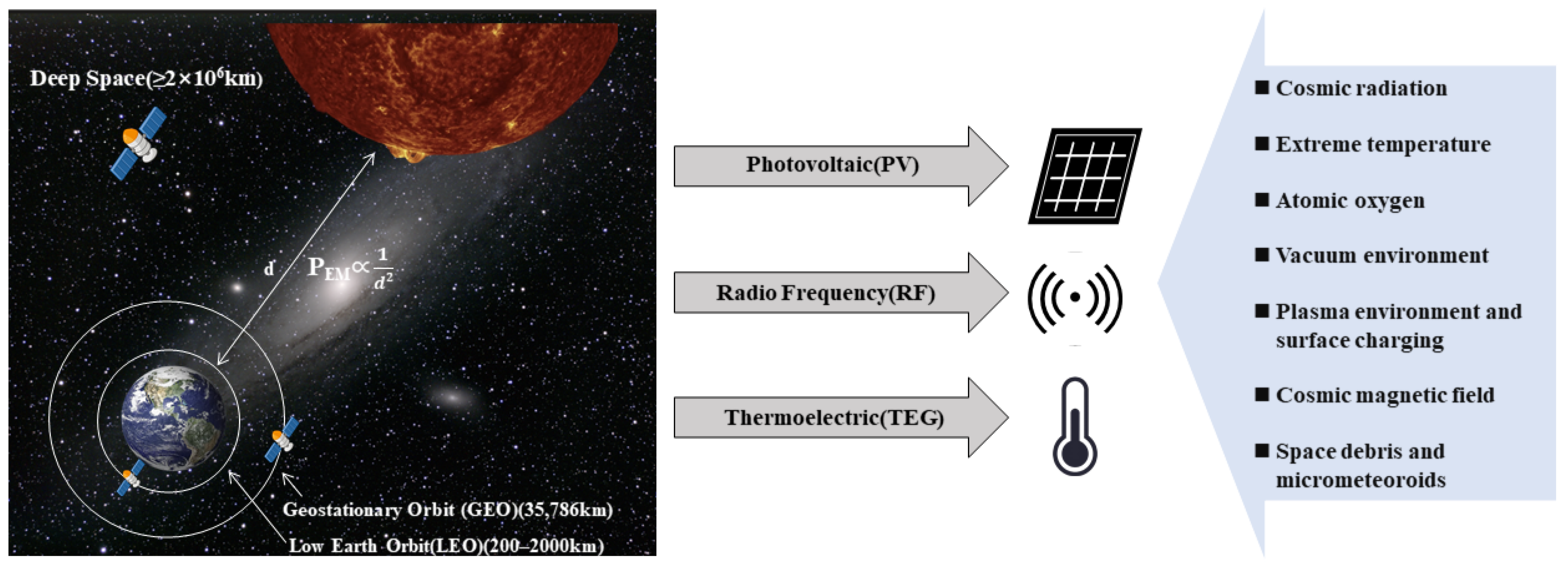
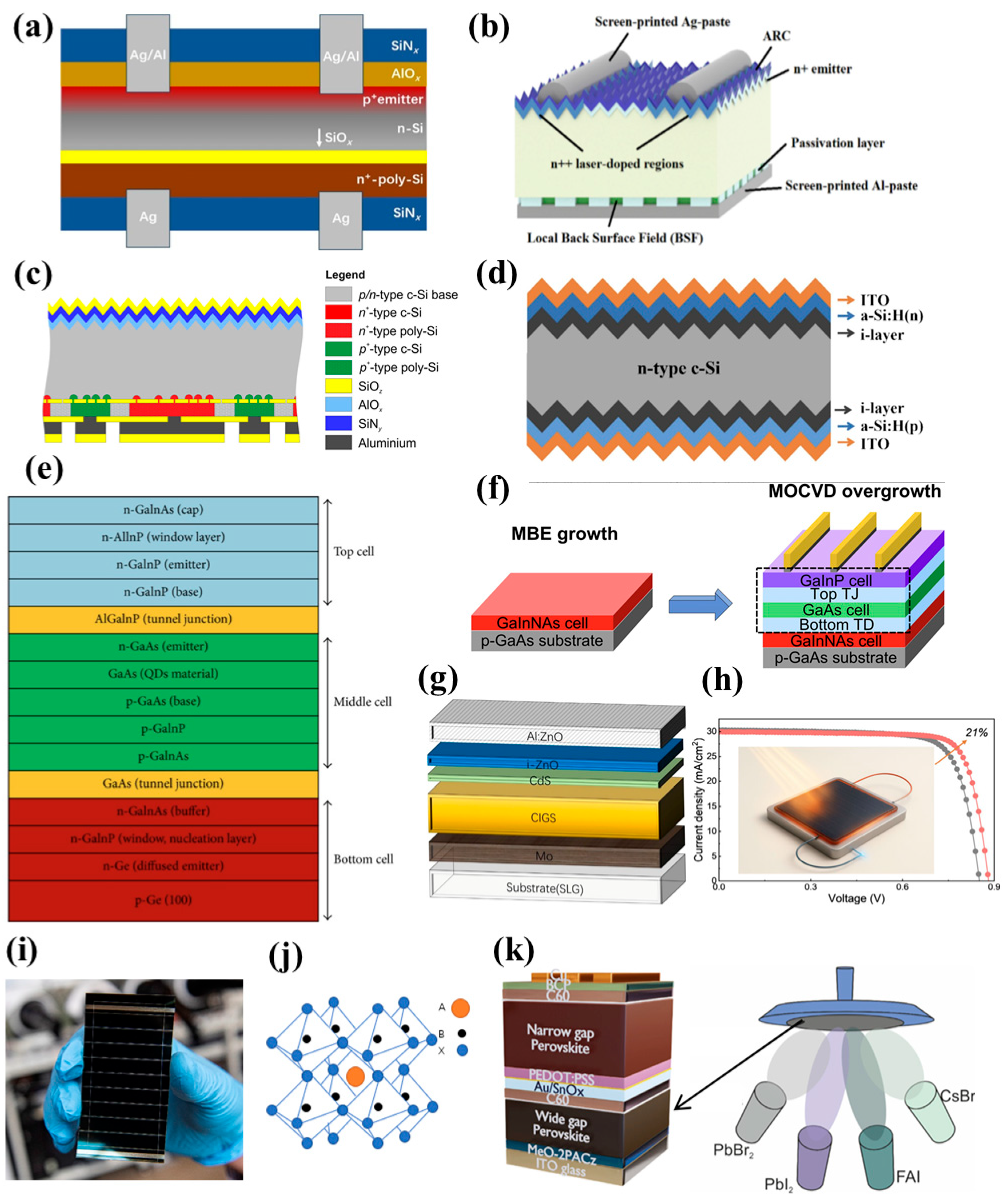
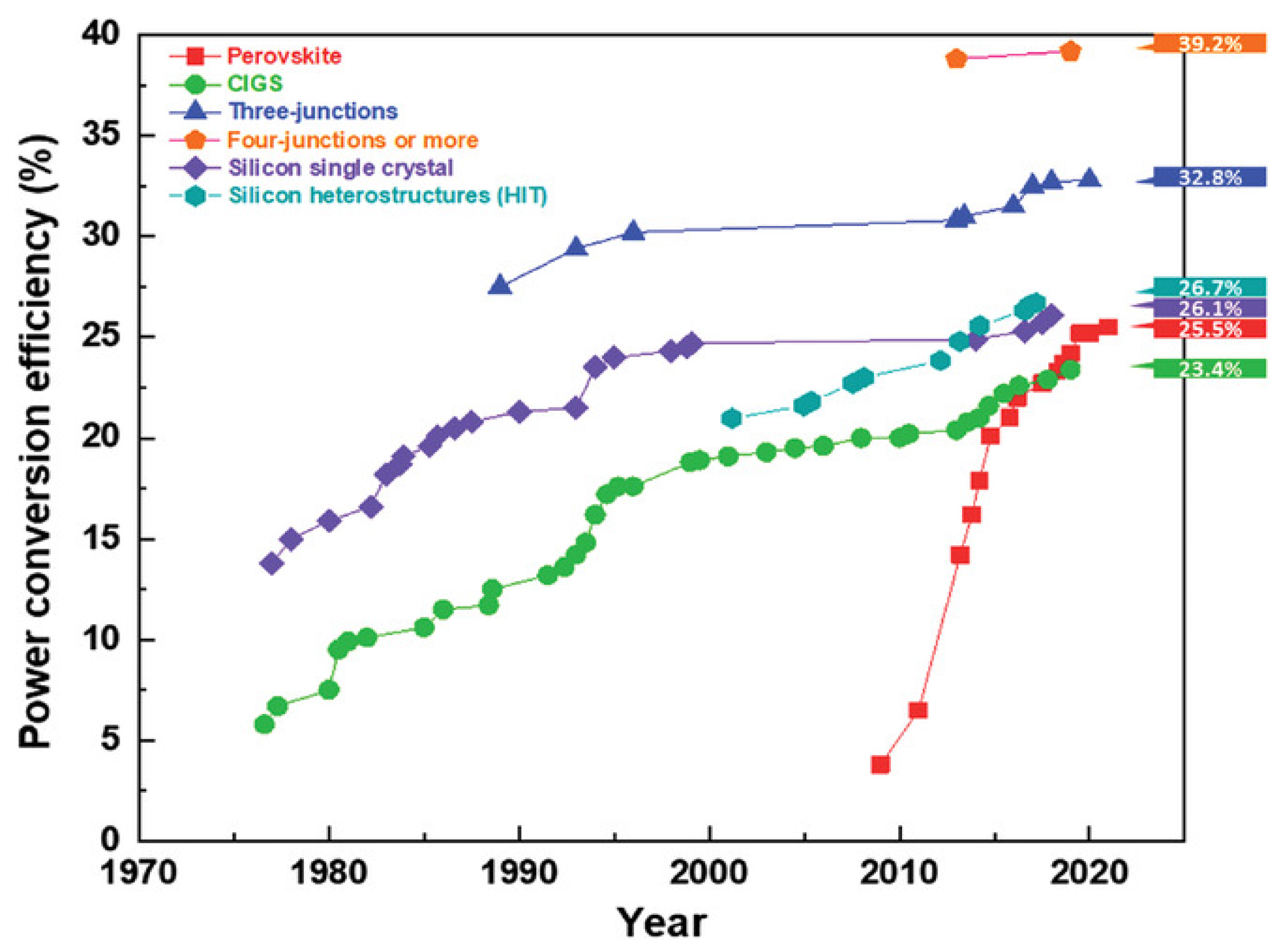
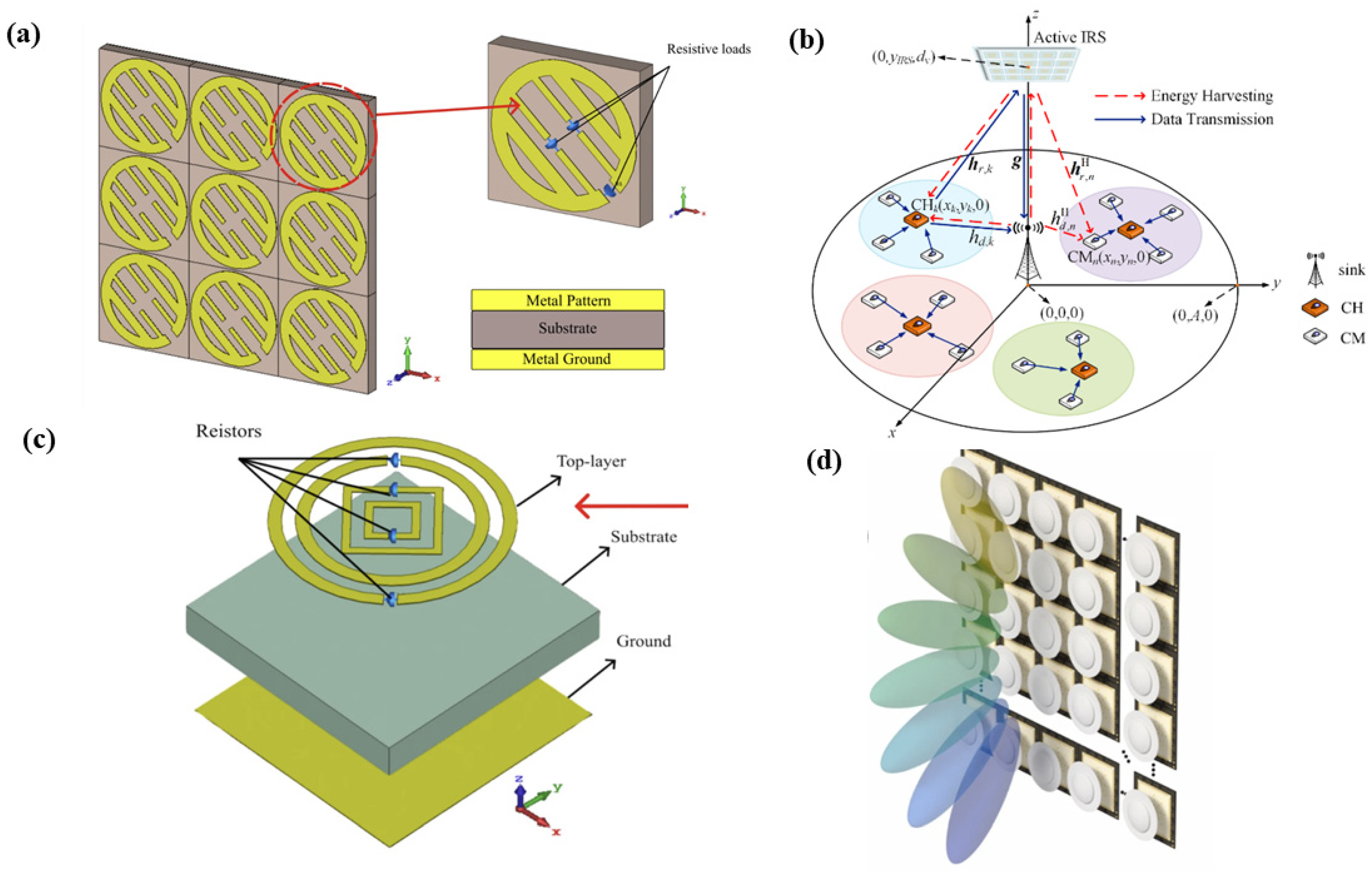
Review of Solar, Thermal, and Electromagnetic Energy Harvesting for Satellites



Abstract
1. Introduction
2. Energy Harvesting Methods
2.1. Solar Photovoltaic Power Generation
2.1.1. Silicon Solar Cells
2.1.2. III-/V-Based Solar Cells
2.1.3. Thin-Film Solar Cells
2.1.4. Perovskite Solar Cells (PSCs)



| Material | Year | PCE | Aperture-Area | FF | Characteristic | References |
|---|---|---|---|---|---|---|
| Six-junction III–V | 2020 | 39.2% (AM1.5g) | 0.25 cm2 | 83.5% | Precise control of subband gaps to achieve maximum AM0 full-spectrum absorption | [20] |
| GaInP, GaInAs/GaAsP, GaInAs | 2022 | 34.2% (AM0) | 0.25 cm2 | - | The band gap of the intermediate cell is modified by using a thick GaInAs/GaAsP strain-balanced quantum well (QW) solar cell with excellent absorption and voltage. | [19] |
| Perovskite | 2022 | 19.1% (AM1.5g) | 6.25 cm2 | 94.7% | Laser stripped all perovskite series modules processed by scalable manufacturing methods (blade coating and vacuum deposition). | [63] |
| (PbI2) 2RbCl Perovskite (flexible) | 2022 | 25.6% (AM1.5g) | 0.108 cm2 | 82.7% | The perovskite phase is stabilized and the band gap is reduced by the introduction of the passive non-active phase (PbI2)2RbCl. | [64] |
| Perovskite/CIGS (flexible) | 2022 | 24.2% (AM1.5g) | 1.04 cm2 | 71.2% | Perovskite and CIGS combination. | [65] |
| SHJ | 2023 | 25.94% (AM1.5g) | 274.4 cm2 | 85.71% | Amorphous undoped SnOx TE with copper electrodes instead of indium-based TE with silver electrodes. | [9] |
| IBC | 2025 | 27.81% (AM1.5g) | 166.1 cm2 | 87.55% | A hybrid fingertip back-contact solar cell was developed by combining advanced full-surface passivation technology with laser-tunneling contact. | [13] |
| GaInP/GaInAsP//Si | 2025 | 36.1% (AM1.5g) | 3.987 cm2 | 86.0% | The back heterojunction is realized, the middle cell is improved, and the advanced metal dielectric back-side grating is used to enhance the light capture of the silicon bottom cell. | [25] |
| Perovskite/silicon (flexible) | 2026 | 33.6% (AM1.5g) | 1 cm2 | 81.9% | Realization of reactive plasma deposition (RPD) needle and indium oxide co-doped with hydrogen (ICO:H) composite layer | [66] |
2.2. Electromagnetic RF Power Generation
2.3. Thermoelectric Power Generation
2.4. Radioisotope Thermoelectric Generators (RTGs)

| Material | Year | η | Tcold Thot | ZT | Power Density | Characteristic | References |
|---|---|---|---|---|---|---|---|
| PbTe | 2018 | 12.0% | Tcold = 283 K Thot = 873 K (ΔT = 590 K) | 1.9 | ~1.0 W/cm2 | The lattice thermal conductivity is significantly reduced by the excess doping and nano-phase precipitation, and the high efficiency is achieved. | [86] |
| n-type Zr0.5Hf0.5NiSn0.97Sb0.03 p-type Nb0.86Hf0.14FeSb | 2020 | 10.5% | Tcold = 366 K Thot = 1046 (ΔT = 680 K) | - | 3.1 W/cm2 | Based on the thermal matching criteria and power factor priority principle, the design integrates high conversion efficiency and ultra-high-power density into a single module, rather than solely pursuing the highest ZT value. | [91] |
| GeTe | 2021 | 7.8% | Tcold = 300 K Thot = 800 K (ΔT = 500 K) | 2.0 | 1.1 W/cm2 | The typical GeTe-based module performance was enhanced by selecting barrier layer materials to improve stability. | [85] |
| GeTe | 2022 | 13.3% | Tcold = 800 K Thot = 294 K (ΔT = 506 K) | 2.7 (750 k) | - | The high-entropy effect was utilized to optimize electron and phonon transport, setting a new efficiency record for similar materials. | [84] |
| Mg2Sn-GeTe | 2025 | 9.0% | - (ΔT = 418 K) | 1.4 | 0.7 W/cm2 | The efficiency limitation of 2Sn caused by high thermal conductivity is resolved, effectively reducing thermal conductivity while maintaining power factor. | [104] |
| MMRTG | 2023 | 6.3% | - (2000 Wth) | - | 115.3 We 2.7 W/kg | RTG can function for a long time in harsh environments, and its technology is very mature. | [100] |
3. Spacecraft Electrical Power System (EPS)
3.1. Satellite Energy Storage Unit
3.1.1. Ni-H2 Batteries
3.1.2. Li-Ion Batteries
3.1.3. Next-Generation Batteries
3.2. Power Management and Distribution
- Power Conditioning Unit (PCU): The Power Conditioning Unit is responsible for power conversion and voltage regulation within the spacecraft electrical power system. It conditions electrical energy harvested from photovoltaic arrays, thermoelectric generators, RF harvesters, and radioisotope power sources through DC/DC converters and regulation circuits, ensuring compatibility with the spacecraft power bus and onboard loads. As the core component of PMAD, there have been many studies conducted around it to optimize its functionality. Cheng et al. [108] proposed a 4 kW hybrid-controlled buck–boost converter topology that achieves wide-range voltage conversion, smooth mode switching, and high conversion efficiency through component reuse and optimized control strategies. Zhang et al. [109] proposed a novel hybrid power-control strategy for a modular three-port converter (TPC)-based satellite power system. These studies improve power-conversion efficiency, enhancing power-flow flexibility, and facilitating the integration of multiple energy sources, thereby supporting the development of more autonomous and resilient spacecraft power systems.
- Battery Management System (BMS): The Battery Management System supervises the operation of energy storage units by monitoring battery voltage, current, temperature, state of charge (SOC), and state of health (SOH). In addition, the BMS provides charge–discharge control, cell balancing, and protection functions to ensure safe and reliable battery operation throughout the mission lifetime. Jiménez et al. [110] presents a new BMS concept for spacecraft with enhanced performance, with not only monitoring and measurement functionalities, but also parameter calculation—such as estimations of the state of charge (SOC) and the state of health (SOH)—and cell balancing, in order to enlarge the lifespan of spacecraft batteries by providing active battery management. They also mentioned the shortage of research on spacecraft BMS. Therefore, more related research is expected.
- Power Distribution Unit (PDU): PDU distributes regulated electrical power from the spacecraft electrical power system to onboard subsystems and payloads. It supports switched, unswitched, and pulsed power outputs, while providing command, telemetry, and fault-isolation functions to ensure reliable spacecraft operation [111].
- Primary and Secondary Bus Converters: Bus converters are used to transfer power between different voltage buses within the spacecraft. Typically, a high-voltage primary bus collects energy from generation sources, while secondary buses provide regulated voltages required by specific loads. These converters improve power transmission efficiency and enable flexible system integration.
- Telemetry and Protection Circuits: Telemetry and protection circuits continuously monitor critical electrical parameters such as voltage, current, power, and temperature. They provide real-time health information to the spacecraft control system and implement protection functions against overvoltage, overcurrent, short circuits, and other abnormal operating conditions.
4. The Impact of Space Environment
4.1. Cosmic Radiation
4.2. Extreme Temperatures
4.3. Atomic Oxygen
4.4. Vacuum Environment
4.5. Plasma Environment and Surface Charging
4.6. Cosmic Magnetic Field
4.7. Space Debris and Micrometeoroids
5. Applications of Different Orbital Satellites
5.1. Low Earth Orbit Satellites
5.2. Geostationary Orbit Satellite
5.3. Deep Space Probe
6. Challenges and Outlook
6.1. Challenges
- (1)
- Reliability: Emerging technologies such as perovskite and flexible photovoltaic devices often exhibit promising performance in laboratory environments but still face challenges related to radiation-induced degradation, thermal cycling, atomic oxygen erosion, and packaging reliability under long-duration space exposure. Furthermore, high-performance space-grade materials remain costly and difficult to manufacture at large scale.
- (2)
- Economics: Beyond technical performance, practical deployment is strongly influenced by manufacturing scalability, launch mass constraints, system complexity, and mission cost. Technologies with excellent laboratory performance may still face significant barriers to adoption if their fabrication processes, qualification requirements, or operational costs are incompatible with spacecraft mission economics.
- (3)
- On-orbit verification: The serious lack of on-orbit flight test data for emerging technologies; the lack of unified test standards and evaluation systems for space energy harvesting devices; the high cost and long cycle of on-orbit verification.
6.2. Outlook
- (1)
- Future space energy systems may employ self-healing photovoltaic materials capable of mitigating radiation-induced defects and microcrack propagation, thereby extending operational lifetime in harsh space environments. In addition, multifunctional structural-energy materials that simultaneously provide load-bearing, power-generation, and energy-storage functions could significantly reduce spacecraft mass and improve system-level energy efficiency.
- (2)
- Development of new materials: In micro and deep space missions, specific power (W·kg−1) is a key point, so it is necessary to develop ultra-thin III/V group, flexible perovskite stacks. At the same time, the development of metamaterials, new thermoelectric materials, and dynamic radioisotope power systems is also crucial.
- (3)
- Future spacecraft may adopt highly integrated energy modules that combine energy harvesting, energy storage, power management, and health-monitoring functions within a single package. Such architectures can reduce system complexity, improve reliability, optimize power utilization, and support autonomous operation of next-generation satellite constellations and deep-space missions.
7. Summary
Author Contributions
Funding
Institutional Review Board Statement
Informed Consent Statement
Data Availability Statement
Conflicts of Interest
References
- Huang, C.; Zhang, C.; Li, J.; Dong, M. Situation and challenges in development of China’s commercial aerospace. Bull. Chin. Acad. Sci. 2025, 40, 1891–1901. [Google Scholar] [CrossRef]
- Dong, M.; Huang, C.; Yang, N.; Yao, Y.; Qin, Y. Suggestions on expanding application scenarios of commercial aerospace market. Bull. Chin. Acad. Sci. 2025, 40, 1914–1925. [Google Scholar] [CrossRef]
- Carney, S. Where Are Voyager 1 and Voyager 2 Now? NASA. Available online: https://science.nasa.gov/mission/voyager/where-are-voyager-1-and-voyager-2-now/#instrument-status (accessed on 20 March 2026).
- Ramanujam, J.; Bishop, D.; Todorov, T.; Gunawan, O.; Rath, J.K.; Nekovei, R.; Artegiani, E.; Romeo, A. Flexible CIGS, CdTe and a-Si:H based thin film solar cells: A review. Prog. Mater. Sci. 2019, 110, 100619. [Google Scholar] [CrossRef]
- Elhady, F.; Fedawy, M.; Abdolkader, T. A review of Thin Film Solar Cells. J. Basic Environ. Sci. 2021, 8, 36–46. [Google Scholar] [CrossRef]
- Sivasankar, S.M.; Amorim, C.D.; Cunha, A.F.d. Progress in Thin-Film Photovoltaics: A Review of Key Strategies to Enhance the Efficiency of CIGS, CdTe, and CZTSSe Solar Cells. J. Compos. Sci. 2025, 9, 143. [Google Scholar] [CrossRef]
- Tu, Y.; Wu, J.; Xu, G.; Yang, X.; Cai, R.; Gong, Q.; Zhu, R.; Huang, W. Perovskite Solar Cells for Space Applications: Progress and Challenges. Adv. Mater. 2021, 33, 2006545. [Google Scholar] [CrossRef] [PubMed]
- Yoon, G.W.; Jo, B.; Boonmongkolras, P.; Han, G.S.; Jung, H.S. Perovskite Tandem Solar Cells for Low Earth Orbit Satellite Power Applications. Adv. Energy Mater. 2025, 15, 2400204. [Google Scholar] [CrossRef]
- Yu, C.; Zou, Q.; Wang, Q.; Zhao, Y.; Ran, X.; Dong, G.; Peng, C.-W.; Allen, V.; Cao, X.; Zhou, J.; et al. Silicon solar cell with undoped tin oxide transparent electrode. Nat. Energy 2023, 8, 1119–1125. [Google Scholar] [CrossRef]
- Razzaq, S.; Wei, L.; Jiao, R.; Cheng, C.; Yuting, H.; Lin, L.; Po-Chuan, Y.; Asghar, A.; Lou, C. Enhancing UV light stability in commercial silicon HJT solar cells and modules. Sol. Energy 2025, 298, 113735. [Google Scholar] [CrossRef]
- Allen, T.G.; Bullock, J.; Yang, X.; Javey, A.; De Wolf, S. Passivating contacts for crystalline silicon solar cells. Nat. Energy 2019, 4, 914–928. [Google Scholar] [CrossRef]
- Zhang, W.; Zhang, K.; Bai, Y.; Zhang, Y.; Yang, K.; Chen, B.; Yang, X.; Li, J.; Sun, Y.; Wu, Y.; et al. Passivating pinholes for large-area and high-efficiency silicon solar cells with tunnel oxide passivated contact. Nat. Commun. 2026, 17, 2490. [Google Scholar] [CrossRef] [PubMed]
- Wang, G.; Yu, M.; Wu, H.; Li, Y.; Xie, L.; Wei, J.; Deng, X.; Zhou, S.; Yuan, T.; Luo, F.; et al. Silicon solar cells with hybrid back contacts. Nature 2025, 647, 369–374. [Google Scholar] [CrossRef] [PubMed]
- Tong, H.; Tan, S.; Zhang, Y.; He, Y.; Ding, C.; Zhang, H.; He, J.; Cao, J.; Liu, H.; Li, Y.; et al. Total-area world-record efficiency of 27.03% for 350.0 cm2 commercial-sized single-junction silicon solar cells. Nat. Commun. 2025, 16, 5920. [Google Scholar] [CrossRef] [PubMed]
- Hollemann, C.; Haase, F.; Schäfer, S.; Krügener, J.; Brendel, R.; Peibst, R. 26.1%-efficient POLO-IBC cells: Quantification of electrical and optical loss mechanisms. Prog. Photovolt. Res. Appl. 2019, 27, 950–958. [Google Scholar] [CrossRef]
- Fedoseyev, A.; Herasimenka, S. Simulation of silicon solar cell radiation effects with GEANT4. AIP Conf. Proc. 2020, 2302, 120004. [Google Scholar] [CrossRef]
- Yamaguchi, M.; Lee, K.H.; Araki, K.; Kojima, N.; Okuno, Y.; Imaizumi, M. Analysis for Radiation Degradation of Advanced Si Space Solar Cells. In 2019 IEEE 46th Photovoltaic Specialists Conference (PVSC), 16–21 June 2019; IEEE: Piscataway, NJ, USA, 2019; pp. 2377–2380. [Google Scholar]
- Baur, C.; Caon, A. The future of space photovoltaics—Challenges and opportunities. In 2025 IEEE 53rd Photovoltaic Specialists Conference (PVSC), 8–13 June 2025; IEEE: Piscataway, NJ, USA, 2025; pp. 1118–1123. [Google Scholar]
- France, R.M.; Geisz, J.F.; Song, T.; Olavarria, W.; Young, M.; Kibbler, A.; Steiner, M.A. Triple-junction solar cells with 39.5% terrestrial and 34.2% space efficiency enabled by thick quantum well superlattices. Joule 2022, 6, 1121–1135. [Google Scholar] [CrossRef]
- Geisz, J.F.; France, R.M.; Schulte, K.L.; Steiner, M.A.; Norman, A.G.; Guthrey, H.L.; Young, M.R.; Song, T.; Moriarty, T. Six-junction III–V solar cells with 47.1% conversion efficiency under 143 Suns concentration. Nat. Energy 2020, 5, 326–335. [Google Scholar] [CrossRef]
- Gruginskie, N.; Cappelluti, F.; Bauhuis, G.J.; Mulder, P.; Haverkamp, E.J.; Vlieg, E.; Schermer, J.J. Electron radiation–induced degradation of GaAs solar cells with different architectures. Prog. Photovolt. Res. Appl. 2020, 28, 266–278. [Google Scholar] [CrossRef]
- Zhao, W.; Liu, G.; Yang, N.; Ge, S.; Shen, Z.; Li, X. Long-Term In Situ Performance Comparison of Si and GaAs Solar Arrays in Medium Earth Orbit. Energy Technol. 2024, 12, 2300634. [Google Scholar] [CrossRef]
- Tukiainen, A.; Aho, A.; Gori, G.; Polojärvi, V.; Casale, M.; Greco, E.; Isoaho, R.; Aho, T.; Raappana, M.; Campesato, R.; et al. High-efficiency GaInP/GaAs/GaInNAs solar cells grown by combined MBE-MOCVD technique. Prog. Photovolt. Res. Appl. 2016, 24, 914–919. [Google Scholar] [CrossRef]
- Dai, P.; Li, E.; Sun, Q.; Long, J.; Wu, X.; Chen, Z.; Yu, M.; Wu, X.; Nie, S.; Yan, W.; et al. Research of screen printing low-temperature silver paste for III-V solar cell. Sol. Energy Mater. Sol. Cells 2025, 289, 113667. [Google Scholar] [CrossRef]
- Schygulla, P.; Müller, R.; Höhn, O.; Schachtner, M.; Chojniak, D.; Cordaro, A.; Tabernig, S.; Bläsi, B.; Polman, A.; Siefer, G.; et al. Wafer-bonded two-terminal III-V//Si triple-junction solar cell with power conversion efficiency of 36.1% at AM1.5g. Prog. Photovolt. Res. Appl. 2025, 33, 100–108. [Google Scholar] [CrossRef]
- Chen, H.-L.; Cattoni, A.; De Lépinau, R.; Walker, A.W.; Höhn, O.; Lackner, D.; Siefer, G.; Faustini, M.; Vandamme, N.; Goffard, J.; et al. A 19.9%-efficient ultrathin solar cell based on a 205-nm-thick GaAs absorber and a silver nanostructured back mirror. Nat. Energy 2019, 4, 761–767. [Google Scholar] [CrossRef]
- Imaizumi, M.; Nakamura, T.; Takamoto, T.; Ohshima, T.; Tajima, M. Radiation degradation characteristics of component subcells in inverted metamorphic triple-junction solar cells irradiated with electrons and protons. Prog. Photovolt. Res. Appl. 2017, 25, 161–174. [Google Scholar] [CrossRef]
- Li, J.; Aierken, A.; Liu, Y.; Zhuang, Y.; Yang, X.; Mo, J.H.; Fan, R.K.; Chen, Q.Y.; Zhang, S.Y.; Huang, Y.M.; et al. A Brief Review of High Efficiency III-V Solar Cells for Space Application. Front. Phys. 2021, 8, 631925. (In English) [Google Scholar] [CrossRef]
- Wang, A.; He, M.; Green, M.A.; Sun, K.; Hao, X. A Critical Review on the Progress of Kesterite Solar Cells: Current Strategies and Insights. Adv. Energy Mater. 2023, 13, 2203046. [Google Scholar] [CrossRef]
- Tomita, H.; Ishiuchi, T.; Kato, T. Development of High-efficiency and Ultra-light CIGS Solar Cell for Space Applications. In 2024 IEEE 52nd Photovoltaic Specialist Conference (PVSC), 9–14 June 2024; IEEE: Piscataway, NJ, USA, 2024; p. 553. [Google Scholar]
- Kumar, V.; Prasad, R.; Chaure, N.B.; Singh, U.P. Advancement in Copper Indium Gallium Diselenide (CIGS)-Based Thin-Film Solar Cells. In Recent Advances in Thin Film Photovoltaics; Singh, U.P., Chaure, N.B., Eds.; Springer Nature: Singapore, 2022; pp. 5–39. [Google Scholar]
- Lontchi, J.; Dufoulon, V.; Crossay, A.; Gamet, D.; Tom, T.; Rebai, A.; Posada, J.; Donsanti, F.; Lincot, D.; Guillemoles, J.F.; et al. Achieving High-Performance In Flexible CIGS Solar Cells Through Advanced Deposition Optimization. In 2025 IEEE 53rd Photovoltaic Specialists Conference (PVSC), 8–13 June 2025; IEEE: Piscataway, NJ, USA, 2025; pp. 0438–0440. [Google Scholar]
- Yin, K.; Wang, J.; Lou, L.; Meng, F.; Xu, X.; Zhang, B.; Jiao, M.; Shi, J.; Li, D.; Wu, H.; et al. Gradient bandgaps in sulfide kesterite solar cells enable over 13% certified efficiency. Nat. Energy 2025, 10, 205–214. [Google Scholar] [CrossRef]
- Zhao, Y.; Boccard, M.; Liu, S.; Becker, J.; Zhao, X.-H.; Campbell, C.M.; Suarez, E.; Lassise, M.B.; Holman, Z.; Zhang, Y.-H. Monocrystalline CdTe solar cells with open-circuit voltage over 1 V and efficiency of 17%. Nat. Energy 2016, 1, 16067. [Google Scholar] [CrossRef]
- Yang, G.; Cho, E.W.; Hwang, Y.J.; Min, B.K.; Kang, Y.; Kim, D.; Kim, J. Radiation-Hard and Ultralightweight Polycrystalline Cadmium Telluride Thin-Film Solar Cells for Space Applications. Energy Technol. 2016, 4, 1463–1468. [Google Scholar] [CrossRef]
- Kim, J.; Hong, Z.; Li, G.; Song, T.-b.; Chey, J.; Lee, Y.S.; You, J.; Chen, C.-C.; Sadana, D.K.; Yang, Y. 10.5% efficient polymer and amorphous silicon hybrid tandem photovoltaic cell. Nat. Commun. 2015, 6, 6391. [Google Scholar] [CrossRef] [PubMed]
- Durant, B.K.; Afshari, H.; Singh, S.; Rout, B.; Eperon, G.E.; Sellers, I.R. Tolerance of Perovskite Solar Cells to Targeted Proton Irradiation and Electronic Ionization Induced Healing. ACS Energy Lett. 2021, 6, 2362–2368. [Google Scholar] [CrossRef]
- Miyazawa, Y.; Shibayama, N.; Ikegami, M.; Miyasaka, T.; Ishigami, R.; Kanaya, S.; Toyota, H.; Hirose, K. In Situ Evaluation of Perovskite Solar Cells after 8 MeV Proton Irradiation at Low Temperatures. J. Phys. Chem. C 2025, 129, 12772–12777. [Google Scholar] [CrossRef]
- Huang, J.S.; Kelzenberg, M.D.; Espinet-González, P.; Mann, C.; Walker, D.; Naqavi, A.; Vaidya, N.; Warmann, E.; Atwater, H.A. Effects of Electron and Proton Radiation on Perovskite Solar Cells for Space Solar Power Application. In 2017 IEEE 44th Photovoltaic Specialist Conference (PVSC), 25–30 June 2017; IEEE: Piscataway, NJ, USA, 2017; pp. 1248–1252. [Google Scholar]
- Miyazawa, Y.; Ikegami, M.; Chen, H.-W.; Ohshima, T.; Imaizumi, M.; Hirose, K.; Miyasaka, T. Tolerance of Perovskite Solar Cell to High-Energy Particle Irradiations in Space Environment. iScience 2018, 2, 148–155. [Google Scholar] [CrossRef] [PubMed]
- Lang, F.; Jošt, M.; Bundesmann, J.; Denker, A.; Albrecht, S.; Landi, G.; Neitzert, H.-C.; Rappich, J.; Nickel, N.H. Efficient minority carrier detrapping mediating the radiation hardness of triple-cation perovskite solar cells under proton irradiation. Energy Environ. Sci. 2019, 12, 1634–1647. [Google Scholar] [CrossRef]
- Lang, F.; Jošt, M.; Frohna, K.; Köhnen, E.; Al-Ashouri, A.; Bowman, A.R.; Bertram, T.; Morales-Vilches, A.B.; Koushik, D.; Tennyson, E.M.; et al. Proton Radiation Hardness of Perovskite Tandem Photovoltaics. Joule 2020, 4, 1054–1069. [Google Scholar] [CrossRef] [PubMed]
- Lin, R.; Wang, Y.; Lu, Q.; Tang, B.; Li, J.; Gao, H.; Gao, Y.; Li, H.; Ding, C.; Wen, J.; et al. All-perovskite tandem solar cells with 3D/3D bilayer perovskite heterojunction. Nature 2023, 620, 994–1000. [Google Scholar] [CrossRef] [PubMed]
- Wang, Y.; Lin, R.; Liu, C.; Wang, X.; Chosy, C.; Haruta, Y.; Bui, A.D.; Li, M.; Sun, H.; Zheng, X.; et al. Homogenized contact in all-perovskite tandems using tailored 2D perovskite. Nature 2024, 635, 867–873. [Google Scholar] [CrossRef] [PubMed]
- Fu, S.; Zhou, S.; Meng, W.; Li, G.; Dong, K.; Pu, D.; Zhou, J.; Wang, C.; Guan, H.; Shao, W.; et al. Piracetam shapes wide-bandgap perovskite crystals for scalable perovskite tandems. Nat. Nanotechnol. 2025, 20, 764–771. [Google Scholar] [CrossRef] [PubMed]
- Tian, C.; Sun, A.; Chen, J.; Zhuang, R.; Chen, C.; Zheng, J.; Liu, S.; Du, J.; Chen, Q.; Cai, L.; et al. Photostable donor–acceptor interface for minimizing energy loss in inverted perovskite solar cells. Nat. Photonics 2026, 20, 287–295. [Google Scholar] [CrossRef]
- Yu, S.; Xiong, Z.; Zhou, H.; Zhang, Q.; Wang, Z.; Ma, F.; Qu, Z.; Zhao, Y.; Chu, X.; Zhang, X.; et al. Homogenized NiOx nanoparticles for improved hole transport in inverted perovskite solar cells. Science 2023, 382, 1399–1404. [Google Scholar] [CrossRef] [PubMed]
- Yuan, M.; Wang, Y.; Liu, Z.; Zhang, J.; Qin, S.; Liu, M.; Chen, Z.; Zhao, Y.; Li, J.; Li, X.; et al. Redox-Improved Self-Assembled Monolayers for Inverted Perovskite Solar Cells. Nat. Commun. 2025, 16, 11330. [Google Scholar] [CrossRef] [PubMed]
- Zhang, X.; Wu, S.; Zhang, H.; Jen, A.K.Y.; Zhan, Y.; Chu, J. Advances in inverted perovskite solar cells. Nat. Photonics 2024, 18, 1243–1253. [Google Scholar] [CrossRef]
- Liu, J.; He, Y.; Ding, L.; Zhang, H.; Li, Q.; Jia, L.; Yu, J.; Lau, T.W.; Li, M.; Qin, Y.; et al. Perovskite/silicon tandem solar cells with bilayer interface passivation. Nature 2024, 635, 596–603. [Google Scholar] [CrossRef] [PubMed]
- Li, F.; Wu, D.; Shang, L.; Xia, R.; Zhang, H.; Huang, Z.; Gong, J.; Mao, L.; Zhang, H.; Sun, Y.; et al. Highly Efficient Monolithic Perovskite/Perovskite/Silicon Triple-Junction Solar Cells. Adv. Mater. 2024, 36, 2311595. [Google Scholar] [CrossRef] [PubMed]
- Shao, S.; Liu, J.; Fang, H.-H.; Qiu, L.; ten Brink, G.H.; Hummelen, J.C.; Koster, L.J.A.; Loi, M.A. Efficient Perovskite Solar Cells over a Broad Temperature Window: The Role of the Charge Carrier Extraction. Adv. Energy Mater. 2017, 7, 1701305. [Google Scholar] [CrossRef]
- Cheacharoen, R.; Rolston, N.; Harwood, D.; Bush, K.A.; Dauskardt, R.H.; McGehee, M.D. Design and understanding of encapsulated perovskite solar cells to withstand temperature cycling. Energy Environ. Sci. 2018, 11, 144–150. [Google Scholar] [CrossRef]
- Kirmani, A.R.; Ostrowski, D.P.; VanSant, K.T.; Byers, T.A.; Bramante, R.C.; Heinselman, K.N.; Tong, J.; Stevens, B.; Nemeth, W.; Zhu, K.; et al. Metal oxide barrier layers for terrestrial and space perovskite photovoltaics. Nat. Energy 2023, 8, 191–202. [Google Scholar] [CrossRef]
- Spampinato, C.; Calogero, G.; Mannino, G.; Valastro, S.; Smecca, E.; Arena, V.; La Magna, P.; Bongiorno, C.; Fazio, E.; Alberti, A. A Sputtered Gig-Lox TiO2 Sponge Integrated with CsPbI3:EuI2 for Semitransparent Perovskite Solar Cells. J. Phys. Chem. C 2025, 129, 16338–16346. [Google Scholar] [CrossRef] [PubMed]
- Ding, Y.; Li, L.; Yin, H.; Jiang, X.; Ding, J.; Yuan, N.; Wang, Q. 22.56% total area efficiency of n-TOPCon solar cell with screen-printed Al paste. Sol. Energy 2024, 280, 112862. [Google Scholar] [CrossRef]
- Wang, Q.; Guo, K.; Gu, S.; Huang, W.; Peng, H.; Wu, W.; Ding, J. Electrical Performance, Loss Analysis, and Efficiency Potential of Industrial-Type PERC, TOPCon, and SHJ Solar Cells: A Comparative Study. Prog. Photovolt. Res. Appl. 2024, 32, 889–903. [Google Scholar] [CrossRef]
- Turala, A.; Jaouad, A.; Masson, D.P.; Fafard, S.; Arès, R.; Aimez, V. Isolation of III-V/Ge Multijunction Solar Cells by Wet Etching. Int. J. Photoenergy 2013, 2013, 583867. [Google Scholar] [CrossRef]
- Liu, W.; Li, H.; Qiao, B.; Zhao, S.; Xu, Z.; Song, D. Highly efficient CIGS solar cells based on a new CIGS bandgap gradient design characterized by numerical simulation. Sol. Energy 2022, 233, 337–344. [Google Scholar] [CrossRef]
- Wu, J.; Gan, Y.; Liu, J.; Su, Y.; Zhou, Y.; Wan, M.; Zhu, H.; Guo, F.; Fu, G.; Mai, Y.; et al. Synergistic Light–Heat–Bias Activation for 21%-Efficient CdSeTe Thin-Film Solar Cells. ACS Energy Lett. 2026, 11, 573–580. [Google Scholar] [CrossRef]
- Chiang, Y.-H.; Frohna, K.; Salway, H.; Abfalterer, A.; Pan, L.; Roose, B.; Anaya, M.; Stranks, S.D. Vacuum-Deposited Wide-Bandgap Perovskite for All-Perovskite Tandem Solar Cells. ACS Energy Lett. 2023, 8, 2728–2737. [Google Scholar] [CrossRef] [PubMed]
- Verduci, R.; Romano, V.; Brunetti, G.; Yaghoobi Nia, N.; Di Carlo, A.; D’Angelo, G.; Ciminelli, C. Solar Energy in Space Applications: Review and Technology Perspectives. Adv. Energy Mater. 2022, 12, 2200125. [Google Scholar] [CrossRef]
- Abdollahi Nejand, B.; Ritzer, D.B.; Hu, H.; Schackmar, F.; Moghadamzadeh, S.; Feeney, T.; Singh, R.; Laufer, F.; Schmager, R.; Azmi, R.; et al. Scalable two-terminal all-perovskite tandem solar modules with a 19.1% efficiency. Nat. Energy 2022, 7, 620–630. [Google Scholar] [CrossRef]
- Zhao, Y.; Ma, F.; Qu, Z.; Yu, S.; Shen, T.; Deng, H.-X.; Chu, X.; Peng, X.; Yuan, Y.; Zhang, X.; et al. Inactive (PbI2)2RbCl stabilizes perovskite films for efficient solar cells. Science 2022, 377, 531–534. [Google Scholar] [CrossRef] [PubMed]
- Jošt, M.; Köhnen, E.; Al-Ashouri, A.; Bertram, T.; Tomšič, Š.; Magomedov, A.; Kasparavicius, E.; Kodalle, T.; Lipovšek, B.; Getautis, V.; et al. Perovskite/CIGS Tandem Solar Cells: From Certified 24.2% toward 30% and Beyond. ACS Energy Lett. 2022, 7, 1298–1307. [Google Scholar] [CrossRef]
- Wang, S.; Li, W.; Yu, C.; Shi, W.; Kang, Q.; Cao, F.; Gao, K.; Yang, L.; Yang, B.; Zhou, J.; et al. Flexible perovskite/silicon tandem solar cells with 33.6% efficiency. Nature 2026, 649, 59–64. [Google Scholar] [CrossRef] [PubMed]
- Ha, T.D.; Nie, X.; Bağcı, H.; Erricolo, D.; Chen, P.Y. A Low-Profile, Wide-Angle, and Bandwidth- Enhanced Rectenna for Radiative Energy Harvesting in the 12 GHz Band. IEEE Antennas Wirel. Propag. Lett. 2024, 23, 3807–3811. [Google Scholar] [CrossRef]
- Das, R.; Swati, M.V.; Baghel, G.S. Highly efficient, broadband, hexagonal shaped rectenna for energy harvesting in IoT applications. AEU—Int. J. Electron. Commun. 2025, 201, 155957. [Google Scholar] [CrossRef]
- Nosrati, M.; Rezaei, P.; Danaie, M.; Khalilpour, J. A broadband integrated rectenna for microwave radio energy harvesting using an integrated hybrid sandwich power divider. e-Prime—Adv. Electr. Eng. Electron. Energy 2025, 11, 100891. [Google Scholar] [CrossRef]
- Assimonis, S.D.; Fusco, V.; Georgiadis, A.; Samaras, T. Efficient and Sensitive Electrically Small Rectenna for Ultra-Low Power RF Energy Harvesting. Sci. Rep. 2018, 8, 15038. [Google Scholar] [CrossRef] [PubMed]
- Parween, S.; Basu, B.; Khan, T. RF energy harvester design using a dual-band rectenna for ultra-low-power electronic systems. AEU—Int. J. Electron. Commun. 2025, 201, 155962. [Google Scholar] [CrossRef]
- Ullah, N.; Islam, M.S.; Hoque, A.; Alzamil, A.; Soliman, M.S.; Islam, M.T. Design and development of a compact, wide-angle metamaterial electromagnetic energy harvester with multiband functionality and polarization-insensitive features. Sci. Rep. 2024, 14, 19000. [Google Scholar] [CrossRef] [PubMed]
- Ullah, N.; Islam, M.T.; Hoque, A.; Khalil, M.A.; Alsaif, H.; Soliman, M.S.; Islam, M.S. High-efficient, polarization-insensitive, wide-angle, compact metamaterial energy harvester for S-band and C-band applications. Sci. Rep. 2024, 14, 24841. [Google Scholar] [CrossRef] [PubMed]
- Ullah, N.; Islam, M.T.; Yong, W.H.; Alenezi, A.M.; Goh, H.H.; Kurniawan, T.A.; Soliman, M.S.; Islam, M.S. Design and experimental validation of a compact dual band double negative metamaterial for energy harvesting applications. Sci. Rep. 2025, 15, 14521. [Google Scholar] [CrossRef] [PubMed]
- Wang, J.; Yu, H. RF energy harvesting schemes for intelligent reflecting surface-aided cognitive radio sensor networks. Sci. Rep. 2022, 12, 22462. [Google Scholar] [CrossRef] [PubMed]
- Wang, J.; Zhu, Y. Joint passive beamforming and deployment design for active intelligent reflecting surface-assisted energy harvesting-cognitive radio sensor networks. Sci. Rep. 2024, 14, 24763. [Google Scholar] [CrossRef] [PubMed]
- Joshi, M.; Hu, K.; Lynch, C.A., III; Tentzeris, M.M. Scalable lens-enhanced broadbeam mmWave harvester delivering tens of milliwatts for wireless power transfer in next-generation smart city environments. Sci. Rep. 2025, 15, 43938. [Google Scholar] [CrossRef] [PubMed]
- Bito, J.; Bahr, R.; Hester, J.G.; Nauroze, S.A.; Georgiadis, A.; Tentzeris, M.M. A Novel Solar and Electromagnetic Energy Harvesting System With a 3-D Printed Package for Energy Efficient Internet-of-Things Wireless Sensors. IEEE Trans. Microw. Theory Tech. 2017, 65, 1831–1842. [Google Scholar] [CrossRef]
- Wan, S.; Lu, P.; Yin, D.; Guan, X.; Ni, W. A compact hybrid solar and electromagnetic energy harvester at 2.45 GHz microstrip rectenna. AEU—Int. J. Electron. Commun. 2023, 172, 154941. [Google Scholar] [CrossRef]
- Nosrati, M.; Rezaei, P. Efficient integrated 5 × 2 rectenna array for low RF energy recovery. AEU—Int. J. Electron. Commun. 2023, 161, 154547. [Google Scholar] [CrossRef]
- Liu, Y.; Sun, H. A coverage-enhanced rectifying array antenna for RF energy harvesting applications. AEU—Int. J. Electron. Commun. 2026, 204, 156112. [Google Scholar] [CrossRef]
- Von Lukowicz, M.; Abbe, E.; Schmiel, T.; Tajmar, M. Thermoelectric Generators on Satellites—An Approach for Waste Heat Recovery in Space. Energies 2016, 9, 541. [Google Scholar] [CrossRef]
- Perumal, S.; Samanta, M.; Ghosh, T.; Shenoy, U.S.; Bohra, A.K.; Bhattacharya, S.; Singh, A.; Waghmare, U.V.; Biswas, K. Realization of High Thermoelectric Figure of Merit in GeTe by Complementary Co-doping of Bi and In. Joule 2019, 3, 2565–2580. [Google Scholar] [CrossRef]
- Jiang, B.; Wang, W.; Liu, S.; Wang, Y.; Wang, C.; Chen, Y.; Xie, L.; Huang, M.; He, J. High figure-of-merit and power generation in high-entropy GeTe-based thermoelectrics. Science 2022, 377, 208–213. [Google Scholar] [CrossRef] [PubMed]
- Xing, T.; Song, Q.; Qiu, P.; Zhang, Q.; Gu, M.; Xia, X.; Liao, J.; Shi, X.; Chen, L. High efficiency GeTe-based materials and modules for thermoelectric power generation. Energy Environ. Sci. 2021, 14, 995–1003. [Google Scholar] [CrossRef]
- Jood, P.; Ohta, M.; Yamamoto, A.; Kanatzidis, M.G. Excessively Doped PbTe with Ge-Induced Nanostructures Enables High-Efficiency Thermoelectric Modules. Joule 2018, 2, 1339–1355. [Google Scholar] [CrossRef]
- Tang, Y.; Hanus, R.; Chen, S.-w.; Snyder, G.J. Solubility design leading to high figure of merit in low-cost Ce-CoSb3 skutterudites. Nat. Commun. 2015, 6, 7584. [Google Scholar] [CrossRef] [PubMed]
- Li, X.; Yao, H.; Ma, B.; Ren, Y.; Yin, L.; Wang, X.; Cao, F.; Chen, C.; Mao, J.; Zhang, Q. Phase boundary mapping boosts thermoelectric performance in p-type FeSb3-based skutterudites. Chem. Eng. J. 2025, 525, 170338. [Google Scholar] [CrossRef]
- Zhang, J.; Zhang, F.; Chen, J.; Tang, P.; Huang, J.; Qiu, C.; Geng, H.; Zhang, L. Low-yield-strength multi-principal element alloy enables high thermal stability in skutterudite thermoelectric interfaces. J. Alloys Compd. 2026, 1051, 186005. [Google Scholar] [CrossRef]
- Zhang, Q.; Pan, Q.; Wang, M.; Pang, K.; Li, R.; Miao, L.; Tan, X.; Hu, H.; Wu, J.; Sun, P.; et al. Commercially scalable (Bi,Sb)2Te3 thermoelectrics via interfacial defects evolution for advanced power generators. Acta Mater. 2025, 292, 121064. [Google Scholar] [CrossRef]
- Xing, Y.; Liu, R.; Liao, J.; Wang, C.; Zhang, Q.; Song, Q.; Xia, X.; Zhu, T.; Bai, S.; Chen, L. A Device-to-Material Strategy Guiding the “Double-High” Thermoelectric Module. Joule 2020, 4, 2475–2483. [Google Scholar] [CrossRef]
- Kilinc, E.; Uysal, F.; Sarı, M.A.; Demir, S.; Kurt, H.; Celik, E. Fabrication of p-type synthesis of p-type Ca2.7 Ag0.3 Co4O9 semiconducting materials for thermoelectric generators in aerospace applications. Ceram. Int. 2026, 52, 1–9. [Google Scholar] [CrossRef]
- Wang, S.; Zuo, G.; Kim, J.; Sirringhaus, H. Progress of Conjugated Polymers as Emerging Thermoelectric Materials. Prog. Polym. Sci. 2022, 129, 101548. [Google Scholar] [CrossRef]
- Song, J.; Li, Z.; Yang, Y.; Shuai, Y. A phase change material-based thermoelectric generation system for near-earth satellites: Enabling continuous power supply and thermal regulation. Appl. Therm. Eng. 2025, 278, 127187. [Google Scholar] [CrossRef]
- Peng, H.; Guo, W.; Feng, S.; Shen, Y. A novel thermoelectric energy harvester using gallium as phase change material for spacecraft power application. Appl. Energy 2022, 322, 119548. [Google Scholar] [CrossRef]
- von Lukowicz, M.; Schmiel, T.; Rosenfeld, M.; Heisig, J.; Tajmar, M. Characterisation of TEGs Under Extreme Environments and Integration Efforts Onto Satellites. J. Electron. Mater. 2015, 44, 362–370. [Google Scholar] [CrossRef]
- Du, G.; Li, Y.; Li, G.; Guo, R.; Liu, G.; Wang, J. Structure Design and Performance Analysis of ~(90)Sr Radioisotope Thermoelectric Generator. Nucl. Power Eng. 2023, 44, 104–111. (In Chinese) [Google Scholar]
- Barklay, C.; Kramer, D.; Whiting, C.; Ambrosi, R.; Mesalam, R. Concept for a Cascaded Multi-Mission Radioisotope Thermoelectric Generator. In 2020 IEEE Aerospace Conference, 7–14 March 2020; IEEE: Piscataway, NJ, USA, 2020; pp. 1–7. [Google Scholar]
- Matthes, C.S.R.; Woerner, D.F.; Hendricks, T.J.; Fleurial, J.P.; Oxnevad, K.I.; Barklay, C.D.; Zakrajsek, J.F. Next-generation radioisotope thermoelectric generator study. In 2018 IEEE Aerospace Conference, 3–10 March 2018; IEEE: Piscataway, NJ, USA, 2018; pp. 1–9. [Google Scholar]
- Whiting, C.E. In-Flight Performance of the Multi-Mission Radioisotope Thermoelectric Generators on Mars. In 2023 IEEE Aerospace Conference, 4–11 March 2023; IEEE: Piscataway, NJ, USA, 2023; pp. 1–8. [Google Scholar]
- VanderVeer, J.R.; Sievers, B.; Oteiza, M.; Amato, M. System Integration of Stirling Convertors into a Dynamic Radioisotope Power System. In 2020 IEEE Aerospace Conference, 7–14 March 2020; IEEE: Piscataway, NJ, USA, 2020; pp. 1–6. [Google Scholar]
- Mesalam, R.; Schmitz, P.C.; Sargeant, H.M.; Turnbull, E.R.; Barco, A.; Wilson, S.; Stuck, J.; Watkinson, E.J.; Oleson, S.R.; Ambrosi, R. Americium fuelled radioisotope stirling generator for lunar surface mobility systems. Acta Astronaut. 2025, 228, 331–345. [Google Scholar] [CrossRef]
- Cui, G.-P.; Feng, C.-P.; Xu, S.-C.; Sun, K.-Y.; Ji, J.-C.; Hou, L.; Lan, H.-B.; Shang, H.-J.; Ding, F.-Z. 3D-printed Bi2Te3-based Thermoelectric Generators for Energy Harvesting and Temperature Response. ACS Appl. Mater. Interfaces 2024, 16, 35353–35360. [Google Scholar] [CrossRef] [PubMed]
- Wu, X.; Wang, L.; Li, A.; Wu, G.; Hu, Z.; Yun, F.F.; Mori, T. High Conversion Efficiency in Intrinsic High Power-Density Mg2Sn-GeTe Thermoelectric Generator. Adv. Sci. 2025, 12, e06997. [Google Scholar] [CrossRef] [PubMed]
- Pathak, A.D.; Saha, S.; Bharti, V.K.; Gaikwad, M.M.; Sharma, C.S. A review on battery technology for space application. J. Energy Storage 2023, 61, 106792. [Google Scholar] [CrossRef]
- Jamison, C.M.; Kim, S.; Ramasamy, H.V.; Adams, T.E.; Pol, V.G. Lithium-Ion Battery Testing Capable of Simulating “Ultralow” Lunar Temperatures. Energy Technol. 2022, 10, 2200799. [Google Scholar] [CrossRef]
- Zhang, Y.; Zhang, W.; Kong, W. Thermal management of space energy storage based on functional synergy. Appl. Therm. Eng. 2026, 287, 129399. [Google Scholar] [CrossRef]
- Cheng, X.; Zheng, K.; Wu, W.; Zhou, B.; Wang, Y.; Wu, X. Research on the MPPT Buck-Boost Topology and its Control Technology for Space Applications. In 2025 6th China International SAR Symposium (CISS), 25–27 October 2025; IEEE: Piscataway, NJ, USA, 2025; pp. 1–4. [Google Scholar]
- Zhang, J.; Wu, H.; Xing, Y.; Hu, H.; Cao, F. Power management of a modular three-port converter-based spacecraft power system. IEEE Trans. Aerosp. Electron. Syst. 2016, 52, 486–492. [Google Scholar] [CrossRef]
- Jiménez, M.Á.; Núñez, A.R.; Calderón, J.; Rosa, S.d.l.; Fereres, S.; Martínez, J.; Bürgler, B.E.; Tourloukis, M.; Panagiotopoulos, N. Development of an Active Battery Management System for Spacecraft. In 2023 13th European Space Power Conference (ESPC), 2–6 October 2023; IEEE: Piscataway, NJ, USA, 2023; pp. 1–5. [Google Scholar]
- Bucior, S.; Segal, L. Spacecraft power distribution unit test system re-use: Advantages, pitfalls and challenges. In 2017 IEEE Aerospace Conference, 4–11 March 2017; IEEE: Piscataway, NJ, USA, 2017; pp. 1–10. [Google Scholar]
- Zheng, Y.; Ganushkina, N.Y.; Jiggens, P.; Jun, I.; Meier, M.; Minow, J.I.; O’Brien, T.P.; Pitchford, D.; Shprits, Y.; Tobiska, W.K.; et al. Space Radiation and Plasma Effects on Satellites and Aviation: Quantities and Metrics for Tracking Performance of Space Weather Environment Models. Space Weather 2019, 17, 1384–1403. [Google Scholar] [CrossRef] [PubMed]
- Lu, Y.; Shao, Q.; Yue, H.; Yang, F. A Review of the Space Environment Effects on Spacecraft in Different Orbits. IEEE Access 2019, 7, 93473–93488. [Google Scholar] [CrossRef]
- Kirmani, A.R.; Durant, B.K.; Grandidier, J.; Haegel, N.M.; Kelzenberg, M.D.; Lao, Y.M.; McGehee, M.D.; McMillon-Brown, L.; Ostrowski, D.P.; Peshek, T.J.; et al. Countdown to perovskite space launch: Guidelines to performing relevant radiation-hardness experiments. Joule 2022, 6, 1015–1031. [Google Scholar] [CrossRef]
- Gakis, D.; Atri, D. Modeling the effectiveness of radiation shielding materials for astronaut protection on Mars. Eur. Phys. J. Plus 2024, 139, 708. [Google Scholar] [CrossRef]
- Peters, A.; Preindl, M.; Fthenakis, V. Semiconductor Material Damage Mechanisms Due to Non-Ionizing Energy in Space-Based Solar Systems. Energies 2025, 18, 509. [Google Scholar] [CrossRef]
- Hooshangi, Z.; Hossein Feghhi, S.A.; Saeedzadeh, R. The effects of low earth orbit atomic oxygen on the properties of Polytetrafluoroethylene. Acta Astronaut. 2016, 119, 233–240. [Google Scholar] [CrossRef]
- Gurnee, E.Z. The Effects of Atomic Oxygen on the Outgassing Properties of Spacecraft Materials. Master’s Thesis, California Polytechnic State University, San Luis Obispo, CA, USA, 2014. [Google Scholar]
- Harty, T. Effects of Atomic Oxygen on the Vacuum-Induced Mass Loss Properties of a Variety of Spacecraft Materials. Master’s Thesis, California Polytechnic State University, San Luis Obispo, CA, USA, 2017. [Google Scholar]
- Pastore, R.; Delfini, A.; Albano, M.; Vricella, A.; Marchetti, M.; Santoni, F.; Piergentili, F. Outgassing effect in polymeric composites exposed to space environment thermal-vacuum conditions. Acta Astronaut. 2020, 170, 466–471. [Google Scholar] [CrossRef]
- Anderson, P.C. Characteristics of spacecraft charging in low Earth orbit. J. Geophys. Res. Space Phys. 2012, 117, A07207. [Google Scholar] [CrossRef]
- Matéo-Vélez, J.C.; Sicard, A.; Payan, D.; Ganushkina, N.; Meredith, N.P.; Sillanpäa, I. Spacecraft surface charging induced by severe environments at geosynchronous orbit. Space Weather 2018, 16, 89–106. [Google Scholar] [CrossRef]
- Sharma, J.; Ratanpal, B.S.; Pirzada, U.M.; Shah, V. Motion of Satellite under the Effect of Oblateness of Earth and Atmospheric Drag. arXiv 2020. [Google Scholar] [CrossRef]
- Usovik, I.V. Review of perspective space debris mitigation solutions. J. Space Saf. Eng. 2023, 10, 55–58. [Google Scholar] [CrossRef]


| References | Year | Service Frequency | RF-DC Efficiency | Output Voltage | Characteristic |
|---|---|---|---|---|---|
| [80] | 2023 | 5.8 GHz | 75.2% (90 μW/cm2) | 9.1 V (10 elements) | A smooth regular array extension antenna composed of 5 × 2 microstrip antennas is designed to enhance the receiving power level at different angles, improve the intensity of low-receiving-power density, and achieve high voltage and high current. |
| [67] | 2024 | 11.5–12.5 GHz | 20% (−10 dBm) | 1.88 V | Maintains robustness to variations in received power and incident angle (from −65° to 65°), while supporting broadband operation across the 11.5 GHz to 12.5 GHz frequency range. |
| [69] | 2025 | 2–18 GHz | 27% (−15 dBm) | >3.7 V | At low input power (below −10 dBm), the output DC voltage across the 2–18 GHz frequency range consistently exceeds 3.7 V. The average power conversion efficiency is 30% at low input power (below −15 dBm). The power conversion efficiency of the input power is less than −5 dB in all working frequency ranges, exceeding 45%. The power conversion efficiency exceeds 40% and the power density reaches 305 μW/cm2 within the 0–360° angle range. |
| [68] | 2025 | 3.6–6.45 GHz | 59.82% (9 dBm) | 1.9 V | Coverage in the 3.6–6.45 GHz frequency band. |
| [71] | 2025 | 0.9 GHz, 1.8 GHz | 68.94% (−5 dBm) | 0.606 V | A novel single-pole antenna with a defective ground structure (DGS) has been developed. |
| [81] | 2026 | 2.45 GHz | 71% (5 dBm) | 1.572 V | The system implements four different radiation beam modes: three multi-beam modes and one high-gain single-beam mode to achieve wide-angle coverage. |
| Technology | Major Environmental Stressors | Primary Degradation Mechanisms |
|---|---|---|
| Photovoltaic Cells | Radiation, thermal cycling, atomic oxygen | Semiconductor damage, encapsulation degradation, interconnect failure |
| RF Energy Harvesters | Thermal cycling, charging, radiation | Rectifier degradation, impedance mismatch, ESD damage |
| Thermoelectric Generators | Thermal cycling, mechanical stress, radiation | Interface degradation, solder fatigue, increased thermal resistance |
| Flexible Harvesters | Atomic oxygen, UV radiation, thermal cycling | Polymer erosion, delamination, cracking |
| Orbit | Dominant Energy Source | Auxiliary Options | Major Environmental Stressors |
|---|---|---|---|
| LEO | Solar PV (TRL 9) | RF harvesting (TRL 2–4), TEG (TRL 3–5) | Atomic oxygen, thermal cycling, radiation, surface charging |
| GEO | Solar PV (TRL 9) | RF harvesting (TRL 2–4), TEG (TRL 3–5) | Electron radiation, deep dielectric charging, thermal cycling |
| Lunar Missions (~1 AU) | Solar PV (TRL 9) | TEG (TRL 3–5) | Lunar dust, thermal extremes, radiation |
| Mars Missions (~1.5 AU) | Solar PV (TRL 9), RTG (TRL 9) | TEG (TRL 3–5) | Dust storms, radiation, low temperatures |
| Inner Solar System Deep Space (≤5 AU) | Solar PV (TRL 9), RTG (TRL 9) | TEG (TRL 3–5) | Solar particle events, cosmic radiation, thermal extremes |
| Outer Solar System (>5 AU) | RTG (TRL 9) | Advanced nuclear systems | Cosmic rays, extreme cold, micrometeoroids |
| Technology | Typical Power Output | Specific Power (W/kg) | Radiation Tolerance | Lifetime | TRL | Flight Heritage |
|---|---|---|---|---|---|---|
| Solar PV | 10 W–100 kW | 50–300 | Moderate–High | 10–15+ years | 9 | Extensive |
| TEG | 1 mW–500 mW | 0.1–10 | High | 10–20+ years | 3–5 | Limited |
| RF Energy Harvesting | 1 μW–10 mW | <1–10 | High | Not well-established | 2–4 | Very limited |
| RTG | 100 W–kW | 2–10 | Very High | 10–30+ years | 9 | Extensive |
Disclaimer/Publisher’s Note: The statements, opinions and data contained in all publications are solely those of the individual author(s) and contributor(s) and not of MDPI and/or the editor(s). MDPI and/or the editor(s) disclaim responsibility for any injury to people or property resulting from any ideas, methods, instructions or products referred to in the content. |
© 2026 by the authors. Licensee MDPI, Basel, Switzerland. This article is an open access article distributed under the terms and conditions of the Creative Commons Attribution (CC BY) license.
Share and Cite
Lu, Y.; Gao, R.; Chen, X.; Wang, L. Review of Solar, Thermal, and Electromagnetic Energy Harvesting for Satellites. Sensors 2026, 26, 4254. https://doi.org/10.3390/s26134254
Lu Y, Gao R, Chen X, Wang L. Review of Solar, Thermal, and Electromagnetic Energy Harvesting for Satellites. Sensors. 2026; 26(13):4254. https://doi.org/10.3390/s26134254
Chicago/Turabian StyleLu, Yurui, Rongke Gao, Xiaozhe Chen, and Lu Wang. 2026. "Review of Solar, Thermal, and Electromagnetic Energy Harvesting for Satellites" Sensors 26, no. 13: 4254. https://doi.org/10.3390/s26134254
APA StyleLu, Y., Gao, R., Chen, X., & Wang, L. (2026). Review of Solar, Thermal, and Electromagnetic Energy Harvesting for Satellites. Sensors, 26(13), 4254. https://doi.org/10.3390/s26134254