Achieving Ultra-Reliable Low Latency Communication in 5G and Beyond



Abstract
1. Introduction
2. Related Work
3. Definitions and KPI
3.1. Latency
3.2. Reliability
3.3. Performance Metrics and KPIs
4. Evolution and Standardization of URLLC
4.1. 3GPP Release 15
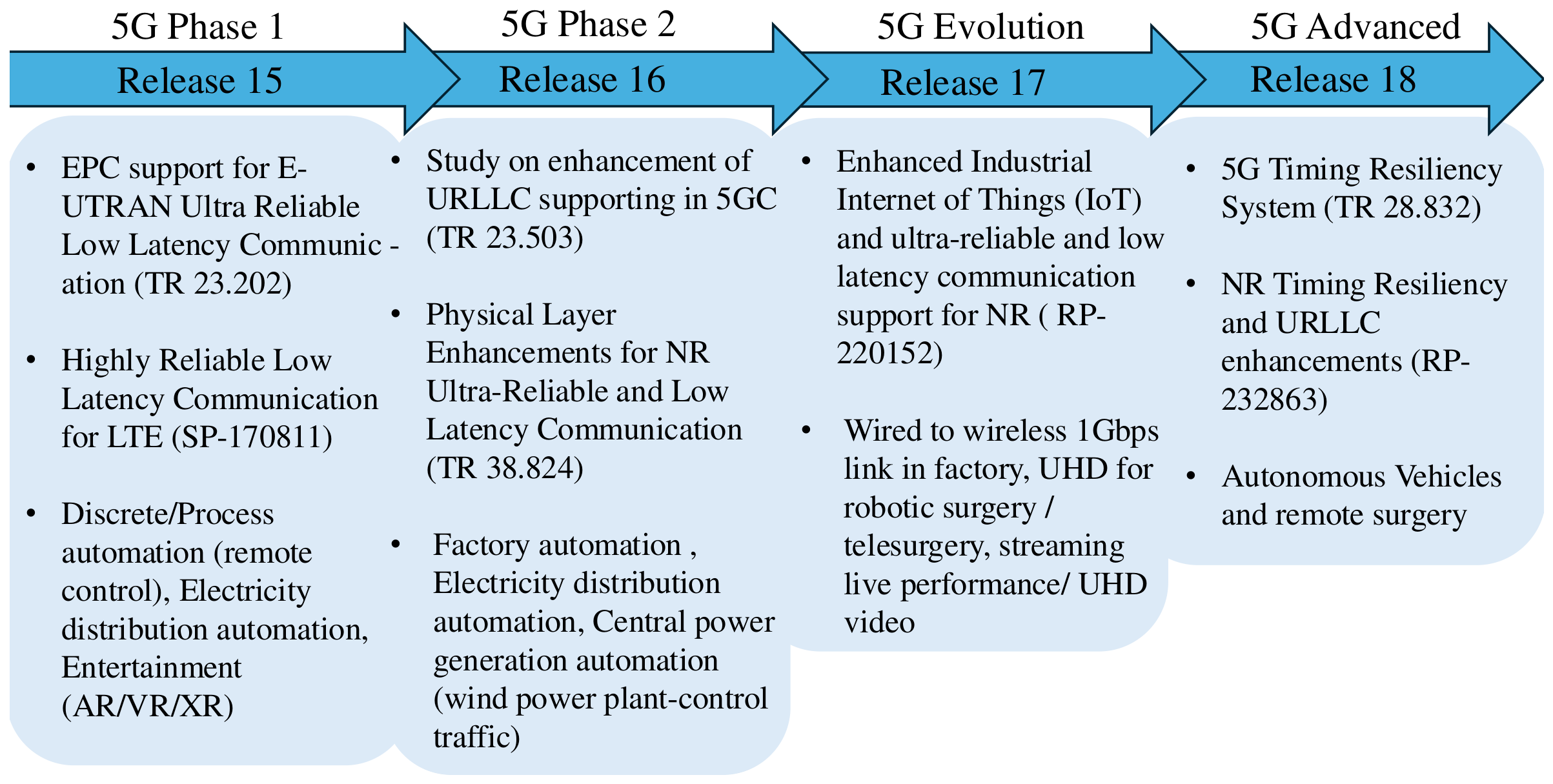
- Release 15 marks the initial 5G phase in which URLLC-capable mechanisms were introduced mainly through LTE-based and early 5G system support, laying the foundation for later URLLC standardization [65].
- The main technical contributions include the following:
- 1.
- Reduced transmission and processing delay through short TTI support, early data transmission, uplink data compression, and faster hybrid automatic repeat request (HARQ) timing. These changes reduced the number of scheduling and retransmission steps needed before data delivery.
- 2.
- Grant-free transmission support, which allowed selected uplink packets to be transmitted without waiting for explicit grants, thereby lowering access delay for small and time-sensitive payloads.
- 3.
- Reliability-oriented enhancements such as PDCCH (physical downlink control channel) repetition, semi-persistent scheduling repetition, packet duplication at the packet data convergence protocol (PDCP) layer, and tighter control-format configuration. These mechanisms increased delivery robustness under poor radio conditions.
- 4.
- Improved system access and recovery procedures, including granular time reference support, enhanced master information block and system information block demodulation, and reduced re-synchronization overhead [66]. These features shortened re-acquisition time after disruption.
- 5.
- Evolved Packet Core (EPC) support for E-UTRAN (Evolved Universal Terrestrial Radio Access Network) URLLC, enabling URLLC-style operation in LTE/EPC-based deployment scenarios [67].
- These features supported use cases such as industrial automation, smart transportation, and electric power distribution, where deterministic delivery and fast recovery are important.
4.2. 3GPP Release 16
- Release 16 extends URLLC from baseline enablers toward phase-2 standardization in 5G, with a stronger emphasis on vertical-industry deployments, especially industrial automation [65].
- The main technical contributions include the following:
- 1.
- Packet duplication and path redundancy mechanisms for reliability enhancement. In particular, 3GPP specified duplication across multiple paths using dual connectivity, two N3 and N9 tunnels, or two N3 tunnels, so that failure on one path would not interrupt packet delivery.
- 2.
- Core-network quality-of-service enhancements such as packet delay budget (PDB) handling, dynamic PDB allocation, QoS monitoring, and session continuity improvements. These changes made latency guarantees more explicit at the service-management level.
- 3.
- New radio-interface mechanisms including updated downlink control information formats, improved PDCCH monitoring, sub-slot HARQ-ACK feedback, dual HARQ-ACK codebooks, physical uplink channel refinements, and better multiplexing/prioritization of traffic with mixed latency requirements.
- 4.
- Support for multiple active configured grants per bandwidth part, which improved uplink flexibility for periodic or bursty low-latency traffic.
4.3. 3GPP Release 17
- Release 17 broadens URLLC evolution by integrating it more tightly with other 5G service requirements, including eMBB and mMTC, while continuing to improve low-latency behavior [65].
- The main technical contributions include the following:
- 1.
- Further physical-layer improvements for HARQ-ACK and channel state information (CSI) reporting, which reduced feedback delay and improved uplink reliability [34].
- 2.
- Enhanced intra-UE multiplexing and prioritization of traffic with different QoS priorities, allowing time-critical packets to be protected more effectively during scheduling [34].
- 3.
- Improvements in edge computing support, including edge relocation capabilities, to reduce application-level response time when compute resources need to move closer to the user.
- 4.
- URLLC operation in unlicensed spectrum, extending low-latency service support beyond licensed new radio (NR) deployments [34].
- 5.
- Additional latency-oriented enhancements include NR sidelink, NR multiple-input multiple-output (MIMO) refinements, uplink data compression, and integrated access and backhaul duplexing improvements.
4.4. 3GPP Release 18
- Release 18 represents the start of the 5G-Advanced phase, where URLLC is increasingly shaped by automation, adaptation, and tighter service guarantees rather than only by radio-interface repetition mechanisms [65].
- The main technical contributions include the following:
- 1.
- AI-assisted network optimization and energy-efficient operation, which improve scheduling responsiveness and resource utilization for latency-sensitive services [71].
- 2.
- Integration with extended reality (XR) and multi-access edge computing, both of which require stable low-latency transport and benefit from tighter coordination between radio and compute resources [71].
- 3.
- Introduction of Low Latency, Low Loss, and Scalable Throughput (L4S), which reduces queuing delay by allowing applications to adapt their sending rates more quickly and thereby improves latency under congestion [71].
- 4.
- The NR Timing Resiliency and URLLC work item, which added support for timing synchronization and reporting in RAN, interworking with transport-layer time-sensitive networking (TSN), and feedback-based adaptation of downstream and upstream scheduling [72].
4.5. 3GPP Release 19 and Beyond
- The main technical directions include the following:
- 1.
- Improved beam management and beamforming, including faster beam selection through UE-initiated measurement reporting, which can reduce interruption time in mobility and blockage-prone scenarios [71].
- 2.
- 3.
- Continued use of AI/ML for RAN automation, network slicing optimization, timing synchronization, and split-RAN support, all of which indirectly strengthen URLLC performance by improving responsiveness and operational stability [71].
5. 5G URLLC Challenges and Enablers
5.1. Sources of Latency and Mitigation Approaches
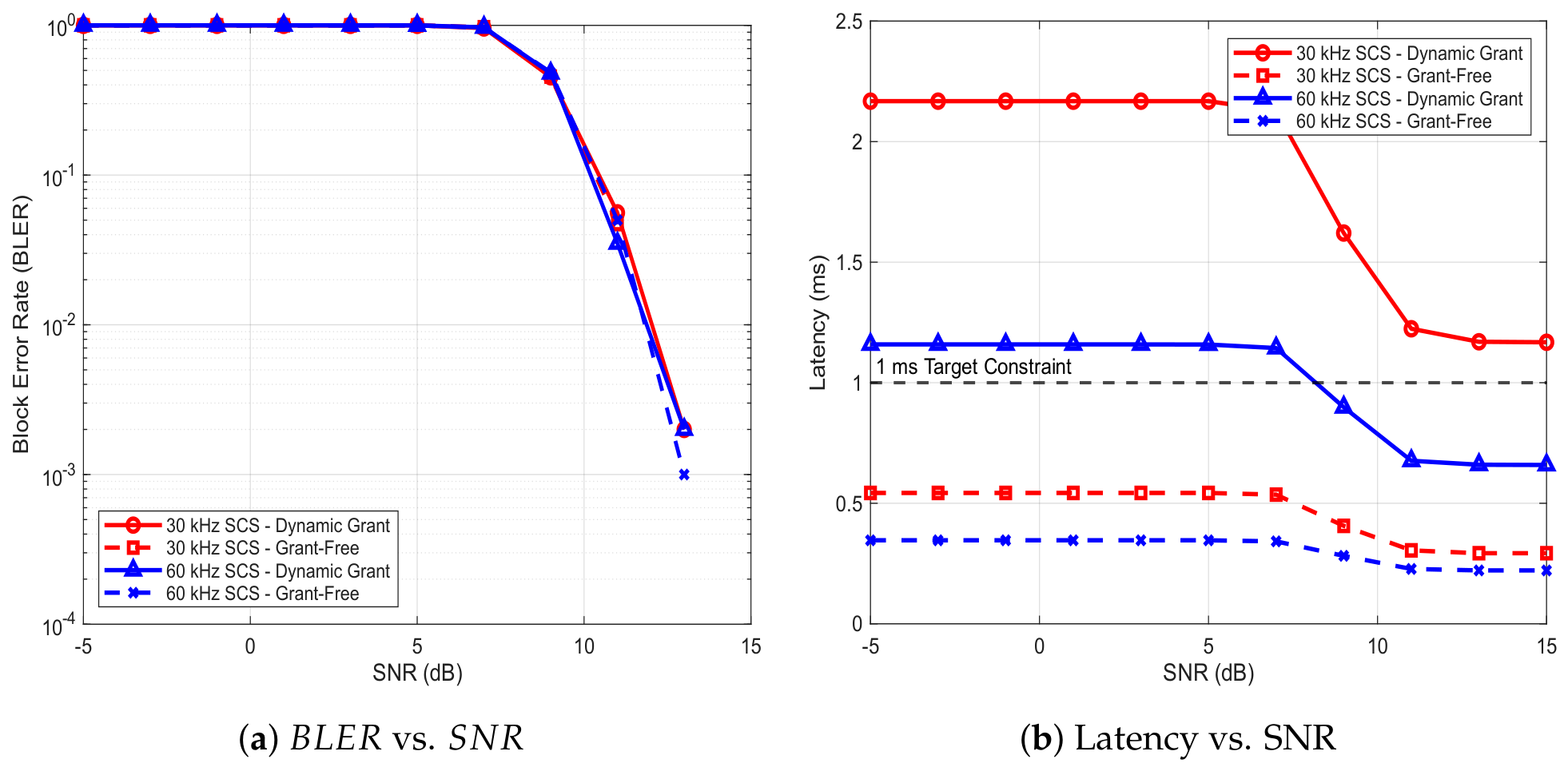
- Frame Structure: The frame structure plays a fundamental role in achieving low latency in wireless communication systems. It determines how data is organized and transmitted over time, directly impacting the time-to-transmit and processing delays. To meet stringent latency targets, such as the 0.5 ms user-plane latency goal in 5G and beyond, flexible frame structures are employed that allow for shorter TTIs or mini-slots. These shorter time units reduce the amount of data processed and transmitted at once, thus lowering processing and scheduling delays. Additionally, adaptable parameters like subcarrier spacing, slot configuration, and uplink-downlink ratios enable dynamic adjustment of transmission times, allowing the system to respond quickly to traffic demands [77]. Fast turnaround of CSI and reduced or eliminated HARQ feedback time further contribute to minimizing latency by enabling quicker retransmissions and maintaining reliable communication [35]. Overall, a highly flexible and fine-grained frame structure is essential for enabling low-latency, high-reliability wireless services that coexist with other traffic types such as eMBB and mMTC.
- Propagation: Propagation latency, also known as RTT, is the time required for a signal to travel from a source to a destination and back. While fundamentally constrained by the laws of physics (speed of electromagnetic waves) and the distance between communicating parties, several strategies can be employed to mitigate its effects, such as minimizing the physical distance or optimizing the transmission environment. Edge computing, which involves deploying computing resources close to end users, reduces the amount of data that needs to travel long distances [78]. Caching frequently accessed data or content near users minimizes the need for repeated long-distance data fetching [79]. Peer-to-peer architectures can enable more direct communication between users, reducing reliance on central servers [80]. Effective propagation conditions, such as line-of-sight (LoS) communication and minimal multipath fading, contribute to lower retransmissions and higher reliability, which in turn reduce overall latency. Advanced techniques such as beamforming improve signal quality and enhance effective communication coverage by compensating for propagation impairments. In addition, millimeter-wave (mmWave) communications provide large bandwidths and high data rates, although they require directional transmission and dense deployments to mitigate their inherent propagation loss and blockage sensitivity. Furthermore, propagation-aware resource allocation and scheduling can adapt transmissions to real-time channel conditions, ensuring prompt delivery and minimizing delay. In dense or obstructed environments, deploying small cells or using non-terrestrial networks (NTNs) can mitigate long propagation delays.
- Processing: Processing delay refers to the time required to handle data or tasks. Major contributors include channel estimation, encoding, and decoding [81]. To reduce this delay, systems can employ rapid channel estimation for adaptive modulation and coding that optimizes data transmission for current channel conditions, ensuring that the transmitted data matches the current channel quality and reducing the need for retransmissions. Implementing advanced error correction and redundancy algorithms can reduce the need for re-transmitting lost or corrupted packets, thereby decreasing processing time due to retransmission delays [82]. Offloading processing tasks to nearby edge servers and breaking down tasks into smaller, parallelizable units can significantly reduce processing time [83]. Predictive algorithms can anticipate the next communication needs based on user behavior and initiate data transmission or processing proactively, reducing perceived latency.
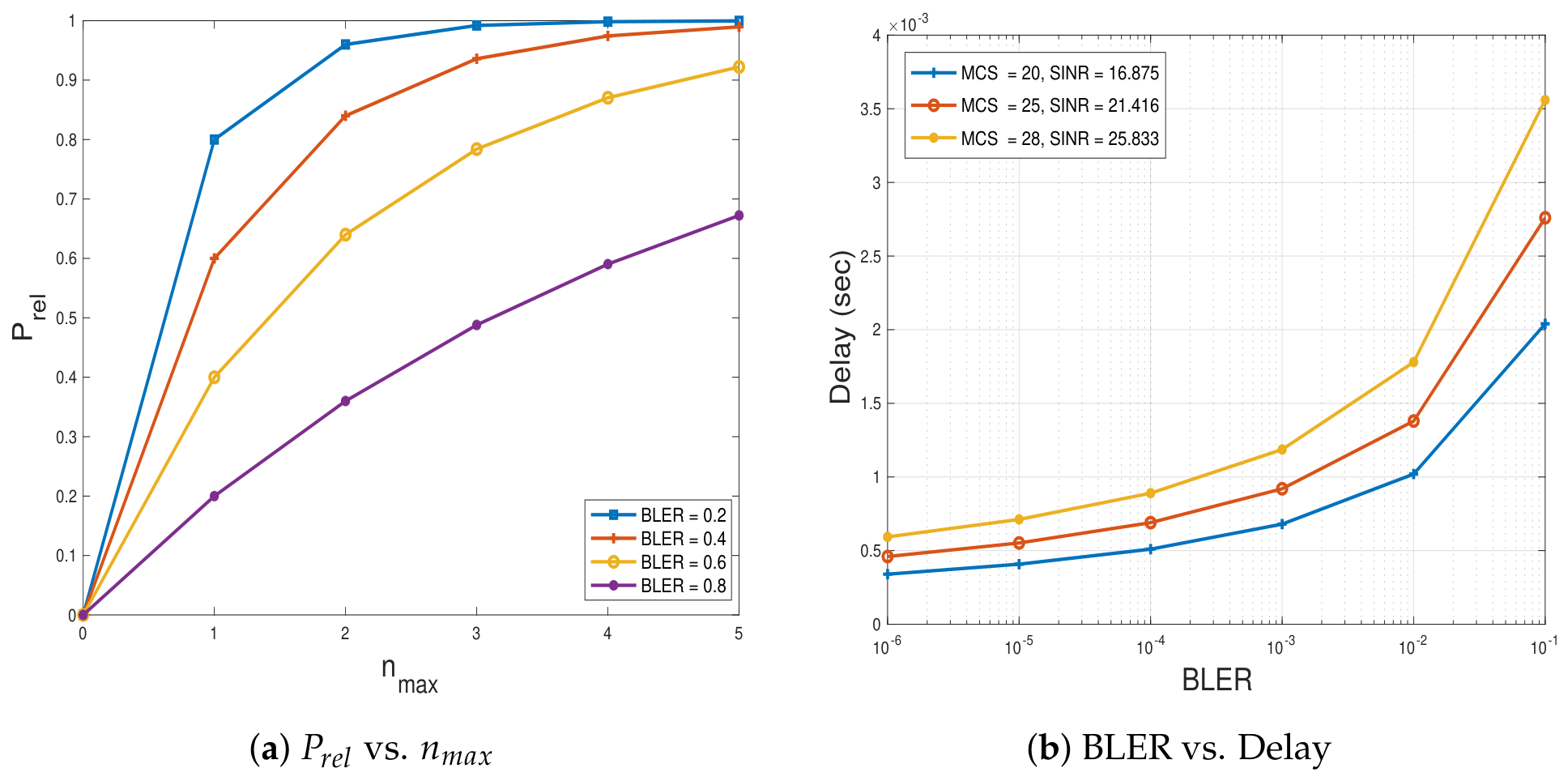
- Retransmission: Reducing retransmissions is a key aspect of achieving low-latency URLLC. Retransmissions occur when a transmitted packet is lost or corrupted and needs to be retransmitted, causing additional delay in the network. HARQ in the access network combines automatic repeat requests (ARQs) with error correction coding, allowing the receiver to request retransmission of only missing or erroneous parts of a packet. This minimizes the amount of retransmitted data and reduces latency compared to a full retransmission. By implementing adaptive modulation and coding techniques that match the transmission rate to the channel quality, the likelihood of errors and retransmissions can be reduced [84]. Early HARQ feedback using predictive ARQ (PARQ) can anticipate potential packet loss and initiate preemptive retransmission, avoiding the delay associated with waiting for negative acknowledgments (NACK) [85]. On the other hand, shorter HARQ TTIs enable faster feedback on channel conditions, allowing quicker retransmission decisions. Using an adaptive modulation and coding scheme (MCS), which adapts the transmission rate to the channel quality, the potential errors and retransmissions can be reduced.
- Scheduling: Scheduling allocates shared channel access among users. Thus, multiple users or devices sharing a limited communication channel or resources induce latency from contention for resources, queuing delays, scheduling overhead, and interference management in communication systems with shared channels. Inefficient scheduling decisions can lead to unpredictable delays, collisions, interference, and increased retransmissions in dynamic environments. To reduce latency, several strategies are necessary, including optimized scheduling algorithms that prioritize low-latency traffic [86], dynamic adaptation of scheduling parameters to real-time network conditions, predictive techniques for proactive adjustments based on traffic patterns [87], and QoS-based traffic prioritization. These approaches ensure timely and efficient resource allocation while minimizing processing complexity and overhead.
5.2. Sources of Reliability Degradation and Mitigation Approaches
- Fading: The main factors in fading are multipath propagation, signal interference, and changing environmental conditions, which cause fluctuations in signal strength and quality [88]. Diversity techniques are like having a backup plan for your data: sending extra copies in different dimensions (space, frequency, or time) increases the chances of successful reception [89]. Sending the duplicated data via antenna diversity for fast fading, higher order single-user MIMO (SU-MIMO) diversity to lower the risk of encountering deep fades, inter-cell non-coherent joint transmission to recover from shadow fading, and cell failures are some of the examples of spatial diversity. In the same way, sending the data over multiple frequencies or time slots can help reduce the effect caused by fading. Techniques such as frequency hopping, orthogonal frequency division multiplexing (OFDM), and time division multiplexing (TDM) distribute the risk of fading and can improve resistance to fading-induced errors. In addition, channel predictive models can help anticipate fading variations and adjust data transmission accordingly, mitigating the effects of sudden signal degradation [90]. Relaying and beamforming are other approaches that reduce the impact of fading.
- Packet loss: Packet loss happens when data packets do not reach their destination. This can occur for many reasons. When the network is very busy, packets drop because the system reaches its capacity. Signals can also be interrupted by other devices or weakened by multipath fading, leading to errors [89]. Collisions occur when multiple devices try to send data simultaneously on a shared channel, resulting in more lost packets. Packet loss can also result from jitter, buffer overflows, QoS rules, packet corruption, routing problems, or network delays [91]. To reduce packet loss, networks require careful planning, reliable hardware, effective error-correction methods, and robust congestion control. Techniques such as multi-connectivity, time diversity, and frequency diversity, combined with HARQ, help improve data transmission stability.
- Interference: Interference happens when unwanted signals disrupt communication between the sender and receiver. This can be caused by nearby devices or external electromagnetic sources operating in the overlapping frequency band [91]. There are several types of interference, such as adjacent channel, co-channel, and cross-technology interference. Multipath propagation, where signals bounce, reflect, and scatter, is a major source of interference (constructive or destructive) at the receiver [92]. Transmitter proximity, signal reflection, frequency congestion, receiver sensitivity, etc., can also cause interference. To reduce interference, the network must use strategic frequency planning, dynamic spectrum management, power control mechanisms, and cognitive radio techniques to adapt according to the transmission parameters. Additionally, interference cancellation, spatial separation, directional antennas, and avoidance algorithms also help to enhance reliability for URLLC applications.
- Network configuration: If network configuration settings are inaccurate, this can result in poor performance, delays, and packet loss because resources and QoS parameters are not set correctly. Without proper monitoring and maintenance, problems may go unnoticed, leading to downtime and unreliable service. Poor load balancing can cause bottlenecks when traffic is high, which lowers reliability [93]. Weak security settings can allow unauthorized access, data breaches, and service interruptions. Not having redundancy or failover systems makes the network vulnerable and creates single points of failure. To improve wireless communication reliability, it is important to plan the network carefully, set parameters accurately, monitor regularly, maintain the system, and follow best practices for configuration [94].
5.3. Latency–Reliability Trade-Off
5.4. URLLC Coexistence
6. The Vision of URLLC Beyond 5G
6.1. Extreme URLLC
6.2. Broadband URLLC
6.3. Scalable URLLC
6.4. Real-Time URLLC
6.5. Precise URLLC
6.6. Secure URLLC
7. Future Direction
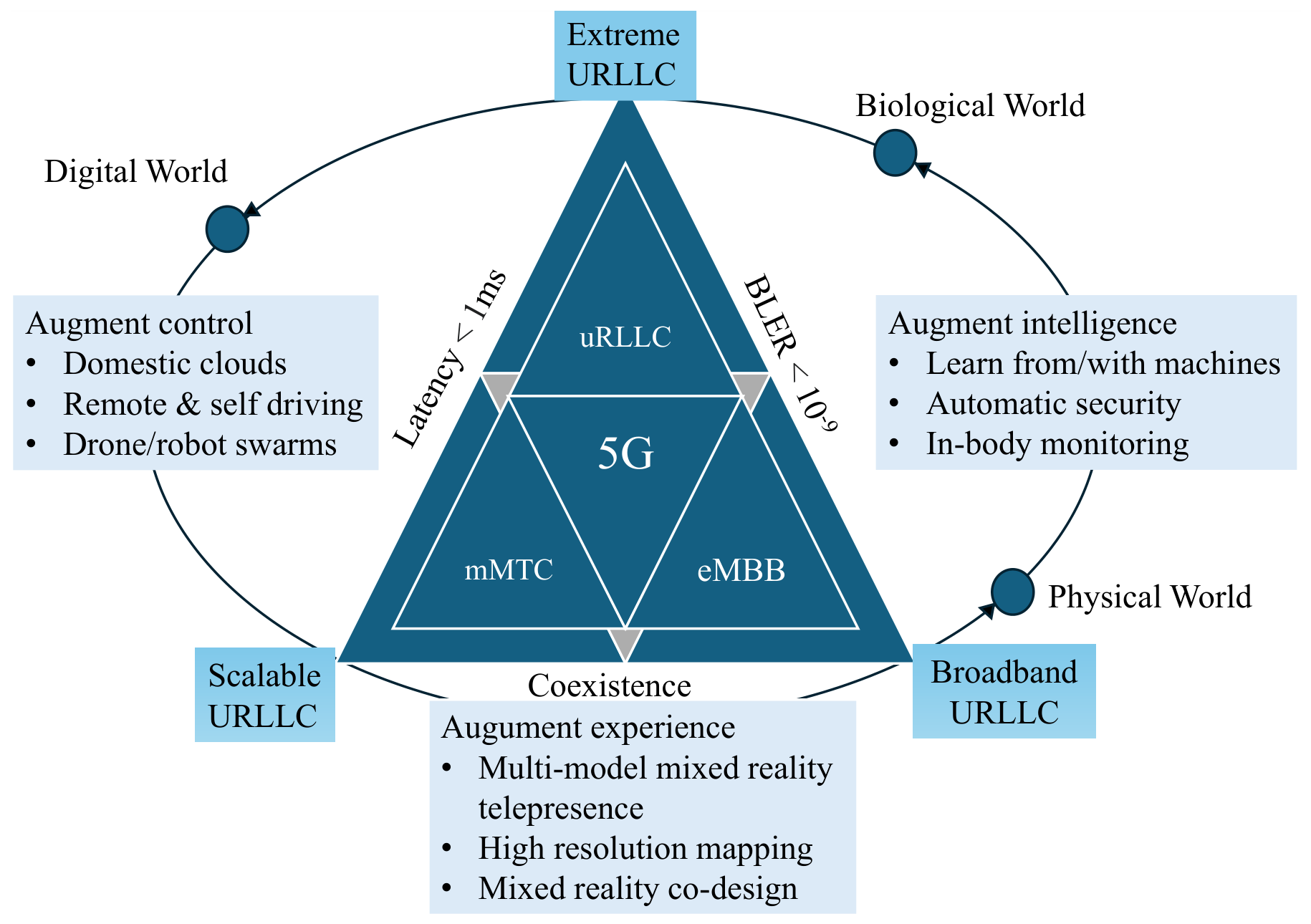
- Integration of AI and Machine Learning: The future of URLLC beyond 5G and toward 6G networks will be shaped significantly by the integration of AI/ML technologies. These advances will enable networks to dynamically optimize resources, forecast traffic congestion, and detect security threats in real time. As a result, these networks can adapt intelligently to heterogeneous and dense communication environments. Particularly, the federated learning (FL) technique uses decentralized decision-making at the edge while preserving the privacy of the data collected at the edge device. Moreover, self-healing network capabilities, which are driven by AI/ML, will enhance reliability while at the same time minimizing downtime in mission-critical systems.
- Advancements in Physical Layer Technologies: Parallel to AI integration, breakthroughs in physical layer technologies are essential to meet stringent latency and reliability demands. THz and sub-THz communications will unlock exceedingly wide bandwidths critical for emerging high-data-rate applications like holographic communication and massive digital twins [28,29,41]. Complementing this, ultra-massive MIMO techniques and RIS will provide improved spectral efficiency and the ability to actively manipulate wireless propagation environments. These advances, together with novel coding and modulation schemes designed for short-packet URLLC traffic, will help overcome the fundamental latency–reliability trade-off.
- Security and Privacy Enhancements: Security and privacy will continue to be top priorities in future URLLC systems. Using a lightweight cryptographic technique that introduces minimum latency overhead will be crucial, along with new physical-layer security techniques that use channel characteristics to safeguard data confidentiality and integrity. Moreover, the introduction of quantum computing demands the use of quantum-resistant cryptography. Furthermore, zero-trust architectures can keep networks secure by constantly verifying devices and users, which is especially important as the IoE continues to grow and introduce new vulnerabilities.
- Edge Computing and Network Slicing: Edge computing and network slicing will continue to grow, bringing processing and storage closer to the end users. This helps minimize end-to-end latency and makes it easier to deliver the specific quality of service each application needs. The adoption of blockchain and other distributed ledger technologies will enhance decentralized trust and accountability that are critical for multi-provider and heterogeneous network environments. These technologies will enable fine-grained isolation of URLLC services and support complex application requirements.
- Standardization and Testing: To make these technologies work efficiently, the standardization ecosystem needs to grow and adapt. It must support interoperable protocols that allow different systems to work together smoothly. Strong testing methods like digital twins will be needed to evaluate performance in realistic conditions, along with unified KPIs to clearly measure the broader goals of URLLC. Cross-industry collaboration will be vital to align network capabilities with application-specific needs and accelerate deployment.
- Ubiquitous Coverage through Non-Terrestrial Networks (NTNs): Non-terrestrial networks (NTNs) play a vital role in improving URLLC coverage. They bring together LEO satellites, high-altitude platforms (HAPs), and UAVs with regular ground networks. This seamless integration solves connectivity problems, especially in remote locations where there is weak coverage. Some of the main challenges, such as propagation delay, synchronization, and multi-domain coordination, must be managed to meet the stringent latency and reliability demands of URLLC.
- Convergence of Communication, Computing, and Control (3C): Finally, URLLC will no longer be isolated to communication alone; it will converge with computing and control to form integrated frameworks essential for real-time cyber-physical applications such as cooperative robotics, remote surgery, and smart energy grids. This convergence requires harmonious sensing, communication, computation, and actuation under tight timing and reliability constraints.
8. Conclusions
Author Contributions
Funding
Data Availability Statement
Conflicts of Interest
References
- Sutton, G.J.; Zeng, J.; Liu, R.P.; Ni, W.; Nguyen, D.N.; Jayawickrama, B.A.; Huang, X.; Abolhasan, M.; Zhang, Z.; Dutkiewicz, E.; et al. Enabling technologies for ultra-reliable and low latency communications: From PHY and MAC layer perspectives. IEEE Commun. Surv. Tutor. 2019, 21, 2488–2524. [Google Scholar] [CrossRef]
- Bennis, M.; Debbah, M.; Poor, H.V. Ultrareliable and low-latency wireless communication: Tail, risk, and scale. Proc. IEEE 2018, 106, 1834–1853. [Google Scholar] [CrossRef]
- Feng, Y.; Gao, F.; Tao, X.; Ma, S.; Poor, H.V. Vision-aided Ultra-Reliable Low-Latency Communications for Smart Factory. IEEE Trans. Commun. 2024, 72, 3439–3453. [Google Scholar] [CrossRef]
- Li, K.; Zhu, P.; Wang, Y.; Wang, J.; You, X. Scheduling of Time-Triggered Traffic for Deterministic URLLC in Industrial Automation. IEEE Internet Things J. 2024, 11, 26552–26567. [Google Scholar] [CrossRef]
- Li, J.; Niu, Y.; Wu, H.; Ai, B.; Quek, T.Q.; Wang, N.; Chen, S. Effective Joint Scheduling and Power Allocation for URLLC-Oriented V2I Communications. IEEE Trans. Veh. Technol. 2024, 73, 11694–11705. [Google Scholar] [CrossRef]
- Wu, Q.; Wang, W.; Fan, P.; Fan, Q.; Wang, J.; Letaief, K.B. URLLC-awared resource allocation for heterogeneous vehicular edge computing. IEEE Trans. Veh. Technol. 2024, 73, 11789–11805. [Google Scholar] [CrossRef]
- Qadri, Y.A.; Jung, H.; Niyato, D. Towards the Internet of Medical Things for Real-Time Health Monitoring over Wi-Fi. IEEE Netw. 2024, 38, 229–237. [Google Scholar] [CrossRef]
- Golmohammadi, N.; Rayguru, M.M.; Baidya, S. Lyapunov-Optimized 5G-Sliced Communications for Telerobotic Applications. In Proceedings of the IEEE INFOCOM 2024-IEEE Conference on Computer Communications Workshops (INFOCOM WKSHPS); IEEE: Vancouver, BC, Canada, 2024; pp. 1–6. [Google Scholar]
- Yang, X.; Zho, Z.; Huang, B. URLLC Key Technologies and Standardization for 6G Power Internet of Things. IEEE Commun. Stand. Mag. 2021, 5, 52–59. [Google Scholar] [CrossRef]
- Pourkabirian, A.; Kordafshari, M.S.; Jindal, A.; Anisi, M.H. A Vision of 6G URLLC: Physical-Layer Technologies and Enablers. IEEE Commun. Stand. Mag. 2024, 8, 20–27. [Google Scholar] [CrossRef]
- Haque, M.E.; Tariq, F.; Khandaker, M.R.A.; Wong, K.K.; Zhang, Y. A Survey of Scheduling in 5G URLLC and Outlook for Emerging 6G Systems. IEEE Access 2023, 11, 34372–34396. [Google Scholar] [CrossRef]
- Amjad, Z.; Nsiah, K.A.; Hilt, B.; Lauffenburger, J.P.; Sikora, A. Latency reduction for narrowband URLLC networks: A performance evaluation. Wirel. Netw. 2021, 27, 2577–2593. [Google Scholar] [CrossRef]
- Zhao, Z.; Du, Q.; Karagiannidis, G.K. Improved grant-free access for URLLC via multi-tier-driven computing: Network-load learning, prediction, and resource allocation. IEEE J. Sel. Areas Commun. 2023, 41, 607–622. [Google Scholar] [CrossRef]
- Khosravirad, S.R.; Viswanathan, H.; Yu, W. Exploiting diversity for ultra-reliable and low-latency wireless control. IEEE Trans. Wirel. Commun. 2020, 20, 316–331. [Google Scholar] [CrossRef]
- Enenche, P.; Kim, D.H.; You, D. Network Coding as Enabler for Achieving URLLC Under TCP and UDP Environments: A Survey. IEEE Access 2023, 11, 76647–76674. [Google Scholar] [CrossRef]
- Yang, H.; Zhang, K.; Zheng, K.; Qian, Y. Secure Edge Caching Placement and Delivery for Ultra-Reliable and Low-Latency Vehicular Networks. In Proceedings of the 2019 IEEE Globecom Workshops (GC Wkshps), Waikoloa, HI, USA, 9–13 December 2019; pp. 1–6. [Google Scholar] [CrossRef]
- Suer, M.T.; Thein, C.; Tchouankem, H.; Wolf, L. Evaluation of Multi-Connectivity Schemes for URLLC Traffic over WiFi and LTE. In Proceedings of the 2020 IEEE Wireless Communications and Networking Conference (WCNC), Seoul, Republic of Korea, 25–28 May 2020; pp. 1–7. [Google Scholar] [CrossRef]
- Khodakhah, F.; Stefanović, Č.; Mahmood, A.; Farag, H.; Österberg, P.; Gidlund, M. NOMA or Puncturing for Uplink eMBB-URLLC Coexistence from an AoI Perspective? In Proceedings of the GLOBECOM 2023—2023 IEEE Global Communications Conference; IEEE: New York, NY, USA, 2023; pp. 4301–4306. [Google Scholar]
- Salh, A.; Audah, L.; Shah, N.S.M.; Alhammadi, A.; Abdullah, Q.; Kim, Y.H.; Al-Gailani, S.A.; Hamzah, S.A.; Esmail, B.A.F.; Almohammedi, A.A. A survey on deep learning for ultra-reliable and low-latency communications challenges on 6G wireless systems. IEEE Access 2021, 9, 55098–55131. [Google Scholar] [CrossRef]
- Tominaga, E.N.; Alves, H.; López, O.L.A.; Souza, R.D.; Rebelatto, J.L.; Latva-Aho, M. Network slicing for eMBB and mMTC with NOMA and space diversity reception. In Proceedings of the 2021 IEEE 93rd Vehicular Technology Conference (VTC2021-Spring); IEEE: New York, NY, USA, 2021; pp. 1–6. [Google Scholar]
- Park, J.; Samarakoon, S.; Shiri, H.; Abdel-Aziz, M.K.; Nishio, T.; Elgabli, A.; Bennis, M. Extreme URLLC: Vision, challenges, and key enablers. arXiv 2020, arXiv:2001.09683. [Google Scholar] [CrossRef]
- Alves, H.; Jo, G.D.; Shin, J.; Yeh, C.; Mahmood, N.H.; Lima, C.; Yoon, C.; Rahatheva, N.; Park, O.S.; Kim, S.; et al. Beyond 5G URLLC evolution: New service modes and practical considerations. arXiv 2021, arXiv:2106.11825. [Google Scholar] [CrossRef]
- Recommendation ITU-R M.2160-0 (11/2023); Framework and Overall Objectives of the Future Development of IMT for 2030 and Beyond. Technical Report; International Telecommunication Union, Radiocommunication Sector (ITU-R): Geneva, Switzerland, 2023.
- Nouri, P. Cooperative Diversity Mechanisms for Critical Machine-Type Communications. 2022. Available online: https://oulurepo.oulu.fi/handle/10024/36941 (accessed on 2 December 2024).
- Haque, M.E.; Tariq, F.; Khandaker, M.R.; Hossain, M.S.; Imran, M.A.; Wong, K.K. A Comprehensive Survey of 5G URLLC and Challenges in the 6G Era. arXiv 2025, arXiv:2508.20205. [Google Scholar] [CrossRef]
- 5G Americas. Ultra-Reliable Low-Latency Communication; Technical Report; 5G Americas: Seattle, WA, USA, 2019. [Google Scholar]
- Singh, S.; Nakkeeran, A.; Singh, P.; Sharma, E.; Bapat, J. Load Balanced ISAC Systems for URLLC Users. arXiv 2026, arXiv:2601.16495. [Google Scholar] [CrossRef]
- Kurma, S.; Katwe, M.; Singh, K.; Pan, C.; Mumtaz, S.; Li, C.-P. RIS-Empowered MEC for URLLC Systems with Digital-Twin-Driven Architecture. IEEE Trans. Commun. 2024, 72, 1983–1997. [Google Scholar] [CrossRef]
- Alhulayil, M.; Aqoulah, M.A.; López-Benítez, M.; Al-Mistarihi, M.F.; Alammar, M.; Al Ayidh, A. Integrated THz/mmWave Transmission Method for Enhanced URLLC Communications. IEEE Trans. Wirel. Commun. 2025, 13, 62914–62929. [Google Scholar] [CrossRef]
- Souza, C.; Falcão, M.; Balieiro, A.; Alves, E.; Taleb, T. Dynamic resource allocation for URLLC and eMBB in MEC-NFV 5G networks. Comput. Netw. 2025, 260, 111127. [Google Scholar] [CrossRef]
- Consortium, D. DETERMINISTIC6G Deliverable D2.1: URLLC Performance Requirements and KPIs, 2023. Available online: https://deterministic6g.eu/images/deliverables/DETERMINISTIC6G-D2.1-v2.0.pdf (accessed on 6 November 2025).
- Chang, B.; Zhang, L.; Li, L.; Zhao, G.; Chen, Z. Optimizing resource allocation in URLLC for real-time wireless control systems. IEEE Trans. Veh. Technol. 2019, 68, 8916–8927. [Google Scholar] [CrossRef]
- Hakeem, S.A.A.; Hussein, H.H.; Kim, H. Vision and research directions of 6G technologies and applications. J. King Saud. Univ.-Comput. Inf. Sci. 2022, 34, 2419–2442. [Google Scholar] [CrossRef]
- Lee, H.; Ko, Y.C. Physical layer enhancements for ultra-reliable low-latency communications in 5G new radio systems. IEEE Commun. Stand. Mag. 2021, 5, 112–122. [Google Scholar] [CrossRef]
- Ji, H.; Park, S.; Yeo, J.; Kim, Y.; Lee, J.; Shim, B. Ultra-reliable and low-latency communications in 5G downlink: Physical layer aspects. IEEE Wirel. Commun. 2018, 25, 124–130. [Google Scholar] [CrossRef]
- Anand, A.; De Veciana, G.; Shakkottai, S. Joint scheduling of URLLC and eMBB traffic in 5G wireless networks. IEEE/ACM Trans. Netw. 2020, 28, 477–490. [Google Scholar] [CrossRef]
- Shaik, R.B.; Nagaradjane, P.; Ioannou, I.; Sittakul, V.; Vasiliou, V.; Pitsillides, A. AI/ML-aided capacity maximization strategies for URLLC in 5G/6G wireless systems: A survey. Comput. Netw. 2024, 249, 110506. [Google Scholar] [CrossRef]
- Pradhan, A.; Das, S.; Piran, M.J.; Han, Z. A survey on security of ultra/hyper reliable low latency communication: Recent advancements, challenges, and future directions. arXiv 2024, arXiv:2404.08160. [Google Scholar] [CrossRef]
- Liu, E.; Effiok, E.; Hitchcock, J. Survey on health care applications in 5G networks. IET Commun. 2020, 14, 1073–1080. [Google Scholar] [CrossRef]
- Kaushik, N.; Kumar, P. AI-Native Self-Optimizing Architectures for Ultra-Reliable 6G Wireless Networks. Iconic Res. Eng. J. (IRE J.) 2026, 9, 2402–2410. [Google Scholar] [CrossRef]
- Ibrahim, A.M.; Nordin, R.; Khamayseh, Y.S.; Amphawan, A.; Jasser, M.B. URLLC for 6G Enabled Industry 5.0: A Taxonomy of Architectures, Cross Layer Techniques, and Time Critical Applications. arXiv 2025, arXiv:2510.08080. [Google Scholar] [CrossRef]
- Lu, Y.; Zhang, J.; Zheng, J.; Ng, D.W.; Ai, B. Joint Beamforming and Blocklength Optimization for URLLC in RIS-Aided Cell-Free Massive MIMO System. IEEE Trans. Wirel. Commun. 2026, 25, 11641–11656. [Google Scholar] [CrossRef]
- Zhang, J.; Xu, X.; Han, S.; Zhang, K.; Zhang, P.; Ren, S. Intelligent ultra-reliable and low latency communications: Security and flexibility. IEEE Trans. Wirel. Commun. 2023, 22, 8392–8406. [Google Scholar] [CrossRef]
- 3rd Generation Partnership Project (3GPP)/ETSI. 3GPP TS 22.261 v16.14.0—Service Requirements for the 5G System. 2021. Available online: https://www.etsi.org/deliver/etsi_ts/122200_122299/122261/16.14.00_60/ts_122261v161400p.pdf (accessed on 10 February 2026).
- Kurose, J.F.; Ross, K.W. Computer Networking: A Top-Down Approach, 8th ed.; Pearson: Amsterdam, The Netherlands, 2020. [Google Scholar]
- Gamal, A.E.; Mammen, J.; Prabhakar, B.; Shah, D. Throughput-delay trade-off in wireless networks. In Proceedings of the IEEE INFOCOM 2004; IEEE: New York, NY, USA, 2004; Volume 1. [Google Scholar]
- Hanly, S.V.; Tse, D.N.C. Multiaccess fading channels. II. Delay-limited capacities. IEEE Trans. Inf. Theory 1998, 44, 2816–2831. [Google Scholar] [CrossRef]
- Chang, C.S.; Zajic, T. Effective bandwidths of departure processes from queues with time varying capacities. In Proceedings of the Proceedings of INFOCOM’95; IEEE: New York, NY, USA, 1995; Volume 3, pp. 1001–1009. [Google Scholar]
- Neely, M.J. A Lyapunov optimization approach to repeated stochastic games. In Proceedings of the 2013 51st Annual Allerton Conference on Communication, Control, and Computing (Allerton); IEEE: New York, NY, USA, 2013; pp. 1082–1089. [Google Scholar][Green Version]
- Deshmukh, P.K.; Mane, D.T. QoS-Aware Routing and Resource Allocation Techniques for Enhanced Network Performance. J. Electr. Syst. 2023, 19, 78. [Google Scholar] [CrossRef]
- Eryilmaz, A.; Srikant, R. Fair resource allocation in wireless networks using queue-length-based scheduling and congestion control. IEEE/ACM Trans. Netw. 2007, 15, 1333–1344. [Google Scholar] [CrossRef]
- Maity, I.; Taleb, T. Resq: Reinforcement learning-based queue allocation in software-defined queuing framework. J. Netw. Netw. Appl. 2022, 2, 143–152. [Google Scholar] [CrossRef]
- URLLC Latency and Reliability Requirements in 5G, 2023. Available online: https://www.5gworldpro.com/blog/2023/10/04/how-is-5g-urllc-defined-and-what-are-related-technologies/ (accessed on 1 December 2025).
- Hidalgo, E.M.; Isaksson, M.; Roshan, M.C.; Marwick, T.H.; Wright, L.; Lambert, G. Evaluating the impacts of network latency, haptics, and ergonomics in a Haptically-Enabled Robot for Teleoperated Echocardiography. Comput. Biol. Med. 2025, 195, 110450. [Google Scholar] [CrossRef]
- Qualcomm Technologies, Inc. Realizing Mission-Critical Industrial Automation with 5G. 2022. Available online: https://www.qualcomm.com/content/dam/qcomm-martech/dm-assets/documents/Qualcomm-Webinar-Realizing-mission-critical-industrial-automation-with-5G.pdf (accessed on 12 February 2026).
- Veedu, S.N.K.; Mozaffari, M.; Höglund, A.; Yavuz, E.A.; Tirronen, T.; Bergman, J.; Wang, Y.P.E. Toward smaller and lower-cost 5G devices with longer battery life: An overview of 3GPP release 17 RedCap. IEEE Commun. Stand. Mag. 2022, 6, 84–90. [Google Scholar] [CrossRef]
- Osama, M.; Ateya, A.A.; Ahmed Elsaid, S.; Muthanna, A. Ultra-reliable low-latency communications: Unmanned aerial vehicles assisted systems. Information 2022, 13, 430. [Google Scholar] [CrossRef]
- GTI. URLLC Evaluation White Paper (Phase1). 2022. Available online: https://www.gtigroup.org/Uploads/File/2022/03/14/u622ee1034d3ec.pdf?utm_source (accessed on 1 February 2026).
- Weichenberg, G.E.; Chan, V.W.; Medard, M. High-reliability architectures for networks under stress. In Proceedings of the IEEE INFOCOM 2004; IEEE: New York, NY, USA, 2004; Volume 1. [Google Scholar]
- Wen, Y.; Chan, V.W. Ultra-reliable communication over unreliable optical networks via lightpath diversity: System characterization and optimization. In Proceedings of the GLOBECOM’03. IEEE Global Telecommunications Conference (IEEE Cat. No. 03CH37489); IEEE: New York, NY, USA, 2003; Volume 5, pp. 2529–2535. [Google Scholar]
- Dombrowski, C.; Gross, J. Reducing outage probability over wireless channels under hard real-time constraints. In Proceedings of the 1st Workshop on Real-Time Wireless for Industrial Applications (Real Win); RWTH Aachen University/KTH Royal Institute of Technology: Aachen, Germany, 2011. [Google Scholar]
- Ultra Reliable and Low Latency Communications. Available online: https://www.3gpp.org/technologies/urlcc-2022 (accessed on 20 August 2024).
- Ratasuk, R.; Mangalvedhe, N.; Xiong, Z.; Robert, M.; Bhatoolaul, D. Enhancements of narrowband IoT in 3GPP Rel-14 and Rel-15. In Proceedings of the 2017 IEEE Conference on Standards for Communications and Networking (CSCN); IEEE: New York, NY, USA, 2017; pp. 60–65. [Google Scholar]
- 3rd Generation Partnership Project (3GPP). TR 23.730: Study on Extended Architecture Support for Cellular Internet of Things (CIoT); Technical Report; 3GPP: Sophia Antipolis, France, 2017. [Google Scholar]
- Pocovi, G.; Abreu, R.; Andres, P.; Deghel, M.; Hugl, K.; Jacobsen, T.; Jayasinghe, K.; Kela, P.; Korhonen, J.; Kuo, P.H.; et al. Further Enhanced URLLC and Industrial IoT Support with Release-17 5G New Radio. IEEE Commun. Stand. Mag. 2023, 7, 12–19. [Google Scholar] [CrossRef]
- 3GPP TR 21.915; Digital Cellular Telecommunications System (Phase 2+) (GSM); Universal Mobile Telecommunications System (UMTS); LTE; 5G. ETSI: Sophia Antipolis, France, 2019.
- 3GPP SP-170811; EPC Support for E-UTRAN URLLC. 3GPP: Sophia Antipolis, France, 2019.
- 3GPP TR 23.725; Study on Enhancement of Ultra-Reliable Low-Latency Communication (URLLC) Support in the 5G Core Network (5GC). 3GPP: Sophia Antipolis, France, 2018.
- 3GPP TR 38.824; SID on Physical Layer Enhancements for NR URLLC. 3GPP: Sophia Antipolis, France, 2019.
- 3GPP TR 33.825; Study on the Security of URLLC for 5GS. 3GPP: Sophia Antipolis, France, 2019.
- Wraycastle Communications. What Are The Differences Between 3GPP Release 18 and 19. 2025. Available online: https://wraycastle.com/blogs/knowledge-base/what-are-the-differences-between-3gpp-release-18-and-19 (accessed on 11 November 2025).
- 3rd Generation Partnership Project (3GPP). Work Item 991036: NR Timing Resiliency and URLLC Enhancements. 2023. Available online: https://portal.3gpp.org/desktopmodules/WorkItem/WorkItemDetails.aspx?-workitemId=991036 (accessed on 20 October 2025).
- Ericsson. The Next Wave of Advanced 5G—3GPP Release 19. 2023. Available online: https://www.ericsson.com/en/blog/2023/12/3gpp-release-19 (accessed on 11 November 2025).
- Lin, X. The bridge toward 6G: 5G-Advanced evolution in 3GPP Release I9. IEEE Commun. Stand. Mag. 2025, 9, 28–35. [Google Scholar] [CrossRef]
- Ji, H.; Park, S.; Yeo, J.; Kim, Y.; Lee, J.; Shim, B. Introduction to ultra reliable and low latency communications in 5G. arXiv 2017, arXiv:1704.05565. [Google Scholar]
- Pocovi, G.; Shariatmadari, H.; Berardinelli, G.; Pedersen, K.; Steiner, J.; Li, Z. Achieving ultra-reliable low-latency communications: Challenges and envisioned system enhancements. IEEE Netw. 2018, 32, 8–15. [Google Scholar] [CrossRef]
- Ford, R.; Zhang, M.; Mezzavilla, M.; Dutta, S.; Rangan, S.; Zorzi, M. Achieving ultra-low latency in 5G millimeter wave cellular networks. IEEE Commun. Mag. 2017, 55, 196–203. [Google Scholar] [CrossRef]
- Duan, Y.; She, C.; Zhao, G.; Quek, T.Q. Delay analysis and computing offloading of URLLC in mobile edge computing systems. In Proceedings of the 2018 10th International Conference on Wireless Communications and Signal Processing (WCSP); IEEE: New York, NY, USA, 2018; pp. 1–6. [Google Scholar]
- Li, Y.; Zhong, C.; Gursoy, M.C.; Velipasalar, S. Learning-based delay-aware caching in wireless D2D caching networks. IEEE Access 2018, 6, 77250–77264. [Google Scholar] [CrossRef]
- Farahani, R.; Çetinkaya, E.; Timmerer, C.; Shojafar, M.; Ghanbari, M.; Hellwagner, H. ALIVE: A Latency-and Cost-Aware Hybrid P2P-CDN Framework for Live Video Streaming. IEEE Trans. Netw. Serv. Manag. 2023, 21, 1561–1580. [Google Scholar]
- Martinian, E.; Sundberg, C.E. Burst erasure correction codes with low decoding delay. IEEE Trans. Inf. Theory 2004, 50, 2494–2502. [Google Scholar] [CrossRef]
- Park, J.; Oh, Y.; Kim, S.; Jeon, Y.S. Joint source-channel coding for channel-adaptive digital semantic communications. IEEE Trans. Cogn. Commun. Netw. 2024, 11, 75–89. [Google Scholar] [CrossRef]
- Tran-Dang, H.; Kim, D.S. FRATO: Fog resource based adaptive task offloading for delay-minimizing IoT service provisioning. IEEE Trans. Parallel Distrib. Syst. 2021, 32, 2491–2508. [Google Scholar] [CrossRef]
- Ahmed, A.; Al-Dweik, A.; Iraqi, Y.; Mukhtar, H.; Naeem, M.; Hossain, E. Hybrid automatic repeat request (HARQ) in wireless communications systems and standards: A contemporary survey. IEEE Commun. Surv. Tutor. 2021, 23, 2711–2752. [Google Scholar] [CrossRef]
- Hummert, M.; Wübben, D.; Dekorsy, A. Neural network-based forecasting of decodability for early ARQ. In Proceedings of the 2021 17th International Symposium on Wireless Communication Systems (ISWCS); IEEE: New York, NY, USA, 2021; pp. 1–6. [Google Scholar]
- Liu, Q.; Li, C.; Shi, Y.; Zhou, B.; Hou, Y.T.; Lou, W. Pistis: A Scheduler to Achieve Ultra Reliability for URLLC Traffic in 5G O-RAN. IEEE Internet Things J. 2024, 11, 35405–35419. [Google Scholar] [CrossRef]
- Morariu, C.; Morariu, O.; Răileanu, S.; Borangiu, T. Machine learning for predictive scheduling and resource allocation in large scale manufacturing systems. Comput. Ind. 2020, 120, 103244. [Google Scholar] [CrossRef]
- Traßl, A.; Scheuvens, L.; Hößler, T.; Schmitt, E.; Franchi, N.; Fettweis, G.P. Outage prediction for URLLC in Rayleigh fading. In Proceedings of the 2020 European Conference on Networks and Communications (EuCNC); IEEE: New York, NY, USA, 2020; pp. 116–121. [Google Scholar]
- Muhammad, I.; Alves, H.; Mahmood, N.H.; López, O.L.A.; Latva-aho, M. Mission effective capacity—A novel dependability metric: A study case of multiconnectivity-enabled URLLC for IIoT. IEEE Trans. Ind. Inform. 2021, 18, 4180–4188. [Google Scholar] [CrossRef]
- Le, K.N. URLLC performance under outdated channel state information and generalised-rician fading. IEEE Trans. Veh. Technol. 2021, 70, 12174–12178. [Google Scholar] [CrossRef]
- Siddiqui, M.U.A.; Abumarshoud, H.; Bariah, L.; Muhaidat, S.; Imran, M.A.; Mohjazi, L. URLLC in beyond 5G and 6G networks: An interference management perspective. IEEE Access 2023, 11, 54639–54663. [Google Scholar] [CrossRef]
- Zeb, S.; Mahmood, A.; Hassan, S.A.; Ahmed, S.H.; Gidlund, M. Impact of indoor multipath channels on timing advance for URLLC in industrial IoT. In Proceedings of the 2020 IEEE International Conference on Communications Workshops (ICC Workshops); IEEE: New York, NY, USA, 2020; pp. 1–6. [Google Scholar]
- Alqahtani, F.; Amoon, M.; Nasr, A.A. Reliable scheduling and load balancing for requests in cloud-fog computing. Peer-Netw. Appl. 2021, 14, 1905–1916. [Google Scholar] [CrossRef]
- Sun, H.; Yu, H.; Fan, G.; Chen, L. QoS-aware task placement with fault-tolerance in the edge-cloud. IEEE Access 2020, 8, 77987–78003. [Google Scholar] [CrossRef]
- 5G Alliance for Connected Industries and Automation. 5G-SMART Testbed in Bosch Semiconductor Factory: Evaluation of Industrial 5G Use Cases; 5G-ACIA White Paper/Press Release; 5G Alliance for Connected Industries and Automation: Frankfurt am Main, Germany, 2021. [Google Scholar]
- Electronics and Telecommunications Research Institute (ETRI). ETRI Developed the Network Technology for Real-Time Remote Control of Smart Factor; Electronics and Telecommunications Research Institute (ETRI): Daejeon, Republic of Korea, 2022. [Google Scholar]
- 5GTNF. Overview—5G Test Network Finland (5GTNF); 5GTNF: Oulu, Finland, 2026. [Google Scholar]
- Wu, X.; Farooq, J.; Chen, J. Joint Admission Control and Resource Provisioning for URLLC Traffic in O-RAN: A Constrained Multi-Agent Reinforcement Learning Approach. In Proceedings of the ICC 2025—IEEE International Conference on Communications, Montreal, QC, Canada, 8–12 June 2025; pp. 1426–1431. [Google Scholar] [CrossRef]
- Abdallah, B.; Khriji, S.; Chéour, R.; Lahoud, C.; Moessner, K.; Kanoun, O. Improving the Reliability of Long-Range Communication against Interference for Non-Line-of-Sight Conditions in Industrial Internet of Things Applications. Appl. Sci. 2024, 14, 868. [Google Scholar] [CrossRef]
- Cheng, C.C.; Sari, H.; Sezginer, S.; Su, Y.T. Enhanced spatial modulation with multiple signal constellations. IEEE Trans. Commun. 2015, 63, 2237–2248. [Google Scholar] [CrossRef]
- Korhonen, J.; Wang, Y. Effect of packet size on loss rate and delay in wireless links. In Proceedings of the IEEE Wireless Communications and Networking Conference; IEEE: New York, NY, USA, 2005; Volume 3, pp. 1608–1613. [Google Scholar]
- Ikegawa, T. Data-unit-size distribution model with retransmitted packet size preservation property and its application to goodput analysis for Stop-and-Wait protocol: Case of independent packet losses. arXiv 2016, arXiv:1610.00149. [Google Scholar]
- Popovski, P.; Stefanović, Č.; Nielsen, J.J.; De Carvalho, E.; Angjelichinoski, M.; Trillingsgaard, K.F.; Bana, A.S. Wireless access in ultra-reliable low-latency communication (URLLC). IEEE Trans. Commun. 2019, 67, 5783–5801. [Google Scholar] [CrossRef]
- Segura, D.; Khatib, E.J.; Munilla, J.; Barco, R. 5G numerologies assessment for URLLC in industrial communications. Sensors 2021, 21, 2489. [Google Scholar] [CrossRef]
- Gerami, M.; Singh, B. Configured grant for ultra-reliable and low-latency communications: Standardization and beyond. IEEE Commun. Stand. Mag. 2023, 6, 40–47. [Google Scholar] [CrossRef]
- Larsson, E.G.; Edfors, O.; Tufvesson, F.; Marzetta, T.L. Massive MIMO for next generation wireless systems. IEEE Commun. Mag. 2014, 52, 186–195. [Google Scholar] [CrossRef]
- Dai, L.; Wang, B.; Yuan, Y.; Han, S.; Chih-Lin, I.; Wang, Z. Non-orthogonal multiple access for 5G: Solutions, challenges, opportunities, and future research trends. IEEE Commun. Mag. 2015, 53, 74–81. [Google Scholar] [CrossRef]
- Mishra, A.; Mao, Y.; Dizdar, O.; Clerckx, B. Rate-splitting multiple access for 6G—Part I: Principles, applications and future works. IEEE Commun. Lett. 2022, 26, 2232–2236. [Google Scholar] [CrossRef]
- Suh, K.; Kim, S.; Ahn, Y.; Kim, S.; Ju, H.; Shim, B. Deep reinforcement learning-based network slicing for beyond 5G. IEEE Access 2022, 10, 7384–7395. [Google Scholar] [CrossRef]
- Ivanova, D.; Zhbankova, E.; Markova, E.; Gaidamaka, Y.; Samouylov, K. Performance modeling and comparison of URLLC and eMBB coexistence strategies in 5G new radio systems. Comput. Netw. 2024, 255, 110904. [Google Scholar] [CrossRef]
- Popovski, P.; Trillingsgaard, K.F.; Simeone, O.; Durisi, G. 5G wireless network slicing for eMBB, URLLC, and mMTC: A communication-theoretic view. IEEE Access 2018, 6, 55765–55779. [Google Scholar] [CrossRef]
- Xie, H.; Zhang, Q.; Du, S.; Yang, Y.; Wu, X.; Qin, P.; Wu, R.; Zhao, X. Study of resource allocation for 5G URLLC/eMBB-oriented power hybrid service. Sensors 2023, 23, 3884. [Google Scholar] [CrossRef]
- Bairagi, A.K.; Munir, M.S.; Alsenwi, M.; Tran, N.H.; Alshamrani, S.S.; Masud, M.; Han, Z.; Hong, C.S. Coexistence mechanism between eMBB and URLLC in 5G wireless networks. IEEE Trans. Commun. 2020, 69, 1736–1749. [Google Scholar] [CrossRef]
- Valentini, L.; Bernardi, E.; Saggese, F.; Chiani, M.; Paolini, E.; Popovski, P. Contention-Based mMTC/URLLC Coexistence Through Coded Random Access and Massive MIMO. IEEE J. Sel. Top. Signal Process. 2024, 18, 1265–1280. [Google Scholar] [CrossRef]
- Weerasinghe, T.N.; Balapuwaduge, I.A.M.; Li, F.Y. Priority-based initial access for URLLC traffic in massive IoT networks: Schemes and performance analysis. Comput. Netw. 2020, 178, 107360. [Google Scholar] [CrossRef]
- Zhang, Y.; Di, B.; Wang, P.; Lin, J.; Song, L. HetMEC: Heterogeneous multi-layer mobile edge computing in the 6G era. IEEE Trans. Veh. Technol. 2020, 69, 4388–4400. [Google Scholar] [CrossRef]
- Nkenyereye, L.; Liu, C.H.; Song, J. Towards secure and privacy preserving collision avoidance system in 5G fog based Internet of Vehicles. Future Gener. Comput. Syst. 2019, 95, 488–499. [Google Scholar] [CrossRef]
- Basnayaka, C.M.W.; Jayakody, D.N.K.; Perera, T.D.P.; Ribeiro, M.V. Age of information in an URLLC-enabled decode-and-forward wireless communication system. In Proceedings of the 2021 IEEE 93rd Vehicular Technology Conference (VTC2021-Spring); IEEE: New York, NY, USA, 2021; pp. 1–6. [Google Scholar]
- Zhang, Y.; Yao, M.; Yang, Q.; Yan, D.; Zhang, X.; Bao, X.; Mei, M. Statistical AoI Guarantee Optimization for Supporting xURLLC in ISAC-enabled V2I Networks. arXiv 2024, arXiv:2408.00381. [Google Scholar] [CrossRef]
- Abdel Hakeem, S.A.; Hussein, H.H.; Kim, H. Security requirements and challenges of 6G technologies and applications. Sensors 2022, 22, 1969. [Google Scholar] [CrossRef]
- Khoshkholghi, M.A.; Mahmoodi, T.; Pal, S.; Chopra, S.; Tendulkar, M.; Sarkar, S. xURLLC in 6G with meshed RAN. arXiv 2023, arXiv:2301.08051. [Google Scholar] [CrossRef]
- Karthikeyan, A.; Devaki, K. Proactive resource allocation for cloud manufacturing: A dynamic approach with DNN-based hybrid many objective leopard seal algorithm. IETE J. Res. 2024, 70, 7257–7271. [Google Scholar] [CrossRef]
- Bai, L.; Han, Z.; Cai, X.; Cheng, X. Multi-Modal Intelligent Channel Modeling Framework for 6G-Enabled Networked Intelligent Systems. arXiv 2025, arXiv:2509.07422. [Google Scholar] [CrossRef]
- Wu, D.; Yang, F.; Xu, B.; Liao, P.; Liu, B. A Survey of Deep Learning Based Radar and Vision Fusion for 3D Object Detection in Autonomous Driving. arXiv 2024, arXiv:2406.00714. [Google Scholar] [CrossRef]
- Celona. What Is URLLC? How Does It Work & What Are the Use Cases; Celona: Campbell, CA, USA, 2022. [Google Scholar]
- Pala, S.; Katwe, M.; Singh, K.; Clerckx, B.; Li, C.P. Spectral-efficient RIS-aided RSMA URLLC: Toward mobile broadband reliable low latency communication (mBRLLC) system. IEEE Trans. Wirel. Commun. 2023, 23, 3507–3524. [Google Scholar] [CrossRef]
- Zhang, Z.; Wang, D.; Guo, Y.; Zhu, P.; Wang, X.; You, X.; Cao, Y. Performance Analysis of uRLLC in A Scalable Cell-free Radio Access Network System. IEEE Trans. Commun. 2025, 73, 10840–10854. [Google Scholar] [CrossRef]
- Iqbal, A.; Khurshaid, T.; Nauman, A.; Rhee, S.B. Energy-Aware Ultra-Reliable Low-Latency Communication for Healthcare IoT in Beyond 5G and 6G Networks. Sensors 2025, 25, 3474. [Google Scholar] [CrossRef]
- She, C.; Sun, C.; Gu, Z.; Li, Y.; Yang, C.; Poor, H.V.; Vucetic, B. A tutorial on ultrareliable and low-latency communications in 6G: Integrating domain knowledge into deep learning. Proc. IEEE 2021, 109, 204–246. [Google Scholar] [CrossRef]
- Popovski, P.; Chiariotti, F.; Huang, K.; Kalør, A.E.; Kountouris, M.; Pappas, N.; Soret, B. A perspective on time toward wireless 6G. Proc. IEEE 2022, 110, 1116–1146. [Google Scholar] [CrossRef]
- IIS, F. 6G for Industrial Communication: Low Latency and Reliable Connectivity, 2024. Available online: https://www.iis.fraunhofer.de/en/ff/kom/iot/low-latency/6g-industrial-iot.html (accessed on 6 November 2025).
- Rakon. White Paper: Synchronisation Requirements in URLLC Networks; Rakon: Singapore, 2023. [Google Scholar]
- Meng, Z.; Zhang, H.; Gross, J. Scheduling with Probabilistic Per-Packet Real-Time Guarantee for Industrial URLLC. In Proceedings of the 2024 IEEE 7th International Conference on Industrial Cyber-Physical Systems (ICPS), St. Louis, MO, USA, 12–15 May 2024; pp. 1–8. [Google Scholar] [CrossRef]
- Ericsson. 6G Security—Drivers and Needs; Technical Report; Ericsson Research: Stockholm, Sweden, 2024. [Google Scholar]



| Use Case | Description | Beyond 5G Capabilities |
|---|---|---|
| Remote Telemedicine & Surgery | Real-time robotic surgery with haptic feedback and imperceptible latency | Microsecond latency, enhanced reliability, precise synchronization |
| Autonomous Vehicles | Collaborative driving with thousands of sensors per vehicle, ultra-reliable control | Sub-millisecond latency, massive device density, AI-enabled mobility |
| Industrial Robotics | Ultra-precise robotic coordination with synchronized operations | Microsecond-level timing precision, zero error tolerance |
| Mixed Reality & Holography | Immersive interaction with real-time rendering and minimal latency | Terabit-per-second data rates, ultra-low latency for seamless experience |
| Defense & Emergency Communications | Mission-critical connectivity in extreme scenarios | Near-perfect reliability and latency under harsh conditions |
| Massive Digital Twins & Smart Cities | Real-time monitoring and control of complex infrastructures | Massive data throughput and synchronization |
| AI-Driven Network & Edge Computing | Real-time AI offloading and adaptive network optimization | Integration of AI/ML for dynamic resource allocation and prediction |
| Survey | Coverage | Analysis | eMBB/mMTC Coexistence | 3GPP Standardization | Practical Deployment | Main Focus/Limitation |
|---|---|---|---|---|---|---|
| Sutton et al. [1] | 5G | PHY/MAC Focus | Limited | Partial | No | Focuses mainly on enabling PHY/MAC techniques for URLLC. |
| Ji et al. [35] | 5G | PHY Layer | No | Limited | No | Discusses ultra-reliable transmission techniques with limited system-level analysis. |
| Lee et al. [34] | 5G | PHY/MAC | Limited | Partial | No | Emphasizes physical-layer enhancements and radio resource techniques. |
| Liu et al. [39] | 5G | Application-Specific | No | No | Limited | Focuses mainly on vertical applications and use cases. |
| Haque et al. [25] | 5G/6G | Partial | Qualitative | Partial | Limited | Provides a broad overview but limited quantitative coexistence and deployment analysis. |
| Shaik et al. [37] | 5G/6G | AI-Centric | No | No | Limited | Focuses on AI/ML-based optimization techniques for URLLC. |
| Pradhan et al. [38] | 5G/6G | Security focus | No | No | Limited | Primarily addresses security and privacy aspects of URLLC. |
| Device/Use Case | References | Latency | Reliability | Comments/Remarks |
|---|---|---|---|---|
| Industrial robot | [24] | <1 ms | >99.999% | Precise and safe real-time control in robotics and automation lines. |
| Mobile robot | [24] | <1 ms | >99.9999% | Flexible manufacturing, immediate adaptation, and safety in mobile logistics. |
| Remote healthcare and surgery | [26] | <100 ms | >99.9999999% | Responsive remote diagnostics or assistance in medical interventions. |
| Sensors | [56] | ∼100 ms | >99.99% | Periodic, non-critical monitoring for environmental or equipment parameters. |
| Head-mounted display | [57] | <10 ms | >99.999% | Supports AR/VR in industrial and medical settings for immersive user experience. |
| Automated guided vehicles | [58] | <10 ms | >99.9999% | Safe, remote, and precise material transport in smart factories. |
| Security camera | [53] | ∼100 ms | >99.99% | Infrastructure surveillance and event documentation, tolerates higher latency. |
| V2X (Platooning) | [53] | <3 ms | >99.999% | Strict real-time vehicular coordination for collaborative driving. |
| V2X (Cooperative maneuver) | [53] | <10 ms | >99.999% | Vehicle-to-vehicle communication for traffic safety and flow optimization. |
| Remote surgery | [53] | <10 to 100 ms | >99.9999% | Critical tactile Internet applications (e.g., telemedicine, remote robotics). |
| Release | Main Focus | Representative Technical Contributions |
|---|---|---|
| 15 | Initial URLLC enablers | Short TTI, grant-free transmission, HARQ timing reduction, PDCCH repetition, PDCP duplication, improved access recovery, EPC support for E-UTRAN URLLC |
| 16 | Phase-2 URLLC for verticals | Packet duplication across multiple paths, QoS/PDB control, improved PDCCH monitoring, sub-slot HARQ-ACK, dual codebooks, configured grant enhancements |
| 17 | Broader 5G integration | HARQ-ACK/CSI feedback improvements, intra-UE prioritization, edge relocation, URLLC in unlicensed spectrum, sidelink and uplink compression enhancements |
| 18 | 5G-Advanced URLLC | AI-assisted optimization, XR and MEC integration, L4S, timing resiliency, TSN interworking, feedback-based scheduling adaptation |
| 19+ | Adaptive and mobility-aware support | Beam management improvement, enhanced mobility, shorter interruption time, AI/ML-based RAN automation and slicing optimization |
| Objective | Component | Description | Approaches |
|---|---|---|---|
| Latency | Frame structure | Time required to send each packet of request, grant, or data. |
|
| Propagation | The duration for a signal to move from the transmitter to the receiver. |
| |
| Processing | Channel estimation, Signal processing (e.g., encoding and decoding). |
| |
| Retransmission | Packet retransmission in access network. HARQ process delay for each retransmission. |
| |
| Scheduling | Minimize queuing delays due to congestion, propagation, and retransmission. |
| |
| Reliability | Fading | Attenuation of a signal due to time, geographical position, and radio frequency. |
|
| Packet loss | Transmitted data does not reach its intended destination due to congestion, device failure, firewalls, etc. |
| |
| Interference | Noise in a signal, such as co-channel interference, adjacent channel interference |
| |
| Network configuration | Assigning network settings, policies, flows, and controls. |
|
| Parameter | Value |
|---|---|
| System bandwidth (B) | 20 MHz |
| eMBB macro-slot duration () | 1 ms |
| URLLC mini-slot duration () | 0.125 ms |
| Baseline eMBB SNR () | 20 dB |
| Baseline URLLC SNR () | 25 dB |
| mMTC SNR () | 5 dB |
| URLLC arrival intensity () | 0–10 packets/slot |
| Finite blocklength (N) | 10–150 symbols |
| Target BLER () | |
| eMBB throughput model | Shannon-based |
| mMTC rate model | Finite blocklength approximation |
| Puncturing mechanism | Preemptive URLLC scheduling |
| Channel assumption | AWGN channel |
| Paper | Coexistence | Challenge | Approach |
|---|---|---|---|
| [110] | eMBB | Modeling coexistence trade-offs between URLLC and eMBB in resource allocation; inefficiency vs. latency/reliability conflicts | Comparative framework evaluating multiple resource sharing and priority strategies including preemption; shows preemption reduces resource needs |
| [111] | eMBB and mMTC | Heterogeneous 5G service integration; interference and resource isolation | Network slicing for service isolation; hybrid multiplexing and scheduling for QoS differentiation |
| [112] | eMBB | Inefficient resource utilization and delay in URLLC–eMBB coexistence | Joint channel selection and power allocation using NOMA, priority multiplexing |
| [113] | eMBB | Scheduling conflicts and resource contention in URLLC–eMBB coexistence | Puncturing-based co-scheduling with URLLC preemption to minimize eMBB degradation |
| [30] | eMBB | Dynamic adaptation to mixed traffic demands; balancing latency and throughput | AI/DRL-based predictive resource scheduling optimizing slice allocation |
| [114] | mMTC | Grant-free mMTC (massive access) can coexist with URLLC without harming URLLC latency/reliability | Grant-free coded random access + massive-MIMO separation + power/preamble design to enable non-orthogonal coexistence and reliable URLLC demarcation. |
| [115] | mMTC | Providing immediate, reliable, and low-latency access for URLLC traffic in massive IoT networks | Priority-based access scheme that enables preemptive and flexible resource allocation for URLLC traffic. |
| Categories | Features | Challenges | Approach | Paper |
|---|---|---|---|---|
| Xtreme URLLC |
|
| Machine learning, AoI, network slicing, mapping, localization | [21,22] |
| Scalable URLLC |
|
| Traffic prediction, joint user detection and decoding, localization, fingerprinting mapping, predictive RRM | [22,113] |
| Broadband URLLC |
|
| Polar codes, graph and cluster-based decoders, genetic algorithms, reinforcement learning, non-binary codes | [22,116,117] |
| Real-time URLLC |
|
| AoI, Finite blocklength, Synergies between TSC and URLLC | [32,118] |
| Precise URLLC |
|
| Maximum allowable transfer interval (MATI), the maximally allowable delay (MAD), AoI | [2,22,119] |
| Secure URLLC |
|
| PLS for lightweight encryption, a ZTA for strict verification, adoption of PQC standards, and AI/ML for proactive threat detection | [25,120] |
Disclaimer/Publisher’s Note: The statements, opinions and data contained in all publications are solely those of the individual author(s) and contributor(s) and not of MDPI and/or the editor(s). MDPI and/or the editor(s) disclaim responsibility for any injury to people or property resulting from any ideas, methods, instructions or products referred to in the content. |
© 2026 by the authors. Licensee MDPI, Basel, Switzerland. This article is an open access article distributed under the terms and conditions of the Creative Commons Attribution (CC BY) license.
Share and Cite
Bajracharya, R.; Shrestha, R. Achieving Ultra-Reliable Low Latency Communication in 5G and Beyond. Sensors 2026, 26, 3485. https://doi.org/10.3390/s26113485
Bajracharya R, Shrestha R. Achieving Ultra-Reliable Low Latency Communication in 5G and Beyond. Sensors. 2026; 26(11):3485. https://doi.org/10.3390/s26113485
Chicago/Turabian StyleBajracharya, Rojeena, and Rakesh Shrestha. 2026. "Achieving Ultra-Reliable Low Latency Communication in 5G and Beyond" Sensors 26, no. 11: 3485. https://doi.org/10.3390/s26113485
APA StyleBajracharya, R., & Shrestha, R. (2026). Achieving Ultra-Reliable Low Latency Communication in 5G and Beyond. Sensors, 26(11), 3485. https://doi.org/10.3390/s26113485