EEG Sensor-Based Computational Model for Personality and Neurocognitive Health Analysis Under Social Stress


Abstract
1. Introduction
- Recognizing EEG-based personality traits in response to the Trier Social Stress Test: This study aims to quantify how brain electrical pulses reflects personality traits, particularly under psychosocial stress. With advancements in wearable EEG technology, monitoring individual differences in real-world contexts has become increasingly accessible.
- Assessing personality-driven neurocognitive markers of health: In today’s high-stress environments, understanding how personality traits influence mental and cognitive health is crucial. Evidence shows that stress severely impacts mental health, with significant variability at individual levels. Tailored approaches are therefore necessary to support individual cognitive well-being.
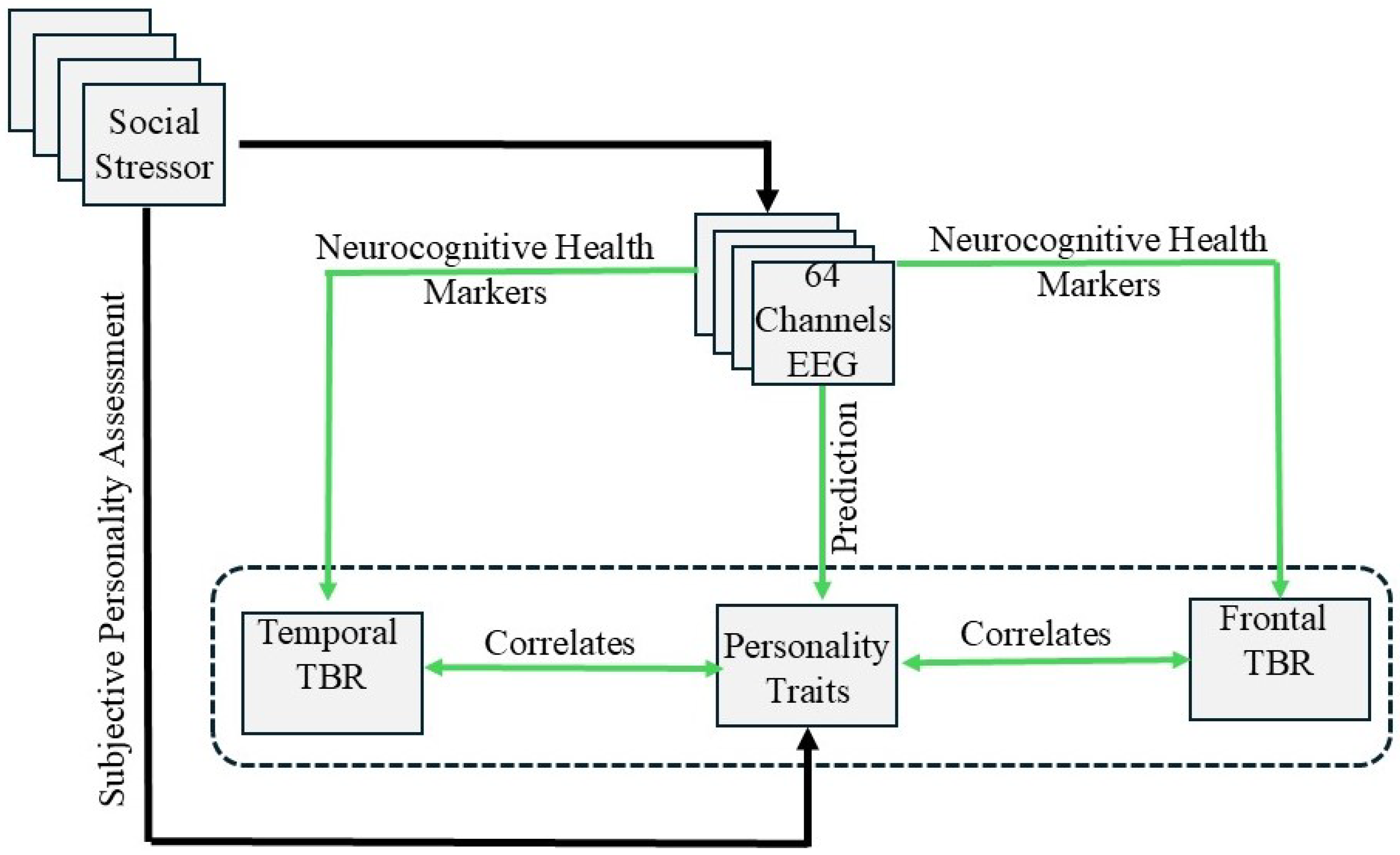
- Understanding personality, cognitive health, and stress interactions: Personality traits critically influence how individuals adapt to social stressors, yet the neurocognitive mechanisms linking these traits to health outcomes remain unclear. The current approaches often isolate psychological or neural factors, neglecting their integration during dynamic social interactions. To address this gap, we develop an EEG-based computational model to identify personality-specific neural markers under social stress. By analyzing EEG data during ecologically valid stress tasks, we decode how traits predict resilience or vulnerability in real-time neural dynamics. These markers offer novel biomarkers for early detection of mental health risks and pave the way for personalized interventions tailored to individual neurocognitive profiles. This work bridges personality psychology and computational neuroscience, advancing precision frameworks to map brain–behavior interactions in socially stressful contexts.
1.1. Objectives
- To examine the potential of EEG brainwave patterns in identifying the Big Five personality traits in response to psychosocial stress induced by the TSST.
- To evaluate the influence of different personality traits on neural rhythms across various high-stress conditions.
- To explore the relationship between personality traits and cognitive health through EEG-based bioindicators by investigating how different personality traits influence or moderate cognitive performance in sustained stress environments.
1.2. Contributions
2. Literature Review
Comparison with State-of-Art EEG-Based Personality Recognition
3. Proposed Methodology
3.1. Data Acquisition
3.1.1. Participants
3.1.2. Experimental Material
3.1.3. Experimental Protocol
3.2. EEG Preprocessing
- Signal filtration
- -
- Bandpass filter (1–45 Hz).
- AutoReject algorithm
- -
- Systematic interpolation.
- -
- Six consensus thresholds (0.10–0.70).
- -
- 1–16 sensors/epoch.
- -
- Post-optimization epoch rejection rates (0–40 epochs/150).
- ICA
- -
- Independent Component Analysis.
- -
- Removal of artifactual sources contributing variance per decomposition.
- Z-score normalization and power spectral analysis
- -
- Power spectral analysis.
- -
- Standardization of each subject’s data by subtracting the mean and dividing by the standard deviation across conditions.
3.3. Feature Extraction and Normalization
3.3.1. Welch Method of PSD Estimation
3.3.2. Z-Score Normalization
- X is the original value;
- is the mean of the signal;
- is the standard deviation of the signal.
3.4. Classification Model Structures and Feature Selection Techniques
4. Experimental Results
4.1. Personality Analysis
4.2. Personality Trait Classification Results
4.2.1. Data Annotation
4.2.2. Classification Performance
4.3. EEG TBR and Personality Trait Correlation
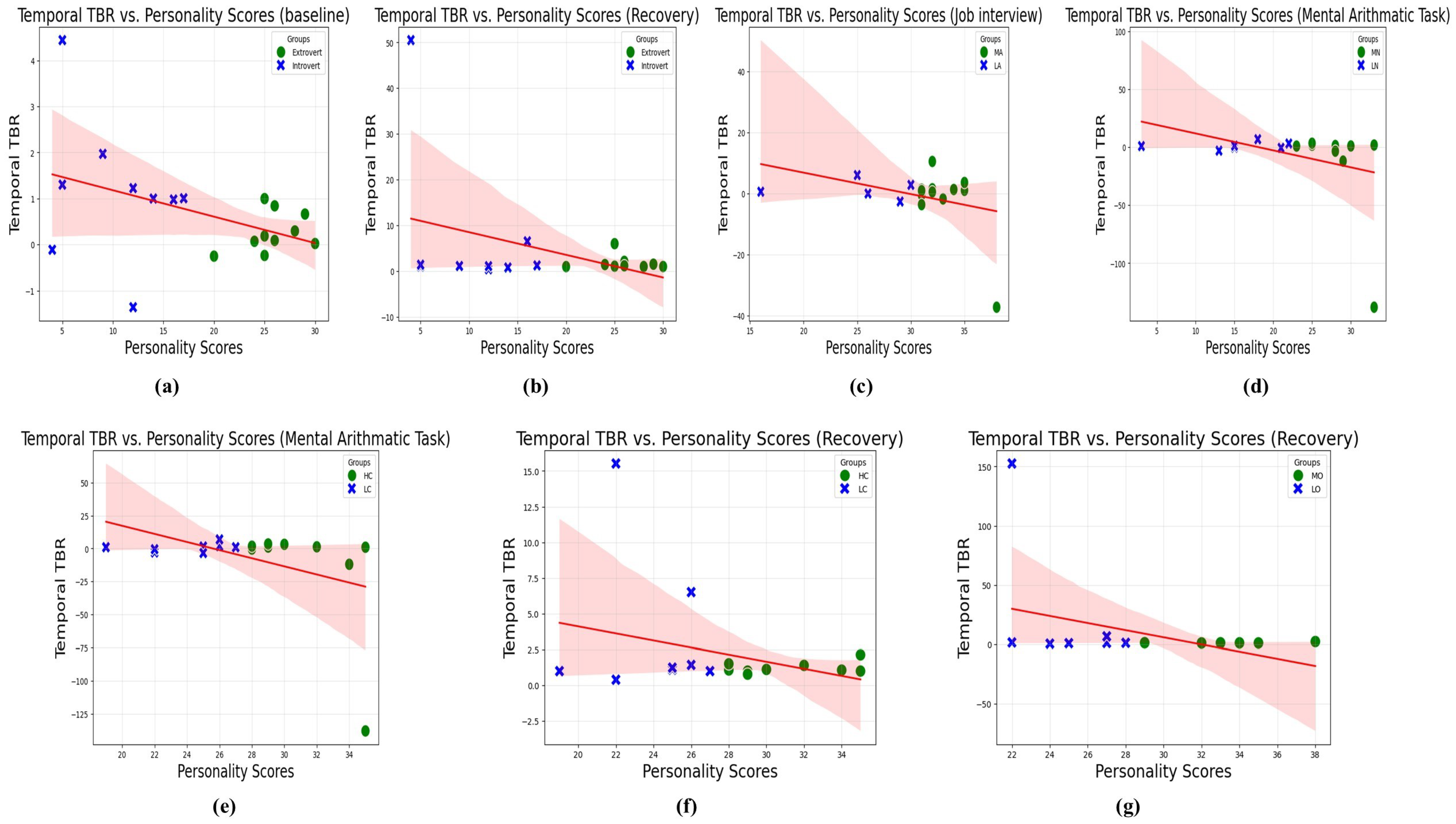
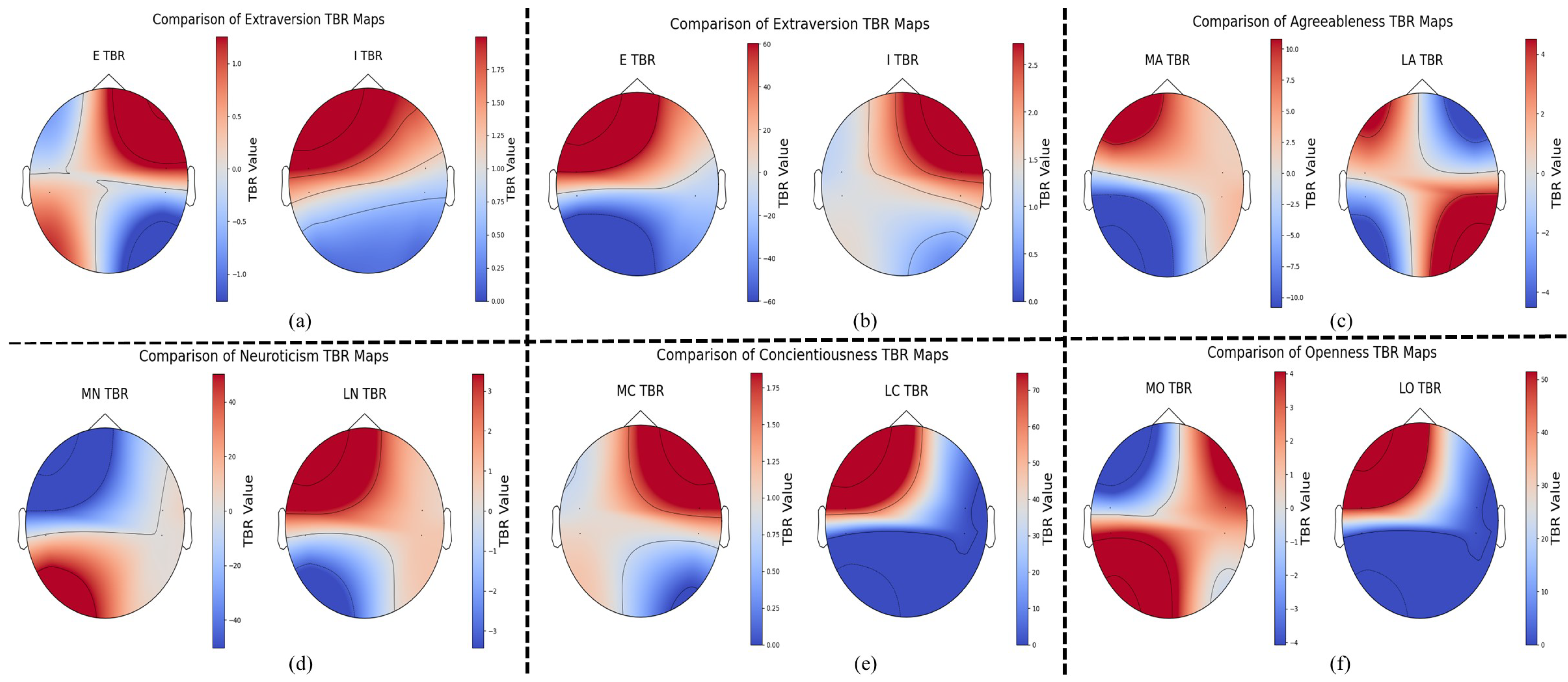
4.3.1. Extraversion and Temporal TBR
4.3.2. Agreeableness and Temporal TBR
4.3.3. Neuroticism and Temporal TBR
4.3.4. Conscientiousness and Temporal TBR
4.3.5. Openness and Temporal TBR
- Weak correlations: ;
- Moderate correlations: ;
- Strong correlations: (no instances observed in this study).
5. Discussion
6. Conclusions
Author Contributions
Funding
Institutional Review Board Statement
Informed Consent Statement
Data Availability Statement
Acknowledgments
Conflicts of Interest
References
- McAdams, D.P.; Olson, B.D. Personality development: Continuity and change over the life course. Annu. Rev. Psychol. 2010, 61, 517–542. [Google Scholar] [CrossRef] [PubMed]
- Digman, J.M. Five robust trait dimensions: Development, stability, and utility. J. Personal. 1989, 57, 195–214. [Google Scholar] [CrossRef] [PubMed]
- Riaz, M.; Majid, M.; Mir, J. High dynamic range multimedia: Better affective agent for human emotional experience. Multimed. Tools Appl. 2024, 83, 25503–25518. [Google Scholar] [CrossRef]
- Ji, Y.; Wu, W.; Zheng, H.; Hu, Y.; Chen, X.; He, L. Is chatgpt a good personality recognizer? a preliminary study. arXiv 2023, arXiv:2307.03952. [Google Scholar] [CrossRef]
- De Smet, S.; Razza, L.B.; Pulopulos, M.M.; De Raedt, R.; Baeken, C.; Brunoni, A.R.; Vanderhasselt, M.A. Stress priming transcranial direct current stimulation (tDCS) enhances updating of emotional content in working memory. Brain Stimul. 2024, 17, 434–443. [Google Scholar] [CrossRef]
- Villada, C.; Hidalgo, V.; Almela, M.; Salvador, A. Individual differences in the psychobiological response to psychosocial stress (Trier Social Stress Test): The relevance of trait anxiety and coping styles. Stress Health 2016, 32, 90–99. [Google Scholar] [CrossRef]
- Terracciano, A.; Stephan, Y.; Luchetti, M.; Albanese, E.; Sutin, A.R. Personality traits and risk of cognitive impairment and dementia. J. Psychiatr. Res. 2017, 89, 22–27. [Google Scholar] [CrossRef]
- Luchetti, M.; Terracciano, A.; Stephan, Y.; Aschwanden, D.; Sutin, A.R. Personality traits and memory: A multilevel analysis across 27 countries from the survey of health, ageing and retirement in Europe. Psychol. Sci. 2021, 32, 1047–1057. [Google Scholar] [CrossRef]
- Azami, H.; Zrenner, C.; Brooks, H.; Zomorrodi, R.; Blumberger, D.M.; Fischer, C.E.; Flint, A.; Herrmann, N.; Kumar, S.; Lanctôt, K.; et al. Beta to theta power ratio in EEG periodic components as a potential biomarker in mild cognitive impairment and Alzheimer’s dementia. Alzheimer’s Res. Ther. 2023, 15, 133. [Google Scholar] [CrossRef]
- Vatsal, R.; Mishra, S.; Thareja, R.; Chakrabarty, M.; Sharma, O.; Shukla, J. An analysis of physiological and psychological responses in virtual reality and flat screen gaming. IEEE Trans. Affect. Comput. 2024, 15, 1696–1710. [Google Scholar] [CrossRef]
- Butt, A.R.; Arsalan, A.; Majid, M. Multimodal personality trait recognition using wearable sensors in response to public speaking. IEEE Sens. J. 2020, 20, 6532–6541. [Google Scholar] [CrossRef]
- Zhao, G.; Ge, Y.; Shen, B.; Wei, X.; Wang, H. Emotion analysis for personality inference from EEG signals. IEEE Trans. Affect. Comput. 2017, 9, 362–371. [Google Scholar] [CrossRef]
- Li, W.; Hu, X.; Long, X.; Tang, L.; Chen, J.; Wang, F.; Zhang, D. EEG responses to emotional videos can quantitatively predict big-five personality traits. Neurocomputing 2020, 415, 368–381. [Google Scholar] [CrossRef]
- Annisa, F.Q.; Supriyanto, E.; Taheri, S. Personality dimensions classification with EEG analysis using support vector machine. In Proceedings of the 2020 3rd International Seminar on Research of Information Technology and Intelligent Systems (ISRITI), Yogyakarta, Indonesia, 10–11 December 2020; pp. 79–82. [Google Scholar]
- Singh, J.; Arya, R. Examining the relationship of personality traits with online teaching using emotive responses and physiological signals. Educ. Inf. Technol. 2023, 28, 11193–11219. [Google Scholar] [CrossRef] [PubMed]
- Subramanian, R.; Wache, J.; Abadi, M.K.; Vieriu, R.L.; Winkler, S.; Sebe, N. ASCERTAIN: Emotion and personality recognition using commercial sensors. IEEE Trans. Affect. Comput. 2016, 9, 147–160. [Google Scholar] [CrossRef]
- Leekha, M.; Khan, S.N.; Srinivas, H.; Shah, R.R.; Shukla, J. VyaktitvaNirdharan: Multimodal Assessment of Personality and Trait Emotional Intelligence. IEEE Trans. Affect. Comput. 2024, 15, 2139–2153. [Google Scholar] [CrossRef]
- Hu, F.; He, K.; Wang, C.; Zheng, Q.; Zhou, B.; Li, G.; Sun, Y. STRFLNet: Spatio-Temporal Representation Fusion Learning Network for EEG-Based Emotion Recognition. IEEE Trans. Affect. Comput. 2025. [Google Scholar] [CrossRef]
- Fan, C.; Wang, J.; Huang, W.; Yang, X.; Pei, G.; Li, T.; Lv, Z. Light-weight residual convolution-based capsule network for EEG emotion recognition. Adv. Eng. Inform. 2024, 61, 102522. [Google Scholar] [CrossRef]
- Goldberg, L.R. A broad-bandwidth, public domain, personality inventory measuring the lower-level facets of several five-factor models. In Personality Psychology in Europe; Tilburg University Press: Tilburg, The Netherlands, 1999; Volume 7, pp. 7–28. [Google Scholar]
- John, O.P.; Naumann, L.P.; Soto, C.J. Paradigm shift to the integrative big five trait taxonomy. In Handbook of Personality: Theory and Research, 3rd ed.; The Guilford Press: New York, NY, USA, 2008; pp. 114–158. [Google Scholar]
- Peters, H.; Matz, S.C. Large language models can infer psychological dispositions of social media users. PNAS Nexus 2024, 3, pgae231. [Google Scholar] [CrossRef]
- Kim, Y. Personality of organizational social media accounts and its relationship with characteristics of their photos: Analyses of startups’ Instagram photos. BMC Psychol. 2024, 12, 233. [Google Scholar] [CrossRef]
- Mark, J.A.; Curtin, A.; Kraft, A.E.; Ziegler, M.D.; Ayaz, H. Mental workload assessment by monitoring brain, heart, and eye with six biomedical modalities during six cognitive tasks. Front. Neuroergonomics 2024, 5, 1345507. [Google Scholar] [CrossRef] [PubMed]
- Moser, M.K.; Resch, B.; Ehrhart, M. An individual-oriented algorithm for stress detection in wearable sensor measurements. IEEE Sens. J. 2023, 23, 22845–22856. [Google Scholar] [CrossRef]
- Zhou, Y.; Huang, S.; Xu, Z.; Wang, P.; Wu, X.; Zhang, D. Cognitive workload recognition using EEG signals and machine learning: A review. IEEE Trans. Cogn. Dev. Syst. 2021, 14, 799–818. [Google Scholar] [CrossRef]
- Tamantini, C.; Cristofanelli, M.L.; Fracasso, F.; Umbrico, A.; Cortellessa, G.; Orlandini, A.; Cordella, F. Physiological Sensor Technologies in Workload Estimation: A Review. IEEE Sens. J. 2025, 25, 34298–34310. [Google Scholar]
- Angkan, P.; Behinaein, B.; Mahmud, Z.; Bhatti, A.; Rodenburg, D.; Hungler, P.; Etemad, A. Multimodal Brain–Computer Interface for In-Vehicle Driver Cognitive Load Measurement: Dataset and Baselines. IEEE Trans. Intell. Transp. Syst. 2024, 25, 5949–5964. [Google Scholar]
- Wang, Q.; Yang, S.; Liu, M.; Cao, Z.; Ma, Q. An eye-tracking study of website complexity from cognitive load perspective. Decis. Support Syst. 2014, 62, 1–10. [Google Scholar] [CrossRef]
- Seixas, F.L.; Zadrozny, B.; Laks, J.; Conci, A.; Saade, D.C.M. A Bayesian network decision model for supporting the diagnosis of dementia, Alzheimer’s disease and mild cognitive impairment. Comput. Biol. Med. 2014, 51, 140–158. [Google Scholar]
- Stuiver, A.; Mulder, B. Cardiovascular state changes in simulated work environments. Front. Neurosci. 2014, 8, 399. [Google Scholar] [CrossRef]
- Narayana, V.V.; Kodali, P. Enhanced epilepsy sensitivity and detection rate with improved specificity by integration of modified lstm networks. IEEE Sens. J. 2025, 25, 11963–11970. [Google Scholar]
- Zubair, M.; Belykh, M.V.; Naik, M.U.K.; Gouher, M.F.M.; Vishwakarma, S.; Ahamed, S.R.; Kongara, R. Detection of epileptic seizures from EEG signals by combining dimensionality reduction algorithms with machine learning models. IEEE Sens. J. 2021, 21, 16861–16869. [Google Scholar]
- Khare, S.K.; Bajaj, V.; Acharya, U.R. PDCNNet: An automatic framework for the detection of Parkinson’s disease using EEG signals. IEEE Sens. J. 2021, 21, 17017–17024. [Google Scholar] [CrossRef]
- Putman, P.; Verkuil, B.; Arias-Garcia, E.; Pantazi, I.; van Schie, C. EEG theta/beta ratio as a potential biomarker for attentional control and resilience against deleterious effects of stress on attention. Cogn. Affect. Behav. Neurosci. 2014, 14, 782–791. [Google Scholar] [CrossRef] [PubMed]
- Wen, T.Y.; Aris, S.M. Electroencephalogram (EEG) stress analysis on alpha/beta ratio and theta/beta ratio. Indones. J. Electr. Eng. Comput. Sci. 2020, 17, 175–182. [Google Scholar]
- Giannakakis, G.; Grigoriadis, D.; Giannakaki, K.; Simantiraki, O.; Roniotis, A.; Tsiknakis, M. Review on psychological stress detection using biosignals. IEEE Trans. Affect. Comput. 2019, 13, 440–460. [Google Scholar] [CrossRef]
- Seo, S.; Gil, Y.; Lee, J. The relation between affective style of stressor on EEG asymmetry and stress scale during multimodal task. In Proceedings of the 2008 Third International Conference on Convergence and Hybrid Information Technology, Busan, Republic of Korea, 11–13 November 2008; Volume 1, pp. 461–466. [Google Scholar]
- Li, P.; Yokoyama, M.; Okamoto, D.; Nakatani, H.; Yagi, T. Resting-state EEG features modulated by depressive state in healthy individuals: Insights from theta PSD, theta-beta ratio, frontal-parietal PLV, and sLORETA. Front. Hum. Neurosci. 2024, 18, 1384330. [Google Scholar] [CrossRef]
- Chang, J.; Choi, Y. Depression diagnosis based on electroencephalography power ratios. Brain Behav. 2023, 13, e3173. [Google Scholar] [CrossRef]
- Habibovic, I.; Almisreb, A.; Hodzic, M.; Turaev, S.; Cantelli-Forti, A. Machine Learning Algorithms and Sensor Technologies for Aging-in-Place Applications: A Review. IEEE Sens. J. 2025, 25, 34326–34347. [Google Scholar] [CrossRef]
- Wertz, J.; Israel, S.; Arseneault, L.; Belsky, D.W.; Bourassa, K.J.; Harrington, H.; Houts, R.; Poulton, R.; Richmond-Rakerd, L.S.; Røysamb, E.; et al. Vital personality scores and healthy aging: Life-course associations and familial transmission. Soc. Sci. Med. 2021, 285, 114283. [Google Scholar] [CrossRef]
- Riaz, M.; Gravina, R. Wearable Sensor Systems to Detect Biomarkers of Personality Traits for Healthy Aging: A Review. IEEE Sens. J. 2024, 24, 27061–27075. [Google Scholar] [CrossRef]
- Riaz, M.; Gravina, R. Anxiety and EEG Frontal Theta-Beta Ratio Relationship Analysis Across Personality Traits During HDR Affective Videos Experience. In Proceedings of the ICT4AWE, Angers, France, 28–30 April 2024; pp. 27–36. [Google Scholar]
- Canli, T. Functional brain mapping of extraversion and neuroticism: Learning from individual differences in emotion processing. J. Personal. 2004, 72, 1105–1132. [Google Scholar] [CrossRef]
- Miranda-Correa, J.A.; Abadi, M.K.; Sebe, N.; Patras, I. Amigos: A dataset for affect, personality and mood research on individuals and groups. IEEE Trans. Affect. Comput. 2018, 12, 479–493. [Google Scholar] [CrossRef]
- Uddin, M.Z.; Hassan, M.M. Activity recognition for cognitive assistance using body sensors data and deep convolutional neural network. IEEE Sens. J. 2018, 19, 8413–8419. [Google Scholar] [CrossRef]
- Greco, A.; Valenza, G.; Lazaro, J.; Garzon-Rey, J.M.; Aguilo, J.; de la Cámara, C.; Bailón, R.; Scilingo, E.P. Acute stress state classification based on electrodermal activity modeling. IEEE Trans. Affect. Comput. 2021, 14, 788–799. [Google Scholar] [CrossRef]
- Richer, R.; Koch, V.; Abel, L.; Hauck, F.; Kurz, M.; Ringgold, V.; Müller, V.; Küderle, A.; Schindler-Gmelch, L.; Eskofier, B.M.; et al. Machine learning-based detection of acute psychosocial stress from body posture and movements. Sci. Rep. 2024, 14, 8251. [Google Scholar] [CrossRef] [PubMed]
- Rodrigues, S.; Paiva, J.S.; Dias, D.; Aleixo, M.; Filipe, R.M.; Cunha, J.P.S. Cognitive impact and psychophysiological effects of stress using a biomonitoring platform. Int. J. Environ. Res. Public Health 2018, 15, 1080. [Google Scholar] [CrossRef] [PubMed]
- Alarcón-Segovia, L.C.; Morel, R.; Spies, R.; Rintoul, I. The challenging scalp–electrode interface and the evolution of materials and electrode integrated icts for electroencephalography. Surf. Rev. Lett. 2024, 31, 2430009. [Google Scholar] [CrossRef]
- Daadaa, Y. EmotionNet: Dissecting Stress and Anxiety Through EEG-based Deep Learning Approaches. Int. J. Adv. Comput. Sci. Appl. 2024, 15, 884–894. [Google Scholar] [CrossRef]
- Jenke, R.; Peer, A.; Buss, M. Feature extraction and selection for emotion recognition from EEG. IEEE Trans. Affect. Comput. 2014, 5, 327–339. [Google Scholar] [CrossRef]
- Maseno, E.M.; Wang, Z. Hybrid wrapper feature selection method based on genetic algorithm and extreme learning machine for intrusion detection. J. Big Data 2024, 11, 24. [Google Scholar] [CrossRef]
- Kyrou, M.; Kompatsiaris, I.; Petrantonakis, P.C. Deep Learning Approaches for Stress Detection: A Survey. IEEE Trans. Affect. Comput. 2025, 16, 499–517. [Google Scholar] [CrossRef]
- Sutin, A.R.; Luchetti, M.; Aschwanden, D.; Sesker, A.A.; Zhu, X.; Stephan, Y.; Terracciano, A. Five-factor model personality domains and facets associated with markers of cognitive health. J. Individ. Differ. 2023, 44, 97–108. [Google Scholar] [CrossRef] [PubMed]
- Brydges, C.R. Effect size guidelines, sample size calculations, and statistical power in gerontology. Innov. Aging 2019, 3, igz036. [Google Scholar] [CrossRef] [PubMed]
- Brouwer, A.M.; Van Schaik, M.G.; Korteling, J.; van Erp, J.B.; Toet, A. Neuroticism, extraversion, conscientiousness and stress: Physiological correlates. IEEE Trans. Affect. Comput. 2014, 6, 109–117. [Google Scholar] [CrossRef]
- Rogala, J.; Dreszer, J.; Malinowska, U.; Waligóra, M.; Pluta, A.; Antonova, I.; Wróbel, A. Stronger connectivity and higher extraversion protect against stress-related deterioration of cognitive functions. Sci. Rep. 2021, 11, 17452. [Google Scholar] [CrossRef]
- Ueda, I.; Kakeda, S.; Watanabe, K.; Sugimoto, K.; Igata, N.; Moriya, J.; Takemoto, K.; Katsuki, A.; Yoshimura, R.; Abe, O.; et al. Brain structural connectivity and neuroticism in healthy adults. Sci. Rep. 2018, 8, 16491. [Google Scholar] [CrossRef]
- Wang, S.; Zhao, Y.; Li, J.; Wang, X.; Luo, K.; Gong, Q. Brain structure links trait conscientiousness to academic performance. Sci. Rep. 2019, 9, 12168. [Google Scholar] [CrossRef]
- Lamers, S.M.; Westerhof, G.J.; Kovács, V.; Bohlmeijer, E.T. Differential relationships in the association of the Big Five personality traits with positive mental health and psychopathology. J. Res. Personal. 2012, 46, 517–524. [Google Scholar]
- Chuan, C.L.; Penyelidikan, J. Sample size estimation using Krejcie and Morgan and Cohen statistical power analysis: A comparison. J. Penyelid. IPBL 2006, 7, 78–86. [Google Scholar]
- Allen, A.P.; Kennedy, P.J.; Cryan, J.F.; Dinan, T.G.; Clarke, G. Biological and psychological markers of stress in humans: Focus on the Trier Social Stress Test. Neurosci. Biobehav. Rev. 2014, 38, 94–124. [Google Scholar] [CrossRef]
- Bian, Z.; Li, Q.; Wang, L.; Lu, C.; Yin, S.; Li, X. Relative power and coherence of EEG series are related to amnestic mild cognitive impairment in diabetes. Front. Aging Neurosci. 2014, 6, 11. [Google Scholar] [CrossRef]
- Kaushik, P.; Shrivastava, P.K. Remediation of Learning Difficulty Utilizing School-Based Cognitive Behavioral Intervention Measured by EEG Theta-Alpha and Theta-Beta Ratio During Resting and Cognitive Task Performance Conditions. Clin. EEG and Neurosci. 2024, 55, 426–444. [Google Scholar] [CrossRef]
- Grandy, T.H.; Werkle-Bergner, M.; Chicherio, C.; Schmiedek, F.; Lövdén, M.; Lindenberger, U. Peak individual alpha frequency qualifies as a stable neurophysiological trait marker in healthy younger and older adults. Psychophysiology 2013, 50, 570–582. [Google Scholar] [CrossRef]
- Lavy, Y.; Dwolatzky, T.; Kaplan, Z.; Guez, J.; Todder, D. Neurofeedback improves memory and peak alpha frequency in individuals with mild cognitive impairment. Appl. Psychophysiol. Biofeedback 2019, 44, 41–49. [Google Scholar] [CrossRef]
- Chapman, R.; Najima, S.; Tylinski Sant’Ana, T.; Lee, C.C.K.; Filice, F.; Babineau, J.; Mollayeva, T. Sex differences in electrical activity of the brain during sleep: A systematic review of electroencephalographic findings across the human lifespan. BioMed. Eng. OnLine 2025, 24, 33. [Google Scholar] [CrossRef]



| Ref. | Year | Sensors | Model | Setting | Methodology | Key Contributions | Limitations |
|---|---|---|---|---|---|---|---|
| [11] | 2020 | EEG, PPG, GSR | Big Five | Public speaking | KNN classification using time–frequency EEG features | Differentiated personality traits using physiological responses | Short recording duration; limited EEG channels; no personality–health analysis |
| [12] | 2017 | EEG | BFI + ERQ | Emotional movie clips | SVM-based classification on EEG emotional responses | Showed influence of emotional context on personality-related neural activity | Limited electrodes; lacks direct personality–emotion modeling |
| [13] | 2020 | EEG | BFI | 28 emotional video clips | EEG analysis combined with self-reports | Estimated Big Five traits from neural patterns | Correlation-only; unclear role of neural dynamics |
| [14] | 2020 | EEG | BFI | Emotional video stimuli | SVM classification into high/low personality scales | Used ASCERTAIN dataset for EEG-based personality recognition | Small dataset; only 8 EEG channels; trait-specific effects unclear |
| [15] | 2023 | EMG, GSR, ECG | Big Five | Online teaching | SVM per-trait from physiological signals | Proposed teacher personality evaluation using biosignals | No EEG; no neurocognitive link |
| [16] | 2016 | EEG, ECG, GSR | Big Five | Affective video trials | Naive Bayes and SVM with uni-/multimodal fusion | Explored personality–affect statistical relations | Weak correlations; emotional stimuli only |
| Our Study | – | EEG | Big Five Scale | Social stress (TSST) | PSD features + SVM; cognitive biomarkers from frontal/temporal regions | Links personality traits with neurocognitive stress response using 64-channel EEG | Exploratory sample (21 subjects); needs larger validation |
| Traits | Ex | A | C | N | O |
|---|---|---|---|---|---|
| Ex | 1 | 0.22 | −0.46 ** | 0.05 | −0.10 |
| A | 0.22 | 1 | −0.18 | −0.08 | −0.46 ** |
| C | −0.46 ** | −0.18 | 1 | 0.37 * | 0.02 |
| N | 0.05 | −0.08 | 0.37 * | 1 | 0.10 |
| O | −0.10 | −0.46 ** | 0.02 | 0.10 | 1 |
| SVM Classifier | MLP Classifier | |||
|---|---|---|---|---|
| Trait | Band | Electrodes | Band | Electrodes |
| Ex | Iz, O2 | C1, O2 | ||
| – | Lz, O2 | |||
| T7, F8, Cz | P5, PO4 | |||
| P8 | CPz, P6 | |||
| P6 | Cz | |||
| A | P9 | Lz, POz | ||
| O1 | C1, PO3 | |||
| P9, T8 | T8 | |||
| – | – | |||
| O1 | O2 | |||
| C | AF4, T8, CP6 | F3, T7 | ||
| Lz, Fz | – | |||
| FP1, PO7, | CPz | |||
| FP1, FC5, Lz, CPz, FPz | C2 | |||
| FT7, PO3, C6, PO4 | Lz | |||
| O | F1, CP1, F2 | P3, PO7, P4 | ||
| – | T8 | |||
| P1, T8 | CP5, CP1 | |||
| – | FC3, F2, F6 | |||
| F5, F8, CP6, O2 | FC1, O2 | |||
| N | Cp5, P7, Lz, Pz, FT8, Cz, PO8, O2 | C4 | ||
| Fc5 | P7, FC2 | |||
| FT7, PO7, FPz Po8, F8 | – | |||
| F1, F3, FT7, Pz, CP4 | AF3, C6 | |||
| FP1, C6, PO4 | F5, Lz | |||
| Trait | Model | Accuracy | Precision | Recall | F-Measure | Ka |
|---|---|---|---|---|---|---|
| Ex | SVM | 81.5 | 0.80 | 0.80 | 0.81 | 0.62 |
| MLP | 88.1 | 0.88 | 0.88 | 0.88 | 0.76 | |
| A | SVM | 76.3 | 0.82 | 0.76 | 0.71 | 0.31 |
| MLP | 94.7 | 0.95 | 0.94 | 0.94 | 0.96 | |
| N | SVM | 81.5 | 0.82 | 0.81 | 0.80 | 0.57 |
| MLP | 84.2 | 0.84 | 0.84 | 0.84 | 0.66 | |
| C | SVM | 76.3 | 0.83 | 0.76 | 0.73 | 0.47 |
| MLP | 81.5 | 0.81 | 0.82 | 0.81 | 0.62 | |
| O | SVM | 89.4 | 0.91 | 0.89 | 0.89 | 0.75 |
| MLP | 93.4 | 0.93 | 0.93 | 0.93 | 0.95 |
| TSST Phases | Region | Ex | A | N | C | O |
|---|---|---|---|---|---|---|
| Baseline | Frontal TBR | 0.03 | 0.05 | 0.05 | −0.14 | 0.20 |
| Temporal TBR | −0.41 | −0.01 | −0.18 | −0.04 | −0.21 | |
| Arithmetic Task | Frontal TBR | 0.19 | 0.01 | −0.29 | −0.22 | −0.01 |
| Temporal TBR | −0.21 | −0.03 | −0.34 | −0.41 | 0.03 | |
| Job Interview | Frontal TBR | 0.22 | 0.22 | 0.25 | −0.13 | 0.06 |
| Temporal TBR | −0.22 | −0.34 | −0.09 | 0.16 | 0.01 | |
| Recovery | Frontal TBR | −0.17 | −0.20 | −0.05 | −0.14 | −0.25 |
| Temporal TBR | −0.40 | 0.11 | 0.06 | −0.32 | −0.37 |
Disclaimer/Publisher’s Note: The statements, opinions and data contained in all publications are solely those of the individual author(s) and contributor(s) and not of MDPI and/or the editor(s). MDPI and/or the editor(s) disclaim responsibility for any injury to people or property resulting from any ideas, methods, instructions or products referred to in the content. |
© 2025 by the authors. Licensee MDPI, Basel, Switzerland. This article is an open access article distributed under the terms and conditions of the Creative Commons Attribution (CC BY) license (https://creativecommons.org/licenses/by/4.0/).
Share and Cite
Riaz, M.; Guerra, P.; Gravina, R. EEG Sensor-Based Computational Model for Personality and Neurocognitive Health Analysis Under Social Stress. Sensors 2025, 25, 7634. https://doi.org/10.3390/s25247634
Riaz M, Guerra P, Gravina R. EEG Sensor-Based Computational Model for Personality and Neurocognitive Health Analysis Under Social Stress. Sensors. 2025; 25(24):7634. https://doi.org/10.3390/s25247634
Chicago/Turabian StyleRiaz, Majid, Pedro Guerra, and Raffaele Gravina. 2025. "EEG Sensor-Based Computational Model for Personality and Neurocognitive Health Analysis Under Social Stress" Sensors 25, no. 24: 7634. https://doi.org/10.3390/s25247634
APA StyleRiaz, M., Guerra, P., & Gravina, R. (2025). EEG Sensor-Based Computational Model for Personality and Neurocognitive Health Analysis Under Social Stress. Sensors, 25(24), 7634. https://doi.org/10.3390/s25247634