Prescribed-Time Leader–Follower Synchronization of Higher-Order Nonlinear Multi-Agent Systems via Fuzzy Neural Adaptive Sliding Control

 , , , , and
Abstract
1. Introduction
- A novel non-singular terminal sliding surface is designed to ensure prescribed-time convergence in synchronization tasks, completely avoiding the singularity problem that commonly arises in conventional terminal SMC approaches.
- A fuzzy neural network (FNN)-based adaptive approximation mechanism is developed to estimate unknown nonlinear dynamics and external disturbances in real time. Compared with RBF-NNs or FLS-based methods, the proposed FNN offers faster learning, improved global approximation, and enhanced robustness through online parameter adaptation.
- A continuous reachability control law is formulated to effectively suppress chattering while preserving robustness, overcoming the high-frequency oscillation and actuator stress often observed in traditional SMC frameworks.
- Rigorous Lyapunov-based stability analysis is provided to guarantee prescribed-time synchronization and the boundedness of all closed-loop signals under matched uncertainties.
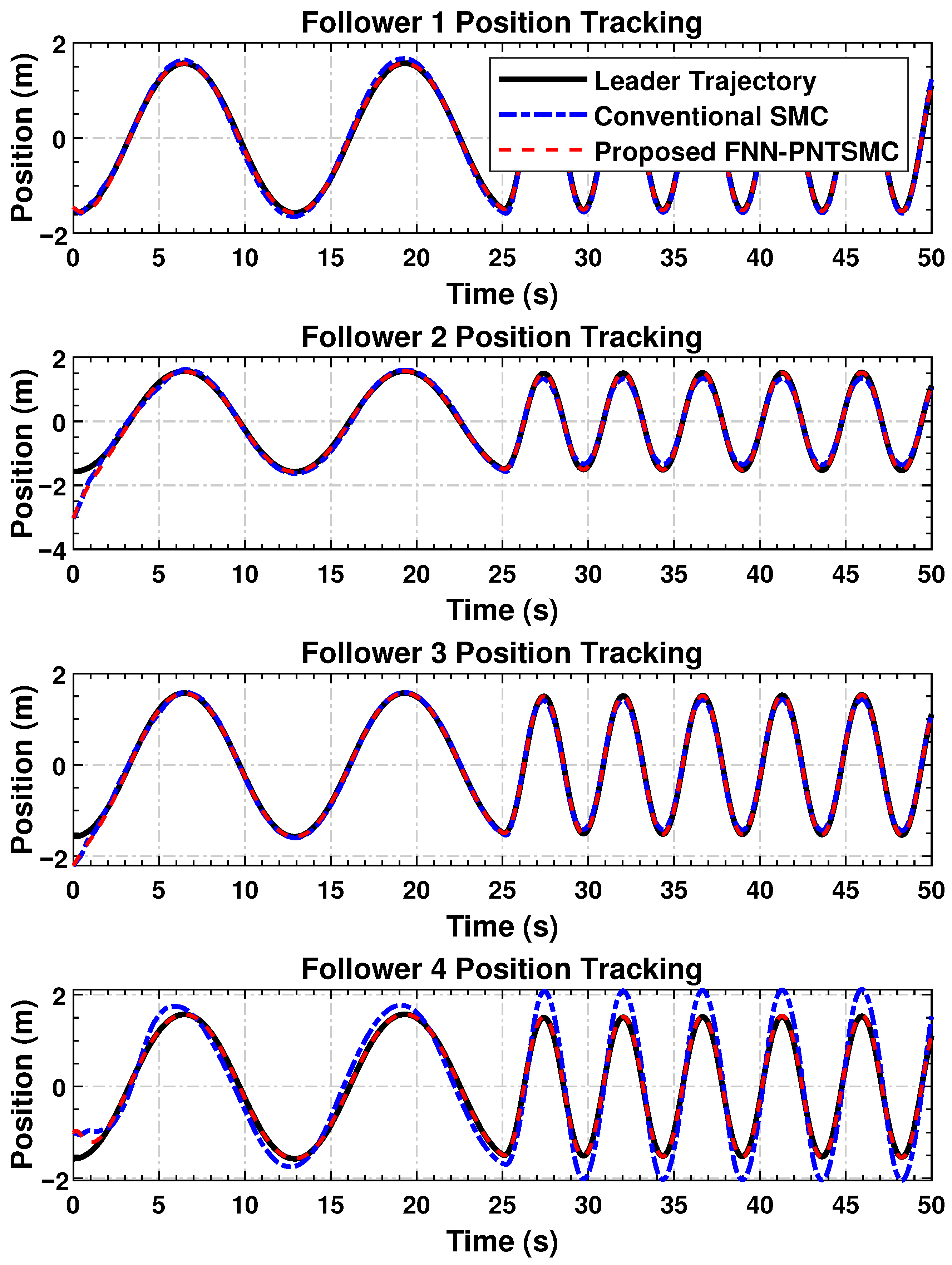
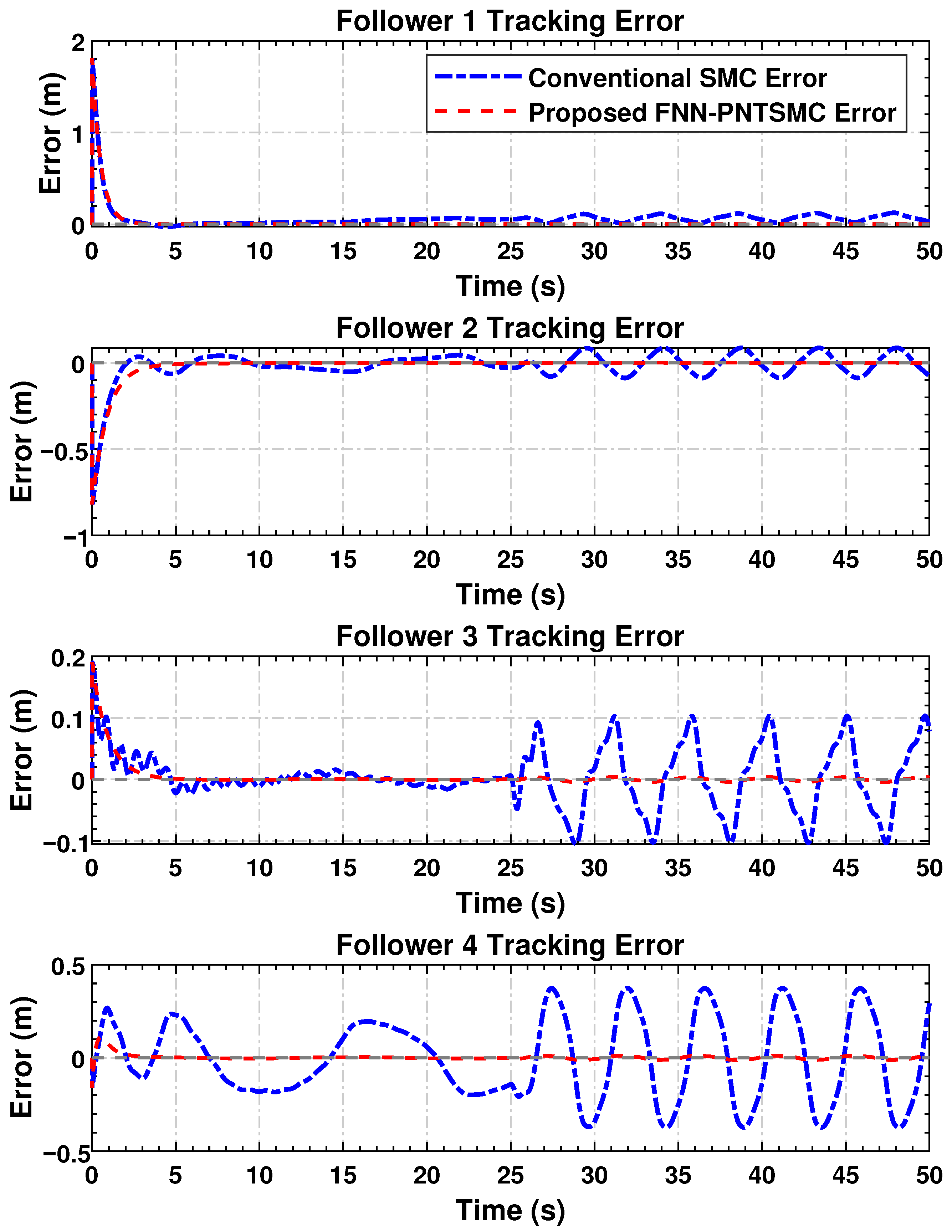
- Extensive simulations on a leader–follower network consisting of one leader and four followers verify that the proposed FNN-based PTSMC achieves faster convergence, higher robustness, and better adaptability than existing finite-time, fixed-time, and classical SMC schemes for uncertain nonlinear multi-agent systems.
2. Problem Formulation and Preliminaries
2.1. Challenges in Higher-Order Multi-Agent Systems
- Higher-Order Dynamics: In contrast to simple first- or second-order systems, most real-world agents have dynamics with more than a single integrator or nonlinear internal variables. The design of controllers for these types of systems requires a deep understanding of their own dynamics.
- Nonlinearities: The agent dynamics are often nonlinear, making it inadequate to use the traditional linear control design techniques. Nonlinearities cause analytical complexity and restrict performance if not adequately addressed.
- Uncertainties: Physical systems are always subject to unmodeled dynamics, disturbance inputs, and parametric uncertainties. These can cause a significant deterioration in stability and tracking performance.
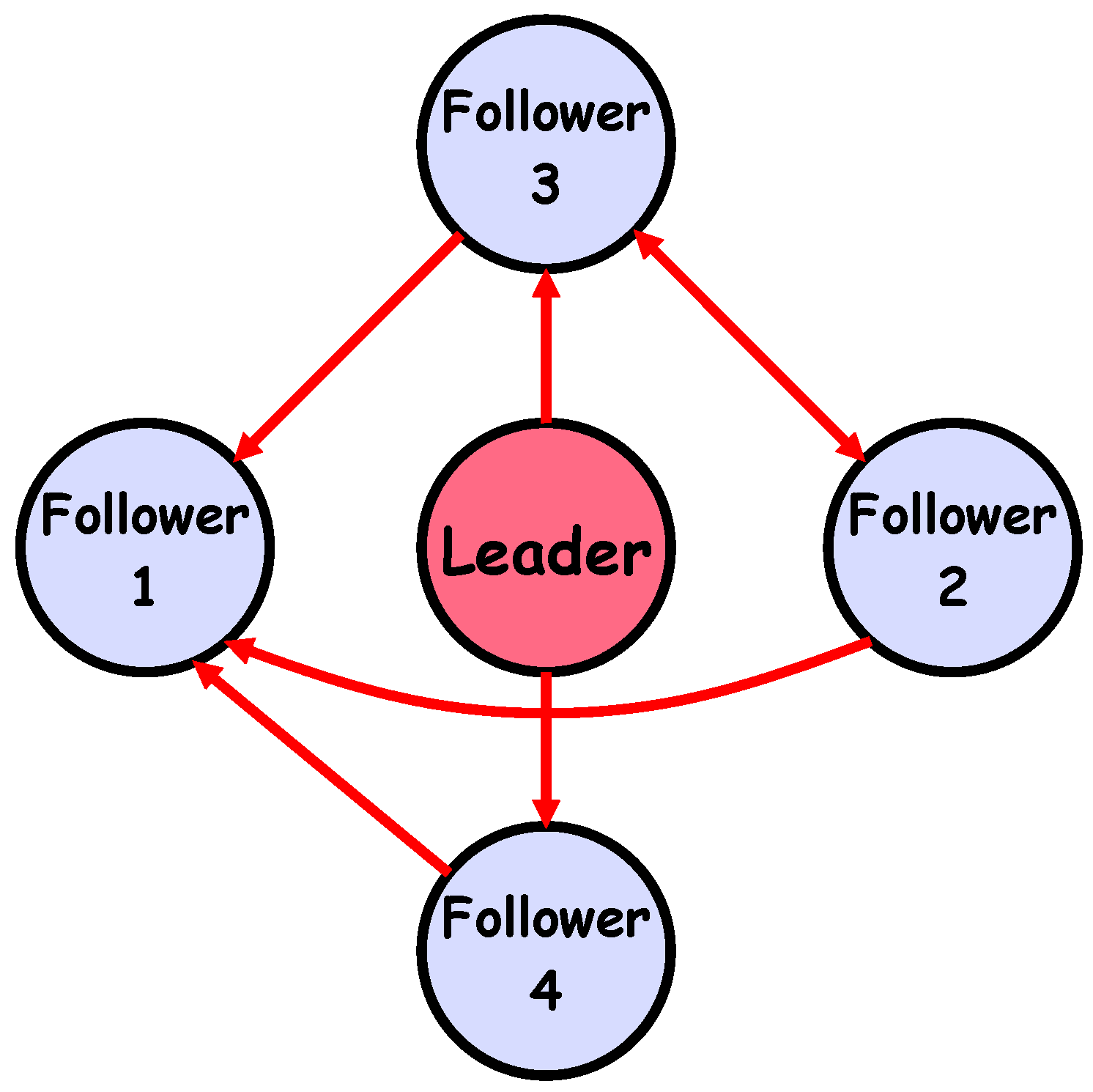
- Networked Interactions: Agents communicate via a communication structure given by a directed graph. The network topology, connectivity, and possibly delays have a significant impact on information flow and control performance.
2.2. Leader-Follower Synchronization Objective
- Distributed Control: Each follower’s control input should be computed using its own state and information received only from neighboring agents, ensuring scalability and fault-tolerance.
- prescribed-time Synchronization: In contrast to asymptotic or finite-time synchronization, prescribed-time synchronization guarantees uniform convergence time, which is particularly valuable in mission-critical scenarios.
2.3. Mathematical Modeling and Network Topology
2.4. Synchronization Mismatch and Reformulated Objective
2.5. Assumptions
- (A1) Controllability: for all , ensuring full actuation.
- (A2) Boundedness:
- Leader state:
- Leader dynamics:
- Uncertainties:
- (A3) Neighbor Awareness: Each follower has access to the states of its neighboring agents and, if directly connected, to the leader’s state.
- (A4) Smoothness: The nonlinear functions and are assumed to be at least -smooth with respect to their arguments. This guarantees the existence and continuity of their first-order derivatives, ensuring the validity of derivative-based operations in the control design and Lyapunov stability analysis.
- (A5) Leader–Follower Connectivity: The communication topology among agents is represented by a directed graph that contains a directed spanning tree rooted at the leader. This ensures that at least one directed path exists from the leader to every follower agent, allowing the leader’s information to propagate throughout the network.
2.6. Role of Graph Theory in Control Design
2.7. Remark on State Availability
3. Control Design
3.1. Fuzzy Neural Network Approximation
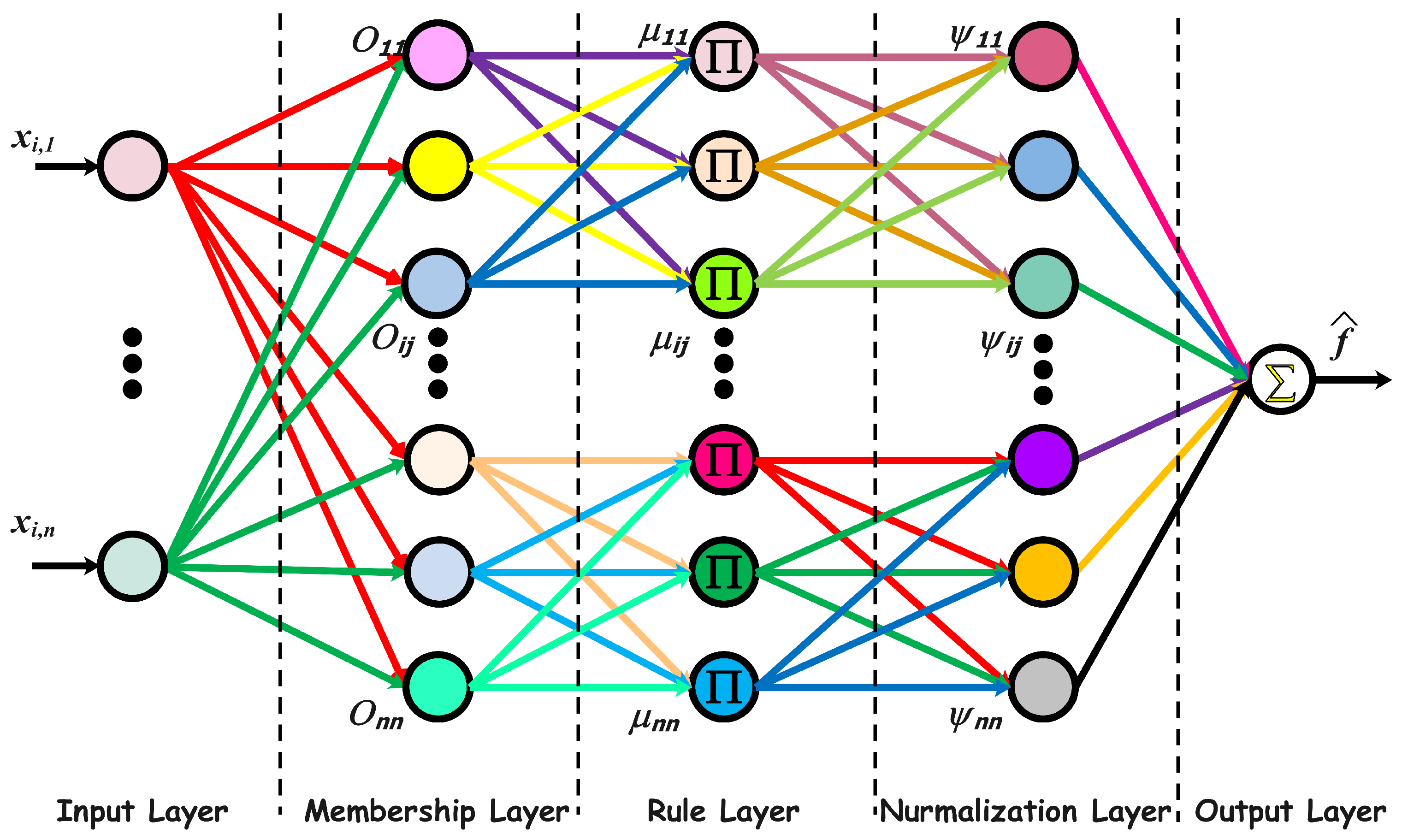
- Forward Propagation: The input vector is processed sequentially through the network’s five layers to produce an estimated output, .
- Parameter Adaptation: The network’s output weights, and , are updated online to minimize approximation errors. These updates are governed by adaptation laws derived from a Lyapunov-based stability analysis, ensuring system stability and prescribed-time convergence.
3.2. Prescribed-Time Non-Singular Terminal Sliding Surface Design
3.3. Prescribed-Time Control Law Design
- All closed-loop signals, including , , and , remain bounded for all .
- The synchronization errors and sliding variables converge to zero within the prescribed time T, i.e.,
3.4. Prescribed-Time Convergence
| Algorithm 1 Fuzzy Neural Network-based PNTSMC |
,
|
4. Illustrative Example: Synchronization Control of a Networked System
4.1. System Dynamics of the Leader and Followers
4.2. Network Topology and Interconnection Matrices
4.3. Control Design for the Illustrative Example
4.3.1. Synchronization Error Dynamics
4.3.2. Prescribed-Time Non-Singular Terminal Sliding Surface
4.3.3. FNN-Based Adaptive Control Law Design
4.3.4. FNN Adaptive Laws
4.3.5. Theoretical Guarantee
4.4. Simulation Results
4.4.1. Controller Parameters
4.4.2. Simulation Setup
4.4.3. Tracking Performance
4.4.4. Mismatch Convergence
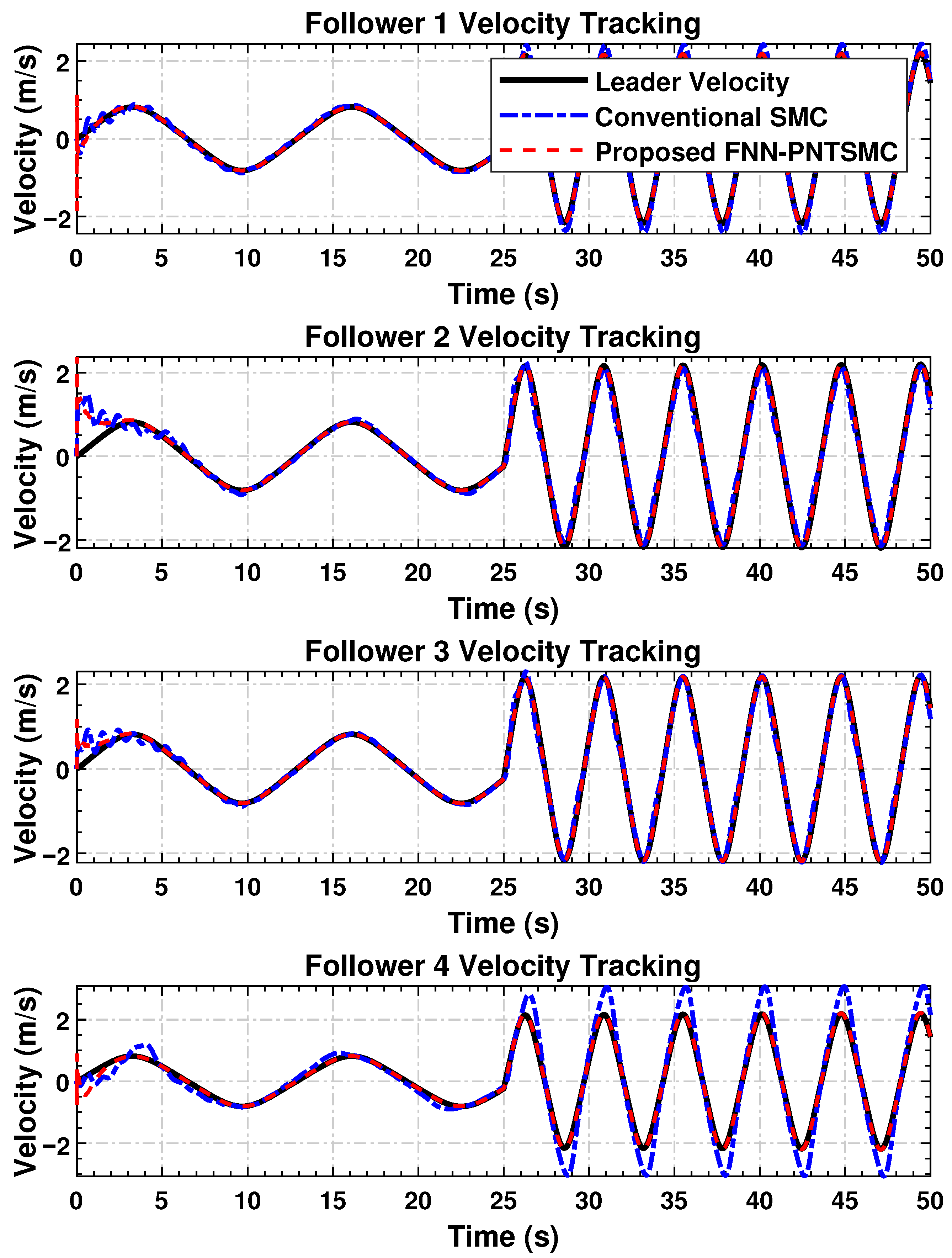
4.4.5. Velocity Tracking
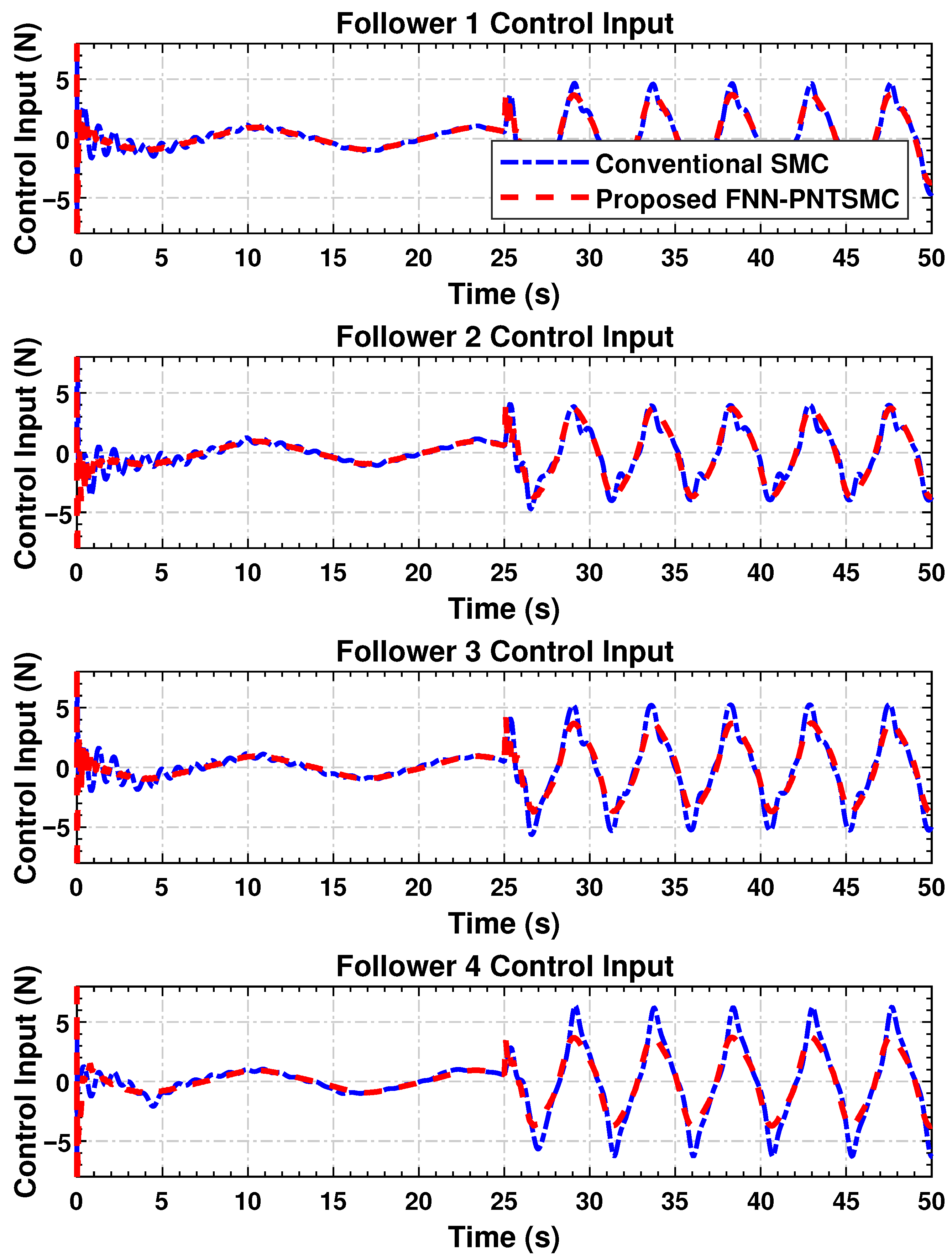
4.4.6. Control Input Synchronization
5. Conclusions
Author Contributions
Funding
Data Availability Statement
Conflicts of Interest
Correction Statement
References
- Wang, Y.; Garcia, E.; Casbeer, D.; Zhang, F. Cooperative Control of Multi-Agent Systems: Theory and Applications; John Wiley and Sons Ltd.: Hoboken, NJ, USA, 2017. [Google Scholar]
- Ali, Z.A.; Alkhammash, E.H.; Hasan, R. State-of-the-art flocking strategies for the collective motion of multi-robots. Machines 2024, 12, 739. [Google Scholar] [CrossRef]
- Bao, G.; Ma, L.; Yi, X. Recent advances on cooperative control of heterogeneous multi-agent systems subject to constraints: A survey. Syst. Sci. Control Eng. 2022, 10, 539–551. [Google Scholar] [CrossRef]
- Li, W.; Shi, F.; Li, W.; Yang, S.; Wang, Z.; Li, J. Review on Cooperative Control of Multi-Agent Systems. Int. J. Appl. Math. Control Eng. 2024, 7, 10–17. [Google Scholar]
- Smith, E.; Robinson, D.; Agalgaonkar, A. Cooperative control of microgrids: A review of theoretical frameworks, applications and recent developments. Energies 2021, 14, 8026. [Google Scholar] [CrossRef]
- Liao, Z.; Shi, J.; Zhang, Y.; Wang, S.; Chen, R.; Sun, Z. A leader–follower attack-tolerant algorithm for resilient rendezvous with reduced network redundancy. IEEE Syst. J. 2025, 19, 212–223. [Google Scholar] [CrossRef]
- Katsoukis, I.; Rovithakis, G.A. A low complexity robust output synchronization protocol with prescribed performance for high-order heterogeneous uncertain MIMO nonlinear multiagent systems. IEEE Trans. Autom. Control 2021, 67, 3128–3133. [Google Scholar] [CrossRef]
- Chen, Z. Synchronization of frequency-modulated multiagent systems. IEEE Trans. Autom. Control 2022, 68, 3425–3439. [Google Scholar] [CrossRef]
- Ning, B.; Han, Q.L.; Zuo, Z.; Ding, L.; Lu, Q.; Ge, X. Fixed-time and prescribed-time consensus control of multiagent systems and its applications: A survey of recent trends and methodologies. IEEE Trans. Ind. Inform. 2022, 19, 1121–1135. [Google Scholar] [CrossRef]
- Lui, D.G.; Petrillo, A.; Santini, S. Leader tracking control for heterogeneous uncertain nonlinear multi-agent systems via a distributed robust adaptive PID strategy. Nonlinear Dyn. 2022, 108, 363–378. [Google Scholar] [CrossRef]
- Munir, M.; Khan, Q.; Ullah, S.; Syeda, T.M.; Algethami, A.A. Control Design for Uncertain Higher-Order Networked Nonlinear Systems via an Arbitrary Order Finite-Time Sliding Mode Control Law. Sensors 2022, 22, 2748. [Google Scholar] [CrossRef]
- Hatanaka, T.; Igarashi, Y.; Fujita, M.; Spong, M.W. Passivity-based pose synchronization in three dimensions. IEEE Trans. Autom. Control 2011, 57, 360–375. [Google Scholar] [CrossRef]
- Zhou, Y.; Yu, X.; Sun, C.; Yu, W. Robust synchronisation of second-order multi-agent system via pinning control. IET Control Theory Appl. 2015, 9, 775–783. [Google Scholar] [CrossRef]
- Nuño, E.; Ortega, R.; Jayawardhana, B.; Basañez, L. Coordination of multi-agent Euler–Lagrange systems via energy-shaping: Networking improves robustness. Automatica 2013, 49, 3065–3071. [Google Scholar] [CrossRef]
- Zhang, H.; Lewis, F.L.; Qu, Z. Lyapunov, adaptive, and optimal design techniques for cooperative systems on directed communication graphs. IEEE Trans. Ind. Electron. 2011, 59, 3026–3041. [Google Scholar] [CrossRef]
- Ullah, S.; Mehmood, A.; Khan, Q.; Rehman, S.; Iqbal, J. Robust integral sliding mode control design for stability enhancement of under-actuated quadcopter. Int. J. Control Autom. Syst. 2020, 18, 1671–1678. [Google Scholar] [CrossRef]
- Pilloni, A.; Pisano, A.; Franceschelli, M.; Usai, E. Finite-time consensus for a network of perturbed double integrators by second-order sliding mode technique. In Proceedings of the 52nd IEEE Conference on Decision and Control, Firenze, Italy, 10–13 December 2013; pp. 2145–2150. [Google Scholar]
- Ullah, S.; Khan, Q.; Mehmood, A.; Kirmani, S.A.M.; Mechali, O. Neuro-adaptive fast integral terminal sliding mode control design with variable gain robust exact differentiator for under-actuated quadcopter UAV. ISA Trans. 2022, 120, 293–304. [Google Scholar] [CrossRef] [PubMed]
- Khan, Q.; Akmeliawati, R.; Bhatti, A.I.; Khan, M.A. Robust stabilization of underactuated nonlinear systems: A fast terminal sliding mode approach. ISA Trans. 2017, 66, 241–248. [Google Scholar] [CrossRef]
- Zhang, H.; Lewis, F.L. Adaptive cooperative tracking control of higher-order nonlinear systems with unknown dynamics. Automatica 2012, 48, 1432–1439. [Google Scholar] [CrossRef]
- El-Ferik, S.; Qureshi, A.; Lewis, F.L. Neuro-adaptive cooperative tracking control of unknown higher-order affine nonlinear systems. Automatica 2014, 50, 798–808. [Google Scholar] [CrossRef]
- Yang, L.; Yang, J. Nonsingular fast terminal sliding-mode control for nonlinear dynamical systems. Int. J. Robust Nonlinear Control 2011, 21, 1865–1879. [Google Scholar] [CrossRef]
- Ullah, S.; Khan, Q.; Mehmood, A. Neuro-adaptive fixed-time non-singular fast terminal sliding mode control design for a class of under-actuated nonlinear systems. Int. J. Control 2023, 96, 1529–1542. [Google Scholar] [CrossRef]
- Wu, Y.; Yu, X.; Man, Z. Terminal sliding mode control design for uncertain dynamic systems. Syst. Control Lett. 1998, 34, 281–287. [Google Scholar] [CrossRef]
- Feng, Y.; Yu, X.; Man, Z. Non-singular terminal sliding mode control of rigid manipulators. Automatica 2002, 38, 2159–2167. [Google Scholar] [CrossRef]
- Feng, Y.; Yu, X.; Han, F. On nonsingular terminal sliding-mode control of nonlinear systems. Automatica 2013, 49, 1715–1722. [Google Scholar] [CrossRef]
- Qiao, L.; Zhang, W. Trajectory tracking control of AUVs via adaptive fast nonsingular integral terminal sliding mode control. IEEE Trans. Ind. Inform. 2019, 16, 1248–1258. [Google Scholar] [CrossRef]
- Wang, Y.; Liu, L.; Wang, D.; Ju, F.; Chen, B. Time-delay control using a novel nonlinear adaptive law for accurate trajectory tracking of cable-driven robots. IEEE Trans. Ind. Inform. 2019, 16, 5234–5243. [Google Scholar] [CrossRef]
- Ullah, S.; Alghamdi, H.; Algethami, A.A.; Alghamdi, B.; Hafeez, G. Robust Control Design of Under-Actuated Nonlinear Systems: Quadcopter Unmanned Aerial Vehicles with Integral Backstepping Integral Terminal Fractional-Order Sliding Mode. Fractal Fract. 2024, 8, 412. [Google Scholar] [CrossRef]
- Polyakov, A. Nonlinear feedback design for fixed-time stabilization of linear control systems. IEEE Trans. Autom. Control 2011, 57, 2106–2110. [Google Scholar] [CrossRef]
- Li, H.; Cai, Y. On SFTSM control with fixed-time convergence. IET Control Theory Appl. 2017, 11, 766–773. [Google Scholar] [CrossRef]
- Ni, J.; Liu, L.; Liu, C.; Hu, X.; Li, S. Fast fixed-time nonsingular terminal sliding mode control and its application to chaos suppression in power system. IEEE Trans. Circuits Syst. II Express Briefs 2016, 64, 151–155. [Google Scholar] [CrossRef]
- Hu, C.; Yu, J.; Chen, Z.; Jiang, H.; Huang, T. Fixed-time stability of dynamical systems and fixed-time synchronization of coupled discontinuous neural networks. Neural Netw. 2017, 89, 74–83. [Google Scholar] [CrossRef] [PubMed]
- Lei, Y.; Wang, Y.W.; Morărescu, I.C.; Postoyan, R. Event-triggered fixed-time stabilization of two time scales linear systems. IEEE Trans. Autom. Control 2022, 68, 1722–1729. [Google Scholar] [CrossRef]
- Long, S.; Huang, W.; Wang, J.; Liu, J.; Gu, Y.; Wang, Z. A fixed-time consensus control with prescribed performance for multi-agent systems under full-state constraints. IEEE Trans. Autom. Sci. Eng. 2024, 22, 6398–6407. [Google Scholar] [CrossRef]
- Xiong, H.; Chen, G.; Ren, H.; Li, H. Broad-Learning-System-Based Model-Free Adaptive Predictive Control for Nonlinear MASs Under DoS Attacks. IEEE/CAA J. Autom. Sin. 2025, 12, 381–393. [Google Scholar] [CrossRef]
- Wang, Z.; Cai, X.; Luo, A.; Ma, H.; Xu, S. Reinforcement-Learning-Based Fixed-Time Prescribed Performance Consensus Control for Stochastic Nonlinear MASs with Sensor Faults. Sensors 2024, 24, 7906. [Google Scholar] [CrossRef]
- Ma, L.; Gao, Y.; Li, B. Distributed Fixed-Time Formation Tracking Control for the Multi-Agent System and an Application in Wheeled Mobile Robots. Actuators 2024, 13, 68. [Google Scholar] [CrossRef]
- Liu, C.; Xu, Z. Multi-Agent System Based Cooperative Control for Speed Convergence of Virtually Coupled Train Formation. Sensors 2024, 24, 4231. [Google Scholar] [CrossRef]
- Li, M.; Zhang, K.; Liu, Y.; Song, F.; Li, T. Prescribed-Time Consensus of Nonlinear Multi-Agent Systems by Dynamic Event-Triggered and Self-Triggered Protocol. IEEE Trans. Autom. Sci. Eng. 2025, 22, 16768–16779. [Google Scholar] [CrossRef]



| Leader Parameters | ||
|---|---|---|
| Parameter | Symbol | Value |
| Mass | 1.0 kg | |
| Damping | 0.5 Ns/m | |
| Input Bound | ||
| Uncertainty Bound | ||
| Follower Parameters | ||
| Parameter | Symbol | Values for Followers 1–4 |
| Mass | [1.0, 1.2, 0.9, 1.1] kg | |
| Damping | [0.5, 0.6, 0.4, 0.55] Ns/m | |
| Input Bound | [≤ 10, ≤ 12, ≤ 9, ≤ 11] | |
| Uncertainty Bound | [≤ 0.3, ≤ 0.35, ≤ 0.25, ≤ 0.28] | |
| Prescribed Time | T | [5, 6, 4.5, 5.5] s |
| Sliding Gain | [3.0, 3.2, 2.8, 3.1] | |
| Discontinuous Gain | [1.5, 1.6, 1.4, 1.55] | |
| Terminal Power | [0.7, 0.65, 0.75, 0.7] | |
| Coupling Gain | [2.0, 2.2, 1.8, 2.1] | |
| Singularity Parameter | [1.2, 1.3, 1.1, 1.25] | |
| Number of Rules | [7, 8, 6, 7] | |
| Learning Rate | [10.0, 9.5, 10.5, 10.0] | |
| Initial Weights | Rand in specified ranges | |
| Basis Function Type | – | Gaussian |
| Approx. Error Bound | [, ≤ 0.06, ≤ 0.04, ≤ 0.05] | |
Disclaimer/Publisher’s Note: The statements, opinions and data contained in all publications are solely those of the individual author(s) and contributor(s) and not of MDPI and/or the editor(s). MDPI and/or the editor(s) disclaim responsibility for any injury to people or property resulting from any ideas, methods, instructions or products referred to in the content. |
© 2025 by the authors. Licensee MDPI, Basel, Switzerland. This article is an open access article distributed under the terms and conditions of the Creative Commons Attribution (CC BY) license (https://creativecommons.org/licenses/by/4.0/).
Share and Cite
Ullah, S.; Babar, M.Z.; Alghamdi, S.; Alsafran, A.S.; Kraiem, H.; Algethami, A.A. Prescribed-Time Leader–Follower Synchronization of Higher-Order Nonlinear Multi-Agent Systems via Fuzzy Neural Adaptive Sliding Control. Sensors 2025, 25, 7483. https://doi.org/10.3390/s25247483
Ullah S, Babar MZ, Alghamdi S, Alsafran AS, Kraiem H, Algethami AA. Prescribed-Time Leader–Follower Synchronization of Higher-Order Nonlinear Multi-Agent Systems via Fuzzy Neural Adaptive Sliding Control. Sensors. 2025; 25(24):7483. https://doi.org/10.3390/s25247483
Chicago/Turabian StyleUllah, Safeer, Muhammad Zeeshan Babar, Sultan Alghamdi, Ahmed S. Alsafran, Habib Kraiem, and Abdullah A. Algethami. 2025. "Prescribed-Time Leader–Follower Synchronization of Higher-Order Nonlinear Multi-Agent Systems via Fuzzy Neural Adaptive Sliding Control" Sensors 25, no. 24: 7483. https://doi.org/10.3390/s25247483
APA StyleUllah, S., Babar, M. Z., Alghamdi, S., Alsafran, A. S., Kraiem, H., & Algethami, A. A. (2025). Prescribed-Time Leader–Follower Synchronization of Higher-Order Nonlinear Multi-Agent Systems via Fuzzy Neural Adaptive Sliding Control. Sensors, 25(24), 7483. https://doi.org/10.3390/s25247483