A Multidimensional Benchmark of Public EEG Datasets for Driver State Monitoring in Brain–Computer Interfaces


Abstract
1. Introduction
2. Methods
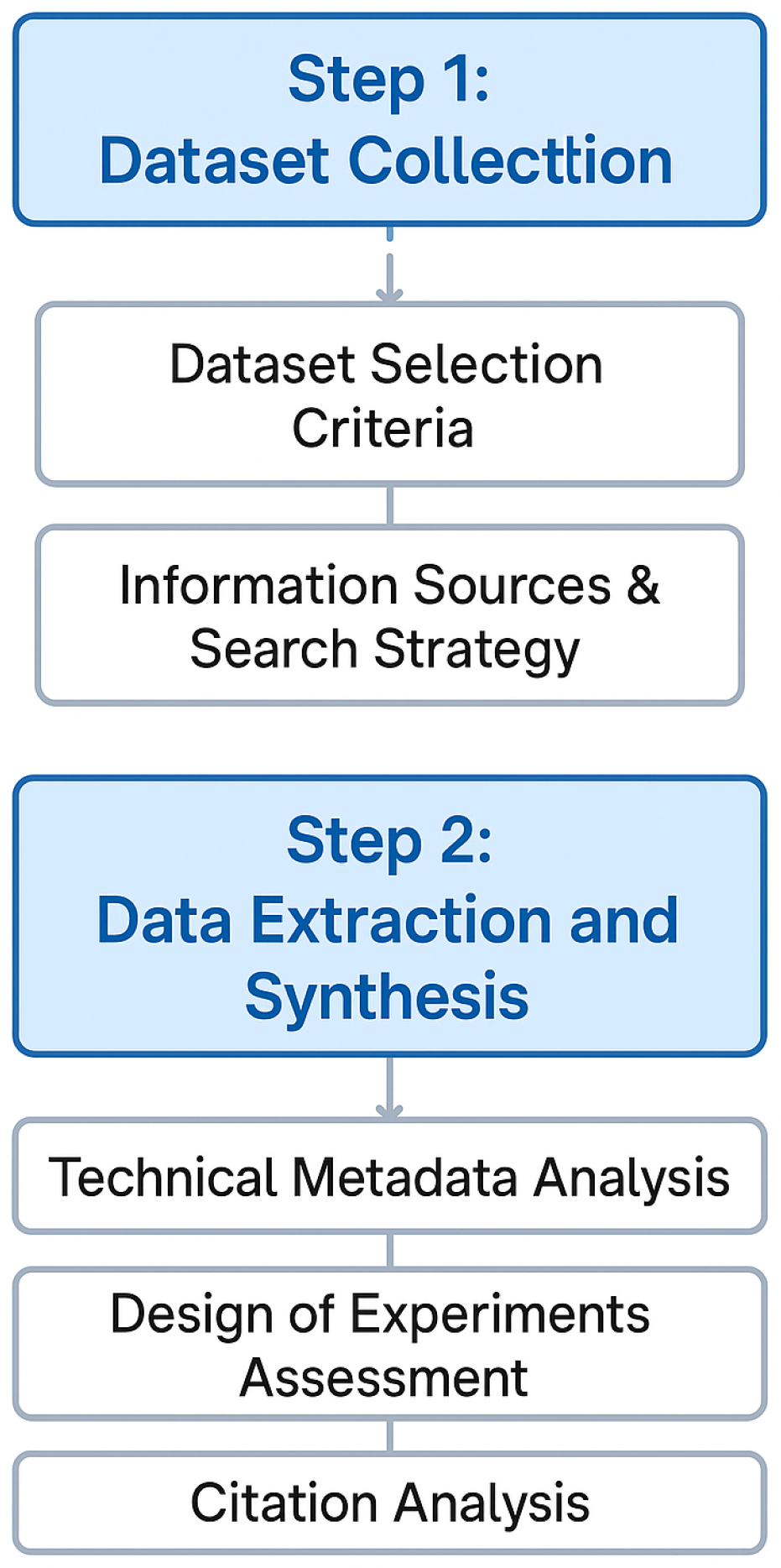
2.1. Dataset Collection
2.1.1. Dataset Selection Criteria
- EEG modality: The inclusion of EEG signals as the main measurement modality. This is due to their unique ability to directly and temporally characterize neural dynamics, which will be essential for understanding driving states from a more authentic perspective [4].
- Driving-related tasks: Tasks related to driving, whether real-world execution, high-fidelity simulations, or neurocognitive imagination paradigms, must maintain realism and practical applicability. This specific criterion places research in real driving situations, such as assessing responses to hazards in a simulator or mental workload when planning a route-on-road [7,8].
- Public accessibility: Making public datasets available allows for independent verification, algorithm benchmarking, and community-based improvement. This guarantees future research based upon open data, which is critical for cumulative scientific progress in EEG-based driver monitoring.
- Peer-reviewed publication: Datasets must come from peer-reviewed articles, not other types of non-validated data (such as Kaggle submissions), and should ensure the academic and methodological integrity and credibility of the underlying data. Complete metadata is required, such as experimental protocols, participant characteristics (age, gender, etc.) and task parameters, to provide vital context for understanding outcomes and alignment across studies.
- Recent collection: Collections that are older than modern EEG/BCI technologies (generally pre-2016) are excluded to focus on collections that align with current signal processing and machine learning models.
- Elevated participant thresholds: Collections with narrow sample datasets (number of subjects ) are rejected since the low statistical power does not meet the required inter-subject variability and statistical power that are needed for generalizable model development [19,20]. At the same time, strict quality standards require documentation on the applied signal preprocessing, artifact removal, and annotation reliability to assess the integrity and replicability of the analysis.
2.1.2. Information Sources and Search Strategy
2.2. Data Extraction and Synthesis
- ★★★ High Openness: Datasets that are publicly available via licenses like Creative Commons Attribution 4.0 (CC BY 4.0) and are downloadable on GitHub or Figshare as examples.
- ★★ Moderate Openness: Datasets that are available on request from the authors or stored under formal contracts that allow them to be shared in an academic context.
- ★ Low Openness: Datasets that are not available to the public or have restricted or vague licensing conditions. These datasets were not considered in this study for purposes of ensuring openness, continued access for research, and alignment with open scientific practice.
2.2.1. Multidimensional Scoring Framework
2.2.2. Terminology Standardization
3. Results
3.1. Comparative Analysis of Dataset Construction
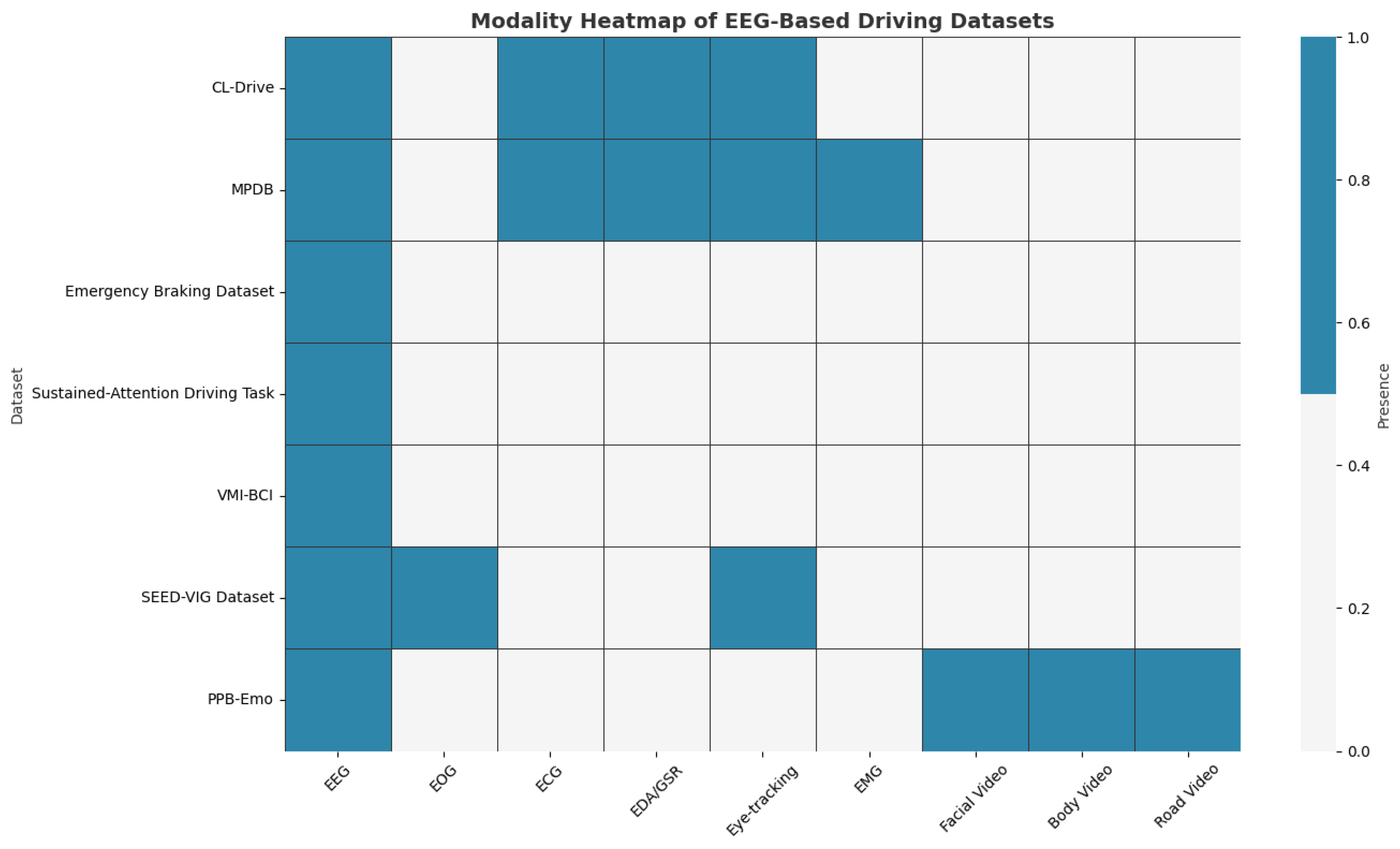
3.1.1. Dataset Modality
3.1.2. Scope
3.1.3. Dataset Accessibility
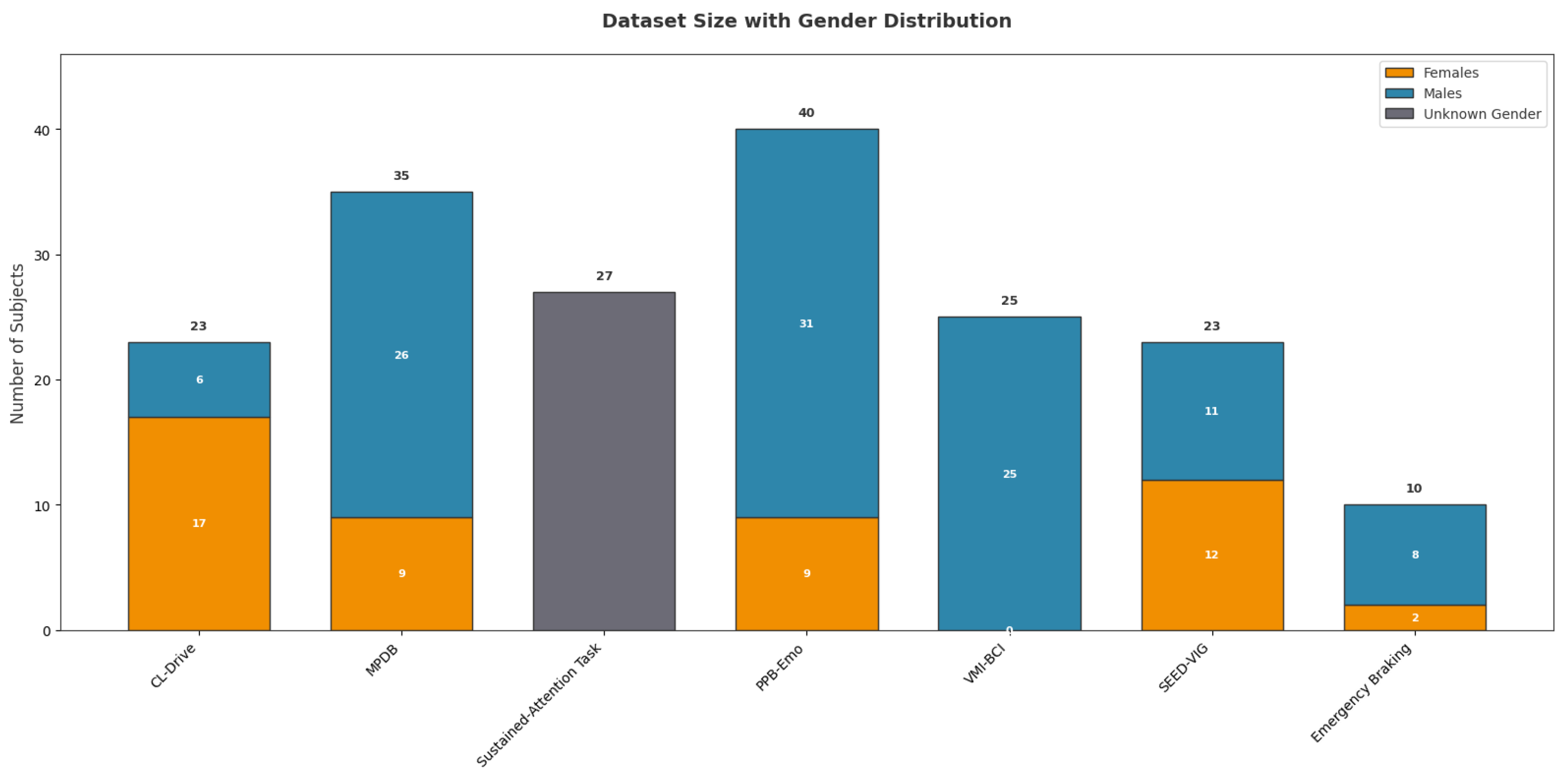
3.1.4. Size and Gender Distribution
3.1.5. Age Distribution
3.1.6. Quantitative Multidimensional Assessment
3.2. Comparative Analysis of Model Performance
- Algorithm Performance: Assess models on neuro-physiological data.
- Emerging Techniques: Provide examples of recent advances.
- Transferability and Benchmarking: Address cross-dataset issues.
3.2.1. Algorithm Performance
3.2.2. Emerging Used Techniques
3.2.3. Transferability and Benchmarking
- Differences in signal resolution (4 vs. 59 EEG channels);
- Labeling granularity;
- Inconsistencies in the acquisition protocol.
4. Discussion
4.1. Limitations
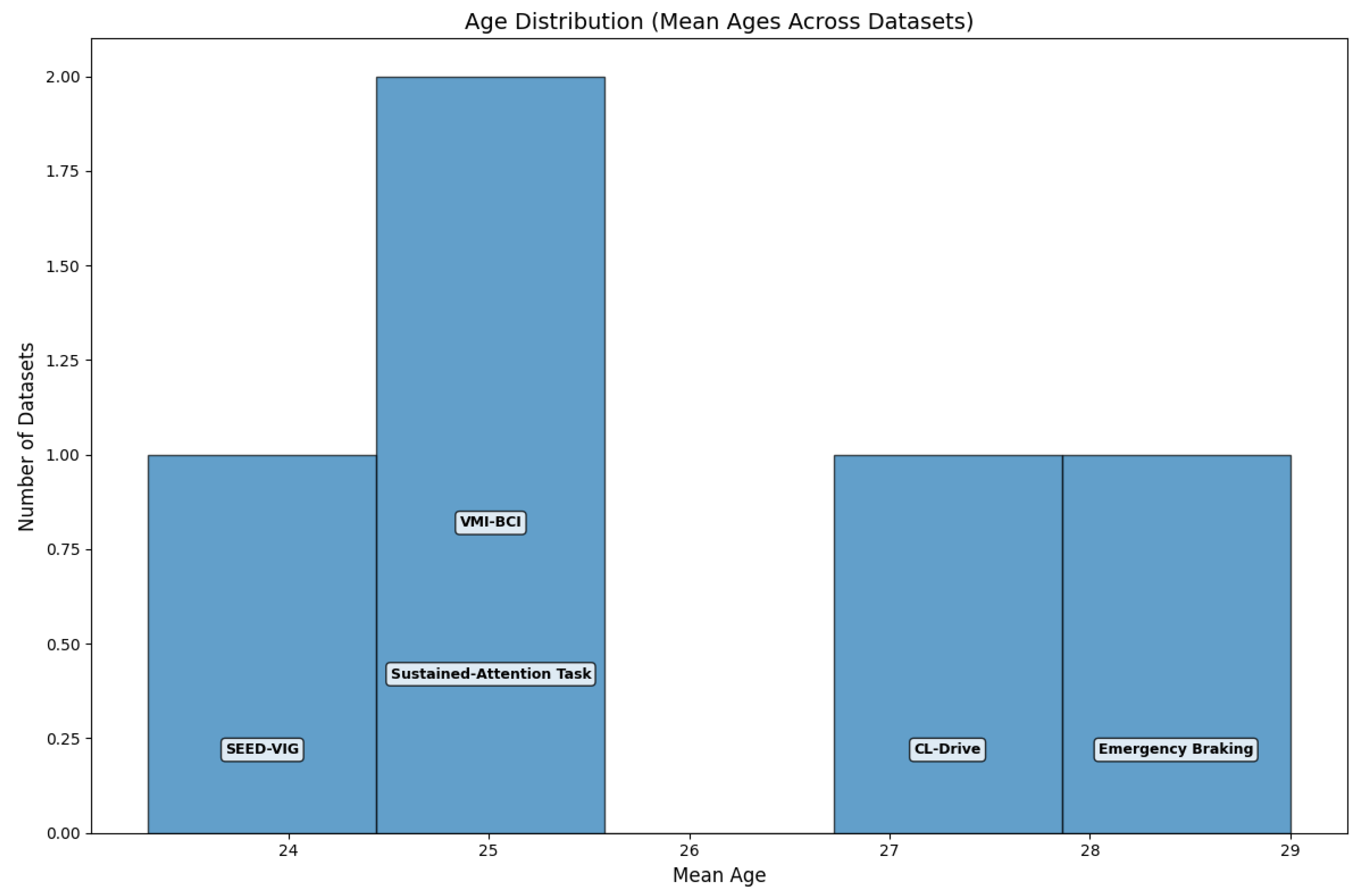
- Age Bias in Participant Demographics: Across all datasets, there is a persistent trend toward early adulthood. Six of the seven cohorts have mean ages ranging from 22 to 28 years, with only two datasets extending past 35 years (MPDB: 20–60 years, PPB-Emo: 19–58 years). Age bias towards the young adult sample (mean age: 25 years) results in poor performance for older drivers. The study in [29] estimated a 22–27% drop in accuracy when models were applied to populations not represented in the training data. This is problematic because of age-related changes in neural processing speed and cognitive workload [30].
- Dependence on Simulated Environments: Existing datasets are exclusively derived from simulated or imagined driving conditions. These setups fail to capture the complexities and unpredictability of real-world driving, including environmental noise, abrupt maneuvers, and infrastructure irregularities. Empirical evidence suggests that simulator-based evaluations may overestimate system performance by 20 to 30% [31], thereby limiting external validity. In addition, driving in real time also creates several EEG challenges specific to driving, including motion artifacts from vibration, electromagnetic interference with vehicle electronics, and more complex attentional demands that will induce changes in spectral patterns and topographical distributions [32]. In addition, new methodologies, such as graph learning [33], can model non-stationary brain connectivity under genuine distractions, and self-supervised learning can train robust representations against noisy real-world data, all bridging the simulation-to-reality gap [34].
- Absence of Affective State Monitoring: While affective states have firmly established roles in understanding behaviors and accident causation, there is only one dataset that includes direct measures of driver emotion (PPB-Emo). Drowsiness is typically covered, but many other emotional dimensions (anxiety, stress, boredom, fear, excitement) that could be informative of risky behavior remain unmonitored. The limited emotional coverage does not enable the models to recognize important states like frustration or road rage, since those signals have unique neural signatures that differ from the more common drowsiness.
- Gender Bias Toward Male Participants: The datasets exhibit a clear male bias (68.6% male). Gender imbalances create models that do not capture neural representations specific to male or female participants. This is shown in the existing research evidencing considerable sex/gender differences in cognitive abilities and neural processing that will modify the characteristics of the EEG signals [35].
- Limitations in Data Accessibility: Some datasets can be accessed freely using repositories like Figshare or GitHub, though a substantial portion (Emergency Braking, VMI-BCI) are provided only by the author upon request. This creates an inequitable research ecosystem whereby validation and progress rely on researcher goodwill. Furthermore, such restrictions prevent replication, secondary analysis, and the creation of multimodal large-scale benchmarks.
- Lack of Cross-Dataset Validation: The field lacks vigorous evidence for generalizable models. The common method of training and testing on single datasets leads to overfitting to specific populations, protocols, and hardware characteristics. Additionally, heterogeneity among the evaluation protocols, preprocessing pipelines, and model architectures remains a barrier towards making cross-dataset performance comparisons or model generalization.
4.2. Recommendations
5. Conclusions
Supplementary Materials
Author Contributions
Funding
Data Availability Statement
Conflicts of Interest
Appendix A. Complete Multidimensional Scoring Guidelines
Appendix A.1. Scoring Methodology
Appendix A.2. Scoring Criteria for the Specific Dimension
Appendix A.2.1. Demographic Diversity
- Five points: Age range > 40 years and gender-balanced distribution (45–55% for males and females);
- Three points: Age range between 25 and 40 years and moderate gender distribution (30–70% for males and females);
- One point: Age range narrow (<10 years) and severe gender imbalance (>80% single gender);
- Zero points: A single demographic group or no demographic information.
Appendix A.2.2. Ecological Validity
- Five points: Real-road driving with naturalistic conditions;
- Three points: High-fidelity driving simulator with interactive scenarios;
- One point: Basic simulation or simplified driving tasks;
- Zero points: Passive video viewing or non-driving contexts.
Appendix A.2.3. Modality Richness
- Five points: ≥3 auxiliary modalities (EOG, ECG, EDA, eye-tracking, etc.);
- Three points: 2 auxiliary modalities;
- One point: 1 auxiliary modality;
- Zero points: EEG-only recording.
Appendix A.2.4. Annotation Quality
- Five points: Multi-modal continuous annotation (continuous ratings + behavioral coding);
- Three points: Multiple discrete labels across sessions;
- One point: Basic task labels only;
- Zero points: No labels or binary classification only.
Appendix A.2.5. Accessibility
- Five points: CC-BY license, direct download;
- Three points: Available on request with academic use allowed;
- One point: Restricted access or unclear licensing;
- Zero points: Not available to the public.
Appendix A.2.6. Technical Quality
- Five points: Full documentation, >30 subjects;
- Three points: Good documentation, 15–30 subjects;
- One point: Limited documentation, 10–15 subjects;
- Zero points: Poor documentation, <10 subjects.
Appendix A.3. Dataset-Specific Score Justifications
Appendix A.3.1. MPDB (Composite: 4.05)
- Demographic: 4.2: Wide age range (20–60) but gender imbalance (74% male);
- Ecological: 3.5: High-fidelity simulation but not real-road;
- Modality: 4.8: EEG + EOG + EDA + gaze + vehicle data (five modalities);
- Annotation: 3.2: Multiple discrete labels for driving behavior;
- Accessibility: 5.0: CC-BY, direct download via Figshare;
- Technical: 4.5: Comprehensive documentation, 35 subjects.
Appendix A.3.2. PPB-Emo (Composite: 3.58)
- Demographic: 3.8: Good age range (19–58) but gender imbalance (78% male);
- Ecological: 2.0: Basic simulated driving tasks;
- Modality: 4.2: EEG + physiological + behavioral data (3+ modalities);
- Annotation: 4.5: Multi-modal emotion annotation;
- Accessibility: 5.0: CC-BY, direct download via Figshare;
- Technical: 4.0: Good documentation, 40 subjects.
Appendix A.3.3. CL-Drive (Composite: 3.33)
- Demographic: 2.5: Narrow age (26.9 mean), female-biased (81% female);
- Ecological: 3.0: High-fidelity simulation;
- Modality: 4.5: EEG + ECG + EDA + gaze (four modalities);
- Annotation: 3.0: Cognitive load labels across tasks;
- Accessibility: 5.0: CC-BY, direct download via GitHub (commit 44b0334, accessed October 2024);
- Technical: 3.0: Limited documentation, 21 subjects.
Appendix A.3.4. SEED-VIG (Composite: 2.83)
- Demographic: 3.0: Narrow age (23.3 ± 1.4), nearly balanced gender;
- Ecological: 1.0: Passive video viewing only;
- Modality: 3.0: EEG + forehead EOG (two modalities);
- Annotation: 3.0: Vigilance state labels;
- Accessibility: 5.0: CC-BY, direct download via Figshare;
- Technical: 3.5: Good documentation, 23 subjects.
Appendix A.3.5. Sustained-Attention (Composite: 2.65)
- Demographic: 1.0: Narrow age (22–28), no gender information;
- Ecological: 3.0: High-fidelity driving simulation;
- Modality: 2.0: EEG-only recording;
- Annotation: 2.0: Basic attention state labels;
- Accessibility: 5.0: CC-BY, direct download via Figshare;
- Technical: 3.5: Good documentation, 27 subjects.
Appendix A.3.6. Emergency Braking (Composite: 2.35)
- Demographic: 2.0: Moderate age range (22–36), gender imbalance (80% male);
- Ecological: 3.0: High-fidelity simulation;
- Modality: 2.0: EEG-only recording;
- Annotation: 2.0: Basic braking intention labels;
- Accessibility: 3.0: Available on request only;
- Technical: 2.0: Limited documentation, 10 subjects.
Appendix A.3.7. VMI-BCI (Composite: 2.15)
- Demographic: 1.0: Narrow age (25 ± 1), all-male participants;
- Ecological: 2.0: Basic simulation tasks;
- Modality: 2.0: EEG-only recording;
- Annotation: 2.0: Basic motor imagery labels;
- Accessibility: 3.0: Available on request only;
- Technical: 3.0: Limited documentation, 25 subjects.

| Dataset Name | Primary Reason for Exclusion |
|---|---|
| EEG Driver Fatigue Detection | Non-peer-reviewed publication (Kaggle source only) |
| Sleepy Driver EEG Brainwave Data | Non-peer-reviewed publication + Insufficient participant count (number of subjects = 4) |
| EEG Dataset Recorded In A Car Simulator | Non-peer-reviewed publication (Kaggle source only) |
| Multimodal Cognitive Load Classification Dataset | Non-peer-reviewed publication (Kaggle source only) |
| Cognitive load during driving dataset | Restricted data access |
| Driving Physiological and Vehicle Data Multimodal Fusion Dataset (DPV-MFD) | Restricted data access |
References
- Angkan, P.; Behinaein, B.; Mahmud, Z.; Bhatti, A.; Rodenburg, D.; Hungler, P.; Etemad, A. Multimodal Brain–Computer Interface for In-Vehicle Driver Cognitive Load Measurement: Dataset and Baselines. IEEE Trans. Intell. Transp. Syst. 2024, 25, 5949–5964. [Google Scholar] [CrossRef]
- Ma, S.; Yan, X.; Billington, J.; Merat, N.; Markkula, G. Cognitive load during driving: EEG microstate metrics are sensitive to task difficulty and predict safety outcomes. Accid. Anal. Prev. 2024, 207, 107769. [Google Scholar] [CrossRef] [PubMed]
- Lin, C.T.; Wu, R.C.; Liang, S.F.; Chao, W.H.; Chen, Y.J.; Jung, T.P. EEG-based drowsiness estimation for safety driving using independent component analysis. IEEE Trans. Circuits Syst. Regul. Pap. 2005, 52, 2726–2738. [Google Scholar] [CrossRef]
- Di Flumeri, G.; Borghini, G.; Aricò, P.; Sciaraffa, N.; Lanzi, P.; Pozzi, S.; Vignali, V.; Lantieri, C.; Bichicchi, A.; Simone, A.; et al. EEG-based mental workload neurometric to evaluate the impact of different traffic and road conditions in real driving settings. Front. Hum. Neurosci. 2018, 12, 509. [Google Scholar] [CrossRef]
- Zheng, W.L.; Lu, B.L. A multimodal approach to estimating vigilance using EEG and forehead EOG. J. Neural Eng. 2017, 14, 026017. [Google Scholar] [CrossRef]
- Page, M.J.; McKenzie, J.E.; Bossuyt, P.M.; Boutron, I.; Hoffmann, T.C.; Mulrow, C.D.; Shamseer, L.; Tetzlaff, J.M.; Akl, E.A.; Brennan, S.E.; et al. The PRISMA 2020 statement: An updated guideline for reporting systematic reviews. Br. Med. J. 2021, 372, n71. [Google Scholar] [CrossRef]
- Peng, Y.; Xu, Q.; Lin, S.; Wang, X.; Xiang, G.; Huang, S.; Zhang, H.; Fan, C. The Application of Electroencephalogram in Driving Safety: Current Status and Future Prospects. Front. Psychol. 2022, 13, 919695. [Google Scholar] [CrossRef]
- Ju, J.; Li, H. A Survey of EEG-Based Driver State and Behavior Detection for Intelligent Vehicles. IEEE Trans. Biom. Behav. Identity Sci. 2024, 6, 420–434. [Google Scholar] [CrossRef]
- Kaggle. EEG Driver Fatigue Detection; Kaggle: San Francisco, CA, USA, 2022. [Google Scholar]
- Kaggle. Sleepy Driver EEG Brainwave Data; Kaggle: San Francisco, CA, USA, 2023. [Google Scholar]
- Kaggle. EEG Dataset Recorded In A Car Simulator; Kaggle: San Francisco, CA, USA, 2023. [Google Scholar]
- Kaggle, University of Texas at Dallas. Multimodal Cognitive Load Classification Dataset; Kaggle: San Francisco, CA, USA, 2023. [Google Scholar]
- Sun, L.; Yang, H.; Li, B. Multimodal Dataset Construction and Validation for Driving-Related Anger: A Wearable Physiological Conduction and Vehicle Driving Data Approach. Electronics 2024, 13, 3904. [Google Scholar] [CrossRef]
- Tao, X.; Gao, D.; Zhang, W.; Liu, T.; Du, B.; Zhang, S.; Qin, Y. A multimodal physiological dataset for driving behaviour analysis. Sci. Data 2024, 11, 378. [Google Scholar] [CrossRef]
- Cao, Z.; Chuang, C.H.; King, J.K.; Lin, C.T. Multi-channel EEG recordings during a sustained-attention driving task. Sci. Data 2019, 6, 19. [Google Scholar] [CrossRef] [PubMed]
- Liang, X.; Yu, Y.; Liu, Y.; Liu, K.; Liu, Y.; Zhou, Z. EEG-based emergency braking intention detection during simulated driving. Biomed. Eng. Online 2023, 22, 65. [Google Scholar] [CrossRef] [PubMed]
- Ban, N.; Qu, C.; Feng, D.; Pan, J. A Hybrid Brain-Computer Interface for Smart Car Control. In Human Brain and Artificial Intelligence; Ying, X., Ed.; Communications in Computer and Information Science; Springer: Singapore, 2023; Volume 1692, pp. 135–147. [Google Scholar] [CrossRef]
- Li, W.; Tan, R.; Xing, Y.; Li, G.; Li, S.; Zeng, G.; Wang, P.; Zhang, B.; Su, X.; Pi, D.; et al. A multimodal psychological, physiological and behavioural dataset for human emotions in driving tasks. Sci. Data 2022, 9, 481. [Google Scholar] [CrossRef]
- Boudewyn, M.A.; Luck, S.J.; Farrens, J.L.; Kappenman, E.S. How many trials does it take to get a significant ERP effect? Psychophysiology 2018, 55, e13049. [Google Scholar] [CrossRef]
- Chaddad, A.; Wu, Y.; Kateb, R.; Bouridane, A. Electroencephalography Signal Processing: A Comprehensive Review and Analysis of Methods and Techniques. Sensors 2023, 23, 6434. [Google Scholar] [CrossRef] [PubMed]
- Ammar, S.; Karray, M.; Triki, N.; Ksantini, M. EEG Variability and Feature Importance in P300-Based BCI. In Proceedings of the Colloque JETSAN 2025, Troyes, France, 18–20 June 2025. [Google Scholar]
- Wang, A.; Wang, J.; Shi, W.; He, D. Cognitive Workload Estimation in Conditionally Automated Vehicles Using Transformer Networks Based on Physiological Signals. Transp. Res. Rec. 2024, 2678, 1183–1196. [Google Scholar] [CrossRef]
- Zhang, W.; Qin, Y.; Tao, X. MMPHGCN: A Hypergraph Convolutional Network for Detection of Driver Intention on Multimodal Physiological Signals. IEEE Signal Process. Lett. 2024, 31, 1730–1734. [Google Scholar] [CrossRef]
- Pulver, D.; Angkan, P.; Hungler, P.; Etemad, A. EEG-based Cognitive Load Classification using Feature Masked Autoencoding and Emotion Transfer Learning. arXiv 2023, arXiv:2308.00246. [Google Scholar] [CrossRef]
- Zhang, G.; Etemad, A. Capsule Attention for Multimodal EEG-EOG Representation Learning With Application to Driver Vigilance Estimation. IEEE Trans. Neural Syst. Rehabil. Eng. 2021, 29, 1138–1149. [Google Scholar] [CrossRef]
- Ahmad, A.; Nakisa, B.; Rastgoo, M.N. Robust Emotion Recognition via Bi-Level Self-Supervised Continual Learning. arXiv 2025, arXiv:2505.10575v2. [Google Scholar] [CrossRef]
- Kachare, P.H.; Sangle, S.B.; Puri, D.V.; Khubrani, M.M.; Al-Shourbaji, I. STEADYNet: Spatiotemporal EEG analysis for dementia detection using convolutional neural network. Cogn. Neurodyn. 2024, 18, 3195–3208. [Google Scholar] [CrossRef]
- Hu, F.; He, K.; Wang, C.; Zheng, Q.; Zhou, B.; Li, G.; Sun, Y. STRFLNet: Spatio-Temporal Representation Fusion Learning Network for EEG-Based Emotion Recognition. IEEE Trans. Affect. Comput. 2025; early access. [Google Scholar] [CrossRef]
- Zeng, H.; Li, X.; Borghini, G.; Zhao, Y.; Aricò, P.; Di Flumeri, G.; Sciaraffa, N.; Zakaria, W.; Kong, W.; Babiloni, F. An EEG-Based Transfer Learning Method for Cross-Subject Fatigue Mental State Prediction. Sensors 2021, 21, 2369. [Google Scholar] [CrossRef]
- Chu, C.; Donato-Woodger, S.; Khan, S.S.; Shi, T.; Leslie, K.; Abbasgholizadeh-Rahimi, S.; Nyrup, R.; Grenier, A. Strategies to Mitigate Age-Related Bias in Machine Learning. JMIR Aging 2024, 7, e53564. [Google Scholar] [CrossRef] [PubMed]
- Dingus, T.A.; Guo, F.; Lee, S.; Antin, J.; Perez, M.; Buchanan-King, M.; Hankey, J. Driver crash risk factors and prevalence evaluation using naturalistic driving data. Proc. Natl. Acad. Sci. USA 2016, 113, 2636–2641. [Google Scholar] [CrossRef]
- Liu, R.; Qi, S.; Hao, S.; Lian, G.; Luo, Y. Using electroencephalography to analyse drivers’ different cognitive workload characteristics based on on-road experiment. Front. Psychol. 2023, 14, 1107176. [Google Scholar] [CrossRef] [PubMed]
- Mohammadi, H.; Karwowski, W. Graph Neural Networks in Brain Connectivity Studies: Methods, Challenges, and Future Directions. Brain Sci. 2024, 15, 17. [Google Scholar] [CrossRef] [PubMed] [PubMed Central]
- Weng, W.; Gu, Y.; Guo, S.; Ma, Y.; Yang, Z.; Liu, Y.; Chen, Y. Self-supervised Learning for Electroencephalogram: A Systematic Survey. ACM Comput. Surv. 2025, 57, 317. [Google Scholar] [CrossRef]
- Kheloui, S.; Jacmin-Park, S.; Larocque, O.; Kerr, P.; Rossi, M.; Cartier, L.; Juster, R.P. Sex/gender differences in cognitive abilities. Neurosci. Biobehav. Rev. 2023, 152, 105333. [Google Scholar] [CrossRef]
- Ganin, Y.; Ustinova, E.; Ajakan, H.; Germain, P.; Larochelle, H.; Laviolette, F.; Marchand, M.; Lempitsky, V. Domain-Adversarial Training of Neural Networks. In Domain Adaptation in Computer Vision Applications; Springer: Cham, Switzerland, 2017; pp. 189–209. [Google Scholar] [CrossRef]
- Zemel, R.; Wu, Y.; Swersky, K.; Pitassi, T.; Dwork, C. Learning Fair Representations. In Proceedings of the 30th International Conference on Machine Learning, Atlanta, GA, USA, 16–21 June 2013; Volume 28, pp. 325–333. [Google Scholar]
- Song, J.; Zhai, Q.; Wang, C.; Liu, J. EEGGAN-Net: Enhancing EEG Signal Classification Through Data Augmentation. Front. Hum. Neurosci. 2024, 18, 1430086. [Google Scholar] [CrossRef]


| Dataset | Year | Subjects | Age | Gender | EEG Channels | Access | Openness |
|---|---|---|---|---|---|---|---|
| MPDB | 2024 | 35 | 20–60 | 26M, 9F | 59 | Figshare | ★★★ |
| SEED-VIG | 2024 | 23 | 23.3 ± 1.4 | 11M, 12F | 17 | Figshare | ★★★ |
| CL-Drive | 2023 | 21 | 26.9 | 6M, 17F | 4 | Github | ★★★ |
| Emergency Braking | 2023 | 10 | 22–36 | 8M, 2F | 28 | Author request | ★★ |
| PPB-Emo | 2022 | 40 | 19–58 | 31M, 9F | 32 | Figshare | ★★★ |
| VMI-BCI | 2021 | 25 | 25 ± 1 | All M | 18 | Author request | ★★ |
| Sustained-Attention | 2019 | 27 | 22–28 | - | 32 | Figshare | ★★★ |
| Dimension | Wt | 5 | 3 | 1 | 0 |
|---|---|---|---|---|---|
| Demographic | 0.20 | Wide age and gender | Mod. diversity | Limited | Severe bias |
| Ecological | 0.25 | Real road | High-fidelity sim | Basic sim | Passive |
| Modality | 0.15 | ≥3 aux | 2 aux | 1 aux | EEG-only |
| Annotation | 0.15 | Multi-modal cont. | Multi-discrete | Basic labels | No/binary |
| Accessibility | 0.10 | CC-BY direct | On request | Restricted | Unavailable |
| Technical | 0.15 | Full docs, >30 | Good docs, 15–30 | Limited, 10–15 | Poor, <10 |
| Modality | Captured Signal |
|---|---|
| EEG (Electroencephalography) | Electrical brain activity from the scalp |
| EOG (Electrooculography) | Corneo-retinal potential (eye movements) |
| ECG (Electrocardiography) | Electrical activity of the heart |
| EDA/GSR (Electrodermal Activity/ Galvanic Skin Response) | Skin conductance (sweat gland activity) |
| Eye-tracking | Gaze direction and fixation points |
| EMG (Electromyography) | Muscle activity (surface electrodes) |
| Dataset | Scope |
|---|---|
| MPDB | Driving Behavior Analysis |
| CL-Drive | Cognitive Load Assessment |
| Emergency Braking | Emergency Braking Intention |
| PPB-Emo | Emotion Recognition |
| VMI-BCI | Visual–Motor Imagery |
| Sustained-Attention | Drowsiness Detection |
| SEED-VIG | Drowsiness Detection |
| Dataset | Demographic | Ecological | Modality | Annotation | Access. | Technical | Comp. | Rank |
|---|---|---|---|---|---|---|---|---|
| MPDB | 4.2 | 3.5 | 4.8 | 3.2 | 5.0 | 4.5 | 4.05 | 1 |
| PPB-Emo | 3.8 | 2.0 | 4.2 | 4.5 | 5.0 | 4.0 | 3.58 | 2 |
| CL-Drive | 2.5 | 3.0 | 4.5 | 3.0 | 5.0 | 3.0 | 3.33 | 3 |
| SEED-VIG | 3.0 | 1.0 | 3.0 | 3.0 | 5.0 | 3.5 | 2.83 | 4 |
| Sustained-Attention | 1.0 | 3.0 | 2.0 | 2.0 | 5.0 | 3.5 | 2.65 | 5 |
| Emergency Braking | 2.0 | 3.0 | 2.0 | 2.0 | 3.0 | 2.0 | 2.35 | 6 |
| VMI-BCI | 1.0 | 2.0 | 2.0 | 2.0 | 3.0 | 3.0 | 2.15 | 7 |
| Dataset | Model | Performance | Key Strength |
|---|---|---|---|
| CL-Drive | XGBoost (multimodal) | 83.67% Acc | Feature fusion effectiveness |
| MPDB | MMPNet (multimodal) | 62.6% Acc | Multimodal integration |
| Sustained-Attention | CNN | 95.2% Acc | Spatial–temporal feature extraction |
| SEED-VIG | DNNSN (LSTM-based) | PCC 0.8237 | Temporal dependency modeling |
| Emergency Braking | EEGNet | AUC 0.94 | High temporal precision |
| VMI-BCI | SVM-EOG hybrid | 85% Acc | Multi-signal integration |
| PPB-Emo | MDERNet (dual-branch DL) | High accuracy (study-specific) | Mid-level multimodal feature fusion |
Disclaimer/Publisher’s Note: The statements, opinions and data contained in all publications are solely those of the individual author(s) and contributor(s) and not of MDPI and/or the editor(s). MDPI and/or the editor(s) disclaim responsibility for any injury to people or property resulting from any ideas, methods, instructions or products referred to in the content. |
© 2025 by the authors. Licensee MDPI, Basel, Switzerland. This article is an open access article distributed under the terms and conditions of the Creative Commons Attribution (CC BY) license (https://creativecommons.org/licenses/by/4.0/).
Share and Cite
Ammar, S.; Triki, N.; Karray, M.; Ksantini, M. A Multidimensional Benchmark of Public EEG Datasets for Driver State Monitoring in Brain–Computer Interfaces. Sensors 2025, 25, 7426. https://doi.org/10.3390/s25247426
Ammar S, Triki N, Karray M, Ksantini M. A Multidimensional Benchmark of Public EEG Datasets for Driver State Monitoring in Brain–Computer Interfaces. Sensors. 2025; 25(24):7426. https://doi.org/10.3390/s25247426
Chicago/Turabian StyleAmmar, Sirine, Nesrine Triki, Mohamed Karray, and Mohamed Ksantini. 2025. "A Multidimensional Benchmark of Public EEG Datasets for Driver State Monitoring in Brain–Computer Interfaces" Sensors 25, no. 24: 7426. https://doi.org/10.3390/s25247426
APA StyleAmmar, S., Triki, N., Karray, M., & Ksantini, M. (2025). A Multidimensional Benchmark of Public EEG Datasets for Driver State Monitoring in Brain–Computer Interfaces. Sensors, 25(24), 7426. https://doi.org/10.3390/s25247426