

AI-Driven Energy-Efficient Routing in IoT-Based Wireless Sensor Networks: A Comprehensive Review



Abstract
1. Introduction
1.1. Research Background and Motivation
1.2. Research Challenges and Questions
- RQ1. What are the current state-of-the-art route optimization techniques used in IoT-based WSNs?
- RQ2. What thorough evaluation and analysis can be conducted to investigate classical and AI-based energy-efficient routing optimization in WSN-IoT networks?
- RQ3. What are the emerging trends, open research challenges, and future directions in developing energy-aware routing protocols for next-generation WSN-IoT systems?
1.3. Research Scope and Contributions
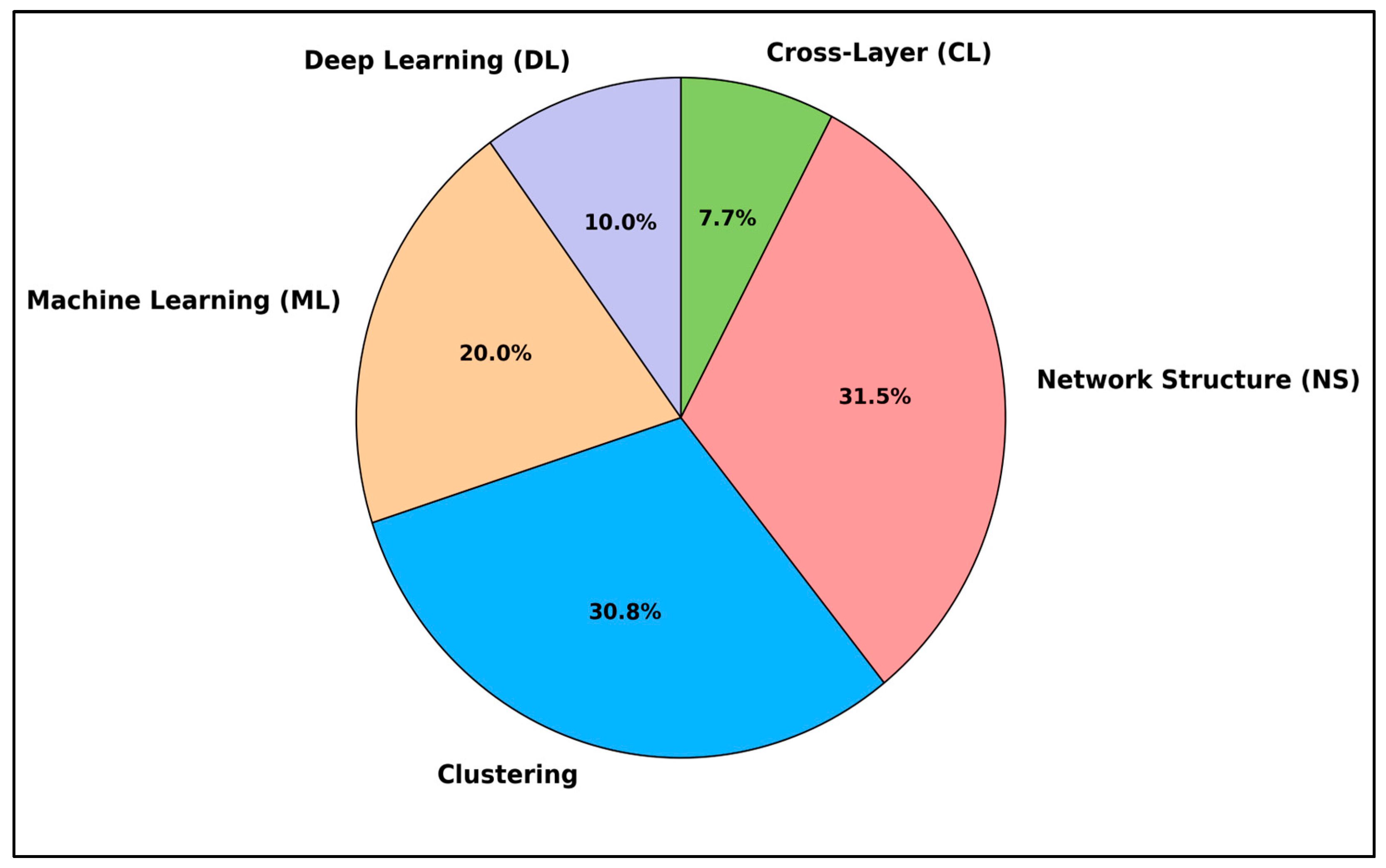
- Comprehensive Literature Survey: We conduct a broad review and categorization of existing energy-efficient routing techniques, distinguishing between conventional methods and AI-enhanced strategies, including machine learning, metaheuristic algorithms, and cross-layer optimization approaches. The surveyed protocols are systematically classified based on key performance attributes such as energy consumption, scalability, packet delivery ratio, latency, and protocol adaptability to IoT-specific constraints.
- Comparative Analysis: We present a detailed evaluation of the strengths, weaknesses, and application scenarios for traditional and AI-driven routing techniques, highlighting each technique’s practical benefits and limitations.
- Research Gap/Challenges analysis led to future directions: Our analysis reveals several unresolved challenges, such as inefficient cluster head selection, energy bottlenecks in multi-hop routing, and limited real-time adaptability of routing algorithms in heterogeneous IoT environments. The paper recommends promising avenues for further exploration, including the development of energy-aware cluster formation mechanisms, lightweight and secure routing protocols for constrained devices, and the integration of AI models capable of self-learning and online optimization in dynamic WSN topologies.
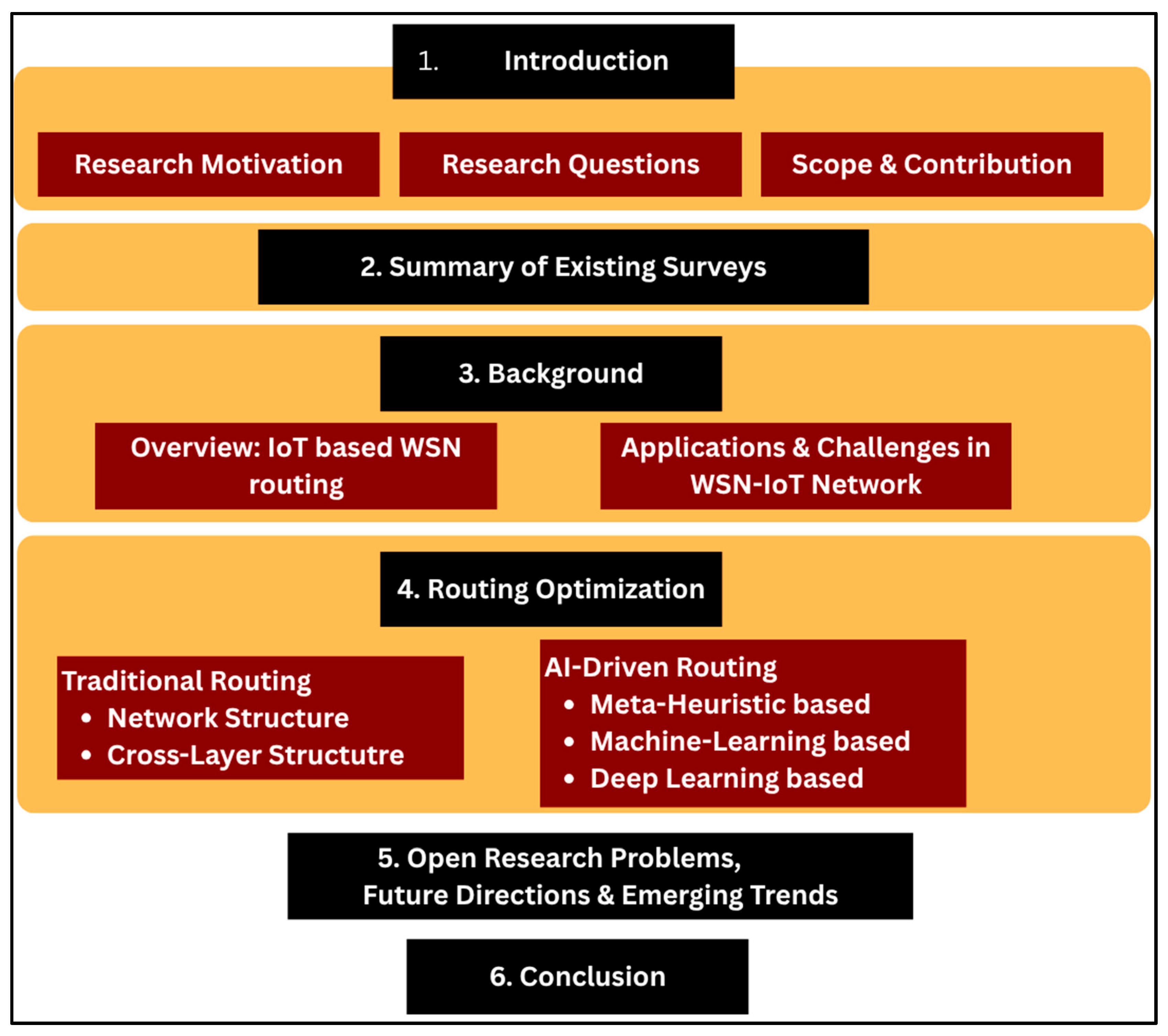
1.4. Structure of This Paper
2. Summary of Existing Surveys
3. IoT-Based Wireless Sensor Networks
3.1. Background and Overview

3.2. Applications and Challenges in IoT-Based WSN
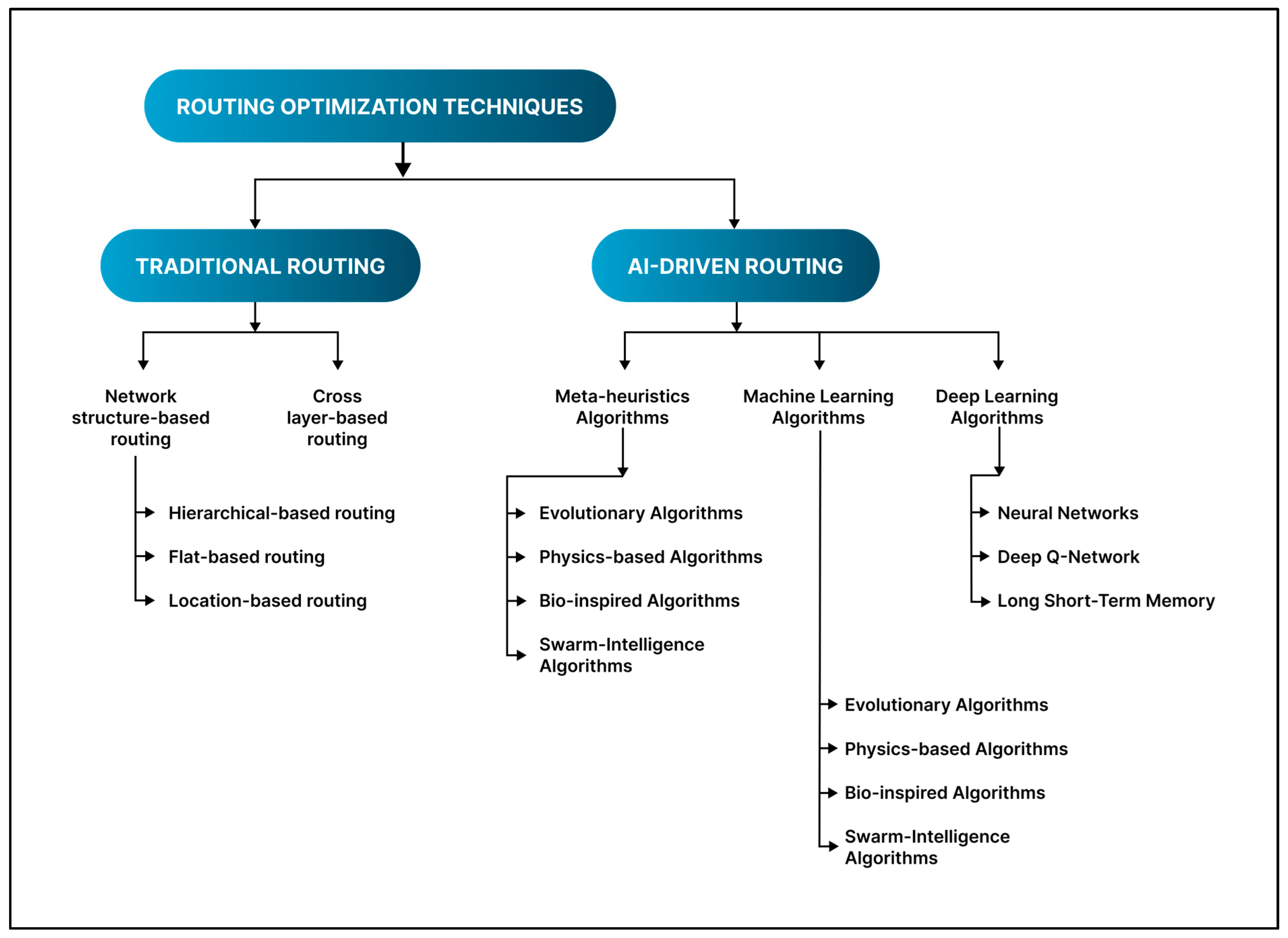
4. Routing Optimization for IoT-Based WSN: A Classification of Literature Review
4.1. Traditional-Based Routing Techniques
4.1.1. Network Structure-Based Routing Techniques
4.1.2. Cross-Layer Design Approach
4.2. AI-Driven Routing Algorithms
4.2.1. Meta-Heuristics Routing Algorithms
4.2.2. Machine Learning-Based Routing Algorithms
4.2.3. Deep Learning-Based Routing Algorithms
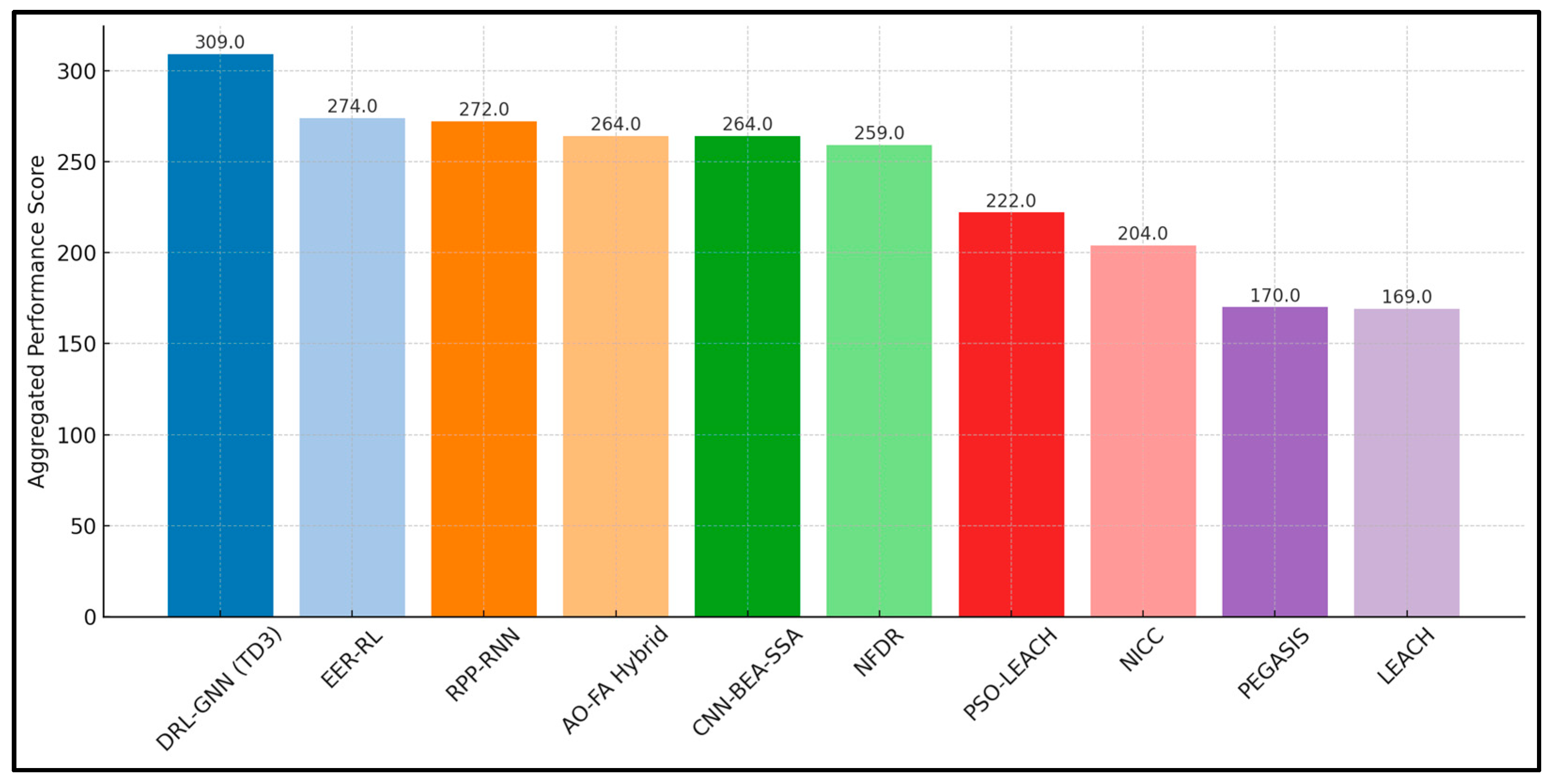
4.2.4. Quantitative Comparison of AI-Based and Conventional Routing Protocols
5. Open Research Problems and Future Directions
5.1. Open Research Problems
- (i)
- Limited Adaptivity and Scalability in Traditional and Hybrid Routing Protocols
- (ii)
- Inadequate Security, Robustness, and Fault Tolerance
- (iii)
- High Overhead and Complexity in Bio-Inspired Cluster-Based Protocols
- (iv)
- Lack of Multi-Objective Optimization and Real-World Validation
- (v)
- Energy Hole and Network Fairness
5.2. Future Research Directions
- (i)
- Advance Adaptive Routing with Context-Aware Deep Reinforcement Learning: Developing routing protocols that use deep reinforcement learning (DRL) integrated with context-awareness offers a pathway to networks that self-adjust to node mobility, fluctuating energy levels, and unpredictable traffic patterns. DRL agents can learn optimal routing actions through continuous interaction with the live network, adjusting strategies as environmental and operational variables change. Context-aware extensions use real-time sensor or environmental inputs—such as node location, link quality, and energy state—to further customize routing [147]. This approach can achieve a higher degree of adaptivity and scalability, allowing large and dynamic networks to maintain stability, efficiency, and prolonged operation, even as operating conditions shift rapidly.
- (ii)
- Integrate Lightweight AI-Driven Security Features and Predictive Fault Detection: Enhancing security and resilience with lightweight, embedded AI modules presents a promising opportunity. By training miniaturized models at the edge or node level, networks can identify abnormal patterns, suspicious traffic, or potential failures in real time with minimal energy or computation costs. Such AI-driven systems can flag intrusions, trigger automatic rerouting, or isolate compromised nodes, thereby minimizing network disruption and maintaining data integrity. Predictive maintenance and anomaly detection backed by on-device intelligence can greatly improve fault tolerance and reduce repair or maintenance overhead in resource-constrained settings [148].
- (iii)
- Hybridize Bio-Inspired Optimization with Lightweight Machine Learning for Cluster Management: Combining bio-inspired metaheuristics with streamlined machine learning techniques could achieve fast, efficient, and adaptive cluster formation and maintenance. Swarm intelligence or evolutionary algorithms can dynamically optimize cluster head selection and role rotation, while machine learning models tune parameters or predict traffic congestion and energy trends. This hybrid approach enables highly flexible, distributed coordination for clustering, while reducing computational burden, energy consumption, and time to convergence when compared to traditional heavyweight solutions [149].
- (iv)
- Develop Multi-Objective, Explainable AI-Based Routing Frameworks and Promote Real-World Validation: Future research should pursue routing solutions that consider multiple, often conflicting, goals in real time. By designing explainable AI frameworks, networks can transparently weigh factors such as latency, load balance, energy use, and security, making the decision processes auditable and more reliable for operational deployment. Prototype routing solutions must be tested beyond simulation, in realistic and diverse field environments, to ensure models are robust, interpretable, and transferable from lab to field. The result will be trustworthy, versatile, and practically validated protocols for real IoT ecosystems [150].
- (v)
- Edge Computing Integration: Integrating edge computing with WSN and IoT routing protocols opens new avenues for localized processing, aggregation, and decision-making. Allowing sensor nodes and clusters to perform computation, apply AI analytics, and adapt routing at the periphery can cut down core network congestion, reduce latency, and make real-time optimization feasible. Edge-enabled protocols also enhance privacy and data locality, enabling efficient use of distributed resources while scaling to support denser and more complex network applications [151]. This direction advances the vision of intelligent, decentralized, and self-managing IoT networks.
5.3. Emerging Trends
- (i)
- Blockchain-Based Secure Routing: Blockchain-based secure routing significantly enhances the security and trustworthiness of WSN by decentralizing and safeguarding routing information against threats such as unauthorized access, data tampering, and man-in-the-middle attacks [152]. Unlike traditional routing protocols that are often vulnerable due to their centralized nature and limited protection mechanisms, integrating blockchain enables each node or cluster head to securely record routing and cluster election data in an immutable ledger maintained by consensus among trusted nodes. This tamper-proof mechanism ensures that all network actions are transparently verifiable and resistant to manipulation, even in adversarial IoT environments. As a result, blockchain integration has been shown to notably improve both security and network longevity.
- (ii)
- 6G-Enabled AI Routing: 6G-enabled AI routing represents a next-generation advance where the ultra-low latency, massive bandwidth, and intelligent orchestration features of 6G wireless networks synergize with advanced artificial intelligence to optimize WSN performance. In the context of IoT-based WSNs, 6G will provide real-time, high-reliability connectivity by leveraging native support for AI-driven protocols [153]. These technologies enable rapid network self-organization, context-aware decision-making, and robust security—even in highly dynamic and large-scale environments. AI-based routing, particularly modular and reinforcement learning frameworks, can adaptively balance energy consumption, minimize latency, and maximize packet delivery, addressing the challenges of resource-constrained nodes and ever-changing traffic demands. As such, 6G-enabled AI routing emerges as a critical trend for building future-proof, highly efficient, and resilient IoT sensor networks.
- (iii)
- Edge-Cloud-Fog Hybrid Architecture: In Edge-Cloud-Fog hybrid architecture computation, storage, and analytics tasks are distributed dynamically across edge devices (sensor nodes), fog nodes (local micro-servers or gateways), and centralized cloud servers [154]. This multi-layer structure enables real-time data processing to close to the data source, drastically reducing latency as fog and edge nodes can respond instantly; studies report up to 40% faster response times for time-sensitive IoT applications compared to cloud-only designs. Offloading computation to edge and fog also conserves energy on resource-constrained sensors by minimizing long-distance transmissions: fog nodes can manage local data aggregation, predictive analytics, and even machine learning, which has been shown to improve energy consumption by up to 2–3 times in industrial deployments. Another benefit can be high scalability, as fog/edge nodes bridge massive numbers of heterogeneous sensors while maintaining flexible interoperability across protocols like ZigBee, Wi-Fi, Bluetooth, and cellular. As demand grows for mobility support, real-time responsiveness, and robust energy management in next-generation IoT networks, edge-cloud-fog architectures will become central to achieving both high performance and efficient, scalable sensor deployments.
- (iv)
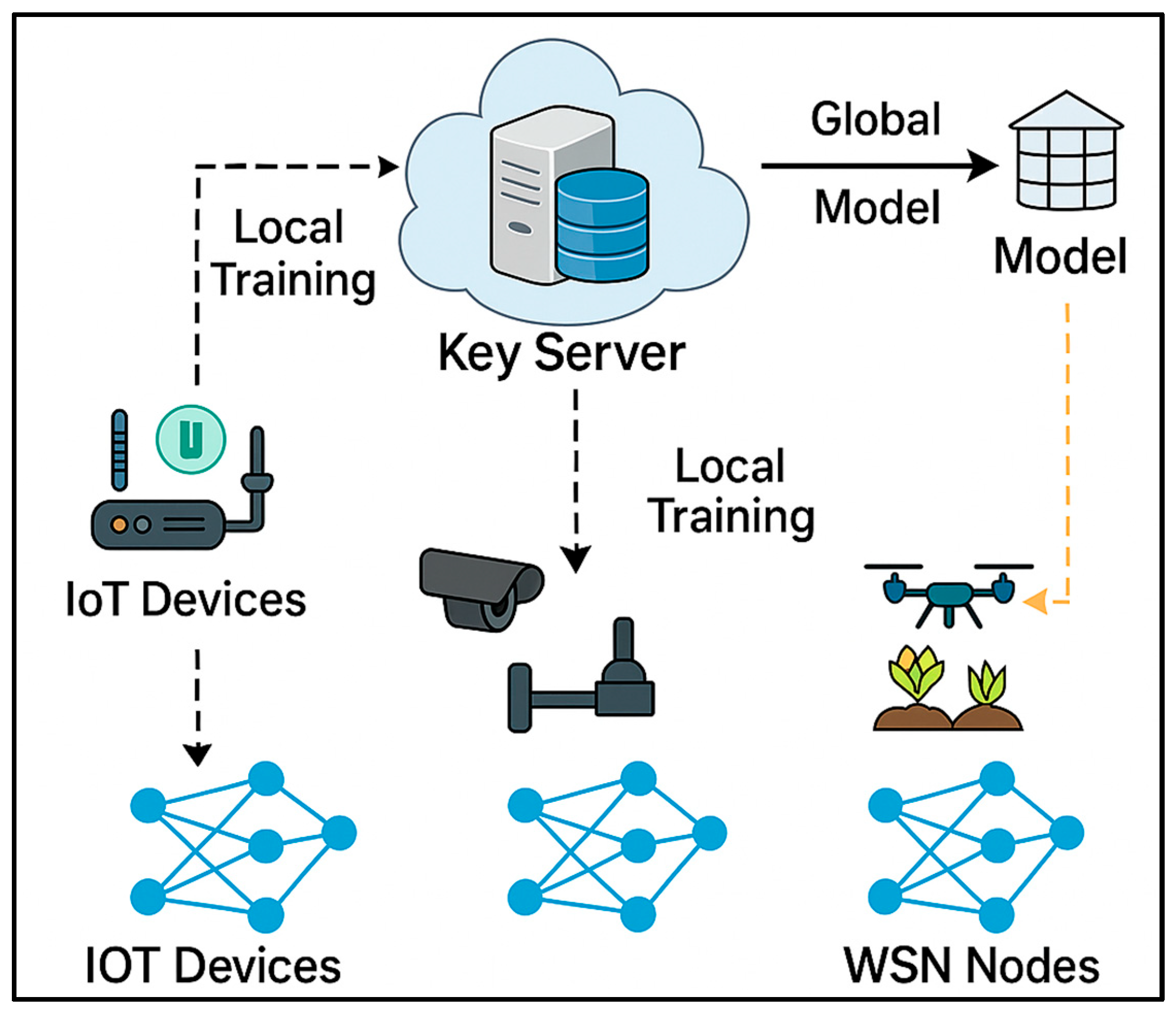
- Federated Learning for Distributed Routing: Federated Learning (FL) has emerged as a transformative approach enabling collaborative model training across distributed sensor nodes without centralizing sensitive data. Each node trains locally using its own observations, transmitting only learned model parameters (~0.4 KB) instead of raw data (~50 KB) to a central aggregator [155]. Figure 9 depicts a collaborative training paradigm where multiple IoT devices, drones, and sensor nodes locally train routing models on their own data without transmitting raw information to a central authority. A key server coordinates the process by aggregating locally trained model updates and computing a global model that is redistributed to all participants, enabling iterative refinement through repeated cycles of local training and global aggregation. This architecture reduces communication overhead by 60–70% and corresponding energy consumption by 15x while preserving privacy. Federated averaging algorithms aggregate local models into an improved global model broadcast back to all nodes. Despite slower convergence than centralized approaches, FL provides 2–5% quality degradation in exchange for massive energy and privacy benefits, making it ideal for large-scale, bandwidth-limited IoT deployments. Current research focuses on handling heterogeneous network conditions and reducing synchronization overhead for widespread adoption anticipated by 2025–2026.
- (v)
- Quantum-Inspired Hybrid Optimization: Quantum-inspired hybrid optimization introduces principles from quantum computing such as superposition, entanglement, and advanced quantum search algorithms into classical metaheuristic optimization techniques for wireless sensor networks (WSNs) [156]. By integrating quantum-inspired algorithms like Quantum Genetic Algorithm (QGA) or Quantum Particle Swarm Optimization (QPSO), these approaches enable more efficient and balanced cluster head selection, proactive energy balancing, and faster convergence than traditional methods. Quantum-inspired techniques mostly use probabilistic search spaces and innovative initialization (e.g., Sobol sequences, Lévy flights) to better avoid local optima and promote uniform energy distribution, addressing persistent challenges such as energy hole prevention and dynamic node deployment. These advances offer scalable solutions for increasingly complex, large-scale IoT networks and pave the way for future integration with more advanced quantum computing hardware.
- (vi)
- Transfer Learning: Transfer learning utilize knowledge or models from one domain, environment, or task and apply them to different but related scenarios without having to retrain from scratch [157]. This is particularly valuable for IoT-based WSNs, where training data can be limited, environments may shift rapidly, and computational resources are scarce. By reusing pretrained models or features from source tasks, transfer learning dramatically speeds up adaptation when new sensor nodes are deployed or when the network faces changing conditions. This makes transfer learning ideal for large-scale distributed networks, especially those with heterogeneous hardware or scenarios that require rapid adaptation, like industrial monitoring or smart agriculture. Importantly, transfer learning also enables more robust operation against concept drift (e.g., sensor aging or failure), supports specialized learning for diverse sensor types, and reduces the need for labeled data, addressing some of the most persistent challenges in practical WSN deployments.
6. Conclusions
Author Contributions
Funding
Data Availability Statement
Acknowledgments
Conflicts of Interest
Abbreviations
| ABC | Artificial Bee Colony |
| ACO | Ant Colony Optimization |
| AODV | Ad hoc On-demand Distance Vector |
| ASFO | Adaptive Swarm Firefly Optimization |
| BEA-SSA | Bald Eagle Assisted Sparrow Search Algorithm |
| BFO | Bacterial Foraging Optimization |
| CBRP | Cluster-Based Routing Protocol |
| CLEERDTS | Cross-Layer Energy-Efficient Reliable Data Transmission System |
| CL-IoT | Cross-layer Internet of Things Protocol |
| CNN | Convolutional Neural Network |
| CSA | Cuckoo Search Algorithm |
| CWSN-eSCPM | Cross-layer Wireless Sensor Network—Enhanced Service and Congestion Prediction Management |
| DL | Deep Learning |
| DRL | Deep Reinforcement Learning |
| DVRP | Distance Vector Routing Protocol |
| ECCM | Event-Cluster-based Cross-layer Management |
| EAR | Energy-Aware Routing |
| EER-RL | Energy-Efficient Routing with Reinforcement Learning |
| FDRL | Federated Deep Reinforcement Learning |
| FMCB-ER | Fuzzy Multi-Criteria Clustering and Bio-inspired Energy-Efficient Routing |
| GA | Genetic Algorithm |
| GAPSO | Genetic Algorithm and Particle Swarm Optimization |
| GEAR | Geographic and Energy Aware Routing |
| GNN | Graph Neural Network |
| GSA | Gravitational Search Algorithm |
| HEED | Hybrid Energy-Efficient Distributed |
| HSEERP | Hierarchical Secured Energy Efficient Routing Protocol |
| LEACH | Low-Energy Adaptive Clustering Hierarchy |
| LSP | Link State Protocol |
| MEC | Mobile Edge Computing |
| ML | Machine Learning |
| MH | Metaheuristics |
| MPNN | Message Passing Neural Network |
| NICC | Nature-Inspired Cross-layer Clustering |
| PEGASIS | Power-Efficient Gathering in Sensor Information System |
| PSO | Particle Swarm Optimization |
| QoS | Quality of Service |
| QPSO | Quantum Particle Swarm Optimization |
| REERP | Region-based Energy-Efficient Routing Protocol |
| RPL | Routing Protocol for Low Power and Lossy Networks |
| RPP-RNN | Rank-Based Path Planning with Recurrent Neural Network |
| RSSI | Received Signal Strength Indicator |
| SNN | Spiking Neural Network |
| SVM | Support Vector Machine |
References
- Akkaya, K.; Younis, M. A survey on routing protocols for wireless sensor networks. Ad Hoc Netw. 2005, 3, 325–349. [Google Scholar] [CrossRef]
- Al-Karaki, J.N.; Kamal, A.E. Routing techniques in wireless sensor networks: A survey. IEEE Wirel. Commun. 2004, 11, 6–28. [Google Scholar] [CrossRef]
- Kenyeres, M.; Kenyeres, J.; Hassankhani Dolatabadi, S. Distributed consensus gossip-based data fusion for suppressing incorrect sensor readings in wireless sensor networks. J. Low Power Electron. Appl. 2025, 15, 6. [Google Scholar] [CrossRef]
- Deng, Y.-Y.; Chen, C.-L.; Tsaur, W.-J.; Tang, Y.-W.; Chen, J.-H. Internet of Things (IoT) based design of a secure and lightweight body area network (BAN) healthcare system. Sensors 2017, 17, 2919. [Google Scholar] [CrossRef]
- Mohamed, R.E.; Saleh, A.I.; Abdelrazzak, M.; Samra, A.S. Survey on wireless sensor network applications and energy efficient routing protocols. Wirel. Pers. Commun. 2018, 101, 1019–1055. [Google Scholar] [CrossRef]
- Heinzelman, W.B. Application-Specific Protocol Architectures for Wireless Networks. Ph.D. Thesis, Massachusetts Institute of Technology, Cambridge, MA, USA, 2000. [Google Scholar]
- Younis, O.; Fahmy, S. HEED: A hybrid, energy-efficient, distributed clustering approach for ad hoc sensor networks. IEEE Trans. Mob. Comput. 2004, 3, 366–379. [Google Scholar] [CrossRef]
- Singh, S.K.; Singh, M.; Singh, D.K. Routing protocols in wireless sensor networks—A survey. Int. J. Comput. Sci. Eng. Surv. (IJCSES) 2010, 1, 63–83. [Google Scholar] [CrossRef]
- Almufti, S.M.; Shaban, A.A.; Ali, Z.A.; Ali, R.I.; Fuente, J.D. Overview of metaheuristic algorithms. Polaris Glob. J. Sch. Res. Trends 2023, 2, 10–32. [Google Scholar] [CrossRef]
- Joshi, P.; Raghuvanshi, A.S. Hybrid approaches to address various challenges in wireless sensor network for IoT applications: Opportunities and open problems. Int. J. Comput. Netw. Appl. 2021, 8, 151–187. [Google Scholar] [CrossRef]
- Velusamy, B.; Pushpan, S.C. A review on swarm intelligence based routing approaches. Int. J. Eng. Technol. Innov 2019, 9, 182–195. [Google Scholar]
- Priyadarshi, R. Energy-Efficient Routing in Wireless Sensor Networks: A Meta-heuristic and Artificial Intelligence-based Approach: A Comprehensive Review. Arch. Comput. Methods Eng. 2024, 31, 2109–2137. [Google Scholar] [CrossRef]
- Al-Karaki, J.N.; Kamal, A.E.; Ul-Mustafa, R. On the optimal clustering in mobile ad hoc networks. In Proceedings of the First IEEE Consumer Communications and Networking Conference, 2004. CCNC 2004, Las Vegas, NV, USA, 5–8 January 2004; pp. 71–76. [Google Scholar]
- Priyadarshi, R. Exploring machine learning solutions for overcoming challenges in IoT-based wireless sensor network routing: A comprehensive review. Wirel. Netw. 2024, 30, 2647–2673. [Google Scholar] [CrossRef]
- Chakraborty, R.S.; Mathew, J.; Vasilakos, A.V. Security and Fault Tolerance in Internet of Things; Springer: Cham, Switzerland, 2019. [Google Scholar]
- Al Aghbari, Z.; Khedr, A.M.; Osamy, W.; Arif, I.; Agrawal, D.P. Routing in wireless sensor networks using optimization techniques: A survey. Wirel. Pers. Commun. 2020, 111, 2407–2434. [Google Scholar] [CrossRef]
- Agarkar, P.T.; Chawan, M.D.; Karule, P.T.; Hajare, P.R. A comprehensive survey on routing schemes and challenges in wireless sensor networks (WSN). Int. J. Comput. Netw. Appl. (IJCNA) 2020, 7, 193–207. [Google Scholar] [CrossRef]
- Poornima, M.; Vimala, H.; Shreyas, J. Holistic survey on energy aware routing techniques for IoT applications. J. Netw. Comput. Appl. 2023, 213, 103584. [Google Scholar] [CrossRef]
- Ramya, R.; Brindha, T. A comprehensive review on optimal cluster head selection in WSN-IOT. Adv. Eng. Softw. 2022, 171, 103170. [Google Scholar] [CrossRef]
- Singh, H.; Yadav, P.; Rishiwal, V.; Yadav, M.; Tanwar, S.; Singh, O. Localization in WSN-Assisted IoT Networks Using Machine Learning Techniques for Smart Agriculture. Int. J. Commun. Syst. 2025, 38, e6004. [Google Scholar] [CrossRef]
- Nag, A.; Mandal, D.; Roy, N.; Firoz Ahmed Fahim, S.; Chand, N. A Survey on Wireless Sensor Network Routing Performance Optimizing and Security Techniques. In Proceedings of the International Conference on Frontiers in Computing and Systems, Himachal Pradesh, India, 16–17 October 2023; pp. 163–177. [Google Scholar]
- Martalò, M.; Pettorru, G.; Atzori, L. A cross-layer survey on secure and low-latency communications in next-generation IoT. IEEE Trans. Netw. Serv. Manag. 2024, 21, 4669–4685. [Google Scholar] [CrossRef]
- Sahu, N.; Veenadhari, S. A Comprehensive Survey of Load Balancing Techniques in Multipath Energy-Consuming Routing Protocols for Wireless Ad hoc Networks in MANET. Indian J. Data Commun. Netw. (IJDCN) 2024, 4, 5–10. [Google Scholar] [CrossRef]
- Rahman, M.A.; Anwar, S.; Pramanik, M.I.; Rahman, M.F. A survey on energy efficient routing techniques in wireless sensor network. In Proceedings of the 2013 15th International Conference on Advanced Communications Technology (ICACT), Pyeongchang, Republic of Korea, 27–30 January 2013; pp. 200–205. [Google Scholar]
- Yadav, R.; Sreedevi, I.; Gupta, D. Bio-inspired hybrid optimization algorithms for energy efficient wireless sensor networks: A comprehensive review. Electronics 2022, 11, 1545. [Google Scholar] [CrossRef]
- Gulati, K.; Boddu, R.S.K.; Kapila, D.; Bangare, S.L.; Chandnani, N.; Saravanan, G. A review paper on wireless sensor network techniques in Internet of Things (IoT). Mater. Today Proc. 2022, 51, 161–165. [Google Scholar] [CrossRef]
- Moslehi, M.M. Exploring coverage and security challenges in wireless sensor networks: A survey. Comput. Netw. 2025, 260, 111096. [Google Scholar] [CrossRef]
- Tuteja, G.; Rani, S.; Sharma, A. Optimizing Routing Protocols for Energy Efficiency in Large-Scale WSN-IoT Deployments. In Proceedings of the 2024 Global Conference on Communications and Information Technologies (GCCIT), Bangalore, India, 25–26 October 2024; pp. 1–6. [Google Scholar]
- Bekal, P.; Kumar, P.; Mane, P.R.; Prabhu, G. A comprehensive review of energy efficient routing protocols for query driven wireless sensor networks. F1000Research 2024, 12, 644. [Google Scholar] [CrossRef]
- Kumar, P.; Sharma, A.; Grover, R.; Kumar, N.; Kuchhal, V.; Singh, S. Exploring Energy-Efficient Routing in IoT-based WSNs: A WoS Bibliometric-based Review. In Proceedings of the 2025 8th International Conference on Computing Methodologies and Communication (ICCMC), Erode, India, 23–25 July 2025; pp. 401–406. [Google Scholar]
- Kim, T.; Vecchietti, L.F.; Choi, K.; Lee, S.; Har, D. Machine learning for advanced wireless sensor networks: A review. IEEE Sens. J. 2020, 21, 12379–12397. [Google Scholar] [CrossRef]
- Abadi, A.F.E.; Asghari, S.E.; Sharifani, S.; Asghari, S.A.; Marvasti, M.B. A survey on utilizing reinforcement learning in wireless sensor networks routing protocols. In Proceedings of the 2022 13th International Conference on Information and Knowledge Technology (IKT), Karaj, Iran, 20–22 December 2022; pp. 1–7. [Google Scholar]
- Yadav, R.; Kumar, V. A Systematic Review Paper on Energy-Efficient Routing Protocols in Internet of Things. IETE J. Res. 2024, 70, 4721–4743. [Google Scholar] [CrossRef]
- Gaidhani, A.R.; Potgantwar, A.D. A review of machine learning-based routing protocols for wireless sensor network lifetime. Eng. Proc. 2024, 59, 231. [Google Scholar]
- Rajput, M.; Yadav, R.N. Machine and Deep Learning Driven Energy Efficient Clustering in IOT-WSNs: A Review. IEEE Sens. J. 2025, 25, 39371–39385. [Google Scholar] [CrossRef]
- Alam, T. A Reliable Communication Framework and Its Use in Internet of Things (IoT). TechRxiv. 2020. Available online: https://www.techrxiv.org/doi/full/10.36227/techrxiv.12657158.v1 (accessed on 17 August 2020).
- Uviase, O.; Kotonya, G. IoT architectural framework: Connection and integration framework for IoT systems. arXiv 2018, arXiv:1803.04780. [Google Scholar] [CrossRef]
- Kumar, M.; Udaya, D. A Survey on Sensor Networks. Int. J. Embed. Softw. Comput. IJESC 2014, 10. [Google Scholar]
- Yick, J.; Mukherjee, B.; Ghosal, D. Wireless sensor network survey. Comput. Netw. 2008, 52, 2292–2330. [Google Scholar] [CrossRef]
- Zanella, A.; Bui, N.; Castellani, A.; Vangelista, L.; Zorzi, M. Internet of things for smart cities. IEEE Internet Things J. 2014, 1, 22–32. [Google Scholar] [CrossRef]
- Marios, K.; Konstantinos, C.; Sotiris, N.; José, R. Passive target tracking: Application with mobile devices using an indoors WSN Future Internet testbed. In Proceedings of the 2011 International Conference on Distributed Computing in Sensor Systems and Workshops (DCOSS), Barcelona, Spain, 27–29 June 2011; pp. 1–6. [Google Scholar]
- Centenaro, M.; Vangelista, L.; Zanella, A.; Zorzi, M. Long-range communications in unlicensed bands: The rising stars in the IoT and smart city scenarios. IEEE Wirel. Commun. 2016, 23, 60–67. [Google Scholar] [CrossRef]
- Mahdi, O.A. Energy Efficient and Load-Balanced Routing Schemes for In-Network Data Aggregation in Wireless Sensor Networks. Ph.D. Thesis, University of Malaya, Kuala Lumpur, Malaysia, 2017. [Google Scholar]
- Pantazis, N.A.; Nikolidakis, S.A.; Vergados, D.D. Energy-efficient routing protocols in wireless sensor networks: A survey. IEEE Commun. Surv. Tutor. 2012, 15, 551–591. [Google Scholar] [CrossRef]
- Al-Fuqaha, A.; Guizani, M.; Mohammadi, M.; Aledhari, M.; Ayyash, M. Internet of things: A survey on enabling technologies, protocols, and applications. IEEE Commun. Surv. Tutor. 2015, 17, 2347–2376. [Google Scholar] [CrossRef]
- Ray, P.P. A survey on Internet of Things architectures. J. King Saud Univ.-Comput. Inf. Sci. 2018, 30, 291–319. [Google Scholar] [CrossRef]
- Najim, A.H.; Kurnaz, S. Study of integration of wireless sensor network and Internet of Things (IoT). Wirel. Pers. Commun. 2023, 1–14. [Google Scholar] [CrossRef]
- Ojha, A.; Gupta, B. Evolving landscape of wireless sensor networks: A survey of trends, timelines, and future perspectives. Discov. Appl. Sci. 2025, 7, 825. [Google Scholar] [CrossRef]
- Al-Healy, A.A.; Ibrahim, Q. WSN Routing Protocols: A Clear and Comprehensive Review. Int. J. Adv. Nat. Sci. Eng. Res. 2025, 9, 1–14. [Google Scholar]
- Tawfeek, M.A.; Alrashdi, I.; Alruwaili, M.; Jamel, L.; Elhady, G.F.; Elwahsh, H. Improving energy efficiency and routing reliability in wireless sensor networks using modified ant colony optimization. EURASIP J. Wirel. Commun. Netw. 2025, 2025, 22. [Google Scholar] [CrossRef]
- Abbas, S.S.; Dag, T.; Gucluoglu, T. Optimizing Mobile Base Station Placement for Prolonging Wireless Sensor Network Lifetime in IoT Applications. Appl. Sci. 2025, 15, 1421. [Google Scholar] [CrossRef]
- Al-Healy, A.A.; Ibrahim, Q. Evaluation Metrics and Optimization Strategies for Routing Protocols in Resource-Constrained Wireless Sensor Networks. Int. J. Data Inform. Intell. Comput. 2025, 4, 30–40. [Google Scholar] [CrossRef]
- Botta, A.; De Donato, W.; Persico, V.; Pescapé, A. Integration of cloud computing and internet of things: A survey. Future Gener. Comput. Syst. 2016, 56, 684–700. [Google Scholar] [CrossRef]
- Hernaez, M. Applications of graphene-based materials in sensors. Sensors 2020, 20, 3196. [Google Scholar] [CrossRef] [PubMed]
- Salam, A. Internet of things in agricultural innovation and security. In Internet of Things for Sustainable Community Development: Wireless Communications, Sensing, and Systems; Springer: Cham, Switzerland, 2024; pp. 71–112. [Google Scholar]
- Sanchez, L.; Muñoz, L.; Galache, J.A.; Sotres, P.; Santana, J.R.; Gutierrez, V.; Ramdhany, R.; Gluhak, A.; Krco, S.; Theodoridis, E. SmartSantander: IoT experimentation over a smart city testbed. Comput. Netw. 2014, 61, 217–238. [Google Scholar] [CrossRef]
- Nur, S. The role of digital health technologies and sensors in revolutionizing wearable health monitoring systems. Int. J. Innov. Res. Comput. Sci. Technol. 2024, 12, 69–80. [Google Scholar] [CrossRef]
- Dunn, J.; Runge, R.; Snyder, M. Wearables and the medical revolution. Pers. Med. 2018, 15, 429–448. [Google Scholar] [CrossRef]
- Wan, J.; Yang, J.; Wang, Z.; Hua, Q. Artificial intelligence for cloud-assisted smart factory. IEEE Access 2018, 6, 55419–55430. [Google Scholar] [CrossRef]
- Zhong, R.Y.; Xu, X.; Klotz, E.; Newman, S.T. Intelligent manufacturing in the context of industry 4.0: A review. Engineering 2017, 3, 616–630. [Google Scholar] [CrossRef]
- Esposito, M.; Palma, L.; Belli, A.; Sabbatini, L.; Pierleoni, P. Recent advances in internet of things solutions for early warning systems: A review. Sensors 2022, 22, 2124. [Google Scholar] [CrossRef]
- Kim, S.G. Energy Efficient Routing Protocols in Wireless Sensor Networks. Int. J. Adv. Comput. Eng. Netw. (IJACEN) 2017, 5, 6–9. [Google Scholar]
- Behera, T.M.; Samal, U.C.; Mohapatra, S.K.; Khan, M.S.; Appasani, B.; Bizon, N.; Thounthong, P. Energy-efficient routing protocols for wireless sensor networks: Architectures, strategies, and performance. Electronics 2022, 11, 2282. [Google Scholar] [CrossRef]
- Sukjaimuk, R.; Nguyen, Q.N.; Sato, T. A smart congestion control mechanism for the green IoT sensor-enabled information-centric networking. Sensors 2018, 18, 2889. [Google Scholar] [CrossRef] [PubMed]
- Javaid, S.; Zeadally, S.; Fahim, H.; He, B. Medical sensors and their integration in wireless body area networks for pervasive healthcare delivery: A review. IEEE Sens. J. 2022, 22, 3860–3877. [Google Scholar] [CrossRef]
- Lin, J.; Yu, W.; Zhang, N.; Yang, X.; Zhang, H.; Zhao, W. A survey on internet of things: Architecture, enabling technologies, security and privacy, and applications. IEEE Internet Things J. 2017, 4, 1125–1142. [Google Scholar] [CrossRef]
- Humayed, A.; Lin, J.; Li, F.; Luo, B. Cyber-physical systems security—A survey. IEEE Internet Things J. 2017, 4, 1802–1831. [Google Scholar] [CrossRef]
- Lahane, S.R.; Jariwala, K. Network structured based routing techniques in wireless sensor network. In Proceedings of the 2018 3rd International Conference for Convergence in Technology (I2CT), Pune, India, 6–8 April 2018; pp. 1–6. [Google Scholar]
- Sabri, A.; Al-Shqeerat, K. Hierarchical cluster-based routing protocols for wireless sensor networks–a survey. IJCSI Int. J. Comput. Sci. Issues 2014, 11, 93–105. [Google Scholar]
- Patil, R.; Kohir, V.V. Energy efficient flat and hierarchical routing protocols in wireless sensor networks: A survey. IOSR J. Electron. Commun. Eng. (IOSR–JECE) 2016, 11, 24–32. [Google Scholar]
- Boussoufa-Lahlah, S.; Semchedine, F.; Bouallouche-Medjkoune, L. Geographic routing protocols for Vehicular Ad hoc NETworks (VANETs): A survey. Veh. Commun. 2018, 11, 20–31. [Google Scholar] [CrossRef]
- Pankaj, C.; Sharma, G.N.; Singh, K.R. Improved energy lifetime of integrated LEACH protocol for wireless sensor network. In Proceedings of the 2021 International Conference on Disruptive Technologies for Multi-Disciplinary Research and Applications (CENTCON), Bengaluru, India, 19–21 November 2021; pp. 265–269. [Google Scholar]
- Ramadhan, F.; Munadi, R. Modified combined leach and pegasis routing protocol for energy efficiency in iot network. In Proceedings of the 2021 International Seminar on Application for Technology of Information and Communication (iSemantic), Semarang, Indonesia, 18–19 September 2021; pp. 389–394. [Google Scholar]
- Chen, S.; Chen, Y.; Huang, Y.; Wei, W. Optimization of LEACH routing protocol algorithm. In Proceedings of the 2023 IEEE 3rd International Conference on Power, Electronics and Computer Applications (ICPECA), Shenyang, China, 29–31 January 2023; pp. 1105–1108. [Google Scholar]
- Vellela, S.S.; Balamanigandan, R. Optimized clustering routing framework to maintain the optimal energy status in the wsn mobile cloud environment. Multimed. Tools Appl. 2024, 83, 7919–7938. [Google Scholar] [CrossRef]
- Dogra, R.; Rani, S.; Gianini, G. REERP: A region-based energy-efficient routing protocol for IoT wireless sensor networks. Energies 2023, 16, 6248. [Google Scholar] [CrossRef]
- Parween, S.; Hussain, S.Z.; Hussain, M.A.; Pradesh, A. A survey on issues and possible solutions of cross-layer design in Internet of Things. Int. J. Comput. Netw. Appl 2021, 8, 311. [Google Scholar] [CrossRef]
- Parween, S.; Hussain, S.Z. A review on cross-layer design approach in WSN by different techniques. Adv. Sci. Technol. Eng. Syst 2020, 5, 741–754. [Google Scholar] [CrossRef]
- Kim, J.-W.; Kim, J.; Lee, J. Cross-Layer MAC/Routing Protocol for Reliability Improvement of the Internet of Things. Sensors 2022, 22, 9429. [Google Scholar] [CrossRef] [PubMed]
- Hosahalli, D.; Srinivas, K.G. Cross-layer routing protocol for event-driven M2M communication in IoT-assisted Smart City Planning and Management: CWSN-eSCPM. IET Wirel. Sens. Syst. 2020, 10, 1–12. [Google Scholar] [CrossRef]
- Mahajan, H.B.; Badarla, A. Cross-layer protocol for WSN-assisted IoT smart farming applications using nature inspired algorithm. Wirel. Pers. Commun. 2021, 121, 3125–3149. [Google Scholar] [CrossRef]
- Panchal, M.; Upadhyay, R.; Vyavahare, P.D. Cross-layer based energy efficient reliable data transmission system for IoT networks. In Proceedings of the 2022 IEEE 11th International Conference on Communication Systems and Network Technologies (CSNT), Indore, India, 23–24 April 2022; pp. 527–532. [Google Scholar]
- Sun, Z.; Wei, L.; Xu, C.; Wang, T.; Nie, Y.; Xing, X.; Lu, J. An energy-efficient cross-layer-sensing clustering method based on intelligent fog computing in WSNs. IEEE Access 2019, 7, 144165–144177. [Google Scholar] [CrossRef]
- Arunkumar, K. A HSEERP—Hierarchical secured energy efficient routing protocol for wireless sensor networks. Peer-to-Peer Netw. Appl. 2024, 17, 163–175. [Google Scholar]
- Prince, B.; Kumar, P.; Singh, S.K. Multi-level clustering and Prediction based energy efficient routing protocol to eliminate Hotspot problem in Wireless Sensor Networks. Sci. Rep. 2025, 15, 1122. [Google Scholar] [CrossRef]
- Moussa, N.; Khemiri-Kallel, S.; El Belrhiti El Alaoui, A. Fog-assisted hierarchical data routing strategy for IoT-enabled WSN: Forest fire detection. Peer-to-Peer Netw. Appl. 2022, 15, 2307–2325. [Google Scholar] [CrossRef]
- Al-Sadoon, M.E.; Jedidi, A.; Al-Raweshidy, H. Dual-tier cluster-based routing in mobile wireless sensor network for IoT application. IEEE Access 2023, 11, 4079–4094. [Google Scholar] [CrossRef]
- Cherappa, V.; Thangarajan, T.; Meenakshi Sundaram, S.S.; Hajjej, F.; Munusamy, A.K.; Shanmugam, R. Energy-efficient clustering and routing using ASFO and a cross-layer-based expedient routing protocol for wireless sensor networks. Sensors 2023, 23, 2788. [Google Scholar] [CrossRef] [PubMed]
- Sarwesh, P.; Mathew, A. Cross layer design with weighted sum approach for extending device sustainability in smart cities. Sustain. Cities Soc. 2022, 77, 103478. [Google Scholar] [CrossRef]
- Renaldo Maximus, A.; Balaji, S. Energy-Efficient Fuzzy Logic With Barnacle Mating Optimization-Based Clustering and Hybrid Optimized Cross-Layer Routing in Wireless Sensor Network. Int. J. Commun. Syst. 2025, 38, e6132. [Google Scholar] [CrossRef]
- Mahajan, H.B.; Badarla, A.; Junnarkar, A.A. CL-IoT: Cross-layer Internet of Things protocol for intelligent manufacturing of smart farming. J. Ambient Intell. Humaniz. Comput. 2021, 12, 7777–7791. [Google Scholar] [CrossRef]
- Tandon, A.; Srivastava, P. Location based secure energy efficient cross layer routing protocols for IOT enabling technologies. Int. J. Innov. Technol. Explor. Eng. (IJITEE) 2019, 8, 368–374. [Google Scholar]
- Pham, T.H.; Raahemi, B. Bio-inspired feature selection algorithms with their applications: A systematic literature review. IEEE Access 2023, 11, 43733–43758. [Google Scholar] [CrossRef]
- Qubbaj, N.; Taleb, A.A.; Salameh, W. Review on LEACH protocol. In Proceedings of the 2020 11th International Conference on Information and Communication Systems (ICICS), Irbid, Jordan, 7–9 April 2020; pp. 414–419. [Google Scholar]
- Senthil, G.; Raaza, A.; Kumar, N. Internet of things energy efficient cluster-based routing using hybrid particle swarm optimization for wireless sensor network. Wirel. Pers. Commun. 2022, 122, 2603–2619. [Google Scholar] [CrossRef]
- Han, H.; Tang, J.; Jing, Z. Wireless sensor network routing optimization based on improved ant colony algorithm in the Internet of Things. Heliyon 2024, 10, e23577. [Google Scholar] [CrossRef]
- Hosseinzadeh, M.; Ionescu-Feleaga, L.; Ionescu, B.-Ș.; Sadrishojaei, M.; Kazemian, F.; Rahmani, A.M.; Khan, F. A hybrid delay aware clustered routing approach using aquila optimizer and firefly algorithm in internet of things. Mathematics 2022, 10, 4331. [Google Scholar] [CrossRef]
- Jaiswal, K.; Anand, V. A Grey-Wolf based Optimized Clustering approach to improve QoS in wireless sensor networks for IoT applications. Peer-to-Peer Netw. Appl. 2021, 14, 1943–1962. [Google Scholar] [CrossRef]
- Santhosh, G.; Prasad, K. Energy optimization routing for hierarchical cluster based WSN using artificial bee colony. Meas. Sens. 2023, 29, 100848. [Google Scholar] [CrossRef]
- Mohanadevi, C.; Selvakumar, S. A qos-aware, hybrid particle swarm optimization-cuckoo search clustering based multipath routing in wireless sensor networks. Wirel. Pers. Commun. 2022, 127, 1985–2001. [Google Scholar] [CrossRef]
- Agbulu, G.P.; Kumar, G.J.R.; Juliet, V.A.; Hassan, S.A. PECDF-CMRP: A power-efficient compressive data fusion and cluster-based multi-hop relay-assisted routing protocol for IoT sensor networks. Wirel. Pers. Commun. 2022, 127, 2955–2977. [Google Scholar] [CrossRef]
- Vaiyapuri, T.; Parvathy, V.S.; Manikandan, V.; Krishnaraj, N.; Gupta, D.; Shankar, K. A novel hybrid optimization for cluster-based routing protocol in information-centric wireless sensor networks for IoT based mobile edge computing. Wirel. Pers. Commun. 2022, 127, 39–62. [Google Scholar] [CrossRef]
- Mehta, D.; Saxena, S. Hierarchical WSN protocol with fuzzy multi-criteria clustering and bio-inspired energy-efficient routing (FMCB-ER). Multimed. Tools Appl. 2022, 81, 35083–35116. [Google Scholar] [CrossRef]
- Giri, A.; Dutta, S.; Neogy, S. An optimized fuzzy clustering algorithm for wireless sensor networks. Wirel. Pers. Commun. 2022, 126, 2731–2751. [Google Scholar] [CrossRef]
- Sowmya, G.; Kiran, M. Improved harmony search algorithm for multihop routing in wireless sensor networks. J. Comput. Syst. Sci. Int. 2022, 61, 1058–1075. [Google Scholar] [CrossRef]
- Gurupriya, M.; Sumathi, A. HOFT-MP: A multipath routing algorithm using hybrid optimal fault tolerant system for WSNs using optimization techniques. Neural Process. Lett. 2022, 54, 5099–5124. [Google Scholar] [CrossRef]
- Kumar, B.S.; Rao, P.T. An optimal emperor penguin optimization based enhanced flower pollination algorithm in WSN for fault diagnosis and prolong network lifespan. Wirel. Pers. Commun. 2022, 127, 2003–2020. [Google Scholar] [CrossRef]
- Jeevanantham, S.; Rebekka, B. Energy-aware neuro-fuzzy routing model for WSN based-IoT. Telecommun. Syst. 2022, 81, 441–459. [Google Scholar] [CrossRef]
- Sood, T.; Sharma, K. A Novelistic GSA and CSA Based Optimization for Energy-Efficient Routing Using Multiple Sinks in HWSNs Under Critical Scenarios. Wirel. Pers. Commun. 2022, 127, 1–37. [Google Scholar] [CrossRef]
- Gupta, G.P.; Saha, B. Load balanced clustering scheme using hybrid metaheuristic technique for mobile sink based wireless sensor networks. J. Ambient Intell. Humaniz. Comput. 2022, 13, 5283–5294. [Google Scholar] [CrossRef]
- Wu, Z.; Wan, G. An enhanced ACO-based mobile sink path determination for data gathering in wireless sensor networks. EURASIP J. Wirel. Commun. Netw. 2022, 2022, 100. [Google Scholar] [CrossRef]
- Norouzi Shad, M.; Maadani, M.; Nesari Moghadam, M. GAPSO-SVM: An IDSS-based energy-aware clustering routing algorithm for IoT perception layer. Wirel. Pers. Commun. 2022, 126, 2249–2268. [Google Scholar] [CrossRef]
- Singh, H.; Bala, M.; Bamber, S.S. Augmenting network lifetime for heterogenous WSN assisted IoT using mobile agent. Wirel. Netw. 2020, 26, 5965–5979. [Google Scholar] [CrossRef]
- Bhargava, D.; Prasanalakshmi, B.; Vaiyapuri, T.; Alsulami, H.; Serbaya, S.H.; Rahmani, A.W. CUCKOO-ANN Based Novel Energy-Efficient Optimization Technique for IoT Sensor Node Modelling. Wirel. Commun. Mob. Comput. 2022, 2022, 8660245. [Google Scholar] [CrossRef]
- Bzai, J.; Alam, F.; Dhafer, A.; Bojović, M.; Altowaijri, S.M.; Niazi, I.K.; Mehmood, R. Machine learning-enabled internet of things (IoT): Data, applications, and industry perspective. Electronics 2022, 11, 2676. [Google Scholar] [CrossRef]
- Amin, R.; Rojas, E.; Aqdus, A.; Ramzan, S.; Casillas-Perez, D.; Arco, J.M. A survey on machine learning techniques for routing optimization in SDN. IEEE Access 2021, 9, 104582–104611. [Google Scholar] [CrossRef]
- Mammeri, Z. Reinforcement learning based routing in networks: Review and classification of approaches. IEEE Access 2019, 7, 55916–55950. [Google Scholar] [CrossRef]
- Serra, A.; Tagliaferri, R. Unsupervised Learning: Clustering. Encycl. Bioinform. Comput. Biol. 2019, 1, 350–357. [Google Scholar]
- Mutombo, V.K.; Lee, S.; Lee, J.; Hong, J. EER-RL: Energy-Efficient Routing Based on Reinforcement Learning. Mob. Inf. Syst. 2021, 2021, 5589145. [Google Scholar]
- Sharma, N.; Agarwal, U.; Shaurya, S.; Mishra, S.; Pandey, O.J. Energy-efficient and QoS-aware data routing in node fault prediction based IoT networks. IEEE Trans. Netw. Serv. Manag. 2023, 20, 4585–4599. [Google Scholar] [CrossRef]
- Majumdar, S.; Subhani, M.M.; Roullier, B.; Anjum, A.; Zhu, R. Congestion prediction for smart sustainable cities using IoT and machine learning approaches. Sustain. Cities Soc. 2021, 64, 102500. [Google Scholar] [CrossRef]
- Krishnan, M.; Lim, Y. Reinforcement learning-based dynamic routing using mobile sink for data collection in WSNs and IoT applications. J. Netw. Comput. Appl. 2021, 194, 103223. [Google Scholar] [CrossRef]
- Soltani, P.; Eskandarpour, M.; Ahmadizad, A.; Soleimani, H. Energy-Efficient Routing Algorithm for Wireless Sensor Networks: A Multi-Agent Reinforcement Learning Approach. arXiv 2025, arXiv:2508.14679. [Google Scholar]
- Godfrey, D.; Suh, B.; Lim, B.H.; Lee, K.-C.; Kim, K.-I. An energy-efficient routing protocol with reinforcement learning in software-defined wireless sensor networks. Sensors 2023, 23, 8435. [Google Scholar] [CrossRef]
- Li, M.; Ai, J. Energy-Aware Clustering in the Internet of Things using Tabu Search and Ant Colony Optimization Algorithms. Int. J. Adv. Comput. Sci. Appl. 2023, 14, 370–376. [Google Scholar] [CrossRef]
- Shin, C.; Lee, M. Swarm-intelligence-centric routing algorithm for wireless sensor networks. Sensors 2020, 20, 5164. [Google Scholar] [CrossRef]
- Razooqi, Y.S.; Al-Asfoor, M. Enhanced Ant Colony Optimization for Routing in WSNs An Energy Aware Approach. Int. J. Intell. Eng. Syst. 2021, 14, 442–452. [Google Scholar] [CrossRef]
- Al-agar, M.A.N.O.; Hameed, Z.S.; Al-Neami, I.A.; Drominko, S.; Kovachiskaya, E. Reduce Energy Consumption and Increase Lifetime via Genetic Algorithm over Wireless Communication Networks. J. Intell. Syst. Internet Things 2025, 14, 36–43. [Google Scholar]
- Norouzi, A.; Zaim, A.H. Genetic algorithm application in optimization of wireless sensor networks. Sci. World J. 2014, 2014, 286575. [Google Scholar] [CrossRef] [PubMed]
- Kamel, S.; Al Qahtani, A.; Al-Shahrani, A.S.M. Particle Swarm Optimization for Wireless Sensor Network Lifespan Maximization. Eng. Technol. Appl. Sci. Res. 2024, 14, 13665–13670. [Google Scholar] [CrossRef]
- Hu, H.; Fan, X.; Wang, C. Energy efficient clustering and routing protocol based on quantum particle swarm optimization and fuzzy logic for wireless sensor networks. Sci. Rep. 2024, 14, 18595. [Google Scholar] [CrossRef] [PubMed]
- Paulraj, S.S.S.; Deepa, T. Energy-efficient data routing using neuro-fuzzy based data routing mechanism for IoT-enabled WSNs. Sci. Rep. 2024, 14, 30081. [Google Scholar] [CrossRef]
- Pushpa, G.; Babu, R.A.; Subashree, S.; Senthilkumar, S. Optimizing coverage in wireless sensor networks using deep reinforcement learning with graph neural networks. Sci. Rep. 2025, 15, 16681. [Google Scholar] [CrossRef]
- Priyadarshi, R.; Kumar, R.R.; Ranjan, R.; Kumar, P.V. AI-based routing algorithms improve energy efficiency, latency, and data reliability in wireless sensor networks. Sci. Rep. 2025, 15, 22292. [Google Scholar] [CrossRef]
- Gurumoorthy, S.; Subhash, P.; Pérez de Prado, R.; Wozniak, M. Optimal cluster head selection in WSN with convolutional neural network-based energy level prediction. Sensors 2022, 22, 9921. [Google Scholar] [CrossRef]
- Saravanan, K.V.; Kavipriya, S.; Vijayalakshmi, K. Enhanced mobile sink path optimization using RPP-RNN algorithm for energy efficient data acquisition in WSNs. Wirel. Netw. 2025, 31, 1705–1717. [Google Scholar]
- El-Sayed, H.H.; Abd-Elgaber, E.M.; Zanaty, E.; Alsubaei, F.S.; Almazroi, A.A.; Bakheet, S.S. An efficient neural network LEACH protocol to extended lifetime of wireless sensor networks. Sci. Rep. 2024, 14, 26943. [Google Scholar] [CrossRef]
- Yang, J.; Liu, F.; Cao, J.; Wang, L. Discrete particle swarm optimization routing protocol for wireless sensor networks with multiple mobile sinks. Sensors 2016, 16, 1081. [Google Scholar] [CrossRef]
- Gonsalves, H.; dos Santos, A.F.; Azevedo, L.H.; Corrêa, L. Immunohistochemical expression of survivin in oral biopsies taken with surgical laser compared to scalpel. Oral Surg. Oral Med. Oral Pathol. Oral Radiol. 2025, 139, e131. [Google Scholar] [CrossRef]
- Lu, Y.; Zhang, Z.; Xu, X.; Liu, L.; Fu, Q.; Chen, J.; Chen, C. GTD3-NET: A deep reinforcement learning-based routing optimization algorithm for wireless networks. Peer-to-Peer Netw. Appl. 2025, 18, 23. [Google Scholar] [CrossRef]
- Snigdh, I.; Gosain, D. Analysis of scalability for routing protocols in wireless sensor networks. Optik 2016, 127, 2535–2538. [Google Scholar] [CrossRef]
- Hassn, B.M. Securing the Connected World: A Review Paper of IoT Security Architecture, Challenges, and Emerging Solutions. J. Al-Qadisiyah Comput. Sci. Math. 2025, 17, 215–228. [Google Scholar] [CrossRef]
- Vaddadi, S.A.; Pillai, S.E.V.S. Fault-Tolerant Routing Strategies in Mobile Wireless Sensor Networks. In Proceedings of the 2024 International Conference on Integrated Circuits and Communication Systems (ICICACS), Raichur, India, 23–24 February 2024; pp. 1–6. [Google Scholar]
- Karpurasundharapondian, P.; Selvi, M. A comprehensive survey on optimization techniques for efficient cluster based routing in WSN. Peer-to-Peer Netw. Appl. 2024, 17, 3080–3093. [Google Scholar] [CrossRef]
- Chen, Y.; Chan, W.H.; Su, E.L.M.; Diao, Q. Multi-objective optimization for smart cities: A systematic review of algorithms, challenges, and future directions. PeerJ Comput. Sci. 2025, 11, e3042. [Google Scholar] [CrossRef]
- Pandey, D.; Kushwaha, V. An Exploratory Study of Optimization Techniques for Congestion Control in Wireless Sensor Networks. Adhoc Sens. Wirel. Netw. 2024, 58, 79. [Google Scholar]
- HC, H.K.; TG, B. DeepLight-RPL: Context-aware Adaptive RPL with Lightweight Deep Learning for Improving the QoS in Industrial IoT Application Scenarios. Int. J. Intell. Eng. Syst. 2025, 18, 821–844. [Google Scholar]
- Wang, J.; Mokhlis, H.; Mansor, N.N.; Illias, H.A.; Ramasamy, A.K.; Wu, X.; Wang, S. Smart fault detection, classification, and localization in distribution networks: AI-driven approaches and emerging technologies. IEEE Access 2025, 13, 141664–141693. [Google Scholar] [CrossRef]
- Vijayakumar, K.; Packirisamy, T. DeepCuckoo: A Synergistic Approach Using Deep Learning and Bioinspired Cuckoo Search for Optimized Energy-Efficient Cluster Head Selection in 5G and Advanced Wireless Sensor Networks. Int. J. Commun. Syst. 2025, 38. [Google Scholar]
- Alsalamah, H.A.; Ismail, W.N. A Swarm-Based Multi-Objective Framework for Lightweight and Real-Time IoT Intrusion Detection. Mathematics 2025, 13, 2522. [Google Scholar] [CrossRef]
- Rancea, A.; Anghel, I.; Cioara, T. Edge computing in healthcare: Innovations, opportunities, and challenges. Future Internet 2024, 16, 329. [Google Scholar] [CrossRef]
- Sachithanandam, V.; Jessintha, D.; Subramani, H.; Saipriya, V. Blockchain integrated multi-objective optimization for energy efficient and secure routing in dynamic wireless sensor networks. Sustain. Comput. Inform. Syst. 2025, 46, 101101. [Google Scholar] [CrossRef]
- Mishra, P.; Kandpal, M.; Panigrahy, S.; Rautaray, J.; Dash, R.K. Energy-aware intelligent routing framework for 6G-based wireless sensor networks. Procedia Comput. Sci. 2025, 258, 1285–1294. [Google Scholar] [CrossRef]
- Corches, C.; Daraban, M.; Stan, O.; Enyedi, S.; Miclea, L. Interconnection of Systems with Cloud-Fog-Edge architectures: Concept and Challenges. J. Control Eng. Appl. Inform. 2021, 23, 60–71. [Google Scholar]
- Abas, S.M.; Noori, S.F.; Yuvaraj, D.; Priya, S.S. Quantum Computing-Inspired Genetic Algorithm for Network Optimization in WSN. Int. J. Intell. Syst. Appl. Eng 2024, 12, 188–194. [Google Scholar]
- Nguyen, C.T.; Van Huynh, N.; Chu, N.H.; Saputra, Y.M.; Hoang, D.T.; Nguyen, D.N.; Pham, Q.-V.; Niyato, D.; Dutkiewicz, E.; Hwang, W.-J. Transfer learning for wireless networks: A comprehensive survey. Proc. IEEE 2022, 110, 1073–1115. [Google Scholar] [CrossRef]
- Bhardwaj, M.; Singh, J.; Gupta, N.; Jadon, K.S.; Dhurandher, S.K. A novel federated learning approach for routing optimisation in opportunistic IoT networks. Int. J. Sens. Netw. 2024, 46, 24–38. [Google Scholar] [CrossRef]



| Ref. | Type of Energy-Efficient Route Optimization Techniques | Clustering | AI-Driven Optimization | Application Area | Review Focused on | ||||
|---|---|---|---|---|---|---|---|---|---|
| NS | CL | MH | ML | DL | |||||
| [16] |  |  | | | | | | WSN routing | Comprehensive survey covering optimization strategies in routing, including trade-offs among cost, energy, and delay |
| [17] | | | | | | | | WSN | Overview of different routing schemes and their performance in WSN, covering latency, scalability, and energy use trade-offs. |
| [18] | | | | | | | | IoT applications | Comprehensive review of energy-aware IoT routing protocols with a focus on efficiency, protocol types, performance, and research gaps |
| [19] | | | | | | | | WSN-IoT | Detailed exploration of optimal CH selection techniques for enhanced energy efficiency. |
| [20] | | | | | | | | WSN-IoT | Application of Machine Learning in Localization for WSN-Assisted IoT with a Focus on Agricultural Monitoring. |
| [21] | | | | | | | | WSN | Comprehensive review of security threats and countermeasures in WSN routing, highlighting optimized secure communication. |
| [22] | | | | | | | | IoT applications | Comprehensive cross-layer review focusing on secure and low-latency communication methods across access, network, and application layers. |
| [23] | | | | | | | | MANETs | Detailed analysis of load balancing in energy-sensitive multipath routing protocols. |
| [24] | | | | | | | | WSN | In-depth study of hierarchical routing protocols, focusing on energy conservation and extending network lifetime. |
| [25] | | | | | | | | Energy- efficient WSN | Comprehensive review of bio-inspired hybrids for enhancing energy efficiency and prolonging lifetime in Wireless Sensor Networks (WSNs). |
| [26] | | | | | | | | IoT systems | Survey covering various WSN techniques, including routing, energy efficiency, and network scalability. |
| [27] | | | | | | | | Next-gen IoT networks | Survey focusing on cross-layer secure communication with latency minimization in IoT. |
| [28] | | | | | | | | WSN-IoT | Study on Protocol-Level Energy Optimization in Large-Scale Networks. |
| [29] | | | | | | | | Query-driven WSNs | Exhaustive review of energy-efficient routing protocols employed in query-based Wireless Sensor Networks (WSNs). |
| [30] | | | | | | | | WSN-IoT | Bibliometric review using Web of Science dataset; maps publication trends, routing techniques, clustering and ML integration; compares protocols and identifies research trends. |
| [31] | | | | | | | | Review of ML and DL techniques for advanced WSNs; emphasizes DL development and applications | |
| [32] | | | | | | | | Focused on Reinforcement Learning specifically for WSN routing; energy efficiency through RL-driven decisions | |
| [33] | | | | | | | | Systematic review of traditional, hybrid, and emerging optimization techniques | |
| [34] | | | | | | | | ML-based routing protocols specifically for WSN lifetime maximization; benefits, limitations, and network parameters | |
| [35] | | | | | | | | Energy-efficient clustering strategies uniquely integrating metaheuristics, ML, and DL | |
| Our Work | | | | | | IoT-based WSN | This survey offers a comprehensive review of routing techniques in IoT-based WSNs, encompassing network structure, cross-layer design, meta-heuristics, machine learning, and deep learning. It also highlights existing challenges in WSN-IoT routing and outlines future research opportunities and potential solutions. | ||
| Communication Level | Role | Routing Involved | Typical Communication | Technologies Used | Data Operations |
|---|---|---|---|---|---|
| Perception Layer | Sensing physical environment using sensor nodes | No | Sensor-to-gateway, Device-to-device (ZigBee, BLE, LoRa) | Sensors, RFID, Bluetooth, ZigBee, LoRa | Data collection and digital signal conversion |
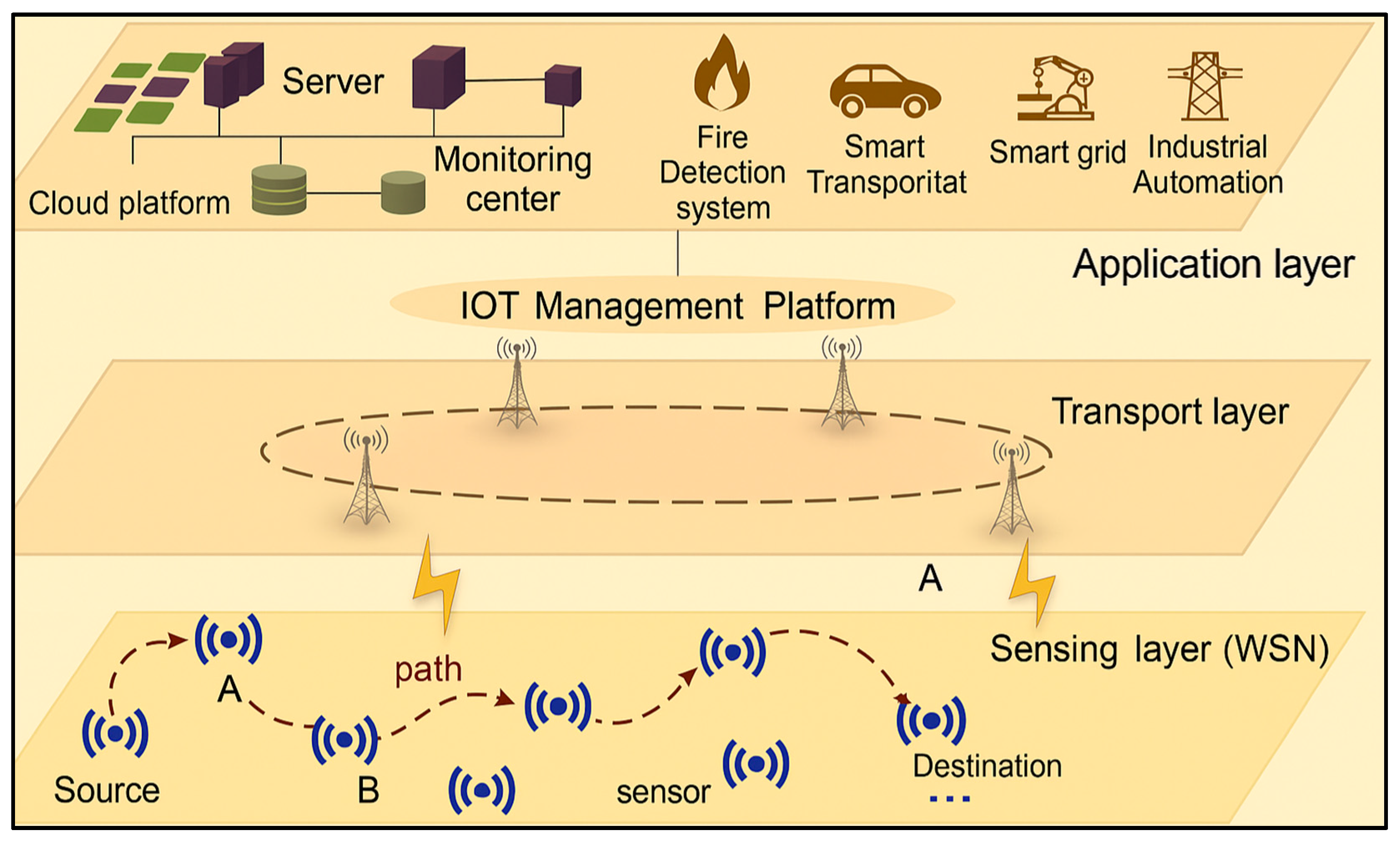
| Middleware Layer | Data aggregation, protocol translation, and cloud interfacing | Minimal/ No | Gateway-to-cloud or Base station-to-server (IP-based protocols) | MQTT, CoAP, HTTP, Cloud services | Data filtering, coaching, load balancing, semantic processing |
| Network Layer | Routing and transmitting data across nodes to a sink/base station | Yes | Node-to-node, Cluster-to-sink (multi-hop routing protocols) | Routing protocols (LEACH, AODV, RPL), Wireless standards (802.15.4) | Path selection, energy-efficient forwarding, QoS maintenance |
| Application Layer | Presenting data to users or external systems through applications | No | User interface, API communication, cloud-to-app | Web/Mobile applications, Dashboards, REST APIs | Visualization, user notifications, and command actuation |
| Ref. | Network Structure | Cross-Layer Optimization | Cluster Head Selection | Energy Efficient | Multi-hop Routing | Mobility Support | Scalability | Research Gaps |
|---|---|---|---|---|---|---|---|---|
| [72] | ✓ | ✗ | ✓ | ✓ | ✗ | ✗ | ✗ | Does not resolve issues such as cluster head failure, scalability in large WSNs, inefficiencies in random cluster creation, security vulnerabilities, and adaptation to dynamic network conditions. |
| [73] | ✓ | ✗ | ✓ | ✓ | ✗ | ✗ | ✗ | Leaves gaps in real-time adaptivity, context-awareness, efficient data aggregation, and secure routing in highly mobile or variable IoT environments. |
| [74] | ✓ | ✗ | ✓ | ✓ | ✗ | ✗ | ✗ | Does not address advanced machine learning integration, security enhancement, or cluster-head election reliability under dynamic loads. |
| [75] | ✓ | ✗ | ✓ | ✓ | ✗ | ✗ | ✗ | Lacks mechanisms for security, handling intense mobility, and robust cross-layer integration needed for IoT/cloud deployments at scale. |
| [76] | ✓ | ✗ | ✓ | ✓ | ✗ | ✗ | ✗ | it does not fully address security, mobility, or energy balancing for nodes experiencing uneven traffic loads. |
| [79] | ✓ | ✗ | ✓ | ✓ | ✗ | ✗ | ✗ | Limited attention to energy consumption minimization and security integration in real-world IoT deployments. |
| [80] | ✓ | ✗ | ✓ | ✓ | ✗ | ✗ | ✗ | Needs further study in terms of energy efficiency, privacy, and data integrity under city-scale stress tests. |
| [81] | ✓ | ✗ | ✓ | ✓ | ✗ | ✗ | ✗ | Gaps remain in generic applicability, integration of security features, and adaptation for unpredictable event patterns. |
| [82] | ✓ | ✗ | ✓ | ✓ | ✗ | ✗ | ✗ | Lacks scalability, validation, and built-in adaptive defenses against network attacks. |
| [83] | ✓ | ✗ | ✓ | ✓ | ✗ | ✗ | ✗ | research gaps persist in end-to-end security, practical real-time event responsiveness, and field deployment studies. |
| [84] | ✓ | ✗ | ✓ | ✓ | ✗ | ✗ | ✗ | Leaves open challenges in lightweight cryptography, scalability, intra-cluster attacks, and context-aware adaptation. |
| [85] | ✓ | ✗ | ✓ | ✓ | ✗ | ✗ | ✗ | Fails to integrate cross-layer optimizations and dynamic mobility handling for non-uniform event patterns. |
| [86] | ✓ | ✗ | ✓ | ✓ | ✗ | ✗ | ✗ | Research still lacks real-world scalability tests, robust security features, and integration of AI for dynamic event response. |
| [87] | ✓ | ✗ | ✓ | ✓ | ✗ | ✗ | ✗ | Gaps persist in achieving seamless energy balance during rapid node movements, secure data aggregation, and adaptive hierarchical architectures. |
| [88] | ✓ | ✗ | ✓ | ✓ | ✗ | ✗ | ✗ | Real-world adaptability, collaborative energy scheduling, and robust, lightweight security are still underdeveloped. |
| [89] | ✓ | ✗ | ✓ | ✓ | ✗ | ✗ | ✗ | Leaves gaps in fine-grained energy management, privacy engineering, and validation for city-scale networks. |
| [90] | ✓ | ✗ | ✓ | ✓ | ✗ | ✗ | ✗ | Missing adaptive real-time mobility, next-gen security, and high-scale empirical deployment data. |
| [91] | ✓ | ✗ | ✓ | ✓ | ✗ | ✗ | ✗ | Lacks comprehensive multi-objective balancing and deployment across other verticals (limited scope) |
| [92] | ✓ | ✗ | ✓ | ✓ | ✗ | ✗ | ✗ | Fails to ensure lightweight, scalable privacy protocols are effective across diverse IoT hardware. |
| Ref. | Core Technique | Contribution | CH Selection Basis | Routing/Data Handling | Key Features | Limitations |
|---|---|---|---|---|---|---|
| [101] | Hybrid PSO + Cuckoo search | QoS-aware clustering with multipath routing | Energy + QoS fitness | Clustered, multipath | QoS supported; static sink | The data transmission process can be optimized using a swarm intelligence algorithm. |
| [102] | Compressive data fusion + clustering | Relay-assisted compressive fusion | Weighted unequal clustering | Multi-hop relay clustering | Energy saving; static sink | Relay nodes are selected based on energy and path loss. Optimization methods could enhance relay selection by energy, distance, and traffic. |
| [103] | Hybrid optimization for ICWSNs | Information-centric clustering with edge | Energy + distance | Clustered, edge-assisted | Edge-enabled; static sink | Six factors were considered for optimal CH selection. Coordination among them is crucial; multi-attribute approaches are required. |
| [104] | Fuzzy multi-criteria + bio-inspired routing | Adaptive fuzzy CH selection | Energy + distance + rank | Clustered, multi-hop | Robust clustering | The use of bio-inspired algorithms instead of Fuzzy rules may optimize the selection of CHs in a better way. |
| [105] | Optimized fuzzy clustering | Uncertainty-aware CH election | Energy + distance (fuzzy rules) | Clustered | Improved energy balance | The use of bio-inspired algorithms instead of Fuzzy rules may optimize the selection of CHs in a better way. |
| [106] | Improved Harmony Search | Throughput-optimized clustering | Energy + distance | Multi-hop clustered | Throughput focus | The network can be clustered to improve energy efficiency further. |
| [107] | Hybrid fault-tolerant multipath | Fault-resilient multipath routing | Energy + reliability | Clustered, multipath | Fault tolerance | Using deep neural networks is resource-consuming, leading to computational complexity and overhead on resource-constrained sensors. |
| [108] | Emperor penguin optimization + enhanced flower pollination | Joint fault diagnosis + CH routing | Energy + behavior indicators | Clustered, multipath | Fault detection | CHs with high energy usage form multiple routes, potentially increasing CH energy consumption |
| [109] | Neuro-fuzzy routing | QoS-aware clustering | Learned fuzzy rules | Clustered | QoS supported | Using neural networks may cause additional computational overhead on the resource-constrained sensors. |
| [110] | Hybrid GSA + CSA | Multi-sink optimization | Energy + delay | Clustered, multi-sink | Multi-sink supported | Swarm optimization guarantees better CH election than weightage-based fitness functions. |
| [111] | Hybrid ABC + DE | Load-balanced clustering for mobile sinks | Avg. energy + delay | Clustered | Mobile sink supported | Mobile sink movement needs location and clock synchronization, inducing routing overhead. |
| [112] | Enhanced ACO | Cluster + mobile sink path optimization | CH + pheromone reinforcement | Clustered, mobile sink | Latency optimized | CHs can be selected using swarm intelligence algorithms for better optimization. |
| [113] | GAPSO + SVM | IDSS-based clustering for IoT layer | Energy + location (SVM aided) | Clustered | Localization aided | Multi-hop communication can provide more energy efficiency. |
| [114] | Mobile agent-assisted clustering | Lifetime extension for heterogeneous WSNs | Heterogeneous energy tiers | Clustered, agent forwarding | Reliability focus | Mobile agents have bloating issues problem |
| Ref. | AI Technique | Energy Efficiency | Network Delay | Scalability | Link Prediction | WSN/IoT Environment | Limitations |
|---|---|---|---|---|---|---|---|
| [123] | Multi-Agent Reinforcement Learning (Q-learning) | ✓ | ✓ | ✓ | ✓ | Dynamic | High computational overhead, slower in large/mobile networks |
| [124] | Dynamic Objective Selection with RL (DOS-RL) | ✓ | ✓ | ✓ | ✓ | Dynamic | Frequent policy updates raise costs and scalability issues as networks grow |
| [125] | Tabu Search + ACO Hybrid | ✓ | ✗ | ✓ | ✗ | Static | Needs parameter tuning, cluster head depletion in topological changes |
| [126] | Swarm Intelligence (PSO, SI models) | ✓ | ✓ | ✓ | ✗ | Dynamic | Sensitive to initial values, synchronization overhead |
| [127] | Ant Colony Optimization (ACO Variant) | ✓ | ✗ | ✓ | ✗ | Dynamic | Multi-agent overhead, increased coordination required |
| [128] | Genetic Algorithm Optimization | ✓ | ✓ | ✓ | ✗ | Static | Iterative optimization slows for rapidly changing networks |
| [129] | Genetic Algorithm | ✓ | ✗ | ✓ | ✗ | Static | Slow adaptation, routing overhead in dynamic scenarios |
| [130] | Particle Swarm Optimization (PSO) | ✓ | ✓ | ✓ | ✗ | Dynamic | High computation needs, slow route updating |
| [131] | Quantum PSO + Fuzzy Logic | ✓ | ✓ | ✓ | ✗ | Dynamic | Increased complexity with combined fuzzy/quantum models |
| [132] | Neuro-fuzzy Data Routing (NFDR) | ✓ | ✓ | ✗ | ✗ | Dynamic | Degrades under rapid state changes |
| [133] | DRL + Graph Neural Network | ✓ | ✓ | ✓ | ✓ | Dynamic | High cost for training and operation |
| [134] | AI-based Modular Framework | ✓ | ✓ | ✓ | ✓ | Dynamic | Heavy overall demand for processing and data |
| [135] | CNN + BEA-SSA | ✓ | ✓ | ✗ | ✗ | Static | Security/complex routing increases delay |
| [136] | RNN (Path Planning/Optimization) | ✓ | ✓ | ✓ | ✗ | Dynamic | Not optimal for all dynamic topologies (e.g., moving sink) |
| [138] | Neural Network LEACH Variant | ✓ | ✓ | ✓ | ✗ | Static | Higher computational needs, heavier model |
| [139] | Greedy Discrete PSO (GMDPSO) | ✓ | ✗ | ✓ | ✗ | Dynamic | Adapts to mobiles, but slow when updating routes |
| [140] | Multi-Intel. Biomedical Routing | ✓ | ✗ | ✗ | ✗ | Static | Specific to biomedical routing; generalizability lacking |
| [137] | DRL with Graph Structure (GTD3-NET) | ✓ | ✓ | ✓ | ✓ | Dynamic | Resource-intensive, not yet validated in the field |
| Protocol (Ref.) | Routing | Energy/ Round (mJ) | Throughput (kbps) | Latency | PDR | Network Lifetime | Mobility |
|---|---|---|---|---|---|---|---|
| LEACH [72] | Traditional (Hierarchical) | 85 | 45 | 120 | 92 | 1200 | No |
| PEGASIS [73] | Traditional (Chain-based) | 65 | 42 | 140 | 90 | 1800 | No |
| NICC [81] | Cross-Layer | 52 | 44 | 125 | 91 | 2100 | Limited |
| PSO-LEACH [93] | Metaheuristic | 55 | 46 | 110 | 94 | 2200 | Limited |
| AO-FA Hybrid [97] | Metaheuristic (Hybrid) | 48 | 50 | 95 | 97 | 3500 | Yes |
| EER-RL [119] | Machine Learning (RL) | 42 | 48 | 85 | 96 | 3200 | Yes |
| Neuro-Fuzzy (NFDR) [132] | Deep Learning (Neuro-Fuzzy) | 50 | 48 | 90 | 96 | 3000 | Limited |
| CNN-BEA-SSA [135] | Deep Learning (CNN) | 48 | 50 | 95 | 97 | 3500 | No |
| RPP-RNN [136] | Deep Learning (RNN) | 45 | 50 | 88 | 97 | 3300 | Yes |
| DRL-GNN (TD3) [137] | Deep Learning (DRL+GNN) | 35 | 52 | 72 | 98 | 4100 | Yes |
Disclaimer/Publisher’s Note: The statements, opinions and data contained in all publications are solely those of the individual author(s) and contributor(s) and not of MDPI and/or the editor(s). MDPI and/or the editor(s) disclaim responsibility for any injury to people or property resulting from any ideas, methods, instructions or products referred to in the content. |
© 2025 by the authors. Licensee MDPI, Basel, Switzerland. This article is an open access article distributed under the terms and conditions of the Creative Commons Attribution (CC BY) license (https://creativecommons.org/licenses/by/4.0/).
Share and Cite
Thakur, S.; Sarkar, N.I.; Yongchareon, S. AI-Driven Energy-Efficient Routing in IoT-Based Wireless Sensor Networks: A Comprehensive Review. Sensors 2025, 25, 7408. https://doi.org/10.3390/s25247408
Thakur S, Sarkar NI, Yongchareon S. AI-Driven Energy-Efficient Routing in IoT-Based Wireless Sensor Networks: A Comprehensive Review. Sensors. 2025; 25(24):7408. https://doi.org/10.3390/s25247408
Chicago/Turabian StyleThakur, Sumendra, Nurul I. Sarkar, and Sira Yongchareon. 2025. "AI-Driven Energy-Efficient Routing in IoT-Based Wireless Sensor Networks: A Comprehensive Review" Sensors 25, no. 24: 7408. https://doi.org/10.3390/s25247408
APA StyleThakur, S., Sarkar, N. I., & Yongchareon, S. (2025). AI-Driven Energy-Efficient Routing in IoT-Based Wireless Sensor Networks: A Comprehensive Review. Sensors, 25(24), 7408. https://doi.org/10.3390/s25247408