
Height Measurement Method for Meter-Wave Multiple Input Multiple Output Radar Based on Transmitted Signals and Receive Filter Design
Abstract
1. Introduction
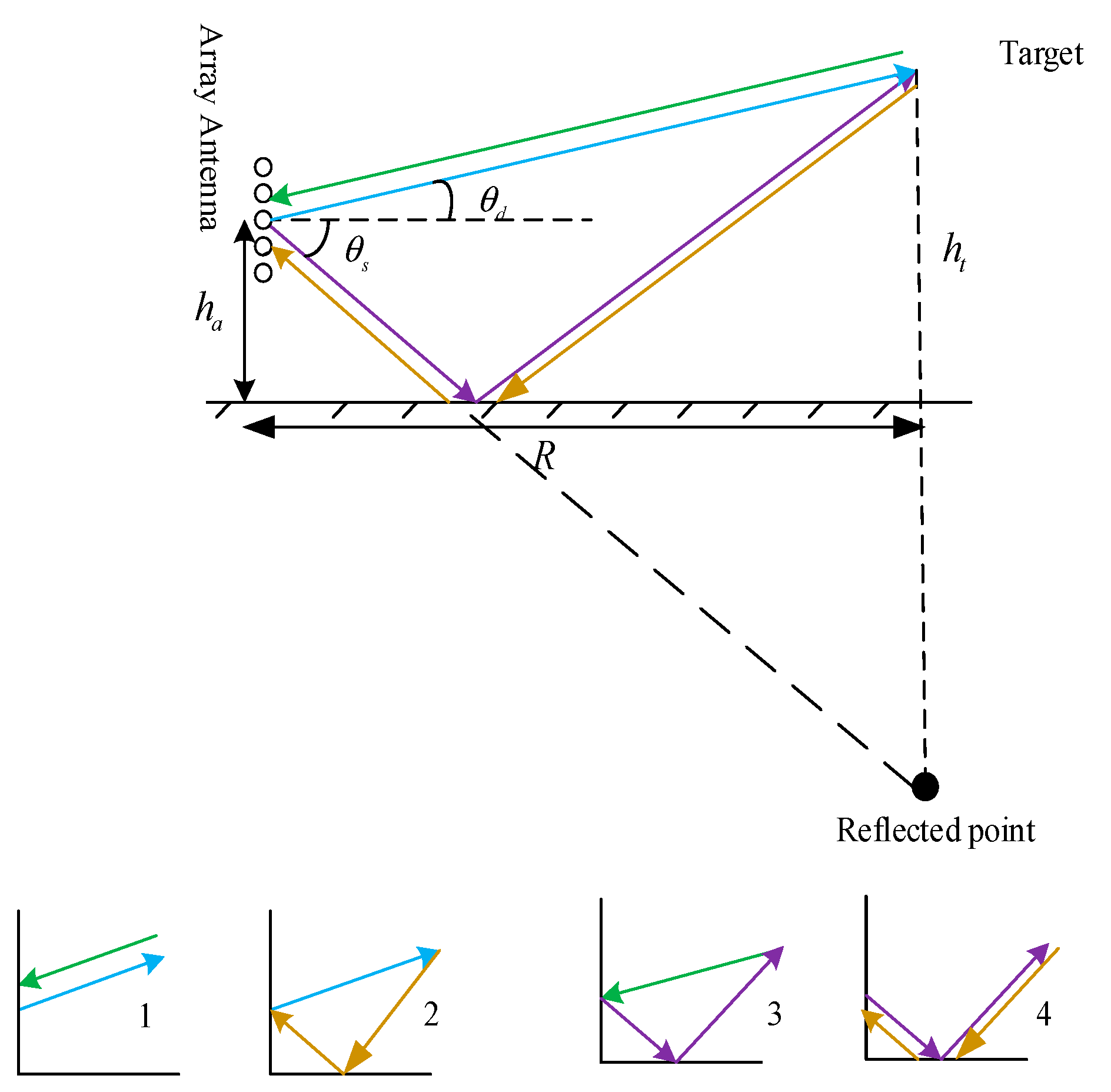
2. Signal Model
3. Analysis and Transformation of the Signal Model
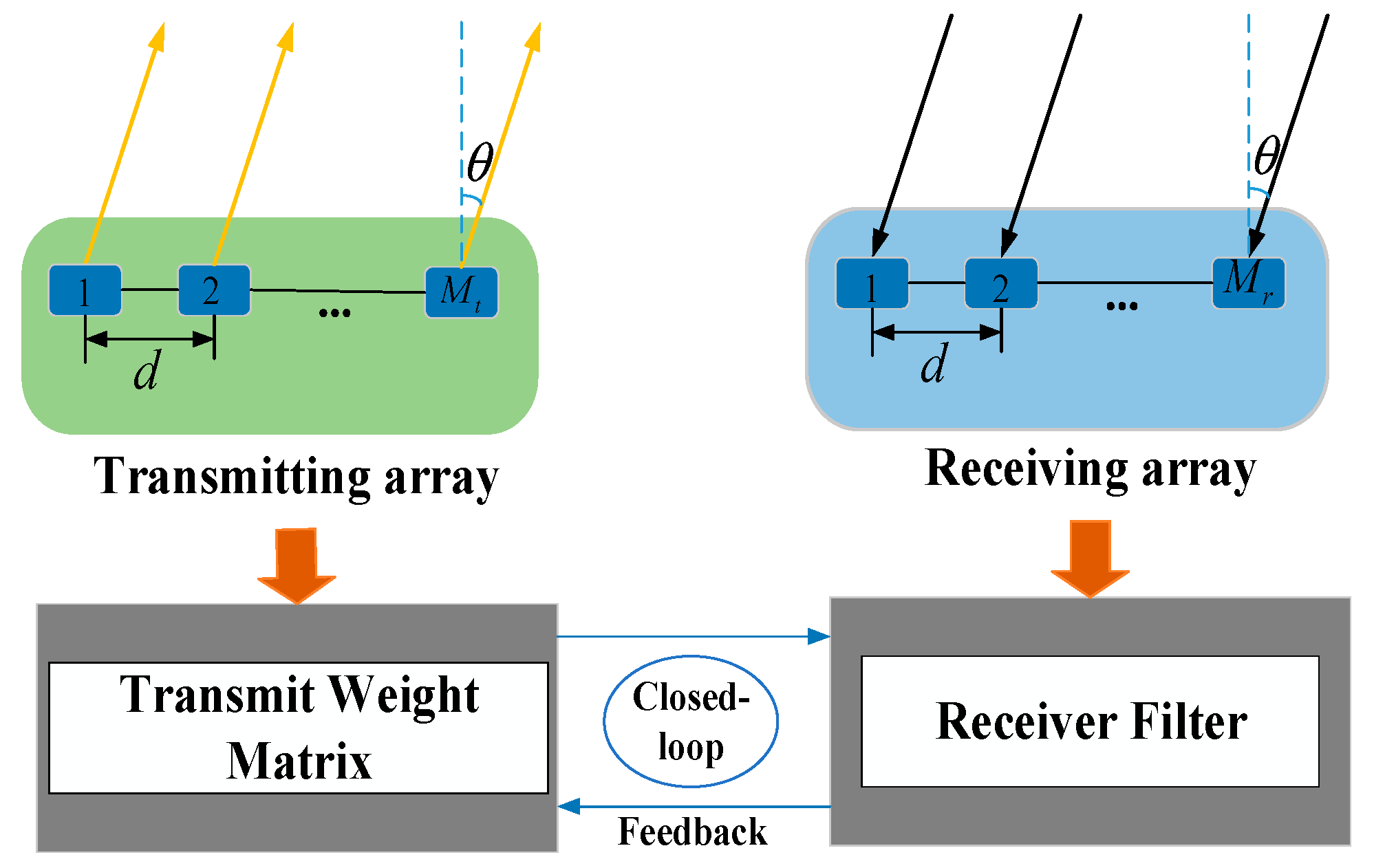
4. Height Measurement Algorithm for Meter-Wave MIMO Radar Based on the Joint Design of Transmitted Signals and Receive Filter
| Algorithm 1. Steps of algorithm |
| Input: , , , , Output: , , |
| Set Step 1: Let , and calculate using Equation (22); |
| Step 2: Calculate using Equation (18); |
Step 3: Solve the problem and obtain ;
|
| Step 4: If , let , , and return to step 1; otherwise, output , ; |
| Step 5: Obtain the spectral peak results using Equation (28) and iterate this through and the angle corresponding to the maximum value of is the elevation angle estimation; |
| Step 6: The height of the low-elevation target can be determined through the relationship between its elevation angle and height. |
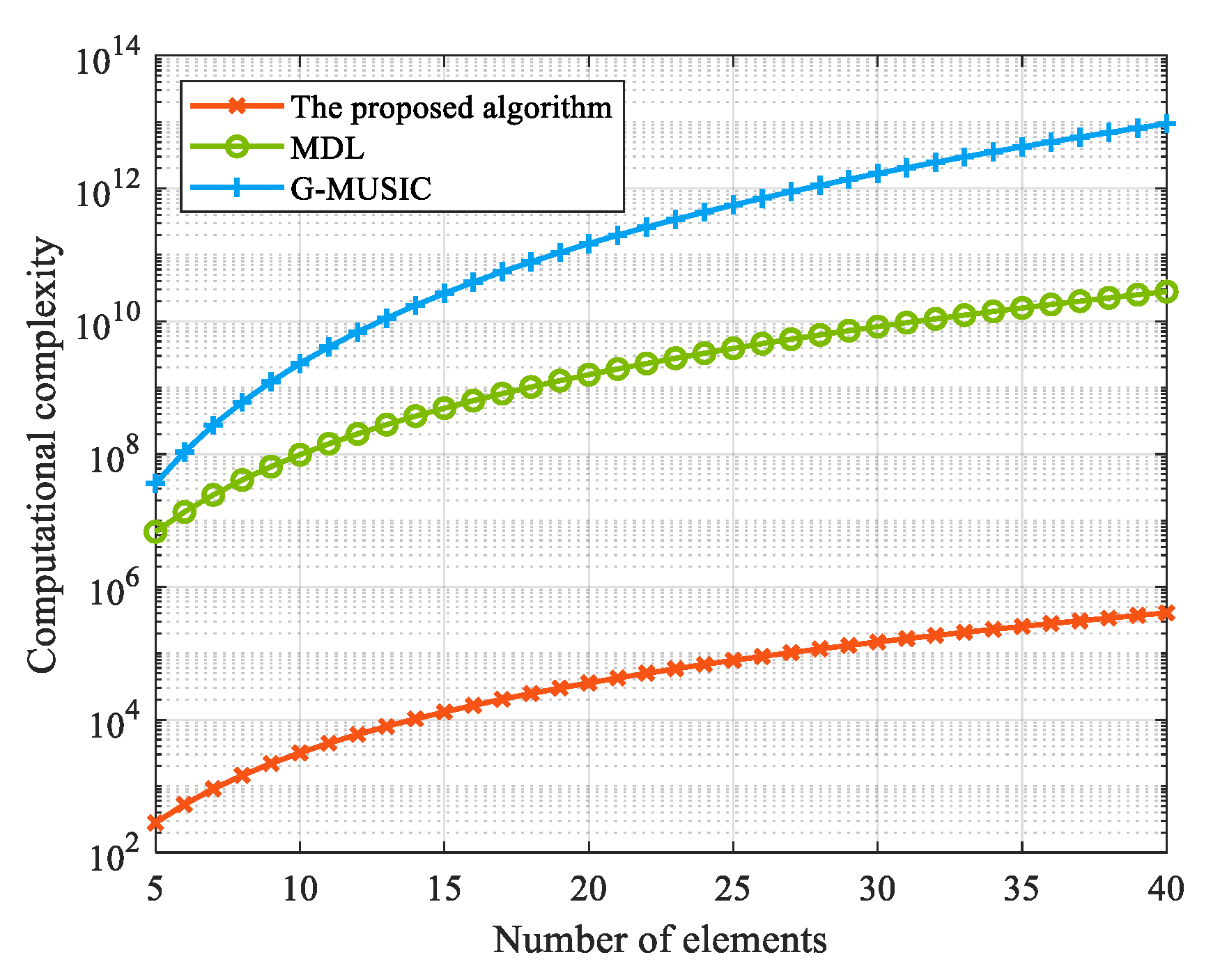
5. Algorithm Complexity Analysis
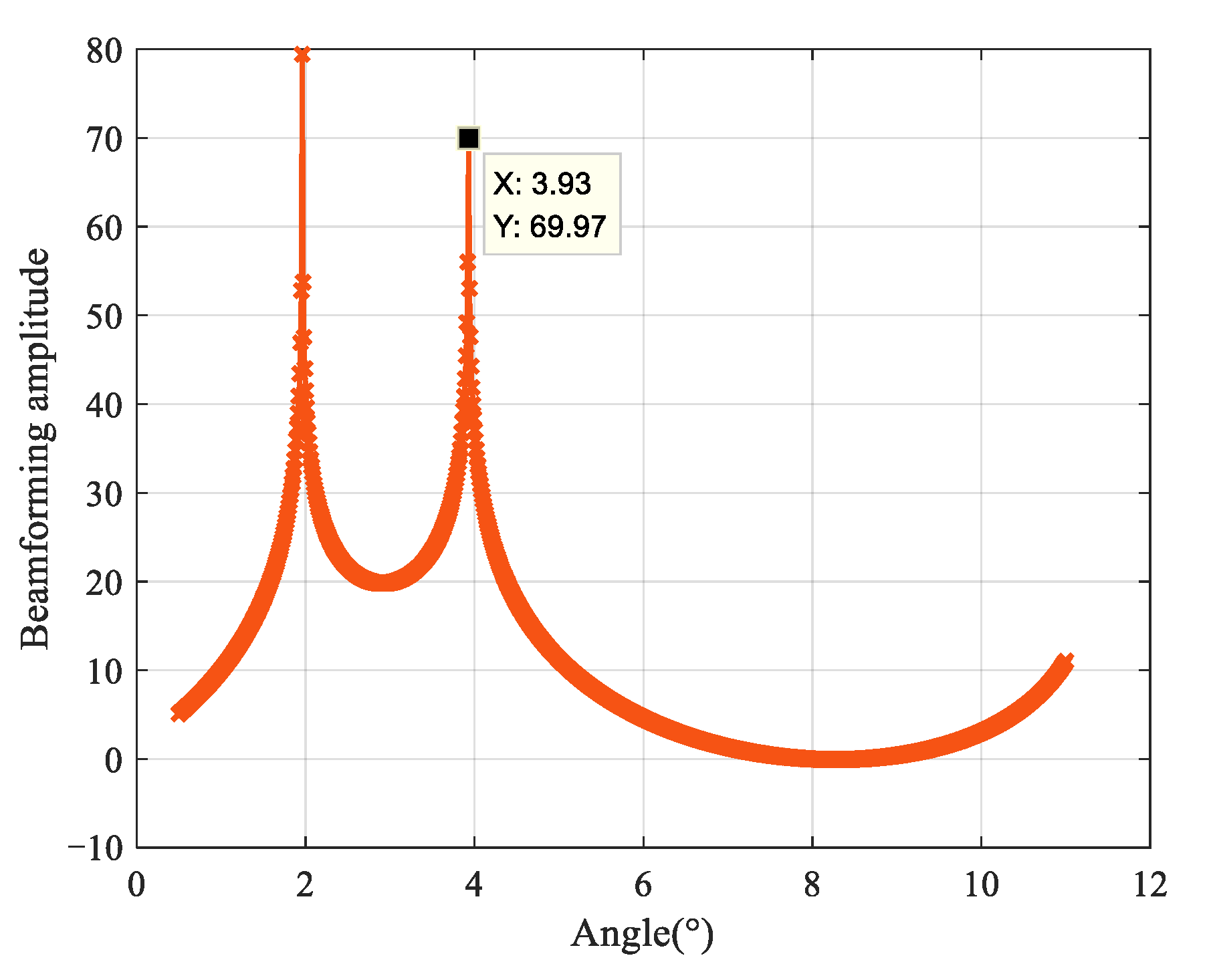
6. Simulation
7. Conclusions
Author Contributions
Funding
Institutional Review Board Statement
Informed Consent Statement
Data Availability Statement
Acknowledgments
Conflicts of Interest
References
- Zhang, Y.; Shi, J.; Zheng, G.; Zhou, H.; Song, Y.; Hu, G. Augmented coprime array design via hole analysis for direction of arrival estimation. IEEE Trans. Aerosp. Electron. Syst, 2024; early access. [CrossRef] [Scilit]
- Zhang, Y.; Zhou, H.; Hu, G. Further results on the degrees of freedom for coprime MIMO systems. IEEE Commun. Lett. 2023, 27, 3335–3339. [Google Scholar] [CrossRef] [Scilit]
- Liu, Y.; Liu, H.W.; Xia, X.G.; Zhang, L.; Jiu, B. Projection Techniques for Altitude Estimation Over Complex Multipath Condition-Based VHF Radar. IEEE J. Sel. Top. Appl. Earth Obs. Remote Sens. 2018, 11, 2362–2375. [Google Scholar] [CrossRef] [Scilit]
- Qin, C.; Zhang, Q.; Zheng, G.M.; Zhang, G.S.; Wang, S.Q. Height Measurement for Meter-Wave MIMO Radar Based on Sparse Array Under Multipath Interference. Remote Sens. 2024, 16, 4331. [Google Scholar] [CrossRef] [Scilit]
- Zoltowski, M.D.; Lee, T.S. Maximum likelihood based sensor array signal processing in the beamspace domain for low angle radar tracking. IEEE Trans. Signal Process. 2002, 39, 656–671. [Google Scholar] [CrossRef] [Scilit]
- Lee, T.S. Beamspace ML Bearing Estimation Incorporating Low-Angle Geometry. IEEE Trans. Aerosp. Electron. Syst. 1991, 27, 441–458. [Google Scholar] [CrossRef] [Scilit]
- Li, C.; Chen, B.; Zheng, Y.; Yang, M. Altitude measurement of low elevation target in complex terrain based on orthogonal matching pursuit. IET Radar Sonar Navig. 2017, 11, 745–775. [Google Scholar] [CrossRef] [Scilit]
- Paik, J.W.; Hong, W.; Lee, J.H. Direction-of-Departure and Direction-of-Arrival Estimation Algorithm Based on Compressive Sensing: Data Fitting. Remote Sens. 2020, 12, 2773. [Google Scholar] [CrossRef] [Scilit]
- Zhu, W.; Chen, B. Novel methods of DOA estimation based on compressed sensing. Multidimens. Syst. Signal Process. 2015, 26, 113–123. [Google Scholar] [CrossRef] [Scilit]
- Friedlander, B. Effects of model mismatch in MIMO radar. IEEE Trans. Signal Process. 2012, 60, 2071–2076. [Google Scholar] [CrossRef] [Scilit]
- Schmidt, R.; Schmidt, R.O. Multiple emitter location and signal parameter estimation. IEEE Trans. Aerosp. Electron. Syst. 1986, 34, 276–280. [Google Scholar] [CrossRef] [Scilit]
- Zhang, W.-J.; Zhao, Y.-B.; Zhang, S.-H. Altitude measurement of meter-wave radar using the general MUSIC algorithm and its improvement. J. Electron. Inf. Technol. 2007, 29, 387–390. [Google Scholar] [CrossRef] [Scilit]
- Djeddou, M.; Belouchrani, A.; Aouada, S. Maximum likelihood angle-frequency estimation in partially known correlated noise for low-elevation targets. IEEE Trans. Signal Process. 2005, 53, 3057–3064. [Google Scholar] [CrossRef] [Scilit]
- Liu, Y.; Jiu, B.; Xia, X. Height measurement of low-angle target using MIMO radar under multipath interference. IEEE Trans. Aerosp. Electron. Syst. 2017, 54, 808–818. [Google Scholar] [CrossRef] [Scilit]
- Zheng, G.; Chen, C.; Song, Y. Height Measurement for Meter Wave MIMO Radar based on Matrix Pencil Under Complex Terrain. IEEE Trans. Veh. Technol. 2023, 72, 11844–11854. [Google Scholar] [CrossRef] [Scilit]
- Foroozan, F.; Asif, A.; Jin, Y. Cramer-Rao bounds for time reversal MIMO radars with multipath. IEEE Trans. Aerosp. Electron. Syst. 2016, 52, 137–154. [Google Scholar] [CrossRef] [Scilit]
- Zeng, X.; Yang, M.; Chen, B.; Jin, Y. Low angle direction of arrival estimation by time reversal. In Proceedings of the ICASSP, New Orleans, LA, USA, 5–9 March 2017. [Google Scholar] [CrossRef] [Scilit]
- Zeng, X.; Yang, M.; Chen, B.; Jin, Y. Estimation of direction of arrival by time reversal for low-angle targets. IEEE Trans. Aerosp. Electron. Syst. 2018, 54, 2675–2694. [Google Scholar] [CrossRef] [Scilit]
- Lukin, V.-P. Adaptive system for laser beam formation in atmosphere with the use of incoherent images as reference sources. J. Opt. 2013, 15, 044009. [Google Scholar] [CrossRef] [Scilit]
- Chen, C.; Tao, J.; Zheng, G.; Song, Y. Meter-wave MIMO radar height measurement method based on adaptive beamforming. Digit. Signal Process. 2022, 120, 1051–2004. [Google Scholar] [CrossRef] [Scilit]
- Haykin, S. Cognitive radar: A way of the future. IEEE Signal Process. Mag. 2006, 23, 30–40. [Google Scholar] [CrossRef] [Scilit]
- Martone, A.F.; Sherbondy, K.D.; Kovarskiy, J.A.; Kirk, B.H.; Narayanan, R.M.; Thornton, C.E.; Buehrer, R.M.; Owen, J.W.; Ravenscroft, B.; Blunt, S.; et al. Closing the loop on cognitive radar for spectrum sharing. IEEE Aerosp. Electron. Syst. Mag. 2021, 36, 44–55. [Google Scholar] [CrossRef] [Scilit]
- Sira, S.P.; Papandreou-Suppappola, A.; Morrell, D. Dynamic configuration of time varying waveforms for agile sensing and tracking in clutter. IEEE Trans. Signal Process. 2007, 55, 3207–3217. [Google Scholar] [CrossRef] [Scilit]
- Hurtado, M.; Zhao, T.; Nehorai, A. Adaptive polarized waveform design for target tracking based on sequential Bayesian interference. IEEE Trans. Signal Process. 2008, 56, 1120–1133. [Google Scholar] [CrossRef]
- Huleihel, W.; Tabrikian, J.; Shavit, R. Optimal adaptive waveform design for cognitive MIMO radar. IEEE Trans. Signal Process. 2013, 61, 5075–5089. [Google Scholar] [CrossRef] [Scilit]
- Sharaga, N.; Tabrikian, J.; Messer, H. Optimal cognitive beamforming for target tracking in MIMO radar/sonar. IEEE J. Sel. Top. Signal Process. 2015, 9, 1440–1450. [Google Scholar] [CrossRef] [Scilit]
- Bell, K.L.; Baker, C.J.; Smith, G.E.; Johnson, J.T.; Rangaswamy, M. Cognitive radar framework for target detection and tracking. IEEE J. Sel. Top. Signal Process. 2015, 9, 1427–1439. [Google Scholar] [CrossRef] [Scilit]
- Sira, S.P.; Li, Y.; Papandreou-Suppappola, A.; Morrell, D.; Cochran, D.; Rangaswamy, M. Waveform-agile sensing for tracking. IEEE Signal Process. Mag. 2009, 26, 53–64. [Google Scholar] [CrossRef] [Scilit]
- Chen, H.; Ta, S.; Sun, B. Cooperative game approach to power allocation for target tracking in distributed MIMO radar sensor networks. IEEE Sens. J. 2015, 15, 5423–5432. [Google Scholar] [CrossRef] [Scilit]
- Manjunath, B.; Zhang, J.J.; Papandreou-Suppappola, A.; Morrell, D. Sensor scheduling with waveform design for dynamic target tracking using MIMO radar. In Proceedings of the 2009 Conference Record of the Forty-Third Asilomar Conference on Signals, Systems and Computers, Pacific Grove, CA, USA, 1–4 November 2009. [Google Scholar]
- Kershaw, D.J.; Evans, R.J. Optimal waveform selection for tracking systems. IEEE Trans. Inf. Theory 1994, 40, 1536–1550. [Google Scholar] [CrossRef] [Scilit]
- Sammartino, P.F.; Baker, C.J.; Griffiths, H.D. Frequency diverse MIMO techniques for radar. IEEE Trans. Aerosp. Electron. Syst. 2013, 49, 201–222. [Google Scholar] [CrossRef] [Scilit]
- Antonik, P.; Wicks, M.C.; Griffiths, H.D.; Baker, C.J. Frequency diverse array radars. In Proceedings of the 2006 IEEE Conference on Radar, Verona, NY, USA, 24–27 April 2006. [Google Scholar] [CrossRef] [Scilit]
- Secmen, M.; Demir, S.; Hizal, A.; Eker, T. Frequency diverse array antenna with periodic time modulated pattern in range and angle. In Proceedings of the 2007 IEEE Radar Conference, Waltham, MA, USA, 17–20 April 2007. [Google Scholar]
- Xu, J.W.; Liao, G.S.; Zhu, S.Q.; Huang, L.; So, H.C. Joint range and angle estimation using MIMO radar with frequency diverse array. IEEE Trans. Signal Process. 2015, 63, 3396–3410. [Google Scholar] [CrossRef] [Scilit]
- Cui, C.; Xu, J.; Gui, R.H.; Wang, W.Q.; Wu, W. Search-free DOD, DOA and range estimation for bistatic FDA-MIMO radar. IEEE Access 2018, 6, 15431–15445. [Google Scholar] [CrossRef] [Scilit]
- Liu, J.; Liu, Z.; Xie, R. Low angle estimation in MIMO radar. Electron. Lett. 2010, 46, 1565–1566. [Google Scholar] [CrossRef] [Scilit]
- Cui, G.; Li, H.; Rangaswamy, M. Mimo radar waveform design with constant modulus and similarity constraints. IEEE Trans. Signal Process. 2014, 62, 343–353. [Google Scholar] [CrossRef] [Scilit]
- Roy, R.; Paulraj, A.; Kailath, T. ESPRIT-A subspace rotation approach to estimation of parameters of cisoids in noise. IEEE Trans. Acoust. Speech Signal Process. 1986, 34, 1340–1342. [Google Scholar] [CrossRef] [Scilit]
- Stoica, P.; Nehorai, A. MUSIC, maximum likelihood, and Cramer-Rao bound. IEEE Trans. Acoust. Speech Signal Process. 1989, 37, 720–741. [Google Scholar] [CrossRef] [Scilit]
- Qin, C.; Zhang, Q.; Zheng, G.M.; Zheng, Y.; Zhang, G.S. Low angle estimation in MIMO radar based on unitary ESPRIT under spatial. IET Radar Sonar Navig. 2024, 18, 1829–1836. [Google Scholar] [CrossRef] [Scilit]



| Parameters | Symbols | Values |
| Number of transmitted array elements | 9 | |
| Number of received array elements | 9 | |
| Reference carrier frequency | ||
| Angle of the presumed target | ||
| Angle of the “Interference Signal” | ||
| Reference antenna’s height | 5 m | |
| Range | 200 km | |
| Number of Monte Carlo trials | 200 | |
| SNR threshold | 0.001 | |
| Number of randomized trials | 500 | |
| Angle search range | ||
| Angle search interval |
Disclaimer/Publisher’s Note: The statements, opinions and data contained in all publications are solely those of the individual author(s) and contributor(s) and not of MDPI and/or the editor(s). MDPI and/or the editor(s) disclaim responsibility for any injury to people or property resulting from any ideas, methods, instructions or products referred to in the content. |
© 2025 by the authors. Licensee MDPI, Basel, Switzerland. This article is an open access article distributed under the terms and conditions of the Creative Commons Attribution (CC BY) license (https://creativecommons.org/licenses/by/4.0/).
Share and Cite
Qin, C.; Zhang, Q.; Zheng, G.; Fu, X.; Zheng, H. Height Measurement Method for Meter-Wave Multiple Input Multiple Output Radar Based on Transmitted Signals and Receive Filter Design. Sensors 2025, 25, 478. https://doi.org/10.3390/s25020478
Qin C, Zhang Q, Zheng G, Fu X, Zheng H. Height Measurement Method for Meter-Wave Multiple Input Multiple Output Radar Based on Transmitted Signals and Receive Filter Design. Sensors. 2025; 25(2):478. https://doi.org/10.3390/s25020478
Chicago/Turabian StyleQin, Cong, Qin Zhang, Guimei Zheng, Xiaolong Fu, and He Zheng. 2025. "Height Measurement Method for Meter-Wave Multiple Input Multiple Output Radar Based on Transmitted Signals and Receive Filter Design" Sensors 25, no. 2: 478. https://doi.org/10.3390/s25020478
APA StyleQin, C., Zhang, Q., Zheng, G., Fu, X., & Zheng, H. (2025). Height Measurement Method for Meter-Wave Multiple Input Multiple Output Radar Based on Transmitted Signals and Receive Filter Design. Sensors, 25(2), 478. https://doi.org/10.3390/s25020478