Understanding Cyclists’ Visual Behavior Using Eye-Tracking Technology: A Systematic Review


Abstract
1. Introduction
2. Methodology
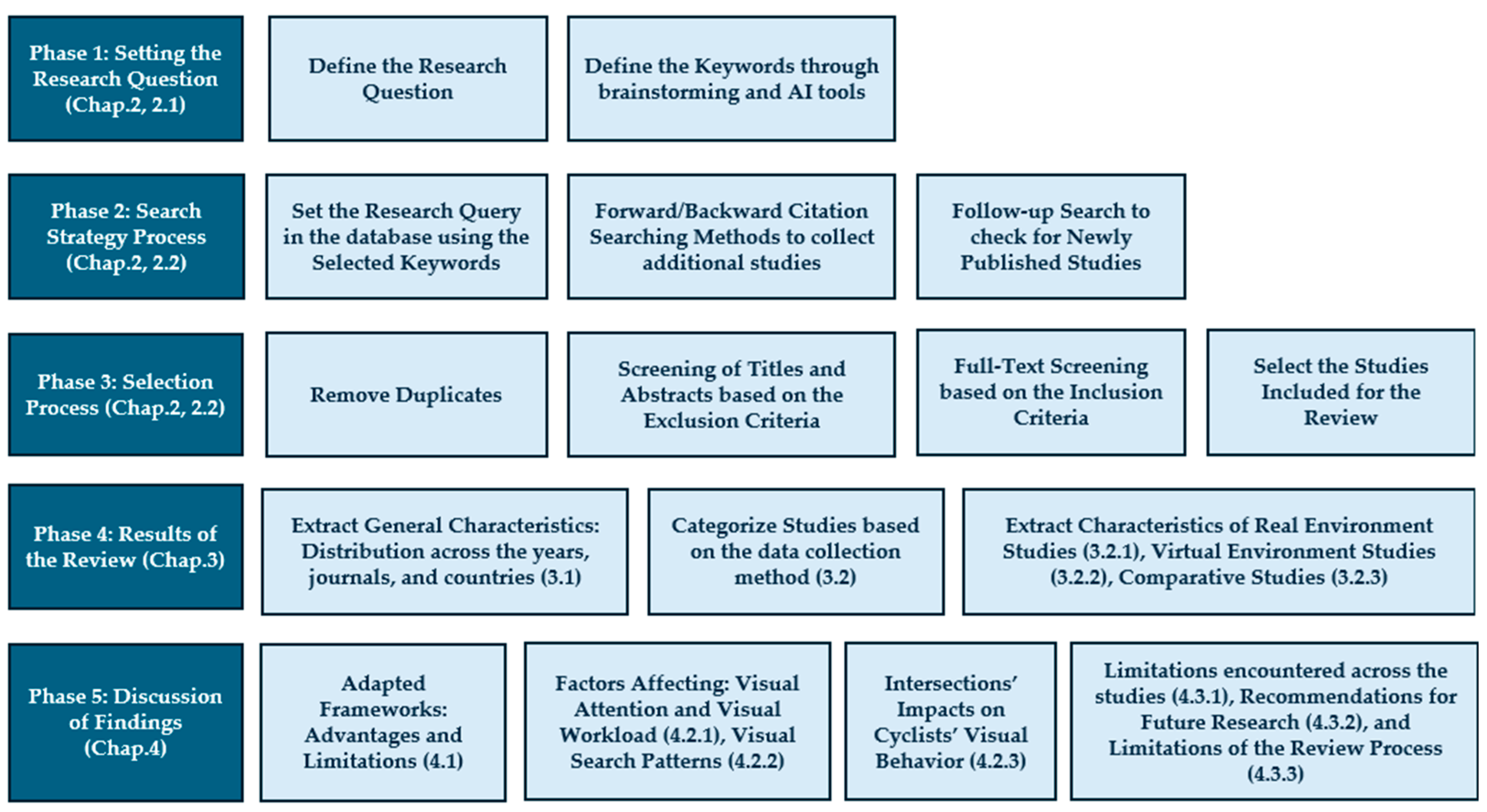
2.1. Defining the Methodological Approach and Key Steps of the Review
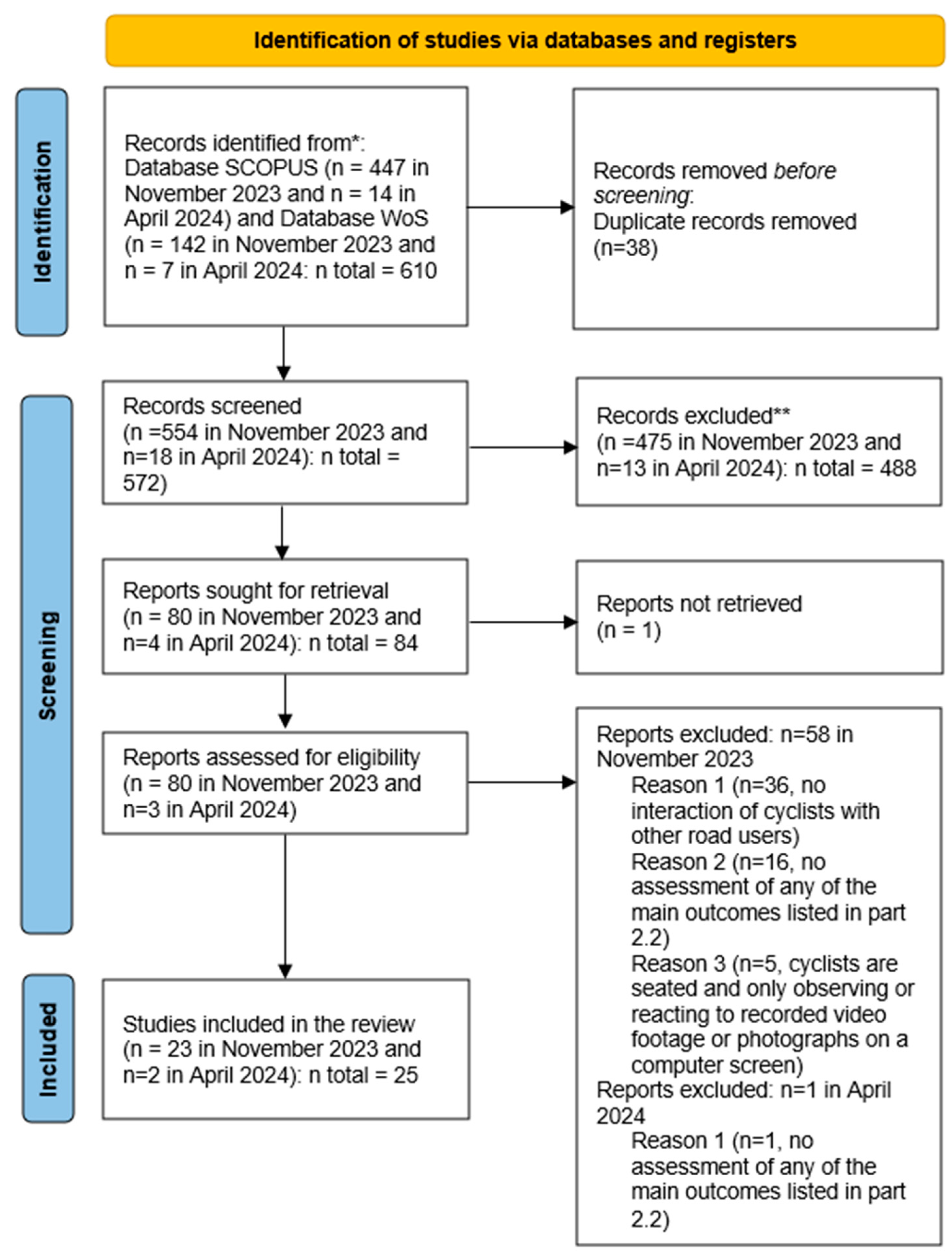
2.2. Search Strategy and Selection Process
- It was a conference paper or thesis, because only peer-reviewed journal articles that underwent a thorough and rigorous review process were included, thus ensuring high reliability and validity of the selected research papers for the review.
- It was in the subject areas of medicine, neuroscience, biochemistry, pharmacology, etc. and it was not related to the general research question.
- It assessed behavior using any method other than eye-tracking.
- The eye-tracking study focused on cars and pedestrians but did not consider interactions with cyclists.
- It involved accidents/collisions related to car drivers.
- It focuses on road safety without mentioning cyclist safety.
- The screening of titles and abstracts was performed using the following two approaches:
- The title was assessed, and if it was clear that the report was in a different field than road safety (for example, medicine or neuroscience), the report was excluded.
- By giving ChatGPT-3.5 the title and abstract and asking the following yes/no questions: “Was eye tracker used in this study?”, “Were cyclists included in this study?”, and “Was cyclist safety assessed in this study?”.
- By evaluating the abstract thoroughly. Because the use of ChatGPT is experimental in systematic reviews, it is important to confirm the results of the AI tool.
- It included interactions of cyclists with other road users (drivers of all types of motorized vehicles, pedestrians, motorists, and e-scooter riders).
- The eye tracker was used in the study to assess one of these outcomes, which are visual attention, visual workload, and hazard perception in the context of cyclist safety.
- The participants were actively cycling during the test, either in real traffic or using a bicycling simulator. Studies where participants were seated and only observing or reacting to recorded video footage or photographs on a computer screen were not included. Thus, the two included data collection methods were real traffic environments and virtual simulations, which will be discussed in detail in Section 3.
- Using the AI tool, ChatPDF, which allows researchers to upload their documents and then analyzes them and answers the questions asked by the reviewers. The yes/no questions were the following: “Does this study include interactions of cyclists with other road users?”, “Was the eye tracker used in the experiment to assess visual attention/ workload/ hazard perception in the context of cyclist safety?”, and “Are cyclists actively cycling during the experiment?”.
- When necessary, the reviewer read the text fully to answer the previous questions. ChatPDF provides answers with proof from the text by giving the page number and highlighting the evidence in the document. However, it may sometimes provide a doubtful response instead of a definitive yes or no. Thus, the answers of ChatPDF were checked carefully, and manual data extraction was performed when needed for accurate answers.
3. Results
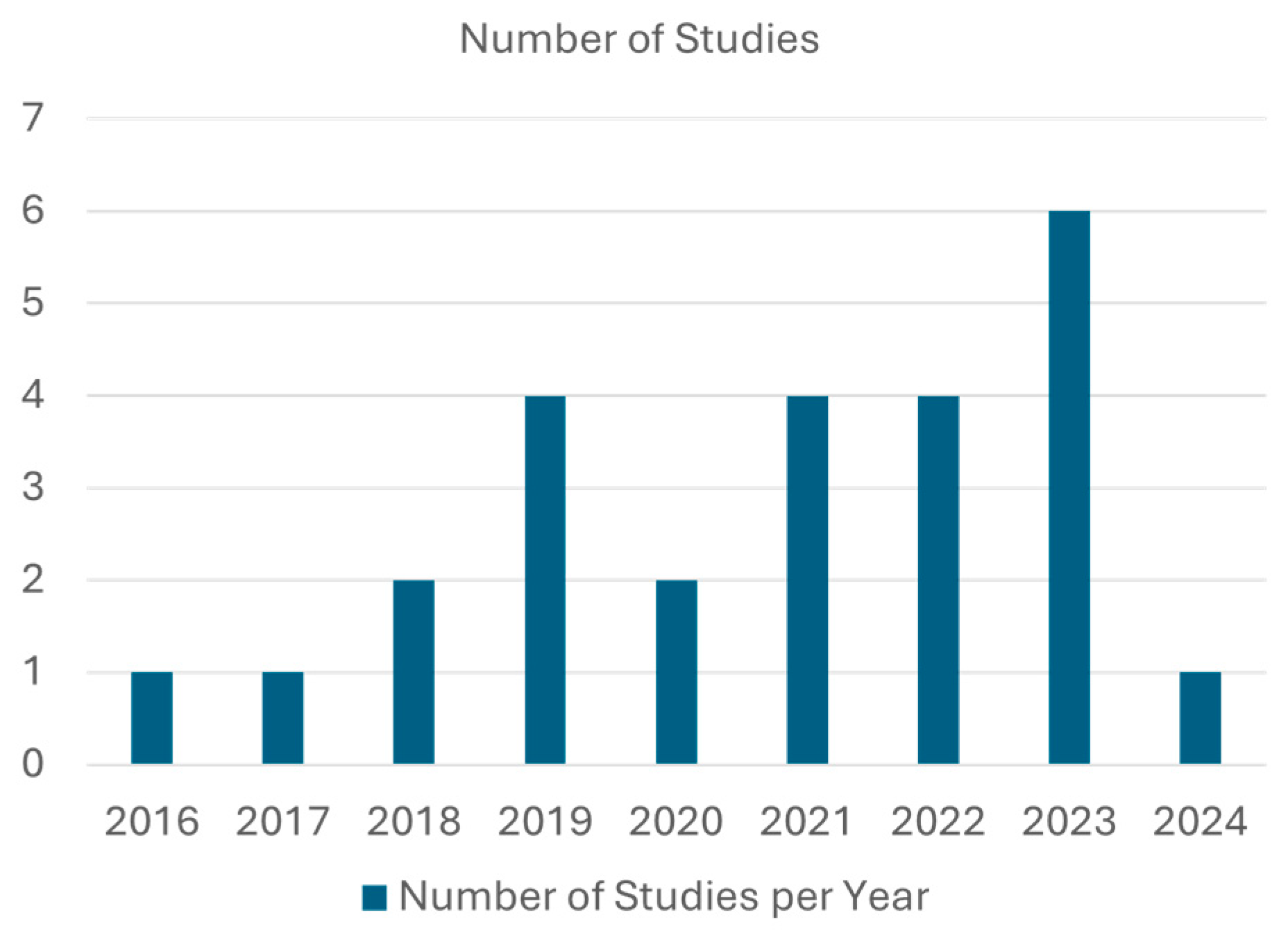
3.1. Studies’ Characteristics
3.2. Results of Individual Studies
- Samples’ characteristics.
- Experimental design and procedure.
- Data collection and analysis.
3.2.1. Real Environment Studies
- Samples’ Characteristics
- 2.
- Experimental Design and Procedure
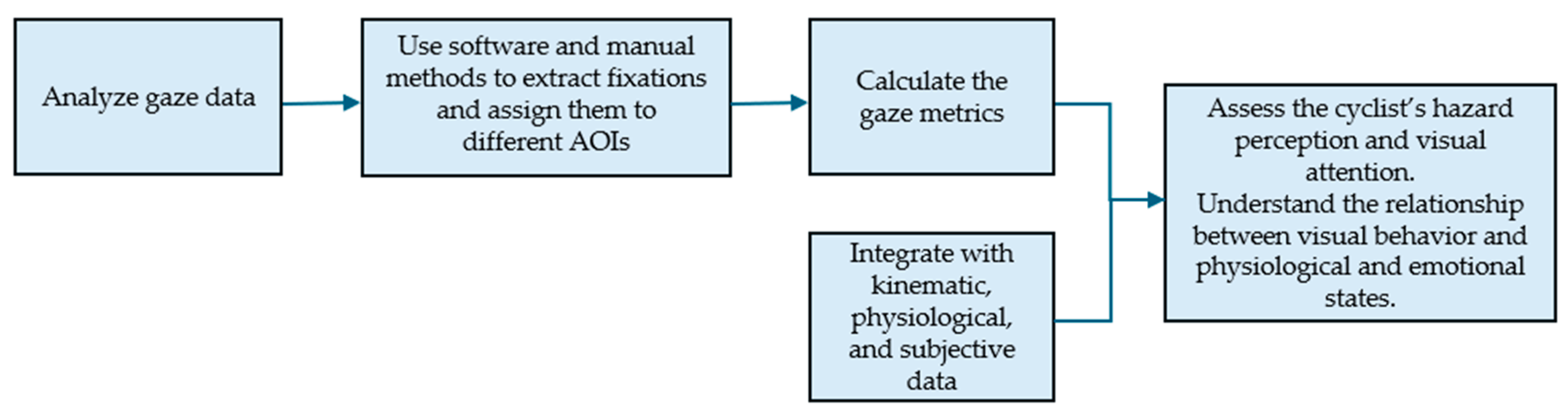
- Visual attention towards different areas of interest (AOI).
- Visual workload in varied route environments.
- Visual scanning behavior and gaze patterns.
- Integration of kinematic, physiological, and subjective risk perception data with gaze data.
- Cycling path: on-street cycling lane with mixed traffic [10], on-street separate cycling lane visually distinguished by a colored pathway separating them from vehicles [10,13], on-street separate cycling lane separated from motorized traffic using a bollard [13], shared bicycle–bus lane [10], shared pedestrian–cyclist lane [10,11,14,17], designated bike lanes in urban traffic [12,18], narrow pedestrian/cyclist tunnel [11], shared pedestrian–cyclist–electric scooter rider lane in a park [15], and off-road cycling path [12,18], also known as a mountain biking trail or a dirt trail, designed and constructed for cyclists away from public roads and urban areas.
- 3.
- Data Collection and Analysis
- Gaze data: collected using eye trackers. Table 3 presents the different gaze metrics measured and analyzed, along with their objectives.
- Kinematic data: obtained through GPS tracking, accelerometers, and gyroscopes, or by calculating the selected distance per time. Table 4 presents the different kinematic metrics collected and analyzed, along with their objectives.
- Subjective data: gathered through questionnaires, surveys, or interviews after the experiment. Similarly, Table 5 presents the subjective data collected and analyzed and their objectives.
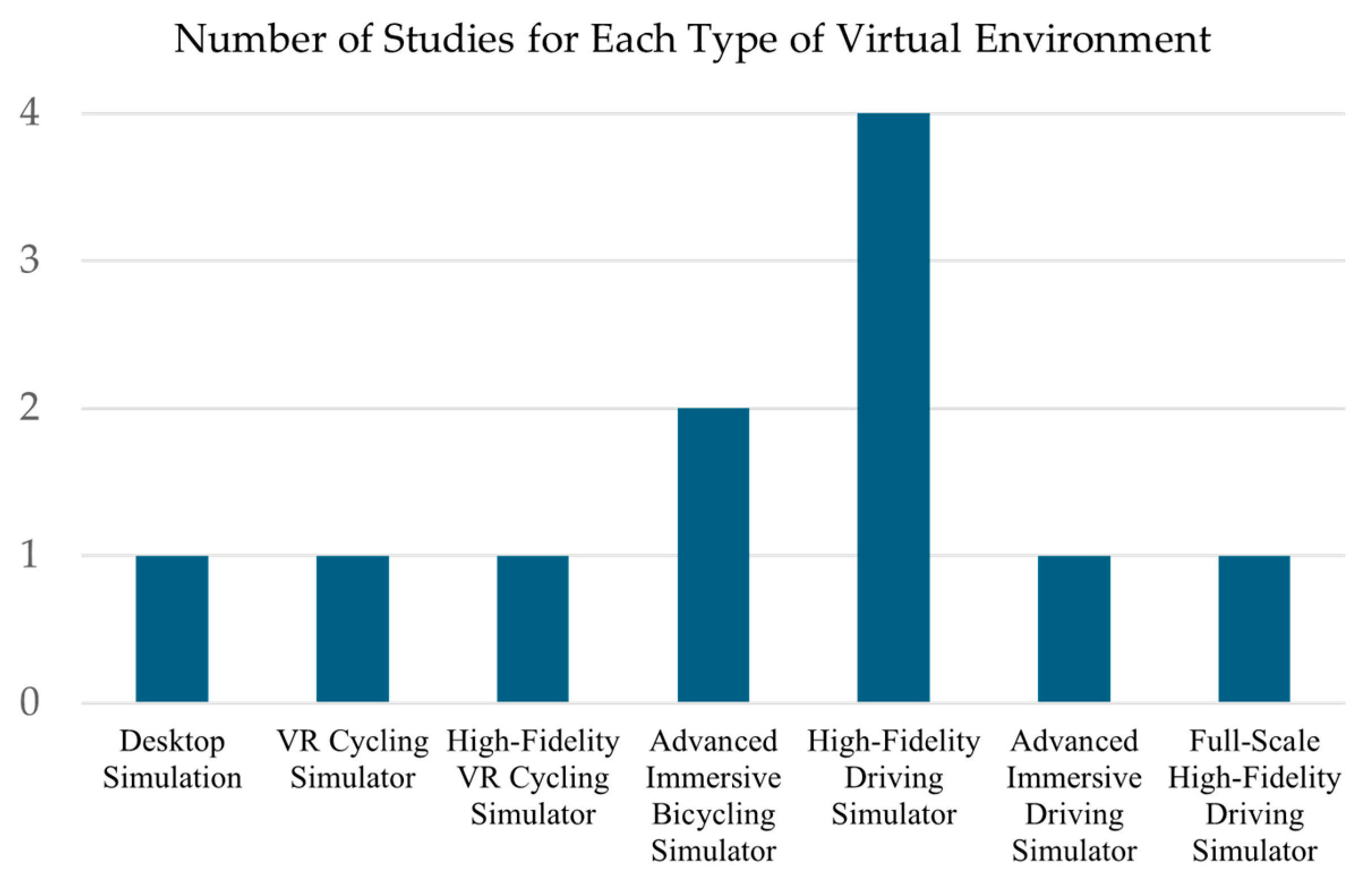
3.2.2. Virtual Environment Studies
- Desktop Simulation: This involves simulation configurations whereby participants operate within an immersive environment, a non-immersive setup, physical interfaces for control, and without head-mounted displays or fully enclosed environments [20].
- Virtual Reality (VR) Cycling Simulator: a Virtual Reality (VR) Cycling Simulator, designed for hazard perception training in traffic and cluttered environments. It features real-time sensor integration and uses procedural content generation for dynamic scenario creation [21].
- High-Fidelity Virtual Reality Cycling Simulator: High-fidelity virtual reality cycling simulators join real-world-standard cycling equipment with that of virtual reality to bring about realistic riding conditions of cyclists for analysis of cyclist behavior in realistic surroundings [22].
- Advanced Immersive Driving Simulator: This is a combination of high-quality features that enable the provision of deep immersion and a responsive driving experience for effective studies of driver behavior in dynamic and emergency conditions [29].
- Full-Scale High-Fidelity Driving Simulator: A high-fidelity driving simulator that involves the use of realistic full-scale systems within the vehicle, advanced motion systems, and technologies involving visual and auditory immersion to create a highly precise and realistic driving experience [30].
- Samples’ Characteristics
- 2.
- Experimental Design and Procedure
- Cyclist–Pedestrian Interactions: used to assess cyclists’ and pedestrians’ behavior at pedestrian crossings at signalized and unsignalized intersections [22]. Detailed information about the study design and driving scenarios is provided in Appendix A, Table A3.
- 3.
- Data Collection and Analysis
- Gaze data collected using eye-tracking systems. These data are briefly summarized in Table 7.
- Kinematic data obtained through GPS tracking, accelerometers, and gyroscopes or by dividing the selected distance per time. These metrics are measured and analyzed, and their objectives are presented in Table 8.
- Subjective data, gathered through questionnaires, surveys, or interviews after the experiment. Table 9 shows the subjective data collected and analyzed, and their objectives.
3.2.3. Comparative Studies (Real Environment vs. Virtual Environment)
- Samples’ Characteristics
- 2.
- Experimental Design and Procedure
- 3.
- Data Collection and Analysis
- Gaze data were obtained through eye trackers, and their characteristics and roles were examined in the data analysis and the results. These data are briefly summarized in Table 11.
- Subjective data were gathered via questionnaires administered after the experiment.
4. Discussion
4.1. Discussion of Adapted Frameworks
- Advantages and limitations of real and virtual environment studies. Studies conducted in real traffic environments offer the advantage of yielding unbiased results, as participants are fully immersed in the actual traffic conditions. This contrasts with virtual environments, which impose controlled settings that may affect cyclists’ natural behavior [33]. However, ethical considerations constrain real traffic studies, particularly those involving distractions, hazards, and conflicts with other road users to assess their impact on cyclists’ visual behavior. This ethical issue can be mitigated in virtual and simulated studies [9,16,32]. The findings indicate that both real and virtual environments provide valuable insights into cyclists’ visual behavior, although there are notable differences in gaze distribution and fixation durations between laboratory and field studies [32].
- Importance of including different types of road users and different experience levels. This review demonstrates that despite the focus on enhancing cyclists’ safety, the participant pool should not be restricted to cyclists alone [12,15,16,26,28,29,30]. Understanding the behavior of drivers and pedestrians towards cyclists is crucial, as interactions between drivers and cyclists predominantly occur at critical points, such as right-turn maneuvers, crossings, and on-road parking, while interactions between cyclists and pedestrians mainly occur at crossings and shared paths. Furthermore, including cyclists and drivers with varying levels of experience enhances the generalizability and applicability of the findings to broader populations [11,30].
- Main traffic scenarios included in the studies. Regarding the driving scenarios employed, the findings indicate that the most prevalent scenarios across all study types were intersection-related and urban route driving scenarios. These results underscore the importance of examining cyclists’ behavior at intersections, which are considered the most complex and high-risk segment. These scenarios primarily assess the visual behavior, decision making, and interaction of cyclists and drivers with other road users at critical points [12,14,17,18,25,27,28]. Additionally, urban route scenarios included a mix of traffic conditions, roadway features, and interactions with pedestrians and other vehicles, providing comprehensive data on visual search strategies, visual search patterns, and risk management in urban settings [13,21,23,32,33].
- Relationship with subjective risk perception. Various methods were employed across the studies to process and analyze gaze data. The general framework involved defining areas of interest (AOI), which are objects in the cyclists’ environment that may be observed during the experiment. Subsequently, gaze locations were extracted and overlaid on frames or the complete scene video. The frame-by-frame analysis [9], which involves extracting fixation data and manually associating each fixation with the relevant road factor, is the most consuming time method [14,17]. Overlaying fixation data on the scene video using software is the most effective method. Additionally, the introduction of machine learning algorithms is increasingly being adapted for extracting and processing gaze data. For instance, a classification task was performed using an unsupervised machine learning algorithm called the “Dwell-time fixation detection algorithm”, which classifies glances as fixations based on a determined glance duration threshold [14,17]. A pattern recognition algorithm was developed using neural networks to identify traffic objects that cyclists were looking at during the trip [19].
- Relationship with physiological measures. The gaze data extracted and analyzed varied across the studies and were selected based on the specific aims of each study. The primary focus across all studies was on the fixation analysis, as it provides insights into various aspects of gaze behavior, such as visual attention, visual workload, visual search patterns, and strategies, as detailed in the previous sections. Generally, fixation data were used to assess how cyclists and drivers navigate through intersections and respond to signage and other road stimuli [13,15,17,24]. Additionally, this helps researchers evaluate the impact of different road layouts, vehicle types, and pedestrian activities on visual attention and explore how environmental conditions, like lighting or weather, affect the visual behavior of road users [9,12,16,28,32]. The principal gaze metrics calculated are discussed as follows:
- Fixation durations and frequencies measure how long and how often participants fixate on specific points or objects, providing insights into what attracts the attention of drivers and cyclists and influences their behavior and decision making.
- Fixation’s locations help researchers infer the priority of visual information and how environmental factors influence visual scanning behaviors.
4.2. Discussion of the Main Findings
4.2.1. Visual Attention and Visual Workload
4.2.2. Visual Search Patterns
4.2.3. Intersections’ Impact on Cyclists’ Visual Behavior
4.3. Limitations and Future Research
4.3.1. Limitations
- Generalizability: Many studies are faced with the problem of their results not being generalizable to a broader population [10,11,19,29,32]. For instance, in study [14], there are challenges of their sample being diverse; hence, the applicability of its results will not work out for all age brackets and places. Similarly, Refs. [24] and [20] had findings whose usefulness demonstrated that the sample from simulating environments has limits in representing real-world situations.
- Limited use of machine learning in data processing and analysis: The use of machine learning in data processing and analysis was limited and found only in three studies, where the neural networks algorithm was used to categorize the objects participants were viewing [19] and the “Dwell-time fixation detection algorithm” classified glances as fixations based on a determined glance duration threshold [14,17]. These tasks are among the first attempts to employ machine learning for working with gaze data.
- Eye-tracking technology limitations (information bias): Several studies reported that eye-tracking technology lays a bias on the location of the fovea considering that foveal processing alone cannot support cycle control and safety due to limited information throughput [9,11,18]. Additionally, there exists a question regarding the applicability and reliability of eye tracking in dynamic cycling environments; see [13,18]. In addition, eye-tracking data may not accurately represent actual visual attention or conscious perception and therefore may introduce information bias. Thus, misinterpretation of eye-tracking data was noted as a risk in several studies, specifically by noting that the gaze may not imply visual attention or hazard perception [9,11,13,19].
- Confounding variables: The most significant concerns were the external factors and the presence of the experimenters. For example, study [16] notes that the logging equipment and experimenters may cause potential confounding through alteration of participants’ natural behavior.
4.3.2. Recommendations for Future Research
- Increasing sample size and diversity: Numerous studies highlighted the need for larger and more diverse samples to improve the generalizability of results [9,12,14,16,17,19]. For example, study [17] recommends recruiting a broader range of individuals and conducting studies in different locations. Similarly, study [14] suggests increasing the sample size and including participants from varied backgrounds, ages, and genders. To analyze data using statistical tests and models, the average sample size for eye-tracking studies is 21 participants [34]. For studies implementing machine learning techniques, no previous studies have specified a certain number; however, because for each participant there is a large dataset, the sample size can be equal to or smaller than 21 (with a minimum of 10). Note that a reduction in the number of participants due to technical issues should be considered.
- Exploring peripheral vision and different urban settings: Several studies emphasized the importance of considering peripheral vision and real-world conditions. This would allow researchers to gain a more comprehensive understanding of cyclists’ visual attention in various traffic conditions. For instance, study [18] suggests investigating the role of peripheral vision in VRU detection, while several recommendations highlight the need to conduct studies under varied urban layouts and traffic densities to understand how different environments impact cyclist behavior and safety [13,16,24,25].
- Behavioral studies under varied conditions: Conducting experiments that examine cyclist behavior across different weather conditions, times of day, and traffic scenarios can provide more actionable insights into effective safety interventions [20,23,28]. As a proposed solution, long-term studies that capture data across different road types, weather conditions, and periods ensure an enhanced comprehension of cyclists’ adaptability to infrastructure and environmental changes. This type of study needs to define a clear objective and overall scope, select dependent and independent variables during long-term data collection, use eye-tracking data with advanced properties that overcome all weather conditions, and provide incentives for participants.
- Advancing data analysis through broader machine learning applications: Study [19] suggests exploring machine learning to understand cyclists’ data demands better and enhancing existing data models by incorporating additional information. Moreover, machine learning can improve the accuracy of visual behavior models and help identify patterns more effectively. Because the road environment dataset contains significant variability, machine learning can also be applied to large datasets that include more factors from both the infrastructure and the cyclists’ environment [35,36]. As a result, a deeper understanding of cyclists’ behavior under various conditions can be achieved.
- Enhancing simulation fidelity: Many studies recommend using advanced simulation technologies to better replicate real-world scenarios and reduce simulator-related biases [10,11,21,22,31]. For example, ref. [22] proposes new methods to improve the simulation experience by integrating development platforms like Unity or Unreal with the transportation simulation software (Synchro or Vissim) to simulate traffic networks, objects, and vehicle behaviors more credibly and create scenarios where different users can interact together, while [31] suggests adapting virtual reality settings to generate varying levels of traffic density.
- Validating and comparing results: Conducting field tests to validate simulator findings and comparing gaze behavior across different environments were recurrent recommendations. Study [20] emphasizes the need for further simulator and field tests to validate the safety impact of the investigated systems. Additionally, ref. [11] suggests comparing gaze behavior and risk perception between different types of urban environments.
- Equipment and multimodal data collection: Studies [9,18,19] recommend using more developed eye trackers with better storage and battery capacity and the ability to include peripheral vision. In study [19], the used eye tracker Pupil Invisible (manufactured by Pupil Labs) has a battery with up to 2.5 h of recording time and 40 h of recording storage, but as equipment has developed over the years, new eye-tracking glasses have up to 4 h of recording time and 25+ h of recording storage, such as Pupils Neon (manufactured also by Pupil Labs). Combining eye tracking with other methods, like EEG, emotion recognition, and interviews, can enhance the accuracy and depth of behavioral analysis [13]. In addition, ref. [22] highlights the importance of integrating heart rate data and behavioral responses with gaze data to understand the effect of stress levels and mental workload on the interactions of participants with the surrounding environment. Thus, such integrations can provide a holistic view of the cognitive and emotional states influencing cyclists’ gaze behaviors.
- Establishment of ethical standards: Given the potential risks associated with real traffic research, establishing, and enforcing global ethical standards for road safety research is crucial [9]. This ensures the protection of participants while also maintaining the integrity of the research data.
4.3.3. Limitations of the Review Process
5. Conclusions
Author Contributions
Funding
Institutional Review Board Statement
Informed Consent Statement
Data Availability Statement
Conflicts of Interest
Appendix A

| ID, Ref. | Objective(s) (Obj) | Research Question (RQ)/Hypothesis (Hyp) | Country | Sample Size |
|---|---|---|---|---|
| 1, [9] | Examine the impact of listening to music on the visual behavior of teenage cyclists in real traffic environments. | Do cyclists counterbalance the reduced auditory input by amplifying their visual attention? | The Netherlands | 14 |
| 2, [16] | Use the Minimum Required Attention (MiRA) theory and the Salience, Effort, Expectancy, Value (SEEV) model to examine whether attentional demands put on drivers and cyclists are different in urban intersections and how difficult it is to fulfill these requirements for the two road user groups. | It is assumed that drivers and cyclists experience differing levels of attentional demands within the same environment. | Sweden | 23 |
| 3, [17] | Investigate cyclist gaze behavior in a real urban environment on bicycle tracks that are exclusive or shared with pedestrians. | This experiment enables analyzing quantitatively cyclists’ gaze patterns and understanding the factors that affect their trip. | Italy | 13 |
| 4, [19] | Obj 1: Explore innovative approaches for evaluating the impact of route guidance measures on cyclists within actual traffic conditions. Obj 2: Assess the usability and traffic safety implications of the newly implemented wayfinding system. | RQ 1: How beneficial was the implementation of the new signage strategy by the Oslo City Council? RQ 2: To what extent did the Oslo city council’s adoption of the new signage strategy prove beneficial? | Norway | 20–28 |
| 5, [10] | Examine cyclists’ behavior, their interactions with road users and, their response to various aspects of the road surface and geometric layout, using an instrumented bike in bad weather. | How do different road surface characteristics and geometric designs influence cyclists’ behavior, perception, and interactions with other road users in extreme weather conditions? | Sweden | 22 |
| 6, [11] | Investigate the effects of subjective risk perception and spatial characteristics of a location on gaze behavior during urban cycling. | Hyp 1: Cyclists consider locations with increased spatial complexity and numerous obstacles that obstruct the line of sight as more unsafe, as they inhibit the early detection of potential hazards. Hyp 2: The spatial complexity of a location and the perceived level of risk do not necessarily dictate how long an object is fixated upon, but they significantly influence the ability and capacity to look ahead. In spatially complex environments, cyclists may need to divert their gaze in various directions and anticipate potential hazards from multiple angles. | Germany | 20 |
| 7, [18] | Obj 1: Identify the prevalence of drivers’ visual scanning failures towards areas where conflicting vulnerable road users (VRUs) could approach at urban intersections. Obj 2: Assess how these scanning failures are moderated by cycling experience for non-novice drivers. | Hyp 1: Experienced drivers who regularly use a bicycle as a transportation tool will have fewer visual scanning failures towards areas where conflicting vulnerable road users (VRUs) can approach compared to drivers who rarely or never use a bicycle for transportation. Hyp 2: Drivers will exhibit more visual scanning failures at intersections with a history of crashes compared to those without a crash history. | Canada | 26 |
| 8, [12] | Obj 1: Provide a more detailed quantification of the areas where drivers direct their attention, aiming to enhance comprehension of human factor challenges related to attention distribution at urban intersections. Obj 2: Examine potential discrepancies between drivers who are cyclists and those who are not. | How do drivers distribute their visual attention to vulnerable road users while navigating urban intersections? | Canada | 26 |
| 9, [13] | Obj 1: Characterize the eye movement patterns of cyclists. Obj 2: Explore possible correlations between the eye gaze behavior of cyclists and urban environmental features, such as elevated cycle paths, physical barriers, land use, and pedestrian volume. | RQ: Study how urban features like elevated cycle paths, physical barriers, land usage, and pedestrian density impact the gaze patterns of cyclists. Hyp: Cyclists would exhibit specific gaze behaviors influenced by different urban characteristics. | Korea | 50 |
| 10, [14] | Understand how design characteristics of intersections moderate how cyclists of various experience levels negotiate the intersections, as measured by the number and duration of fixations. | How do cyclists visually interact with the environment, and how do certain factors, such as experience level and intersection design, influence their visual attention and decision-making? | Italy | 13 |
| 11, [15] | Investigate the visual attention and speeds of pedestrians, cyclists, and electric scooter (ES) riders when using shared roads. | Compare the visual attention and speeds of pedestrians, cyclists, and electric scooter riders in shared road environments to understand differences in behavior and potential hazards. | Poland | 12 |
| 12, [20] | Assess the impact of the cyclist warning system (CWS) on behavioral indicators (braking reaction, gaze behavior) and subjective ratings of perceived safety and mental workload. | Investigate the effects of a CWS on a behavioral level and its users’ assessments, considering age-related effects. | Germany | 51 |
| 13, [23] | Analyze the physiological response and visual attention of cyclists in commercial vehicle loading zones to understand how different environmental and roadway conditions affect cyclist stress levels. | Determine how the size of the commercial vehicle loading zone influences the stress responses of cyclists, considering factors like the presence and position of a courier and loading zone accessories. | Oregon, USA | 48 |
| 14, [24] | Investigate the impact of pavement markings, truck traffic, and gender on the visual attention of cyclists during conflicts with truck traffic. | RQ 1: Do pavement markings and truck maneuvers affect the visual attention of cyclists? RQ 2: Does cyclist gender influence cyclists’ visual attention during conflicts with truck traffic? | Oregon, USA | 48 (7 excluded due to technical problems) |
| 15, [25] | Evaluate the effects of engineering treatments on motorist behavior during right-turn maneuvers at signalized intersections, specifically focusing on the latter portion of the green phase. | Hyp 1: “The engineering intervention does not impact the average duration of fixation for right-turning drivers on areas of interest (AOIs) within the driving environment.” Hyp 2: “The engineering intervention does not influence the time-to-collision (TTC) values of right-turning motorists during near-collision or collision events.” Hyp 3: “The engineering intervention does not impact the velocity of right-turning motorists during near collision or collision occurrences.” | Oregon, USA | 28 |
| 16, [26] | Investigate the impact of cyclist-evoked arousal and attention to cyclists on driving behavior in the context of driver–cyclist interactions. | Stronger physiological arousal and greater attention to cyclists will be associated with safer driving behavior. | Texas, USA | 104 |
| 17, [29] | Obj 1: Investigate driver responses in emergency car-to-cyclist collisions. Obj 2: Understand the factors influencing collision occurrences in scenarios with different time to collision (TTC) values for cyclists approaching from near and far sides. | How do drivers react when cyclists intrude into a car’s path at an intersection? | Japan | 31 |
| 18, [30] | Examine the visual attention and behavior of two categories of drivers with varying levels of experience in pedal cycling (cyclists and non-cyclists) towards vulnerable road users at intersections within a driving simulator. | Investigating the behavior and visual attention of drivers with differing pedal cycling experiences towards vulnerable road users at junctions in a driving simulator. | UK | Study 1: 40 Study 2: 40 |
| 19, [27] | Investigate how the presence of cyclists affects driver performance during automated vehicle take-over requests (TORs) in a driving simulator. | How do human drivers of automated vehicles interact with cyclists during a right-turn maneuver after receiving a take-over request (TOR)? | Oregon, USA | 46 (3 excluded due to technical problems) |
| 20, [28] | Investigate the driver’s visual attention and the risk of a right-hook crash in a simulated virtual environment at signalized intersections when a cyclist is present and in different circumstances that might affect the driver’s visual attention. | How do the relative positions of adjacent cyclists influence a right-turning driver’s visual search and mean total fixation duration on areas of interest in the driving environment? | Oregon, USA | 67 (16 excluded due to technical problems) |
| 21, [22] | Propose a framework for evaluating cyclist and pedestrian behavioral changes by integrating human physiological sensing within immersive virtual environments (IVEs). | How are participants’ stress levels and cognitive load impacted by different roadway settings and real-time events in the IVE? | Virginia, USA | 5 |
| 22, [21] | Evaluate hazard detection and anticipation of overt and covert traffic situations in young cyclists using an immersive virtual reality bicycle simulator. | Assess the effectiveness of a virtual reality cycling simulator in measuring hazard anticipation skills in children. | Belgium | 130 |
| 23, [31] | Develop and evaluate a virtual environment to assess cycling hazard perception skills. | The development and evaluation of a Cycling and Hazard Perception virtual reality (VR) simulator (CHP-VR simulator) to assess and potentially train hazard perception skills in cyclists. | Finland | 6 |
| 24, [32] | Obj 1: Analyze the visual behavior of cyclists in both simulated and real scenarios. Obj 2: Understand the factors that could affect their performance and safety. | RQ: Compare the visual behavior of cyclists in simulated and real scenarios to highlight objective differences in behavior. Hyp: There will be variations in visual attention and workload between the two scenarios. | Sweden | 40 (20 for the on-site test and 20 for the simulated experiment) |
| 25, [33] | Evaluate and compare the gaze behavior in the field with that in a cycling simulator setup to assess the realism of the simulator in reproducing traffic behavior. | Hyp 1: More control glances at the roadway in the field study are expected compared to the simulation study. Hyp 2: More active gaze behaviors in the field study are anticipated in terms of the number of fixations per time unit. | Germany | 19 Simulation study: 15 Field study: 14 |
| ID, Ref. | Source of Participants | Mean Age (sd) | Female, % | Road User Type | Cycling Experience | Equipment |
|---|---|---|---|---|---|---|
| 1, [9] | From a secondary school near the SWOV Institute for Road Safety Research in The Hague, Netherlands. | 17.1 (0.5) | 50 | Cyclist | On average about 6.5 h of cycling per week | A mobile eye-tracking headset at a rate of 30 Hz |
| 2, [16] | A web-based questionnaire, distributed via Facebook. | 39 (14) | 52 | Cyclist and driver | Cycled and drove at least sometimes | 1. For cyclists only: two action cameras equipped with GPS 2. For drivers only: a data logger that records speed, position, and the forward, rearward, right-side, and driver views 3. For cyclists and drivers: a head-mounted eye tracker |
| 3, [17] | From the community of the urban center of Bologna. | 25 (7) | 3 | Cyclist | 46% cycle every day and 3 inexperienced cyclists | A mobile eye-tracking system with glasses at a rate of 30 Hz |
| 4, [19] | Parents of children of a school. | N/A | N/A | Cyclist | Have some, but not much, cycling experience | A mobile eye-tracking system with glasses at a rate of 30 Hz |
| 5, [10] | 1. Emails sent to university students and staff. 2. Posts on Stockholm’s social media groups. | Male: 37.9 (13.4) Female: 32.4 (14.1) | 36 | Cyclist | For males: 30.9 (15.9) years of average cycling experience For females: 26 (15.8) years | 1. Instrumented bicycle: IMU, GPS, and other sensors 2. Mobile eye-tracker glasses at a rate of 50 or 100 Hz, and a microphone to record ambient sounds |
| 6, [11] | Student recruitment via the announcement board of a research center. | 26.6 (7.46) | 50 | Cyclist | Experienced cyclists: mean hours: 5.44 (1.04) | 1. Mobile eye-tracking system glasses at a rate of 60 Hz 2. LiDAR scanning |
| 7, [18] | 1. University email lists, public. 2. Online platforms. 3. Flyers distributed in the vicinity of the university campus. | 42 (4.5) | 50 | Driver | 13 cyclists and 13 non-cyclists | 1. The instrumented vehicle “2014 Toyota RAV4 vehicle”, equipped with two dashboard cameras—one facing the road and the other towards the driver’s seat 2. Head-mounted eye-tracking glasses at a rate of 60 Hz |
| 8, [12] | 1. University email lists, public. 2. Online platforms. 3. Flyers distributed in the vicinity of the university campus. | 42 (4.5) | 50 | Driver | 13 cyclists and 13 non-cyclists | 1. The instrumented vehicle “2014 Toyota RAV4 vehicle” 2. Head-mounted eye-tracking glasses at a rate of 60 Hz |
| 9, [13] | From the website of Seoul National University. | 24 | 50 | Cyclist | The majority cycled once a month or several times a year for exercise and leisure | 1. Mobile eye-tracker glasses at a rate of 50 Hz |
| 10, [14] | University students. | 25 | 23 | Cyclist | Divided nearly equally between experienced and inexperienced cyclists | A mobile eye-tracking system with glasses at a rate of 30 Hz |
| 11, [15] | Students at Politechnika Krakowska. | For males: 22.7 (1.3) For females: 22.6 (3.3) | 41 | Pedestrian, cyclist, and electric scooter rider | Frequent users of both bicycles and electric scooters (ESs) | Mobile eye tracker at a rate of 25 Hz |
| 12, [20] | 1. From university email distributors. 2. Contacts in the private network. | For the younger group: 25.5 For the older group: 65.8 | For the younger group: 63% For the older group: 29% | Cyclist | Experienced (regular) | 1. Bicycle simulator with a cyclist warning system (CWS) developed by Fraunhofer IVI (at a rate of 10 Hz) 2. Eye-tracking glasses at a rate of 60 Hz |
| 13, [23] | Not explicitly mentioned; the majority of participants were university students. | Male: 36.45 (15.57) Female: 29.84 (7.48) | 0.5 | Cyclist | More than half of the participants were experienced cyclists | 1. Bicycling simulator 2. Galvanic skin response (GSR) sensor 3. Mobile eye tracker at a rate of 30 Hz 4. A camera to capture the participants’ runs |
| 14, [24] | By posting and distributing flyers across the OSU campus and the city of Corvallis, Oregon. | Male: 29.44 (13.07) Female: 28.52 (11.93) | 0.57 | Cyclist | Not mentioned | 1. Full-scale bicycling simulator 2. Mobile eye tracker at a rate of 30 Hz |
| 15, [25] | From the local communities neighboring Corvallis, Oregon. | 38 | 36 | Driver | Not mentioned | 1. High-fidelity driving simulator 2. Mobile eye tracker at a rate of 30 Hz |
| 16, [26] | From a university campus. | 26.7 (9.9) | 0.63 | Driver | Driving experience of at least 1.5 years | 1. High-fidelity driving simulator 2. Physiological sensor 3. Eye-tracking camera at a rate of 60 Hz 4. GSR sensor |
| 17, [29] | Not explicitly mentioned. | 40.3 (17.2) | 0.0645 | Driver | Not explicitly mentioned; they have a driving license | 1. Immersive driving simulator 2. Eye-tracking systems |
| 18, [30] | Not explicitly mentioned; selected based on their frequency of pedal cycling usage. | Study 1: 24 (6.8) for pedal cyclists, and 22 (2.1) for non-pedal cyclists Study 2: 25 (7.3) for pedal cyclists, and 22 (7.3) for non-pedal cyclists | Study 1: 57.5% Study 2: 60% | Driver | * Half of the participants cycle frequently * Driving license dated between a minimum of 1 month and a maximum of 263 months * Annual mileage between 50 and 10,000 mile | 1. High-fidelity driving simulator 2. Eye-tracking systems |
| 19, [27] | 1. Flyers distributed across Corvallis, Oregon. 2. Emails sent to various campus groups and mailing lists. | 30.7 (15.11) | 0.465 | Driver | Driving experience of at least 1 year | 1. Full-scale bicycling simulator 2. Mobile eye tracker at a rate of 30 Hz |
| 20, [28] | From the area neighboring Corvallis, Oregon. | 30.24 | 0.4117 | Driver | Driving experience of at least 1 year | 1. High-fidelity motion-based simulator 2. Head-mounted eye tracker at a rate of 30 Hz |
| 21, [22] | From the local community: residents in Charlottesville. | 31 (3.4) | Not mentioned | Cyclist and pedestrian | Experienced in cycling | 1. VR headset with eye tracking 2. Smartwatch that has the “SWEAR” app installed 3. Stationary bike 4. Bicycle simulator 5. Treadmill 6. Cameras |
| 22, [21] | From three schools that volunteered. | 11.37 (0.54) | 0.7077 | Cyclist | Just be able to ride a bike; no additional criteria | 1. Instrumented bicycle 2. VR headset 3. Eye-tracking glasses at a rate of 120 Hz |
| 23, [31] | Volunteering, with no mention of the source. | 33.7 (8.5) | 0 | Cyclist | Experienced: on average, 3.8 ± 2.9 h of cycling per week | 1. CHP-VR simulator: stationary bicycle 2. Headset to develop the VR 3. Speed sensor 4. In real traffic environment: eye-tracking glasses |
| 24, [32] | 1. Social media networks. 2. Posters within the universities where the tests were conducted. | For the on-site test: 35.15 (13.7) For the simulated experiment: 27.47 (4.5) | 45 | Cyclist | For males: 30.9 (15.9) years of experience For females: 26 (15.8) years of experience * No previous experience with bicycle simulator | 1. Mobile eye tracker 2. Bicycle simulator 3. The NASA Task Load Index (NASA-TLX) questionnaire |
| 25, [33] | Not explicitly mentioned (were involved in a prior study examining visual search behaviors while cycling on road). | 26.31 (7.31) | 26 | Cyclist | Varied between cycling frequently (many times) per week and less often than once per week | 1. Head-mounted eye tracker at a rate of 60Hz 2. Scene camera 3. Simulator |
| ID, Ref. | Driving Scenarios | Environment | Study Design | Sampling Strategy | Data Collection Method | Experiment Duration | Variables |
|---|---|---|---|---|---|---|---|
| 1, [9] | Intersections | Daylight and dry weather | Observational (naturalistic) | Purposive sampling | Real traffic environment | Average: 13 min | 1. Number of glances 2. Glance duration 3. Glance percentage to intersecting roads to the right |
| 2, [16] | Intersections | In autumn: cloudy weather | Cross-sectional | Purposive sampling | Real traffic environment | Not mentioned | 1. Attentional requirement 2. Visual behavior 3. Information sampling strategies (looking forward, left, down, etc.) 4. Complexity levels of intersections 5. Gaze behavior of cyclists and drivers |
| 3, [17] | Intersections | In autumn and spring: cloudy weather | Observational (naturalistic) | Purposive sampling | Real traffic environment | Not mentioned | 1. Cyclist gaze behavior 2. Visual elements in the urban environment 3. Cycling path characteristics 4. Participant demographics |
| 4, [19] | Intersections | Clear weather (creates challenging conditions) | Quasi-experimental | Purposive sampling | Real traffic environment | About 20 min | 1. Independent variables related to the signage strategy: type of signage, location of signs 2. Dependent variables: cyclists’ route choices, gaze behavior, and interaction with road users and signage |
| 5, [10] | Urban route | Cold weather with snow-covered surfaces | Observational (naturalistic) | Convenience sampling | Real traffic environment | Not mentioned | 1. Road surface characteristics 2. Geometric design of the infrastructure 3. Cycling speed, power, and cadence 4. Cyclists’ behavior, perception of safety and comfort, and participants’ demographic information |
| 6, [11] | Intersections | Good weather conditions | Observational (naturalistic) | Mixed method: convenience and purposive sampling | Real traffic environment | About one hour | 1. Subjective risk perception 2. Vista space properties (openness, drift, and mean radial length) 3. Individual factors (such as cycling experience) 4. Gaze behavior parameters (fixation duration, sight vector lengths, gaze angles) |
| 7, [18] | Urban route, intersections | Good weather conditions between April and May | Mixed-methods design: quantitative–qualitative | Purposive sampling | Real traffic environment | Average: 14 min | 1. Cycling experience (cyclist drivers vs. non-cyclist drivers) 2. Demographic variables (gender, age, years of full licensure) 3. Driving frequency 4. Presence of family members who ride bicycles frequently 5. Eye gaze metrics: gaze direction accuracy, pupil tracking accuracy, and visual angle accuracy |
| 8, [12] | Intersections | Good weather conditions between April and May | Observational (naturalistic) | Purposive sampling | Real traffic environment | Not mentioned | 1. Driver Characteristics (such as cycling experience) 2. Signal status (green or red) 3. Areas of relevance for vulnerable road users 4. Driver gaze behaviors |
| 9, [13] | Urban route | Sunny days between August and September | Observational (naturalistic) | Purposive sampling | Real traffic environment | About 50 min | 1. Urban characteristics:
|
| 10, [14] | Intersections | Cloudy weather | Observational (naturalistic) | Purposive sampling | Real traffic environment | Not mentioned | 1. Cyclists’ experience level 2. Eye gaze behavior:
4. Physiological responses, such as cortisol activity |
| 11, [15] | Urban route | Dry weather (late summer, early autumn) | Observational (naturalistic) | Purposive sampling | Real traffic environment | About 2h | 1. Mode of transport (pedestrians, cyclists, electric scooter riders) 2. Fixation zones (horizon, sides, roadway, pedestrian, transport vehicle) 3. Fixation distances 4. Speeds 5. Traffic rule violations |
| 12, [20] | Cyclist–driver interaction scenarios at intersections | Not available | Experimental | Convenience sampling | Virtual traffic environment using a bicycle simulator | Not mentioned | 1. System usage (WITH vs. WITHOUT CWS) 2. Age group (younger vs. older cyclists) |
| 13, [23] | Cyclist–driver interaction scenarios at vehicle loading zones | Not available | Experimental | Mixed method: convenience and purposive sampling | Virtual traffic environment using a bicycle simulator | Average: 15 min | 1. Loading zone size 2. Courier position 3. Presence of accessories 4. Participant demographics 5. Number of fixations 6. Fixation duration |
| 14, [24] | Cyclist–truck driver interaction scenarios | Not available | Experimental | Convenience sampling | Virtual traffic environment using a bicycle simulator | Not mentioned | 1. Colored pavement markings 2. Truck maneuvering 3. Cyclists’ gender 3. Total fixation duration on pavement markings (TFD-PM) 4. Total fixation duration on the truck (TFD-Truck) |
| 15, [25] | Cyclist–driver interaction scenarios at intersections with different engineering treatments (markings, signs, curb radius) | Not available | Experimental | Convenience sampling | Virtual traffic environment using a driving simulator | Not mentioned | 1. Engineering treatments:
|
| 16, [26] | Cyclist–driver interaction scenarios | Not available | Experimental | Convenience sampling | Virtual traffic environment using a driving simulator | One hour | 1. Driver performance data:
|
| 17, [29] | Cyclist–driver interaction scenarios | Not available | Experimental | Convenience sampling | Virtual traffic environment using a driving simulator | Not mentioned | 1. Car and cyclist velocities 2. Distances from the car and cyclist to the point of intersection 3. Time to collision (TTC) 4. Braking reaction time (BRT) 5. Time when the cyclist is visible 6. Gaze behavior |
| 18, [30] | Cyclist–driver interaction scenarios at T-junction | Not available | Mixed-methods design:
| Purposive sampling | Virtual traffic environment using a driving simulator | Not mentioned | 1. Road Sign: “Give Way” and “Stop” 2. Group: pedal cyclists vs. non-pedal cyclists, 3. Drivers’ license 4. Annual mileage 5. Age range 6. Vehicle type: pedal cycle, motorcycle, and car 7. Distance to oncoming vehicles at junctions (near, medium, and far) 8. Proportion of fixations 9. Mean fixation duration |
| 19, [27] | Right-turn maneuvers scenarios | Not available | Experimental | Mixed method: convenience and purposive sampling | Virtual traffic environment using a driving simulator | 30 min | 1. Relative bicycle position 2. Secondary task engagement 3. Driver’s speed 4. Track length 5. Driver performance measures:
|
| 20, [28] | Right-turn maneuvers scenarios | Not available | Experimental | Mixed method: convenience and purposive sampling | Virtual traffic environment using a driving simulator | About 50 min | 1. The relative positions and speeds of adjacent cyclists 2. The presence of oncoming left-turning vehicular traffic 3. The presence of conflicting pedestrians 4. Eye movement data:
|
| 21, [22] | Scenarios in urban route | Not available | Experimental | Convenience sampling | Virtual traffic environment (VR) | Not mentioned | 1. Heart rate 2. Hand acceleration 3. Fixations 4. Horizontal gaze direction 5. Gaze Entropy: Stationary Gaze Entropy (SGE) and Gaze Transition Entropy (GTE) 6. Pupil diameter 7. Horizontal head movement direction |
| 22, [21] | Hazards scenarios for young cyclists | Not available | Experimental | Mixed method: convenience and purposive sampling | Virtual traffic environment (VR) | Not mentioned | 1. Gaze behavior:
4. Hazard anticipation 5. Simulator sickness 6. Realism perception |
| 23, [31] | Urban route | Dry weather conditions | Experimental | Convenience sampling (opportunistic) | Virtual traffic environment (virtual reality (VR)) | Not mentioned | 1. Gaze location:
3. Reaction times to hazards |
| 24, [32] | Urban route | Dry weather conditions | Experimental | Purposive sampling | Comparative | Not mentioned | 1. Visual attention 2. Workload 3. Fixation duration 4. Attention distribution 5. Cycling experience 6. Familiarity with the route 7. Subjective perception |
| 25, [33] | Urban route | Dry weather conditions | Experimental | Convenience sampling | Comparative | Not mentioned | 1. Gaze behavior metrics:
3. Eye movement patterns |
| ID, Ref. | Outcomes Measured | Study ID | Outcomes Measured |
|---|---|---|---|
| 1, [9] | Visual attention | 14, [24] | The effects of pavement markings, truck maneuvering, and gender on cyclists’ visual attention during conflicts with truck traffic |
| 2, [16] | 1. Differences in attentional requirements between drivers and cyclists 2. Fulfillment of attentional requirements (if the demand was high or low) 3. Fulfillment of information sampling strategies (effort and timing needed) 4. Difficulty of fulfilling these requirements for both road user groups 5. Glance frequency per direction and target type | 15, [25] | Changes in driver performance during right-turn maneuvers at signalized intersections: 1. Visual attention of motorists 2. Crash avoidance behavior 3. Potential crash severity |
| 3, [17] | 1. Proportion of fixation 2. Number and duration of fixations 3. Relative frequency of fixation on different elements 4. Cyclists’ visual workload | 16, [26] | 1. Time to fixate on the cyclist on the first overtake interaction 2. Peak response and differences in values of physiological data when encountering a cyclist 3. Relationship between the self-reported responses, physiological and eye-tracking measures, and simulator behaviors using a correlation matrix: attentional bias to cyclists, arousal due to encountering a cyclist |
| 4, [19] | 1. Impact of the signage strategy on cyclists’ route choices 2. Glance duration at road items 3. Attention to road users and signage 4. Overall navigational experience in urban environments | 17, [29] | 1. Number of collisions and avoidances 2. Behavior changes to avoid collisions 3. Compare the values of speed, BRT, and TTC between the collision group and the collision avoided group 4. Gaze location 5. Braking and swerving responses of participants 6. Notice time 7. Gaze angle |
| 5, [10] | 1. Perception of safety and comfort 2. Power and cadence during cycling 3. Visual attention using the eye tracker 4. Subjective evaluations of the cycling experience | 18, [30] | 1. Visual attention measures of drivers towards vulnerable road users at junctions 2. Differences in visual search behavior based on pedal cycling experience 3. Comparison of drivers’ behavior when pulling out or waiting at junctions |
| 6, [11] | 1. Traveling speed 2. Subjective risk perception 3. Fixation duration 4. Sight vector lengths 5. Gaze angles | 19, [27] | 1. Collision avoidance behavior:
|
| 7, [18] | 1. Gaze locations: to identify patterns of visual attention allocation and potential scanning failures towards VRUs 2. Number of turns, categorized as instances of visual scanning failure across each combination of cycling experience and crash history 3. Number of turns, identified as instances of visual scanning failure across various types of turns | 20, [28] | 1. Driver’s visual attention 2. Risk of a right-hook crash |
| 8, [12] | 1. Driver glance patterns (temporal glance distributions, percentage of time looking at different AOIs, percentage of time looking by cycling experience) 2. Attention allocation to pedestrians and cyclists 3. Potential risks posed to vulnerable road users (glance allocation to visual scanning failure related to AOIs) | 21, [22] | 1. Changes in heart rate 2. Gaze behavior 3. Visual scanning patterns 4. Stress levels of participants in response to different roadway settings and events in the IVE |
| 9, [13] | 1. Distribution of cyclists’ gaze fixations 2. Fixation duration percentage based on different road factors 3. Impact of urban characteristics on cyclists’ gaze patterns | 22, [21] | 1. Performance in hazard detection tasks 2. Performance in hazard anticipation tasks 3. Simulator sickness scores 4. Realism perception scores 5. Gaze behavior metrics |
| 10, [14] | 1. Patterns of gaze behavior 2. Differences in visual attention between experienced and inexperienced cyclists 3. Impact of intersection design on cyclists’ visual behavior and decision making | 23, [31] | 1. Gaze behavior 2. Perception–action coupling in VR and naturalistic environments 3. The comparability of visual search behavior in VR and real-world cycling scenarios |
| 11, [15] | 1. Number of fixations 2. Fixation durations 3. Distribution of Fixations in different zones 4. Speeds of participants 5. Interactions with other road users 6. Traffic rule violations | 24, [32] | 1. Variations in visual attention between simulated and real scenarios 2. Differences in attention distribution 3. Fixation duration 3. Subjective perception of mental and physical workload 4. Level of frustration 5. Cognitive and physical workload |
| 12, [20] | 1. Braking behavior: braking reaction time 2. Gaze behavior
4. Perceived safety | 25, [33] | 1. Differences in fixations and visits between the field and simulation settings 2. Variation in average visit duration between the field and simulation studies 3. Comparison of gaze distribution between the field and simulation settings 4. Comparison of fixation durations per second between the field and simulation settings |
| 13, [23] | 1. Post-survey results 2. GSR readings and visual attention performance of cyclists as they navigate commercial vehicle loading zones |
| ID, Ref. | Results | Study ID | Results |
| 1, [9] | Cyclists’ visual behavior was not affected by listening to music. | 14, [24] |
|
| 2, [16] | There are differences in attentional requirements and information sampling strategies between cyclists and drivers. | 15, [25] |
|
| 3, [17] |
| 16, [26] |
|
| 4, [19] |
| 17, [29] |
|
| 5, [10] |
| 18, [30] |
|
| 6, [11] |
| 19, [27] |
|
| 7, [18] |
| 20, [28] |
|
| 8, [12] |
| 21, [22] |
|
| 9, [13] |
| 22, [21] |
|
| 10, [14] |
| 23, [31] |
|
| 11, [15] |
| 24, [32] |
|
| 12, [20] |
| 25, [33] |
|
| 13, [23] |
|
References
- Boele-Vos, M.; Schagen, I.V. European Commission Road Safety Thematic Report—Cyclists; European Commission, Directorate General for Transport: Brussels, Belgium, 2024. [Google Scholar]
- Mellauner, M.; Fleischer, M.; Donabauer, M.; Soteropoulos, A. European Commission Facts and Figures Cyclists; European Commission, Directorate General for Transport: Brussels, Belgium, 2021. [Google Scholar]
- Shinar, D.; Valero-Mora, P.; van Strijp-Houtenbos, M.; Haworth, N.; Schramm, A.; De Bruyne, G.; Cavallo, V.; Chliaoutakis, J.; Dias, J.; Ferraro, O.E.; et al. Under-Reporting Bicycle Accidents to Police in the COST TU1101 International Survey: Cross-Country Comparisons and Associated Factors. Accid. Anal. Prev. 2018, 110, 177–186. [Google Scholar] [CrossRef] [Scilit] [PubMed]
- Schepers, J.P.; Weijermars, A.M.; Boele, M.J.; Dijkstra, A.; Bos, N.M. Oudere Fietsers: Ongevallen Met Oudere Fietsers En Factoren Die Daarbij Een Rol Spelen; SWOV Institute for Road Safety Research: The Hague, The Netherlands, 2020. [Google Scholar]
- Morris, A.; Brown, L.; Thomas, P.; Davidse, R.J.; Phan, V.; Margaritis, D.; Usami, D.S.; Robibaro, M.; Krupinska, A.; Sicinska, K.; et al. SaferWheels Study on Powered Two-Wheeler and Bicycle Accidents in the EU—Final Report; Loughborough University: Loughborough, UK, 2018. [Google Scholar]
- Olesen, A.V.; Madsen, T.K.O.; Hels, T.; Hosseinpour, M.; Lahrmann, H.S. Single-Bicycle Crashes: An in-Depth Analysis of Self-Reported Crashes and Estimation of Attributable Hospital Cost. Accid. Anal. Prev. 2021, 161, 106353. [Google Scholar] [CrossRef] [Scilit] [PubMed]
- Page, M.J.; McKenzie, J.E.; Bossuyt, P.M.; Boutron, I.; Hoffmann, T.C.; Mulrow, C.D.; Shamseer, L.; Tetzlaff, J.M.; Akl, E.A.; Brennan, S.E.; et al. The PRISMA 2020 Statement: An Updated Guideline for Reporting Systematic Reviews. BMJ 2021, 372, n71. [Google Scholar] [CrossRef] [Scilit] [PubMed]
- Sparck Jones, K. A Statistical Interpretation of Term Specificity and Its Application in Retrieval. J. Doc. 1972, 28, 11–21. [Google Scholar] [CrossRef] [Scilit]
- Stelling-Konczak, A.; Vlakveld, W.P.; van Gent, P.; Commandeur, J.J.F.; van Wee, B.; Hagenzieker, M. A Study in Real Traffic Examining Glance Behaviour of Teenage Cyclists When Listening to Music: Results and Ethical Considerations. Transp. Res. Part F Traffic Psychol. Behav. 2018, 55, 47–57. [Google Scholar] [CrossRef] [Scilit]
- Shoman, M.M.; Imine, H.; Acerra, E.M.; Lantieri, C. Evaluation of Cycling Safety and Comfort in Bad Weather and Surface Conditions Using an Instrumented Bicycle. IEEE Access 2023, 11, 15096–15108. [Google Scholar] [CrossRef] [Scilit]
- von Stülpnagel, R. Gaze Behavior during Urban Cycling: Effects of Subjective Risk Perception and Vista Space Properties. Transp. Res. Part F Traffic Psychol. Behav. 2020, 75, 222–238. [Google Scholar] [CrossRef] [Scilit]
- Girgis, J.; Powell, M.; Donmez, B.; Pratt, J.; Hess, P. How Do Drivers Allocate Visual Attention to Vulnerable Road Users When Turning at Urban Intersections? Transp. Res. Interdiscip. Perspect. 2023, 19, 100822. [Google Scholar] [CrossRef] [Scilit]
- Jang, G.; Kim, S. Investigating the Effect of a Raised Cycle Track, Physical Separation, Land Use and Number of Pedestrian on Cyclists’ Gaze Behavior. J. Archit. Urban. 2019, 43, 112–122. [Google Scholar] [CrossRef] [Scilit]
- Rupi, F.; Krizek, K.J. Visual Eye Gaze While Cycling: Analyzing Eye Tracking at Signalized Intersections in Urban Conditions. Sustainability 2019, 11, 6089. [Google Scholar] [CrossRef] [Scilit]
- Pashkevich, A.; Burghardt, T.E.; Puławska-Obiedowska, S.; Šucha, M. Visual Attention and Speeds of Pedestrians, Cyclists, and Electric Scooter Riders When Using Shared Road—A Field Eye Tracker Experiment. Case Stud. Transp. Policy 2022, 10, 549–558. [Google Scholar] [CrossRef] [Scilit]
- Kircher, K.; Ahlström, C. Attentional Requirements on Cyclists and Drivers in Urban Intersections. Transp. Res. Part F Traffic Psychol. Behav. 2020, 68, 105–117. [Google Scholar] [CrossRef] [Scilit]
- Mantuano, A.; Bernardi, S.; Rupi, F. Cyclist Gaze Behavior in Urban Space: An Eye-Tracking Experiment on the Bicycle Network of Bologna. Case Stud. Transp. Policy 2017, 5, 408–416. [Google Scholar] [CrossRef] [Scilit]
- Kaya, N.; Girgis, J.; Hansma, B.; Donmez, B. Hey, Watch Where You’re Going! An on-Road Study of Driver Scanning Failures towards Pedestrians and Cyclists. Accid. Anal. Prev. 2021, 162, 106380. [Google Scholar] [CrossRef] [Scilit]
- Aasvik, O.; Fyhri, A. Distracting or Informative? Examining Signage for Cyclists Using Eye-Tracking. Traffic Saf. Res. 2022, 2, 000013. [Google Scholar] [CrossRef] [Scilit]
- Springer-Teumer, S.; Kreißig, I.; Krems, J.F. Anticipatory Information Makes the Difference: Behavioral Effects and User Assessments of a Cyclist Warning System to Enhance Cyclists’ Situation Awareness. J. Safety Res. 2023, 87, 266–284. [Google Scholar] [CrossRef] [Scilit] [PubMed]
- Zeuwts, L.H.R.H.; Vanhuele, R.; Vansteenkiste, P.; Deconinck, F.J.A.; Lenoir, M. Using an Immersive Virtual Reality Bicycle Simulator to Evaluate Hazard Detection and Anticipation of Overt and Covert Traffic Situations in Young Bicyclists. Virtual Real. 2023, 27, 1507–1527. [Google Scholar] [CrossRef] [Scilit]
- Guo, X.; Angulo, A.; Robartes, E.; Chen, T.D.; Heydarian, A. ORCLSim: A System Architecture for Studying Bicyclist and Pedestrian Physiological Behavior through Immersive Virtual Environments. J. Adv. Transp. 2022, 2022, 2750369. [Google Scholar] [CrossRef] [Scilit]
- Jashami, H.; Cobb, D.; Sinkus, I.; Liu, Y.; McCormack, E.; Goodchild, A.; Hurwitz, D. Evaluation of Bicyclist Physiological Response and Visual Attention in Commercial Vehicle Loading Zones. J. Safety Res. 2024, 88, 313–325. [Google Scholar] [CrossRef] [Scilit] [PubMed]
- Abadi, M.G.; Maloney, P.; Hurwitz, D. Exploring Bicyclists’ Visual Attention during Conflicts with Truck Traffic. Transp. Res. Rec. 2022, 2676, 137–144. [Google Scholar] [CrossRef] [Scilit]
- Warner, J.; Hurwitz, D.S.; Monsere, C.M.; Fleskes, K. A Simulator-Based Analysis of Engineering Treatments for Right-Hook Bicycle Crashes at Signalized Intersections. Accid. Anal. Prev. 2017, 104, 46–57. [Google Scholar] [CrossRef] [Scilit]
- Kim, A.J.; Alambeigi, H.; Goddard, T.; McDonald, A.D.; Anderson, B.A. Bicyclist-Evoked Arousal and Greater Attention to Bicyclists Independently Promote Safer Driving. Cogn. Res. Princ. Implic. 2021, 6, 66. [Google Scholar] [CrossRef] [Scilit] [PubMed]
- Fleskes, K.; Hurwitz, D.S. Influence of Bicyclist Presence on Driver Performance during Automated Vehicle Take-over Requests. Transp. Res. Part F Traffic Psychol. Behav. 2019, 64, 495–508. [Google Scholar] [CrossRef] [Scilit]
- Jannat, M.; Tapiro, H.; Monsere, C.; Hurwitz, D.S. Right-Hook Crash Scenario: Effects of Environmental Factors on Driver’s Visual Attention and Crash Risk. J. Transp. Eng. Part Syst. 2020, 146, 04020026. [Google Scholar] [CrossRef] [Scilit]
- Zhao, Y.; Mizuno, K.; Aoshima, Y.; Kanianthra, J.N.; Inagami, M. Driver Responses to Cyclists Crossing from Near and Far Side in Driving Simulator Experiments. Int. J. Automot. Eng. 2022, 13, 89–96. [Google Scholar] [CrossRef] [Scilit] [PubMed]
- Robbins, C.J.; Chapman, P. Drivers’ Visual Search Behavior Toward Vulnerable Road Users at Junctions as a Function of Cycling Experience. Hum. Factors 2018, 60, 889–901. [Google Scholar] [CrossRef] [Scilit]
- van Paridon, K.; Timmis, M.A.; Sadeghi Esfahlani, S. Development and Evaluation of a Virtual Environment to Assess Cycling Hazard Perception Skills. Sensors 2021, 21, 5499. [Google Scholar] [CrossRef] [Scilit] [PubMed]
- Acerra, E.M.; Shoman, M.; Imine, H.; Brasile, C.; Lantieri, C.; Vignali, V. The Visual Behaviour of the Cyclist: Comparison between Simulated and Real Scenarios. Infrastructures 2023, 8, 92. [Google Scholar] [CrossRef] [Scilit]
- Gay, N.; Trefzger, M.; Sawilla, S.; Schlegel, T. How Realistic Is the Gaze Behaviour in a Cycling Simulator? A Comparative Study between Lab and Field. Transp. Res. Procedia 2023, 72, 1061–1068. [Google Scholar] [CrossRef] [Scilit]
- Caine, K. Local Standards for Sample Size at CHI. In Proceedings of the 2016 CHI Conference on Human Factors in Computing Systems; Association for Computing Machinery, New York, NY, USA, 7 May 2016; pp. 981–992. [Google Scholar]
- Yaqoob, S.; Cafiso, S.; Morabito, G.; Pappalardo, G. Deep Transfer Learning-Based Anomaly Detection for Cycling Safety. J. Safety Res. 2023, 87, 122–131. [Google Scholar] [CrossRef] [Scilit]
- Yaqoob, S.; Cafiso, S.; Morabito, G.; Pappalardo, G. Detection of Anomalies in Cycling Behavior with Convolutional Neural Network and Deep Learning. Eur. Transp. Res. Rev. 2023, 15, 9. [Google Scholar] [CrossRef] [Scilit]
- Nguyen-Trung, K.; Saeri, A.K.; Kaufman, S. Applying ChatGPT and AI-Powered Tools to Accelerate Evidence Reviews. Hum. Behav. Emerg. Technol. 2024, 2024, 8815424. [Google Scholar] [CrossRef] [Scilit]
- Souifi, L.; Khabou, N.; Rodriguez, I.; Kacem, A. Towards the Use of AI-Based Tools for Systematic Literature Review. In Proceedings of the 16th International Conference on Agents and Artificial Intelligence ICAART 2024, Rome, Italy, 23–25 February 2024; Volume 2, pp. 595–603. [Google Scholar]
- Infante, A.; Guerri, G.; Del Ciello, A.; Gullì, C.; Chiloiro, S.; De Vizio, S.; Ruscelli, L.; Merlino, B.; Natale, L.; Sala, E.; et al. Would ChatPDF Be Advantageous for Expediting the Interpretation of Imaging and Clinical Articles in PDF Format? J. Med. Artif. Intell. 2025, 8. [Google Scholar] [CrossRef] [Scilit]


| Journal Name | Number of Articles |
|---|---|
| Transportation Research Part F: Traffic Psychology and Behaviour | 4 |
| Case Studies on Transport Policy | 2 |
| Accident Analysis and Prevention | 2 |
| Journal of Safety Research | 2 |
| Traffic Safety Research | 1 |
| IEEE Access | 1 |
| Transportation Research Interdisciplinary Perspectives | 1 |
| Transportation Research Procedia | 1 |
| Journal of Architecture and Urbanism | 1 |
| Infrastructures | 1 |
| Sustainability | 1 |
| Cognitive Research: Principles and Implications | 1 |
| Sensors | 1 |
| International Journal of Automotive Engineering | 1 |
| Human Factors | 1 |
| Transportation Research Board | 1 |
| Journal of Advanced Transportation | 1 |
| Journal of Transportation Engineering, Part A: Systems | 1 |
| Virtual Reality | 1 |
| Continent | Countries | Number of Articles |
|---|---|---|
| Europe | Belgium | 1 |
| Germany | 3 | |
| Sweden Italy The Netherlands Finland Poland Norway UK | 3 2 1 1 1 1 1 | |
| North America | USA | 7 |
| Canada | 2 | |
| Asia | Japan | 1 |
| South Korea | 1 |
| Eye-Tracking Data | Characteristics | Objectives |
|---|---|---|
| Glance (fixation and saccades) |
| Investigate cyclists’ visual attention while listening to music and riding in urban areas, including, specifically, intersections [9], explore visual sampling strategies and their different purposes [16], understand the drivers’ behavior towards cyclists and road features when approaching intersections [12], understand how cyclists’ visual attention was allocated to different objects while cycling and interacting with other road users, and identify how visual scan patterns are affected by different urban features [13]. |
| Fixation |
| Quantify visual workload during cycling [17], explore the relationship between visual attention and physiological responses (level of cortisol) [14], understand how spatial properties impact gaze patterns and risk perception [11], and understand the visual attention patterns [15] |
| Gaze |
| Analyze the driver’s visual attention allocation towards areas where potentially conflicting vulnerable road users (VRUs) could approach during driving maneuvers at urban intersections [18] |
| Eye-tracker videos Analysis | Explore cyclists’ behavior and understand how cyclists navigate challenging conditions and respond to environmental stimuli (when approaching a two-way cycling path when interacting with cars, on a U-turn, when faced with a red traffic light, etc.) [10]. | |
| Kinematic Data | Objectives |
|---|---|
| Speed | Understand the effects of different road conditions (snowy and dry) on cyclists’ safety and comfort while cycling [10], examine the influence of speed on visual attention behavior and visual search patterns for pedestrians, cyclists, and e-scooter riders in shared road spaces [15], and explore how cyclists and drivers navigate intersections and the effect of speed on their ability to process visual information and respond to stimuli [16]. |
| Power | Measures the amount of effort made by cyclists while pedaling to evaluate the physical demands on cyclists and their overall performance in different situations [10]. |
| Cadence | Reflects a cyclist’s pedaling rhythm, revealing how they adapt their technique to maintain efficiency, control, stability, and safety in different conditions [10]. |
| Position | Study how road users’ locations in intersections influence visibility, decision-making, and potential conflicts between cyclists and drivers [16]. |
| Subjective Data | Objectives |
|---|---|
| Perceived safety and risks | Understand how cyclists interact in challenging conditions by analyzing their safety feelings while cycling in cold and snowy conditions [10] and understand the effects of the different levels of risk perception of cyclists on their behavior [11,14]. |
| Comfort levels and difficulties encountered | Identify challenges faced in adverse weather conditions, thus improving cycling infrastructure [10], understand factors influencing decision making in different scenarios [16], understand how path quality affects cyclists’ comfort, and improve cycling facilities that are more challenging to navigate [17]. |
| Perceived visual information | Identify the elements that capture cyclists’ attention at intersections [16] and urban routes [17], thus understanding the cyclists’ interaction behavior with other road users and their environment [16,17], and explore the effectiveness of implementing a new signage strategy and its influence on cyclists’ behavior [19]. |
| Familiarity with test locations | Aims to understand the individual differences based on cyclists’ familiarity with the road and correlate them with cyclists’ visual behavior [11,14]. |
| Cycling skills and habits | Classify participants and explore how different experience levels might influence their gaze patterns [11,14,16,17]. |
| Effects of winter clothes | Examine how winter clothing affects cyclists’ visibility and mobility [10]. |
| Study ID | Saccade Duration (Milliseconds) | Fixation Duration (Milliseconds) |
|---|---|---|
| [9,16] | <200 | >200 |
| [17] | (0–80) | (80–500) |
| [12] | <100 | >100 |
| [15] | <200 | >200 |
| Eye-Tracking Data | Characteristics | Objectives |
|---|---|---|
| Fixation |
| Assess the hazard perception of cyclists in response to different AOIs within their field of view [20] and the visual attention performance of cyclists as they navigate commercial vehicle loading zones [23], understand the effects of pavement markings, truck maneuvering, and gender on cyclists’ visual attention during conflicts with truck traffic [24], assess the distribution of cyclists’ visual attention to different AOIs during the test [25], assess if visual attention is linked to physiological arousal and changes in driving behavior [26], evaluate the drivers’ visual attention at junctions [30], assess the visual attention of drivers of automated vehicles when they interacted with cyclists during a right-turn maneuver after receiving a take-over request (TOR) [27], measure drivers’ visual attention during right-turn maneuvers in the presence of adjacent cyclists [28], and evaluate young cyclists’ hazard perception and anticipation ability in different traffic situations [21]. |
| Saccade |
| |
| Gaze |
| Integrated with velocity, acceleration, and braking reaction time to understand the effects of these parameters on car–cyclist collision occurrence [29] to explore visual scanning patterns, the level of visual workload, and stress levels (inferred from pupil diameter size) of participants [22]. |
| Kinematic Data | Objectives |
|---|---|
| Speed/velocity | Assess how quickly participants approach hazards to indicate their level of risk-taking behavior [21], understand their comfort levels and reactions to roadway designs or traffic conditions [22], evaluate interaction dynamics between vehicles and cyclists, including scenarios like right turns and intersection maneuvers [27], and assess collision risks and safe driving practices [26,29]. |
| Braking reaction time (BRT) | Evaluate how quickly cyclists respond to critical events with and without collision warning systems (CWSs), thus assessing CWSs’ effectiveness in enhancing reaction times to hazards [20] and evaluate how much time drivers need to initiate braking after cyclists become visible [29]. |
| Time to collision (TTC) | Evaluate CWSs’ influence on cyclists’ hazard awareness and reaction [20] and understand collision risks during interactions, such as right-turn scenarios or automated vehicle take-over requests [27,29]. |
| Cadence | Evaluate cycling efficiency, control, and safety in simulated traffic scenarios [21] |
| Steering | Analyze participant maneuvering to avoid hazards, indicating decision-making and control abilities [22], and evaluate how drivers adjust steering in response to cyclists, reflecting their attentiveness and interaction dynamics [26]. |
| Position data | Analyze the interaction dynamics between vehicles and cyclists, particularly in right-turn scenarios [27]. |
| Distance measurement to oncoming vehicles at junctions | Assess how the distance affects the driver’s visual attention and decision making, particularly in terms of when and how safely they pull out at the junction [30]. |
| Driver performance data | Evaluate how drivers adjust their lane position, steering wheel position, accelerator pedal position, and brake pedal position when interacting with cyclists to ensure safe navigation and collision avoidance and analyze time headway to upstream objects and the time to lane crossing to understand drivers’ situational awareness and ability to react appropriately to the presence of cyclists [30]. |
| Subjective Data | Objectives |
|---|---|
| Perceived Safety | Assess cyclists’ feelings of safety when using collision warning systems (CWSs), focusing on their confidence and sense of security in hazardous situations [20], and evaluate drivers’ perceptions of safety when interacting with cyclists, particularly in challenging scenarios, to understand the emotional and cognitive influences on behavior [26,30]. |
| Mental Workload | Analyze the cognitive demands put on cyclists using the CWS to determine whether the CWS has a positive or negative effect on mental workload [20]. |
| Realism and Simulator Experience | Evaluate the realism and user experience of virtual environments to ensure they effectively replicate real-life conditions while minimizing simulator sickness symptoms [21,22,23]. |
| Emotional Responses and Self-Perception | Capture drivers’ feelings of anxiety, nervousness, and self-perceived skills when interacting with cyclists to understand emotional and cognitive effects on behavior [26]. |
| Individual Differences and Cycling/Driving Skills | Gather demographic data and driving or cycling experience to better understand participant behavior, focusing on differences in reactions to road scenarios [23,29,30]. |
| Physiological Data | Objectives |
|---|---|
| Heart Rate (HR) | Track cardiovascular responses to traffic conditions, potential hazards, and environmental stimuli, offering insights into stress, excitement, or anxiety levels during interactions or simulated scenarios [22,26]. |
| Breathing Rate | Evaluate variations in drivers’ breathing patterns as indicators of stress or anxiety when interacting with cyclists, thus assessing emotional arousal [26]. |
| Electrodermal Activity (EDA)/Galvanic Skin Response (GSR) | Monitor skin conductance changes to evaluate physiological arousal or stress, helping to analyze participants’ emotional responses during challenging traffic scenarios [23,26]. |
| Head Movements | Study participants’ head movement patterns to understand their visual scanning behavior and awareness of potential hazards [22]. |
| Eye-Tracking Data | Characteristics | Objectives |
|---|---|---|
| Fixation |
| Assess the hazard perception skills of cyclists [31], analyze cyclists’ visual attention [32], and assess the difference in gaze distribution and fixation durations and numbers [33]. In all studies, results were compared between real and simulated experiments. |
| Saccade |
| |
| Blink |
|
Disclaimer/Publisher’s Note: The statements, opinions and data contained in all publications are solely those of the individual author(s) and contributor(s) and not of MDPI and/or the editor(s). MDPI and/or the editor(s) disclaim responsibility for any injury to people or property resulting from any ideas, methods, instructions or products referred to in the content. |
© 2024 by the authors. Licensee MDPI, Basel, Switzerland. This article is an open access article distributed under the terms and conditions of the Creative Commons Attribution (CC BY) license (https://creativecommons.org/licenses/by/4.0/).
Share and Cite
Kchour, F.; Cafiso, S.; Pappalardo, G. Understanding Cyclists’ Visual Behavior Using Eye-Tracking Technology: A Systematic Review. Sensors 2025, 25, 22. https://doi.org/10.3390/s25010022
Kchour F, Cafiso S, Pappalardo G. Understanding Cyclists’ Visual Behavior Using Eye-Tracking Technology: A Systematic Review. Sensors. 2025; 25(1):22. https://doi.org/10.3390/s25010022
Chicago/Turabian StyleKchour, Fatima, Salvatore Cafiso, and Giuseppina Pappalardo. 2025. "Understanding Cyclists’ Visual Behavior Using Eye-Tracking Technology: A Systematic Review" Sensors 25, no. 1: 22. https://doi.org/10.3390/s25010022
APA StyleKchour, F., Cafiso, S., & Pappalardo, G. (2025). Understanding Cyclists’ Visual Behavior Using Eye-Tracking Technology: A Systematic Review. Sensors, 25(1), 22. https://doi.org/10.3390/s25010022