Article

Metalearning-Based Fault-Tolerant Control for Skid Steering Vehicles under Actuator Fault Conditions
School of Electrical Engineering and Automation, East China Jiaotong University, Nanchang 330013, China
*
Author to whom correspondence should be addressed.
Sensors 2022, 22(3), 845; https://doi.org/10.3390/s22030845
Submission received: 24 December 2021 / Revised: 16 January 2022 / Accepted: 19 January 2022 / Published: 22 January 2022
(This article belongs to the Special Issue Artificial Intelligence Enhanced Health Monitoring and Diagnostics)

Abstract

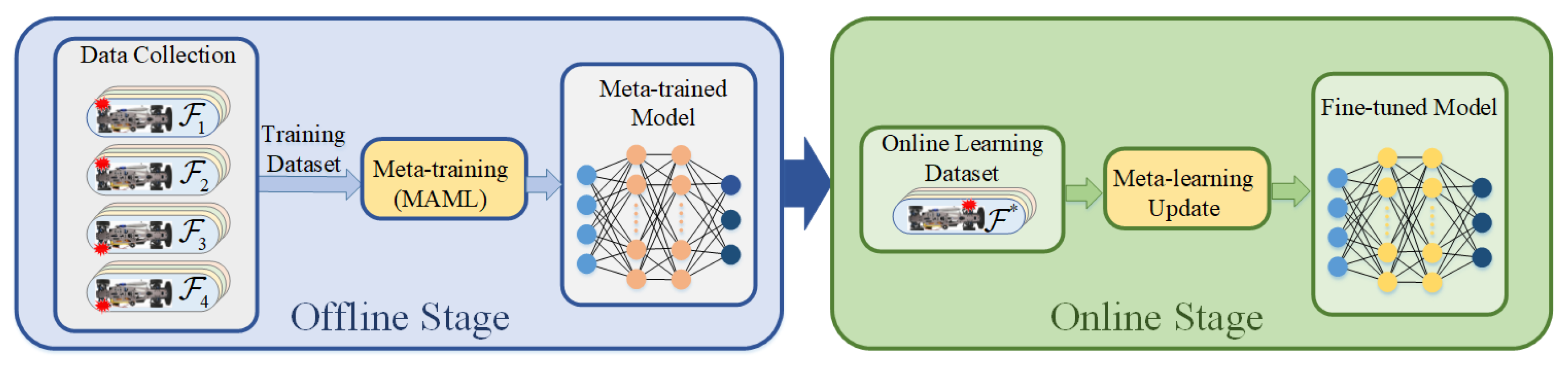
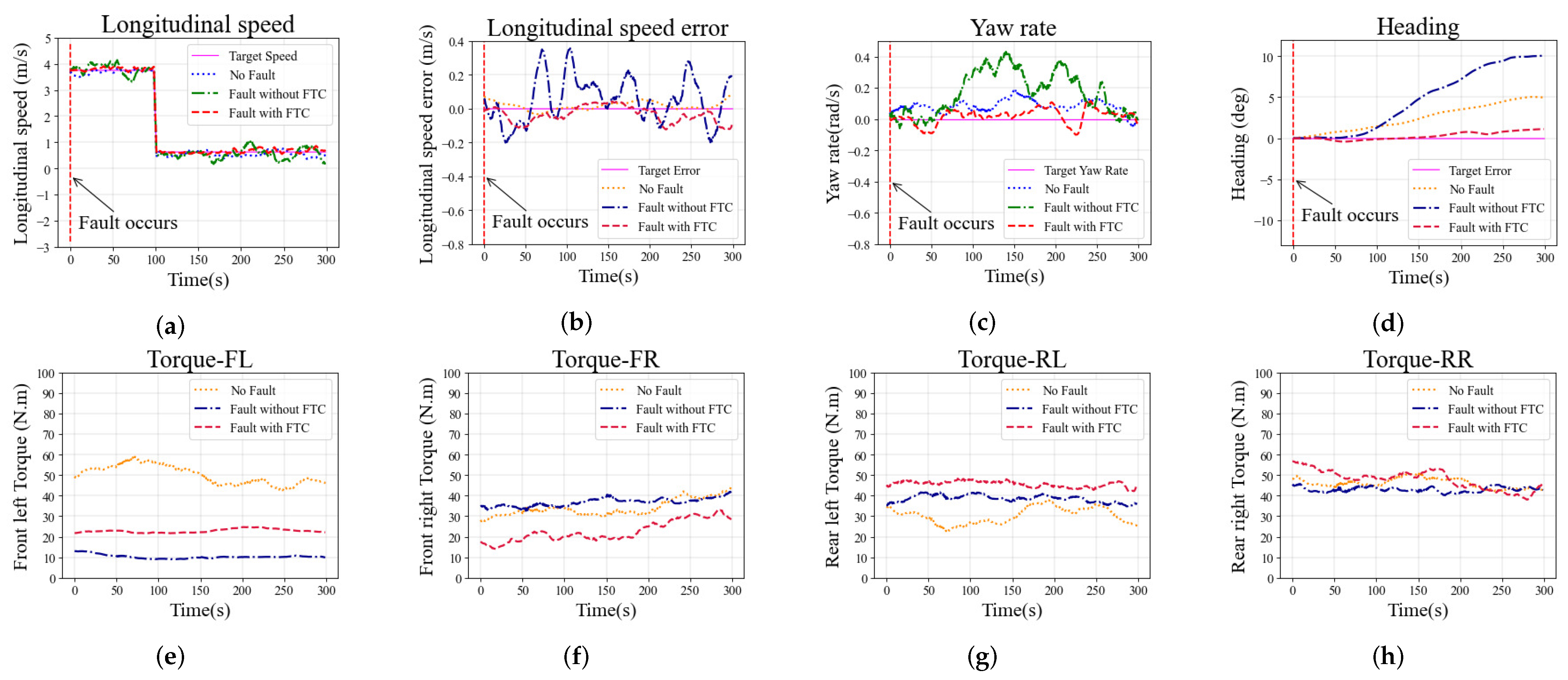
Using reinforcement learning (RL) for torque distribution of skid steering vehicles has attracted increasing attention recently. Various RL-based torque distribution methods have been proposed to deal with this classical vehicle control problem, achieving a better performance than traditional control methods. However, most RL-based methods focus only on improving the performance of skid steering vehicles, while actuator faults that may lead to unsafe conditions or catastrophic events are frequently omitted in existing control schemes. This study proposes a meta-RL-based fault-tolerant control (FTC) method to improve the tracking performance of vehicles in the case of actuator faults. Based on meta deep deterministic policy gradient (meta-DDPG), the proposed FTC method has a representative gradient-based metalearning algorithm workflow, which includes an offline stage and an online stage. In the offline stage, an experience replay buffer with various actuator faults is constructed to provide data for training the metatraining model; then, the metatrained model is used to develop an online meta-RL update method to quickly adapt its control policy to actuator fault conditions. Simulations of four scenarios demonstrate that the proposed FTC method can achieve a high performance and adapt to actuator fault conditions stably.
Keywords: fault-tolerant control; skid steering vehicle; reinforcement learning (RL); metalearning; torque distribution fault-tolerant control; skid steering vehicle; reinforcement learning (RL); metalearning; torque distribution