


Toward the Development of Combined Artificial Sensing Systems for Food Quality Evaluation: A Review on the Application of Data Fusion of Electronic Noses, Electronic Tongues and Electronic Eyes


Abstract
1. Introduction
2. Artificial Sensors
2.1. Electronic Nose
2.2. Electronic Tongue
2.3. Electronic Eye
3. Data Fusion
3.1. Low-Level Data Fusion
3.2. Mid-Level DATA Fusion
3.3. High-Level Data Fusion
4. Applications
4.1. EN + ET
4.2. EN + EE
4.3. ET + EE
4.4. ET + EN + EE
5. Conclusions
Author Contributions
Funding
Institutional Review Board Statement
Informed Consent Statement
Data Availability Statement
Conflicts of Interest
References
- Borràs, E.; Ferré, J.; Boqué, R.; Mestres, M.; Aceña, L.; Busto, O. Data Fusion Methodologies for Food and Beverage Authentication and Quality Assessment—A Review. Anal. Chim. Acta 2015, 891, 1–14. [Google Scholar] [CrossRef] [Scilit] [PubMed]
- Gutiérrez, J.; Horrillo, M.C. Advances in Artificial Olfaction: Sensors and Applications. Talanta 2014, 124, 95–105. [Google Scholar] [CrossRef] [Scilit] [PubMed]
- Loutfi, A.; Coradeschi, S.; Mani, G.K.; Shankar, P.; Rayappan, J.B.B. Electronic Noses for Food Quality: A Review. J. Food Eng. 2015, 144, 103–111. [Google Scholar] [CrossRef] [Scilit]
- Escuder-Gilabert, L.; Peris, M. Review: Highlights in Recent Applications of Electronic Tongues in Food Analysis. Anal. Chim. Acta 2010, 665, 15–25. [Google Scholar] [CrossRef] [Scilit]
- Tahara, Y.; Toko, K. Electronic Tongues-a Review. IEEE Sens. J. 2013, 13, 3001–3011. [Google Scholar] [CrossRef] [Scilit]
- Jackman, P.; Sun, D.-W. Recent Advances in Image Processing Using Image Texture Features for Food Quality Assessment. Trends Food Sci. Technol. 2013, 29, 35–43. [Google Scholar] [CrossRef] [Scilit]
- Wu, D.; Sun, D.-W. Colour Measurements by Computer Vision for Food Quality Control—A Review. Trends Food Sci. Technol. 2013, 29, 5–20. [Google Scholar] [CrossRef] [Scilit]
- Krantz-Rülcker, C.; Stenberg, M.; Winquist, F.; Lundström, I. Electronic Tongues for Environmental Monitoring Based on Sensor Arrays and Pattern Recognition: A Review. Anal. Chim. Acta 2001, 426, 217–226. [Google Scholar] [CrossRef] [Scilit]
- Deisingh, A.K.; Stone, D.C.; Thompson, M. Applications of Electronic Noses and Tongues in Food Analysis. Int. J. Food Sci. Technol. 2004, 39, 587–604. [Google Scholar] [CrossRef] [Scilit]
- Patel, H.K.; Kunpara, M.J. Electronic Nose Sensor Response and Qualitative Review of E-Nose Sensors. In Proceedings of the 2011 Nirma University International Conference on Engineering: Current Trends in Technology, NUiCONE 2011, Ahmedabad, India, 8–10 December 2011. [Google Scholar]
- Fitzgerald, J.E.; Bui, E.T.H.; Simon, N.M.; Fenniri, H. Artificial Nose Technology: Status and Prospects in Diagnostics. Trends Biotechnol. 2017, 35, 33–42. [Google Scholar] [CrossRef] [Scilit] [PubMed]
- Pathare, P.B.; Opara, U.L.; Al-Said, F.A.-J. Colour Measurement and Analysis in Fresh and Processed Foods: A Review. Food Bioprocess Technol. 2013, 6, 36–60. [Google Scholar] [CrossRef] [Scilit]
- Zhang, J.; Li, L.; Gao, N.; Wang, D.; Gao, Q.; Jiang, S. Feature Extraction and Selection from Volatile Compounds for Analytical Classification of Chinese Red Wines from Different Varieties. Anal. Chim. Acta 2010, 662, 137–142. [Google Scholar] [CrossRef] [Scilit]
- Pizarro, C.; Rodríguez-Tecedor, S.; Pérez-del-Notario, N.; González-Sáiz, J.M. Recognition of Volatile Compounds as Markers in Geographical Discrimination of Spanish Extra Virgin Olive Oils by Chemometric Analysis of Non-Specific Chromatography Volatile Profiles. J. Chromatogr. A 2011, 1218, 518–523. [Google Scholar] [CrossRef] [Scilit]
- Pacioni, G.; Cerretani, L.; Procida, G.; Cichelli, A. Composition of Commercial Truffle Flavored Oils with GC-MS Analysis and Discrimination with an Electronic Nose. Food Chem. 2014, 146, 30–35. [Google Scholar] [CrossRef] [Scilit] [PubMed]
- Kiani, S.; Minaei, S.; Ghasemi-Varnamkhasti, M. Fusion of Artificial Senses as a Robust Approach to Food Quality Assessment. J. Food Eng. 2016, 171, 230–239. [Google Scholar] [CrossRef] [Scilit]
- di Rosa, A.R.; Leone, F.; Cheli, F.; Chiofalo, V. Fusion of Electronic Nose, Electronic Tongue and Computer Vision for Animal Source Food Authentication and Quality Assessment—A Review. J. Food Eng. 2017, 210, 62–75. [Google Scholar] [CrossRef] [Scilit]
- Silvestri, M.; Elia, A.; Bertelli, D.; Salvatore, E.; Durante, C.; Li Vigni, M.; Marchetti, A.; Cocchi, M. A Mid Level Data Fusion Strategy for the Varietal Classification of Lambrusco PDO Wines. Chemom. Intell. Lab. Syst. 2014, 137, 181–189. [Google Scholar] [CrossRef] [Scilit]
- Casale, M.; Casolino, C.; Oliveri, P.; Forina, M. The Potential of Coupling Information Using Three Analytical Techniques for Identifying the Geographical Origin of Liguria Extra Virgin Olive Oil. Food Chem. 2010, 118, 163–170. [Google Scholar] [CrossRef] [Scilit]
- Calvini, R.; Foca, G.; Ulrici, A. Data Dimensionality Reduction and Data Fusion for Fast Characterization of Green Coffee Samples Using Hyperspectral Sensors. Anal. Bioanal. Chem. 2016, 408, 7351–7366. [Google Scholar] [CrossRef] [Scilit]
- Forshed, J.; Idborg, H.; Jacobsson, S.P. Evaluation of Different Techniques for Data Fusion of LC/MS and 1H-NMR. Chemom. Intell. Lab. Syst. 2007, 85, 102–109. [Google Scholar] [CrossRef] [Scilit]
- Banerjee, R.; Chattopadhyay, P.; Tudu, B.; Bhattacharyya, N.; Bandyopadhyay, R. Artificial Flavor Perception of Black Tea Using Fusion of Electronic Nose and Tongue Response: A Bayesian Statistical Approach. J. Food Eng. 2014, 142, 87–93. [Google Scholar] [CrossRef] [Scilit]
- Haddi, Z.; Alami, H.; el Bari, N.; Tounsi, M.; Barhoumi, H.; Maaref, A.; Jaffrezic-Renault, N.; Bouchikhi, B. Electronic Nose and Tongue Combination for Improved Classification of Moroccan Virgin Olive Oil Profiles. Food Res. Int. 2013, 54, 1488–1498. [Google Scholar] [CrossRef] [Scilit]
- Peris, M.; Escuder-Gilabert, L. On-Line Monitoring of Food Fermentation Processes Using Electronic Noses and Electronic Tongues: A Review. Anal. Chim. Acta 2013, 804, 29–36. [Google Scholar] [CrossRef] [Scilit] [PubMed]
- Rodríguez-Méndez, M.L.; de Saja, J.A.; González-Antón, R.; García-Hernández, C.; Medina-Plaza, C.; García-Cabezón, C.; Martín-Pedrosa, F. Electronic Noses and Tongues in Wine Industry. Front. Bioeng. Biotechnol. 2016, 4, 1–12. [Google Scholar] [CrossRef] [Scilit] [PubMed]
- Baldwin, E.A.; Bai, J.; Plotto, A.; Dea, S. Electronic Noses and Tongues: Applications for the Food and Pharmaceutical Industries. Sensors 2011, 11, 4744–4766. [Google Scholar] [CrossRef] [Scilit]
- Rudnitskaya, A.; Legin, A. Using Electronic Tongues and Noses to Assess Food. CAB Rev. Perspect. Agric. Vet. Sci. Nutr. Nat. Resour. 2010, 5, 1–20. [Google Scholar] [CrossRef] [Scilit]
- Apetrei, C.; Apetrei, I.M.; Villanueva, S.; de Saja, J.A.; Gutierrez-Rosales, F.; Rodriguez-Mendez, M.L. Combination of an E-Nose, an e-Tongue and an e-Eye for the Characterisation of Olive Oils with Different Degree of Bitterness. Anal. Chim. Acta 2010, 663, 91–97. [Google Scholar] [CrossRef] [Scilit]
- Ouyang, Q.; Zhao, J.; Chen, Q. Instrumental Intelligent Test of Food Sensory Quality as Mimic of Human Panel Test Combining Multiple Cross-Perception Sensors and Data Fusion. Anal. Chim. Acta 2014, 841, 68–76. [Google Scholar] [CrossRef] [Scilit]
- Buratti, S.; Malegori, C.; Benedetti, S.; Oliveri, P.; Giovanelli, G. E-Nose, e-Tongue and e-Eye for Edible Olive Oil Characterization and Shelf Life Assessment: A Powerful Data Fusion Approach. Talanta 2018, 182, 131–141. [Google Scholar] [CrossRef] [Scilit]
- Gardner, P.N.; Bartlett, J.W. Electronic Noses. Principles and Applications. Meas. Sci. Technol. 2000, 11, 1087. [Google Scholar] [CrossRef] [Scilit]
- Jeong, S.-Y.; Kim, J.-S.; Lee, J.-H. Rational Design of Semiconductor-Based Chemiresistors and Their Libraries for Next-Generation Artificial Olfaction. Adv. Mater. 2020, 32, 2002075. [Google Scholar] [CrossRef] [Scilit] [PubMed]
- Chang, Y.-P.; Liu, W.-C.; Tseng, M.-C.; Chu, Y.-H. Ionic Liquids Tailored for Reaction-Based Gas Sensing on Quartz Crystal Microbalance. Rev. Anal. Chem. 2015, 34, 77–86. [Google Scholar] [CrossRef] [Scilit]
- James, D.; Scott, S.M.; Ali, Z.; O’Hare, W.T. Chemical Sensors for Electronic Nose Systems. Microchim. Acta 2005, 149, 1–17. [Google Scholar] [CrossRef] [Scilit]
- Karakaya, D.; Ulucan, O.; Turkan, M. Electronic Nose and Its Applications: A Survey. Int. J. Autom. Comput. 2020, 17, 179–209. [Google Scholar] [CrossRef] [Scilit]
- Wilson, A.D.; Baietto, M. Applications and Advances in Electronic-Nose Technologies. Sensors 2009, 9, 5099–5148. [Google Scholar] [CrossRef] [Scilit]
- Peris, M.; Escuder-Gilabert, L. A 21st Century Technique for Food Control: Electronic Noses. Anal. Chim. Acta 2009, 638, 1–15. [Google Scholar] [CrossRef] [Scilit]
- Majchrzak, T.; Wojnowski, W.; Dymerski, T.; Gębicki, J.; Namieśnik, J. Electronic Noses in Classification and Quality Control of Edible Oils: A Review. Food Chem. 2018, 246, 192–201. [Google Scholar] [CrossRef] [Scilit] [PubMed]
- Shi, H.; Zhang, M.; Adhikari, B. Advances of Electronic Nose and Its Application in Fresh Foods: A Review. Crit. Rev. Food Sci. Nutr. 2018, 58, 2700–2710. [Google Scholar] [CrossRef] [Scilit]
- Sanaeifar, A.; ZakiDizaji, H.; Jafari, A.; Guardia, M.D.L. Early Detection of Contamination and Defect in Foodstuffs by Electronic Nose: A Review. TrAC Trends Anal. Chem. 2017, 97, 257–271. [Google Scholar] [CrossRef] [Scilit]
- Legin, A.; Rudnitskaya, A.; Vlasov, Y. Electronic Tongues: Sensors, Systems, Applications. Sens. Update 2002, 10, 143–188. [Google Scholar] [CrossRef] [Scilit]
- Toko, K. Electronic Sensing of Tastes. Electroanalysis 1998, 10, 657–669. [Google Scholar] [CrossRef]
- Ciosek, P.; Wróblewski, W. Sensor Arrays for Liquid Sensing—Electronic Tongue Systems. Analyst 2007, 132, 963–978. [Google Scholar] [CrossRef] [Scilit]
- del Valle, M. Electronic Tongues Employing Electrochemical Sensors. Electroanalysis 2010, 22, 1539–1555. [Google Scholar] [CrossRef] [Scilit]
- Legin, A.; Rudnitskaya, A.; Vlasov, Y.; di Natale, C.; Mazzone, E.; D’Amico, A. Application of Electronic Tongue for Qualitative and Quantitative Analysis of Complex Liquid Media. Sens. Actuators B Chem. 2000, 65, 232–234. [Google Scholar] [CrossRef] [Scilit]
- Cortina, M.; Gutés, A.; Alegret, S.; del Valle, M. Sequential Injection System with Higher Dimensional Electrochemical Sensor Signals: Part 2. Potentiometric e-Tongue for the Determination of Alkaline Ions. Talanta 2005, 66, 1197–1206. [Google Scholar] [CrossRef] [Scilit]
- Ciosek, P.; Brzózka, Z.; Wróblewski, W. Classification of Beverages Using a Reduced Sensor Array. Sens. Actuators B Chem. 2004, 103, 76–83. [Google Scholar] [CrossRef] [Scilit]
- Podrażka, M.; Bączyńska, E.; Kundys, M.; Jeleń, P.S.; Witkowska Nery, E. Electronic Tongue—A Tool for All Tastes? Biosensors 2018, 8, 3. [Google Scholar] [CrossRef] [Scilit]
- Jiang, H.; Zhang, M.; Bhandari, B.; Adhikari, B. Application of Electronic Tongue for Fresh Foods Quality Evaluation: A Review. Food Rev. Int. 2018, 34, 746–769. [Google Scholar] [CrossRef] [Scilit]
- Pérez-Ràfols, C.; Serrano, N.; Ariño, C.; Esteban, M.; Díaz-Cruz, J.M. Voltammetric Electronic Tongues in Food Analysis. Sensors 2019, 19, 4261. [Google Scholar] [CrossRef] [Scilit]
- Śliwińska, M.; Wiśniewska, P.; Dymerski, T.; Namieśnik, J.; Wardencki, W. Food Analysis Using Artificial Senses. J. Agric. Food Chem. 2014, 62, 1423–1448. [Google Scholar] [CrossRef] [Scilit]
- Brosnan, T.; Sun, D.-W. Improving Quality Inspection of Food Products by Computer Vision—A Review. J. Food Eng. 2004, 61, 3–16. [Google Scholar] [CrossRef] [Scilit]
- Du, C.J.; Sun, D.W. Learning Techniques Used in Computer Vision for Food Quality Evaluation: A Review. J. Food Eng. 2006, 72, 39–55. [Google Scholar] [CrossRef] [Scilit]
- Pagnin, L.; Calvini, R.; Wiesinger, R.; Weber, J.; Schreiner, M. Photodegradation Kinetics of Alkyd Paints: The Influence of Varying Amounts of Inorganic Pigments on the Stability of the Synthetic Binder. Front. Mater. 2020, 7. [Google Scholar] [CrossRef] [Scilit]
- Valous, N.A.; Mendoza, F.; Sun, D.-W.; Allen, P. Colour Calibration of a Laboratory Computer Vision System for Quality Evaluation of Pre-Sliced Hams. Meat Sci. 2009, 81, 132–141. [Google Scholar] [CrossRef] [Scilit]
- Larraín, R.E.; Schaefer, D.M.; Reed, J.D. Use of Digital Images to Estimate CIE Color Coordinates of Beef. Food Res. Int. 2008, 41, 380–385. [Google Scholar] [CrossRef] [Scilit]
- Gonçalves Dias Diniz, P.H. Chemometrics-Assisted Color Histogram-Based Analytical Systems. J. Chemom. 2020, 34. [Google Scholar] [CrossRef] [Scilit]
- Calvini, R.; Orlandi, G.; Foca, G.; Ulrici, A. Colourgrams GUI: A Graphical User-Friendly Interface for the Analysis of Large Datasets of RGB Images. Chemom. Intell. Lab. Syst. 2020, 196, 103915–103926. [Google Scholar] [CrossRef] [Scilit]
- Savitzky, A.; Golay, M.J.E. Smoothing and Differentiation of Data by Simplified Least Squares Procedures. Anal. Chem. 1964, 36, 1627–1639. [Google Scholar] [CrossRef] [Scilit]
- Oliveri, P.; Malegori, C.; Simonetti, R.; Casale, M. The Impact of Signal Pre-Processing on the Final Interpretation of Analytical Outcomes—A Tutorial. Anal. Chim. Acta 2019, 1058, 9–17. [Google Scholar] [CrossRef] [Scilit] [PubMed]
- Barnes, R.J.; Dhanoa, M.S.; Lister, S.J. Standard Normal Variate Transformation and De-Trending of near-Infrared Diffuse Reflectance Spectra. Appl. Spectrosc. 1989, 43, 772–777. [Google Scholar] [CrossRef] [Scilit]
- Kohler, A.; Zimonja, M.; Segtnan, V.; Martens, H. Standard Normal Variate, Multiplicative Signal Correction and Extended Multiplicative Signal Correction Preprocessing in Biospectroscopy. In Comprehensive Chemometrics; Elsevier: Amsterdam, The Netherlands, 2009; Volume 2, pp. 139–162. [Google Scholar]
- Mehmood, T.; Liland, K.H.; Snipen, L.; Sæbø, S. A Review of Variable Selection Methods in Partial Least Squares Regression. Chemom. Intell. Lab. Syst. 2012, 118, 62–69. [Google Scholar] [CrossRef] [Scilit]
- Osborne, S.D.; Jordan, R.B.; Künnemeyer, R. Method of Wavelength Selection for Partial Least Squares. Analyst 1997, 122, 1531–1537. [Google Scholar] [CrossRef] [Scilit]
- Chong, I.-G.; Jun, C.-H. Performance of Some Variable Selection Methods When Multicollinearity Is Present. Chemom. Intell. Lab. Syst. 2005, 78, 103–112. [Google Scholar] [CrossRef] [Scilit]
- Prieto, N.; Oliveri, P.; Leardi, R.; Gay, M.; Apetrei, C.; Rodriguez-Méndez, M.L.; de Saja, J.A. Application of a GA-PLS Strategy for Variable Reduction of Electronic Tongue Signals. Sens. Actuators B Chem. 2013, 183, 52–57. [Google Scholar] [CrossRef] [Scilit]
- Nørgaard, L.; Saudland, A.; Wagner, J.; Nielsen, J.P.; Munck, L.; Engelsen, S.B. Interval Partial Least-Squares Regression (IPLS): A Comparative Chemometric Study with an Example from near-Infrared Spectroscopy. Appl. Spectrosc. 2000, 54, 413–419. [Google Scholar] [CrossRef] [Scilit]
- Calvini, R.; Ulrici, A.; Amigo, J.M. Practical Comparison of Sparse Methods for Classification of Arabica and Robusta Coffee Species Using near Infrared Hyperspectral Imaging. Chemom. Intell. Lab. Syst. 2015, 146, 503–511. [Google Scholar] [CrossRef] [Scilit]
- Kuncheva, L.I. Combining Pattern Classifiers: Methods and Algorithms, 2nd ed.; John Wiley & Sons, Inc.: Hoboken, NJ, USA, 2014; Volume 9781118315, ISBN 9781118914564. [Google Scholar]
- Roussel, S.; Bellon-Maurel, V.; Roger, J.-M.; Grenier, P. Fusion of Aroma, FT-IR and UV Sensor Data Based on the Bayesian Inference. Application to the Discrimination of White Grape Varieties. Chemom. Intell. Lab. Syst. 2003, 65, 209–219. [Google Scholar] [CrossRef] [Scilit]
- Shafer, G. A Mathematical Theory of Evidence; Princeton University Press: Princeton, NJ, USA, 2021; ISBN 9780691214696. [Google Scholar]
- Zhang, H.; Shao, W.; Qiu, S.; Wang, J.; Wei, Z. Collaborative Analysis on the Marked Ages of Rice Wines by Electronic Tongue and Nose Based on Different Feature Data Sets. Sensors 2020, 20, 1065. [Google Scholar] [CrossRef] [Scilit]
- Dong, W.; Zhao, J.; Hu, R.; Dong, Y.; Tan, L. Differentiation of Chinese Robusta Coffees According to Species, Using a Combined Electronic Nose and Tongue, with the Aid of Chemometrics. Food Chem. 2017, 229, 743–751. [Google Scholar] [CrossRef] [Scilit]
- Banerjee, M.B.; Roy, R.B.; Tudu, B.; Bandyopadhyay, R.; Bhattacharyya, N. Black Tea Classification Employing Feature Fusion of E-Nose and E-Tongue Responses. J. Food Eng. 2019, 244, 55–63. [Google Scholar] [CrossRef] [Scilit]
- Zakaria, A.; Md. Shakaff, A.Y.; Adom, A.H.; Ahmad, M.N.; Masnan, M.J.; Aziz, A.H.A.; Fikri, N.A.; Abdullah, A.H.; Kamarudin, L.M. Improved Classification of Orthosiphon Stamineus by Data Fusion of Electronic Nose and Tongue Sensors. Sensors 2010, 10, 8782–8796. [Google Scholar] [CrossRef] [Scilit]
- Tian, X.; Wang, J.; Ma, Z.; Li, M.; Wei, Z.; Díaz-Cruz, J.M. Combination of an E-Nose and an E-Tongue for Adulteration Detection of Minced Mutton Mixed with Pork. J. Food Qual. 2019, 2019. [Google Scholar] [CrossRef] [Scilit]
- Hong, X.; Wang, J. Detection of Adulteration in Cherry Tomato Juices Based on Electronic Nose and Tongue: Comparison of Different Data Fusion Approaches. J. Food Eng. 2014, 126, 89–97. [Google Scholar] [CrossRef] [Scilit]
- Men, H.; Chen, D.; Zhang, X.; Liu, J.; Ning, K. Data Fusion of Electronic Nose and Electronic Tongue for Detection of Mixed Edible-Oil. J. Sens. 2014, 2014, 840685. [Google Scholar] [CrossRef] [Scilit]
- Dai, C.; Huang, X.; Huang, D.; Lv, R.; Sun, J.; Zhang, Z.; Ma, M.; Aheto, J.H. Detection of Submerged Fermentation of Tremella Aurantialba Using Data Fusion of Electronic Nose and Tongue. J. Food Process Eng. 2019, 42, 1–7. [Google Scholar] [CrossRef] [Scilit]
- Huang, L.; Zhao, J.; Chen, Q.; Zhang, Y. Nondestructive Measurement of Total Volatile Basic Nitrogen (TVB-N) in Pork Meat by Integrating near Infrared Spectroscopy, Computer Vision and Electronic Nose Techniques. Food Chem. 2014, 145, 228–236. [Google Scholar] [CrossRef] [Scilit] [PubMed]
- Korel, F.; Luzuriaga, D.A.; Balaban, M.Ö. Objective Quality Assessment of Raw Tilapia (Oreochromis Niloticus) Fillets Using Electronic Nose and Machine Vision. J. Food Sci. 2001, 66, 1018–1024. [Google Scholar] [CrossRef] [Scilit]
- Xu, M.; Wang, J.; Gu, S. Rapid Identification of Tea Quality by E-Nose and Computer Vision Combining with a Synergetic Data Fusion Strategy. J. Food Eng. 2019, 241, 10–17. [Google Scholar] [CrossRef] [Scilit]
- Huang, X.-Y.; Pan, S.-H.; Sun, Z.-Y.; Ye, W.-T.; Aheto, J.H. Evaluating Quality of Tomato during Storage Using Fusion Information of Computer Vision and Electronic Nose. J. Food Process Eng. 2018, 41, 1–7. [Google Scholar] [CrossRef] [Scilit]
- Liu, Q.; Sun, K.; Zhao, N.; Yang, J.; Zhang, Y.; Ma, C.; Pan, L.; Tu, K. Information Fusion of Hyperspectral Imaging and Electronic Nose for Evaluation of Fungal Contamination in Strawberries during Decay. Postharvest Biol. Technol. 2019, 153, 152–160. [Google Scholar] [CrossRef] [Scilit]
- Aheto, J.H.; Huang, X.; Tian, X.; Ren, Y.; Ernest, B.; Alenyorege, E.A.; Dai, C.; Hongyang, T.; Xiaorui, Z.; Wang, P. Multi-Sensor Integration Approach Based on Hyperspectral Imaging and Electronic Nose for Quantitation of Fat and Peroxide Value of Pork Meat. Anal. Bioanal. Chem. 2020, 412, 1169–1179. [Google Scholar] [CrossRef] [Scilit]
- Gutiérrez, M.; Llobera, A.; Vila-Planas, J.; Capdevila, F.; Demming, S.; Büttgenbach, S.; Mínguez, S.; Jiménez-Jorquera, C. Hybrid Electronic Tongue Based on Optical and Electrochemical Microsensors for Quality Control of Wine. Analyst 2010, 135, 1718–1725. [Google Scholar] [CrossRef] [Scilit]
- Gutiérrez, M.; Domingo, C.; Vila-Planas, J.; Ipatov, A.; Capdevila, F.; Demming, S.; Büttgenbach, S.; Llobera, A.; Jiménez-Jorquera, C. Hybrid Electronic Tongue for the Characterization and Quantification of Grape Variety in Red Wines. Sens. Actuators B Chem. 2011, 156, 695–702. [Google Scholar] [CrossRef] [Scilit]
- Gutiérrez-Capitán, M.; Santiago, J.-L.; Vila-Planas, J.; Llobera, A.; Boso, S.; Gago, P.; Martínez, M.-C.; Jiménez-Jorquera, C. Classification and Characterization of Different White Grape Juices by Using a Hybrid Electronic Tongue. J. Agric. Food Chem. 2013, 61, 9325–9332. [Google Scholar] [CrossRef] [Scilit]
- Bulbarello, A.; Cuenca, M.; Schweikert, L.; Mannino, S.; Scampicchio, M. Hybrid E-Tongue for the Evaluation of Sweetness and Bitterness of Soft Drinks Fortified with Epigallocatechin Gallate. Electroanalysis 2012, 24, 1989–1994. [Google Scholar] [CrossRef] [Scilit]
- Orlandi, G.; Calvini, R.; Foca, G.; Pigani, L.; Vasile Simone, G.; Ulrici, A. Data Fusion of Electronic Eye and Electronic Tongue Signals to Monitor Grape Ripening. Talanta 2019, 195, 181–189. [Google Scholar] [CrossRef] [Scilit]
- Pigani, L.; Vasile Simone, G.; Foca, G.; Ulrici, A.; Masino, F.; Cubillana-Aguilera, L.; Calvini, R.; Seeber, R. Prediction of Parameters Related to Grape Ripening by Multivariate Calibration of Voltammetric Signals Acquired by an Electronic Tongue. Talanta 2018, 178, 178–187. [Google Scholar] [CrossRef] [Scilit]
- Orlandi, G.; Calvini, R.; Pigani, L.; Foca, G.; Vasile Simone, G.; Antonelli, A.; Ulrici, A. Electronic Eye for the Prediction of Parameters Related to Grape Ripening. Talanta 2018, 186, 381–388. [Google Scholar] [CrossRef] [Scilit]
- di Rosa, A.R.; Leone, F.; Scattareggia, C.; Chiofalo, V. Botanical Origin Identification of Sicilian Honeys Based on Artificial Senses and Multi-Sensor Data Fusion. Eur. Food Res. Technol. 2018, 244, 117–125. [Google Scholar] [CrossRef] [Scilit]
- Apetrei, I.M.; Rodríguez-Méndez, M.L.; Apetrei, C.; Nevares, I.; del Alamo, M.; de Saja, J.A. Monitoring of Evolution during Red Wine Aging in Oak Barrels and Alternative Method by Means of an Electronic Panel Test. Food Res. Int. 2012, 45, 244–249. [Google Scholar] [CrossRef] [Scilit]
- Xu, M.; Wang, J.; Zhu, L. The Qualitative and Quantitative Assessment of Tea Quality Based on E-Nose, E-Tongue and E-Eye Combined with Chemometrics. Food Chem. 2019, 289, 482–489. [Google Scholar] [CrossRef] [Scilit]
- Prieto, N.; Gay, M.; Vidal, S.; Aagaard, O.; de Saja, J.A.; Rodriguez-Mendez, M.L. Analysis of the Influence of the Type of Closure in the Organoleptic Characteristics of a Red Wine by Using an Electronic Panel. Food Chem. 2011, 129, 589–594. [Google Scholar] [CrossRef] [Scilit]

| Artificial Senses | Biological Senses | Sensory Properties | Analytical Instruments |
|---|---|---|---|
| Electronic tongue | Tongue | Taste/Flavor | Electrochemical sensors, optical sensors, gravimetric sensors |
| Electronic nose | Nose | Odor/Aroma | Electrochemical sensors, optical sensors, gravimetric sensors |
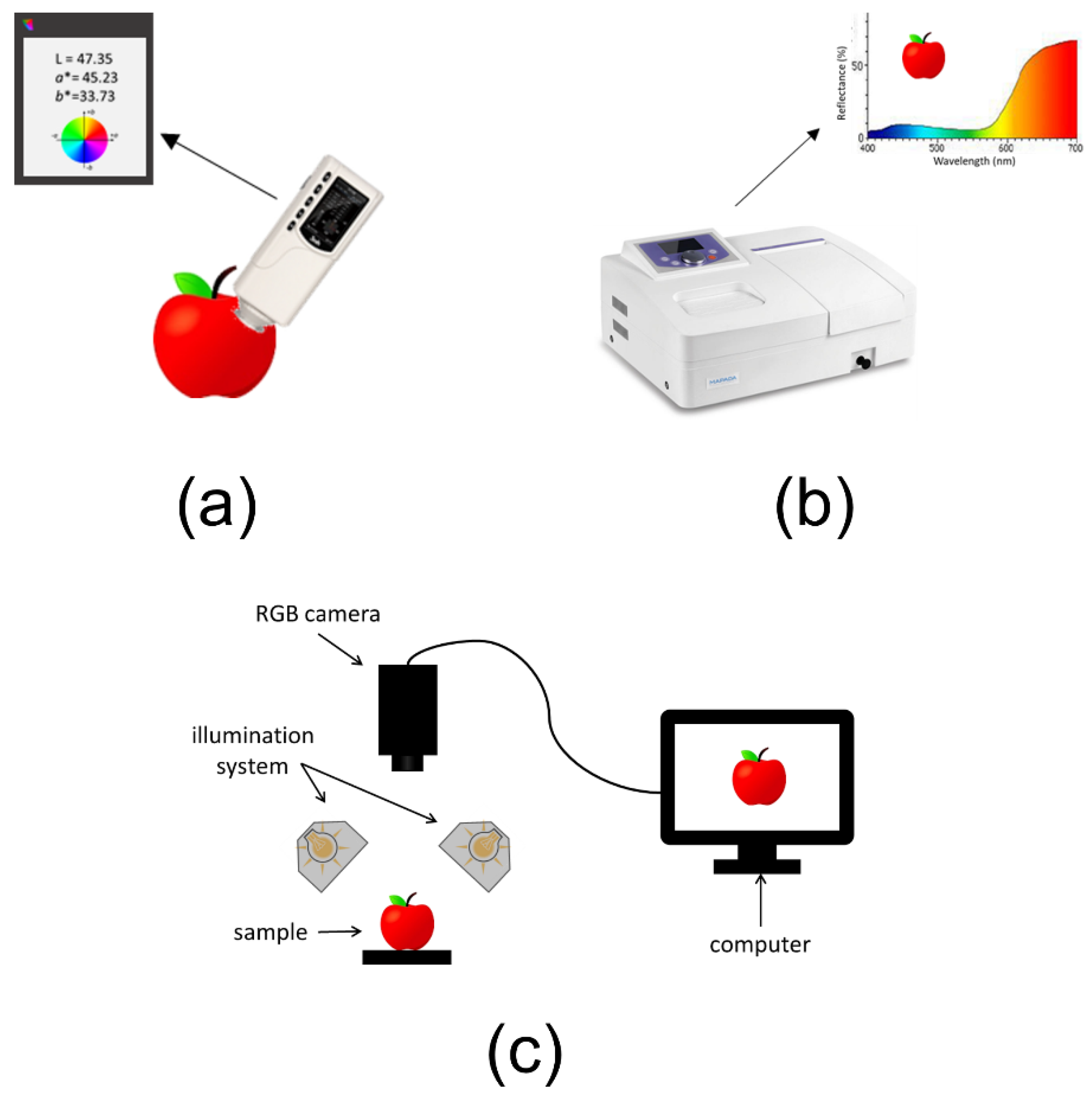
| Electronic eye | Eye | Color | Colorimeter, spectrophotometer, RGB camera |
| Food Matrix | Aim of the Study | ET | EN | Data-Fusion Method | Ref. |
|---|---|---|---|---|---|
| Black tea | Quality assessment of black tea | 5 electrodes made of 5 different noble metals | 5 commercial MOS sensors | Mid-level of extracted features (wavelet) | [22] |
| Virgin olive oils | Characterize virgin olive oils from different geographical areas | 4 electrodes of different metals | 5 commercial MOS sensors | Low-level | [23] |
| Rice wines | Evaluating the marked ages of rice wines | 3 types of modified electrodes with conducting polymer | 12 MOS sensors | Low-level | [72] |
| Chinese Robusta coffees | Characterizationand classification of Chinese Robusta coffee cultivars | Commercial e-tongue | Commercial e-nose | Low-level | [73] |
| Black tea | Classification of different grade of black tea | 5 electrodes made of 5 different noble metals | 5 commercial MOS sensors | Mid-level of extracted features (wavelets) | [74] |
| Orthosiphon stamineus | Classification of Orthosiphon stamineus | 7 commercial ion-selective sensors | Commercial e-nose | Low-level | [75] |
| Meat | Recognition of organoleptic characteristics of minced mutton adulterated with pork | Commercial taste system | Commercial e-nose | Low-level fusion and mid-level fusion | [76] |
| Cherry tomato juices | Authentication of fresh cherry tomato juices adulterated with overripe tomato juices | Commercial e-tongue | Commercial e-nose | Low-level; mid-level with selected features (PCA scores, F selection, stepwise selection) | [77] |
| Edible oil | Detection of the blending ratio of old frying oil and new edible-oil | Gold electrode | 8 commercial gas sensors | Low-level | [78] |
| Mushroom | Detection of submerged fermentation | Commercial e-tongue | 10 commercial MOS sensors | Low-level | [79] |
| Food Matrix | Aim of the Study | EN | EE | Data-Fusion Method | Ref. |
|---|---|---|---|---|---|
| Pork meat | Determination of total volatile basic nitrogen content for evaluating pork freshness | 11 commercial MOS sensors | CCD camera | Mid-level with selected features | [80] |
| Tilapia fillets | Characterization of fresh and spoiled tilapia fillets | 12 commercial MOS sensors | CCD camera | Low-level | [81] |
| Longjing tea | Quality grading of tea samples | Commercial e-nose | CMOS camera | Mid-level with both feature extraction and feature selection High-level data fusion | [82] |
| Tomatoes | Prediction of ripening stage and quality parameters | 10 MOS sensors | CCD camera | Mid-level, fusion of first PCs of each block | [83] |
| Strawberries | Evaluation of fungal contamination on strawberries during decay and determination of quality attributes | Commercial e-nose | Vis-NIR hyperspectral imaging system (400–1000 nm) | Low-level Mid-level with extracted features (PCA scores) | [84] |
| Pork meat | Quantification of intramuscular fat and peroxide value | Commercial e-nose | Vis-NIR hyperspectral imaging system (400–1000 nm) | Mid-level with extracted features (PCA scores after variable selection) | [85] |
| Food Matrix | Aim of the Study | ET | EE | Data-Fusion Method | Ref. |
|---|---|---|---|---|---|
| Wine | Determination of quality parameters in red and white wines | Set of ISFET sensors | Spectrometer (200–1100 nm) | Mid-level with selected features | [86] |
| Wine | Characterization and quantification of grape varieties in red wines | Set of ISFET sensors | Spectrometer (200–1100 nm) | Mid-level with selected features | [87] |
| White grape juices | Discrimination of juices obtained from different grape varieties | Set of IFSET sensors | Lab-on-a-chip spectrophotometer (200–1100 nm) | Mid-level with selected features | [88] |
| Soft drinks fortified with extracts of green tea | Characterization of different formulations and prediction of sweetness and bitterness | 2 screen printed sensors | UV–Vis spectrometer | Low-level and mid-level | [89] |
| Grape must | Quantification of the chemical parameters used to assess phenolic ripening in grapes | PEDOT electrode and SNGC-electrode | Flatbed scanner | Low-level; mid-level with selected features Mid-level with extracted features (PLS scores) | [90] |
| Food Matrix | Aim of the Study | ET | EN | EE | Data-Fusion Method | Ref. |
|---|---|---|---|---|---|---|
| Extra virgin olive oils | Characterization of virgin olive oils from different varieties of olives and different degree of bitterness | Carbon paste Electrodes modified with olive oils | 13 commercial MOS sensors | Spectrophotometer (380–780 nm) | Low-level | [28] |
| Rice wines | Prediction of human sensory attributes of rice wine | Commercial e-tongue | Portable e-nose | Colorimeter | Low-level | [29] |
| Olive oils | Characterization of edible olive oils and quality decay assessment of extra virgin olive oil and olive oil during shelf-life tests | Commercial e-tongue | Commercial e-nose | Spectrophotometer (380–780 nm) | Mid-level with extracted features (PCA scores) | [30] |
| Longjing green tea | Classification of quality grades and quantification of quality indices | Commercial e-tongue | Commercial e-nose | Colorimeter | Low-level | [95] |
| Wine | Discrimination of wines with different oxygen levels and antioxidant capabilities | Modified carbon paste electrodes | 15 MOS sensors | UV–Vis spectrophotometer | Low-level | [96] |
Publisher’s Note: MDPI stays neutral with regard to jurisdictional claims in published maps and institutional affiliations. |
© 2022 by the authors. Licensee MDPI, Basel, Switzerland. This article is an open access article distributed under the terms and conditions of the Creative Commons Attribution (CC BY) license (https://creativecommons.org/licenses/by/4.0/).
Share and Cite
Calvini, R.; Pigani, L. Toward the Development of Combined Artificial Sensing Systems for Food Quality Evaluation: A Review on the Application of Data Fusion of Electronic Noses, Electronic Tongues and Electronic Eyes. Sensors 2022, 22, 577. https://doi.org/10.3390/s22020577
Calvini R, Pigani L. Toward the Development of Combined Artificial Sensing Systems for Food Quality Evaluation: A Review on the Application of Data Fusion of Electronic Noses, Electronic Tongues and Electronic Eyes. Sensors. 2022; 22(2):577. https://doi.org/10.3390/s22020577
Chicago/Turabian StyleCalvini, Rosalba, and Laura Pigani. 2022. "Toward the Development of Combined Artificial Sensing Systems for Food Quality Evaluation: A Review on the Application of Data Fusion of Electronic Noses, Electronic Tongues and Electronic Eyes" Sensors 22, no. 2: 577. https://doi.org/10.3390/s22020577
APA StyleCalvini, R., & Pigani, L. (2022). Toward the Development of Combined Artificial Sensing Systems for Food Quality Evaluation: A Review on the Application of Data Fusion of Electronic Noses, Electronic Tongues and Electronic Eyes. Sensors, 22(2), 577. https://doi.org/10.3390/s22020577

