Abstract
This paper presents an approach to the construction of block error-correcting code for data transmission systems with short packets. The need for this is driven by the necessity of information interaction between objects of machine-type communication network with a dynamically changing structure and unique system of commands or alerts for each network object. The codewords of a code are permutations with a given minimum pairwise Hamming distance. The purpose of the study is to develop a statistical method for constructing a code, in contrast to known algebraic methods, and to investigate the code size. An algorithm for generating codewords has been developed. It can be implemented both by enumeration of the full set of permutations, and by enumeration of a given number of randomly selected permutations. We have experimentally determined the dependencies of the average and the maximum values of the code size on the size of a subset of permutations used for constructing the code. A technique for computing approximation quadratic polynomials for the determined code size dependencies has been developed. These polynomials and their corresponding curves estimate the size of a code generated from a subset of random permutations of such a size that a statistically significant experiment cannot be performed. The results of implementing the developed technique for constructing a code based on permutations of lengths 7 and 11 have been presented. The prediction relative error of the code size did not exceed the value of 0.72% for permutation length 11, code distance 9, random permutation subset size 50,000, and permutation statistical study range limited by 5040.
1. Introduction
The volume of information transfer including confidential information is continuously growing. According to the Statista Research Department report [1], over the next years up to 2025, global data creation is projected to grow to more than 180 zettabytes. A competitive environment has been created for designing and improving both attack systems and information security systems. These circumstances lead to an increase in the mathematical and logical complexity and degree of intellectualization of the used algorithms, processes, and technical means. As a result, the effectiveness and dependability [2] (reliability and security) of telecommunication systems and networks, as well as their components that implement data protection functions need to be improved.
Integrating methods of channel coding and cryptographic protection, or secure channel coding schemes, is one of the ways to increase the efficiency of information-processing tools, as well as to ensure data protection during its storage and transmission in telecommunication systems and networks.
Note that short packet transmission [3] is a key feature of modern wireless systems, ultra-reliable networks, sensor networks, massive machine-type communications (MTC), and IoT applications [4]. The prevalence of such systems and networks in the modern world requires the creation of new and the adaptation of existing approaches, to ensure the transmitted information integrity and confidentiality. In particular, the resources performance necessary for channel coding and cryptographic protection as well as the resources speed can play a decisive role.
This study considers an information interaction of MTC objects in a network with a dynamically changing structure. Each object of such a network, for example, a dynamic wireless sensor network [5], has its own unique system of commands or alerts. This system of commands or alerts forms an ensemble of messages to be agreed between the object of information interaction and other network participants.
1.1. Related Literature
Currently known secure-channel coding schemes are based on the McEliece cryptosystem [6,7,8,9], universal stochastic coding [10,11], ‘golden’ cryptography [12,13], perfect algebraic constructions [14,15], and the use of permutations [16,17].
This study develops an approach using permutations.
The methodology of integrated-information security based on non-separable factorial coding [18,19] uses a subset of the set of permutations of numbers as codewords. Each number is encoded by a binary code with a fixed length of bits. Such information conversion allows getting a non-standard and redundant frame structure that does not require a separate field for the syncword, allows maintaining frame synchronization on the data signal, and allows the non-separable factorial code being used as a transport mechanism in short packet communications [20,21,22,23,24,25,26,27]. The cost of including syncwords is not negligible in such systems [28,29,30]. Using a non-separable factorial code makes it possible to effectively search for frame boundaries even with a bit error rate close to 0.5, which is important for information transmission under the conditions of strong noise [31,32]. In addition, non-separable factorial coding may be a suitable tool to implement a cross-layer integrated approach to security and achieve secure short-packet communication from the perspective of both cryptography and physical layer security [26,27].
Previous studies [33,34] investigate the ability of a non-separable factorial code to detect and correct communication channel errors. The efficiency of the code has been proven, which is achieved, among other factors, due to its synchronization properties [31,32]. The studies [33,34] use the binary Hamming distance between codewords.
In this paper, similarly to the error-correcting Reed-Solomon coding [35], we will consider symbols as elements of a codeword. This approach is of interest to ensure reliable transmission of permutations, in particular, for a three-pass cryptographic protocol based on permutations [36].
We introduce the following definition to distinguish between the binary Hamming distance used in previous studies [33,34] and the Hamming distance between permutations of symbols .
Definition 1.
The symbol Hamming distancebetween two permutationsandis the number of symbol positions in which permutationsandare different.
It is obvious that and . In addition, if and only if .
Definition 2.
A block codeis a code generated with a subset of permutations of lengthwith symbol Hamming distance.
In this case, is the symbol code distance.
Let be the -code size equal to the number of its codewords.
Since the code size determines the amount of information transmitted by each codeword equal to bits, the use of a -code of the maximum size is the most efficient in terms of channel capacity. The last statement also follows from the central problem of coding theory [37,38].
In the literature [39], the -codes are called error correcting permutation codes. These codes are used for error correction of powerline communications using M-ary frequency shift keying modulation [40].
There are lower bounds for (in particular, Gilbert–Varshamov bounds and their improvements) as well as algebraic techniques for constructing -codes [39,41,42,43,44,45,46,47]. For example, , , if is a prime power then and [41], and [42]. Studies [39,43] use automorphism groups to provide lower bounds. The authors of the literature [44] use permutations invariant under isometries. The study [45,46] uses sequential partition and extension, parallel partition and extension, and a modified Kronecker product operation. The recent study [47] improves lower bounds using permutation rational functions.
In this study, in contrast to known algebraic methods, we present a statistical method for constructing a -code and estimating its size . We also take into account the fact that the -code must be unique for each object in the dynamic wireless sensor network, and the code agreement between the participants of the information exchange process can take place by applying a cryptographic protocol [36]. In such conditions, increasing the variability and unpredictability of the codeword ensemble is a necessary key condition for ensuring the protocol strength.
1.2. Main Contributions
We will generate codewords for a -code by enumerating a set of permutations of length and selecting permutations with the symbol Hamming distance to all preselected permutations not exceeding the value. Constructing a -code is complicated by the fact that when increases, it is practically impossible to generate permutations.
The goal of the study is to determine the dependence of the code size on the values of and when using the proposed statistical method.
To achieve this goal, the following tasks must be solved.
- A statistical algorithm to generate codewords for a -code must be developed and implemented.
- An analysis of the distribution frequency of a random value for a given number of implementations of the codeword generating algorithm must be performed. The distribution law for must be determined.
- The dependences of the average and the maximum -code size, its standard deviation from the parameters and must be explored.
- A technique to estimate a -code size depending on parameters and must be developed and applied.
1.3. Paper Structure
This paper is organized as follows: Section 2 describes an algorithm to generate a set of codewords, analyses the dependence of the -code size on the values of and , and presents a technique for constructing an approximation polynomial for the code size dependencies; Section 3 shows the results of implementing the developed technique for and discusses the results, and Section 4 is the conclusion.
2. Materials and Methods
2.1. Algorithm to Generate Codewords
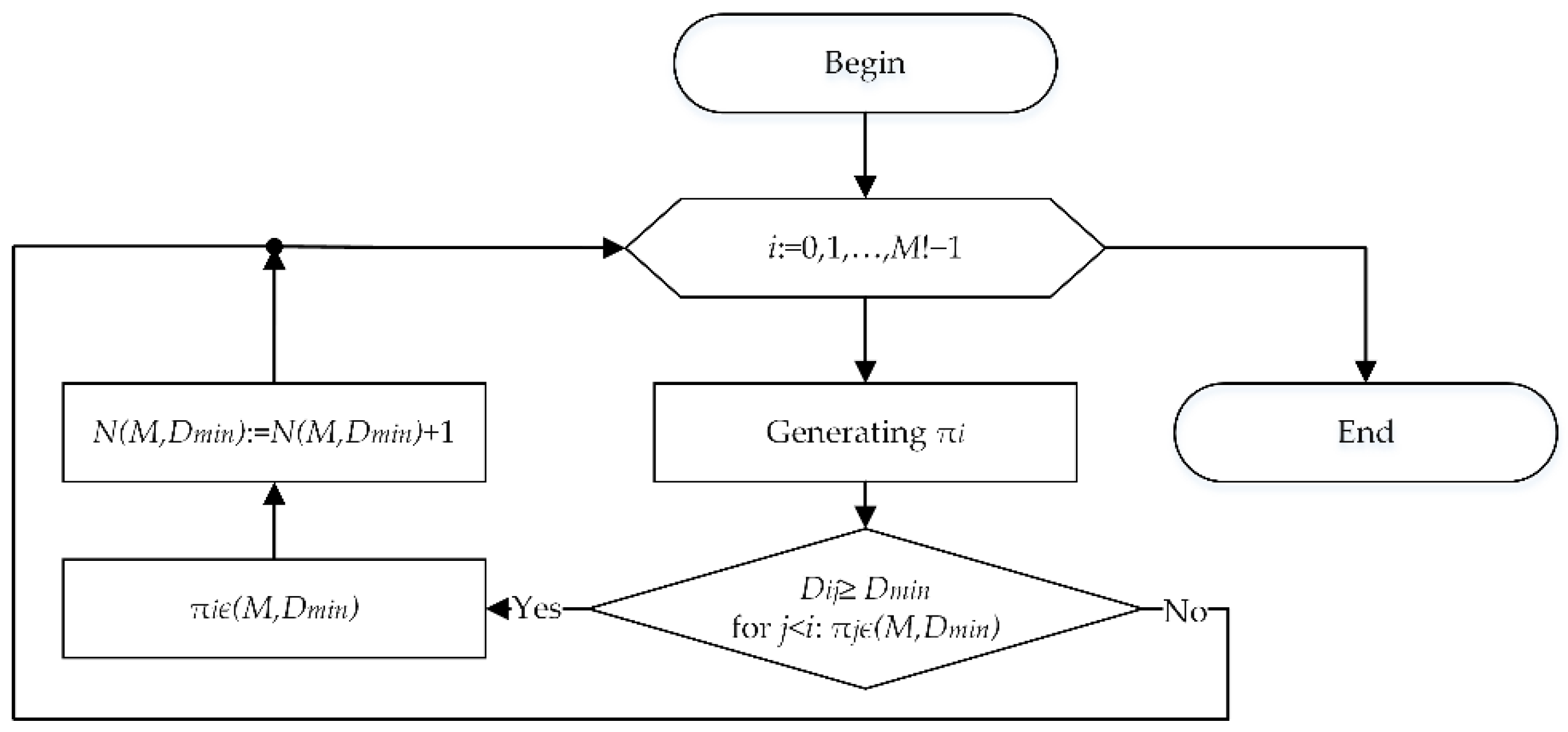
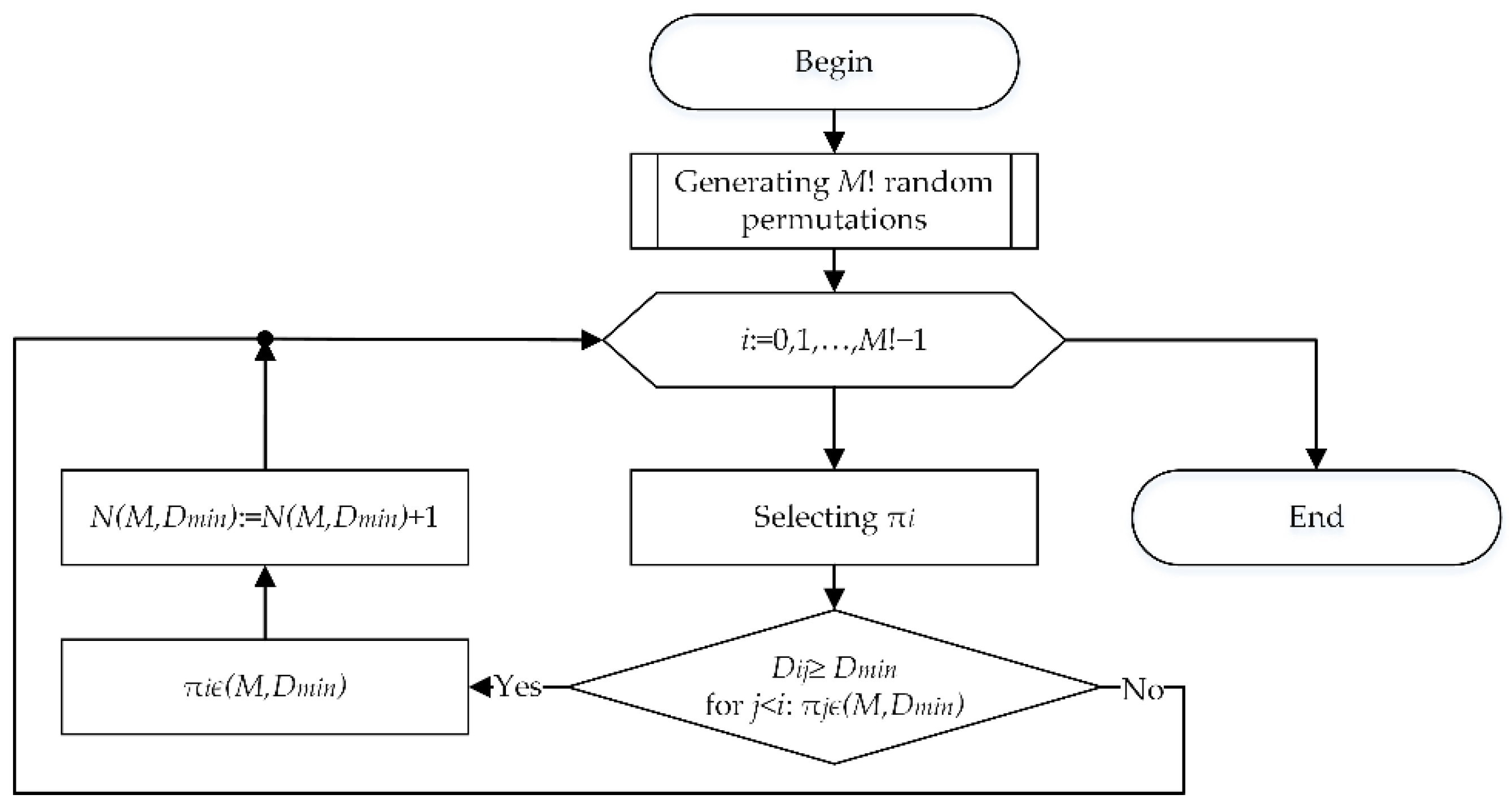
Figure 1 shows the algorithm to generate a set of codewords of a -code.
Figure 1.
Algorithm to generate a set of codewords.
Initially the set of codewords does not contain permutations. The initial complete set of permutations is generated randomly. The first permutation is selected and placed into the set of codewords being generated. Then the second permutation is selected and the Hamming distance to the first codeword is calculated for it. If the calculated distance is no less than the given value, the second permutation is also placed into the set of codewords. Otherwise, the next permutation from the initial set is selected. We continue the process of selecting permutations, calculating the Hamming distances to all selected codewords, and placing the permutation into the set of codewords if all calculated Hamming distances are no less than till all permutations of the initial set have been enumerated. After that, the number of permutations in the set of codewords is counted.
Constructing of a complete set of permutations can be implemented both by generating them in a certain, for example, lexicographic order with subsequent mixing, and by using random factorial numbers and their bijective transformation into permutations. At the same time, storing the permutation numbers (or the corresponding factorial numbers) instead of the permutations reduces the required amount of memory; however, due to additional transformations, it leads to an increase in the time to generate and output a permutation.
To reduce the amount of memory required to store the full set of permutations, the initial set of permutations can be generated simultaneously with their analysis. In this case, in the algorithm of Figure 1, there is no block for generating the initial set of permutations, and the block for selecting the next permutation is replaced by a block for generating the next permutation (Figure 2).
Figure 2.
Algorithm to generate a set of codewords without storing the full set of permutations.
At the same time, the uniqueness check of the generated permutation is additionally implemented in the new block. Table 1 shows estimates of the mathematical expectation and the standard deviation of the code size, as well as its maximum value obtained as a result of implementing the algorithm shown in Figure 1 for 10,000 experiments with and .
Table 1.
Values of , , and for and .
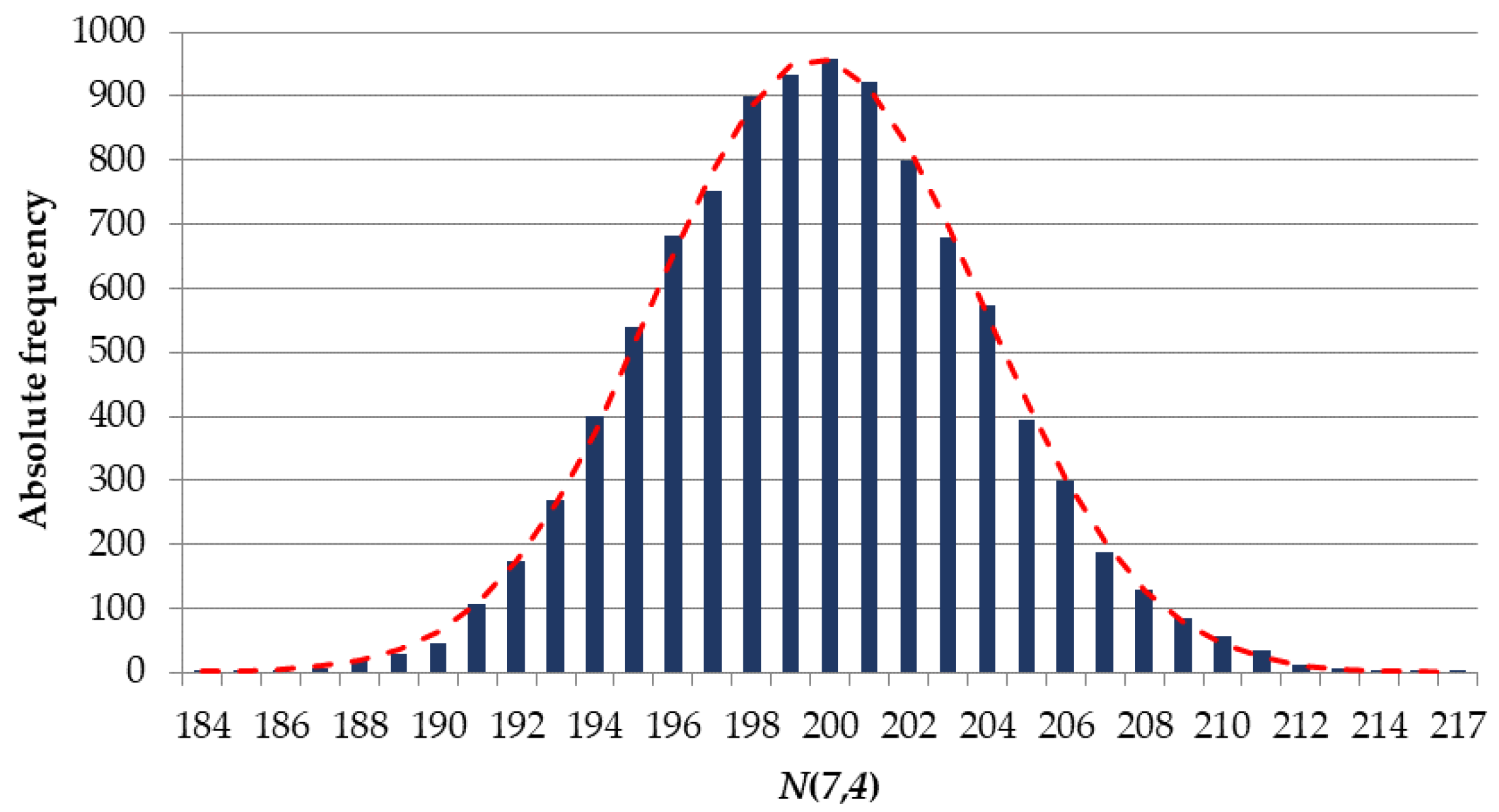
Figure 3 shows a histogram of the distribution of a random value for and .
Figure 3.
Histogram of the distribution of a random value .
Let the null hypothesis state that the distribution of a random value corresponds to a normal distribution. The use of Pearson’s chi-squared test [48] indicates that there is no reason to reject the null hypothesis with the achieved p-value (significance level) of 0.2768.
The normality of the distribution of a random value is also confirmed for and : . However, for and .
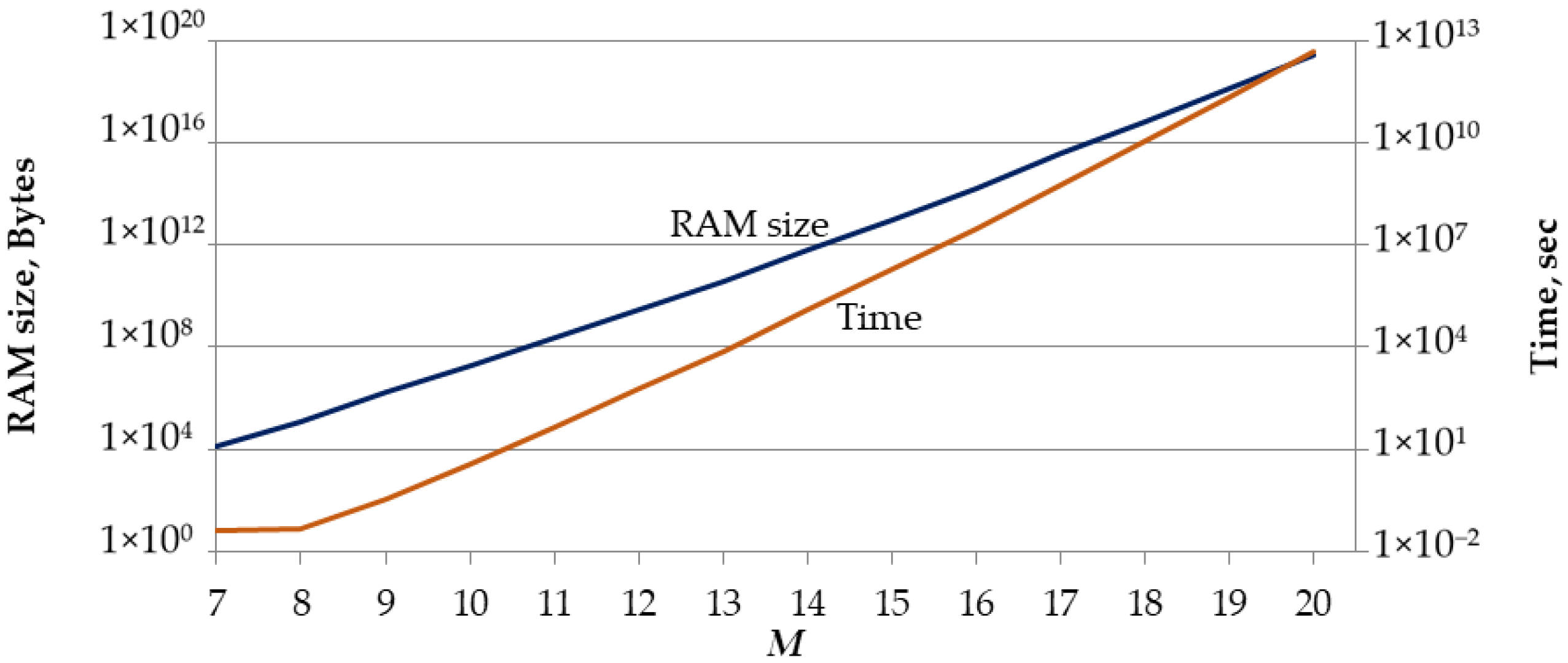
Note that as the value of increases, the implementation of the algorithm shown in Figure 1 becomes more difficult, since the generation of a complete set of permutations requires a significant amount of memory and processor time (Figure 4). For example, storing of permutations using a fixed length binary code to encode permutation symbols requires 209.37 MB of memory; for M = 15 this amount is 8.92 TB. These calculations do not take into account the need to store service information. If we add service information then the memory amount required to form a complete set of permutations in the Python programming language [49] is 67 MB for , 667 MB for , 7.15 GB for , and 70 GB for . It is possible to somewhat reduce the amount of used memory by optimizing the program code. However, it is almost impossible to implement the algorithm shown in Figure 1 on a standard modern workstation when .
Figure 4.
The required amount of memory and time to generate a complete set of permutations.
The average time to generate one permutation was determined experimentally by generating 1,000,000 permutations of a given length .
All experiments in this research were implemented in the Python programming language [49] using the PyCharm Community Edition 2020.3 [50] integrated development environment on a desktop personal computer with the following parameters:
- OS—Windows 10
- CPU—Intel Core i5-10400F
- RAM 32Gb (2x16Gb dual channel 3200Mhz)
- GPU—GeForce GTX 1650 4Gb
- Hard Drive—SSD M.2 2280 1TB Samsung
Here, we provide the possibility to construct a -code for the values of that do not allow generating permutations in practice.
The approach proposed in this study is based on the following. The algorithm to generate a set of codewords shown in Figure 1 is preserved. At the same time, the initial set of permutations is a proper subset of the complete set of permutations. The size of such a proper subset is denoted by .
2.2. Algorithms to Generate the Initial Set of Random Permutations
Permutations of the initial set will also be generated randomly. Here, we consider two algorithms:
- Generating a random integer decimal number in the range , converting the decimal number into a factorial number using division operations [51], and then converting the factorial number into a permutation [51];
- Randomly generating individual digits of a factorial number and converting the factorial number into a permutation.
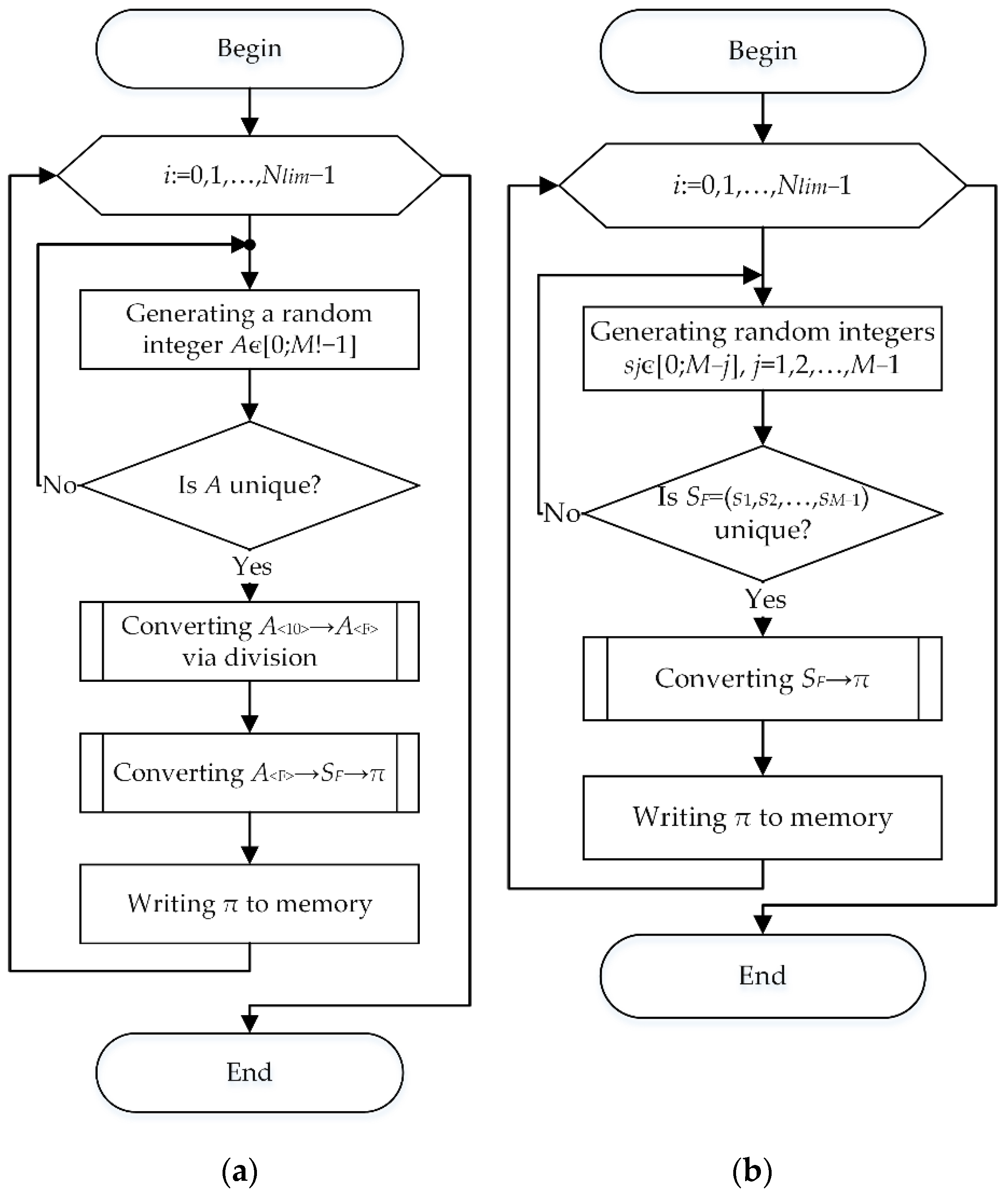
For example, permutation with the basic permutation can be generated with both the first and the second algorithm. The first algorithm: A decimal number is generated, converted into a factorial number , and then converted into a permutation syndrome [52] and a permutation itself. The second algorithm: Each element of the syndrome is generated separately and is then converted into a permutation .
Both of the above algorithms to generate the initial set of permutations control the uniqueness of permutations within the set (Figure 5).
Figure 5.
Algorithms to generate the initial set of random permutations: (a) By division; (b) By generating digits.
Note that the above algorithms to generate permutations can also be applied in the block for generating the next permutation of the algorithm in Figure 2. In this case, the algorithms will output the permutation for analysis instead of writing it to the memory.
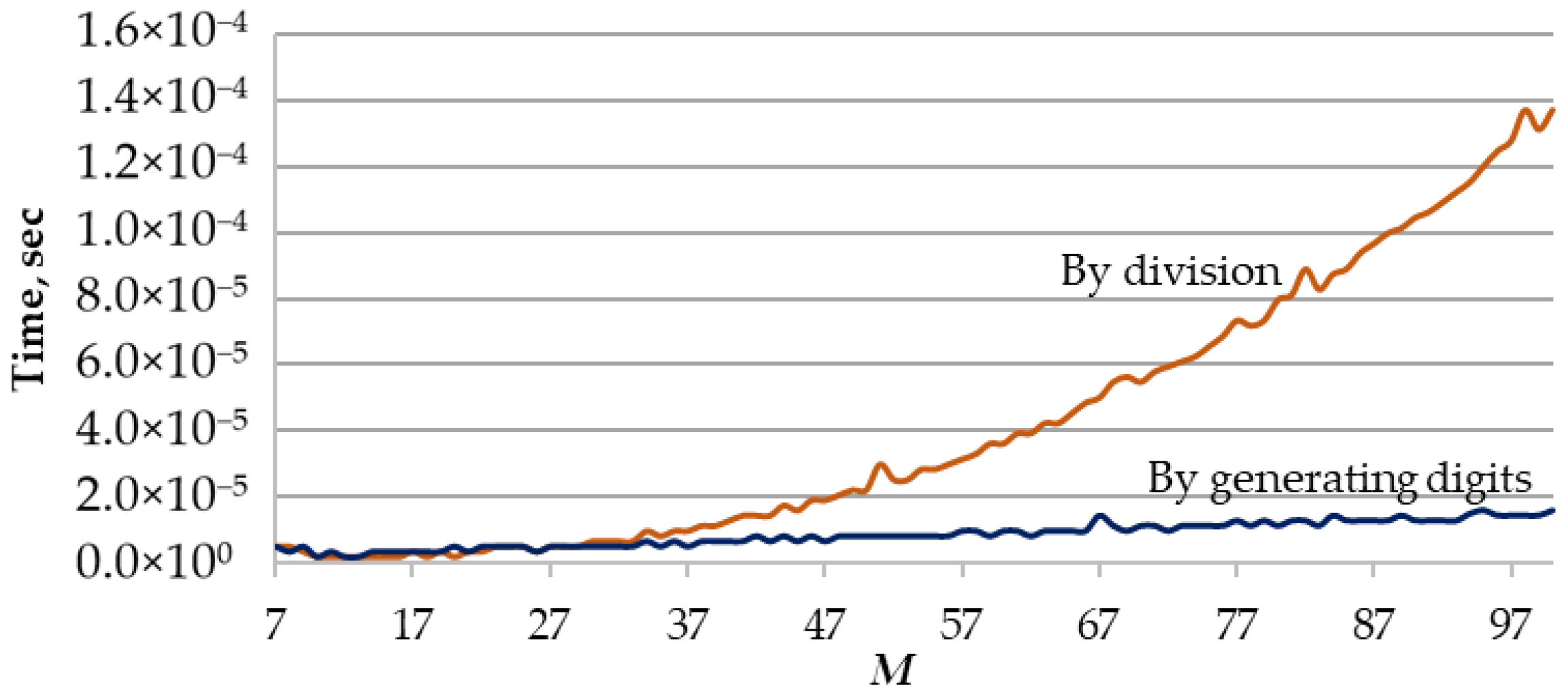
Comparing the speed of the two algorithms for generating random permutations shown in Figure 5, we evaluated the performance of only the distinctive parts of the presented algorithms, the procedures for generating factorial numbers. The average time to generate one factorial number (Figure 6) was calculated based on the results of the generation of 10,000 numbers.
Figure 6.
The average time to generate one factorial number using two different algorithms.
The achieved graphs indicate that the time to generate a factorial number with the first algorithm (Figure 5) increases with an increase of the value much faster than the second method. In addition, unlike the first algorithm, the processes for the second algorithm in Figure 5 are convenient for parallelization. This circumstance makes it possible to further increase the performance of the algorithm.
In this paper, we will use the second proposed algorithm to generate the initial set of random permutations, .
2.3. Dependence of the -Code Size on the Values of , , and
We will use to denote block factorial code formed by a subset of random permutations, and will use to denote the size of -code.
Next, we determine the dependence of the size on the value of . Such dependence can be used both to determine the required value of when designing a data transmission system with a -code, and to evaluate the efficiency of the code constructed from random permutations.
We will determine the dependence experimentally. In this case, the values are formed as follows.
Let . Then
or
where is a step; .
Let . Here, we accept for . Values for are given in Table 2.
Table 2.
Dependence of for and when .
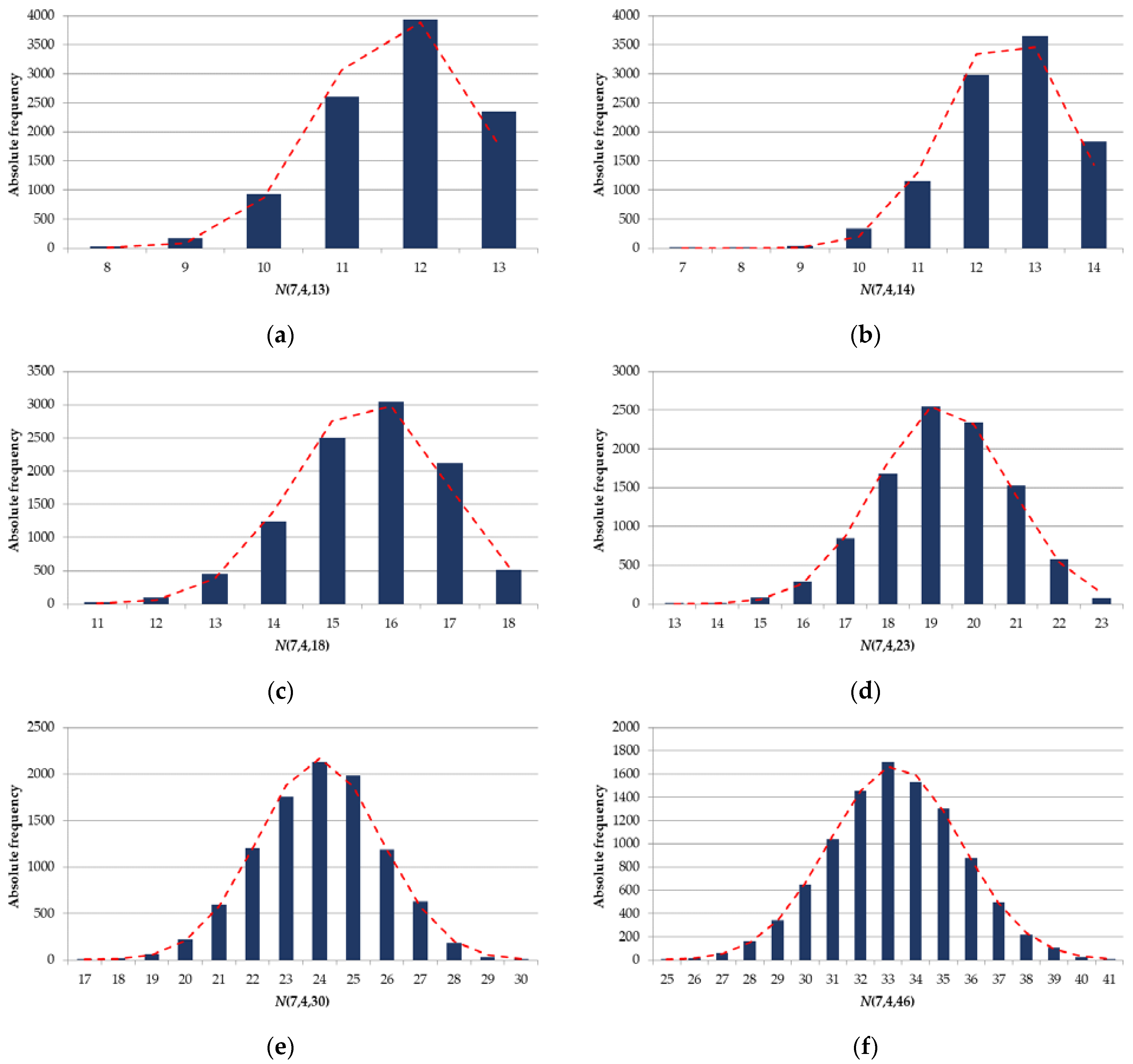
Similarly to Figure 3, Figure 7 shows the histograms of the distribution of a random value for at and , constructed as a result of 10,000 experiments.
Figure 7.
Histograms of the distribution of a random variable for: (a) ; (b) ; (c) ; (d) ; (e) ; (f) .
By analogy with the distribution of a random value , we accept the null statistical hypothesis, which states that a random variable is normally distributed. We apply Pearson’s chi-square test to test the null hypothesis. Table 3 shows the p-values obtained for at and from Table 2.
Table 3.
p-values for .
In Table 3, the green highlights the cases where the normal distribution for at the significance level of is confirmed; and the red highlights the cases where the normal distribution for is not confirmed. These results can serve as evidence that at large values the normal distribution begins to be observed at smaller values of .
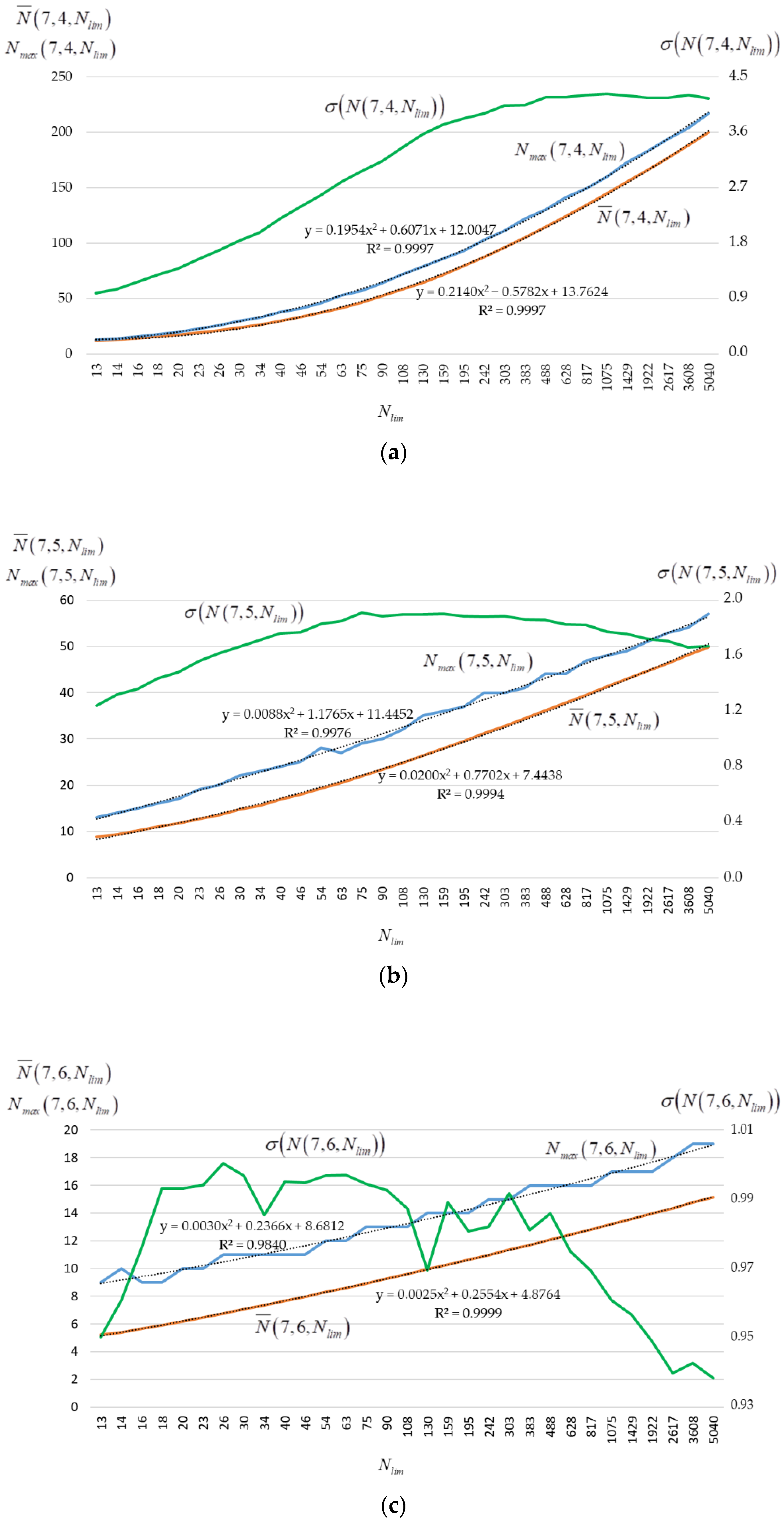
Figure 8 shows the graphs of estimates of the mathematical expectation , standard deviation , and the maximum value of the -code size against the value . The curves on Figure 8 are obtained as a result of 10,000 experiments for and .
Figure 8.
Graphs of , and for and: (a) ; (b) ; (c) .
Figure 8 also shows the approximation curves [53] and equations, as well as the approximation reliability coefficient for the dependences of estimates of the mathematical expectation and the maximum value . The close to unity indicates an accurate description of the dependencies and for by a second-degree polynomial of the form . Table 4 summarizes the coefficients , , for the and approximation polynomials.
Table 4.
Coefficients of quadratic approximation polynomials for and .
Note that according to Equation (2). Then the approximation functions can be easily calculated by setting the values of for the required .
2.4. Technique for Constructing an Approximation Polynomial
To construct approximations for dependencies and and, if necessary, to perform extrapolation to predict the behaviour of these functions at values exceeding the upper limit of the range of their statistical study, it is necessary to perform the next steps:
- To calculate , to set and values, and to calculate ;
- To generate dependencies and for the range of values determined in accordance with (2);
- To determine approximation polynomials for and .
It is also possible to select the values of for constructing dependencies and in the opposite direction with respect to (1), from the smallest to the largest. In this case, the method to obtain approximations is as follows:
- Values of , , and are chosen. Values of are calculated using an expressionwhere . It’s obvious that ;
- Dependences and are also formed for the range of values determined in accordance with (3);
- Quadratic approximation polynomials are calculated for and .
To obtain approximation polynomials of the form in the obtained expressions of the form , it is necessary to perform the replacement .
3. Results
Here, we apply the developed method for when it is necessary to predict the average and the maximum number of codewords with formed by and random permutations.
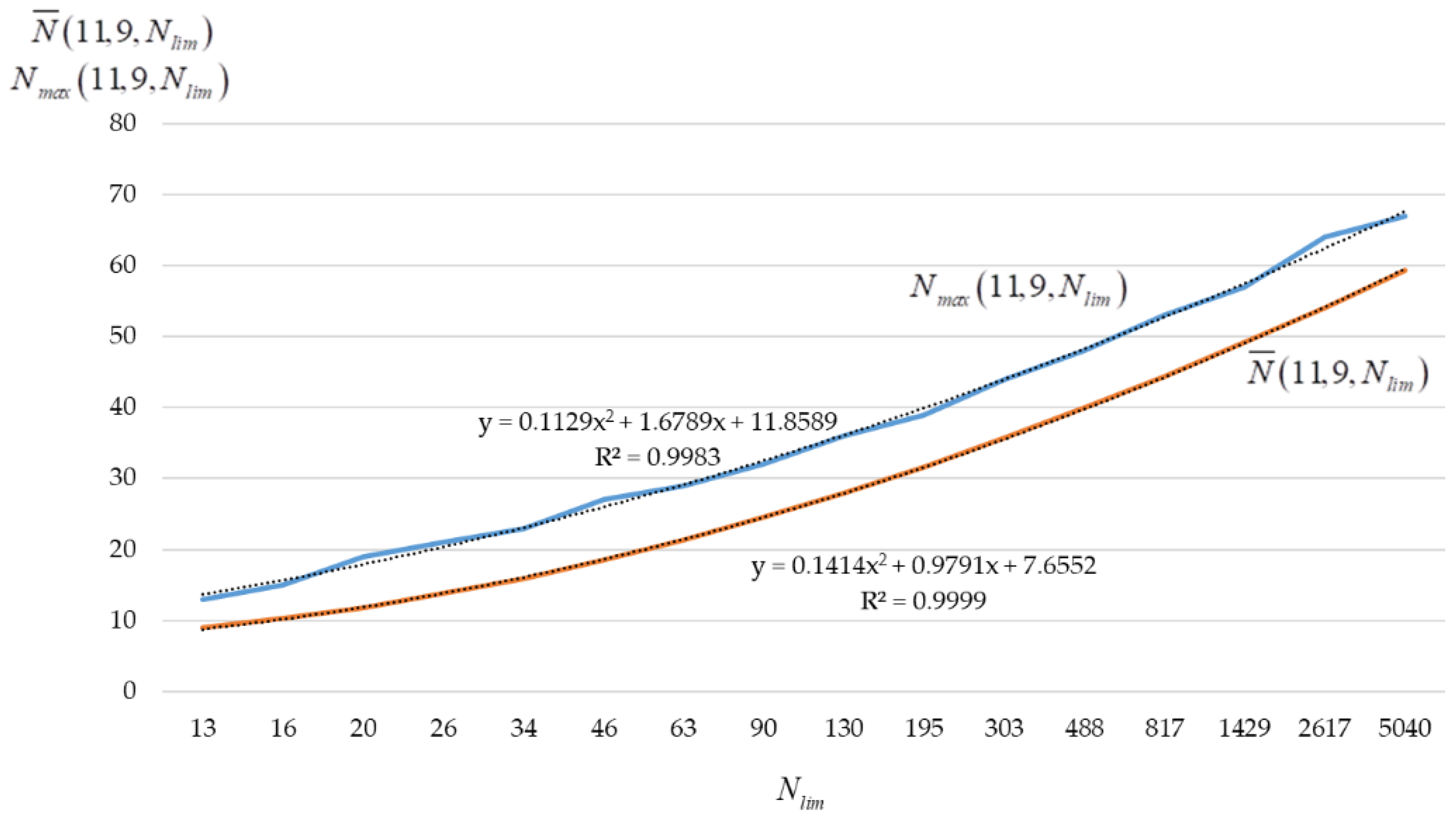
To construct approximations, we use the values given in Table 2 for the step at . Figure 9 shows the graphs of the estimates of the mathematical expectation and the maximum value of the code size against the value . Each value of and was formed as a result of 10,000 experiments.
Figure 9.
Graphs and when .
If we place values and into the expression (1) , and calculate the corresponding values of , we can get , . Note that , . Then the predicted values and are equal to 73.3836 and 81.2250 for and 77.1631 and 84.8191 for .
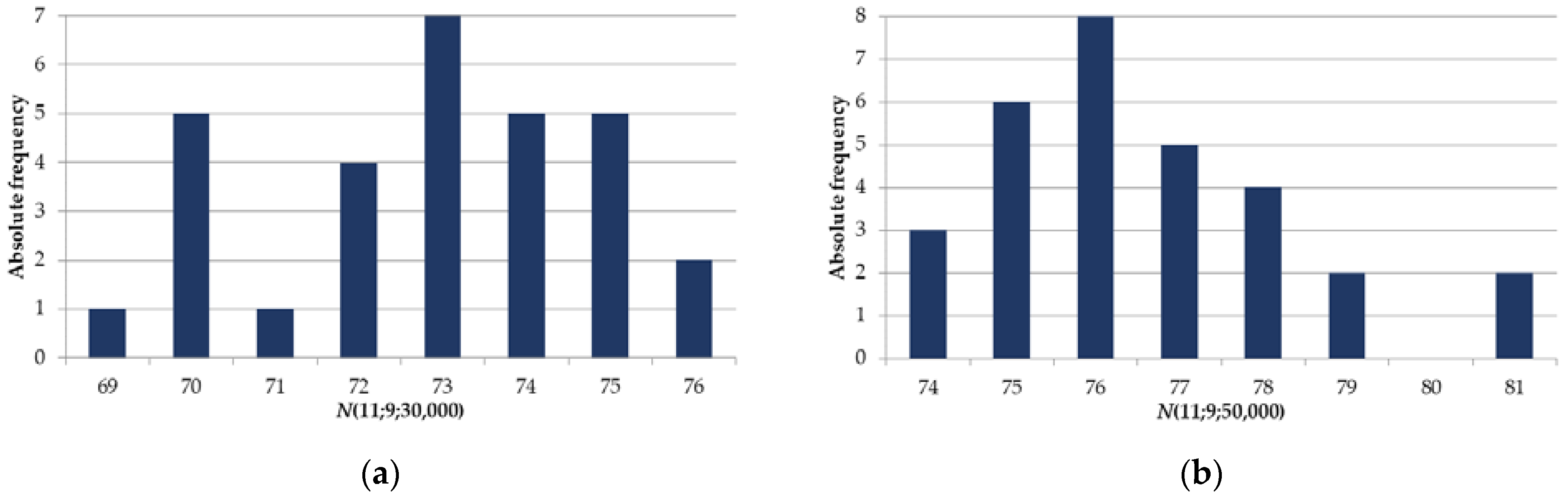
Figure 10 shows the histograms of the distribution of random values and constructed as a result of experiments. The resulting average values are 72.8667 and 76.5667 (maximum values are 76 and 81).
Figure 10.
Histograms of the distribution of a random value for: (a) ; (b) .
Here, we determine the confidence interval for the obtained sample means [54]:
where is the sample mean;
is the corrected sample standard deviation, is the sample standard deviation;
is the number of experiments ;
is the the upper quantile of Student’s t-distribution with degrees of freedom.
Let . Then, the confidence interval is for , and it is for .
The predicted values of 73.3836 and 77.1631 fall within the indicated confidence intervals.
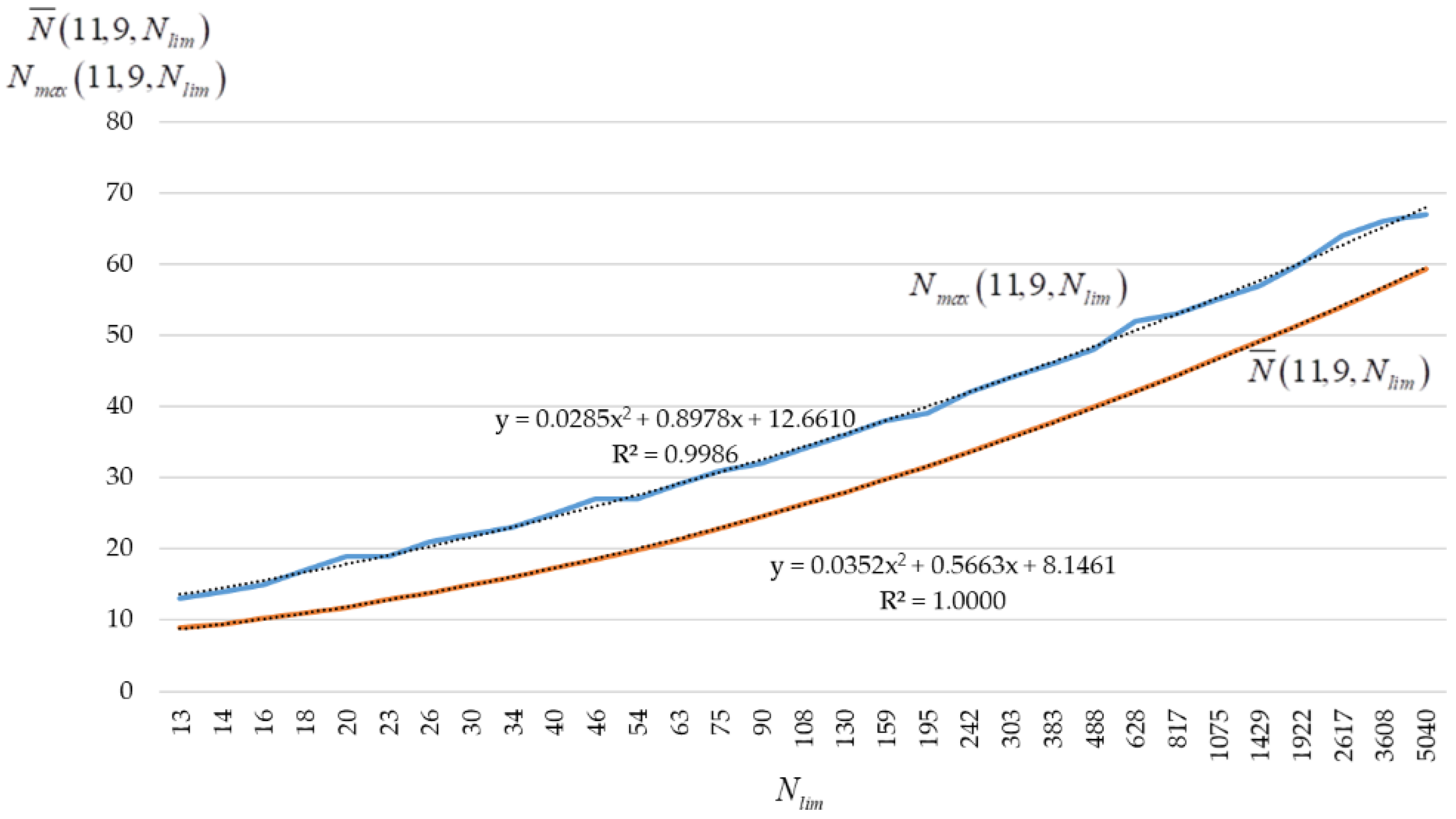
Then, let when . Figure 11 shows the graphs of the estimates of the mathematical expectation and the maximum value of the -code size against the value . Each value of and was formed as a result of 10,000 experiments.
Figure 11.
Graphs and when .
By placing values and into the expression (1) , and calculating the corresponding values of we get , . Taking into account that , , the predicted values and are equal to 73.3922 and 80.8342 for and 77.1775 and 84.3992 for .
Let the step be further increased. Table 5 summarizes the predicted values and for and when .
Table 5.
Predicted values and for and depending on the step value.
Table 5 shows that all predicted values fall within the indicated confidence intervals for and for .
Here, we calculate and present in Table 6 the relative prediction error for the values given in Table 5. We assume that the maximum number of reference points forms the most accurate prediction.
Table 6.
Relative prediction error, %.
The results in Table 6 indicate that three points as far as possible from each other are sufficient to obtain an approximation curve (an approximation polynomial of the second degree). At the same time, the authors recommend using four points to construct such a curve.
Here, we discuss the study results.
The proposed algorithm to generate codewords allows for the provision of the necessary technical result of constructing -code with the required code distance. However, the obtained values do not reach the known lower bounds [39,41,42,43,44,45,46,47]. For example, . At the same time, paper [39] gives the lower bound of 154 for the -code size. The corresponding values for are vs. the lower bound of 42 and vs. the lower bound of 77 in [39]. However, we cannot say that the result is negative. First, in this study, we used not an algebraic, but a statistical method for code construction. Second, the proposed statistical method, unlike the algebraic method, allows for the construction of a unique system of commands or alerts for dynamic wireless sensor network objects. Note also that increasing the -code size may lead to a decrease in the number of different possible -codes, which can be constructed for the defined values of , , and . In turn, the number of different possible -codes is important for applying the -code both in secure-channel coding schemes and for constructing a unique system of commands or alerts for MTC objects. At the same time, we do not deny the need to continue the search for new effective and fast statistical methods for -code construction or to improve the proposed method. Determining the balance between the -code size and the number of possible different -codes is an actual problem that can be the subject for further research.
The study has shown that the relative error in predicting the size of -code increases with increasing the hypothetical number of permutations in the initial set, as well as with increasing the step . However, the nature of this dependence is not obvious and can be further investigated.
4. Conclusions
In this paper, we have developed and implemented a statistical algorithm to generate codewords of a -code by enumerating a set of permutations of length and selecting permutations with the symbol Hamming distance to all preselected codewords not exceeding the value.
We applied two algorithms to generate a random factorial number. The first algorithm is based on the conversion from a random decimal number by division, and the second algorithm is based on the random generation of individual digits of a factorial number. We found that the second method is faster.
We have determined experimentally the dependences of the average and the maximum values of the size of a -code constructed from a subset of permutations, on the value of .
A technique to compute approximation quadratic polynomials for the determined dependences of the average and the maximum values of the -code size has been developed. A key feature of this technique is to use the function (1) of a double logarithm and to use a quadratic polynomial. The approximation polynomials and their corresponding curves can be used to extrapolate the dependencies and predict their behavior at values exceeding the upper limit of their statistical study range.
Finally, we confirmed the effectiveness of the developed technique to estimate the average and the maximum size values for and at the upper limit of the statistical study range . The prediction relative error of -code size did not exceed the value of 0.72% obtained for and .
Author Contributions
Conceptualization, E.F. and A.S.; methodology, E.F., A.S., M.M., B.S. and J.N.; software, M.M. and B.S.; validation, M.M., B.S. and R.S.; investigation, A.S., M.M., E.F. and B.S.; writing—original draft preparation, E.F., A.S. and J.N.; writing—review and editing, E.F., A.S., M.M. and B.S.; funding acquisition, E.F. All authors have read and agreed to the published version of the manuscript.
Funding
This research was partly funded by the Ministry of Education and Science of Ukraine, grant number 0120U102607.
Institutional Review Board Statement
Not applicable.
Informed Consent Statement
Not applicable.
Data Availability Statement
All initial data, program codes will be provided upon request to the correspondent’s e-mail with appropriate justification.
Acknowledgments
The authors thank the anonymous reviewers for their useful comments that helped to improve this paper. The authors are grateful to Valerii Shvydkyi for helpful remarks and discussions.
Conflicts of Interest
The authors declare no conflict of interest.
References
- Statista Research Department. Volume of Data/Information Created, Captured, Copied, and Consumed Worldwide from 2010 to 2025. Available online: https://www.statista.com/statistics/871513/worldwide-data-created/ (accessed on 22 June 2022).
- Avizienis, A.; Laprie, J.-C.; Randell, B. Fundamental Concepts of Dependability; Department of Computing Science Technical Report Series; Department of Computing Science, University of Newcastle upon Tyne: Newcastle upon Tyne, UK, 2001; p. 21. [Google Scholar]
- Durisi, D.; Liva, G.; Polyanskiy, Y. Short-Packet Transmission. In Information Theoretic Perspectives on 5G Systems and Beyond; Marić, I., Shamai (Shitz), S., Simeone, O., Eds.; Cambridge University Press: Cambridge, UK, 2022. [Google Scholar]
- Mahmood, N.H.; Böcker, S.; Moerman, I.; López, O.A.; Munari, A.; Mikhaylov, K.; Clazzer, F.; Bartz, H.; Park, O.-S.; Mercier, E.; et al. Machine Type Communications: Key Drivers and Enablers towards the 6G Era. J. Wirel. Com. Netw. 2021, 2021, 134. [Google Scholar] [CrossRef]
- Elhoseny, M.; Hassanien, A.E. Dynamic Wireless Sensor Networks: New Directions for Smart Technologies. In Studies in Systems, Decision and Control, 1st ed.; Springer: Berlin/Heidelberg, Germany, 2019; ISBN 978-3-319-92807-4. [Google Scholar]
- McEliece, R.J. A Public-Key Criptosystem Based on Algebraic Theory; Jet Propulsi on Lab: Pasadena, CA, USA, 1978; pp. 114–116. [Google Scholar]
- Rao, T.R.N. Joint Encryption and Error Correction Schemes. In Proceedings of the 11th Annual International Symposium on Computer Architecture—ISCA ’84, Ann Arbor, MI, USA, 5–7 June 1984; ACM Press: New York, NY, USA, 1984; pp. 240–241. [Google Scholar]
- Niederreiter, H. Knapsack-Type Cryptosystems and Algebraic Coding Theory. Prob. Control Inf. Theory 1986, 15, 159–166. [Google Scholar]
- Rao, T.R.N.; Nam, K.-H. Private-Key Algebraic-Coded Cryptosystems. In Advances in Cryptology—CRYPTO’ 86; Odlyzko, A.M., Ed.; Lecture Notes in Computer Science; Springer: Berlin/Heidelberg, Germany, 1987; Volume 263, pp. 35–48. ISBN 978-3-540-18047-0. [Google Scholar]
- Kløve, T.; Korzhik, V.I. Error Detecting Codes: General Theory and Their Application in Feedback Communication Systems; Kluwer Academic Publishers: Boston, MA, USA, 1995; ISBN 978-0-7923-9629-1. [Google Scholar]
- Kløve, T. Codes for Error Detection; Series on Coding Theory and Cryptology; World Scientific: Singapore, 2007; Volume 2, ISBN 978-981-270-586-0. [Google Scholar]
- Stakhov, A.P. The “Golden” Matrices and a New Kind of Cryptography. Chaos Solitons Fractals 2007, 32, 1138–1146. [Google Scholar] [CrossRef]
- Stakhov, A.P. The Golden Section, Fibonacci Numbers, Mathematics of Harmony and “Golden” Scientific Revolution. Comput. Sci. Cybersecur. 2016, 2016, 31–68. [Google Scholar]
- Mazurkov, M.I.; Chechel’nitskii, V.Y.; Murr, P. Information Security Method Based on Perfect Binary Arrays. Radioelectron. Commun. Syst. 2008, 51, 612–614. [Google Scholar] [CrossRef]
- Mazurkov, M.I.; Chechelnytskyi, V.Y.; Nekrasov, K.K. Three-Level Cryptographic System for Block Data Encryption. Radioelectron. Commun. Syst. 2010, 53, 376–379. [Google Scholar] [CrossRef]
- Borisenko, A.A.; Kalashnikov, V.V.; Kulik, I.A.; Goryachev, A.E. Generation of Permutations Based Upon Factorial Numbers. In Proceedings of the Eighth International Conference on Intelligent Systems Design and Applications, Kaohiung, Taiwan, 26 November 2008; IEEE Computer Society: Washington, DC, USA, 2008; pp. 57–61. [Google Scholar]
- Borysenko, A.A.; Horiachev, O.Y.; Matsenko, S.M.; Kobiakov, O.M. Noise-Immune Codes Based on Permutations. In Proceedings of the 2018 IEEE 9th International Conference on Dependable Systems, Services and Technologies (DESSERT), Kiev, Ukraine, 24–27 May 2018; IEEE: Washington, DC, USA, 2018; pp. 609–612. [Google Scholar]
- Al-Azzeh, J.S.; Ayyoub, B.; Faure, E.; Shvydkyi, V.; Kharin, O.; Lavdanskyi, A. Telecommunication Systems with Multiple Access Based on Data Factorial Coding. Int. J. Commun. Antenna Propag. 2020, 10, 102–113. [Google Scholar] [CrossRef]
- Faure, E.; Shcherba, A.; Vasiliu, Y.; Fesenko, A. Cryptographic Key Exchange Method for Data Factorial Coding. CEUR Workshop Proc. 2020, 2654, 643–653. [Google Scholar]
- Durisi, G.; Koch, T.; Popovski, P. Toward Massive, Ultrareliable, and Low-Latency Wireless Communication With Short Packets. Proc. IEEE 2016, 104, 1711–1726. [Google Scholar] [CrossRef] [Green Version]
- Lee, B.; Park, S.; Love, D.J.; Ji, H.; Shim, B. Packet Structure and Receiver Design for Low Latency Wireless Communications With Ultra-Short Packets. IEEE Trans. Commun. 2018, 66, 796–807. [Google Scholar] [CrossRef]
- Bana, A.-S.; Trillingsgaard, K.F.; Popovski, P.; de Carvalho, E. Short Packet Structure for Ultra-Reliable Machine-Type Communication: Tradeoff between Detection and Decoding. In Proceedings of the 2018 IEEE International Conference on Acoustics, Speech and Signal Processing (ICASSP), Calgary, AB, Canada, 15–20 April 2018; IEEE: Washington, DC, USA, 2018; pp. 6608–6612. [Google Scholar]
- Salamat Ullah, S.; Liew, S.C.; Liva, G.; Wang, T. Short-Packet Physical-Layer Network Coding. IEEE Trans. Commun. 2020, 68, 737–751. [Google Scholar] [CrossRef]
- Salamat Ullah, S.; Liew, S.C.; Liva, G.; Wang, T. Implementation of Short-Packet Physical-Layer Network Coding. IEEE Trans. Mob. Comput. 2021, 20, 1. [Google Scholar] [CrossRef]
- Wu, J.; Kim, W.; Shim, B. Pilot-Less One-Shot Sparse Coding for Short Packet-Based Machine-Type Communications. IEEE Trans. Veh. Technol. 2020, 69, 9117–9120. [Google Scholar] [CrossRef]
- Feng, C.; Wang, H. Secure Short-Packet Communications at the Physical Layer for 5G and Beyond. arXiv 2021, arXiv:2107.05966. [Google Scholar] [CrossRef]
- Feng, C.; Wang, H.-M.; Poor, H.V. Reliable and Secure Short-Packet Communications. IEEE Trans. Wirel. Commun. 2022, 21, 1913–1926. [Google Scholar] [CrossRef]
- Nguyen, A.T.P.; Le Bidan, R.; Guilloud, F. Superimposed Frame Synchronization Optimization for Finite Blocklength Regime. In Proceedings of the 2019 IEEE Wireless Communications and Networking Conference Workshop (WCNCW), Marrakech, Morocco, 15–19 April 2019; IEEE: Washington, DC, USA, 2019; pp. 1–6. [Google Scholar]
- Nguyen, A.T.P.; Le Bidan, R.; Guilloud, F. Trade-Off Between Frame Synchronization and Channel Decoding for Short Packets. IEEE Commun. Lett. 2019, 23, 979–982. [Google Scholar] [CrossRef]
- Nguyen, A.T.P.; Guilloud, F.; Le Bidan, R. On the Optimization of Resources for Short Frame Synchronization. Ann. Telecommun. 2020, 75, 635–640. [Google Scholar] [CrossRef]
- Faure, E.; Shcherba, A.; Stupka, B. Permutation-Based Frame Synchronisation Method for Short Packet Communication Systems. In Proceedings of the 2021 11th IEEE International Conference on Intelligent Data Acquisition and Advanced Computing Systems: Technology and Applications (IDAACS), Cracow, Poland, 22 September 2021; IEEE: Washington, DC, USA, 2021; pp. 1073–1077. [Google Scholar]
- Al-Azzeh, J.; Faure, E.; Shcherba, A.; Stupka, B. Permutation-Based Frame Synchronization Method for Data Transmission Systems with Short Packets. Egypt. Inform. J. 2022, in press. [Google Scholar] [CrossRef]
- Faure, E.V. Factorial coding with data recovery. Visnyk Cherkaskogo Derzhavnogo Tehnol. Univ. 2016, 2, 33–39. [Google Scholar]
- Faure, E.V. Factorial Coding with Error Correction. Radio Electron. Comput. Sci. Control. 2017, 3, 130–138. [Google Scholar] [CrossRef] [Green Version]
- Reed, I.S.; Solomon, G. Polynomial Codes Over Certain Finite Fields. J. Soc. Ind. Appl. Math. 1960, 8, 300–304. [Google Scholar] [CrossRef]
- Shcherba, A.; Faure, E.; Lavdanska, O. Three-Pass Cryptographic Protocol Based on Permutations. In Proceedings of the 2020 IEEE 2nd International Conference on Advanced Trends in Information Theory (ATIT), Kyiv, Ukraine, 25 November 2020; IEEE: Washington, DC, USA, 2020; pp. 281–284. [Google Scholar]
- Conway, J.H.; Sloane, N.J.A. Sphere Packings, Lattices, and Groups, 3rd ed.; Springer: New York, NY, USA, 1999; ISBN 978-1-4757-6568-7. [Google Scholar]
- MacWilliams, F.J.; Sloane, N.J.A. The Theory of Error Correcting Codes; North Holland Mathematical Library; North Holland Publishing Co.: Amsterdam, The Netherlands, 1977; ISBN 978-0-444-85193-2. [Google Scholar]
- Smith, D.H.; Montemanni, R. A New Table of Permutation Codes. Des. Codes Cryptogr. 2012, 63, 241–253. [Google Scholar] [CrossRef]
- Vinck, A.J.H. Coded Modulation for Power Line Communications. arXiv 2011, arXiv:1104.1528. [Google Scholar] [CrossRef]
- Frankl, P.; Deza, M. On the Maximum Number of Permutations with given Maximal or Minimal Distance. J. Comb. Theory Ser. A 1977, 22, 352–360. [Google Scholar] [CrossRef] [Green Version]
- Dixon, J.D.; Mortimer, B. Permutation Groups; Springer: New York, NY, USA, 1996; ISBN 978-1-4612-0731-3. [Google Scholar]
- Chu, W.; Colbourn, C.J.; Dukes, P. Constructions for Permutation Codes in Powerline Communications. Des. Codes Cryptogr. 2004, 32, 51–64. [Google Scholar] [CrossRef]
- Janiszczak, I.; Lempken, W.; Östergård, P.R.J.; Staszewski, R. Permutation Codes Invariant under Isometries. Des. Codes Cryptogr. 2015, 75, 497–507. [Google Scholar] [CrossRef]
- Bereg, S.; Mojica, L.G.; Morales, L.; Sudborough, H. Kronecker Product and Tiling of Permutation Arrays for Hamming Distances. In Proceedings of the 2017 IEEE International Symposium on Information Theory (ISIT), Aachen, Germany, 25–30 June 2017; IEEE: Washington, DC, USA; pp. 2198–2202. [Google Scholar]
- Bereg, S.; Mojica, L.G.; Morales, L.; Sudborough, H. Constructing Permutation Arrays Using Partition and Extension. Des. Codes Cryptogr. 2020, 88, 311–339. [Google Scholar] [CrossRef] [Green Version]
- Bereg, S.; Malouf, B.; Morales, L.; Stanley, T.; Sudborough, I.H. Using Permutation Rational Functions to Obtain Permutation Arrays with Large Hamming Distance. Des. Codes Cryptogr. 2022, 90, 1659–1677. [Google Scholar] [CrossRef]
- Neyman, J.; Pearson, E.S. On the Use and Interpretation of Certain Test Criteria for Purposes of Statistical Inference: Part I. Biometrika 1928, 20A, 175. [Google Scholar] [CrossRef]
- Python 3.10.5 Documentation. Available online: https://docs.python.org/3/ (accessed on 2 June 2022).
- Other Versions—PyCharm Edu. Available online: https://www.jetbrains.com/pycharm/download/download-thanks.html?platform=windows&code=PCC (accessed on 2 June 2022).
- Borysenko, O.; Kulyk, I.; Horiachev, O. Electronic system for generating permutations based on factorial numbers. Her. Sumy State Univ. 2007, 1, 183–188. [Google Scholar]
- Faure, E.; Shvydkyi, V.; Shcherba, A. Method for Generating Reproducible and Unpredictable Sequence of Permutations. Bezpeka ìnf. 2014, 20, 253–258. [Google Scholar] [CrossRef]
- Celant, G.; Broniatowski, M. Interpolation and Extrapolation Optimal Designs 1: Polynomial Regression and Approximation Theory; Mathematics and Statistics; John Wiley: London, UK; Hoboken, NJ, USA, 2016; ISBN 978-1-84821-995-3. [Google Scholar]
- Meeker, W.Q.; Hahn, G.J.; Escobar, L.A. Statistical Intervals: A Guide for Practitioners and Researchers, 2nd ed.; Wiley series in Probability and Statistics; Wiley: Hoboken, NJ, USA, 2017; ISBN 978-0-471-68717-7. [Google Scholar]
Publisher’s Note: MDPI stays neutral with regard to jurisdictional claims in published maps and institutional affiliations. |
© 2022 by the authors. Licensee MDPI, Basel, Switzerland. This article is an open access article distributed under the terms and conditions of the Creative Commons Attribution (CC BY) license (https://creativecommons.org/licenses/by/4.0/).