


Multi-Radio Based Rendezvous Technique for Heterogeneous Cognitive Radio Sensor Network

Abstract
1. Introduction
- (i)
- Channel Symmetricity: For the symmetric channel, the cognitive radio transmitter (CR-Tx) and cognitive radio receiver (CR-Rx) have the same available channels. The available channels indicate the number of vacant channels for rendezvous. In other words, the number of empty (and common) channels is the same as the total number of channels. The number of empty channels, on the other hand, could be smaller than the actual number of channels. In addition, the number of common channels might be smaller than the number of empty channels. If the number of empty or common channels is less than the total number of channels, the case is classified as the asymmetric channel.
- (ii)
- Channel Synchronicity: There is a lack of time alignment for rendezvous initiation because every CRU node may not have the same time slot to start the rendezvous process. This is known as the asynchronous channel state. The synchronous condition indicates that CR-Tx and CR-Rx have precisely the same rendezvous activation time.
- (iii)
- Anonymous Condition: The anonymous situation states that any CRU node is unaware of another node’s strategies. Some possible strategies are the channel selection process, implemented algorithm and channel vacancy condition, node information such as node id, wake-up time, etc.
- (iv)
- Channel Homogeneity: When both channel number homogeneity (symmetric condition) and time homogeneity (synchronous status) prevail for the given nodes, it is referred to as a homogeneous (fully homogeneous) channel condition. Apart from that, a partially homogeneous state is predicted, in which channel homogeneous channel number exists but time synchronisation does not.
- (v)
- Channel Heterogeneity: Heterogeneous channels are those that have a wide variety of typical vacant channels for various nodes. In other words, it lacks both channel symmetry and synchronicity.
- (vi)
- Deterministic Condition: The predefined rule of channel hopping or visiting channel for CR-Tx and CR-Rx are set such that, both ends are exactly aware of its counterpart. For instance, at any time slot, CR-Tx (resp. CR-Rx) knows the channel selected by CR-Rx (resp. CR-Rx). In the partially deterministic approach, each node only has limited knowledge of other nodes’ strategies and channel conditions.
- (vii)
- Non-deterministic Condition: Non-deterministic rendezvous, on the other hand, refers to a case in which no one recognizes the other nodes’ rendezvous strategy or methodology or channel selection process.
2. System Model
2.1. Network Model
2.2. Prime Number Theory for Rendezvous Process
3. Proposed Rendezvous Method Based on Prime Number Theory for Multi-Radio System
3.1. Prime Number Theory Based Channel Cycle
3.2. Multi-Radio-Based Channel Sequence
4. Rendezvous Probability and Optimal Parameters for the Proposed Method
4.1. Rendezvous Probability
4.2. Optimized Parameters for Rendezvous
5. Simulation Result
6. Conclusions
Author Contributions
Funding
Institutional Review Board Statement
Informed Consent Statement
Data Availability Statement
Conflicts of Interest
Appendix A. Derivation of Rendezvous Probability for Single Cycle
References
- Salim, S.; Moh, S. An Energy-Efficient Game-Theory-Based Spectrum Decision Scheme for Cognitive Radio Sensor Networks. Sensors 2016, 16, 1009. [Google Scholar] [CrossRef] [Scilit] [PubMed]
- Heejung, Y.; Zikria, Y.B. Cognitive Radio Networks for Internet of Things and Wireless Sensor Networks. Sensors 2020, 20, 5288. [Google Scholar] [CrossRef] [Scilit]
- Vladimir, S.; Koo, I. An Efficient Clustering Protocol for Cognitive Radio Sensor Networks. Electronics 2021, 10, 84. [Google Scholar] [CrossRef] [Scilit]
- Ahmad, W.S.H.M.W.; Radzi, N.A.M.; Samidi, F.S.; Ismail, A.; Abdullah, F.; Jamaludin, M.Z.; Zakaria, M.N. 5G Technology: Towards Dynamic Spectrum Sharing Using Cognitive Radio Networks. IEEE Access 2020, 8, 14460–14488. [Google Scholar] [CrossRef] [Scilit]
- Arunthavanathan, S.; Kandeepan, S.; Evans, R.J. Reinforcement learning based secondary user transmissions in cognitive radio networks. In Proceedings of the 2013 IEEE Globecom Workshops (GC Wkshps), Atlanta, GA, USA, 9–13 December 2013; pp. 374–379. [Google Scholar] [CrossRef] [Scilit]
- Arunthavanathan, S.; Kandeepan, S.; Evans, R.J. A Markov Decision Process-Based Opportunistic Spectral Access. IEEE Wirel. Commun. Lett. 2016, 5, 544–547. [Google Scholar] [CrossRef] [Scilit]
- Buddhikot, M.M.; Kolodzy, P.; Miller, S.; Ryan, K.; Evans, J. DIMSUMnet: New directions in wireless networking using coordinated dynamic spectrum. In Proceedings of the Sixth IEEE International Symposium on a World of Wireless Mobile and Multimedia Networks, Taormina-Giardini Naxos, Italy, 16 June 2005; pp. 78–85. [Google Scholar] [CrossRef] [Scilit]
- Kondareddy, Y.R.; Agrawal, P.; Sivalingam, K. Cognitive Radio Network setup without a Common Control Channel. In Proceedings of the MILCOM 2008-2008 IEEE Military Communications Conference, San Diego, CA, USA, 16–19 November 2008; pp. 1–6. [Google Scholar]
- Jia, J.; Zhang, Q.; Shen, X.S. HC-MAC: A Hardware-Constrained Cognitive MAC for Efficient Spectrum Management. IEEE J. Sel. Areas Commun. 2008, 26, 106–117. [Google Scholar] [CrossRef] [Scilit]
- Krishnamurthy, S.; Thoppian, M.; Venkatesan, S.; Prakash, R. Control channel based MAC-layer configuration, routing and situation awareness for cognitive radio networks. In Proceedings of the MILCOM 2005—2005 IEEE Military Communications Conference, Atlantic City, NJ, USA, 17–20 October 2005; Volume 1, pp. 455–460. [Google Scholar]
- Ma, L.; Han, X.; Shen, C.-C. Dynamic open spectrum sharing MAC protocol for wireless ad hoc networks. In Proceedings of the First IEEE International Symposium on New Frontiers in Dynamic Spectrum Access Networks, DySPAN 2005, Baltimore, MD, USA, 8–11 November 2005; pp. 203–213. [Google Scholar]
- Lin, Z.; Liu, H.; Chu, X.; Leung, Y.W. Jump-stay based channel-hopping algorithm with guaranteed rendezvous for cognitive radio networks. In Proceedings of the IEEE INFOCOM, Shanghai, China, 10–15 April 2011; pp. 2444–2452. [Google Scholar] [CrossRef] [Scilit]
- Liu, H.; Lin, Z.; Chu, X.; Leung, Y.W. Jump-Stay Rendezvous Algorithm for Cognitive Radio Networks. IEEE Trans. Parallel Distrib. Syst. 2012, 23, 1867–1881. [Google Scholar] [CrossRef]
- Tan, X.J.; Zhou, C.; Chen, J. Symmetric Channel Hopping for Blind Rendezvous in Cognitive Radio Networks Based on Union of Disjoint Difference Sets. IEEE Trans. Veh. Technol. 2017, 66, 10233–10248. [Google Scholar] [CrossRef] [Scilit]
- Chiang, M.; Yang, G.; Chiang, C.; Kwong, W.C. Asynchronous-Symmetric Channel-Hopping Sequences Over Prime Field for Cognitive Radio Networks. IEEE Commun. Lett. 2018, 22, 618–621. [Google Scholar] [CrossRef] [Scilit]
- Theis, N.C.; Thomas, R.W.; DaSilva, L.A. Rendezvous for Cognitive Radios. IEEE Trans. Mob. Comput. 2011, 10, 216–227. [Google Scholar] [CrossRef] [Scilit]
- Islam, M.T.; Kandeepan, S.; Evans, R.J. Monte-Carlo Simulation Based Analysis of Sender-Jump Receiver-Wait Rendezvous Technique with Asymmetric Channels for Cognitive Networks. In Proceedings of the 2018 12th International Conference on Signal Processing and Communication Systems (ICSPCS), Cairns, QLD, Australia, 17–19 December 2018; pp. 1–8. [Google Scholar] [CrossRef] [Scilit]
- Islam, M.T.; Kandeepan, S.; Evans, R.J. Statistical Distribution Analysis of Sender-Jump Receiver-Wait Rendezvous in Cognitive Radio. IEEE Commun. Lett. 2019, 23, 1310–1313. [Google Scholar] [CrossRef] [Scilit]
- Islam, M.T.; Kandeepan, S.; Evans, R.J. Prime Number Theory based Multi-Radio Rendezvous for Cognitive Radio Communication. In Proceedings of the 2019 IEEE 2nd International Conference on Information Communication and Signal Processing (ICICSP), Weihai, China, 28–30 September 2019; pp. 225–229. [Google Scholar]
- Sheu, J.; Lin, J. A Multi-Radio Rendezvous Algorithm Based on Chinese Remainder Theorem in Heterogeneous Cognitive Radio Networks. IEEE Trans. Mob. Comput. 2018, 17, 1980–1990. [Google Scholar] [CrossRef] [Scilit]
- Shin, J.; Yang, D.; Kim, C. A Channel Rendezvous Scheme for Cognitive Radio Networks. IEEE Commun. Lett. 2010, 14, 954–956. [Google Scholar] [CrossRef] [Scilit]
- Li, J.; Zhao, H.; Wei, J.; Ma, D.; Zhu, C.; Hu, X.; Zhou, L. Sender-jump receiver-wait: A blind rendezvous algorithm for distributed cognitive radio networks. In Proceedings of the 2016 IEEE 27th Annual International Symposium on Personal, Indoor, and Mobile Radio Communications (PIMRC), Valencia, Spain, 4–8 September 2016; pp. 1–6. [Google Scholar] [CrossRef] [Scilit]
- Hossain, A.; Sarkar, N.I. Rendezvous in cognitive radio ad-hoc networks with asymmetric channel view. In Proceedings of the WoWMoM 2015: A World of Wireless Mobile and Multimedia Networks, Boston, MA, USA, 14–17 June 2015; pp. 1–6. [Google Scholar] [CrossRef] [Scilit]
- Kim, Y. Fast and Robust Asynchronous Rendezvous Scheme for Cognitive Radio Networks. Appl. Sci. 2019, 9, 2481. [Google Scholar] [CrossRef] [Scilit]
- Sahoo, P.K.; Sahoo, D. Sequence-Based Channel Hopping Algorithms for Dynamic Spectrum Sharing in Cognitive Radio Networks. IEEE J. Sel. Areas Commun. 2016, 34, 2814–2828. [Google Scholar] [CrossRef]
- Zhang, Y.; Lo, Y.; Wong, W.S. On Channel Hopping Sequences With Full Rendezvous Diversity for Cognitive Radio Networks. IEEE Wirel. Commun. Lett. 2018, 7, 574–577. [Google Scholar] [CrossRef] [Scilit]
- Bian, K.; Park, J.M.J. Maximizing rendezvous diversity in rendezvous protocols for decentralized cognitive radio networks. IEEE Trans. Mob. Comput. 2013, 12, 1294–1307. [Google Scholar] [CrossRef] [Scilit]
- Lin, T.; Wu, K.; Yin, G. Channel-Hopping Scheme and Channel-Diverse Routing in Static Multi-Radio Multi-Hop Wireless Networks. IEEE Trans. Comput. 2015, 64, 71–86. [Google Scholar] [CrossRef] [Scilit]
- Reguera, V.A.; Guerra, E.O.; Algora, C.M.G.; Nowé, A.; Steenhaut, K. On the upper bound for the time to rendezvous in multi-hop cognitive radio networks. In Proceedings of the 2016 IEEE 21st International Workshop on Computer Aided Modelling and Design of Communication Links and Networks (CAMAD), Toronto, ON, Canada, 23–25 October 2016; pp. 31–36. [Google Scholar] [CrossRef] [Scilit]
- Lin, T.; Yang, G.; Kwong, W.C. A Homogeneous Multi-Radio Rendezvous Algorithm for Cognitive Radio Networks. IEEE Commun. Lett. 2019, 23, 736–739. [Google Scholar] [CrossRef] [Scilit]
- Chang, C.; Chang, Y.; Sheu, J. A Fast Multi-Radio Rendezvous Algorithm in Heterogeneous Cognitive Radio Networks. In Proceedings of the 2018 IEEE International Conference on Communications (ICC), Kansas City, MO, USA, 20–24 May 2018; pp. 1–7. [Google Scholar] [CrossRef] [Scilit]
- Al-Mqdashi, A.; Sali, A.; Noordin, N.k.; Hashim, S.J.; Nordin, R. Efficient Matrix-Based Channel Hopping Schemes for Blind Rendezvous in Distributed Cognitive Radio Networks. Sensors 2018, 18, 4360. [Google Scholar] [CrossRef] [Scilit]
- Li, A.; Han, G.; Ohtsuki, T. Enhanced Channel Hopping Algorithm for Heterogeneous Cognitive Radio Networks. In Proceedings of the 2018 IEEE Global Communications Conference (GLOBECOM), Abu Dhabi, United Arab Emirates, 9–13 December 2018; pp. 1–7. [Google Scholar] [CrossRef] [Scilit]
- Li, A.; Han, G.; Ohtsuki, T. A Fast Blind Scheme With Full Rendezvous Diversity for Heterogeneous Cognitive Radio Networks. IEEE Trans. Cogn. Commun. Netw. 2019, 5, 805–818. [Google Scholar] [CrossRef] [Scilit]
- Li, A.; Han, G.; Ohtsuki, T. Multiple Radios for Fast Rendezvous in Heterogeneous Cognitive Radio Networks. IEEE Access 2019, 7, 37342–37359. [Google Scholar] [CrossRef] [Scilit]
- Miller, F.; Vandome, A.; McBrewster, J. Inclusion-Exclusion Principle; VDM Publishing: Saarbrücken, Germany, 2010. [Google Scholar]
- Hassani, M. Derangements and applications. J. Integer Seq. 2003, 6, 1–3. [Google Scholar]
- Gessel, I.M. Generalized Rook Polynomials and Orthogonal Polynomials. In q-Series and Partitions; Stanton, D., Ed.; Springer: New York, NY, USA, 1989; pp. 159–176. [Google Scholar]
- Even, S.; Gillis, J. Derangements and Laguerre polynomials. Math. Proc. Camb. Philos. Soc. 1976, 79, 135–143. [Google Scholar] [CrossRef] [Scilit]
- Foata, D.; Zeilberger:i, D. Laguerre polynomials, weighted derangements, and positivity. SIAM J. Disc. Math. 1988, 1, 425–433. [Google Scholar] [CrossRef] [Scilit]
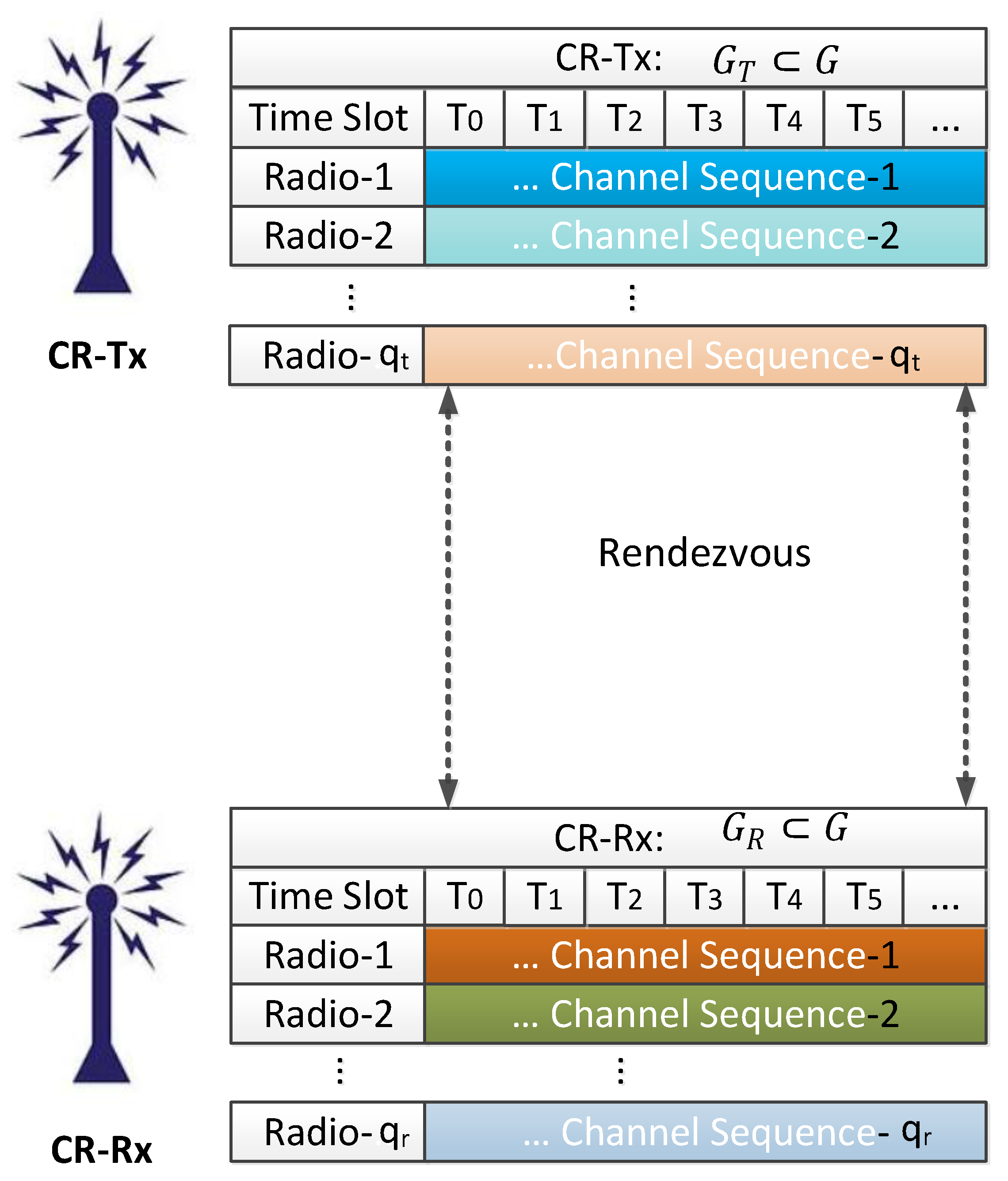
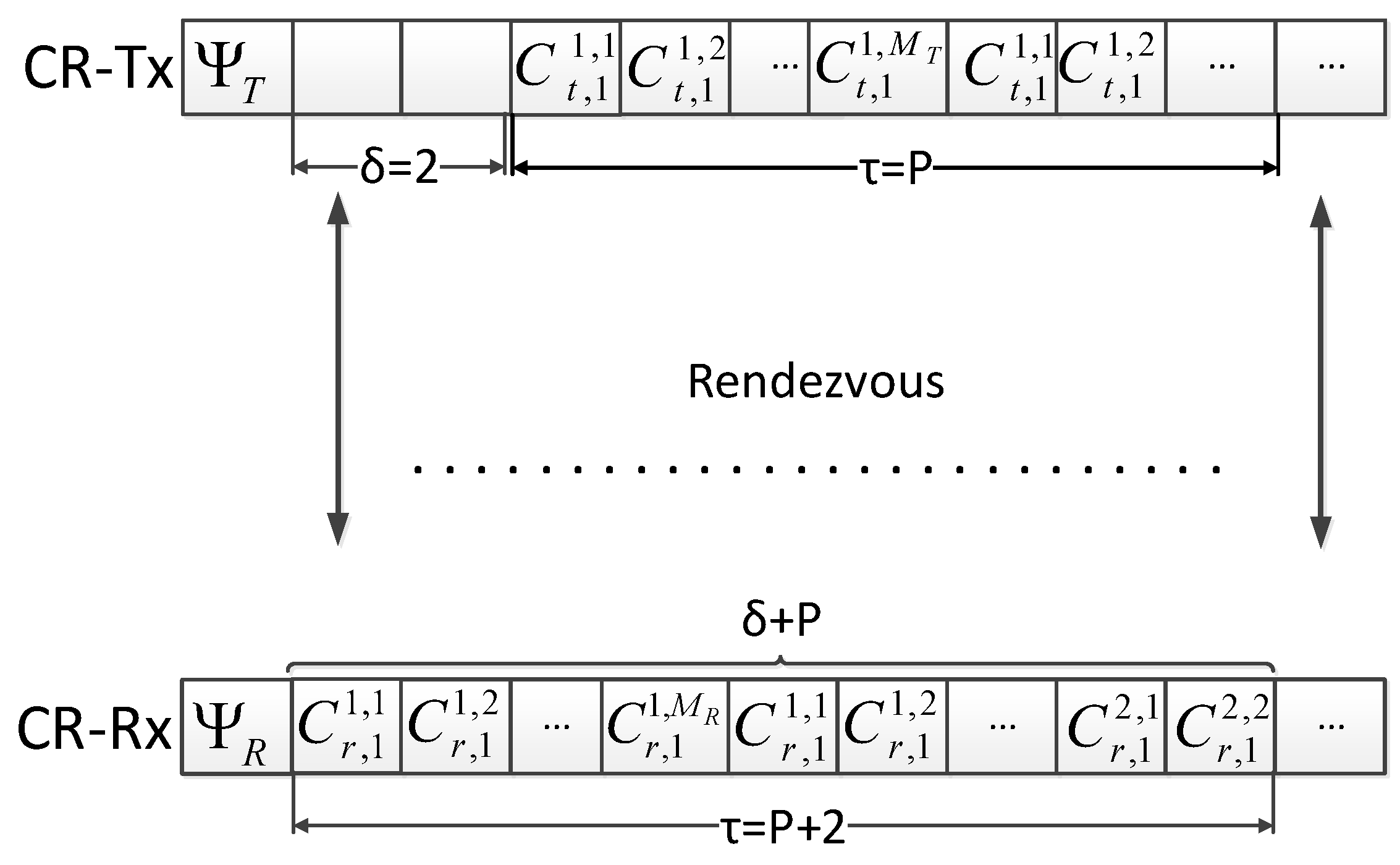
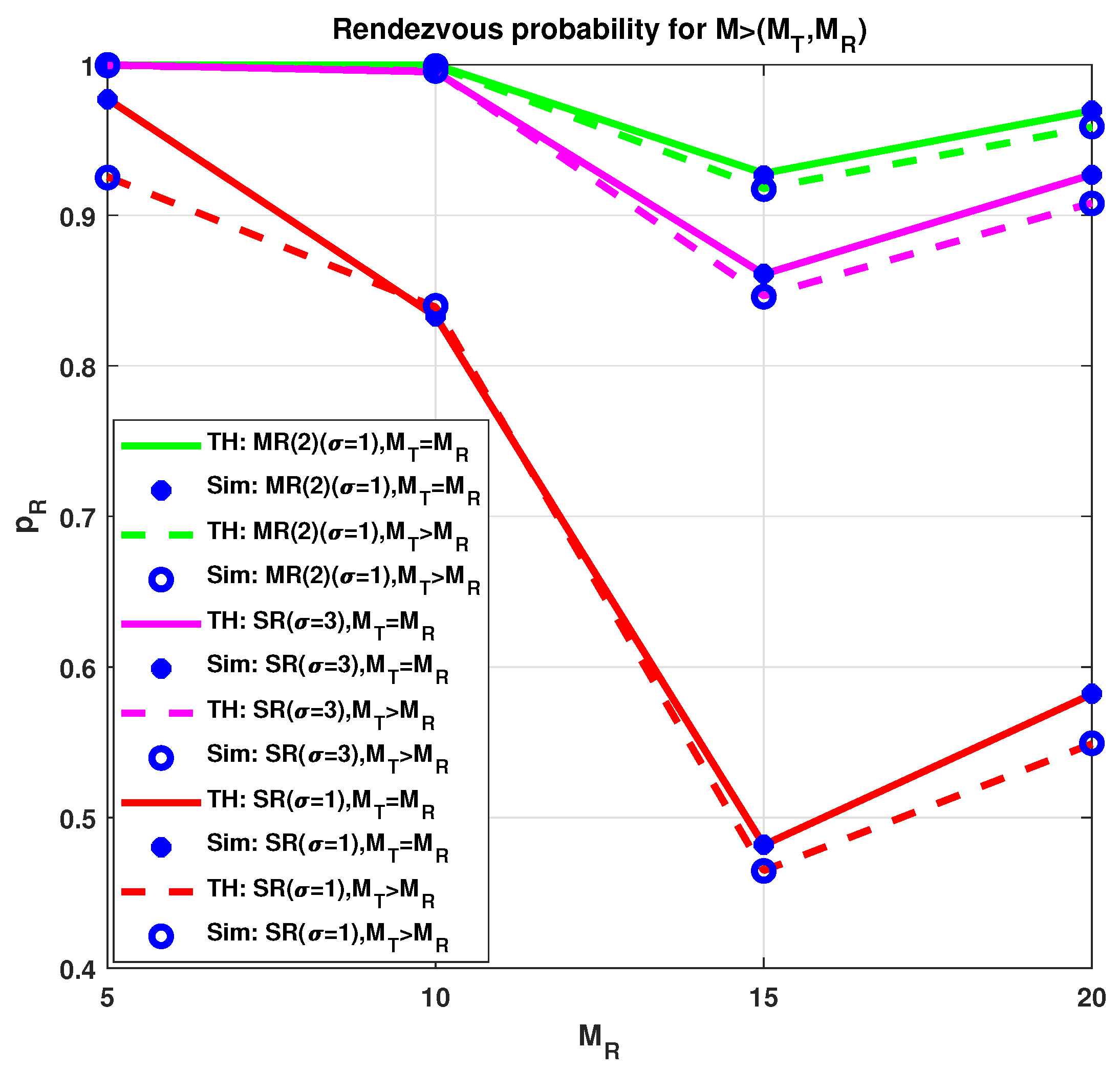
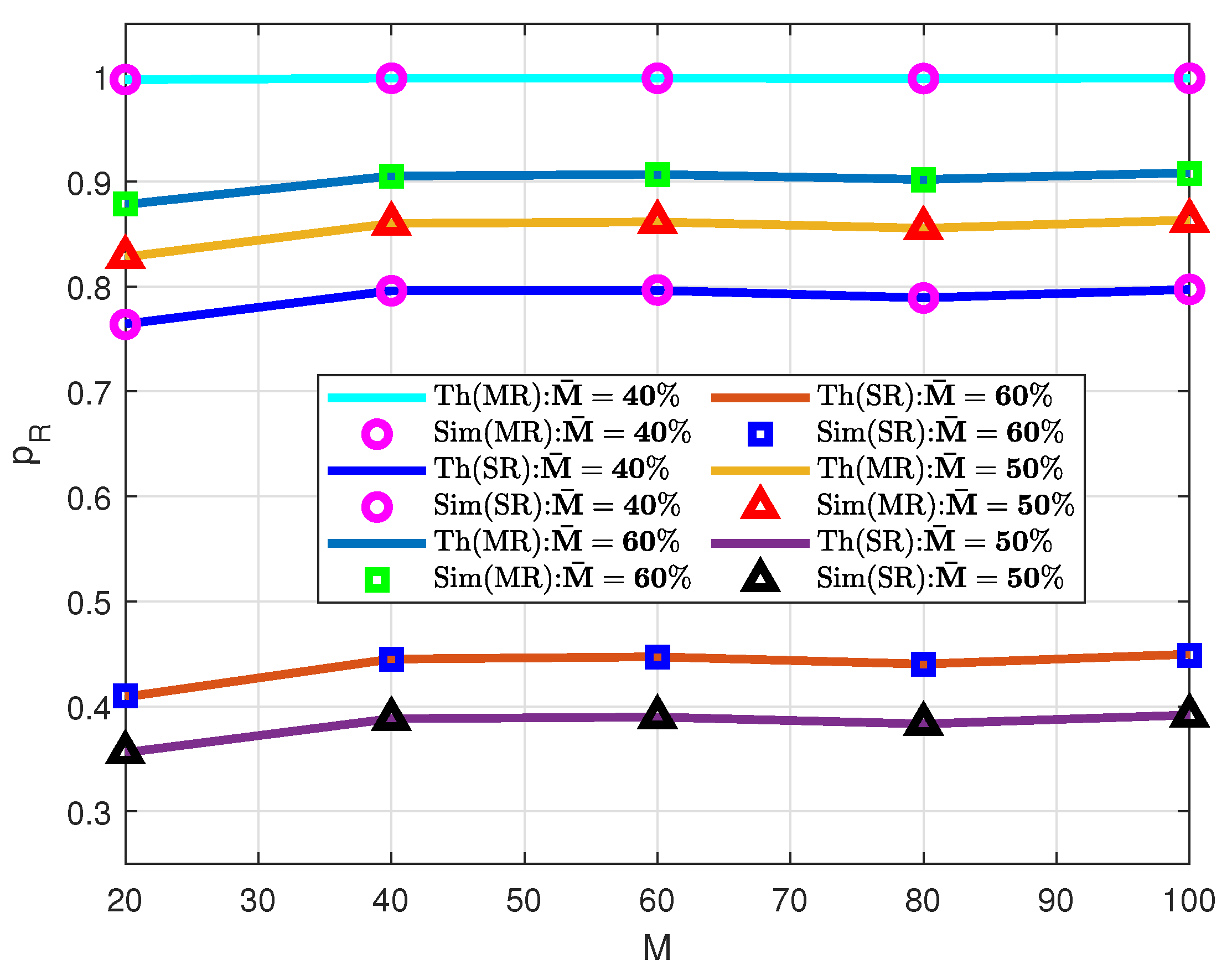

| Parameter | Value |
|---|---|
| Number of Monte Carlo runs | – |
| Number of total channels | 10–150 |
| Number of CR-Tx and CR-Rx channels | |
| Number of common channels | |
| Delay (rendezvous activation) | |
| Number of radios | |
| Target rendezvous probability ( ) | |
| Number of channel cycle |
Publisher’s Note: MDPI stays neutral with regard to jurisdictional claims in published maps and institutional affiliations. |
© 2021 by the authors. Licensee MDPI, Basel, Switzerland. This article is an open access article distributed under the terms and conditions of the Creative Commons Attribution (CC BY) license (https://creativecommons.org/licenses/by/4.0/).
Share and Cite
Islam, M.T.; Kandeepan, S.; Evans, R.J. Multi-Radio Based Rendezvous Technique for Heterogeneous Cognitive Radio Sensor Network. Sensors 2021, 21, 2997. https://doi.org/10.3390/s21092997
Islam MT, Kandeepan S, Evans RJ. Multi-Radio Based Rendezvous Technique for Heterogeneous Cognitive Radio Sensor Network. Sensors. 2021; 21(9):2997. https://doi.org/10.3390/s21092997
Chicago/Turabian StyleIslam, Md. Tahidul, Sithamparanathan Kandeepan, and Robin. J. Evans. 2021. "Multi-Radio Based Rendezvous Technique for Heterogeneous Cognitive Radio Sensor Network" Sensors 21, no. 9: 2997. https://doi.org/10.3390/s21092997
APA StyleIslam, M. T., Kandeepan, S., & Evans, R. J. (2021). Multi-Radio Based Rendezvous Technique for Heterogeneous Cognitive Radio Sensor Network. Sensors, 21(9), 2997. https://doi.org/10.3390/s21092997

