Hyperspectral Imagery for Assessing Laser-Induced Thermal State Change in Liver
 , ,
, ,  ,
,  , ,
, ,  and
and 
Abstract
1. Introduction
2. Materials and Methods
2.1. Hyperspectral Camera System
2.2. Animal Model Experimental Protocol
2.3. Hypercubes Data Processing
2.3.1. Data Pre-Processing
2.3.2. Spectral Area-Based Analysis
2.3.3. Image-Based Analysis
3. Results
3.1. Results of the Data Pre-Processing
3.2. Results of the Spectral Area-Based Analysis
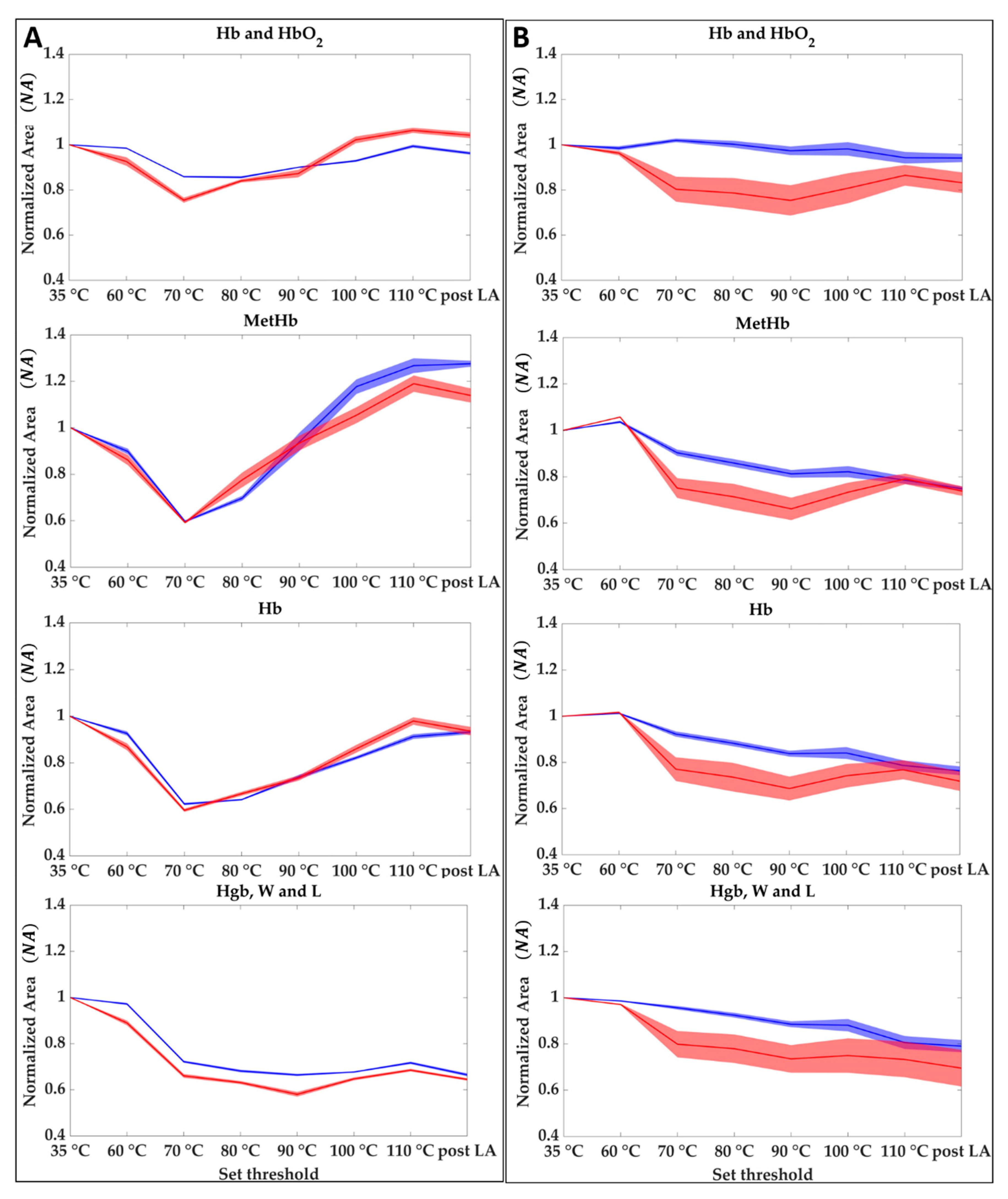
- 35 to 60 °C—Decrease of Hb, MetHb, and Hgb, W and L for the central zone, whereas in the boundary the thermal effect is delayed because of the heat conduction towards the peripheral area. Starting from a value equal to 1 at 35 °C, MetHb and Hb, especially, reached 0.88 and 0.89 values in the center zone;
- 60 to 70 °C—Decrease of the four chromophores for the total area (center and boundary). In the center zone, minimum values of 0.80, 0.59, 0.61 are reached for Hb and HbO2, Hb, MetHb, respectively. In the boundary, NA values experience a more moderate decrease with a minimum for the MetHb of around 0.82;
- 70 to 80 °C—Increase of Hb and HbO2, Hb, MetHb in the center, whereas for Hgb, W and L a decrease is still visible. The boundary values show still a slight decrease;
- 80 to 90 °C—Increase of Hb and HbO2, Hb, MetHb in the center, whereas for the boundary a decrease is still visible until reaching minimum values of 0.86, 0.73, 0.76 for Hb and HbO2, Hb, and MetHb, respectively. On the other hand, Hgb, W and L reaches the minimum value of 0.62 in the center.
- 90 to 110 °C—Increase of Hb and HbO2, Hb, MetHb. Whereas for Hb and HbO2, and Hb the NA values return almost to the initial conditions, the MetHb reached a maximum value of 1.32 following the activation of MetHb at 65 °C [42]. The final value of the area after the LA lies above the initial conditions, thus showing that the chromophore formed due to the temperature effect remains after the thermal treatment. Even the Hgb, W and L range shows a slight increase reaching 0.70 value at the end of the ablation process. In the boundary, values show a slight increase in this step. For the MetHb, the final values are below the initial conditions contrary to the situation at the center.
- 110 °C to post LA—Once a maximum temperature of 110 °C is reached the amount of chromophores in both the zones does not experience any consistent variation. A decrease is noticeable as an overall trend.
3.3. Results of the Image-Based Analysis
4. Discussion
5. Conclusions
Author Contributions
Funding
Institutional Review Board Statement
Informed Consent Statement
Conflicts of Interest
References
- Di Costanzo, G.G.; Francica, G.; Pacella, C.M. Laser ablation for small hepatocellular carcinoma: State of the art and future perspectives. World J. Hepatol. 2014, 6, 704–715. [Google Scholar] [CrossRef]
- Stafford, R.J.; Fuentes, D.; Elliott, A.A.; Weinberg, J.S.; Ahrar, K. Laser-induced thermal therapy for tumor ablation. Crit. Rev. Biomed. Eng. 2010, 38, 79–100. [Google Scholar] [CrossRef] [PubMed]
- Saccomandi, P.; Schena, E.; Pacella, C.M. New Horizons for Laser Ablation: Nanomedicine, Thermometry, and Hyperthermal Treatment Planning Tools. In Image-Guided Laser Ablation; Springer: Cham, Switzerland, 2020; pp. 145–151. [Google Scholar]
- Chu, K.F.; Dupuy, D.E. Thermal ablation of tumours: Biological mechanisms and advances in therapy. Nat. Rev. Cancer 2014, 14, 199–208. [Google Scholar] [CrossRef] [PubMed]
- Streffer, C. Molecular and Cellular Mechanisms of Hyperthermia. In Thermoradiotherapy and Thermochemotherapy; Springer: Berlin/Heidelberg, Germany, 1995; pp. 47–74. [Google Scholar]
- De Landro, M.; Ianniello, J.; Yon, M.; Wolf, A.; Quesson, B.; Schena, E.; Saccomandi, P. Fiber Bragg Grating Sensors for Performance Evaluation of Fast Magnetic Resonance Thermometry on Synthetic Phantom. Sensors 2020, 20, 6468. [Google Scholar] [CrossRef] [PubMed]
- Rieke, V.; Pauly, K.B. MR thermometry. J. Magn. Reson. Imaging 2008, 27, 376–390. [Google Scholar] [CrossRef]
- Morra, F.; De Landro, M.; Korganbayev, S.; Wolf, A.; Dostovalov, A.; Cigada, A.; Saccomandi, P. Spatially resolved thermometry during laser ablation in tissues: Distributed and quasi-distributed fiber optic-based sensing. Opt. Fiber Technol. 2020, 58, 102295. [Google Scholar] [CrossRef]
- Milne, P.J.; Parel, J.M.; Manns, F.; Denham, D.B.; Gonzalez-Cirre, X.; Robinson, D.S. Development of stereotactically guided laser interstitial thermotherapy of breast cancer: In situ measurement and analysis of the temperature field in ex vivo and in vivo adipose tissue. Lasers Surg. Med. 2000, 26, 67–75. [Google Scholar] [CrossRef]
- Asadi, S.; Bianchi, L.; De Landro, M.; Korganbayev, S.; Schena, E.; Saccomandi, P. Laser-induced optothermal response of gold nanoparticles: From a physical viewpoint to cancer treatment application. J. Biophotonics 2020, e202000161. [Google Scholar] [CrossRef]
- Korganbayev, S.; Orrico, A.; Bianchi, L.; De Landro, M.; Wolf, A.; Dostovalov, A.; Saccomandi, P. Closed-Loop Temperature Control Based on Fiber Bragg Grating Sensors for Laser Ablation of Hepatic Tissue. Sensors 2020, 20, 6496. [Google Scholar] [CrossRef]
- Quesson, B.; De Zwart, J.A.; Moonen, C.T.W. Magnetic resonance temperature imaging for guidance of thermotherapy. J. Magn. Reson. Imaging 2000, 12, 525–533. [Google Scholar] [CrossRef]
- Saccomandi, P.; Schena, E.; Silvestri, S. Techniques for temperature monitoring during laser-induced thermotherapy: An overview. Int. J. Hyperth. 2013, 29, 609–619. [Google Scholar] [CrossRef]
- Borman, P.T.S.; Bos, C.; De Boorder, T.; Raaymakers, B.W.; Moonen, C.T.W.; Crijns, S.P.M. Towards real-time thermometry using simultaneous multislice MRI. Phys. Med. Biol. 2016, 61, N461–N477. [Google Scholar] [CrossRef]
- Dewhirst, M.W.; Viglianti, B.L.; Lora-Michiels, M.; Hanson, M.; Hoopes, P.J. Basic principles of thermal dosimetry and thermal thresholds for tissue damage from hyperthermia. Int. J. Hyperth. 2003, 19, 267–294. [Google Scholar] [CrossRef] [PubMed]
- Yarmolenko, P.S.; Moon, E.J.; Landon, C.; Manzoor, A.; Hochman, D.W.; Viglianti, B.L.; Dewhirst, M.W. Thresholds for thermal damage to normal tissues: An update. Int. J. Hyperth. 2011, 27, 320–343. [Google Scholar] [CrossRef] [PubMed]
- Diederich, C.J. Thermal ablation and high-temperature thermal therapy: Overview of technology and clinical implementation. Int. J. Hyperth. 2005, 21, 745–753. [Google Scholar] [CrossRef]
- Clark, T.W.I.; Millward, S.F.; Gervais, D.A.; Goldberg, S.N.; Grassi, C.J.; Kinney, T.B.; Phillips, D.A.; Sacks, D.; Cardella, J.F. Reporting standards for percutaneous thermal ablation of renal cell carcinoma. J. Vasc. Interv. Radiol. 2006, 17, 1563–1570. [Google Scholar] [CrossRef] [PubMed][Green Version]
- Boas, D.A.; Pitris, C.; Ramanujam, N. Handbook of Biomedical Optics; CRC Press: Boca Raton, FL, USA, 2016. [Google Scholar]
- Cordone, L.; Cupane, A.; Leone, M.; Vitrano, E. Optical absorption spectra of deoxy- and oxyhemoglobin in the temperature range 300—20 K. Biophys. Chem. 1986, 24, 259–275. [Google Scholar] [CrossRef]
- Biagio, P.S.; Vitrano, E.; Cupane, A.; Madonia, F.; Alma, M. Temperature induced difference spectra of Oxy and Deoxy hemoglobin in the near IR, visible and soret regions. Biochem. Biophys. Res. Commun. 1977, 77, 1158–1165. [Google Scholar] [CrossRef]
- Gil, D.A.; Swift, L.M.; Asfour, H.; Muselimyan, N.; Mercader, M.A.; Sarvazyan, N.A. Autofluorescence hyperspectral imaging of radiofrequency ablation lesions in porcine cardiac tissue. J. Biophotonics 2017, 10, 1008–1017. [Google Scholar] [CrossRef]
- De Landro, M.; Saccomandi, P.; Barberio, M.; Schena, E.; Marescaux, M.J.; Diana, M. Hyperspectral imaging for thermal effect monitoring in in vivo liver during laser ablation. In Proceedings of the 2019 41st Annual International Conference of the IEEE Engineering in Medicine and Biology Society (EMBC), Berlin, Germany, 23–27 July 2019; pp. 1851–1854. [Google Scholar]
- De Landro, M.; Barberio, M.; Felli, E.; Agnus, V.; Pizzicannella, M.; Diana, M.; Saccomandi, P. Hyperspectral image-based analysis of thermal damage in living liver undergoing laser ablation. In Proceedings of the Clinical Biophotonics, Virtual Conference, 2020; Volume 11362, p. 113620G. Available online: https://www.spiedigitallibrary.org/conference-proceedings-of-spie/11362/113620G/Hyperspectral-image-based-analysis-of-thermal-damage-in-living-liver/10.1117/12.2555465.short (accessed on 18 January 2021).
- Aref, M.H.; Aboughaleb, I.H.; El-Sharkawy, Y.H. Tissue characterization utilizing hyperspectral imaging for liver thermal ablation. Photodiagnosis Photodyn. Ther. 2020, 31, 101899. [Google Scholar] [CrossRef]
- Lu, G.; Fei, B. Medical hyperspectral imaging: A review. J. Biomed. Opt. 2014, 19, 010901. [Google Scholar] [CrossRef] [PubMed]
- Holmer, A.; Tetschke, F.; Marotz, J.; Malberg, H.; Markgraf, W.; Thiele, C.; Kulcke, A. Oxygenation and perfusion monitoring with a hyperspectral camera system for chemical based tissue analysis of skin and organs. Physiol. Meas. 2016, 37, 2064–2078. [Google Scholar] [CrossRef] [PubMed]
- Kho, E.; Dashtbozorg, B.; De Boer, L.L.; Van De Vijver, K.K.; Sterenborg, H.J.C.M.; Ruers, T.J.M. Broadband hyperspectral imaging for breast tumor detection using spectral and spatial information. Biomed. Opt. Express 2019, 10, 4496–4515. [Google Scholar] [CrossRef] [PubMed]
- Halicek, M.; Lu, G.; Little, J.V.; Wang, X.; Patel, M.; Griffith, C.C.; El-Deiry, M.W.; Chen, A.Y.; Fei, B. Deep convolutional neural networks for classifying head and neck cancer using hyperspectral imaging. J. Biomed. Opt. 2017, 22, 060503. [Google Scholar] [CrossRef] [PubMed]
- Uhr, J.W.; Huebschman, M.L.; Frenkel, E.P.; Lane, N.L.; Ashfaq, R.; Liu, H.; Rana, D.R.; Cheng, L.; Lin, A.T.; Hughes, G.A.; et al. Molecular profiling of individual tumor cells by hyperspectral microscopic imaging. Transl. Res. 2012, 159, 366–375. [Google Scholar] [CrossRef]
- Sarmiento, S.; Halicek, M.; Fabelo, H.; Callicó, G.; Fei, B. The use of hyperspectral and multispectral imaging in digital histology: A systematic review. Biomed. Opt. Express 2020, 11, 3195–3233. [Google Scholar]
- He, Q.; Wang, R.K. Hyperspectral imaging enabled by an unmodified smartphone for analyzing skin morphological features and monitoring hemodynamics. Biomed. Opt. Express 2020, 11, 895–910. [Google Scholar] [CrossRef]
- Zuzak, K.J.; Naik, S.C.; Alexandrakis, G.; Hawkins, D.; Behbehani, K.; Livingston, E.H. Characterization of a Near-Infrared Laparoscopic Hyperspectral Imaging System for Minimally Invasive Surgery. Anal. Chem. 2007, 79, 4709–4715. [Google Scholar] [CrossRef]
- Zuzak, K.J.; Francis, R.P.; Wehner, E.F.; Smith, J.; Litorja, M.; Allen, D.W.; Tracy, C.R.; Cadeddu, J.; Livingston, E. Hyperspectral imaging utilizing LCTF and DLP technology for surgical and clinical applications. SPIE BIOS Biomedical Optics 2009, 7170, 71700C. [Google Scholar] [CrossRef]
- Urade, T.; Felli, E.; Barberio, M.; Al-Taher, M.; Felli, E.; Goffin, L.; Agnus, V.; Ettorre, G.M.; Marescaux, J.; Mutter, D.; et al. Hyperspectral enhanced reality (HYPER) for anatomical liver resection. Surg. Endosc. 2020, 216146511. [Google Scholar] [CrossRef]
- Barberio, M.; Longo, F.; Fiorillo, C.; Seeliger, B.; Mascagni, P.; Agnus, V.; Lindner, V.; Geny, B.; Charles, A.-L.; Gockel, I.; et al. HYPerspectral Enhanced Reality (HYPER): A physiology-based surgical guidance tool. Surg. Endosc. 2020, 34, 1736–1744. [Google Scholar] [CrossRef] [PubMed]
- Akbari, H.; Kosugi, Y.; Kojima, K.; Tanaka, N. Detection and Analysis of the Intestinal Ischemia Using Visible and Invisible Hyperspectral Imaging. IEEE Trans. Biomed. Eng. 2010, 57, 2011–2017. [Google Scholar] [CrossRef] [PubMed]
- Barberio, M.; Felli, E.; Seyller, E.; Longo, F.; Chand, M.; Gockel, I.; Geny, B.; Swanström, L.; Marescaux, J.; Agnus, V.; et al. Quantitative fluorescence angiography versus hyperspectral imaging to assess bowel ischemia: A comparative study in enhanced reality. Surgery 2020, 168, 178–184. [Google Scholar] [CrossRef] [PubMed]
- Kulcke, A.; Holmer, A.; Wahl, P.; Siemers, F.; Wild, T.; Daeschlein, G. A compact hyperspectral camera for measurement of perfusion parameters in medicine. Biomed. Tech. Eng. 2018, 63, 519–527. [Google Scholar] [CrossRef] [PubMed]
- Holmer, A.; Marotz, J.; Wahl, P.; Dau, M.; Kämmerer, P.W. Hyperspectral imaging in perfusion and wound diagnostics – methods and algorithms for the determination of tissue parameters. Biomed. Tech. Eng. 2018, 63, 547–556. [Google Scholar] [CrossRef]
- Gonzalez, R.C.; Woods, R.E. Digital Image Processing, 3rd ed.; Prentice Hall, Inc.: Upper Saddle River, NJ, USA, 2009. [Google Scholar]
- Barton, J.K.; Frangineas, G.; Pummer, H.; Black, J.F. Cooperative Phenomena in Two-pulse, Two-color Laser Photocoagulation of Cutaneous Blood Vessels. Photochem. Photobiol. 2001, 73, 642–650. [Google Scholar] [CrossRef]
- Jacques, S.L. Optical properties of biological tissues: A review. Phys. Med. Biol. 2013, 58, R37–R61. [Google Scholar] [CrossRef]
- Sfareni, R.; Boffi, A.; Quaresima, V.; Ferrari, M. Near infrared absorption spectra of human deoxy- and oxyhaemoglobin in the temperature range 20–40 °C. Biochim. Biophys. Acta (BBA) Protein Struct. Mol. Enzym. 1997, 1340, 165–169. [Google Scholar] [CrossRef]
- Landgrebe, D. Hyperspectral image data analysis. IEEE Signal Process. Mag. 2002, 19, 17–28. [Google Scholar] [CrossRef]
- Spliethoff, J.W.; Tanis, E.; Evers, D.J.; Hendriks, B.H.W.; Prevoo, W.; Ruers, T.J.M. Monitoring of tumor radio frequency ablation using derivative spectroscopy. J. Biomed. Opt. 2014, 19, 097004. [Google Scholar] [CrossRef]
- Nagarajan, V.K.; Ward, J.M.; Yu, B. Association of Liver Tissue Optical Properties and Thermal Damage. Lasers Surg. Med. 2020, 52, 779–787. [Google Scholar] [CrossRef] [PubMed]
- Swift, L.; Asfour, H.; Muselimyan, N.; Larson, C.; Armstrong, K.; Sarvazyan, N. Hyperspectral imaging for label-free in vivo identification of myocardial scars and sites of radiofrequency ablation lesions. Hear. Rhythm. 2018, 15, 564–575. [Google Scholar] [CrossRef] [PubMed]
- Wang, J.; Li, Q. Quantitative analysis of liver tumors at different stages using microscopic hyperspectral imaging technology. J. Biomed. Opt. 2018, 23, 106002. [Google Scholar] [CrossRef] [PubMed]



| Hb and HbO2 | MetHb | Hb | Hgb, W and L | |
|---|---|---|---|---|
| Set Threshold | ||||
| 60 °C | C = −4.47 ± 4.40 B = −2.60 ± 2.46 | C = −12.02 ± 4.59 B = 4.67 ± 1.45 | C = −10.29 ± 4.16 B = 1.48 ± 0.82 | C = −6.90 ± 4.69 B = −2.15 ± 1.03 |
| 70 °C | C = −19.31 ± 5.77 B = −8.86 ± 14.59 | C = −40.50 ± 1.11 B = −17.26 ± 10.87 | C = −39.04 ± 2.02 B = −15.32 ± 11.76 | C = −30.86 ± 3.58 B = −12.21 ± 12.56 |
| 80 °C | C = −15.20 ± 1.67 B = −10.54 ± 15.90 | C = −26.35 ± 6.87 B = −21.38 ± 12.24 | C = −34.56 ± 2.00 B = −19.01 ± 13.00 | C = −34.33 ± 3.00 B = −14.79 ± 12.81 |
| 90 °C | C = −11.35 ± 3.13 B = −13.63 ± 16.24 | C = −6.30 ± 8.42 B = −26.29 ± 11.56 | C = −26.32 ± 2.41 B = −23.76 ± 11.82 | C = −37.74 ± 4.76 B = −18.95 ± 12.76 |
| 100 °C | C = −2.48 ± 5.50 B = −10.54 ± 15.11 | C = 11.59 ± 10.00 B = −22.23 ± 9.11 | C = −15.94 ± 3.61 B = −20.84 ± 10.76 | C = −33.77 ± 1.93 B = −18.44 ± 14.76 |
| 110 °C | C = 2.88 ± 4.28 B = −9.62 ± 9.54 | C = 22.87 ± 8.82 B = −21.20 ± 4.62 | C = −5.39 ± 4.73 B = −22.24 ± 7.77 | C = −29.88 ± 2.09 B = −23.02 ± 14.05 |
Publisher’s Note: MDPI stays neutral with regard to jurisdictional claims in published maps and institutional affiliations. |
© 2021 by the authors. Licensee MDPI, Basel, Switzerland. This article is an open access article distributed under the terms and conditions of the Creative Commons Attribution (CC BY) license (http://creativecommons.org/licenses/by/4.0/).
Share and Cite
De Landro, M.; Espíritu García-Molina, I.; Barberio, M.; Felli, E.; Agnus, V.; Pizzicannella, M.; Diana, M.; Zappa, E.; Saccomandi, P. Hyperspectral Imagery for Assessing Laser-Induced Thermal State Change in Liver. Sensors 2021, 21, 643. https://doi.org/10.3390/s21020643
De Landro M, Espíritu García-Molina I, Barberio M, Felli E, Agnus V, Pizzicannella M, Diana M, Zappa E, Saccomandi P. Hyperspectral Imagery for Assessing Laser-Induced Thermal State Change in Liver. Sensors. 2021; 21(2):643. https://doi.org/10.3390/s21020643
Chicago/Turabian StyleDe Landro, Martina, Ignacio Espíritu García-Molina, Manuel Barberio, Eric Felli, Vincent Agnus, Margherita Pizzicannella, Michele Diana, Emanuele Zappa, and Paola Saccomandi. 2021. "Hyperspectral Imagery for Assessing Laser-Induced Thermal State Change in Liver" Sensors 21, no. 2: 643. https://doi.org/10.3390/s21020643
APA StyleDe Landro, M., Espíritu García-Molina, I., Barberio, M., Felli, E., Agnus, V., Pizzicannella, M., Diana, M., Zappa, E., & Saccomandi, P. (2021). Hyperspectral Imagery for Assessing Laser-Induced Thermal State Change in Liver. Sensors, 21(2), 643. https://doi.org/10.3390/s21020643