Article

Congested Crowd Counting via Adaptive Multi-Scale Context Learning †

1
School of Computer Science and Information Engineering, Shanghai Institute of Technology, Shanghai 201418, China
2
School of Electrical and Electronic Engineering, Shanghai Institute of Technology, Shanghai 201418, China
3
School of Mechatronical Engineering, Beijing Institute of Technology, Beijing 100081, China
*
Author to whom correspondence should be addressed.
This paper is an extended version of the conference paper. Zhang, Y.; Zhao, H.; Zhou, F.; Zhang, Q.; Shi, Y.; Liang, L. MSCANet: Adaptive multi-scale context aggregation network for congested crowd counting. In Proceedings of the 27th International Conference on Multimedia Modeling; Springer: Prague, Czech Republic, 2021; pp. 1–12.
Sensors 2021, 21(11), 3777; https://doi.org/10.3390/s21113777
Submission received: 11 April 2021 / Revised: 23 May 2021 / Accepted: 27 May 2021 / Published: 29 May 2021
(This article belongs to the Section Sensing and Imaging)

Abstract

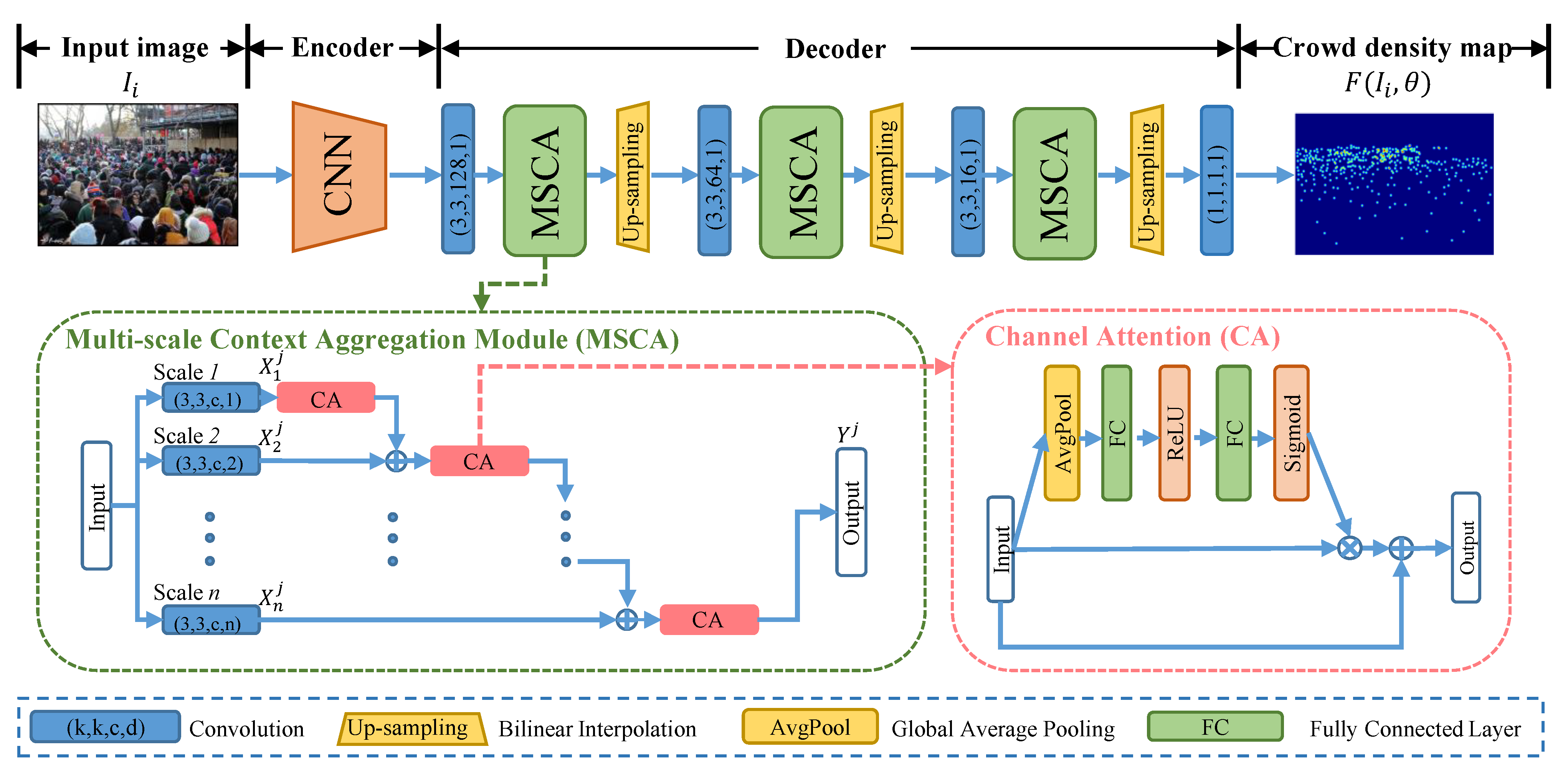
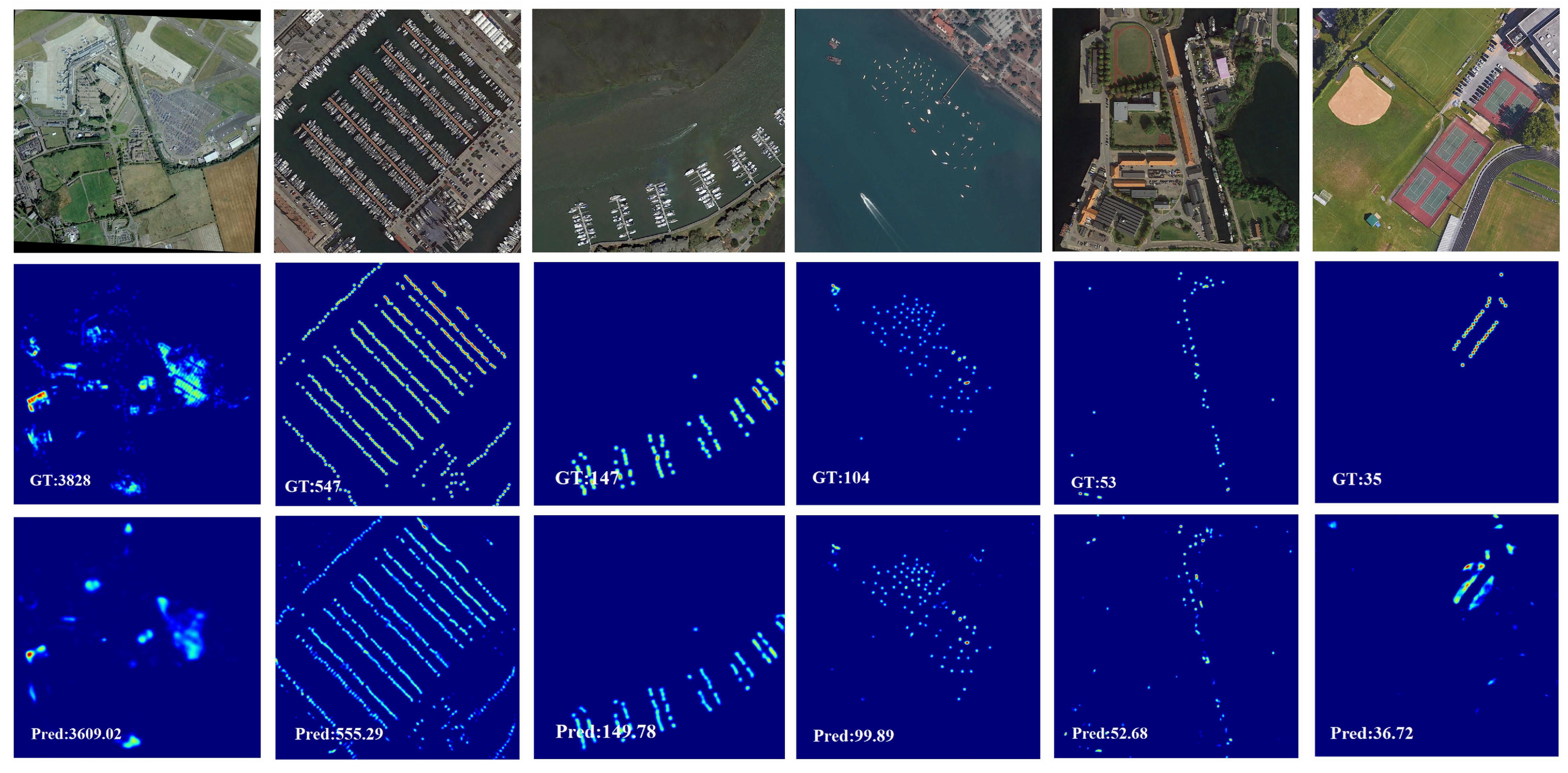
In this paper, we propose a novel congested crowd counting network for crowd density estimation, i.e., the Adaptive Multi-scale Context Aggregation Network (MSCANet). MSCANet efficiently leverages the spatial context information to accomplish crowd density estimation in a complicated crowd scene. To achieve this, a multi-scale context learning block, called the Multi-scale Context Aggregation module (MSCA), is proposed to first extract different scale information and then adaptively aggregate it to capture the full scale of the crowd. Employing multiple MSCAs in a cascaded manner, the MSCANet can deeply utilize the spatial context information and modulate preliminary features into more distinguishing and scale-sensitive features, which are finally applied to a 1 × 1 convolution operation to obtain the crowd density results. Extensive experiments on three challenging crowd counting benchmarks showed that our model yielded compelling performance against the other state-of-the-art methods. To thoroughly prove the generality of MSCANet, we extend our method to two relevant tasks: crowd localization and remote sensing object counting. The extension experiment results also confirmed the effectiveness of MSCANet.
Keywords: crowd counting; crowd density estimation; multi-scale context learning; crowd localization; remote sensing object counting crowd counting; crowd density estimation; multi-scale context learning; crowd localization; remote sensing object counting