


Abstract
The inter-satellite relative navigation method—based on radio frequency (RF) range and angle measurements—offers good autonomy and high precision, and has been successfully applied to two-satellite formation missions. However, two main challenges occur when this method is applied to multi-microsatellite formations: (i) the implementation difficulty of the inter-satellite RF angle measurement increases significantly as the number of satellites increases; and (ii) there is no high-precision, scalable RF measurement scheme or corresponding multi-satellite relative navigation algorithm that supports multi-satellite formations. Thus, a novel multi-satellite relative navigation scheme based on inter-satellite RF range and angle measurements is proposed. The measurement layer requires only a small number of chief satellites, and a novel distributed multi-satellite range measurement scheme is adopted to meet the scalability requirement. An inter-satellite relative navigation algorithm for multi-satellite formations is also proposed. This algorithm achieves high-precision relative navigation by fusing the algorithm and measurement layers. Simulation results show that the proposed scheme requires only three chief satellites to perform inter-satellite angle measurements. Moreover, with the typical inter-satellite measurement accuracy and an inter-satellite distance of around 1 km, the proposed scheme achieves a multi-satellite relative navigation accuracy of ~30 cm, which is about the same as the relative navigation accuracy of two-satellite formations. Furthermore, decreasing the number of chief satellites only slightly degrades accuracy, thereby significantly reducing the implementation difficulty of multi-satellite RF angle measurements.
1. Introduction
Microsatellites are relatively low cost and have a short development cycle and excellent flexibility. Thus, they are a perfect substitute for traditional large satellites in multi-satellite missions such as satellite formations, especially for large-scale applications. Missions that cannot be achieved using a single satellite can be accomplished with multi-satellite formations through inter-satellite cooperation. Consequently, microsatellite formations are widely employed in a number of space missions.
Inter-satellite relative measurement and navigation are the premise and basis for inter-satellite cooperation in the formation. The traditional method based on ground telemetry, tracking, and command (TT&C) network suffers from limited observation time, low precision, and poor real-time performance, and therefore cannot satisfy the relative navigation application demands for general satellite formations. To meet the high-precision, real-time operations and autonomy requirements of satellite formations, most measurement methods for inter-satellite relative navigation use global navigation satellite systems (GNSS), radar, inter-satellite radio frequency (RF), and optical measurements [1]. Overall, GNSS and RF measurement methods provide the best performance (Table 1) and are widely used. The GNSS-based method has achieved great success, and centimeter-level real-time relative navigation accuracy can be achieved with the carrier phase differential GNSS (CDGNSS) technique for satellite formations in low earth orbit (LEO) [2]. However, the application of the GNSS-based method is restricted because highly accurate measurement cannot be guaranteed in orbits above LEO. This method also offers limited autonomy because the GNSS constellation depends on the ground TT&C network. The inter-satellite RF measurements, which are independent of satellite orbital altitude and are almost independent of any external systems, not only have the potential to achieve higher measurement accuracy than CDGNSS, but also have excellent autonomy. Thus, RF measurements play an important role in the increasing number of satellite formation missions.
Table 1.
Advantages and limitations of different relative navigation approaches [1]. Reproduced with permission from IFAC Proceedings Volumes; published by Elsevier, 2011.
Unlike GNSS, which supports three-dimensional navigation, inter-satellite RF measurement is a one-dimensional approach. Thus, RF angle measurements are conventionally combined with RF range measurements to achieve inter-satellite relative navigation.
Two-satellite relative navigation based on a single inter-satellite relative measurement (inter-satellite range measurement, angle measurement, or range-rate measurement) has been extensively studied. For angles-only relative navigation, David C. Woffinden et al. [3] studied the observability criteria; Francisco J. Franquiz et al. [4] proposed optimal range observability maneuvers and trajectory planning methods for spacecraft formations under constrained relative orbital motion; Jianjun Luo et al. [5] developed angles-only relative navigation and guidance coupling algorithm in the context of Clohessy–Wiltshire and Tschauner–Hempel dynamics; and Baichun Gong et al. [6] studied the angles-only relative navigation problem for spacecraft proximity operations when the camera offset from the vehicle center-of-mass allows for range observability. For range-only relative navigation, John A. Christian [7] explored the observability of range-only relative navigation and revealed the multiplicities of possible relative trajectories of various special relative orbits; Yanghe Shen et al. [8] conducted relative orbit determination with quantum ranging, which provides more accurate range measurement than traditional methods; and Daan C. Massen et al. [9] and Frank R. Chavez et al. [10] utilized relative orbital elements instead of Hill coordinates for relative orbit determination. Besides, Cagri Kilic et al. [11] explored the relative navigation of a formation of small satellites using only range-rate measurements that may be acquired using radio hardware already on the spacecraft.
Multi-satellite absolute navigation based on inter-satellite measurements has also been studied by several researchers. Yunpeng Hu et al. [12] proposed a novel solution for autonomous orbit determination for three spacecraft with inertial angles-only measurements, and analyzed the observability. Wei Kang et al. [13] developed the observability theory and estimation algorithms for multi-satellite systems.
However, these navigation algorithms have various limitations, such as strict requirements on the satellite orbit type, which restricts their practical application. For satellite formation missions, NASA developed an RF-based autonomous formation flying (AFF) sensor and applied it to the Space-Technology 3 (ST-3) mission. The AFF sensor can achieve an inter-satellite range measurement accuracy of better than 5 mm and an inter-satellite angle measurement accuracy of better than 1 arcmin (0.017 deg) over a range of 50–1010 m [14]. However, the relative navigation accuracy has not been reported. The PRISMA mission successfully verified the inter-satellite relative navigation based on RF range and angle measurements. The inter-satellite range measurement accuracy was 1 cm, angle measurement accuracy was 0.2 deg, and relative navigation accuracy was approximately 70 cm over a range of 2–4 km [15].
Although relative navigation methods based on inter-satellite RF range and angle measurements have been studied and applied, almost all are for two-satellite formations. Relative navigation methods for multi-satellite formations have barely been studied, which significantly hinders the development of satellite formations.
There are two critical problems in the application of RF-based multi-satellite relative navigation. First, although the current inter-satellite RF angle measurement technology is relatively mature, its implementation is significantly more complex than inter-satellite RF range measurement. For multi-satellite formations, the number of inter-satellite angle measurements soars in power series with the number of satellites. Thus, implementing multi-satellite RF angle measurement becomes difficult when using a microsatellite platform due to the extremely limited computational resources. In a formation consisting of N satellites, if inter-satellite angle measurement is required between any two satellites, the number of inter-satellite angle measurements increases dramatically to . Wang et al. [16] proposed a multi-satellite relative navigation method based on inter-satellite range and angle measurements. Their approach selects one chief satellite, with the others being deputy satellites, and performs inter-satellite angle measurements between the chief and deputy satellites. This method reduces the difficulty of implementing angle measurements to some extent. However, when the number of satellites is large, it is still challenging to achieve angle measurements between the chief and deputy satellites. Second, there is no multi-satellite RF measurement scheme and corresponding multi-satellite relative navigation algorithm. Although multi-satellite navigation methods were previously studied, they focused on the navigation algorithm layer instead of the measurement layer. Without a feasible multi-satellite RF measurement framework, such navigation algorithms are far from practical application.
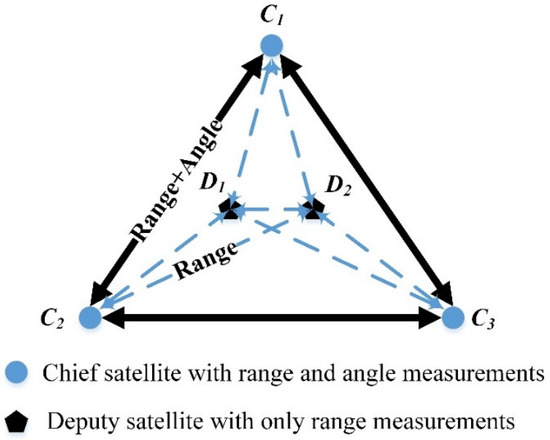
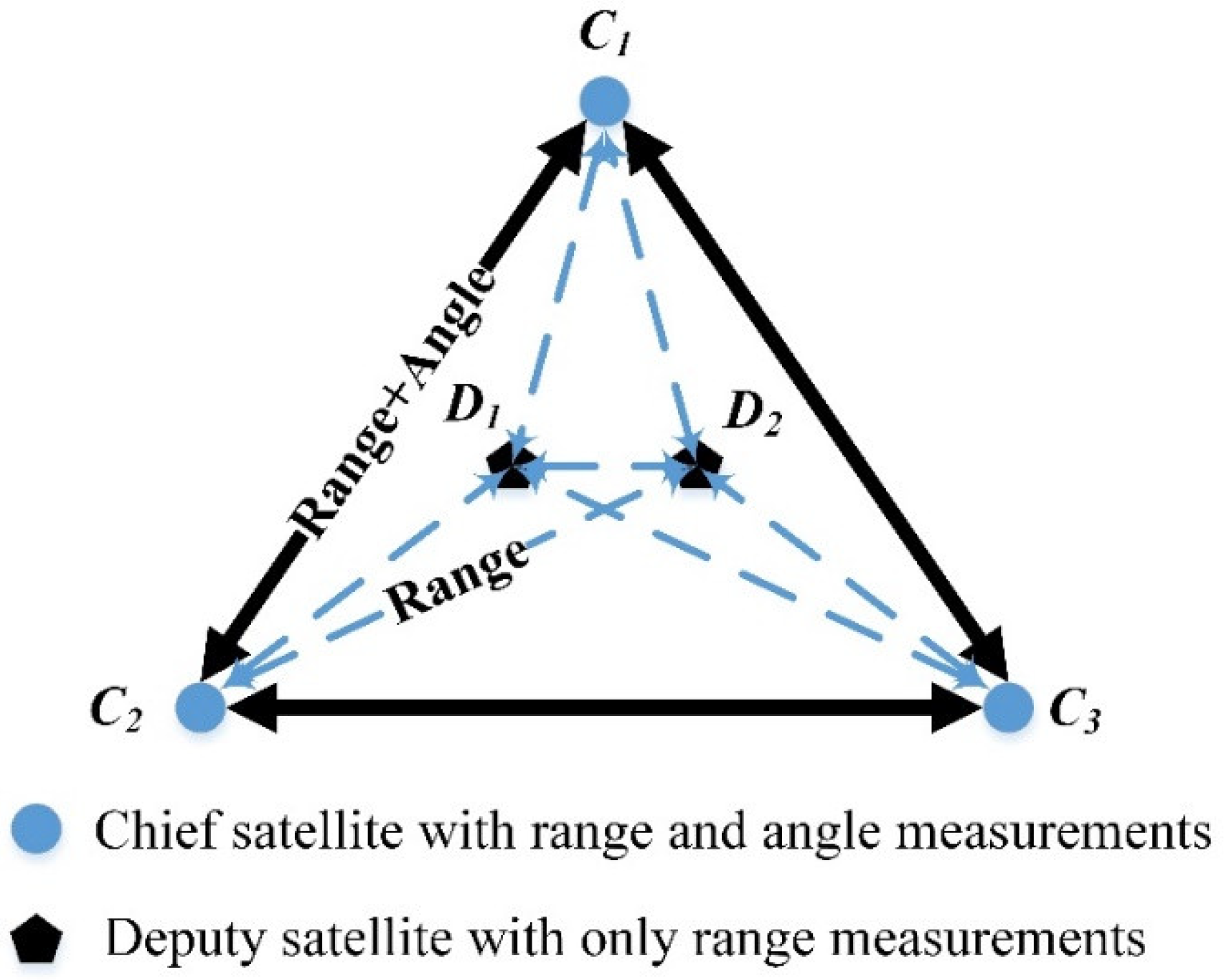
To overcome these two problems, a novel multi-satellite relative navigation scheme based on RF measurements is proposed. This scheme uses the concept of dividing a satellite formation into deputy satellites and a small number of chief satellites. The inter-satellite range measurements are performed among all the satellites, whereas the inter-satellite angle measurements are conducted only among the chief satellites. As the number of inter-satellite angle measurements is simply related to the pre-specified number of chief satellites, and is therefore independent of the total number of satellites, the difficulty of achieving inter-satellite angle measurements is significantly reduced and the scalability of the satellite formation is not affected. According to previous research by several of the authors [17], a multi-satellite measurement scheme based on time division multiple access (TDMA) could be adopted to achieve high-precision inter-satellite range measurements while effectively solving the scalability problem of frequency division multiple access (FDMA)-based or code division multiple access (CDMA)-based measurement schemes. Such a scheme would fully satisfy the application requirements of multi-satellite relative navigation described above. Based on this RF measurement scheme and the idea of measuring angles among a small number of chief satellites, a multi-satellite relative navigation algorithm could be designed to construct a high-precision multi-satellite autonomous relative navigation scheme for the large-scale applications of microsatellites.
4. Numerical Simulation
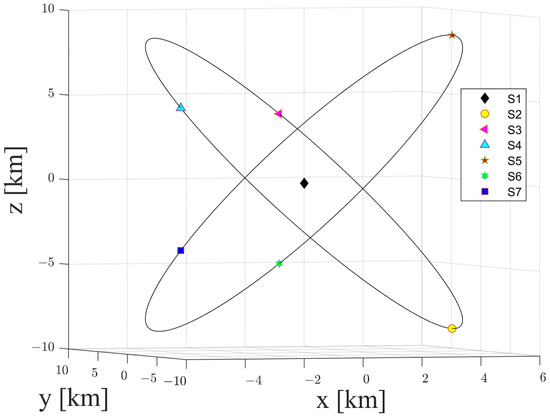
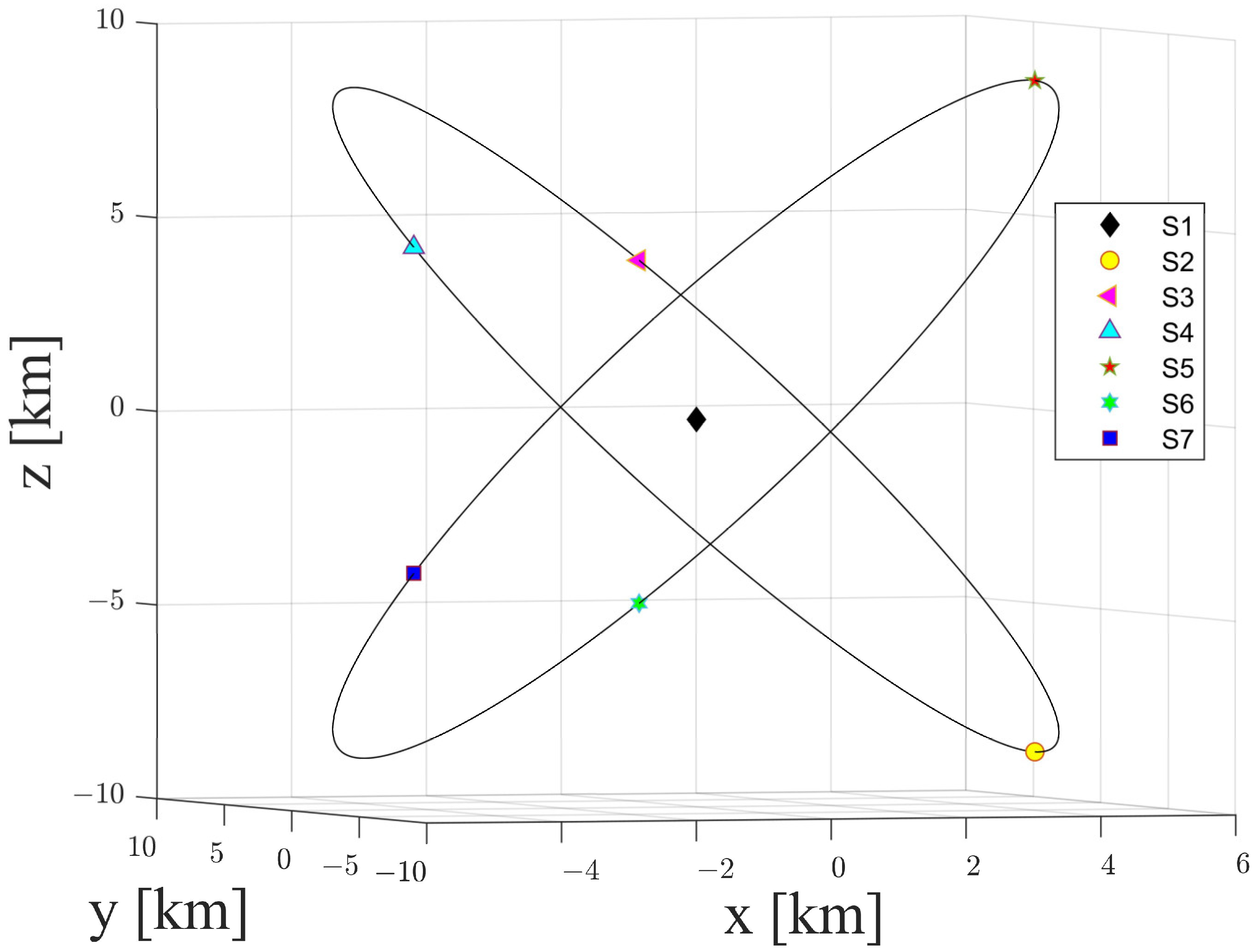
The space-circle formation is a typical satellite formation-flying configuration in which three satellites compose a projected circular formation centered at a reference satellite. To verify the effectiveness of the proposed multi-satellite relative navigation scheme and to evaluate the accuracy of the multi-satellite relative navigation algorithm, we designed a seven-satellite space-circle formation. Precisely, the seven-satellite space-circle formation consists of a reference satellite and two space-circle formations (Figure 9). Three of the seven satellites, , are in one relative orbit, with the initial phases being 0 deg, 120 deg, and 240 deg, respectively. The remaining three satellites, , are in the other relative orbit, and their initial phases are 0 deg, 120 deg, and 240 deg, respectively. The orbits of the seven-satellite space-circle formation were calculated for a space-circle radius of 1 km and a radius of 10 km. The results are presented in Table 2 and Table 3.
Figure 9.
Seven-satellite space-circle formation in the Hill frame centered at (space-circle radius of 10 km).
Table 2.
Orbit elements of the seven-satellite space-circle formation (space-circle radius of 1 km).
Table 3.
Orbit elements of the seven-satellite space-circle formation (space-circle radius of 10 km).
The number of chief satellites determines the difficulty of achieving inter-satellite angle measurement in a large-scale satellite network. To clarify the influence of the number of chief satellites, simulations were conducted with 2–6 chief satellites:
- Case a: 6 chief satellites (, , , , , ) and 1 deputy satellite ();
- Case b: 5 chief satellites (, , , , ) and 2 deputy satellites (, );
- Case c: 4 chief satellites (, , , ) and 3 deputy satellites (, , );
- Case d: 3 chief satellites (, , ) and 4 deputy satellites (, , , );
- Case e: 2 chief satellites (, ) and 5 deputy satellites (, , , , ).
In Case e, as there are only two chief satellites, no spatial position reference is available, and so the relative navigation algorithm for the deputy satellites diverges according to the theory. Case e is used to validate this inference further.
The measurement accuracy determines the relative navigation accuracy. Pre-simulation analysis and ground tests have shown that sub-centimeter-level range measurement accuracy can be achieved. With the RF measurement method, angle accuracy of 1 arcmin (0.017 deg) to 0.1 deg can be achieved at a working distance of more than 30 km. With the infrared and laser measurement methods, inter-satellite angle measurement accuracy reaches 1 arcsec (0.00028 deg), where the working distance can be up to 30 km for the infrared measurement method and less than 1 km for the laser measurement method.
Inter-satellite RF measurement accuracy is related to factors such as the frequency source, the signal-to-noise ratio, and the inter-satellite distance. To ensure generalization of the simulation results, the range measurement error is set to
and the angle measurement errors and are set to
Although the inter-satellite angle is measured among all the chief satellites, only the angle measurements between one chief satellite and the other chief satellites are used. Consequently, the redundancy of the angle measurements could be exploited to provide backup information or to improve the navigation accuracy. This is not discussed in the present paper. Without a loss of generality, chief satellite is set as the origin of the Hill frame in all the simulations, and the angle measurements between and the remaining chief satellites are used.
4.1. GDOP Analysis
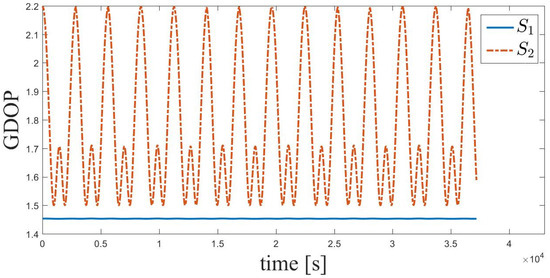
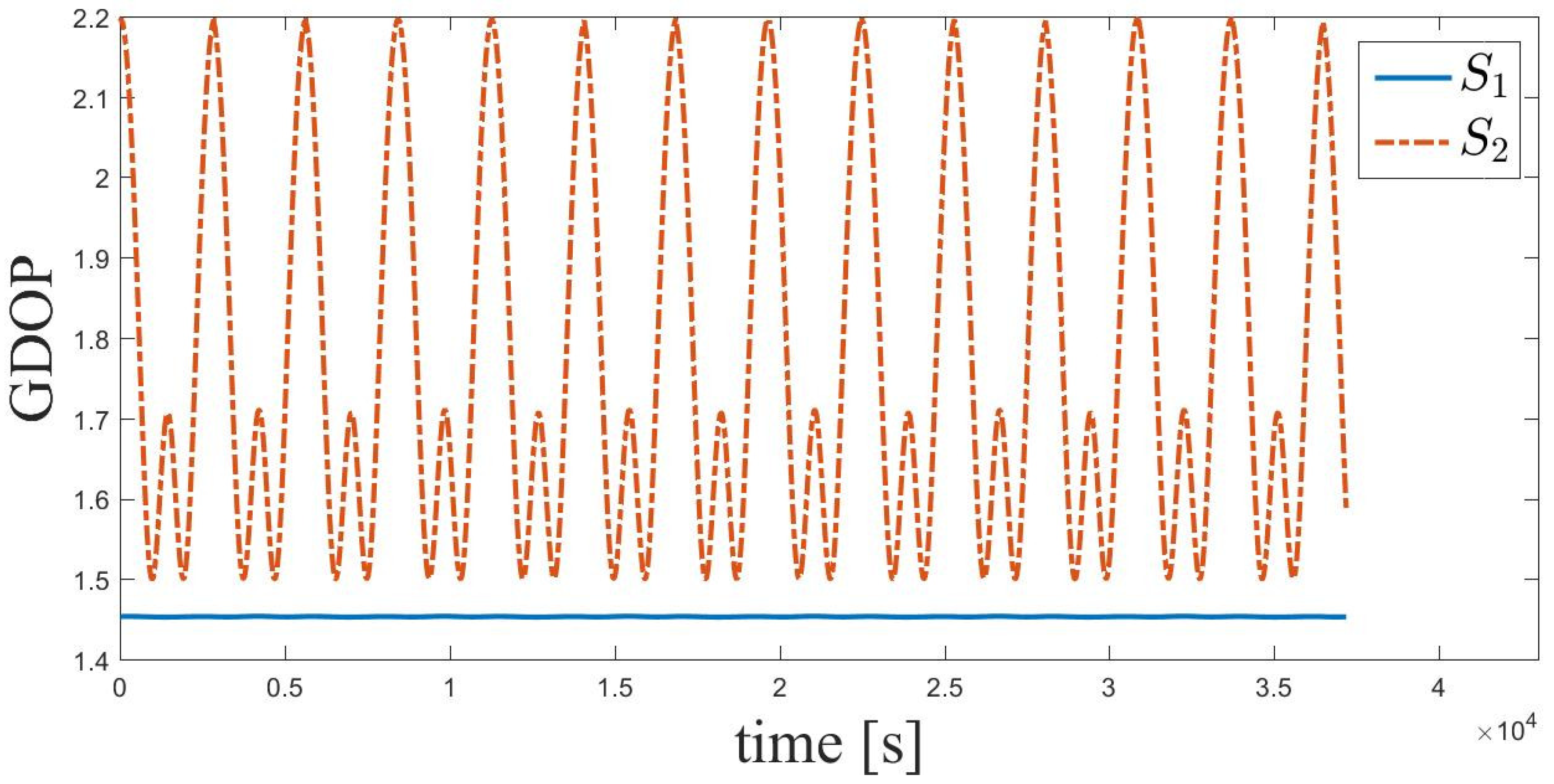
As the structure of the seven-satellite space-circle formation is symmetrical, the geometric locations of satellites can be considered to be equivalent. Take as an example. The GDOP values of satellites and are compared in Figure 10. The mean GDOP value of is 1.45, which is significantly smaller than that of (mean GDOP value = 1.78). The effect of GDOP on the relative navigation accuracy of deputy satellites is analyzed later.
Figure 10.
Time history of GDOP of and .
4.2. Simulation of Multi-Satellite Relative Navigation Algorithm
The Satellite Tool Kit (STK) software [30] is used to generate data for the seven-satellite space-circle formation. The initial state error of satellite () is set to
The initial state covariance matrix is
The measurement error covariance matrix of the chief satellite is
and the measurement error covariance matrix of deputy satellite is
The time slot of the distributed multi-satellite measurement scheme is 1 s and the measurement period is 14 s for the seven-satellite formation. The process noise covariance matrix is
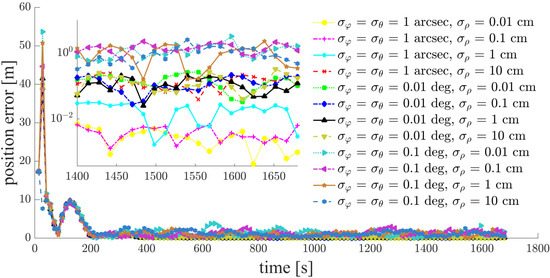
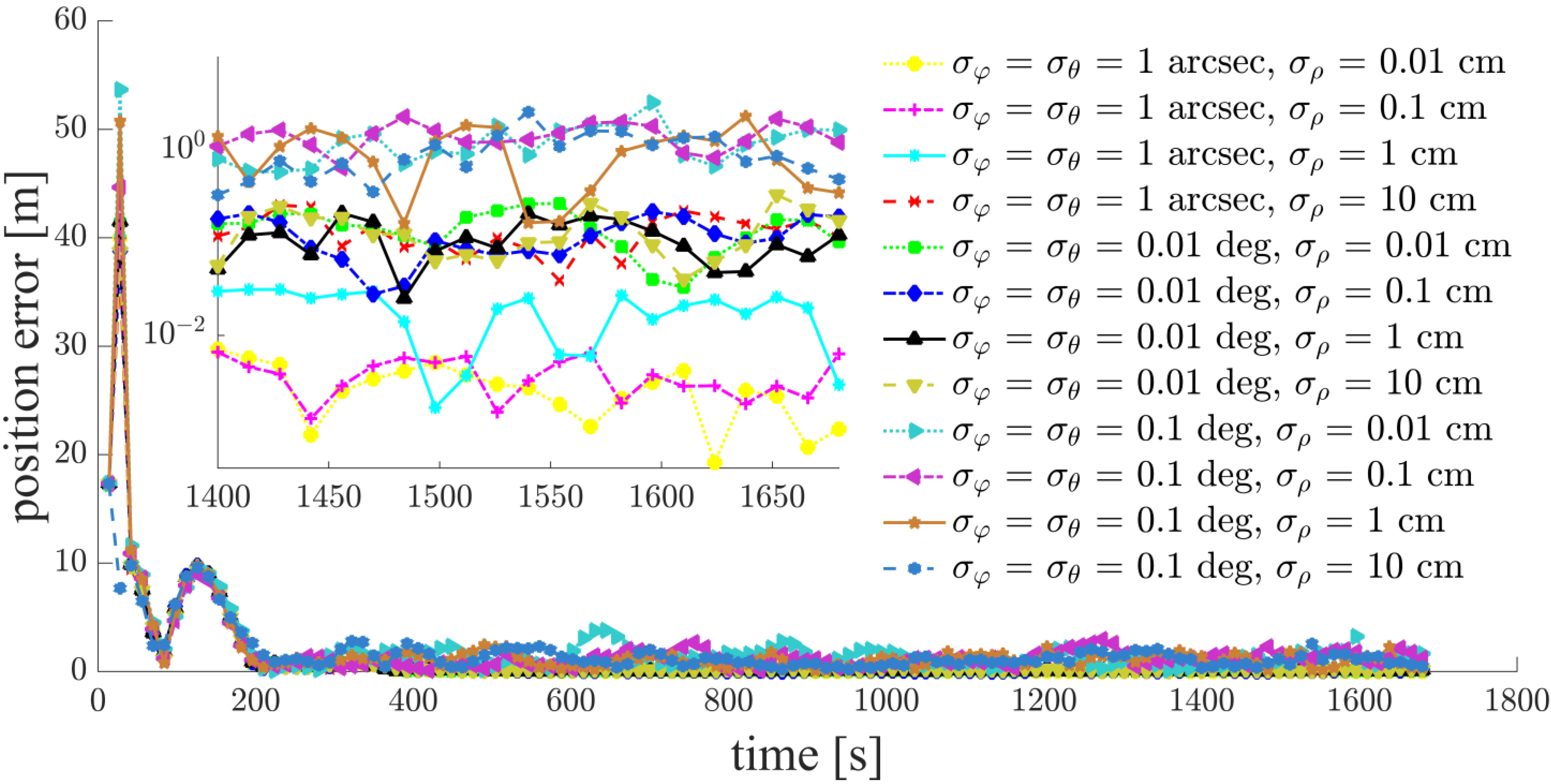
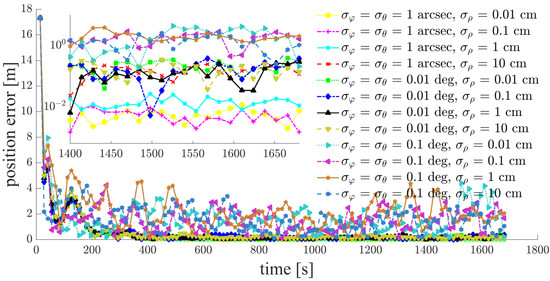
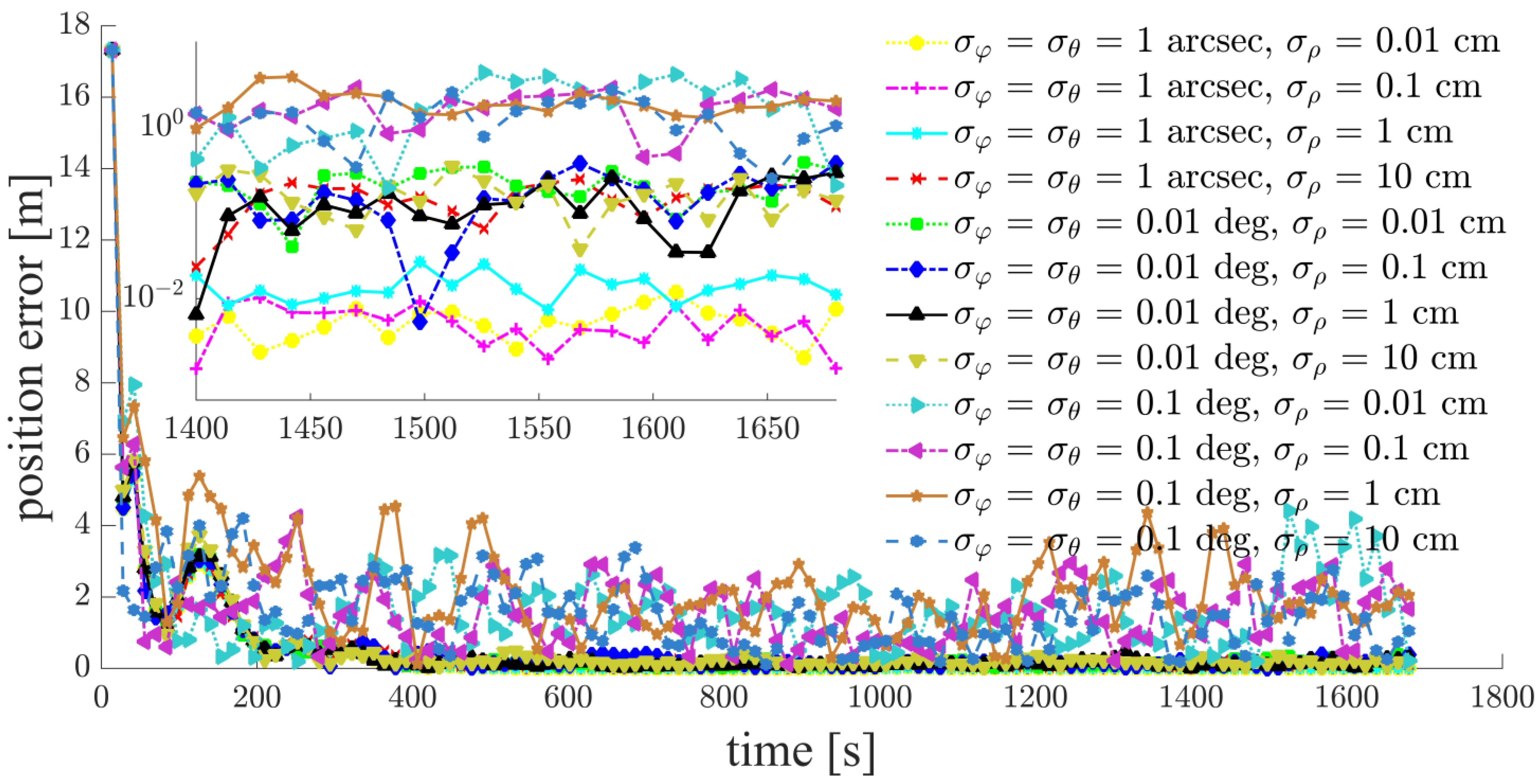
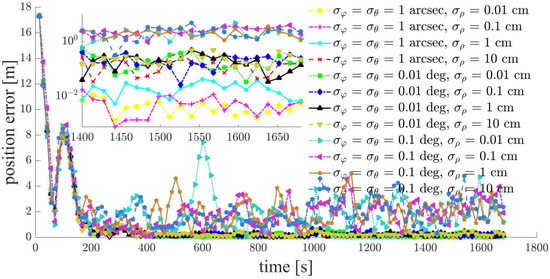
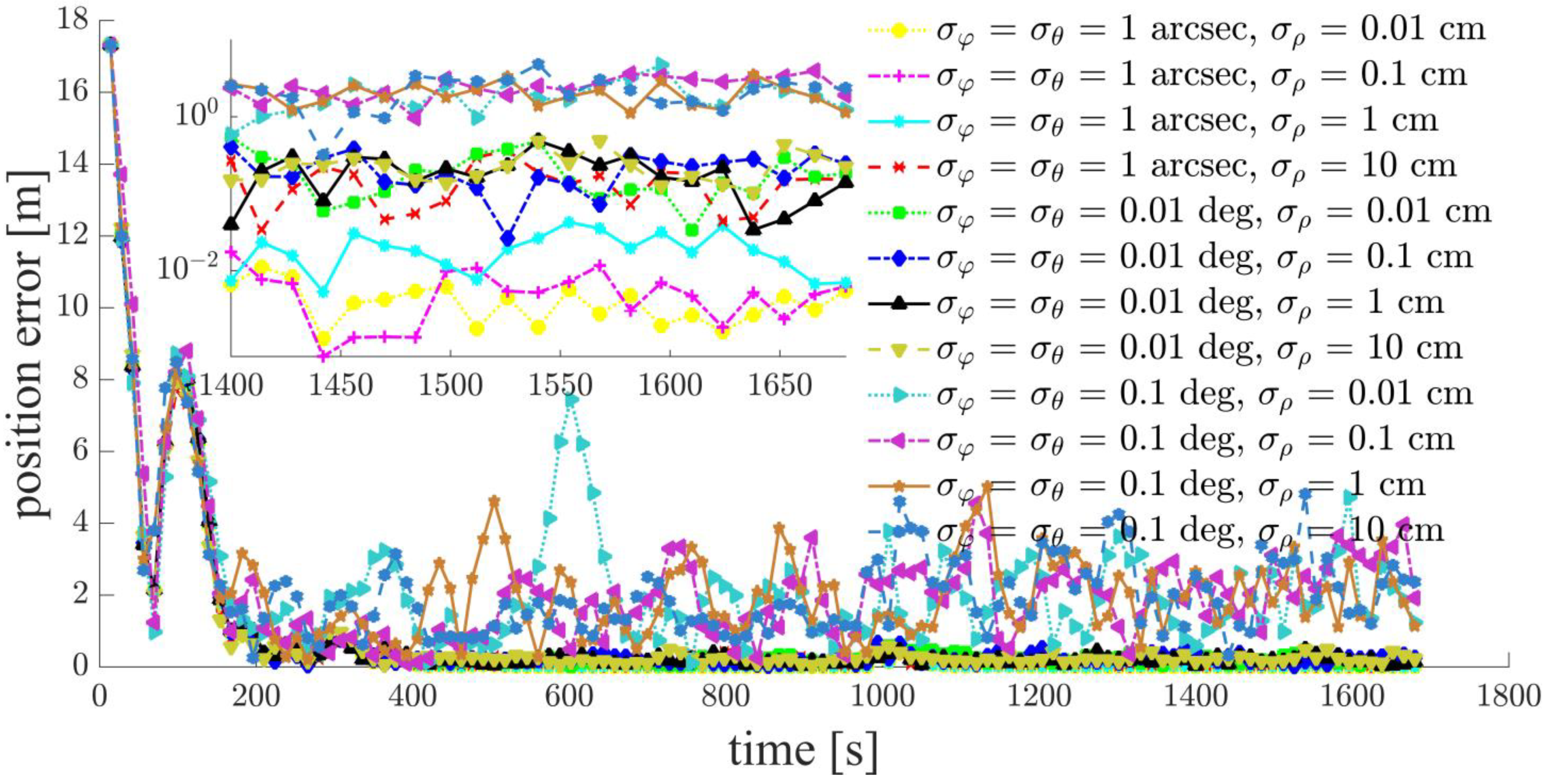
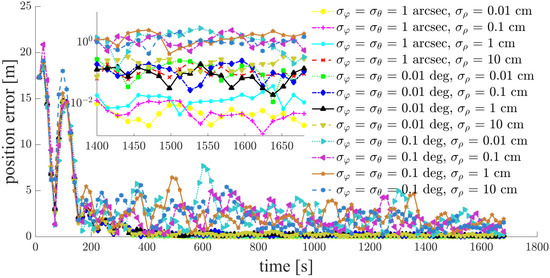
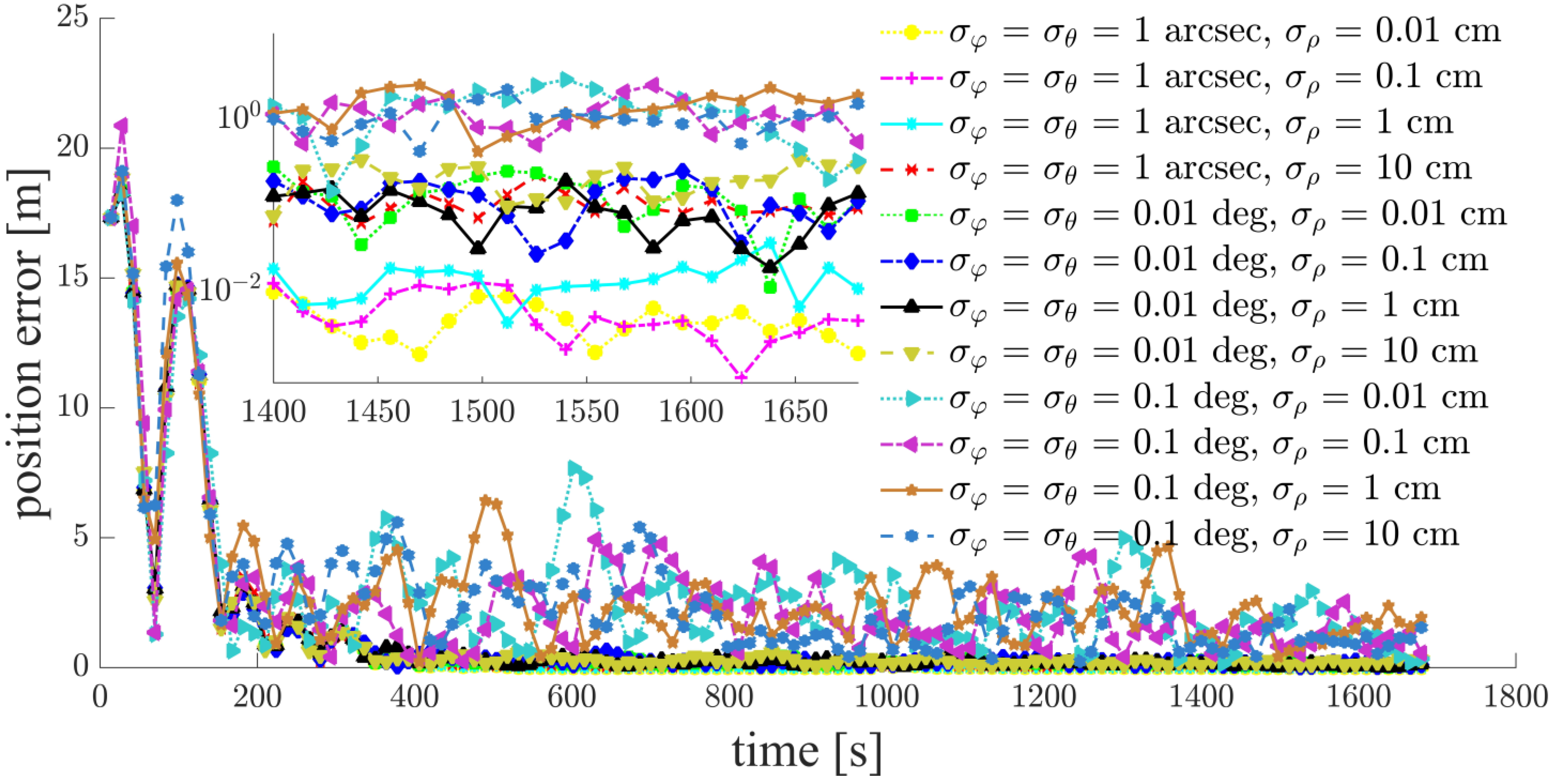
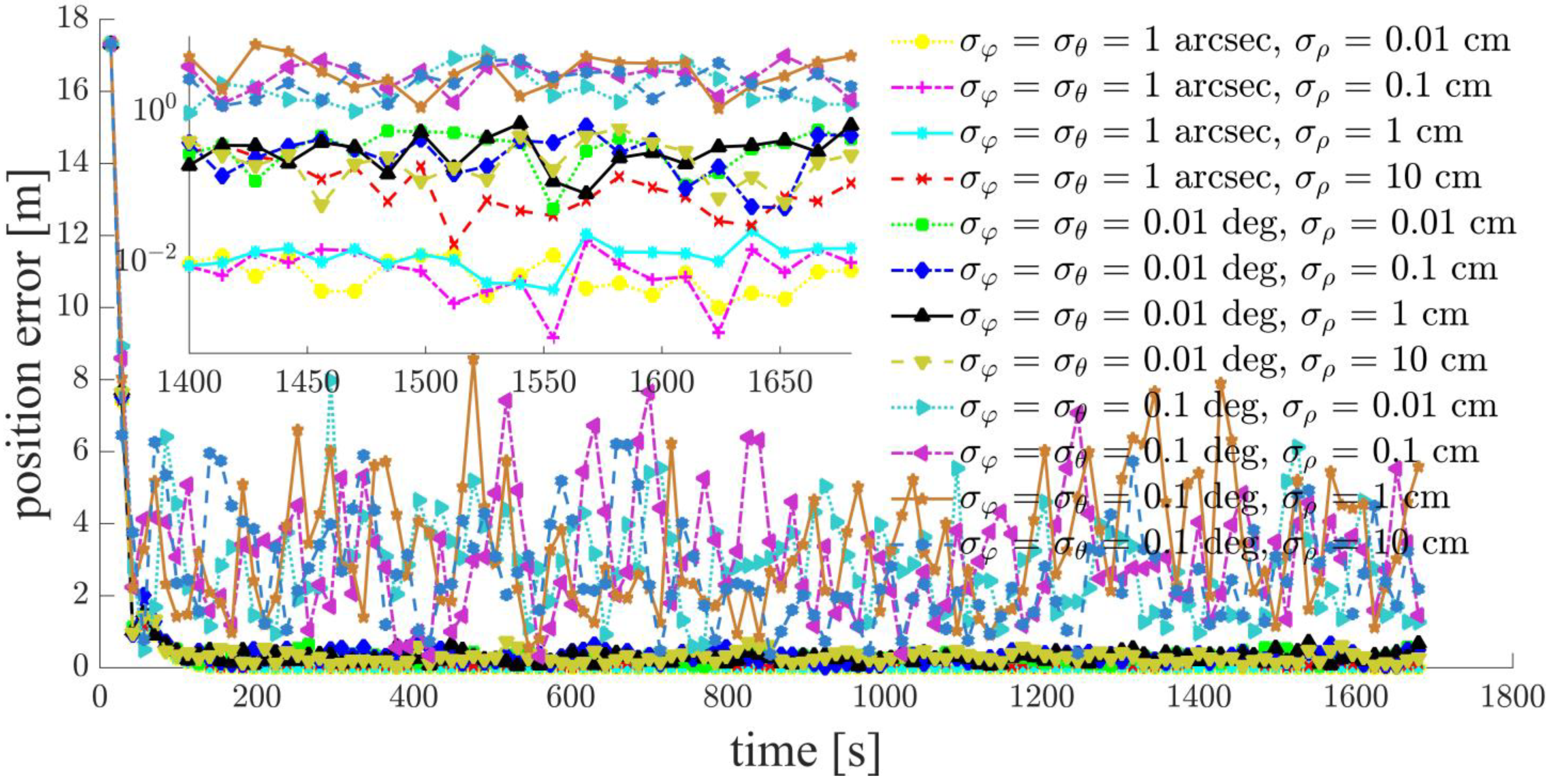
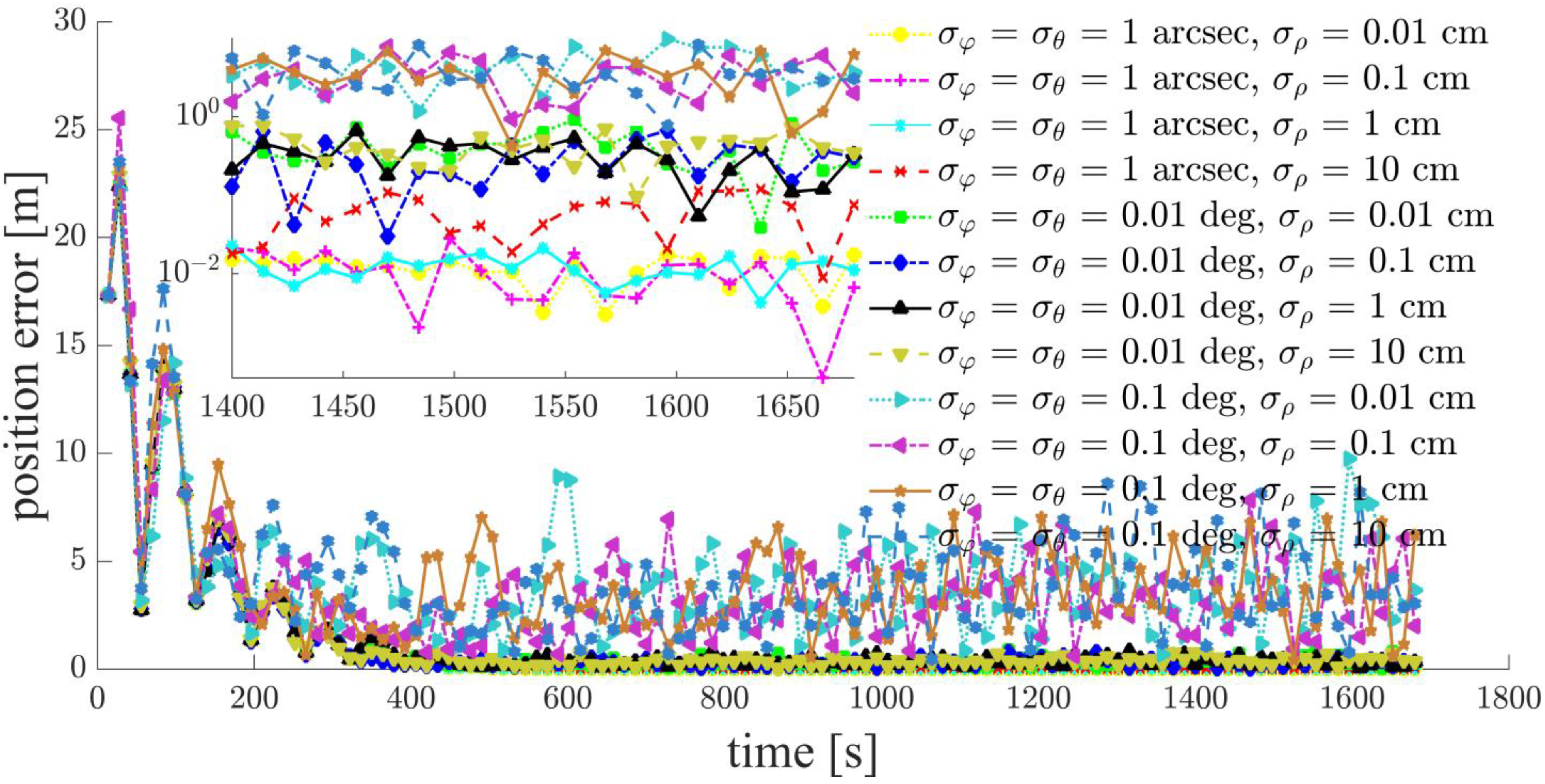
Focusing on a typical simulation scenario with a space-circle radius of 1 km and three chief satellites (Case d: , , ), the simulation results for the chief satellites , and the deputy satellites , , , are shown in Figure 11, Figure 12, Figure 13, Figure 14, Figure 15 and Figure 16. is the origin of the Hill frame, and the relative state is , which does not need to be determined. For brevity, only the statistical results are given for the other cases in the remainder of this paper.
Figure 11.
Relative navigation errors of (simulated scenario: Case d, space-circle formation radius of 1 km).
Figure 12.
Relative navigation errors of (simulated scenario: Case d, space-circle formation radius of 1 km).
Figure 13.
Relative navigation errors of (simulated scenario: Case d, space-circle formation radius of 1 km).
Figure 14.
Relative navigation errors of (simulated scenario: Case d, space-circle formation radius of 1 km).
Figure 15.
Relative navigation errors of (simulated scenario: Case d, space-circle formation radius of 1 km).
Figure 16.
Relative navigation errors of (simulated scenario: Case d, space-circle formation radius of 1 km).
The inter-satellite RF angle measurement accuracy can reach 0.01 deg, and the inter-satellite RF range measurement accuracy is at the centimeter-level for the distributed multi-satellite measurement scheme. Under this condition, the relative navigation results shown in Figure 11, Figure 12, Figure 13, Figure 14, Figure 15 and Figure 16 are summarized in Table 4.
Table 4.
Multi-satellite relative navigation results (simulated scenario: Cases a–d, space-circle formation radius of 1 km, ).
As inferred above, the relative navigation algorithm for the deputy satellites will diverge in Case e; this is verified by the simulation results in Figure 17. Therefore, no statistics are presented for Case e.
Figure 17.
Relative navigation errors of (simulated scenario: Case e, space-circle formation radius 1 km).
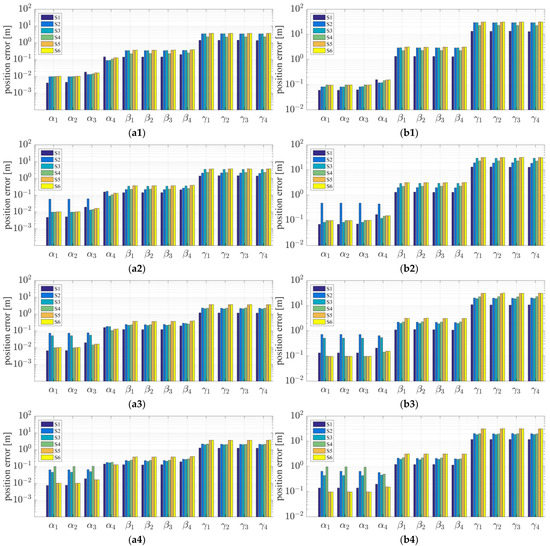
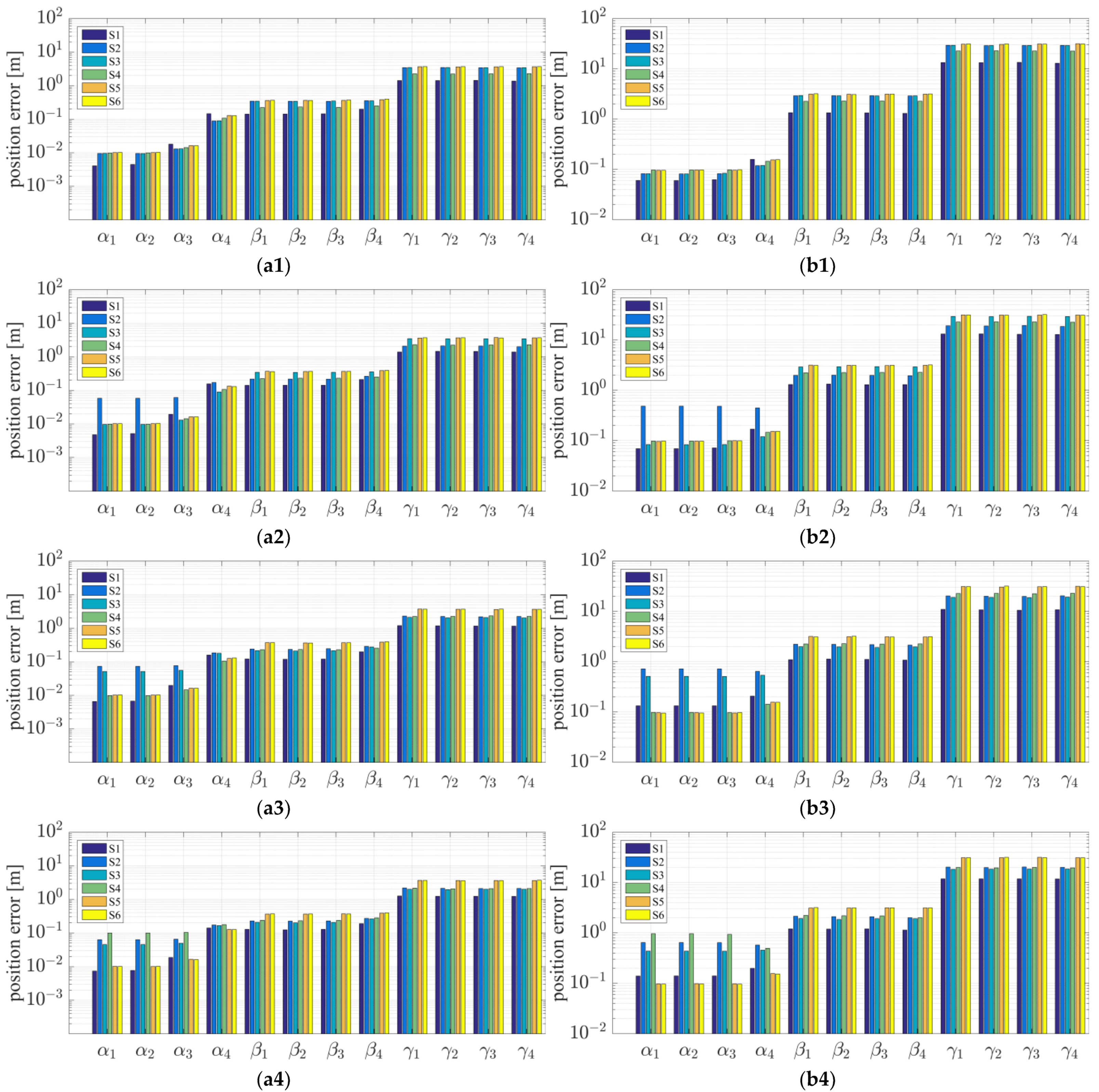
To assess the effect of the inter-satellite measurement accuracy, inter-satellite distance, GDOP value, and number of chief satellites on the relative navigation accuracy, simulations were also conducted under the scenarios summarized in Table 5. Statistical results for the relative navigation accuracy are displayed in Figure 18.
Table 5.
Simulation scenarios and simulation parameters.
Figure 18.
Statistics on the relative navigation accuracy under different simulation scenarios: (a1) Case a: space-circle radius 1 km and 6 chief satellites; (b1) Case a: space-circle radius 10 km and 6 chief satellites; (a2) Case b: space-circle radius 1 km and 5 chief satellites; (b2) Case b: space-circle radius 10 km and 5 chief satellites; (a3) Case c: space-circle radius 1 km and 4 chief satellites; (b3) Case c: space-circle radius 10 km and 4 chief satellites; (a4) Case d: space-circle radius 1 km and 3 chief satellites; (b4) Case d: space-circle radius 10 km and 3 chief satellites.
Based on the simulation results, we present the following conclusions and analyses:
- Inter-satellite distance is an essential factor in determining the accuracy of multi-satellite relative navigation (Figure 18). The multi-satellite relative navigation accuracy is negatively related to the inter-satellite distance.
- According to the relative navigation simulation results of deputy satellites and (Figure 18), with a smaller GDOP value, the relative navigation accuracy of is remarkably better than that of .
- Under the typical scenario of and a space-circle radius of 1 km, the relative navigation accuracy of the deputy satellites is better than that of the chief satellites when there are at least three chief satellites (Table 4 and Figure 18). This is because the relatively low angle measurement accuracy affects the relative navigation accuracy of the chief satellites rather than that of the deputy satellites. When the angle measurement accuracy reaches 1 arcsec and the range measurement accuracy is better than 1 cm, the relative navigation accuracy of all deputy satellites except is slightly lower than that of the chief satellites. However, the relative navigation accuracy of the deputy satellites still reaches the centimeter level, which meets the application requirements of most missions. In general, the relative navigation accuracy of the deputy satellites is comparable with that of the chief satellites, regardless of scenario.
- Taking the scenario with a space-circle radius of 1 km as an example, the multi-satellite relative navigation accuracy is summarized in Figure 18. The multi-satellite relative navigation accuracy is significantly affected by the angle measurement accuracy. When the inter-satellite angle measurement accuracy is 0.1 deg, the multi-satellite relative navigation accuracy is only 1 m. However, when the inter-satellite angle measurement accuracy improves to 1 arcsec, the multi-satellite relative navigation accuracy is significantly affected by the range measurement accuracy. The multi-satellite relative navigation accuracy is better than 1 cm with a range measurement accuracy of better than 1 mm, and is maintained within 20 cm with a range measurement accuracy of 10 cm. Therefore, improving inter-satellite RF angle measurement accuracy is critical to further improving multi-satellite relative navigation accuracy.
5. Conclusions
We have proposed an innovative multi-satellite relative navigation scheme based on inter-satellite RF measurements for large-scale microsatellite formations. This scheme uses inter-satellite RF range and angle measurements. Only three chief satellites are required in this scheme, which significantly reduces the implementation difficulty of multi-satellite angle measurements. Simultaneously, based on the high-precision distributed multi-satellite RF range measurement scheme, a multi-satellite relative navigation algorithm has been developed and integrated with the measurement scheme. Numerical simulation results demonstrate the effects of the inter-satellite distance, GDOP value, range measurement accuracy, and angle measurement accuracy on the multi-satellite relative navigation accuracy. With the typical inter-satellite RF range and angle measurement accuracy, and an inter-satellite distance of around 1 km, the multi-satellite relative navigation accuracy reaches a level of ~30 cm, and the accuracy is comparable between the deputy satellites (which use range measurements) and the chief satellites (which use both range and angle measurements). Further, the multi-satellite relative navigation accuracy is robust to the number of chief satellites, demonstrating the incredible scalability of the proposed scheme. Finally, relative navigation accuracy can be improved to the centimeter level when more accurate angle measurement is provided using laser or infrared technology.
Author Contributions
Conceptualization, S.M. and X.J.; methodology, S.M.; software, S.M.; validation, S.M.; formal analysis, S.M. and C.L.; investigation, S.M. and X.J.; data curation, S.M.; writing—original draft preparation, S.M. and W.Z.; writing—review and editing, S.M., Z.X. and X.J.; visualization, S.M., W.Z.; supervision, X.J.; project administration, X.J. and Z.J.; funding acquisition, X.J. and Z.J. All authors have read and agreed to the published version of the manuscript.
Funding
This work was supported by the National Natural Science Foundation of China (62073289) and the Primary Research and Development Plan of Zhejiang Province (209C05004).
Institutional Review Board Statement
Not applicable.
Informed Consent Statement
Not applicable.
Data Availability Statement
The data presented in this study are available on request from the corresponding author.
Conflicts of Interest
The authors declare no conflict of interest.
References
- Marszalek, M.; Kurz, O.; Drentschew, M.; Schmidt, M.; Schilling, K. Intersatellite Links and Relative Navigation: Pre-conditions for Formation Flights with Pico- and Nanosatellites. IFAC Proc. Vol. 2011, 44, 3027–3032. [Google Scholar] [CrossRef] [Scilit]
- Leung, S.; Montenbruck, O. Real-time navigation of formation-flying spacecraft using global-positioning-system measurements. J. Guid. Control Dyn. 2005, 28, 226–235. [Google Scholar] [CrossRef] [Scilit]
- Woffinden, D.C.; Geller, D.K. Observability Criteria for Angles-Only Navigation. IEEE Trans. Aerosp. Electron. Syst. 2009, 45, 1194–1208. [Google Scholar] [CrossRef] [Scilit]
- Franquiz, F.J.; Muñoz, J.D.; Udrea, B.; Balas, M.J. Optimal Range Observability Maneuvers of a Spacecraft Formation Using Angles-Only Navigation. Acta Astronaut. 2018, 153, 337–348. [Google Scholar] [CrossRef] [Scilit]
- Luo, J.; Gong, B.; Yuan, J.; Zhang, Z. Angles-Only Relative Navigation and Closed-Loop Guidance for Spacecraft Proximity Operations. Acta Astronaut. 2016, 128, 91–106. [Google Scholar] [CrossRef] [Scilit]
- Gong, B.; Luo, J.; Li, S.; Li, W. Observability Criterion of Angles-Only Navigation for Spacecraft Proximity Operations. Proc. Inst. Mech. Eng. Part G J. Aerosp. Eng. 2019, 233, 4302–4315. [Google Scholar] [CrossRef] [Scilit]
- Christian, J.A. Relative Navigation Using Only Intersatellite Range Measurements. J. Spacecr. Rockets 2017, 54, 13–28. [Google Scholar] [CrossRef] [Scilit]
- Shen, Y.; Xu, L.; Zhang, H.; Chen, S.; Song, S. Relative Orbit Determination for Satellite Formation Flying Based on Quantum Ranging. Adv. Space Res. 2015, 56, 680–692. [Google Scholar] [CrossRef] [Scilit]
- Maessen, D.; Gill, E. Relative Orbital Element Estimation and Observability Analysis for Formation Flying Satellites using Inter-Satellite Range Measurements Only. In Proceedings of the AIAA Guidance, Navigation, and Control Conference, Toronto, ON, Canada, 6–9 August 2010. [Google Scholar]
- Chavez, F.; Lovell, T. Relative-Orbit Element Estimation for Satellite Navigation and Guidance. In Proceedings of the AIAA/AAS Astrodynamics Specialist Conference and Exhibit, Providence, RI, USA, 16–19 August 2004. [Google Scholar]
- Kilic, C.; Christian, J.A. Spacecraft Relative Navigation Using Only Range-Rate Measurements. In Proceedings of the AIAA Guidance, Navigation, and Control Conference, Grapevine, TX, USA, 9–13 January 2017. [Google Scholar]
- Hu, Y.; Sharf, I.; Chen, L. Three-Spacecraft Autonomous Orbit Determination and Observability Analysis with Inertial Angles-Only Measurements. Acta Astronaut. 2020, 170, 106–121. [Google Scholar] [CrossRef] [Scilit]
- Kang, W.; Ross, I.M.; Pham, K.; Gong, Q. Autonomous Observability of Networked Multisatellite Systems. J. Guid. Control. Dyn. 2009, 32, 869–877. [Google Scholar] [CrossRef] [Scilit]
- Wu, S.-C.; Kuang, D. Positioning with Autonomous Formation Flyer (AFF) on Space-Technology 3. In Proceedings of the 12th International Technical Meeting of the Satellite Division of The Institute of Navigation (ION GPS 1999), Nashville, TN, USA, 15–18 September 1999; pp. 385–392. [Google Scholar]
- Grelier, T.; Guidotti, P.Y.; Delpech, M.; Harr, J.; Thevenet, J.-B.; Leyre, X. Formation Flying Radio Frequency Instrument: First Flight Results from The PRISMA Mission. In Proceedings of the 2010 5th ESA Workshop on Satellite Navigation Technologies and European Workshop on GNSS Signals and Signal Processing (NAVITEC), Noordwijk, The Netherlands, 8–10 December 2011; pp. 1–8. [Google Scholar]
- Wang, X.; Qin, W.; Bai, Y.; Cui, N. A Novel Decentralized Relative Navigation Algorithm for Spacecraft Formation Flying. Aerosp. Sci. Technol. 2016, 48, 28–36. [Google Scholar] [CrossRef] [Scilit]
- Mo, S.; Jin, X.; Hu, W.; Zhang, W.; Xu, Z.; Jin, Z. Distributed Multi-Satellite Measurement Scheme Oriented Towards Microsatellite Formations. Electron. Lett. 2020, 56, 252–255. [Google Scholar] [CrossRef] [Scilit]
- Xu, J.; Zhang, C.; Wang, C.; Jin, Z.; Dynamics. Novel Approach to Intersatellite Time-Difference Measurements for Microsatellites. J. Guid. Control. Dyn. 2018, 41, 2476–2482. [Google Scholar] [CrossRef] [Scilit]
- Clohessy, W.H.; Wiltshire, R.S. Terminal Guidance System for Satellite Rendezvous. J. Aerosp. Sci. 1960, 27, 653–658. [Google Scholar] [CrossRef] [Scilit]
- Gilani, S.A.A.; Palmer, P.L. Analysis of Fidelities of Linearized Orbital Models Using Least Squares. In Proceedings of the 2011 Aerospace Conference, Big Sky, MT, USA, 5–12 March 2011; pp. 1–15. [Google Scholar]
- Schweighart, S.A.; Sedwick, R.J. High-Fidelity Linearized J Model for Satellite Formation Flight. J. Guid. Control. Dyn. 2002, 25, 1073–1080. [Google Scholar] [CrossRef] [Scilit]
- Carter, T.; Humi, M. Clohessy-Wiltshire Equations Modified to Include Quadratic Drag. J. Guid. Control. Dyn. 2002, 25, 1058–1063. [Google Scholar] [CrossRef] [Scilit]
- Neirynck, D.; Luk, E.; McLaughlin, M. An Alternative Double-Sided Two-Way Ranging Method. In Proceedings of the 2016 13th Workshop on Positioning, Navigation and Communications (WPNC), Bremen, Germany, 19–20 October 2016; pp. 1–4. [Google Scholar]
- Jung, S.; Park, S.-Y.; Park, C.-D.; Kim, S.-W.; Jang, Y.-S. Real-Time Determination of Relative Position Between Satellites Using Laser Ranging. J. Astron. Space Sci. 2012, 29, 351–362. [Google Scholar] [CrossRef] [Scilit]
- Longlong, X.; Shaoyang, T.; Kun, L.; Dapeng, H. Design of Infrared Measurement System for Determining the Relative Position of Inner-Formation Gravity Satellite. Infrared Laser Eng. 2013. [Google Scholar] [CrossRef]
- Konatowski, S.; Kaniewski, P.; Matuszewski, J. Comparison of estimation accuracy of EKF, UKF and PF filters. Annu. Navig. 2016, 23, 69–87. [Google Scholar] [CrossRef] [Scilit]
- Burden, R.L.; Faires, J.D. Numerical Analysis, 7th ed.; Higher Education Press: Beijing, China, 2002. [Google Scholar]
- Sharifi, M.; Sneeuw, N.; Keller, W. Gravity Recovery Capability of Four Generic Satellite Formations. In Proceedings of the “Gravity Field of the Earth” Symposium, General Command of Mapping, Istanbul, Turkey, 28 August–1 September 2007; pp. 211–216. [Google Scholar]
- Langley, R.B. Dilution of precision. GPS World 1999, 10, 52–59. [Google Scholar]
- Satellite Tool Kit. Available online: https://www.agi.com/missions/space-operations-missions (accessed on 4 May 2021).

Publisher’s Note: MDPI stays neutral with regard to jurisdictional claims in published maps and institutional affiliations. |
© 2021 by the authors. Licensee MDPI, Basel, Switzerland. This article is an open access article distributed under the terms and conditions of the Creative Commons Attribution (CC BY) license (https://creativecommons.org/licenses/by/4.0/).