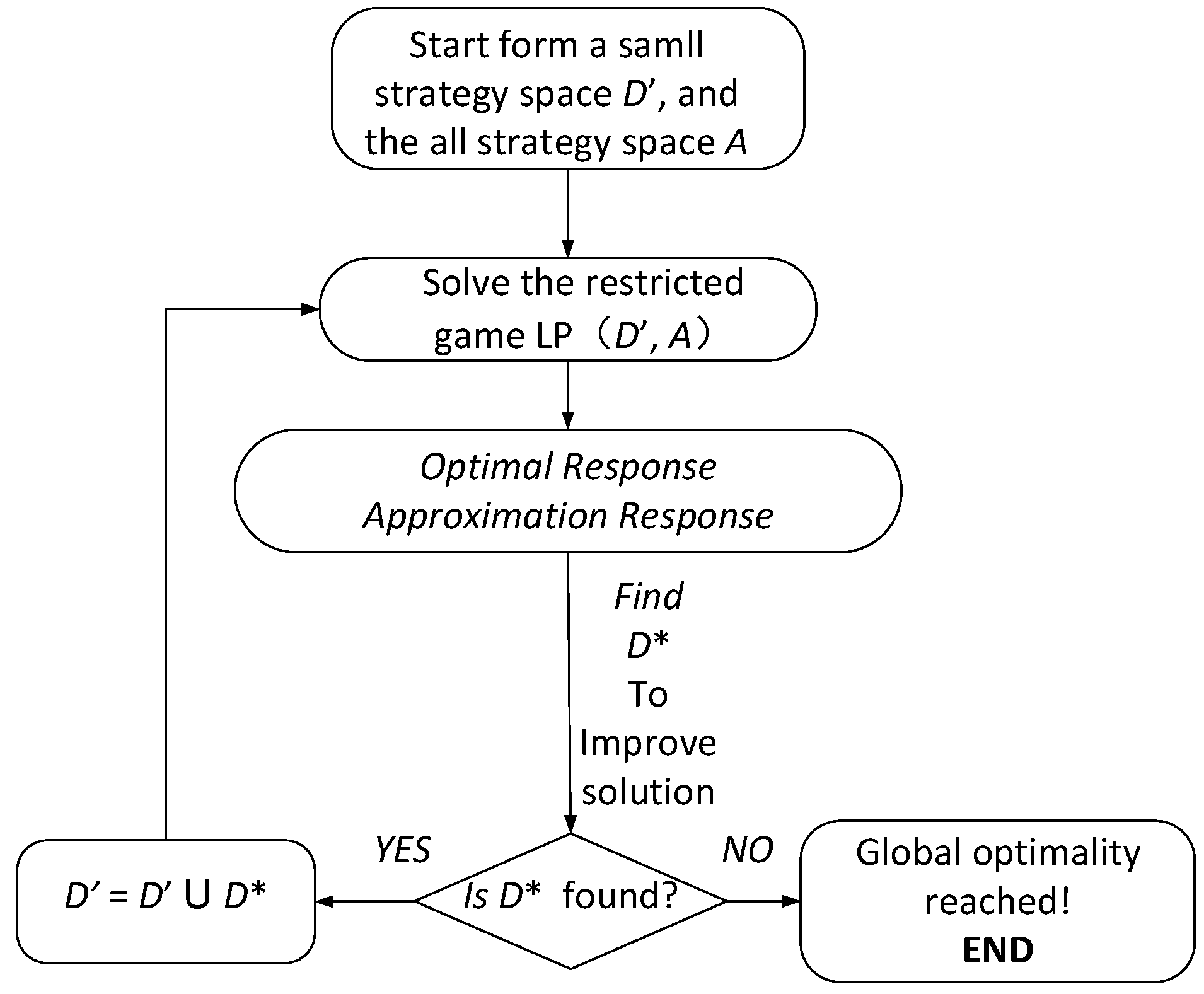
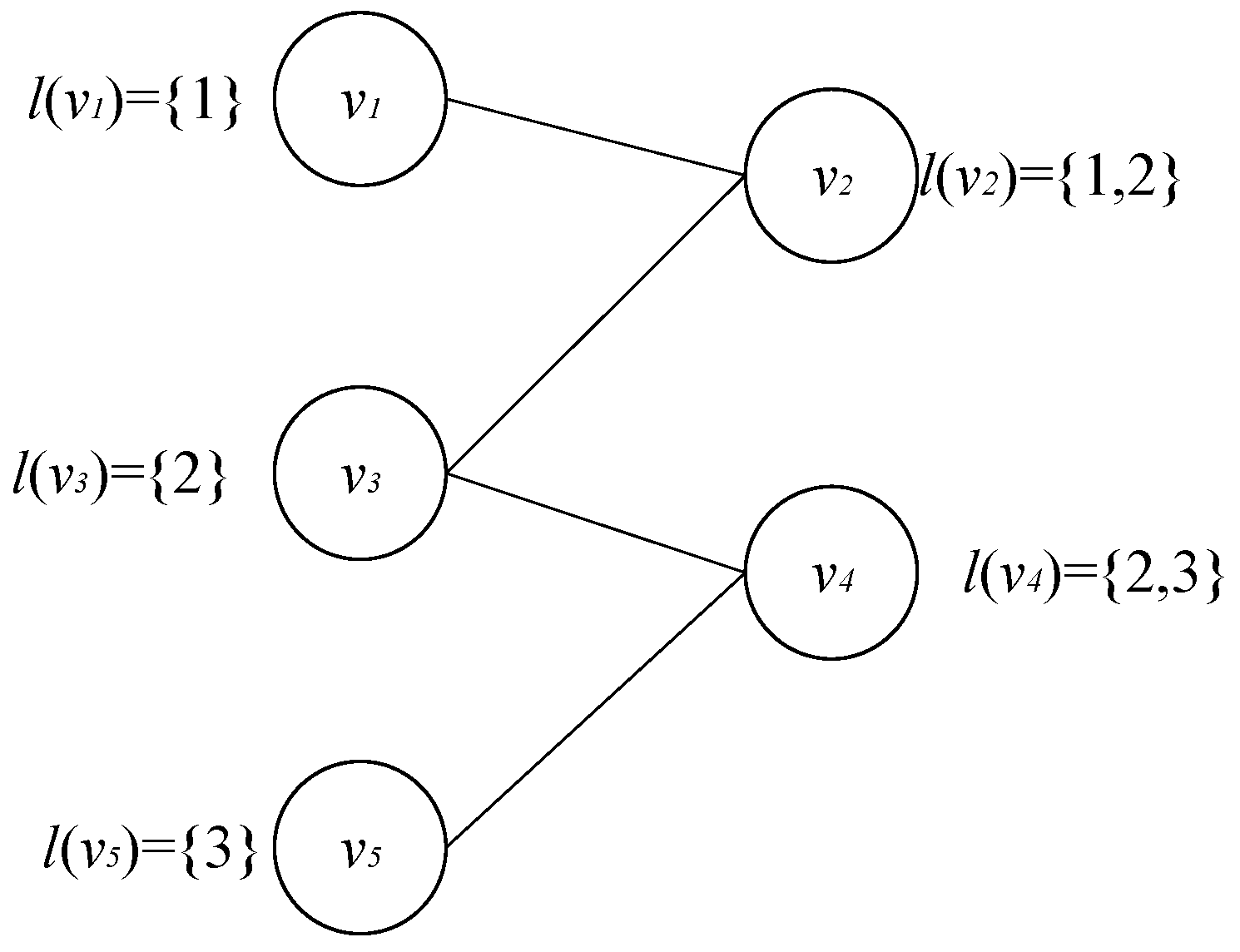
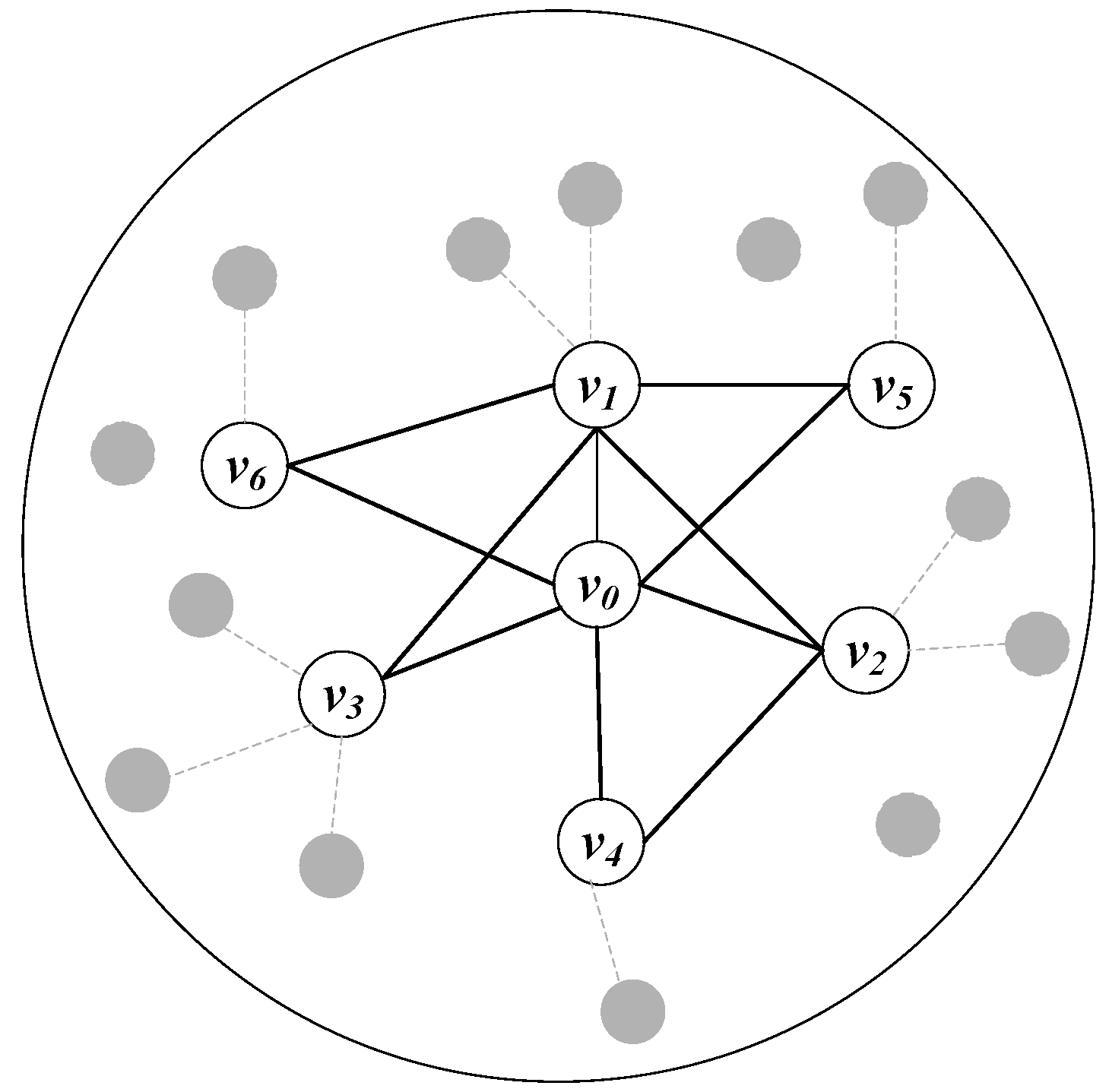
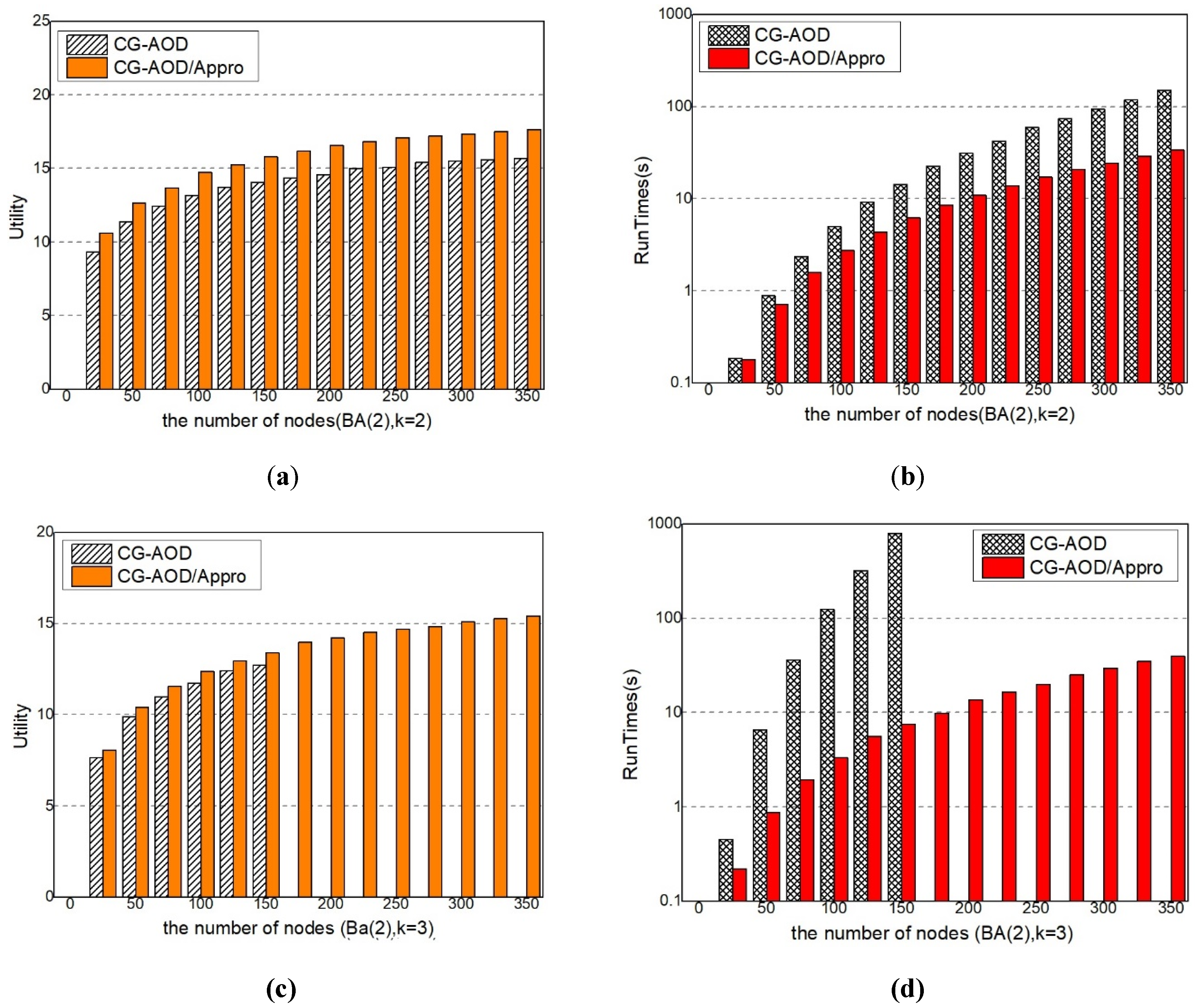
A Stackelberg Security Game for Adversarial Outbreak Detection in the Internet of Things


Abstract
1. Introduction
1.1. Background
1.2. Motivation
1.2.1. The Uncertainty of Propagation Trajectory
1.2.2. The Limit of Computing Resource
1.2.3. The Dynamics of Scheduling Strategy
1.3. Our Contribution
- Firstly, we generated a “Propagation Time Initialization Table” to obtain the determined detection time.
- Secondly, we built a Stackelberg model which is proposed to formulate the Adversarial Outbreak Detection problem in limited resource for IoT.
- For the Stackelberg model, we adopt a CG-AOD algorithm. As the response of defender is an NP-hard problem, we formulated mixed-integer linear programming (MILPs) and exploited an approximate algorithm--greedy algorithm to speed up the solution. Theoretically, we proved that an approximate ratio of constant factors can be obtained through the algorithm.
- Finally, we design a numerical experiment and a series of experiments in terms of solution time and quality by constructing a specific network case model and expansion model. The results show that the CG-AOD and CG-AOD/Appro algorithm is robust and scalable.
2. Related Work
2.1. IDSs for IoT
2.2. Outbreak Detection
2.3. Security Game
2.4. Monte Carlo Method in IoT
3. Adversarial Outbreak Detection Game Model
3.1. Network
3.2. Virus Propagation
3.3. Strategies
3.4. Utility
3.5. Equilibrium
4. Approach
4.1. Overview of CG-AOD
| Algorithm 1 Overview of CG-AOD |
| 1: |
| 2: |
| 3: |
| 4: repeat; |
| 5: ; |
| 6: ; |
| 7: if |
| 8: ; |
| 9: |
| 10: ; |
| 11: |
4.2. Optimal Response
4.3. Approximation Response
| Algorithm 2 Approximation Response |
| 1: |
| 2: |
| 3: |
| 4: |
| 5: |
| 6: |
| 7: ; |
| 8: |
| 9:; |
| 10: |
| 11: if |
| 12: ; |
| 13: |
| 14: else; |
| 15: return null. |
5. Experimental Evaluation
5.1. Numerical Example
5.2. Solution Quality Analysis
5.2.1. Comparison of the Approximation Solution with the Optimal Solution
5.2.2. Comparison of the CG-AOD/Appro Algorithm with Other Benchmark Methods
- RP: the defender randomly opens k nodes for monitoring, and the attacker randomly selects a node as the source node of the infection.
- DCP [53]: the defender, according to the node degree value, selects the nodes to monitor, and then the attacker makes the Optimal Response according to the defender’s pure strategy.
- CELF [10]: the defender uses the CELF algorithm that is the classical greedy algorithm to choose k nodes for the sensor.
- RM: a defender mixed strategy where the marginal coverage probability of each vertex is a random value.
- DCM: a defender mixed strategy where the marginal coverage probability of each vertex is normalized degree centrality.
6. Conclusions
Author Contributions
Funding
Conflicts of Interest
References
- Li, S.; Xu, L.; Zhao, S. The Internet of Things: A Survey; Kluwer Academic Publishers: Dordrecht, The Netherlands, 2015; pp. 243–259. [Google Scholar]
- Alaba, F.A.; Othman, M.; Hashem, I.A.T.; Alotaibi, F. Internet of things Security: A Survey. J. Netw. Comput. Appl. 2017, 88, 10–28. [Google Scholar] [CrossRef]
- Wang, T.; Wu, Q.; Wen, S.; Cai, Y.; Tian, H.; Chen, Y.; Wang, B. Propagation Modeling and Defending of a Mobile Sensor Worm in Wireless Sensor and Actuator Networks. Sensors 2017, 17, 139. [Google Scholar] [CrossRef] [PubMed]
- Kolias, C.; Kambourakis, G.; Stavrou, A.; Jeffrey, M.S. DDoS in the IoT. Mirai and Other Botnets. IEEE Comput. 2017, 50, 80–84. [Google Scholar] [CrossRef]
- Kaspersky. Available online: https://www.kaspersky.com/blog/attack-on-dyn-explained/13325/ (accessed on 31 January 2020).
- Csoonline. Available online: https://www.csoonline.com/article/3227906/what-is-wannacry-ransomware-how-does-it-infect-and-who-was-responsible.html (accessed on 31 January 2020).
- ZDNet. Available online: https://www.zdnet.com/article/iot-security-warning-cyber-attacks-on-medical-devices-could-put-patients-at-risk/ (accessed on 31 January 2020).
- Zarpelao, B.B.; Miani, R.S.; Kawakani, C.T.; de Alvarenga, S.C. A survey of intrusion detection in Internet of Things. J. Netw. Comput. Appl. 2017, 84, 25–37. [Google Scholar] [CrossRef]
- Sharma, S.; Kaul, A. A survey on Intrusion Detection Systems and Honeypot based proactive security mechanisms in VANETs and VANET Cloud. Veh. Commun. 2018, 12, 138–164. [Google Scholar] [CrossRef]
- Leskovec, J.; Krause, A.; Guestrin, C.; Faloutsos, C.; Faloutsos, C.; VanBriesen, J.; Glance, N. Cost-effective outbreak detection in networks. In Proceedings of the 13th ACM SIGKDD International Conference on Knowledge Discovery and Data Mining, San Jose, CA, USA, 12–15 August 2007; pp. 420–429. [Google Scholar]
- Krause, A.; Guestrin, C. Optimizing Sensing: From Water to the Web. IEEE Comput. 2009, 42, 38–45. [Google Scholar] [CrossRef]
- Krause, A.; Rajagopal, R.; Gupta, A.; Guestrin, C. Simultaneous optimization of sensor placements and balanced schedules. IEEE Trans. Automat. Contr. 2011, 56, 2390–2405. [Google Scholar] [CrossRef]
- Sela, P.L.; Abbas, W.; Koutsoukos, X.; Amin, S. Sensor placement for fault location identification in water networks: A minimum test cover approach. Automatica 2016, 72, 1–16. [Google Scholar]
- Jung, D.; Kim, J.H. Using mechanical reliability in multiobjective optimal meter placement for pipe burst detection. J. Water Resour. Plan. Manag. 2018, 144, 04018031. [Google Scholar] [CrossRef]
- Shakarian, P.; Lei, H.; Lindelauf, R. Power grid defense against malicious cascading failure. In Proceedings of the 2014 International Conference on Autonomous Agents and Multi-Agent Systems, Paris, France, 5–9 May 2014; pp. 813–820. [Google Scholar]
- Lin, F.H.; Zhou, Y.; An, X.; You, I.; Choo, K.K.R. Fair Resource Allocation in an Intrusion-Detection System for Edge Computing: Ensuring the Security of Internet of Things Devices. IEEE Consum. Electron. Mag. 2018, 7, 45–50. [Google Scholar] [CrossRef]
- Xu, Q.; Ren, P.; Song, H.; Du, Q. Security enhancement for IoT communications exposed to eavesdroppers with uncertain locations. IEEE Access 2016, 4, 2840–2853. [Google Scholar] [CrossRef]
- Veerappan, C.S.; Keong, P.L.K.; Tang, Z.; Tan, F. Taxonomy on malware evasion countermeasures techniques. In Proceedings of the IEEE World Forum on Internet of Things, Singapore, 5–8 February 2018; pp. 558–563. [Google Scholar]
- Hu, H.; Wang, M.; Ouyang, M.; Hu, G. Toward Network Worm Victims Identification Based on Cascading Motif Discovery. Electronics 2019, 9, 1. [Google Scholar] [CrossRef]
- Bethencourt, J.; Franklin, J.; Vernon, M.K. Mapping Internet Sensors with Probe Response Attacks. In Proceedings of the USENIX Security Symposium, Baltimore, MD, USA, 31 July–5 August 2005; pp. 193–208. [Google Scholar]
- Hu, F. Security and privacy in Internet of things (IoTs): Models, Algorithms, and Implementations; CRC Press: Boca Raton, FL, USA, 2016; pp. 70–78. [Google Scholar]
- Zhou, C.; Lu, W.X.; Zhang, J.; Li, L.; Hu, Y.; Guo, L. Early detection of dynamic harmful cascades in large-scale networks. J. Comput. Sci-Neth. 2018, 28, 304–317. [Google Scholar] [CrossRef]
- Acarali, D.; Rajarajan, M.; Komninos, N.; Zarpelão, B.B. Modelling the Spread of Botnet Malware in IoT-Based Wireless Sensor Networks. Secur. Commun. Netw. 2019, 2019, 3745619:1–3745619:13. [Google Scholar] [CrossRef]
- Sedjelmaci, H.; Senouci, S.M.; Al-Bahri, M. A lightweight anomaly detection technique for low-resource IoT devices: A game-theoretic methodology. In Proceedings of the IEEE International Conference on Communications, Kuala Lumpur, Malaysia, 22–27 May 2016; pp. 1–6. [Google Scholar]
- Liu, B.; Xu, H.; Zhou, X. Stackelberg Dynamic Game-Based Resource Allocation in Threat Defense for Internet of Things. Sensors 2018, 18, 4074. [Google Scholar] [CrossRef]
- Sohail, M.; Khan, S.; Ahmad, R.; Singh, D.; Lloret, J. Game Theoretic Solution for Power Management in IoT-Based Wireless Sensor Networks. Sensors 2019, 19, 3835. [Google Scholar] [CrossRef]
- Krause, A.; Guestrin, C. Submodularity and its Applications in Optimized Information Gathering. ACM TIST 2011, 2, 1–20. [Google Scholar] [CrossRef]
- Huang, C.T.; Sakib, M.N.; Njilla, L.; Kamhoua, C. A Game Theoretic Approach for Making IoT Device Connectivity Decisions During Malware Outbreak. In Proceedings of the International Conference on Computing, Networking and Communications, Honolulu, HI, USA, 18–21 February 2019; pp. 457–462. [Google Scholar]
- Robert, C.; George, C. Monte Carlo Statistical Methods. 2013. Available online: https://books.google.com.hk/books?hl=en&lr=&id=lrvfBwAAQBAJ&oi=fnd&pg=PR17&dq=Monte+Carlo+statistical+methods&ots=GNEp5duzJ5&sig=Oe3pCPujDaKSK25qQ4eoT_OrKDU&redir_esc=y&hl=zh-CN&sourceid=cndr#v=onepage&q=Monte%20Carlo%20statistical%20methods&f=false (accessed on 31 January 2020).
- Benkhelifa, E.; Welsh, T.; Hamouda, W. A critical review of practices and challenges in intrusion detection systems for IoT: Toward universal and resilient systems. IEEE Commun. Suvr. Tut. 2018, 20, 3496–3509. [Google Scholar] [CrossRef]
- Sforzin, A.; Mármol, F.G.; Conti, M.; Bohli, J.M. RPiDS: Raspberry Pi IDS—A Fruitful Intrusion Detection System for IoT. In Proceedings of the IEEE Conferences on Ubiquitous Intelligence & Computing, Advanced and Trusted Computing, Scalable Computing and Communications, Cloud and Big Data Computing, Internet of People, and Smart World Congress, Toulouse, France, 18–21 July 2016; pp. 440–448. [Google Scholar]
- Peng, Y.; Yang, J.; Wu, C.; Guo, C.; Hu, C.; Li, Z. deTector: A Topology-aware Monitoring System for Data Center Networks. In Proceedings of the USENIX Annual Technical Conference, Santa Clara, CA, USA, 12–14 July 2017; pp. 55–68. [Google Scholar]
- Yu, Y.; Xiao, G. On early detection of strong infections in complex networks. J. Phys. A-Math. Thero. 2014, 47, 881–892. [Google Scholar] [CrossRef][Green Version]
- Zhang, H.; Alim, M.A.; Thai, M.T.; Nguyen, H.T. Monitor placement to timely detect misinformation in Online Social Networks. In Proceedings of the IEEE International Conference on Communications, London, UK, 8–12 June 2015; pp. 1152–1157. [Google Scholar]
- Krause, A.; McMahan, B.; Guestrin, C.; Gupta, A. Selecting Observations against Adversarial Objectives. In Proceedings of the Advances in Neural Information Processing Systems, Vancouver, BC, Canada, 3–6 December 2007; pp. 777–784. [Google Scholar]
- Semasinghe, P.; Maghsudi, S.; Hossain, E. Game theoretic mechanisms for resource management in massive wireless IoT systems. IEEE Commun. Mag. 2017, 55, 121–127. [Google Scholar] [CrossRef]
- Rullo, A.; Midi, D.; Serra, E.; Bertino, E. Pareto optimal security resource allocation for Internet of Things. TOPS 2017, 20, 1–30. [Google Scholar] [CrossRef]
- Altman, E.; Avrachenkov, K.; Garnaev, A. Jamming in wireless networks: The case of several jammers. In Proceedings of the 2009 International Conference on Game Theory for Networks, Istanbul, Turkey, 13–15 May 2009; pp. 585–592. [Google Scholar]
- Namvar, N.; Saad, W.; Bahadori, N.; Kelley, B. Jamming in the Internet of Things: A Game-Theoretic Perspective. In Proceedings of the IEEE Global Communications Conference, Washington, DC, USA, 4–8 December 2016; pp. 1–6. [Google Scholar]
- Zhu, Q.; Bushnell, L.; Başar, T. Game-theoretic analysis of node capture and cloning attack with multiple attackers in wireless sensor networks. In Proceedings of the 51th IEEE Conference on Decision and Control, Maui, HI, USA, 10–13 December 2012; pp. 3404–3411. [Google Scholar]
- Cheng, H.T.; Zhuang, W. Pareto optimal resource management for wireless mesh networks with QoS assurance: joint node clustering and subcarrier allocation. IEEE T. Wirel. Commun. 2009, 8, 1573–1583. [Google Scholar] [CrossRef]
- Tsai, J.; Nguyen, T.H.; Tambe, M. Security Games for Controlling Contagion. In Proceedings of the 26th AAAI Conference on Artificial Intelligence, Toronto, ON, Canada, 22–26 July 2012; pp. 1464–1470. [Google Scholar]
- Yin, Y.; An, B.; Jain, M. Game-theoretic resource allocation for protecting large public events. In Proceedings of the 28th AAAI Conference on Artificial Intelligence, Quebec, QC, Canada, 27–31 July 2014; pp. 826–834. [Google Scholar]
- Wang, Z.; Yin, Y.; An, B. Computing Optimal Monitoring Strategy for Detecting Terrorist Plots. In Proceedings of the of the 30th AAAI Conference on Artificial Intelligence, Phoenix, AZ, USA, 12–17 February 2016; pp. 637–643. [Google Scholar]
- Jain, M.; Kardes, E.; Kiekintveld, C.; Ordónez, F.; Tambe, M. Security Games with Arbitrary Schedules: A Branch and Price Approach. In Proceedings of the 24th AAAI Conference on Artificial Intelligence, Atlanta, GA, USA, 11–15 July 2010; pp. 792–797. [Google Scholar]
- Jain, M.; Kardes, E.; Kiekintveld, C.; Ordónez, F.; Tambe, M. Security games with protection externalities. In Proceedings of the 29th AAAI Conference on Artificial Intelligence, Austin, TX, USA, 25–30 January 2015; pp. 914–920. [Google Scholar]
- Hu, X.; Zhu, W.; An, B.; Jin, P.; Xia, W. A branch and price algorithm for EOS constellation imaging and downloading integrated scheduling problem. Comput & OR 2019, 104, 74–89. [Google Scholar]
- Rullo, A.; Serra, E.; Bertino, E.; Lobo, J. Shortfall-based optimal placement of security resources for mobile IoT scenarios. In Proceedings of the European Symposium on Research in Computer Security, Oslo, Norway, 11–15 September 2017; pp. 419–436. [Google Scholar]
- Serra, E.; Jajodia, S.; Pugliese, A.; Rullo, A.; Subrahmanian, V.S. Pareto-Optima Adversarial Defense of Enterprise Systems. ACM Tans. Inf. Syst. Secur. 2015, 17, 1–39. [Google Scholar] [CrossRef]
- Nemhauser, G.L.; Wolsey, L.A.; Fisher, M.L. An analysis of approximations for maximizing submodular set functions—I. Math. Program. 1978, 14, 265–294. [Google Scholar] [CrossRef]
- Wen, S.; Zhou, W.; Zhang, J.; Xiang, Y.; Zhou, W.; Jia, W.; Zou, C.C. Modeling and analysis on the propagation dynamics of modern email malware. IEEE Trans. Dependable. Secure. Comput. 2014, 11, 361–374. [Google Scholar] [CrossRef]
- Barabási, A.L.; Albert, R. Emergence of scaling in random networks. Science 1999, 286, 509–512. [Google Scholar]
- Tsai, J.; Yin, Z.; Kwak, J.Y.; Kempe, D.; Kiehintveld, C.; Tambe, M. Urban Security: Game-Theoretic Resource Allocation in Networked Domains. In Proceedings of the 24th AAAI Conference on Artificial Intelligence, Atlanta, GA, USA, 11–15 July 2010; 2010; pp. 881–886. [Google Scholar]
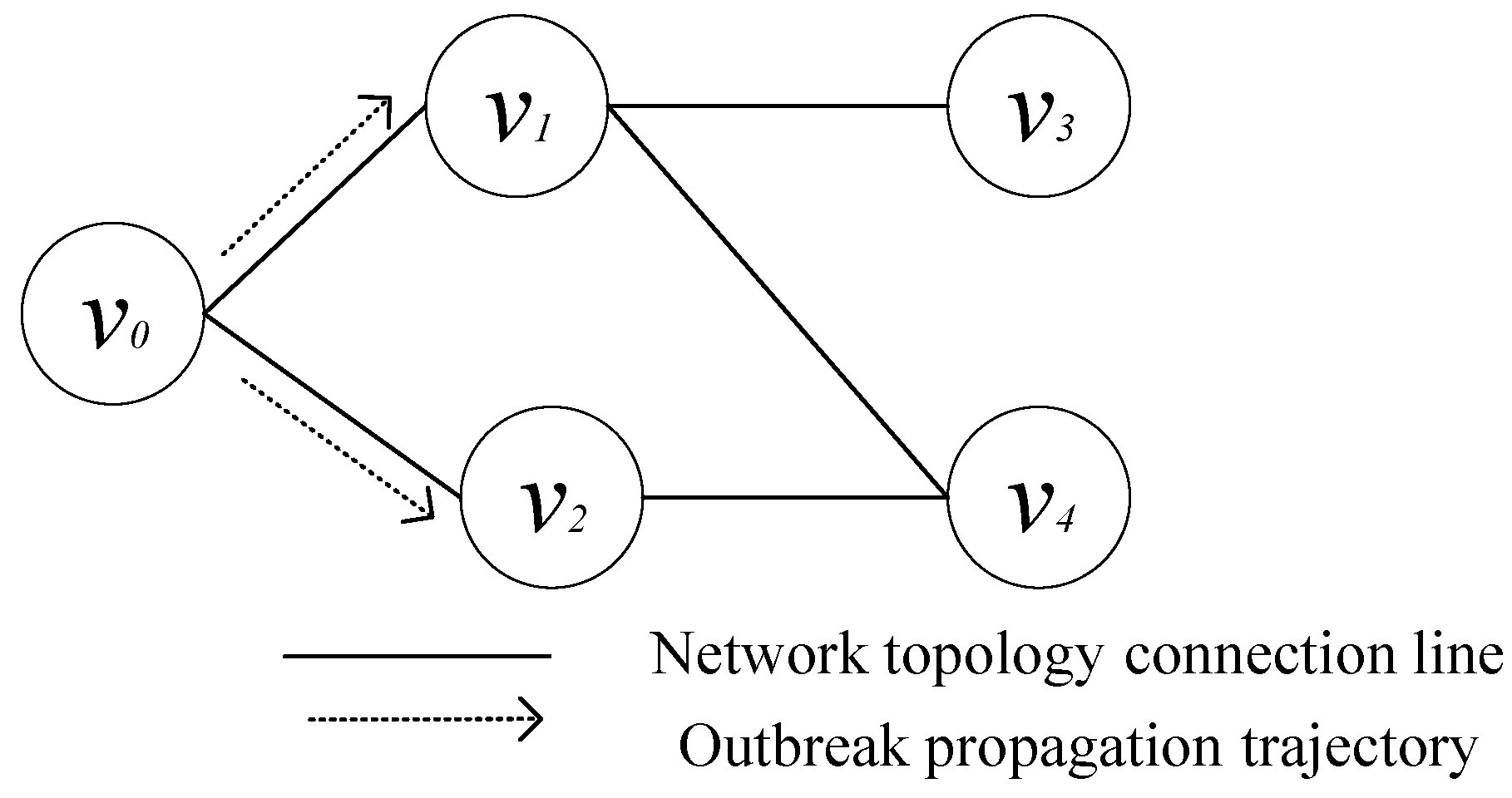
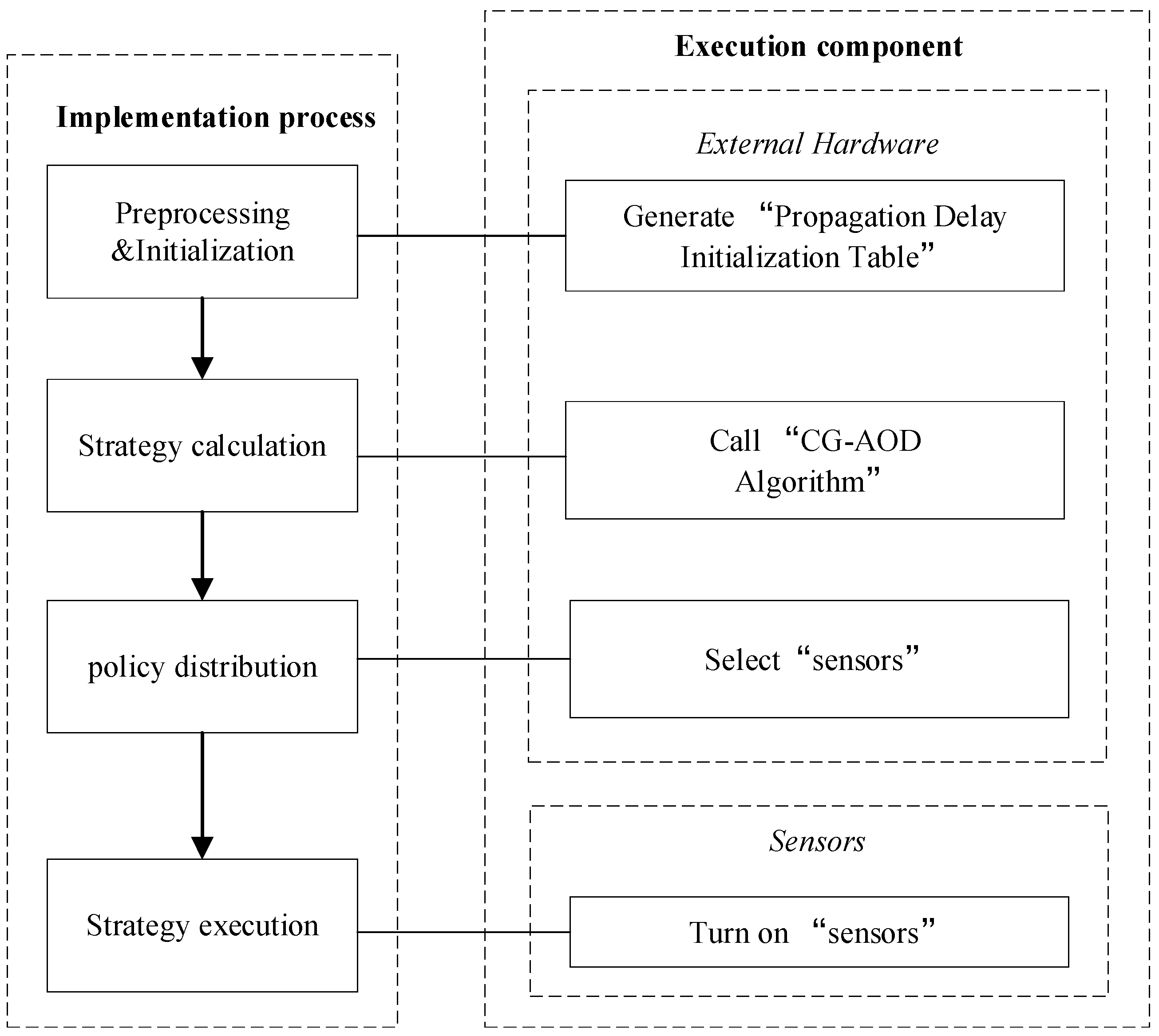


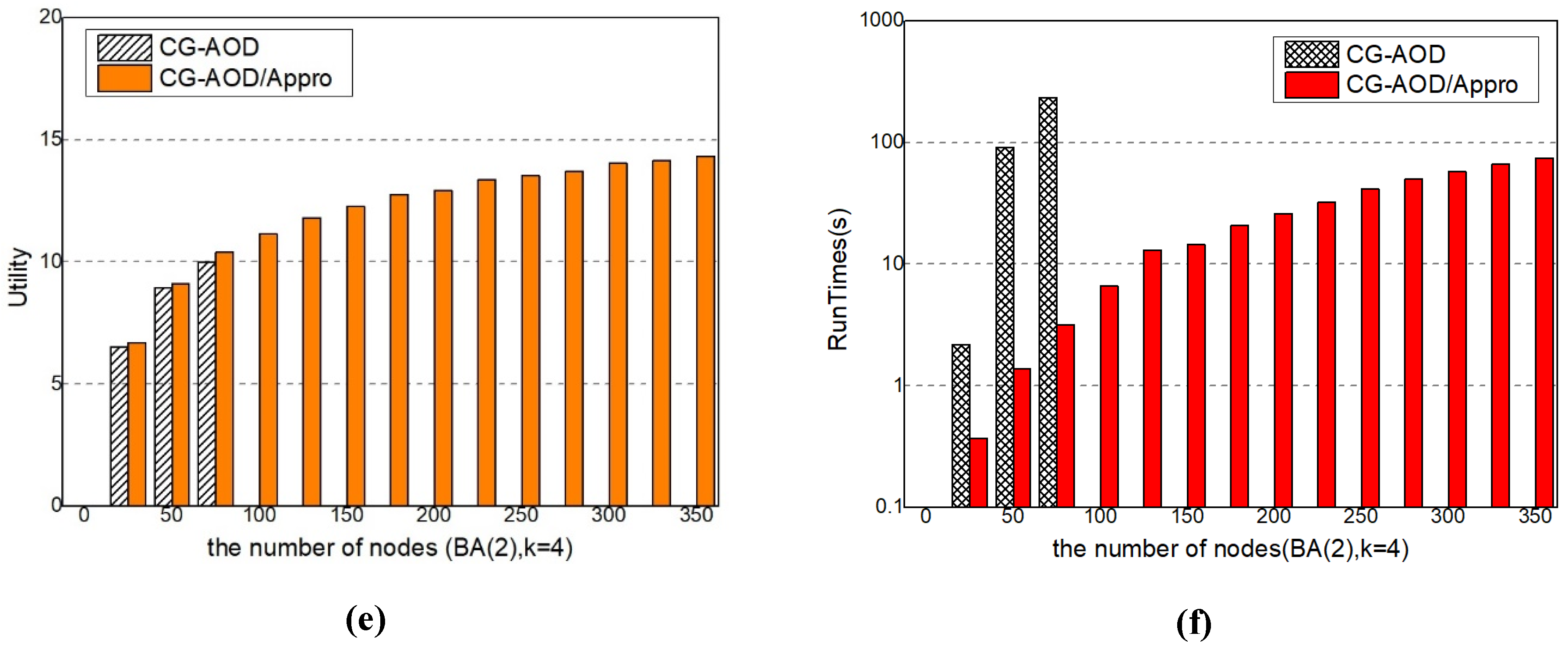
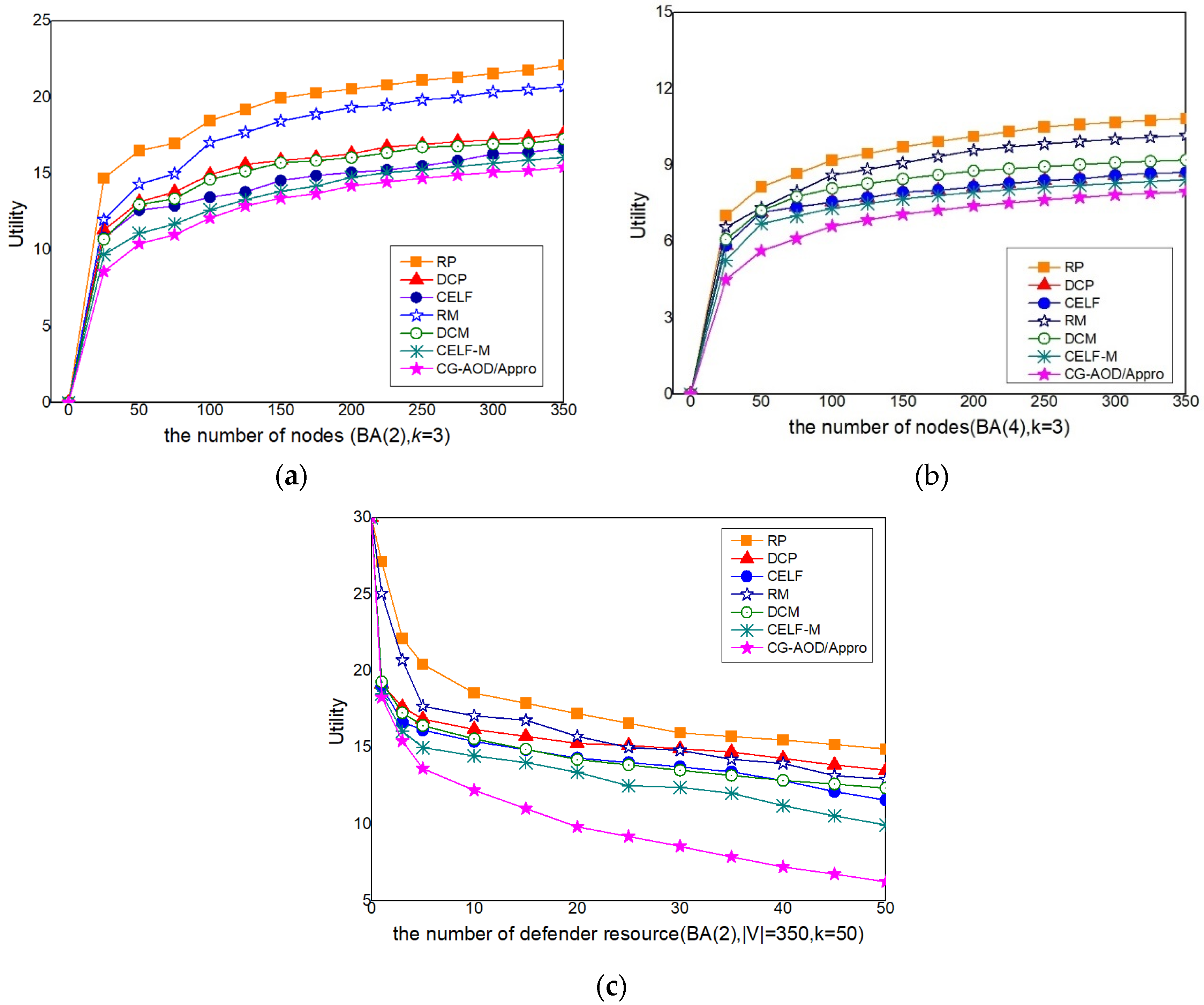

| Node | … | … | ||||
|---|---|---|---|---|---|---|
| 0 | … | … | ||||
| 0 | … | … | ||||
| … | … | … | … | … | … | … |
| … | … | |||||
| … | … | … | … | … | … | … |
| … | … | 0 |
| Pure Strategy | Corresponding Element in U | Vertices |
|---|---|---|
| 1 | ||
| 2 | ||
| 3 |
| STEP | Attacker Strategy | Defender Strategy | Payoff |
|---|---|---|---|
| 1 | {,,} | ||
| Equilibrium | {,,}(1) | 9 | |
| 2 | {,,},{,,} | ||
| Equilibrium | (0.891089) (0.108911) | {,,}(0.613861) {,,}(0.386139) | 5.52475 |
| 3 | {,,},{,,}, {,,} | ||
| Equilibrium | (0.473684) (0.526316) | {,,} (0.526316) {,,}(0.473684) | 4.73684 |
| 4 | {,,},{,,}, {,,},{,} | ||
| Equilibrium | (0.99099) (0.00990099) | {,,}(0.418042) {,,}(0.376238) {,}(0.205721) | 3.76238 |
| 5 | {,,},{,,}, {,,},{,}, ,,} | ||
| Equilibrium | (0.898204) (0.0718563) (0.0299401) | {,,}(0.409182) {,,}(0.368263) {,,}(0.222555) | 3.68263 |
| 6 | {,,},{,,}, {,,},{,}, {,,},{,,} | ||
| Equilibrium | (0.0539423) (0.552908) (0.33606) (0.0570889) | {,,}(0.393179) {,,}(0.353861) {,,}(0.213851) {,,}(0.0391082) | 3.53861 |
| 7 | {,,},{,,}, {,,},{,,}, {,,},{,,}, ,,} | ||
| Equilibrium | (0.239721) (0.129297) (0.0127931) (0.196489) | {,,}(0.275675) {,,}(0.317281) ,,}(0.150301) {,,}(0.135167) {,,}(0.121576) | 3.17281 |
| 8 | {,,},{,,}, {,,},{,}, ,,},{,,}, {,,},{,,} | ||
| Equilibrium | (0.175687) (0.183212) (0.208893) (0.17239) (0.198778) (0.061041) | {,,}(0.268945) {,,}(0.239261) ,,}(0.106774) {,,}(0.100118) {,,}(0.191897) {,,}(0.0930045) | 2.97854 |
| 9 | {,,},{,,}, {,,},{,}, ,,},{,,}, {,,},{,,}, ,,} | ||
| Equilibrium | (0.01404) (0.211501) (0.0971293) (0.140188) (0.198705) (0.163512) (0.174924) | {,,} (0.22779) {,,}(0.236859) {,,}(0.121694) {,,} (0.113244) ,,}(0.171224) {,,} (0.088595) {,,}(0.0405945) | 2.92673 |
| 10 | {,,},{,,}, {,,},{,}, {,,},{,,}, {,,},{,,}, ,,},{,,} | ||
| Equilibrium | (0.00326235) (0.0742531) (0.122845) (0.169188) (0.215608) (0.2072) (0.174924) | {,,} (0.0268422) {,,} (0.278986) ,,}(0.0251817) ,,}(0.056574) ,,}(0.134177) {,,} (0.230782) | 2.78986 |
| 11 | {,,},{,,}, {,,},{,}, ,,},{,,}, ,,},{,,}, {,,},{,,} {,,} | ||
| Equilibrium | (0.0176406) (0.124691) (0.165048) (0.186597) (0.199553) (0.202604) | {,,}(0.278624) {,,} (0.0248471) {,,}(0.246089) ,,}(0.029415) {,,} (0.162656) {,,} (0.230108) {,,}(0.0282604) | 2.78624 |
© 2020 by the authors. Licensee MDPI, Basel, Switzerland. This article is an open access article distributed under the terms and conditions of the Creative Commons Attribution (CC BY) license (http://creativecommons.org/licenses/by/4.0/).
Share and Cite
Chen, L.; Wang, Z.; Li, F.; Guo, Y.; Geng, K. A Stackelberg Security Game for Adversarial Outbreak Detection in the Internet of Things. Sensors 2020, 20, 804. https://doi.org/10.3390/s20030804
Chen L, Wang Z, Li F, Guo Y, Geng K. A Stackelberg Security Game for Adversarial Outbreak Detection in the Internet of Things. Sensors. 2020; 20(3):804. https://doi.org/10.3390/s20030804
Chicago/Turabian StyleChen, Lili, Zhen Wang, Fenghua Li, Yunchuan Guo, and Kui Geng. 2020. "A Stackelberg Security Game for Adversarial Outbreak Detection in the Internet of Things" Sensors 20, no. 3: 804. https://doi.org/10.3390/s20030804
APA StyleChen, L., Wang, Z., Li, F., Guo, Y., & Geng, K. (2020). A Stackelberg Security Game for Adversarial Outbreak Detection in the Internet of Things. Sensors, 20(3), 804. https://doi.org/10.3390/s20030804