IoT Resource Allocation and Optimization Based on Heuristic Algorithm

 ,
, 

Abstract
1. Introduction
2. Related Work
2.1. Methods Based on Deterministic Algorithms
2.2. Methods Based on Heuristic Algorithm
3. Formal Definition of IRAP
3.1. Objective Function
| : | Total cost (the objective function) |
| : | Total number of gateways |
| : | Number of resources |
| : | Number of connected resources to gateway j |
| : | Total cost of transferring data between jth gateway and its resources |
| : | Total cost of communication between gateways |
| : | Number of resources assigned to gateway i |
| : | Cost of communication between jth gateway and all resources connected to it |
| : | Total value of penalty |
| : | Penalty value for ith gateway |
| : | Constant number |
4. Whale Optimization Algorithm (WOA)
5. The Proposed Algorithm
5.1. Steps of the Proposed Algorithm
5.2. Whale Creating
5.3. Distance Function
| Algorithm 1: |
5.4. Spiral Function
| Algorithm 2: |
5.5. Shrinking Function
| Algorithm 3: |
5.6. Searchprey Function
| Algorithm 4: |
5.6.1. Join Function
5.6.2. Swap Function
5.6.3. Randomwalk Function
5.7. Parameter
5.8. Graph Clustering
| Algorithm 5: |
6. Implementation and Analysis
6.1. Dataset
6.2. Simulation Results
6.3. The Effect of Spiral, Shrinking and Searchprey Functions
6.4. The Effect of Factor
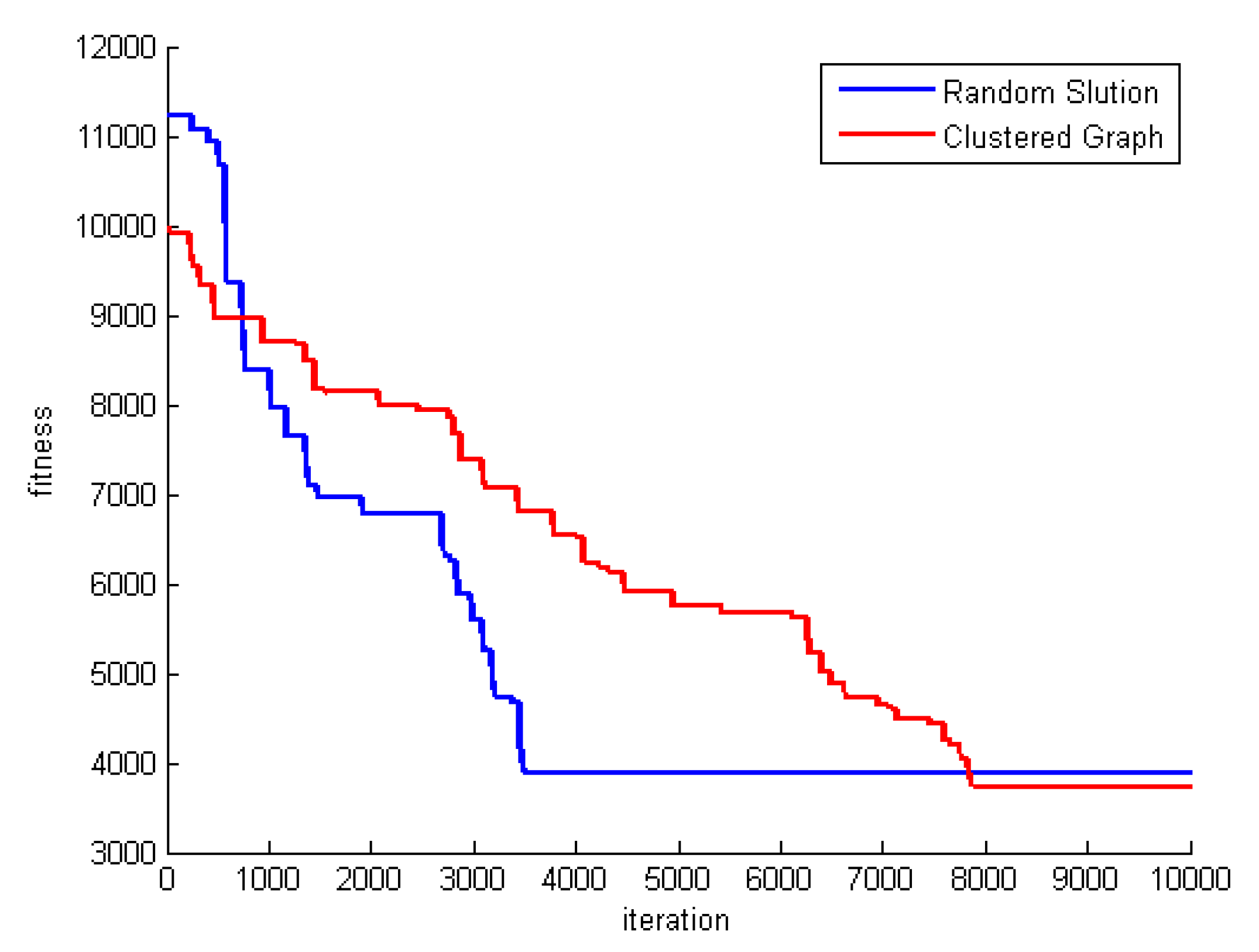
6.5. The Effect of the Graph Clustering
7. Conclusions
Author Contributions
Funding
Conflicts of Interest
References
- Ortiz, A.M.; Hussein, D.; Park, S.; Han, S.N.; Crespi, N. The cluster between internet of things and social networks: Review and research challenges. IEEE Internet Things J. 2014, 1, 206–215. [Google Scholar] [CrossRef] [Scilit]
- Luckshmi, A.I.; Visalakshi, P.; Karthikeyan, N.K. Intelligent schemes for bandwidth allocation in cellular mobile networks. In Proceedings of the 2011 International Conference on Process Automation, Control and Computing, Coimbatore, Tamilnadu, India, 20–22 July 2011; IEEE: Piscataway, NJ, USA, 2011; pp. 1–6. [Google Scholar]
- Kim, K.S.; Uno, S.; Kim, M.W. Adaptive QoS mechanism for wireless mobile network. J. Comput. Sci. Eng. 2010, 4, 153–172. [Google Scholar] [CrossRef] [Scilit]
- Perera, C.; Zaslavsky, A.; Christen, P.; Georgakopoulos, D. Context aware computing for the internet of things: A survey. IEEE Commun. Surv. Tutor. 2013, 16, 414–454. [Google Scholar] [CrossRef] [Scilit]
- Zanella, A.; Bui, N.; Castellani, A.; Vangelista, L.; Zorzi, M. Internet of things for smart cities. IEEE Internet Things J. 2014, 1, 22–32. [Google Scholar] [CrossRef] [Scilit]
- Hosseinabadi, A.A.R.; Farahabadi, A.B.; Rostami, M.H.S.; Lateran, A.F. Presentation of a new and beneficial method through problem solving timing of open shop by random algorithm gravitational emulation local search. Int. J. Comput. Sci. Issues 2013, 10, 745. [Google Scholar]
- Shareh, M.B.; Navidi, H.; Javadi, H.H.S.; HosseinZadeh, M. Preventing Sybil attacks in P2P file sharing networks based on the evolutionary game model. Inf. Sci. 2019, 470, 94–108. [Google Scholar] [CrossRef] [Scilit]
- Hosseinabadi, A.A.R.; Slowik, A.; Sadeghilalimi, M.; Farokhzad, M.; Sangaiah, A.K. An Ameliorative Hybrid Algorithm for Solving the Capacitated Vehicle Routing Problem. IEEE Access 2019, 7, 175454–175465. [Google Scholar] [CrossRef] [Scilit]
- Misbahuddin, S.; Zubairi, J.A.; Saggaf, A.; Basuni, J.; Sulaiman, A.; Al-Sofi, A. IoT based dynamic road traffic management for smart cities. In Proceedings of the 2015 12th International Conference on High-Capacity Optical Networks and Enabling/Emerging Technologies (HONET), Islamabad, Pakistan, 21–23 December 2015; IEEE: Piscataway, NJ, USA, 2015; pp. 1–5. [Google Scholar]
- Ashton, K. That ‘internet of things’ thing. RFID J. 2009, 22, 97–114. [Google Scholar]
- Bandyopadhyay, D.; Sen, J. Internet of things: Applications and challenges in technology and standardization. Wirel. Pers. Commun. 2011, 58, 49–69. [Google Scholar] [CrossRef] [Scilit]
- Domingo, M.C. An overview of the Internet of Things for people with disabilities. J. Netw. Comput. Appl. 2012, 35, 584–596. [Google Scholar] [CrossRef] [Scilit]
- Grilo, A.; Sarmento, H.; Nunes, M.; Gonçalves, J.; Pereira, P.; Casaca, A.; Fortunato, C. A wireless sensors suite for smart grid applications. In Proceedings of the 1st International Workshop on Information Technology for Energy Applications, Lisbon, Portugal, 6–7 September 2012. [Google Scholar]
- Khodadadi, F.; Dastjerdi, A.V.; Buyya, R. Internet of Things: An overview. In Internet of Things; Morgan Kaufmann: Burlington, MA, USA, 2016; pp. 3–27. [Google Scholar]
- Ericsson Mobility Report 2016. Available online: https://www.ericsson.com/res/docs/2016/ericsson-mobility-report-2016.pdf (accessed on 18 January 2020).
- Tsai, C.W. SEIRA: An effective algorithm for IoT resource allocation problem. Comput. Commun. 2018, 119, 156–166. [Google Scholar] [CrossRef] [Scilit]
- Kashikolaei, S.M.G.; Hosseinabadi, A.A.R.; Saemi, B.; Shareh, M.B.; Sangaiah, A.K.; Bian, G.B. An enhancement of task scheduling in cloud computing based on imperialist competitive algorithm and firefly algorithm. J. Supercomput. 2019, 1–28. [Google Scholar] [CrossRef] [Scilit]
- Bozorgi, S.M.; Rostami, A.S.; Hosseinabadi, A.A.R.; Balas, V.E. A new clustering protocol for energy harvesting-wireless sensor networks. Comput. Electr. Eng. 2017, 64, 233–247. [Google Scholar] [CrossRef] [Scilit]
- Rostami, A.S.; Badkoobe, M.; Mohanna, F.; Hosseinabadi, A.A.R.; Sangaiah, A.K. Survey on clustering in heterogeneous and homogeneous wireless sensor networks. J. Supercomput. 2018, 74, 277–323. [Google Scholar] [CrossRef] [Scilit]
- Hosseinabadi, A.R.; Vahidi, J.; Saemi, B.; Sangaiah, A.K.; Elhoseny, M. Extended Genetic Algorithm for Solving Open-Shop Scheduling Problem. Soft Comput. 2018, 23, 5099–5116. [Google Scholar] [CrossRef] [Scilit]
- Back, T. Evolutionary Algorithms in Theory and Practice: Evolution Strategies, Evolutionary Programming, Genetic Algorithms; Oxford University Press: Oxford, UK, 1996. [Google Scholar]
- Mirjalili, S.; Lewis, A. The whale optimization algorithm. Adv. Eng. Softw. 2016, 95, 51–67. [Google Scholar] [CrossRef] [Scilit]
- Sangaiah, A.K.; Suraki, M.Y.; Sadeghilalimi, M.; Bozorgi, S.M.; Hosseinabadi, A.A.R.; Wang, J. A new meta-heuristic algorithm for solving the flexible dynamic job-shop problem with parallel machines. Symmetry 2019, 11, 165. [Google Scholar] [CrossRef] [Scilit]
- Sangaiah, A.K.; Bian, G.B.; Bozorgi, S.M.; Suraki, M.Y.; Hosseinabadi, A.A.R.; Shareh, M.B. A novel quality-of-service-aware web services composition using biogeography-based optimization algorithm. Soft Comput. 2019, 1–13. [Google Scholar] [CrossRef] [Scilit]
- Brumitt, B.; Meyers, B.; Krumm, J.; Kern, A.; Shafer, S. Easyliving: Technologies for intelligent environments. In International Symposium on Handheld and Ubiquitous Computing; Springer: Heidelberg, Berlin, 2000; pp. 12–29. [Google Scholar]
- Fox, A.; Johanson, B.; Hanrahan, P.; Winograd, T. Integrating information appliances into an interactive workspace. IEEE Comput. Graph. Appl. 2000, 20, 54–65. [Google Scholar] [CrossRef] [Scilit]
- Tzafestas, S.; Triantafyllakis, A. Deterministic scheduling in computing and manufacturing systems: A survey of models and algorithms. Math. Comput. Simul. 1993, 35, 397–434. [Google Scholar] [CrossRef] [Scilit]
- Ben-Or, M.; Tiwari, P. A deterministic algorithm for sparse multivariate polynomial interpolation. In Proceedings of the Twentieth Annual ACM Symposium on Theory of Computing, Chicago, IL, USA, 1 January 1988; ACM: New York, NY, USA, 1988; pp. 301–309. [Google Scholar]
- Román, M.; Hess, C.; Cerqueira, R.; Ranganathan, A.; Campbell, R.H.; Nahrstedt, K. A middleware infrastructure for active spaces. IEEE Pervasive Comput. 2002, 1, 74–83. [Google Scholar] [CrossRef] [Scilit]
- Garlan, D.; Siewiorek, D.P.; Smailagic, A.; Steenkiste, P. Project aura: Toward distraction-free pervasive computing. IEEE Pervasive Comput. 2002, 1, 22–31. [Google Scholar] [CrossRef] [Scilit]
- Colistra, G.; Pilloni, V.; Atzori, L. The problem of task allocation in the Internet of Things and the consensus-based approach. Comput. Netw. 2014, 73, 98–111. [Google Scholar] [CrossRef] [Scilit]
- Angelakis, V.; Avgouleas, I.; Pappas, N.; Fitzgerald, E.; Yuan, D. Allocation of heterogeneous resources of an IoT device to flexible services. IEEE Internet Things J. 2016, 3, 691–700. [Google Scholar] [CrossRef] [Scilit]
- Huang, J.; Yin, Y.; Duan, Q.; Yan, H. A game-theoretic analysis on context-aware resource allocation for device-to-device communications in cloud-centric internet of things. In Proceedings of the 2015 3rd International Conference on Future Internet of Things and Cloud, Rome, Italy, 24–26 August 2015; IEEE: Piscataway, NJ, USA, 2015; pp. 80–86. [Google Scholar]
- Kim, S. Asymptotic shapley value based resource allocation scheme for IoT services. Comput. Netw. 2016, 100, 55–63. [Google Scholar] [CrossRef] [Scilit]
- Hartmann, S. A competitive genetic algorithm for resource-constrained project scheduling. Nav. Res. Logist. 1998, 45, 733–750. [Google Scholar] [CrossRef]
- Kim, M.; Ko, I.Y. An efficient resource allocation approach based on a genetic algorithm for composite services in IoT environments. In Proceedings of the 2015 IEEE International Conference on Web Services, New York, NY, USA, 27 June–2 July 2015; IEEE: Piscataway, NJ, USA, 2015; pp. 543–550. [Google Scholar]
- Yin, P.Y.; Wang, J.Y. A particle swarm optimization approach to the nonlinear resource allocation problem. Appl. Math. Comput. 2006, 183, 232–242. [Google Scholar] [CrossRef] [Scilit]
- Aerts, J.C.; Heuvelink, G.B. Using simulated annealing for resource allocation. Int. J. Geogr. Inf. Sci. 2002, 16, 571–587. [Google Scholar] [CrossRef] [Scilit]
- Boctor, F.F. Resource-constrained project scheduling by simulated annealing. Int. J. Prod. Res. 1996, 34, 2335–2351. [Google Scholar] [CrossRef] [Scilit]
- Belfares, L.; Klibi, W.; Lo, N.; Guitouni, A. Multi-objectives Tabu Search based algorithm for progressive resource allocation. Eur. J. Oper. Res. 2007, 177, 1779–1799. [Google Scholar] [CrossRef] [Scilit]
- Chaharsooghi, S.K.; Kermani, A.H.M. An effective ant colony optimization algorithm (ACO) for multi-objective resource allocation problem (MORAP). Appl. Math. Comput. 2008, 200, 167–177. [Google Scholar] [CrossRef] [Scilit]
- Lee, Z.J.; Lee, C.Y. A hybrid search algorithm with heuristics for resource allocation problem. Inf. Sci. 2005, 173, 155–167. [Google Scholar] [CrossRef] [Scilit]
- Gai, K.; Qiu, M. Optimal resource allocation using reinforcement learning for IoT content-centric services. Appl. Soft Comput. 2018, 70, 12–21. [Google Scholar] [CrossRef] [Scilit]
- Chowdhury, A.; Raut, S.A.; Narman, H.S. DA-DRLS: Drift adaptive deep reinforcement learning based scheduling for IoT resource management. J. Netw. Comput. Appl. 2019, 138, 51–65. [Google Scholar] [CrossRef] [Scilit]
- Singh, A.; Viniotis, Y. Resource allocation for IoT applications in cloud environments. In Proceedings of the 2017 International Conference on Computing, Networking and Communications (ICNC), Silicon Valley, CA, USA, 20 January 2017; IEEE: Piscataway, NJ, USA, 2017; pp. 719–723. [Google Scholar]
- Baker, T.; Ugljanin, E.; Faci, N.; Sellami, M.; Maamar, Z.; Kajan, E. Everything as a resource: Foundations and illustration through Internet-of-things. Comput. Ind. 2018, 94, 62–74. [Google Scholar] [CrossRef] [Scilit]
- Hatti, D.I.; Sutagundar, A.V. Fuzzy based job classification and resource allocation in IoT. In Proceedings of the 2017 International Conference on Inventive Systems and Control (ICISC), Coimbatore, India, 19–20 January 2017; IEEE: Piscataway, NJ, USA, 2017; pp. 1–4. [Google Scholar]
- Dou, Z.; Si, G.; Lin, Y.; Wang, M. An adaptive resource allocation model with anti-jamming in IoT network. IEEE Access 2019, 7, 93250–93258. [Google Scholar] [CrossRef] [Scilit]





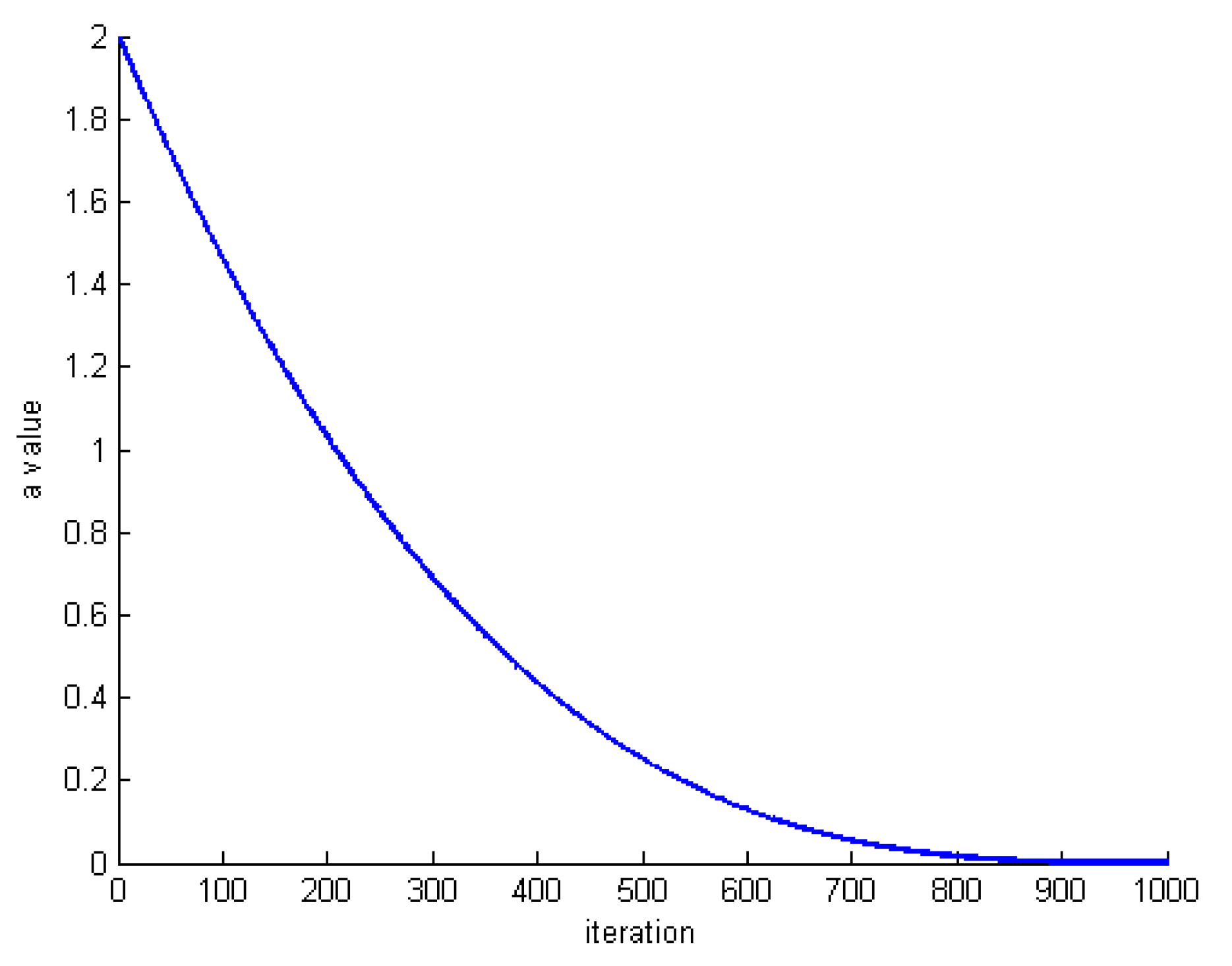
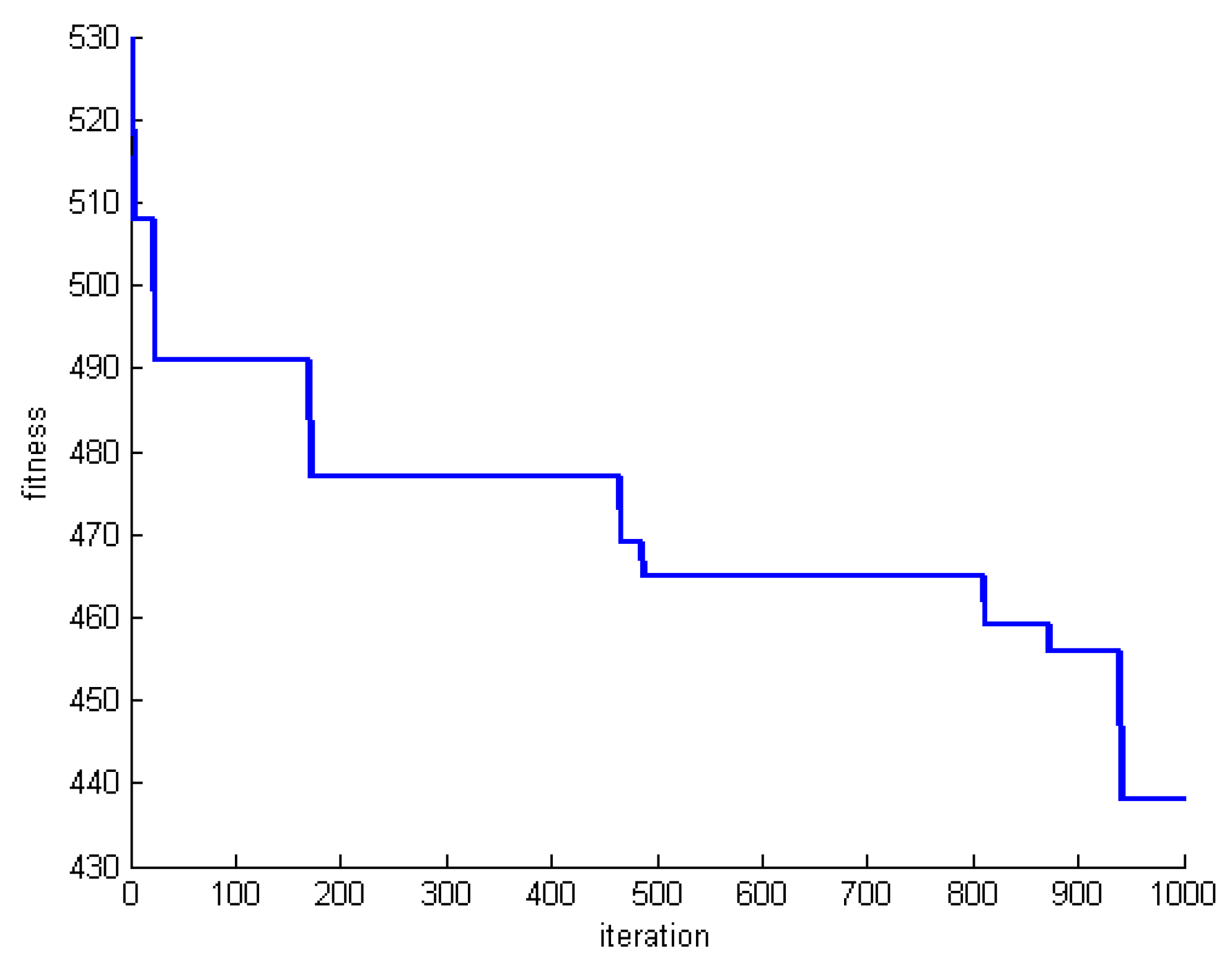

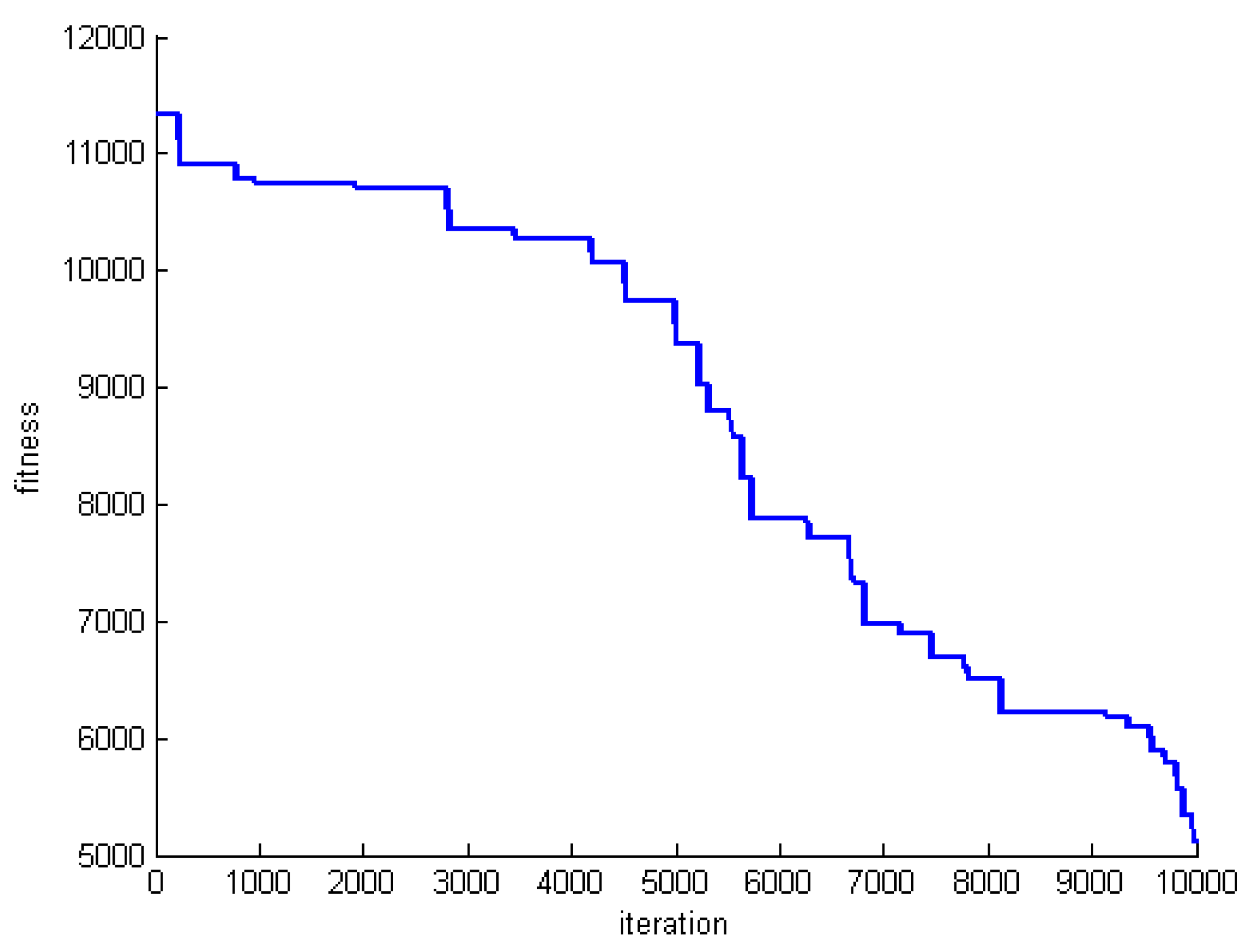

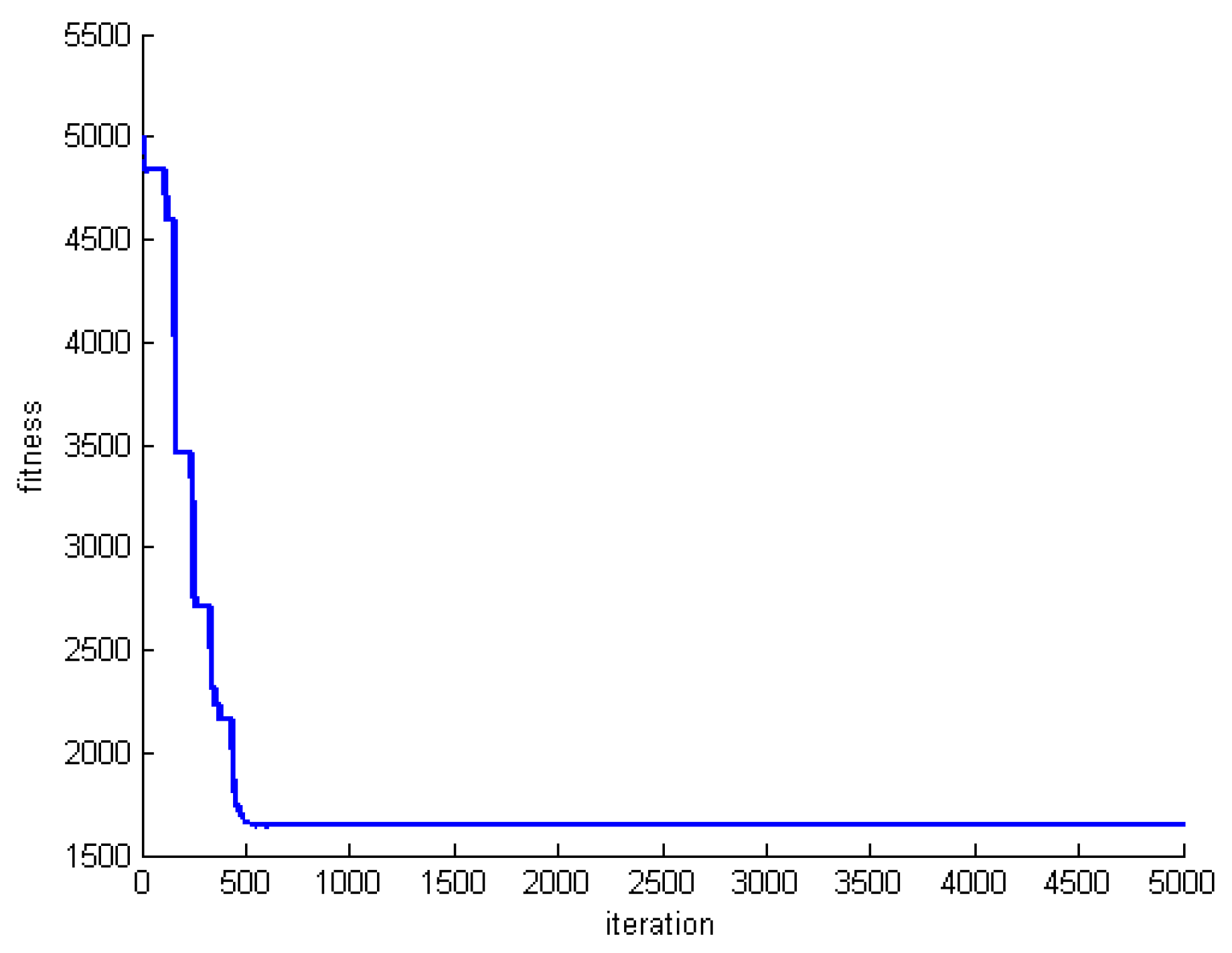


| Reference | Algorithm | Year | Pros and Cons |
|---|---|---|---|
| [31] | Consensus-based approach | 2014 |
|
| [34] | Asymptotic shapely value-based resource allocation scheme | 2016 |
|
| [36] | Genetic Algorithm | 2015 |
|
| [16] | Search Economics Algorithm and k-means clustering algorithm | 2018 |
|
| [47] | Fuzzy based job classification | 2017 |
|
| Gateway | Resource | ||||||||||
|---|---|---|---|---|---|---|---|---|---|---|---|
| Indices | 1 | 2 | 3 | 4 | 5 () | 6 () | 7 () | 8 () | 9 () | 10 () | 11 () |
| Allocate | 3 | 1 | 4 | 3 | 1 | 4 | 4 | 4 | 3 | 2 | 1 |
| Gateway | Resource | ||||||||||
|---|---|---|---|---|---|---|---|---|---|---|---|
| Indices | 1 | 2 | 3 | 4 | 5 () | 6 () | 7 () | 8 () | 9 () | 10 () | 11 () |
| W1 | 3 | 1 | 4 | 3 | 1 | 4 | 4 | 4 | 3 | 2 | 1 |
| W2 | 3 | 3 | 4 | 2 | 1 | 2 | 2 | 4 | 3 | 4 | 1 |
| Gateway | Resource | ||||||||||
|---|---|---|---|---|---|---|---|---|---|---|---|
| Indices | 1 | 2 | 3 | 4 | 5 () | 6 () | 7 () | 8 () | 9 () | 10 () | 11 () |
| W1 | 3 | 1 | 4 | 3 | 1 | 4 | 4 | 4 | 3 | 2 | 1 |
| Best | 3 | 3 | 4 | 2 | 1 | 2 | 2 | 4 | 3 | 4 | 1 |
| Spiral | 3 | 1 | 4 | 1 | 1 | 2 | 4 | 4 | 3 | 4 | 1 |
| Gateway | Resource | ||||||||||
|---|---|---|---|---|---|---|---|---|---|---|---|
| Indices | 1 | 2 | 3 | 4 | 5 () | 6 () | 7 () | 8 () | 9 () | 10 () | 11 () |
| W1 | 3 | 1 | 4 | 3 | 1 | 4 | 4 | 4 | 3 | 2 | 1 |
| Best | 3 | 1 | 4 | 2 | 1 | 2 | 2 | 4 | 3 | 4 | 1 |
| Shrinking | 3 | 1 | 4 | 2 | 1 | 3 | 4 | 4 | 3 | 2 | 1 |
| Gateway | Resource | ||||||||||
|---|---|---|---|---|---|---|---|---|---|---|---|
| Indices | 1 | 2 | 3 | 4 | 5 () | 6 () | 7 () | 8 () | 9 () | 10 () | 11 () |
| W1 | 3 | 1 | 4 | 3 | 1 | 4 | 4 | 4 | 3 | 2 | 1 |
| W2 | 3 | 1 | 4 | 2 | 1 | 2 | 4 | 4 | 2 | 4 | 1 |
| Join | 3 | 1 | 4 | 3 | 1 | 3 | 4 | 4 | 2 | 4 | 1 |
| Gateway | Resource | ||||||||||
|---|---|---|---|---|---|---|---|---|---|---|---|
| Indices | 1 | 2 | 3 | 4 | 5 () | 6 () | 7 () | 8 () | 9 () | 10 () | 11 () |
| W1 | 3 | 1 | 4 | 3 | 1 | 4 | 4 | 4 | 3 | 2 | 1 |
| W2 | 3 | 3 | 4 | 2 | 1 | 4 | 4 | 4 | 2 | 4 | 1 |
| Swap | 3 | 3 | 4 | 2 | 1 | 4 | 4 | 4 | 3 | 2 | 1 |
| Data Set Name | Number of Gateways | Number of Resources |
|---|---|---|
| DS1 | 4 | 10 |
| DS2 | 4 | 12 |
| DS3 | 4 | 16 |
| DS4 | 40 | 100 |
| DS5 | 40 | 200 |
| DS6 | 40 | 400 |
| DS7 | 100 | 400 |
| DS8 | 100 | 800 |
| GA [36] | SEIRA [16] | WOA (Proposed) | |
|---|---|---|---|
| DS1 | 180.5 | 180.5 | 180.5 |
| DS2 | 214 | 214 | 214 |
| DS3 | 242.5 | 242.5 | 242.5 |
| DS4 | 841 | 835 | 836.6 |
| DS5 | 1260.4 | 1233 | 1230 |
| DS6 | 1920.6 | 1905.3 | 1901.4 |
| DS7 | 2728.8 | 2669.1 | 2661.8 |
| DS8 | 3857.3 | 3753.7 | 3725 |
| Number of Whales | Number of Rounds | Best Solution |
|---|---|---|
| 1,000,000 | 1 | 270.5 |
| 100,000 | 10 | 233 |
| 10,000 | 100 | 197.5 |
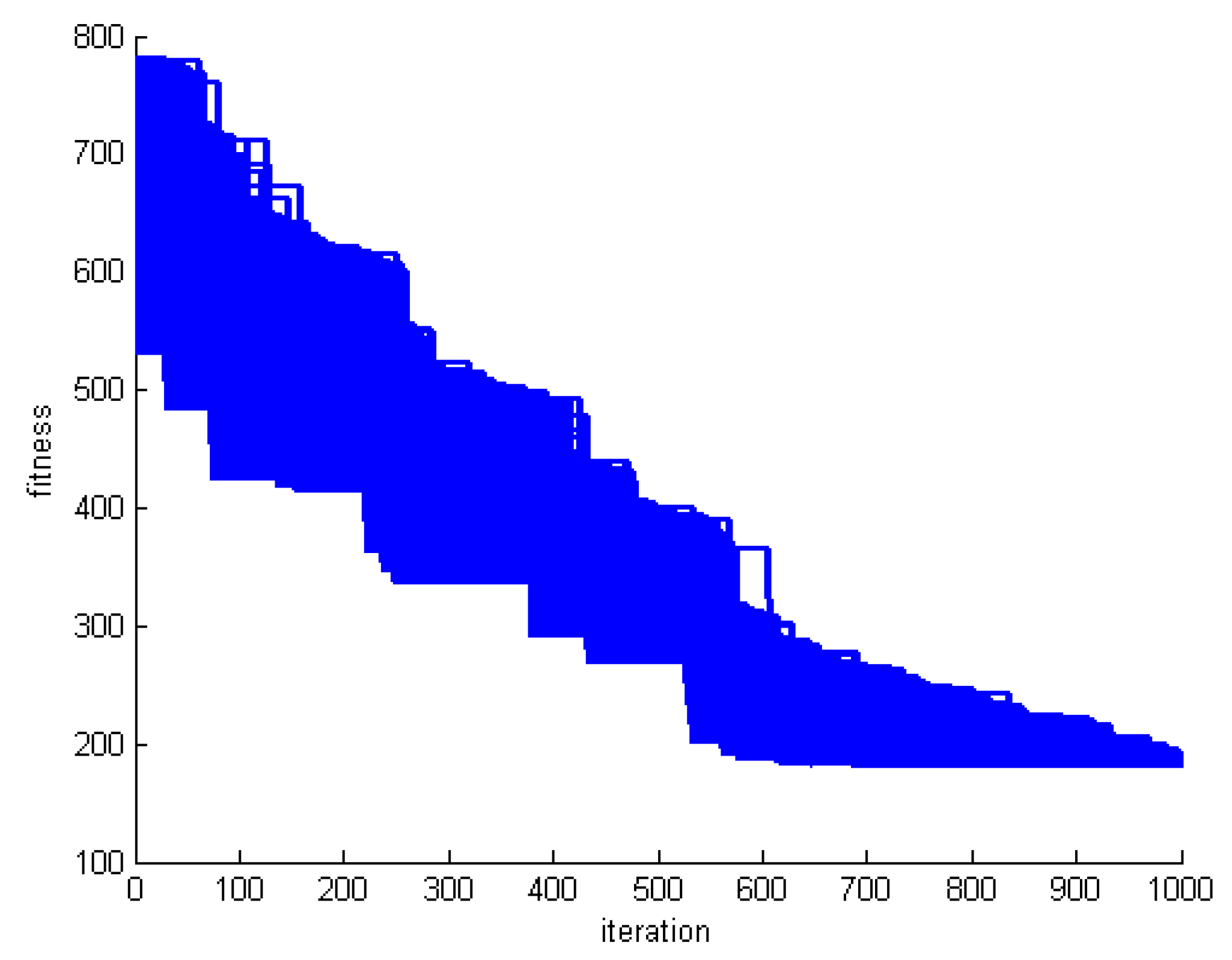
| 1000 | 1000 | 180.5 |
| Number of Whales | Number of Rounds | Best Solution |
|---|---|---|
| 25,000,000 | 1 | 1470.1 |
| 500,000 | 50 | 1431.4 |
| 50,000 | 500 | 1298.8 |
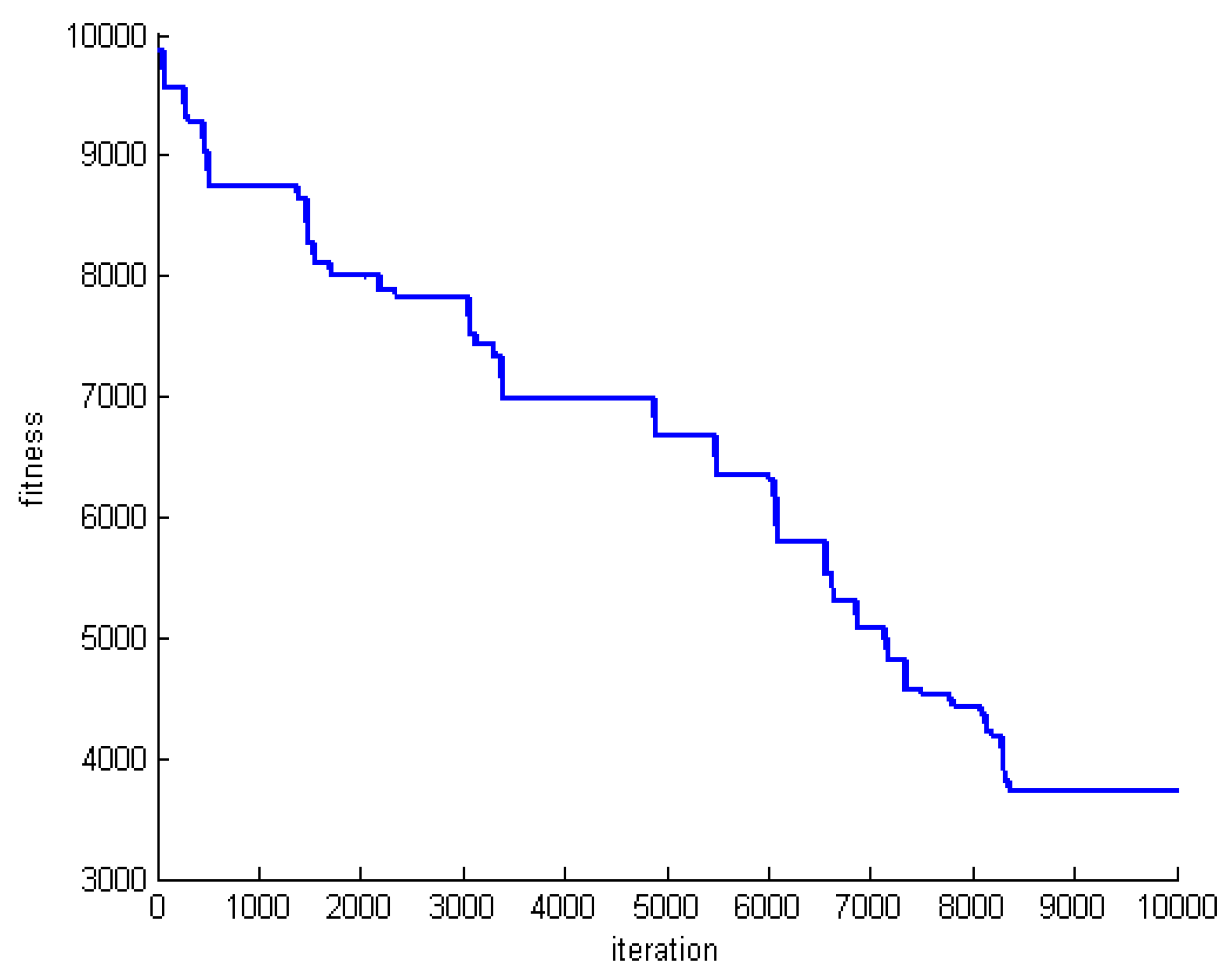
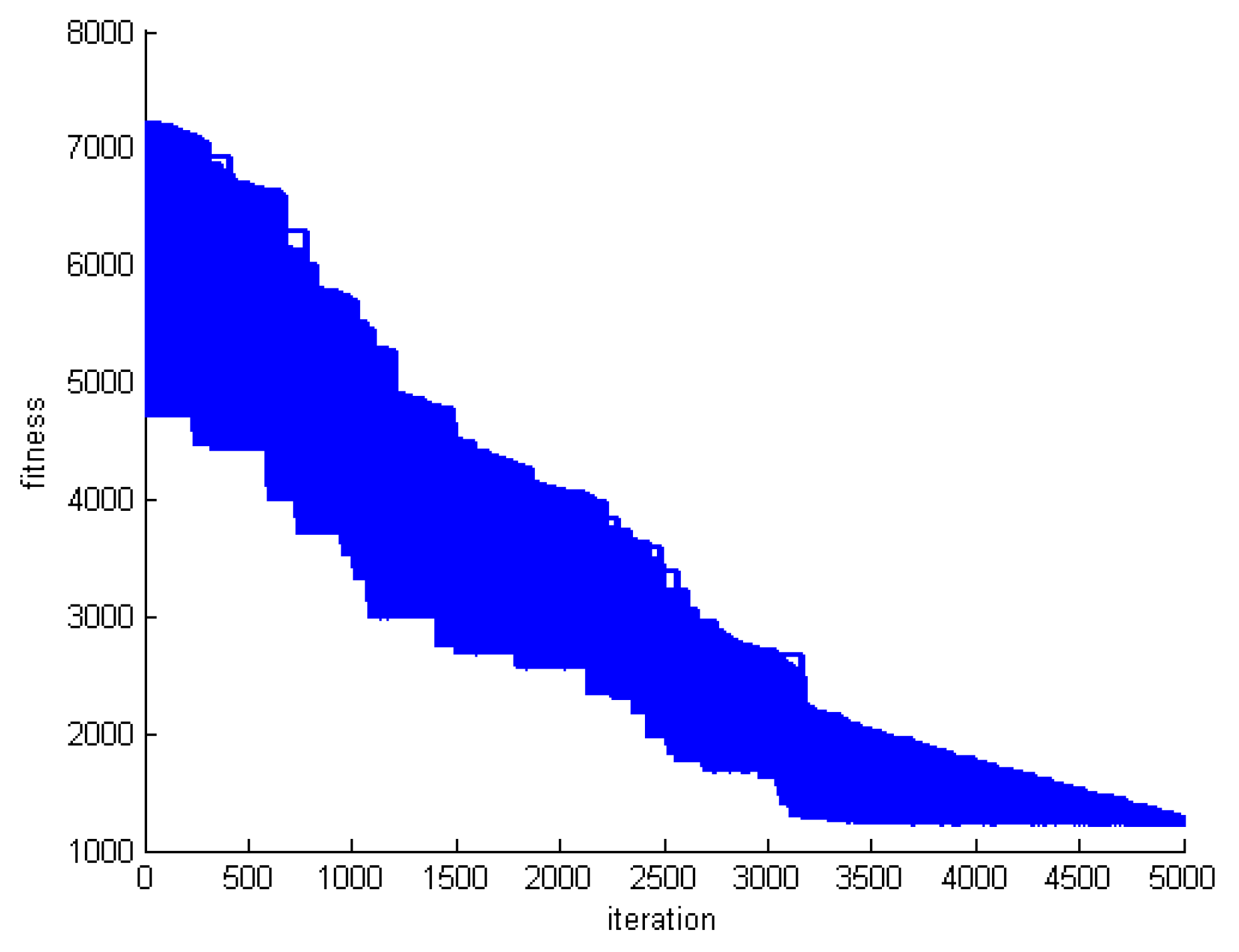
| 5000 | 5000 | 1230 |
| Number of Whales | Number of Rounds | Best Solution |
|---|---|---|
| 100,000,000 | 1 | 4357 |
| 10,000,000 | 10 | 4124.5 |
| 1,000,000 | 100 | 4023.2 |
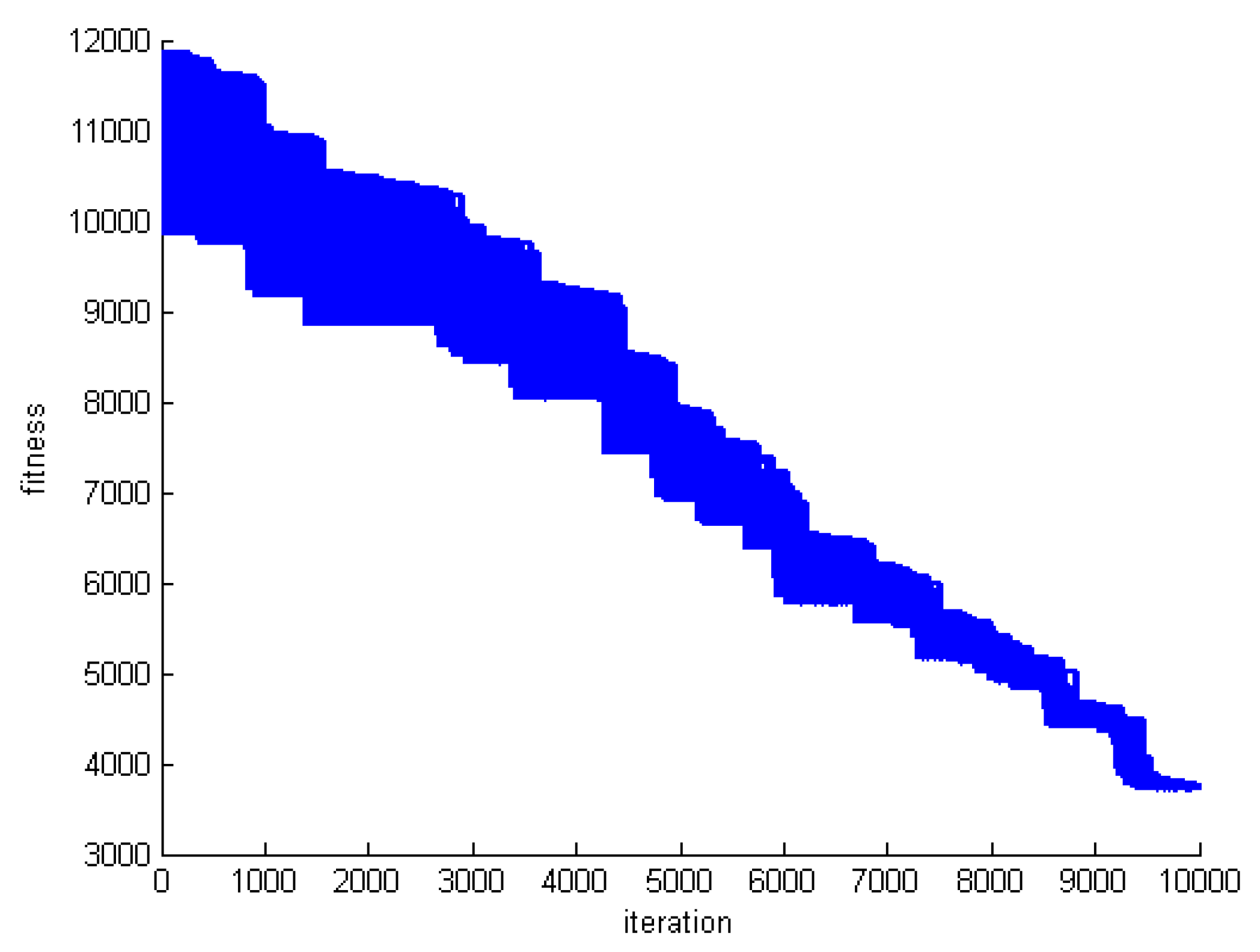
| 10,000 | 10,000 | 3725 |
| Problem | Graph Clustering | Random | ||
|---|---|---|---|---|
| Best Answer in First Generation | The Final Answer | Best Answer in First Generation | The Final Answer | |
| DS1 | 540 | 180.5 | 571 | 180.5 |
| DS2 | 612 | 214 | 664.5 | 214 |
| DS3 | 707.2 | 242.5 | 755 | 242.5 |
| DS4 | 2927 | 836.6 | 3374 | 852 |
| DS5 | 4750 | 1230 | 5219.4 | 1258.5 |
| DS6 | 6206 | 1901.4 | 7126 | 1942 |
| DS7 | 7480.2 | 2661.8 | 9135 | 2730.2 |
| DS8 | 9955 | 3725 | 11,324 | 3892 |
© 2020 by the authors. Licensee MDPI, Basel, Switzerland. This article is an open access article distributed under the terms and conditions of the Creative Commons Attribution (CC BY) license (http://creativecommons.org/licenses/by/4.0/).
Share and Cite
Sangaiah, A.K.; Hosseinabadi, A.A.R.; Shareh, M.B.; Bozorgi Rad, S.Y.; Zolfagharian, A.; Chilamkurti, N. IoT Resource Allocation and Optimization Based on Heuristic Algorithm. Sensors 2020, 20, 539. https://doi.org/10.3390/s20020539
Sangaiah AK, Hosseinabadi AAR, Shareh MB, Bozorgi Rad SY, Zolfagharian A, Chilamkurti N. IoT Resource Allocation and Optimization Based on Heuristic Algorithm. Sensors. 2020; 20(2):539. https://doi.org/10.3390/s20020539
Chicago/Turabian StyleSangaiah, Arun Kumar, Ali Asghar Rahmani Hosseinabadi, Morteza Babazadeh Shareh, Seyed Yaser Bozorgi Rad, Atekeh Zolfagharian, and Naveen Chilamkurti. 2020. "IoT Resource Allocation and Optimization Based on Heuristic Algorithm" Sensors 20, no. 2: 539. https://doi.org/10.3390/s20020539
APA StyleSangaiah, A. K., Hosseinabadi, A. A. R., Shareh, M. B., Bozorgi Rad, S. Y., Zolfagharian, A., & Chilamkurti, N. (2020). IoT Resource Allocation and Optimization Based on Heuristic Algorithm. Sensors, 20(2), 539. https://doi.org/10.3390/s20020539