Parkinson’s disease (PD) is clinically characterized by both motor and non–motor symptoms. The most common motor symptoms are slowness of movement (bradykinesia), hastening of the gait (festination), paucity of spontaneous movements (akinesia), and poor postural stability. Gait impairment is the most incapacitating symptom among patients with PD [
1], as it negatively affects mobility and independence and results in fall-related injuries, emotional stresses, and deterioration of patients’ quality of life [
2,
3,
4,
5].
Freezing of gait (FoG) is commonly regarded as a feature of akinesia, an extreme form of bradykinesia [
6]. FoG is described as brief episodes of inability to step forward or as taking extremely short steps when initiating gait or turning [
7]. FoG is highly affected by environmental stimuli, cognitive input, medication, and anxiety [
8,
9]. It occurs more frequently at home than in the clinic, in complete darkness, and in other settings that require greater cognitive load like dual-tasking situations [
10,
11,
12,
13].
1.1. FoG Treatment
PD treatments have been under investigation for some time, with levodopa (LD) and dopamine agonist (DA) as the most common pharmacological treatments for patients suffering from impaired activities of daily living. Although LD decreases duration of FoG episodes and their frequency during on-medication periods, FoG incidents are still difficult to treat during off state and in advanced stages of the disease. On the other hand, drugs for non-motor symptoms can interfere with the effectiveness of LD and aggravate motor symptoms [
14]. DA, in contrast with LD, may provoke more FoG episodes in early stages of disease [
15]. For many patients with concurrent FoG symptoms and cognitive disorder, the efficacy of medication therapy is poor and deep brain stimulation (DBS) is often prescribed [
16]. Non–randomized studies with low sample sizes have shown that DBS can improve FoG and the effect can last for at least 1 year, however, the risk of aggravating other symptoms still exists [
16,
17]. Therefore, new effective non-pharmacologic treatments are still needed to relieve FoG symptoms.
1.2. External Cueing
It is thought that motor dysfunctions in PD result from limited resources and less automaticity of motor plans due to the damage to the basal ganglia [
18]. To tackle this, non-invasive, non-pharmacological interventions in the form of external stimuli have recently gained attention. Patients are instructed how to shift their attention toward gait using external cues as discrete targets [
19,
20]. Spatial cues (e.g., strips placed or laser beams projected on the floor) can be customized for each patient based on their stride length to show patients
where to put their next step. On the other hand, temporal cues (e.g., auditory metronome or vibrotactile feedback) are customized based on cadence and inform users
when a step should be taken. Studies suggest that externally cued training can reduce FoG severity and improve gait velocity, stride length and upper-limb movements immediately after training [
19,
21,
22].
Frazzitta et al. investigated the effects of visual and auditory external cueing on PD patients with FoG symptoms. Patients received cueing therapy daily for 20 min and demonstrated statistically significant improvements in Freezing of Gait Questionnaire (FOGQ) score after four weeks [
23]. Nieuwboer et al. delivered cueing training in the home of 153 individuals with PD. Cueing devices provided three cueing modalities: (1) auditory (a beep triggered through an earpiece); (2) visual (light flashes triggered through a light-emitting diode attached to a pair of glasses); and (3) somatosensory (pulsed vibrations triggered by a miniature cylinder worn under a wristband). The results showed that severity of freezing was reduced by 5.5% in patients with FoG symptoms [
24]. Kadivar et al. compared a battery of clinical assessments after a 6-week training session and 4 weeks follow-up in two groups of eight patients practicing with rhythmic auditory stimulation stepping (RAS group) and no-cue stepping (no RAS group). Results suggested that the RAS group significantly improved FoG symptoms (as measured by FOGQ) and maintained improvements above baseline values for at least 4 weeks after practice termination [
25].
1.3. FoG Detection
“Always-on” cueing is defined as a paradigm in which stimulus is delivered repeatedly to the user regardless of any prior or imminent FoG episodes. However, individuals with PD are known to adapt to interventions provided continuously, thus reducing the effect of cueing [
19,
26]. Therefore, it is ideal to deliver an external stimuli only when it is contingent on symptom onset. This requires the development of an integrative system capable of automatically detecting FoG episodes. A variety of methods for such an approach include using data captured from electrocardiography (ECG) systems [
27], electromyography (EMG) systems [
28,
29], 3D motion systems [
30,
31], foot pressure sensors [
32,
33], and Inertial Measurement Units (IMUs) [
34,
35].
To date, a variety of approaches have been employed resulting in varied classification accuracy. Example applications include that of Tahafchi et al., who used temporal, spatial, and physiological features to train a Support Vector Machine (SVM) classifier to identify freezing episodes. Data were collected using inertial sensors attached to the thigh, shank, and foot, and non-invasive surface EMG sensors attached to quadriceps/tibialis muscles of PD patients. They detected 90% of the FoG events correctly, while identifying 8% of the non-FoG data incorrectly as FoG [
36]. Another group, Mazilu et al., tested different supervised machine learning algorithms on detecting FoG events using 3-D acceleration signals collected from the ankle, knee, and hip of ten PD patients. A correlation-based feature subset selection was used to choose only the most discriminative features. They compared results from two different approaches: “patient-dependent”, in which both training and testing data were from the same participant, and “patient-independent” utilizing leave-one-out cross validation. Their results for patient-dependent models showed average sensitivity, specificity, and F1 (see Equation (4)) of 99.54%, 99.96% and 99.75%, respectively, using Random Forest classifiers. However, the average performance for patient-independent models resulted in much lower sensitivity and specificity (66.25% and 95.38%, respectively) [
37].
Using more recent techniques, Camps et al. applied a deep learning (DL) method to detect FoG episodes in home environments. Their algorithm employed an eight-layered one-dimensional convolutional neural network and spectral window stacking as data representation to combine information from both the prior and current signal windows. They used data from a single IMU placed on the waist of thirteen patients to train the DL model and tested the model on data from four other patients (not included in the training set). The DL model detected FoG episodes with sensitivity and specificity of 91.9% and of 89.5%, respectively [
38]. Finally, Xia et al. implemented a deep convolutional neural network to detect FoG events. The system segmented 1-dimensional acceleration signals into windows of 4 s and realized automatic feature learning in order to discriminate FoG from normal gait, thus, removing the need for extracting hand-crafted features and time-consuming feature selection. They reached average sensitivity and specificity of 99.64% and 99.99%, respectively, using patient-dependent, and 74.43% and 90.60% using patient-independent models [
39].
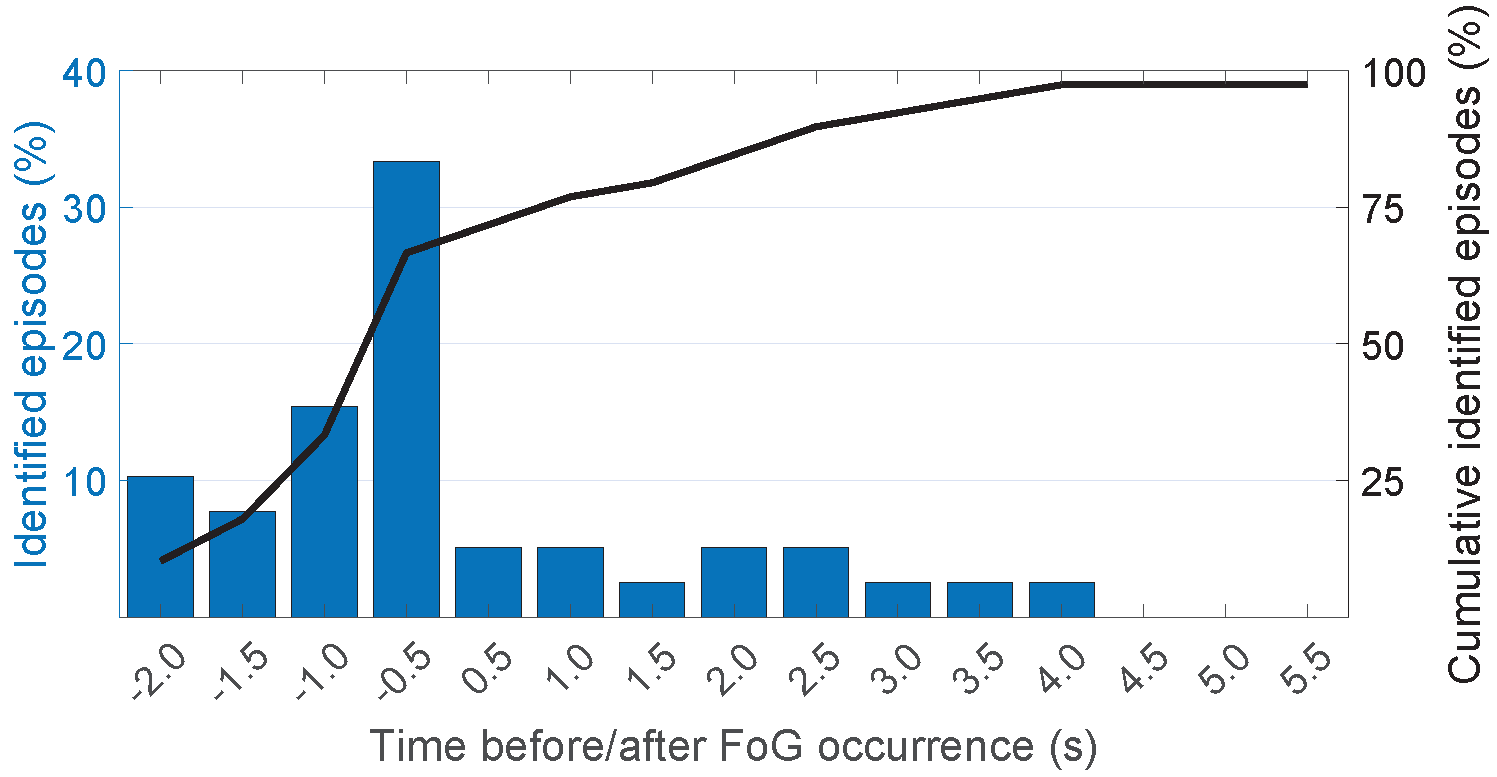
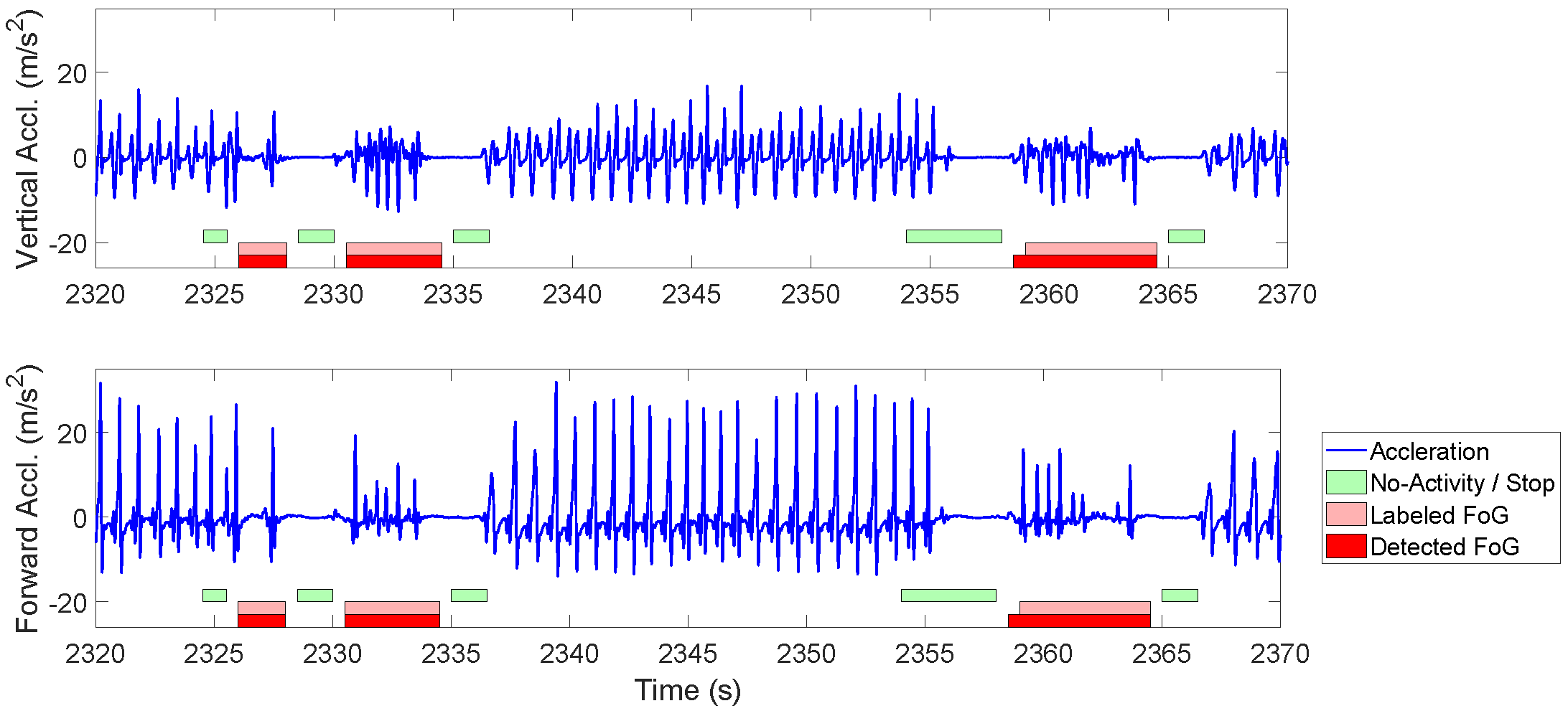
The described studies achieved high classification accuracy for FoG detection, especially with patient-dependent models which reduces the effect of heterogeneity in data from different participants. However, these studies seldom reported the detection latency (i.e., time associated with classification after FoG onset) and prediction capability (i.e., time associated with classification prior to FoG onset). This study aimed to evaluate the classification performance of individual and ensemble classifiers for FoG, while also addressing the class imbalance problem inherent to FoG (i.e., the relative infrequency of FoG occurrence when compared to normal gait behaviors). With the encouraging results obtained in the experiments, we hope this study can provide an effective intervention to accurately predict FoG events using wearable inertial sensor data, and ultimately help patients prevent FoG through external cueing.
1.4. FoG Prediction
Providing cues during an actual FoG episode may result in cognitive overload by superimposing an external stepping rhythm, which may aggravate the FoG. Ginis et al. suggested that an optimal timing for delivering intelligent cues is before the actual onset of a potential FoG episode [
19]. Such predictions would also enable preventive cueing and potentially reduce the likelihood of this disabling symptom [
24]. Palmerini et al. trained a linear discriminant analysis classifier to discriminate pre-FoG episodes from normal gait in eleven PD patients using a wearable multi-sensor setup. After removing data corresponding to FoG and with no sufficient motion, data for each patient was divided into 2 s windows of pre-FoG and normal gait. The classifier identified 83% of the pre-FoG episodes on average in patient-dependent model [
40].
Torvi et al. developed a deep learning algorithm to predict FoG events before their occurrence. They also studied the performance of transfer learning algorithms to address the domain disparity between data from different subjects, in order to develop a better prediction model for a particular subject. The model predicted 88% of the events within 1 s before FoG occurrence in patient dependent mode, with 50% of the data used for training. The prediction accuracy improved to 93% with the addition of transfer learning techniques to develop a prediction model for a particular subject by leveraging data from different subjects [
41].
Existing literature reported wide ranges of FoG detection and prediction accuracy for participants using primarily patient-dependent approaches. This is partly due to the fact that participants reacted differentially to the FoG stimuli included in the experiments, which caused wide ranges of FoG to non-FoG data ratios. Oftentimes, high levels of class imbalance in data set aggravated model performance. Therefore, new techniques are needed to address this issue, particularly when patient-dependent models are to be developed and implemented in cueing intervention devices. In this study we investigated the effect of data imbalance on the performance of classifiers in predicting and detecting FoG. We applied three common approaches: using ensemble classifiers [
42], adding new synthetic FoG samples to the training dataset to improve balance [
43], and increasing misclassification cost for the minority class, i.e., FoG [
44]. The selected classifier must have high performance in discriminating FoG from normal gait within an appropriate time period before or after FoG occurrence.