Efficient Hybrid Emergency Aware MAC Protocol for Wireless Body Sensor Networks

 ,
,  , and
, and 
Abstract
:1. Introduction
2. Related Work
3. Hybrid DTDMA/DS-CDMA Protocol
3.1. DTDMA Protocol
3.2. DS-CDMA
3.3. Proposed DTDMA/DS-CDMA MAC Protocol
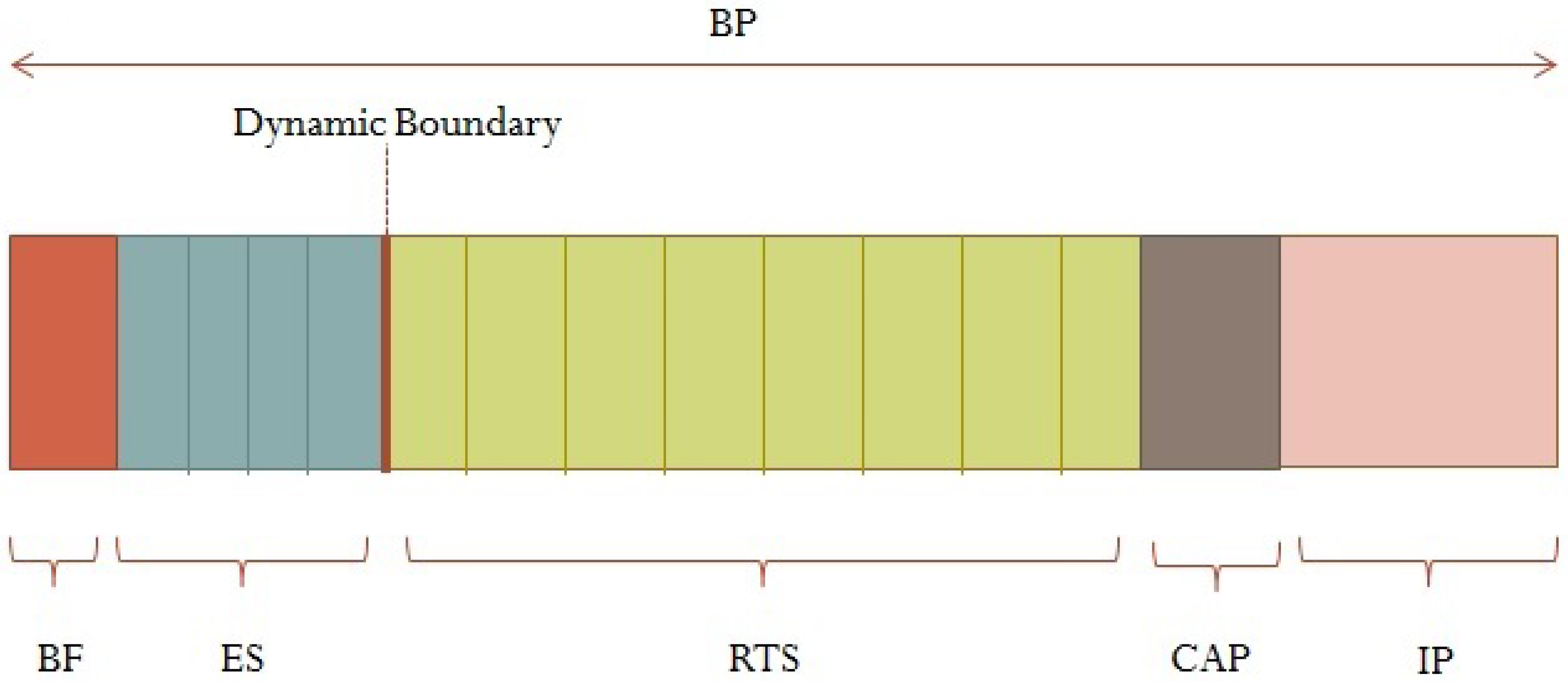
3.3.1. Proposed Superframe Structure
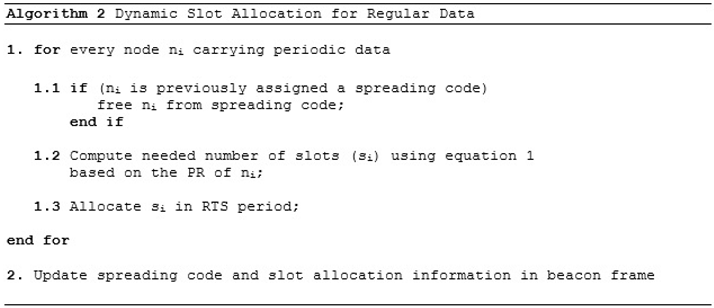
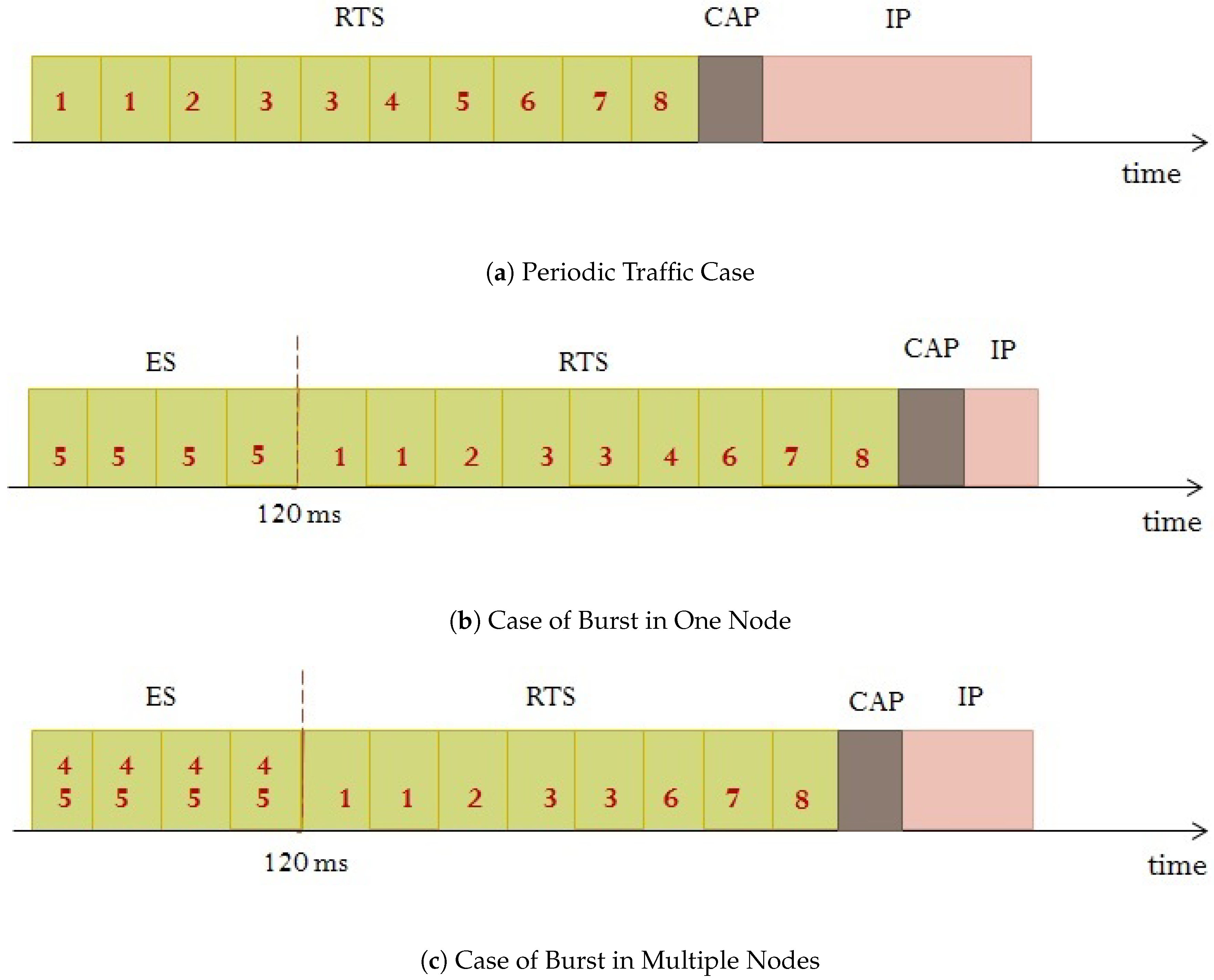
3.3.2. Slot Allocation Procedure

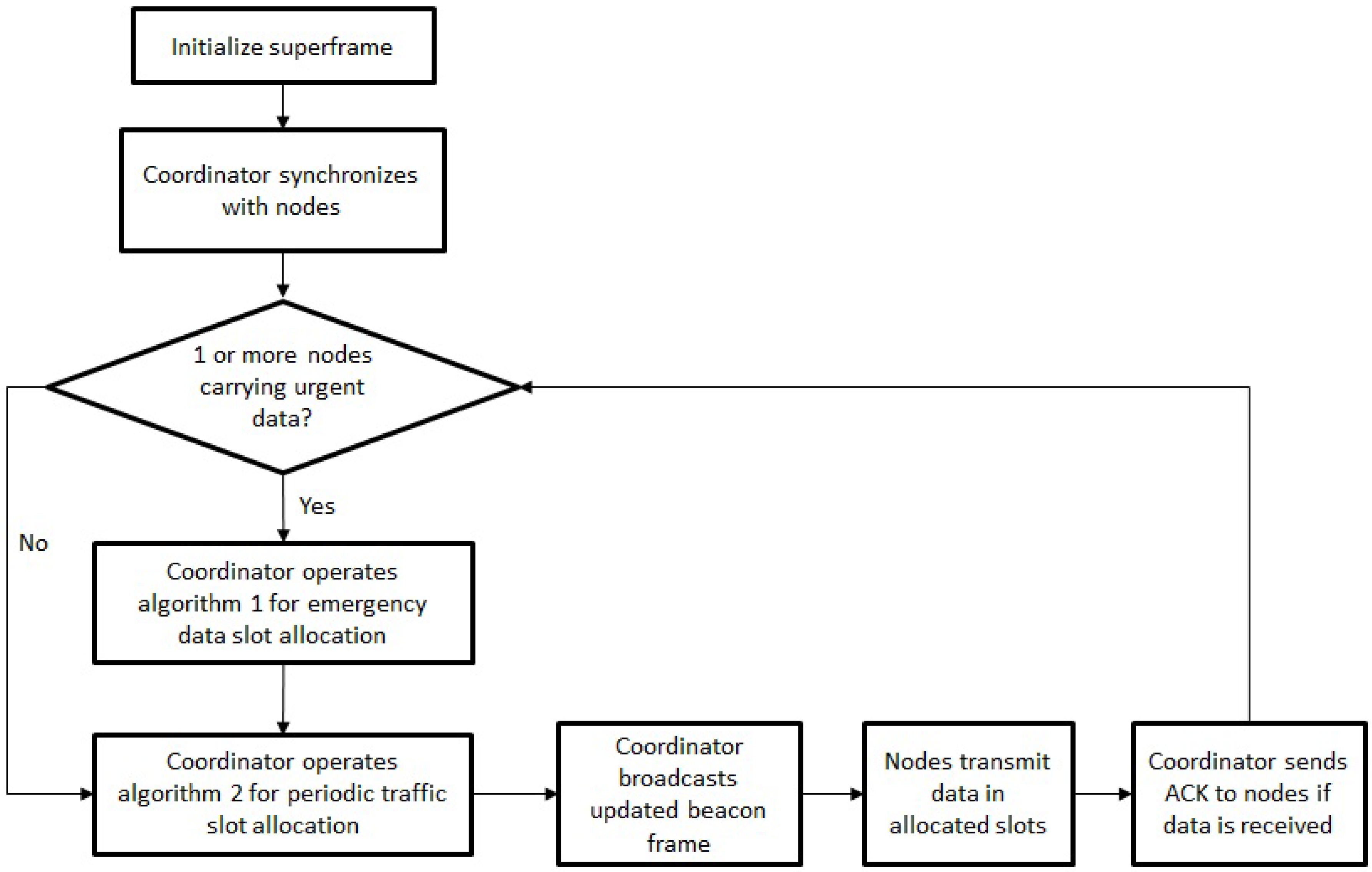
3.3.3. Protocol Data Transfer Operation
4. Evaluation of the Proposed Scheme
4.1. Performance Metrics
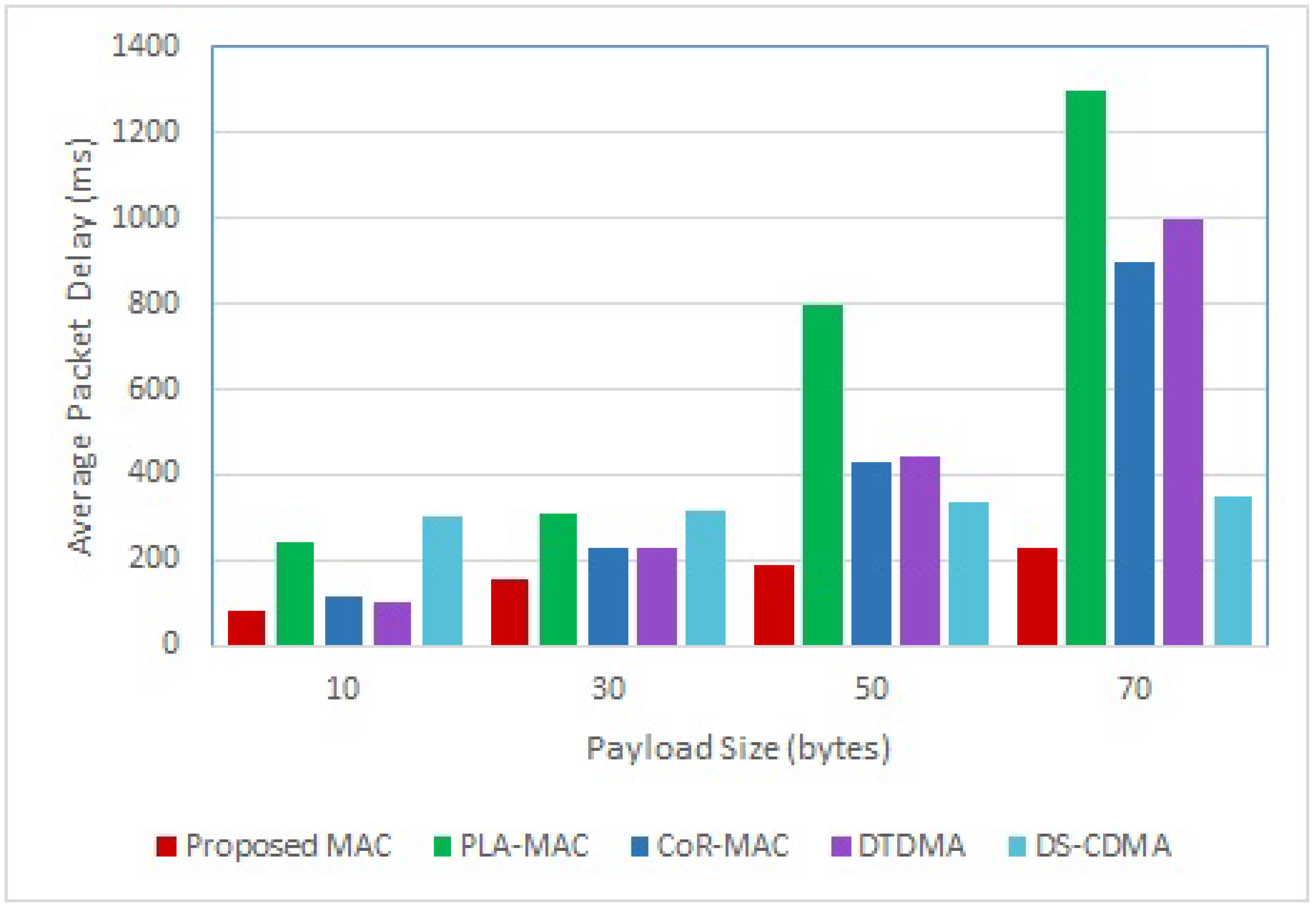
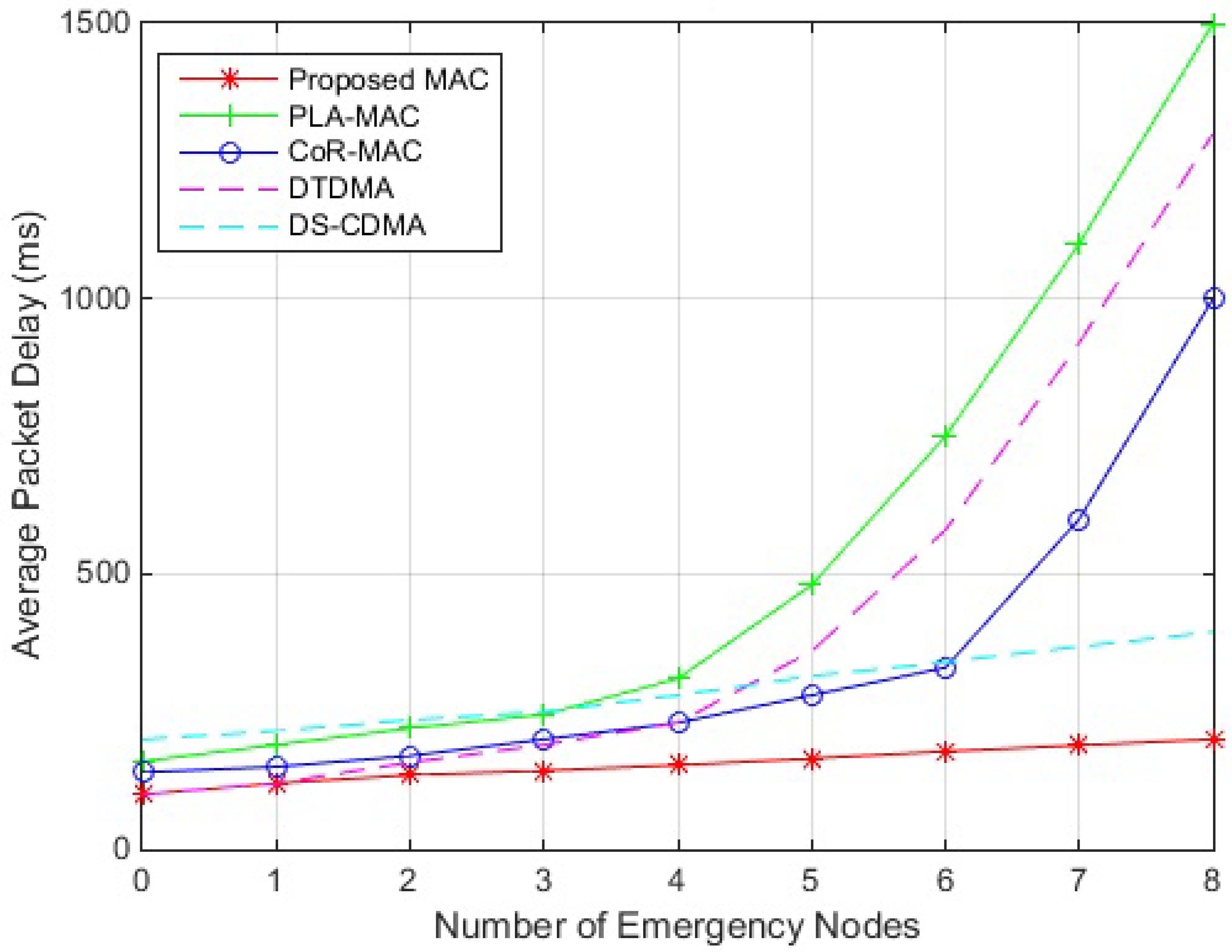
- Average Packet Delay: it is the interval of time between the generation of a packet by the sensor node, to the moment when it is successfully received by the coordinator. This metric shows the ability of the MAC protocol to deliver packets with minimal delay.
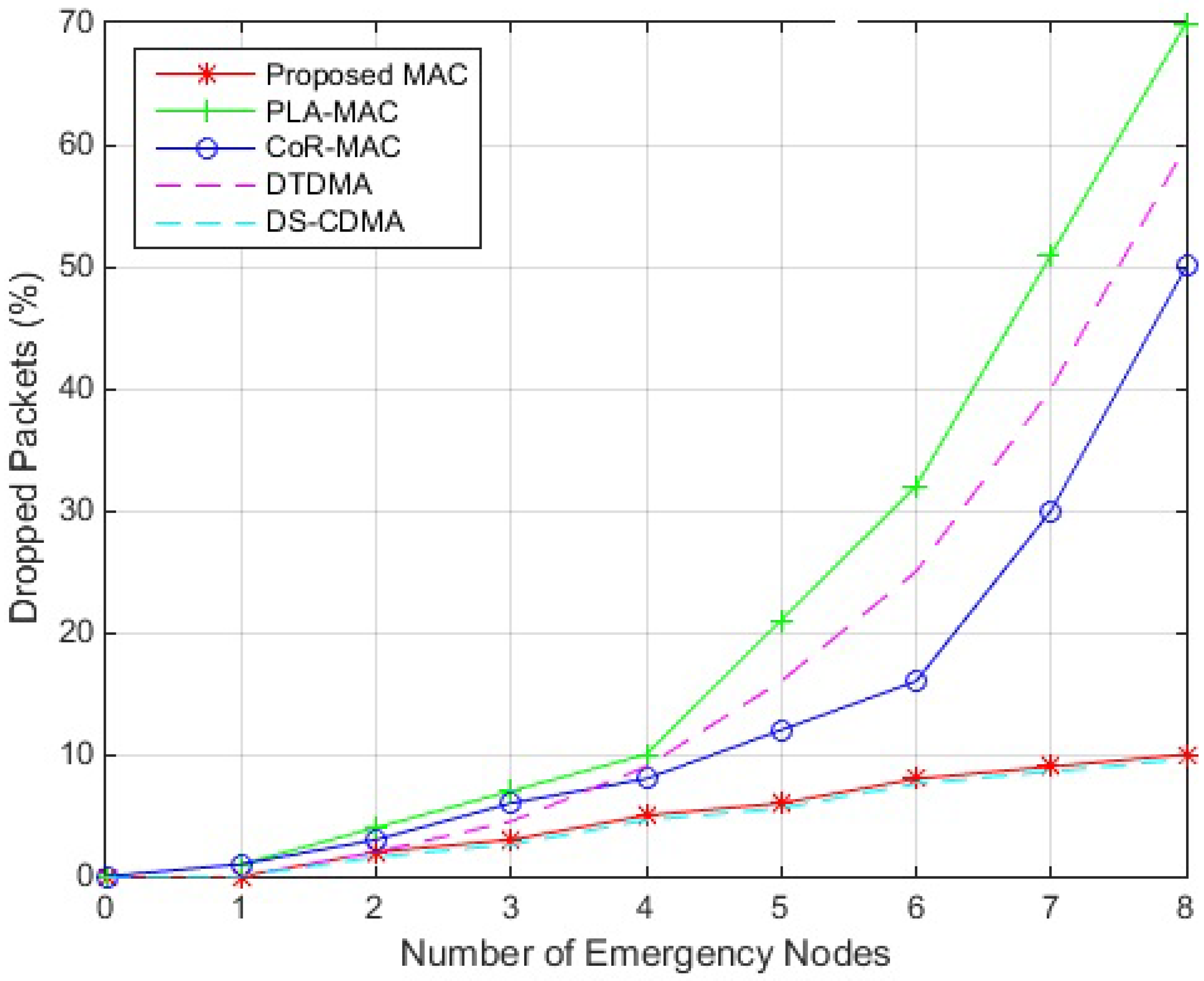
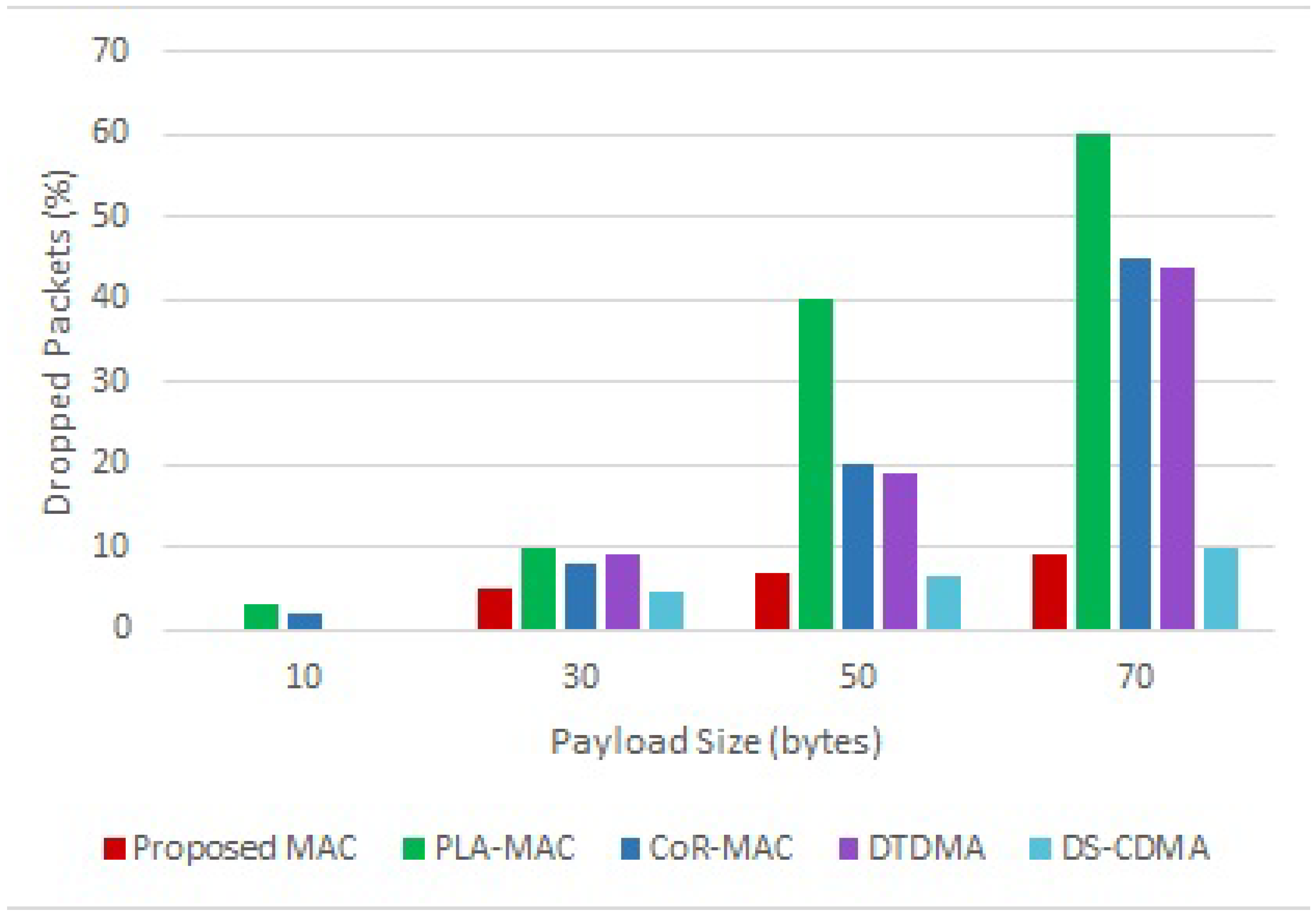
- Percentage of Dropped Packets: it is the ratio of the number of packets that are dropped due to failed transmission to the total number of generated packets by the nodes. This metric allows to evaluate the reliability of the compared schemes and their ability to transmit packets successfully.
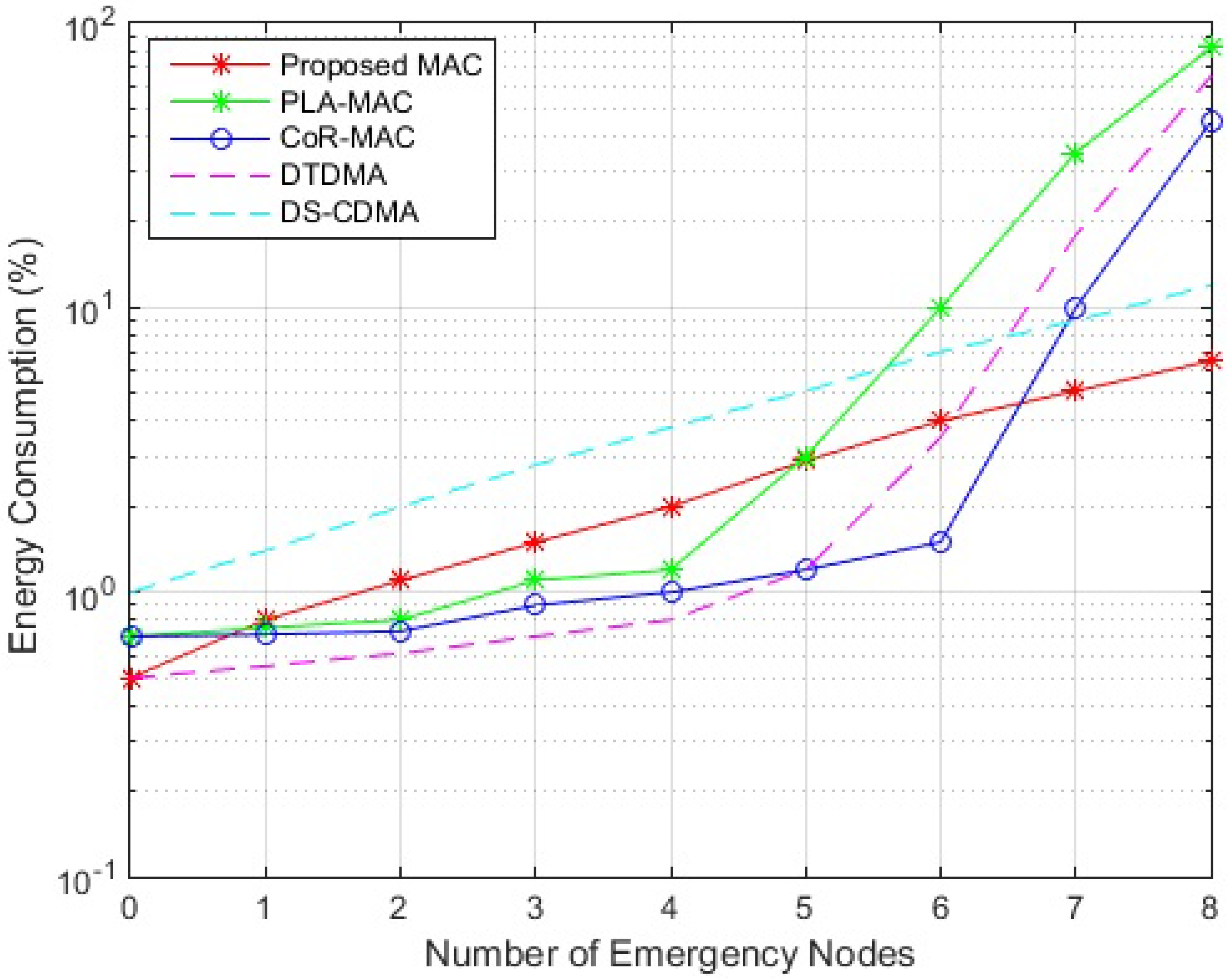
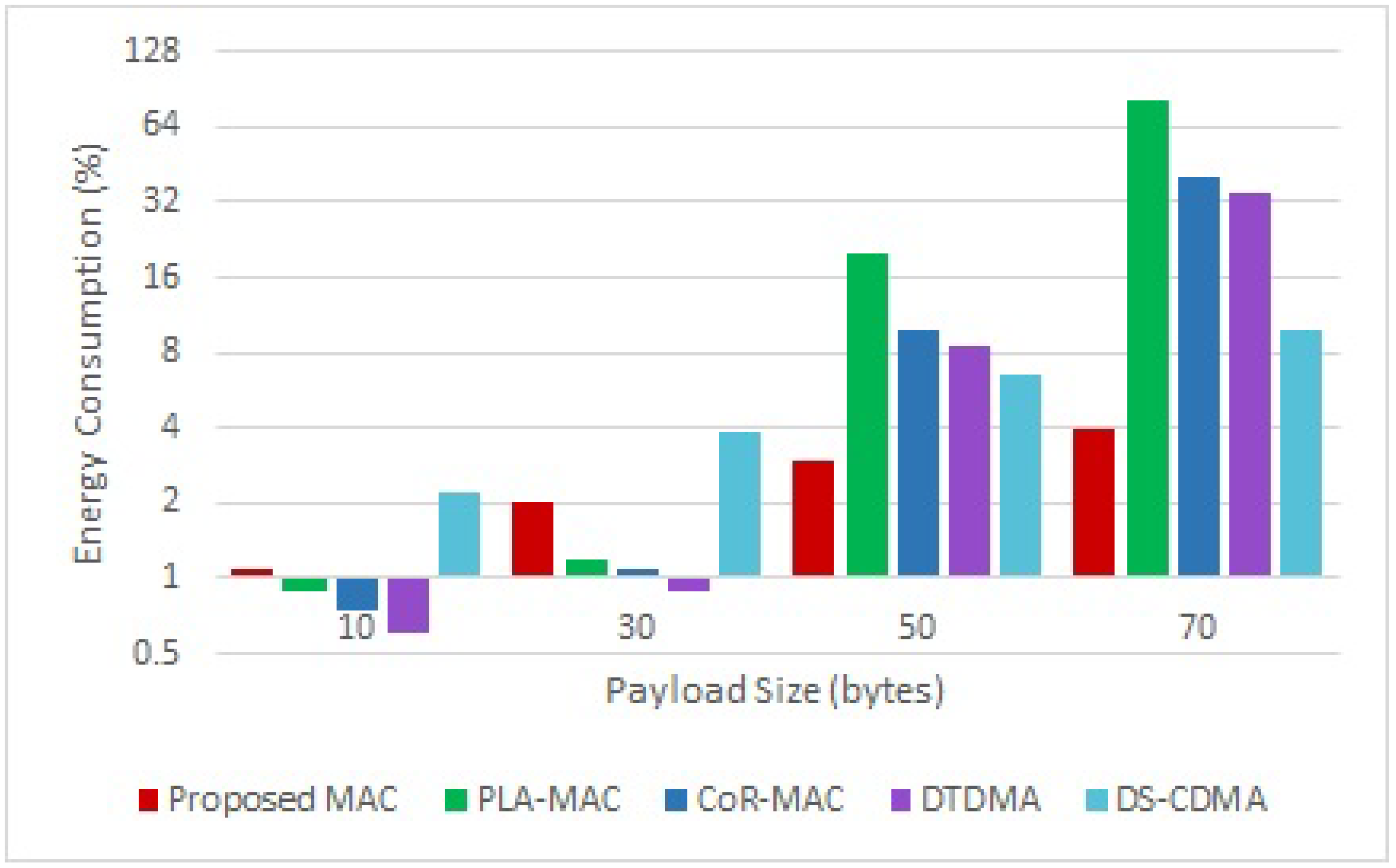
- Energy Consumption: it represents the percentage of energy consumed by each protocol with respect to the total energy consumed by the system to send the data. this metric is used to assess the energy efficiency o the compared protocols.
4.2. Simulation Parameters
4.3. Simulation Results and Discussion
4.3.1. Performance for Varying Number of Emergency Nodes
4.3.2. Performance for Varying Payload Size
5. Conclusions and Future Work
Author Contributions
Funding
Conflicts of Interest
References
- Boudargham, N.; Bou abdo, J.; Demerjian, J.; Guyeux, C. Exhaustive Study on Medical Sensors. In Proceedings of the 11th International Conference on Sensor Technologies and Applications (SENSORCOM), Rome, Italy, 10–14 September 2017. [Google Scholar]
- Boudargham, N.; Bou abdo, J.; Demerjian, J.; Guyeux, C.; Atechian, T. Efficient Cluster-Based Routing Algorithm for Body Sensor Networks. In Proceedings of the 2018 IEEE Middle East & North Africa COMMunications Conference (MENACOMM), Jounieh, Lebanon, 18–20 April 2018. [Google Scholar]
- Boudargham, N.; Bou abdo, J.; Demerjian, J.; Guyeux, C.; Makhoul, A. Collaborative Body Sensor Networks: Taxonomy and Open Challenges. In Proceedings of the 2018 IEEE Middle East & North Africa COMMunications Conference (MENACOMM), Jounieh, Lebanon, 18–20 April 2018. [Google Scholar]
- Kamble, J.; Vidhate, A. Improved MAC protocol for emergency handling in WBAN. In Proceedings of the International Conference on Automatic Control and Dynamic Optimization Techniques (ICACDOT), Pune, India, 9–10 September 2016. [Google Scholar]
- Liu, B.; Yan, Z.; Chen, C.W. MAC protocol in wireless body area networks for E-health: Challenges and a context-aware design. IEEE Wirel. Commun. 2013, 20, 64–72. [Google Scholar]
- Salayma, M.; Al-Dubai, A.; Romdhani, I.; Nasser, Y. Reliability and Energy Efficiency Enhancement for Emergency-Aware Wireless Body Area Networks (WBAN). IEEE Trans. Green Commun. Netw. 2018, 804–816. [Google Scholar] [CrossRef]
- Masud, F.; Abdullah, A.H.; Abdul-Salaam, G.; Ullah, F. Traffic Adaptive MAC Protocols in Wireless Body Area Networks. Wirel. Commun. Mob. Comput. 2017, 2017, 8267162. [Google Scholar] [CrossRef]
- Salayma, M.; Al-Dubai, A.; Romdhani, I. Reliability and energy efficiency enhancement in wireless body area networks for e-health. In Proceedings of the 19th Conference of Open Innovations Association (FRUCT), Jyvaskyla, Finland, 7–11 November 2016. [Google Scholar]
- Rezvani, S.; Ali Ghorashi, S. A Novel WBAN MAC protocol with Improved Energy Consumption and Data Rate. KSII Trans. Int. Inf. Syst. 2012, 6, 2302–2322. [Google Scholar] [CrossRef]
- Deepshikha; Chauhan, S. Succinct Review on MAC Protocols for Wireless Body Area Networks. Int. J. Grid Distrib. Comput. 2018, 11, 65–79. [Google Scholar]
- Yoon, J.S.; Ahn, G.S.; Joo, S.S.; Lee, M.J. PNP-MAC: Preemptive slot allocation and non-preemptive transmission for providing QoS in body area networks. In Proceedings of the 7th IEEE Consumer Communications and Networking Conference (CCNC), Las Vegas, NV, USA, 9–12 January 2010. [Google Scholar]
- Li, C.; Hao, B.; Zhang, K.; Liu, Y.; Li, J. A novel medium access control protocol with low delay and traffic adaptivity for wireless body area networks. J. Med. Syst. 2011, 35, 1265–1275. [Google Scholar] [CrossRef] [PubMed]
- Anjum, I.; Alam, N.; Razzaque, M.A.; Mehedi Hassan, M.; Alamri, A. Traffic priority and load adaptive MAC protocol for QoS provisioning in body sensor networks. Int. J. Distrib. Sens. Netw. 2013, 9, 205192. [Google Scholar] [CrossRef]
- Liu, B.; Yan, Z.; Chen, C.W. CA-MAC: A hybrid context-aware MAC protocol for wireless body area networks. In Proceedings of the 2011 IEEE 13th IEEE International Conference on e-Health Networking Applications and Services (Healthcom), Columbia, MO, USA, 13–15 June 2011. [Google Scholar]
- Yu, J.; Park, L.; Park, J.; Cho, S.; Keum, C. Cor-MAC: Contention over reservation MAC protocol for time-critical services in wireless body area sensor networks. Sens. J. 2016, 16, 656. [Google Scholar] [CrossRef] [PubMed]
- Ali, K.A.; Sarker, J.H.; Mouftah, H.T. Urgency-based MAC protocol for wireless sensor body area networks. In Proceedings of the 2010 IEEE International Conference on Communications Workshops (ICC), Capetown, South Africa, 23–27 May 2010. [Google Scholar]
- Zhang, Y.; Dolmans, G. A new priority-guaranteed MAC protocol for emerging body area networks. In Proceedings of the 2009 IEEE 5th International Conference on Wireless and Mobile Communications, Cannes, France, 23–29 August 2009. [Google Scholar]
- Boudargham, N.; Bou abdo, J.; Demerjian, J.; Guyeux, C.; Makhoul, A. Investigating Low Level Protocols for Wireless Body Sensor Networks. In Proceedings of the 2016 IEEE 13th ACS/IEEE International Conference on Computer Systems and Applications, Agadir, Morocco, 29 November–2 December 2016. [Google Scholar]
- Kwak, K.S.; Ullah, S. A traffic-adaptive MAC protocol for WBAN. In Proceedings of the 2010 IEEE GLOBECOM Workshops (GC Wkshps), Miami, FL, USA, 6–10 December 2010; pp. 1286–1289. [Google Scholar]
- Alam, M.M.; Berder, O.; Menard, D.; Sentieys, O. TAD-MAC: Traffic-aware dynamic MAC protocol for wireless body area sensor networks. IEEE J. Emerg. Sel. Top. Circuits Syst. 2012, 2, 109–119. [Google Scholar] [CrossRef]
- Alam, M.M.; Hamida, E.B.; Berder, O.; Menard, D.; Sentieys, O. A heuristic self-adaptive medium access control for resource-constrained WBAN Systems. IEEE Access 2016, 4, 1287–1300. [Google Scholar] [CrossRef]
- Javaid, N.; Israr, I.; Khan, M.A.; Javaid, A.; Bouk, S.H.; Khan, Z.A. Analyzing medium access techniques in wireless body area networks. arXiv, 2013; arXiv:1304.1047. [Google Scholar] [CrossRef]
- Pourmohseni, B.; Eshghi, M. Reliable energy-efficient dynamic-TDMA MAC protocol for wireless body area networks. Int. J. Appl. Innov. Eng. Manag. 2013, 2, 393–402. [Google Scholar]
- Rahim, A.; Javaid, N.; Aslam, M.; Rahman, Z.; Qasim, U.; Khan, Z. A comprehensive survey of MAC protocols for wireless body area networks. In Proceedings of the 7th International Conference on Broadband, Wireless Computing, Communication and Applications (BWCCA), Victoria, BC, Canada, 12–14 November 2012. [Google Scholar]
- Tawfiq, A.; Abouei, J.; Plataniotis, K.N. Cyclic orthogonal codes in CDMA-based asynchronous wireless body area networks. In Proceedings of the 2012 IEEE International Conference on Acoustics, Speech and Signal Processing (ICASSP), Kyoto, Japan, 25–30 March 2012; pp. 1593–1596. [Google Scholar]
- Ma, L.; Leung, H.; Li, D. Hybrid tdma/cdma mac protocol for wireless sensor networks. J. Netw. 2014, 9, 2665. [Google Scholar] [CrossRef]
- Ettus, M.N. Power Consumption and Latency as a Function of Path Loss and Routing in Multihop SS-CDMA Wireless Networks. 1997. Available online: http://citeseerx.ist.psu.edu/viewdoc/summary?doi=10.1.1.110.8660 (accessed on 16 August 2018).
- Zhou, J.; Guo, A.; T Nguyen, H.; Su, S. Intelligent management of multiple access schemes in wireless body area network. J. Netw. 2015. [Google Scholar] [CrossRef]
- Nordic Semiconductor. Single Chip 2.4 GHz Transceiver, Rev. 2.0. 2007. Available online: https://www.nordicsemi.com/eng/Products/2.4GHz-RF/nRF24L01 (accessed on 8 June 2018).




| Parameter | Value |
|---|---|
| Number of Nodes | 16 |
| Topology Size | 2 m × 1 m |
| Topology Type | Star |
| Number of Nodes with Urgent Data | 0–8 |
| Packet Rate for Regular Traffic | 1–20 packets/s |
| Packet Rate for Emergency Traffic | 100 packets/s |
| Regular Traffic Model | CBR |
| Emergency Traffic Model | Poisson |
| Payload Size | 10, 30, 50, 70 Bytes |
| Slot Duration | 5 ms |
| Channel Rate | 250 Kbps |
© 2018 by the authors. Licensee MDPI, Basel, Switzerland. This article is an open access article distributed under the terms and conditions of the Creative Commons Attribution (CC BY) license (http://creativecommons.org/licenses/by/4.0/).
Share and Cite
Bou Dargham, N.; Makhoul, A.; Bou Abdo, J.; Demerjian, J.; Guyeux, C. Efficient Hybrid Emergency Aware MAC Protocol for Wireless Body Sensor Networks. Sensors 2018, 18, 3572. https://doi.org/10.3390/s18103572
Bou Dargham N, Makhoul A, Bou Abdo J, Demerjian J, Guyeux C. Efficient Hybrid Emergency Aware MAC Protocol for Wireless Body Sensor Networks. Sensors. 2018; 18(10):3572. https://doi.org/10.3390/s18103572
Chicago/Turabian StyleBou Dargham, Nadine, Abdallah Makhoul, Jacques Bou Abdo, Jacques Demerjian, and Christophe Guyeux. 2018. "Efficient Hybrid Emergency Aware MAC Protocol for Wireless Body Sensor Networks" Sensors 18, no. 10: 3572. https://doi.org/10.3390/s18103572
APA StyleBou Dargham, N., Makhoul, A., Bou Abdo, J., Demerjian, J., & Guyeux, C. (2018). Efficient Hybrid Emergency Aware MAC Protocol for Wireless Body Sensor Networks. Sensors, 18(10), 3572. https://doi.org/10.3390/s18103572