Article

Effects of Landscape Litter Compost Application on Soil Microbial Community and Co-Occurrence Network Structure

1
College of Forestry, Northeast Forestry University, Harbin 150040, China
2
Hebei Key Laboratory of Agroecological Safety, Hebei University of Environmental Engineering, Qinhuangdao 066102, China
*
Author to whom correspondence should be addressed.
These authors contributed equally to this work.
Diversity 2026, 18(9), 529; https://doi.org/10.3390/d18090529
Submission received: 21 July 2026 / Revised: 26 August 2026 / Accepted: 28 August 2026 / Published: 31 August 2026
(This article belongs to the Special Issue Microbial Diversity in Different Environments)

Abstract

The improvement in urban greening has led to the generation of large amounts of landscape litter, and determining how to efficiently utilize this organic waste has become an urgent issue. Composting, as a pollution-free method of organic waste treatment, can improve the soil environment. However, there remains a lack of systematic research on the effects of compost on soil microbial communities. This study was conducted at the Tuanlin Forestry Station in Qinhuangdao City. By applying different levels of compost and combining measurements of soil properties with high-throughput sequencing, the study investigated the effects of compost application on soil microbial community. Compost application increased available phosphorus, available potassium, and microbial biomass, while simultaneously lowering pH. Compost application caused significant changes in β-diversity, altering the composition of the microbial community. Redundancy analysis indicated that available phosphorus and pH were the primary factors driving changes in microbial communities. In addition, compost application increased the number of nodes in the co-occurrence network and the average degree of connectivity. Overall, compost drives changes in microbial communities by modulating the soil environment. This study provides a theoretical basis for the resource utilization of landscape litter and the management of compost application.

1. Introduction

While improvements in urban greening and the continued expansion of landscaped green spaces have helped improve the urban ecological environment, they have also led to the generation of large amounts of urban landscape litter and plant waste. This landscape litter includes dead branches, fallen leaves, and pruning clippings [1], and its main components include cellulose, lignin, and organic matter. In forest ecosystems, microbial communities drive material cycling and energy flow by decomposing litter [2,3]. However, in urban ecosystems, litter in urban landscapes tends to accumulate in large quantities over a short period of time, exhibiting distinct seasonal and cumulative patterns. This does not align with the long-term decomposition processes found in forest ecosystems, and excessive accumulation may place a burden on the environment; therefore, it must be managed through artificial means. Composting offers a new approach and method for managing organic waste such as landscape litter. At its core, composting is a biotechnological process that relies on microorganisms to break down and transform organic matter under specific environmental conditions; the resulting stable humus improves soil quality and promotes plant growth [4,5]. In the past, strategies for managing landscape litter have primarily involved incineration and landfilling. These methods not only waste resources and are costly, but also cause a range of environmental problems, including air and soil pollution and land use [6]. Soil is an important natural resource on Earth. Composed of various components such as minerals, organic matter, and soil organisms, it serves as the material foundation for maintaining ecosystem functions and ensuring human survival and development [7]. Soil formation is a slow process, and soil is difficult to regenerate; therefore, maintaining soil health is of great importance. In agricultural and forestry production, high crop yields generally depend on the extensive use of chemical fertilizers [8]. However, the use of chemical fertilizers and pesticides has had a negative impact on soil health, and soil contamination is very severe in many areas [9]. Research findings have shown that, although both chemical fertilizers and composted organic waste can increase soil nitrogen and phosphorus levels, compost demonstrates more significant advantages than chemical fertilizers in improving soil nutrient status and enhancing soil quality. The application of composted organic waste significantly improves soil health; for example, it increases soil organic matter (SOM) and nutrient content [6]. SOM primarily originates from plants, animals, and external inputs, and its content serves as an important indicator for evaluating soil quality and health [9,10].
The application of compost not only alters the physicochemical properties of soil but also further influences the structure and ecological functions of soil microbial communities by regulating resource availability [11]. Soil microbial communities are an essential component of soil ecological function; they play a critical role in the decomposition and cycling of organic matter, the mineralization of soil nutrients, and energy flow, and they serve as key indicators of ecosystem health [12,13]. In particular, bacteria play a crucial role in the energy and nutrient cycles of ecosystems by actively participating in processes such as the decomposition of SOM and the release of nutrients [14,15]. Fungi play an important role in breaking down complex organic matter and promoting the formation and structural stability of soil aggregates. Microorganisms require organic matter and nutrients to support their metabolic activities. Various soil properties can influence microbial communities, and the introduction of exogenous substances such as compost or chemical fertilizers inevitably alters the environment in which soil microorganisms utilize resources, thereby affecting the composition of soil microbial communities [16,17]. Related studies have shown that different methods of exogenous nutrient input have varying effects on soil microbial communities. The heavy use of chemical fertilizers reduces the α-diversity of microbial communities and alters their composition, leading to greater homogeneity [18,19], whereas the addition of moderate amounts of compost increases microbial biomass and has a positive effect on maintaining and enhancing microbial diversity [20]. The ecological effects of compost depend primarily on its biochemical properties; however, organic waste from different sources is highly heterogeneous and has a complex chemical composition, resulting in significant differences in the nutrient content and biological activity of the resulting compost [21]. At the same time, the effects of compost application are jointly influenced by factors such as the type of raw materials, application rate, and degree of decomposition. Excessive application of compost may inhibit the growth and reproduction of soil bacterial communities [11], significantly alter microbial community structure, and reduce microbial community similarity [6].
Microbial co-occurrence networks are complex structures formed by microbial groups through interactions such as competition and mutualism, and they reflect the dynamic changes in microbial community structure in response to environmental changes [22]. Changes in topological parameters—such as the number of nodes, edges, average degree, and modularity—can be associated with microbial population stability and resilience [23,24]. Therefore, co-occurrence network analysis is an important method for analyzing the structure and functional relationships of microbial communities, as well as an effective way to illustrate species relationships and ecological connections [25,26]. Fertilizer application also affects the co-occurrence networks of soil microbial communities. Studies have shown that the application of multi-source manure compost and chemical fertilizers can significantly alter microbial co-occurrence networks: specifically, manure-based compost increases the number of nodes, the number of edges, the average degree, and the network density of the soil microbial co-occurrence network, while reducing the average path length. This promotes network complexity and enhances ecological stability [20]. Long-term application of chemical fertilizers increases the path length of co-occurrence networks, which has a negative impact on these networks and reduces the functional redundancy of microbial co-occurrence networks [27]. Existing studies have primarily focused on the responses of soil microbial communities and co-occurrence network structures following the application of chemical fertilizers and manure-based compost, whereas research on changes in soil microbial community structure and the process of ecological network restructuring following the application of landscape litter compost is relatively scarce.
Therefore, this study selected the Tuanlin Forestry Station in Qinhuangdao City, Hebei Province, located in North China, as the study area. Naturally fallen landscape litter was collected from within the forestry station and subjected to composting under controlled conditions. Based on the baseline soil nutrient levels in the experimental plots and the recommended application ranges for organic fertilizers in landscaping, different compost application rates were designed, and compost at these various rates was applied to the experimental plots at the forestry station. Soil sampling was then conducted in July, August, and October—during the growing season—to study the soil microbial communities in the experimental plots at the forestry station. Accordingly, this study hypothesizes that different compost application rates will significantly affect soil microbial community diversity and structure, while altering microbial co-occurrence network characteristics. The findings provide a theoretical basis for the scientific application and resource utilization of landscape litter compost.

2. Materials and Methods

2.1. Experimental Area

This study selected the Tuanlin Forestry Station in Qinhuangdao City, Hebei Province, as the study area. The Tuanlin Forestry Station is located along the Changli section of the Bohai Sea coast (119°11′–119°21′ E, 39°23′–39°44′ N). It lies within a warm-temperate, semi-humid, monsoon-influenced continental climate zone and exhibits the typical characteristics of a coastal shelterbelt ecosystem. In 1993, it was approved for development as the provincial-level Golden Coast Forest Park. The region has an average annual temperature of approximately 12 °C, with average summer temperatures ranging from 22 to 25 °C. At the same time, long-term ecological development and landscape maintenance have resulted in high vegetation coverage and a rich variety of landscape plant resources in the area. The vegetation of Tuanlin Forestry Station is primarily composed of artificial shelterbelts. The main tree species planted in the forest area include Robinia pseudoacacia L. and Populus przewalskii Maxim., among others. Long-term vegetation restoration and managed forestry practices have resulted in high vegetation cover in this area and generated large amounts of landscape litter and understory plant litter, providing an excellent experimental site for research on litter composting and its ecological effects on soil.

2.2. Experimental Design and Sample Collection

This study collected landscape litter from the study area to use as compost feedstock. After collection, the litter underwent pretreatment and was composted under controlled conditions. During the composting process, the initial C/N ratio of the material was adjusted to 25:1, the moisture content was maintained between 60% and 70%, and a composting microbial agent was inoculated at a rate of 1% of the dry matter weight. After being mixed thoroughly, the compost pile was built. The temperature was allowed to rise naturally through microbial metabolism, and the pile was turned when the temperature dropped to promote thorough decomposition. Composting was completed in about one month. Subsequently, different compost application rates were designed based on the baseline soil nutrient levels in the experimental fields and the recommended application ranges for landscape organic fertilizers. Using the mass ratio method, four compost application gradients were established, corresponding to application rates of 1500 (TB), 4500 (TC), 7500 (TD), and 15,000 (TE) kg ha−1, with a no-compost treatment (TA) serving as the control. Each treatment was replicated in three experimental plots (n = 3), with each plot measuring 5 m × 5 m. The plots were spaced at least 10 m apart to avoid interference between plots. Following compost application, soil samples were collected every one and a half months starting in early July 2025, specifically in early July, mid-August, and early October. Five sampling locations were selected in the experimental field—one each in the northeast, southeast, northwest, southwest, and center. Surface rocks and debris were removed from each sampling point, and soil samples were collected using a soil auger. The soil samples from the five locations were then thoroughly mixed to form a single replicate. After collection, the samples were preserved with dry ice and promptly transported back to the laboratory. Fresh soil samples used for determining parameters such as available nitrogen and microbial carbon and nitrogen were stored at −20 degrees Celsius and analyzed promptly, while soil samples used for other physicochemical analyses were air-dried before storage; soil samples intended for microbial sequencing and analysis were stored in a −80 °C freezer.

2.3. Determination of Soil Physicochemical Properties

Some of the collected soil samples were used to determine soil physicochemical properties. First, the soil pH was measured using the potentiometric method. Air-dried soil and deionized water were mixed in a 1:2.5 ratio; after shaking and allowing the mixture to settle, the pH was measured using a pH meter. After extracting available phosphorus (AP) from the soil using a sodium bicarbonate solution, the AP content was determined using the molybdenum–antimony colorimetric method. Soil available potassium (AK) was extracted using an ammonium acetate solution, and the exchangeable potassium content was determined using a flame photometer. SOM was determined using the external heating oxidation method with potassium dichromate. Organic carbon in the soil was oxidized using a potassium dichromate–sulfuric acid system, and the SOM content was calculated based on the amount of oxidizing agent consumed. Soil microbial biomass carbon (MBC) and nitrogen (MBN) were determined using a C/N analyzer (MultiN/C3100, Analytik Jena, Jena, Germany) after chloroform fumigation–potassium sulfate extraction. Total nitrogen (TN) and total phosphorus (TP) in the soil were extracted using the sulfuric acid digestion method, and the extract was analyzed using flow analysis (AA3, Bran-Luebbe, Hamburg, Germany). Inorganic nitrogen (NH4+, NO3) in the soil was extracted using potassium chloride; after filtration, the extract was analyzed using a flow analyzer.

2.4. DNA Extraction and Amplicon Sequencing

A portion of the soil samples was used for microbial high-throughput sequencing. Soil DNA was extracted using the E.Z.N.A. DNA Kit (Omega Bio-tek, Norcross, GA, USA). After extraction, the DNA quality was assessed by electrophoresis, and DNA meeting the standards was subjected to polymerase chain reaction (PCR) amplification. The 16S rRNA gene of bacteria was amplified using the primers 338F (5′-barcode-ACTCCTACGGGAGGCAGCA-3′) and 806R (5′-barcode-GGACTACHVGGGTWTCTAAT-3′) to amplify the V3-V4 region. The fungal ITS region was amplified using the ITS1F (5′-CTTGGTCATTTAGAGGAAGTAA-3′) and ITS2R (5′-GCTGCGTTCTTCATCGATGC-3′) primers. Amplification products were purified using Agencourt AMPure XP magnetic beads (Omega Bio-tek, Norcross, GA, USA), and the concentration of the library was then measured. Based on the results from the Agilent 2100 Bioanalyzer (Agilent Technologies, Santa Clara, CA, USA), qualified library fragments were selected for sequencing. Adapter sequences were removed from the raw sequencing data using cutadapt v2.6, and low-complexity sequences were filtered out through quality control to obtain “Clean Data.” FLASH software (v1.2.11) was used to assemble paired-end sequencing reads to generate tags. Using USEARCH v11.0.667, OTU clustering analysis was performed based on 97% sequence similarity to generate OTU representative sequences. The tags were then mapped back to the OTU representative sequences to obtain OTU abundance tables for each sample. The RDP Classifier was used to align and annotate OTU sequences against a database, with a confidence threshold set at 0.6; finally, unannotated OTUs were removed, and valid OTUs were retained for subsequent analysis.

2.5. Data Analysis

Based on OTU data from the microbial community, we examined the number of OTUs to calculate the ACE index and used the vegan package in R to calculate the Shannon index of the microbial community. Principal Coordinate Analysis (PCoA) was performed using the Bray–Curtis distance to illustrate microbial community β-diversity [28]. OTU data were aggregated at the phylum level, and the relative abundances of bacterial and fungal phyla were calculated. Dominant and rare microbial species were identified based on relative abundance. A redundancy analysis (RDA) model was developed using microbial community abundance data at the OTU level as the response variable and soil physicochemical parameters as explanatory variables to analyze the relationship between environmental factors and microbial community structure. To ensure the comparability of the networks across different treatment groups, all samples underwent a consistent data preprocessing and network construction workflow. We calculated the relative abundance of OTUs, retaining only those that appear in at least two samples and have an average relative abundance greater than 0.05%. Based on Spearman’s correlation analysis, significant correlations were identified using the thresholds |r| > 0.80 and p < 0.05 to construct a microbial co-occurrence network. Remove isolated nodes with no connections. Each analysis used the same OTU filtering criteria, correlation analysis methods, and network construction parameters to ensure the comparability of network characteristics [29]. It should be noted that co-occurrence networks reflect statistical associations among taxa, rather than direct ecological interactions. The microbial co-occurrence network was constructed using the igraph software package, and relevant network topological metrics were calculated. Visual analysis of the network structure was performed using Gephi 0.10.0 [30] to reveal potential associations among bacterial and fungal communities under different compost application treatments. A two-way analysis of variance was used to examine the effects of compost treatment, sampling time, and their interaction on changes in soil physicochemical properties. Multiple comparisons were performed using Tukey’s HSD test, with a significance level of p < 0.05. The effects of compost application treatments and sampling time on changes in bacterial and fungal community structures were assessed using permutational multivariate analysis of variance based on Bray–Curtis dissimilarity. Additionally, permutation tests were used to evaluate the significance of the RDA model and the explanatory power of soil physicochemical parameters for microbial community variation. The visualization of the figures and charts was performed using the ggplot2 package, and statistical analysis of the relevant data was conducted in R (Version 4.5.3).

3. Results

3.1. Changes in Soil Physicochemical Properties Following Compost Application

The application of landscape litter compost significantly altered certain physicochemical properties of the soil. Compared with the control group that received no compost, soil pH showed a decreasing trend as the amount of compost applied increased; specifically, in July and October, the pH in the TC, TD, and TE treatment groups was significantly lower than that in the control group (p < 0.05, Table S1). At the same time, compost application promoted the accumulation of available nutrients in the soil. Following compost application, AP and AK levels showed an upward trend. In October, the AP and AK contents in the TD and TE treatment groups were higher and significantly greater than those in the other treatment groups and the control group (p < 0.05, Table S1). The effect of compost application on SOM was primarily evident in the later stages of the sampling period. In July, there were minimal differences in SOM content among the treatment groups, but SOM content increased in August and October. Following compost application, TN and TP levels in the soil showed an upward trend; in August, TN and TP levels in the TE treatment group were significantly higher than those in the other treatments. In contrast, compost application had a weaker effect on inorganic nitrogen. In July and October, the differences in NH4+ and NO3 concentrations among the treatment groups were not statistically significant. Compost application had a significant effect on soil microbial biomass. In August, the MBC and MBN contents in the TE treatment group were significantly higher than those in the control group and other treatment groups (p < 0.05, Table S1). In contrast, although MBC in the other compost application treatments showed an increasing trend, the increase was not statistically significant. No significant differences in MBN content were observed among the different compost application treatments. Two-way analysis of variance indicated that compost application significantly affected all soil physicochemical properties except NH4+, and the interaction between sampling time and compost application also significantly affected all soil physicochemical parameters except for NH4+ (p < 0.05, Table S2).

3.2. Changes in Microbial Community Diversity Following Compost Application

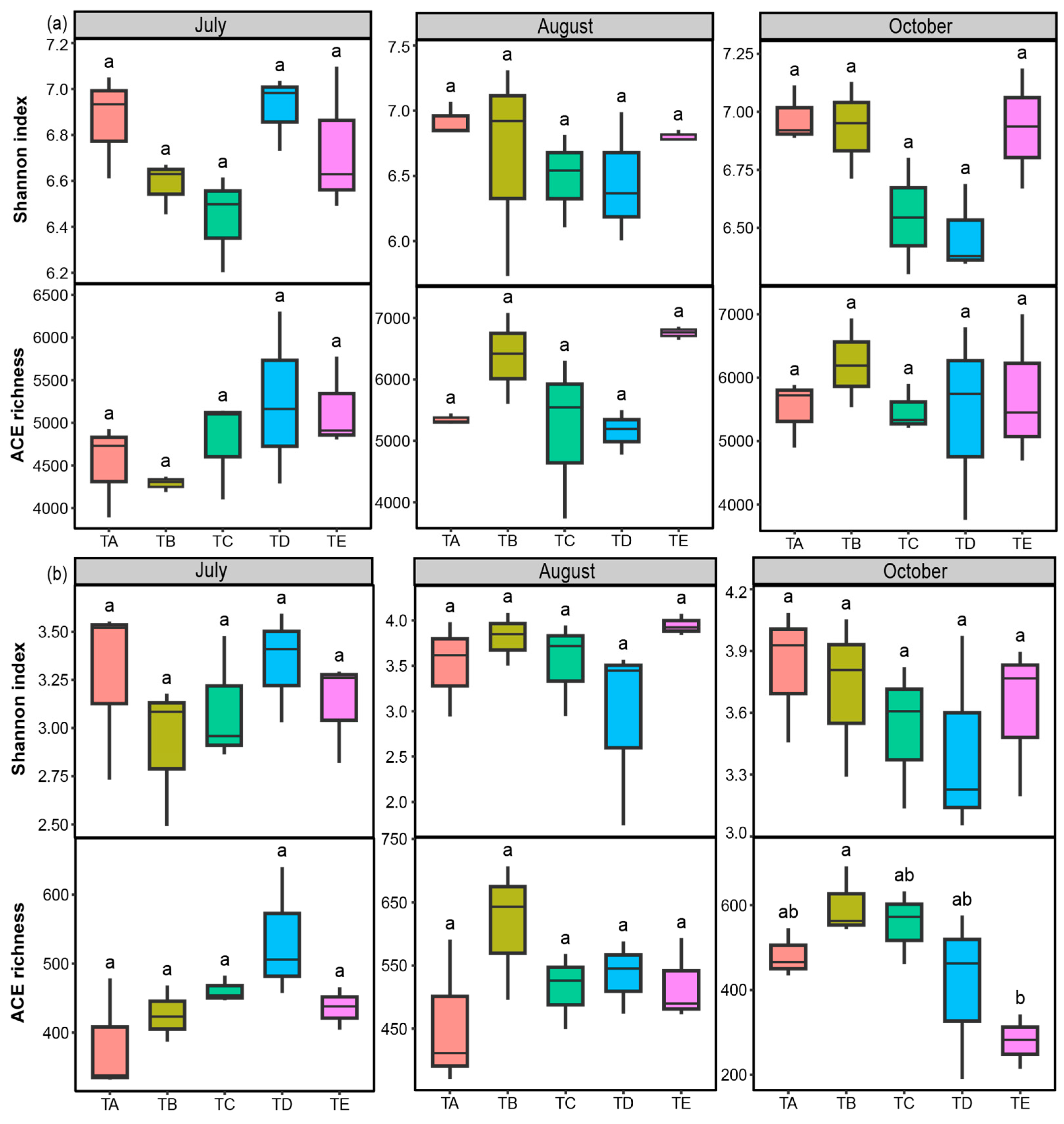
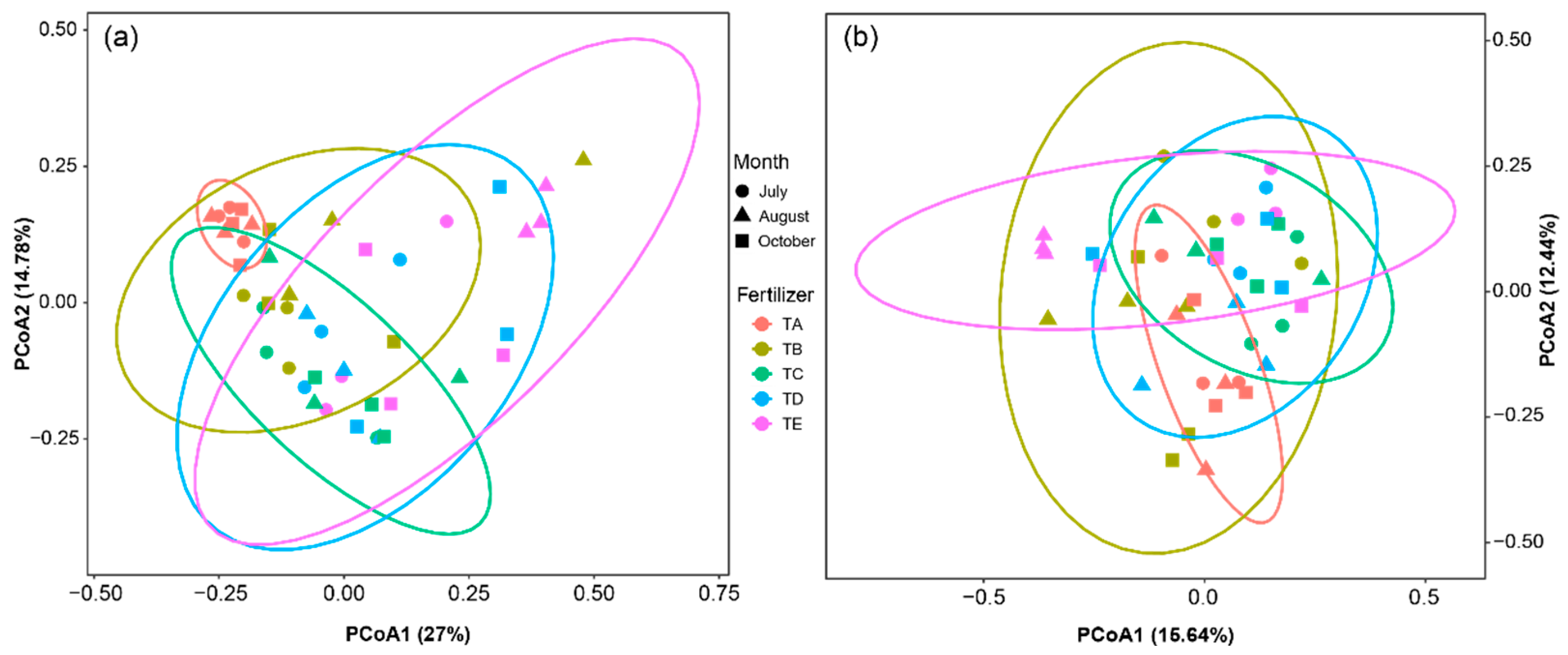
Changes in the α-diversity of bacterial communities were not significant; the Shannon index and ACE index remained relatively stable across different compost application treatments, showing a weak response to treatment. No significant differences were observed in the Shannon index and ACE index of bacterial communities among the different treatments, and all treatments fell within the same significance level. The Shannon index of the fungal community did not show significant differences among the different compost application treatments; however, the ACE index of the fungal community exhibited a certain degree of time dependence in response to compost application. In July and August, there were no significant differences among the treatments, but by October, significant differentiation emerged among the treatments, with the ACE index in the TE treatment group showing a significant decrease (p < 0.05, Figure 1). PCoA indicated that compost application significantly altered the composition and structure of the microbial community. Bacterial community samples from the control group exhibited high clustering in the ordination space, whereas after compost application, bacterial community samples from the TB-TE group showed a more pronounced separation, and the sample groups at different compost levels shifted. The β-diversity of the fungal community also exhibited a similar trend. Fungal community data points from the control group were primarily concentrated within a smaller spatial range, whereas samples from the different compost application treatments deviated from the control group, forming relatively distinct distribution regions (Figure 2). Permutational multivariate analysis of variance further confirmed that both month and compost treatment significantly influenced the structure of bacterial and fungal communities (p < 0.05, Table 1); furthermore, the compost treatment explained a higher proportion of the variation in both bacterial and fungal communities than the month factor.

3.3. Changes in Microbial Community Structure Following Compost Application

The rank-abundance curves showed that bacterial and fungal communities in the control group and the various compost application treatments exhibited a typical long-tail distribution, with a small number of dominant microbial taxa having high relative abundances, while a large number of rare taxa had low relative abundances; this distribution pattern was even more pronounced in fungal communities. In the bacterial community, the relative abundances of dominant and rare species increased following compost application, with the most pronounced increases observed in the TC and TD treatment groups. In the fungal community, the relative abundances of dominant species did not fluctuate significantly before and after compost application, while those of rare species showed an upward trend (Figure S1). The phylum-level stacked bar chart of microorganisms shows that the bacterial community consists of phyla such as Pseudomonadota, Actinomycetota, Acidobacteriota, and Bacillota. Among these, Pseudomonadota, as the dominant phylum, showed little change after compost application. In contrast to the control group, the relative abundance of the Actinomycetota phylum decreased after compost addition, while that of the Bacillota phylum increased. The fungal community consisted primarily of two dominant phyla, Ascomycota and Basidiomycota, which together accounted for the vast majority of the fungal community’s relative abundance. At the same time, following the application of compost, the relative abundance of Ascomycota showed an upward trend, while that of Basidiomycota showed a downward trend (Figure S2). Venn diagrams showed that microbial communities across different compost application treatments shared a large number of OTUs, while each treatment also possessed a certain number of unique OTUs. In the bacterial community, the proportion of shared OTUs among the treatments was relatively high. The number of treatment-specific OTUs in the composting treatments was generally higher than in the control treatment. In the fungal community, a similarly high proportion of shared OTUs was observed, but the number of treatment-specific OTUs was lower than in the bacterial community; however, the number of treatment-specific OTUs in the composting treatments was higher than in the control group (Figure S3).

3.4. Relationship Between Microbial Community Structure and Soil Environmental Factors Following Compost Application

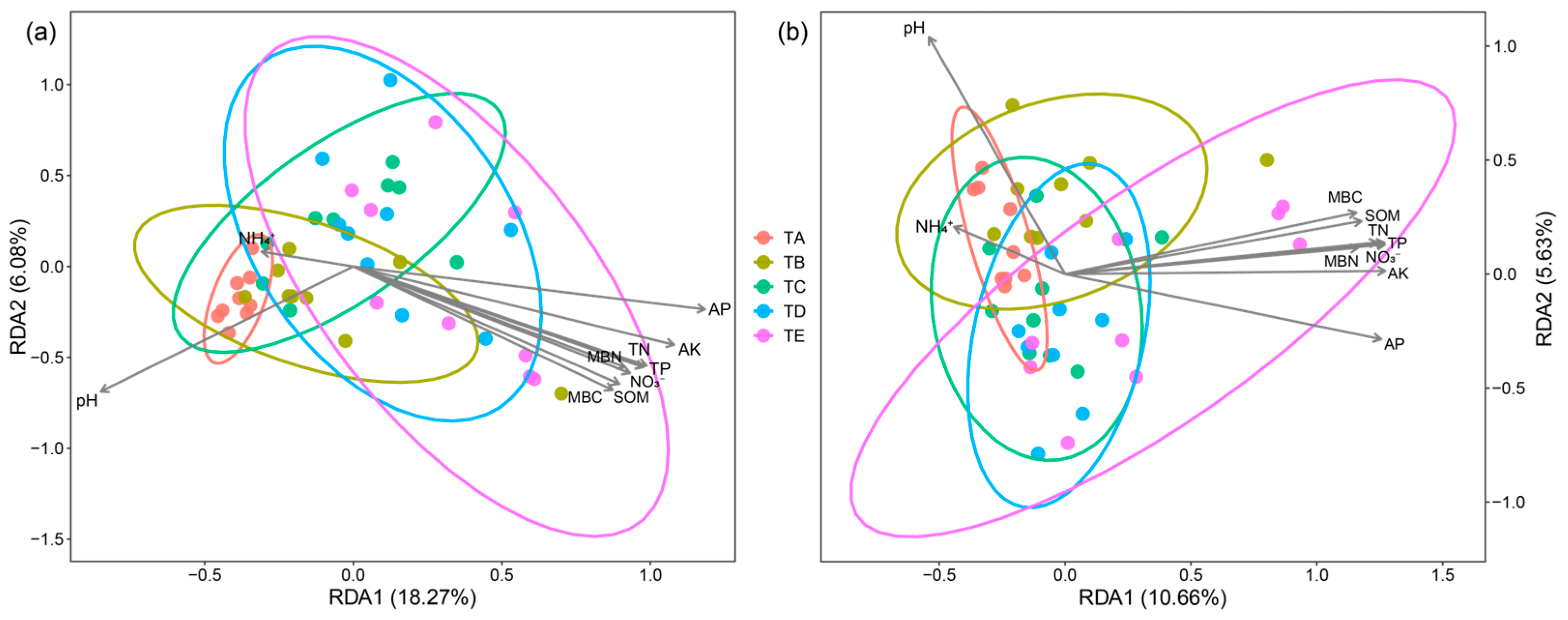
RDA demonstrated the relationship between soil environmental factors and soil microbial communities following compost application; the direction and length of the arrows representing environmental factors indicate that different environmental factors play different roles in explaining changes in microbial community structure. In the bacterial community, TP, SOM, AK, and AP were primarily distributed along the positive direction of the RDA1 axis and showed a positive correlation with changes in bacterial community structure. In contrast, pH and NH4+ were primarily distributed along the negative direction of the RDA1 axis and exhibited an inverse relationship with the aforementioned nutrient factors (Figure 3). An analysis of the explanatory power of environmental factors revealed that pH and AP were the primary environmental factors influencing changes in bacterial community structure, with AP explaining the highest proportion of variation in bacterial communities, followed by pH (Table 2). Similar to the bacterial community, SOM, TN, TP, AP, and AK were primarily aligned along the positive direction of the RDA1 axis and showed a positive correlation with changes in fungal community structure (Figure 3). AP and pH were the main factors significantly influencing fungal community structure. Among these, AP had the highest explanatory power (Table 2).

3.5. Effects of Compost Application on the Structural Characteristics of Microbial Co-Occurrence Networks

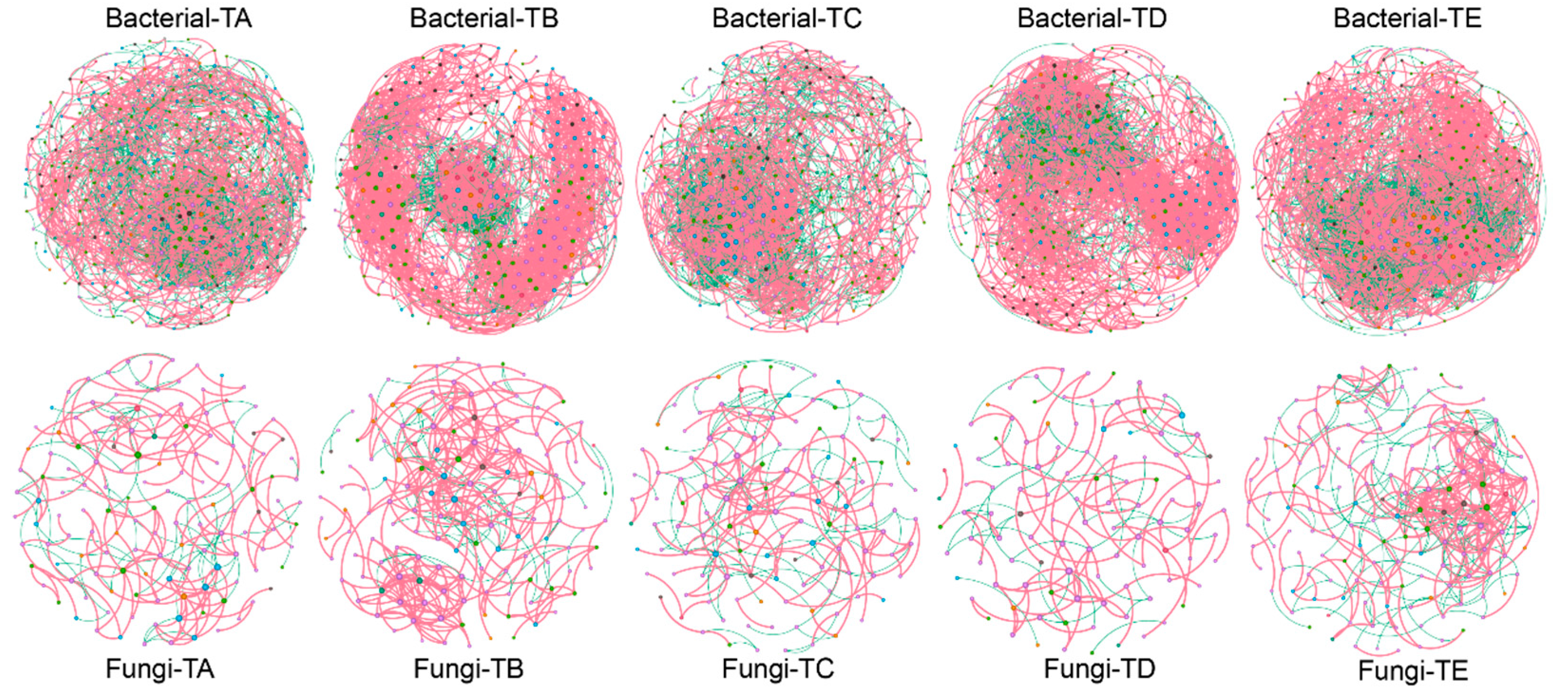
Based on Spearman’s correlation analysis, significant correlations were identified using a threshold of |r| > 0.80 and p < 0.05, and a microbial co-occurrence network was constructed to reveal potential associations within bacterial and fungal communities under different compost application treatments. Positive correlations accounted for a higher proportion of the connections in the microbial co-occurrence network, while negative correlations accounted for a lower proportion; the topological index of the bacterial co-occurrence network was more complex, whereas that of the fungal co-occurrence network was simpler (Figure 4). For bacterial communities, the number of nodes in the co-occurrence networks ranged from 311 to 363 across different treatments, the number of edges ranged from 2453 to 4691, and the average degree ranged from 14.80 to 28.34. Following compost application, the number of edges and average degree in bacterial co-occurrence networks increased, whereas the modularity index decreased. Among the treatments, the TE treatment exhibited the highest network connectivity, consisting of 331 nodes, 4691 edges, and an average degree of 28.34 (Table 3). For fungal communities, co-occurrence networks were relatively smaller, with the number of nodes ranging from 104 to 147, edges ranging from 130 to 391, and average degree ranging from 2.50 to 5.32 (Table 3). Among these, the TE treatment also exhibited the highest network connectivity, with 147 nodes, 391 edges, and an average degree of 5.32 (Table 3).

4. Discussion

4.1. Compost Application Drives Changes in Soil Microbial Community β-Diversity and Structure

Compost made from landscape litter—which enters the soil as an exogenous organic source—is rich in organic matter, humus, and other components, and it is likely to alter the soil microenvironment [5,7,31]. This study found that soil pH decreased following compost application, indicating that compost application led to slight soil acidification. At the same time, the levels of AP and AK significantly increased after compost application, as did SOM content; compost application may promote the accumulation of available nutrients and exert a synergistic regulatory effect on soil pH and nutrient status [1]. A slight decrease in soil pH can accelerate the decomposition of organic matter and nutrient cycling processes, promoting the colonization of acidophilic microorganisms. AP and AK are essential nutrient indicators for microorganisms to obtain energy and grow under stressful conditions, and organic matter provides a carbon source and energy for microbial communities [7,32,33]. Therefore, compost application improves the soil microenvironment, optimizes conditions for microbial survival and resource utilization, and provides a more suitable niche for microbial communities, thereby further influencing soil microbial communities [34,35,36]. First, this study found that compost application led to an increase in soil microbial biomass, with the MBC content in the high-compost-rate treatment group being significantly higher than that in the control group. Higher levels of compost application promoted the accumulation of microbial carbon in the soil. Other studies have also reached the same conclusion: the addition of compost increases microbial activity and raises microbial biomass [9,11]. Contrary to the first hypothesis, changes in the α-diversity of bacterial and fungal communities following compost application were not significant, indicating a weak response to the treatment. However, PCoA revealed that the β-diversity of microbial communities underwent significant changes after compost application; samples from the control group without compost application were highly homogeneous and exhibited a high degree of clustering. In contrast, after compost application, the bacterial community samples from the TB-TE treatment showed a more pronounced separation, indicating that compost application altered the β-diversity of the bacterial community, causing the originally stable microbial community to transition to a new community state [6]. Bacillota in bacterial communities and Ascomycota in fungal communities are capable of rapidly utilizing readily degradable organic matter and quickly acquiring resources, resulting in rapid growth [37]; therefore, their relative abundances increase when compost is introduced. Although compost application did not fundamentally alter the composition of dominant phyla in the bacterial and fungal communities, it did change the relative abundances of some dominant taxa and increased the number of unique OTUs, thereby driving community restructuring by altering the relative abundances of dominant and rare species within the microbial community [20]. The input of exogenous organic matter and nutrients has altered the soil resource environment, promoting microbial community differentiation and niche expansion. RDA indicated that nutrient factors such as SOM, TP, TN, and AK were strongly correlated with changes in microbial communities, suggesting that the increased supply of organic matter and nutrients from compost provided a new resource base for microorganisms, and that this nutrient supply was a key factor in regulating microbial activity [38,39]. AP and pH were significantly correlated with microbial community structure, indicating that phosphorus availability is a key factor driving changes in microbial community structure following compost application. Changes in soil pH resulting from compost application may further influence processes such as microbial metabolic activity and nutrient transformation and uptake [26,40]. At the same time, because different microbial groups had distinct optimal pH ranges, changes in pH may exert a selective effect on microbial community composition by intensifying interspecific competition and niche differentiation among microbial groups [41], thereby further influencing plant diversity and ecosystem multifunctionality [42,43]. In summary, compost application did not significantly alter the level of soil microbial community diversity; rather, by modifying soil nutrient availability and pH conditions, it drove adjustments in microbial community composition and dominant taxa, causing the community structure to gradually shift toward a state adapted to the input of exogenous organic matter. However, this study primarily analyzed the effects of compost application on soil microorganisms based on changes in microbial community structure and environmental factors; it has not yet provided an in-depth examination of changes in the functional characteristics and metabolic processes of different microbial groups. Additionally, this study does not include baseline soil data prior to compost application; therefore, it is not possible to directly evaluate the absolute magnitude of changes before and after compost application, which is one of the limitations of this study. Future research could combine metagenomic and metatranscriptomic approaches to further elucidate the effects of compost application on the functional responses of soil microorganisms and ecological processes.

4.2. Effects of Compost Application on the Co-Occurrence Network of Soil Microbial Communities

The relationships among species in soil microbial communities do not exist in isolation; rather, they form a highly interconnected network through complex interactions such as competition, predation, and mutualism [22,44]. Co-occurrence network patterns reveal the interactive or competitive relationships among microbial communities. They reflect changes in the stability and complexity of microbial communities in response to shifts in the external environment and serve as important tools for analyzing functional relationships within communities [23,45,46]. This study found that compost application not only significantly influenced the structural characteristics of the soil microbial community but also altered the patterns of interactions among microorganisms, thereby affecting the microbial co-occurrence network. Consistent with the hypothesis of this study, compared with the control group, compost application increased both the number of connections between nodes and the strength of associations among nodes in the co-occurrence network; the increase in the number of edges reflects enhanced network connectivity within the microbial community [47,48]. A higher average degree indicates increased correlations among microbial species, suggesting that the community is in a highly active state characterized by frequent material exchange. Following the addition of compost, changes in the co-occurrence network topology metrics indicate an increase in the complexity of the microbial network. Compared to networks with simple structures, complex networks typically exhibit stronger functional complementarity, accompanied by enhanced potential associations among microbial taxa [49]. A higher degree of network modularity may weaken the connections between microbial groups, leading to a more fragmented community structure and limiting potential interactions among groups. In this study, the addition of compost reduced the degree of network modularity, indicating that internal connections within the microbial community were strengthened and the network structure became more cohesive. At the same time, following the addition of compost, the proportion of positive correlations in the microbial co-occurrence network was relatively high, indicating that the microbial community was in a resource-rich environment where there was no intense competition among microbial taxa. Intra-community synergistic interactions were enhanced, and the community operated in a cooperative and resource-sharing dynamic. In this study, the increase in microbial co-occurrence network connectivity following compost application is consistent with previous findings, which indicate that microbial taxa can form closer associations through niche differentiation and synergistic resource utilization [50,51]. This may contribute to enhanced microbial community stability and potentially support soil ecosystem functioning. Previous studies have shown that the complexity of microbial co-occurrence networks is closely related to soil pH [52]. Microbial co-occurrence networks in slightly acidic environments typically exhibit higher complexity and stability, whereas those in neutral environments generally exhibit lower network complexity and stability [26,53]. It is worth noting that there is no direct correlation between microbial community diversity and the complexity of co-occurrence networks; higher microbial diversity does not necessarily lead to the formation of more complex network structures within microbial communities, as some microbial groups may be in a state of low activity and have not formed distinct ecological associations, whereas network complexity more accurately reflects the underlying association patterns and organizational structure characteristics within the community [54]. Consistent with this, compost application in this study did not significantly increase the α-diversity of the soil microbial community, further indicating that changes in community diversity are not the primary factor determining the complexity of the co-occurrence network.

5. Conclusions

Based on data on soil microbial communities from different composting treatments at the Tuanlin Forestry Station in Qinhuangdao City, Hebei Province, this study reveals the effects of compost application on soil physicochemical properties, microbial community structure, and co-occurrence network characteristics. The study findings indicated that the addition of landscape litter compost significantly altered soil environmental conditions, promoting increases in AP, AK, SOM, and microbial biomass, while simultaneously lowering soil pH and altering the soil resource environment on which microorganisms depend for survival. Compost application had a minor effect on microbial α-diversity but altered the composition of bacterial and fungal communities; compost application was a key factor driving these community changes. RDA indicated that soil nutrients and pH were the key environmental factors influencing changes in microbial community structure, suggesting that compost primarily promotes changes in microbial community structure by regulating soil nutrient availability and the acid-base environment. In addition, the application of compost increased the complexity of the microbial co-occurrence network, enhanced network connectivity, and reduced the level of modularity, indicating strengthened potential associations among microbial groups. Overall, landscape litter compost application improves the soil environment, drives changes in microbial community structure and network interaction patterns, and causes microbial communities to gradually adapt to the input of exogenous organic matter. This study provides a theoretical basis for the resource utilization of landscape litter and the management of compost application, and it reveals the ecological mechanisms by which compost application regulates the structure of soil microbial communities and their network interactions. However, as this study is primarily based on analyses of community composition and co-occurrence network characteristics, it has not yet provided an in-depth analysis of the responses of microbial functional genes and metabolic processes. In the future, techniques such as metagenomics and metatranscriptomics could be integrated to further elucidate the mechanisms by which compost application influences soil ecological functions.

Supplementary Materials

The following supporting information can be downloaded at https://www.mdpi.com/article/10.3390/d18090529/s1, Table S1. Differences in soil physicochemical properties across sampling months and compost application rates. Table S2. Two-way analysis of variance of the effects of sampling time and compost application rates on soil physicochemical properties. Figure S1. Rank-abundance curves of soil microbial community for different sampling months and compost application rates. a. Bacterial community; b. Fungal community. Figure S2. Relative abundances and differences in soil microbial community at the phylum level for different sampling months and compost application rates. a, b, c. Bacterial community; d, e, f. Fungal community. a and d, July; b and e, August; c and f, October. Figure S3. Venn diagrams of soil microbial community for different sampling months and compost application rates. a, b, c. Bacterial community; d, e, f. Fungal community. a and d, July; b and e, August; c and f, October.

Author Contributions

Methodology, L.M.; investigation, Y.S. and J.L.; writing—original draft, X.H. and H.Y.; supervision, L.M. All authors have read and agreed to the published version of the manuscript.

Funding

This study was funded by the following project: the Annual Institutional Project of Hebei University of Environmental Engineering (XJXM-ZD-2024002).

Institutional Review Board Statement

Not applicable.

Data Availability Statement

The original contributions presented in this study are included in the article. Further inquiries can be directed to the corresponding author.

Conflicts of Interest

The authors declare no conflicts of interest.

References

  1. Wang, D.; Li, S.Y.; Sun, X.Y.; Hao, D.; Li, Y.L.; Wang, H. Effects of Compost Application of Green Waste on Soil Properties: A Meta-Analysis. Sustainability 2024, 16, 8877. [Google Scholar] [CrossRef] [Scilit]
  2. Crowther, T.W.; van den Hoogen, J.; Wan, J.; Mayes, M.A.; Keiser, A.D.; Mo, L.; Averill, C.; Maynard, D.S. The Global Soil Community and Its Influence on Biogeochemistry. Science 2019, 365, eaav0550. [Google Scholar] [CrossRef] [Scilit]
  3. Lavallee, J.M.; Chomel, M.; Alvarez Segura, N.; de Castro, F.; Goodall, T.; Magilton, M.; Rhymes, J.M.; Delgado-Baquerizo, M.; Griffiths, R.I.; Baggs, E.M.; et al. Land Management Shapes Drought Responses of Dominant Soil Microbial Taxa across Grasslands. Nat. Commun. 2024, 15, 29. [Google Scholar] [CrossRef] [Scilit]
  4. Gajalakshmi, S.; Abbasi, S.A. Solid Waste Management by Composting: State of the Art. Crit. Rev. Environ. Sci. Technol. 2008, 38, 311–400. [Google Scholar] [CrossRef] [Scilit]
  5. Gao, X.T.; Tan, W.B.; Zhao, Y.; Wu, J.Q.; Sun, Q.H.; Qi, H.S.; Xie, X.Y.; Wei, Z.M. Diversity in the Mechanisms of Humin Formation during Composting with Different Materials. Environ. Sci. Technol. 2019, 53, 3653–3662. [Google Scholar] [CrossRef] [Scilit]
  6. Chen, X.D.; Wang, Y.; Guo, B.; Qiu, G.Y.; Liu, J.L.; Jin, J.W.; Zhang, J.B.; Li, H. Salinity Drives Bacterial Community Shift in Paddy Soils Applied with Perishable Waste Compost. Arch. Agron. Soil Sci. 2026, 72, 1–12. [Google Scholar] [CrossRef] [Scilit]
  7. Feng, X.J.; Sun, X.Y.; Zhou, W.J.; Zhang, W.; Che, F.W.; Li, S.Y. The Effects of Green Waste Compost on Soil N, P, K, and Organic Matter Fractions in Forestry Soils: Elemental Analysis Evaluation. RSC Adv. 2021, 11, 31983–31991. [Google Scholar] [CrossRef] [Scilit]
  8. Zhao, X.Y.; Wang, Y.; Cai, D.M.; Xi, B.D. Tailored Composting and Fertilization Strategies Can Inspire the Transformation of Agriculture for Sustainable Development. J. Agric. Food Chem. 2024, 72, 8874–8875. [Google Scholar] [CrossRef] [Scilit]
  9. Diacono, M.; Montemurro, F. Long-Term Effects of Organic Amendments on Soil Fertility. A Review. Agron. Sustain. Dev. 2010, 30, 401–422. [Google Scholar] [CrossRef] [Scilit]
  10. Fontaine, S.; Barot, S.; Barré, P.; Bdioui, N.; Mary, B.; Rumpel, C. Stability of Organic Carbon in Deep Soil Layers Controlled by Fresh Carbon Supply. Nature 2007, 450, 277–280. [Google Scholar] [CrossRef] [Scilit]
  11. Zhang, X.; Song, Y.; Yang, X.; Hu, C.; Wang, K. Regulation of Soil Enzyme Activity and Bacterial Communities by Food Waste Compost Application during Field Tobacco Cultivation Cycle. Appl. Soil Ecol. 2023, 192, 105016. [Google Scholar] [CrossRef] [Scilit]
  12. Delgado-Baquerizo, M.; Reich, P.B.; Trivedi, C.; Eldridge, D.J.; Abades, S.; Alfaro, F.D.; Bastida, F.; Berhe, A.A.; Cutler, N.A.; Gallardo, A.; et al. Multiple Elements of Soil Biodiversity Drive Ecosystem Functions across Biomes. Nat. Ecol. Evol. 2020, 4, 210–220. [Google Scholar] [CrossRef] [Scilit]
  13. Falkowski, P.G.; Fenchel, T.; Delong, E.F. The Microbial Engines That Drive Earth’s Biogeochemical Cycles. Science 2008, 320, 1034–1039. [Google Scholar] [CrossRef] [Scilit]
  14. Sokol, N.W.; Slessarev, E.; Marschmann, G.L.; Nicolas, A.; Blazewicz, S.J.; Brodie, E.L.; Firestone, M.K.; Foley, M.M.; Hestrin, R.; Hungate, B.A.; et al. Life and Death in the Soil Microbiome: How Ecological Processes Influence Biogeochemistry. Nat. Rev. Microbiol. 2022, 20, 415–430. [Google Scholar] [CrossRef] [Scilit]
  15. Huang, X.; Wang, J.; Dumack, K.; Anantharaman, K.; Ma, B.; He, Y.; Liu, W.; Di, H.; Li, Y.; Xu, J. Temperature-Dependent Trophic Associations Modulate Soil Bacterial Communities Along Latitudinal Gradients. ISME J. 2024, 18, wrae145. [Google Scholar] [CrossRef] [Scilit]
  16. Soman, C.; Li, D.F.; Wander, M.M.; Kent, A.D. Long-Term Fertilizer and Crop-Rotation Treatments Differentially Affect Soil Bacterial Community Structure. Plant Soil 2017, 413, 145–159. [Google Scholar] [CrossRef] [Scilit]
  17. Leff, J.W.; Jones, S.E.; Prober, S.M.; Barberán, A.; Borer, E.T.; Firn, J.L.; Harpole, W.S.; Hobbie, S.E.; Hofmockel, K.S.; Knops, J.M.H.; et al. Consistent Responses of Soil Microbial Communities to Elevated Nutrient Inputs in Grasslands across the Globe. Proc. Natl. Acad. Sci. USA 2015, 112, 10967–10972. [Google Scholar] [CrossRef] [Scilit]
  18. Thrush, S.F.; Hewitt, J.E.; Dayton, P.K.; Coco, G.; Lohrer, A.M.; Norkko, A.; Norkko, J.; Chiantore, M. Forecasting the Limits of Resilience: Integrating Empirical Research with Theory. Proc. R. Soc. B-Biol. Sci. 2009, 276, 3209–3217. [Google Scholar] [CrossRef] [Scilit]
  19. Pahalvi, H.N.; Rafiya, L.; Rashid, S.; Nisar, B.; Kamili, A.N. Chemical Fertilizers and Their Impact on Soil Health. In Microbiota and Biofertilizers, Vol 2: Ecofriendly Tools for Reclamation of Degraded Soil Environs; Dar, G.H., Bhat, R.A., Mehmood, M.A., Hakeem, K.R., Eds.; Springer International Publishing: Cham, Switzerland, 2021; Volume 2, pp. 1–20. [Google Scholar]
  20. Wang, Y.; Lu, Y.; Chen, X.Y.; Zhao, X.Y.; Xi, B.D. Distinct Temporal Succession Patterns of Soil Microbial Communities under Multi-Source Compost and Chemical Fertilizer Application. Environ. Res. 2026, 297, 124163. [Google Scholar] [CrossRef] [Scilit]
  21. Zhao, X.; Xi, B.; Wang, Y.; Dang, Q.; Tian, Z.; Cai, D.; Lu, Y. Insight into Redox Sites and Intermolecular Interactions of Soil Dissolved Organic Matter through Diverse-Compost Applications Using Vsomm2 and Schrödinger. ACS ES&T Eng. 2025, 5, 137–148. [Google Scholar] [CrossRef] [Scilit]
  22. Milke, F.; Garcia, S.L.; Simon, M.; Pacheco-Valenciana, A.; Lennartz, S.T. Microbial Cohorts: Bringing Ecological Meaning to the Modularity Concept of Co-Occurrence Networks. ISME Commun. 2026, 6, ycag037. [Google Scholar] [CrossRef] [Scilit]
  23. Byers, A.K.; Wakelin, S.A.; Condron, L.; Black, A. Land Use Change Disrupts the Network Complexity and Stability of Soil Microbial Carbon Cycling Genes across an Agricultural Mosaic Landscape. Microb. Ecol. 2024, 87, 167. [Google Scholar] [CrossRef] [Scilit]
  24. Wagg, C.; Schlaeppi, K.; Banerjee, S.; Kuramae, E.E.; van der Heijden, M.G.A. Fungal-Bacterial Diversity and Microbiome Complexity Predict Ecosystem Functioning. Nat. Commun. 2019, 10, 4841. [Google Scholar] [CrossRef] [Scilit]
  25. Ramirez, K.S.; Geisen, S.; Morriën, E.; Snoek, B.L.; van der Putten, W.H. Network Analyses Can Advance above-Belowground Ecology. Trends Plant Sci. 2018, 23, 759–768. [Google Scholar] [CrossRef] [Scilit]
  26. Kerfahi, D.; Guo, Y.P.; Dong, K.; Wang, Q.K.; Adams, J.M. Ph Is the Major Predictor of Soil Microbial Network Complexity in Chinese Forests Along a Latitudinal Gradient. Catena 2024, 234, 107595. [Google Scholar] [CrossRef] [Scilit]
  27. Eo, J.; Park, K.-C. Long-Term Effects of Imbalanced Fertilization on the Composition and Diversity of Soil Bacterial Community. Agric. Ecosyst. Environ. 2016, 231, 176–182. [Google Scholar] [CrossRef] [Scilit]
  28. Anderson, M.J.; Crist, T.O.; Chase, J.M.; Vellend, M.; Inouye, B.D.; Freestone, A.L.; Sanders, N.J.; Cornell, H.V.; Comita, L.S.; Davies, K.F.; et al. Navigating the Multiple Meanings of Β Diversity: A Roadmap for the Practicing Ecologist. Ecol. Lett. 2011, 14, 19–28. [Google Scholar] [CrossRef] [Scilit]
  29. Liu, C.; Li, C.; Jiang, Y.; Zeng, R.J.; Yao, M.; Li, X. A Guide for Comparing Microbial Co-Occurrence Networks. iMeta 2023, 2, e71. [Google Scholar] [CrossRef] [Scilit]
  30. Bastian, M.; Heymann, S.; Jacomy, M. Gephi: An Open Source Software for Exploring and Manipulating Networks. Proc. Int. AAAI Conf. Web Soc. Media 2009, 3, 361–362. [Google Scholar] [CrossRef] [Scilit]
  31. Cayuela, M.L.; Sánchez-Monedero, M.A.; Roig, A. Evaluation of Two Different Aeration Systems for Composting Two-Phase Olive Mill Wastes. Process Biochem. 2006, 41, 616–623. [Google Scholar] [CrossRef] [Scilit]
  32. Bastida, F.; Eldridge, D.J.; García, C.; Png, G.K.; Bardgett, R.D.; Delgado-Baquerizo, M. Soil Microbial Diversity–Biomass Relationships Are Driven by Soil Carbon Content across Global Biomes. ISME J. 2021, 15, 2081–2091. [Google Scholar] [CrossRef] [Scilit]
  33. Delgado-Baquerizo, M.; Maestre, F.T.; Reich, P.B.; Jeffries, T.C.; Gaitan, J.J.; Encinar, D.; Berdugo, M.; Campbell, C.D.; Singh, B.K. Microbial Diversity Drives Multifunctionality in Terrestrial Ecosystems. Nat. Commun. 2016, 7, 10541. [Google Scholar] [CrossRef] [Scilit]
  34. Bahram, M.; Hildebrand, F.; Forslund, S.K.; Anderson, J.L.; Soudzilovskaia, N.A.; Bodegom, P.M.; Bengtsson-Palme, J.; Anslan, S.; Coelho, L.P.; Harend, H.; et al. Structure and Function of the Global Topsoil Microbiome. Nature 2018, 560, 233–237. [Google Scholar] [CrossRef] [Scilit]
  35. Landesman, W.J.; Nelson, D.M.; Fitzpatrick, M.C. Soil Properties and Tree Species Drive Β-Diversity of Soil Bacterial Communities. Soil Biol. Biochem. 2014, 76, 201–209. [Google Scholar] [CrossRef] [Scilit]
  36. Zhang, J.; Elser, J.J. Carbon: Nitrogen: Phosphorus Stoichiometry in Fungi: A Meta-Analysis. Front. Microbiol. 2017, 8, 1281. [Google Scholar] [CrossRef] [Scilit]
  37. Ramirez, K.S.; Craine, J.M.; Fierer, N. Consistent Effects of Nitrogen Amendments on Soil Microbial Communities and Processes across Biomes. Glob. Change Biol. 2012, 18, 1918–1927. [Google Scholar] [CrossRef] [Scilit]
  38. Wang, X.D.; Feng, J.G.; Ao, G.K.L.; Qin, W.K.; Han, M.G.; Shen, Y.W.; Liu, M.L.; Chen, Y.; Zhu, B. Globally Nitrogen Addition Alters Soil Microbial Community Structure, but Has Minor Effects on Soil Microbial Diversity and Richness. Soil Biol. Biochem. 2023, 179, 108982. [Google Scholar] [CrossRef] [Scilit]
  39. Chen, X.; Tian, J.Q.; Liu, S.X.; Wei, Z.J.; Wang, Y.; Song, X.Y.; Zhang, X.Y.; Bai, Y.F. The Complexity of the Bacterial Community in Response to Fertilization Determines Forage Production in a Semiarid Grassland. Ecol. Indic. 2022, 139, 108918. [Google Scholar] [CrossRef] [Scilit]
  40. Lauber, C.L.; Hamady, M.; Knight, R.; Fierer, N. Pyrosequencing-Based Assessment of Soil Ph as a Predictor of Soil Bacterial Community Structure at the Continental Scale. Appl. Environ. Microbiol. 2009, 75, 5111–5120. [Google Scholar] [CrossRef] [Scilit]
  41. Jia, M.; Gao, Z.; Gu, H.; Zhao, C.; Liu, M.; Liu, F.; Xie, L.; Wang, L.; Zhang, G.; Liu, Y. Effects of Precipitation Change and Nitrogen Addition on the Composition, Diversity, and Molecular Ecological Network of Soil Bacterial Communities in a Desert Steppe. PLoS ONE 2021, 16, e0248194. [Google Scholar] [CrossRef] [Scilit]
  42. Valencia, E.; Galland, T.; Carmona, C.P.; Goberna, M.; Götzenberger, L.; Leps, J.; Verdú, M.; Macek, P.; de Bello, F. The Functional Structure of Plant Communities Drives Soil Functioning Via Changes in Soil Abiotic Properties. Ecology 2022, 103, e3833. [Google Scholar] [CrossRef] [Scilit]
  43. Wang, C.Q.; Kuzyakov, Y. Mechanisms and Implications of Bacterial-Fungal Competition for Soil Resources. ISME J. 2024, 18, wrae073. [Google Scholar] [CrossRef] [Scilit]
  44. Chen, L.J.; Dini-Andreote, F.; Liu, H.Q.; Wang, H.X.; Dumbrell, A.; Wang, Z.Y.; Chen, X.Y.; Chen, F.F.; Chen, X.L.; Wu, L.C.; et al. Integrating Variation in Bacterial-Fungal Co-Occurrence Network with Soil Carbon Dynamics. J. Appl. Ecol. 2024, 61, 36–50. [Google Scholar] [CrossRef] [Scilit]
  45. Jiao, S.; Peng, Z.H.; Qi, J.J.; Gao, J.M.; Wei, G.H. Linking Bacterial-Fungal Relationships to Microbial Diversity and Soil Nutrient Cycling. mSystems 2021, 6, e01052-20. [Google Scholar] [CrossRef] [Scilit]
  46. Faust, K.; Lima-Mendez, G.; Lerat, J.S.; Sathirapongsasuti, J.F.; Knight, R.; Huttenhower, C.; Lenaerts, T.; Raes, J. Cross-Biome Comparison of Microbial Association Networks. Front. Microbiol. 2015, 6, 1200. [Google Scholar] [CrossRef] [Scilit]
  47. Berry, D.; Widder, S. Deciphering Microbial Interactions and Detecting Keystone Species with Co-Occurrence Networks. Front. Microbiol. 2014, 5, 219. [Google Scholar] [CrossRef] [Scilit]
  48. Zhang, C.; Lei, S.L.; Wu, H.Y.; Liao, L.R.; Wang, X.T.; Zhang, L.; Liu, G.B.; Wang, G.L.; Fang, L.C.; Song, Z.L. Simplified Microbial Network Reduced Microbial Structure Stability and Soil Functionality in Alpine Grassland Along a Natural Aridity Gradient. Soil Biol. Biochem. 2024, 191, 109366. [Google Scholar] [CrossRef] [Scilit]
  49. Luo, S.; Png, G.K.; Ostle, N.J.; Zhou, H.K.; Hou, X.Y.; Luo, C.L.; Quinton, J.N.; Schaffner, U.; Sweeney, C.; Wang, D.J.; et al. Grassland Degradation-Induced Declines in Soil Fungal Complexity Reduce Fungal Community Stability and Ecosystem Multifunctionality. Soil Biol. Biochem. 2023, 176, 108865. [Google Scholar] [CrossRef] [Scilit]
  50. Zhang, Y.D.; Niu, D.C.; Li, Q.W.; Liu, H.Y.; Wang, Y.; Xu, J.R.; Du, B.M.; Guo, D.; Liu, Y.B.; Fu, H.; et al. Nonlinear Response of Soil Microbial Network Complexity to Long-Term Nitrogen Addition in a Semiarid Grassland: Implications for Soil Carbon Processes. Agric. Ecosyst. Environ. 2025, 380, 109407. [Google Scholar] [CrossRef] [Scilit]
  51. Hernandez, D.J.; David, A.S.; Menges, E.S.; Searcy, C.A.; Afkhami, M.E. Environmental Stress Destabilizes Microbial Networks. ISME J. 2021, 15, 1722–1734. [Google Scholar] [CrossRef] [Scilit]
  52. Fierer, N. Embracing the Unknown: Disentangling the Complexities of the Soil Microbiome. Nat. Rev. Microbiol. 2017, 15, 579–590. [Google Scholar] [CrossRef] [Scilit]
  53. Yang, Y.; Shi, Y.; Fang, J.; Chu, H.Y.; Adams, J.M. Soil Microbial Network Complexity Varies with Ph as a Continuum, Not a Threshold, across the North China Plain. Front. Microbiol. 2022, 13, 895687. [Google Scholar] [CrossRef] [Scilit]
  54. Liu, S.E.; Wang, H.; Tian, P.; Yao, X.; Sun, H.; Wang, Q.K.; Delgado-Baquerizo, M. Decoupled Diversity Patterns in Bacteria and Fungi across Continental Forest Ecosystems. Soil Biol. Biochem. 2020, 144, 107763. [Google Scholar] [CrossRef] [Scilit]
Figure 1. Changes in soil microbial community α-diversity across different sampling months and compost application rates: TA: 0 kg ha−1; TB: 1500 kg ha−1; TC: 4500 kg ha−1; TD: 7500 kg ha−1; TE: 15,000 kg ha−1. (a) Bacterial community. (b) Fungal community. Different lowercase letters indicate significant differences between treatment groups (p < 0.05).
Diversity 18 00529 g001
Figure 2. Differences in β-diversity of soil microbial community based on PCoA: (a) Bacterial community; (b) Fungal community.
Diversity 18 00529 g002
Figure 3. RDA of soil microbial community structure and environmental factors across different sampling months and compost application rates: (a) Bacterial community; (b) Fungal community.
Diversity 18 00529 g003
Figure 4. Co-occurrence networks of the soil microbial community. Nodes represent OTUs, and edges represent significant correlations (|r| > 0.8, p < 0.05); pink indicates a positive correlation, and green indicates a negative correlation.
Diversity 18 00529 g004
Table 1. Comparison of differences in soil microbial community structure based on permutational multivariate analysis of variance across different sampling months and compost application rates.
OrganismFactorDfR2Fp
BacteriaMonth20.10163.07550.001
Treatment40.24493.7050.001
Month*T80.15781.19360.131
FungiMonth20.10893.03230.001
Treatment40.18722.60680.001
Month*T80.16551.15230.119
Df represents the degrees of freedom, R2 represents the proportion of variance explained by each factor, F is the test statistic, p indicates the significance level, and Month*T represents the interaction between month and treatment.
Table 2. Fitting analysis of environmental factors to soil microbial community structure based on RDA.
OrganismVariableAKTNpHTPAPMBNSOMNO3MBCNH4+
BacteriaR20.600.560.530.560.650.510.540.540.540.05
F1.151.232.440.911.861.061.241.251.281.18
p0.230.190.010.480.030.320.190.200.180.21
FungiR20.720.720.610.710.740.610.640.690.630.11
F1.340.961.810.941.600.951.290.751.291.14
p0.080.480.010.540.020.500.120.880.110.24
AK, available potassium; TN, total nitrogen; pH, soil pH; TP, total phosphorus; AP, available phosphorus; MBN, microbial biomass nitrogen; SOM, soil organic matter; NO3, nitrate nitrogen; MBC, microbial biomass carbon; NH4+, ammonium nitrogen, R2, the proportion of variance explained by each factor; F, the test statistic; p, the significance level.
Table 3. Topological characteristics of the co-occurrence network of soil microbial community.
OrganismNetwork MetricsTATBTCTDTE
BacterialNodes363316311337331
Edges26862833245331594691
Average degree14.8017.9315.7618.7528.34
Modularity5.280.891.621.161.35
FungiNodes137142124104147
Edges223339207130391
Average degree3.264.783.342.505.32
Modularity1.470.912.421.61.38
Disclaimer/Publisher’s Note: The statements, opinions and data contained in all publications are solely those of the individual author(s) and contributor(s) and not of MDPI and/or the editor(s). MDPI and/or the editor(s) disclaim responsibility for any injury to people or property resulting from any ideas, methods, instructions or products referred to in the content.