
Diversity of Vascular Flora in Organic and Conventional Olive Orchards in Crete, Greece

 , and
, and
Abstract
1. Introduction
2. Materials and Methods
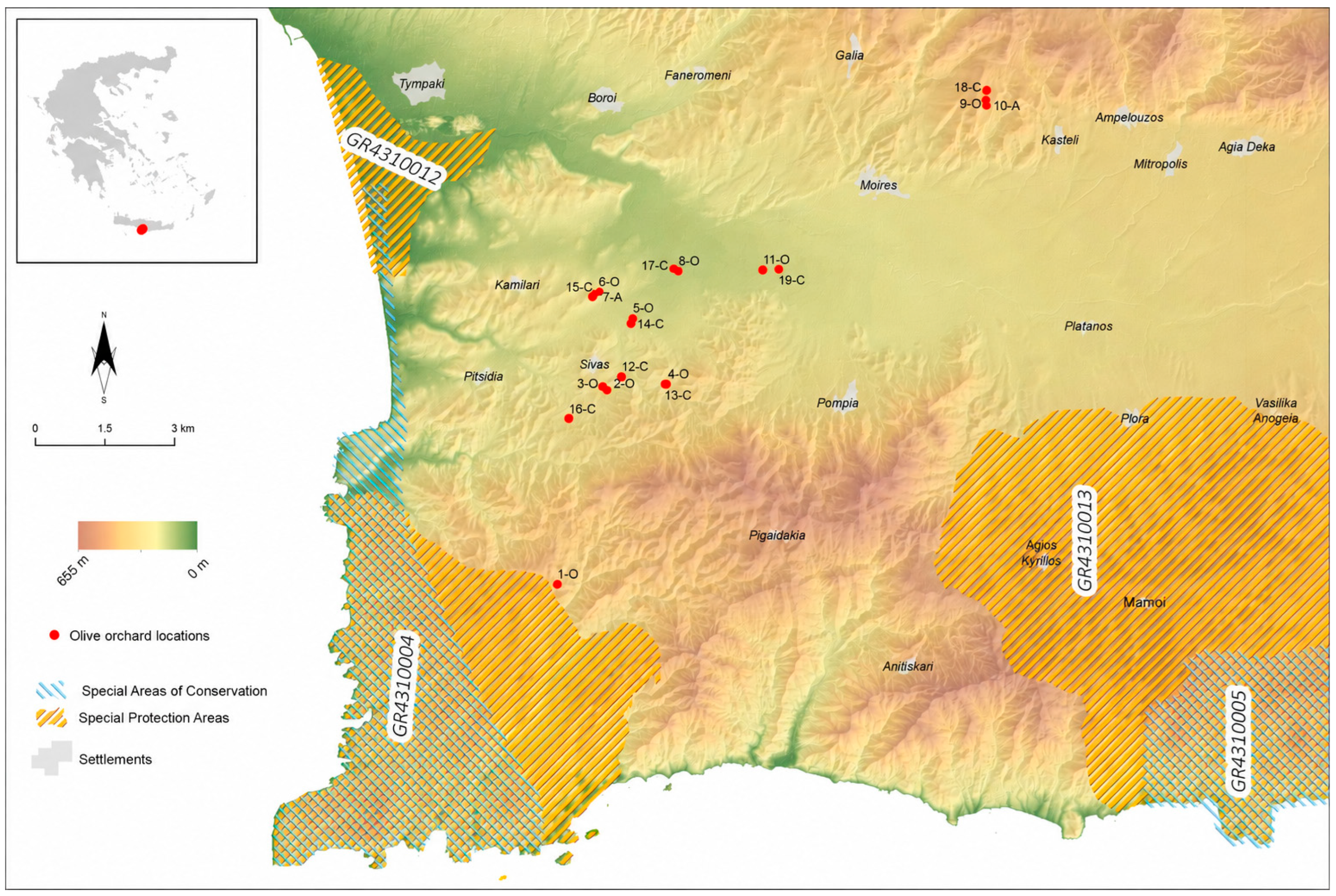
2.1. Study Area
2.2. Survey Protocol
2.3. Nomenclature and Taxonomic Arrangement
2.4. Data Analysis
3. Results
4. Discussion
5. Conclusions
Author Contributions
Funding
Institutional Review Board Statement
Data Availability Statement
Acknowledgments
Conflicts of Interest
Abbreviations
| GI | Green Infrastructure |
| EU | European Union |
| MS | Management System |
| AZ | Agroecological Zone |
| O | Organic |
| C | Conventional |
| A | Abandoned |
| PD 67/81 | Presidential Decree 67/81 |
| HBS | Hellenic Botanical society |
| HNV | High Nature Value |
| NS | Not Significant |
| T | Trend |
| HMU | Hellenic Mediterranean University |
References
- Loumou, A.; Giourga, C. Olive Groves: “The Life and Identity of the Mediterranean”. Agric. Hum. Values 2003, 20, 87–95. [Google Scholar] [CrossRef]
- Gomiero, T.; Pimentel, D.; Paoletti, M.G. Environmental Impact of Different Agricultural Management Practices: Conventional vs. Organic Agriculture. Crit. Rev. Plant Sci. 2011, 30, 95–124. [Google Scholar] [CrossRef]
- Solomou, A.D. Farmland Abandonment and High Nature Value Farming in Mediterranean Landscapes: Plant Biodiversity Outcomes and Biocultural Trade-Offs. Land 2026, 15, 793. [Google Scholar] [CrossRef]
- Solomou, A.; Sfougaris, A. Determining Indicators of Terrestrial Biodiversity in Olive Grove and Natural Mediterranean Ecosystems. Int. J. Trend Res. Dev. 2016, 3, 292–299. [Google Scholar]
- Schippers, P.; Van Groenendael, J.M.; Vleeshouwers, L.M.; Hunt, R. Herbaceous Plant Strategies in Disturbed Habitats. Oikos 2001, 95, 198–210. [Google Scholar] [CrossRef]
- Maccherini, S.; Santi, E.; Bonini, I.; Amici, V.; Pruscini, S.; Palazzo, D.; Selva, F.C. The Impact of Land Abandonment on the Plant Diversity of Olive Groves. Biodivers. Conserv. 2013, 22, 3067–3083. [Google Scholar] [CrossRef]
- Scheepens, N.; Stavrianakis, G.; Komba, R.; Sentas, S.; Kizos, T. Indications of Understorey Management Practices Impact on Vascular Plant and Arthropod Diversity in Olive Groves on Lesvos, Greece. Entomol. Hell. 2024, 33, 110–125. [Google Scholar] [CrossRef]
- Pereira, A.J.; Porto, M.; Correia, O.; Beja, P. Traditional Ploughing Is Critical to the Conservation of Threatened Plants in Mediterranean Olive Groves. Agric. Ecosyst. Environ. 2024, 359, 108775. [Google Scholar] [CrossRef]
- Tarifa, R.; Martínez-Núñez, C.; Valera, F.; González-Varo, J.P.; Salido, T.; Rey, P.J. Agricultural Intensification Erodes Taxonomic and Functional Diversity in Mediterranean Olive Groves by Filtering out Rare Species. J. Appl. Ecol. 2021, 58, 2266–2276. [Google Scholar] [CrossRef]
- Vahamidis, P.; Chachalis, D.; Akrivou, A.; Karanasios, E.; Ganopoulou, M.; Argiri, A.; Mandoulaki, A.; Hatzigiannakis, E.; Arampatzis, G.; Panagopoulos, A.; et al. Weed Species’ Diversity and Composition as Shaped by the Interaction of Management, Site, and Soil Variables in Olive Groves of Southern Greece. Agronomy 2024, 14, 640. [Google Scholar] [CrossRef]
- Terzi, M.; Barca, E.; Cazzato, E.; D’Amico, F.S.; Lasorella, C.; Fracchiolla, M. Effects of Weed Control Practices on Plant Diversity in a Homogenous Olive-Dominated Landscape (South-East of Italy). Plants 2021, 10, 1090. [Google Scholar] [CrossRef] [PubMed]
- Bergmeier, E.; Strid, A. Regional Diversity, Population Trends and Threat Assessment of the Weeds of Traditional Agriculture in Greece: Weeds of Greek Traditional Agriculture. Bot. J. Linn. Soc. 2014, 175, 607–623. [Google Scholar] [CrossRef]
- Turland, N.J.; Chilton, L.; Press, J.R. Flora of the Cretan Area: Annotated Checklist & Atlas; EPIC series; H.M.S.O: London, UK, 1993.
- Strid, A. Atlas of the Aegean Flora Part 1: Text & Plates; Botanischer Garten und Botanisches Museum, Berlin-Dahlem: Berlin, Germany, 2016. [Google Scholar]
- Strid, A. Atlas of the Aegean Flora. Part 2: Maps; Botanischer Garten und Botanisches Museum, Berlin-Dahlem: Berlin, Germany, 2016. [Google Scholar]
- Solomou, A.D.; Sfougaris, A.I. Herbaceous Plant Diversity and Identification of Indicator Species in Olive Groves in Central Greece. Commun. Soil Sci. Plant Anal. 2013, 44, 320–330. [Google Scholar] [CrossRef]
- Rey, P.J.; Manzaneda, A.J.; Valera, F.; Alcántara, J.M.; Tarifa, R.; Isla, J.; Molina-Pardo, J.L.; Calvo, G.; Salido, T.; Gutiérrez, J.E.; et al. Landscape-Moderated Biodiversity Effects of Ground Herb Cover in Olive Groves: Implications for Regional Biodiversity Conservation. Agric. Ecosyst. Environ. 2019, 277, 61–73. [Google Scholar] [CrossRef]
- ELSTAT. Available online: https://www.statistics.gr/el/statistics/-/publication/SPG06/ (accessed on 15 June 2026).
- Rackham, O.; Moody, J.A. The Making of the Cretan Landscape; Manchester University Press: Manchester, UK, 1996. [Google Scholar]
- Stobbelaar, D.J.; Kuiper, J.; van Mansvelt, J.D.; Kabourakis, E. Landscape Quality on Organic Farms in the Messara Valley, Crete: Organic Farms as Components in the Landscape. Agric. Ecosyst. Environ. 2000, 77, 79–93. [Google Scholar] [CrossRef]
- Bàrberi, P.; Burgio, G.; Dinelli, G.; Moonen, A.C.; Otto, S.; Vazzana, C.; Zanin, G. Functional Biodiversity in the Agricultural Landscape: Relationships between Weeds and Arthropod Fauna. Weed Res. 2010, 50, 388–401. [Google Scholar] [CrossRef]
- Balzan, M.V.; Sadula, R.; Scalvenzi, L. Assessing Ecosystem Services Supplied by Agroecosystems in Mediterranean Europe: A Literature Review. Land 2020, 9, 245. [Google Scholar] [CrossRef]
- Ruymbeke, K.V.; Ferreira, J.G.; Gkisakis, V.D.; Kantelhardt, J.; Manevska-Tasevska, G.; Matthews, P.; Niedermayr, A.; Schaller, L.; Bańkowska, K.; Mertens, K.; et al. Assessing the Impact of Farm-Management Practices on Ecosystem Services in European Agricultural Systems: A Rapid Evidence Assessment. Sustainability 2023, 15, 12819. [Google Scholar] [CrossRef]
- Stavrianakis, G.; Sentas, E.; Tscheulin, T.; Kizos, T. Does Biodiversity Affect Olive Fly Populations? Evidence from Different Understorey Treatments. Discov. Conserv. 2024, 1, 3. [Google Scholar] [CrossRef]
- Zografakis, I.; Pereira, C.S.; Pavão, F.A.; Alves, C.; Loulakis, A.; Chasourakis, I.; Kabourakis, E. Boosting Biodiversity in Olive Orchards: The Benefits of Organic Farming and Green Infrastructure. Available online: https://climed-fruit.eu/wp-content/uploads/2025/10/Boosting-biodiversity-in-olive-orchards.pdf (accessed on 12 July 2026).
- Kabourakis, E.; Zografakis, I.; Loulakis, A.; Chasourakis, I.; Volakakis, N. Green Infrastructure Establishment for Sustainable Olive Orchards The Case of LIFE IGIC Project. Available online: https://climed-fruit.eu/wp-content/uploads/2025/09/FV-Bonus-TA_Green-Infrastructure_EN.pdf (accessed on 12 July 2026).
- Midolo, G.; Axmanová, I.; Divíšek, J.; Dřevojan, P.; Lososová, Z.; Večeřa, M.; Karger, D.N.; Thuiller, W.; Bruelheide, H.; Aćić, S.; et al. Diversity and Distribution of Raunkiær’s Life Forms in European Vegetation. J. Veg. Sci. 2024, 35, e13229. [Google Scholar] [CrossRef]
- Solomou, A.; Sfougaris, A. Comparing Conventional and Organic Olive Groves in Central Greece: Plant and Bird Diversity and Abundance. Renew. Agric. Food Syst. 2011, 26, 297–316. [Google Scholar] [CrossRef]
- Loulakis, A.; Georgiadis, C.; Kollaros, D.; Demetriou, J.; Chasourakis, I.; Zografakis, I.; Kabourakis, E. Faunistic Updates on Greek Ants: First Record of Strumigenys Membranifera (Emery, 1869) from Crete and Strumigenys Baudueri (Emery, 1875) from Andros. Biodivers. Data J. 2026, 14, e183362. [Google Scholar] [CrossRef] [PubMed]
- Simões, M.; Belo, A.; Pinto-Cruz, C.; Pinheiro, A. Natural Vegetation Management to Conserve Biodiversity and Soil Water in Olive Orchards. Span. J. Agric. Res. 2014, 12, 633–643. [Google Scholar] [CrossRef]
- Gkisakis, V.D.; Volakakis, N.G.; Kabourakis, E.M. Agroecological Zones as an Important Driver of Canopy Arthropod Community in Olive Agroecosystems. Biol. Control 2020, 149, 104319. [Google Scholar] [CrossRef]
- Life IGIC. Available online: https://www.lifeigic.eu/en/ (accessed on 12 July 2026).
- Allen, H.D.; Randall, R.E.; Amable, G.S.; Devereux, B.J. The Impact of Changing Olive Cultivation Practices on the Ground Flora of Olive Groves in the Messara and Psiloritis Regions, Crete, Greece. Land Degrad. Dev. 2006, 17, 249–273. [Google Scholar] [CrossRef]
- Panitsa, M.; Kagiampaki, A.; Kougioumoutzis, K. Plant Diversity and Biogeography of the Aegean Archipelago: A New Synthesis; Broken Hill Publishers Ltd.: Nicosia, Cyprus, 2018. [Google Scholar]
- Dimopoulos, P.; Raus, T.; Bergmeier, E.; Constantinidis, T.; Iatrou, G.; Kokkini, S.; Strid, A.; Tzanoudakis, D. Vascular Plants of Greece: An Annotated Checklist; Botanic Garden and Botanical Museum Berlin-Dahlem: Berlin, Germany; Hellenic Botanical Society: Athens, Greece, 2013. [Google Scholar]
- Fielding, J.; Nicholas, T. Flowers of Crete; Board of Trustees of the Royal Botanic Gardens: London, UK, 2005. [Google Scholar]
- Turland, N.; Phitos, D.; Kamari, G.; Bareka, P. Weeds of the Traditional Agriculture of Crete. Willdenowia 2004, 34, 381–406. [Google Scholar] [CrossRef][Green Version]
- Solomou, A.D.; Sfougaris, A. Contribution of Agro-Environmental Factors to Yield and Plant Diversity of Olive Grove Ecosystems (Olea Europaea L.) in the Mediterranean Landscape. Agronomy 2021, 11, 161. [Google Scholar] [CrossRef]
- Kakampoura, B.; Panitsa, M. Plant Diversity of Olive Groves under Different Management Practices: A Case Study on Lesbos Island (East Aegean Area, Greece). Flora Mediterr. 2022, 32, 375–386. [Google Scholar] [CrossRef]
- Michail, I.; Tsahatsanis, P.; Kontele, Β.; Karagianni, I.; Kolokitha, K.; Benista, G.; Gkisakis, V. Effect of Farming System on Ant Assemblages and Ground Cover Fauna in Greek Olive Groves. AGROFOR Int. J. 2024, 9, 58–67. [Google Scholar]
- Daliakopoulos, I.; Tsanis, I. Historical Evolution of Dryland Ecosystems; CASCADE: Eugene, OR, USA, 2014; p. 126. [Google Scholar]
- Gkisakis, V.D.; Bàrberi, P.; Kabourakis, E.M. Olive Canopy Arthropods under Organic, Integrated, and Conventional Management. The Effect of Farming Practices, Climate and Landscape. Agroecol. Sustain. Food Syst. 2018, 42, 843–858. [Google Scholar] [CrossRef]
- Samaritakis, V. nhmc. Available online: https://www.nhmc.uoc.gr/wp-content/uploads/2023/09/natura2000_texnikos_odigos_final (accessed on 12 July 2026).
- Regulation (EU) 2018/848 of the European Parliament and of the Council of 30 May 2018 on Organic Production and Labelling of Organic Products and Repealing Council Regulation (EC) No 834/2007. 2018, Vol. 150. Available online: http://data.europa.eu/eli/reg/2018/848/oj (accessed on 12 July 2026).
- European Commission-CINEA-D2 LIFE 3.0-LIFE Project Public Page. Available online: https://webgate.ec.europa.eu/life/publicWebsite/project/LIFE16-NAT-GR-000575/improvement-of-green-infrastructure-in-agroecosystems-reconnecting-natural-areas-by-countering-habitat-fragmentation (accessed on 12 July 2026).
- Green Infrastructure in Olive Orchards. Available online: https://lovaps.hmu.gr/apps/green-report/index/ (accessed on 12 July 2026).
- Kabourakis, E. Code of Practices for Ecological Olive Production Systems in Crete; CABI: Oxfordshire, UK, 1999. [Google Scholar]
- Kabourakis, E. Prototyping and Dissemination of Ecological Olive Production Systems: A Methodology for Designing and a First Step towards Validation and Dissemination of Prototype Ecological Olive Productions Systems (EOPS) in Crete; Wageningen University and Research: Wageningen, The Netherlands, 1996. [Google Scholar]
- Volakakis, N.G.; Eyre, M.D.; Kabourakis, E.M. Olive Fly Bactrocera Oleae (Diptera, Tephritidae) Activity and Fruit Infestation Under Mass Trapping in an Organic Table Olive Orchard in Crete, Greece. J. Sustain. Agric. 2012, 36, 683–698. [Google Scholar] [CrossRef]
- Vascular Plants of Greece Checklist|Flora of Greece–An Annotated Checklist. Available online: https://portal.cybertaxonomy.org/flora-greece/intro (accessed on 14 June 2026).
- Dimopoulos, P.; Raus, T.; Bergmeier, E.; Constantinidis, T.; Iatrou, G.; Kokkini, S.; Strid, A.; Tzanoudakis, D. Vascular Plants of Greece: An Annotated Checklist. Supplement. Willdenowia 2016, 46, 301–347. [Google Scholar] [CrossRef]
- THE ANGIOSPERM PHYLOGENY GROUP. An Update of the Angiosperm Phylogeny Group Classification for the Orders and Families of Flowering Plants: APG III: APG III. Bot. J. Linn. Soc. 2009, 161, 105–121. [Google Scholar] [CrossRef]
- HBS Newsletter|Hellenic Botanical Society. Available online: https://www.hbs.gr/en/newsletter (accessed on 15 June 2026).
- Cano, D.; Martínez-Núñez, C.; Pérez, A.J.; Salido, T.; Rey, P.J. Small Floral Patches Are Resistant Reservoirs of Wild Floral Visitor Insects and the Pollination Service in Agricultural Landscapes. Biol. Conserv. 2022, 276, 109789. [Google Scholar] [CrossRef]
- Radić Lakoš, T.; Milović, M.; Jelaska, S.D. Possible Implications of Two Management Types in Olive Groves on Plant Diversity. Agric. Conspec. Sci. 2014, 79, 209–220. [Google Scholar]
- Fekete, R.; Vincze, O.; Süveges, K.; Bak, H.; Malkócs, T.; Löki, V.; Urgyán, R.; Molnár, V.A. The Role of Olive Groves in the Conservation of Mediterranean Orchids. Glob. Ecol. Conserv. 2023, 44, e02490. [Google Scholar] [CrossRef]
- Huqi, B.; Dhima, K.; Vasilakoglou, I.; Keco, R.; Salaku, F. Weed Flora and Weed Management in Established Olive Groves in Albania. Weed Biol. Manag. 2009, 9, 276–285. [Google Scholar] [CrossRef]
- Pereira, A.J.; Clemente, A.; Correia, O.; Porto, M. Conservation Value of Mediterranean Traditional Olive Groves: A Quantitative Assessment of an Ultimate Refuge for Threatened Arable Flora. Biodivers. Conserv. 2025, 34, 4501–4523. [Google Scholar] [CrossRef]
- de la Torre, V.; Díaz-Portero, M.Á.; Goded, S.; Calmaestra, R.G.; Moreno-Opo, R. Herbaceous Covers in Traditional Olive Orchards Maintain Bird and Butterfly Diversity in Central Spain. Eur. J. Wildl. Res. 2025, 71, 29. [Google Scholar] [CrossRef]
- Jiménez, M.N.; Castro-Rodríguez, J.; Navarro, F.B. The Effects of Farming System and Soil Management on Floristic Diversity in Sloping Olive Groves. Renew. Agric. Food Syst. 2023, 38, e15. [Google Scholar] [CrossRef]
- Solomou, A.D.; Sfougaris, A.I. Determinants of Woody Plant Species Richness in Abandoned Olive Grove Ecosystems and Maquis of Central Greece. Commun. Soil Sci. Plant Anal. 2015, 46, 317–325. [Google Scholar] [CrossRef]
- Panitsa, M.; Tzanoudakis, D.; Sfenthourakis, S. Turnover of Plants on Small Islets of the Eastern Aegean Sea within Two Decades. J. Biogeogr. 2008, 35, 1049–1061. [Google Scholar] [CrossRef]
- Castro, H.; Lehsten, V.; Lavorel, S.; Freitas, H. Functional Response Traits in Relation to Land Use Change in the Montado. Agric. Ecosyst. Environ. 2010, 137, 183–191. [Google Scholar] [CrossRef]
- Erfanian, M.B.; Alatalo, J.M.; Ejtehadi, H. Severe Vegetation Degradation Associated with Different Disturbance Types in a Poorly Managed Urban Recreation Destination in Iran. Sci. Rep. 2021, 11, 19695. [Google Scholar] [CrossRef] [PubMed]
- Lazarina, M.; Charalampopoulos, A.; Psaralexi, M.; Krigas, N.; Michailidou, D.-E.; Kallimanis, A.S.; Sgardelis, S.P. Diversity Patterns of Different Life Forms of Plants along an Elevational Gradient in Crete, Greece. Diversity 2019, 11, 200. [Google Scholar] [CrossRef]
- Siebert, S.F. Traditional Agriculture and the Conservation of Biological Diversity in Crete, Greece. Int. J. Agric. Sustain. 2004, 2, 109–117. [Google Scholar] [CrossRef]
- POWO. Plants of the World Online; Royal Botanic Gardens, Kew: London, UK, 2016; Available online: https://powo.science.kew.org/ (accessed on 16 June 2026).
- The Red Data Book of Rare and Threatened Plants of Greece|Hellenic Botanical Society. Available online: https://www.hbs.gr/en/publications/red-data-book-greece (accessed on 16 June 2026).
- YPEN. Available online: https://ypen.gov.gr/perivallon/viopoikilotita/nomothesia/ (accessed on 12 July 2026).


| Taxonomic Order | No of Families Within Order | Relative Family Richness for Each Order (%) | No of Species Within Order | Relative Species Richness for Each Order (%) |
|---|---|---|---|---|
| Alismatales | 1 | 1.7 | 2 | 0.6 |
| Apiales | 1 | 1.7 | 12 | 3.6 |
| Arecales | 1 | 1.7 | 1 | 0.3 |
| Asparagales | 5 | 8.3 | 25 | 7.6 |
| Asterales | 2 | 3.3 | 50 | 15.1 |
| Boraginales | 1 | 1.7 | 13 | 3.9 |
| Brassicales | 2 | 3.3 | 10 | 3.0 |
| Caryophyllales | 6 | 10 | 18 | 5.4 |
| Cucurbitales | 1 | 1.7 | 2 | 0.6 |
| Cupressales | 1 | 1.7 | 1 | 0.3 |
| Dipsacales | 2 | 3.3 | 3 | 0.9 |
| Ericales | 1 | 1.7 | 1 | 0.3 |
| Fabales | 1 | 1.7 | 47 | 14.2 |
| Fagales | 1 | 1.7 | 1 | 0.3 |
| Gentianales | 3 | 5.0 | 10 | 3.0 |
| Geraniales | 1 | 1.7 | 6 | 1.8 |
| Lamiales | 7 | 11.7 | 38 | 11.5 |
| Malpighiales | 3 | 5.0 | 10 | 3.0 |
| Malvales | 3 | 5.0 | 8 | 2.4 |
| Myrtales | 2 | 3.3 | 3 | 0.9 |
| Oxalidales | 1 | 1.7 | 1 | 0.3 |
| Poales | 2 | 3.3 | 37 | 11.2 |
| Ranunculales | 3 | 5.0 | 11 | 3.3 |
| Rosales | 4 | 6.7 | 13 | 3.9 |
| Santanales | 1 | 1.7 | 1 | 0.3 |
| Sapindales | 1 | 1.7 | 1 | 0.3 |
| Solanales | 2 | 3.3 | 6 | 1.8 |
| Vitales | 1 | 1.7 | 1 | 0.3 |
| Total Orders | 28 | |||
| Total Families | 60 | |||
| Total Species | 331 | |||
| Family Name | Number of Species (Species Richness) | Family Relative Species Richness (%) |
|---|---|---|
| Arecaceae | 1 | 0.3 |
| Acanthaceae | 1 | 0.3 |
| Amaranthaceae | 2 | 0.6 |
| Amaryllidaceae | 3 | 0.9 |
| Anacardiaceae | 1 | 0.3 |
| Apiaceae | 12 | 3.6 |
| Apocynaceae | 1 | 0.3 |
| Araceae | 2 | 0.6 |
| Asparagaceae | 6 | 1.8 |
| Asphodelaceae | 1 | 0.3 |
| Asteraceae | 49 | 14.8 |
| Berberidaceae | 1 | 0.3 |
| Boraginaceae | 13 | 3.9 |
| Brassicaceae | 9 | 2.7 |
| Campanulaceae | 1 | 0.3 |
| Capparaceae | 1 | 0.3 |
| Caryophyllaceae | 5 | 1.5 |
| Chenopodiaceae | 6 | 1.8 |
| Cistaceae | 3 | 0.9 |
| Convolvulaceae | 3 | 0.9 |
| Cucurbitaceae | 2 | 0.6 |
| Cupressaceae | 1 | 0.3 |
| Cyperaceae | 1 | 0.3 |
| Dipsacaceae | 2 | 0.6 |
| Euphorbiaceae | 7 | 2.1 |
| Fabaceae | 47 | 14.2 |
| Gentianaceae | 2 | 0.6 |
| Geraniaceae | 6 | 1.8 |
| Hypericaceae | 1 | 0.3 |
| Iridaceae | 2 | 0.6 |
| Juglandaceae | 1 | 0.3 |
| Lamiaceae | 19 | 5.7 |
| Lauraceae | 1 | 0.3 |
| Linaceae | 2 | 0.6 |
| Lythraceae | 2 | 0.6 |
| Malvaceae | 4 | 1.2 |
| Moraceae | 2 | 0.6 |
| Myrtaceae | 1 | 0.3 |
| Oleaceae | 1 | 0.3 |
| Orchidaceae | 13 | 3.9 |
| Orobanchaceae | 5 | 1.5 |
| Oxalidaceae | 1 | 0.3 |
| Papaveraceae | 4 | 1.2 |
| Plantaginaceae | 7 | 2.1 |
| Poaceae | 36 | 10.9 |
| Polygonaceae | 2 | 0.6 |
| Portulacaceae | 1 | 0.3 |
| Primulaceae | 1 | 0.3 |
| Ranunculaceae | 5 | 1.5 |
| Rhamnaceae | 1 | 0.3 |
| Rosaceae | 8 | 2.4 |
| Rubiaceae | 7 | 2.1 |
| Santalaceae | 1 | 0.3 |
| Scrophulariaceae | 4 | 1.2 |
| Solanaceae | 3 | 0.9 |
| Thymeleaceae | 1 | 0.3 |
| Urticaceae | 2 | 0.6 |
| Valerianaceae | 1 | 0.3 |
| Verbenaceae | 1 | 0.3 |
| Vitaceae | 1 | 0.3 |
| Species ID | Olive Orchards | Species Frequency | ||||||||||||||||||||||
|---|---|---|---|---|---|---|---|---|---|---|---|---|---|---|---|---|---|---|---|---|---|---|---|---|
| Organic | Conventional | Abandoned | ||||||||||||||||||||||
| Hilly | Hilly | Hilly | Hilly | Plain | Hilly | Plain | Hilly | Plain | Hilly | Hilly | Plain | Hilly | Hilly | Plain | Hilly | Plain | Hilly | Hilly | ||||||
| Order | Family | Species Name | Raunkiær Life Form Classification | Conservation Status | 1O | 2O | 3O | 4O | 5O | 6O | 8O | 9O | 11O | 12C | 13C | 14C | 15C | 16C | 17C | 18C | 19C | 7A | 10A | |
| Alismatales | Araceae | Arisarum vulgare O.Targ.Tozz. | Geophyte | - | + | + | + | + | + | + | + | + | 42% | |||||||||||
| Arum concinnatum Schott | Geophyte | - | + | + | + | + | + | + | + | 37% | ||||||||||||||
| Apiales | Apiaceae | Ammi majus L. | Therophyte | PD 67/81 | + | + | 11% | |||||||||||||||||
| Bupleurum gracile d’Urv. | Therophyte | - | + | 5% | ||||||||||||||||||||
| Coriandrum sativum L. | Therophyte | - | + | 5% | ||||||||||||||||||||
| Daucus carota L. | Therophyte/Hemicryptophyte | - | + | + | + | + | + | + | + | + | + | + | + | + | + | + | 74% | |||||||
| Eryngium campestre L. | Hemicryptophyte | - | + | + | + | + | 21% | |||||||||||||||||
| Foeniculum vulgare Mill. | Hemicryptophyte | - | + | + | + | + | + | 26% | ||||||||||||||||
| Lagoecia cuminoides Soy.-Will | Therophyte | - | + | + | 11% | |||||||||||||||||||
| Scandix pecten-veneris L. | Therophyte | - | + | + | + | + | + | + | + | + | 42% | |||||||||||||
| Smyrnium olusatrum L. | Hemicryptophyte | - | + | 5% | ||||||||||||||||||||
| Tordylium apulum L. | Therophyte | - | + | + | + | 16% | ||||||||||||||||||
| Torilis arvensis Huds. | Therophyte | - | + | 5% | ||||||||||||||||||||
| Torilis leptophylla (L.) Rchb.f. | Therophyte | - | + | + | + | 16% | ||||||||||||||||||
| Arecales | Arecaceae | Phoenix theophrasti Greuter | Phanerophyte | - | + | 5% | ||||||||||||||||||
| Asparagales | Amaryllidaceae | Allium ampeloprasum L. | Geophyte | - | + | + | + | + | + | + | 32% | |||||||||||||
| Allium subhirsutum L. | Geophyte | - | + | + | + | + | + | + | + | 37% | ||||||||||||||
| Narcissus tazetta L. | Geophyte | - | + | + | + | 16% | ||||||||||||||||||
| Asparagaceae | Asparagus aphyllus L. | Chamaephyte | - | + | + | + | + | + | + | + | + | + | + | + | + | + | 68% | |||||||
| Drimia numidica (Jord. & Fourr.) J.C.Manning & Goldblatt | Geophyte | - | + | + | + | + | + | 26% | ||||||||||||||||
| Muscari comosum (L.) Mill. | Geophyte | - | + | + | + | + | + | + | + | + | 42% | |||||||||||||
| Muscari speizenhoferi (Heldr. ex Osterm.) H.R.Wehrh | Geophyte | - | + | 5% | ||||||||||||||||||||
| Ornithogalum narbonense L. | Geophyte | - | + | + | + | + | 21% | |||||||||||||||||
| Prospero autumnale (L.) Speta | Geophyte | - | + | 5% | ||||||||||||||||||||
| Asphodelaceae | Asphodelus ramosus L. | Geophyte | - | + | + | 11% | ||||||||||||||||||
| Iridaceae | Gladiolus italicus Mill. | Geophyte | - | + | + | + | + | + | 26% | |||||||||||||||
| Moraea sisyrinchium (L.) Ker Gawl. | Geophyte | - | + | + | + | + | 21% | |||||||||||||||||
| Orchidaceae | Anacamptis collina (Banks & Sol. ex Russell) R.M.Bateman, Pridgeon & M.W.Chase | Geophyte | PD 67/81 | + | + | + | + | + | 26% | |||||||||||||||
| Anacamptis coriophora subsp. Fragrans (Pollini) R.M.Bateman | Geophyte | PD 67/81 | + | 5% | ||||||||||||||||||||
| Anacamptis papilionacea (L.) R.M.Bateman, Pridgeon & M.W.Chase | Geophyte | PD 67/81 | + | 5% | ||||||||||||||||||||
| Anacamptis pyramidalis (L.) Rich. | Geophyte | PD 67/81 | + | 5% | ||||||||||||||||||||
| Himantoglossum robertianum (Loisel.) P.Delforge | Geophyte | - | + | 5% | ||||||||||||||||||||
| Ophrys cretica (Vierh.) E.Nelson | Geophyte | PD 67/81 | + | 5% | ||||||||||||||||||||
| Ophrys lutea Cav. | Geophyte | PD 67/81 | + | + | 11% | |||||||||||||||||||
| Ophrys scolopax subsp. Heldreichii (Schltr.) E.Nelson | Geophyte | PD 67/81 | + | + | 11% | |||||||||||||||||||
| Orchis italica Poir. | Geophyte | PD 67/81 | + | 5% | ||||||||||||||||||||
| Serapias bergonii E.G.Camus | Geophyte | PD 67/81 | + | + | 11% | |||||||||||||||||||
| Serapias lingua L. | Geophyte | PD 67/82 | + | + | 11% | |||||||||||||||||||
| Serapias parviflora Parl. | Geophyte | PD 67/83 | + | 5% | ||||||||||||||||||||
| Serapias sp. | Geophyte | PD 67/84 | + | + | + | + | 21% | |||||||||||||||||
| Asterales | Asteraceae | Anthemis chia L. | Therophyte | - | + | + | + | 16% | ||||||||||||||||
| Artemisia arborescens L. | Chamaephyte | - | + | 5% | ||||||||||||||||||||
| Asteriscus aquaticus (L.) Less. | Therophyte | - | + | + | 11% | |||||||||||||||||||
| Atractylis cancellata L. | Therophyte | - | + | 5% | ||||||||||||||||||||
| Bellis annua L. | Therophyte | - | + | + | + | 16% | ||||||||||||||||||
| Calendula arvensis L. | Therophyte | - | + | + | + | + | + | + | + | + | + | + | + | + | 63% | |||||||||
| Carlina lanata L. | Hemicryptophyte | - | + | 5% | ||||||||||||||||||||
| Carthamus lanatus L. | Therophyte | - | + | + | + | + | 21% | |||||||||||||||||
| Cichorium intybus L. | Hemicryptophyte | - | + | + | 11% | |||||||||||||||||||
| Cichorium pumilum Jacq. | Therophyte | - | + | 5% | ||||||||||||||||||||
| Cirsium sp. | Hemicryptophyte | - | + | 5% | ||||||||||||||||||||
| Crepis commutata (Spreng.) Greuter | Hemicryptophyte | - | + | + | + | + | + | + | + | + | + | + | + | + | + | + | 74% | |||||||
| Crepis neglecta subsp. Cretica (Boiss.) Vierh. | Therophyte | - | + | + | + | + | 21% | |||||||||||||||||
| Crepis vesicaria subsp. vesicaria | Hemicryptophyte | - | + | + | + | + | + | + | + | + | + | + | + | + | + | + | + | + | + | + | + | 100% | ||
| Crupina crupinastrum (Moris) Vis. | Therophyte | - | + | 5% | ||||||||||||||||||||
| Dittrichia graveolens (L.) Greuter | Therophyte | - | + | + | + | 16% | ||||||||||||||||||
| Dittrichia viscosa (L.) Greuter | Chamaephyte/Hemicryptophyte | - | + | + | + | 16% | ||||||||||||||||||
| Echinops spinosissimus Turra | Hemicryptophyte | - | + | + | + | 16% | ||||||||||||||||||
| Erigeron bonariensis L. | Hemicryptophyte | - | + | + | 11% | |||||||||||||||||||
| Erigeron canadensis L. | Therophyte/Hemicryptophyte | - | + | + | + | + | + | + | + | + | + | + | 53% | |||||||||||
| Erigeron sumatrensis Retz. | Hemicryptophyte | - | + | 5% | ||||||||||||||||||||
| Filago pyramidata (L.) Huds. | Therophyte | - | + | 5% | ||||||||||||||||||||
| Galactites tomentosus Moench | Therophyte | - | + | + | + | + | + | 26% | ||||||||||||||||
| Geropogon hybridus (L.) Sch.Bip. | Therophyte | - | + | + | 11% | |||||||||||||||||||
| Glebionis coronaria (L.) Cass. ex Spach | Therophyte | - | + | + | + | + | + | + | + | + | + | + | + | + | + | + | 74% | |||||||
| Hedypnois rhagadioloides subsp. Tubaeformis (Ten.) Hayek | Therophyte | - | + | + | 11% | |||||||||||||||||||
| Helichrysum stoechas subsp. barrelieri (Ten.) Nyman | Chamaephyte | - | + | + | + | + | + | + | + | + | 42% | |||||||||||||
| Helminthotheca echioides (L.) Holub | Therophyte | - | + | + | + | + | + | 26% | ||||||||||||||||
| Hypochaeris achyrophorus L. | Therophyte/Hemicryptophyte | - | + | + | + | + | + | 26% | ||||||||||||||||
| Lactuca serriola L. | Therophyte/Hemicryptophyte | - | + | + | + | + | + | + | + | + | + | + | + | + | + | + | + | + | + | 89% | ||||
| Lactuca tuberosa Jacq. | Hemicryptophyte | - | + | + | + | + | 21% | |||||||||||||||||
| Lamyropsis cynaroides (Lam.) Dittrich | Hemicryptophyte | - | + | 5% | ||||||||||||||||||||
| Leontodon tuberosus L. | Hemicryptophyte | - | + | + | + | + | 21% | |||||||||||||||||
| Matricaria chamomilla L. | Therophyte | - | + | 5% | ||||||||||||||||||||
| Notobasis syriaca (L.) Cass. | Therophyte | - | + | + | + | 16% | ||||||||||||||||||
| Pallenis spinosa (L.) Cass. | Therophyte/Hemicryptophyte | - | + | + | + | + | 21% | |||||||||||||||||
| Phagnalon rupestre subsp. graecum Boiss. & Heldr. | Chamaephyte | - | + | + | + | + | + | + | + | 37% | ||||||||||||||
| Reichardia picroides (L.) Roth | Hemicryptophyte | - | + | + | + | + | + | + | + | + | + | + | + | 58% | ||||||||||
| Gelasia cretica Willd | Hemicryptophyte | - | + | 5% | ||||||||||||||||||||
| Senecio vulgaris L. | Therophyte | - | + | + | + | + | + | + | + | + | + | + | + | + | + | + | + | 79% | ||||||
| Sonchus asper (L.) Hill | Therophyte | - | + | + | + | + | + | + | + | + | + | + | + | + | 63% | |||||||||
| Sonchus oleraceus L. | Therophyte | - | + | + | + | + | + | + | + | + | + | + | + | + | + | + | + | + | + | + | + | 100% | ||
| Symphyotrichum squamatum (Spreng.) G.L.Nesom | Chamaephyte/Hemicryptophyte | - | + | + | + | + | + | + | + | + | + | + | 53% | |||||||||||
| Taraxacum sp. | - | - | + | + | + | 16% | ||||||||||||||||||
| Tolpis umbellata Bertol. | Therophyte | - | + | + | + | + | + | 26% | ||||||||||||||||
| Tolpis virgata (Desf.) Bertol. | Hemicryptophyte | - | + | + | + | 16% | ||||||||||||||||||
| Tragopogon porrifolius subsp. Eriospermus (Ten.) Greuter | Therophyte/Hemicryptophyte | - | + | + | + | + | + | + | + | + | + | 47% | ||||||||||||
| Urospermum picroides (L.) Scop. ex F.W.Schmidt | Therophyte | - | + | + | + | + | + | + | + | + | + | + | + | + | + | + | + | 79% | ||||||
| Xanthium strumarium L. | Therophyte | - | + | + | 11% | |||||||||||||||||||
| Campanulaceae | Campanula erinus L. | Therophyte | - | + | 5% | |||||||||||||||||||
| Boraginales | Boraginaceae | Anchusa aegyptiaca (L.) A.DC. | Therophyte | - | + | 5% | ||||||||||||||||||
| Anchusa azurea Mill. | Hemicryptophyte | - | + | + | + | + | 21% | |||||||||||||||||
| Anchusa undulata subsp. hybrida (Ten.) Bég. | Hemicryptophyte | - | + | + | + | 16% | ||||||||||||||||||
| Borago officinalis L. | Therophyte | - | + | 5% | ||||||||||||||||||||
| Cerinthe major L. | Therophyte | - | + | 5% | ||||||||||||||||||||
| Cynoglossum columnae Ten. | Therophyte | - | + | + | + | 16% | ||||||||||||||||||
| Cynoglossum creticum Mill. | Hemicryptophyte | - | + | + | + | + | + | + | + | + | + | 47% | ||||||||||||
| Echium angustifolium subsp. angustifolium | Therophyte/Hemicryptophyte | - | + | + | + | + | + | + | + | + | + | 47% | ||||||||||||
| Echium italicum subsp. biebersteini (Lacaita) Greuter & Burdet | Hemicryptophyte | - | + | + | + | + | + | + | + | 37% | ||||||||||||||
| Echium plantagineum L. | Therophyte/Hemicryptophyte | - | + | + | + | + | 21% | |||||||||||||||||
| Heliotropium dolosum De Not. | Therophyte | - | + | 5% | ||||||||||||||||||||
| Heliotropeum europaeum L. | Therophyte | - | + | + | + | + | + | + | + | + | + | + | + | + | + | + | + | + | 84% | |||||
| Neatostema apulum (L.) I.M.Johnst. | Therophyte | - | + | 5% | ||||||||||||||||||||
| Brassicales | Brassicaceae | Biscutella didyma L. | Therophyte | - | + | + | 11% | |||||||||||||||||
| Capsella bursa-pastoris (L.) Medik. | Therophyte/Hemicryptophyte | - | + | 5% | ||||||||||||||||||||
| Eruca vesicaria (L.) Cav. | Therophyte | - | + | + | 11% | |||||||||||||||||||
| Hirschfeldia incana (L.) Lagr.-Foss | Therophyte/hemicryptophyte | - | + | + | + | + | + | 26% | ||||||||||||||||
| Raphanus raphanistrum L. | Therophyte | - | + | + | 11% | |||||||||||||||||||
| Sinapis alba L. | Therophyte | - | + | + | + | + | + | + | + | + | + | + | + | + | + | + | + | + | 84% | |||||
| Sinapis arvensis L. | Therophyte | - | 0% | |||||||||||||||||||||
| Sisymbrium officinale (L.) Scop. | Therophyte | - | + | 5% | ||||||||||||||||||||
| Sisymbrium orientale L. | Therophyte | - | + | 5% | ||||||||||||||||||||
| Capparaceae | Capparis spinosa var. canescens Coss. | Chamaephyte/Phanerophyte | - | + | + | + | + | + | + | + | + | + | + | + | + | + | + | 74% | ||||||
| Caryophyllales | Amaranthaceae | Amaranthus blitoides S.Watson | Therophyte | - | + | + | + | + | + | + | + | + | + | + | + | + | + | + | + | + | 84% | |||
| Amaranthus retroflexus L. | Therophyte | - | + | + | + | + | + | + | + | + | + | + | + | + | 63% | |||||||||
| Caryophyllaceae | Agrostemma githago L. | Therophyte | - | + | 5% | |||||||||||||||||||
| Cerastium glomeratum Thuill. | Therophyte | - | + | 5% | ||||||||||||||||||||
| Silene colorata Poir. | Therophyte | - | + | 5% | ||||||||||||||||||||
| Silene vulgaris (Moench) Garcke | Chamaephyte/Hemicryptophyte | - | + | + | + | + | 21% | |||||||||||||||||
| Stellaria media (L.) Vill. | Therophyte/Hemicryptophyte | - | + | + | + | + | + | + | + | + | 42% | |||||||||||||
| Chenopodiaceae | Atriplex sp. | Chamaephyte | - | + | 5% | |||||||||||||||||||
| Beta sp. | Therophyte/Hemicryptophyte | - | + | + | 11% | |||||||||||||||||||
| Chenopodiastrum murale (L.) S.Fuentes, Uotila & Borsch | Therophyte | - | + | + | + | + | + | + | + | 37% | ||||||||||||||
| Chenopodium album L. | Therophyte | - | + | + | + | + | + | + | + | + | + | + | + | + | + | 68% | ||||||||
| Chenopodium opulifolium Schrad. ex W.D.J.Koch & Ziz | Therophyte | - | + | + | + | + | + | + | + | + | + | 47% | ||||||||||||
| Chenopodium vulvaria L. | Therophyte | - | + | + | + | + | 21% | |||||||||||||||||
| Polygonaceae | Polygonum aviculare L. | Therophyte | - | + | 5% | |||||||||||||||||||
| Rumex bucephalophorus L. | Therophyte | - | + | + | 11% | |||||||||||||||||||
| Portulacaceae | Portulaca oleracea L. | Therophyte | - | + | + | + | + | + | + | + | 37% | |||||||||||||
| Tamaricaceae | Tamarix parviflora DC. | Phanerophyte | - | 0% | ||||||||||||||||||||
| Cucurbitales | Cucurbitaceae | Bryonia cretica L. | Geophyte/Hemicryptophyte | - | + | + | 11% | |||||||||||||||||
| Ecballium elaterium (L.) A.Rich. | Geophyte | - | + | + | 11% | |||||||||||||||||||
| Cupressales | Cupressaceae | Cupressus sempervirens L. | Phanerophyte | - | + | + | + | + | + | + | + | + | + | + | + | 58% | ||||||||
| Dipsacales | Dipsacaceae | Lomelosia brachiata (Sm.) Greuter & Burdet | Therophyte | - | + | 5% | ||||||||||||||||||
| Scabiosa atropurpurea L. | Hemicryptophyte | - | + | + | + | + | 21% | |||||||||||||||||
| Valerianaceae | Valerianella sp. | Therophyte | - | + | + | 11% | ||||||||||||||||||
| Ericales | Primulaceae | Anagallis arvensis L. | Therophyte/Hemicryptophyte | - | + | + | + | + | + | + | + | + | + | + | + | + | + | + | 74% | |||||
| Fabales | Fabaceae | Anthyllis vulneraria L. | Hemicryptophyte | - | + | + | 11% | |||||||||||||||||
| Bituminaria bituminosa (L.) C.H.Stirt. | Hemicryptophyte | - | + | + | 11% | |||||||||||||||||||
| Calicotome villosa (Poir.) Link | Phanerophyte | - | + | 5% | ||||||||||||||||||||
| Ceratonia siliqua L. | Phanerophyte | - | + | + | 11% | |||||||||||||||||||
| Cicer arietinum L. | Therophyte | - | 0% | |||||||||||||||||||||
| Coronilla scorpioides (L.) W.D.J.Koch | Therophyte | - | + | + | 11% | |||||||||||||||||||
| Ebenus cretica L. | Chamaephyte | - | + | 5% | ||||||||||||||||||||
| Genista acanthoclada DC. | Chamaephyte/Phanerophyte | - | + | 5% | ||||||||||||||||||||
| Hippocrepis biflora Spreng. | Therophyte | - | + | + | 11% | |||||||||||||||||||
| Hippocrepis ciliata Willd. | Therophyte | - | + | 5% | ||||||||||||||||||||
| Anthyllis circinnata (L.) D.D.Sokoloff | Therophyte | - | + | + | 11% | |||||||||||||||||||
| Lathyrus aphaca L. | Therophyte | - | + | + | 11% | |||||||||||||||||||
| Lathyrus cicera L. | Therophyte | - | + | + | + | 16% | ||||||||||||||||||
| Lotus cytisoides L. | Hemicryptophyte | - | + | + | + | + | + | + | + | 37% | ||||||||||||||
| Lotus edulis L. | Therophyte | - | + | + | + | + | + | + | + | + | + | 47% | ||||||||||||
| Lotus ornithopodioides L. | Therophyte | - | + | + | + | + | + | + | + | + | + | + | + | + | + | + | + | 79% | ||||||
| Lotus peregrinus L. | Therophyte | - | + | + | 11% | |||||||||||||||||||
| Lupinus albus L. | Therophyte | - | + | 5% | ||||||||||||||||||||
| Lupinus angustifolius L. | Therophyte | - | + | 5% | ||||||||||||||||||||
| Medicago arabica L. | Therophyte | - | + | 5% | ||||||||||||||||||||
| Medicago arborea L. | Phanerophyte | - | + | + | + | + | + | 26% | ||||||||||||||||
| Medicago ciliaris (L.) All. | Therophyte | - | + | 5% | ||||||||||||||||||||
| Medicago littoralis Rohde ex Loisel. | Therophyte | - | + | 5% | ||||||||||||||||||||
| Medicago orbicularis (L.) Bartal. | Therophyte | - | + | + | + | + | + | + | + | + | + | + | 53% | |||||||||||
| Medicago polymorpha L. | Therophyte | - | + | + | + | + | + | + | + | + | + | + | + | + | + | + | + | + | + | + | + | 100% | ||
| Medicago scutellata (L.) Mill. | Therophyte | - | + | 5% | ||||||||||||||||||||
| Melilotus indicus (L.) All. | Therophyte | - | + | + | + | + | + | 26% | ||||||||||||||||
| Onobrychis caput-galli (L.) Lam. | Therophyte | - | + | + | + | + | + | + | + | + | 42% | |||||||||||||
| Ononis pubescens L. | Therophyte | - | + | + | + | 16% | ||||||||||||||||||
| Ononis viscosa subsp. breviflora | Therophyte | - | + | 5% | ||||||||||||||||||||
| Ornithopus compressus L. | Therophyte | - | + | 5% | ||||||||||||||||||||
| Lathyrus oleraceus Lam. | Therophyte | - | + | + | + | 16% | ||||||||||||||||||
| Scorpiurus muricatus L. | Therophyte | - | + | + | + | + | 21% | |||||||||||||||||
| Coronilla securidaca L. | Therophyte | - | + | + | + | + | + | 26% | ||||||||||||||||
| Sulla spinosissima (L.) B.H.Choi & H.Ohashi | Therophyte | - | + | + | 11% | |||||||||||||||||||
| Lotus tetragonolobus L. | Therophyte | - | + | + | + | + | + | 26% | ||||||||||||||||
| Trifolium angustifolium L. | Therophyte | - | + | + | + | + | 21% | |||||||||||||||||
| Trifolium campestre Schreb. | Therophyte | - | + | + | + | + | + | + | + | + | 42% | |||||||||||||
| Trifolium repens L. | Hemicryptophyte | - | + | + | + | + | + | 26% | ||||||||||||||||
| Trifolium stellatum L. | Therophyte | - | + | + | + | 16% | ||||||||||||||||||
| Trifolium tomentosum L. | Therophyte | - | + | + | 11% | |||||||||||||||||||
| Tripodion tetraphyllum (L.) Fourr. | Therophyte | - | + | + | + | + | + | + | + | 37% | ||||||||||||||
| Vicia hybrida L. | Therophyte | - | + | + | 11% | |||||||||||||||||||
| Vicia peregrina L. | Therophyte | - | + | + | 11% | |||||||||||||||||||
| Vicia sativa L. | Therophyte | - | + | + | + | + | + | + | + | + | 42% | |||||||||||||
| Vicia faba L. | Therophyte | - | + | + | + | 16% | ||||||||||||||||||
| Juglandaceae | Juglans regia L. | Phanerophyte | - | + | + | + | 16% | |||||||||||||||||
| Gentianales | Apocynaceae | Nerium oleander L. | Phanerophyte | - | + | + | + | + | + | + | 32% | |||||||||||||
| Gentianaceae | Blackstonia perfoliata (L.) Huds. | Therophyte | - | + | + | 11% | ||||||||||||||||||
| Centaurium pulchellum (Sw.) Hayek ex Hand.-Mazz., Stadlm., Janch. & Faltis | Therophyte | - | + | + | + | + | + | + | + | 37% | ||||||||||||||
| Rubiaceae | Crucianella latifolia L. | Therophyte | - | + | + | 11% | ||||||||||||||||||
| Crucianella macrostachya Boiss. | Therophyte | - | + | 5% | ||||||||||||||||||||
| Galium aparine L. | Therophyte | - | + | + | + | + | + | + | + | + | 42% | |||||||||||||
| Galium setaceum Lam. | Therophyte | - | + | + | 11% | |||||||||||||||||||
| Rubia tinctorum L. | Hemicryptophyte | - | + | 5% | ||||||||||||||||||||
| Sherardia arvensis L. | Therophyte | - | + | 5% | ||||||||||||||||||||
| Valantia hispida L. | Therophyte | - | + | 5% | ||||||||||||||||||||
| Geraniales | Geraniaceae | Erodium cicutarium (L.) L’Hér. | Therophyte | - | + | + | + | + | 21% | |||||||||||||||
| Erodium gruinum (L.) L’Hér. | Therophyte | - | + | + | + | + | + | + | 32% | |||||||||||||||
| Erodium malacoides (L.) L’Hér. | Therophyte/Hemicryptophyte | - | + | + | + | + | + | + | + | + | + | + | + | + | + | + | 74% | |||||||
| Erodium moschatum (L.) L’Hér. | Therophyte/Hemicryptophyte | - | + | + | + | + | + | + | + | 37% | ||||||||||||||
| Geranium molle L. | Therophyte | - | + | + | 11% | |||||||||||||||||||
| Geranium rotundifolium L. | Therophyte | - | + | + | 11% | |||||||||||||||||||
| Lamiales | Acanthaceae | Acanthus spinosus L. | Hemicryptophyte | - | + | + | + | + | 21% | |||||||||||||||
| Lamiaceae | Ajuga iva (L.) Schreb. | Hemicryptophyte | - | + | 5% | |||||||||||||||||||
| Lamium amplexicaule L. | Therophyte | - | + | + | + | + | + | + | + | 37% | ||||||||||||||
| Lavandula stoechas L. | Phanerophyte | - | + | + | + | + | 21% | |||||||||||||||||
| Melissa officinalis L. | Hemicryptophyte | - | + | 5% | ||||||||||||||||||||
| Micromeria nervosa (Desf.) Benth. | Chamaephyte | - | + | + | + | + | 21% | |||||||||||||||||
| Origanum dictamnus L. | Chamaephyte | PD 67/81 | + | + | 11% | |||||||||||||||||||
| Origanum onites L. | Chamaephyte | - | + | + | + | + | + | 26% | ||||||||||||||||
| Prasium majus L. | Phanerophyte | - | + | + | + | 16% | ||||||||||||||||||
| Salvia Rosmarinus Spenn. | Phanerophyte | - | + | + | + | + | + | + | 32% | |||||||||||||||
| Salvia fruticosa Mill. | Phanerophyte | - | + | + | 11% | |||||||||||||||||||
| Salvia verbenaca L. | Hemicryptophyte | - | + | 5% | ||||||||||||||||||||
| Salvia viridis L. | Therophyte | - | + | + | + | 16% | ||||||||||||||||||
| Satureja thymbra L. | Chamaephyte | - | + | + | 11% | |||||||||||||||||||
| Sideritis romana subsp. curvidens (Stapf) Holmboe | Therophyte | - | + | 5% | ||||||||||||||||||||
| Stachys cretica subsp. cretica | Hemicryptophyte | - | + | + | + | 16% | ||||||||||||||||||
| Stachys spinosa L. | Chamaephyte | - | + | 5% | ||||||||||||||||||||
| Teucrium alpestre Sm. | Chamaephyte | - | + | 5% | ||||||||||||||||||||
| Thymbra capitata (L.) Cav. | Chamaephyte | - | + | 5% | ||||||||||||||||||||
| Vitex agnus-castus L. | Phanerophyte | - | + | 5% | ||||||||||||||||||||
| Oleaceae | Olea europaea subsp. europaea | Phanerophyte | - | + | + | + | + | + | + | + | + | + | + | + | + | + | + | + | + | + | + | 95% | ||
| Orobanchaceae | Parentucellia latifolia (L.) Caruel | Therophyte | - | + | 5% | |||||||||||||||||||
| Bellardia trixago (L.) All. | Therophyte | - | + | + | + | + | 21% | |||||||||||||||||
| Parentucellia viscosa (L.) Caruel | Therophyte | - | + | + | 11% | |||||||||||||||||||
| Orobanche pubescens d’Urv. | Therophyte | - | + | + | + | 16% | ||||||||||||||||||
| Orobanche mutelii F.W.Schultz | Therophyte | - | + | + | + | + | + | + | + | + | + | + | + | + | + | + | + | + | 84% | |||||
| Plantaginaceae | Kickxia elatine (L.) Dumort. | Therophyte | - | + | + | + | + | + | + | + | + | + | + | 53% | ||||||||||
| Misopates orontium (L.) Raf. | Therophyte | - | + | 5% | ||||||||||||||||||||
| Plantago afra L. | Therophyte | - | + | + | + | 16% | ||||||||||||||||||
| Plantago lagopus L. | Therophyte | - | + | + | + | + | 21% | |||||||||||||||||
| Plantago lanceolata L. | Hemicryptophyte | - | + | 5% | ||||||||||||||||||||
| Veronica cymbalaria Bodard | Therophyte | - | + | + | 11% | |||||||||||||||||||
| Veronica persica Poir. | Therophyte | - | + | + | + | + | + | 26% | ||||||||||||||||
| Scrophulariaceae | Scrophularia lucida L. | Hemicryptophyte | - | + | + | + | 16% | |||||||||||||||||
| Scrophularia peregrina L. | Therophyte | - | + | 5% | ||||||||||||||||||||
| Verbascum macrurum Ten. | Hemicryptophyte | - | + | 5% | ||||||||||||||||||||
| Verbascum sinuatum L. | Hemicryptophyte | - | + | + | + | + | + | + | + | 37% | ||||||||||||||
| Verbenaceae | Verbena officinalis L. | Hemicryptophyte | - | + | + | 11% | ||||||||||||||||||
| Laurales | Lauraceae | Laurus nobilis L. | Phanerophyte | - | + | 5% | ||||||||||||||||||
| Malpighiales | Euphorbiaceae | Andrachne telephioides L. | Chamaephyte | - | + | + | + | 16% | ||||||||||||||||
| Chrozophora tinctoria (L.) A.Juss. | Therophyte | - | + | + | + | + | + | + | + | 37% | ||||||||||||||
| Euphorbia chamaesyce L. | Therophyte | - | + | + | 11% | |||||||||||||||||||
| Euphorbia exigua L. | Therophyte | - | + | 5% | ||||||||||||||||||||
| Euphorbia helioscopia L. | Therophyte | - | + | + | + | + | + | + | + | 37% | ||||||||||||||
| Euphorbia peplus L. | Therophyte | - | + | + | + | + | + | + | + | 37% | ||||||||||||||
| Mercurialis annua L. | Therophyte | - | + | + | + | + | + | + | + | + | 42% | |||||||||||||
| Hypericaceae | Hypericum triquetrifolium Turra | Geophyte | - | + | + | + | + | + | + | + | + | + | + | + | 58% | |||||||||
| Linaceae | Linum bienne Mill. | Therophyte/Hemicryptophyte | - | + | + | 11% | ||||||||||||||||||
| Linum strictum L. | Therophyte | - | + | + | + | + | + | + | + | 37% | ||||||||||||||
| Malvales | Cistaceae | Cistus creticus L. | Chamaephyte | - | + | 5% | ||||||||||||||||||
| Cistus parviflorus Lam. | Chamaephyte | - | + | 5% | ||||||||||||||||||||
| Fumana arabica (L.) Spach | Chamaephyte | - | + | + | 11% | |||||||||||||||||||
| Malvaceae | Hibiscus trionum L. | Therophyte | - | + | 5% | |||||||||||||||||||
| Malva nicaeensis All. | Therophyte/Hemicryptophyte | - | + | + | + | + | + | + | + | + | + | + | + | + | + | + | + | + | + | 89% | ||||
| Malva sylvestris L. | Therophyte/Hemicryptophyte | - | + | + | 11% | |||||||||||||||||||
| Malva unguiculata (Desf.) Alef. | Phanerophyte | - | + | + | + | + | + | 26% | ||||||||||||||||
| Thymeleaceae | Thymelaea hirsuta (L.) Endl. | Phanerophyte | - | + | + | + | + | 21% | ||||||||||||||||
| Myrtales | Lythraceae | Lythrum junceum Banks & Sol. | Therophyte/Hemicryptophyte | - | + | 5% | ||||||||||||||||||
| Punica granatum L. | Phanerophyte | - | + | 5% | ||||||||||||||||||||
| Myrtaceae | Myrtus communis L. | Phanerophyte | - | + | 5% | |||||||||||||||||||
| Oxalidales | Oxalidaceae | Oxalis pes-caprae L. | Geophyte | - | + | + | + | + | + | + | + | + | + | + | + | + | + | + | + | + | + | + | + | 100% |
| Poales | Cyperaceae | Cyperus rotundus L. | Geophyte | - | + | + | + | + | + | + | 32% | |||||||||||||
| Poaceae | Aegilops sp. | Therophyte | - | + | + | + | + | + | 26% | |||||||||||||||
| Aira elegans Willd. | Therophyte | - | + | + | 11% | |||||||||||||||||||
| Avena barbata Pott ex Link | Therophyte | - | + | + | + | + | + | + | + | + | + | + | + | + | + | + | + | + | + | + | 95% | |||
| Avena sativa L. | Therophyte | - | + | + | 11% | |||||||||||||||||||
| Avena sterilis L. | Therophyte | - | + | + | + | + | + | + | + | + | + | + | + | + | + | + | + | + | + | + | 95% | |||
| Brachypodium distachyon (L.) P.Beauv. | Therophyte | - | + | 5% | ||||||||||||||||||||
| Briza maxima L. | Therophyte | - | + | + | + | + | 21% | |||||||||||||||||
| Briza minor L. | Therophyte | - | + | + | 11% | |||||||||||||||||||
| Bromus diandrus Roth | Therophyte | - | + | + | + | + | + | + | + | + | + | + | + | + | + | 68% | ||||||||
| Bromus hordeaceus L. | Therophyte | - | + | + | + | + | 21% | |||||||||||||||||
| Bromus intermedius Zumagl. | Therophyte | - | + | 5% | ||||||||||||||||||||
| Bromus madritensis L. | Therophyte | - | + | + | + | + | + | + | + | + | + | + | + | + | + | + | + | + | + | 89% | ||||
| Bromus rigidus Roth | Therophyte | - | + | 5% | ||||||||||||||||||||
| Bromus sterilis L. | Therophyte | - | + | + | + | 16% | ||||||||||||||||||
| Catapodium rigidum (L.) C.E.Hubb. | Therophyte | - | + | + | + | 16% | ||||||||||||||||||
| Cynodon dactylon (L.) Pers. | Geophyte | - | + | + | + | + | + | + | + | + | + | + | + | + | + | + | + | + | + | 89% | ||||
| Dactylis glomerata L. | Hemicryptophyte | - | + | 5% | ||||||||||||||||||||
| Dasypyrum villosum (L.) Borbás | Therophyte | - | + | + | + | + | 21% | |||||||||||||||||
| Gastridium ventricosum (Gouan) Schinz & Thell. | Therophyte | - | + | + | + | + | + | + | 32% | |||||||||||||||
| Hordeum bulbosum L. | Hemicryptophyte | - | + | + | + | 16% | ||||||||||||||||||
| Hordeum murinum L. | Therophyte | - | + | + | + | + | + | + | + | + | + | + | + | + | + | + | 74% | |||||||
| Hordeum vulgare L. | Therophyte | - | + | + | + | + | 21% | |||||||||||||||||
| Hordeum vulgare subsp. spontaneum (K.Koch) Asch. & Graebn. | Therophyte | - | + | + | + | + | + | + | + | + | 42% | |||||||||||||
| Hyparrhenia hirta (L.) Stapf | Hemicryptophyte | - | + | + | 11% | |||||||||||||||||||
| Lagurus ovatus L. | Therophyte | - | + | + | + | 16% | ||||||||||||||||||
| Lolium perenne L. | Hemicryptophyte | - | + | + | + | 16% | ||||||||||||||||||
| Lolium rigidum Gaudin | Therophyte | - | + | + | + | + | + | + | + | + | + | + | 53% | |||||||||||
| Melica ciliata L. | Hemicryptophyte | - | + | 5% | ||||||||||||||||||||
| Phalaris minor Retz. | Therophyte | - | + | + | + | + | + | + | + | + | + | + | 53% | |||||||||||
| Phragmites australis subsp. australis | Geophyte/Hemicryptophyte | - | + | + | + | + | 21% | |||||||||||||||||
| Oloptum miliaceum (L.) Röser & Hamasha | Chamaephyte/Hemicryptophyte | - | + | + | + | + | + | + | + | + | + | + | + | + | + | + | + | + | + | 89% | ||||
| Rostraria cristata (L.) Tzvelev | Therophyte | - | + | + | + | + | + | + | + | 37% | ||||||||||||||
| Setaria verticillata (L.) P.Beauv. | Therophyte | - | + | + | + | + | + | + | + | + | + | + | + | + | 63% | |||||||||
| Sorghum halepense (L.) Pers. | Geophyte | - | + | + | + | + | + | + | 32% | |||||||||||||||
| Stipellula capensis (Thunb.) Röser & Hamasha | Therophyte/Hemicryptophyte | - | + | + | + | 16% | ||||||||||||||||||
| Triticum aestivum L. | Therophyte | - | + | 5% | ||||||||||||||||||||
| Ranunculales | Berberidaceae | Leontice leontopetalum subsp. leontopetalum | Hemicryptophyte | Vulnerable in The Red Data Book Of Rare And Threatened Plants Of Greece | + | + | 11% | |||||||||||||||||
| Papaveraceae | Fumaria officinalis L. | Therophyte | - | + | 5% | |||||||||||||||||||
| Roemeria hybrida (L.) DC. | Therophyte | - | + | 5% | ||||||||||||||||||||
| Papaver purpureomarginatum Kadereit | Therophyte | - | + | + | + | + | + | + | 32% | |||||||||||||||
| Papaver rhoeas L. | Therophyte | PD 67/81 | + | + | + | + | + | + | + | 37% | ||||||||||||||
| Ranunculaceae | Anemone coronaria L. | Geophyte | - | + | + | + | + | + | 26% | |||||||||||||||
| Nigella arvensis L. | Therophyte | - | + | 5% | ||||||||||||||||||||
| Ranunculus asiaticus L. | Hemicryptophyte | - | + | + | + | 16% | ||||||||||||||||||
| Ranunculus bullatus L. | Hemicryptophyte | - | + | 5% | ||||||||||||||||||||
| Ranunculus neapolitanus Ten. | Hemicryptophyte | - | + | 5% | ||||||||||||||||||||
| Rosales | Moraceae | Ficus carica L. | Phanerophyte | - | + | + | + | + | 21% | |||||||||||||||
| Morus sp. | Phanerophyte | - | + | 5% | ||||||||||||||||||||
| Rhamnaceae | Rhamnus alaternus L. | Phanerophyte | - | + | 5% | |||||||||||||||||||
| Rosaceae | Eriobotrya japonica (Thunb.) Lindl. | Phanerophyte | - | + | + | + | + | + | 26% | |||||||||||||||
| Prunus armeniaca L. | Phanerophyte | - | + | + | 11% | |||||||||||||||||||
| Prunus webii (Spach) Fritsch | Phanerophyte | - | + | + | + | + | + | 26% | ||||||||||||||||
| Prunus persica (L.) Batsch | Phanerophyte | - | + | + | 11% | |||||||||||||||||||
| Pyrus spinosa Forssk. | Phanerophyte | - | + | + | + | 16% | ||||||||||||||||||
| Rubus sanctus Kuntze | Phanerophyte | PD 67/81 | + | + | + | + | + | + | 32% | |||||||||||||||
| Sanguisorba minor Scop. | Hemicryptophyte | - | + | + | 11% | |||||||||||||||||||
| Sarcopoterium spinosum (L.) Spach | Chamaephyte | - | + | + | + | 16% | ||||||||||||||||||
| Urticaceae | Parietaria cretica L. | Therophyte/Hemicryptophyte | - | + | 5% | |||||||||||||||||||
| Urtica urens L. | Therophyte | - | + | + | + | + | + | + | 32% | |||||||||||||||
| Santalales | Santalaceae | Osyris alba L. | Phanerophyte | - | + | 5% | ||||||||||||||||||
| Sapindales | Anacardiaceae | Pistacia lentiscus L. | Phanerophyte | - | + | 5% | ||||||||||||||||||
| Solanales | Convolvulaceae | Convonvulus altheoides L. | Hemicryptophyte | - | + | + | + | 16% | ||||||||||||||||
| Convonvulus arvensis L. | Geophyte/Hemicryptophyte | - | + | + | + | + | + | + | + | + | + | + | + | + | 63% | |||||||||
| Convolvulus dorycnium L. | Chamaephyte/Phanerophyte | - | + | 5% | ||||||||||||||||||||
| Solanaceae | Mandragora officinarum L. | Hemicryptophyte | - | + | + | + | + | + | + | + | 37% | |||||||||||||
| Solanum nigrum L. | Phanerophyte | - | + | + | + | + | + | + | + | + | + | + | + | + | + | + | + | 79% | ||||||
| Solanum tuberosum L. | Geophyte | - | + | + | 11% | |||||||||||||||||||
| Vitales | Vitaceae | Vitis vinifera L. | Phanerophyte | - | + | + | 11% | |||||||||||||||||
| Total number of species per olive orchard | 109 | 71 | 62 | 66 | 63 | 94 | 67 | 155 | 40 | 73 | 71 | 55 | 95 | 58 | 37 | 50 | 66 | 114 | 148 | |||||
| Factor | Total Species Richness | Total Family Richness | |
|---|---|---|---|
| Management System (MS) | Organic | 257 | 56 |
| Conventional | 192 | 50 | |
| Abandoned | 195 | 45 | |
| Agroecological Zone (AZ) | Hilly | 316 | 59 |
| Plain | 128 | 43 | |
| Univariate comparisons of paired olive orchards | |||
| Factor | Mean Species richness | Mean family richness | |
| Management System (MS) | Organic | 66.83 ± 7.05 | 28.17 ± 1.74 |
| Conventional | 63.17 ± 7.91 | 26.33 ± 1.45 | |
| Significance | NS | NS | |
| Agroecological Zone (AZ) | Hilly | 78.33 ± 5.20 | 26.33 ± 1.54 |
| Plain | 54.67 ± 5.41 | 25.17 ± 1.17 | |
| Significance | p = 0.01 | T (p = 0.057) | |
Disclaimer/Publisher’s Note: The statements, opinions and data contained in all publications are solely those of the individual author(s) and contributor(s) and not of MDPI and/or the editor(s). MDPI and/or the editor(s) disclaim responsibility for any injury to people or property resulting from any ideas, methods, instructions or products referred to in the content. |
© 2026 by the authors. Licensee MDPI, Basel, Switzerland. This article is an open access article distributed under the terms and conditions of the Creative Commons Attribution (CC BY) license.
Share and Cite
Zografakis, I.E.; Avramakis, E.; Loulakis, A.M.; Chasourakis, I.A.; Vrachnakis, T.; Kollaros, D.; Kabourakis, E.M. Diversity of Vascular Flora in Organic and Conventional Olive Orchards in Crete, Greece. Diversity 2026, 18, 444. https://doi.org/10.3390/d18080444
Zografakis IE, Avramakis E, Loulakis AM, Chasourakis IA, Vrachnakis T, Kollaros D, Kabourakis EM. Diversity of Vascular Flora in Organic and Conventional Olive Orchards in Crete, Greece. Diversity. 2026; 18(8):444. https://doi.org/10.3390/d18080444
Chicago/Turabian StyleZografakis, Ioannis E., Emmanouil Avramakis, Antonios M. Loulakis, Ioannis A. Chasourakis, Theodoros Vrachnakis, Dimitrios Kollaros, and Emmanouil M. Kabourakis. 2026. "Diversity of Vascular Flora in Organic and Conventional Olive Orchards in Crete, Greece" Diversity 18, no. 8: 444. https://doi.org/10.3390/d18080444
APA StyleZografakis, I. E., Avramakis, E., Loulakis, A. M., Chasourakis, I. A., Vrachnakis, T., Kollaros, D., & Kabourakis, E. M. (2026). Diversity of Vascular Flora in Organic and Conventional Olive Orchards in Crete, Greece. Diversity, 18(8), 444. https://doi.org/10.3390/d18080444